


The KIDMED questionnaire was published in 2004 in Public Health Nutrition ( Reference Serra-Majem, Ribas and Ngo 1 ). The KIDMED questionnaire has been used for more than a decade by researchers, nutritionists and educators to evaluate adherence to the Mediterranean diet (MD) in children and adolescents. A recent study has shown that the KIDMED questionnaire is the most widely used scoring system to assess adherence to the MD in children and adolescents( Reference Iaccarino Idelson, Scalfi and Valerio 2 ). Several studies have been carried out in Spain( Reference Rubio-Arias, Ramos Campo and Ruiloba Nuñez 3 – Reference Navarro-González, López-Nicolás and Rodríguez-Tadeo 6 ) and others in the Mediterranean area( Reference Mistretta, Marventano and Antoci 7 – Reference Papadaki and Mavrikaki 9 ). Few data are available for non-Mediterranean countries( Reference Muros, Cofre-Bolados and Arriscado 10 , Reference Fernando Rodríguez, Ximen Palma and Ángela Romo 11 ). Obesity is increasing in Greece, which topped the Organisation for Economic Co-operation and Development’s childhood obesity league in 2014, followed by Italy( 12 ). The last few decades have seen considerable changes in the dietary habits of the Mediterranean population, especially in children and adolescents. High energy intake and the massive consumption of high-sugar foods (such as soft drinks, sweets, bakery products) and other refined or ultra-processed foods have impacted upon nutritional habits( Reference Singh, Micha and Khatibzadeh 13 , Reference Singh, Micha and Khatibzadeh 14 ). These foods have replaced traditional and local Mediterranean foods. The decreased adherence to the MD probably has detrimental health effects for the Mediterranean population( Reference da Silva, Bach-Faig and Raidó Quintana 15 ). The repeated inclusion of certain foods such as fruit juice, refined cereals or refined grains in the MD may have negative effects on health( Reference Wojcicki and Heyman 16 – Reference Issa, Darmon and Salameh 18 ). We consider the larger issue of scientific responsibility for improving and updating a common tool used to assess adherence to the MD. The authors of the present commentary used the KIDMED questionnaire for our studies; as a result of our studies, we propose a critical appraisal of the KIDMED questionnaire.
Discussion and modifications
The first question
The first question assigns a positive value of +1 if a child or an adolescent takes fruit or fruit juice every day. This question highlights an equivalence between fruit and fruit juice. Historically, fruit juice was marketed as a healthy drink and it was recommended by paediatricians. Recent studies advance the call for some update in the first question to better reflect current research. Our approach to the change proposed in the first question is to consider as healthy MD only the daily intake of fruit. We should not consider fruit juice as a staple food with a daily intake. Several studies have declared that daily intake of fruit juice is not recommended( Reference Singh, Micha and Khatibzadeh 14 , Reference Wojcicki and Heyman 16 , Reference Popkin, Armstrong and Bray 19 ). Fruit juice intake was negatively associated with the prevention of type 2 diabetes, whereas an increase in whole fruit consumption was associated with a lower hazard for diabetes( Reference Bazzano, Li and Joshipura 20 , Reference Imamura, O’Connor and Ye 21 ). Any sugar-sweetened drinks, fruit drinks, sports/energy drinks, sweetened iced teas or homemade beverages which contain at least 210 kJ (50 kcal) per 240 ml (8 US fluid ounce) serving have been considered sweetened sugar beverages, but 100 % fruit juice was excluded( Reference Singh, Micha and Khatibzadeh 14 ). Unfortunately, a single 240 ml glass of 100 % fresh orange juice contains more than 210 kJ( Reference Singh, Micha and Khatibzadeh 13 ). Whole fruit has a different macronutrient composition, including fewer kilojoules from sugar, compared with fruit juice or any other fruit beverages( Reference Wojcicki and Heyman 16 ). The sales of soft beverages, including juice, soft drinks, energy drinks, coffee, sweetened tea and any other combination, have increased and are expected to continue growing in the next few years. The intake of sugar-sweetened beverages and fruit juices has become a major source of fluid intake in the USA( Reference Bleich, Wang and Wang 22 ) and it is possible that the same will occur in Europe in the next few years. Generally, children and adolescents are the highest consumers of fruit juice and juice drinks. Children and adolescents do not know the differences between these beverages because juice is supposed to be 100 % fruit or vegetables, and commonly they drink juice regardless if it is fruit juice, fruit drinks with about 5–15 % of fruit juice, juice with milk, teas with fruit or any other combinations. There is emerging evidence that the intake of juices may contribute to obesity( Reference Singh, Micha and Khatibzadeh 13 , Reference Singh, Micha and Khatibzadeh 14 , Reference Wojcicki and Heyman 16 , Reference Shefferly, Scharf and DeBoer 23 ). There is no equivalence between fruit and fruit juice. The physiological responses of the human body to solid and liquid fruit are different( Reference Flood-Obbagy and Rolls 24 ). In the last decade several respected official dietetics and health organizations have recommended appropriate dietary habits, including consuming whole fruit rather than fruit juice( Reference Heyman and Abrams 17 , Reference Harvard 25 , 26 ). Having a fruit every day is definitively a Mediterranean eating and healthy habit. The WHO, American Cancer Society and other European dietary guidelines suggest the consumption of at least 4–5 servings of fruit and vegetables per day( 27 , 28 ). The US Department of Agriculture’s MyPlate guideline has recommended to fill a quarter of the plate with coloured fruits( 29 ). An increase of fruit intake( Reference Sharma, Chung and Kim 30 ) and water intake( Reference Fresán, Gea and Bes-Rastrollo 31 ) instead of fruit juice has some benefits on obesity and weight loss, especially among children and adolescents. We support the inclusion of high amounts of fruit in the diet of children and adolescents to improve a healthy MD. Therefore, we propose to the authors to delete ‘or fruit juice’ from the first question of the KIDMED questionnaire and reword the question as: ‘Takes a fruit every day’ and assign a positive value of +1 (see Table 1). The new first question is also correctly related to the second question of the KIDMED questionnaire.
Update of the KIDMED questionnaire to assess quality of the Mediterranean diet in children and adolescents
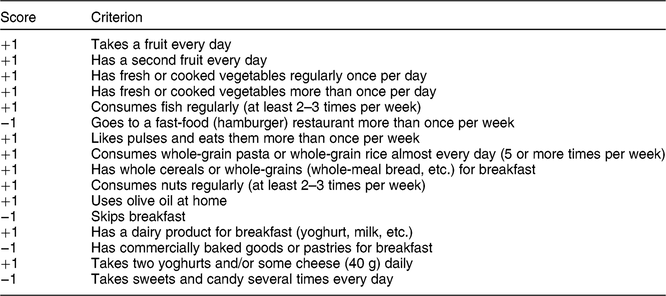
KIDMED, Mediterranean Diet Quality Index in children and adolescents.
Value of the KIDMED score: ≤3, very-low-quality diet; 4–7, need to improve the food pattern to adjust it to the Mediterranean one; ≥8, optimal Mediterranean diet.
The eighth and ninth questions: whole-grain foods
The core of our critical appraisal for the eighth and the ninth question is similar. There is extensive scientific literature on the benefits of the intake of whole-grain foods( Reference Aune, Keum and Giovannucci 32 – Reference Mozaffarian, Lee and Kennedy 34 ). Based on the latest scientific literature, our proposed approach to the change the questionnaire is to consider as healthy MD only the intake of whole cereals and whole grains. Refined cereals or grains and derived foods should not be included in the healthy MD as staple foods with daily intake. In the Mediterranean countries there is a high intake of refined cereals and grains for breakfast and this could be considered partially a Mediterranean eating habit. Furthermore, high intake of refined cereals and grains cannot be considered a healthy habit. Scientific evidence indicates that refined carbohydrates, sugar, whole grains and dietary fibre play important roles in diabetes, obesity, CVD( Reference Temple 35 ) and other related chronic diseases( Reference Chen, Chen and Wang 36 ). Our suggestion to the authors is to assign a positive value of +1 in the eighth and ninth questions if a child or adolescent consumes whole-grain foods.
The eighth question
The eighth question assigns a positive value of +1 if a child or adolescent takes pasta or rice almost every day (5 or more times per week). Research on the public health impact of refined carbohydrates and of whole cereals is of great importance in the context of the obesity epidemic and some other related chronic diseases. Since 2011 the Healthy Eating Plate of Harvard University has indicated that most carbohydrate intake should come from whole grains rather than refined grains( Reference Harvard 25 ). The recent update of the report of World Cancer Research Fund and the American Institute for Cancer Research has recommended to make whole grains part of the usual daily diet( 37 ). It has been estimated that the glycaemic index of white rice is higher than that of brown rice( Reference Kaur, Ranawana and Henry 38 , Reference Shobana, Kokila and Lakshmipriya 39 ). Brown rice has more fibre and more vitamins than white rice. Substitution of whole grains, including brown rice, for white rice may facilitate the prevention of type 2 diabetes and help with other non-communicable diseases such as obesity and CVD( Reference Temple 35 ). Therefore, we suggest to the authors to add ‘whole-grain’ to the eighth question of the questionnaire and reword the question as: ‘Consumes whole-grain pasta or whole-grain rice almost every day (5 or more times per week)’ and assign a positive value of +1 (see Table 1).
The ninth question
The ninth question assigns a positive value of +1 if a child or an adolescent has cereals or grains (bread, etc.) for breakfast. First of all, it is probable that children and adolescents can misunderstand the term ‘cereals for breakfast’ as ready-to-eat cereals. The intake of ready-to-eat cereals at breakfast time has increased over the last decades( Reference Kafatos, Linardakis and Bertsias 40 , Reference Mullan and Singh 41 ). Actually, ready-to-eat cereals are one of the most frequent breakfasts among children and adolescents( Reference Rito, Dinis and Rascôa 42 ). Ready-to-eat cereals are not a Mediterranean food and most important they are non-compliant with the European nutrient profile model, especially regarding sugar content( Reference Rito, Dinis and Rascôa 42 , 43 ). If the cereals or grains are whole grains, the nutritional value will be higher compared with refined ones. Whole grains generally produce a lower postprandial glucose response( Reference Marventano, Vetrani and Vitale 44 ). The protective mechanism of whole grains is explained mainly by dietary fibre, resistant starch and oligosaccharides. Whole grains contain vitamins, minerals, phenolic compounds and phyto-oestrogens that have been related to protecting against cancer( Reference Slavin 45 ). Protection against the risk of cancers related to hormones and pancreatic cancer has been associated with the regular consumption of whole-grain cereals( Reference Gil, Ortega and Maldonado 46 ). Therefore, we suggest to the authors to add ‘whole cereals or whole grains’ to the ninth question of the KIDMED questionnaire and reword the question as: ‘Has whole cereals or whole grains (whole-meal bread, etc.) for breakfast’ and assign a positive value of +1 (see Table 1).
Conclusions
Recent studies advance the call for some update in the KIDMED questionnaire, to better reflect current guidelines and research, as well as the basic principles of the MD. We propose an update of the first, eighth and ninth questions of the KIDMED questionnaire. The modifications about fruit juice and whole-grain foods make the questionnaire a better tool to evaluate the adherence to the MD. Some implications for practice and research are possible. The next question could be: is it possible that these modifications can change the mean adherence score to the MD?
Acknowledgements
Acknowledgements: Anthony Sweeney and Isabel Rodríguez of the Schoola Institute of Alicante have collaborated with language assistance. Financial support: This research received no specific grant from any funding agency in the public, commercial or not-for-profit sectors. Conflict of interest: None of the authors has any conflicts of interest or financial ties to disclose. Authorship: C.A. and P.C.-P. are authors of this commentary, both argued the discussed issues, designed the new proposal and wrote the manuscript. Ethics of human subject participation: Not applicable.
Author ORCIDs
Cesare Altavilla, 0000-0002-7415-4139. Pablo Caballero-Pérez, 0000-0002-1234-2150.



