


Medical schools in Canada and the United States have seen lower proportions of medical school classes applying to neurosurgical residencies. 1 - Reference Wilson and Pugh 3 It has been suggested that issues regarding work-life balance may partially explain these trends as almost 90% of medical students still find neurosurgery to be an interesting specialty but only one-third would consider a neurosurgical career.Reference Hill, Dias and Kitchen 4
Numerous studies have demonstrated an increased desire for work-life balance among medical students and a trend towards greater interest in more lifestyle-friendly specialties including radiology, ophthalmology, anesthesiology, and dermatology. In studies describing this trend, specific issues of concern are the long duration of surgical residency training and the high rates of depression, anxiety disorders, and job dissatisfaction referenced among surgeons.Reference Brown and Friedman 5 - Reference Van der Horst, Siegrist, Orlow and Giger 10 As well, medical school classes have increasing proportions of females and there is data suggesting females may be less likely to be interested in surgical specialties and show a greater emphasis on lifestyle factors.Reference Benzil, Abosch and Germano 11 , Reference Sonnad and Colletti 12
Changes to the structure of medical education may have also caused inadvertent pressures away from surgical careers, with trends towards early career choices, emphasis on primary care, and approaches to dissolve historical hierarchies among medical specialties.Reference Resnick 13 , Reference Saleh 14 Most students make specialty decisions by their second year of medical school which is before receiving the majority of exposure, which occurs in later clerkship rotations.Reference Wilson and Pugh 3 , Reference Al-Heeti, Nassar, Decorby, Winch and Reid 15 - Reference Kozar, Lucci and Miller 20
Studies comparing students who desire a career in surgery with those who aspire to enter more lifestyle-friendly specialties suggest that predictors of surgical interest include enthusiasm for the procedures and impacts, desire for intellectual challenge and research opportunities, positive interactions with surgeons, perceptions of prestige, and minimal discouragement by lifestyle concerns and work hours.Reference Kozar, Lucci and Miller 20 - Reference Takeda, Morio, Snell, Otaki, Takahashi and Kai 23 Predictors for non-surgical specialties include subjective desire for a fulfilling life, preoccupation with concerns of job security, and a perception that surgical specialties are difficult.Reference Hill, Dias and Kitchen 4 , Reference Takeda, Morio, Snell, Otaki, Takahashi and Kai 23
With this decreasing rate of interest and increasing attrition of surgical residents 24 , Reference Dodson and Webb 25 many centres have recommended early exposure to improve interest in neurosurgery before medical students make career decisions. Specific strategies that have been shown to improve interest include: 1) knowledge translational approaches to alleviate lifestyle concerns, emphasize neurosurgeon satisfaction rates, address concerns about content difficulty, and improve awareness of the impacts on patient lives; 2) increasing awareness of research opportunities and their potential impacts; 3) providing mentorship; 4) operating room and clinic observerships; and 5) increased staff/resident involvement in undergraduate medical education.Reference Al-Heeti, Nassar, Decorby, Winch and Reid 15 , Reference Kozar, Lucci and Miller 20 , Reference Agarwal, Norrmén-Smith, Tomei, Prestigiacomo and Gandhi 26 - Reference Whittaker, Estes, Ash and Meyer 33
The Surgical Exploration and Discovery (SEAD) program at the University of Toronto is a structured surgical program where students dedicate two summer weeks for operating room observerships, surgical skills workshops, and discussions about the nature of surgical work and lifestyles. Each direct-entry surgical specialty is covered over the course of one day, allowing for comprehensive learning and immediate comparisons between specialties. In the inaugural year of the program in 2012, 84% of participants indicated a qualitative increase in their interest in becoming a surgeon. Most (90%) of students identified a specialty of noninterest though the program, strengthening career goals and helping to optimize clerkship rotation choices.Reference Gawad, Moussa, Christakis and Rutka 34 During the second year of the SEAD program a survey was administered to 2013 (prospectively) and 2012 (retrospectively) participants to determine demographics, interest in neurosurgery pre- and post-intervention, other assessments of the impact of the SEAD program, and perceptions regarding medical career attractors/deterrents.
Methods
Participant population and structured surgical program
The University of Toronto Research Ethics Board approved the methodology for this study. The program accepts 20 students per year from first year medical students at the University of Toronto. They are selected on the basis of a written application describing how the program will complement the career decision making process of the student, the extent to which they have pursued surgical research and observerships, and the extent to which they have pursed non-surgical specialties. The overarching goal is to provide this experience to students who are still unsure of their interests despite efforts to investigate on their own, thereby maximizing the impact of this experience.
The program curriculum has been previously described in detail.Reference Gawad, Moussa, Christakis and Rutka 34 Briefly, students participated in morning operating room observerships, lunch-time specialty talks, and afternoon hands-on surgical workshops, spending approximately one day on each of: Cardiac Surgery, General Surgery, Neurosurgery, Orthopedic Surgery, Plastic Surgery, Urology, and Vascular Surgery. This approach directly addressed major themes in the literature showing that experience in operating rooms, discussions of specialty impacts and lifestyle considerations, and hands-on exposure has been shown to increase interest in surgical specialties. 8 , Reference Benzil, Abosch and Germano 11 , Reference Berman, Rosenthal, Curry, Evans and Gusberg 16 , Reference Kozar, Lucci and Miller 20 , Reference Agarwal, Norrmén-Smith, Tomei, Prestigiacomo and Gandhi 26 - Reference Whittaker, Estes, Ash and Meyer 33
SEAD participants from the first two years of the SEAD program (2012 and 2013, n=40) were invited to participate. The primary author participated in the SEAD program in 2012 and did not participate in the survey and one student in 2012 did not complete the majority of the program, leaving 38 potential respondents. Information was collected by paper and online surveys which included information about the study, a statement that responses would not impact their experience in the program, and required consent.
Questionnaire
A 51 question survey was created based on literature describing medical student attitudes towards neurosurgery (Supplemental Figure F1). A pre-SEAD questionnaire inquired about student demographics (three questions); pre-intervention neurosurgical experiences in research, observerships, and leadership (three questions); and pre-medical and pre-SEAD interest in neurosurgery (two questions). A post-SEAD questionnaire included questions about the impact of the structured surgical experience on interest in neurosurgery and characteristics of the specialty (eight questions), theoretical interest in neurosurgery if lifestyle factors were controlled for across all surgical specialties (one question), as well as relevant attractors and deterrents for choosing specialties (34 questions). In total, therefore, we asked about four measures of interest: interest pre-SEAD intervention, interest post-SEAD intervention, a retrospective assessment of interest before medical school (to control for impacts made by pre-clerkship year one lecture-based education about neurosurgery), and a theoretical measure to assess interest post-SEAD based on students cognitively controlling for the impact of lifestyle factors on their decisions. The survey was newly created for this study and was validated to assess the intended outcomes through feedback from six other SEAD program coordinators who had participated in the program the previous year.
For SEAD 2013 participants (n=20) the pre-SEAD questionnaire was administered at the start of the program and the post-SEAD questionnaire at the end. Year 2012 SEAD participants (n=18) were sent a link to a combined online SurveyMonkey® questionnaire (which included both the pre-SEAD and post-SEAD questionnaires) by email to collect data retrospectively. Reminder emails were sent after each two-week period of non-response over six weeks.
Data analysis
Responses were transcribed from paper-based surveys and SurveyMonkey® data exports into Statistical Package for the Social Sciences (SPSS) software, version 21. Outcome data was expressed as frequencies and percentages and presented in Tables 1-5. Additionally, data on interest in neurosurgery under four different conditions (premedical, pre-intervention, post-intervention, and with lifestyle factors controlled for) were compared with a repeated measures analysis of variance (ANOVA) with a consistent Likert scale. Given significance, a Sidak post-hoc analysis compared each measurement pair for significant difference. Significance was set to p<0.05, with multiple comparisons accounted for by the method of analysis.
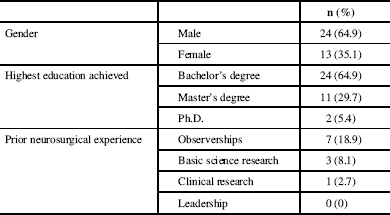
Characteristics of the study population (N=37)
Interest in neurosurgery (N=37)

Interest level in four settings is shown (groups A-D) with a repeated measures ANOVA showing a significant difference between the groups. Sidak post-hoc analyses identify statistical differences in interest directly before and after SEAD (groups B×C) as well as in comparing interest after SEAD to theoretical interest if lifestyle factors were controlled (groups C×D). Mean Likert values show the directionality of these changes; a decrease following SEAD and an increase when lifestyle is controlled for.
NS, neurosurgery; ANOVA, analysis of variance; SEM, standard error of the mean; CI, confidence interval.
* Collected retrospectively.
^ Collected retrospectively for 2012 participants.
† Respondents were asked about their level of interest in neurosurgery post-intervention if, theoretically, lifestyle factors were equal across all surgical specialties.
A repeated measures ANOVA compared interest level between groups A-D.
‡ α=0.05.
Impact of structured surgical intervention (N=37)

NS, neurosurgery.
Potential attractors towards and deterrents from medical specialties as well as perceived nature of neurosurgery (N=37)

Respondents identified the degree to which certain factors were important in the decision making in choosing medical specialties of interest, as well as the degree to which these same factors are perceived to be characteristic of neurosurgery.
Potential factors affected interest in neurosurgery pre- and post-intervention (N=37)

NS, neurosurgery.
‡ α=0.00625, corrected for multiple comparisons using Bonferroni method with n=8.
In order to assess for factors predicting interest in neurosurgery pre- and post-intervention, four survey questions were selected that represent major themes involved in student decision making based on the literature: 8 , Reference Benzil, Abosch and Germano 11 , Reference Berman, Rosenthal, Curry, Evans and Gusberg 16 , Reference Kozar, Lucci and Miller 20 , Reference Agarwal, Norrmén-Smith, Tomei, Prestigiacomo and Gandhi 26 - Reference Whittaker, Estes, Ash and Meyer 33 gender, completion of neurosurgical research, perception of compatibility with neurosurgical culture, and perception of compatibility with neurosurgical lifestyle. Significance was tested with Chi-square statistics, with α set to 0.00625 using Bonferroni correction for multiple comparisons (eight comparisons, four measures by two samples). Significant differences were presented with 95% confidence interval odds ratios and p values.
Results
Survey response and student demographics
Of 38 potential respondents, 37 voluntarily completed surveys (20/20 from the 2013 SEAD participants and 17/18 from the 2012 SEAD participants). Student demographics are presented in Table 1 and show that two-thirds of participants were male, one-third had advanced educational degrees, one-fifth had completed neurosurgical operating room observerships prior to the SEAD program, and 10% had completed neurosurgical research prior to SEAD.
Interest in neurosurgery and impact of SEAD
All four assessments of interest in neurosurgery, under different conditions, are shown in Table 2. Responses indicate that 11% of students were interested in neurosurgery before medical school, 27% during medical school pre-intervention, 11% post-intervention, and 38% post-intervention when controlling for lifestyle factors. Analysis shows that these repeated measures are significantly different (p<0.0005), with statistical differences between pre-and post-intervention interest levels as well as between post-intervention and those controlled for lifestyle factors (p=0.001 and p<0.0005, respectively).
Other measures of the impact of this surgical experience are shown in Table 3. The majority of students (81%) felt that the SEAD program improved their understanding of the field of neurosurgery. Almost two-thirds attributed their reduced interest in neurosurgery to their learning experiences in other surgical specialties and 21% expressed an increased interest in neurosurgery following SEAD. The majority (81%) felt that their lifestyle was inconsistent with neurosurgical practice post-intervention and only one-quarter perceived that they fit with neurosurgical culture. Nineteen percent of students intended to explore neurosurgery further with observerships following SEAD and one student planned to organize further neurosurgical research.
The four students who remained interested in neurosurgery following intervention all planned to engage in further neurosurgical clinic and operating room shadowing experiences post-SEAD (data not shown). They all considered patient impact to be an attractor towards a medical career and 75% felt that neurosurgeons mediate significant impacts. Half felt compatible with neurosurgical culture and the other half were neutral.
Attractors and deterrents of medical specialty choice and the nature of neurosurgery
The factors most endorsed by students as being attractors to a medical specialty were perceived patient impact (92%) and intellectual stimulation (87%) (Table 4). Over half of participants also considered specialty culture, respect, and earnings to be attractors in making specialty decisions. Three-quarters of students consider the top three attractors (impact, intellectual stimulation, and respect) to be representative of neurosurgery and over half felt that neurosurgeons make significant earnings.
The most commonly endorsed deterrents were lifestyle (78%), job competition (76%), and workload (68%) (Table 4). Nearly half of respondents also considered specialty culture, level of stress, and length of residency to be deterrents. Between 70-97% of students considered the aforementioned deterrents to be descriptive of neurosurgery.
Pre- and post-intervention predictors of interest in neurosurgery
Those who were interested/undecided regarding a neurosurgical career were combined together for the analysis of potential predictors, as these were all students who had not yet ruled out a neurosurgical career. These students were compared to those who were uninterested in neurosurgery based on the following attributes: gender, neurosurgical research experience, and perception of compatibility to neurosurgical culture and lifestyle. These were identified as capturing underlying themes motivating medical student decisions according to the literature. 8 , Reference Benzil, Abosch and Germano 11 , Reference Berman, Rosenthal, Curry, Evans and Gusberg 16 , Reference Kozar, Lucci and Miller 20 , Reference Agarwal, Norrmén-Smith, Tomei, Prestigiacomo and Gandhi 26 - Reference Whittaker, Estes, Ash and Meyer 33
None of gender, neurosurgical research, or fit with neurosurgical culture/lifestyle were associated with interest in neurosurgery pre-intervention. Following SEAD, interest in neurosurgery was associated with having completed neurosurgical research (OR=16.8, 95% CI=1.4-195.7, p=0.006) and feeling compatible with neurosurgical culture (OR=18.8, 95% CI-2.7-127.5, p=0.001).
Discussion
Rationale for initiatives to address falling medical student interest in neurosurgery
Despite being a specialty with the potential for significant clinical and research impact, neurosurgery has faced decreasing medical student interest. 1 - Reference Hill, Dias and Kitchen 4 This phenomenon is likely multifactorial with students perceiving poor work-life balance, experiencing pressure for early career choice, being educated with emphasis on primary care, and learning in a system with lesser inter-specialty hierarchies.Reference Brown and Friedman 5 - Reference Saleh 14
Accordingly, multiple centres have coordinated efforts to increase early exposures to neurosurgery in medical school. Initiatives shown to increase medical student interest in a neurosurgical residency include knowledge translation to alleviate lifestyle concerns and to foster a desire to make neurosurgical impacts, research opportunities, mentorship and positive staff interaction, resident teaching, and participation in operating room cases.Reference Berman, Rosenthal, Curry, Evans and Gusberg 16 , Reference Kozar, Lucci and Miller 20 , Reference Agarwal, Norrmén-Smith, Tomei, Prestigiacomo and Gandhi 26 - Reference Whittaker, Estes, Ash and Meyer 33 However, with increasing attrition of surgical residents it is unclear whether a generalized increase in interest should be the goal rather than selectively enhancing the interest of a smaller number of potential candidates. 24 , Reference Dodson and Webb 25
The Impact of the SEAD program on neurosurgical interest
The Surgical Exploration and Discovery (SEAD) program at the University of Toronto is a unique structural surgical teaching program that provides standardized experiences for medical students across all direct-entry surgical specialties.Reference Gawad, Moussa, Christakis and Rutka 34 Therefore, it was the ideal program to assess whether combined teaching in neurosurgery and other surgical specialties would selectively enhance the interest of a few students with aligned interest rather than generally increasing interest among many.
The level of interest decreased from 27% to 11% following the SEAD program, which is in contrast to the increased rates of interest seen in published studies employing initiatives involving neurosurgical teaching only.Reference Berman, Rosenthal, Curry, Evans and Gusberg 16 , Reference Kozar, Lucci and Miller 20 , Reference Agarwal, Norrmén-Smith, Tomei, Prestigiacomo and Gandhi 26 - Reference Whittaker, Estes, Ash and Meyer 33 Two-thirds of students felt that learning about other surgical specialties reduced their interest in neurosurgery. Together, these findings suggest that the high rates of interest seen in previous studies may indeed reflect an increase in general surgical interest following neurosurgical education rather than a specific interest in neurosurgery. The concern with generally increasing neurosurgical interest is that students may make early career commitments and leave other potential specialties of interest relatively unexplored, which may lead to reconsideration of career direction and specialty transfer when the demands of residency are realized.
Comparison of SEAD program impacts to those of previous initiatives
All four students remaining interested in neurosurgery after the SEAD program had an interest in neurosurgery over other surgical specialties, considered patient impact to be important in deciding on a specialty, and did not have concerns with their fit in the neurosurgical culture. Additionally, none felt that learning about other specialties reduced their relative interest in neurosurgery and all planned to do further neurosurgical shadowing experiences. Therefore, the SEAD program was effective in preferentially enhancing the interest of those students whose career outlook is most consistent with the demands on a neurosurgical resident.
A subgroup analysis revealed that those who had completed neurosurgical research and those who felt compatible with the neurosurgical culture were more likely to be interested following the intervention, but not before. This data provides further support that the structured SEAD intervention reduced overall interest in neurosurgery by selecting for those who appreciate the academic nature of neurosurgery and are attracted towards the specialty culture. Arguably, these are positive characteristics that would improve the chances for success in residency and for balance between clinical and research responsibilities. The predictors of neurosurgical interest in our population are similar to predictors of a general interest in surgery found previously, including enthusiasm for procedures and impacts, desire for intellectual challenge, interest in research, positive interactions with staff, perception of prestige, and less discouragement by lifestyle.Reference Kozar, Lucci and Miller 20 - Reference Takeda, Morio, Snell, Otaki, Takahashi and Kai 23 The research and lifestyle demands are considerable in a neurosurgical residency/career and so it is understandable that these were predictive of neurosurgical interest in our study.
Limitations
The sample size of our study was relatively small and so the statistical power was limited. Furthermore, a portion of the study group was asked about interest in neurosurgery in a retrospective fashion, which poses inherent difficulties and potential inaccuracies due to recall bias. However, prospective data including interest in neurosurgery from this same cohort was published in 2013 and these prospective responses were not inconsistent with the retrospectively-provided ones for our study, supporting the inclusion of this data.Reference Gawad, Moussa, Christakis and Rutka 34 The accurate recall is likely due to the fact that the SEAD program is a memorable highlight in the educational experiences of participants and that students were able to reference SEAD application forms and personal notes regarding experiences in the program while completing the online survey to enhance recall.
The study sample, as well, is not representative of general medical school classes, since the students entering the SEAD program represent only 8% of the entire class and clearly selects for those already interested in surgical specialties. Available data on the University of Toronto medical classes shows that males made up 49% of the overall medical classes over the two years included in the study but 65% of study participants were male. 35
The SEAD format allowed for effective comparison of intellectual interest between specialties, but there was no exposure to the on call and after-hours responsibilities of the specialty. Given the demanding nature of a neurosurgical residency, standardization among all neurosurgical specialties in the SEAD program likely significantly underrepresents the lifestyle and demands of neurosurgery. Since the program was short and each student met only two to three neurosurgeons each, student impressions were likely based on interactions with, and presentations by, particular staff.
With all these limitations, we recognize that future larger, prospective studies are needed. Nevertheless, our results provide important pilot data on a previously understudied topic that may guide further work aiming to foster medical student interest in neurosurgery. It may also be helpful for future studies to perform similar in-depth analyses on student interest in other surgical specialties following the SEAD program and to assess eventual specialty decisions after multiple cohorts of SEAD participants have entered residency.
Conclusions
This surgical exposure intervention increased understanding about neurosurgery and resulted in an overall reduction in interest in neurosurgery as a career. However, those who remained interested were motivated to engage in further neurosurgical clinical experiences. This intervention might, therefore, aid in early selection of those motivated to satisfy the demands of a neurosurgical career. Future efforts may aim to further enhance the interest of those who are motivated after early surgical exposure, through the coordination of neurosurgical research and clinical experiences.
Disclosure
The authors report no conflict of interest concerning the materials or methods used in this study or the findings specified in this paper.
Acknowledgements
The authors thank Drs. George Christakis and James Rutka for their continued involvement in the SEAD program, Dr. Nicolas Phan and the staff at the Li Ka Shing Surgical Skills Centre for supporting the 2013 neurosurgery workshop, Dr. R. Loch MacDonald for his talk on the life of a neurosurgeon during SEAD 2013, Dr. Nada Gawad for her vision in coordinating the inaugural year of the program, Dr. Neil D’Souza in his role as the 2013 SEAD director, and all the medical students involved in SEAD 2012 and 2013.
Disclosure Information
Jeffrey Zuccato and Abhaya Kulkarni do not have anything to disclose.
Supplementary Material
To view supplementary material for this article, please visit http://dx.doi.org/10.1017/cjn.2015.332



