



Long-chain n-3 PUFA (n-3 LCPUFA) play important roles in brain development and function and may affect various psychopathologies, including stress(Reference Pusceddu, Kelly and Stanton1). Furthermore, solid evidence from studies in adults shows that n-3 LCPUFA reduce blood pressure (BP)(Reference Geleijnse, Giltay and Grobbee2) and resting heart rate (HR)(Reference Mozaffarian, Geelen and Brouwer3) and n-3 LCPUFA has also been shown to increase HR variability (HRV)(Reference Christensen4,Reference Xin, Wei and Li5) . These changes could indicate an increase in parasympathetic activity(Reference Kim, Cheon and Bai6), and it has been suggested that n-3 LCPUFA could blunt the shift from parasympathetic to sympathetic activity in response to stress(Reference Monahan, Wilson and Ray7,Reference Carter, Schwartz and Yang8) .
Stress occurs in response to threatening external stimuli and can be induced by true or perceived psychological threats(Reference Hostinar, Sullivan and Gunnar9) and physiological exposures. Temperature challenges, that is, the cold pressor test (CPT) is often used to evoke an acute physiological stress response, which is examined by BP, HR or saliva cortisol measurements. Results from stress tests are often evaluated as ratios between measures before and during the temperature challenge, but potential effects of n-3 LCPUFA may also affect the post-test recovery response.
Studies in both animals and humans have shown that n-3 LCPUFA supplementation consistently reduces BP(Reference Mills and Ward10–Reference Sauder, Skulas-Ray and Campbell13) and saliva or plasma cortisol in response to stress(Reference Delarue, Matzinger and Binnert12,Reference Keenan, Hipwell and Bortner14,Reference Yehuda, Rabinovitz and Mostofsky15) , but only some studies observed a reduction in HR(Reference Delarue, Matzinger and Binnert12,Reference Sauder, Skulas-Ray and Campbell13) . One study in adults found that a high dose of n-3 LCPUFA increased HRV after both mental- and temperature-induced stress(Reference Sauder, Skulas-Ray and Campbell13), but did not affect the ratio between the measures taken during and before the test of stressful stimuli. Plasma n-3 LCPUFA have in observational studies been associated with resting levels of cerebrospinal fluid corticotrophin releasing hormone(Reference Hibbeln, Bissette and Umhau16) and plasma cortisol(Reference Thesing, Bot and Milaneschi17), but the effect of n-3 LCPUFA supplementation on cortisol under conditions of rest is not consistent(Reference Noreen, Sass and Crowe18–Reference Hellhammer, Hero and Franz20). To our knowledge, no studies have investigated whether n-3 LCPUFA intake can affect stress in children.
The aim of the present study was to investigate the effects of consumption of n-3 LCPUFA from oily fish on hair cortisol and explore the effect on the response in saliva cortisol, BP and heart rhythm recordings after CPT in healthy children. As stress responses have been shown to differ between boys and girls(Reference Bale and Epperson21) and due to sex differences in the effect of oily fish on resting HR(Reference Vuholm, Rantanen and Teisen22), we will also assess any sex-specific effects of the fish intervention.
Methods
Study design
The FiSK (‘Fisk, børn, Sundhed og Kognition’ (Fish, children, health and cognition)) Junior study was conducted between August 2016 and June 2017 at Department of Nutrition, Exercise and Sports, University of Copenhagen, Denmark. The design of the study was a two-arm randomised clinical trial in which 8–9-year-old children were randomised to receive 300 g/week of oily fish or poultry (control) for 12 ± 2 weeks. A detailed description of the study design was published before the study(Reference Damsgaard, Lauritzen and Hauger23). The study was conducted in accordance with the Declaration of Helsinki, approved by the Committee on Biomedical Research Ethics for the Capital Region of Denmark (H-16018225) and registered in ClinicalTrials.gov (NCT02809508) before recruitment was initiated. The co-primary outcomes of the trial were diastolic BP and plasma TAG and the secondary outcomes covered other cardiometabolic risk markers, cognitive function and well-being. These secondary outcomes have been published previously(Reference Vuholm, Rantanen and Teisen22,Reference Teisen, Vuholm and Niclasen24) . In this paper, we evaluate effects on stress, which were pre-specified as explorative study outcomes.
Participants
Invitation letters were sent to 8–9-year-old children with residence in the Capital Region of Denmark, who were identified through the Danish Civil Registration System. The inclusion criteria were as follows: the child had to be healthy, speak Danish and like both chicken and oily fish, but were not allowed to consume oily fish more than once per week or take any n-3 LCPUFA supplements 3 months prior to the intervention start. Moreover, the parent(s) should be able to read and speak Danish. Exclusion criteria were serious chronic diseases that could interfere with the study outcomes, diagnosed attention-deficit/hyperactivity disorder or other psychiatric illness, intake of medication that could affect study outcomes and concomitant participation in other studies with dietary supplements or blood sampling. The household could not have more than five members and only one child from each household was included in the study.
Randomisation and blinding
Randomisation was performed in blocks of twelve children to ensure approximately equal allocation to the fish and poultry groups over the year. A staff member not involved in data collection produced a computer-generated randomisation list and made sealed, sequentially numbered envelopes that contained the corresponding allocation. The children were randomly assigned to the intervention groups by the study team at the end of the baseline examination. This procedure ensured that both participants and investigators were blinded to the allocation during the baseline examination, but owing to the nature of the intervention, blinding during the intervention and at the endpoint visit was not possible.
Intervention
The participants were instructed to consume oily fish or poultry twice a week for dinner and three times per week for lunch. The oily fish was provided free of charge as fresh or frozen ‘Aquaculture Stewardship Council’-certified salmon fillets from Norway for dinner and salmon fish cakes, mackerel in tomato sauce, smoked mackerel, marinated herring, smoked trout and salmon sausages for lunch (all >6 g fat/100 g). The target was a total intake of about 300 g/week oily fish, which is within Danish national recommendation, and was expected to provide approximately 0·8–1·0 g/d n-3 LCPUFA. The children who were allocated to consume poultry were provided with products that were selected to have a fat content comparable to the fish products and included different cuts of frozen, organic chicken (minced, whole, breast and thighs) for dinner and liver pâté, chicken meatballs, turkey salami and chicken sausages for lunch. The families received a booklet with recipes for oily fish and chicken that were matched by energy and fat content. We instructed the parents to substitute some of the meats that the child normally consumed with the intervention products, but apart from that to maintain the child’s usual dietary and physical activity habits.
Background information
Questionnaires on socio-demographic background and food intake during the last month were answered by one of the parents and anthropometric measurements were performed as previously described(Reference Vuholm, Rantanen and Teisen22). Pubertal stage was evaluated by Tanner scores based on questionnaires on breast development for girls and development of pubic hair for boys, which were answered by the child with aid from a parent. Children’s physical activity was recorded using tri-axial accelerometers (ActiGraph) during seven consecutive days and eight nights prior to each examination.
Erythrocyte fatty acid analysis
We collected fasting venous blood samples at the baseline and endpoint visit. The fatty acid composition was analysed in erythrocytes isolated from lithium heparinised venous blood and stored in saline with antioxidant 2,6-di-tert-butyl-4-methylphenol (butylated hydroxytoluene; Sigma-Aldrich) and nitrogen at −80°C for maximum 9 months until analysis, which was performed by GC at the Department of Kinesiology, University of Waterloo, Canada (ON)(Reference Metherel, Buzikievich and Charkhzarin25). The inter- and intra-assay variation was <5 % for all identified fatty acids. The sum of DHA and EPA in % (w/w) of total fatty acids (FA%) in erythrocytes was used as a biomarker of oily fish intake.
Hair cortisol
A small tuft of hair (approximately 5–20 mg) was cut from the posterior vertex of the child’s head. Cortisol concentrations were analysed in the 3 cm of hair that was closest to the scalp, as this reflects cortisol accumulation and hence stress levels over the last 3 months approximately. The cortisol analysis was performed at Department of Psychology, Technical University of Dresden, Germany as previously described(Reference Davenport, Tiefenbacher and Lutz26). The hair segments were washed three times by gently mixing for 3 min in 2·5 ml isopropanol and dried for at least 12 h. Steroids were extracted from aliquots of 7·5 mg hair by addition of 1·5 ml pure methanol for at least 18 h and then spun in a micro-centrifuge at 10 000 rpm for 2 min. A quantity of 1 ml of supernatant was transferred to a new tube, where the methanol was evaporated at 50°C under a constant stream of N2 until the samples were completely dried after which the tubes were vortexed for 15 s with 0·4 ml of water. Cortisol was determined in a 50 µl aliquot by a commercially available immunoassay with chemiluminescence detection (CLIA, IBL-Hamburg). Both intra-assay and inter-assay variation was below 15 %.
Cold pressor test
We assessed the children’s acute physiological stress response by a CPT, in which the children were required to submerge their dominant hand up to the wrist in a tub with 5 ± 2°C cold water. The children were instructed to keep the hand in the water for 1 min and only to remove their hand if they found the test too uncomfortable. BP was measured in a sitting position with an automated device (Connex ProBP 3400 digital; Welch Allyn) immediately before and after the CPT. We collected 0·5–2 ml saliva samples in salivettes (Sarstedt) before and 20 min after the test. The saliva samples were frozen and stored at −20°C until they were sent to Department of Psychology, Technical University of Dresden, Germany where they were thawed and centrifuged at 3000 rpm for 5 min. Cortisol was measured in the supernatant by a commercially available chemiluminescence immunoassay with high sensitivity (IBL International). Both intra- and inter-assay variation was below 8 %.
The children’s heart rhythm was recorded continuously during the entire examination visit by a four-lead two-channel digital recorder (Lifecard CF, Del Mar Reynolds Medical Limited). The recording was marked at the beginning of the CPT to enable a detailed analysis from approximately 5 min before to 10 min after the test. The recordings were analysed at Department of Nephrology, Aalborg University Hospital, Denmark and edited using a semi-automated method with visual confirmation of all arrhythmias and premature atrial and ventricular beats. All non-sinus beats and artifacts were excluded from the analysis. Time-domain and frequency-domain analyses were performed in 1-min segments using HRV Tools (Reynolds Medical Limited). From the recordings, we obtained the mean and sd of inter-beat intervals (normal inter-beat interval (NN) and standard deviation of beat-to-beat interval (SDNN), respectively) and frequency-domain measures of power in the low-frequency range (LF, 0·04–0·15 Hz) and high-frequency range (HF, 0·15–0·4 Hz) and the LF:HF ratio. We used values for the individual 1-min segments to explore the overall stress response and combined two segments to obtain before and during the test means. The pre-CPT means were based on the first 2 min (i.e. 5 and 4 min before the test). The 2 min that we used to calculate means during the CPT included the 1-min cold-stimulus and short-time intervals immediately before and after the child was exposed to the cold water as this did not coincide precisely with the 1-min segments. For a subsample of seventeen children, NN and SDNN during the actual 1-min cold-stimulus were calculated manually and these did not differ significantly from the 2-min mean from the HRV Tools (data not shown).
Sample size
The sample size was calculated based on expected effect size and previously observed sd for the primary outcomes, diastolic BP and TAG, in a sample of 823 Danish 8–11-year-old children(Reference Damsgaard, Dalskov and Laursen27). To detect a group difference of 0·5 sd with a significance level of α = 0·05 and 80 % power and to allow for 25 % missing data due to drop-out and insufficient blood sampling, we aimed to recruit 200 children.
Statistical analysis
Data are presented as mean values and standard deviations, medians and 25th–75th percentiles, or percentages as appropriate. We assessed normal distribution visually with histograms and validated linear models using residual and normal probability plots. Data were analysed based on all available data from participants with measures of a given outcome from both baseline and endpoint. Hair cortisol, salivary cortisol, LF, HF and LF:HF were all log-transformed (natural) before statistical analyses but were back-transformed to present estimates on the original scale. Due to variation in the delay between CPT termination and BP measurement (range 15–180 s) and a strong association between BP and the time delay (diastolic BP: r −0·43, P < 0·001), we used time-adjusted post-CPT BP measures derived from the mean post-CPT BP of all the children and residuals from a linear regression model with post-CPT BP and delay time. Correlations between hair cortisol, saliva cortisol and BP before and after CPT and HRV measures before and during CPT at baseline were explored using simple bivariate Pearson analyses.
Differences between diet groups after the intervention were examined using ANCOVA (for all continuous variables) or logistic regression for the outcome ‘removed hand from water’ to calculate OR between premature termination of the cold-stimuli in the fish v. the poultry group. All models used to examine intervention effects in the outcomes included respective baseline values and sex. The models for the cardiac autonomic function measures during CPT were additionally adjusted for the exact time within the 2-min period when the hand was immersed in water at endpoint and the difference between time at endpoint v. baseline. As the exact duration of the cold-stimuli could affect or mediate effects on measures during and after CPT, we made analyses both with and without adjustment for the number of seconds the hand was in water at endpoint and the difference relative to the duration at baseline. This adjustment did not affect the results, so we only show those from the adjusted analyses. Group differences in the mean measures of cardiac autonomic function in the 1-min segments over the assessed stress response period were analysed by ANOVA adjusting for baseline value and sex and a similar repeated measures analysis for overall main effect of diet with time and group as factors. We examined potential dose–response relationships with erythrocyte EPA + DHA by linear regression models for all outcomes with a group difference P value <0·1. In secondary analyses, we examined potential sex differences in the intervention effects in sex-stratified analyses and by inclusion of a sex–group interaction term in the ANCOVA and logistic regression models.
Results
Of the 3693 children who were invited to participate in the study, 364 responded and 199 met the inclusion criteria and were randomised to fish or poultry. In total, 197 (99 %) completed the study (online Supplementary Fig. S1). Baseline characteristics of the completing children were similar in the two groups (Table 1). As previously shown, the intervention increased the intake of oily fish to 375 (325–426) g/week among children in fish group, corresponding to 913 (sd 278) mg/d EPA + DHA and resulted in an increase in erythrocyte EPA + DHA from 4·9 (sd 1·0) to 7·3 (sd 1·4) FA%(Reference Vuholm, Teisen and Buch28). The energy intake and macronutrient composition of the diets in the two groups did not differ and there were no differences in the overall distribution of SFA, MUFA and PUFA in the erythrocytes after the intervention(Reference Vuholm, Teisen and Buch28).
Baseline characteristics of the study population*
(Medians and 25th–75th percentiles; percentages; mean values and standard deviations)

FA%, weight/weight % of total fatty acids.
* Data are given as mean values and standard deviations for normally distributed continuous variables, medians and 25th–75th percentiles for non-normally distributed continuous variables or percentages for categorical variables.
† Defined as Tanner stage ≥2.
‡ Based on age- and sex-specific cut-offs defined to pass through BMI 18·5, 25 and 30 kg/m2, respectively, at age 18 years.
§ Measured as total vertical counts in the accelerometer recordings divided by wear-time.
Simple bivariate correlation analyses showed no correlations between baseline concentrations of hair cortisol and any of the measures from the CPT, except for diastolic BP after the cold-challenge (r −0·20, P < 0·05). Similarly, there were no correlations with saliva cortisol, except for a correlation between post-CPT saliva cortisol and SDNN during the test (r 0·18, P < 0·05). Furthermore, there were no correlations between systolic BP and any of the other measures, but pre-test diastolic BP was correlated with the HRV measures, except for HF before the test (r values between −0·42 and −0·23). Diastolic BP after the test also correlated with SDNN and HF during the test (r −0·19 and −0·18, respectively). All the cardiac function measures, except LF:HF, were correlated with each other both before and after CPT (r 0·14–0·75, most P < 0·01).
We observed no overall effect of the fish intervention on long-term stress measured by hair cortisol (Table 2), but there was a tendency for a sex-specific effect (P sex × group = 0·074) driven by a 0·9 (95 % CI − 1·0, 2·9) ng/g decrease among boys and a 0·7 (95 % CI −0·2, 1·6) ng/g increase among girls (online Supplementary Table S1).
Measures of long-term and acute stress before and after the intervention and estimated difference between the groups
(Medians and 25th–75th percentiles; mean values and standard deviations; mean differences and 95 % confidence intervals; odds ratio and 95 % confidence interval)
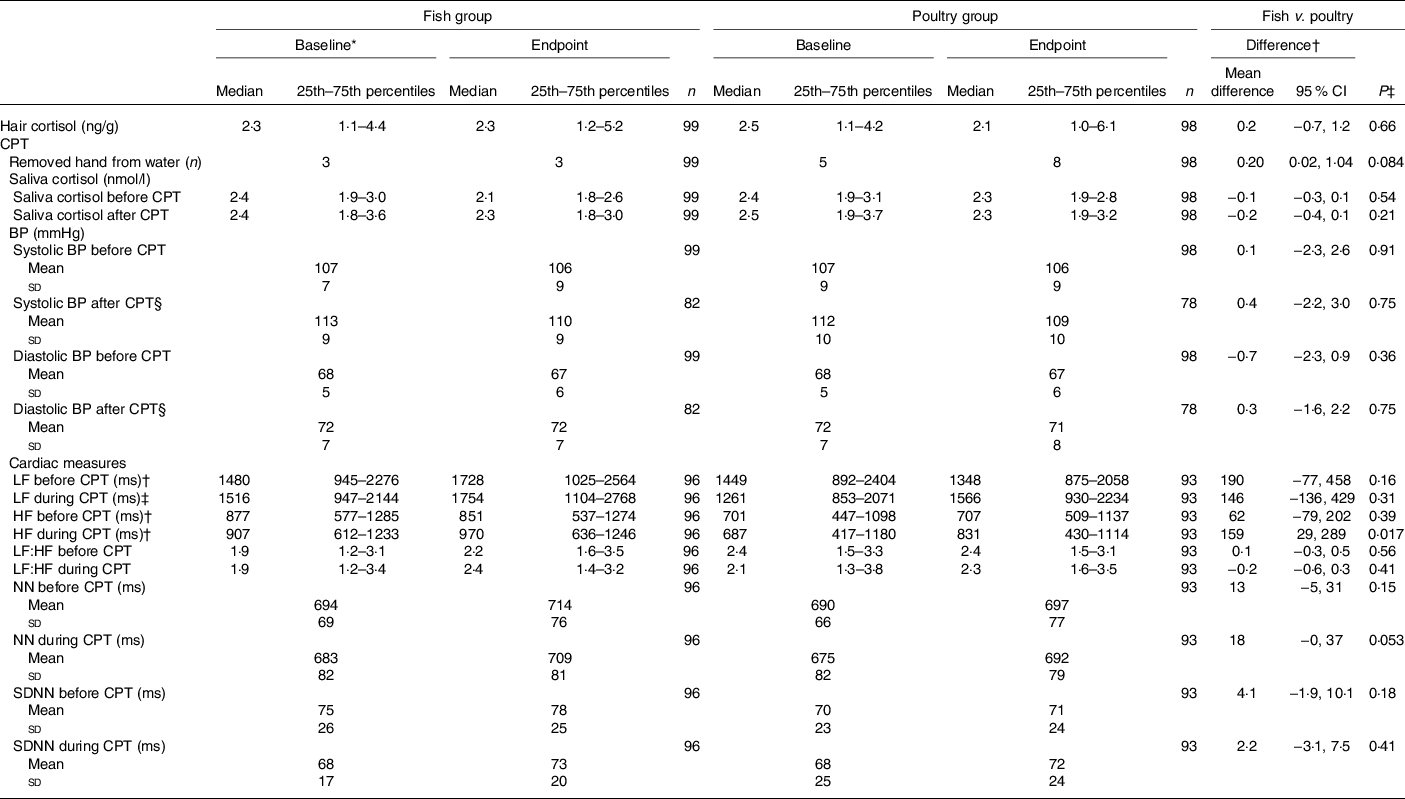
BP, blood pressure; LF, low frequency (0·04–0·15 Hz) power; HF, high frequency (0·15–0·4 Hz) power; NN, mean of all normal inter-beat intervals; SDNN, standard deviation of all NN-intervals.
* Baseline and endpoint values are presented as mean values and standard deviations, medians and 25th–75th percentiles, or numbers.
† Differences between diet groups at endpoint from logistic regression models (‘removed hand from water’, which is given as the OR (95 % CI) of premature termination of the cold stimuli in the fish v. the poultry group) or ANCOVA (all other outcomes presented as mean differences and 95 % CI in fish v. poultry group) adjusted for baseline values and sex. Models for measures after and during the CPT were additionally adjusted for the exact time in the 2-min interval when the hand was immersed in the cold water at endpoint and the difference relative to the time at baseline as well as total time the hand was in the water at endpoint and the difference relative to the time at baseline.
‡ P value for group difference in the above models. Some BP and cardiac measures are missing due to failure to measure BP after the CPT and lack of heart rhythm recordings or failure to retrieve data from the recordings.
§ Adjusted for time delay between cold-stimulus termination and BP assessment.
Of the children, 4 % did not manage to keep their hand in the cold water for the entire 1-min period during the CPT at baseline, but withdrew it after 31 (sd 18) s. The fish intervention tended to reduce the probability of premature removal of the hand, which was 80 % lower than in the poultry group (Table 2). We observed no group differences in saliva cortisol or BP before or after the test, or in the pre-test measures of cardiac autonomic function (Table 2). However, after the intervention, the children in the fish group had higher HF during the test (including some time just before and after the test), which reflects increased parasympathetic activity. There was also a tendency towards increased NN, that is, lower HR, in the fish group (Table 2). These effects were not supported by dose–response relationships with erythrocyte EPA + DHA (β 31 (95 % CI −9, 72) and β 4·29 (95 % CI −1·39, 9·97) for HF and NN, respectively. LF, LF:HF and SDNN during the test were not affected by the intervention (Table 2). The CPT measures in boys and girls did not differ at baseline and there were no apparent sex differences in the effect of the intervention on any of the outcomes (online Supplementary Table S1).
The overall changes in HRV from 5 min before to 10 min after the CPT at baseline showed that the strongest responses in HF, LF:HF and NN occurred during the recovery phase after the test. There was no acute response in LF:HF, but the response curve showed a peak in sympathetic activity 2 min after the end of the cold-stimulus followed by a nadir 5 min later (Fig. 1(b)). The change in the sympathetic–parasympathetic balance was reflected in a corresponding decrease in HF followed by a parasympathetic peak around 7 min after the test (Fig. 1(a)). Contrary to LF:HF, the HF curve showed an acute dual response to CPT, with a drop immediately before the stimulus, which quickly returned to the pre-test level during the actual exposure to the cold water. At the second examination, the LF:HF response curve was slightly smoother with a gradual rise already from the beginning of the stimulus to the post-CPT peak 3 min after test followed by a similar gradual decrease towards the nadir and back up again (Fig. 1(d)). The LF:HF level 4 min after the test was slightly higher in the poultry group (P = 0·020) (Fig. 1(d)). There was no major change in the HF response between the baseline and endpoint visit in the poultry group, but the response curves were shifted upwards during the entire observation period at endpoint in the fish group (estimated group difference of 150 (sem 70) ms2, P = 0·044). The response curves for NN showed a similar acute two phase response as HF during CPT (Fig. 2(a)) and a tendency for a similar overall increase (decrease in HR) in the fish group (15 (sem 9) ms, P = 0·099) accompanied by a weak trend for an increase in SDNN (3·8 (sem 2·5) ms, P = 0·128) (Fig. 2(b)). The increase in parasympathetic activity in the fish group was supported by a significant higher HF peak level 6 min after the test compared with the poultry group (P = 0·037), which remained higher during the decline (P = 0·072 and P = 0·046 at 7 and 9 min after the test, respectively) (Fig. 1(c)). Group differences in NN were also observed in the post-CPT response (Fig. 2(a), P = 0·018 and 0·024 at 7 and 9 min after CPT, respectively), but there were no significant differences for SDNN at any time after the CPT (Fig. 2(b)). Higher HF and NN were also indicated before and during CPT (P = 0·053 and P = 0·065 at 2 min and 1 min before the test, respectively, and P = 0·093 for HF during the test) (Fig. 1(c)). There were only slight differences in the LF response (online Supplementary Fig. S2).
Stress responses to cold-pressor test (CPT) on cardiac autonomic function at baseline and after intake of oily fish or poultry for 12 weeks. (a) High frequency power (0·15–0·4 Hz) and (b) ratio between low frequency (0·04–0·15 Hz) and high frequency power at baseline plotted against time from 5 min before the test (indicated with vertical lines) until 10 min after the cold-stimulus. (c) and (d) The same responses after the intervention for children in the fish ( ) and poultry (
 ) groups, separately. The dots represent means with 95 % confidence intervals in each 1-min segment. Differences between groups in all 1-min segments were investigated by ANCOVA on log-transformed values adjusting for baseline values and sex. Group differences in the individual segments are indicated by asterisks: * P < 0·05 and (*) P < 0·10.

Stress responses to cold-pressor test (CPT) on heart rate after dietary intervention with oily fish or poultry for 12 weeks. (a) Beat-to-beat interval and (b) variation in beat-to-beat intervals from 5 min before the test (indicated with vertical lines) until 10 min after the cold-stimulus in children in the fish () and poultry () groups. The dots represent means with 95 % confidence intervals in each 1-min segment. Differences between groups in all 1-min segments were investigated by ANCOVA adjusting for baseline values and sex. Group differences in the individual segments are indicated by asterisks: * P < 0·05 and (*) P < 0·10.

Discussion
In the present study, we found some effects of the fish intervention on the examined stress measures. The children who consumed oily fish tended to have an increased parasympathetic activity reflected by higher HF and lower HR during acute cold-induced stress and changes in cardiac autonomic function (HF, LF:HF and NN) during the first 10 min of recovery after the CPT compared with the children in the poultry group. The results support the hypothesis that n-3 LCPUFA intake may attenuate acute stress by a favourable shift in the sympathetic-parasympathetic balance, but we did not find any effects on the general level of stress assessed by cortisol accumulation in the hair during the 12-week intervention period.
Multiple studies have shown that n-3 LCPUFA consumption reduces HR(Reference Mozaffarian, Geelen and Brouwer3) and increases overall cardiac autonomic function in adults(Reference Xin, Wei and Li5,Reference Christensen and Schmidt29) , indicating a shift in balance between parasympathetic and sympathetic stimulation towards vagal tone predominance. It is likely that the effect of n-3 LCPUFA may have a more pronounced effect on cardiac autonomic function under conditions with sympathetic nervous stimulation, for example, in response to stress. It is also likely that sensitivity is highest if the stress response is assessed over a time interval and not just by measures of cardiac autonomic function during the actual challenge. We observed an immediate increase in HR and decrease in parasympathetic activity upon exposure to the cold water, which returned to pre-test levels as soon as the stimulus stopped. The cardiac response to the CPT in the children appeared to be strongest during the recovery phase, which was characterised by a large sympathetic peak 2–3 min after the cold-stimulus followed by a parasympathetic peak 4–5 min later. A study in healthy young adults also found a sympathetic peak after the cold-stimulus period (3 min at 10°C), which occurred already after 16–26 s and returned to normal approximately 1 min after termination of the stimulus(Reference Peng, Yan and Zhou30). The authors proposed that the sympathetic peak reflects adaption to the temperature change and this could be slower in children, but the delayed sympathetic peak in our study could also be due to stronger stimulation. Thus, in order to capture potential effects of n-3 LCPUFA on the sympathetic and parasympathetic balance, it is essential to analyse heart rhythm recordings after stress in short-time intervals rather than 5–20 min intervals as used in previous studies(Reference Sauder, Skulas-Ray and Campbell13,Reference Vargas-Luna, Huerta-Franco and Schurman31,Reference Evans, Seidman and Tsao32) .
We found that fish consumption increased HR and specific HRV indices of parasympathetic activity both during and after CPT. Our findings are in line with results from a study in adults at risk of CVD, which showed increased parasympathetic activity after both mental and cold-induced stress in response to a high n-3 LCPUFA dose (3·4 g/d)(Reference Sauder, Skulas-Ray and Campbell13). The effect was dose dependent, but not in itself significant after intervention with a dose of 0·85 g/d(Reference Sauder, Skulas-Ray and Campbell13), which is comparable to the children’s n-3 LCPUFA intake from the oily fish in the present study. In that study, there was no detectable effect of n-3 LCPUFA on HRV measures during the stress conditions relative to the pre-test measures(Reference Sauder, Skulas-Ray and Campbell13). Previous studies suggest that n-3 LCPUFA can change intrinsic HR without any modulation on autonomic cardiac tone(Reference Harris, Gonzales and Laney33) and we cannot reject that the observed group differences in the stress response could reflect a general decrease in HR. However, we did not observe any pronounced difference in cardiac autonomic function between the groups before the test and did not find any effect of the intervention on mean HR and HRV over the entire 3-h examination visit(Reference Vuholm, Rantanen and Teisen22). Although the CPT responses indicate an overall decrease in HR and an increase in parasympathetic stimulation, one could suspect that this reflects an effect of n-3 LCPUFA intake on stress prior to a test in the laboratory setting. Recent research has shown a connection between HRV and HR, emphasising that HRV is mainly influenced by the underlying HR(Reference Monfredi, Lyashkov and Johnsen34–Reference Gasior, Sacha and Jelen36). The observed effect on HRV in our study may therefore be driven by an isolated effect on HR, but we cannot determine if this is the case as changes in HR and HRV coincide in our set-up.
The children in the fish group tended to be better at keeping their hand in the cold water for the entire duration of the CPT, but the power to detect this was low as few children withdrew their hand before 1 min. This could indicate that fish intake may improve perceived stress or pain. The effect of n-3 LCPUFA on perceived stress during a stress task has only been examined in one trial, which did not show any effect(Reference Hellhammer, Hero and Franz20). We found no overall effect of oily fish on cortisol accumulation in the hair, but the results indicate that there might be a sex-specific effect, with a decrease in hair cortisol among boys and an increase among girls. This was unexpected considering our finding that the fish intervention reduced mean resting HR only among the girls(Reference Vuholm, Rantanen and Teisen22). The lack of effect on hair and saliva cortisol is not in line with previous reports of cortisol lowering effects of n-3 LCPUFA supplementation(Reference Thesing, Bot and Milaneschi17). However, hair cortisol assessment is challenging and the observed hair cortisol concentrations in our population of healthy children was low compared with adults(Reference Sauve, Koren and Walsh37) and this may leave little room for improvement.
Our study is strengthened by high compliance, which was objectively assessed by measurements of n-3 LCPUFA in erythrocytes and a low drop-out rate, as well as the use of a variety of different stress measures including well-characterised and reproducible electrophysiological stress parameters. This is, however, accompanied by a high number of statistical tests and the risk of type I errors. We did not make any adjustment for multiple testing due to the exploratory nature of the study and correlations between the outcomes. Furthermore, the sample size was calculated based on the primary cardiometabolic outcomes and we expect that the power could be low, specifically for the analysis of sex-specific effect. The sensitivity of our stress response measures may be diminished by the timing of their collection. Saliva cortisol was only collected 20 min after CPT, so we may have missed the peak, although cortisol has previously been reported to peak around this time(Reference Schwabe, Haddad and Schachinger38,Reference Smeets, Cornelisse and Quaedflieg39) . The timing of the post-CPT BP measurement differed between children due to problems with the BP device and around 25 % had a delay of more than 1 min after the cold-stimuli at one of the visits. The BP measures were adjusted for the delay, but this may not compensate sufficiently, as the impact of CPT on BP has been reported to diminish quickly(Reference Zhao, Bazzano and Cao40). The rate of the change in BP after CPT could depend on the stress response, so it would have been optimal to assess BP more than once during the first minutes after CPT. Furthermore, the exact timing of the cold-stimulus within the 2 min that we used to infer cardiac autonomic function during CPT varied, which is a serious limitation in the use of the 2-min measure to reflect the acute CPT response due to the two-phased response in vagal tone and HR. Thus, although the 2-min scores correlated with results from a continuous analysis of the cardiac responses in a subsample, it may have increased the variance and decreased the sensitivity to detect the effect of diet.
Several studies have shown that n-3 LCPUFA deficiency affects anxiety in rodents(Reference Fedorova and Salem41), which in some of the studies differed between male and females(Reference Levant, Ozias and Carlson42,Reference Dervola, Roberg and Woien43) . Some previous studies of effects of n-3 LCPUFA on long-term stress have reported reduced perceived stress(Reference Keenan, Hipwell and Bortner14,Reference Hellhammer, Hero and Franz20) and anxiety(Reference Kiecolt-Glaser, Belury and Andridge44), whereas others found no effects(Reference Sauder, Skulas-Ray and Campbell13,Reference Bradbury, Myers and Meyer45,Reference Bradbury, Myers and Oliver46) . In humans, n-3 LCPUFA supplementation has been reported to alleviate anger after a stress test(Reference Giles, Mahoney and Urry19) and decrease aggression during exams(Reference Hamazaki, Itomura and Sawazaki47). Inappropriate responsiveness to stress may have long-term consequence for cardiovascular health(Reference Dimsdale48) and can affect cognitive abilities, social behaviours and emotional well-being(Reference Charmandari, Achermann and Carel49–Reference Buwalda, Geerdink and Vidal52). Thus, potential effects of n-3 LCPUFA on stress robustness may have implications for overall health and well-being on top of the previously reported effects of n-3 LCPUFA on cognitive function(Reference Teisen, Vuholm and Niclasen24) and cardiometabolic markers(Reference Vuholm, Rantanen and Teisen22) in the present study.
In conclusion, this exploratory study did not show any pronounced effects of oily fish on markers of long-term and acute stress, but we did find effects that indicated increased parasympathetic activity in response to temperature-induced stress. These results warrant further investigations into the effect of n-3 LCPUFA on responses to different types of stress stimuli and it might be relevant to explore potential sex differences.
Acknowledgements
The study was supported financially by Nordea-fonden (grant no. 02-2015-1429). Nordea-fonden had no role in the study design, data collection, data analyses, data interpretation or writing of the manuscript.
L. L., C. T. D., M. N. T. and S. V. designed the study; M. N. T. and S. V. performed the data collection; J. M. R. and J. H. C. analysed the electrocardiogram recordings; M. N. T. and L. L. performed statistical analysis and drafted the paper. All authors read and approved the final manuscript.
The authors declare that there are no conflicts of interest.
Supplementary material
For supplementary material referred to in this article, please visit https://doi.org/10.1017/S000711452000519X



