

Introduction
When Sayyid Aḥmad Ḥusain, qāẓī (qāḍī, judge) for the city of Bharuch in western Gujarat, lost the right to collect fees for affixing his seal and signature to an array of important legal documents following an order from the judge at the Ṣadr Court of ʿAdālat in Surat in 1839, he promptly dispatched a petition to the Governor in Council at Bombay complaining of the local judge’s affront to his status and access to income.Footnote 1 In his complaint, the qazi enumerated several charges against John Romer, the judge at Surat, who had stripped him of his right to attest vakālat- and muḵẖtār-nāmas (deeds of representation) executed “both for the court and private use.”Footnote 2 This task, which had been part of the qazi’s domain prior to the British East India Company’s interference, helped secure private rights and provide public stability by drawing on the qazi’s skills of investigation and authentication. Taking away this right, Sayyid Aḥmad Ḥusain argued, would “prove detrimental” to the qazi, who would suffer great losses of income, and to the “Sirkar and Ryot (government and citizenry),” who would also suffer without the qazi’s guarantee. Unfortunately, despite these protestations, the qazi’s complaint earned him no reward. The judges of the Ṣadr Court remained firm in their decision to take over these and other documentary protocols formerly belonging to the office of the qazi.
Though the relationship between paper practices and imperial power has received increased attention in recent years, the qazi’s role in executing legal documents has yet to receive serious consideration.Footnote 3 The analysis that follows therefore examines the qazi’s role as a legal intermediary first in the context of the East India Company’s (EIC) changing orientation to paperwork and to the authority of local documentation and second in relation to the diverse populations of merchants, traders, landowners, and agriculturalists in the coastal regions of western India he served. It argues that the qazi’s ultimate failure to retain control over multiple forms of legal documentation relevant to Company interests marked a decisive shift in the qazi’s social status and legal function that had long-term ramifications for the construction and interpretation of religious law in British India.Footnote 4 Sayyid Aḥmad Ḥusain and other members of his family were not the only qazis to engage Company officials in these types of negotiations, but the family’s prolonged engagement with the Company—and ultimate decision to heed Company demands—reflect larger transformations in the history of legal writing and document production that opened the door to future incursions into the definition of legal identity and legal activity—definitions that continue to resonate in postcolonial South Asia today. From the family’s assistance establishing law and order after the British takeover of the city, to Aḥmad Ḥusain’s negotiations for a more expansive definition of his office, to his son Nūr-ud-dīn Ḥusain’s role in the production of registers legible to the state, the family’s professional trajectory stands as an important case study in the history of British expansion and legal-imperial domination in South Asia.
The Calligraphic Company StateFootnote 5
In the context of imperial expansion, contests over the execution and interpretation of legal documents constituted an important arena in which different modes of legal life “jockeyed” with one another for supremacy.Footnote 6 In some locations, such contests resulted in the complete disregard for existing systems of sovereignty and prevailing claims to property in exchange for European modes of laying claim to and establishing ownership.Footnote 7 In the case of western India at this time, such negotiations materialised in acts of terminological appropriation and rough approximation, bringing a diverse array of documentary forms under common rubrics comprehensible to Company officials. Legislation flattened entire aspects of indigenous legal life, erasing nuance through translation into European languages and overriding local difference through attempts to understand diffuse legal processes via orthodox interpretations.Footnote 8 Such activities privileged specific understandings of what constituted the “legal” and placed other practices outside the recognised legal order.Footnote 9 Matters pertaining to marriage and other “doctrinal” issues remained the qazi’s responsibility while associated processes of legal representation (i.e., vakālat and muḵẖtārī) became those of the state (Figure 1). Writings produced by intermediaries such as Aḥmad Ḥusain trace this transformation, indexing the terminological transformations that marked the pernicious process through which colonial rule constructed categories of religious life and law at a time when jurisdictions, domains, procedures, and modalities were yet unsettled.
Sample muḵẖtār-nāma from a late-nineteenth-century writing guide, showing the use of five-rupee stamp paper at the top. Courtesy of the British Library. © British Library Board (Asia, Pacific and Africa Printed Books and Serials, 14117.b.27(2), Reference MaulvīMaulvī Sayyid Bāqir ʿAlī, Majmūʿa-yi Kāg̱ẖaẕāt-i Kārravā’ī [Lucknow: Gulshan-i Muḥammadī Press, 1890], 51).

Scholarship from across the subcontinent has demonstrated that within the context of British expansion, intermediaries, interpreters, spies, scribes, translators, news-writers, and letter-carriers made vital contributions to the project of imperial knowledge production and domination.Footnote 10 What emerges from these studies is a common argument linking information orders and scribal practices with imperial expansion through the production, translation, interpretation, and possession of written records. Law was also central to this project such that “knowing the country,” to use C. A. Bayly’s expression, was synonymous with acquiring, analysing, and controlling the production of legal documents. While the historiography on colonial legal change is rife with studies of colonial efforts to translate and codify religious law, interest in the appropriation and transformation of existing documentary forms has received far less attention.Footnote 11 The present study uses documents written and preserved by a family of qazis from Bharuch to explore this aspect of legal history and to trace the effects of legal categorisation on the articulation and documentary construction of socio-familial relations. Such records demonstrate the everyday materiality of law as it intersected with and confronted the ideologies of imperial translation projects.
As legal intermediaries, well versed in the authorial skills necessary to turn the vicissitudes of ordinary life into the language of legal writing, qazis held a position of privilege within this scramble for information. They were channels through which EIC directives could move and sluices capable of curtailing the flow of information.Footnote 12 In their negotiations with the Company state, the qazis of Bharuch not only resisted wholesale appropriations and attempts to import entire categories of legal activity into the domain of the Company’s subordinate courts but also contributed to the process of translating local practices into forms more readily recognised by the state. Aḥmad Ḥusain and his colleagues brokered information exchanges between Company civil servants anxious to quell rural disorder and local individuals who sought protection in the law to safeguard their everyday transactions. Losing the right to oversee the diversity of documents formerly within their domain, while retaining the right to produce the documents Company officials considered properly “doctrinal” or religious at the end of these negotiations, marked not simply the qazis’ loss of status in the face of legal modernisation but more importantly the making of a legal category for the qazis’ now-identified “Muslim” clients—one that would have lasting effects on legal access and status in the decades to follow. The transition from a world of legal heterogeneity to one characterised by codified uniformity, however, took time, and the qazis of Bharuch played but one part in this transformation.Footnote 13
A History of Service to the State
Negotiations between the qazis of Bharuch and Company administrators spanned four generations of Aḥmad Ḥusain’s family and surfaced during several successive phases of Company policy (see Figure 2 below). The family’s documented interactions began in 1803 when, following its takeover of Bharuch, the Company acknowledged the claim to the office of qazi of Zain-ul-ʿĀbidīn, Aḥmad Ḥusain’s grandfather. During Zain-ul-ʿĀbidīn’s lifetime, the Company began the process of converting the qazi’s office from one supported by nominal fees and stipendiary entitlements (in the form of land grants, honorary shawls, and other perquisites) to one based in salaried employment. For Zain-ul-ʿĀbidīn, this change meant that upon the recommendation of Judge Charles George Prendergast, who believed the office deserved a higher salary owing to “the difficulty there at present appears to be in procuring Native Law Officers for Company courts possessing the necessary qualification[s],” the qazi began to receive a monthly salary of one hundred rupees, in addition to “the usual presents of a pair of Shawls” (valued at 100–120 rupees) on the occasion of the ʿĪd holidays.Footnote 14 Along with his salary, Zain-ul-ʿĀbidīn continued to collect fees for authenticating documents and performing marriage ceremonies while also working in the Company’s subordinate courts.Footnote 15
Line of succession for the office of the qazi in Bharuch. © Elizabeth Lhost.
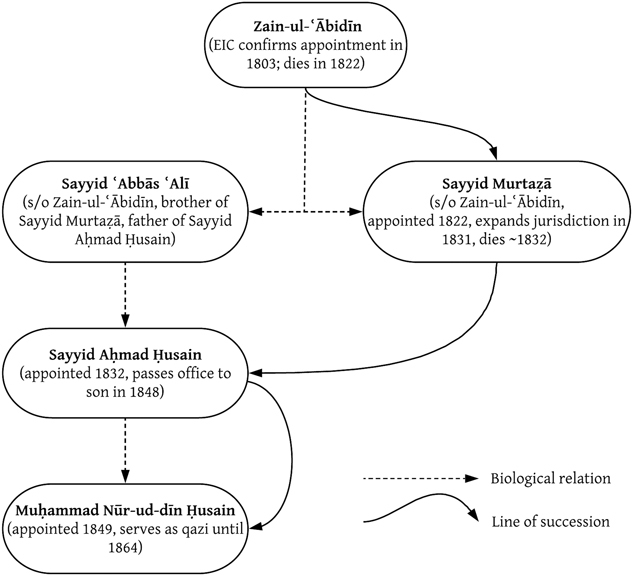
When Zain-ul-ʿĀbidīn passed away in 1822, the position of qazi went to his son, Sayyid Murtaẓā.Footnote 16 Once in office, Sayyid Murtaẓā successfully extended his jurisdiction from the city to the surrounding district (pargana). After complaining about the harassment he faced “in the discharge of his duties . . . in the Purguna,” Sayyid Murtaẓā convinced the judicial commissioner then on circuit to grant him a new sanad (certificate of appointment) as “Kazee of the Town and Purgunnah of Broach,” to mark this extension.Footnote 17 When Sayyid Aḥmad Ḥusain then became qazi following his uncle’s death, he assumed jurisdiction over the expanded territory of the city and the district. As past experiences showed, petitioning the Company was a profitable method for affirming one’s status and authority.
The family further confirmed its hold on the qaziship at Bharuch when Aḥmad Ḥusain successfully passed the office to his son, Muḥammad Nūr-ud-dīn Ḥusain, in 1849. Although Company policy rejected the idea of hereditary appointments, the judicial department routinely found ways to make exceptions.Footnote 18 Thus, when Aḥmad Ḥusain, long-time Company supporter and employee, wrote to announce his impending retirement and to request that the position proceed to his son, the government agreed, following a cursory consideration of the proposed candidate’s qualifications. Naturally, Nūr-ud-dīn was rightfully qualified for the office, “well versed in the Persian and Arabic languages,” and his family had been “well wishers of the Government long before the rule was established in [the] country.”Footnote 19 Once again, following a series of petitions, the family secured its position as an ally and important agent of law through expressions of utility and fidelity to the EIC.
Sayyid Aḥmad Ḥusain’s above-cited complaint against Judge Romer, however, drew upon more than the family’s reputation: it explicitly cited the economic losses he faced as a direct result of this most recent interference. As part of his complaint, Aḥmad Ḥusain claimed to earn upwards of seven hundred rupees annually for his work signing and sealing documents like vakālat- and muḵẖtār-nāmas.Footnote 20 Certainly, given their professional status, the family was not destitute, but there is little evidence to support the particularities of his complaint. A government statement compiled in 1864 calculated the total annual income for the qazi of Bharuch at Rs. 786, the majority of which (Rs. 570) came from endowments and the remainder of which (Rs. 216) the qazi received in the form of tributary ḵẖilʿats (robes).Footnote 21 Receipt of this amount annually made the qazi of Bharuch one of the highest-paid functionaries in the Bombay Presidency, earning more than qazis in neighbouring towns, and demonstrating his symbolic—and administrative—importance for British rule.
In the eyes of Company officials, however, the qazi was a religious figure whose domain extended only to matters of a “doctrinal” nature, belonging to religious ritual and what would become the contents of Islamic personal law.Footnote 22 From this perspective, powers of attorney and other deeds of representation did not fall within his ambit and consequently belonged to the documentary purview of the growing Company state. Narrowing the qazi’s authority to the categories of religious personal law necessarily limited the application of his expertise to an artificially delimited range of legal transactions. Furthermore, what Company policy did not acknowledge was the extent to which vakālat-nāmas, muḵẖtār-nāmas, and other purportedly “secular” documents were embedded within the material practices of documenting and performing “religious” functions like overseeing marriages and divorces. That is, even in the context of religious practice, these transactions called upon a web of legal documentary forms, many of which Company officials felt belonged to the jurisdiction of their “secular” courts. In this regard, then, evidence from the records of the qazis of Bharuch demonstrate that EIC negotiations not only limited the types of transactions over which the qazi could exercise his authority but also recast those transactions within an Anglophone understanding of marriage and divorce, redefining how such transactions were negotiated and executed in documents the qazi had formerly produced with an eye toward other social, economic, and material concerns.Footnote 23
The Life of a Local Qazi
Company records provide ample evidence about the nature and substance of the qazis’ complaints against new policies but provide little information about their day-to-day work. Such considerations require additional sources. Fortunately, relevant sources for the qazis of Bharuch exist in the form of manuscripts, loose documents, and registers previously belonging to the family, including an important manuscript titled A Manual for Qazis and Muftis, which was compiled toward the end of the eighteenth century.Footnote 24 Now held in the Oriental Records section of the National Archives of India, the manuscript comprises fifty-six pages of Persian-language text with interlinear glosses, translations, and brief explanations. The work provides little instruction for a local qazi looking to establish his practice in a particular locale but offers instead an overview of the documents qazis would author and authenticate.
Documents included within the compilation speak to the breadth of the qazis’ notarial practices, but the English title affixed to the manuscript is misleading. The so-called manual includes no discussion of the qazi’s roles or responsibilities, nor does it describe proper methods for maintaining records, performing public services, or training for the office, as one might expect from a work belonging to the adab al-qāḍī (manners and etiquette of qazis) genre.Footnote 25 Instead, the text provides only copies of legal documents, collected almost entirely from popular works of munshāt in circulation at the time.Footnote 26 Close reading shows that entire sections of the text are copied from common works of inshāʾ, including chapters six and seven of Harkaran Dās Kanbōh’s Inshaʾ-yi Harkaran, which relate to legal agreements (qabālajāt-i sharʿī).Footnote 27 Nonetheless, the simple act of copying provides insights into the author’s own perception of the office. The selection of certain documents demonstrates the compiler’s interest in some legal forms over others, while the reference to well-known works of inshāʾ place him within the wider world of Mughal intellectual life and Indo-Persian literary culture more broadly. Furthermore, the fact that only certain legal documents from these works of inshāʾ made their way into the Bharuch Manual underscores the connection between the selected documents and the qazi’s daily life. More a commonplace book than a rule-bound manual, the Bharuch Manual stands as a miscellaneous collection of everyday document forms gathered into a single text for ease of regular reference, offering a detailed snapshot of legal documentary culture in late-eighteenth-century Gujarat.Footnote 28
Interlinear notes and marginal glosses further underscore the text’s aims and hint at the compiler’s need to rely upon such devices to understand and interpret the technicalities of the documents he produced.Footnote 29 For instance, the compiler glosses terms like intifāʿ (profit, benefit) as fāʼida (profit, gain), marks nafs (soul, spirit, self) as ẕāt (essence, substance, self), and explains the title of a sample iʿtāq nāma (deed of manumission) using the more common term āzād (freedom, emancipation). In sum, these explanatory notes point to a preference for Persian expressions over their more legalistic Arabic equivalents and highlights the text’s didactic application.Footnote 30 In this way, the Bharuch Manual showcases the qazi’s day-to-day activities as notary and illustrates the importance he placed on the accurate transcription and interpretation of legal documents.Footnote 31 Further enquiry into the linguistic register of Persian prevailing at the time could, perhaps, situate the text more accurately within the local Bharuch milieu, but even without extensive lexicographic analysis, the text’s interlinear notes clarify the work’s purpose as an instrument of instruction and accessible aide-mémoire.
Orthographic variation also draws attention to the text’s geographic origins and its local relevance. For example, the text’s only sample fārig̱ẖḵẖat̤t̤ī (a deed of release found in the qazis’ registers discussed below) appears in the section of the Manual copied from the Inshāʾ-yi Harkaran under the heading “pāra-ḵẖat̤t̤ī.”Footnote 32 The divergent spelling here could reflect a conscious decision to replace the Arabic word fārig̱ẖ (void, vacant) with the Persian pāra (as in, pāra-pāra kardan, to tear to pieces, to nullify), but a more likely explanation lies in the nature of the local Gujarati script. In Gujarati, the aspirated pha and the fricative fa are represented with the same character, rather than with two distinct characters, as in Persian. From the cover pages of the qazis’ later registers containing fārig̱ẖḵẖat̤t̤īs, this explanation becomes even more probable. These headings identify the registers’ contents with the word phārēg, written in the Gujarati script, rather than with the term fārig̱ẖ, written in the Perso-Arabic script. The fārig̱ẖḵẖat̤t̤ī (or pāra-ḵẖat̤t̤ī) is only one of several document drafts replicated in the Bharuch Manual but the orthographic shift noted here—as well as in the document’s conversion from a generic form of debt release to one of divorce noted in the registers analysed below—illustrates one of the ways terminological adjustments marked larger changes in the construction and redefinition of legal categories at this time.
As a collection, the Bharuch Manual reveals the diversity of documentary forms and legal matters that constituted the qazi’s professional activities around the turn of the nineteenth century. Altogether, the text contains draft copies of nearly fifty documents, encompassing numerous kinds of agreements and arrangements, from documents for buying and selling houses (baiʿ nāma-yi ḥawīlī), gardens (tamassuk-i firūḵẖt-i bāg̱ẖ), and slave girls (ḵẖat̤-i ḵẖarīd-i kanīzak); to papers for renting and leasing property (qabāla-yi rahn-i ḥawīlī; ḵẖat̤-i kirāya-yi ḥawīlī); to deeds for establishing heirs and dividing inheritances (qasm nāma; wirās̤at nāma); to certificates for manumitting slaves (iʿtāq nāma; āzād nāma-yi g̱ẖulām) and recording animal casualties (saqt̤ī-nāma-yi asp). In addition to commercial documents acknowledging and dissolving financial agreements (e.g., tamassuk-i dain maʿ ẓāminī; ḵẖat̤-i muẓārabat; pāra ḵẖat̤t̤ī wa lā dʿawá), the manual also includes deeds of marriage (nikāḥ nāma) and divorce (t̤alāq nāma).Footnote 33 In short, the contents cover a range of social, economic, and material relations that surpass the narrow definition of “doctrinal” ascribed to the qazi’s office in Company discourse and make it clear that the qazi signed and authorised multiple types of transactions in his everyday course of affairs.Footnote 34
Local Notarial Practice
Before the qazis of Bharuch began to maintain registers as servants of the EIC under the directives of Regulation XXVI of 1827, they dealt in individual documents.Footnote 35 The family’s extant collection includes a dozen specimen from 1670 to 1816 CE (1080–1231 AH).Footnote 36 The majority of these documents are deeds of sale for single-storey houses and small parcels of land, but together, the documents provide useful information about social relations, property ownership, and legal activities in and around the city of Bharuch. They include references to property held under security bonds (tamassuk) certified by the qazi (ba-muhr-i īn ḵẖādim-i sharʿ-i sharīf); to the acknowledgement of rights of inheritance involved in the sale of different parcels; to the existence of joint ownership, incorporation (mushārakat), or the lack thereof in some cases; and to representation before the qazi personally (aṣālatāñ) or through an agent (vakālatāñ). Furthermore, although the documents cover a range of years from Aurangzeb’s reign (r. 1658–1707) to the early colonial period (e.g., 1231 AH/1816 CE), they exhibit many features in common.
As was customary, the documents bear the seal of the qazi (see Figure 3), or, as in one example, that of the mufti.Footnote 37 Some also include private seals among the attestations, though most witnesses simply signed the deed. Persian is the primary language, but attestations appear in several scripts (Perso-Arabic, Gujarati, Modi, and Devanagari), highlighting the heterographic, if not heteroglossic, context of their production. While witness attestations crowd the main text—often filling the entire right-hand margin with a dozen or more statements—the main contracting parties often mark their assent with a simple “sign” (ʿalāmāt) or decorative object (e.g., a flower), rather than with a signature. The signatures and “signs” also indicate varying levels of literacy among the contracting parties, suggesting that legal documentation was not the exclusive domain of literate merchant communities but that agriculturalists and artisans also participated.Footnote 38
Sale deed from the family archives of the qazis of Bharuch, with the seal of the qazi at the top, and attestations along the right-hand margin. 19 Muḥarram 1195 AH (15 January 1781 CE). Courtesy of the National Archives of India (Miscellaneous Manuscripts Microfilmed at Bharuch, Acc. No. 851, Sr. No. 45).

The Bharuch collection reflects a period of transition, from the symbolic elegance of imperial decrees to the pragmatic functionalism of Company practice.Footnote 39 Indeed, the qazis of Bharuch (and their demands to retain the right to author and authenticate all manner of legal documents, including the aforementioned vakālat- and muḵẖtār-nāmas) challenged the Company’s documentary hegemony and brought to light the pressing need to declare certain types of documents and deeds the explicit purview of Company scribes and employees. Removing the authority to authenticate “secular” contracts from the legal domain of the qazi’s religious or “doctrinal” work was one step toward the redefinition of Islamic law in the nineteenth century.Footnote 40 Eighteenth-century specimens from the family’s collection underscore the transition that took place in the nineteenth century as new documentary regimes modified the qazi’s work and altered his notarial position.Footnote 41 The transition from flexible, personal documentation to abstract, tabular notation found in registers not only recast the qazi’s day-to-day responsibilities in line with those of Company accountants and administrative minions but also reshaped the very definition of what it meant to contract a marriage—not in terms of what was permissible or possible according to fiqh (Islamic jurisprudence) but in terms of European notions of marriage, divorce, and other domestic contracts. Registers produced by the qazis of Bharuch illustrate the way novel registration procedures reduced complex, heterogeneous legal agreements to blunt transactional instruments.
From Document to Register
The introduction of tabular registers in the first decades of the nineteenth century changed the process of performing and documenting transactions with respect to form and content in two important ways. First, the register converted flexible narratives into rigid fill-in-the-blank forms. Second, the registers converted speaking subjects into recorded objects. Thus, with the shift from document to register, from private deed to (more) public record, the nature of these transactions also changed.Footnote 42 To demonstrate this point clearly, this section surveys a pair of registers containing fārig̱ẖḵẖat̤t̤īs, or deeds of separation and release, as they moved from open-ended transcriptions of private, contractual agreements to tabular records with prescribed contents.Footnote 43 While on the one hand these registers demonstrate prevailing differences between prescriptive formulae and the diversity of local practices, on the other hand they map directly onto the imperial project of separating, categorising, and manipulating categories of legal expression. Evidence from these registers thus points to the ways in which documentary practices shaped the construction of legal identities and the regulation of social practices in the city of Bharuch and throughout British India.
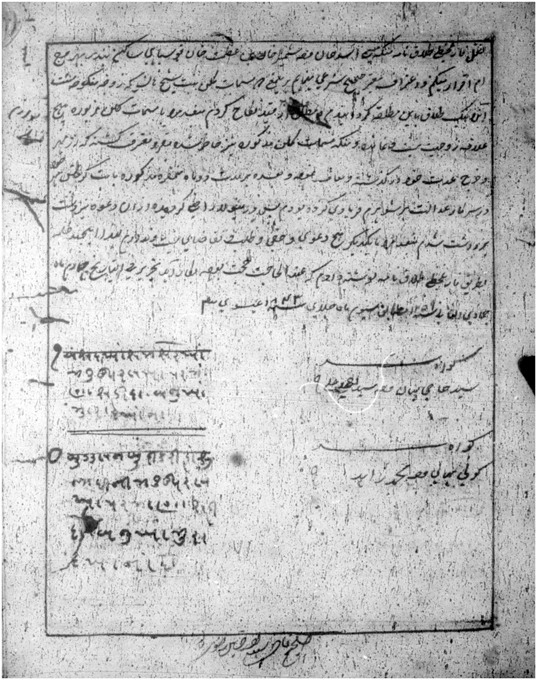
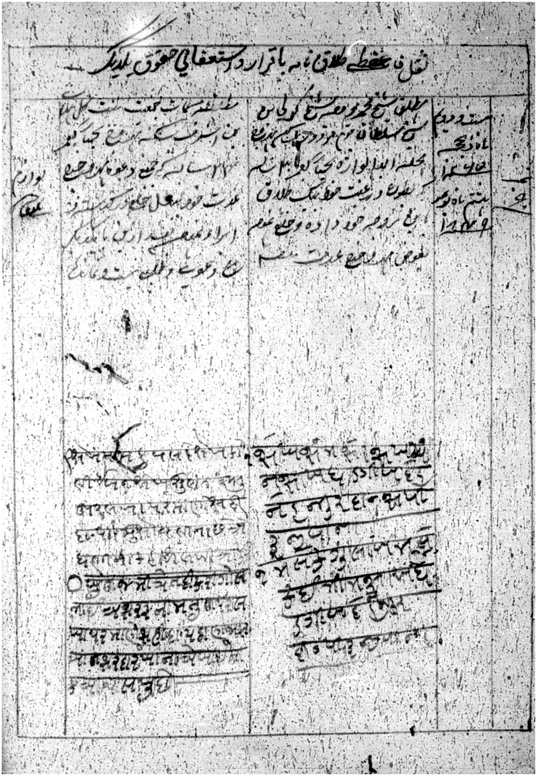
Normative manuals classify the fārig̱ẖḵẖat̤t̤ī as a deed acknowledging the repayment of a debt and releasing the debtor. Contemporary law reports and dictionaries confirm this widespread usage and point to the deed’s utility in a variety of contexts, from maritime commercial debts to agricultural revenue collection to forms of divorce practised by non-Muslim groups.Footnote 44 As a legal deed, then, the fārig̱ẖḵẖat̤t̤ī straddled what would become the colonial categories of personal-religious and civil contract law. Entries recorded in the qazis’ two registers (see Figures 4 and 5) further evince this transformation from the form’s use as an umbrella term covering many types of nullification to one of increasing specificity, referring only to “divorce.” This semantic shift points to the larger effects of administrative efforts to fix legal terms generally and in the context of the fārig̱ẖḵẖat̤t̤ī specifically, to move away from more capacious ideas of debt release to more rigid understandings of marital separation.Footnote 45 The registers map these changes directly and materially, but to understand this transformation it is first necessary to consider the scope of the fārig̱ẖḵẖat̤t̤ī as a legal form.
Fārig̱ẖḵẖat̤t̤īs recorded in the registers from Bharuch mirror those found in normative texts: “I, who am so-and-so (falān), son of so-and-so, born of so-and-so, state and legally affirm that I release so-and-so from any obligation to me.”Footnote 46 The difference between the qazi’s limited use of the term and the fārig̱ẖḵẖat̤t̤ī’s more capacious definition is that in Bharuch, the contractual bind between the two parties is one of marital debt and obligation. Rather than mentioning an “account” (ḥisāb) or “property” (māl), as normative models might imply, the document now refers to “marital relations” (ʿalāqa-yi zaujīyat) and to the “bond of marriage” (qaid-i nikāḥ). Though it is tempting to read these documents simply as evidence of the qazi’s turn to family affairs, such a reading misses the legal-contractual nature of marriage in Islam and privileges instead the sacral, Christian definition of marriage. Indeed, the documents themselves retain the language of contracts and mutually constituted obligations and expectations reflective of the form’s other uses and the qazi’s wider sphere of legal practice. That is, in its earlier iterations, the fārig̱ẖḵẖat̤t̤ī resisted easy classification and was not constrained to religious or “doctrinal” matters, as Company policy soon began to dictate.Footnote 47 Replicating normative models, then, entries in the register appear as follows:
I, who am named Shaiḵẖ Mīr Muḥammad, son of Kālū, of the weaver community [qaum], … residing at Bharuch, state and legally affirm to this effect that I release one Zainab, daughter of Khaisā Bhāʾī, who is my lawfully wedded wife [zauj-i mankūḥa-yi man ast] from the confines of marriage after which there will not be, nor will remain, any marital connection between myself and the aforementioned Zainab.Footnote 48
Fārig̱ẖḵẖat̤t̤ī from the collection of the qazis of Bharuch, with witness signatures below, and the qazi’s certification at the bottom of the page. 4 Jumādī as̤-s̤ānī 1259 AH (3 July 1843 CE). Courtesy of the National Archives of India (Miscellaneous Manuscripts Microfilmed at Bharuch, Acc. No. 851, Sr. No. 41, Entry 3).
Tabular fārig̱ẖḵẖat̤t̤ī-t̤alāq-nāma from the collection of the qazis of Bharuch. 22 Ẕī al-ḥijja 1265 (7 November 1849). Courtesy of the National Archives of India (Miscellaneous Manuscripts Microfilmed at Bharuch, Acc. No. 851, Sr. No. 42, Entry 9).
Given that Islamic law considers marriage a form of civil contract—a fact British civil servants struggled to comprehend well into the nineteenth century—the text translated above is not unexpected.Footnote 49 What is important to note, however, is the qazi’s instrumentality in establishing and nullifying these marital relationships through the application of this generic legal form. Though most of the fārig̱ẖḵẖat̤t̤īs recorded in these registers refer to divorce by mutual consent (for which there is no exchange of money or property) and reflect obligations and indebtedness rooted in the bonds of marriage, the register records other modes of separation as well. The document also requires the presence of—and gives voice to—both parties involved. After the husband’s opening statement, then, the entries also record the second party’s statement, acknowledging the wife’s presence and recording her testimony:
I, who am called Zainab, am also present [nīz ḥāẓir shuda] and state and affirm that I abstain from mahr and the expense of ʿiddat owed to me and forgive [these debts].Footnote 50
After both parties have spoken, the entry concludes with a statement confirming the terms of the release:
After this agreement, there is no claim, admission, request, or demand nor will any remain [between us]. Consequently, I [the qazi] have written [nawishta] and provided these brief remarks [īn chand kalima] so that when required, they may serve as proof. Written on the 3rd of Rabīʿ al-awwal 1259 Hijrī, corresponding to 4th April 1843 CE.Footnote 51
The parties then sign the entry—here Mīr Muḥammad signs in Perso-Arabic script while Zainab writes her name in Gujarati—and the witnesses affix their signatures (or signs). In this example, the four witness add their names in the Gujarati script, and the separation is complete.Footnote 52
In the context of a highly mobile, mercantile population, access to documentation for legal separation can be as important as documentation for legal obligation. Thus, the deed of divorce by mutual consent should not be misread as an attempt to limit the woman’s access to economic or social capital. Rather, the deed’s easy execution and implicit acknowledgement of mutual debt and obligation reflect the legal subject-hood of both parties. Furthermore, the registers containing such fārig̱ẖḵẖat̤t̤īs acknowledge the qazi’s central role in providing access to legal documentation for the purposes of creating, and in this case, terminating relationships. Despite the qazi’s centrality for documenting and authenticating the dissolution of such relationships, the pressures of bureaucratic record-keeping, already visible across these two registers of fārig̱ẖḵẖat̤t̤īs (Sr. Nos. 41 and 42), compounded his transformation from non-religious notary to Islamic officiant.
In the second notebook, the fārig̱ẖḵẖat̤t̤ī becomes a “fārig̱ẖḵẖat̤t̤ī t̤alāqnāma” (deed of separation and divorce), bringing the multiple possibilities of separation (fārig̱ẖ) under the singular heading of t̤alāq (divorce) and making the heterogeneous possibility of the fārig̱ẖḵẖat̤t̤ī compliant with EIC understandings of religious personal law under the heading “divorce.”Footnote 53 With this change, the tabular layout also modified the composition of the legal agreements it recorded. Narrative statements allowed for individual variation and specification, but the tabular formats preferred by Company officials made the completion of an entry the only evidence of its legality. That is, where narrative statements embedded legal power within the complex of written statements, witness testimonies, and the qazi’s authority, register entries by contrast relied on the page’s filled-in spaces alone (see Figure 5). As such, the transition from narrative statement to tabular layout not only excised from his domain the flexible elements that allowed the qazi of Bharuch to interact with Gujarat’s diverse population but also turned the written contract imbued with legal authority into a register entry now dependent upon British interpretations of doctrinal practice. On paper, the qazi had become a religious figure solely assigned to handle the “doctrinal” affairs of the Muslim community.
Despite their efforts to negotiate with the Company, the qazis of Bharuch were unable to retain control over the range of legal deeds and documents they previously authorised, but at the same time, by asserting their rights to maintain limited records, the qazis’ transformation indexed the establishment of new legal categories—public and private, commercial and personal, secular and doctrinal—with categorically British valences. In so doing, the transformation of the fārig̱ẖḵẖat̤t̤ī from a deed of nullification and separation into a deed of divorce reflected a new interpretation for the qazi’s work in Bharuch and produced a quintessentially communal interpretation of his records. Rather than marking a steady progression from status to contract, the reconfiguration of the qazi’s work in nineteenth-century Bharuch instead marked a turn from written contract to religious-legal status.Footnote 54
Conclusion
Considering the effects of social translation that accompanied the process of scribal transformation elsewhere, it is no surprise that qazis familiar with earlier modes of notarial practice confronted imperial policy on the grounds of personal and public loss. Though it was perhaps not possible to see at the time, changes in documentary authorship prefigured even greater changes in the formulation of legal categories.Footnote 55 British conceptions of legal authority could not account for the plurality of experiences, exchanges, and evidence made possible under the generic heading of the fārig̱ẖḵẖat̤t̤ī, let alone those of the vakālat- and muḵẖtār-nāma cited in Aḥmad Ḥusain’s initial complaint. Drawing an ever-tighter circle around the modes and forms of writing over which qazis could exercise authority was thus part of a much larger process of legal transformation. Along with document forms like vakālat- and muḵẖtār-nāmas cited in Aḥmad Ḥusain’s original petition, Company officials rejected the qazi’s utilisation of the full range of contractual arrangements and nullifications nestled within more expansive definitions of the fārig̱ẖḵẖat̤t̤ī. Instead, such forms had to be recast under the rubric of “doctrinal,” personal, and religious law—devoid of the heterogeneity and flexibility observed in their earlier iterations. In the context of Company expansion, such narrative statements were dangerously open-ended. The Company craved documentary specificity, and the qazis of Bharuch followed suit by making their records rigid, eschewing narrative statements in exchange for fill-in-the-blank renderings of acceptable legal status.
Record-keeping at this time did more than simply render legal practices from the edges of empire legible to the imperial bureaucracy; it also transformed the contents of those practices. Once the information became abstracted from its narration, it could no longer account for individual variation without transgressing the written (tabular) arrangement. Predetermined writing practices went beyond the mere fact of recording transactions: they determined the very definition of the exchange. As one of the evidentiary platforms on which the Company manifested its larger programme of legal transformation and appropriation, the qazi’s register indexes the extension of imperial policy at the first moment of legal articulation—that is, the moment in which private agreements become publicly cognisable in legal documents. While histories of colonial legal change tend to elide this moment in an effort to highlight the textual translation practices of British officials, qazi registers from Bharuch, in fact, reveal the importance of this moment and draw attention to the influence of legal definition embedded within the initial act of transcription.
Through persistent negotiations with East India Company officials in Bombay, the qazis of Bharuch were able to carve a place for their work in the administration of law at the local level, but such participation was not immune to the policies of colonial categorisation and compartmentalisation. In its categorisation of the qazi as a “religious” official, responsible only for matters of religious “doctrine,” Company policy missed the diversity and complexity of the legal agreements individuals like Sayyid Aḥmad Ḥusain supervised through their everyday notarial activities as qazi. In this way, Company policy not only divested the qazis of Bharuch of their ability to author and authenticate deeds like vakālat- and muḵẖtār-nāmas but also removed those (and other documentary) forms from the matrix of deeds and agreements that constituted the legal articulation of marital and other social, familial, or commercial relations. The transformation of the fārig̱ẖḵẖat̤t̤ī in the first decades of the nineteenth century suggests that even where social relations were catalogued and articulated through contractual agreements, Company policy worked to unsettle such agreements from indigenous modes of documentation, reserving certain written forms for “secular” proceedings and relegating others to “religious” fora. Evidence from the qazis of Bharuch thus illustrates how the implementation of categorical assumptions about the application of religious law at the local level reconfigured social relationships before litigants even entered colonial courtrooms.
In the debates surrounding the extent to which the qazis of Bharuch could engage in the authentication and registration of specific legal documents, ideas about the categorisation of legal transactions are already evident. These ideas kept marriage and divorce within the qazi’s religio-legal domain while placing concepts of representation and advocacy (vakālat, muḵẖtārī) under the authority of the Company’s courts. But drawing the lines separating religious and secular transactions required a redefinition of those terms. If legal progress entails a transition from ascribed status to written contract, then the qazi’s records challenge the notion that European law brought the gift of legal documentation to South Asia. Not only do the registers point to the presence of multiple forms of legal agreement (commercial, social, marital) under the heading of the fārig̱ẖḵẖat̤t̤ī, but they also demonstrate the ways in which EIC interference actively worked to turn contractual forms into communal categories.


 Open access

