





Introduction
The widespread use of atrazine in corn since the mid-1960s has allowed growers to control problematic grass and broadleaf weeds (Akobundu et al. Reference Akobundu, Sweet, Duke and Minotti1975; Syngenta 2021). According to the latest agricultural chemical use survey for corn, released by the U.S. Department of Agriculture, atrazine was the most widely used active ingredient in the crop in 2021, with approximately 26.8 million kg applied (USDA-NASS 2022). The use of atrazine has enabled growers to adopt conservation tillage practices due to its postemergence and soil residual activity, and for its control of certain glyphosate-resistant weeds (Mitchell Reference Mitchell2013). However, this widespread use has led to environmental concerns. The U.S. Environmental Protection Agency (EPA) has expressed concern about atrazine runoff and classified the chemical as a surface and groundwater contaminant (US EPA 2016).
One concern is atrazine’s mobility in soil. The organic carbon-water partition coefficient (Koc) for atrazine is considered low, with reported values ranging from 15 to 155, indicating a higher risk of soil leaching than with other herbicides (Davidson et al. Reference Davidson, Rao, Ou, Wheeler and Rothwell1980; Lavy Reference Lavy1968; US EPA 1990). Additionally, atrazine is listed as moderately water soluble with a value of 30 mg L−1 at 20 C (Ney Reference Ney1995; WHO 1996). Previous research has demonstrated a direct correlation between the amount of atrazine detected in surface and groundwater and the amount applied to nearby agricultural fields (Barbash et al. Reference Barbash, Thelin, Kolpin and Gilliom2001; Larson et al. Reference Larson, Capel and Majewski1997). Given the water solubility, low KOC value, and widespread use, environmental concerns about atrazine persist (US EPA 2016).
The off-target movement of atrazine to surface and groundwater may harm plants and animals. Lake periphyton communities, for example, had reductions in productivity and growth rates of 21% to 82%, depending on exposure levels (Hamilton et al. Reference Hamilton, Jackson, Kaushik and Solomon1987). Due to toxicological, environmental, and ecological concerns, the EPA has been reviewing the atrazine label and is proposing mitigation measures. In 2024, the EPA released proposed revisions to the label that include reducing the maximum annual use rate from 2,800 g ai ha−1 to 2,240 g ai ha−1 with preemergence applications not to exceed 1,340 g ai ha−1, and forbidding applications of atrazine during rainfall or when soils are saturated or surpass field capacity (US EPA 2024c).
In addition to the proposed label changes, the EPA is implementing a herbicide strategy for endangered species (US EPA 2024a). The strategy aims to protect federally endangered and threatened species from herbicide effects through runoff and drift mitigation. Applicators will need to achieve a specific number of points for each herbicide they apply. The number of points one needs will vary based on the potential impact that each herbicide has on endangered or threatened species. The finalized strategy, released in August 2024, outlines mitigation measures that applicators can select to achieve the required points. Mitigation measures include cover crops, spray buffers to sensitive areas, reduced tillage, and grassed waterways, among others (US EPA 2024b). Another option for achieving points is to reduce the proportion of a field that needs treatment. Applicators can achieve two, three, or four mitigation points when the proportion of the field treated with a herbicide is reduced by 10% to <30%, 30% to <60%, or ≥60%, respectively. Targeted herbicide applications are one way to achieve this reduction and achieve mitigation points. Up to 62.4% reduction in area of soybean [Glycine max (L.) Merr.] sprayed was achieved when the John Deere See & Spray system, the first commercially available targeted sprayer for use in the United States row-crops, was used (Avent et al. Reference Avent, Norsworthy, Patzoldt, Schwartz-Lazaro, Houston, Butts and Vazquez2024). Leise et al. (Reference Leise, Singh, La Menza, Knezevic and Jhala2025) used a Greeneye Technology precision sprayer on corn and demonstrated a 94% reduction in herbicide use at the early postemergence application.
Targeted applications can reduce herbicide use by accounting for the spatial distribution of weeds within fields. While crops are uniformly distributed in agricultural fields, weeds tend to emerge nonuniformly in clumps across the field (Cardina et al. Reference Cardina, Johnson and Sparrow1997; Metcalfe et al. Reference Metcalfe, Milne, Coleman, Murdoch and Storkey2019; Wiles et al. Reference Wiles, Wilkerson, Gold and Coble1992). Being able to distinguish weeds from crops allows targeted spraying of weed-infested areas, leaving weed-free areas unexposed to unnecessary herbicide use. In addition to sound environmental stewardship, reducing the proportion of the field sprayed will consequently lower herbicide costs for growers. Input costs for growing corn have been increasing over the years. For example, in Illinois, the direct costs of production inputs such as seed, fertilizer, and pesticides have increased from $331 ha−1 in 2000 to $1,379 ha−1 in 2022 (Paulson et al. Reference Paulson, Schnitkey, Zulauf, Colussi and Baltz2023). Breaking this down further, pesticide costs were $79 ha−1 in 2000, and they increased to $316 ha−1 by 2022. Among all classes of pesticides, herbicides are the most widely used in corn production, with 96% of planted hectares in the United States receiving herbicide applications in 2021 (USDA-NASS 2022). Fungicides and insecticides were applied to 19% and 14% of corn hectares, respectively. With production costs increasing faster than crop prices, producers are seeking ways to reduce costs and increase profit margins.
The John Deere company announced in 2020 that it had developed a targeted sprayer, called See & Spray. In 2022, the See & Spray Ultimate became commercially available, marking the first targeted sprayer for in-crop applications in U.S. row-crop production. The Ultimate is one of two John Deere models currently available for row-crop use (John Deere 2025). The Ultimate features a dual-product tank system with dual boom lines, allowing for simultaneous broadcast and targeted applications. The Premium platform features a single-tank design that can either broadcast or target apply. Targeted applications can used on corn, soybean, cotton (Gossypium hirsutum L.), and fallow ground with either the Ultimate or Premium. Each model uses computer vision and machine learning to detect weeds and activate only the nozzles needed to apply herbicides. Therefore, the objective of this research was to determine whether targeted applications of postemergence herbicides to corn can provide comparable weed control to that of broadcast applications while reducing the percentage of the field that is sprayed.
Materials and Methods
Experimental Sites and Design
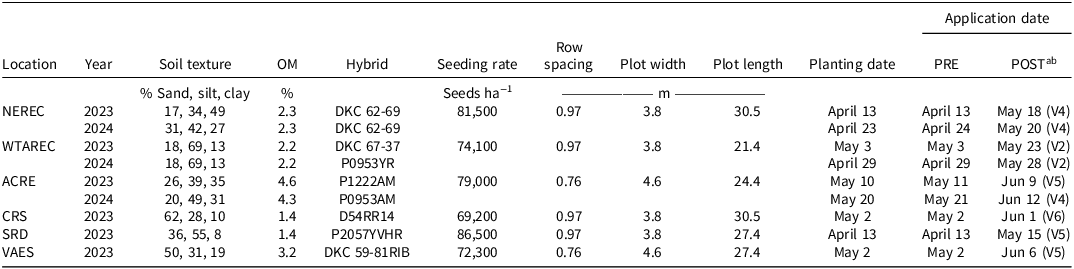
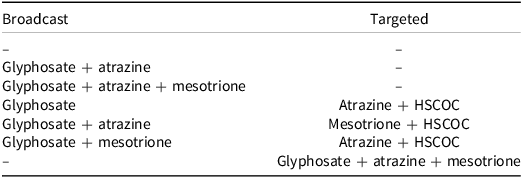
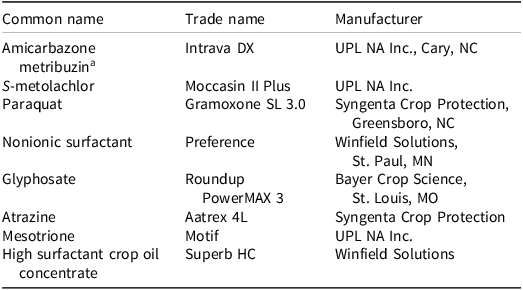
Field experiments were conducted at the Northeast Research and Extension Center (NEREC) in Keiser, Arkansas (35.674967°N, 90.079179°W); the West Tennessee AgResearch and Education Center (WTAREC) in Jackson, Tennessee (35.6311°N, 88.8564°W); and the Agronomy Center for Research and Education (ACRE) in West Lafayette, Indiana (40.497015°N, 86.996032°W) in 2023 and 2024 and at Stoneville R&D (SRD) in Greenville, Mississippi (33.314133°N, 91.127839°W); the Caswell Research Station (CRS) in Kinston, North Carolina (35.2722742°N, 77.6259681°W); and the Virginia Agricultural Experiment Station (VAES) in Blacksburg, Virginia (37.194533°N, 80.571468°W) only in 2023 (Table 1). Each experiment was set up as a randomized complete block design with four replications and a single factor to determine whether targeted applications can mitigate atrazine use on corn while providing weed control levels comparable to those of broadcast applications. Each experiment included six treatments, along with a nontreated check for comparison. Excluding the nontreated control, all treatments in 2023 at all sites received the same preemergence application of paraquat (716 g ai ha−1), S-metolachlor (1,400 g ai ha−1), and a nonionic surfactant at 0.25% v/v broadcast applied. In 2024, amicarbazone (329 g ai ha−1) and metribuzin (186 g ha−1) were added to the preemergence treatments at all sites, except at NEREC, where amicarbazone and metribuzin were applied at 490 and 280 g ha−1, respectively. Postemergence applications differed among treatments and consisted of combinations of atrazine, glyphosate, and mesotrione applied either broadcast or targeted (with the See & Spray Premium) or in a dual tank-boom system application (with the See & Spray Ultimate), which included both broadcast and targeted sprays in the same operation (Table 2). A high-surfactant crop oil concentrate was included as needed, per herbicide label recommendations. Herbicide treatments and application methods are listed in Table 2. All herbicide sources are listed in Table 3.
Site-specific information. a

a Abbreviations: ACRE, Agronomy Center for Research and Education, West Lafayette, Indiana; CRS, Caswell Research Station, Kinston, North Carolina; NEREC, Northeast Research and Extension Center, Keiser, Arkansas; OM, organic matter; POST, postemergence; PRE, preemergence; SRD, Stoneville R&D, Greenville, Mississippi; VAES, Virginia Agricultural Experiment Station, Blacksburg, Virginia; WTAREC, West Tennessee AgResearch and Education Center, Jackson, Tennessee.
b Growth stage is presented in parentheses.

a Abbreviation: HSCOC, high surfactant crop oil concentrate.
b Every treatment, except the nontreated, received the same preemergence herbicide applications of S-metolachlor, paraquat, and a nonionic surfactant in 2023. In 2024, amicarbazone and metribuzin were added to the preemergence treatments.
Herbicides and adjuvants used in this experiment.

a Amicarbazone and metribuzin were only used in trials conducted in 2024.
All field sites were planted with a glyphosate-resistant corn hybrid (Roundup Ready Corn 2; Bayer Crop Science, St. Louis, MO) that is adapted to the specific region at seeding rates common to the area (Table 1). Fertility decisions for each site were made to meet local university recommendations for corn, based on soil test results. Furrow irrigation was used as needed at NEREC and SRD, while natural precipitation was used for watering at all other sites. Plots were four rows wide, and the dimensions at each site are listed in Table 1.
Preemergence herbicides were applied within 24 h of planting using PSLDMQ2003 nozzles (Deere & Company, Moline, IL) at 248 kPa. Postemergence herbicides were applied 20 to 35 d after preemergence treatments, depending on the site (Table 1). AI8003 nozzles (TeeJet Technologies, Glendale Heights, IL) with a prototype 40-degree rear-incline cap were used for targeted applications at 283 kPa. The rearward inclination allows for more time between weed detection and decision to spray, thereby increasing the accuracy of the targeted applications for See & Spray. AI8003 nozzles without a rearward inclination were used for broadcast-only postemergence applications at 283 kPa. TeeJet AIXR11002 nozzles were used to broadcast postemergence herbicides at 345 kPa during simultaneous targeted applications. The nozzles differ between the broadcast-only and simultaneous applications, as recommended for the commercial-sized See & Spray Ultimate because the dual-product tank system does not hold equal volumes. To optimize operator efficiency during simultaneous application, the recommend spray volume rates are 94 L ha−1 for the broadcast application and 140 L ha−1 for the targeted application. Nozzles used with targeted applications must first be characterized for use with this technology to ensure proper application. All nozzles were calibrated to apply 140 L ha−1 at 12.9 kph, except AIXR 11002 nozzles, which were used at 94 L ha−1.
Small-Plot See & Spray Ultimate
All treatments were applied with a scaled version of the See & Spray Ultimate for small-plot research, provided by Blue River Technology (Santa Clara, CA). The small-plot sprayer is mounted to the front-end loader of a tractor and uses the same sensors, processors, and cameras as the commercially available sprayer. This sprayer differs from the commercial machine in boom size and fluid delivery system. Unlike the 96 nozzles spaced 38 cm apart on the commercial machine, the scaled version features 10 nozzles, also spaced 38 cm apart, to facilitate small-plot research. The commercial machine employs a mechanical fluid delivery system pressurization, whereas the small-plot sprayer features two onboard air compressors with pressure regulators, enabling the operator to attach two 18.9-L tanks. Two solenoid valves, located at each nozzle body, with a dual boom line, enable simultaneous broadcast and targeted applications. Additionally, the small-plot sprayer can record the plot at the time of application, allowing quantitative assessments, such as weed area and area sprayed, to be calculated later using John Deere’s proprietary software. The small latitudinal and longitudinal buffer setting and the medium detection sensitivity were used for targeted postemergence applications. Buffer settings determine how many nozzles are triggered and for how long, whereas the sensitivity setting determines how confident the machine needs to be in distinguishing weeds and crops.
Data Collection and Analysis
Crop injury was visibly rated 14 and 28 d after the postemergence (DAP) application. Weed control was visibly rated at 28 DAP in 2023 and 2024, and at 14 DAP in 2024. Injury to the crop and weed control were rated on a scale of 0% to 100%, with 0% indicating no injury or weed control compared to the nontreated control, and 100% indicating complete plant death or no weeds present (Frans and Talbert Reference Frans, Talbert and Truelove1977). Palmer amaranth was present at the sites in Arkansas, Mississippi, North Carolina, and Tennessee in 2023 and Arkansas and Tennessee in 2024. Broadleaf signalgrass (Urochloa platyphylla Wright) was present in Arkansas and Mississippi in 2023. Echinochloa species were present in Arkansas and Tennessee in 2023. Yellow nutsedge (Cyperus esculentus L.) was present in Mississippi and Virginia in 2023. Morningglory (Ipomora) species were present in Indiana, Tennessee, and Virginia in 2023; and in Arkansas, Indiana, and Tennessee in 2024. The weed area and area sprayed were recorded by the sprayer during the postemergence application. After collecting data from the sprayer, weed area and area sprayed were made relative to the area recorded for each plot. Once the corn reached maturity, the center two rows of each four- or six-row plot were harvested. The seed moisture was adjusted to 13% to report grain yields for each plot expressed in kilograms per hectare (kg ha−1).
All data were analyzed in JMP Pro software (v.18; SAS Institute Inc., Cary, NC). Data from 2023 were analyzed separately from 2024, because amicarbazone and metribuzin were added to the preemergence treatments in 2024. The addition of these herbicides was due to poor weed control in 2023 from the preemergence treatment, which caused targeted applications at postemergence to spray the majority of the area. To determine the amount of herbicide savings achieved with targeted applications in each year, the distributions of percentage area spayed with all treatments using targeted applications were used to calculate the mean and 95% confidence interval (C.I.). Corn injury and weed control data were bound between 0 and 1 and fit to a generalized linear mixed model with a beta distribution with a logit link function, with treatment as a fixed effect and replication nested within site as a random effect. The experimental site was treated as a random effect within a year to broaden the inference of the research, with six sites included in the 2023 analysis and three in the 2024 analysis. Grain yield residuals deviated from normality based on the Shapiro-Wilk test; therefore, data were analyzed using a generalized linear mixed model assuming a gamma distribution, with treatment as a fixed effect and replication nested within location as a random effect. Crop injury, weed control, and grain yield were subjected to ANOVA, with means separated using a Tukey HSD test with α = 0.05. The relationship between weed area and area sprayed was determined using a regression analysis in the Fit Curve platform of JMP Pro software (v.18.0). To determine the best-fit model, every sigmoidal nonlinear relationship was explored, and a Weibull growth model was selected based on the Akaike information criterion. The Weibull growth model reported overall R 2 = 0.840 and root mean-square error = 0.122 (Equation 1): $\begin{align}{\rm{\% \;Area\;sprayed}} = &Asymptote \\&*\left( {1 - EXP\left\{ {\; - {{\left[ {{{\% \;Weed\;area}}\over{{Inflection\;point}}} \right]}^{Growth\;rate}}} \right\}} \right)\end{align}$
Results and Discussion
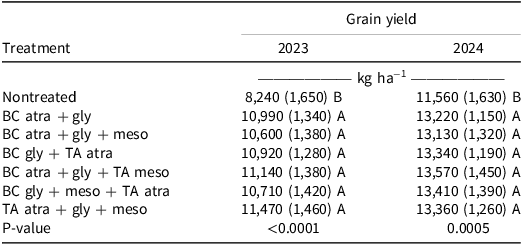
None of the treatments in this study induced crop injury (data not shown). These results are not surprising since all herbicides used were applied at rates labeled for use on corn. However, previous research published by Avent et al. (Reference Avent, Norsworthy, Patzoldt, Schwartz-Lazaro, Houston, Butts and Vazquez2024) found that the use of targeted applications to soybean was able to reduce crop response slightly, though this reduction was minimal and did not lead to increased grain yield compared to broadcast applications. Likewise, corn grain yield in this research was neither improved nor reduced by targeted applications compared to broadcast applications, regardless of whether any of the treatments incorporated targeted applications (Table 4). The only treatment in this trial that reduced corn grain yield in either year was the nontreated check, which experienced a 15% to 28% loss due to weed competition. A yield loss of corn of up to 50% can be observed when weeds are left uncontrolled during the growing season (Barber et al. Reference Barber, Scott, Norsworthy, Espinoza and Jeremy2015; Soltani et al. Reference Soltani, Dille, Burke, Everman, VanGessel, Davis and Sikkema2016).
Corn grain yield after broadcast, single-tank and dual-tank–boom system targeted applications postemergence in 2023 and 2024.a-c

a Abbreviations: atra, atrazine; BC, broadcast; gly, glyphosate; meso, mesotrione; TA, targeted application.
b Means within a column with the same uppercase letter are not different according to the Tukey HSD test (α = 0.05).
c Numbers in parentheses represent the 95% confidence interval.
The only weed species evaluated in 2023 that exhibited a significant difference in control (P < 0.05) was Palmer amaranth when assessed at 28 DAP (Table 5). Broadleaf signalgrass, Echinochloa species, yellow nutsedge, and morningglory species did not differ in control between broadcast or targeted application. Control of broadleaf signalgrass, Echinochloa species, and morningglory was 94% or greater, whereas control of yellow nutsedge ranged from 86% to 96%. When glyphosate was broadcast-applied with atrazine target-applied with the See & Spray Ultimate version, Palmer amaranth control was 91%. Although this was different from the broadcast and targeted applications of glyphosate, atrazine, and mesotrione, it was not different from the broadcast application of just glyphosate and atrazine (86%). Adding the third active ingredient and site of action (mesotrione) resulted in overall increased Palmer amaranth control, from 92% to 97%. The synergistic activity of mesotrione and photosystem II inhibitors has been well documented (Abendroth et al. Reference Abendroth, Martin and Roeth2006; Hugie et al. Reference Hugie, Bollero, Tranel and Riechers2008; Walsh et al. Reference Walsh, Stratford, Stone and Powles2012; Woodyard et al. Reference Woodyard, Hugie and Riechers2009). In addition to improved weed control, using multiple sites of action is recommended as a best management practice to mitigate the spread of herbicide resistance (Norsworthy et al. Reference Norsworthy, Ward, Shaw, Llewellyn, Nichols, Webster, Bradley, Frisvold, Powles, Burgos, Witt and Barrett2012). All other weed species evaluated in 2023 were controlled to a comparable degree across the broadcast, dual tank-boom system, and single boom targeted applications.
Weed control evaluations 28 d after postemergence broadcast and targeted applications in 2023.a–e

a Abbreviations: atra, atrazine; BC, broadcast; gly, glyphosate; meso, mesotrione; TA, targeted application.
b Echinochloa species include barnyardgrass [Echinochloa crus-galli (L.) Beau.] and junglerice [Echinochloa colona (L.) Link]; morningglory species include pitted morningglory (Ipomoea lacunosa L.) and ivyleaf morningglory (Ipomoea hederacea Jacq.).
c Means within a column with the same uppercase letter are not different according to the Tukey HSD test (α = 0.05).
d Weed control is reported on a 0% to 100% scale, with 0% representing no weed control compared to the nontreated and 100% representing no weeds present.
e Numbers in parentheses represent the 95% confidence interval.
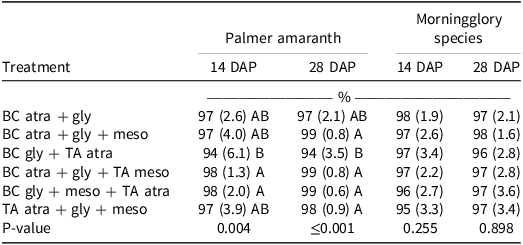
In 2024, the same trend was observed with Palmer amaranth. The dual tank-boom system with broadcast-applied glyphosate and target-applied atrazine resulted in the lowest control (94%) of Palmer amaranth (Table 6). However, this treatment did not differ from the same two herbicides applied broadcast. Overall, weed control ranged from 94% to 99% for Palmer amaranth and morningglory species across both evaluation timings. Targeted applications of atrazine, glyphosate, and mesotrione were all comparable to those of broadcast applications of these herbicides. Prior research by Goudy et al. (Reference Goudy, Bennett, Brown and Tardif2001) and Avent et al. (Reference Avent, Norsworthy, Patzoldt, Schwartz-Lazaro, Houston, Butts and Vazquez2024) has shown that site-specific, targeted herbicide applications to soybean can provide comparable weed control to broadcast applications while reducing chemical inputs.
Weed control evaluations after broadcast and targeted applications postemergence in 2024.a–e

a Abbreviations: atra, atrazine; BC, broadcast; DAP, days after postemergence application; gly, glyphosate; meso, mesotrione; TA, targeted application.
b Morningglory species include pitted morningglory (Ipomoea lacunosa L.) and ivyleaf morningglory (Ipomoea hederacea Jacq.).
c Means within a column with the same uppercase letter are not different according to the Tukey HSD test (α = 0.05).
d Weed control reported on a 0% to 100% scale, with 0% representing no weed control compared to the nontreated and 100% representing no weeds present.
e Numbers in parentheses represent the 95% confidence interval.
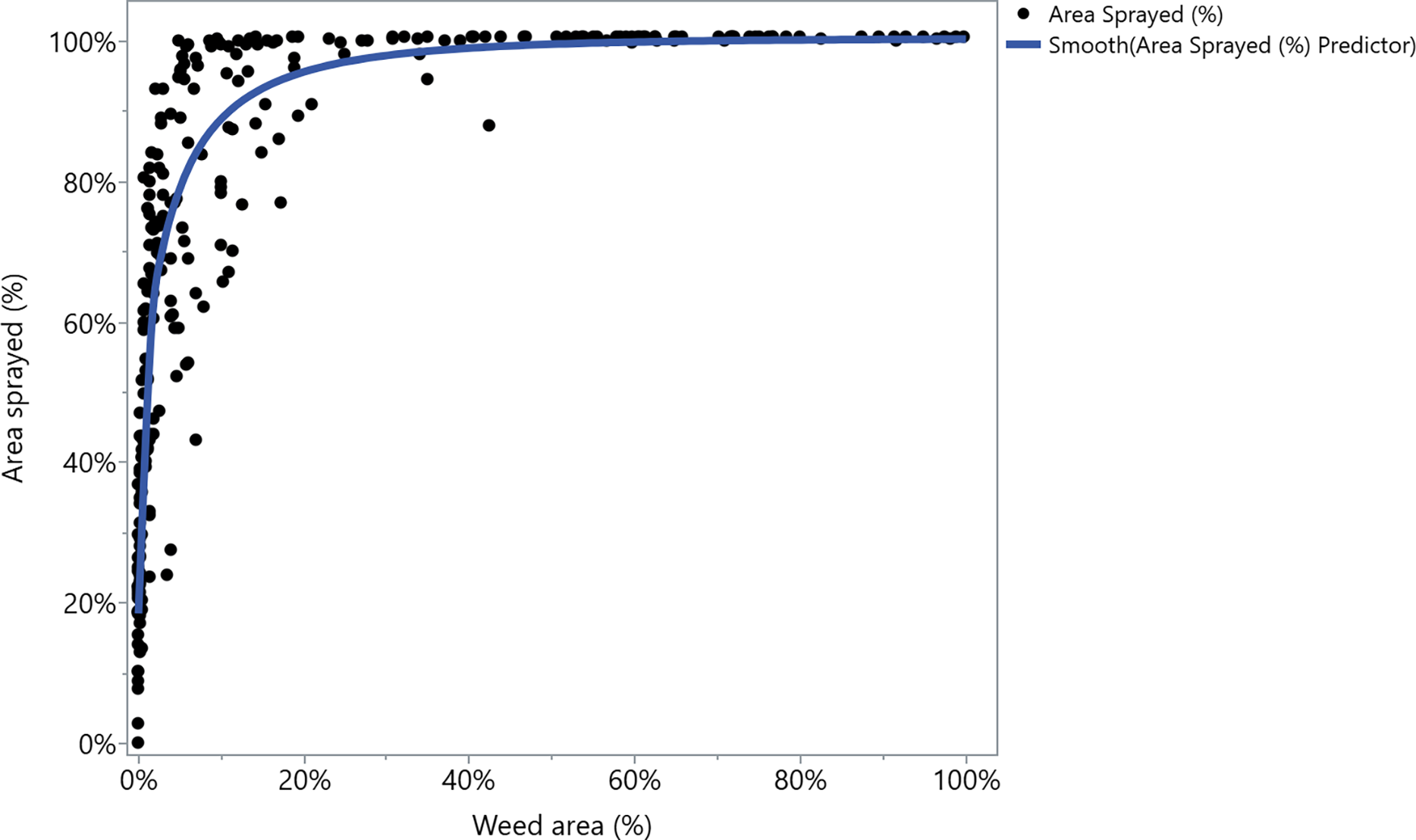
The small-plot See & Spray Ultimate prototype collected weed-area and sprayed-area data each year when the postemergence herbicides were applied. These data were explored, and a strong nonlinear relationship (R 2 = 0.84) was observed between percent weed area and percent area sprayed (Figure 1). As the percentage of area covered by weeds increased, so did the percentage of area sprayed, which is consistent with prior research on soybean (Avent et al. Reference Avent, Norsworthy, Patzoldt, Schwartz-Lazaro, Houston, Butts and Vazquez2024). This result is logical because the sprayer uses machine vision to detect weeds and only the nozzles that can produce spray droplets targeted at the detected weed are activated (W. Patzoldt, personal communication). As the machine detects more weeds, more nozzles can be activated to spray herbicides, thereby increasing the area sprayed. Of interest is that as the weed area reached 20%, the area sprayed was above 90%. This highlights the critical importance of near-complete early-season weed management to realize the potential reduction in herbicide use from targeted spray applications. One factor that could influence this interaction is the buffer setting selected by the applicator. A small buffer setting was used in this study. A medium or high buffer setting would increase the number of nozzles activated and the activation duration, thereby increasing the sprayed area from the same level of weed area.
The relationship between weed area and area sprayed with targeted applications from the John Deere See & Spray. Weed area and area sprayed were calculated in 2023 and 2024 using John Deere’s technology from plot recordings at the time of the postemergence herbicide applications in corn. The predicted line is based on a Weibull growth model and was selected based on the Akaike information criterion. Percent area sprayed = asymptote*(1− EXP{ −[(% weed area)/(inflection point)]^(growth rate)}). Asymptote, inflection point, and growth rate estimates are 1.00399, 0.02049, and 0.48811, respectively. The R 2 = 0.84 and root mean-square error = 0.122. Data were analyzed in JMP Pro software (v.18.0; SAS Institute) using the fit curve platform.

In both years, comparable weed control to a broadcast application was observed when the targeted applications sprayed the same herbicides (Tables 5 and 6). Herbicide savings were also achieved in each year. However, greater savings were observed in 2024. Given that the preemergence application was uniform across treatments and the mean postemergence-treated area is dependent on weed presence, mean area sprayed values from all targeted applications were combined to estimate the reduction in field area treated. The mean area sprayed in 2023 with targeted applications was 86% (81% to 90% C.I.), whereas 52% (46% to 59% C.I.) of the area was sprayed in 2024. The fewer weeds and more effective, early-season weed control in 2024 are attributed to the addition of amicarbazone and metribuzin to the preemergence herbicide program. The choice of preemergence herbicides will influence the species and density of weeds present in the field when the postemergence herbicides are applied. A more robust preemergence weed control program will lead to fewer weeds present at a timely postemergence application. This density reduction can result in greater savings potential when targeting applications of postemergence chemistries, which is consistent with other research evaluating targeted applications of herbicides (Leise et al. Reference Leise, Singh, La Menza, Knezevic and Jhala2025). In 2023, only S-metolachlor and paraquat were applied preemergence. Consequently, weed control was poor at the postemergence timing, and targeted applications were sprayed over most of the plot area. Paraquat does not provide residual control, and S-metolachlor has a limited spectrum; furthermore, widespread resistance to Group 15 herbicides has been reported in Palmer amaranth and waterhemp [Amaranthus tuberculatus (Moq.) Sauer], which are highly competitive weeds in corn (Heap Reference Heap2025; Janak and Grichar Reference Janek and Grichar2016; Rangani et al. Reference Rangani, Noguera, Salas-Perez, Benedetti and Roma-Burgos2021; Strom et al. Reference Strom, Hager, Seiter, Davis and Riechers2020).
Limited research has been reported on the use of targeted herbicide applications and the associated savings and weed control expected. Petelewicz et al. (Reference Petelewicz, Zhou, Schiavon, MacDonald, Schumann and Boyd2024) used a different machine vision-based weed control model in a turfgrass setting and estimated up to 80% herbicide savings compared to a broadcast application. However, this research was just a simulation using various nozzle density scenarios and was not conducted under field conditions. Leise et al. (Reference Leise, Singh, La Menza, Knezevic and Jhala2025) evaluated two sprayers with targeted application technology to corn and soybean and concluded that both sprayers achieved weed control that was comparable to that of a broadcast sprayer, with herbicide savings ranging from 1% to 94%. Avent et al. (Reference Avent, Norsworthy, Patzoldt, Schwartz-Lazaro, Houston, Butts and Vazquez2024) used the same prototype sprayer on soybean as used by this research here and reported ≥98% control of all species evaluated as well as herbicide savings of up to 65%, depending on application timing. Future research is needed to determine the herbicide savings and weed control expected with this technology in other cropping systems over a broader range of herbicide programs.
Practical Implications
The results of this study indicate that a reduction in the percentage of field area that had postemergence-applied atrazine can be achieved through a targeted spray system without reducing weed control. These results are especially evident when using a robust preemergence weed control program, as was observed in 2024, which demonstrates a scenario of balanced weed-resistance management and reduced environmental impact. Reducing herbicide use, including atrazine, is vital for practicing good environmental stewardship and for lowering herbicide costs for growers. With new technology, adoption costs should be considered when determining overall savings and a detailed economic analysis would be valuable in future work. With the recent announcement of EPA’s herbicide mitigation plan, applicators will need to achieve points through the EPA-listed mitigation strategies to spray herbicides, and the number of points can reduce the drift buffer size (EPA 2024b). The number of points needed depends on both the herbicide and the region where the applicator is located. Anyone choosing to apply atrazine will need three to six points, depending on whether the watershed for the field has been identified as exceeding the atrazine concentration-equivalent level of concern of 9.7 µg L−1 (EPA 2024c).
One of the mitigation measures listed by the EPA is reducing the proportion of a field that is treated (EPA 2024b). Based on this research, in 2023, an applicator would achieve two mitigation points for reducing the area treated by 16%. In 2024, when only 52% of the field was treated with targeted applications, the applicator would achieve three mitigation points for having 48% of the field not treated. However, since the applicator does not know how much of the field will be sprayed with targeted applications until after spraying, it is best to incorporate additional mitigation measures listed by the EPA. Relying solely on reducing the proportion of the field treated is not sufficient due to the variability in savings across years and herbicide programs.
Emerged weed populations at postemergence applications are likely indicative of the spatial heterogeneity of the soil seedbank. Therefore, targeted placement of residual herbicides like atrazine in areas of the field with the greatest weed-management value may provide environmental benefits, although further research is needed to confirm these effects and the long-term implications. The results presented here clearly show that targeted applications of atrazine do not alter weed control or corn grain yield compared to broadcast applications.
Acknowledgments
We thank the many support staff members at the various research stations where this research was conducted for their assistance with the studies.
Funding
Funding for this research was provided by UPL and Deere & Company.
Competing interests
Michael Houston is an employee of Deere & Company. Ryan Henry is an employee of UPL NA Inc. All other authors declare they have no conflicts of interest.


 Open access

