

Introduction
The modern world is facing an increase in the number of local and global conflicts, natural disasters, artificial accidents, terrorist attacks, etc. This leads to a significant number of victims, whose identification becomes a difficult task due to the difficult conditions or scale of the tragedies. Wars, such as the conflict in Ukraine, Syria and Afghanistan, as well as natural disasters (earthquakes, floods), create situations where body identification is an important humanitarian task. Identification of the deceased is not only a legal or medical procedure but also an act of humanity that helps families obtain answers about the fate of their loved ones. The proper burial of the deceased is an important element of cultural and religious traditions, as well as the basis for completing the mourning process for the families. Investigations into war crimes, disasters and other tragic events require accurate identification to ensure justice and respect for human rights. Victim identification is also important for legal procedures, such as determining inheritance rights, pension payments or other social benefits. Modern techniques such as criminalistic DNA analysis, three-dimensional (3D) facial reconstruction, artificial intelligence, forensic anthropology and state-of-the-art databases can significantly improve the accuracy of identification. The use of such innovations helps to solve problems related to damage to bodies, their preservation or the absence of traditional identification features (documents, fingerprints, etc.). Globalization and international armed conflicts require coordination of efforts between different countries, organizations (e.g. the International Committee of the Red Cross) and institutions. This puts the unification of identification methods and standards on the agenda. The study and implementation of innovative methods contribute to the development of forensic medicine and criminalistics, as well as the creation of new approaches to dealing with mass graves, fragmented bodies or complex cases.
According to the findings of Chadiuk, Kozan, and Kotsiubynska (Reference Chadiuk, Kozan and Kotsiubynska2024), the process of identifying those killed in armed conflicts or disasters is a complex task that requires the integration of forensic, legal–medical and technological approaches. At the same time, several issues complicate this process related to physical, technical and ethical aspects. As noted by Voichenko et al. (Reference Voichenko, Vyun, Chernyak and Levchenko2023), identification is necessary for a person who has been severely disfigured as a result of criminal activity, warfare, natural or man-made disasters, or extreme decomposition.
The process of identifying victims of significant losses caused by natural or human-made disasters is known as disaster victim identification (DVI). According to Biliakov and Erhard (Reference Biliakov and Erhard2023), experts analyse postmortem human remains to find clues, which can be in the form of fingerprints, odontological or dental examinations, DNA profiling, and possibly specific physical characteristics of the victim, such as tattoos, scars or surgical implants. Visual identification is not considered accurate. As noted by Mishalov, Voichenko, and Kozlov (Reference Mishalov, Voichenko and Kozlov2022) in their study, DNA, fingerprints, and dental and medical data are collected at the victim’s residence or from family members. To identify the victim, a team of experts evaluates and matches the two sets of data after they are collected.
According to Stepaniuk and Husieva (Reference Stepaniuk and Husieva2023), the identification process begins with the investigation of the place where the body was found and continues with a forensic autopsy; therefore, the process involves police, criminalists, forensic scientists, doctors and family members of the deceased. Notably, DNA profiling is a useful technique for locating unknown persons.
Research on the study and analysis of the use of specialized knowledge in the method of investigating crimes and in the process of identifying those killed during hostilities and armed conflicts is of scientific and practical interest (Borysenko et al. Reference Borysenko, Bululukov, Pcholkin, Baranchuk and Prykhodko2021; Shevchuk et al. Reference Shevchuk, Vapniarchuk, Borysenko, Zatenatsky and Semenogov2022b). The organization and conduct of such research are highly relevant for studying the issues of investigating war crimes and identifying victims of military conflicts, as the involvement of specialists, the appointment and conduct of forensic examinations, and the implementation of tactical operations increase the effectiveness of combatting such crimes in the context of their successful detection, disclosure, investigation and subsequent objective trial.
According to the findings of Verna et al. (Reference Verna, Costedoat, Stevanovitch, Adam, Desfossés, Jacques and Signoli2020), the earliest requirement for the responsible burial of war dead appears at the Geneva Conference of 1864. In 1906, the Geneva Convention extended the obligation also to cover the dead on the battlefield.Footnote 1 The first attempts to ensure proper accounting of the war dead, providing as much detail as possible regarding identity, were made at the Venice Conference in 1938, which dealt with the requirements and practices for the preparation of lists of the dead, wounded and prisoners of war. The Hague Conference of 1969, following the diminishing importance of traditional military means on the battlefield and the steady increase in the number of non-combatants killed in the conflict, led to the adoption of two protocols that specifically address the protection of civilians in armed conflict.
According to Vaswani, Caenazzo, and Congram (Reference Vaswani, Caenazzo and Congram2024), the process of identifying those killed in armed conflicts and disasters faces several criminalistic, forensic medical and ethical challenges. Addressing these challenges requires an integrated approach, including the use of advanced technologies, international cooperation and consideration of the rights of the victims’ relatives. Such an approach will contribute not only to the identification of victims but also to the restoration of justice and public peace.
Therefore, the study aimed to develop, research and implement innovative methods of identification of deceased persons in difficult conditions, such as armed conflicts and disasters, to effectively identify the person, protect the rights of victims and provide their families with information. The objectives of the topic are: to explore modern approaches and technologies used in criminalistics and forensic examination and identification of the dead; to consider the use of DNA analysis, biometric technologies, forensic medical and digital technologies in the identification process; and to analyse the practices of identification of the dead in countries with experience of armed conflict or disaster.
Materials and Methods
The study identified the peculiarities of the process and highlighted the problems that arise during the identification of the dead during a war or disaster. The techniques and methods of identification were analysed, and the main problems and limitations in posthumous identification were addressed. Traditional, genetic, biometric and innovative methods of identification were analysed separately, and the role of forensic medical, criminalistic and technological devices in the process of establishing the identity of the deceased was determined. The methodology and features of each method were investigated. The effectiveness of technologies such as DNA analysis, biometrics and digital technologies was assessed. The main advantages and disadvantages of using innovative approaches are highlighted. The experience of different countries in the identification process (Ukraine, India, the United States of America and South Korea) was analysed. The analysis of the experience of these countries determined which technologies are more efficient depending on the size of the population, the country’s resources and technical capabilities.
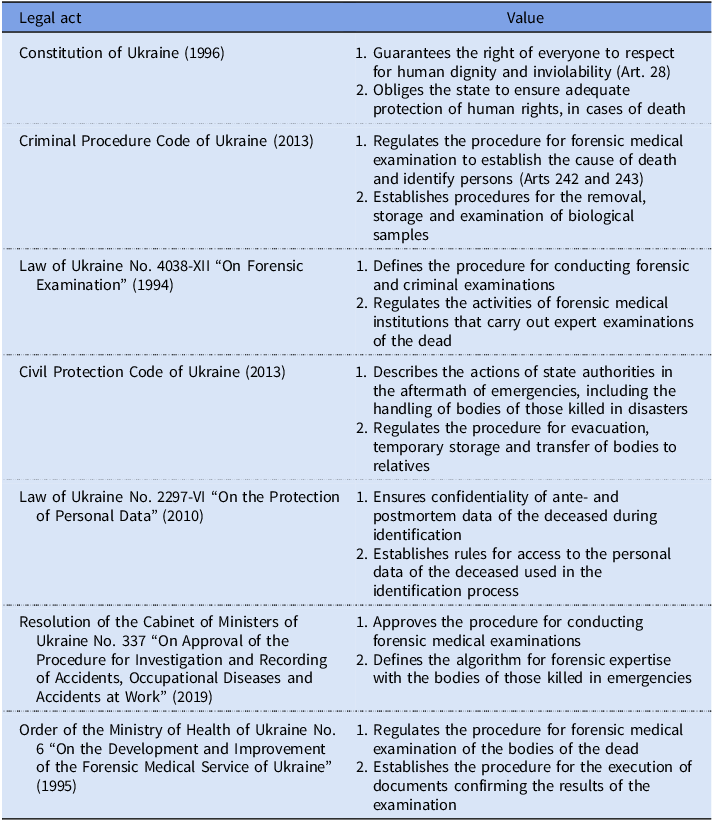
The formal legal (dogmatic) method was used to analyse the legal acts and regulatory documents that define the procedure for identifying the dead in Ukraine, in particular: the Constitution of Ukraine (1996); the Criminal Procedure Code of Ukraine (2013); Law of Ukraine No. 4038-XII “On Forensic Examination” (1994); the Civil Protection Code of Ukraine (2013); Law of Ukraine No. 2297-VI “On the Protection of Personal Data” (2010); Resolution of the Cabinet of Ministers of Ukraine No. 337 “On Approval of the Procedure for Investigation and Recording of Accidents, Occupational Diseases and Accidents at Work” (2019); and Order of the Ministry of Health of Ukraine No. 6 “On the Development and Improvement of the Forensic Medical Service of Ukraine” (1995). International law (in particular, the Geneva Convention Relative to the Treatment of Prisoners of War of 1949)Footnote 2 plays a role in regulating the process under study.
Real-life cases were studied through case-study analysis: identification of victims of the war in Ukraine (Real-Picado, Díaz, and Gomes Reference Real-Picado, Díaz and Gomes2023); the Sewol ferry disaster in South Korea (Alshehhi et al. Reference Alshehhi, Almarzooqi, Alhammadi, Werghi, Tay and Alsafar2023); the earthquake in Haiti (Gupta and Sadiq Reference Gupta and Sadiq2010); the terrorist attack on the Twin Towers on 11 September 2001 in New York (Ziętkiewicz et al. 2012); the MH17 air crash of 2014 (de Boer et al. Reference De Boer, Maat, Kadarmo, Widodo, Kloosterman and Kal2018); and the importance of the Aadhaar scheme in India (Mehta Reference Mehta2023). The INTERPOL DVI standard (Knudsen Reference Knudsen, Payne-James and Byard2024) was studied as a standard in the field of identification of victims of disasters and wars. The main stages of the DVI process were investigated.
Results
The process of identification of the dead in Ukraine is regulated by several legal acts covering criminalistic, forensic medical and legal aspects. They are aimed at ensuring the effectiveness of the process, adherence to ethical standards and protection of citizens’ rights (Table 1). They are designed to ensure the effectiveness of this process, compliance with ethical standards and protection of citizens’ rights.
Legal regulation of the process of identification of the dead in Ukraine

In the twenty-first century, DNA forensics are critical for locating and identifying missing persons and the deceased (Silali, Odero, and Rogena Reference Silali, Odero and Rogena2021). Blood, sperm, saliva, urine, hair, teeth, bones, tissues and cell layers are among the elements used for DNA detection and examination. The main conditions for DNA examination are the condition of the biological object (absence of degradation and exposure to inhibitors) and the amount of DNA present (Siuta et al. Reference Siuta, Dobosz, Kawecki and Dobosz2023).
Gill et al. (Reference Gill, Benschop, Buckleton, Bleka and Taylor2021) demonstrated that short tandem repeat marker genotyping is a practical and reliable substitute for identification when a body with a high degree of decomposition is found, which is often the case during war when identification based on general morphological features is not possible. Corpses with progressive changes in the process of decomposition are often used for the analysis of bone or dental material.
The cost-effective and efficient technique of postmortem DNA sampling in mass fatalities on commercially available DNA preservation cards (FTA cards), which are popular in forensic laboratories and portable due to their small size and stability at room temperature, proposed by Soniya and Suresh Kumar (Reference Soniya, Suresh Kumar, Ranjan Dash, Shrivastava and Lorente2022) is noteworthy.
To identify the bodies of the 298 victims of the 2014 MH17 crash, the Netherlands’ experts developed the DVI sampling method (de Boer et al. Reference De Boer, Maat, Kadarmo, Widodo, Kloosterman and Kal2018). This method uses a fast, simple, affordable and effective way to collect samples of teeth, bones, muscles and bone marrow. They provided detailed instructions along with suggestions on the type of tissue to be collected and where to cut it. According to the methodology, 98.2% of the samples collected from the crash site yielded very informative DNA genotyping results without the possibility of contamination and, consequently, inaccurate identification of the victim’s DNA (de Boer et al. Reference De Boer, Maat, Kadarmo, Widodo, Kloosterman and Kal2018).
According to biological experts, the first cadaveric material used for DNA identification during the military conflict in Ukraine has a high degree of polymerase chain reaction inhibition and DNA degradation (Real-Picado et al. Reference Real-Picado, Díaz and Gomes2023). This is determined by the fact that the aggressor country, Russia, not only made it impossible to remove the materials promptly but also violated the customs of burial and preservation of the deceased. The cadaveric material is submitted for examination in four conventional categories: (a) remains removed within hours or days after death and stored in a frozen or deeply chilled state; (b) remains of exhumed bodies that are subject to decomposition; and (c) remains exposed to different levels of heat. Suppose the material is taken from soft tissue or blood. In that case, there is a high risk of contamination for the first category of objects, as sterility rules may be violated during the collection of material in the morgue. As a result, the choice of osteodental material is still preferable, as aggressive substances such as hypochlorite and ultraviolet light are applied to the bone surface. If osteodental material is sent, identification is not a problem for the second category. Even after purification with the buffers included in the well-known kits (PrepFiler and PrepFiler BTA), the high concentration of polymerase chain reaction inhibitors (putrescine, cadaverine) in soft tissue and blood residues prevents DNA identification due to deep degradation. Due to the high degradation of DNA caused by visible putrefactive changes and storage in plastic bags, often in open storage areas, the third category is difficult to identify.
Bone can be subject to DNA extraction in cases of significant putrefactive changes. For this purpose, 10–15 cm of the diaphysis is sawn off from the long tubular bone, cleaned with a detergent solution and then dried (Girela-Lopez, Beltran-Aroca, and García-Mozo Reference Girela-Lopez, Beltran-Aroca, García-Mozo, Cristóbal, Blanco and Bueno2020). Instruments should be kept aseptic during the biological sampling phase by regularly cleaning and rinsing them with distilled water before use. Dental forceps can remove multiple teeth along with the root in blast trauma, resulting in body destruction and serious limb damage. Teeth are key elements in the use of DNA analysis to identify unidentified bodies, as they act as a shell that protects the DNA from harmful environmental factors.
Experts emphasize that a comprehensive approach should be taken when identifying the dead in mass casualty emergencies in Ukraine (Ashbridge et al. Reference Ashbridge, Randolph-Quinney, Janaway, Forbes and Ivshina2022). This means that traditional identification studies should first be conducted to identify common features and then individual features. Identification should not be achieved through DNA analysis alone. Initial biological profiling, i.e. the identification of general characteristics such as race, sex, age, height, headgear size, blood type and other characteristics, becomes more important in cases of mass deaths caused by natural disasters and military conflicts (Ide Reference Ide2023). These characteristics not only serve as a source of additional information but also allow for forensic distinction between objects. Conventional methods of human identification are easy to use, do not require expensive equipment, are readily available and do not have substantial time requirements.
Although forensic DNA is well developed and is still used for the practical identification of war and disaster victims, DNA testing is still expensive and slow. In war-crimes investigations, traditional methods of identification, such as DNA testing and visual identification by family members, pose a dilemma for both practitioners and family members (Blau et al. Reference Blau, Roberts, Cunha, Delabarde, Mundorff and de Boer2023). When bodies are decomposed or burned, the identification process is often complicated. Family members are often opposed to the digging up of bodies; both family members and identifiers are often traumatized by seeing such conditions.
Biometrics is a technology for measuring and statistically analysing biological data. In information technology, biometrics refers to technologies that measure and analyse characteristics of the human body, such as DNA, fingerprints, retina and iris, voice patterns and print patterns for authentication purposes (Melzi et al. Reference Melzi, Rathgeb, Tolosana, Vera-Rodriguez and Busch2024). Biometric technologies consider potential data as a means of identification. Forensic DNA analysis limits the bodies of innocent victims to bones, teeth and many follicles. Other biometric data about a person are known to include race, sex, age, height, weight, fingerprints, retina, blood type, blood proteins and hair. A variety of biometric technologies have been developed and used to identify victims of war and disasters, and their application depends on the type and duration of the incident and the quality of available ante- and postmortem records. The five main types of biometric technologies used are photographs, anthropological features, fingerprints, odontological data and DNA-based methods (Mesejo et al. Reference Mesejo, Martos, Ibáñez, Novo and Ortega2020). Identification is usually conducted using morphological or structural features or those distinctive characteristics that are inherent in a particular biometric. Pre-processing is usually required to digitize those features that are not normally in digital form. Biometric operations are then performed to acquire, encode, represent, compare and match the digital biometric characteristics. Histograms of the biometric signals are computed to perform statistical analysis of these histograms for identification. Appropriate biometric technology is used in conjunction with available biometric data, biometric data quality, cost, simplicity, speed, accuracy and any other relevant parameters. Quality limitations must be considered for both antemortem and postmortem records; otherwise, satisfactory identification cannot be made with the biometric technology of choice. The required reliability of identification is usually the driving force behind the selection of the appropriate biometric technology to be used. To describe the effectiveness of a biometric identification system in terms of performance, three objective quality indicators are established. Factors for planning and conducting a disaster identification project are discussed, and conclusions are drawn from three empirical reports.
In India, more than 400 million people, as of 2013 alone, were registered in the Aadhaar scheme, which aims to issue a unique 12-digit identification number to all residents (Mehta Reference Mehta2023). A key feature of Aadhaar is that it uses unique biometric identifiers to link people to their numbers. For the first time, there is a database that contains the biometric data of almost half a billion people in India. There are several advantages to using this database for DVI in India. It covers a large proportion of the population, significantly reducing the number of people who remain unidentified, thereby reducing the time and money spent on pathological examinations and other activities. The computer interface to the database is easy to use and requires minimal operator training. It is possible to immediately determine whether a given person is alive or deceased, or whether data are missing. Currently, the Aadhaar number and the corresponding biometric data are not linked to the police or the National Crime Bureau. This linkage will greatly enhance the effectiveness of law enforcement and national security. Given the unique biometric characteristics of humans, unique Aadhaar numbers for the deceased can be used to ensure that unidentified remains contain unique biometric information that identifies the missing person and is used to reunite families of suspected remains (Singh Reference Singh2021). Having biometric information embedded in the Aadhaar number will allow for faster and more accurate identification of disaster victims. Ensuring that biometric data are collected using the latest forensic technology could potentially eradicate misidentifications of victims in disasters. Furthermore, by combining the Aadhaar database with other information databases, unidentified remains can be identified more effectively, leading to a reduction in the number of remains that need to be identified.
The use of 3D scanning and virtual reconstruction is increasing in the field of forensic investigations (Haltsova et al. Reference Haltsova, Kharytonov, Khramtsov, Zhytnyi and Vasyliev2021). High-resolution data allow forensic pathologists to examine some trivial injuries on victims that are unlikely to be directly observed or extracted using two-dimensional (2D) images, including information related to microfractures, colour variations and damage to tissue surfaces (de Boer et al. Reference De Boer, Blau, Delabarde and Hackman2019). Compared to the conventional method, these new techniques can significantly reduce sample damage. This improvement means that 3D scanning could become the standard for human tissue analysis. Digital models created by 3D scanning can provide 2D images of tissue and section shapes that are useful for subsequent histological analyses.
For instance, 3D scanning was used to image the skulls of victims of the Sewol ferry disaster in South Korea to identify the victims. Accurate measurement of the skull is a key process in facial reconstruction, and the videogrammetry technique can quickly measure different points of the skull if an image of the skull is obtained, although only 2D data can be obtained. Thus, this study employed 3D facial approximation techniques using a variety of methods based on extensive skull research to obtain the biological profile and features of each victim, including sex, age, ancestry, physique and antemortem injuries (Alshehhi et al. Reference Alshehhi, Almarzooqi, Alhammadi, Werghi, Tay and Alsafar2023). Despite the effectiveness of 3D facial data for facial approximation technology, the pantomimic facial features of each victim have not been sufficiently estimated using other existing methods. Furthermore, 3D facial approximation technology differs depending on the solution or manipulation of some of the observed data. However, in the case of the Sewol ferry, it was often difficult to identify victims due to the large number of victims and environmental degradation. In addition, the rotten condition and subsequent postmortem damage caused limitations to a range of forensic techniques, such as fingerprint and dental comparisons, which are essential for victim identification. Through research and the sharing of information and methods between forensic science agencies, facial anthropologists can help make biological pixel profiles available when otherwise only semi-anatomical markers remain. In the case of the ferry disaster, however, a large number of expert descriptions were conducted simultaneously, and records and reports containing the remains of the deceased were reviewed at the same time, leading to instant identification of potential victims.
The decomposition, incineration, burial or transport of bodies causes numerous changes to human remains over time, caused by both physical factors such as temperature and humidity and biotic agents such as necrophagous organisms. Consequently, the recovery of these remains often requires a long time, at the end of which the corpses are found in various stages of decomposition or with physical and morphological changes, only some of which are identifiable by traditional methods. Classical identification methods are not applicable in certain intermediate and postmortem conditions of destruction that alter or distort the primary and secondary sexual characteristics of the living. In these circumstances, the rapid availability of certain non-classical biometric methods for body identification is a necessity. These non-classical methods include, among others, morphometrics or other morphological details of human bones (Meucci, Verna, and Costedoat Reference Meucci, Verna and Costedoat2022). The advantage of these techniques is that they provide rapid results and exploit the unique and non-destructive human-specific or general nature of different bone materials, including macro-inorganic atomic and stoichiometric mapping techniques or molecular reaction techniques such as neutron activation analysis, electron microscopy with X-ray microanalysis or other useful methods with a defined and reasonable bone suitability threshold. Anthropological analysis and forensic analysis are key methods for identifying the deceased in cases where the body remains are damaged, decomposed or presented only as bone remains. These methods can be used to determine the basic characteristics of a person, including sex, age, ethnicity, physical features and even the living conditions of the deceased.
Comparing X-rays of bones, prosthetics and other medical devices with available medical records is one of the most effective methods of identifying the deceased, especially in circumstances where other physical or biometric characteristics of the body are destroyed (Morele, Hill, and Keyes Reference Morele, Hill and Keyes2024). This method is based on the unique anatomical features of the bone structure (shape of the skull, teeth, vertebrae, limbs, etc.) and the presence of specific medical interventions (implants, prostheses, pins, plates, etc.).
The use of X-ray image data for anthropological analysis has been established in forensic anthropology, for example, for antemortem and postmortem comparisons for identification purposes. Currently, it is also worth noting the increasing adoption of the X-ray computed tomography protocol for the detection of internal injuries in human remains in forensic anthropology (Withers et al. Reference Withers, Bouman, Carmignato, Cnudde, Grimaldi, Hagen, Maire, Manley, Plessis and Stock2021). This technological criterion is used in postmortem scenarios for anthropological tasks such as biological profiling. However, in cases of mass recoveries or ossuaries in which there are large numbers of unidentified human remains, attempts at individual anatomization are often futile, and biological profiles are often made using medical records, especially when such data are available. In this context, there is a new opportunity to use X-ray images as a complement to traditional methods of anthropological analysis. The purpose of this pilot study is to address the prospects of X-ray images of human remains, which will be included in banked medical records to the maximum extent possible, for the identification of victims of persecution.
X-rays taken during the life of the victims have significant potential, providing anatomical data that take a long time to obtain, thus providing additional information. It is necessary to identify features that exclude human remains not documented in the bank’s medical records. These features include: the presence of multiple amputations in different locations, including the skull cap, which may suggest the presence of cortical slices; or the destruction of the remains themselves, scattered carpal bones or extensive bone fragmentation. Medical records contain information about the dimensions of some bones that are not easily measured from early radiological images because they contain only one-dimensional bone dimensions. In addition, it is sometimes necessary to measure pelvic bones by sex or age at death. Medical records that contain the sex, age, date of examination, place of examination, body height, weight and date of death of a single individual are useful for determining sex and age.
The research highlighted the importance of medical records in forensic anthropology. Following the devastating earthquake in Haiti in 2010, which led to the loss of hundreds of thousands of people, the process of identifying the dead faced significant challenges (Gupta and Sadiq Reference Gupta and Sadiq2010). Due to the scale of the tragedy and the condition of the bodies, traditional methods such as facial recognition or identification of personal belongings often proved impossible. In this context, medical devices, including implants, have become an important source for identifying the dead. Metal implants, prostheses, dental crowns and other devices remained intact even in the harsh conditions of the earthquake. Many medical devices, such as pacemakers or orthopaedic pins, have serial numbers or manufacturer’s markings that allow them to be traced to a specific patient. They have recorded information about the serial number, date of implantation and manufacturer. These data have become an important source of information for body identification. Pins, plates and joint prostheses made of titanium or stainless steel are well preserved. In many cases, they contained serial numbers that were checked against manufacturers’ databases. Metal–ceramic crowns, dental implants and braces were analysed using X-rays and compared with data from dental clinics. Forensic experts removed medical devices from the remains for detailed analysis. The serial numbers of the devices or X-ray data were compared with the antemortem records. The data obtained were used to establish links between the remains and specific patients. However, in Haiti, most medical facilities did not keep electronic records, making it difficult to access antemortem information and identify implants, which required cooperation with international manufacturers, a time-consuming process.
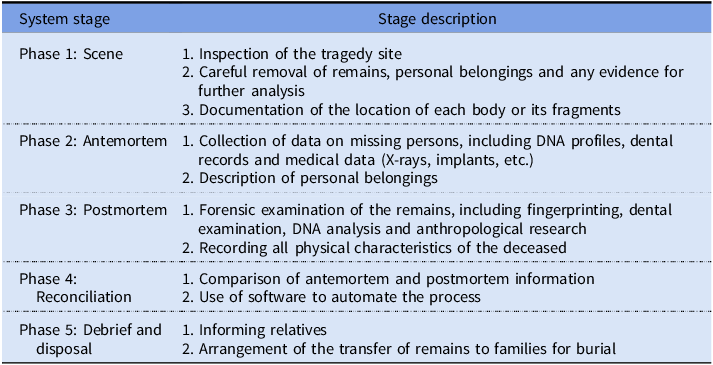
INTERPOL DVI is an international system developed to identify victims of mass disasters (natural or artificial) and armed conflicts (Knudsen Reference Knudsen, Payne-James and Byard2024). This methodology is based on standardized protocols that ensure effective, scientifically based identification of bodies and their return to families (Table 2). The main goal of this system is to identify the deceased in a manner that respects human dignity and religious and cultural sensitivities (Byrd and Ross Reference Byrd, Ross, Ross and Byrd2024). All procedures are based on accurate scientific data, such as DNA analysis, fingerprinting, dental analysis and other methods. The identification results correlate with the requirements of each country’s legislation.
Steps in the disaster victim identification process
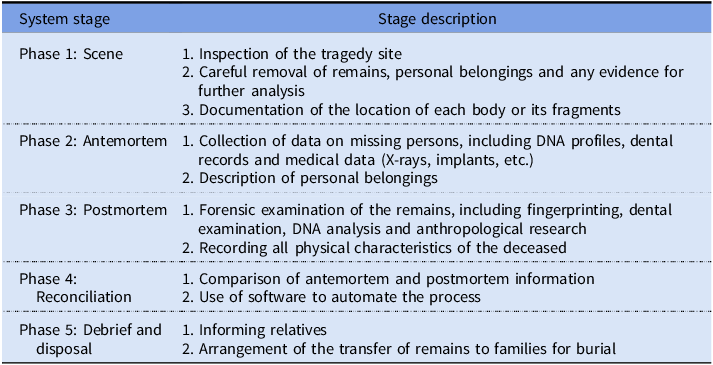
Source: Lessig and Prinz (Reference Lessig, Prinz and Madea2022).
INTERPOL DVI standards are the primary standard for identifying victims of disasters and wars. They ensure an accurate, ethical and transparent process, even in challenging environments. The integration of modern technologies, such as artificial intelligence and big data, further enhances the effectiveness of these standards, making them an integral part of the international emergency response system.
DVI techniques are central in the identification of the remains of the victims of the terrorist attack on the Twin Towers on 11 September 2001 in New York City (Ziętkiewicz et al. 2012). It was one of the largest victim identification operations in modern history and faced numerous challenges due to the scale of the disaster, the condition of the remains and the need to ensure the accuracy of the process. More than 2,700 people died because of the collapse of buildings and fires. The condition of the bodies made identification difficult, with most remains severely damaged or fragmented. More than 21,000 separate body fragments were found, requiring careful analysis. Hundreds of bodies remained unidentified due to the lack of sufficient antemortem data. The identification process was groundbreaking in its use of modern scientific and technological methods.
Thus, the identification of deceased persons during armed conflicts and disasters is a complex process that requires innovative approaches due to the large amount of work, difficult conditions and often a high level of body destruction. Modern criminalistic and forensic medical methods can improve the efficiency and accuracy of identification.
Discussion
Identification of the deceased is the final stage in establishing the end of life of a person who went missing during military or peaceful actions. Search and, if necessary, rescue operations are conducted to identify victims of hostilities following the principles of international humanitarian law and continue when military operations are not in progress. The purpose of the identification of deceased persons may be individual, family or regional, and it varies depending on the goals and objectives of those interested in this identification. For some purposes, unconfirmed circumstantial evidence may be sufficient, or a comprehensive examination including a range of molecular genetic tests may be required. It is important to conduct a comprehensive investigation into the death of a person to avoid gaps in legislation that may lead to a lack of effective legislation in addressing the issues that arise concerning a missing person.
The process of identification of the dead during armed conflicts and disasters is a relatively new and not fully understood area of research. The process of identifying those killed in armed conflicts and disasters is still in its infancy. As noted by Puerto et al. (Reference Puerto, Abboud, Baraybar, Carracedo, Fonseca, Goodwin, Guyomarc’h, Jimenez, Krenzer, Mendez, Prieto, Gonzalez, Orozco, Taylor, Tennakoon, Winter and Finegan2021), several terms are used in the scientific literature to describe the process of identifying deceased persons, such as identification of the person, as well as identification of unidentified deceased persons. It is possible to assume that this ambiguity is because different tasks need to be solved in different conditions to obtain accurate and reliable information about individuals. According to forensic medicine, the following types of identification are distinguished: primary (visual); biometric; and secondary (based on all others).
The study determined that the formation of the identity of the deceased is a complex and multifaceted task, the implementation of which directly depends on the conditions of death. The conditions of a person’s death largely determine the complexity and methods of the identification process. In each case, an individual approach is required, considering the specifics of the body condition, the environment and the availability of resources. Having studied this issue, Tiemensma, Hinchliffe, and Lee (Reference Tiemensma, Hinchliffe, Lee, Payne-James and Byard2024) include both external and internal factors related to bacterial contamination of tissue and the effect of high or low temperatures on its composition. Internal and external factors, along with the combined effect of several secondary factors, lead to complete or partial damage and loss of macro/micromorphological characteristics in secondary groups of people, including medical and transport personnel, as well as rescuers. Direct diagnostic signs of exposure to thermal factors that do not lead to bacteriological changes, although they can capture groups of extreme and cadaveric victims of natural and unnatural causes, have been identified.
As the study established, the identification of the deceased is an important but complex process that takes place during armed conflict and disasters. Although the process of identifying the dead in armed conflict and natural disasters is largely similar, it is important to recognize that mass atrocities and other types of disasters have different backgrounds and the political processes associated with the response, including investigation and prosecution, are different. This is also argued by Manera-Scliar et al. (Reference Manera-Scliar, Hernández, Martín-López and Gomes2023). However, as noted by the scholars, the need and purpose of the methods used to identify the deceased are relatively more standardized across the two types of circumstances compared to the obstacles encountered in the application of these methods. Heavy workloads, enormous and devastating physical and mental impact, political challenges, logistical difficulties, mass displacement, urgent need to save lives, pressure from relatives of the missing, intercultural sensitivities of staff and limited resources, including expert personnel, are some of the well-known factors that affect the effectiveness of the identification process.
While the identification process is predominantly important for fulfilling legal obligations, it also has immediate and ethical implications for religious and psychological issues. According to the findings of Phan et al. (Reference Phan, Ngu, Chen, Wu, Lin and Hsu2020), one recurring argument that combines the subtle terminology of the connections between the legal, religious, social and psychological aspects of the identification process into a coherent term is “honouring”. Forensic medical intervention by expert professionals is necessary when identification becomes difficult due to local capacity constraints. In such circumstances, when national and international forensic expertise is required, family associations and the local population can contribute in a variety of ways, for example, in obtaining accurate antemortem information, family DNA samples and registering missing-person data.
A challenge for forensic experts today is to recover identity documentation, such as deathbed photographs and medical records, of people who were documented during their lifetime. The deceased usually do not have any identification documents on them that allow them to contact relatives or facilitate the completion of antemortem information to identify human remains. It is crucial to identify victims of armed conflict and disasters to assist grieving families. This helps fulfill the societal obligation to recover the dead, ensures the human right to be identified for burial, and provides closure for families regarding missing relatives. These principles are outlined in international instruments and national legislation, and are supported by established ethical codes. Authorities who decide to exhume mass graves or transfer human remains are usually motivated by protection, justice, humanitarian, social or religious reasons.
The history of body identification demonstrates how methods have gradually improved, adapting to the challenges of each tragedy. Modern technologies, such as DNA analysis, anthropological research and artificial intelligence, are the result of previous development. However, even currently, the identification process requires significant effort, time and international cooperation, especially in the context of large-scale disasters or armed conflicts. According to Bikker (Reference Bikker, Mallett, Blythe and Berry2014), the science of forensic identification is characterized by the use of mainly physical methods and, more recently, technological approaches. The process should always be approached holistically. However, this has not always been the case, emphasizing its importance. However, proper management and control procedures for the identification of human remains have made it possible to use a range of techniques, such as anthropological, radiological, toxicological and genetic methods, which are used in combination, sharing complementary information between the scientific analyses involved. As criminalistic disciplines may evaluate evidence from a victim or perpetrator, other techniques such as odontology and facial reconstruction are often used in the process of identifying human remains. Digital photographic facial reconstruction is described, which is currently less detailed and frequently used, and is not generally accepted in the forensic anthropology and criminalistics community as a criterion for inclusion, without the need for further traditional evaluation of biological profile variables, biological processes, mechanics and subsystems present in digital individual scientific images in colour depth.
The development, implementation and use of innovative approaches, tools and technologies in criminalistics and forensic examination to identify those killed during armed conflicts are key areas of research that scholars and practitioners focus on (Orlovskyi, Us, and Shevchuk Reference Orlovskyi, Us and Shevchuk2023; Shevchuk et al. Reference Shevchuk, Shevchuk, Kompaniiets, Lukashevych and Tkachova2022a). Research has shown that European practices in the development of criminalistics and forensic examination focus on the integration of advanced institutions and the introduction of the most effective methods and modern technologies in the investigation of war crimes and the identification of victims of military conflicts using legal–medical and forensic means (Shevchuk et al. Reference Shevchuk, Kapustina, Zatenatskyi, Kostenko and Kolesnikova2023).
Scholars agree that the identification of those killed in armed conflicts and disasters is multidimensional (Getman et al. Reference Getman, Yaroshenko, Demenko, Lutsenko and Prokopiev2024). It encompasses not only technical and legal aspects, but also important ethical, psychological and socio-political aspects. Improvements in technology and enhanced international cooperation are key to making this process more effective.
Conclusions
Identification of the dead during armed conflicts and disasters is a complex and multifaceted process that combines criminalistic, forensic medical, technical and legal aspects. Innovative methods can significantly increase the efficiency of these activities, but their implementation requires addressing several challenges, including technical limitations, lack of resources and imperfect legal regulation. The integration of modern technologies, international cooperation and ethical approaches will create the conditions for effectively overcoming these challenges.
Innovative identification methods, such as DNA analysis, forensic anthropology, forensic medicine, criminalistics, medical record comparison, big data and artificial intelligence, significantly increase the accuracy and speed of identification. Their use is particularly relevant in situations where traditional methods, such as fingerprinting or visual identification, are ineffective due to the condition of the bodies. Significant obstacles in the identification process are associated with the destruction of bodies, mass graves and the lack of unified databases of antemortem information. The integration of automated identification systems could be a solution to these problems. Complications also arise from the condition of the remains, including decomposition, fragmentation or thermal damage, which require the use of modern laboratory technologies such as mass spectrometry and criminalistic 3D reconstruction. However, the low level of logistical support remains a key challenge.
Identification through DNA, biometrics (fingerprints, dental records), criminalistics and medical implants is becoming a key tool in cases where traditional methods are insufficient. Genomic research provides high accuracy even in difficult conditions.
The use of innovative methods requires consideration of ethical and legal standards, including the protection of personal data, respect for religious and cultural traditions, and the right of families to information about the deceased. International standards, such as INTERPOL DVI, are key to coordinating the work of experts and ensuring the reliability of results. Integration into national identification systems is an important step to increase efficiency. The INTERPOL DVI standards and the involvement of international organizations contribute to the harmonization of identification procedures in mass casualty situations. International databases and joint protocols ensure effective coordination between countries.
The main limitation of the topic is the absence of a unified system for evaluating innovative methods, namely, insufficiently developed criteria for assessing the effectiveness of new methods, such as artificial intelligence or biometric technologies, and the lack of systematic comparisons between traditional and innovative approaches. In addition, the research is hampered by the lack of real cases for analysis due to the confidentiality of forensic materials. There is a lack of large datasets that could be used to analyse and test innovative approaches.
Identification of the dead in armed conflicts and disasters is a multifaceted topic that requires the integration of modern technologies, forensic approaches and forensic practices. Therefore, future research on the identification of the deceased should focus on the integration of the latest technologies, improving standards and considering socio-ethical aspects. The combination of criminalistics, forensic medicine and innovative approaches will not only improve the accuracy of identifications but also promote justice by helping families find answers even in the most difficult circumstances.
Competing interests
The authors declare they have no financial and competing interests.
Viktor Shevchuk is a DSc and Head of the Department of Criminalistics, Yaroslav Mudryi National Law University. He focuses his research on the integration of artificial intelligence technologies into criminalistics and evidence analysis.
Oleksandr Dunaev is a researcher at the Department of Forensic Medicine, Medical Law named after Prof. M.S. Bokarius, Kharkiv National Medical University. He focuses on the development and application of innovative forensic techniques, particularly DNA analysis and forensic anthropology, to improve the identification of deceased persons in disaster and conflict scenarios.
Olha Tyshchenko is a researcher at the Department of Criminal Process, Yaroslav Mudryi National Law University. She specializes in the ethical and legal aspects of forensic identification, with an emphasis on the protection of personal data, cultural sensitivity and the integration of international standards such as INTERPOL DVI protocols.
Ganna Biletska is a PhD and Associate Professor at the Department of Criminalistics, Yaroslav Mudryi National Law University. She conducts research on the application of advanced technologies, such as big data, artificial intelligence and mass spectrometry, in forensic investigations, aiming to enhance the accuracy and efficiency of deceased identification processes.
Vladyslav Nehrebetskyi is a PhD and Associate Professor at the Department of Criminalistics, Yaroslav Mudryi National Law University. He conducts research on comparative criminal law, with particular attention to artificial intelligence applications in international investigative practices.