




Introduction
Terrestrial mollusks, particularly land snails, have been recognized as typical “index animals” due to their sensitivity to climate change (Liu, Reference Liu1985). Land snails are widely distributed in the semiarid to arid regions of China, such as the Chinese Loess Plateau (CLP), and abundant fossil shells are preserved in the loess deposits on the CLP, serving as a valuable archive for paleoclimate reconstruction (Wu et al., Reference Wu, Li and Rousseau2018). Modern ecological studies reveal that the spatial composition and diversity patterns of land snail communities in China are principally governed by environmental parameters, particularly air temperature and relative humidity (Chen and Gao, Reference Chen and Gao1987). This established the theoretical foundation for employing snail assemblages in reconstructing climate change in the geological past. For example, the assemblages of land snail fossils on the CLP have been used to reconstruct monsoonal environmental change in East Asia ranging from tectonic to orbital, and even millennial timescales (Rousseau and Wu, Reference Rousseau and Wu1997; Rousseau et al., Reference Rousseau, Wu and Guo2000; Wu et al., Reference Wu, Chen, Rousseau, Li, Pei and Wu2007, Reference Wu, Li and Rousseau2018; Li et al., Reference Li, Rousseau, Wu, Hao and Pei2008; Dong et al., Reference Dong, Wu, Li, Zhang, Zhang, Shen and Lu2022a). However, despite these successful applications, significant challenges persist in the interpretation of the assemblages of fossil records, particularly regarding the precise environmental significance of species assemblages and taphonomic biases in shell preservation (Wu et al., Reference Wu, Li and Rousseau2018).
In the past few decades, growing studies have focused on environmental controls of shell geochemical composition in terrestrial gastropods, particularly stable carbon (δ13C) and oxygen (δ18O) isotopic signatures (e.g., Bao et al., Reference Bao, Sheng, Teng and Ji2018, Reference Bao, Sheng, Lu, Li, Luo, Shen, Wu, Ji and Chen2019; Wang et al., Reference Wang, Cui, Zhai and Ding2016, Reference Wang, Dettman, Wang, Zhang, Saito, Quade, Feng, Liu and Chen2020; Zhai et al., Reference Zhai, Wang, Qin, Cui, Zhang and Ding2019; Zamanian et al., Reference Zamanian, Lechler, Schauer, Kuzyakov and Huntington2021). Within East Asian summer monsoon (EASM) domains, snail shell δ13C values have been interpreted to reflect variations in the δ13C values of C3 plants and associated precipitation patterns (Bao et al., Reference Bao, Sheng, Teng and Ji2018). This assumption hinges on the premise of proportional consumption of available vegetation by snails (Goodfriend and Magaritz, Reference Goodfriend and Magaritz1987), although individual habitat may restrict snails to specific microenvironments. Moreover, several studies have proven that inorganic carbon from carbonate substrate or carbonate minerals also contributes to the carbon source of the shell (Goodfriend and Stipp, Reference Goodfriend and Stipp1983; Yanes et al., Reference Yanes, Romanek, Delgado, Brant, Noakes, Alonso and Ibáñez2009; Xu et al., Reference Xu, Gu, Han, Liu, Pei, Lu, Wu and Chen2010; Zhang et al., Reference Zhang, Yamada, Suzuki and Yoshida2014), which further complicates the interpretation of shell δ13C proxy. The correlation between shell δ13C and local rainfall is also species dependent, that is, no significant correlation can be drawn between δ13C compositions of a common northerly species, Cathaica fasciola, and local rainfall (Bao et al., Reference Bao, Sheng, Teng and Ji2018), preventing us from applying this proxy to reconstruct paleoprecipitation amounts on the CLP.
Regarding shell δ18O signatures, previous studies have demonstrated that the δ18O of modern land snail shells is largely determined by the δ18O of snail body water and thus the δ18O of precipitation (Goodfriend et al., Reference Goodfriend, Magaritz and Gat1989; Yanes et al., Reference Yanes, Al-Qattan, Rech, Pigati, Dodd and Nekola2018; N. Zhang et al., Reference Zhang, Yamada and Yoshida2018). Recent works carrying out ultra-high-resolution δ18O analysis have shown that snail shell δ18O exhibits large seasonal variations, up to ∼14‰ during the growing seasons from March to October, likely influenced by seasonal changes in precipitation δ18O (Dong et al., Reference Dong, Yan, Zong, Wang, Liu, Xing, Lan, Wei, Dodson and An2022b; Zong et al., Reference Zong, Dong, Song, Yan, Xing, Liu, Cao, Hu and An2023; Li et al., Reference Li, Dong, Yan, Huang, Zong, Wang, Liu, Cao, Liu and An2024), suggesting that snail shell δ18O can be applied to investigate climatic seasonality (Wang et al., Reference Wang, Dettman, Wang, Zhang, Saito, Quade, Feng, Liu and Chen2020). However, this requires sampling of the whole fossil snail shell, while only shell fragments are preserved in the loess deposits in most cases. Given these complicated factors associated with δ13C and δ18O of snail shells, emerging shell-based geochemical proxies may have the potential to circumvent current limitations while providing insights into carbonate formation mechanisms and environmental interactions.
The incorporation of trace metals into authigenic carbonates on the CLP may record the ambient environment under which they are precipitated. Notably, the trace metal compositions of microcodium, which is formed due to the replacement of biological cells by the authigenic calcite in the loess deposits, have been found to be controlled by the composition of soil solution, serving as quantitative proxies for paleoprecipitation amounts (Li and Li, Reference Li and Li2014). This is due to the progressive precipitation of secondary calcite that increases the Mg/Ca and Sr/Ca ratios of the residue soil solution, which is called “prior calcite precipitation” (PCP) and can be quantitively described by a Rayleigh distillation model (Li and Li, Reference Li and Li2014). Analogous PCP processes have also been established to explain the trace metal compositions of speleothems (Owen et al., Reference Owen, Day, Hu, Liu, Pointing, Blättler and Henderson2016; H. Zhang et al., Reference Zhang, Yamada and Yoshida2018). Being biomineralized as aragonite, the snail shells may have the potential to document the composition of soil solution and thus the degree of Rayleigh distillation on the CLP, which deserves systematic investigation.
So far, no systematic investigation of the trace metal compositions of snail shells has been carried out, likely due to the complex bedrock types that obscure the direct comparison of shell trace metal compositions from different regions. Because loess is relatively homogeneous and representative of the upper continental crust in terms of geochemical compositions (Rudnick and Gao, Reference Rudnick and Gao2014), it provides a valuable opportunity to calibrate the correlation between the trace metal compositions of snail shells and environmental factors on the CLP. In this study, modern snail shells (Cathaica sp.) were collected on the CLP and analyzed for trace metal compositions (Sr/Ca, Mg/Ca, Mn/Ca, and Ba/Ca), δ13C, and δ18O. The intra-shell variations of element/Ca ratios were investigated to assess the seasonal variability. This was followed by the evaluation of inter-shell variability at a single site to address the influence of changes in microenvironments on element/Ca ratios of snail shells. Finally, spatial variations of shell element/Ca ratios on the CLP were investigated, and the potential controlling factors on shell element/Ca ratios were addressed.
Materials and methods
Modern snail shells (Cathaica sp.) were collected from 16 sites across the CLP (Fig. 1). Cathaica sp. is mainly distributed in northern China and is active from spring to autumn (Zhang et al., Reference Zhang, Du, Qin, Zhao, Wang and Zhang2015a). Live samples were collected either on plants or on the surface of the loess outcrop (Fig. 1). Shells of recently dead snails were collected where living snails were not available, especially in the northwestern sites where living snails are difficult to find. Shells were ultrasonically cleaned in deionized water at least three times to remove detrital materials. The clean individual shells were then air-dried and stored in centrifuge tubes. Subsamples of an individual shell were obtained using a dental drill and were then ground to powder using an agate mortar and pestle. The powder samples were then treated with 10% H2O2 solution to remove organic matter. At least three subsamples were drilled from an individual shell and at least three shells were subsampled from a specific site.
Left, The sampling sites on the Chinese Loess Plateau (CLP) and spatial gradients of mean annual precipitation (MAP) from 1979 to 2025. Right, Typical lifestyles of the snail: either active movement and feeding during favorable conditions or retreating into its shell and entering a dormant state during unfavorable periods during sampling in the field. The precipitation data are from CPC Global Unified Gauge-Based Analysis of Daily Precipitation (https://www.psl.noaa.gov/data/gridded/data.cpc.globalprecip.html).

For trace metal analysis, the shell powder was leached with 2 ml 0.001 M HNO3 before being dissolved in 2 ml 0.3 M HNO3. The 0.001 M HNO3 was used as a dilute acid to ensure minimal dissolution of the mineral phases while effectively removing loosely bound or exchangeable elements from the sample surfaces. Trace element concentrations of the shell powder were measured using inductively coupled plasma mass spectrometry (ICP-MS) at Nanjing University. The Ca concentrations of the sample solution were first adjusted to 80 ppm and a set of mixed standards with a constant Ca concentration of 80 ppm were used to calibrate the elemental ratios. The long-term reproducibility of Sr/Ca, Mg/Ca, Mn/Ca, Ba/Ca, and Al/Ca is better than 3% based on repeated measurements of an in-house standard. For carbon and oxygen isotope analysis, the shell powder was digested with 100% H3PO4 at 75°C in a Kiel IV carbonate device to produce CO2 gas and analyzed for carbon and oxygen isotopes on a Finnigan MAT 253 mass spectrometer at the Nanjing Institute of Geology and Palaeontology, CAS. All data are reported in δ-notation relative to the VPDB standard and the long-term reproducibility was better than ±0.06‰ and ±0.16‰ (2 SD) for carbon and oxygen isotopes, respectively.
Results
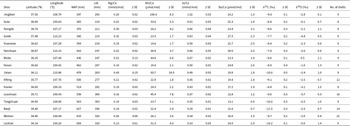
Snail shell Sr/Ca and Ba/Ca ratios are characterized by limited intra-shell but tiny inter-shell variations, while Mn/Ca and Mg/Ca ratios show large intra- and inter-shell variations (Figs. 2 and 3). Large spatial variations of snail shell Sr/Ca and Ba/Ca were found, with the lowest Sr/Ca and Ba/Ca ratios being 0.19 mmol/mol and 4.9 µmol/mol, respectively, in the southeastern CLP, and the highest Sr/Ca and Ba/Ca ratios reaching 1.15 mmol/mol and 35.5 µmol/mol, respectively, in the northwestern CLP (Fig. 4, Table 1). Significant correlations can be drawn between snail shell Sr/Ca and Ba/Ca ratios and mean annual precipitation (MAP), with higher Sr/Ca and Ba/Ca ratios being recorded in the sites on the northwestern CLP where MAP is lower (Fig. 4). The Sr/Ca and Ba/Ca ratios of the snail shell show a significant positive correlation, with higher values for the samples from the northwestern sites on CLP (Fig. 5).
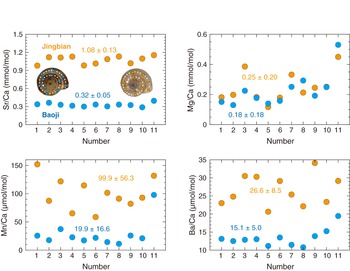
Intra-shell variations of element/Ca ratios of Cathaica sp. shells at Baoji and Jingbian, China. Circles denote the element/Ca ratios of 11 subsamples from an individual shell at Baoji (blue) and Jingbian (orange).

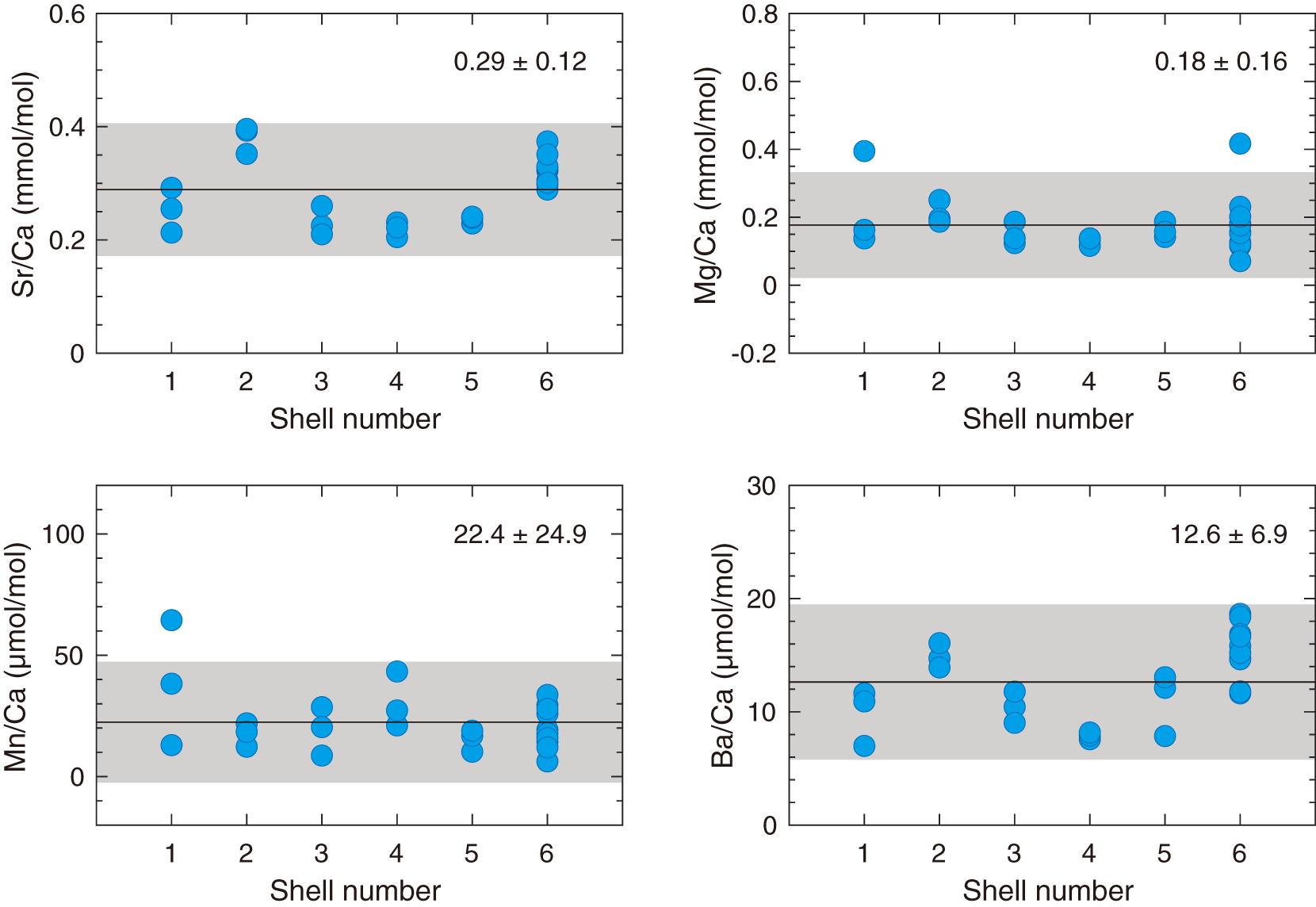
Inter-shell variations of element/Ca ratios of Cathaica sp. shells at Baoji, China. Circles denote the element/Ca ratios of six individual shells from Baoji, with at least three subsamples from each shell.

Cross-plots of mean annual precipitation (MAP) vs. Sr/Ca (a), Mg/Ca (b), Mn/Ca (c), Ba/Ca (d), δ13C (e), and δ18O (f) of Cathaica sp. shells on the Chinese Loess Plateau (CLP). Blue circles denote all measurements, while purple triangles represent mean values of an individual site, with error bars showing 2× standard error of the mean (2 SE).

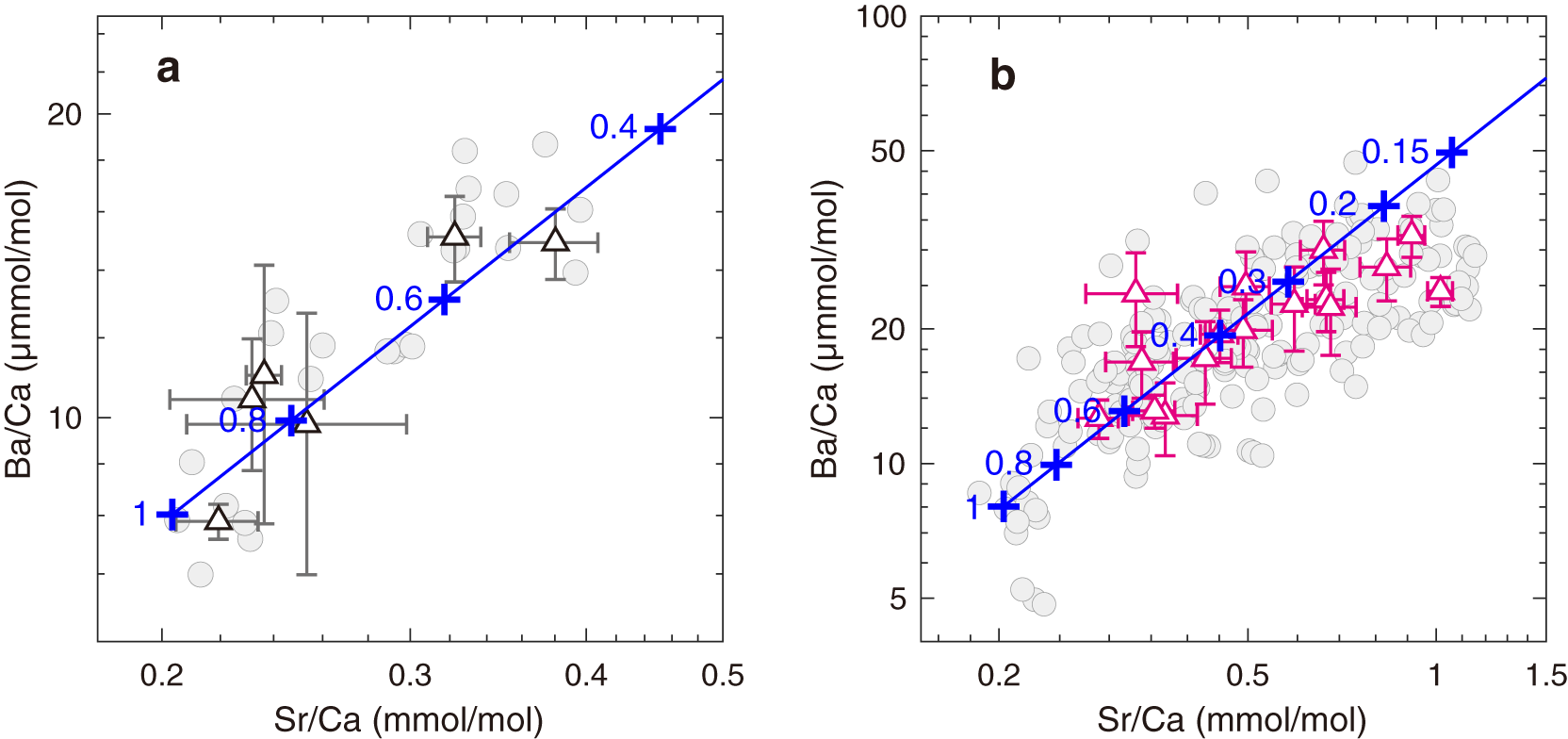
Sr/Ca and Ba/Ca ratios of Cathaica sp. shells from Baoji (a) and 16 sites on the Chinese Loess Plateau (CLP) (b) explained by Rayleigh distillation model (blue lines). Gray circles represent subsamples of an individual shell, while triangles in (a) represent the mean value of an individual shell (2 SD) at Baoji and triangles in (b) represent the mean value of at a sampling site (2 SE). Crosses denote the fraction of initial Ca remaining in soil water after the precipitation of secondary calcite.

The trace metal compositions of Cathaica sp. shells on the Chinese Loess Plateau.a

a JJA, summer (June, July, August); MAP, mean annual precipitation.
Discussion
Intra- and inter-shell variability of element/Ca ratios on the CLP
The intra-shell variations of element/Ca ratios were evaluated by analyzing 11 subsamples along the growth axis from an individual shell from a southeastern site (Baoji) and another from a northwestern site (Jingbian) (Fig. 2). Shell Sr/Ca varies between 0.29 and 0.37 mmol/mol at Baoji and between 0.98 and 1.15 mmol/mol at Jingbian (Fig. 2a), demonstrating that snail shell Sr/Ca exhibits limited intra-shell variation compared with the large spatial difference between Baoji and Jingbian. Snail shell Mn/Ca and Ba/Ca ratios also display significant spatial differences between Baoji (19.9 ± 16.6 µmol/mol and 15.1 ± 5.0 µmol/mol, respectively) and Jingbian (99.9 ± 56.3 µmol/mol and 26.6 ± 8.5 µmol/mol, respectively) (Fig. 2c and d), but the intra-shell variability of Mn/Ca (58.6–151.9 µmol/mol at Jingbian and 6.2–33.7 µmol/mol at Baoji) and Ba/Ca (20.6–34.1 µmol/mol at Jingbian and 11.6–18.7 µmol/mol at Baoji) are also significant compared with the spatial difference between Baoji and Jingbian. Snail shell Mg/Ca ratios also exhibit appreciable intra-shell variability (0.07–0.42 mmol/mol at Baoji and 0.12–0.45 mmol/mol at Jingbian) and are indistinguishable between Baoji and Jingbian (Fig. 2b). Taking the spatial difference as a reference, our results thus demonstrate that the snail shell Sr/Ca ratio exhibits limited intra-shell variability, while the snail shell Mg/Ca, Mn/Ca, and Ba/Ca ratios show substantial intra-shell variability. We further evaluated the inter-shell variability of element/Ca ratios by comparing the trace metal compositions of six individual shells collected from different areas at Baoji. The inter-shell variability of Sr/Ca, Mg/Ca, Mn/Ca, and Ba/Ca ratios is determined to be 0.12 mmol/mol, 0.16 mmol/mol, 24.9 µmol/mol, and 6.9 µmol/mol, respectively (Fig. 3), which is comparable to the aforementioned intra-shell variability of Sr/Ca, Mg/Ca, Mn/Ca, and Ba/Ca ratios, thus suggesting tiny inter-shell variability of element/Ca ratios for Cathaica sp. at a single site.
Nevertheless, the inter-shell variability of Sr/Ca and Ba/Ca ratios is relatively small compared with the spatial variations across the CLP (Fig. 4). Based on the multi-shell results from 16 sixteen sites, it is evident that shell element/Ca ratios from each site exhibit similar variability, with smaller variability of Sr/Ca and Ba/Ca ratios and comparable variability of Mg/Ca and Mn/Ca ratios compared with the spatial difference. Shell Sr/Ca ratio shows a clear spatial trend, with higher values being recorded in the sites on the northwestern CLP where MAP is lower. A similar trend has also been observed for shell Ba/Ca ratios, although two southeastern sites show relatively high shell Ba/Ca ratios and three northwestern sites show relatively low shell Ba/Ca ratios. Given the tiny inter-shell variability and the significant spatial trend, the Sr/Ca and Ba/Ca ratios of Cathaica sp. very likely represent measures of processes related to regional climatic factors.
Factors controlling element/Ca ratios of land snail shells on CLP
The incorporation of trace metals into land snail shells is controlled by two key processes: the source of cations and snail biomineralization processes. The influence of species on the biomineralization processes, and thus trace metal compositions, also known as the “vital effect,” has been widely observed in other biogenic aragonite, such as scleractinian corals (Cohen et al., Reference Cohen, Owens, Layne and Shimizu2002; Gagnon et al., Reference Gagnon, Adkins, Fernandez and Robinson2007; Chen et al., Reference Chen, Littley, Rae, Charles, Guan and Adkins2022). Because only Cathaica sp. is explored in this study, the influence of the vital effect on the inter-shell variability of element/Ca ratios is expected to be minor. However, the vital effect may play a key role in determining the intra-shell variability of element/Ca ratios, especially the Mn/Ca and Mg/Ca ratios. There is evidence that the structure of the aragonitic host can be altered locally such that Mn attains an octahedral coordination, promoting the enrichment of Mn many orders of magnitude higher in its aragonite shell (Soldati et al., Reference Soldati, Jacob, Glatzel, Swarbrick and Geck2016). This may explain the large intra-shell variability of Mn/Ca ratio observed in this study. The distribution of Mn in mollusk shells is also influenced by the presence of organic matter, as has been revealed in aragonitic estuarine bivalve shells (Takesue et al., Reference Takesue, Bacon and Thompson2008). However, our previous study that explored the distribution of trace metals and organic matter in a modern Cathaica sp. shell demonstrates that the distribution of Mn is inconsistent with that of organic matter (Li et al., Reference Li, Chen, Robinson, Wang, Li, Liu and Knowles2023), thus suggesting a limited influence of organic matter on Mn incorporation. Incorporation of Mg into biogenic aragonite is also strongly modified by the vital effect, as exemplified by the much higher Mg/Ca ratios in the center of calcification (COC) in corals (Robinson et al., Reference Robinson, Adkins, Frank, Gagnon, Prouty, Brendan Roark and de Flierdt2014). So far, few studies have explored the incorporation rules of Mg in land snail shells, but it can be expected that the distribution of Mg is related to the presence of COC in the snail shell, which warrants further investigation. Because Ba and Sr occur exclusively in shell aragonite and are minimally modified by the biomineralization processes in biogenic aragonite (Cohen et al., Reference Cohen, Owens, Layne and Shimizu2002; Gagnon et al., Reference Gagnon, Adkins, Fernandez and Robinson2007; Chen et al., Reference Chen, Littley, Rae, Charles, Guan and Adkins2022), we only address the controlling factors of the shell Sr/Ca and Ba/Ca ratios in the following discussion.
Another key factor associated with the biomineralization processes is the elemental partition coefficient between water and aragonite, which depends on temperature, crystal growth rate, pH, saturation state, and so on (Dietzel et al., Reference Dietzel, Gussone and Eisenhauer2004; Gaetani and Cohen, Reference Gaetani and Cohen2006; Rollion-Bard and Blamart, Reference Rollion-Bard and Blamart2015). The positive correlation between Sr/Ca and Ba/Ca ratios of the snail shell (Fig. 5) seems to indicate the control of temperature on partition coefficients of Sr (DSr) and Ba (DBa) in aragonite, given that both DSr and DBa decrease with increasing temperature (Gaetani and Cohen, Reference Gaetani and Cohen2006). The temperature dependence of DSr and DBa also likely explains the decreasing trend of shell Sr/Ca and Ba/Ca ratios from the northwest to the southeast of the CLP (Fig. 3). However, precipitation experiments suggest that the incorporation of Sr into aragonite decreases from 1.28 at 10°C to 1.11 at 30°C, while the incorporation of Ba into aragonite decreases from 3.62 at 10°C to 1.84 at 30°C in inorganic aragonite (Gaetani and Cohen, Reference Gaetani and Cohen2006). The relatively insensitive variations of DSr coupled with sensitive variations of DBa to changing temperature thus cannot account for the positive correlation between shell Sr/Ca and Ba/Ca ratios as well as large spatial variations of shell Sr/Ca ratios.
The Sr/Ca and Ba/Ca ratios of the Cathaica sp. shell in Chinese loess may largely reflect the source of Sr and Ba. Although it is thought that Cathaica sp. selectively eat different plants (Zhang et al., Reference Zhang, Du, Qin, Yang, Sun and Wang2015b), radiocarbon studies of Cathaica sp. shells on the CLP show that ∼8–27% of the carbon comes from soil carbonate (Xu et al., Reference Xu, Gu, Han, Liu, Pei, Lu, Wu and Chen2010, Reference Xu, Gu, Han, Hao, Lu, Wang, Wu and Peng2011). This suggests that the source of Sr and Ba for Cathaica sp. shell is likely a mixture of soil solution and plant tissues. However, the direct uptake of trace elements by snails from soil solutions is limited due to the short residence time of rainwater on the surface and the higher evaporation rates on the plateau. Instead, the majority of trace elements in snail shells are likely derived indirectly through the consumption of plants, which absorb these elements from the soil solution. While snails can exchange water in the form of gas through their soft bodies, this process is unlikely to contribute significantly to the uptake of trace elements. Sr is mainly taken up by plants from soil solution by plant roots, although there is no known biogenic function for Sr (Burger and Lichtscheidl, Reference Burger and Lichtscheidl2019), while Ba also represents an element not essential to plants and is known to be toxic at higher concentrations (Lamb et al., Reference Lamb, Matanitobua, Palanisami, Megharaj and Naidu2013). Because Ba concentrations in the soil solution of the CLP do not reach the phytotoxicity-inducing level, it is reasonable to assume that Sr and Ba are taken up indiscriminately from Ca by plants.
The transfer of Ca, Sr, and Ba through soils to plants is likely complicated by foliage density and rooting depths at the weathering crust developed on different bedrocks (Reynolds et al., Reference Reynolds, Quade and Betancourt2012), which is limited due to the relatively homogeneous phytocoenosis and geochemical compositions of loess on the CLP. While detrital zircon data indicate variability in provenance at the mineralogical level (e.g., Zhang et al., Reference Zhang, Lu, He, Xie, Wang, Zhang and Breecker2022), the bulk geochemical composition of Chinese loess remains relatively homogeneous across the CLP over the course of Quaternary, as suggested by consistent major element compositions (e.g., SiO2, Al2O3, Fe2O3) of loess across the plateau (e.g., Chen et al., Reference Chen, An, Liu, Ji, Yang and Chen2001; Jahn et al., Reference Jahn, Gallet and Han2001). In support of this, a recent study that explored the radiogenic strontium isotope (87Sr/86Sr) of authigenic carbonates in loess also pointed to a relatively stable source of the strontium (Li et al., Reference Li, Liu, Abels, You, Zhang, Chen and Ji2017), which indicates an invariant Sr/Ca ratio in the initial weathering product. Therefore, the Sr/Ca and Ba/Ca ratios of Cathaica sp. shell most likely reflect the changing compositions of soil solution on the CLP.
Previous studies have shown that the compositions of soil water on the CLP are controlled by the Rayleigh distillation processes related to the precipitation of authigenic carbonate (Li and Li, Reference Li and Li2014). The leaching of primary carbonates and subsequent precipitation of secondary carbonates (mainly calcite) is a typical characteristic of Chinese loess (Liu, Reference Liu1985; Li et al., Reference Li, Chen and Chen2013). After a rainfall event, soil solution may be distilled to be oversaturated, which enables the precipitation of authigenic calcite. Due to the low partition coefficients (≪ 1) of Sr and Mg in calcite (Tang et al., Reference Tang, Köhler and Dietzel2008; Hasiuk and Lohmann, Reference Hasiuk and Lohmann2010), progressive precipitation of secondary calcite will increase the Sr/Ca and Mg/Ca ratios of the residue soil solution. As note earlier, this PCP mechanism has also been effectively utilized to decipher the trace element and stable isotope signatures of speleothems (e.g., Johnson et al., Reference Johnson, Hu, Belshaw and Henderson2006; Sinclair et al., Reference Sinclair, Banner, Taylor, Partin, Jenson, Mylroie, Goddard, Quinn, Jocson and Miklavič2012).
Due to the low partition coefficient of Ba in calcite (Tesoriero and Pankow, Reference Tesoriero and Pankow1996), the evolving Sr/Ca and Ba/Ca ratios of soil solution, and thus snail shells in response to the precipitation of secondary calcite, can also be modeled by the Rayleigh distillation (Fig. 5). The governing equations for modeling the Sr/Ca and Ba/Ca ratios of snail shells are as follows:
 \begin{equation}{\left[ {{\text{Sr}}/{\text{Ca}}} \right]_{{\text{snail}}}} = {\text{ }}{{\text{D}}_{{\text{Sr}}\_{\text{ara}}}} \times {\left[ {{\text{Sr}}/{\text{Ca}}} \right]_0} \times {f^{{{\text{D}}_{{\text{Sr}}\_{\text{cal}}}}{\text{ }} - 1}}\end{equation}
 \begin{equation}{\left[ {{\text{Ba}}/{\text{Ca}}} \right]_{{\text{snail}}}} = {\text{ }}{{\text{D}}_{{\text{Ba}}\_{\text{ara}}}} \times {\left[ {{\text{Ba}}/{\text{Ca}}} \right]_0} \times {f^{{{\text{D}}_{{\text{Ba}}\_{\text{cal}}}}{\text{ }} - 1}}\end{equation}
where [Sr/Ca]0 and [Ba/Ca]0 denote the Sr/Ca and Ba/Ca ratios of the initial soil solution, respectively, DSr_ara and DSr_cal are the partition coefficients of Sr in aragonite and calcite, respectively, DBa_ara and DBa_cal are the partition coefficients of Ba in aragonite and calcite, respectively, f represents the fraction of initial Ca remaining in soil water after the precipitation of secondary calcite. The DSr_ara and DBa_ara values are derived from the precipitation experiments, which are 1.13 and 2.11 at 25°C, respectively (Gaetani and Cohen, Reference Gaetani and Cohen2006). DSr_cal and DBa_cal are set to be 0.13 and 0.012, respectively, to fit the data; both are within the range determined experimentally by Tesoriero and Pankow (Reference Tesoriero and Pankow1996). The values of 0.18 mmol/mol and 3.8 µmol/mol are used for the initial Sr/Ca and Ba/Ca ratios, respectively, with the underlying assumption that samples with the lowest Sr/Ca and Ba/Ca ratios have an f value close to 1. Despite this assumption is not likely to be true, the exact compositions of initial soil solution do not change the trend of the model.
As demonstrated in Fig. 5, the Rayleigh distillation model largely accounts for the correlation between Sr/Ca and Ba/Ca ratios of snail shells at Baoji and across the CLP (Fig. 5). Higher Sr/Ca and Ba/Ca ratios in northwestern sites on the CLP can be explained by a higher degree of Rayleigh distillation (lower f values) that increases the Sr/Ca and Ba/Ca ratios of the residue soil solution, which is then recorded by the snail shell via indirect take-up of plants by snails. It is important to note that a higher degree of Rayleigh distillation (or PCP) does not necessarily lead to the formation of more authigenic carbonates in drier regions. The formation of authigenic carbonates depends not only on the degree of Rayleigh distillation but also on the frequency of soil solution refreshment. For example, in the southeastern regions of the CLP, where rainfall is more frequent, the soil solution is refreshed more often. This results in a less-evolved soil solution and a lower degree of Rayleigh distillation, even though more authigenic carbonates may form due to the repeated refreshment of the soil solution. Therefore, the Sr/Ca and Ba/Ca ratios of Cathaica sp. shell, which record the compositions of soil solution, may be proxies for the degree of Rayleigh distillation on the CLP.
Land snail shell Sr/Ca and Ba/Ca ratios as proxies for paleoprecipitation
The distinct negative correlation between MAP and the Sr/Ca and Ba/Ca ratios of Cathaica sp. shell suggests that the soil solution compositions, and consequently the degree of Rayleigh distillation, are strongly influenced by MAP on the CLP (Fig. 6a and b). Two possible mechanisms may account for the control of precipitation amounts on the degree of Rayleigh distillation on CLP and thus the Sr/Ca and Ba/Ca ratios of Cathaica sp. shells (Li and Li, Reference Li and Li2014). First, in northwestern sites where rain events are less frequent, soil solution may undergo a higher degree of Rayleigh distillation. This is because the soil solution evolves over a longer period without being refreshed by a new rainfall, leading to higher Sr/Ca and Ba/Ca ratios in the soil solution and, subsequently, in the Cathaica sp. shells in the northwestern CLP. Second, lower MAP in northwestern sites means that the proportion of fresh rainwater relative to the highly evolved soil water is smaller. As a result, the soil solution remains more concentrated in Sr and Ba compared with Ca, further contributing to the elevated Sr/Ca and Ba/Ca ratios observed in the shells.
Cross-plots between mean annual precipitation (MAP) and the Sr/Ca and Ba/Ca ratios of Cathaica sp. shells (a and b) and between summer (June, July, August [JJA]) precipitation and the Sr/Ca and Ba/Ca ratios of Cathaica sp. shells (c and d). Black lines denote the correlation between precipitation amounts and the Sr/Ca and Ba/Ca ratios. Error bars represent 2 SE.

Because Cathaica sp. tends to live in summer within a warm-humid climate (Wang et al., Reference Wang, Cui, Zhai and Ding2016), it is more reasonable to compare shell Sr/Ca and Ba/Ca ratios with summer (June, July, and August [JJA]) precipitation amounts. This is particularly important, because the proportion of summer precipitation, which is closely linked to the intensity of the EASM, may have varied significantly over time. Variations in summer monsoon intensity could lead to changes in the seasonal distribution of precipitation, with summer precipitation becoming more or less dominant relative to annual totals. Therefore, the relationship between shell Sr/Ca and Ba/Ca ratios and summer precipitation is likely more robust and directly reflective of the environmental conditions experienced by Cathaica sp. during its active period.
As shown in Fig. 6, the correlation between shell Sr/Ca and Ba/Ca ratios and JJA precipitation is statistically significant, with high r 2 values of 0.87 and 0.50 for Sr/Ca and Ba/Ca, respectively. This strong correlation further supports the interpretation that summer precipitation, rather than annual precipitation, is the primary driver of the observed geochemical patterns in the shells. By focusing on summer precipitation, we can better account for potential variations in summer monsoon intensity and its impact on the hydrological and geochemical processes influencing Cathaica sp. shell compositions. The snail-derived transfer function also avoids a key problem associated with the calibration curve based on soil carbonates (e.g., Li and Li, Reference Li and Li2014), in which Holocene soils instead of profile-top (modern) soils were used. Because there is evidence that the EASM has evolved during the course of Holocene (e.g., An et al., Reference An, Porter, Kutzbach, Xihao, Suming, Xiaodong, Xiaoqiang and Weijian2000; Chen et al., Reference Chen, Yu, Yang, Ito, Wang, Madsen and Huang2008; Cheng et al., Reference Cheng, Edwards, Sinha, Spötl, Yi, Chen and Kelly2016), this may lead to biased paleoprecipitation reconstructions. Therefore, the snail shell–based calibration provides a more robust framework for reconstructing past hydrological conditions and summer monsoon intensity on the CLP in the past. It should be noted that local microenvironmental changes can lead to variations in the degree of Rayleigh distillation at a single site, resulting in substantial inter-shell variability of Sr/Ca and Ba/Ca ratios. This variability, which also follows the Rayleigh distillation model, is demonstrated by the multi-shell results from Baoji (Fig. 5a). Such inter-shell variability may reflect the inhomogeneity of precipitation in a restricted region. It is worth noting that the intra-shell variability of Sr/Ca and Ba/Ca ratios is somewhat larger in Jingbian than in Baoji (Fig. 2), which is likely because seasonal fluctuations in the degree of Rayleigh distillation are amplified in northwestern sites, and warrants further investigation. Nevertheless, our results indicate that the local changes in the degree of Rayleigh distillation have an insignificant influence on the correlation between summer precipitation and snail shell Sr/Ca ratios across the CLP (Fig. 6c).
While the Sr/Ca ratios in modern Cathaica sp. shells exhibit a robust correlation with summer precipitation (r 2 = 0.87), the Ba/Ca ratios display substantially greater scatter (r 2 = 0.50). This disparity may be attributed to several factors, including temperature, precipitation of barite, and adsorption of Ba by solid phases. First, temperature-dependent partitioning effects enhance Ba uptake into aragonite at warmer conditions (Gaetani and Cohen, Reference Gaetani and Cohen2006), explaining the anomalously elevated shell Ba/Ca ratios at southeastern sites with higher mean annual temperatures (Fig. 6b and d). Second, in the arid northwestern CLP regions, intense evapotranspiration coupled with low rainfall likely promotes barite (BaSO4) precipitation within soil solutions. This process effectively depletes bioavailable Ba, resulting in depressed shell Ba/Ca ratios at three northwestern sites (Fig. 6b and d). Third, the complexity is compounded by Ba adsorption onto soil organic matter and mineral surfaces (Gou et al., Reference Gou, Jin, Galy, Gong, Nan, Jin and Wang2020), introducing nonconservative behavior that obscures hydrological signals. Moreover, diagenetic processes may further undermine the reliability of Ba/Ca as a paleo-proxy. Recent work demonstrates that fossil Cathaica sp. shells undergo Ba enrichment through organic matter–mediated adsorption after burial into sediments (Li et al., Reference Li, Chen, Robinson, Wang, Li, Liu and Knowles2023), whereas Sr remains largely unaffected by postdepositional alteration. This fundamental divergence in geochemical resilience establishes Sr/Ca as the more robust indicator. We therefore propose applying the modern Sr/Ca–summer precipitation calibration to quantitatively reconstruct paleo-summer precipitation regimes on the CLP in the past (Fig. 6c).
It is worth noting that the Sr/Ca ratio in snail shells as a paleoprecipitation proxy can be influenced by several factors that must be carefully considered to ensure accurate interpretations. First, regional variability in shell composition can introduce significant noise into the data. To mitigate this, it is essential to average multiple shells from the same region to reduce the impact of individual anomalies. Second, the species of the shell can also affect the Sr/Ca ratio, as different species may incorporate Sr and Ca differently during biomineralization. Therefore, it is crucial to conduct species-specific calibration studies to account for these variations. Third, the biomineralization process itself can introduce complexities, as it is influenced by both environmental conditions and biological factors. To better understand these processes, in the future, controlled laboratory experiments are necessary to isolate and study the specific mechanisms involved.
Implication for land snail shell δ13C and δ18O as climate proxies
Carbon and oxygen isotope compositions of land snail shells (δ13C and δ18O) are shown to be indicative of local climate conditions (Bao et al., Reference Bao, Sheng, Teng and Ji2018, Reference Bao, Sheng, Lu, Li, Luo, Shen, Wu, Ji and Chen2019; Wang et al., Reference Wang, Cui, Zhai and Ding2016, Reference Wang, Dettman, Wang, Zhang, Saito, Quade, Feng, Liu and Chen2020; Zhai et al., Reference Zhai, Wang, Qin, Cui, Zhang and Ding2019; Zamanian et al., Reference Zamanian, Lechler, Schauer, Kuzyakov and Huntington2021). As demonstrated in Fig. 4e, the δ13C of Cathaica sp. shells exhibits a negative correlation with MAP, which is generally consistent with previous studies, demonstrating that snail shell δ13C is controlled by the δ13C of C3 plants and thus local rainfall in East Asia (Bao et al., Reference Bao, Sheng, Teng and Ji2018, Reference Bao, Sheng, Lu, Li, Luo, Shen, Wu, Ji and Chen2019). Nevertheless, the increasing trend of the shell δ13C from southeast to northwest may also indicate greater ingestion of 13C-enriched soil carbonate due to the lack of water. It is worth noting that PCP processes could also influence the δ13C values of the shells, as demonstrated in speleothem studies (e.g., Johnson et al., Reference Johnson, Hu, Belshaw and Henderson2006). PCP may lead to 13C enrichment in the remaining dissolved inorganic carbon, which could partly explain higher δ13C values in northwestern sites on the CLP (Fig. 4e). However, given that the majority of the carbon in the shell comes from plant tissue, the influence of PCP on the δ13C of Cathaica sp. shells is expected to be minor.
Large intra-shell variability of δ18O has been observed (Fig. 4f), which can be attributed to the seasonal variations of precipitation δ18O on the CLP (Dong et al., Reference Dong, Wu, Li, Zhang, Zhang, Shen and Lu2022a; Li et al., Reference Li, Dong, Yan, Huang, Zong, Wang, Liu, Cao, Liu and An2024). This substantial seasonal variability in shell δ18O may limit its utility as a quantitative paleoprecipitation proxy but offers a promising avenue for reconstructing paleo-weather patterns (e.g., Wang et al., Reference Wang, Dong, Han, Liu, Luo, Yang and He2024). For example, a recent study utilizing secondary ion mass spectrometry has obtained ultra-high-resolution δ18O variations in modern snail shells, which likely reveal daily variations of precipitation δ18O and suggest that the δ18O composition of the shells has the potential to record the occurrence of rainfall events in the past (Dong et al., Reference Dong, Yan, Zong, Wang, Liu, Xing, Lan, Wei, Dodson and An2022b). Regarding this, the comparison of high-resolution δ18O and Sr/Ca ratio within an individual shell may help account for the intra-shell variability of Sr/Ca ratio and validate the reliability of the shell Sr/Ca ratio as a paleoprecipitation indicator. Given the low-resolution and largely invariant Sr/Ca ratios within an individual shell observed in this study (Fig. 2), shell Sr/Ca is more likely to record the mean state of soil solution, while shell δ18O may respond more rapidly to ambient environmental changes, as the transfer of water through vascular plants is more efficient than that of cations.
Concluding remarks
In this study, modern snail shells (Cathaica sp.) were collected on the CLP and analyzed for trace metal compositions. Limited intra-shell variability and tiny inter-shell variability have been observed for the Sr/Ca and Ba/Ca ratios of the snail shell. A significant positive correlation can be drawn between the Sr/Ca and Ba/Ca ratios of Cathaica sp. shells across the CLP, with higher shell Sr/Ca and Ba/Ca ratios being recorded in the sites on the northwestern CLP where less monsoonal rainfall is received. The Sr/Ca and Ba/Ca ratios of the snail shell seem to be controlled by the composition of the soil solution rather than biomineralization processes. We attribute the evolving Sr/Ca and Ba/Ca ratios of soil solution to progressive precipitation of secondary calcite, which can be described by a Rayleigh distillation model. Precipitation amount may control the degree of Rayleigh distillation and thus the Sr/Ca and Ba/Ca ratios of the snail shell. Compared with the Sr/Ca ratio, the Ba/Ca ratio of the snail shell is likely also influenced by processes other than precipitation amount. A strong negative correlation has been observed between summer precipitation and the Sr/Ca ratio of the snail shell, which lends support to the application of Cathaica sp. Sr/Ca ratio as a novel proxy for paleo-rainfall in East Asia.
Acknowledgments
We would like to thank Jing Liu for her help with carbon and oxygen isotope analysis. We acknowledge constructive comments from the associate editor (Kathleen Johnson) and two anonymous reviewers that helped improve the manuscript.
Funding Statement
This work was supported by the National Natural Science Foundation of China (42372211), the Fundamental Research Funds for NIGPAS (NGBS202212), and the State Key Laboratory of Palaeobiology and Stratigraphy.
Conflicts of Interest
There are no conflicts to declare.




 Open access

