




In 1900, Rudolf Diesel, the famous inventor of the combustible engine, constructed a motor for la société Otto, a developer of French automobiles. The engine, displayed at the Universal Exposition in Paris, ran on peanut oil and could be fueled by ‘the large quantities of peanuts that were available in the African colonies’.Footnote 1 According to Diesel, the peanut's ‘productive power’ would supply the French colonies in West Africa with ‘power and industry from their own resources’, relieving them from the financial burden of purchasing imported coal and petrol. Although the engine won the exhibition's grand prize and received the Third Republic's enthusiastic endorsement, the concept of a motor powered by peanut fuels was, as one French engineer lamented years later, ‘still a dream of the future’.Footnote 2
However, some colonial officials in the confederated territories of French West Africa (l'Afrique occidentale française, or AOF) believed that oleaginous plants could serve as a viable alternative to fossil fuels and could sustain and expand the colony's extractive economy. With the establishment of colonial rule in 1895, the French constructed a system of infrastructure in Senegal to power urban centers and to transport cash crops via railways and roads from the interior to the coast. Yet the poor quality of coal and the absence of petrol in AOF left the colony relatively energy-poor and required the French to import fossil fuels from Europe, Great Britain, and the United States. The expensive and unreliable nature of imported fossil fuels, then, pushed many colonial officials to consider local fuels, namely charcoal, firewood, and peanut fuels.Footnote 3
This article examines the history of energy use in colonial Senegal, and it explores Senegal's transition from a preindustrial to a colonial energy economy. In so doing, it investigates how Africans and their colonizers developed interconnected systems of energy use that included local and imported fuels, African and colonial systems of labor and technology, and traditional and mechanized forms of conveyance. Drawing on Brian Larkin's concept that infrastructures ‘are matter that enable the movement of other matter’, or ‘that they are things and also the relation between things’, this article demonstrates how systems of energy use in colonial Senegal transitioned from a series of small, independent technologies and labor practices into a deeply entangled and contested network of energy infrastructure.Footnote 4
In the late nineteenth century, Senegal operated within what E. A. Wrigley called the ‘organic economy’, or what Fernand Braudel referred to as the ‘biological old regime’.Footnote 5 Nearly all forms of usable energy came from solar radiation and plant photosynthesis, limiting growth to the ‘production horizon’ of the organic economy.Footnote 6 However, with the onset of colonial rule and the introduction of fossil fuels, trains, and trucks, Senegal's energy economy took on a new dimension. As colonial officials used fossil fuels, forced labor, and transportation infrastructure to expand networks of trade and distribution, Africans incorporated these ‘tools of empire’ into their own regimes of energy use while also establishing a robust industry of local fuels — namely charcoal and peanut fuels — that relied on longstanding networks of African labor and expertise.Footnote 7 Through the entanglement of these local and colonial systems of energy use and infrastructure, Africans and their colonizers forged a hybrid energy economy — not organic, not industrial — specific to its colonial context.Footnote 8
Exploring the history of energy use in colonial Senegal also requires particular attention to the systems of labor that underpinned the colonial energy economy. Ostensibly, colonial officials and local populations established separate systems of labor to construct the colony's infrastructure, cultivate peanuts, and produce firewood and charcoal. The French recruited navétanes (migrant workers) and corvée (forced) laborers to cultivate peanuts and construct railways and roads, while local elites relied on longstanding networks of labor and migration to capitalize on the growing demand for local fuels and cash crops.Footnote 9 In particular, the Murid Brotherhood mobilized their followers, or talibé, through a network of Quranic schools, known as daara tarbiya, to produce peanuts and other agricultural goods.Footnote 10 Alternatively, Wolof and Serer communities relied on enterprising peasants and Bambara and Fulbe migrant workers, referred to as surga, who not only cultivated peanuts but constructed a dynamic industry of charcoal production.Footnote 11 In this way, the growing demand for raw materials and consumable goods — notably charcoal and peanuts — created new demands for certain kinds of labor, expertise, and transportation.Footnote 12 These independent systems of labor constructed and sustained the colony's entangled network of energy infrastructure, creating an energy economy dependent on a mix of local and imported fuels as well as nonmechanized and mechanized forms of conveyance.
Furthermore, energy use in colonial Senegal was not only a mix of European and African systems of knowledge and labor, but also a blend of localized, ethnic systems of material production. In examining how Bambara and Fulbe charcoal makers, Wolof and Serer farmers, and the Murid Brotherhood appropriated practices of charcoal making and peanut cultivation from one another, this article illustrates how the production of local fuels transitioned from small and independent technologies into a critical component of the colony's energy infrastructure which, alongside trains, trucks, and imported fossil fuels, sustained economic activity.Footnote 13 In this way, Senegal's colonial energy economy relied on interconnected systems of local energy use, in which Africans shared and appropriated their own systems of labor and technological know-how to capitalize on the colony's growing demand for fuels.
Studies of organic economies and their various pathways to industrialization have focused overwhelmingly on Europe and North America, demonstrating how fossil fuels and technological innovations advanced them from preindustrial to industrial economies.Footnote 14 This seemingly teleological approach to the history of energy, however, fails to account for the large populations of people — in Africa and elsewhere — that have vastly different experiences in energy use. To be sure, Africanist scholars have long rejected this techno-modernizationist approach, preferring instead to take technological change in Africa on its own terms. In her work on medicine and healing in Africa, Abena Dove Osseo-Asare notes that Africanist scholars of science and technology must strive to ‘destabilize the hierarchies of knowledge’ that privilege scientific authority over traditional expertise.Footnote 15 Since our current definitions of science, technology, and innovation were born out of processes of imperialism and colonialism, as Clapperton Mavhunga has convincingly argued, Africanist scholars must reconsider ‘what the technological, the scientific, and the innovative might mean from Africa’.Footnote 16
Historians have responded to this clarion call by exploring how African and European processes of invention and innovation collided, overlapped, and even developed in conjunction with one another. In their respective studies of mobility in Tanzania and Ghana, Joshua Grace and Jennifer Hart show how Africans appropriated networks of transportation, using roads, trucks, and vehicles to establish a resilient system of ‘African automobility’.Footnote 17 Laura Ann Twagira, in examining ‘robot farmers’, technology, and gender roles in the French Soudan, contends that African men navigated new technologies by shaping their ‘own engagements with modern agricultural technology’ and adjusting to the constantly shifting politics of international development.Footnote 18 In colonial Madagascar, Tasha Rijke-Epstein argues that the development of new infrastructural systems of sanitation ‘created new demands for certain kinds of labor’, in which notions of difference were negotiated and contested between colonial officials and local populations.Footnote 19 Emily Lynn Osborn, in exploring energy use and containers in West Africa, investigates how the rapid economic and industrial growth of the twentieth century changed the way people stored, carried, and distributed goods. This shift in ‘containerization’, which introduced petroleum-based containers such as canned food, plastics, automobiles, and large shipping containers to West Africa, brought the fossil fuel economy into urban centers, rural communities, and households.Footnote 20 Thus, in studying how Africans responded to and appropriated colonial networks of infrastructure and technology, these scholars have collectively ‘shifted the emphasis away from colonial infrastructure as disparity’ to one that portrays Africans as dynamic ‘technological agents’.Footnote 21
Yet despite recent studies of science, technology, and infrastructure in Africa, historians have generally overlooked the role of energy on the continent, ignoring the critical ways that Africans deployed local systems of knowledge and expertise to construct networks of energy infrastructure over time and space. This article takes up this task by focusing on sites where local and colonial systems of energy use collided, such as the coastal cities and hinterlands of Dakar and Saint-Louis and the regions adjacent to railways and roads in the peanut basin. It first examines how, in response to the growing demand for fuels along railways and in colonial urban centers, charcoal makers and peanut producers established a robust industry of local fuels during the early years of colonial rule and until the First World War. It then shifts to the 1920s and 1930s and explores how the Murids, peanut cultivators, charcoal makers, and merchants used a combination of local and colonial forms of transportation — animal transport, railways, roads, and trucks — to circulate cash crops and local fuels to urban centers. The article concludes with an analysis of fossil fuel shortages during the Second World War (caused by the British blockade of Vichy colonies) and examines how Senegal pivoted to a primarily biofuel-powered economy. In doing so, it underscores the various ways that colonial and local systems of energy use converged, creating an entangled network of energy infrastructure in which colonial officials developed innovative strategies to cope with energy scarcity and the Senegalese established a dynamic and robust system of local fuel production.
From an organic to a colonial energy economy
Before colonial rule, Senegal operated within an organic economy that depended almost exclusively on local sources of energy. At the center of energy use was the household, which collected, processed, and converted organic materials into different forms of heat (woodfuels), metabolic energy (foodstuffs), and mechanical energy (muscle power). In general, households relied on firewood as the primary fuel for cooking, charcoal for metallurgy and blacksmithing, and on the muscle power of farmers, domestic servants, enslaved people, and pack animals to cultivate fields, collect woodfuels, and transport goods.Footnote 22 Despite the dramatic political and economic changes brought on by colonial rule in the late nineteenth century, these everyday practices of energy use did not simply disappear. Rather, local populations adjusted their systems of labor, material production, and networks of mobility to capitalize on the growing demand for local fuels to power urban centers, trains, and steamships. Examining these continuities and changes from the precolonial to colonial period, then, helps to explain why certain populations in Senegal — notably Wolof and Serer farmers, Bambara and Fulbe charcoal makers, and the Murid Brotherhood — played such a critical role in the colonial energy economy.
In the eighteenth and nineteenth centuries, local systems of labor, material production, and mobility were critical forms of energy use, enabling precolonial states and polities to establish a robust grain trade, expand peanut production from local to foreign markets, and compete with French and European traders.Footnote 23 During this time, the Wolof and Serer states either traded enslaved populations to Europeans — many of whom were Bambara laborers from present-day Mali — or forced them to cultivate millet and sorghum for the internal and external slave trades.Footnote 24 When the transatlantic slave trade ended in the mid-nineteenth century, ruling elites transitioned to ‘legitimate’ commerce, which, according to Mamadou Diouf, introduced new possibilities for peasants and farmers to accumulate wealth by using enslaved labor to produce cash crop peanuts.Footnote 25 By the late nineteenth century, however, Senegalese populations adjusted their systems of labor and material production once again, capitalizing on the social and technological changes brought on by colonialism and the abolition of slavery.Footnote 26 At this time, a large workforce of local peasants, formerly enslaved populations, and migrant Bambara and Fulbe workers responded to the material demands of the colony and migrated to the peanut basin where they worked for Wolof and Serer households or became talibé of the Murid Brotherhood.Footnote 27 Thus, as Senegal began its transition from an organic to a colonial energy economy, these longstanding systems of labor, production, and migration became critical components of the colony's emerging energy infrastructure.
With the arrival of steamships and the construction of railways, migrant laborers — and the Bambara in particular — took up woodfuel production to meet the growing energy demands of the colony. In the 1870s and 1880s, French merchants engineered new flat-bottomed steamships that could navigate the shallow waters of the Senegal River.Footnote 28 As they steamed upriver, some migrant workers cut trees, collected firewood, made charcoal, and provided steamships with woodfuels.Footnote 29 Similarly, the construction of the colony's railways also required the industrial use of firewood and charcoal. Completed in 1885, the Dakar-Saint-Louis railway was the first in West Africa and it attracted French commercial houses, formerly enslaved people, peasant farmers, and migrant workers to the peanut basin. As railway traffic increased, with special ‘peanut trains’ traveling back and forth between Dakar and Thiès, many Bambara workers generated supplemental income by selling firewood and charcoal to the railways.Footnote 30 In 1890, colonial officials recorded that woodfuel production was so robust that it collectively sent ‘the forests in retreat’, as ‘peanut fields replaced the bush’ and trains consumed thousands of tonnes of woodfuels per year.Footnote 31
The growth of colonial urban centers, and Dakar and Saint-Louis in particular, also relied on a mix of coal, woodfuels, and peanut fuels. Between 1897 and 1914, Dakar's population tripled from 8,700 residents to 24,914, which was due to a significant overhaul of the port of Dakar and its designation as the capital of AOF in 1902.Footnote 32 During this time, the colony imported an average of 52,000 tonnes of coal each year from Britain and the United States, and from 1902 to 1907 coal consumption increased from 29,545 to 79,694 tonnes per year.Footnote 33 Despite the increased demand for coal in the colony, which was often used to refuel steamships traveling elsewhere in the French Empire, colonial urban centers also required charcoal to sustain this growth, as the energy output of one tonne of charcoal was roughly the equivalent to 0.83 tonnes of coal.Footnote 34 In 1903, M. Courtet, a French administrator in Saint-Louis, estimated that the daily consumption of charcoal averaged two kilograms per person, and with a population of 20,173 inhabitants, he noted that individuals in Saint-Louis consumed approximately 43 tonnes per day and 14,710 tonnes per year. By Courtet's figures, then, Dakar's total population of roughly 25,000 people in 1907 required a minimum of 50 tonnes per day and 18,250 tonnes per year.Footnote 35
As such, colonial urban centers relied on both local and imported fuels to construct a system of public works and infrastructure, from factories and merchant houses to electrical grids and running water. In Saint-Louis, Courtet noted that charcoal served as a critical source of energy for the ‘power plant which supplies electricity to the city and the factory which supplies the ice for the colony’, as well as ‘the materials for the construction of indigenous huts, the heat for brick factories, and for state and private industries’.Footnote 36 Urban centers also used peanut oil to light street lamps and fuel hydraulic pumps to circulate water, and some factories and refineries even used peanut shells as a source of combustible fuel rather than coal.Footnote 37 In 1887, Maurel et Prom, a prosperous merchant house in colonial Senegal, powered the colony's first electrical grid in Rufisque with local and imported fuels, and then also helped launch others in Saint-Louis in 1889 and Dakar and Gorée in 1904. Coal, woodfuels, and peanut fuels also played a critical role in pumping potable water to urban populations. In 1904, the French expanded a water station in Hann, a small village situated six kilometers from Dakar, by installing two steam engines that could pump approximately 100 cubic meters of water per 24 hours. From the station, the water flowed through 250 mm pipes and emptied into 40 public fountains and 60 watering holes.Footnote 38
The colony's industrialized infrastructure, however, remained the privilege of colonial administrators, commercial houses, and the urban elite. Indeed, visitors to Dakar noted the dramatic differences between the Plateau, or the ‘White City’, and the Médina, or the ‘African Village’. Those who occupied the Plateau, a French neighborhood that featured the wide boulevards, cafés, and bakeries of the metropole, represented only 9 per cent of the city's population but consumed nearly all of its fuels and electricity.Footnote 39 During a brief stay in Dakar, E. D. Morel, the famous British journalist who unveiled the atrocities of King Leopold II's Congo Free State, observed that ‘one must leave the busy quays, the “palace”, with its cool and stately interior, and even the gorgeous views from its terraces and walk or drive through the native town, two or three kilometers away’.Footnote 40 In the villages, he observed, there were ‘mile upon mile of compounds’ comprised of ‘conical and thatched’ huts interspersed with ‘tall stalks of millet and broad-leaved bananas’. Along the narrow passages and streets, ‘You note the quaint-shaped granaries where the millet crops are kept and the women pounding grain in wooden or stone mortars for the inevitable couscous’.
The Parisian-style boulevards of the Plateau and the thatched huts and compounds of the Médina portray two separate energy economies within the same cityscape. Yet the amenities of a modern European lifestyle — the cafés, factories, power plants, water stations, and electrical grids — depended on a mix of local and imported fuels, African systems of labor, and networks of nonmechanized and mechanized transportation. This blend of energy systems transcended Dakar's segregated neighborhoods, demonstrating not only how woodfuels and peanut fuels served as critical components of a new energy infrastructure, but also how farmers and charcoal makers tailored their systems of labor and material production to the demands of the colonial energy economy.
Woodfuels as industrial fuels, 1895–1920
Aside from blacksmiths, Senegalese populations viewed charcoal making as a dirty occupation and associated it with evil spirits and bad luck.Footnote 41 Yet for migrant workers, and for some Bambara and Fulbe communities in particular, charcoal making became a useful expertise that provided supplemental income after the peanut harvest. In the early colonial period, migrant workers — typically young men referred to as surga or navétanes — settled in the peanut basin to construct the railways and cultivate peanuts. Once they arrived, they boarded with a Wolof or Serer njatigi (head of household), who advanced them meals, lodging, and plots of land in return for their labor.Footnote 42 When the growing season ended, some surga — initially Bambara migrants — took up charcoal making while still boarding with the njatigi. As the demand for charcoal increased during the fossil-fuel-lean years of the First World War, some Fulbe migrants from the neighboring colony of Guinea also settled in the hinterlands of Dakar and Saint-Louis, worked for peanut-cultivating households, and learned the charcoal trade from some Bambara migrants. Over time, Fulbe charcoal makers took on the dominant role in the industry and combined the labor systems of the Wolof and Serer with their newly acquired expertise in charcoal making. In this way, they became the njatigi of the charcoal market, creating a resilient industry through the appropriation of local ethnic systems of knowledge, technological expertise, and labor.Footnote 43
In general, surga worked under a njatigi who oversaw the technical processes of charcoal production.Footnote 44 The surga felled large trees, chopped and collected branches, and then constructed charcoal mounds. For each mound, the surga piled large branches on top of each other, typically one meter in length, and then used several smaller branches as kindling to ignite the fire and start the carbonization process. During mound construction, they molded a small chimney with branches and mud, enabling them to ignite the fire without excessive oxygen. After lighting the fire, they closed the chimney leaving the mound to burn for an extended period of time. Small and large batches of charcoal burned for shorter and longer periods of time; the former could take just 12 hours while the latter 3 to 5 days.Footnote 45 Once the charcoal was ready for consumption, the njatigi made arrangements with traitants, who were either French or Lebanese middlemen, to transport it to railway stations and then to urban centers.Footnote 46 Through this process, the surga, njatigi, and traitants constructed a new, interconnected network of energy infrastructure that powered households, bakeries, factories, electrical grids, water stations, and colonial administrative buildings.Footnote 47
As migrant workers responded to the growing demand for charcoal in urban centers, colonial administrators feared that an increase in woodcutting would accelerate deforestation. In 1904, five Bambara charcoal makers filed a complaint against the chief of Ganjool, a village to the south of Saint-Louis, who had accused the workers of illegal cutting and confiscated their tools. In the complaint, they noted that selling charcoal was their main source of income and they requested that their tools be returned to them. In response, the colonial state upheld a forest decree from 1896, which penalized unauthorized woodcutting in the hinterlands, and fined each of them 15 francs per violation.Footnote 48 In a separate account, Jean Adam, an officer in the Service d'agriculture, reported that Bambara charcoal makers in the peripheral forests of Dakar produced roughly 3,000 tonnes of charcoal per year.Footnote 49 Adam complained that they ‘attacked’ the forests by cutting ‘the trunk at the base of the tree’ and ‘igniting a small fire’, which, he believed, was a ‘rapid waste of our forest wealth’ since the ‘future of our forests cannot be renewed’ by ‘charred’ stumps.Footnote 50 The problem, he averred, was not woodfuel production per se, but the way migrant workers produced it.
The solution to illegal woodcutting, according to Adam, was to create large forest reserves, form a colonial forest corps, and designate predetermined areas for exploitation. Limited by available personnel, however, the colonial state relied instead on agents in the Service d'agriculture, developing a makeshift forestry policy that regulated and taxed woodfuels while enforcing financial penalties for illegal cutting.Footnote 51 Anxious over the sustainability of local fuels, Adam advocated for a ‘more organized practice in exploitation’ that would permit the colony's population to possess ‘all the wood and all the charcoal necessary’.Footnote 52 While the report noted that forests in the hinterlands could ‘provide a certain quantity of combustibles’, he complained that the administration lacked ‘the appropriate staff essential for responsible exploitation’. Thus, the forest decrees and attempts to standardize charcoal production were irrelevant since the proposed measures to protect the forests ‘were not promulgated’ and almost no form of ‘prosecution was exercised’ due to the absence of specialized personnel.Footnote 53 Although colonial officials voiced concern over the perceived increase of deforestation, they tacitly accepted that charcoal makers would continue to work without interference from the colonial state.
At first glance, the numerous complaints of deforestation in the early colonial period reflect the contested nature of charcoal production as well as the environmental strain of Senegal's rapid transition from an organic to a colonial energy economy. Yet, for many scholars of Africa's environmental history, colonial reports of deforestation and degradation were overreactions, driven by misguided understandings of Africa's landscapes. As James Fairhead and Melissa Leach note in their study of colonial Guinea, French reports of deforestation frequently produced ‘misreadings’ of the landscape, overlooking how pastoralists, farmers, and forest workers contributed to processes of forest regeneration.Footnote 54 And in his numerous studies of the charcoal market in Senegal, Jesse Ribot similarly argues that colonial reports of deforestation were driven by fears of scarcity and cursory ‘views from the road’, in which superficial changes to the landscape were mistaken for widespread degradation.Footnote 55
However, while colonial officials may have exaggerated the actual pace of deforestation in Senegal, the rapid increase in woodfuel consumption in Dakar, Saint-Louis, and elsewhere suggests that scholars should reconsider whether all colonial reports of deforestation were equally misguided. In contrast to Fairhead and Leach's study of the forested regions of Guinea, the hinterlands of Dakar, Saint-Louis, and the semiarid peanut basin were situated not only in vastly different ecological zones but also in close proximity to urban centers, which placed increased pressure on Senegal's forested environment. Furthermore, according to Abdou Fall, a former forest service officer in colonial Senegal, the peripheral forests of Dakar and Saint-Louis rapidly declined and pushed charcoal makers further into the interior and far from coastal cities. The problem, he averred, was ‘the augmentation of the population’ and the inability of the colonial state to develop a ‘rational exploitation’ of the forests to match the growing demand for charcoal.Footnote 56
Thus, it seems unlikely that all colonial reports of deforestation were misreadings of the landscape. Rather, they signal a transformation of the colony's environments, in which the growing demands for woodfuels brought on visible changes to Senegal's forests. However, it must also be acknowledged that colonial administrators frequently blamed local populations for forest decline, overlooking how environmental change was in itself a consequence of the colonial state's growing energy needs. Changes to Senegal's landscapes should not, in other words, be categorized through a dichotomy of colonial expertise versus local practice. They serve instead as evidence of the transition from an organic to a colonial energy economy, in which forests, urban centers, railways, colonial officials, and charcoal makers were entangled within a new energy infrastructure made legible by Senegal's changing natural landscapes.
Peanut fuels as industrial fuels, 1895–1920
Similar to charcoal, peanut fuels served as a viable alternative to fossil fuels and became a critical part of Senegal's energy infrastructure during the early colonial period. Yet, in contrast to charcoal, which was mainly produced to provide fuel for urban centers, peanuts were a dynamic plant that could be used as a lucrative cash crop, livestock feed, fuel, or a dietary supplement. Thus, peasant farmers, migrant workers, and the Murid Brotherhood often tailored their output to market demands, preferring to sell peanuts en grain during stretches of favorable export prices. But when peanut prices dropped or when the colony endured fossil fuel scarcities during the First World War, producers could capitalize by selling peanut oil, shells, and cakes as lubricants and fuels to commercial houses and factories.
As previously mentioned, peanut cultivation relied on large populations of migrant workers who travelled to the peanut basin in search of work and land. Wolof and Serer farmers, as well as the Murids, incorporated local peasants and migrant Bambara and Fulbe workers into their systems of production by developing an organized structure of agricultural labor.Footnote 57 During the growing season from June to November, the Wolof and Serer njatigi hosted Bambara and Fulbe navétanes, or surga, to cultivate their lands five days a week. On their days off, surga grew their own peanuts to sell in the market and made and sold charcoal, eventually saving enough money to work their way out of the njatigi household.Footnote 58 In general, the surga required 25 to 30 days to clear a field and roughly 15 days to harvest the crop, while the women of the njatigi household took 30 days for sowing and weeding and 80 days for shelling.Footnote 59 Through this process, peanut producers not only profited from cash cropping but used peanuts for livestock feed and dietary supplements, and sold the byproducts as fuels and industrial lubricants.
For some peasants and migrant workers, the Murid Brotherhood offered a similarly attractive option to capitalize on peanut farming. By settling the lands adjacent to the railways, the Murids inhabited uncultivated regions connected to coastal urban centers, and they transformed Quranic schools, known as daara tarbiya, into organized systems of agricultural production. With the prospect of working and eventually owning their own lands, some migrant workers and peasant farmers became talibé, entered the daara tarbiya, and worked in the service of a marabout for several years until they were eventually granted land of their own. By promising them work, food, and access to land, the Murids constructed a labor force that brought new territories under their control, as well as considerable amounts of material wealth. As the brotherhood was so effective in expanding peanut production, the French encouraged and then legally bestowed the Murids with rights to uncultivated lands in the interior.Footnote 60
The productive capacity of these local systems of peanut cultivation stirred the imagination of some colonial officials, who envisioned a peanut fuel-powered colony in which European technologies and science would transform the ferme indigénès (peasant farms) into modern systems of fuel production. Yves Henry, an officer in the Service d'agriculture, observed that ‘experiments in France . . . have shown proof that vegetable oils serve as an excellent fuel’ and ‘will be used for automobiles’ in the near future. Since large parts of the colony possessed ‘no fuel other than gasoline’, oleaginous plant fuels could ‘completely modify the conditions of agriculture and transportation’.Footnote 61 This technological advancement meant that colonial officials could, theoretically, sustain the colony's extractive economy with local fuels.
Similarly, Gabriel Louis Angoulvant, the governor-general of AOF (1918–9), attempted to tap into the local peanut oil industry by distributing mechanized oil presses to local villages, which would ‘permit them to harvest and shell the grains on the spot’.Footnote 62 The machines, he claimed, could be ‘easily distributed as long as we choose robust models that are light in weight, easy to repair, and come with stocks of spare parts’.Footnote 63 French companies responded quickly to the call for mechanized peanut oil presses, which could be installed and shared among households. In one pamphlet (Fig. 1), the company, La société des pressoirs Colin, promoted the huilerie familiale (family oil press) as a way to extract high-quality oil from oleaginous grains.Footnote 64
Women in Senegal pressing peanuts with a mortar and pestle (to the left) and the ‘modern’ household peanut oil press, or the ‘L'huilerie familiale’ (to the right). The caption below the photograph reads: ‘Native installation for the treatment of oleaginous grain. Natives using a rudimentary material’.
Source: ANS 1 R/376, La société des pressoirs Colin, ‘L'huilerie familiale’, n.d. [1922?].
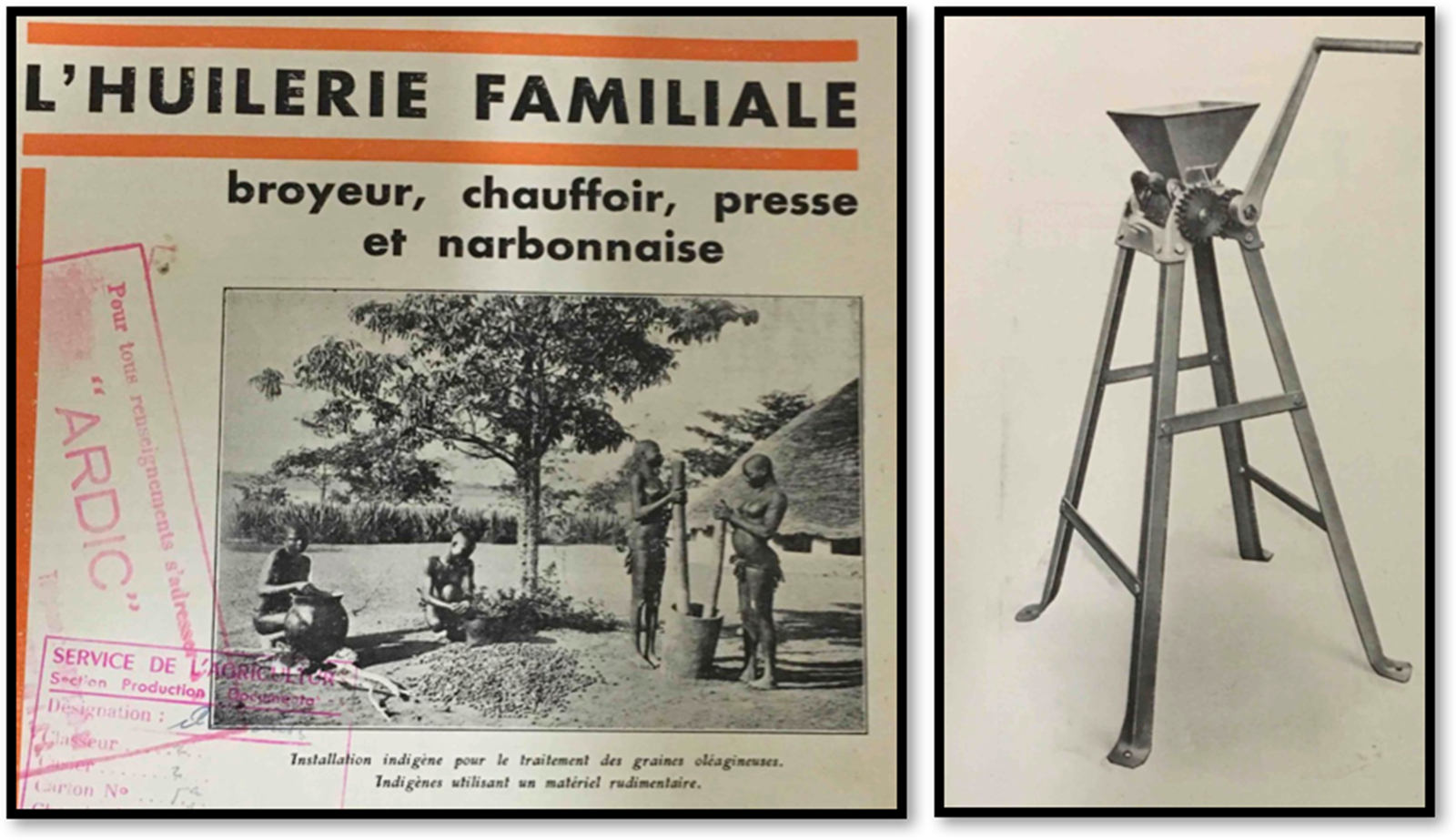
The image above portrays four women — two sorting the peanuts from their shells and two pressing the oil with a large mortar and pestle — emphasizing the rudimentary nature of pressing oleaginous grains in Senegalese villages. This practice of pressing oil, according to the pamphlet, produced ‘a bad product’ and ‘extracted only a small part of the oil from the grain’. In contrast, the sleek metallic press represented a more efficient means to extract oil. The grinder, atop a four-legged stand, contained two high-resistance rollers that could be adjusted for different speeds depending on the grains. On average, the press could yield 27 to 30 kilograms of peanut oil per hour and could be transported from one household to another with relative ease.Footnote 65 Through these mechanical presses, then, the French aimed to transform local households into individual peanut oil refineries.
The advertisement for the huilerie familiale reaffirms the colonial trope that African methods of agriculture were traditional, primitive, and required improvement. Yet, while the metallic press appeared to be a more efficient tool than a mortar and pestle, the productive capacity of local households precluded the need for a new, modern practice of oil pressing. To be sure, peanut production rapidly expanded in the early colonial period without the help of mechanized presses, climbing from a wartime low of 124,000 tonnes in 1916 to 283,000 in 1920.Footnote 66 The mechanical press was also an unnecessary cost for most Senegalese households. According to the French botanist August Chevalier, the ‘elite of the indigenous masses’ were the only colonial subjects with ‘sufficient resources’ to employ this method of agriculture, and there was little ‘hope that these new practical tools will be adopted immediately by all growers’.Footnote 67
Although the colonial administration advocated for an increase in locally produced peanut oil, some commercial houses lobbied against it. During the First World War, when peanut prices collapsed due to disruptions in shipping and the recruitment of Senegalese soldiers from the peanut basin, commercial houses and urban refineries competed with local growers to turn a profit on peanut oil.Footnote 68 In 1917, Senegalese farmers sold oil at a lower price than the colonial refineries’ rate of 2.5 francs per liter. Concerned that local producers would undercut French companies, the governor-general announced that the administration would buy the entire peanut harvest, which would both protect colonial oil refineries and provide peasant farmers with income.Footnote 69 Conveniently, the colonial state could also use peanut oil and its byproducts as a substitute for fossil fuels, which were in short supply during the war. In 1917, the French experimented with a mixture of coal and peanut shells to power a new 750 horsepower electric generator in Dakar. Although unadulterated coal was a more efficient source of fuel, this strategy decreased the cost of electricity and, by 1918, one tonne of mixed fuel (coal and peanut shells) cost 60 francs, whereas one tonne of coal fetched 180 francs.Footnote 70
Peanut production increased after the war and while colonial officials celebrated a return to normalcy, some were alarmed by its unintended environmental consequences. By 1920, emerging trading centers along the railways, such as Kaolack and Tambacounda, became thriving regions of peanut cultivation as local populations, and the Murids in particular, occupied new lands. According to J. Belvert, a colonial administrator in Kaolack, the expansion of peanut cultivation threatened regional forests as the ‘talibés place themselves in a line and begin to cut down the trees and clear the ground with frenetic zeal’.Footnote 71 In a separate report, one colonial officer noted that deforestation and soil erosion between Dakar and Saint-Louis were the result of unregulated peanut cultivation. From Louga to Saint-Louis, he recorded that ‘deforestation was nearly complete’ and that the absence of trees ‘causes such a weakening of yields that the crop is often miserable, if not impossible’ to harvest.Footnote 72
Similar to colonial reports that blamed charcoal makers for forest destruction, colonial anxieties about soil erosion and forest decline in the peanut basin reflect Senegal's transition from an organic to a colonial energy economy.Footnote 73 While it is likely that the French overestimated the rate of environmental degradation, the presumed culprits — peanut producers, migrant laborers, and tablibé — were themselves responding to the energy demands and extractive economy of the colonial state. Indeed, French efforts to increase and regulate peanut fuels, as well as their struggle to reduce the rate of deforestation and soil erosion, were not just attempts to control how Africans managed and exploited their lands, but desperate responses to the environmental costs of the colonial energy economy.
Entangled infrastructures, 1920–40
Throughout the 1920s and 1930s, the French expanded the colony's transportation infrastructure through the completion of the Thiès-Kayes railway in 1924, the construction of an 11,000-kilometer network of roads built with corvée labor, the importation of 20,000 tonnes of petrol per year, and the increase in the number of vehicles in Senegal (which grew from 935 in 1925 to 8,435 in 1932, of which two-thirds were trucks).Footnote 74
In general, the colonial state relied on corvée labor to build much of the colony's transportation infrastructure, and roads in particular. Due to Senegal's large migrant labor force, the French did not use corvée labor for cash crop production as it did in other regions of AOF.Footnote 75 Rather, French colonial officials relied on local chiefs and administrators to recruit workers to construct the roads that linked peanut farms to railway stations. Recruitment of corvée labor occurred at the end of the rainy season in October or November, and once the chiefs received the request from the colonial administration, they consulted the village elders and then selected members from their respective communities. Due to the lack of machinery, such as tractors or earth movers, corvée laborers toiled with rudimentary tools such as spades, hatchets, machetes, and baskets, and were tasked with weeding the road bed, felling trees, flattening anthills, and leveling the terrain.Footnote 76 While the use of corvée labor was a highly exploitative and deplorable practice, the network of new roads throughout the colony connected commercial houses and urban merchants to peanut growers and charcoal makers in the interior, serving as a critical component of the colony's energy infrastructure that presented new possibilities to increase trade.
By the late 1920s, the Murids took full advantage of the colony's new infrastructure, using roads and railways to their advantage while also developing plans to construct their own rail line from Diourbel to Touba — the final resting place of their founder, Amadou Bamba. Before his death in 1927, Bamba began the construction of the Great Mosque of Touba, which required a considerable labor force to transport materials and equipment.Footnote 77 The French approved the construction of the railway, hoping that the Murids would also settle the lands adjacent to it and export 15,000 to 20,000 tonnes of peanuts per year.Footnote 78 Although the French provided the technical expertise for the project, the Murids supplied a labor force of talibé and pack animals to complete the job.Footnote 79 The combination of local and colonial systems of labor and technology proved to be a success, as peanut production expanded throughout the region and pilgrims traveled to Touba to visit Bamba's tomb. As such, the entanglement of local and colonial systems of energy — trains, peanut cultivation, pack animals, and the labor of the talibé — coalesced into an energy infrastructure that served the interests of both the Murids and the colonial state.
As transportation infrastructure extended into the southeastern regions of the colony, the Murids, closely followed by Lebanese merchants, also settled and cultivated the lands parallel to the roads and railways. The Murids and the Lebanese worked in tandem, with the former growing peanuts and the latter transporting the harvests by truck to railway stations or urban centers.Footnote 80 Although this mutually beneficial relationship yielded a substantial increase in cash crop production, French merchants and colonial administrators vacillated between supporting and condemning the Lebanese middlemen. The truck drivers, whom the French referred to collectively as Syrien, were part of a larger wave of immigrants from the eastern Mediterranean during the colonial period. This ‘Syrian invasion’, according to one observer, was ‘an economic factor which seriously worries the French traders and does not please the officials’.Footnote 81 Since truck transport was not officially regulated by the state, the Lebanese merchants were elusive and could ‘travel widely and buy peanuts with the natives’ who had ‘little choice but to go along with these illegal transactions’.Footnote 82 Yet, for some French trading companies, the merchants were essential to the peanut trade, and by the late 1920s some senior officials defended the Lebanese merchants’ position in the cash crop economy despite their ability to work around colonial regulations.Footnote 83
During the Great Depression, when global peanut prices collapsed and peasant farmers had large surpluses, colonial officials feared that Lebanese merchants and peanut growers would undercut commercial houses and colonial oil refineries. Just as they did during the First World War, peanut producers weathered the economic crisis in part by producing and selling peanut oil. This time, however, they could rely on Lebanese merchants, who offered better rates than the railway, to transport both peanuts and peanut oil to trading stations and urban centers.Footnote 84 Concerned that illicit truck transport would upend the railways, undercut urban trading houses, and deprive the colony of tax revenue, the French pushed for stricter regulations on motor vehicles. Between 1932 and 1934, the colonial state made vehicle registration and permits both time-consuming and costly, levied a tax on imported gasoline, and banned the use of trucks in the peanut trade.Footnote 85 In an effort to push the Lebanese traders out of the market, the French also encouraged peanut farmers to use pack animals to transport goods from villages to trading stations. Unsurprisingly, the administration's efforts failed due to the cumbersome nature of animal transport as well as its high cost.Footnote 86 Instead, peanut producers partnered with the Lebanese, who provided them with materials — peanut sacks in particular — to load and transport their crop.Footnote 87 Alternatively, some French administrators believed that they could directly compete with the Lebanese merchants by increasing the colonial truck fleet. However, by 1936, the colonial state had acquired only 32 trucks and 22 smaller commercial vehicles for the peanut trade, a miniscule percentage of the 2,300 trucks already in the colony.Footnote 88
Although there is a general lack of documentation that directly connects charcoal makers to the Lebanese merchants, it is likely that some Fulbe migrants used them to transport woodfuels from the hinterlands to urban centers, especially since the merchants owned most of the trucks in the colony, as well as scores of urban shops and stores.Footnote 89 During the 1930s, colonial administrators repeatedly noted that urban merchants played a critical role in transporting charcoal from the forests of Thiès, which produced roughly 80 per cent of the capital's charcoal, to Dakar.Footnote 90 In an attempt to relieve pressure on the region's forests, the French encouraged charcoal makers and urban merchants to shift production to the Petite Côte, a coastal forest to the south. Between 1934 and 1937, charcoal production in Thiès fell from 17,924 to 590 cubic meters, while production in the Petite Côte increased from 3,615 to 15,718 cubic meters. This dramatic shift, according to the colonial administration, was due to the ‘immigration of charcoal producers’ as well as the impressive mobility of urban merchants.Footnote 91 To that end, Lebanese merchants often worked in favor of both colonial officials and charcoal makers, serving as the conduits between the colony's entangled networks of energy infrastructure.
Through the integration of roads, railways, trucks, and petrol into their own systems of labor, production, and distribution, the Murids, peanut producers, charcoal makers, and Lebanese truck drivers demonstrated a remarkable ability to combine and appropriate local and colonial systems of energy use to turn profit and expand their industries. In contrast, the colonial state failed to match the dynamism of local populations, consistently struggling to control and regulate the way cash crops and local fuels circulated from the interior to the coast.
A charcoal-powered colony, 1940–45
In September of 1940, the British military, in an attempt to capture Senegal from Vichy France, launched the Battle of Dakar. Although the initial attempt failed and Vichy did not surrender Senegal until 1943, the British imposed a blockade of the colony, prompting widespread fossil fuel shortages. Forced to turn inward for its energy needs, the colony relied on peanut fuels and charcoal to endure the lean years of the war.
Senegal's wartime fuel scarcity prompted a renewed interest in peanut fuels as a replacement for fossil fuels. In 1941, Jean Jalbert, a French colonial engineer, advocated for the use of peanut oil as a carburant for vehicles and local industries. To start, he insisted that ‘oil refineries should be installed throughout the entire colony’ or ‘at the very least in urban and cultural centers’, so as to ensure that there ‘is always enough fuel for une force motrice’. Next, he recommended that ‘a certain number of localities should be chosen for their geographical location’ to serve as ‘mother ships’ for the factories and smaller oil refineries in remote areas.Footnote 92 Although Jalbert's plans to establish a peanut-fuel-powered economy never materialized, peanut fuels did serve as a resourceful alternative to fossil fuels in urban centers.Footnote 93 In Dakar and Saint-Louis, the French used peanut oil as an industrial lubricant and fuel for street lamps, and in 1941 peanut oil refineries in Diourbel delivered 81,267 kilowatts of electricity for refrigeration, factories, and commercial houses.Footnote 94 Though not a panacea to wartime Senegal's energy woes, peanut fuels did serve as a ready complement to another local fuel: charcoal.
In 1941, André Aubreville, inspector general of the colonial forest service, called for a dramatic increase in charcoal production, pushing the colony to produce 1,000 tonnes of charcoal per month as a ‘substitute for imported fuels’.Footnote 95 At the same time, the governor-general encouraged forest workers to increase charcoal production by converting at least 5 per cent of harvested timber into charcoal during the dry season and 30 per cent during the wet season. As an incentive, he offered tax reductions and exclusive access to classified forests, which resonated with some Fulbe charcoal makers. Between 1940 and 1943, charcoal output increased from 3,000 to 38,000 tonnes annually, and many Fulbe migrants traveled to the forests of Thiès and the Petite Côte to capitalize on this growth.Footnote 96 Working in teams of ten to twenty, charcoal makers exploited 250 to 500 square meters of dense hardwoods.Footnote 97 Once the charcoal was ready, they loaded it onto trains, trucks, and pack animals to coastal urban centers, where urban merchants and charcoal cooperatives purchased and sold it to local vendors.Footnote 98
The increase in charcoal production also triggered concerns of deforestation within the colonial administration, underscoring both the contested nature of the charcoal industry as well as the environmental consequences of fossil fuel scarcity during the war. To combat illegal charcoal production, the colonial state made forest permits the exclusive right of French citizens and created its own labor force of charcoal makers, hoping that the exclusion of black-market charcoal would slow the ‘intensive and fraudulent exploitation’ of forests.Footnote 99 Despite these efforts, however, charcoal makers intensified cutting and avoided forest service checkpoints by transporting woodfuels with pack animals, using local passageways and trails, and traveling along waterways ‘with the help of native canoes’.Footnote 100 In urban centers, merchants also circumvented colonial authorities, forming charcoal cooperatives to lobby and in some cases strong-arm the colonial state. In 1943, the Compagnie des Charbonnages, a group of urban merchants, refused to purchase charcoal from the colonial forest service, rejecting a shipment from the Casamance because their stocks ‘have already met the demands of their customers’ and flooding the market with charcoal would ‘immobilize their capital’. Since it ‘was likely to remain in port for a long time’ and ‘run the risk of losing capital’, the colonial administration ultimately took the loss and purchased the charcoal.Footnote 101
As charcoal production increased the French retrofitted trucks, vehicles, and factories with charcoal powered engines, known as gazogènes (see Fig. 2). Gazogènes were mounted on vehicles and converted timber or charcoal into wood gas, which was then cooled, filtered, and used to power an internal combustion engine. In this way, the French developed an innovative technology to cope with energy scarcity, while migrant charcoal makers and local populations not only supplied them with fuel but, as shown in Fig. 2, also developed the expertise to maintain them.Footnote 102
Gazogène. Two men attending to a charcoal-powered engine in Senegal.
Source: Photographer Unknown, Associated Press, ‘Charcoal-Burning Automobile’, 7 June 1942.

Imports of gazogènes started slowly but increased throughout the war, climbing from 18 gazogènes in February of 1941 to 2,285 by the end of the year.Footnote 103 Since the consumption of charcoal was relatively high, with the average gazogène-fitted truck burning one kilogram of charcoal per kilometer driven, vehicles needed to refuel frequently. By 1942, the colonial state constructed 130 distribution centers across AOF, and since charcoal could be produced almost anywhere in West Africa, locals were expected to provide travelers with charcoal and to attend and maintain the engines.Footnote 104 However, in 1943, just as the colony adjusted its energy infrastructure to accommodate the gazogène, the British blockade ended, fossil fuels returned to Senegal, and the French suspended charcoal production obligations and removed gazogènes from vehicles and trucks. Though short-lived, the gazogène epitomized the very essence of the colonial energy economy. By combining and mobilizing charcoal production with an imported biofuel motor, colonial officials and local populations developed a contested, yet integrated network of energy infrastructure born out of African and colonial systems of labor, knowledge, and mobility.
The lean years of the war and the relative success of charcoal as an industrial fuel pushed some colonial officials to consider its potential as a long-term solution to Senegal's energy crisis. After the war, Paul Bellouard, an officer in the forest service, argued that charcoal made Senegal less vulnerable to energy shortages, noting that it was ‘better, in effect, that Senegal should devote its foreign exchange to the purchase of capital goods — machines, automobiles, tractors — rather than to import high-priced energy which can be found on its own soil’.Footnote 105 Although the colonial administration dismissed Bellouard's suggestion, charcoal continued to serve as a staple fuel for the colony. From 1945 to the end of colonial rule in 1960, charcoal production surpassed its wartime height and still constitutes nearly 45 per cent of Senegal's energy use today.Footnote 106
Conclusion
This article has situated the history of energy use within an African historical context and has examined the various ways that Senegalese populations and their colonizers forged a colonial energy economy based on a blend of local and imported fuels, African and colonial systems of labor and technology, and nonmechanized and mechanized forms of transportation. In doing so, it has shown that systems of energy use during the colonial period did not fall neatly within the categories of organic or industrial economies, nor did they serve as a point of transition from a primitive state of energy use to a more advanced one. Rather, this article has demonstrated that energy use in colonial Senegal was specific to the context of colonialism, illuminating how colonial officials and local populations developed interconnected systems of energy use that coalesced into a contested, yet integrated energy infrastructure — one that continues to shape how the Senegalese use energy today.
To be sure, the entangled infrastructures of the colonial energy economy are still visible in present-day Senegal, as many populations still use a blend of local and imported fuels to sustain their households and businesses. Yet the recent discovery of oil off the Atlantic coast in 2014, as well as the installation of new solar plants and wind farms, have made Senegal's energy economy more dynamic, increasing access to power and electricity for rural communities.Footnote 107 These developments have placed Senegal in an advantageous position to build a new infrastructure of renewable and fossilized energy. By ‘leapfrogging’, or perhaps bypassing, the aging industrial infrastructure of the West, Senegal could possibly chart a new pathway forward in energy use, drawing on a diverse range of global and local knowledge, technology, and expertise to incite economic growth and prosperity.
Acknowledgments
Research for this article was supported by grants and fellowships from the University of Chicago, as well as L’École des hautes études en sciences sociales in Paris. Earlier versions were presented at the African Studies Workshop at the University of Chicago, the Southeast Regional Seminar in African Studies, and the 61st Annual Meeting of the African Studies Association in Atlanta, 2018. I would like to thank Emily Lynn Osborn, Fredrik Albritton Jonsson, James Hevia, and Jesse Ribot for their guidance and mentorship, and I would like to express my gratitude to Elizabeth Fretwell, Colin Rydell, Kyle Gardner, Zebulon Dingley, Teddy Harris, and my incredibly supportive colleagues at the College of Charleston for their comments on earlier drafts. I am also indebted to the editors and anonymous reviewers of The Journal of African History for their insightful suggestions.


 Open access

