




Introduction
As most North American neighbourhoods are designed for personal automobiles as the primary mode of transportation, driving remains an important activity for older adults’ physical, psychological, and social needs (Turcotte, Reference Turcotte2012). Many older adults have been driving for more than 60 years, making driving a part of their identity and relating the ability to drive to a sense of freedom and independence (Stinchcombe, Hopper, Mullen, & Bédard, Reference Stinchcombe, Hopper, Mullen and Bédard2021). Although linked to overall health and well-being, driving is also associated with risk of injury and mortality as it is a complex task that requires a combination of physical abilities, cognitive functioning, visual acuity, and processing speed to perform safely (Ang, Jennifer, Chen, & Lee, Reference Ang, Jennifer, Chen and Lee2019). Changes in health and cognition may make certain aspects of driving more difficult and impact older adults’ ability to drive safely (Huang, Luster, Karagol, Park, & Pitts, Reference Huang, Luster, Karagol, Park and Pitts2020).
Worldwide, many countries are experiencing aging population resulting in a growing number of older drivers, with adults over age 65 making up the fastest growing segment of the licensed population. In 2009, 75 per cent of Canadian adults over age 65 reported that they were still driving (Turcotte, Reference Turcotte2012). Driving cessation is associated with many negative outcomes, including poor health, depression, decreased social engagement, as well as increased institutionalization and mortality risk (Chihuri et al., Reference Chihuri, Mielenz, DiMaggio, Betz, DiGuiseppi and Jones2016). A study by Feng and Meuleners (Reference Feng and Meuleners2020) found that 92 per cent of individuals planning to cease driving have concerns about driving cessation, but that most older adults do not make any lifestyle changes to prepare for a time when they may no longer drive.
Evidence suggests that some individuals begin to avoid certain driving situations as they age. Based on the self-regulatory theory, as older adults become self-aware of changes in their driving behaviour, they are more likely to avoid situations to reduce risk (e.g., night driving, rush hour traffic) (Stalvey, Owsley, Stalvey, & Owsley, Reference Stalvey, Owsley, Stalvey and Owsley2000). Rudman, Friedland, Chipman, and Sciortino’s (Reference Rudman, Friedland, Chipman and Sciortino2006) Model of Driving Self-Regulation details that self-regulation depends on interpersonal factors (i.e., family and physician feedback), intrapersonal factors (i.e., self-perceived changes in abilities, symbolic importance of driving), and environmental factors (i.e., environmental hazards, social norms, alternative transport). When older drivers’ comfort levels are reduced to an unacceptable level, despite their self-regulation, they may then make the decision to cease driving.
Common self-regulation behaviours include reducing driving frequency and distance, avoiding driving at night and in poor weather, and avoiding busy intersections (Ang et al., Reference Ang, Jennifer, Chen and Lee2019). Self-regulation of driving may be due to several reasons. Increasing age is associated with greater driving regulation and poorer driving confidence. This association may be explained as older adults report poorer general health, including poorer vision, as well as decreased cognitive and physical abilities necessary for safe driving (Conlon, Rahaley, & Davis, Reference Conlon, Rahaley and Davis2017). Along with objective health status, perceived health symptoms have been found to be associated with avoiding challenging driving situations (Tuokko et al., Reference Tuokko, Sukhawathanakul, Walzak, Jouk, Myers and Marshall2016). Many studies have concluded that perceived health is as important as objective health when deciding to restrict driving in older age (Ang et al., Reference Ang, Jennifer, Chen and Lee2019). Furthermore, women have been found to reduce their driving distance (Charlton et al., Reference Charlton, Koppel, D’Elia, Hua, St. Louis and Darzins2019), to be more likely to self-restrict (St. Louis et al., Reference St. Louis, Koppel, Molnar, Di Stefano, Darzins, Bédard, Mullen, Myers, Marshall and Charlton2020), and to consider driving cessation earlier when compared to men (Ang et al., Reference Ang, Jennifer, Chen and Lee2019). Other commonly reported reasons of self-regulation include psychological changes such as depression and safety concern, social influences, environmental factors, and driving history (Ang et al., Reference Ang, Jennifer, Chen and Lee2019).
Subjective cognitive difficulties have also been found to be associated with driving self-regulation (Conlon et al., Reference Conlon, Rahaley and Davis2017), as older adults may restrict their driving to compensate for declines in cognitive function and avoid potential collisions (Vance et al., Reference Vance, Roenker, Cissell, Edwards, Wadley and Ball2006). Similarly, many older adults categorized as having low cognitive functioning have been found to restrict their driving to short distances (Freund & Szinovacz, Reference Freund and Szinovacz2002). On the other hand, Kowalski et al. (Reference Kowalski, Love, Tuokko, MacDonald, Hultsch and Strauss2012) found that cognitive impairment was related to driving status but not driving restriction or reduction, whereas Rapoport et al. (Reference Rapoport, Naglie, Weegar, Myers, Cameron and Crizzle2013) found no association between cognitive functioning and driving behaviours.
One less studied determinant of driving avoidance is an individual’s personality traits. The Five Factor Model (FFM) of personality categorizes personality into five domains: extraversion (outgoing, energetic, assertive), conscientiousness (responsible, organized, reliable), agreeableness (cooperative, considerate, sympathetic), openness (imaginative, adventurous, curious), and neuroticism (anxious, unstable, lacking in confidence) (McCrae & John, Reference McCrae and John1992). Evidence suggests that personality is related to driving outcomes across the lifespan, specifically predicting risky behaviours in young adults. A study by Monteiro et al. (Reference Monteiro, Coelho, Hanel, Pimentel and Gouveia2018) found that individuals high in neuroticism show higher levels of anger and aggressive behaviours while driving, resulting in riskier driving behaviours. Similarly, evidence shows that a high level of extraversion is associated with decreased driving performance (Adrian, Postal, Moessinger, Rascle, & Charles, Reference Adrian, Postal, Moessinger, Rascle and Charles2011), with increased crashes, traffic violations, and risky behaviours (Clarke & Robertson, Reference Clarke and Robertson2005; Riendeau, Stinchcombe, Weaver, & Bédard, Reference Riendeau, Stinchcombe, Weaver and Bédard2018). In contrast, high conscientiousness has been associated with less risky driving in mid-age drivers (Riendeau et al., Reference Riendeau, Stinchcombe, Weaver and Bédard2018).
Given the relationship between driving and personality, it is important to understand the relationship between driving behaviours and personality in older adulthood. To date, limited research has focused on the relationship between personality traits and driving habits within older populations. A recent study by Sawula et al. (Reference Sawula, Mullen, Stinchcombe, Weaver, Tuokko and Naglie2017) found that in a sample of older drivers (72–92 years), extraversion was associated with an increased tendency to drive in challenging situations, after controlling for covariates. Similarly, it has been found that individuals with high extraversion were more likely to rate their driving abilities greater than those with low extraversion, prompting driving in riskier circumstances (McPeek, Nichols, Classen, & Breiner, Reference McPeek, Nichols, Classen and Breiner2011). Although self-regulation is commonly believed to be an ideal step in the transition towards driving cessation, a study by Schulz et al. (Reference Schulz, Beblo, Spannhorst, Labudda, Wagner, Bertke, Boedeker, Driessen, Kreisel and Toepper2020) concluded that self-reported driving avoidance is an independent indicator of reduced on-road driving skills. This suggests that driving avoidance may not be an optimal strategy for safe driving in older adulthood.
The purpose of this paper is to examine determinants of situational driving avoidance, with a particular emphasis on the roles of personality traits, gender, and cognition within a large sample of mid-life and older adults from the Canadian Longitudinal Study on Aging (CLSA). It is important to better understand the correlates of driving avoidance among aging adults to best support continued mobility and safe driving for an aging population. It was anticipated that women would avoid more situations than men, and that participants with lower cognition scores would also report greater driving avoidance. In terms of personality characteristics, it was anticipated that extraversion would be associated with less driving avoidance.
Method
Sample
The CLSA is a longitudinal study of health and aging (Raina et al., Reference Raina, Wolfson, Kirkland, Griffith, Oremus and Patterson2009; Raina et al., Reference Raina, Wolfson, Kirkland, Griffith, Balion and Cossette2019). At baseline (2015), community-dwelling older adults (45–85 years) were recruited (n > 50,000). Data collection is ongoing. Post-baseline, data are collected at every three-year interval, which will continue until participant death or the year 2033 (Raina et al., Reference Raina, Wolfson, Kirkland, Griffith, Balion and Cossette2019). CLSA participants can be differentiated based on their study cohort: the tracking or comprehensive cohort. Data for the tracking cohort (n = 21,241) were collected via less-resource intensive means: trained interviews conducted 60-minute telephone-based interviews using a computer-assisted telephone interview (CATI) system. In contrast, comprehensive cohort participants (n = 30,097) consented to multiple data collection methods (telephone and in-person assessments). The latter required participants to live within 25–50 kilometers of a national data collection site (n = 11) (Raina et al., Reference Raina, Wolfson, Kirkland, Griffith, Balion and Cossette2019). As part of the in-person visits, standardized neuropsychological assessment measures (detailed below), other clinical (e.g., fitness), and biological (e.g., urine) measures were collected (Raina et al., Reference Raina, Wolfson, Kirkland, Griffith, Balion and Cossette2019). The in-person assessments included both an in-home visit (90 minutes), where trained interviewers administered a series of questionnaire modules, and in-person visit to their local data collection site for more in-depth measurements (2.5 hours). Participants could refuse the biological sample portion of the data collection site visit and still participate in the CLSA (Raina et al., Reference Raina, Wolfson, Kirkland, Griffith, Balion and Cossette2019). Additionally, tracking and comprehensive participants were administered a short (30-minute) Maintaining Contact Questionnaire following their baseline assessment; however, the content differed by cohort (see www.clsa-elcv.ca/doc/540). The survey materials administered to the two cohorts are a mix of shared (e.g., demographics, general health) and non-shared questionnaire modules (e.g., personality traits) (Raina, Wolfson, & Kirkland, Reference Raina, Wolfson and Kirkland2008), the combination of which allows for joint or independent analysis of the two cohorts (Raina et al., Reference Raina, Wolfson, Kirkland, Griffith, Balion and Cossette2019). For a breakdown of the tracking and comprehensive cohort questionnaire modules, please see Tables 6.1 and 6.2 of the CLSA protocol, respectively (Raina et al., Reference Raina, Wolfson and Kirkland2008).
The CLSA protocol (Raina et al., Reference Raina, Wolfson and Kirkland2008) details the recruitment methodology, but in brief, the Canadian Community Health Survey – Healthy Aging Component (CCHS-HA) defined the eligibility criteria for selecting participants into the CLSA and was one of three recruitment strategies (Raina et al., Reference Raina, Wolfson and Kirkland2008). In addition, random digit dialing (RDD) (landline telephones) and provincial health care registration databases were employed to supplement recruitment and meet the targeted sample size (Raina et al., Reference Raina, Wolfson and Kirkland2008). The comprehensive cohort was recruited solely via RDD and health care registries (Raina et al., Reference Raina, Wolfson and Kirkland2008). Given that the CCHS sampling frame defined the inclusion criteria of the CLSA, it also outlined the CLSA’s exclusion criteria. In accord with Statistics Canada recruitment methodologies, the following is a list of persons or groups of persons not eligible for CLSA participation: Canadian persons living in the territories or select remote regions, persons living on First Nations reserves and settlements, full-time members of the Canadian Armed Forces, incarcerated persons, and institutionalized persons, including long-term care residents, at baseline (Raina et al., Reference Raina, Wolfson and Kirkland2008). All participants provided written informed consent (Raina et al., Reference Raina, Wolfson, Kirkland, Griffith, Oremus and Patterson2009). The Lakehead University Research Ethics Board (REB #1466056) approved these analyses.
Outcome
Driving avoidance
Participants were asked: If possible, do you try to avoid any of these driving situations? The response options included:
-
• On and off ramps
-
• Traffic circles
-
• Four-way stops without traffic signals
-
• Unfamiliar routes
-
• Heavy traffic in town
-
• Heavy traffic or rush hour on multi-lane or divided highways/expressways
-
• Heavy traffic or rush hour on single-lane or undivided highways/expressways
-
• Making left-hand turns with traffic lights
-
• Making left-hand turns with no traffic lights or stop signs
-
• Travelling next to large trucks
-
• Crossing or entering busy streets without traffic signals
-
• Yielding to traffic at yield signs
-
• Driving in heavy rain or snow
-
• Driving at dawn or dusk
-
• Driving at night
For each participant, the total number of situations avoided was summed and ranged from 0–15, with higher scores indicating greater driving avoidance.
Covariates
Demographic variables
Demographic variables included in the analysis were chronological age (continuous), education, household income, gender, retirement status, and whether participants lived in a rural or urban area. Respondents’ educational attainment was classified as “less than secondary school” (referent), “secondary school graduation,” “some post-secondary,” and “post-secondary graduation.” Participants were asked to report their household income: What is your best estimate of the total household income received by all household members, from all sources, before taxes and deductions, in the past 12 months? Responses were categorized as “< $20,000” (referent), “$20,000–49,999,” “$50,000–99,999,” “$100,000–149,999,” and “≥ $150,000.”
Health variables
Self-reported health was captured by asking participants: In general, would you say your health is excellent, very good, good, fair, or poor? Participants were asked about their sensory function; they self-reported the quality of their hearing and vision on a five-point scale from “poor” to “excellent.” Specifically, participants were asked: Is your hearing, using a hearing aid if you use one… and, Is your eyesight, using glasses or corrective lens if you use them…. For both sensory health characteristics, responses were collapsed to represent the presence (poor/fair) or absence (good/very good/excellent) of low hearing and vision, respectively. The number of symptoms of depression over the past week was quantified using the short form of the Centre for Epidemiologic Studies – Depression Scale (CESD-10) (Andresen, Malmgren, Carter, & Patrick, Reference Andresen, Malmgren, Carter and Patrick1994). Items on the scale are summed to generate a score with a range of 0–30, with higher scores indicating greater symptoms. The CESD-10 shows good psychometric properties, including high test-retest reliability (r = 0.71) (Andresen et al., Reference Andresen, Malmgren, Carter and Patrick1994).
Cognition
We computed an overall cognitive function variable based on the three measures of cognition administered to the Comprehensive cohort as part of their in-home assessment: the Rey Auditory Verbal Learning Test (RAVLT) (Rey, Reference Rey1964), the Mental Alternation Test (MAT) (Jones, Reference Jones1993), and the Animal Naming Fluency Test (AFT) (Read, Reference Read1987). The RAVLT is a 15-item word learning test that assesses learning and retention (memory). Scores for the (first) immediate and delayed recall trials represent the total number of correct responses for each trial, respectively, and have a possible range of 0–15.
Both the MAT and AFT were administered to obtain a baseline assessment of participants’ executive function. The MAT requires participants to alternate between numbers 1–26 and the letters of the alphabet (i.e., 1-A-2-B-3-C, etc.). The total number of correct scores on the MAT ranges from 0–52, with higher scores indicative of better mental flexibility and processing speed (Tuokko et al., Reference Tuokko, Griffith, Simard, Taler, O’Connell and Voll2020). In contrast, the AFT assesses verbal category fluency, with participants asked to name as many animals as possible within 60 seconds (Tuokko, Griffith, Simard, & Taler, Reference Tuokko, Griffith, Simard and Taler2017). Two AFT scoring algorithms were developed for purposes of the CLSA (Tuokko et al., Reference Tuokko, Griffith, Simard and Taler2017), with the more lenient of the two methods used here. Like the MAT, the AFT produces a total score that ranges from 0–52, with higher scores indicative of better executive function.
For purposes of this study, we computed an overall indicator of cognitive function composed of memory (RAVLT) and executive function (MAT and AFT). The measure of cognitive function was computed in a stepwise fashion:
-
1. Raw (individual) test scores were standardized to obtain z-scores.
-
2. We summed the respective measures for memory (immediate + delayed recall trials) and executive function (MAT + AFT).
-
3. We combined the memory and executive function measures (memory + executive function).
We standardized the raw test scores by the participants’ language of administration for each test (French, English, or Bilingual) (Oremus et al., Reference Oremus, Konnert, Law, Maxwell, O’Connell and Tyas2019). Standardized scores were then combined to derive an overall z-score for each measure. More information on the administration and performance of the cognitive measures within the Comprehensive cohort is available elsewhere (Tuokko et al., Reference Tuokko, Griffith, Simard, Taler, O’Connell and Voll2020).
Primary Predictor
Personality
The Ten-Item Personality Inventory (TIPI) was used to measure participants’ personality (Gosling, Rentfrow, & Swann, Reference Gosling, Rentfrow and Swann2003). The TIPI includes questions that represent each of the FFM domains to provide a measure of each of the five personality traits on a scale from 1 to 10. For neuroticism, the TIPI provides a measure of its contrast dimension, emotional stability; higher scores indicate greater emotional stability. The TIPI has been found to have adequate convergent validity (mean r = 0.77) and test-retest reliability (mean r = 0.72) (Gosling et al., Reference Gosling, Rentfrow and Swann2003).
Analysis
Analyses were conducted in Stata/SE 15.1 (StataCorp LLC, College Station, TX). For categorical variables, frequencies (n) and percentages (%) are reported; for quantitative variables, means (M) and standard deviations (SD) are reported. Given the evidence that the outcome variable (driving avoidance) was overdispersed, a multiple negative binomial regression analysis was conducted (UCLA: Statistical Consulting Group, 2021). As a first step, we examined the crude (i.e., bivariate) relationships between the covariates and personality traits (primary predictor) with driving avoidance (outcome). Next, we entered personality traits and the covariates as a single block into a multivariable regression model treating driving avoidance as the outcome variable. Given the existing evidence showing differences in driving avoidance by age, gender, and cognitive function, we also entered an age × gender × cognition three-way interaction and all lower-order (two-way) interactions. If the higher-order (three-way) interaction was not statistically significant, the lower-order interactions were visualized if statistically significant (p <.05).
Analytic Sample
Participants in the comprehensive cohort (only) completed personality measures as part of their Maintaining Contact Questionnaire (Raina et al., Reference Raina, Wolfson and Kirkland2008). Thus, our analytic sample was defined by participation in the comprehensive cohort (n = 30,097) and the initial CLSA maintaining contact questionnaire for the comprehensive cohort (n = 28,789). Further, given our focus on driving avoidance, participants were included if they reported holding a valid driver’s license and driving more than once a month (n = 25,120). In terms of missingness, most variables showed less than 2 per cent missing, apart from income (6.1%) and total cognition (7%). The cognition variable was a composite of several cognitive tasks that were audio recorded and later scored (Tuokko et al., Reference Tuokko, Griffith, Simard, Taler, O’Connell and Voll2020). Due to poor sound quality, some recordings were unable to be scored. After removal of missingness, the analytic sample consisted of n = 20,998. Alpha was set to α = .05 (two-tailed).
Results
Sample Characteristics
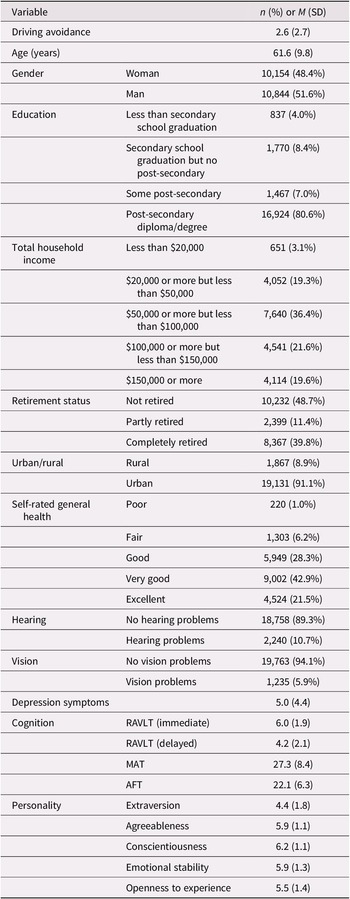
The mean age of participants in the analytic sample was 61.6 years (range 45–86 years). In terms of education, 80.6 per cent of participants reported having completed post-secondary school. Participants had high levels of household income, with over 40 per cent of the sample reporting a household income of at least $100,000. Just over 50 per cent of the sample reported being either partly retired or completely retired, and 91 per cent reported living in an urban environment. Participants had high general health with 64.4 per cent of the sample reporting their self-rated health as at least “very good.” With respect to sensory function, 10.7 per cent of the sample reported hearing problems and 5.9 per cent reported vision problems. Participant characteristics are summarized in Table 1.
Participant characteristics (n = 20,998)

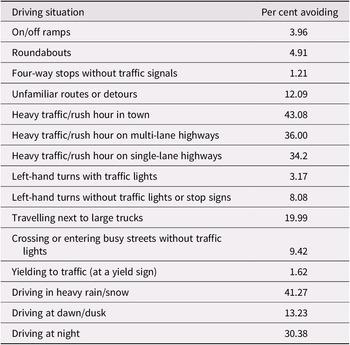
Participants reported avoiding a mean of 2.6 (SD = 2.7) driving situations (range = 0–15 situations). The most commonly avoided driving situation was avoiding heavy traffic/rush hour in town (43%) followed by driving in heavy rain or snow (41%) and driving at night (30%). Participant response rates for each driving avoidance scenario are summarized in Table 2.
Participant response rates for avoiding specific driving situations

Regression Analysis
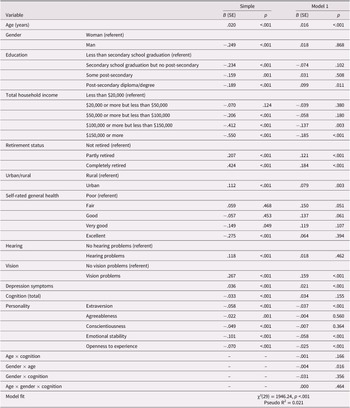
The results of simple and multivariable linear regression models treating driving avoidance as the outcome variable are presented in Table 3. Bivariate associations showed that individuals who reported more driving avoidance were older, more likely to be women, partly or completely retired, and living in an urban environment. Participants who reported higher incomes, completion of post-secondary education, and “very good” or better general health tended to avoid fewer driving situations. Participants with a greater number of depression symptoms avoided more situations, whereas participants who exhibited higher total cognition scores avoided fewer situations. In terms of personality traits, all five personality traits were associated with less avoidance among participants in the sample.
Results of simple and multiple regression models treating driving avoidance as the outcome

After accounting for the covariates in the multivariable model, several of the statistically significant relationships observed in the bivariate models held (see Table 3). Age was statistically significant in the multivariable model (B = .016, SE = .001, p < .001); however, it was also implicated in a two-way interaction (described below), tempering its interpretability as a standalone covariate. Higher household income categories were associated with less avoidance in comparison to the lowest income category; participants who reported an annual household income of $100,000 to $149,999 (B = −.137, SE = .045, p = .003) or a household income of $150,000 or more (B = −.185, SE = .046, p < .001) were less likely to avoid driving situations. Participants who were partly retired (B = .121, SE = .027, p < .001) or fully retired (B = .184, SE = .022, p < .001) were more likely to avoid driving situations compared to participants who were not retired. Compared to participants living in a rural environment, participants living in an urban environment were more likely to avoid driving situations (B = .079, SE = .026, p = .003).
In terms of health, levels of self-rated general health, hearing problems, and cognitive function were no longer associated with driving avoidance after accounting for the other covariates. Vision problems (B = .159, SE = .031, p < .001) and depression symptoms (B = .020, SE = .002, p < .001) were associated with greater driving avoidance in the multivariable model.
Three of the five personality traits reached statistical significance in the multivariable analysis. Higher extraversion (B = −.037, SE = .004, p < .001), openness to experience (B = −.024, SE = .005, p < .001), and emotional stability were associated with less driving avoidance (B = −.058, SE = .006, p < .001).
Interactions
The results of the three-way interaction between age, gender, and cognition did not reach statistical significance. However, a statistically significant lower-order interaction between age and gender was observed, suggesting that the relationship between chronological age and driving avoidance depends on gender (B = −.004, SE = .002, p = .016). Figure 1 shows the predicted values of driving avoidance (y-axis) at five-year increments in chronological age by gender. For both men and women, as age increases, so does the number of driving situations avoided. At all age increments, women avoid more situations than men; the magnitude of the difference between men and women increases with age such that the biggest difference between men and women in driving avoidance is at age 85 years (i.e., the maximum age of the sample).
Visualized interaction between age and gender.

Discussion
Driving avoidance is an important outcome because of its relationship to future driving cessation and potential health outcomes (Edwards, Lunsman, Perkins, Rebok, & Roth, Reference Edwards, Lunsman, Perkins, Rebok and Roth2009). In this study, we examined the correlates of driving avoidance in a sample of adults ages 45–85 years, with a particular emphasis on the roles of personality traits, gender, and cognition. Our study yielded several noteworthy findings.
First, consistent with previous work in this field, our crude analyses showed that women reported greater driving avoidance than men (Barrett, Gumber, & Douglas, Reference Barrett, Gumber and Douglas2018; Choi, Adams, & Kahana, Reference Choi, Adams and Kahana2013) and that older age was associated with more avoidance (Stalvey et al., Reference Stalvey, Owsley, Stalvey and Owsley2000). In the multivariable model, however, our findings showed that the relationship between gender and driving avoidance depends on age such that the gender difference in driving avoidance increases among older age groups. In their qualitative review of the literature on driving reduction and driving cessation, Ang et al. (Reference Ang, Jennifer, Chen and Lee2019) highlighted the gendered nature of driving, noting that women are more willing than men to reduce and cease driving. When considered through the Model of Driving Self-Regulation, it is reasonable to surmise that intrapersonal factors that often accompany aging, such as perceived changes in abilities, may amplify gender differences in driving avoidance. Additionally, the stronger association between gender and driving avoidance in older age groups may be related to cohort differences such that older women in the sample may have historically driven less than men and therefore may be less comfortable driving when compared to younger women in the sample (Hakamies-Blomqvist & Siren, Reference Hakamies-Blomqvist and Siren2003; Molnar et al., Reference Molnar, Eby, Vivoda, Bogard, Zakraksek and St Louis2018).
Second, with respect to cognitive function, the crude analysis showed a negative association between cognition and driving avoidance such that participants with higher cognition were less likely to report avoiding driving situations. The addition of multiple potential covariates, however, attenuated this finding in the multivariable model, and cognition was no longer significantly associated with driving avoidance. The lack of association after adjustment may be related to the relatively young sample in the baseline wave of the CLSA and the fact that participants had to be free from cognitive impairment to be enrolled in the study.
Third, given existing evidence showing a relationship between personality traits and driving behaviours among older adults, five personality traits were entered into the model, treating driving avoidance as the outcome. Consistent with existing research (Sawula et al., Reference Sawula, Mullen, Stinchcombe, Weaver, Tuokko and Naglie2017), the results showed that extraversion was negatively associated with driving avoidance such that individuals who were more extroverted were less likely to report avoiding driving situations. This finding follows other work showing that extraversion is associated with risky and dangerous driving: collisions, traffic violations, and driving under the influence of alcohol (Clarke & Robertson, Reference Clarke and Robertson2005; Fine, Reference Fine1963; Kirkcaldy & Furnham, Reference Kirkcaldy and Furnham2000; Lajunen, Reference Lajunen2001; Renner & Anderle, Reference Renner and Anderle2000; Smith & Kirkham, Reference Smith and Kirkham1981). Extroverts may be less likely to avoid certain driving situations that could lead to bodily harm and may be less likely to cease driving even when safety becomes compromised. Openness to experiences was also negatively associated with driving avoidance, and while the body of literature linking openness to experience and driving is less robust, some evidence points to a relationship with at-fault crashes (Arthur & Graziano, Reference Arthur and Graziano1996). Finally, we did observe a negative association between emotional stability and driving avoidance such that individuals who reported more emotional stability reported less avoidance. This aligns with existing work showing a relationship between anxious driving styles and driving avoidance (Gwyther & Holland, Reference Gwyther and Holland2012).
While the focus of our study was on gender, cognition, and personality traits, the results did yield other interesting findings. Participants living in rural environments were less likely to avoid driving situations. It is possible that, within rural areas, the driving environment is less complex and that participants may not encounter challenging driving situations such as heavy traffic or rush hour on multi-lane highways, leading to lower avoidance scores in this study. Another explanation may be that rural-dwelling older adults have a greater reliance on driving a personal automobile as alternative transportation options are limited and there is reduced walkability to services (e.g., pharmacies, doctor’s offices, and supermarkets) (Hansen, Newbold, Scott, Vrkljan, & Grenier, Reference Hansen, Newbold, Scott, Vrkljan and Grenier2020). Additionally, individuals who reported low vision function also reported greater driving avoidance. Other work has highlighted the salience of vision problems in driving performance, its relationship to driving avoidance, and its contribution to driving cessation (Ragland, Satariano, & MacLeod, Reference Ragland, Satariano and MacLeod2004).
Strengths of this work include a large population-based sample, which allowed for the inclusion of numerous relevant covariates. In addition, cognitive function was captured objectively and included measures of memory and executive function. The 40-year age range allowed us to capture the driving behaviours of a wide age group, enhancing the generalizability of this work. An important limitation is the reliance on self-report driving as an outcome measure. Similarly, the cross-sectional study design precludes our understanding of whether driving avoidance temporally preceded our predictors (e.g., retirement, depression symptoms). Further, participants were required to drive more than once per month for inclusion in the present study. Due to the cross-sectional design, we were unable to examine whether driving avoidance led to driving cessation or whether driving avoidance is a precursor to reductions in driving frequency. Follow-up data will allow us to examine the temporal relationships between driving avoidance and driving cessation. It is unclear whether driving avoidance reported here reflects changes in objective driving safety. Participants were not required to take part in an on-road driving test as part of the CLSA.
Conclusions
Driving remains a primary means of mobility for older adults. For some, driving avoidance may be indicative of changes in driving safety, whereas for others it may lead to unnecessary restricting in community mobility. Understanding the factors that contribute to driving avoidance is an important component of promoting community mobility for an aging population. Supporting the safety and mobility of older drivers is multifaceted, involving driver optimization through training initiatives, evidence-based driver assessment, and facilitating adaptation during the driving cessation process. Our findings show that women of older ages tend to report more driving avoidance and that personality traits, notably extraversion, emotional stability, and openness to experience, may also play a role in determining driving avoidance. These correlates can assist researchers and practitioners to identify who is avoiding and tailor supports appropriately.
Acknowledgement
The opinions expressed in this manuscript are the authors´ own and do not reflect the views of the Canadian Longitudinal Study on Aging (CLSA).
Funding
This research was made possible using the data/biospecimens collected by the Canadian Longitudinal Study on Aging (CLSA). Funding for the CLSA is provided by the Government of Canada through the Canadian Institutes of Health Research (CIHR) under grant reference: LSA 97743 and the Canada Foundation for Innovation. This research has been conducted using the CLSA data set Baseline Tracking Dataset version 3.2, Baseline Comprehensive Dataset version 3.1, under Application Number 170323. The CLSA is led by Drs. Parminder Raina, Christina Wolfson, and Susan Kirkland. Data are available from the Canadian Longitudinal Study on Aging (www.clsa-elcv.ca) for researchers who meet the criteria for access to de-identified CLSA data. This research used data from the CLSA supported in part by the Ontario Ministry of Transportation. This project was funded through a CIHR Catalyst grant (373190) awarded to Dr. Michel Bédard. Ms. Shawna Hopper holds a doctoral scholarship from the Social Sciences and Humanities Research Council of Canada. Ms. Nicole G. Hammond is funded by the Frederick Banting and Charles Best Canada Graduate Scholarship Doctoral Awards (CGS-D) program. Dr. Arne Stinchcombe holds a New Investigator award from the Alzheimer’s Society of Canada Research Program.


 Open access

