





1. Introduction
Let $K$
be a number field and
$K$
be a number field and $p$
an odd prime. Two elliptic curves
$p$
an odd prime. Two elliptic curves $E_1$
and
$E_1$
and $E_2$
defined over
$E_2$
defined over $K$
are said to be
$K$
are said to be $p$
-congruent if
$p$
-congruent if $E_1[p] \cong E_2[p]$
as
$E_1[p] \cong E_2[p]$
as $\textrm {Gal}(\bar {K}/K)$
-modules, where
$\textrm {Gal}(\bar {K}/K)$
-modules, where $\bar {K}$
denotes any fixed algebraic closure of
$\bar {K}$
denotes any fixed algebraic closure of $K$
. More generally, we will study in this article pairs of elliptic curves
$K$
. More generally, we will study in this article pairs of elliptic curves $E_1$
and
$E_1$
and $E_2$
such that
$E_2$
such that $E_1[p^i] \cong E_2[p^i]$
for some positive integer
$E_1[p^i] \cong E_2[p^i]$
for some positive integer $i$
, which we will simply call congruent elliptic curves in this paper. Let
$i$
, which we will simply call congruent elliptic curves in this paper. Let $K_{\infty }/K$
be a
$K_{\infty }/K$
be a $\mathbb{Z}_p$
-extension and let
$\mathbb{Z}_p$
-extension and let $\textrm {Sel}(E_i/K_{\infty })$
be the
$\textrm {Sel}(E_i/K_{\infty })$
be the $p$
-primary classical Selmer group of
$p$
-primary classical Selmer group of $E_i$
over
$E_i$
over $K_{\infty }$
. We denote the Pontryagin dual of
$K_{\infty }$
. We denote the Pontryagin dual of $\textrm {Sel}(E_i/K_{\infty })$
by
$\textrm {Sel}(E_i/K_{\infty })$
by $X(E_i/K_{\infty })$
. Now assume for
$X(E_i/K_{\infty })$
. Now assume for $i=1,2$
that
$i=1,2$
that $E_i$
has good ordinary reduction at all primes of
$E_i$
has good ordinary reduction at all primes of $K$
dividing
$K$
dividing $p$
and that
$p$
and that $X(E_i/K_{\infty })$
is a
$X(E_i/K_{\infty })$
is a $\Lambda \,:\!=\,{\mathbb{Z}}_p[[T]] \cong {\mathbb{Z}_p}[[\textrm {Gal}(K_\infty /K)]]$
-torsion module. When
$\Lambda \,:\!=\,{\mathbb{Z}}_p[[T]] \cong {\mathbb{Z}_p}[[\textrm {Gal}(K_\infty /K)]]$
-torsion module. When $K={\mathbb{Q}}$
(so
$K={\mathbb{Q}}$
(so $K_{\infty }={\mathbb{Q}}_{cyc}$
, the cyclotomic
$K_{\infty }={\mathbb{Q}}_{cyc}$
, the cyclotomic $\mathbb{Z}_p$
-extension of
$\mathbb{Z}_p$
-extension of $\mathbb{Q}$
) the Greenberg-Vatsal paper [Reference Greenberg and Vatsal20] studies the relations between the lambda invariants
$\mathbb{Q}$
) the Greenberg-Vatsal paper [Reference Greenberg and Vatsal20] studies the relations between the lambda invariants $\lambda (X(E_1/K_\infty ))$
and
$\lambda (X(E_1/K_\infty ))$
and $\lambda (X(E_2/K_\infty ))$
under the assumption that
$\lambda (X(E_2/K_\infty ))$
under the assumption that $\mu (X(E_i/K_{\infty }))=0$
for
$\mu (X(E_i/K_{\infty }))=0$
for $i=1$
or
$i=1$
or $2$
. These results were later generalized by Kidwell [Reference Kidwell28] to arbitrary number fields. The paper of Kundu and Ray [Reference Kundu and Ray37] refines the results of Greenberg-Vatsal and Kidwell, and the authors use their results to construct elliptic curves
$2$
. These results were later generalized by Kidwell [Reference Kidwell28] to arbitrary number fields. The paper of Kundu and Ray [Reference Kundu and Ray37] refines the results of Greenberg-Vatsal and Kidwell, and the authors use their results to construct elliptic curves $E$
over an imaginary quadratic field
$E$
over an imaginary quadratic field $K$
such that
$K$
such that $X(E/K_{ac})$
has a large
$X(E/K_{ac})$
has a large $\lambda$
-invariant where
$\lambda$
-invariant where $K_{ac}$
is the anticyclotomic
$K_{ac}$
is the anticyclotomic $\mathbb{Z}_p$
-extension of
$\mathbb{Z}_p$
-extension of $K$
.
$K$
.
In a similar fashion to the above results, the aim of this paper is to study relationships between generalized Iwasawa invariants of Pontryagin duals of Selmer groups for congruent elliptic curves over ${\mathbb{Z}}_p^d$
-extensions. The generalized Iwasawa invariants were introduced by Cuoco and Monsky in [Reference Cuoco and Monsky11]. These are defined as follows: Let
${\mathbb{Z}}_p^d$
-extensions. The generalized Iwasawa invariants were introduced by Cuoco and Monsky in [Reference Cuoco and Monsky11]. These are defined as follows: Let $G$
be a profinite group isomorphic to
$G$
be a profinite group isomorphic to ${\mathbb{Z}}_p^d$
for some
${\mathbb{Z}}_p^d$
for some $d \geq 1$
. The Iwasawa algebra
$d \geq 1$
. The Iwasawa algebra $\Lambda _d = {\mathbb{Z}}_p[[G]]$
attached to
$\Lambda _d = {\mathbb{Z}}_p[[G]]$
attached to $G$
may be identified (by choosing a set of topological generators of
$G$
may be identified (by choosing a set of topological generators of $G$
) with
$G$
) with ${\mathbb{Z}}_p[[T_1,T_2,\ldots , T_d]]$
. Now let
${\mathbb{Z}}_p[[T_1,T_2,\ldots , T_d]]$
. Now let $M$
be a finitely generated torsion
$M$
be a finitely generated torsion $\Lambda _d$
-module that is not pseudo-null. Then there exists a pseudo-null module
$\Lambda _d$
-module that is not pseudo-null. Then there exists a pseudo-null module $A$
and an exact sequence
$A$
and an exact sequence
 \begin{align} 0 \longrightarrow \bigoplus _{i=1}^s \Lambda _d/p^{m_i} \oplus \bigoplus _{j=1}^t \Lambda _d/h_j^{n_j} \longrightarrow M \longrightarrow A \longrightarrow 0. \end{align}
In the above, the exponents are natural numbers and the $h_j$
are irreducible elements of
$h_j$
are irreducible elements of $\Lambda _d$
which are prime to
$\Lambda _d$
which are prime to $p$
. The module
$p$
. The module $\bigoplus _{i=1}^s \Lambda _d/p^{m_i} \oplus \bigoplus _{j=1}^t \Lambda _d/h_j^{n_j}$
is called an elementary
$\bigoplus _{i=1}^s \Lambda _d/p^{m_i} \oplus \bigoplus _{j=1}^t \Lambda _d/h_j^{n_j}$
is called an elementary $\Lambda _d$
-module attached to
$\Lambda _d$
-module attached to $M$
. The element
$M$
. The element $f_M=\prod _{i=1}^s p^{m_i} \cdot \prod _{j = 1}^t h_j^{n_j}$
is the characteristic power series of
$f_M=\prod _{i=1}^s p^{m_i} \cdot \prod _{j = 1}^t h_j^{n_j}$
is the characteristic power series of $M$
. One then defines the generalized Iwasawa invariants of
$M$
. One then defines the generalized Iwasawa invariants of $M$
as follows. First,
$M$
as follows. First, $m_0(M) = \sum _{i=1}^s m_i$
. The definition of the second invariant is more involved. We write
$m_0(M) = \sum _{i=1}^s m_i$
. The definition of the second invariant is more involved. We write $f_M = p^{m_0(M)} \cdot g_M$
, and we consider the (nonzero) image
$f_M = p^{m_0(M)} \cdot g_M$
, and we consider the (nonzero) image $\overline {g_M}$
of
$\overline {g_M}$
of $g_M$
in the quotient ring
$g_M$
in the quotient ring $\Omega _d = \Lambda _d/p$
. We let
$\Omega _d = \Lambda _d/p$
. We let $l_0(M)$
be the sum of the valuations
$l_0(M)$
be the sum of the valuations $v_{\mathfrak{p}}(\overline {g_M})$
, where
$v_{\mathfrak{p}}(\overline {g_M})$
, where $\mathfrak{p}$
runs over the primes of
$\mathfrak{p}$
runs over the primes of $\Omega _d$
of the form
$\Omega _d$
of the form $\overline {\gamma - 1}$
, with
$\overline {\gamma - 1}$
, with $\gamma \in G$
not a
$\gamma \in G$
not a $p$
-th power (since
$p$
-th power (since $\Lambda _d/p$
is a unique factorization domain, this sum is in fact finite). Finally, for a pseudo-null
$\Lambda _d/p$
is a unique factorization domain, this sum is in fact finite). Finally, for a pseudo-null $\Lambda _d$
-module
$\Lambda _d$
-module $M$
, we define
$M$
, we define $f_M = 0$
and
$f_M = 0$
and $m_0(M) = l_0(M) = 0$
.
$m_0(M) = l_0(M) = 0$
.
In [Reference Kleine and Matar35], we introduced a modified $l_0$
-invariant which is defined as follows. Let
$l_0$
-invariant which is defined as follows. Let $d \gt 1$
. Recall that
$d \gt 1$
. Recall that $\Lambda _d \cong {\mathbb{Z}}_p[[G]]$
, where
$\Lambda _d \cong {\mathbb{Z}}_p[[G]]$
, where $G$
is topologically isomorphic to
$G$
is topologically isomorphic to ${\mathbb{Z}}_p^d$
. As above, let
${\mathbb{Z}}_p^d$
. As above, let $M$
be any finitely generated torsion
$M$
be any finitely generated torsion $\Lambda _d$
-module that is not pseudo-null, and let
$\Lambda _d$
-module that is not pseudo-null, and let $f_M$
be the characteristic power series of
$f_M$
be the characteristic power series of $M$
. Write
$M$
. Write $f_M = p^{m_0(M)} \cdot g_M$
with
$f_M = p^{m_0(M)} \cdot g_M$
with $p \nmid g_M$
, as usual, and consider the image
$p \nmid g_M$
, as usual, and consider the image $\overline {g_M}$
of
$\overline {g_M}$
of $g_M$
in
$g_M$
in $\Omega _d$
.
$\Omega _d$
.
Definition 1.1.
Let $\mathcal{T}$
be the set of tuples
$\mathcal{T}$
be the set of tuples $(\gamma _1, \ldots , \gamma _{d-1})$
of elements of
$(\gamma _1, \ldots , \gamma _{d-1})$
of elements of $G$
which topologically generate subgroups isomorphic to
$G$
which topologically generate subgroups isomorphic to ${\mathbb{Z}}_p^{d-1}$
. We let
${\mathbb{Z}}_p^{d-1}$
. We let
 \begin{equation*} \widehat {l_0}(M) = \widehat {l_0}(\overline {g_M}) = \sum _{\mathfrak{p}} v_{\mathfrak{p}}(\overline {g_M}), \end{equation*}
where $\mathfrak{p}$
runs over the minimal prime ideals of
$\mathfrak{p}$
runs over the minimal prime ideals of $(\overline {g_M}) \subseteq \Omega _d$
which are contained in some prime ideal
$(\overline {g_M}) \subseteq \Omega _d$
which are contained in some prime ideal $\mathcal{P}_t$
of the form
$\mathcal{P}_t$
of the form $(\overline {\gamma _1 - 1}, \ldots , \overline {\gamma _{d-1}-1})$
, for any tuple
$(\overline {\gamma _1 - 1}, \ldots , \overline {\gamma _{d-1}-1})$
, for any tuple $t = (\gamma _1, \ldots , \gamma _{d-1})$
of
$t = (\gamma _1, \ldots , \gamma _{d-1})$
of $\mathcal{T}$
.
$\mathcal{T}$
.
Note that $\widehat {l_0}(M) \ge l_0(M)$
by the definitions, and that
$\widehat {l_0}(M) \ge l_0(M)$
by the definitions, and that $\widehat {l_0}(M) = l_0(M)$
if
$\widehat {l_0}(M) = l_0(M)$
if $d = 2$
.
$d = 2$
.
If $d = 1$
, that is, for
$d = 1$
, that is, for $\Lambda$
-modules, we can define Iwasawa invariants even for non-torsion modules. To be more precise, let
$\Lambda$
-modules, we can define Iwasawa invariants even for non-torsion modules. To be more precise, let $M$
be a finitely generated (non-necessarily torsion)
$M$
be a finitely generated (non-necessarily torsion) $\Lambda$
-module. Then there exist finite
$\Lambda$
-module. Then there exist finite $\Lambda$
-modules
$\Lambda$
-modules $A$
and
$A$
and $B$
and an exact sequence
$B$
and an exact sequence
 \begin{align} 0 \longrightarrow A \longrightarrow M \longrightarrow \Lambda ^r \oplus \bigoplus _{i=1}^s \Lambda /p^{m_i} \oplus \bigoplus _{j=1}^t \Lambda /h_j^{n_j} \longrightarrow B \longrightarrow 0. \end{align}
In the above, the exponents are again natural numbers and the $h_j$
are now irreducible polynomials in
$h_j$
are now irreducible polynomials in ${\mathbb{Z}}_p[T]$
which are prime to
${\mathbb{Z}}_p[T]$
which are prime to $p$
. The module
$p$
. The module $\Lambda ^r \oplus \bigoplus _{i=1}^s \Lambda /p^{m_i} \oplus \bigoplus _{j=1}^t \Lambda /h_j^{n_j}$
is again called an elementary
$\Lambda ^r \oplus \bigoplus _{i=1}^s \Lambda /p^{m_i} \oplus \bigoplus _{j=1}^t \Lambda /h_j^{n_j}$
is again called an elementary $\Lambda _d$
-module attached to
$\Lambda _d$
-module attached to $M$
,
$M$
, $r$
is called the rank of
$r$
is called the rank of $M$
, and
$M$
, and $f_M=\prod _{i=1}^s p^{m_i} \cdot \prod _{j = 1}^t h_j^{n_j}$
is the characteristic power series of
$f_M=\prod _{i=1}^s p^{m_i} \cdot \prod _{j = 1}^t h_j^{n_j}$
is the characteristic power series of $M$
, which is now a polynomial in
$M$
, which is now a polynomial in ${\mathbb{Z}}_p[T]$
. In fact,
${\mathbb{Z}}_p[T]$
. In fact, $\prod _{j = 1}^t h_j^{n_j}$
is a so-called distinguished polynomial, that is, it is monic and congruent to some power of
$\prod _{j = 1}^t h_j^{n_j}$
is a so-called distinguished polynomial, that is, it is monic and congruent to some power of $T$
modulo
$T$
modulo $p$
in the ring
$p$
in the ring $\Lambda$
. We define the Iwasawa invariants of
$\Lambda$
. We define the Iwasawa invariants of $M$
as follows:
$M$
as follows: $\mu (M) = \sum _i m_i$
(
$\mu (M) = \sum _i m_i$
( $= m_0(M)$
for a torsion
$= m_0(M)$
for a torsion $\Lambda$
-module
$\Lambda$
-module $M$
) and we let
$M$
) and we let $\lambda (M)$
be the degree of
$\lambda (M)$
be the degree of $f_M$
(i.e.
$f_M$
(i.e. $\prod _{j = 1}^t h_j^{n_j} \equiv T^{\lambda (M)} \pmod {p}$
). One can show that
$\prod _{j = 1}^t h_j^{n_j} \equiv T^{\lambda (M)} \pmod {p}$
). One can show that $\lambda (M) = l_0(M)$
for a torsion
$\lambda (M) = l_0(M)$
for a torsion $\Lambda$
-module
$\Lambda$
-module $M$
.
$M$
.
Let $\mathbb{L}_{\infty }$
be a fixed
$\mathbb{L}_{\infty }$
be a fixed $\mathbb{Z}_p^d$
-extension of
$\mathbb{Z}_p^d$
-extension of $K$
. If
$K$
. If $\sigma _1, \sigma _2,\ldots ,\sigma _d$
are topological generators of
$\sigma _1, \sigma _2,\ldots ,\sigma _d$
are topological generators of $\textrm {Gal}(\mathbb{L}_{\infty }/K)$
, we let
$\textrm {Gal}(\mathbb{L}_{\infty }/K)$
, we let $T_i=\sigma _i-1$
for each
$T_i=\sigma _i-1$
for each $i$
. Suppose that
$i$
. Suppose that $E_1$
and
$E_1$
and $E_2$
are two elliptic curves over
$E_2$
are two elliptic curves over $K$
. We let
$K$
. We let $\Lambda _d={\mathbb{Z}_p}[[\textrm {Gal}(\mathbb{L}_{\infty }/K)]]$
be the Iwasawa algebra attached to
$\Lambda _d={\mathbb{Z}_p}[[\textrm {Gal}(\mathbb{L}_{\infty }/K)]]$
be the Iwasawa algebra attached to $\mathbb{L}_{\infty }/K$
, identified with the power series ring
$\mathbb{L}_{\infty }/K$
, identified with the power series ring ${\mathbb{Z}_p}[[T_1,T_2,\ldots ,T_d]]$
. We assume that neither
${\mathbb{Z}_p}[[T_1,T_2,\ldots ,T_d]]$
. We assume that neither $X(E_1/\mathbb{L}_{\infty })$
nor
$X(E_1/\mathbb{L}_{\infty })$
nor $X(E_2/\mathbb{L}_{\infty })$
is a pseudo-null
$X(E_2/\mathbb{L}_{\infty })$
is a pseudo-null $\Lambda _2$
-module, that is, their characteristic power series are nonzero. If
$\Lambda _2$
-module, that is, their characteristic power series are nonzero. If $X(E_j/\mathbb{L}_{\infty })$
is a torsion
$X(E_j/\mathbb{L}_{\infty })$
is a torsion $\Lambda _d$
-module, then let
$\Lambda _d$
-module, then let $m_{0,j}=m_0(X(E_j/\mathbb{L}_{\infty }))$
,
$m_{0,j}=m_0(X(E_j/\mathbb{L}_{\infty }))$
, $\widehat {l_{0,j}}=\widehat {l_0}(X(E_j/\mathbb{L}_{\infty }))$
, and
$\widehat {l_{0,j}}=\widehat {l_0}(X(E_j/\mathbb{L}_{\infty }))$
, and $l_{0,j} = l_0(X(E_j/\mathbb{L}_\infty ))$
and let
$l_{0,j} = l_0(X(E_j/\mathbb{L}_\infty ))$
and let $f_j$
be the characteristic power series of
$f_j$
be the characteristic power series of $X(E_j/\mathbb{L}_{\infty })$
. We can write
$X(E_j/\mathbb{L}_{\infty })$
. We can write $f_j=p^{m_{0,j}}g_j$
so that
$f_j=p^{m_{0,j}}g_j$
so that $p \nmid g_j$
. Let
$p \nmid g_j$
. Let $S_p$
be the set of primes of
$S_p$
be the set of primes of $K$
above
$K$
above $p$
.
$p$
.
We fix a finite set S of nonarchimedean primes of K containing $S_p$
and all the primes where either
$S_p$
and all the primes where either $E_1$
or
$E_1$
or $E_2$
has bad reduction.
$E_2$
has bad reduction.
Definition 1.2.
Let $\mathcal{E}$
be the set of
$\mathcal{E}$
be the set of $\mathbb{Z}_p$
-extensions of
$\mathbb{Z}_p$
-extensions of $K$
which are contained in our fixed
$K$
which are contained in our fixed ${\mathbb{Z}}_p^d$
-extension
${\mathbb{Z}}_p^d$
-extension $\mathbb{L}_\infty$
. Define
$\mathbb{L}_\infty$
. Define $\mathcal{E}_p$
(resp.
$\mathcal{E}_p$
(resp. $\mathcal{E}_{ns}$
) to be the set of all
$\mathcal{E}_{ns}$
) to be the set of all $\mathbb{Z}_p$
-extensions
$\mathbb{Z}_p$
-extensions $K_{\infty } \in \mathcal{E}$
in which all primes in
$K_{\infty } \in \mathcal{E}$
in which all primes in $S_p$
ramify (resp. no prime in
$S_p$
ramify (resp. no prime in $S$
splits completely).
$S$
splits completely).
As examples of $\mathbb{Z}_p$
-extensions which belong or do not belong to
$\mathbb{Z}_p$
-extensions which belong or do not belong to $E_p$
and
$E_p$
and $E_{ns}$
, we mention that the cyclotomic
$E_{ns}$
, we mention that the cyclotomic $\mathbb{Z}_p$
-extension of
$\mathbb{Z}_p$
-extension of $K$
is contained in
$K$
is contained in $\mathcal{E}_p \cap \mathcal{E}_{ns}$
. If
$\mathcal{E}_p \cap \mathcal{E}_{ns}$
. If $K$
is a quadratic imaginary field and the prime of
$K$
is a quadratic imaginary field and the prime of $\mathbb{Q}$
below some prime in
$\mathbb{Q}$
below some prime in $S$
is inert in
$S$
is inert in $K/{\mathbb{Q}}$
, then that prime in
$K/{\mathbb{Q}}$
, then that prime in $S$
splits completely in the anticyclotomic
$S$
splits completely in the anticyclotomic $\mathbb{Z}_p$
-extension of
$\mathbb{Z}_p$
-extension of $K$
and hence this extension is not in
$K$
and hence this extension is not in $\mathcal{E}_{ns}$
. Furthermore, for this field
$\mathcal{E}_{ns}$
. Furthermore, for this field $K$
if
$K$
if $p$
splits in
$p$
splits in $K/{\mathbb{Q}}$
, then
$K/{\mathbb{Q}}$
, then $K$
has two
$K$
has two $\mathbb{Z}_p$
-extensions not contained in
$\mathbb{Z}_p$
-extensions not contained in $\mathcal{E}_p$
.
$\mathcal{E}_p$
.
Definition 1.3.
Let $E$
be an elliptic curve defined over
$E$
be an elliptic curve defined over $K$
. If
$K$
. If $v$
is a prime of
$v$
is a prime of $K$
, then we say that
$K$
, then we say that $E$
satisfies
$E$
satisfies $({\star})$
at
$({\star})$
at $v$
if either
$v$
if either $E$
has good reduction at
$E$
has good reduction at $v$
or one of the following two conditions is met:
$v$
or one of the following two conditions is met:
-
(i) $E$
has additive reduction at
$v$
, and
$p \geq 5$
, or
$E$
has additive reduction at
$v$
, and
$p \geq 5$
, or
-
(ii)
$E$
has multiplicative reduction at
$v$
, and
$p \nmid c_v$
and
$p \nmid \#k_v^{\times }$
where
$k_v$
is the residue field of
$K_v$
and
$c_v$
is the Tamagawa number.


Throughout this paper, we assume that $E_1$
and
$E_1$
and $E_2$
have good ordinary reduction at all primes of K above p.
$E_2$
have good ordinary reduction at all primes of K above p.
We let $\mu _p$
denote the group of
$\mu _p$
denote the group of $p$
-th roots of unity. Throughout the paper, we make the following assumption on our field
$p$
-th roots of unity. Throughout the paper, we make the following assumption on our field $K$
:
$K$
:
Condition $(\Delta )$
: For every prime
$(\Delta )$
: For every prime $\mathfrak{p}$
of
$\mathfrak{p}$
of $K$
above
$K$
above $p$
, we have that the inertia subgroup of the extension
$p$
, we have that the inertia subgroup of the extension $K_{\mathfrak{p}}(\mu _p)/K_{\mathfrak{p}}$
is nontrivial.
$K_{\mathfrak{p}}(\mu _p)/K_{\mathfrak{p}}$
is nontrivial.
This condition is needed for the proof of the central Lemma 3.5. Note that it is a rather mild assumption (see also Remark 1.6).
The main results of this paper are the following two theorems. Actually, the first theorem was obtained by Lim in a more general setting (see [Reference Lim39, Theorem 4.2.1]). We give a different proof of this result which will, in contrast to Lim’s approach, be strong enough to derive also results on generalized $\lambda$
-invariants (see Theorem1.5, and cf. also the introduction to Section 6).
$\lambda$
-invariants (see Theorem1.5, and cf. also the introduction to Section 6).
Theorem 1.4.
Assume that $\mathcal{E}_p \neq \emptyset$
and
$\mathcal{E}_p \neq \emptyset$
and $\mathcal{E}_{ns} \neq \emptyset$
. If
$\mathcal{E}_{ns} \neq \emptyset$
. If $X(E_1/\mathbb{L}_{\infty })$
is a
$X(E_1/\mathbb{L}_{\infty })$
is a $\Lambda _d$
-torsion module and
$\Lambda _d$
-torsion module and $E_1[p^i] \cong E_2[p^i]$
for some integer
$E_1[p^i] \cong E_2[p^i]$
for some integer $i \gt m_{0,1}$
, then
$i \gt m_{0,1}$
, then $X(E_2/\mathbb{L}_{\infty })$
is a
$X(E_2/\mathbb{L}_{\infty })$
is a $\Lambda _d$
-torsion module with
$\Lambda _d$
-torsion module with $m_{0,2}=m_{0,1}$
.
$m_{0,2}=m_{0,1}$
.
Recall that we denote by $f_1 = p^{m_{0,1}} g_1$
and
$f_1 = p^{m_{0,1}} g_1$
and $f_2 = p^{m_{0,2}} g_2$
the characteristic power series of
$f_2 = p^{m_{0,2}} g_2$
the characteristic power series of $X(E_1/\mathbb{L}_\infty )$
and
$X(E_1/\mathbb{L}_\infty )$
and $X(E_2/\mathbb{L}_\infty )$
, and that
$X(E_2/\mathbb{L}_\infty )$
, and that $f_1, f_2 \ne 1$
since we assume that
$f_1, f_2 \ne 1$
since we assume that $X(E_1/\mathbb{L}_\infty )$
and
$X(E_1/\mathbb{L}_\infty )$
and $X(E_2/\mathbb{L}_\infty )$
are not pseudo-null over
$X(E_2/\mathbb{L}_\infty )$
are not pseudo-null over $\Lambda _d$
. Let
$\Lambda _d$
. Let $\Omega _d = \Lambda _d/p$
be the ‘mod
$\Omega _d = \Lambda _d/p$
be the ‘mod $p$
’ Iwasawa algebra, and denote by
$p$
’ Iwasawa algebra, and denote by $\overline {g_1}$
and
$\overline {g_1}$
and $\overline {g_2}$
the cosets of
$\overline {g_2}$
the cosets of $g_1$
and
$g_1$
and $g_2$
in
$g_2$
in $\Omega _d$
.
$\Omega _d$
.
Theorem 1.5.
Assume that $\mathcal{E}_p \neq \emptyset$
,
$\mathcal{E}_p \neq \emptyset$
, $\mathcal{E}_{ns} \neq \emptyset$
, and that both
$\mathcal{E}_{ns} \neq \emptyset$
, and that both $E_1$
and
$E_1$
and $E_2$
satisfy condition
$E_2$
satisfy condition $({\star})$
for all
$({\star})$
for all $v \in S$
. Furthermore, we assume
$v \in S$
. Furthermore, we assume
-
(i) Both
$E_1(\mathbb{L}_\infty )[p^\infty ]$
and
$E_2(\mathbb{L}_\infty )[p^\infty ]$
are finite.
-
(ii) If
$d \gt 2$
, the maximal pseudo-null submodules of
$X(E_1/\mathbb{L}_\infty )$
and
$X(E_2/\mathbb{L}_\infty )$
are finitely generated over
${\mathbb{Z}}_p$
. -
(iii) The decomposition subgroups
$D_v(\mathbb{L}_\infty /K) \subseteq \textrm {Gal}(\mathbb{L}_\infty /K)$
are open for each
$v \mid p$
. -
(iv)
$X(E_1/\mathbb{L}_{\infty })$
is a
$\Lambda _d$
-torsion module and
$E_1[p^i] \cong E_2[p^i]$
for some integer
$i \gt m_{0,1}$
.





Then the following statements hold.
-
(1)
$X(E_2/\mathbb{L}_{\infty })$
is a
$\Lambda _d$
-torsion module with
$m_{0,2}=m_{0,1}$
. Moreover,
$\widehat {l_{0,1}} \ne 0$
if and only if
$\widehat {l_{0,2}} \ne 0$
. -
(2)
$l_{0,2}=l_{0,1}$
.


Let us comment on the additional hypotheses in Theorem1.5.
-
• Condition (i) is mild as [Reference Kleine, Matar and Sujatha36, Lemma 3.5] shows.
-
• Concerning condition (ii), we need the maximal pseudo-null submodules of the Pontryagin duals of the Selmer groups to be “not too large” in order to be able to apply results from [Reference Kleine and Matar35]. In Section 9, we provide two explicit settings where condition (ii) is met.
-
• The third hypothesis (iii) in Theorem1.5 ensures that
$\mathbb{L}_\infty$
contains only finitely many primes above
$p$
. In particular, if
$K_\infty \subseteq \mathbb{L}_\infty$
denotes any
${\mathbb{Z}}_p$
-extension of
$K$
, then no prime
$v$
of
$K$
above
$p$
splits completely in
$K_\infty$
(this is needed for Proposition 7.10). An example where (iii) holds is when
$K$
is an imaginary quadratic field (see [Reference Minardi45, Lemma 3.1]). Also, (iii) is easily seen to hold if
$K$
has only one prime above
$p$
.


The above theorems are proven using an up-down approach: to show a relationship between generalized Iwasawa invariants of $X(E_1/\mathbb{L}_{\infty })$
and
$X(E_1/\mathbb{L}_{\infty })$
and $X(E_2/\mathbb{L}_{\infty })$
, we formulate using results of [Reference Kleine and Matar35] an equivalent statement concerning Iwasawa invariants of
$X(E_2/\mathbb{L}_{\infty })$
, we formulate using results of [Reference Kleine and Matar35] an equivalent statement concerning Iwasawa invariants of $X(E_1/K_{\infty })$
and
$X(E_1/K_{\infty })$
and $X(E_2/K_{\infty })$
where
$X(E_2/K_{\infty })$
where $K_{\infty }/K$
are
$K_{\infty }/K$
are $\mathbb{Z}_p$
-extensions inside
$\mathbb{Z}_p$
-extensions inside $\mathbb{L}_{\infty }$
. We then prove this latter statement using techniques similar to ones used in [Reference Greenberg and Vatsal20], [Reference Kidwell28], and [Reference Kundu and Ray37].
$\mathbb{L}_{\infty }$
. We then prove this latter statement using techniques similar to ones used in [Reference Greenberg and Vatsal20], [Reference Kidwell28], and [Reference Kundu and Ray37].
Note that, unlike the former three papers, we do not assume that $E_j(K)[p]=0$
. A key result of Hachimori and Matsuno [Reference Hachimori and Matsuno23] describing the maximal finite submodule of the Pontryagin dual of
$E_j(K)[p]=0$
. A key result of Hachimori and Matsuno [Reference Hachimori and Matsuno23] describing the maximal finite submodule of the Pontryagin dual of $\textrm {Sel}(E/K_{\infty })$
where
$\textrm {Sel}(E/K_{\infty })$
where $K_{\infty }/K$
is a
$K_{\infty }/K$
is a $\mathbb{Z}_p$
-extension will allow us to work in the case
$\mathbb{Z}_p$
-extension will allow us to work in the case $E_j(K)[p] \neq 0$
.
$E_j(K)[p] \neq 0$
.
Remark 1.6.
Assume that the elliptic curves $E_1$
and
$E_1$
and $E_2$
are defined over a subfield
$E_2$
are defined over a subfield $K'$
of
$K'$
of $K$
and the isomorphism
$K$
and the isomorphism $E_1[p^i] \cong E_2[p^i]$
in Theorems
1.4
and
1.5
is
$E_1[p^i] \cong E_2[p^i]$
in Theorems
1.4
and
1.5
is $\textrm {Gal}(\bar {K}/K')$
-equivariant. Then the proof of Lemma 3.5 reveals that we can replace the condition
$\textrm {Gal}(\bar {K}/K')$
-equivariant. Then the proof of Lemma 3.5 reveals that we can replace the condition $(\Delta )$
by
$(\Delta )$
by
Condition $(\Delta ')$
: For every prime
$(\Delta ')$
: For every prime $\mathfrak{p}$
of
$\mathfrak{p}$
of $K'$
above
$K'$
above $p$
, we have that the inertia subgroup of the extension
$p$
, we have that the inertia subgroup of the extension $K'_{\mathfrak{p}}(\mu _p)/K'_{\mathfrak{p}}$
is nontrivial.
$K'_{\mathfrak{p}}(\mu _p)/K'_{\mathfrak{p}}$
is nontrivial.
Note that when $K'={\mathbb{Q}}$
condition
$K'={\mathbb{Q}}$
condition $(\Delta ')$
is true. In fact, condition
$(\Delta ')$
is true. In fact, condition $(\Delta ')$
will be true as soon as
$(\Delta ')$
will be true as soon as $p$
is unramified in
$p$
is unramified in $K'$
or if
$K'$
or if $K'$
is a normal extension of
$K'$
is a normal extension of $\mathbb{Q}$
and
$\mathbb{Q}$
and $p-1$
does not divide the degree of the extension
$p-1$
does not divide the degree of the extension $K'/{\mathbb{Q}}$
.
$K'/{\mathbb{Q}}$
.
Let us briefly summarize the structure of the paper. The article consists of nine sections, including this introduction. In Section 2, we introduce three kinds of Selmer groups which are used in the literature, and we compare these Selmer groups over (multiple) ${\mathbb{Z}}_p$
-extensions of
${\mathbb{Z}}_p$
-extensions of $K$
. Although preliminary in nature, we believe that this overview on relations between the different kinds of Selmer groups is of independent interest. Moreover, we bound the ranks of the maximal finite
$K$
. Although preliminary in nature, we believe that this overview on relations between the different kinds of Selmer groups is of independent interest. Moreover, we bound the ranks of the maximal finite $\Lambda$
-submodules of Selmer groups over
$\Lambda$
-submodules of Selmer groups over ${\mathbb{Z}}_p$
-extensions by using the results of Hachimori–Matsuno mentioned above. In Section 3, we explore the property
${\mathbb{Z}}_p$
-extensions by using the results of Hachimori–Matsuno mentioned above. In Section 3, we explore the property $({\star})$
from Definition 1.3, and we prove several control theorems.
$({\star})$
from Definition 1.3, and we prove several control theorems.
The Iwasawa $\mu$
- and
$\mu$
- and $\lambda$
-invariants of Selmer groups over
$\lambda$
-invariants of Selmer groups over ${\mathbb{Z}}_p$
-extensions are studied in Section 4. These results form the basis of our up-down proof of Theorem1.4, which is given in Section 5. In Section 6, we describe an alternative proof of Theorem1.4 which is due to Lim (see [Reference Lim39]). Lim’s proof is completely different from ours and relies on asymptotic growth formulas which are due to Cuoco, Monsky, and Perbet. It allows to compare
${\mathbb{Z}}_p$
-extensions are studied in Section 4. These results form the basis of our up-down proof of Theorem1.4, which is given in Section 5. In Section 6, we describe an alternative proof of Theorem1.4 which is due to Lim (see [Reference Lim39]). Lim’s proof is completely different from ours and relies on asymptotic growth formulas which are due to Cuoco, Monsky, and Perbet. It allows to compare $\Lambda$
-ranks and
$\Lambda$
-ranks and $\mu$
-invariants of Selmer groups of congruent elliptic curves over (multiple)
$\mu$
-invariants of Selmer groups of congruent elliptic curves over (multiple) ${\mathbb{Z}}_p$
-extensions. At the end of Section 6, we show how to derive results on (generalized)
${\mathbb{Z}}_p$
-extensions. At the end of Section 6, we show how to derive results on (generalized) $\lambda$
-invariants from Lim’s approach. It turns out that this approach can deal with
$\lambda$
-invariants from Lim’s approach. It turns out that this approach can deal with $\lambda$
-invariants only under very restrictive assumptions. Therefore, we return to our up-down approach in Section 7, where we present a proof of Theorem1.5, which works under less restrictive assumptions.
$\lambda$
-invariants only under very restrictive assumptions. Therefore, we return to our up-down approach in Section 7, where we present a proof of Theorem1.5, which works under less restrictive assumptions.
In Section 8, we study the $\mathfrak{M}_H(G)$
-property (see also [Reference Kleine, Matar and Sujatha36]). This notion goes back to work of Coates et al. [Reference Coates, Fukaya, Kato, Sujatha and Venjakob6, Reference Coates and Sujatha9] on noncommutative Iwasawa theory. The validity of a suitable
$\mathfrak{M}_H(G)$
-property (see also [Reference Kleine, Matar and Sujatha36]). This notion goes back to work of Coates et al. [Reference Coates, Fukaya, Kato, Sujatha and Venjakob6, Reference Coates and Sujatha9] on noncommutative Iwasawa theory. The validity of a suitable $\mathfrak{M}_H(G)$
-property is essential even for the formulation of a main conjecture in noncommutative Iwasawa theory, since it segregates a natural subclass of Iwasawa modules with a sufficiently nice structure theory. Even in the commutative setting of
$\mathfrak{M}_H(G)$
-property is essential even for the formulation of a main conjecture in noncommutative Iwasawa theory, since it segregates a natural subclass of Iwasawa modules with a sufficiently nice structure theory. Even in the commutative setting of ${\mathbb{Z}}_p^d$
-extensions, there are not many known cases where the property holds, in particular outside of the cyclotomic
${\mathbb{Z}}_p^d$
-extensions, there are not many known cases where the property holds, in particular outside of the cyclotomic ${\mathbb{Z}}_p$
-extension. We show that under suitable hypotheses the
${\mathbb{Z}}_p$
-extension. We show that under suitable hypotheses the $\mathfrak{M}_H(G)$
-property holds for the Selmer groups of an elliptic curve
$\mathfrak{M}_H(G)$
-property holds for the Selmer groups of an elliptic curve $E$
if and only if it holds for any elliptic curve
$E$
if and only if it holds for any elliptic curve $E_2$
which is congruent to
$E_2$
which is congruent to $E$
. We also prove that the
$E$
. We also prove that the $\mathfrak{M}_H(G)$
-property holds for a dense subset of
$\mathfrak{M}_H(G)$
-property holds for a dense subset of ${\mathbb{Z}}_p$
-extensions inside many
${\mathbb{Z}}_p$
-extensions inside many ${\mathbb{Z}}_p^d$
-extensions
${\mathbb{Z}}_p^d$
-extensions $\mathbb{L}_\infty /K$
; this result generalizes a result from [Reference Kleine, Matar and Sujatha36] from dimension 2 to dimension
$\mathbb{L}_\infty /K$
; this result generalizes a result from [Reference Kleine, Matar and Sujatha36] from dimension 2 to dimension $d$
. In Section 9, we study the maximal pseudo-null submodules of Selmer groups over multiple
$d$
. In Section 9, we study the maximal pseudo-null submodules of Selmer groups over multiple ${\mathbb{Z}}_p$
-extensions of
${\mathbb{Z}}_p$
-extensions of $K$
. Finally, we end the paper with a section on concrete numerical examples that illustrate Theorems1.4 and 1.5.
$K$
. Finally, we end the paper with a section on concrete numerical examples that illustrate Theorems1.4 and 1.5.
2. Comparing Selmer groups
In this section, we define various Selmer groups and prove results that compare these different groups. We recall the definition of the classical Selmer group and then define two other Selmer groups which we call the strict and Greenberg Selmer groups. The comparison theorems in this section will allow us to compare results formulated for these different Selmer groups. This is especially important for Theorems1.4 and 1.5 which are formulated for the classical Selmer group. As it is easier to work with the Greenberg Selmer group rather than the classical Selmer group, we use in the proofs of these theorems our comparison result Corollary 2.4 to change the Selmer group.
In this section, we let $E$
be any elliptic curve defined over
$E$
be any elliptic curve defined over $K$
and only in this section we let
$K$
and only in this section we let $S$
be any finite set of nonarchimedean primes of
$S$
be any finite set of nonarchimedean primes of $K$
containing
$K$
containing $S_p$
and all the primes where
$S_p$
and all the primes where $E$
has bad reduction. Let
$E$
has bad reduction. Let $K_S$
be the maximal extension of
$K_S$
be the maximal extension of $K$
unramified outside
$K$
unramified outside $S$
and the archimedean primes of
$S$
and the archimedean primes of $K$
. Suppose now that
$K$
. Suppose now that $F/K$
is a field extension with
$F/K$
is a field extension with $K \subseteq F \subseteq K_S$
. We let
$K \subseteq F \subseteq K_S$
. We let $G_S(F)=\textrm {Gal}(K_S/F)$
and let
$G_S(F)=\textrm {Gal}(K_S/F)$
and let $S_F$
,
$S_F$
, $S_{F,p}$
be the sets of primes of
$S_{F,p}$
be the sets of primes of $F$
above those in
$F$
above those in $S$
,
$S$
, $S_p$
, respectively. For every prime
$S_p$
, respectively. For every prime $w \in S_F$
, we define a subgroup
$w \in S_F$
, we define a subgroup $H^1_f(F_w, E[p^{\infty }])$
of
$H^1_f(F_w, E[p^{\infty }])$
of $H^1(F_w, E[p^{\infty }])$
and let
$H^1(F_w, E[p^{\infty }])$
and let
 \begin{equation*}H^1_s(F_w, E[p^{\infty }])=H^1(F_w, E[p^{\infty }])/H^1_f(F_w, E[p^{\infty }]).\end{equation*}
Define $\mathcal{L}(E/F)=\prod _{w \in S_F} H^1_f(F_w, E[p^{\infty }])$
. The
$\mathcal{L}(E/F)=\prod _{w \in S_F} H^1_f(F_w, E[p^{\infty }])$
. The $p^{\infty }$
-Selmer group of
$p^{\infty }$
-Selmer group of $E/F$
attached to this data is defined as
$E/F$
attached to this data is defined as
 \begin{equation*}\displaystyle 0 \longrightarrow \textrm {Sel}(E/F, \mathcal{L}(E/F)) \longrightarrow H^1(G_S(F), E[p^{\infty }]) \longrightarrow \prod _{w \in S_F} H^1_s(F_w, E[p^{\infty }]). \end{equation*}
We now list various local conditions.
-
(1)
$H^1_{kum}(F_w, E[p^{\infty }])=\textrm {img}(E(F_w)\otimes {\mathbb{Q}_p}/{\mathbb{Z}_p} \hookrightarrow H^1(F_w, E[p^{\infty }]))$
Note that because of Mattuck’s theorem, we get that
$H^1_f(F_w, E[p^{\infty }])=0$
for primes
$w$
not dividing
$p$
. -
(2)
Here,
\begin{equation*} H^1_{str}(F_w, E[p^{\infty }])= \begin{cases} \ker (H^1(F_w, E[p^{\infty }]) \longrightarrow H^1(F_w, \tilde {E}[p^{\infty }])) & \text{if } w \mid p,\\ 0 & \text{if } w \nmid p. \end{cases} \end{equation*}
$\tilde {E}$
is the reduced elliptic curve over the residue field.
-
(3)
Here,
\begin{equation*} H^1_{Gr}(F_w, E[p^{\infty }])= \begin{cases} \ker (H^1(F_w, E[p^{\infty }]) \longrightarrow H^1(I_w, \tilde {E}[p^{\infty }])) & \text{if } w \mid p,\\ 0 & \text{if } w \nmid p. \end{cases} \end{equation*}
$I_w$
is the inertia group.



Each of the above local conditions defines a Selmer group:
-
(1) If
$F/K$
is a finite extension, and when
$H^1_f(F_w, E[p^{\infty }])=H^1_{kum}(F_w, E[p^{\infty }])$
for all
$w \in S_F$
then we denote
$\textrm {Sel}(E/F, \mathcal{L}(E/F))$
by
$\textrm {Sel}(E/F)$
. This is the classical Selmer group of
$E/F$
. If
$F/K$
is an infinite extension, then when
$H^1_f(F_w, E[p^{\infty }])=H^1_{kum}(F_w, E[p^{\infty }])$
for all
$w \in S_F$
we denote
$\textrm {Sel}(E/F, \mathcal{L}(E/F))$
by
$\textrm {Sel}_{\infty }(E/F)$
. For any
$F/K$
(finite or infinite), we write
$H^1_{kum,s}(F_w, E[p^{\infty }])$
for
$H^1_s(F_w, E[p^{\infty }])$
. -
(2) If
$F/K$
is a finite extension, then when
$H^1_f(F_w, E[p^{\infty }])=H^1_{str}(F_w, E[p^{\infty }])$
for all
$w \in S_F$
we denote
$\textrm {Sel}(E/F, \mathcal{L}(E/F))$
by
$\textrm {Sel}^{str}(E/F)$
. We call this the strict Selmer group. If
$F/K$
is an infinite extension, then when
$H^1_f(F_w, E[p^{\infty }])=H^1_{str}(F_w, E[p^{\infty }])$
for all
$w \in S_F$
we denote
$\textrm {Sel}(E/F, \mathcal{L}(E/F))$
by
$\textrm {Sel}^{str}_{\infty }(E/F)$
. For any
$F/K$
(finite or infinite), we write
$H^1_{str,s}(F_w, E[p^{\infty }])$
for
$H^1_s(F_w, E[p^{\infty }])$
. -
(3) If
$F/K$
is a finite extension, then when
$H^1_f(F_w, E[p^{\infty }])=H^1_{Gr}(F_w, E[p^{\infty }])$
for all
$w \in S_F$
we denote
$\textrm {Sel}(E/F, \mathcal{L}(E/F))$
by
$\textrm {Sel}^{Gr}(E/F)$
. We call this the Greenberg Selmer group (see [Reference Greenberg15]). If
$F/K$
is an infinite extension, then when
$H^1_f(F_w, E[p^{\infty }])=H^1_{Gr}(F_w, E[p^{\infty }])$
for all
$w \in S_F$
we denote
$\textrm {Sel}(E/F, \mathcal{L}(E/F))$
by
$\textrm {Sel}^{Gr}_{\infty }(E/F)$
. For any
$F/K$
(finite or infinite), we write
$H^1_{Gr,s}(F_w, E[p^{\infty }])$
for
$H^1_s(F_w, E[p^{\infty }])$
.





































Now let $L/K$
be a
$L/K$
be a $p$
-adic Lie extension with
$p$
-adic Lie extension with $K \subseteq L \subset K_S$
. We define
$K \subseteq L \subset K_S$
. We define
 \begin{equation*}\textrm {Sel}(E/L)=\mathop {\varinjlim }\limits \textrm {Sel}(E/F), \quad \textrm {Sel}^{str}(E/L)=\mathop {\varinjlim }\limits \textrm {Sel}^{str}(E/F)\end{equation*}
and
 \begin{equation*}\textrm {Sel}^{Gr}(E/L)=\mathop {\varinjlim }\limits \textrm {Sel}^{Gr}(E/F)\end{equation*}
where the direct limits run over all finite extensions $F$
of
$F$
of $K$
contained in
$K$
contained in $L$
with respect to restriction. We call these, respectively, the classical, strict, and Greenberg Selmer groups.
$L$
with respect to restriction. We call these, respectively, the classical, strict, and Greenberg Selmer groups.
We denote the Pontryagin duals of $\textrm {Sel}(E/L)$
,
$\textrm {Sel}(E/L)$
, $\textrm {Sel}^{str}(E/L)$
, and
$\textrm {Sel}^{str}(E/L)$
, and $\textrm {Sel}^{Gr}(E/L)$
by
$\textrm {Sel}^{Gr}(E/L)$
by $X(E/L)$
,
$X(E/L)$
, $X^{str}(E/L)$
, and
$X^{str}(E/L)$
, and $X^{Gr}(E/L)$
, respectively.
$X^{Gr}(E/L)$
, respectively.
Suppose that $F/K$
is a field extension with
$F/K$
is a field extension with $K \subseteq F \subseteq K_S$
. Sometimes,
$K \subseteq F \subseteq K_S$
. Sometimes, $H^1_f(F_w, E[p^{\infty }])$
for primes
$H^1_f(F_w, E[p^{\infty }])$
for primes $w \nmid p$
is defined as:
$w \nmid p$
is defined as:
 \begin{equation*}H^1_{ur}(F_w, E[p^{\infty }])=\ker (H^1(F_w, E[p^{\infty }]) \longrightarrow H^1(I_w, E[p^{\infty }])).\end{equation*}
This is equal to $H^1(\textrm {Gal}(\overline {F_w}/F_w)/I_w, E[p^{\infty }]^{I_w})$
. If
$H^1(\textrm {Gal}(\overline {F_w}/F_w)/I_w, E[p^{\infty }]^{I_w})$
. If $F/K$
is a
$F/K$
is a ${\mathbb{Z}}_p^d$
-extension and a prime
${\mathbb{Z}}_p^d$
-extension and a prime $v$
of
$v$
of $K$
not dividing
$K$
not dividing $p$
does not split completely in
$p$
does not split completely in $F/K$
, then for any prime
$F/K$
, then for any prime $w$
of
$w$
of $F$
above
$F$
above $v$
the pro-
$v$
the pro- $p$
part of
$p$
part of $\textrm {Gal}(\overline {F_w}/F_w)/I_w$
is trivial. Therefore, in this case, we see that we get the same definition of the Selmer group of
$\textrm {Gal}(\overline {F_w}/F_w)/I_w$
is trivial. Therefore, in this case, we see that we get the same definition of the Selmer group of $F/K$
if we choose
$F/K$
if we choose $H^1_f(F_w, E[p^{\infty }])$
to be either zero or
$H^1_f(F_w, E[p^{\infty }])$
to be either zero or $H^1_{ur}(F_w, E[p^{\infty }])$
.
$H^1_{ur}(F_w, E[p^{\infty }])$
.
For the rest of this section, we define $\Omega$
to be the set of finite extensions
$\Omega$
to be the set of finite extensions $F$
of
$F$
of $K$
inside
$K$
inside $\mathbb{L}_{\infty }$
for a
$\mathbb{L}_{\infty }$
for a ${\mathbb{Z}}_p^d$
-extension
${\mathbb{Z}}_p^d$
-extension $\mathbb{L}_\infty$
of
$\mathbb{L}_\infty$
of $K$
. We will compare the three kinds of Selmer groups over
$K$
. We will compare the three kinds of Selmer groups over $\mathbb{L}_{\infty }$
. First, we have the following important observation.
$\mathbb{L}_{\infty }$
. First, we have the following important observation.
Lemma 2.1. We have equalities
-
(a)
$\textrm {Sel}(E/\mathbb{L}_{\infty })=\textrm {Sel}_{\infty }(E/\mathbb{L}_{\infty })$
, -
(b)
$\textrm {Sel}^{str}(E/\mathbb{L}_{\infty })=\textrm {Sel}^{str}_{\infty }(E/\mathbb{L}_{\infty })$
, -
(c)
$\textrm {Sel}^{Gr}(E/\mathbb{L}_{\infty })=\textrm {Sel}^{Gr}_{\infty }(E/\mathbb{L}_{\infty })$
.



Moreover, each of these Selmer groups is independent of the set $S$
.
$S$
.
Proof.
We prove (a). The proof of (b) and (c) will be similar. To simplify the notation, we denote $\mathbb{L}_{\infty }$
by
$\mathbb{L}_{\infty }$
by $L$
. From the definitions, we have exact sequences
$L$
. From the definitions, we have exact sequences
 \begin{equation*}\displaystyle 0 \longrightarrow \textrm {Sel}_{\infty }(E/L) \longrightarrow H^1(G_S(L), E[p^{\infty }]) \longrightarrow \prod _{w \in S_L} H^1(L_w, E)[p^{\infty }], \end{equation*}
 \begin{equation*}\displaystyle 0 \longrightarrow \textrm {Sel}(E/L) \longrightarrow H^1(G_S(L), E[p^{\infty }]) \longrightarrow \bigoplus _{v \in S} \left (\mathop {\varinjlim }\limits _{F \in \Omega } \bigoplus _{w|v}H^1(F_w,E)[p^{\infty }]\right ), \end{equation*}
where the direct limit in the last term in the second exact sequence runs over all finite extensions $F/K$
inside
$F/K$
inside $L$
.
$L$
.
Define
 \begin{equation*}X\,:\!=\,\bigoplus _{v \in S} \left (\mathop {\varinjlim }\limits _{F \in \Omega } \bigoplus _{w|v}H^1(F_w,E)[p^{\infty }]\right ), \end{equation*}
 \begin{equation*}Y\,:\!=\,\prod _{w \in S_L} H^1(L_w, E)[p^{\infty }]. \end{equation*}
To prove the lemma, it will be enough to exhibit an injection $\Xi : X \hookrightarrow Y$
. To obtain such an injection, we need to show that for any
$\Xi : X \hookrightarrow Y$
. To obtain such an injection, we need to show that for any $v \in S$
, we have an injection
$v \in S$
, we have an injection $\Xi _v\,:\, X_v \hookrightarrow Y_v$
, where
$\Xi _v\,:\, X_v \hookrightarrow Y_v$
, where ${X_v\,:\!=\,\mathop {\varinjlim }\limits _{F \in \Omega } \bigoplus _{w|v}H^1(F_w,E)[p^{\infty }]}$
and
${X_v\,:\!=\,\mathop {\varinjlim }\limits _{F \in \Omega } \bigoplus _{w|v}H^1(F_w,E)[p^{\infty }]}$
and $Y_v\,:\!=\,\prod _{w | v} H^1(L_w, E)[p^{\infty }]$
.
$Y_v\,:\!=\,\prod _{w | v} H^1(L_w, E)[p^{\infty }]$
.
For any $F \in \Omega$
, the restriction maps induce a map
$F \in \Omega$
, the restriction maps induce a map $\theta _F\,:\, \bigoplus _{w|v}H^1(F_w,E)[p^{\infty }] \longrightarrow \prod _{w | v} H^1(L_w, E)[p^{\infty }]$
. The maps
$\theta _F\,:\, \bigoplus _{w|v}H^1(F_w,E)[p^{\infty }] \longrightarrow \prod _{w | v} H^1(L_w, E)[p^{\infty }]$
. The maps $\{\theta _F\}_{F \in \Omega }$
are compatible under restriction and hence from the universal property of the direct limit we have a homomorphism
$\{\theta _F\}_{F \in \Omega }$
are compatible under restriction and hence from the universal property of the direct limit we have a homomorphism $\Xi _v\,:\, X_v \longrightarrow Y_v$
. We now show that
$\Xi _v\,:\, X_v \longrightarrow Y_v$
. We now show that $\Xi _v$
is an injection.
$\Xi _v$
is an injection.
Assume that $x \in \ker \Xi _v$
. We have that for some
$x \in \ker \Xi _v$
. We have that for some $F \in \Omega$
,
$F \in \Omega$
, $x=\alpha _F(x_F)$
where
$x=\alpha _F(x_F)$
where $x_F \in \bigoplus _{w|v}H^1(F_w,E)[p^{\infty }]$
and
$x_F \in \bigoplus _{w|v}H^1(F_w,E)[p^{\infty }]$
and $\alpha _F \,:\, \bigoplus _{w|v}H^1(F_w,E)[p^{\infty }] \longrightarrow X_v$
is the map into the direct limit. Since
$\alpha _F \,:\, \bigoplus _{w|v}H^1(F_w,E)[p^{\infty }] \longrightarrow X_v$
is the map into the direct limit. Since $\Xi _v \circ \alpha _F = \theta _F$
, we have that
$\Xi _v \circ \alpha _F = \theta _F$
, we have that $\theta _F(x_F)=0$
.
$\theta _F(x_F)=0$
.
Write $x_F=(z_w)$
where the component
$x_F=(z_w)$
where the component $z_w$
is contained in
$z_w$
is contained in $H^1(F_w,E)[p^{\infty }]$
. Let
$H^1(F_w,E)[p^{\infty }]$
. Let $w$
be a prime of
$w$
be a prime of $F$
above
$F$
above $v$
. Choose a prime
$v$
. Choose a prime $w'$
of
$w'$
of $L$
above
$L$
above $w$
. Since
$w$
. Since $\theta _F(x_F)=0$
, it follows that
$\theta _F(x_F)=0$
, it follows that $\textrm {res}_{L_{w'}}(z_w)=0$
, where
$\textrm {res}_{L_{w'}}(z_w)=0$
, where
 \begin{align*}{\textrm {res}_{L_{w'}}\,:\, H^1(F_w,E)[p^{\infty }] \longrightarrow H^1(L_{w'}, E)[p^{\infty }]}\end{align*}
is the restriction map. It is well known that we have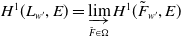 $H^1(L_{w'}, E) = \mathop {\varinjlim }\limits _{\tilde {F} \in \Omega } H^1(\tilde {F}_{w'}, E)$
, where for
$H^1(L_{w'}, E) = \mathop {\varinjlim }\limits _{\tilde {F} \in \Omega } H^1(\tilde {F}_{w'}, E)$
, where for $\tilde {F} \in \Omega$
,
$\tilde {F} \in \Omega$
, $\tilde {F}_{w'}$
means the completion of
$\tilde {F}_{w'}$
means the completion of $\tilde {F}$
at the prime of
$\tilde {F}$
at the prime of $\tilde {F}$
below
$\tilde {F}$
below $w'$
. Hence,
$w'$
. Hence, $H^1(L_{w'}, E)[p^{\infty }] = \mathop {\varinjlim }\limits _{\tilde {F} \in \Omega } H^1(\tilde {F}_{w'}, E)[p^{\infty }]$
. Therefore from this and the fact that
$H^1(L_{w'}, E)[p^{\infty }] = \mathop {\varinjlim }\limits _{\tilde {F} \in \Omega } H^1(\tilde {F}_{w'}, E)[p^{\infty }]$
. Therefore from this and the fact that $\textrm {res}_{L_{w'}}(z_w)=0$
, we see that there exists
$\textrm {res}_{L_{w'}}(z_w)=0$
, we see that there exists $F^{(w)} \in \Omega$
that is Galois over
$F^{(w)} \in \Omega$
that is Galois over $F$
with
$F$
with $\textrm {res}_{(F^{(w)})_{w'}}(z_w)=0$
, where
$\textrm {res}_{(F^{(w)})_{w'}}(z_w)=0$
, where $\textrm {res}_{(F^{(w)})_{w'}}\,:\, H^1(F_w,E)[p^{\infty }] \longrightarrow H^1((F^{(w)})_{w'}, E)[p^{\infty }]$
is the restriction map.
$\textrm {res}_{(F^{(w)})_{w'}}\,:\, H^1(F_w,E)[p^{\infty }] \longrightarrow H^1((F^{(w)})_{w'}, E)[p^{\infty }]$
is the restriction map.
Since $F^{(w)}$
is Galois over
$F^{(w)}$
is Galois over $F$
, if
$F$
, if $\tilde {w}$
is any prime of
$\tilde {w}$
is any prime of $F^{(w)}$
above
$F^{(w)}$
above $w$
, then the completion
$w$
, then the completion $(F^{(w)})_{\tilde {w}}$
is equal to
$(F^{(w)})_{\tilde {w}}$
is equal to $(F^{(w)})_{w'}$
. Therefore, for any prime
$(F^{(w)})_{w'}$
. Therefore, for any prime $\tilde {w}$
of
$\tilde {w}$
of $F^{(w)}$
above
$F^{(w)}$
above $w$
we have
$w$
we have $\textrm {res}_{(F^{(w)})_{\tilde {w}}}(z_w)=0$
.
$\textrm {res}_{(F^{(w)})_{\tilde {w}}}(z_w)=0$
.
Now let $F'$
be the composite of the fields
$F'$
be the composite of the fields $F^{(w)}$
where
$F^{(w)}$
where $w$
runs over all primes of
$w$
runs over all primes of $F$
above
$F$
above $v$
. Then we see that
$v$
. Then we see that $\beta _{F,F'}(x_F)=0$
, where
$\beta _{F,F'}(x_F)=0$
, where $\beta _{F,F'}\,:\, \bigoplus _{w|v}H^1(F_w,E)[p^{\infty }] \longrightarrow \bigoplus _{w|v}H^1(F'_w,E)[p^{\infty }]$
is the map coming from restriction in each component. Therefore,
$\beta _{F,F'}\,:\, \bigoplus _{w|v}H^1(F_w,E)[p^{\infty }] \longrightarrow \bigoplus _{w|v}H^1(F'_w,E)[p^{\infty }]$
is the map coming from restriction in each component. Therefore, $x=\alpha _F(x_F)=0$
and hence
$x=\alpha _F(x_F)=0$
and hence $\ker \Xi _v=0$
.
$\ker \Xi _v=0$
.
Finally, to prove that each of the Selmer groups in the statement of the lemma is independent of the set $S$
, we only need to show that this result is true if
$S$
, we only need to show that this result is true if $\mathbb{L}_{\infty }$
is replaced with
$\mathbb{L}_{\infty }$
is replaced with $F \in \Omega$
. To this end, let
$F \in \Omega$
. To this end, let $F \in \Omega$
and let
$F \in \Omega$
and let $S$
be any finite set of nonarchimedean primes of
$S$
be any finite set of nonarchimedean primes of $K$
containing
$K$
containing $S_p$
and all the primes where
$S_p$
and all the primes where $E$
has bad reduction. By [Reference Milne44, Proposition I-6.5], we have an exact sequence
$E$
has bad reduction. By [Reference Milne44, Proposition I-6.5], we have an exact sequence
 \begin{equation} 0 \longrightarrow H^1(G_S(F), E[p^{\infty }]) \longrightarrow H^1(F, E[p^{\infty }]) \longrightarrow \prod _{w \notin S_F} H^1(F_w, E)[p^{\infty }]. \end{equation}
We should note that loc. cit. assumes that $S_F$
contains all archimedean primes of
$S_F$
contains all archimedean primes of $F$
. For any archimedean prime
$F$
. For any archimedean prime $w$
of
$w$
of $F$
, we have
$F$
, we have $H^1(F_w, E[p^{\infty }])=0$
because
$H^1(F_w, E[p^{\infty }])=0$
because $p$
is odd. Also recall from the beginning of this section that we defined
$p$
is odd. Also recall from the beginning of this section that we defined $K_S$
to be the maximal extension of
$K_S$
to be the maximal extension of $K$
unramified outside
$K$
unramified outside $S$
and the archimedean primes of
$S$
and the archimedean primes of $K$
. Thus, we do in fact have an exact sequence (3).
$K$
. Thus, we do in fact have an exact sequence (3).
Let $\bullet \in \{kum, str, Gr\}$
. We now show that
$\bullet \in \{kum, str, Gr\}$
. We now show that $\textrm {Sel}^{\bullet }(E/F)$
is independent of the set
$\textrm {Sel}^{\bullet }(E/F)$
is independent of the set $S$
, where
$S$
, where $\textrm {Sel}^{kum}(E/F)=\textrm {Sel}(E/F)$
. For
$\textrm {Sel}^{kum}(E/F)=\textrm {Sel}(E/F)$
. For $\bullet =kum$
, this is proven in [Reference Milne44, Corollary I-6.6]. We can easily now adapt the proof to also work for the strict and Greenberg Selmer groups. Consider the exact sequence
$\bullet =kum$
, this is proven in [Reference Milne44, Corollary I-6.6]. We can easily now adapt the proof to also work for the strict and Greenberg Selmer groups. Consider the exact sequence
 \begin{equation} H^1(F, E[p^{\infty }]) \xrightarrow {\,\,\theta\,\, } \prod _{\text{all} \, w} H^1_{\bullet ,s}(F_w, E[p^{\infty }]) \xrightarrow {\,\,\pi\,\, } \prod _{w \notin S_F} H^1_{\bullet ,s}(F_w, E[p^{\infty }]). \end{equation}
In the above sequence, $\theta$
is the localization map and
$\theta$
is the localization map and $\pi$
is just the projection. This sequence of maps induces an exact sequence
$\pi$
is just the projection. This sequence of maps induces an exact sequence
 \begin{equation} 0 \longrightarrow \ker \theta \longrightarrow \ker \pi \circ \theta \longrightarrow \ker \pi . \end{equation}
If $w \notin S_F$
, then in particular
$w \notin S_F$
, then in particular $w$
does not divide
$w$
does not divide $p$
. By Mattuck’s theorem
$p$
. By Mattuck’s theorem $E(F_w) \cong \mathbb{Z}_l^d \times T$
, where
$E(F_w) \cong \mathbb{Z}_l^d \times T$
, where $l$
is the residue characteristic of
$l$
is the residue characteristic of $F_w$
,
$F_w$
, $d=[F_w\,:\,{\mathbb{Q}_l}]$
and
$d=[F_w\,:\,{\mathbb{Q}_l}]$
and $T$
is a finite group. Since
$T$
is a finite group. Since $l \ne p$
, we have
$l \ne p$
, we have $E(F_w)\otimes {\mathbb{Q}_p}/{\mathbb{Z}_p}=0$
and so
$E(F_w)\otimes {\mathbb{Q}_p}/{\mathbb{Z}_p}=0$
and so
 \begin{equation*}H^1_{\bullet ,s}(F_w, E[p^{\infty }])=H^1(F_w, E[p^{\infty }])=H^1(F_w, E)[p^{\infty }].\end{equation*}
Taking this into account, we get from (3) that $\ker \pi \circ \theta = H^1(G_S(F), E[p^{\infty }])$
. Therefore, we get from (5) an exact sequence
$\ker \pi \circ \theta = H^1(G_S(F), E[p^{\infty }])$
. Therefore, we get from (5) an exact sequence
 \begin{equation*}0 \longrightarrow \ker \theta \longrightarrow H^1(G_S(F), E[p^{\infty }]) \longrightarrow \prod _{w \in S_F} H^1_{\bullet ,s}(F_w, E[p^{\infty }]).\end{equation*}
So $\ker \theta = \textrm {Sel}^{\bullet }(E/F)$
. Since
$\ker \theta = \textrm {Sel}^{\bullet }(E/F)$
. Since $\ker \theta$
does not depend on the set
$\ker \theta$
does not depend on the set $S$
, the Selmer group
$S$
, the Selmer group $\textrm {Sel}^{\bullet }(E/F)$
is independent of the set
$\textrm {Sel}^{\bullet }(E/F)$
is independent of the set $S$
.
$S$
.
We will use the equalities in the previous lemma throughout the paper without reference. In what follows, let $\mathbb{L}_\infty /K$
be an arbitrary, but fixed
$\mathbb{L}_\infty /K$
be an arbitrary, but fixed ${\mathbb{Z}}_p^d$
-extension.
${\mathbb{Z}}_p^d$
-extension.
Proposition 2.2.
We have an equality $\textrm {Sel}^{Gr}(E/\mathbb{L}_{\infty }) = \textrm {Sel}^{str}(E/\mathbb{L}_{\infty })$
.
$\textrm {Sel}^{Gr}(E/\mathbb{L}_{\infty }) = \textrm {Sel}^{str}(E/\mathbb{L}_{\infty })$
.
Proof.
To prove the proposition, it will clearly suffice to show that for any $F \in \Omega$
we have
$F \in \Omega$
we have ${\textrm {Sel}_p}^{Gr}(E/F) = {\textrm {Sel}_p}^{str}(E/F)$
. Let
${\textrm {Sel}_p}^{Gr}(E/F) = {\textrm {Sel}_p}^{str}(E/F)$
. Let $F \in \Omega$
and consider the commutative diagram
$F \in \Omega$
and consider the commutative diagram

Applying the snake lemma to the above diagram, we get an exact sequence
 \begin{equation*}0 \longrightarrow \textrm {Sel}^{str}(E/F) \xrightarrow {\,\,\iota\,\,} \textrm {Sel}^{Gr}(E/F) \longrightarrow \textrm {img} \lambda _F \cap \ker \alpha \longrightarrow 0. \end{equation*}
Therefore to prove the result, it will suffice to show that $\ker \alpha =0$
. It is easy to see that we have an injection
$\ker \alpha =0$
. It is easy to see that we have an injection $\ker \alpha \hookrightarrow \bigoplus _{w \in S_{F,p}} H^1(\mathfrak{h}_{F,w}, \tilde {E}[p^{\infty }])$
, where
$\ker \alpha \hookrightarrow \bigoplus _{w \in S_{F,p}} H^1(\mathfrak{h}_{F,w}, \tilde {E}[p^{\infty }])$
, where $\mathfrak{h}_{F,w}=\textrm {Gal}(\overline {F_w}/F_w)/I_w$
and
$\mathfrak{h}_{F,w}=\textrm {Gal}(\overline {F_w}/F_w)/I_w$
and $I_w$
is the inertia subgroup.
$I_w$
is the inertia subgroup.
As the residue field of $F_w$
is finite,
$F_w$
is finite, $\mathfrak{h}_{F,w}$
acts nontrivially on
$\mathfrak{h}_{F,w}$
acts nontrivially on $\tilde {E}[p^{\infty }]$
. Now,
$\tilde {E}[p^{\infty }]$
. Now,
 \begin{align*}H^1(\mathfrak{h}_{F,w}, \tilde {E}[p^{\infty }])=\tilde {E}[p^{\infty }]/(g-1)\tilde {E}[p^{\infty }]\end{align*}
where $g$
is a topological generator of
$g$
is a topological generator of $\mathfrak{h}_{F,w}$
. Since
$\mathfrak{h}_{F,w}$
. Since $\tilde {E}[p^{\infty }]$
is isomorphic to
$\tilde {E}[p^{\infty }]$
is isomorphic to ${\mathbb{Q}_p}/{\mathbb{Z}_p}$
and
${\mathbb{Q}_p}/{\mathbb{Z}_p}$
and $\mathfrak{h}_{F,w}$
acts nontrivially on it, it follows that
$\mathfrak{h}_{F,w}$
acts nontrivially on it, it follows that $\tilde {E}[p^{\infty }]/(g-1)\tilde {E}[p^{\infty }]=0$
. So,
$\tilde {E}[p^{\infty }]/(g-1)\tilde {E}[p^{\infty }]=0$
. So, $H^1(\mathfrak{h}_{F,w}, \tilde {E}[p^{\infty }])=0$
as desired.
$H^1(\mathfrak{h}_{F,w}, \tilde {E}[p^{\infty }])=0$
as desired.
Proposition 2.3. The following assertions hold.
-
(a) If
$F/K$
is a finite subextension of
$\mathbb{L}_{\infty }/K$
and
$w \in S_{F,p}$
, we let
$k_{F_w}$
denote the residue field of
$F_w$
. We have an inclusion map
$\iota \,:\, \textrm {Sel}(E/\mathbb{L}_{\infty }) \longrightarrow \textrm {Sel}^{str}(E/\mathbb{L}_{\infty })$
and an embedding
where the inverse limit is taken with respect to corestriction.
\begin{align*}\theta \,:\, \textrm {coker} \iota \hookrightarrow \Big(\mathop {\varprojlim }\limits _{F \in \Omega } \bigoplus _{w \in S_{F,p}} \tilde {E}(k_{F_w})[p^{\infty }]\Big )^{\vee },\end{align*}
-
(b) If
$X(E/\mathbb{L}_{\infty })$
is
$\Lambda _d$
-torsion and
$E(\mathbb{L}_{\infty })[p^{\infty }]$
is finite, then
$\theta$
is an isomorphism.
-
(c) If every prime in
$S_p$
ramifies in
$\mathbb{L}_{\infty }/K$
, then
$\textrm {Sel}(E/\mathbb{L}_{\infty })= \textrm {Sel}^{str}(E/\mathbb{L}_{\infty })$
. -
(d)
$X(E/\mathbb{L}_{\infty })$
is a finitely generated
$\Lambda _d$
-torsion module if and only if
$X^{str}(E/\mathbb{L}_{\infty })$
is a finitely generated
$\Lambda _d$
-torsion module.








Proof.
By the discussion in [Reference Coates and Greenberg7, pg. 152–153], we have for any finite extension $F/K$
inside
$F/K$
inside $\mathbb{L}_{\infty }$
and
$\mathbb{L}_{\infty }$
and $w \in S_{F,p}$
that
$w \in S_{F,p}$
that $H^1_{kum}(F_w, E[p^{\infty }]) \subseteq H^1_{str}(F_w, E[p^{\infty }])$
. Therefore, we have an inclusion
$H^1_{kum}(F_w, E[p^{\infty }]) \subseteq H^1_{str}(F_w, E[p^{\infty }])$
. Therefore, we have an inclusion
 \begin{equation*}\iota \,:\, \textrm {Sel}(E/\mathbb{L}_{\infty }) \longrightarrow \textrm {Sel}^{str}(E/\mathbb{L}_{\infty }).\end{equation*}
Let $S_{\infty }$
be the set of primes of
$S_{\infty }$
be the set of primes of $\mathbb{L}_{\infty }$
above those in
$\mathbb{L}_{\infty }$
above those in $S$
. We have the following commutative diagram
$S$
. We have the following commutative diagram

Applying the snake lemma to the above diagram, we get an exact sequence
 \begin{equation*}0 \longrightarrow \textrm {Sel}(E/\mathbb{L}_{\infty }) \stackrel {\iota }{\longrightarrow } \textrm {Sel}^{str}(E/\mathbb{L}_{\infty }) \longrightarrow \textrm {img} \lambda _{\infty } \cap \ker \alpha \longrightarrow 0.\end{equation*}
We have an isomorphism
 \begin{equation*}\ker \alpha \cong \mathop {\varinjlim }\limits _{F \in \Omega } \bigoplus _{w \in S_F} H^1_{str}(F_w, E[p^{\infty }])/H^1_{kum}(F_w, E[p^{\infty }]). \end{equation*}
Let $F \in \Omega$
and let
$F \in \Omega$
and let $w \in S_{F,p}$
. Let
$w \in S_{F,p}$
. Let $C_w=\mathcal{F}(\bar {\mathfrak{m}})[p^{\infty }]$
where
$C_w=\mathcal{F}(\bar {\mathfrak{m}})[p^{\infty }]$
where $\bar {\mathfrak{m}}$
is the maximal ideal of
$\bar {\mathfrak{m}}$
is the maximal ideal of $\overline {F_w}$
and
$\overline {F_w}$
and $\mathcal{F}$
is the formal group of
$\mathcal{F}$
is the formal group of $E$
. First, we note that Tate local duality [Reference Neukirch, Schmidt and Wingberg47, Theorem 7.2.6] together with the Weil pairing yields a non-degenerate pairing
$E$
. First, we note that Tate local duality [Reference Neukirch, Schmidt and Wingberg47, Theorem 7.2.6] together with the Weil pairing yields a non-degenerate pairing
 \begin{equation*}\langle \; , \;\rangle \,:\, H^2(F_w, T_p(C_w)) \times H^0(F_w, \tilde {E}[p^{\infty }]) \longrightarrow {\mathbb{Q}_p}/{\mathbb{Z}_p}\end{equation*}
where $T_p(C_w)$
is the
$T_p(C_w)$
is the $p$
-adic Tate module of
$p$
-adic Tate module of $C_w$
. If
$C_w$
. If $F'_w/F_w$
is a finite extension, let
$F'_w/F_w$
is a finite extension, let
 \begin{align*}\textrm {res}\,:\, H^2(F_w, T_p(C_w)) \longrightarrow H^2(F'_w, T_p(C_w))\end{align*}
be the restriction map and let $\textrm {cor}\,:\, H^0(F'_w, \tilde {E}[p^{\infty }]) \longrightarrow H^0(F_w, \tilde {E}[p^{\infty }])$
be the corestriction (norm) map. For
$\textrm {cor}\,:\, H^0(F'_w, \tilde {E}[p^{\infty }]) \longrightarrow H^0(F_w, \tilde {E}[p^{\infty }])$
be the corestriction (norm) map. For $a \in H^2(F_w, T_p(C_w))$
and
$a \in H^2(F_w, T_p(C_w))$
and $b \in H^0(F'_w, \tilde {E}[p^{\infty }])$
, a property of Tate local duality gives
$b \in H^0(F'_w, \tilde {E}[p^{\infty }])$
, a property of Tate local duality gives $\langle \textrm {res} a, b \rangle =\langle a, \textrm {cor} b \rangle$
. We have maps
$\langle \textrm {res} a, b \rangle =\langle a, \textrm {cor} b \rangle$
. We have maps
 \begin{equation*}\kappa _{F_w}\,:\, E(F_w)\otimes {\mathbb{Q}_p}/{\mathbb{Z}_p} \hookrightarrow H^1(F_w, E[p^{\infty }]), \end{equation*}
 \begin{equation*}\lambda _{F_w}\,:\, H^1(F_w, C_w) \longrightarrow H^1(F_w, E[p^{\infty }]). \end{equation*}
Taking into account [Reference Coates and Greenberg7, Proposition4.5], the proof of [Reference Coates and Greenberg7, Proposition 4.6] shows that we have an isomorphism $\theta _{F_w}\,:\, \textrm {img} \lambda _{F_w}/\textrm {img} \kappa _{F_w} \stackrel {\sim }{\longrightarrow } (\tilde {E}(k_{F_w})[p^{\infty }])^{\vee }$
where
$\theta _{F_w}\,:\, \textrm {img} \lambda _{F_w}/\textrm {img} \kappa _{F_w} \stackrel {\sim }{\longrightarrow } (\tilde {E}(k_{F_w})[p^{\infty }])^{\vee }$
where $k_{F_w}$
is the residue field of
$k_{F_w}$
is the residue field of $F_w$
. Consider the exact sequence
$F_w$
. Consider the exact sequence
 \begin{equation*}0 \longrightarrow C_w \longrightarrow E[p^{\infty }] \longrightarrow \tilde {E}[p^{\infty }] \longrightarrow 0. \end{equation*}
From this exact sequence, we see that $\textrm {img} \lambda _{F_w}=H^1_{str}(F_w, E[p^{\infty }])$
. Therefore, taking into account the property of Tate local duality above and the description of the map
$\textrm {img} \lambda _{F_w}=H^1_{str}(F_w, E[p^{\infty }])$
. Therefore, taking into account the property of Tate local duality above and the description of the map $\theta _{F_w}$
, we have an isomorphism
$\theta _{F_w}$
, we have an isomorphism
 \begin{equation*}\mathop {\varinjlim }\limits _{F \in \Omega } \bigoplus _{w \in S_{F,p}} \textrm {img} \lambda _{F_w}/\textrm {img} \kappa _{F_w} \cong \bigg(\mathop {\varprojlim }\limits _{F \in \Omega }\bigoplus _{w \in S_{F,p}} \tilde {E}(k_{F_w})[p^{\infty }]\bigg)^{\vee }. \end{equation*}
The direct limits are taken with respect to restriction and inverse limits are taken with respect to corestriction. This proves (a).
If $X(E/\mathbb{L}_{\infty })$
is
$X(E/\mathbb{L}_{\infty })$
is $\Lambda _d$
-torsion and
$\Lambda _d$
-torsion and $E(\mathbb{L}_{\infty })[p^{\infty }])$
is finite, then by [Reference Hachimori and Venjakob25, Theorem 7.2] the map
$E(\mathbb{L}_{\infty })[p^{\infty }])$
is finite, then by [Reference Hachimori and Venjakob25, Theorem 7.2] the map $\lambda _{\infty }$
in the commutative diagram above is surjective. Therefore by the proof of part (a), we see that
$\lambda _{\infty }$
in the commutative diagram above is surjective. Therefore by the proof of part (a), we see that $\theta$
is an isomorphism. This proves (b).
$\theta$
is an isomorphism. This proves (b).
For part (c), we note that if $L'_w/L_w$
is a finite totally ramified extension, then the norm map from
$L'_w/L_w$
is a finite totally ramified extension, then the norm map from $\tilde {E}(k_{L'_w})[p^{\infty }]$
to
$\tilde {E}(k_{L'_w})[p^{\infty }]$
to $\tilde {E}(k_{L_w})[p^{\infty }]$
is multiplication by
$\tilde {E}(k_{L_w})[p^{\infty }]$
is multiplication by $[L'_w\,:\,L_w]$
. Therefore, if every prime in
$[L'_w\,:\,L_w]$
. Therefore, if every prime in $S_p$
ramifies in
$S_p$
ramifies in $\mathbb{L}_{\infty }/K$
, we see from this that
$\mathbb{L}_{\infty }/K$
, we see from this that $(\!\mathop {\varprojlim }\limits _{F \in \Omega }\bigoplus _{w \in S_{F,p}} \tilde {E}(k_{F_w})[p^{\infty }])^{\vee }=0$
and so
$(\!\mathop {\varprojlim }\limits _{F \in \Omega }\bigoplus _{w \in S_{F,p}} \tilde {E}(k_{F_w})[p^{\infty }])^{\vee }=0$
and so $\textrm {Sel}(E/\mathbb{L}_{\infty })= \textrm {Sel}^{str}(E/\mathbb{L}_{\infty })$
. Alternatively, (c) follows from [Reference Coates and Greenberg7, Prop. 4.3].
$\textrm {Sel}(E/\mathbb{L}_{\infty })= \textrm {Sel}^{str}(E/\mathbb{L}_{\infty })$
. Alternatively, (c) follows from [Reference Coates and Greenberg7, Prop. 4.3].
From (a), we see that to prove (d), we only have to show that the Pontryagin dual of ${A\,:\!=\,\Big(\mathop {\varprojlim }\limits _{F \in \Omega }\bigoplus _{w \in S_{F,p}} \tilde {E}(k_{F_w})[p^{\infty }]\Big)^{\vee }}$
is a finitely generated
${A\,:\!=\,\Big(\mathop {\varprojlim }\limits _{F \in \Omega }\bigoplus _{w \in S_{F,p}} \tilde {E}(k_{F_w})[p^{\infty }]\Big)^{\vee }}$
is a finitely generated $\Lambda _d$
-torsion module. For
$\Lambda _d$
-torsion module. For $v \in S_p$
, we let
$v \in S_p$
, we let ${B_v\,:\!=\, \Big(\mathop {\varprojlim }\limits _{F \in \Omega }\bigoplus _{w|v} \tilde {E}(k_{F_w})[p^{\infty }]\Big)^{\vee }}$
where the direct sum ranges over all primes
${B_v\,:\!=\, \Big(\mathop {\varprojlim }\limits _{F \in \Omega }\bigoplus _{w|v} \tilde {E}(k_{F_w})[p^{\infty }]\Big)^{\vee }}$
where the direct sum ranges over all primes $w$
of
$w$
of $F \in \Omega$
dividing
$F \in \Omega$
dividing $v$
. To show that
$v$
. To show that $A^{\vee }$
is a finitely generated torsion
$A^{\vee }$
is a finitely generated torsion $\Lambda _d$
-module, it suffices to show that for any
$\Lambda _d$
-module, it suffices to show that for any $v \in S_p$
the
$v \in S_p$
the $\Lambda _d$
-module
$\Lambda _d$
-module $(B_v)^{\vee }$
is finitely generated torsion. Let
$(B_v)^{\vee }$
is finitely generated torsion. Let $v \in S_p$
and let
$v \in S_p$
and let $G=\textrm {Gal}(\mathbb{L}_{\infty }/K)$
. By Shapiro’s lemma, we have
$G=\textrm {Gal}(\mathbb{L}_{\infty }/K)$
. By Shapiro’s lemma, we have $(B_v)^G \cong \Big(\Big(\mathop {\varprojlim }\limits _{F \in \Omega } \tilde {E}(k_{F_w})[p^{\infty }]\Big)^{\vee }\Big)^{G_w}$
where
$(B_v)^G \cong \Big(\Big(\mathop {\varprojlim }\limits _{F \in \Omega } \tilde {E}(k_{F_w})[p^{\infty }]\Big)^{\vee }\Big)^{G_w}$
where $w$
is some prime of
$w$
is some prime of $\mathbb{L}_{\infty }$
above
$\mathbb{L}_{\infty }$
above $v$
and
$v$
and $G_w$
is the decomposition group. As
$G_w$
is the decomposition group. As $\mathop {\varprojlim }\limits \tilde {E}(k_{F_w})[p^{\infty }]$
is a pro-
$\mathop {\varprojlim }\limits \tilde {E}(k_{F_w})[p^{\infty }]$
is a pro- $p$
procyclic group, it is a quotient of
$p$
procyclic group, it is a quotient of $\mathbb{Z}_p$
(see [Reference Ribes and Zalesskii51, Proposition 2.7.1]). Therefore,
$\mathbb{Z}_p$
(see [Reference Ribes and Zalesskii51, Proposition 2.7.1]). Therefore, $(B_v)^G$
is cofinitely generated over
$(B_v)^G$
is cofinitely generated over $\mathbb{Z}_p$
, and so
$\mathbb{Z}_p$
, and so $(B_v)^\vee$
is a finitely generated
$(B_v)^\vee$
is a finitely generated $\Lambda _d$
-module.
$\Lambda _d$
-module.
To prove that $(B_v)^{\vee }$
is a torsion
$(B_v)^{\vee }$
is a torsion $\Lambda _d$
-module, we consider two cases. First assume that
$\Lambda _d$
-module, we consider two cases. First assume that $v$
splits completely in
$v$
splits completely in $\mathbb{L}_{\infty }/K$
. Let
$\mathbb{L}_{\infty }/K$
. Let $w$
be a prime of
$w$
be a prime of $\mathbb{L}_{\infty }$
above
$\mathbb{L}_{\infty }$
above $v$
. Then
$v$
. Then $\mathop {\varprojlim }\limits \tilde {E}(k_{F_w})[p^{\infty }]=\tilde {E}(k_{K_v})[p^{\infty }]$
is finite. Therefore, some power of
$\mathop {\varprojlim }\limits \tilde {E}(k_{F_w})[p^{\infty }]=\tilde {E}(k_{K_v})[p^{\infty }]$
is finite. Therefore, some power of $p$
annihilates
$p$
annihilates $B_v$
whence
$B_v$
whence $(B_v)^{\vee }$
is a torsion
$(B_v)^{\vee }$
is a torsion $\Lambda _d$
-module.
$\Lambda _d$
-module.
Now assume that $v$
does not split completely in
$v$
does not split completely in $\mathbb{L}_{\infty }/K$
. Choose some
$\mathbb{L}_{\infty }/K$
. Choose some $\mathbb{Z}_p$
-extension
$\mathbb{Z}_p$
-extension $K_{\infty }/K$
inside
$K_{\infty }/K$
inside $\mathbb{L}_{\infty }$
where
$\mathbb{L}_{\infty }$
where $v$
does not split completely and let
$v$
does not split completely and let $H=\textrm {Gal}(\mathbb{L}_{\infty }/K_\infty )$
. Let
$H=\textrm {Gal}(\mathbb{L}_{\infty }/K_\infty )$
. Let $T$
be the set of primes of
$T$
be the set of primes of $K_{\infty }$
above
$K_{\infty }$
above $v$
. Then by Shapiro’s lemma it follows that
$v$
. Then by Shapiro’s lemma it follows that $(B_v)^H \cong \Big(\Big(\mathop {\varprojlim }\limits _{F \in \Omega } \bigoplus _{w \in T} \tilde {E}(k_{F_w})[p^{\infty }]\Big)^{\vee }\Big)^{H_w}$
where for each
$(B_v)^H \cong \Big(\Big(\mathop {\varprojlim }\limits _{F \in \Omega } \bigoplus _{w \in T} \tilde {E}(k_{F_w})[p^{\infty }]\Big)^{\vee }\Big)^{H_w}$
where for each $w \in T$
we have also written
$w \in T$
we have also written $w$
for a fixed prime of
$w$
for a fixed prime of $\mathbb{L}_{\infty }$
and
$\mathbb{L}_{\infty }$
and $H_w$
is the decomposition group. Since the set
$H_w$
is the decomposition group. Since the set $T$
is finite, we see that
$T$
is finite, we see that $(B_v)^H$
is cofinitely generated over
$(B_v)^H$
is cofinitely generated over $\mathbb{Z}_p$
. Therefore,
$\mathbb{Z}_p$
. Therefore, $(B_v)^{\vee }$
is finitely generated over
$(B_v)^{\vee }$
is finitely generated over ${\mathbb{Z}_p}[[H]]$
whence it is a torsion
${\mathbb{Z}_p}[[H]]$
whence it is a torsion $\Lambda _d$
-module.
$\Lambda _d$
-module.
Recall the notion of $\mathcal{E}_p$
from Definition 1.2. From Propositions 2.2 and 2.3, we get
$\mathcal{E}_p$
from Definition 1.2. From Propositions 2.2 and 2.3, we get
Corollary 2.4.
Assume that $\mathcal{E}_p \neq \emptyset$
. Then
$\mathcal{E}_p \neq \emptyset$
. Then
 \begin{equation*}\textrm {Sel}(E/\mathbb{L}_{\infty })=\textrm {Sel}^{str}(E/\mathbb{L}_{\infty })=\textrm {Sel}^{Gr}(E/\mathbb{L}_{\infty }).\end{equation*}
Definition 2.5.
For an abelian group $G$
, we define its
$G$
, we define its $p$
-rank as
$p$
-rank as
 \begin{equation*}r_p(G)=\dim _{{\mathbb{F}_p}}(G[p]).\end{equation*}
Under certain conditions, we will need to bound the $p$
-rank of the maximal finite
$p$
-rank of the maximal finite $\Lambda$
-submodule of
$\Lambda$
-submodule of $X^{Gr}(E/K_{\infty })$
as
$X^{Gr}(E/K_{\infty })$
as $K_{\infty }$
runs over the set
$K_{\infty }$
runs over the set $\mathcal{E}$
. To achieve this, we use the result of Hachimori–Matsuno [Reference Hachimori and Matsuno23] to bound the order of the maximal finite submodule of
$\mathcal{E}$
. To achieve this, we use the result of Hachimori–Matsuno [Reference Hachimori and Matsuno23] to bound the order of the maximal finite submodule of $X(E/K_{\infty })$
. First, we need
$X(E/K_{\infty })$
. First, we need
Lemma 2.6.
Let $K_{\infty } \in \mathcal{E}$
. We write
$K_{\infty } \in \mathcal{E}$
. We write $\Gamma = \textrm {Gal}(K_\infty /K)$
, and we let
$\Gamma = \textrm {Gal}(K_\infty /K)$
, and we let $\Gamma _n = \textrm {Gal}(K_\infty /K_n)$
for each
$\Gamma _n = \textrm {Gal}(K_\infty /K_n)$
for each $n \in {\mathbb{N}}$
. Let
$n \in {\mathbb{N}}$
. Let $s_n\,:\, \textrm {Sel}(E/K_n) \longrightarrow \textrm {Sel}(E/K_{\infty })^{\Gamma _n}$
be the map induced by restriction. Then
$s_n\,:\, \textrm {Sel}(E/K_n) \longrightarrow \textrm {Sel}(E/K_{\infty })^{\Gamma _n}$
be the map induced by restriction. Then $\ker s_n$
is finite with
$\ker s_n$
is finite with ${r_p(\!\ker s_n) \le 2}$
, and the order of
${r_p(\!\ker s_n) \le 2}$
, and the order of $\ker s_n$
is bounded as
$\ker s_n$
is bounded as $n$
varies.
$n$
varies.
Proof.
For any $n$
, consider the restriction map
$n$
, consider the restriction map
 \begin{equation*} g_n\,:\, H^1(G_S(K_n), E[p^{\infty }]) \longrightarrow H^1(G_S(K_{\infty }), E[p^{\infty }])^{\Gamma _n}. \end{equation*}
Since $\ker s_n$
injects into
$\ker s_n$
injects into $\ker g_n$
, it will suffice to prove the desired result for
$\ker g_n$
, it will suffice to prove the desired result for $\ker g_n$
instead. We have
$\ker g_n$
instead. We have $\ker g_n=H^1(\Gamma _n, E(K_{\infty })[p^{\infty }])$
. Let
$\ker g_n=H^1(\Gamma _n, E(K_{\infty })[p^{\infty }])$
. Let $W=E(K_{\infty })[p^{\infty }]$
. If
$W=E(K_{\infty })[p^{\infty }]$
. If $\gamma$
is a topological generator of
$\gamma$
is a topological generator of $\textrm {Gal}(K_{\infty }/K)=\Gamma$
, then
$\textrm {Gal}(K_{\infty }/K)=\Gamma$
, then $\ker g_n=W/(\gamma ^{p^n}-1)W$
. The kernel of
$\ker g_n=W/(\gamma ^{p^n}-1)W$
. The kernel of $\gamma ^{p^n}-1$
acting on
$\gamma ^{p^n}-1$
acting on $W$
is
$W$
is $E(K_n)[p^{\infty }]$
which is finite.
$E(K_n)[p^{\infty }]$
which is finite.
Let $W_{\text{div}}$
be the maximal divisible subgroup of
$W_{\text{div}}$
be the maximal divisible subgroup of $W$
. Since
$W$
. Since $W_{\text{div}}$
has finite
$W_{\text{div}}$
has finite $\mathbb{Z}_p$
-corank and the kernel of
$\mathbb{Z}_p$
-corank and the kernel of $\gamma ^{p^n}-1$
acting on
$\gamma ^{p^n}-1$
acting on $W$
is finite, it follows that
$W$
is finite, it follows that $(\gamma ^{p^n}-1)W_{\text{div}}=W_{\text{div}}$
. Therefore, we see that we have a surjection
$(\gamma ^{p^n}-1)W_{\text{div}}=W_{\text{div}}$
. Therefore, we see that we have a surjection $W/W_{\text{div}} \twoheadrightarrow \ker g_n$
. This shows that
$W/W_{\text{div}} \twoheadrightarrow \ker g_n$
. This shows that $|\ker g_n|$
is bounded by
$|\ker g_n|$
is bounded by $[W\,:\, W_{\text{div}}]$
and also that
$[W\,:\, W_{\text{div}}]$
and also that
 \begin{align*}r_p(\ker g_n) \leq r_p(W/W_{\text{div}}) \le 2.\end{align*}
Definition 2.7.
If $K_{\infty } \in \mathcal{E}$
, we denote the maximal finite
$K_{\infty } \in \mathcal{E}$
, we denote the maximal finite $\Lambda$
-submodule of
$\Lambda$
-submodule of $X(E/K_{\infty })$
(resp.
$X(E/K_{\infty })$
(resp. $X^{Gr}(E/K_{\infty })$
) by
$X^{Gr}(E/K_{\infty })$
) by $\mathfrak{X}(E/K_{\infty })$
(resp.
$\mathfrak{X}(E/K_{\infty })$
(resp. $\mathfrak{X}^{Gr}(E/K_{\infty })$
).
$\mathfrak{X}^{Gr}(E/K_{\infty })$
).
Now, we have the following important theorem
Theorem 2.8 (Hachimori–Matsuno [Reference Hachimori and Matsuno23]). Suppose that $K_{\infty } \in \mathcal{E}$
and that
$K_{\infty } \in \mathcal{E}$
and that $X(E/K_{\infty })$
is
$X(E/K_{\infty })$
is $\Lambda$
-torsion. Then
$\Lambda$
-torsion. Then $\mathfrak{X}(E/K_{\infty })$
is isomorphic to
$\mathfrak{X}(E/K_{\infty })$
is isomorphic to $\mathop {\varprojlim }\limits \ker s_n$
where
$\mathop {\varprojlim }\limits \ker s_n$
where $s_n\,:\, \textrm {Sel}(E/K_n) \longrightarrow \textrm {Sel}(E/K_{\infty })^{\Gamma _n}$
and the inverse limit is taken with respect to the corestriction maps.
$s_n\,:\, \textrm {Sel}(E/K_n) \longrightarrow \textrm {Sel}(E/K_{\infty })^{\Gamma _n}$
and the inverse limit is taken with respect to the corestriction maps.
From Theorem2.8 and Lemma 2.6, we have
Proposition 2.9.
For all $K_{\infty } \in \mathcal{E}$
with
$K_{\infty } \in \mathcal{E}$
with $X(E/K_{\infty })$ $\Lambda$
-torsion, we have
$\Lambda$
-torsion, we have $r_p(\mathfrak{X}(E/K_{\infty })) \le 2$
.
$r_p(\mathfrak{X}(E/K_{\infty })) \le 2$
.
Proof.
Let $K_{\infty } \in \mathcal{E}$
with
$K_{\infty } \in \mathcal{E}$
with $X(E/K_{\infty })$ $\Lambda$
-torsion. Let
$\Lambda$
-torsion. Let
 \begin{equation*} s_n\,:\, \textrm {Sel}(E/K_n) \longrightarrow \textrm {Sel}(E/K_{\infty })^{\Gamma _n}\end{equation*}
and let $A_n\,:\!=\,\ker s_n$
. From Lemma 2.6, we know that
$A_n\,:\!=\,\ker s_n$
. From Lemma 2.6, we know that $A_n$
is finite with bounded order as
$A_n$
is finite with bounded order as $n$
varies. For any
$n$
varies. For any $n$
, consider the exact sequence
$n$
, consider the exact sequence $A_n \xrightarrow {\times p} A_n \longrightarrow A_n/p \longrightarrow 0$
. Since
$A_n \xrightarrow {\times p} A_n \longrightarrow A_n/p \longrightarrow 0$
. Since $A_n/p$
is finite, it follows by taking inverse limits with respect to corestriction that we have an exact sequence (see [Reference Ribes and Zalesskii51, Lemma 1.1.5])
$A_n/p$
is finite, it follows by taking inverse limits with respect to corestriction that we have an exact sequence (see [Reference Ribes and Zalesskii51, Lemma 1.1.5])
 \begin{equation*}\mathop {\varprojlim }\limits A_n \xrightarrow {\times p} \mathop {\varprojlim }\limits A_n \longrightarrow \mathop {\varprojlim }\limits (A_n/p) \longrightarrow 0. \end{equation*}
Taking Theorem2.8 into account, the above exact sequence implies
 \begin{equation*}\mathfrak{X}(E/K_{\infty })/p\cong (\mathop {\varprojlim }\limits A_n)/p \cong \mathop {\varprojlim }\limits (A_n/p). \end{equation*}
By Lemma 2.6, for any $n$
, we have
$n$
, we have $\dim _{{\mathbb{F}_p}}(A_n/p) \le 2$
. From this, it follows that the inverse system coming from the groups
$\dim _{{\mathbb{F}_p}}(A_n/p) \le 2$
. From this, it follows that the inverse system coming from the groups $A_n/p$
is Mittag-Leffler. For any
$A_n/p$
is Mittag-Leffler. For any $i \in {\mathbb{N}}$
let
$i \in {\mathbb{N}}$
let $B_i \subseteq A_i/p$
be the stable image of
$B_i \subseteq A_i/p$
be the stable image of $\overline {\text{cor}}(A_j/p)$
for
$\overline {\text{cor}}(A_j/p)$
for $j \geq i$
where
$j \geq i$
where $\overline {\text{cor}}$
is the map induced by corestriction. Then
$\overline {\text{cor}}$
is the map induced by corestriction. Then $\mathop {\varprojlim }\limits (A_n/p) = \mathop {\varprojlim }\limits B_n$
. By the choice of the groups
$\mathop {\varprojlim }\limits (A_n/p) = \mathop {\varprojlim }\limits B_n$
. By the choice of the groups $B_i$
, the inverse system coming from these groups has surjective maps. As each
$B_i$
, the inverse system coming from these groups has surjective maps. As each $B_i$
is finite, therefore for some
$B_i$
is finite, therefore for some $N \geq 0$
we have for
$N \geq 0$
we have for $j \geq i \geq N$
that the map
$j \geq i \geq N$
that the map $\overline {\text{cor}}\,:\, B_j \longrightarrow B_i$
is an isomorphism. Then
$\overline {\text{cor}}\,:\, B_j \longrightarrow B_i$
is an isomorphism. Then $\mathop {\varprojlim }\limits B_n \cong B_N$
. Whence we have
$\mathop {\varprojlim }\limits B_n \cong B_N$
. Whence we have
 \begin{equation*} \dim _{{\mathbb{F}_p}}(\!\mathop {\varprojlim }\limits B_n)=\dim _{{\mathbb{F}_p}}(B_N) \leq \dim _{{\mathbb{F}_p}}(A_N/p) \leq 2.\end{equation*}
This completes the proof.
Proposition 2.10.
Assume that $E(\mathbb{L}_{\infty })[p^{\infty }]$
is finite and that the decomposition subgroups
$E(\mathbb{L}_{\infty })[p^{\infty }]$
is finite and that the decomposition subgroups ${D_v(\mathbb{L}_\infty /K) \subseteq \textrm {Gal}(\mathbb{L}_\infty /K)}$
are open for each
${D_v(\mathbb{L}_\infty /K) \subseteq \textrm {Gal}(\mathbb{L}_\infty /K)}$
are open for each $v \mid p$
. Then there exists a constant
$v \mid p$
. Then there exists a constant $C^{Gr} \geq 0$
such that for all
$C^{Gr} \geq 0$
such that for all $K_{\infty } \in \mathcal{E}$
with
$K_{\infty } \in \mathcal{E}$
with $X^{Gr}(E/K_{\infty })$ $\Lambda$
-torsion we have
$\Lambda$
-torsion we have $r_p(\mathfrak{X}^{Gr}(E/K_{\infty })) \le C^{Gr}$
.
$r_p(\mathfrak{X}^{Gr}(E/K_{\infty })) \le C^{Gr}$
.
Proof.
Let $t$
be the number of primes of
$t$
be the number of primes of $\mathbb{L}_{\infty }$
above
$\mathbb{L}_{\infty }$
above $p$
. We claim that
$p$
. We claim that $C^{Gr}=t+2$
has the required property. Let
$C^{Gr}=t+2$
has the required property. Let $K_{\infty } \in \mathcal{E}$
be such that
$K_{\infty } \in \mathcal{E}$
be such that $X^{Gr}(E/K_{\infty })$
is
$X^{Gr}(E/K_{\infty })$
is $\Lambda$
-torsion. Propositions 2.2 and 2.3 hold for any
$\Lambda$
-torsion. Propositions 2.2 and 2.3 hold for any ${\mathbb{Z}}_p^d$
-extension
${\mathbb{Z}}_p^d$
-extension $\mathbb{L}_{\infty }/K$
. Applying them to the
$\mathbb{L}_{\infty }/K$
. Applying them to the $\mathbb{Z}_p$
-extension
$\mathbb{Z}_p$
-extension $K_{\infty }/K$
, we see that
$K_{\infty }/K$
, we see that $X(E/K_{\infty })$
is
$X(E/K_{\infty })$
is $\Lambda$
-torsion. Therefore, by Proposition 2.9
$\Lambda$
-torsion. Therefore, by Proposition 2.9 $r_p(\mathfrak{X}(E/K_{\infty })) \le 2$
.
$r_p(\mathfrak{X}(E/K_{\infty })) \le 2$
.
By Propositions 2.2 and 2.3, we have a surjection
 \begin{equation*}\Psi \,:\, X^{Gr}(E/K_{\infty }) \twoheadrightarrow X(E/K_{\infty }). \end{equation*}
Therefore, we have an exact sequence
 \begin{equation*}0 \longrightarrow \mathfrak{X}^{Gr}(E/K_{\infty }) \cap \ker \Psi \longrightarrow \mathfrak{X}^{Gr}(E/K_{\infty }) \longrightarrow \mathfrak{X}(E/K_{\infty }) \longrightarrow 0.\end{equation*}
From this exact sequence and the fact that $r_p(\mathfrak{X}(E/K_{\infty })) \le 2$
, we see that to show that
$r_p(\mathfrak{X}(E/K_{\infty })) \le 2$
, we see that to show that ${r_p(\mathfrak{X}^{Gr}(E/K_{\infty })) \le t+2}$
it will suffice to show that
${r_p(\mathfrak{X}^{Gr}(E/K_{\infty })) \le t+2}$
it will suffice to show that $r_p(\ker \Psi ) \leq t$
.
$r_p(\ker \Psi ) \leq t$
.
With the notation of Proposition 2.3 let
 \begin{equation*}A\,:\!=\, \left (\mathop {\varprojlim }\limits _{F \in \Omega } \bigoplus _{w \in S_{F,p}} \tilde {E}(k_{F_w})[p^{\infty }]\right )^{\vee }. \end{equation*}
It is easy to see that $\dim _{{\mathbb{F}_p}}(A/p) \leq t$
. This fact together with Propositions 2.2 and 2.3 implies that
$\dim _{{\mathbb{F}_p}}(A/p) \leq t$
. This fact together with Propositions 2.2 and 2.3 implies that $r_p(\ker \Psi ) \leq t$
. This completes the proof.
$r_p(\ker \Psi ) \leq t$
. This completes the proof.
Remark 2.11. The main tool needed to prove Theorem 2.8 of Hachimori–Matsuno is the Cassels–Tate pairing for the classical Selmer group:
 \begin{equation*}\textrm {Sel}(E/K_n) \times \textrm {Sel}(E/K_n) \longrightarrow {\mathbb{Q}_p}/{\mathbb{Z}_p}. \end{equation*}
Here $K_n$
is any tower field of our
$K_n$
is any tower field of our $\mathbb{Z}_p$
-extension
$\mathbb{Z}_p$
-extension $K_{\infty }/K$
. In Li Guo’s paper [Reference Guo21], a slightly modified version of
$K_{\infty }/K$
. In Li Guo’s paper [Reference Guo21], a slightly modified version of $\textrm {Sel}^{str}(E/K_n)$
is defined which we denote by
$\textrm {Sel}^{str}(E/K_n)$
is defined which we denote by $\textrm {Sel}^{str*}(E/K_n)$
. loc. cit. defines a pairing:
$\textrm {Sel}^{str*}(E/K_n)$
. loc. cit. defines a pairing:
 \begin{equation*}\textrm {Sel}^{str*}(E/K_n) \times \textrm {Sel}^{str*}(E/K_n) \longrightarrow {\mathbb{Q}_p}/{\mathbb{Z}_p}. \end{equation*}
With this pairing, one can prove the analog of the Hachimori–Matsuno result for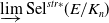 $\mathop {\varinjlim }\limits \textrm {Sel}^{str*}(E/K_n)$
. We need to impose some conditions in order to get
$\mathop {\varinjlim }\limits \textrm {Sel}^{str*}(E/K_n)$
. We need to impose some conditions in order to get $\mathop {\varinjlim }\limits \textrm {Sel}^{str*}(E/K_n)=\textrm {Sel}^{str}(E/K_{\infty })$
. Therefore to avoid additional hypotheses, we have proven Proposition 2.10 using Propositions 2.9
,
2.2 and 2.3
.
$\mathop {\varinjlim }\limits \textrm {Sel}^{str*}(E/K_n)=\textrm {Sel}^{str}(E/K_{\infty })$
. Therefore to avoid additional hypotheses, we have proven Proposition 2.10 using Propositions 2.9
,
2.2 and 2.3
.
3. Results on
$\textbf{Sel}^{\textbf{Gr}}({\textbf{E/K}}_{\boldsymbol{\infty} })$
for
$K_{\infty } \in \mathcal{E}$


In this section, we prove some important results on ${\textrm {Sel}_p}^{Gr}(E/K_{\infty })$
for
${\textrm {Sel}_p}^{Gr}(E/K_{\infty })$
for $K_{\infty } \in \mathcal{E}$
. Let
$K_{\infty } \in \mathcal{E}$
. Let $E$
be either
$E$
be either $E_1$
or
$E_1$
or $E_2$
. Recall from the introduction that
$E_2$
. Recall from the introduction that $S$
is a finite set of nonarchimedean primes of
$S$
is a finite set of nonarchimedean primes of $K$
containing
$K$
containing $S_p$
and all the primes where either
$S_p$
and all the primes where either $E_1$
or
$E_1$
or $E_2$
has bad reduction. Suppose now that
$E_2$
has bad reduction. Suppose now that $F$
is a field with
$F$
is a field with $K \subseteq F \subseteq K_S$
.
$K \subseteq F \subseteq K_S$
.
For a prime $v \in S \setminus S_p$
, we define
$v \in S \setminus S_p$
, we define
 \begin{equation*}\mathcal{H}_v(E/F)=\prod _{w|v}H^1(F_w,E[p^{\infty }])\end{equation*}
where the sum is over all primes $w$
dividing
$w$
dividing $v$
.
$v$
.
Proposition 3.1.
Let $K_{\infty }/K$
be a
$K_{\infty }/K$
be a $\mathbb{Z}_p$
-extension. Assume that
$\mathbb{Z}_p$
-extension. Assume that $v \notin S_p$
does not split completely in
$v \notin S_p$
does not split completely in $K_{\infty }/K$
. Then
$K_{\infty }/K$
. Then $\mathcal{H}_v(E/K_{\infty })^{\vee }$
is a finitely generated free
$\mathcal{H}_v(E/K_{\infty })^{\vee }$
is a finitely generated free $\mathbb{Z}_p$
-module with
$\mathbb{Z}_p$
-module with $\textrm {rank}_{{\mathbb{Z}_p}}(\mathcal{H}_v(E/K_{\infty })^{\vee })\le 2n$
where
$\textrm {rank}_{{\mathbb{Z}_p}}(\mathcal{H}_v(E/K_{\infty })^{\vee })\le 2n$
where $n$
is the number of primes of
$n$
is the number of primes of $K_{\infty }$
above
$K_{\infty }$
above $v$
.
$v$
.
Proof.
Let $w$
be a prime of
$w$
be a prime of $K_{\infty }$
above
$K_{\infty }$
above $v$
. First, we show that
$v$
. First, we show that $H^1(K_{\infty ,w}, E[p^{\infty }])$
is divisible. Since
$H^1(K_{\infty ,w}, E[p^{\infty }])$
is divisible. Since $v$
does not split completely in
$v$
does not split completely in $K_{\infty }/K$
, it follows from [Reference Neukirch, Schmidt and Wingberg47, Theorem 7.1.8(i)] that
$K_{\infty }/K$
, it follows from [Reference Neukirch, Schmidt and Wingberg47, Theorem 7.1.8(i)] that $cd_p(K_{\infty ,w}) \le 1$
. The exact sequence
$cd_p(K_{\infty ,w}) \le 1$
. The exact sequence $0 \longrightarrow E[p] \longrightarrow E[p^{\infty }] \xrightarrow {\times p} E[p^{\infty }] \longrightarrow 0$
induces an exact sequence
$0 \longrightarrow E[p] \longrightarrow E[p^{\infty }] \xrightarrow {\times p} E[p^{\infty }] \longrightarrow 0$
induces an exact sequence
 \begin{equation*}H^1(K_{\infty ,w}, E[p^{\infty }]) \xrightarrow {\times p} H^1(K_{\infty ,w}, E[p^{\infty }]) \longrightarrow H^2(K_{\infty ,w}, E[p]). \end{equation*}
The last term is zero because $cd_p(K_{\infty ,w}) \le 1$
whence
$cd_p(K_{\infty ,w}) \le 1$
whence $H^1(K_{\infty ,w}, E[p^{\infty }])$
is divisible.
$H^1(K_{\infty ,w}, E[p^{\infty }])$
is divisible.
Let $B=\textrm {Hom}_{{\mathbb{Z}_p}}(T_p(E[p^{\infty }]), \mu _{p^{\infty }})$
where
$B=\textrm {Hom}_{{\mathbb{Z}_p}}(T_p(E[p^{\infty }]), \mu _{p^{\infty }})$
where $T_p(E[p^{\infty }])$
is the
$T_p(E[p^{\infty }])$
is the $p$
-adic Tate module of
$p$
-adic Tate module of $E[p^{\infty }]$
and
$E[p^{\infty }]$
and $\mu _{p^{\infty }}$
is the group of
$\mu _{p^{\infty }}$
is the group of $p$
-power roots of unity. By [Reference Greenberg15, Proposition 2],
$p$
-power roots of unity. By [Reference Greenberg15, Proposition 2], $H^1(K_{\infty ,w}, E[p^{\infty }])$
is cofinitely generated over
$H^1(K_{\infty ,w}, E[p^{\infty }])$
is cofinitely generated over $\mathbb{Z}_p$
with
$\mathbb{Z}_p$
with $\textrm {corank}_{{\mathbb{Z}_p}}(H^1(K_{\infty ,w}, E[p^{\infty }]))=\textrm {corank}_{{\mathbb{Z}_p}}(H^0(K_{\infty ,w}, B))$
. By the Weil pairing
$\textrm {corank}_{{\mathbb{Z}_p}}(H^1(K_{\infty ,w}, E[p^{\infty }]))=\textrm {corank}_{{\mathbb{Z}_p}}(H^0(K_{\infty ,w}, B))$
. By the Weil pairing $B \cong E[p^{\infty }]$
and therefore
$B \cong E[p^{\infty }]$
and therefore $\textrm {corank}_{{\mathbb{Z}_p}}(H^1(K_{\infty ,w}, E[p^{\infty }]))=\textrm {corank}_{{\mathbb{Z}_p}}(E(K_{\infty ,w})[p^{\infty }])$
. This completes the proof.
$\textrm {corank}_{{\mathbb{Z}_p}}(H^1(K_{\infty ,w}, E[p^{\infty }]))=\textrm {corank}_{{\mathbb{Z}_p}}(E(K_{\infty ,w})[p^{\infty }])$
. This completes the proof.
Proposition 3.2.
Let $K_{\infty }/K$
be a
$K_{\infty }/K$
be a $\mathbb{Z}_p$
-extension. Let
$\mathbb{Z}_p$
-extension. Let $v \notin S_p$
. Then the following two assertions hold true.
$v \notin S_p$
. Then the following two assertions hold true.
-
(i) If
$E$
has additive reduction at
$v$
and
$p \geq 5$
, then
$\mathcal{H}_v(E/K_{\infty })=0$
. -
(ii) If
$E$
has multiplicative reduction at
$v$
,
$p \nmid c_v$
and
$p \nmid \#k_v^{\times }$
where
$k_v$
is the residue field of
$K_v$
, then
$\mathcal{H}_v(E/K_{\infty })=0$
.


Proof.
Let $w$
be a prime of
$w$
be a prime of $K_{\infty }$
above
$K_{\infty }$
above $v$
. If
$v$
. If $v$
does not split completely in
$v$
does not split completely in $K_{\infty }/K$
, then
$K_{\infty }/K$
, then $K_{\infty ,w}/K_v$
is a
$K_{\infty ,w}/K_v$
is a $\mathbb{Z}_p$
-extension. Let
$\mathbb{Z}_p$
-extension. Let $\Gamma _w=\textrm {Gal}(K_{\infty ,w}/K_v)$
. Then
$\Gamma _w=\textrm {Gal}(K_{\infty ,w}/K_v)$
. Then $cd_p(\Gamma _w)=1$
and so we get a surjection
$cd_p(\Gamma _w)=1$
and so we get a surjection
 \begin{align*}H^1(K_v, E[p^{\infty }]) \twoheadrightarrow H^1(K_{\infty ,w}, E[p^{\infty }])^{\Gamma _w}.\end{align*}
Since $\Gamma _w$
is pro-
$\Gamma _w$
is pro- $p$
, we see that to show that
$p$
, we see that to show that $H^1(K_{\infty ,w}, E[p^{\infty }])=0$
, it will suffice to show that
$H^1(K_{\infty ,w}, E[p^{\infty }])=0$
, it will suffice to show that $H^1(K_v, E[p^{\infty }])=0$
. If
$H^1(K_v, E[p^{\infty }])=0$
. If $v$
splits completely in
$v$
splits completely in $K_{\infty }/K$
, then
$K_{\infty }/K$
, then $H^1(K_{\infty ,w}, E[p^{\infty }])=H^1(K_v, E[p^{\infty }])$
. Therefore, we see that in either case that we must show that
$H^1(K_{\infty ,w}, E[p^{\infty }])=H^1(K_v, E[p^{\infty }])$
. Therefore, we see that in either case that we must show that $H^1(K_v, E[p^{\infty }])=0$
.
$H^1(K_v, E[p^{\infty }])=0$
.
By Mattuck’s Theorem, we have that $E(K_v) \cong \mathbb{Z}_l^d \times T$
, where
$E(K_v) \cong \mathbb{Z}_l^d \times T$
, where $l$
is the residue characteristic of
$l$
is the residue characteristic of $K_v$
,
$K_v$
, $d=[K_v\,:\,{\mathbb{Q}_l}]$
and
$d=[K_v\,:\,{\mathbb{Q}_l}]$
and $T$
is a finite group. Since
$T$
is a finite group. Since $l \ne p$
, we have
$l \ne p$
, we have $E(K_v)\otimes {\mathbb{Q}_p}/{\mathbb{Z}_p}=0$
and so
$E(K_v)\otimes {\mathbb{Q}_p}/{\mathbb{Z}_p}=0$
and so $H^1(K_v, E[p^{\infty }])=H^1(K_v, E)[p^{\infty }]$
. By Tate duality for abelian varieties over local fields [Reference Milne44, Corollary I-3.4], we have an isomorphism
$H^1(K_v, E[p^{\infty }])=H^1(K_v, E)[p^{\infty }]$
. By Tate duality for abelian varieties over local fields [Reference Milne44, Corollary I-3.4], we have an isomorphism $H^1(K_v, E)^{\vee } \cong E(K_v)$
. Therefore,
$H^1(K_v, E)^{\vee } \cong E(K_v)$
. Therefore, $(H^1(K_v, E)[p^{\infty }])^{\vee } \cong \mathop {\varprojlim }\limits E(K_v)/p^nE(K_v)$
. Since
$(H^1(K_v, E)[p^{\infty }])^{\vee } \cong \mathop {\varprojlim }\limits E(K_v)/p^nE(K_v)$
. Since ${E(K_v) \cong \mathbb{Z}_l^d \times T}$
and
${E(K_v) \cong \mathbb{Z}_l^d \times T}$
and $l \ne p$
, we have that
$l \ne p$
, we have that $\mathop {\varprojlim }\limits E(K_v)/p^nE(K_v)$
is just the (finite)
$\mathop {\varprojlim }\limits E(K_v)/p^nE(K_v)$
is just the (finite) $p$
-primary subgroup of
$p$
-primary subgroup of $E(K_v)$
. It follows from the previous facts that
$E(K_v)$
. It follows from the previous facts that $H^1(K_v, E[p^{\infty }])$
is isomorphic to
$H^1(K_v, E[p^{\infty }])$
is isomorphic to $E(K_v)[p^{\infty }]$
and so we only need to show that
$E(K_v)[p^{\infty }]$
and so we only need to show that $E(K_v)[p^{\infty }]=0$
.
$E(K_v)[p^{\infty }]=0$
.
Assume that $E$
has additive reduction at
$E$
has additive reduction at $v$
and
$v$
and $p$
and
$p$
and $p \geq 5$
. Let
$p \geq 5$
. Let $E_0(K_v)$
be the group of points of
$E_0(K_v)$
be the group of points of $E(K_v)$
of nonsingular reduction. Since
$E(K_v)$
of nonsingular reduction. Since $p \geq 5$
, by [Reference Silverman57, pg. 448] the cardinality of
$p \geq 5$
, by [Reference Silverman57, pg. 448] the cardinality of $E(K_v)/E_0(K_v)$
is prime to
$E(K_v)/E_0(K_v)$
is prime to $p$
. Therefore,
$p$
. Therefore, $E(K_v)[p^{\infty }]=E_0(K_v)[p^{\infty }]$
. Let
$E(K_v)[p^{\infty }]=E_0(K_v)[p^{\infty }]$
. Let $\hat {E}$
be the formal group of
$\hat {E}$
be the formal group of $E/K_v$
and
$E/K_v$
and $\mathfrak{m}_v$
the maximal ideal of
$\mathfrak{m}_v$
the maximal ideal of $O_v$
(the ring of integers of
$O_v$
(the ring of integers of $K_v$
). Since
$K_v$
). Since $v \nmid p$
,
$v \nmid p$
, $\hat {E}(\mathfrak{m}_v)$
has no elements of order
$\hat {E}(\mathfrak{m}_v)$
has no elements of order $p$
and so
$p$
and so $E(K_v)[p^{\infty }]=E_0(K_v)[p^{\infty }]$
injects into the set
$E(K_v)[p^{\infty }]=E_0(K_v)[p^{\infty }]$
injects into the set $\tilde {E}_{ns}(k_v)$
of nonsingular points of the reduction of
$\tilde {E}_{ns}(k_v)$
of nonsingular points of the reduction of $E$
modulo the residue field
$E$
modulo the residue field $k_v$
. But as
$k_v$
. But as $E$
has additive reduction at
$E$
has additive reduction at $v$
we have
$v$
we have $\tilde {E}_{ns}(k_v)\cong k_v$
. Since
$\tilde {E}_{ns}(k_v)\cong k_v$
. Since $k_v$
has no points of order
$k_v$
has no points of order $p$
(because
$p$
(because $v \nmid p$
), we see that
$v \nmid p$
), we see that $E(K_v)[p^{\infty }]=0$
. This proves (i).
$E(K_v)[p^{\infty }]=0$
. This proves (i).
Now assume that $E$
has multiplicative reduction at
$E$
has multiplicative reduction at $v$
,
$v$
, $p \nmid c_v$
and
$p \nmid c_v$
and $p \nmid \#k_v^{\times }$
. Since
$p \nmid \#k_v^{\times }$
. Since $p \nmid c_v$
,
$p \nmid c_v$
, $\#E(K_v)/E_0(K_v)$
is prime to
$\#E(K_v)/E_0(K_v)$
is prime to $p$
and so
$p$
and so $E(K_v)[p^{\infty }]=E_0(K_v)[p^{\infty }]$
. As above we have that
$E(K_v)[p^{\infty }]=E_0(K_v)[p^{\infty }]$
. As above we have that $E(K_v)[p^{\infty }]=E_0(K_v)[p^{\infty }]$
injects into
$E(K_v)[p^{\infty }]=E_0(K_v)[p^{\infty }]$
injects into $\tilde {E}_{ns}(k_v)$
. As
$\tilde {E}_{ns}(k_v)$
. As $E$
has multiplicative reduction at
$E$
has multiplicative reduction at $v$
,
$v$
, $\tilde {E}_{ns}(k_v)\cong k_v^{\times }$
. Since
$\tilde {E}_{ns}(k_v)\cong k_v^{\times }$
. Since $p \nmid \#k_v^{\times }$
by assumption, we can conclude that
$p \nmid \#k_v^{\times }$
by assumption, we can conclude that $E(K_v)[p^{\infty }]=0$
. This proves (ii).
$E(K_v)[p^{\infty }]=0$
. This proves (ii).
Let $K_{\infty }/K$
be a
$K_{\infty }/K$
be a $\mathbb{Z}_p$
-extension. Let
$\mathbb{Z}_p$
-extension. Let $S_{K_{\infty }}$
(resp.
$S_{K_{\infty }}$
(resp. $S_{K_{\infty ,p}}$
) be the sets of primes of
$S_{K_{\infty ,p}}$
) be the sets of primes of $K_{\infty }$
above those in
$K_{\infty }$
above those in $S$
(resp.
$S$
(resp. $S_p$
). We now define the “non-primitive” Greenberg Selmer group as
$S_p$
). We now define the “non-primitive” Greenberg Selmer group as
 \begin{align} \displaystyle 0 \longrightarrow \textrm {Sel}^{Gr(p)}(E/K_{\infty }) \longrightarrow H^1(G_S(K_{\infty }), E[p^{\infty }]) \longrightarrow \prod _{w \in S_{K_{\infty ,p}}} H^1_{Gr,s}(K_{\infty ,w}, E[p^{\infty }]). \end{align}
We will denote the Pontryagin dual of $\textrm {Sel}^{Gr(p)}(E/K_{\infty })$
by
$\textrm {Sel}^{Gr(p)}(E/K_{\infty })$
by $X^{Gr(p)}(E/K_{\infty })$
. We now define the reduced Greenberg Selmer groups and reduced non-primitive Greenberg Selmer groups. To define these, we first define the reduced local conditions. For
$X^{Gr(p)}(E/K_{\infty })$
. We now define the reduced Greenberg Selmer groups and reduced non-primitive Greenberg Selmer groups. To define these, we first define the reduced local conditions. For $i \in {\mathbb{N}}$
, we define
$i \in {\mathbb{N}}$
, we define
 \begin{equation*} H^1_{Gr}(K_{\infty ,w}, E[p^i])= \begin{cases} \ker (H^1(K_{\infty ,w}, E[p^i]) \longrightarrow H^1(I_w, \tilde {E}[p^i])) & \text{if } w \mid p,\\ 0 & \text{if } w \nmid p. \end{cases} \end{equation*}
For any prime $w$
of
$w$
of $K_{\infty }$
, we define
$K_{\infty }$
, we define
 \begin{equation*}H^1_{Gr,s}(K_{\infty ,w}, E[p^i])=H^1(K_{\infty ,w}, E[p^i])/H^1_{Gr}(K_{\infty ,w}, E[p^i]). \end{equation*}
We define
 \begin{equation*}\displaystyle 0 \longrightarrow \textrm {Sel}^{Gr}(E[p^i]/K_{\infty }) \longrightarrow H^1(G_S(K_{\infty }), E[p^i]) \longrightarrow \prod _{w \in S_{K_{\infty }}} H^1_{Gr,s}(K_{\infty ,w}, E[p^i]) , \end{equation*}
 \begin{equation*} \displaystyle 0 \longrightarrow \textrm {Sel}^{Gr(p)}(E[p^i]/K_{\infty }) \longrightarrow H^1(G_S(K_{\infty }), E[p^i]) \longrightarrow \prod _{w \in S_{K_{\infty ,p}}} H^1_{Gr,s}(K_{\infty ,w}, E[p^i]). \end{equation*}
Recall from Definition 2.5 that for an abelian group $G$
, we define its
$G$
, we define its $p$
-rank as
$p$
-rank as $r_p(G)=\dim _{{\mathbb{F}_p}}(G[p])$
. We have the following result.
$r_p(G)=\dim _{{\mathbb{F}_p}}(G[p])$
. We have the following result.
Proposition 3.3.
For any $K_{\infty } \in \mathcal{E}_p$
and each
$K_{\infty } \in \mathcal{E}_p$
and each $i \in {\mathbb{N}}$
, the natural map
$i \in {\mathbb{N}}$
, the natural map
 \begin{equation*} s_i\,:\, \textrm {Sel}^{Gr(p)}(E[p^i]/K_{\infty }) \longrightarrow \textrm {Sel}^{Gr(p)}(E/K_{\infty })[p^i]\end{equation*}
is surjective with finite kernel satisfying $r_p(\ker s_i) \leq 2$
and
$r_p(\ker s_i) \leq 2$
and $|\ker (s_i)| \le p^{2i}$
.
$|\ker (s_i)| \le p^{2i}$
.
Proof. Consider the commutative diagram

The map $g_i$
is surjective with
$g_i$
is surjective with $\ker g_i = E(K_{\infty })[p^{\infty }]/p^i$
, whence
$\ker g_i = E(K_{\infty })[p^{\infty }]/p^i$
, whence $r_p(\ker g_i) \leq 2$
. It follows from this and the snake lemma that the desired result will follow if we can show that the map
$r_p(\ker g_i) \leq 2$
. It follows from this and the snake lemma that the desired result will follow if we can show that the map $h_i$
is injective. This in turn will follow if we can show that the map
$h_i$
is injective. This in turn will follow if we can show that the map $h_{w,i}\,:\, H^1(I_w, \tilde {E}[p^i]) \longrightarrow H^1(I_w, \tilde {E}[p^{\infty }])[p^i]$
is injective where
$h_{w,i}\,:\, H^1(I_w, \tilde {E}[p^i]) \longrightarrow H^1(I_w, \tilde {E}[p^{\infty }])[p^i]$
is injective where $w$
is a prime of
$w$
is a prime of $K_{\infty }$
above
$K_{\infty }$
above $p$
. But
$p$
. But $I_w$
acts trivially on
$I_w$
acts trivially on $\tilde {E}$
, so
$\tilde {E}$
, so
 \begin{equation*} \ker h_{w,i} = H^0(I_w, \tilde {E}[p^{\infty }])/p^i=\tilde {E}[p^{\infty }]/p^i =0.\end{equation*}
This completes the proof.
Remark 3.4.
The proof of the above lemma shows that $s_i$
is an isomorphism if
$s_i$
is an isomorphism if $E(K_\infty )[p^\infty ] = 0$
.
$E(K_\infty )[p^\infty ] = 0$
.
Lemma 3.5.
For any $K_{\infty } \in \mathcal{E}_p$
and every
$K_{\infty } \in \mathcal{E}_p$
and every $i \in {\mathbb{N}}$
,
$i \in {\mathbb{N}}$
, $i \gt 0$
, the isomorphism
$i \gt 0$
, the isomorphism $E_1[p^i] \cong E_2[p^i]$
of Galois modules induces an isomorphism
$E_1[p^i] \cong E_2[p^i]$
of Galois modules induces an isomorphism
 \begin{equation*}\textrm {Sel}^{Gr(p)}(E_1[p^i]/K_{\infty }) \cong \textrm {Sel}^{Gr(p)}(E_2[p^i]/K_{\infty }). \end{equation*}
Proof.
The isomorphism $\Phi \,:\, E_1[p^i] \cong E_2[p^i]$
induces an isomorphism
$\Phi \,:\, E_1[p^i] \cong E_2[p^i]$
induces an isomorphism
 \begin{align*}H^1(G_S(K_{\infty }), E_1[p^i]) \cong H^1(G_S(K_{\infty }), E_2[p^i]).\end{align*}
Let $v$
be a prime of
$v$
be a prime of $K$
above
$K$
above $p$
. We want to show that
$p$
. We want to show that $\Phi$
induces an isomorphism
$\Phi$
induces an isomorphism $\Phi _v\,:\, {\tilde {E_1}[p^i] \cong \tilde {E_2}[p^i]}$
. We now show that condition
$\Phi _v\,:\, {\tilde {E_1}[p^i] \cong \tilde {E_2}[p^i]}$
. We now show that condition $(\Delta )$
in the introduction implies that such a map
$(\Delta )$
in the introduction implies that such a map $\Phi _v$
can be induced from
$\Phi _v$
can be induced from $\Phi$
. Let
$\Phi$
. Let $G_{K_v} = \textrm {Gal}(\bar {K}_v/K_v)$
and let
$G_{K_v} = \textrm {Gal}(\bar {K}_v/K_v)$
and let $I_v$
be the inertia subgroup.
$I_v$
be the inertia subgroup.
Let $C_v=\mathcal{F}(\bar {\mathfrak{m}})$
where
$C_v=\mathcal{F}(\bar {\mathfrak{m}})$
where $\bar {\mathfrak{m}}$
is the maximal ideal of
$\bar {\mathfrak{m}}$
is the maximal ideal of $\bar {K}_v$
and
$\bar {K}_v$
and $\mathcal{F}$
is the formal group of
$\mathcal{F}$
is the formal group of $E_1$
. We similarly define
$E_1$
. We similarly define $D_v$
using the formal group of
$D_v$
using the formal group of $E_2$
. Then we have exact sequences
$E_2$
. Then we have exact sequences
 \begin{equation*}0 \longrightarrow C_v[p^n] \longrightarrow E_1[p^n] \longrightarrow \tilde {E}_1[p^n] \longrightarrow 0,\end{equation*}
 \begin{equation*}0 \longrightarrow D_v[p^n] \longrightarrow E_2[p^n] \longrightarrow \tilde {E}_2[p^n] \longrightarrow 0.\end{equation*}
From the exact sequences above, we see that to prove that $\Phi _v$
can be induced from
$\Phi _v$
can be induced from $\Phi$
we need to show that
$\Phi$
we need to show that $\Phi (C_v[p^n])=D_v[p^n]$
. To show that, we use a similar argument to that of Greenberg and Vatsal, see [Reference Greenberg and Vatsal20, p. 26]. Let
$\Phi (C_v[p^n])=D_v[p^n]$
. To show that, we use a similar argument to that of Greenberg and Vatsal, see [Reference Greenberg and Vatsal20, p. 26]. Let $\mu _{p^n}$
be the group of
$\mu _{p^n}$
be the group of $p^n$
-th roots of unity in
$p^n$
-th roots of unity in $\bar {K}_v$
. It will suffice to prove that
$\bar {K}_v$
. It will suffice to prove that $C_v[p^n]$
is the unique subgroup of
$C_v[p^n]$
is the unique subgroup of $E_1[p^n]$
that is isomorphic to
$E_1[p^n]$
that is isomorphic to $\mu _{p^n}$
as an
$\mu _{p^n}$
as an $I_v$
-module and similarly for
$I_v$
-module and similarly for $E_2[p^n]$
. Note that as
$E_2[p^n]$
. Note that as $E_1$
and
$E_1$
and $E_2$
have good ordinary reduction at
$E_2$
have good ordinary reduction at $v$
; therefore as
$v$
; therefore as ${\mathbb{Z}}/p^n{\mathbb{Z}}$
-modules, we have
${\mathbb{Z}}/p^n{\mathbb{Z}}$
-modules, we have $\tilde {E}_1[p^n] \cong \tilde {E}_2[p^n] \cong {\mathbb{Z}}/p^n{\mathbb{Z}}$
. As
$\tilde {E}_1[p^n] \cong \tilde {E}_2[p^n] \cong {\mathbb{Z}}/p^n{\mathbb{Z}}$
. As $I_v$
acts trivially on
$I_v$
acts trivially on $\tilde {E}_1[p^n]$
, we see by the Weil pairing that
$\tilde {E}_1[p^n]$
, we see by the Weil pairing that $I_v$
acts on
$I_v$
acts on $C_v[p^n]$
by the
$C_v[p^n]$
by the $p^n$
-cyclotomic character
$p^n$
-cyclotomic character $\chi$
, that is,
$\chi$
, that is, $C_v[p^n] \cong \mu _{p^n}$
as an
$C_v[p^n] \cong \mu _{p^n}$
as an $I_v$
-module. Now we show that
$I_v$
-module. Now we show that $C_v[p^n]$
is the unique subgroup with this property.
$C_v[p^n]$
is the unique subgroup with this property.
CLAIM: $I_v$
acts nontrivially on any nontrivial quotient of
$I_v$
acts nontrivially on any nontrivial quotient of $\mu _{p^n}$
. Assume that the claim is not true. Any nontrivial quotient of
$\mu _{p^n}$
. Assume that the claim is not true. Any nontrivial quotient of $\mu _{p^n}$
is of the form
$\mu _{p^n}$
is of the form $\mu _{p^n}/\mu _{p^k}$
where
$\mu _{p^n}/\mu _{p^k}$
where $k \lt n$
. Let
$k \lt n$
. Let $\sigma \in I_v$
and let
$\sigma \in I_v$
and let $\zeta$
be a primitive
$\zeta$
be a primitive $p^n$
-th root of unity. Then
$p^n$
-th root of unity. Then $\sigma (\zeta )\mu _{p^k}=\sigma (\zeta \mu _{p^k})=\zeta \mu _{p^k}$
, that is
$\sigma (\zeta )\mu _{p^k}=\sigma (\zeta \mu _{p^k})=\zeta \mu _{p^k}$
, that is $\sigma (\zeta )=\zeta \alpha$
where
$\sigma (\zeta )=\zeta \alpha$
where $\alpha \in \mu _{p^k}$
. Since
$\alpha \in \mu _{p^k}$
. Since $\alpha =\zeta ^c$
for some integer
$\alpha =\zeta ^c$
for some integer $c$
divisible by
$c$
divisible by $p^{n-k}$
, we have that
$p^{n-k}$
, we have that $\sigma (\zeta )=\zeta ^{1+c}$
for such an integer
$\sigma (\zeta )=\zeta ^{1+c}$
for such an integer $c$
. Then
$c$
. Then $\sigma (\zeta ^{p^{n-1}})=(\zeta ^{p^{n-1}})^{1+c}=\zeta ^{p^{n-1}}$
since
$\sigma (\zeta ^{p^{n-1}})=(\zeta ^{p^{n-1}})^{1+c}=\zeta ^{p^{n-1}}$
since $cp^{n-1}$
is divisible by
$cp^{n-1}$
is divisible by $p^n$
. Thus,
$p^n$
. Thus, $\sigma (\mu _p)=\mu _p$
. This holds for all
$\sigma (\mu _p)=\mu _p$
. This holds for all $\sigma \in I_v$
. Therefore,
$\sigma \in I_v$
. Therefore, $(\mu _p)^{I_v}=\mu _p$
. This contradicts
$(\mu _p)^{I_v}=\mu _p$
. This contradicts $(\Delta )$
and so we see that the claim is true.
$(\Delta )$
and so we see that the claim is true.
Now suppose that $U \neq C_v[p^n]$
is a subgroup of
$U \neq C_v[p^n]$
is a subgroup of $E_1[p^n]$
that is isomorphic to
$E_1[p^n]$
that is isomorphic to $\mu _{p^n}$
as an
$\mu _{p^n}$
as an $I_v$
-module. Consider the quotient
$I_v$
-module. Consider the quotient $U/(U \cap C_v[p^n])$
. Since
$U/(U \cap C_v[p^n])$
. Since $U \neq C_v[p^n]$
, this is a nontrivial quotient of
$U \neq C_v[p^n]$
, this is a nontrivial quotient of $U$
and so by the above claim
$U$
and so by the above claim $I_v$
acts nontrivially on this quotient. But we have a
$I_v$
acts nontrivially on this quotient. But we have a $({\mathbb{Z}}/p^n{\mathbb{Z}})[I_v]$
-injection
$({\mathbb{Z}}/p^n{\mathbb{Z}})[I_v]$
-injection
 \begin{align*}U/(U \cap C_v[p^n]) \hookrightarrow \tilde {E}_1[p^n].\end{align*}
Since $I_v$
acts trivially on
$I_v$
acts trivially on $\tilde {E}_1[p^n]$
, this is a contradiction. Therefore, we see that
$\tilde {E}_1[p^n]$
, this is a contradiction. Therefore, we see that $U=C_v[p^n]$
, that is,
$U=C_v[p^n]$
, that is, $C_v[p^n]$
is the unique subgroup of
$C_v[p^n]$
is the unique subgroup of $E_1[p^n]$
that is isomorphic to
$E_1[p^n]$
that is isomorphic to $\mu _{p^n}$
as an
$\mu _{p^n}$
as an $I_v$
-module. Thus,
$I_v$
-module. Thus, $\Phi$
induces an isomorphism
$\Phi$
induces an isomorphism $\Phi _v$
.
$\Phi _v$
.
It follows from this that for any $w \in S_p$
, we have an isomorphism
$w \in S_p$
, we have an isomorphism
 \begin{align*}H^1_{Gr,s}(K_{\infty ,w}, E_1[p^i]) \cong H^1_{Gr,s}(K_{\infty ,w}, E_2[p^i]).\end{align*}
The lemma follows from these observations.
We end this section with the following control theorem (where as usual we assume that $d \geq 2$
). Let
$d \geq 2$
). Let $E$
be either
$E$
be either $E_1$
or
$E_1$
or $E_2$
. Let
$E_2$
. Let $S$
be the set of primes of
$S$
be the set of primes of $K$
which lie above
$K$
which lie above $p$
or where
$p$
or where $E$
has bad reduction.
$E$
has bad reduction.
Proposition 3.6.
Let $K_{\infty } \in \mathcal{E}$
. Consider the dual of the restriction map
$K_{\infty } \in \mathcal{E}$
. Consider the dual of the restriction map
 \begin{equation*}f^\vee \colon X^{Gr}(E/\mathbb{L}_{\infty })_{\textrm {Gal}(\mathbb{L}_{\infty }/K_{\infty })} \longrightarrow X^{Gr}(E/K_{\infty }). \end{equation*}
We have
-
(a)
$\textrm {coker} f^{\vee }$
is a finitely generated
${\mathbb{Z}}_p$
-module with
$\textrm {rank}_{{\mathbb{Z}}_p}(\textrm {coker}\, f^{\vee }) \leq (d-1)$
. -
(b) Let
$m_p=\sum _{v | p} m_v$
where the sum runs over the primes of
$K$
above
$p$
and
$m_v$
is defined to be zero if
$v$
splits completely in
$K_{\infty }$
and equal to the number of primes of
$K_{\infty }$
above
$v$
otherwise. Then
$\ker f^{\vee }$
is a finitely generated torsion
$\Lambda$
-module with
$\lambda (\ker f^{\vee }) \leq (d-1)m_p +(d-1)(d-2)/2$
.



Proof. Taking into account Proposition 2.2, this proposition can be proven in an identical way to [Reference Kleine and Matar35, Lemma 3.11].
Corollary 3.7.
Let $K_{\infty } \in \mathcal{E}$
, then the following assertions hold.
$K_{\infty } \in \mathcal{E}$
, then the following assertions hold.
-
(a)
$\textrm {rank}_{\Lambda }(X^{Gr}(E/K_{\infty })) = \textrm {rank}_{\Lambda }(X^{Gr}(E/\mathbb{L}_{\infty })_{\textrm {Gal}(\mathbb{L}_{\infty }/K_{\infty })})$
. -
(b) Assume that
-
(1) no prime in
$S_p$
splits completely in
$K_{\infty }/K$
, -
(2)
$\textrm {rank}_{\Lambda }(X^{Gr}(E/K_{\infty })) = \textrm {rank}_{\Lambda }(X^{Gr}(E/\mathbb{L}_{\infty })_{\textrm {Gal}(\mathbb{L}_{\infty }/K_{\infty })})=0$
.
Furthermore, assume either of the following conditions is true
-
(i) No prime in
$S \setminus S_p$
splits completely in
$K_{\infty }/K$
-
(ii)
$E$
satisfies
$({\star})$
from the introduction for all
$v \in S$
Then
$\mu (X^{Gr}(E/K_{\infty })) = \mu (X^{Gr}(E/\mathbb{L}_{\infty })_{\textrm {Gal}(\mathbb{L}_{\infty }/K_{\infty })})$
. -
-
(c) If no prime in
$S_p$
splits completely in
$K_{\infty }/K$
, then there exists a neighbourhood
$\mathcal{E}(K_{\infty },n)$
such that
$|\lambda (X^{Gr}(E/K'_{\infty })) - \lambda (X^{Gr}(E/\mathbb{L}_{\infty })_{\textrm {Gal}(\mathbb{L}_{\infty }/K'_{\infty })})|$
is bounded as
$K'_\infty$
runs over the elements of
$\mathcal{E}(K_{\infty },n)$
for which
\begin{equation*}\textrm {rank}_{\Lambda }(X^{Gr}(E/K'_{\infty })) = \textrm {rank}_{\Lambda }(X^{Gr}(E/\mathbb{L}_{\infty })_{\textrm {Gal}(\mathbb{L}_{\infty }/K'_{\infty })}=0. \end{equation*}






Proof.
Statement (a) follows directly from Proposition 3.6. Now assume that both $X^{Gr}(E/K_{\infty })$
and
$X^{Gr}(E/K_{\infty })$
and $X^{Gr}(E/\mathbb{L}_{\infty })_{\textrm {Gal}(\mathbb{L}_{\infty }/K_{\infty })}$
are
$X^{Gr}(E/\mathbb{L}_{\infty })_{\textrm {Gal}(\mathbb{L}_{\infty }/K_{\infty })}$
are $\Lambda$
-torsion. Also assume that no prime in
$\Lambda$
-torsion. Also assume that no prime in $S_p$
splits completely in
$S_p$
splits completely in $K_{\infty }/K$
. By Lemma 2.1, we may assume that
$K_{\infty }/K$
. By Lemma 2.1, we may assume that $S$
is precisely the set of primes of
$S$
is precisely the set of primes of $K$
above
$K$
above $p$
and where
$p$
and where $E$
has bad reduction. If
$E$
has bad reduction. If $E$
satisfies
$E$
satisfies $({\star})$
for all
$({\star})$
for all $v \in S$
, then by Proposition 3.2, for any prime of
$v \in S$
, then by Proposition 3.2, for any prime of $K_{\infty }$
lying over a prime of
$K_{\infty }$
lying over a prime of $S \setminus S_p$
we have
$S \setminus S_p$
we have $H^1(K_{\infty ,w}, E[p^{\infty }])=0$
. From this and the proof of Proposition 3.6, we have that under either condition (i) or (ii) both
$H^1(K_{\infty ,w}, E[p^{\infty }])=0$
. From this and the proof of Proposition 3.6, we have that under either condition (i) or (ii) both $\mu (\ker f^{\vee })=0$
and
$\mu (\ker f^{\vee })=0$
and $\mu (\textrm {coker} f^{\vee })=0$
. This proves (b). We can prove part (c) in an identical way to [Reference Kleine and Matar35, Corollary 3.12(b)].
$\mu (\textrm {coker} f^{\vee })=0$
. This proves (b). We can prove part (c) in an identical way to [Reference Kleine and Matar35, Corollary 3.12(b)].
4. Congruent elliptic curves and
$\mathbb{Z}_p$
-extensions

In this section, we collect some results about relationships between Iwasawa invariants of Pontryagin duals of Selmer groups of congruent elliptic curves over $\mathbb{Z}_p$
-extensions. Via the up-down approach described in the introduction, we will in the next sections use these results to prove our main theorems.
$\mathbb{Z}_p$
-extensions. Via the up-down approach described in the introduction, we will in the next sections use these results to prove our main theorems.
We need the following auxiliary result, which is due to Lim.
Lemma 4.1 (Lim [Reference Lim39], Lemma 2.4.1). Let $M$
be a finitely generated
$M$
be a finitely generated $\Lambda$
-module. Suppose that there is a
$\Lambda$
-module. Suppose that there is a $\Lambda$
-module homomorphism
$\Lambda$
-module homomorphism
 \begin{align} \varphi \colon M[p^\infty ] \longrightarrow \bigoplus _{j = 1}^s \Lambda /(p^{m_j}) \end{align}
with pseudo-null (i.e. finite) kernel and cokernel. Then we have
 \begin{equation*} \mu (M/p^i) = i \cdot \text {rank}_\Lambda (M) + \sum _{j = 1}^s \min (i, m_j). \end{equation*}
for every $i \in {\mathbb{N}}$
,
$i \in {\mathbb{N}}$
, $i \ge 1$
.
$i \ge 1$
.
Note that the module $\bigoplus _{j = 1}^s \Lambda /(p^{m_j})$
is an elementary
$\bigoplus _{j = 1}^s \Lambda /(p^{m_j})$
is an elementary $\Lambda$
-module attached to
$\Lambda$
-module attached to $M[p^\infty ]$
, as in the exact sequence (2).
$M[p^\infty ]$
, as in the exact sequence (2).
Definition 4.2.
Let $M$
be a finitely generated
$M$
be a finitely generated $\Lambda$
-module, and consider a pseudo-isomorphism
$\Lambda$
-module, and consider a pseudo-isomorphism $\varphi$
as in equation (7). Then we define
$\varphi$
as in equation (7). Then we define $e(M)$
to be the maximum of the exponents
$e(M)$
to be the maximum of the exponents $m_j$
,
$m_j$
, $1 \le j \le s$
.
$1 \le j \le s$
.
The following theorem illustrates relationships between $\mu$
-invariants of Pontryagin duals of Selmer groups of congruent elliptic curves. Recall Definitions 1.2 and 1.3 from the introduction.
$\mu$
-invariants of Pontryagin duals of Selmer groups of congruent elliptic curves. Recall Definitions 1.2 and 1.3 from the introduction.
Theorem 4.3.
Assume that either $K_{\infty } \in \mathcal{E}_{ns}$
or
$K_{\infty } \in \mathcal{E}_{ns}$
or $E_1$
and
$E_1$
and $E_2$
satisfy condition
$E_2$
satisfy condition $({\star})$
for all
$({\star})$
for all $v \in S$
.
$v \in S$
.
-
(a) Suppose that
$E_1[p^i] \cong E_2[p^i]$
as Galois modules, where
$i$
is larger than both
$e(X^{Gr}(E_1/K_\infty ))$
and
$e(X^{Gr}(E_2/K_\infty ))$
. Then
and
\begin{equation*} \text {rank}_\Lambda (X^{Gr}(E_1/K_\infty )) = \text {rank}_\Lambda (X^{Gr}(E_2/K_\infty ))\end{equation*}
In fact, the two
\begin{equation*} \mu (X^{Gr}(E_1/K_\infty )) = \mu (X^{Gr}(E_2/K_\infty )).\end{equation*}
$\Lambda$
-modules
$X^{Gr}(E_1/K_\infty )[p^\infty ]$
and
$X^{Gr}(E_2/K_\infty )[p^\infty ]$
are pseudo-isomorphic.
-
(b) Now suppose that
$\text {rank}_\Lambda (X^{Gr}(E_1/K_\infty )) \le \text {rank}_\Lambda (X^{Gr}(E_2/K_\infty ))$
and that
$E_1[p^i] \cong E_2[p^i]$
for some
$i \gt e(X^{Gr}(E_1/K_\infty ))$
. Then the
$\Lambda$
-ranks are equal, and the
$p$
-primary torsion submodules of
$X^{Gr}(E_1/K_\infty )$
and
$X^{Gr}(E_2/K_\infty )$
are pseudo-isomorphic as
$\Lambda$
-modules.
-
(c) If
$E_1[p] \cong E_2[p]$
, then
$\textrm {Sel}^{Gr}(E_1/K_{\infty })$
is
$\Lambda$
-cotorsion with
$\mu =0$
if and only if
$\textrm {Sel}^{Gr}(E_2/K_{\infty })$
is
$\Lambda$
-cotorsion with
$\mu =0$
.








Proof. The following proof uses ideas from the proof of [Reference Lim39, Theorem 4.2.1]. But note that Lim’s result was proven only for torsion Iwasawa modules.
For both $j = 1$
and
$j = 1$
and $j = 2$
, we have an exact sequence
$j = 2$
, we have an exact sequence
 \begin{equation*}0 \longrightarrow \textrm {Sel}^{Gr}(E_j/K_{\infty }) \longrightarrow \textrm {Sel}^{Gr(p)}(E_j/K_{\infty }) \longrightarrow \prod _{v \in S \setminus S_p} \mathcal{H}_v(E_j/K_{\infty }). \end{equation*}
If $K_{\infty } \in \mathcal{E}_{ns}$
, then by Proposition 3.1 we see that
$K_{\infty } \in \mathcal{E}_{ns}$
, then by Proposition 3.1 we see that $\bigoplus _{v \in S \setminus S_p}\mathcal{H}_v(E_j/K_{\infty })$
is a cotorsion
$\bigoplus _{v \in S \setminus S_p}\mathcal{H}_v(E_j/K_{\infty })$
is a cotorsion $\Lambda$
-module with
$\Lambda$
-module with $\mu =0$
for both
$\mu =0$
for both $j = 1,2$
. By Lemma 2.1 in the exact sequence above, we may assume for
$j = 1,2$
. By Lemma 2.1 in the exact sequence above, we may assume for $j=1,2$
that
$j=1,2$
that $S$
is precisely the set of primes of
$S$
is precisely the set of primes of $K$
which lie above
$K$
which lie above $p$
or where
$p$
or where $E_j$
has bad reduction. If both
$E_j$
has bad reduction. If both $E_1$
and
$E_1$
and $E_2$
satisfy condition
$E_2$
satisfy condition $({\star})$
for all
$({\star})$
for all $v \in S$
, then by Proposition 3.2
$v \in S$
, then by Proposition 3.2 $\bigoplus _{v \in S \setminus S_p}\mathcal{H}_v(E_j/K_{\infty })=0$
,
$\bigoplus _{v \in S \setminus S_p}\mathcal{H}_v(E_j/K_{\infty })=0$
, $j = 1,2$
. Taking Pontryagin duals in the above exact sequence, we may conclude that in either case we have
$j = 1,2$
. Taking Pontryagin duals in the above exact sequence, we may conclude that in either case we have
 \begin{equation*} \text {rank}_\Lambda (X^{Gr}(E_j/K_\infty )) = \text {rank}_\Lambda (X^{Gr(p)}(E_j/K_\infty ))\end{equation*}
and
 \begin{equation*} \mu (X^{Gr}(E_j/K_\infty )) = \mu (X^{Gr(p)}(E_j/K_\infty ))\end{equation*}
for both $j = 1$
and
$j = 1$
and $j = 2$
. In fact, the
$j = 2$
. In fact, the $p$
-torsion submodules are pseudo-isomorphic, that is,
$p$
-torsion submodules are pseudo-isomorphic, that is,
 \begin{equation*} e(X^{Gr}(E_j/K_\infty )) = e(X^{Gr(p)}(E_j/K_\infty ))\end{equation*}
for both $j$
. Moreover, for every
$j$
. Moreover, for every $k \in {\mathbb{N}}$
we have an exact sequence
$k \in {\mathbb{N}}$
we have an exact sequence
 \begin{equation*} \prod _{v \in S \setminus S_p} \mathcal{H}_v(E_j/K_\infty )^{\vee }/p^k \longrightarrow X^{Gr(p)}/p^k \longrightarrow X^{Gr}/p^k \longrightarrow 0, \end{equation*}
where the first term is finite for each $k$
.
$k$
.
Suppose first that $E_1[p^i] \cong E_2[p^i]$
for some
$E_1[p^i] \cong E_2[p^i]$
for some $i \gt 1$
. Then Lemma 3.5 implies
$i \gt 1$
. Then Lemma 3.5 implies
 \begin{align*}\textrm {Sel}^{Gr(p)}(E_1[p^i]/K_{\infty }) \cong \textrm {Sel}^{Gr(p)}(E_2[p^i]/K_{\infty }).\end{align*}
From Proposition 3.3, we have for $j=1,2$
that the natural map
$j=1,2$
that the natural map
 \begin{align*}\textrm {Sel}^{Gr(p)}(E_j[p^i]/K_\infty ) \longrightarrow \textrm {Sel}^{Gr(p)}(E_j/K_\infty )[p^i]\end{align*}
is a surjection with finite kernel. Combining the two previous facts and taking Pontryagin duals, we obtain that we have a pseudo-isomorphism of $\Lambda$
-modules
$\Lambda$
-modules
 \begin{equation*} X^{Gr(p)}(E_1/K_\infty )/p^i \sim X^{Gr(p)}(E_2/K_\infty )/p^i. \end{equation*}
In particular, the $\mu$
-invariants of these two quotient modules are equal. Note that we also have
$\mu$
-invariants of these two quotient modules are equal. Note that we also have ${E_1[p^{i-1}] \cong E_2[p^{i-1}]}$
, and therefore we also have an equality of
${E_1[p^{i-1}] \cong E_2[p^{i-1}]}$
, and therefore we also have an equality of $\mu$
-invariants
$\mu$
-invariants
 \begin{equation*} \mu (X^{Gr(p)}(E_1/K_\infty )/p^{i-1}) = \mu (X^{Gr(p)}(E_2/K_\infty )/p^{i-1}). \end{equation*}
As we have seen in the first part of the proof, this implies that we have an analogous equation for $X^{Gr}$
instead of
$X^{Gr}$
instead of $X^{Gr(p)}$
. Now we apply Lemma 4.1, both with
$X^{Gr(p)}$
. Now we apply Lemma 4.1, both with $i$
and
$i$
and $i-1$
, and obtain that
$i-1$
, and obtain that
 \begin{eqnarray*} i \cdot r_1 + \mu (X^{Gr}(E_1/K_\infty )) & = & i \cdot r_2 + \mu (X^{Gr}(E_2/K_\infty )), \\ (i-1) \cdot r_1 + \mu (X^{Gr}(E_1/K_\infty )) & = & (i-1) \cdot r_2 + \mu (X^{Gr}(E_2/K_\infty )), \end{eqnarray*}
where we let $r_1 = \text {rank}_\Lambda (X^{Gr}(E_1/K_\infty ))$
and
$r_1 = \text {rank}_\Lambda (X^{Gr}(E_1/K_\infty ))$
and $r_2 = \text {rank}_\Lambda (X^{Gr}(E_2/K_\infty ))$
for brevity. Here, we use the fact that
$r_2 = \text {rank}_\Lambda (X^{Gr}(E_2/K_\infty ))$
for brevity. Here, we use the fact that $i-1$
is greater than or equal to the maximum of both
$i-1$
is greater than or equal to the maximum of both $e(X^{Gr(p)}(E_j/K_\infty ))$
,
$e(X^{Gr(p)}(E_j/K_\infty ))$
, $j \in \{1,2\}$
. Subtracting the two equations, we obtain that the two
$j \in \{1,2\}$
. Subtracting the two equations, we obtain that the two $\Lambda$
-ranks are equal, and then the first equation concludes the proof of the first part of (a). In order to obtain the last part, we just note that our assumptions imply that
$\Lambda$
-ranks are equal, and then the first equation concludes the proof of the first part of (a). In order to obtain the last part, we just note that our assumptions imply that ${E_1[p^k] \cong E_2[p^k]}$
for each
${E_1[p^k] \cong E_2[p^k]}$
for each $k \le i$
. Writing down the corresponding equations from Lemma 4.1 and comparing the coefficients
$k \le i$
. Writing down the corresponding equations from Lemma 4.1 and comparing the coefficients $\min (k, m_j)$
for the two
$\min (k, m_j)$
for the two $\Lambda$
-modules, starting from
$\Lambda$
-modules, starting from $k = {i-1}$
and going down to
$k = {i-1}$
and going down to $k =1$
, we can finish the proof of (a) via an induction.
$k =1$
, we can finish the proof of (a) via an induction.
Now suppose that we are the setting of (b). Write down the equation from Lemma 4.1 for each integer $k \le i$
. Recall that
$k \le i$
. Recall that $i-1 \ge e(X^{Gr}(E_1/K_\infty ))$
. Comparing the equations for
$i-1 \ge e(X^{Gr}(E_1/K_\infty ))$
. Comparing the equations for $k = i$
and
$k = i$
and $k = i-1$
, we may conclude that
$k = i-1$
, we may conclude that
 \begin{equation*} \mu (X^{Gr}(E_1/K_\infty )) = \mu (X^{Gr}(E_1/K_\infty )/p^i) = \mu (X^{Gr}(E_1/K_\infty )/p^{i-1})\end{equation*}
equals both
 \begin{equation*}i \cdot (r_2 - r_1) + \mu (X^{Gr}(E_2/K_\infty )/p^i)\end{equation*}
and
 \begin{equation*} (i-1) \cdot (r_2 - r_1) + \mu (X^{Gr}(E_2/K_\infty )/p^{i-1}). \end{equation*}
Letting $r \,:\!=\, r_2 - r_1$
for brevity, we obtain that
$r \,:\!=\, r_2 - r_1$
for brevity, we obtain that
 \begin{equation*} i r + \mu (X^{Gr}(E_2/K_\infty )/p^i) = (i-1) r + \mu (X^{Gr}(E_2/K_\infty )/p^{i-1}). \end{equation*}
Since it is obvious that the first (respectively, the second) summand on the left-hand side of this equation is greater than or equal to the first (respectively, the second) summand on the right-hand side (here we use the assumption that $r \ge 0$
), we conclude that we must have
$r \ge 0$
), we conclude that we must have
 \begin{equation*} i r = (i-1) r, \quad \mu (X^{Gr}(E_2/K_\infty /p^i)) = \mu (X^{Gr}(E_2/K_\infty )/p^{i-1}). \end{equation*}
This proves that $e(X^{Gr}(E_2/K_\infty )) \le i-1$
, and that
$e(X^{Gr}(E_2/K_\infty )) \le i-1$
, and that $r = 0$
, that is,
$r = 0$
, that is, $\text {rank}_\Lambda (X^{Gr}(E_1/K_\infty )) = \text {rank}_\Lambda (X^{Gr}(E_2/K_\infty ))$
. Now we proceed iteratively, as in the proof of (a), decreasing the value of
$\text {rank}_\Lambda (X^{Gr}(E_1/K_\infty )) = \text {rank}_\Lambda (X^{Gr}(E_2/K_\infty ))$
. Now we proceed iteratively, as in the proof of (a), decreasing the value of $k$
step by step.
$k$
step by step.
Finally, we prove the last assertion of the theorem. From the structure theorem of finitely generated $\Lambda$
-modules, it is easy to see that
$\Lambda$
-modules, it is easy to see that
 \begin{align*} &\textrm {Sel}^{Gr(p)}(E_i/K_{\infty }) \text{ is } \Lambda \text{-cotorsion with } \mu =0\\ \Longleftrightarrow\ &\textrm {Sel}^{Gr(p)}(E_i/K_{\infty })[p] \text{ is finite}. \end{align*}
From Proposition 3.3 and Lemma 3.5 it follows that, since $E_1[p] \cong E_2[p]$
,
$E_1[p] \cong E_2[p]$
, $\textrm {Sel}^{Gr(p)}(E_1/K_{\infty })[p]$
is finite if and only if
$\textrm {Sel}^{Gr(p)}(E_1/K_{\infty })[p]$
is finite if and only if $\textrm {Sel}^{Gr(p)}(E_2/K_{\infty })[p]$
is finite. Part (c) of the theorem follows by combining these results.
$\textrm {Sel}^{Gr(p)}(E_2/K_{\infty })[p]$
is finite. Part (c) of the theorem follows by combining these results.
Definition 4.4.
If $K_{\infty } \in \mathcal{E}$
, we denote the maximal finite
$K_{\infty } \in \mathcal{E}$
, we denote the maximal finite $\Lambda$
-submodule of
$\Lambda$
-submodule of $X^{Gr(p)}(E_j/K_{\infty })$
by
$X^{Gr(p)}(E_j/K_{\infty })$
by $\mathfrak{X}^{Gr(p)}(E/K_{\infty })$
.
$\mathfrak{X}^{Gr(p)}(E/K_{\infty })$
.
Proposition 4.5.
Let $E$
be either
$E$
be either $E_1$
or
$E_1$
or $E_2$
. Assume the following:
$E_2$
. Assume the following:
-
(1)
$E(\mathbb{L}_{\infty })[p^{\infty }]$
is finite
-
(2) The decomposition subgroups
$D_v(\mathbb{L}_\infty /K) \subseteq \textrm {Gal}(\mathbb{L}_\infty /K)$
are open for each
$v \mid p$
-
(3)
$E$
satisfies
$({\star})$
from Definition 1.3 for all
$v \in S$


Then there exists a constant $C^{Gr} \geq 0$
such that for all
$C^{Gr} \geq 0$
such that for all $K_{\infty } \in \mathcal{E}$
with
$K_{\infty } \in \mathcal{E}$
with $X^{Gr}(E/K_{\infty })$ $\Lambda$
-torsion we have
$\Lambda$
-torsion we have $r_p(\mathfrak{X}^{Gr(p)}(E/K_{\infty })) \le C^{Gr}$
.
$r_p(\mathfrak{X}^{Gr(p)}(E/K_{\infty })) \le C^{Gr}$
.
Proof.
Let $K_{\infty } \in \mathcal{E}$
with
$K_{\infty } \in \mathcal{E}$
with $X^{Gr}(E/K_{\infty })$ $\Lambda$
-torsion. We have an exact sequence
$\Lambda$
-torsion. We have an exact sequence
 \begin{equation*}\prod _{v \in S\setminus S_p} \mathcal{H}_v(E/K_{\infty })^{\vee } \longrightarrow X^{Gr(p)}(E/K_{\infty }) \longrightarrow X^{Gr}(E/K_{\infty }) \longrightarrow 0. \end{equation*}
By Lemma 2.1, we may assume that $S$
is precisely the set of primes of
$S$
is precisely the set of primes of $K$
above
$K$
above $p$
or where
$p$
or where $E$
has bad reduction. By Proposition 3.2, the first term in the above sequence is trivial. Therefore, the desired result follows from Proposition 2.10.
$E$
has bad reduction. By Proposition 3.2, the first term in the above sequence is trivial. Therefore, the desired result follows from Proposition 2.10.
In order to be able to compare $\lambda$
-invariants, we need
$\lambda$
-invariants, we need
Lemma 4.6.
Assume that both $E_1$
and
$E_1$
and $E_2$
satisfy condition
$E_2$
satisfy condition $({\star})$
for all
$({\star})$
for all $v \in S$
. Then for any
$v \in S$
. Then for any $K_\infty \in \mathcal{E}$
, we have
$K_\infty \in \mathcal{E}$
, we have $\lambda (X^{Gr}(E_j/\tilde {K}_\infty ))= \lambda (X^{Gr(p)}(E_j/\tilde {K}_\infty ))$
.
$\lambda (X^{Gr}(E_j/\tilde {K}_\infty ))= \lambda (X^{Gr(p)}(E_j/\tilde {K}_\infty ))$
.
Proof. We have an exact sequence
 \begin{equation*}\prod _{v \in S\setminus S_p} \mathcal{H}_v(E/K_{\infty })^{\vee } \longrightarrow X^{Gr(p)}(E/K_{\infty }) \longrightarrow X^{Gr}(E/K_{\infty }) \longrightarrow 0. \end{equation*}
By Lemma 2.1, we may assume that $S$
is precisely the set of primes of
$S$
is precisely the set of primes of $K$
above
$K$
above $p$
or where
$p$
or where $E$
has bad reduction. By Proposition 3.2, the first term in the above sequence is trivial. The lemma follows.
$E$
has bad reduction. By Proposition 3.2, the first term in the above sequence is trivial. The lemma follows.
Greenberg [Reference Greenberg14] introduced the following topology on $\mathcal{E}$
. For
$\mathcal{E}$
. For $L \in \mathcal{E}$
and
$L \in \mathcal{E}$
and $n$
a positive integer, we define
$n$
a positive integer, we define $\mathcal{E}(L,n)\,:\!=\,\{L' \in \mathcal{E} \, | \, [L' \cap L \,:\,K] \geq p^n\}$
. This means that
$\mathcal{E}(L,n)\,:\!=\,\{L' \in \mathcal{E} \, | \, [L' \cap L \,:\,K] \geq p^n\}$
. This means that $\mathcal{E}(L,n)$
consists of all
$\mathcal{E}(L,n)$
consists of all $\mathbb{Z}_p$
-extensions of
$\mathbb{Z}_p$
-extensions of $K$
which coincide with
$K$
which coincide with $L$
at least up to the
$L$
at least up to the $n$
-th layer. Taking
$n$
-th layer. Taking $\mathcal{E}(L,n)$
as a base of neighborhoods of
$\mathcal{E}(L,n)$
as a base of neighborhoods of $L$
gives us a topology on
$L$
gives us a topology on $\mathcal{E}$
.
$\mathcal{E}$
.
Lemma 4.7. Assume the following
-
(1)
$E_1(\mathbb{L}_{\infty })[p^{\infty }]$
and
$E_2(\mathbb{L}_{\infty })[p^{\infty }]$
are finite,
-
(2) the decomposition subgroups
$D_v(\mathbb{L}_\infty /K) \subseteq \textrm {Gal}(\mathbb{L}_\infty /K)$
are open for each
$v \mid p$
, -
(3)
$E_1$
and
$E_2$
satisfy
$({\star})$
for all
$v \in S$
.Suppose that
$K_{\infty }$
is a
$\mathbb{Z}_p$
-extension of
$K$
such that
-
(4)
$X^{Gr}(E_1/K_{\infty })$
is
$\Lambda$
-torsion.
Assume that
-
(5)
$E_1[p^i] \cong E_2[p^i]$
for some integer
$i$
such that
$i \gt \mu (X^{Gr}(E_1/K_{\infty }))$
. Then
$X^{Gr}(E_2/K_{\infty })$
is
$\Lambda$
-torsion and
where
\begin{equation*}|\lambda (X^{Gr}(E_1/K_\infty )) - \lambda (X^{Gr}(E_2/K_\infty ))| \le 2 i + C^{Gr}, \end{equation*}
$C^{Gr}$
denotes the constant from Proposition 4.5
.








Proof.
In view of our hypotheses, it follows from Theorem 4.3(b) that $X^{Gr}(E_2/K_{\infty })$
is
$X^{Gr}(E_2/K_{\infty })$
is $\Lambda$
-torsion with
$\Lambda$
-torsion with $\mu (X^{Gr}(E_2/K_{\infty }))=\mu (X^{Gr}(E_1/K_{\infty }))$
.
$\mu (X^{Gr}(E_2/K_{\infty }))=\mu (X^{Gr}(E_1/K_{\infty }))$
.
Now fix $K_\infty$
. For both
$K_\infty$
. For both $j = 1$
and
$j = 1$
and $j = 2$
, we have a commutative diagram
$j = 2$
, we have a commutative diagram

In the above diagram, the left vertical map is inclusion and the middle vertical map is the identity map. This commutative diagram implies that we have another commutative diagram

By Proposition 3.3, the rows are exact with $\#B_k \leq p^{2k}$
for both
$\#B_k \leq p^{2k}$
for both $k = i$
and
$k = i$
and $k = i-1$
. Taking Pontryagin duals and using the snake lemma, the above commutative diagram induces a map
$k = i-1$
. Taking Pontryagin duals and using the snake lemma, the above commutative diagram induces a map $\theta _j \colon p^{i-1}X^{Gr(p)}(E_j/K_{\infty })/p^i \longrightarrow \ker \widehat {\iota _{j*}}$
where
$\theta _j \colon p^{i-1}X^{Gr(p)}(E_j/K_{\infty })/p^i \longrightarrow \ker \widehat {\iota _{j*}}$
where $\widehat {\iota _{j*}}$
is the dual map to
$\widehat {\iota _{j*}}$
is the dual map to $\iota _{j*}$
. The map
$\iota _{j*}$
. The map $\theta _j$
is injective with
$\theta _j$
is injective with $\#\textrm {coker} \theta _j \leq p^{2i}$
.
$\#\textrm {coker} \theta _j \leq p^{2i}$
.
Now Lemma 3.5 implies that $\ker \widehat {\iota _{1*}} \cong \ker \widehat {\iota _{2*}}$
. Since
$\ker \widehat {\iota _{1*}} \cong \ker \widehat {\iota _{2*}}$
. Since $p^{i-1}$
annihilates the ‘
$p^{i-1}$
annihilates the ‘ $\mu$
-parts’ of both
$\mu$
-parts’ of both $X^{Gr(p)}(E_j/K_\infty )$
,
$X^{Gr(p)}(E_j/K_\infty )$
, $j = 1,2$
, it is easy to see that
$j = 1,2$
, it is easy to see that $p^{i-1}X^{Gr(p)}(E_j/K_{\infty })/p^i$
are finite for
$p^{i-1}X^{Gr(p)}(E_j/K_{\infty })/p^i$
are finite for $j=1,2$
. From these two facts and the above, we have
$j=1,2$
. From these two facts and the above, we have
 \begin{align*} \#p^{i-1}X^{Gr(p)}(E_1/K_{\infty })/p^i \cdot \#\textrm {coker} \theta _1 &= \#\ker \widehat {\iota _{1*}}\\ &=\#\ker \widehat {\iota _{2*}}\\ &=\#p^{i-1}X^{Gr(p)}(E_2/K_{\infty })/p^i \cdot \#\textrm {coker} \theta _2. \end{align*}
Therefore, we may conclude that
 \begin{equation*}|v_p(|p^{i-1}X^{Gr(p)}(E_1/K_{\infty })/p^i|) - v_p(|p^{i-1}X^{Gr(p)}(E_2/K_{\infty })/p^i|)|\end{equation*}
equals
 \begin{equation*}|v_p(|\textrm {coker} \theta _1|) - v_p(|\textrm {coker} \theta _2|)|, \end{equation*}
and therefore it is bounded by $2i$
.
$2i$
.
Recall that $\mathfrak{X}^{Gr(p)}(E_j/K_\infty ) \subseteq X^{Gr(p)}(E_j/K_\infty )$
denotes the maximal finite
$\mathfrak{X}^{Gr(p)}(E_j/K_\infty ) \subseteq X^{Gr(p)}(E_j/K_\infty )$
denotes the maximal finite $\Lambda$
-submodule,
$\Lambda$
-submodule, $j = 1,2$
. Let
$j = 1,2$
. Let $C^{Gr}$
be the integer in Proposition 4.5. By Proposition 4.5
$C^{Gr}$
be the integer in Proposition 4.5. By Proposition 4.5 $r_p(\mathfrak{X}^{Gr(p)}(E_j/K_\infty )) \le C^{Gr}$
for each
$r_p(\mathfrak{X}^{Gr(p)}(E_j/K_\infty )) \le C^{Gr}$
for each $j = 1,2$
.
$j = 1,2$
.
Using that $p^{i-1}$
annihilates the ‘
$p^{i-1}$
annihilates the ‘ $\mu$
-parts’ of both
$\mu$
-parts’ of both $X^{Gr(p)}(E_j/K_\infty )$
,
$X^{Gr(p)}(E_j/K_\infty )$
, $j = 1,2$
, we will now show by using [Reference Kleine and Müller33, Lemma 3.8] that the cardinality of
$j = 1,2$
, we will now show by using [Reference Kleine and Müller33, Lemma 3.8] that the cardinality of $p^{i-1} X^{Gr(p)}(E_j/K_\infty )/p^{i}$
differs from
$p^{i-1} X^{Gr(p)}(E_j/K_\infty )/p^{i}$
differs from $p^{\lambda (X^{Gr(p)}(E_j/K_\infty ))}$
by at most
$p^{\lambda (X^{Gr(p)}(E_j/K_\infty ))}$
by at most $p^{r_p(\mathfrak{X}^{Gr(p)}(E_j/K_\infty ))}$
,
$p^{r_p(\mathfrak{X}^{Gr(p)}(E_j/K_\infty ))}$
, $j = 1,2$
. Then it will follow from the above that the difference between the
$j = 1,2$
. Then it will follow from the above that the difference between the $\lambda$
-invariants of these two
$\lambda$
-invariants of these two $\Lambda$
-modules is bounded by
$\Lambda$
-modules is bounded by $2i + C^{Gr}$
, and the assertion of the lemma follows from Lemma 4.6.
$2i + C^{Gr}$
, and the assertion of the lemma follows from Lemma 4.6.
In order to prove the above claim, we fix $j$
and abbreviate
$j$
and abbreviate $X^{Gr(p)}(E_j/K_\infty )$
to
$X^{Gr(p)}(E_j/K_\infty )$
to $X$
. Let
$X$
. Let $Y = p^{i-1} X$
. Then
$Y = p^{i-1} X$
. Then $Y$
is a finitely generated and torsion
$Y$
is a finitely generated and torsion $\Lambda$
-module, and it follows from the choice of
$\Lambda$
-module, and it follows from the choice of $i$
that
$i$
that $\mu (Y) = 0$
. We let
$\mu (Y) = 0$
. We let $\mathfrak{X} \subseteq X$
and
$\mathfrak{X} \subseteq X$
and $\mathcal{Y} \subseteq Y$
be the maximal finite
$\mathcal{Y} \subseteq Y$
be the maximal finite $\Lambda$
-submodules, and we fix an elementary
$\Lambda$
-submodules, and we fix an elementary $\Lambda$
-module
$\Lambda$
-module $E_Y$
attached to
$E_Y$
attached to $Y$
.
$Y$
.
Then we have an exact sequence
 \begin{equation*} 0 \longrightarrow \mathcal{Y} \longrightarrow Y \longrightarrow \tilde {E}_Y \longrightarrow 0, \end{equation*}
where $\tilde {E}_Y \subseteq E_Y$
is a submodule of finite index. For any abelian group
$\tilde {E}_Y \subseteq E_Y$
is a submodule of finite index. For any abelian group $A$
, we define
$A$
, we define $\text {rank}_p(A) = v_p(|A/pA|)$
, provided this number is finite. Since
$\text {rank}_p(A) = v_p(|A/pA|)$
, provided this number is finite. Since $\mu (Y) = 0$
, multiplication by
$\mu (Y) = 0$
, multiplication by $p$
is injective on
$p$
is injective on $\tilde {E}_Y \subseteq E_Y$
and we have an equality
$\tilde {E}_Y \subseteq E_Y$
and we have an equality
 \begin{equation*} \text {rank}_p(Y) = \text {rank}_p(\mathcal{Y}) + \text {rank}_p(\tilde {E}_Y) \end{equation*}
of $p$
-ranks. Since
$p$
-ranks. Since $p$
does not divide the characteristic power series
$p$
does not divide the characteristic power series $f_Y$
of
$f_Y$
of $Y$
, it follows from [Reference Kleine31, Proposition 3.4(i) and (iv)] that
$Y$
, it follows from [Reference Kleine31, Proposition 3.4(i) and (iv)] that $\text {rank}_p(\tilde {E}_Y) = \text {rank}_p(E_Y)$
, and the latter is just
$\text {rank}_p(\tilde {E}_Y) = \text {rank}_p(E_Y)$
, and the latter is just $\lambda (E_Y) = \lambda (Y) = \lambda (X)$
because
$\lambda (E_Y) = \lambda (Y) = \lambda (X)$
because $f_Y$
is a distinguished polynomial. On the other hand, since
$f_Y$
is a distinguished polynomial. On the other hand, since $\mathcal{Y} \subseteq \mathfrak{X}$
, we have
$\mathcal{Y} \subseteq \mathfrak{X}$
, we have $\text {rank}_p(\mathcal{Y}) \le \text {rank}_p(\mathfrak{X})$
. This proves the above claim.
$\text {rank}_p(\mathcal{Y}) \le \text {rank}_p(\mathfrak{X})$
. This proves the above claim.
5. Proof of the first main theorem
In this section, we prove Theorem1.4. First, we need the following
Lemma 5.1.
Assume that $\mathcal{E}_{ns} \neq \emptyset$
. For
$\mathcal{E}_{ns} \neq \emptyset$
. For $j=1,2$ $X^{Gr}(E_j/\mathbb{L}_{\infty })$
is a torsion
$X^{Gr}(E_j/\mathbb{L}_{\infty })$
is a torsion $\Lambda _d$
-module with
$\Lambda _d$
-module with $m_0(X^{Gr}(E_j/\mathbb{L}_{\infty }))=\alpha$
if and only if there exist a finite number of
$m_0(X^{Gr}(E_j/\mathbb{L}_{\infty }))=\alpha$
if and only if there exist a finite number of ${\mathbb{Z}}_p^{d-1}$
-extensions of
${\mathbb{Z}}_p^{d-1}$
-extensions of $K$
contained in
$K$
contained in $\mathbb{L}_\infty$
such that for all
$\mathbb{L}_\infty$
such that for all $\tilde {K}_{\infty } \in \mathcal{E}$
that are not contained in these extensions we have that
$\tilde {K}_{\infty } \in \mathcal{E}$
that are not contained in these extensions we have that $X^{Gr}(E_j/\tilde {K}_{\infty })$
is
$X^{Gr}(E_j/\tilde {K}_{\infty })$
is $\Lambda$
-torsion with
$\Lambda$
-torsion with $\mu (X^{Gr}(E_j/\tilde {K}_{\infty }))=\alpha$
.
$\mu (X^{Gr}(E_j/\tilde {K}_{\infty }))=\alpha$
.
Proof.
Let $j \in \{1,2\}$
. For brevity, we let
$j \in \{1,2\}$
. For brevity, we let $X = X^{Gr}(E_j/\mathbb{L}_\infty )$
. We have the following facts:
$X = X^{Gr}(E_j/\mathbb{L}_\infty )$
. We have the following facts:
-
(a) If
$X$
is
$\Lambda _d$
-torsion, then for any
$\tilde {K}_{\infty } \in \mathcal{E}$
and
$\tilde {H} = \textrm {Gal}(\mathbb{L}_\infty /\tilde {K}_\infty )$
it follows from [Reference Monsky46, Theorem 3.2] that
$X_{\tilde {H}}$
is a torsion
$\Lambda$
-module with
$\mu$
-invariant equal to
$m_0(X)$
as long as
$\tilde {K}_\infty$
is not contained in a fixed finite number of
${\mathbb{Z}}_p^{d-1}$
-extensions of
$K$
contained in
$\mathbb{L}_\infty$
. -
(b) Let
$\tilde {K}_{\infty } \in \mathcal{E}$
and
$\tilde {H} = \textrm {Gal}(\mathbb{L}_\infty /\tilde {K}_\infty )$
. From [Reference Lim40, Lemma4.7], it follows that if
$X_{\tilde {H}}$
is
$\Lambda$
-torsion, then
$X$
is
$\Lambda _d$
-torsion. -
(c) Let
$\tilde {K}_{\infty } \in \mathcal{E}$
and
$\tilde {H} = \textrm {Gal}(\mathbb{L}_\infty /\tilde {K}_\infty )$
. Corollary 3.7 implies that-
(i)
$\textrm {rank}_{\Lambda }(X_{\tilde {H}})=\textrm {rank}_{\Lambda }(X^{Gr}(E/\tilde {K}_{\infty }))$
, -
(ii)
$\mu (X_{\tilde {H}}) = \mu (X^{Gr}(E/\tilde {K}_\infty ))$
if there does not exist a prime in
$S$
which splits completely in
$\tilde {K}_{\infty }/K$
.
-













The condition in (c)-(ii) above means that it will suffice if $\tilde {K}_\infty$
is not contained in the decomposition field of any of the primes
$\tilde {K}_\infty$
is not contained in the decomposition field of any of the primes $v \in S$
. Since
$v \in S$
. Since $\mathcal{E}_{ns} \neq \emptyset$
, the decomposition subgroup
$\mathcal{E}_{ns} \neq \emptyset$
, the decomposition subgroup $D_v(\mathbb{L}_\infty /K) \subseteq \textrm {Gal}(\mathbb{L}_\infty /K)$
has
$D_v(\mathbb{L}_\infty /K) \subseteq \textrm {Gal}(\mathbb{L}_\infty /K)$
has $\mathbb{Z}_p$
-rank at least one for each
$\mathbb{Z}_p$
-rank at least one for each $v \in S$
. Therefore, condition (c)-(ii) excludes the
$v \in S$
. Therefore, condition (c)-(ii) excludes the ${\mathbb{Z}}_p$
-extensions which are contained in a finite set of
${\mathbb{Z}}_p$
-extensions which are contained in a finite set of ${\mathbb{Z}}_p^{d-1}$
-extensions inside
${\mathbb{Z}}_p^{d-1}$
-extensions inside $\mathbb{L}_\infty$
. The statement of the lemma easily follows from this and the facts (a), (b), and (c) above.
$\mathbb{L}_\infty$
. The statement of the lemma easily follows from this and the facts (a), (b), and (c) above.
We can now prove the first main result, namely Theorem1.4 from the introduction.
Proof of Theorem 1.4. By Propositions 2.2 and 2.3, it suffices to prove the theorem with $X(E_j/\mathbb{L}_{\infty })$
replaced with
$X(E_j/\mathbb{L}_{\infty })$
replaced with $X^{Gr}(E_j/\mathbb{L}_{\infty })$
for
$X^{Gr}(E_j/\mathbb{L}_{\infty })$
for $j=1,2$
. Assume that
$j=1,2$
. Assume that $X^{Gr}(E_1/\mathbb{L}_{\infty })$
is a torsion
$X^{Gr}(E_1/\mathbb{L}_{\infty })$
is a torsion $\Lambda _d$
-module with
$\Lambda _d$
-module with ${E_1[p^i] \cong E_2[p^i]}$
for some integer
${E_1[p^i] \cong E_2[p^i]}$
for some integer $i \gt m_{0,1}$
. By Lemma 5.1 for all
$i \gt m_{0,1}$
. By Lemma 5.1 for all $\tilde {K}_{\infty } \in \mathcal{E}$
that are not contained in a fixed finite number of
$\tilde {K}_{\infty } \in \mathcal{E}$
that are not contained in a fixed finite number of ${\mathbb{Z}}_p^{d-1}$
-extensions of
${\mathbb{Z}}_p^{d-1}$
-extensions of $K$
contained in
$K$
contained in $\mathbb{L}_\infty$
, we have that
$\mathbb{L}_\infty$
, we have that $X^{Gr}(E_1/\tilde {K}_{\infty })$
is
$X^{Gr}(E_1/\tilde {K}_{\infty })$
is $\Lambda$
-torsion with
$\Lambda$
-torsion with $\mu (X^{Gr}(E_1/\tilde {K}_{\infty }))=m_{0,1}$
. Note that
$\mu (X^{Gr}(E_1/\tilde {K}_{\infty }))=m_{0,1}$
. Note that $\mu (X^{Gr}(E_1/K_\infty )) \ge e(X^{Gr}(E_1/K_\infty ))$
for any
$\mu (X^{Gr}(E_1/K_\infty )) \ge e(X^{Gr}(E_1/K_\infty ))$
for any $K_\infty \in \mathcal{E}$
. Therefore, we see from Theorem4.3(b) that for all
$K_\infty \in \mathcal{E}$
. Therefore, we see from Theorem4.3(b) that for all $\tilde {K}_{\infty } \in \mathcal{E}$
that are not contained in a fixed finite number of
$\tilde {K}_{\infty } \in \mathcal{E}$
that are not contained in a fixed finite number of ${\mathbb{Z}}_p^{d-1}$
-extensions of
${\mathbb{Z}}_p^{d-1}$
-extensions of $K$
contained in
$K$
contained in $\mathbb{L}_\infty$
we have that
$\mathbb{L}_\infty$
we have that $X^{Gr}(E_2/\tilde {K}_{\infty })$
is
$X^{Gr}(E_2/\tilde {K}_{\infty })$
is $\Lambda$
-torsion with
$\Lambda$
-torsion with $\mu (X^{Gr}(E_2/\tilde {K}_{\infty }))=m_{0,1}$
. Then by Lemma 5.1,
$\mu (X^{Gr}(E_2/\tilde {K}_{\infty }))=m_{0,1}$
. Then by Lemma 5.1, $X^{Gr}(E_2/\mathbb{L}_{\infty })$
is a torsion
$X^{Gr}(E_2/\mathbb{L}_{\infty })$
is a torsion $\Lambda _d$
-module with
$\Lambda _d$
-module with $m_{0,2}=m_{0,1}$
.
$m_{0,2}=m_{0,1}$
.
6. Via Lim’s approach
In [Reference Lim39], Lim gave a proof of Theorem1.4 in more generality, using a completely different approach. We will now describe this approach briefly. Then we strengthen Lim’s approach in order to compare also $l_0$
-invariants of Selmer groups. It will turn out that in order to compare
$l_0$
-invariants of Selmer groups. It will turn out that in order to compare $l_0$
-invariants via Lim’s approach, a strong additional hypothesis is needed (see Theorem6.15 below). Our up-down approach seems more suitable for handling
$l_0$
-invariants via Lim’s approach, a strong additional hypothesis is needed (see Theorem6.15 below). Our up-down approach seems more suitable for handling $l_0$
-invariants, since it allows us to prove Theorem1.5 which holds under milder assumptions. We will follow that approach in Section 7.
$l_0$
-invariants, since it allows us to prove Theorem1.5 which holds under milder assumptions. We will follow that approach in Section 7.
In this section, we will work with $X^{str}(E/\mathbb{L}_{\infty })$
. By Proposition 2.2, our results apply to
$X^{str}(E/\mathbb{L}_{\infty })$
. By Proposition 2.2, our results apply to $X^{Gr}(E/\mathbb{L}_{\infty })$
and under suitable assumptions (see Proposition 2.3) our results also apply to
$X^{Gr}(E/\mathbb{L}_{\infty })$
and under suitable assumptions (see Proposition 2.3) our results also apply to $X(E/\mathbb{L}_{\infty })$
.
$X(E/\mathbb{L}_{\infty })$
.
Let $X = X^{str}(E_1/\mathbb{L}_\infty )$
and
$X = X^{str}(E_1/\mathbb{L}_\infty )$
and $X' = X^{str}(E_2/\mathbb{L}_\infty )$
, and write
$X' = X^{str}(E_2/\mathbb{L}_\infty )$
, and write $G = \textrm {Gal}(\mathbb{L}_\infty /K) \cong {\mathbb{Z}}_p^d$
. Then
$G = \textrm {Gal}(\mathbb{L}_\infty /K) \cong {\mathbb{Z}}_p^d$
. Then $\mathbb{L}_\infty = \bigcup _n \mathbb{L}_n$
, where each number field
$\mathbb{L}_\infty = \bigcup _n \mathbb{L}_n$
, where each number field $\mathbb{L}_n = \mathbb{L}_\infty ^{G_n}$
,
$\mathbb{L}_n = \mathbb{L}_\infty ^{G_n}$
, $G_n = G^{p^n}$
, satisfies
$G_n = G^{p^n}$
, satisfies $\textrm {Gal}(\mathbb{L}_n/K) \cong ({\mathbb{Z}}/p^n{\mathbb{Z}})^d$
. On any finite level
$\textrm {Gal}(\mathbb{L}_n/K) \cong ({\mathbb{Z}}/p^n{\mathbb{Z}})^d$
. On any finite level $n$
, we write
$n$
, we write $X_n = X^{str}(E_1/\mathbb{L}_n)$
and
$X_n = X^{str}(E_1/\mathbb{L}_n)$
and $X_n' = X^{str}(E_2/\mathbb{L}_n)$
for brevity.
$X_n' = X^{str}(E_2/\mathbb{L}_n)$
for brevity.
The strategy is as follows. We encode the information about the $m_0$
-invariants into asymptotic growth formulas for the orders of the quotients
$m_0$
-invariants into asymptotic growth formulas for the orders of the quotients $X_{G_n}$
and
$X_{G_n}$
and $X'_{G_n}$
, moding out the submodules of elements which are multiples of
$X'_{G_n}$
, moding out the submodules of elements which are multiples of $p^k$
for a sufficiently large
$p^k$
for a sufficiently large $k$
(it will be important that
$k$
(it will be important that $k$
is larger than
$k$
is larger than $m_0(X)$
). In fact, the
$m_0(X)$
). In fact, the $m_0$
-invariants and the
$m_0$
-invariants and the $\Lambda _d$
-ranks give rise to the leading terms in these asymptotic formulas. Via a control theorem, the quotients
$\Lambda _d$
-ranks give rise to the leading terms in these asymptotic formulas. Via a control theorem, the quotients $X_{G_n}/p^k$
and
$X_{G_n}/p^k$
and $X'_{G_n}/p^k$
are related to analogous quotients of the Pontryagin duals of the strict Selmer groups
$X'_{G_n}/p^k$
are related to analogous quotients of the Pontryagin duals of the strict Selmer groups $X^{str}(E_1/\mathbb{L}_n)$
and
$X^{str}(E_1/\mathbb{L}_n)$
and $X^{str}(E_2/\mathbb{L}_n)$
. Via a result similar to Proposition 3.3 (see Lemma 6.4), we can relate these quotients to the Pontryagin duals of residual Selmer groups
$X^{str}(E_2/\mathbb{L}_n)$
. Via a result similar to Proposition 3.3 (see Lemma 6.4), we can relate these quotients to the Pontryagin duals of residual Selmer groups $\textrm {Sel}^{str}(E_j[p^k]/\mathbb{L}_n)$
,
$\textrm {Sel}^{str}(E_j[p^k]/\mathbb{L}_n)$
, $j = 1,2$
, which are defined as the classical strict Selmer groups in Section 2, but with
$j = 1,2$
, which are defined as the classical strict Selmer groups in Section 2, but with $E_j[p^\infty ]$
replaced by
$E_j[p^\infty ]$
replaced by $E_j[p^k]$
. If
$E_j[p^k]$
. If $E_1[p^k] \cong E_2[p^k]$
as Galois modules, then the cardinalities of the two latter groups are equal (this will follow from a result analogous to Lemma 3.5). All in all we obtain that
$E_1[p^k] \cong E_2[p^k]$
as Galois modules, then the cardinalities of the two latter groups are equal (this will follow from a result analogous to Lemma 3.5). All in all we obtain that $|X_{G_n}/p^k|$
and
$|X_{G_n}/p^k|$
and $|X'_{G_n}/p^k|$
are equal up to a certain error term which does not affect the leading terms in the above growth formulas, therefore matching up the rank and
$|X'_{G_n}/p^k|$
are equal up to a certain error term which does not affect the leading terms in the above growth formulas, therefore matching up the rank and $m_0$
-invariant of
$m_0$
-invariant of $X$
and
$X$
and $X'$
.
$X'$
.
We will now make this more precise. For the first step, we first choose $k = n$
in the above explanation; this will be eventually larger than the
$k = n$
in the above explanation; this will be eventually larger than the $m_0$
-invariant of both
$m_0$
-invariant of both $X$
and
$X$
and $X'$
. We start with three auxiliary lemmas.
$X'$
. We start with three auxiliary lemmas.
Lemma 6.1.
Let $M$
be a finitely generated
$M$
be a finitely generated $\Lambda _d$
-module, and let
$\Lambda _d$
-module, and let $r = \text {rank}_{\Lambda _d}(M)$
. Then
$r = \text {rank}_{\Lambda _d}(M)$
. Then
 \begin{equation*} | v_p(|M_{G_n}/p^n|) - \left ( r \cdot n p^{dn} + m_0(M) \cdot p^{dn}\right )| = O(n p^{(d-1)n}). \end{equation*}
Proof. See [Reference Perbet50, Théorème 2.1 (ii)].
Let $E_M = \bigoplus _{i=1}^s \Lambda _d/(p^{m_i}) \oplus \bigoplus _{j = 1}^t \Lambda _d/(h_j^{n_j})$
be an elementary
$E_M = \bigoplus _{i=1}^s \Lambda _d/(p^{m_i}) \oplus \bigoplus _{j = 1}^t \Lambda _d/(h_j^{n_j})$
be an elementary $\Lambda _d$
-module attached to
$\Lambda _d$
-module attached to $M$
. Then
$M$
. Then $m_0(M) = \sum _i m_i$
by the definitions. Now let
$m_0(M) = \sum _i m_i$
by the definitions. Now let $k \in {\mathbb{N}}$
be arbitrary, but fixed. Then we define a truncated
$k \in {\mathbb{N}}$
be arbitrary, but fixed. Then we define a truncated $m_0$
-invariant by
$m_0$
-invariant by
 \begin{equation*} m_0^{(k)}(M) \,:\!=\, \sum _{i=1}^s \min (k, m_i). \end{equation*}
Note: If $M$
is
$M$
is $\Lambda _d$
-torsion, then
$\Lambda _d$
-torsion, then $m_0^{(k)}(M) = m_0(M/p^k)$
for each
$m_0^{(k)}(M) = m_0(M/p^k)$
for each $k \in {\mathbb{N}}$
.
$k \in {\mathbb{N}}$
.
Corollary 6.2.
Let $M$
be as in Lemma 6.1
, and let
$M$
be as in Lemma 6.1
, and let $k \in {\mathbb{N}}$
be arbitrary but fixed. Suppose that
$k \in {\mathbb{N}}$
be arbitrary but fixed. Suppose that $M$
is
$M$
is $\Lambda _d$
-torsion. Then
$\Lambda _d$
-torsion. Then
 \begin{equation*} |v_p(|M_{G_n}/p^k|) - m_0^{(k)}(M)p^{dn}| = O(n p^{(d-1)n}). \end{equation*}
Proof.
We apply Lemma 6.1 to the module $M/p^k$
, noting that
$M/p^k$
, noting that
 \begin{equation*} M_{G_n}/p^k = (M/p^k)_{G_n}/p^n \end{equation*}
for each $n \ge k$
.
$n \ge k$
.
The next result which we need is a control theorem that was proved by Lim. Recall that $X = X^{str}(E_1/\mathbb{L}_\infty )$
. For each
$X = X^{str}(E_1/\mathbb{L}_\infty )$
. For each $n$
, we let
$n$
, we let $X_n = X^{str}(E_1/\mathbb{L}_n)$
for brevity.
$X_n = X^{str}(E_1/\mathbb{L}_n)$
for brevity.
Lemma 6.3.
Suppose that no prime in $S$
is completely split in
$S$
is completely split in $\mathbb{L}_\infty$
, and fix some integer
$\mathbb{L}_\infty$
, and fix some integer $k$
. Then
$k$
. Then
 \begin{equation*} |v_p(|X_{G_n}/p^k|) - v_p(|X_n/p^k|)| = O(p^{n(d-1)}) \end{equation*}
and
 \begin{equation*} |v_p(|X_{G_n}/p^n|) - v_p(|X_n/p^n|)| = O(n p^{n(d-1)}). \end{equation*}
A similar result holds for $X' = X(E_2/\mathbb{L}_\infty )$
.
$X' = X(E_2/\mathbb{L}_\infty )$
.
Proof. It has been shown in the proof of [Reference Lim39, Proposition 4.1.3] on page 1174 of loc. cit. that the kernels and cokernels of the maps
 \begin{equation*} t_{n,k} \colon X_{G_n}/p^k \longrightarrow X_n/p^k\end{equation*}
are finite abelian $p$
-groups and that the
$p$
-groups and that the $p$
-ranks of these groups are in
$p$
-ranks of these groups are in $O(p^{n(d-1)})$
where the implicit constant does not depend on
$O(p^{n(d-1)})$
where the implicit constant does not depend on $n$
or
$n$
or $k$
. Here, we mean by the
$k$
. Here, we mean by the $p$
-rank of a finite abelian
$p$
-rank of a finite abelian $p$
-group
$p$
-group $A$
the dimension of
$A$
the dimension of $A/p$
over the field
$A/p$
over the field ${\mathbb{F}}_p$
with
${\mathbb{F}}_p$
with $p$
elements, as in Definition 2.5.
$p$
elements, as in Definition 2.5.
This immediately gives the first claim (for fixed $k$
). In order to obtain the second claim, we let
$k$
). In order to obtain the second claim, we let $k = n$
(recall that the
$k = n$
(recall that the $p$
-ranks of the kernels and cokernels are bounded independently in
$p$
-ranks of the kernels and cokernels are bounded independently in $k$
).
$k$
).
Let $X^{str}(E_j[p^k]/\mathbb{L}_n)$
be the Pontryagin dual of
$X^{str}(E_j[p^k]/\mathbb{L}_n)$
be the Pontryagin dual of $\textrm {Sel}^{str}(E_j[p^k]/\mathbb{L}_n)$
. We also need the following lemma.
$\textrm {Sel}^{str}(E_j[p^k]/\mathbb{L}_n)$
. We also need the following lemma.
Lemma 6.4.
Suppose that no prime in $S$
is completely split in the
$S$
is completely split in the ${\mathbb{Z}}_p^d$
-extension
${\mathbb{Z}}_p^d$
-extension $\mathbb{L}_\infty /K$
, and fix some integer
$\mathbb{L}_\infty /K$
, and fix some integer $k$
. Then the number of primes above some
$k$
. Then the number of primes above some $v \in S$
in
$v \in S$
in $\mathbb{L}_n$
is
$\mathbb{L}_n$
is $O(p^{n(d-1)})$
,
$O(p^{n(d-1)})$
,
 \begin{equation*} | v_p(|X_n/p^k|) - v_p(|X^{str}(E_1[p^k]/\mathbb{L}_n)|) | = O(p^{(d-1)n}) \end{equation*}
and
 \begin{equation*} | v_p(|X_n/p^n|) - v_p(|X^{str}(E_1[p^n]/\mathbb{L}_n)|) | = O(n p^{(d-1)n}). \end{equation*}
A similar result holds for $X' = X^{str}(E_2/\mathbb{L}_\infty )$
.
$X' = X^{str}(E_2/\mathbb{L}_\infty )$
.
Proof. Again, we refer the reader to the proof of [Reference Lim39, Proposition 4.1.3] on page 1174 of loc. cit.
In order to obtain a better error term, we will use the following variant of that lemma.
Lemma 6.5.
Let $\mathbb{L}_\infty /K$
be a
$\mathbb{L}_\infty /K$
be a ${\mathbb{Z}}_p^d$
-extension, and suppose that the following hypotheses hold.
${\mathbb{Z}}_p^d$
-extension, and suppose that the following hypotheses hold.
-
(i)
$E_1$
satisfies condition
$({\star})$
from the introduction for all
$v \in S$
. -
(ii) The decomposition subgroups
$D_v(\mathbb{L}_\infty /K) \subseteq \textrm {Gal}(\mathbb{L}_\infty /K)$
have
${\mathbb{Z}}_p$
-ranks at least two for each
$v \in S_p$
.


Then the natural map
 \begin{equation*} s_n \colon X_n/p^n \longrightarrow X^{str}(E_1[p^n]/\mathbb{L}_n)\end{equation*}
has finite kernel and cokernel, and the $p$
-valuation of the order of the kernel and cokernel of
$p$
-valuation of the order of the kernel and cokernel of $s_n$
is in
$s_n$
is in $O(n p^{(d-2)n})$
.
$O(n p^{(d-2)n})$
.
A similar result holds for $X' = X^{str}(E_2/\mathbb{L}_\infty )$
.
$X' = X^{str}(E_2/\mathbb{L}_\infty )$
.
Proof.
By Lemma 2.1, we may assume that $S$
is precisely the set of primes of
$S$
is precisely the set of primes of $K$
which lie above
$K$
which lie above $p$
or where
$p$
or where $E$
has bad reduction. Let
$E$
has bad reduction. Let $S_n$
be the set of primes of
$S_n$
be the set of primes of $\mathbb{L}_n$
above those in
$\mathbb{L}_n$
above those in $S$
and let
$S$
and let $S_{p,n}$
be the primes of
$S_{p,n}$
be the primes of $\mathbb{L}_n$
above
$\mathbb{L}_n$
above $p$
. Consider the maps
$p$
. Consider the maps
 \begin{equation*}\theta _n\,:\, \bigoplus _{w \in S_{p,n}} H^1(\mathbb{L}_{n,w}, \tilde {E}[p^n]) \longrightarrow \bigoplus _{w \in S_{p,n}} H^1(\mathbb{L}_{n,w}, \tilde {E}[p^{\infty }])[p^n], \end{equation*}
 \begin{equation*}\psi _n\,:\, \bigoplus _{w \in S_n \setminus S_{p,n}} H^1(\mathbb{L}_{n,w}, E[p^n]) \longrightarrow \bigoplus _{w \in S_n \setminus S_{p,n}} H^1(\mathbb{L}_{n,w}, E[p^{\infty }])[p^n]. \end{equation*}
As in the proof of [Reference Lim39, Proposition 4.1.3], we see that to prove the lemma we must show that $v_p(|\ker \theta _n|)=O(np^{(d-2)n})$
and
$v_p(|\ker \theta _n|)=O(np^{(d-2)n})$
and $v_p(|\ker \psi _n|)=O(np^{(d-2)n})$
. Condition (ii) implies that the number of primes of
$v_p(|\ker \psi _n|)=O(np^{(d-2)n})$
. Condition (ii) implies that the number of primes of $\mathbb{L}_n$
above any prime in
$\mathbb{L}_n$
above any prime in $S_p$
is
$S_p$
is $O(p^{(d-2)n})$
. Then as is the proof of loc. cit., this immediately proves that
$O(p^{(d-2)n})$
. Then as is the proof of loc. cit., this immediately proves that $v_p(|\ker \theta _n|)=O(np^{(d-2)n})$
.
$v_p(|\ker \theta _n|)=O(np^{(d-2)n})$
.
We now turn to $\ker \psi _n$
. We now show that condition (i) of the lemma implies that
$\ker \psi _n$
. We now show that condition (i) of the lemma implies that $H^1(\mathbb{L}_{n,w}, E[p^n])=0$
for all
$H^1(\mathbb{L}_{n,w}, E[p^n])=0$
for all $n \geq 0$
and
$n \geq 0$
and $w \in S_n \setminus S_{p,n}$
. This implies that
$w \in S_n \setminus S_{p,n}$
. This implies that $\ker \psi _n=0$
. Let
$\ker \psi _n=0$
. Let $n \geq 0$
and
$n \geq 0$
and $w \in S_n \setminus S_{p,n}$
. Then we have an exact sequence
$w \in S_n \setminus S_{p,n}$
. Then we have an exact sequence
 \begin{equation*}0 \longrightarrow E(\mathbb{L}_{n,w})/p^n \longrightarrow H^1(\mathbb{L}_{n,w}, E[p^n]) \longrightarrow H^1(\mathbb{L}_{n,w}, E)[p^n] \longrightarrow 0.\end{equation*}
By Mattuck’s Theorem, we have that $E(\mathbb{L}_{n,w}) \cong \mathbb{Z}_l^d \times T$
, where
$E(\mathbb{L}_{n,w}) \cong \mathbb{Z}_l^d \times T$
, where $l$
is the residue characteristic of
$l$
is the residue characteristic of $\mathbb{L}_{n,w}$
,
$\mathbb{L}_{n,w}$
, $d=[\mathbb{L}_{n,w}\,:\,{\mathbb{Q}_l}]$
and
$d=[\mathbb{L}_{n,w}\,:\,{\mathbb{Q}_l}]$
and $T$
is a finite group. Since
$T$
is a finite group. Since $l \ne p$
, we have
$l \ne p$
, we have $E(\mathbb{L}_{n,w})/p^n \cong E(\mathbb{L}_{n,w})[p^n]$
. By Tate duality for abelian varieties over local fields (see [Reference Milne44, Corollary I-3.4]), we have an isomorphism
$E(\mathbb{L}_{n,w})/p^n \cong E(\mathbb{L}_{n,w})[p^n]$
. By Tate duality for abelian varieties over local fields (see [Reference Milne44, Corollary I-3.4]), we have an isomorphism $H^1(\mathbb{L}_{n,w}, E)^{\vee } \cong E(\mathbb{L}_{n,w})$
. Therefore,
$H^1(\mathbb{L}_{n,w}, E)^{\vee } \cong E(\mathbb{L}_{n,w})$
. Therefore, $(H^1(\mathbb{L}_{n,w}, E)[p^n])^{\vee } \cong E(\mathbb{L}_{n,w})/p^n$
. So as above we have
$(H^1(\mathbb{L}_{n,w}, E)[p^n])^{\vee } \cong E(\mathbb{L}_{n,w})/p^n$
. So as above we have $H^1(\mathbb{L}_{n,w}, E)[p^n] \cong (H^1(\mathbb{L}_{n,w}, E)[p^n])^{\vee } \cong E(\mathbb{L}_{n,w})[p^n]$
. Combining the two previous facts with the exact sequence above, we see that
$H^1(\mathbb{L}_{n,w}, E)[p^n] \cong (H^1(\mathbb{L}_{n,w}, E)[p^n])^{\vee } \cong E(\mathbb{L}_{n,w})[p^n]$
. Combining the two previous facts with the exact sequence above, we see that $|H^1(\mathbb{L}_{n,w}, E[p^n])|=|E(\mathbb{L}_{n,w})[p^n]|^2$
.
$|H^1(\mathbb{L}_{n,w}, E[p^n])|=|E(\mathbb{L}_{n,w})[p^n]|^2$
.
The proof of Proposition 3.2 shows that condition (i) implies that $E(K_v)[p^{\infty }]=0$
where
$E(K_v)[p^{\infty }]=0$
where $v$
is the prime of
$v$
is the prime of $K$
below
$K$
below $w$
. So
$w$
. So $(E(\mathbb{L}_{n,w})[p^{\infty }])^{\textrm {Gal}(\mathbb{L}_{n,w}/K_v)}=E(K_v)[p^{\infty }]=0$
. Therefore,
$(E(\mathbb{L}_{n,w})[p^{\infty }])^{\textrm {Gal}(\mathbb{L}_{n,w}/K_v)}=E(K_v)[p^{\infty }]=0$
. Therefore, $E(\mathbb{L}_{n,w})[p^{\infty }]=0$
whence by the result above
$E(\mathbb{L}_{n,w})[p^{\infty }]=0$
whence by the result above $H^1(\mathbb{L}_{n,w}, E[p^n])=0$
. This completes the proof.
$H^1(\mathbb{L}_{n,w}, E[p^n])=0$
. This completes the proof.
Now suppose that $E_1[p^n] \cong E_2[p^n]$
for all
$E_1[p^n] \cong E_2[p^n]$
for all $n \in {\mathbb{N}}$
(we will relax drastically this assumption below). Then it follows from Lemmas 6.1, 6.3, and 6.4 that
$n \in {\mathbb{N}}$
(we will relax drastically this assumption below). Then it follows from Lemmas 6.1, 6.3, and 6.4 that
 \begin{equation*} |\left (r n p^{dn} + m_0(X) p^{dn} \right )- \left ( r' n p^{dn} + m_0(X') p^{dn} \right )| = O(n p^{n(d-1)}). \end{equation*}
Here, we let $r = \text {rank}_{\Lambda _d}(X)$
and
$r = \text {rank}_{\Lambda _d}(X)$
and $r' = \text {rank}_{\Lambda _d}(X')$
. This immediately implies that
$r' = \text {rank}_{\Lambda _d}(X')$
. This immediately implies that $r = r'$
, and that
$r = r'$
, and that $m_0(X) = m_0(X')$
.
$m_0(X) = m_0(X')$
.
Now we improve on the above approach. First, we want to get rid of the assumption that ${E_1[p^n] \cong E_2[p^n]}$
for all
${E_1[p^n] \cong E_2[p^n]}$
for all $n$
. Second, we would like to say something about
$n$
. Second, we would like to say something about $l_0$
-invariants.
$l_0$
-invariants.
To the first aim, we suppose from now on that $X$
and
$X$
and $X'$
are both torsion
$X'$
are both torsion $\Lambda _d$
-modules. Instead of choosing
$\Lambda _d$
-modules. Instead of choosing $k = n$
in the above quotients, we let
$k = n$
in the above quotients, we let $k$
vary from 1 to
$k$
vary from 1 to $m_0(X) + 1$
(it suffices to replace
$m_0(X) + 1$
(it suffices to replace $m_0(X)$
by the exponent
$m_0(X)$
by the exponent $e(X)$
of
$e(X)$
of $X$
, see below). Using Corollary 6.2 and the first formulas in Lemmas 6.3 and 6.4, we obtain that for each such
$X$
, see below). Using Corollary 6.2 and the first formulas in Lemmas 6.3 and 6.4, we obtain that for each such $k$
we have
$k$
we have
 \begin{equation*} \left |\left (m_0^{(k)}(X) p^{dn} \right )- \left (m_0^{(k)}(X') p^{dn} \right )\right | = O(p^{n(d-1)}). \end{equation*}
Now suppose that $E_1[p^i] \cong E_2[p^i]$
for some
$E_1[p^i] \cong E_2[p^i]$
for some $i \gt e(X)$
(here
$i \gt e(X)$
(here $e(X)$
means the maximum of the exponents
$e(X)$
means the maximum of the exponents $m_i$
in the elementary
$m_i$
in the elementary $\Lambda _d$
-module attached to
$\Lambda _d$
-module attached to $M$
, as in Definition 4.2). Then
$M$
, as in Definition 4.2). Then $m_0^{(k)}(X) = m_0^{(k)}(X')$
for each
$m_0^{(k)}(X) = m_0^{(k)}(X')$
for each $k \le e(X) + 1$
. In particular,
$k \le e(X) + 1$
. In particular,
 \begin{equation*} m_0^{(e(X) + 1)}(X') = m_0^{(e(X) + 1)}(X) = m_0^{(e(X))}(X) = m_0^{(e(X))}(X'). \end{equation*}
This shows that $m_0(X') = m_0(X)$
and that in fact the
$m_0(X') = m_0(X)$
and that in fact the $p$
-torsion submodules of the elementary
$p$
-torsion submodules of the elementary $\Lambda _d$
-modules attached to
$\Lambda _d$
-modules attached to $X$
and
$X$
and $X'$
are isomorphic, that is,
$X'$
are isomorphic, that is, $X[p^\infty ]$
is pseudo-isomorphic to
$X[p^\infty ]$
is pseudo-isomorphic to $X'[p^\infty ]$
. We summarize this result as
$X'[p^\infty ]$
. We summarize this result as
Theorem 6.6 (Lim). Let $\mathbb{L}_\infty /K$
be a
$\mathbb{L}_\infty /K$
be a ${\mathbb{Z}}_p^d$
-extension such that no prime in
${\mathbb{Z}}_p^d$
-extension such that no prime in $S$
is totally split in
$S$
is totally split in $\mathbb{L}_\infty$
. Suppose that
$\mathbb{L}_\infty$
. Suppose that $X = X^{str}(E_1/\mathbb{L}_\infty )$
and
$X = X^{str}(E_1/\mathbb{L}_\infty )$
and $X' = X^{str}(E_2/\mathbb{L}_\infty )$
are both
$X' = X^{str}(E_2/\mathbb{L}_\infty )$
are both $\Lambda _d$
-torsion modules, and that
$\Lambda _d$
-torsion modules, and that $E_1[p^i] \cong E_2[p^i]$
for some
$E_1[p^i] \cong E_2[p^i]$
for some $i \gt e(X)$
.
$i \gt e(X)$
.
Then there exists a pseudo-isomorphism
 \begin{equation*} X[p^\infty ] \sim X'[p^\infty ], \end{equation*}
and in particular we have $m_0(X) = m_0(X')$
.
$m_0(X) = m_0(X')$
.
In order to reach the second aim formulated above, we first have to formulate more precise asymptotic growth formulas. We will use a formula which has been obtained by the first-named author and Katharina Müller in [Reference Kleine and Müller34], generalizing work of Cuoco and Monsky from [Reference Cuoco and Monsky11]. In order to formulate the result, we have to introduce some notation from [Reference Cuoco and Monsky11].
In the asymptotic formula which we will use, the coinvariant modules $X_{G_n}$
are replaced by certain smaller quotients, which are a bit involved to introduce. For the convenience of the reader, we provide a definition from scratch. Recall that
$X_{G_n}$
are replaced by certain smaller quotients, which are a bit involved to introduce. For the convenience of the reader, we provide a definition from scratch. Recall that $\Lambda _d$
has been identified with
$\Lambda _d$
has been identified with ${\mathbb{Z}}_p[[T_1, \ldots , T_d]]$
by mapping a set of topological generators
${\mathbb{Z}}_p[[T_1, \ldots , T_d]]$
by mapping a set of topological generators $\gamma _1, \ldots , \gamma _d$
of
$\gamma _1, \ldots , \gamma _d$
of $G \cong {\mathbb{Z}}_p^d$
to the elements
$G \cong {\mathbb{Z}}_p^d$
to the elements $T_1 + 1, \ldots , T_d + 1$
. For any element
$T_1 + 1, \ldots , T_d + 1$
. For any element ${\sigma \in G \setminus G^p}$
, we can introduce a variable
${\sigma \in G \setminus G^p}$
, we can introduce a variable $S = \sigma - 1$
in
$S = \sigma - 1$
in $\Lambda _d$
. We consider the polynomials
$\Lambda _d$
. We consider the polynomials
 \begin{equation*} \omega _0(S) \,:\!=\, S, \quad \omega _n(S) \,:\!=\, (S+1)^{p^n}-1, \, n \ge 1, \quad \nu _n(S) \,:\!=\, \frac {\omega _{n+1}(S)}{\omega _n(S)}, \end{equation*}
where $n$
is any natural number. Moreover, we also let, for two natural numbers
$n$
is any natural number. Moreover, we also let, for two natural numbers $n \ge m$
,
$n \ge m$
,
 \begin{equation*} \nu _{n,m}(S) \,:\!=\, \frac {\omega _n(S)}{\omega _m(S)} = \nu _{n-1}(S) \cdot \nu _{n-2}(S) \cdot \ldots \cdot \nu _m(S). \end{equation*}
Following [Reference Cuoco and Monsky11, Definitions 4.1 and 4.6], we define
Definition 6.7.
Let $M$
be a finitely generated torsion
$M$
be a finitely generated torsion $\Lambda _d$
-module. A structure
$\Lambda _d$
-module. A structure $\mathcal{S}$
on
$\mathcal{S}$
on $M$
consists of an integer
$M$
consists of an integer $v \ge 0$
and a finite set of tuples
$v \ge 0$
and a finite set of tuples $(\sigma _i, M_i)$
, where
$(\sigma _i, M_i)$
, where $\sigma _i \in G \setminus G^p$
and
$\sigma _i \in G \setminus G^p$
and $M_i \subseteq M$
is a submodule for each
$M_i \subseteq M$
is a submodule for each $i$
.
$i$
.
For each $n \in {\mathbb{N}}$
let
$n \in {\mathbb{N}}$
let $I_n \subseteq \Lambda _d$
be the ideal generated by
$I_n \subseteq \Lambda _d$
be the ideal generated by $\omega _n(T_1), \ldots , \omega _n(T_d)$
.
$\omega _n(T_1), \ldots , \omega _n(T_d)$
.
Given a structure $\mathcal{S}$
on
$\mathcal{S}$
on $M$
, we define
$M$
, we define $J_n = J_n(\mathcal{S})$
to be the submodule of
$J_n = J_n(\mathcal{S})$
to be the submodule of $M$
generated by
$M$
generated by $I_n \cdot M$
and
$I_n \cdot M$
and $\sum _i \nu _{n,v}(S_i) \cdot M_i$
, where the sum runs over all pairs
$\sum _i \nu _{n,v}(S_i) \cdot M_i$
, where the sum runs over all pairs $(\sigma _i, M_i)$
in
$(\sigma _i, M_i)$
in $\mathcal{S}$
and
$\mathcal{S}$
and $S_i = \sigma _i - 1$
for each
$S_i = \sigma _i - 1$
for each $i$
.
$i$
.
A structure $\mathcal{S}$
is called admissible on
$\mathcal{S}$
is called admissible on $M$
if
$M$
if
 \begin{equation*} \text {rank}_{{\mathbb{Z}}_p}(M/J_n) = O(p^{(d-2)n}). \end{equation*}
Remark 6.8.
The quotients $M_{G_n}$
of coinvariants considered in the asymptotic formula in Lemma 6.1 correspond to the quotients
$M_{G_n}$
of coinvariants considered in the asymptotic formula in Lemma 6.1 correspond to the quotients $M/I_n$
, since
$M/I_n$
, since $I_n$
is just the augmentation ideal of the subgroup
$I_n$
is just the augmentation ideal of the subgroup $G_n = G^{p^n} \subseteq G$
in
$G_n = G^{p^n} \subseteq G$
in $\Lambda _d$
. Therefore, these quotients correspond to the ‘empty structure’ on
$\Lambda _d$
. Therefore, these quotients correspond to the ‘empty structure’ on $M$
, that is,
$M$
, that is, $J_n = I_n \cdot M$
and there are no additional submodules
$J_n = I_n \cdot M$
and there are no additional submodules $M_i$
of
$M_i$
of $M$
. Unfortunately, this structure is not always admissible in the above sense.
$M$
. Unfortunately, this structure is not always admissible in the above sense.
Suppose now that we are given a finitely generated and torsion $\Lambda _d$
-module
$\Lambda _d$
-module $M$
. Let us briefly describe how one can come up with an admissible structure on
$M$
. Let us briefly describe how one can come up with an admissible structure on $M$
.
$M$
.
Let $E_M$
be an elementary torsion
$E_M$
be an elementary torsion $\Lambda _d$
-module attached to
$\Lambda _d$
-module attached to $M$
. As in the introduction, we write
$M$
. As in the introduction, we write
 \begin{equation*} E_M = \bigoplus _{i = 1}^s \Lambda _d/(p^{m_i}) \oplus \bigoplus _{j = 1}^t \Lambda _d/(h_j^{n_j}), \end{equation*}
where the power series $h_1, \ldots , h_t$
are irreducible and coprime with
$h_1, \ldots , h_t$
are irreducible and coprime with $p$
. Recall that the characteristic power series
$p$
. Recall that the characteristic power series $f_M$
of
$f_M$
of $M$
is just the same as
$M$
is just the same as $p^{m_0(M)} \cdot \prod _{j = 1}^t h_j^{n_j}$
. It follows from [Reference Cuoco and Monsky11, Theorem 3.13] that the empty structure (see also Remark 6.8) is admissible on
$p^{m_0(M)} \cdot \prod _{j = 1}^t h_j^{n_j}$
. It follows from [Reference Cuoco and Monsky11, Theorem 3.13] that the empty structure (see also Remark 6.8) is admissible on $M$
as long as no irreducible element
$M$
as long as no irreducible element $h_j$
is a special prime element. By this, Cuoco and Monsky mean the following:
$h_j$
is a special prime element. By this, Cuoco and Monsky mean the following:
Definition 6.9.
A prime element $h \in \Lambda _d = {\mathbb{Z}}_p[[G]]$
is called special if there exists some
$h \in \Lambda _d = {\mathbb{Z}}_p[[G]]$
is called special if there exists some $\sigma \in G \setminus G^p$
such that for
$\sigma \in G \setminus G^p$
such that for $S = \sigma - 1$
we have either
$S = \sigma - 1$
we have either
-
(1)
$h = S$
or
-
(2)
$h = \nu _r(S)$
for some
$r \in {\mathbb{N}}$
.


It remains to define an admissible structure on $M$
if some of the irreducible elements
$M$
if some of the irreducible elements $h_j$
dividing the characteristic power series
$h_j$
dividing the characteristic power series $f_M$
of
$f_M$
of $M$
are special. Suppose first that
$M$
are special. Suppose first that $M = E_M = \Lambda _d/(h^n)$
for some special prime
$M = E_M = \Lambda _d/(h^n)$
for some special prime $h$
. We let
$h$
. We let $\sigma$
be the corresponding group element, and we define
$\sigma$
be the corresponding group element, and we define $\mathcal{S}$
to be the one element structure
$\mathcal{S}$
to be the one element structure $(v, \{ (\sigma , M)\})$
, where
$(v, \{ (\sigma , M)\})$
, where $v = 0$
in case (1) and
$v = 0$
in case (1) and $v = r$
in case (2). In other words, we define
$v = r$
in case (2). In other words, we define
 \begin{equation*} J_n = I_n \cdot M + \nu _{n,v}(S) \cdot M, \end{equation*}
where the choice of $v$
depends on the type of the special prime
$v$
depends on the type of the special prime $h$
, as described above. It is easy to see that
$h$
, as described above. It is easy to see that $\text {rank}_{{\mathbb{Z}}_p}(M/J_n) = O(p^{(d-2)n})$
with that choice of
$\text {rank}_{{\mathbb{Z}}_p}(M/J_n) = O(p^{(d-2)n})$
with that choice of $\mathcal{S}$
, that is, this structure is admissible on
$\mathcal{S}$
, that is, this structure is admissible on $M = \Lambda _d/(h^n)$
.
$M = \Lambda _d/(h^n)$
.
Now suppose that $M = E_M = \bigoplus _{i = 1}^s \Lambda _d/(p^{m_i}) \oplus \bigoplus _{j = 1}^t \Lambda _d/(h_j^{n_j})$
. In this case, we let (without loss of generality)
$M = E_M = \bigoplus _{i = 1}^s \Lambda _d/(p^{m_i}) \oplus \bigoplus _{j = 1}^t \Lambda _d/(h_j^{n_j})$
. In this case, we let (without loss of generality) $M_1, \ldots , M_c$
be the cyclic submodules
$M_1, \ldots , M_c$
be the cyclic submodules $\Lambda _d/(h_i^{n_i})$
such that
$\Lambda _d/(h_i^{n_i})$
such that $h_1, \ldots , h_c$
are special. For each such
$h_1, \ldots , h_c$
are special. For each such $i$
, let
$i$
, let $S_i = \sigma _i - 1$
be the corresponding variable and choose
$S_i = \sigma _i - 1$
be the corresponding variable and choose $r_i = 0$
or
$r_i = 0$
or $r_i = r$
depending on whether we have a first case special prime or a second case special prime, and let
$r_i = r$
depending on whether we have a first case special prime or a second case special prime, and let $\hat {r} = \max (r_1, \ldots , r_c)$
. Note that
$\hat {r} = \max (r_1, \ldots , r_c)$
. Note that $\hat {r}$
is the smallest number such that
$\hat {r}$
is the smallest number such that $\nu _{\hat {r}}(S_i)$
is coprime with each
$\nu _{\hat {r}}(S_i)$
is coprime with each $h_i \in {\mathbb{Z}}_p[S_i]$
. This is what makes the following structure admissible: We take
$h_i \in {\mathbb{Z}}_p[S_i]$
. This is what makes the following structure admissible: We take
 \begin{align} \mathcal{S} = (\hat {r}, \{ (\sigma _1, M_1), (\sigma _2, M_2), \ldots , (\sigma _c, M_c)\}), \end{align}
where $M_i = \Lambda _d/(h_i^{n_i})$
, respectively.
$M_i = \Lambda _d/(h_i^{n_i})$
, respectively.
If $M$
is not an elementary
$M$
is not an elementary $\Lambda _d$
-module, then we proceed via a ‘dirty trick’, by applying the following result of Cuoco and Monsky (see [Reference Cuoco and Monsky11, Theorem 4.12]).
$\Lambda _d$
-module, then we proceed via a ‘dirty trick’, by applying the following result of Cuoco and Monsky (see [Reference Cuoco and Monsky11, Theorem 4.12]).
Proposition 6.10.
Let $M$
and
$M$
and $M'$
be two pseudo-isomorphic torsion
$M'$
be two pseudo-isomorphic torsion $\Lambda _d$
-modules, and let
$\Lambda _d$
-modules, and let $\mathcal{S}$
and
$\mathcal{S}$
and $\mathcal{S}'$
be any admissible structures on
$\mathcal{S}'$
be any admissible structures on $M$
and
$M$
and $M'$
, with attached quotients
$M'$
, with attached quotients $M/J_n$
and
$M/J_n$
and $M'/J_n'$
. Then
$M'/J_n'$
. Then
 \begin{equation*} |v_p(|(M/J_n)[p^\infty ]|) - v_p(|(M'/J_n')[p^\infty ]|)| = O(p^{(d-1)n}). \end{equation*}
Since we will be interested in the growth of the orders of our quotients only up to an error of $O(p^{(d-1)n})$
(see also Lemma 6.12 below), we can now proceed as follows: If
$O(p^{(d-1)n})$
(see also Lemma 6.12 below), we can now proceed as follows: If $M$
is not elementary, then we just replace
$M$
is not elementary, then we just replace $M$
by
$M$
by $E_M$
and choose the admissible structure on
$E_M$
and choose the admissible structure on $E_M$
which has been defined above. It follows from the above proposition that it suffices to study the growth of
$E_M$
which has been defined above. It follows from the above proposition that it suffices to study the growth of $v_p(|E_M/J_n|)$
for this particular structure. In other words, we do not have to think too much about a particular choice of admissible structure on
$v_p(|E_M/J_n|)$
for this particular structure. In other words, we do not have to think too much about a particular choice of admissible structure on $M$
if
$M$
if $M$
is not elementary.
$M$
is not elementary.
The following result of Cuoco and Monsky will allow us to simplify the definition of the structure as given in (8).
Proposition 6.11.
Let $\mathcal{S}$
be an admissible structure on
$\mathcal{S}$
be an admissible structure on $M$
, and let
$M$
, and let $J_n(\mathcal{S}) \subseteq M$
be the corresponding submodules used in the quotients. Let
$J_n(\mathcal{S}) \subseteq M$
be the corresponding submodules used in the quotients. Let $\mathcal{S}'$
be the new structure which is obtained from
$\mathcal{S}'$
be the new structure which is obtained from $\mathcal{S}$
by replacing
$\mathcal{S}$
by replacing $M_1$
by
$M_1$
by $M$
, and let
$M$
, and let $J_n' \,:\!=\, J_n(\mathcal{S}')$
be the corresponding submodules. Then
$J_n' \,:\!=\, J_n(\mathcal{S}')$
be the corresponding submodules. Then $\mathcal{S}'$
is also admissible, and
$\mathcal{S}'$
is also admissible, and
 \begin{equation*} |v_p(|(M/J_n)[p^\infty ]|) - v_p(|(M/J_n')[p^\infty ]|)| = O(p^{(d-1)n}). \end{equation*}
Proof.
It is obvious that $\mathcal{S}'$
is again admissible, since we are making the quotients
$\mathcal{S}'$
is again admissible, since we are making the quotients $M/J_n$
even smaller. Now apply [Reference Cuoco and Monsky11, Lemma 4.9].
$M/J_n$
even smaller. Now apply [Reference Cuoco and Monsky11, Lemma 4.9].
Applying this proposition iteratively, we can replace the structure $\mathcal{S}$
from (8) by the easier structure
$\mathcal{S}$
from (8) by the easier structure
 \begin{equation*} {S}' = (\hat {r}, \{(\sigma _1, M), (\sigma _2, M), \ldots , (\sigma _c, M)\}), \end{equation*}
which we will denote by $\mathcal{S}$
again in what follows. Note that the quotients
$\mathcal{S}$
again in what follows. Note that the quotients $M/J_n$
with respect to this structure are just
$M/J_n$
with respect to this structure are just $M/(\mathcal{I}_n \cdot M)$
, where
$M/(\mathcal{I}_n \cdot M)$
, where
 \begin{align} \mathcal{I}_n = \mathcal{I}_n(\mathcal{S}) = I_n + (\nu _{n,\hat {r}}(S_1), \ldots , \nu _{n,\hat {r}}(S_c)). \end{align}
Now we turn to the study of $l_0$
-invariants. We can formulate the following asymptotic formula from [Reference Kleine and Müller34].
$l_0$
-invariants. We can formulate the following asymptotic formula from [Reference Kleine and Müller34].
Lemma 6.12.
Let $M$
be a finitely generated and torsion
$M$
be a finitely generated and torsion $\Lambda _d$
-module, and consider the quotients
$\Lambda _d$
-module, and consider the quotients $M/J_n$
attached to an admissible structure
$M/J_n$
attached to an admissible structure $\mathcal{S}$
on
$\mathcal{S}$
on $M$
, as described above. Then
$M$
, as described above. Then
 \begin{equation*} \left |v_p(|M/J_n/p^n|) - \left ( m_0(M) \cdot p^{dn} + l_0(M) \cdot n p^{(d-1)n}\right )\right | = O(p^{(d-1)n}). \end{equation*}
Proof. It follows from [Reference Kleine and Müller34, Lemma 5.12] that
 \begin{equation*} \left |v_p(|(M/J_n)[p^\infty ]/p^n|) - \left ( m_0(M) \cdot p^{dn} + l_0(M) \cdot n p^{(d-1)n}\right )\right | = O(p^{(d-1)n}). \end{equation*}
Since $\mathcal{S}$
is admissible, we have
$\mathcal{S}$
is admissible, we have $\text {rank}_{{\mathbb{Z}}_p}(M/J_n)=O(p^{(d-2)n})$
, and therefore we may replace
$\text {rank}_{{\mathbb{Z}}_p}(M/J_n)=O(p^{(d-2)n})$
, and therefore we may replace $(M/J_n)[p^\infty ]$
by
$(M/J_n)[p^\infty ]$
by $M/J_n$
in the above asymptotic formula.
$M/J_n$
in the above asymptotic formula.
The last ingredient which will be needed is the following control theorem. By an identical proof to [Reference Kleine and Müller34, Theorem 6.8], we have
Proposition 6.13.
Let $\mathbb{L}_\infty /K$
be a
$\mathbb{L}_\infty /K$
be a ${\mathbb{Z}}_p^d$
-extension with intermediate number fields
${\mathbb{Z}}_p^d$
-extension with intermediate number fields $\mathbb{L}_n$
as above, let
$\mathbb{L}_n$
as above, let $E$
be an elliptic curve with good ordinary reduction at
$E$
be an elliptic curve with good ordinary reduction at $p$
and suppose that no prime of
$p$
and suppose that no prime of $S$
splits completely in
$S$
splits completely in $\mathbb{L}_\infty$
. Then the kernels and the cokernels of the natural maps
$\mathbb{L}_\infty$
. Then the kernels and the cokernels of the natural maps
 \begin{equation*} s_n \colon X_{G_n} \longrightarrow X_n \end{equation*}
are finite. Moreover, the $p$
-valuations of the orders of the kernels and cokernels are in
$p$
-valuations of the orders of the kernels and cokernels are in $O(p^{(d-1)n})$
.
$O(p^{(d-1)n})$
.
Corollary 6.14.
In the setting of the previous proposition, let $\mathcal{S}$
be an admissible structure on
$\mathcal{S}$
be an admissible structure on $X = X^{str}(E/\mathbb{L}_\infty )$
, with corresponding quotients
$X = X^{str}(E/\mathbb{L}_\infty )$
, with corresponding quotients $X/\mathcal{I}_n$
, where the ideals
$X/\mathcal{I}_n$
, where the ideals $\mathcal{I}_n \subseteq \Lambda _d$
are defined as in (9). Then the kernels and cokernels of the induced maps
$\mathcal{I}_n \subseteq \Lambda _d$
are defined as in (9). Then the kernels and cokernels of the induced maps
 \begin{equation*} t_n \colon X/\mathcal{I}_n \longrightarrow X_n/\mathcal{I}_n\end{equation*}
are finite, and the $p$
-valuations of their orders are in
$p$
-valuations of their orders are in $O(p^{(d-1)n})$
.
$O(p^{(d-1)n})$
.
Note that $I_n \subseteq \mathcal{I}_n$
operates trivially on
$I_n \subseteq \mathcal{I}_n$
operates trivially on $X_n = X^{str}(E/\mathbb{L}_n)$
, that is,
$X_n = X^{str}(E/\mathbb{L}_n)$
, that is,
 \begin{equation*} X/\mathcal{I}_n = X_n/(\nu _{n,\hat {r}}(S_1), \ldots , \nu _{n,\hat {r}}(S_c)). \end{equation*}
Proof. Consider the commutative diagram

Let $t$
be the number of generators of
$t$
be the number of generators of $\mathcal{I}_n$
(note that each of these ideals has the same number of generators). Then it follows from the snake lemma that
$\mathcal{I}_n$
(note that each of these ideals has the same number of generators). Then it follows from the snake lemma that
 \begin{equation*} |\textrm {coker}(t_n)| \le |\textrm {coker}(s_n)| \end{equation*}
and
 \begin{equation*} |\ker (t_n)| \le |\ker (s_n)| \cdot |\textrm {coker}(r_n)|. \end{equation*}
Since $\textrm {coker}(r_n) = \mathcal{I}_n \cdot \textrm {coker}(s_n)$
, we may conclude that
$\textrm {coker}(r_n) = \mathcal{I}_n \cdot \textrm {coker}(s_n)$
, we may conclude that
 \begin{equation*} |\ker (t_n)| \le |\ker (s_n)| \cdot |\textrm {coker}(s_n)|^t.\end{equation*}
Therefore, the statement of the corollary follows from Proposition 6.13.
Now assume that the hypotheses $(i)$
and
$(i)$
and $(ii)$
from Lemma 6.5 are satisfied. Then Lemma 6.5 implies that
$(ii)$
from Lemma 6.5 are satisfied. Then Lemma 6.5 implies that
 \begin{equation} |v_p(|X_n/p^n|) - v_p(|X^{str}(E_1[p^n]/\mathbb{L}_n)|)| = O(n p^{(d-2)n}). \end{equation}
If we assume that $E_1[p^n] \cong E_2[p^n]$
for each
$E_1[p^n] \cong E_2[p^n]$
for each $n \in {\mathbb{N}}$
(here we will not be able to relax this assumption), then we may conclude as in Lemma 3.5 that
$n \in {\mathbb{N}}$
(here we will not be able to relax this assumption), then we may conclude as in Lemma 3.5 that
 \begin{equation} X^{str}(E_1[p^n]/\mathbb{L}_n) \cong X^{str}(E_2[p^n]/\mathbb{L}_n). \end{equation}
Choose a structure $\mathcal{S}$
which is admissible on both
$\mathcal{S}$
which is admissible on both $X$
and
$X$
and $X'$
. Then we may use the same arguments as in the proof of Corollary 6.14 to derive from (10) and (11) that
$X'$
. Then we may use the same arguments as in the proof of Corollary 6.14 to derive from (10) and (11) that
 \begin{equation*} \left | v_p(|(X_n/J_n)/p^n|) - v_p(|(X'_n/J_n)/p^n|)\right | = O(np^{(d-2)n}). \end{equation*}
Then it follows from Lemma 6.12 and Corollary 6.14 that
 \begin{equation*} \left |\left ( m_0(X) p^{dn} + l_0(X) n p^{(d-1)n}\right ) - \left ( m_0(X') p^{dn} + l_0(X') n p^{(d-1)n}\right )\right | = O(p^{(d-1)n}).\end{equation*}
This (together with Theorem6.6) proves the following
Theorem 6.15.
Let $\mathbb{L}_\infty /K$
be a
$\mathbb{L}_\infty /K$
be a ${\mathbb{Z}}_p^d$
-extension such that no prime of
${\mathbb{Z}}_p^d$
-extension such that no prime of $S$
splits completely in
$S$
splits completely in $\mathbb{L}_\infty$
. We assume that the following hypotheses are satisfied.
$\mathbb{L}_\infty$
. We assume that the following hypotheses are satisfied.
-
(a)
$E_1[p^n] \cong E_2[p^n]$
for every
$n \in {\mathbb{N}}$
. -
(b)
$E_1$
and
$E_2$
satisfy condition
$({\star})$
from the introduction for all
$v \in S$
. -
(c) The decomposition subgroups
$D_v(\mathbb{L}_\infty /K) \subseteq \textrm {Gal}(\mathbb{L}_\infty /K)$
have
${\mathbb{Z}}_p$
-ranks at least two for each
$v \in S_p$
.



Then
 \begin{equation*} \text {rank}_{\Lambda _d}(X) = \text {rank}_{\Lambda _d}(X'). \end{equation*}
If these ranks are equal to 0, then
-
(i)
$m_0(X) = m_0(X')$
and
-
(ii)
$l_0(X) = l_0(X')$
.


Remark 6.16.
Hypothesis (a) in Theorem
6.15
implies that the $p$
-adic Tate modules of
$p$
-adic Tate modules of $E_1[p^\infty ]$
and
$E_1[p^\infty ]$
and $E_2[p^\infty ]$
are isomorphic. Indeed, letting
$E_2[p^\infty ]$
are isomorphic. Indeed, letting $C_n$
be the set of
$C_n$
be the set of $G_K$
-isomorphisms between
$G_K$
-isomorphisms between $E_1[p^n]$
and
$E_1[p^n]$
and $E_2[p^n]$
,
$E_2[p^n]$
, $n \in {\mathbb{N}}$
, the assumption implies that each
$n \in {\mathbb{N}}$
, the assumption implies that each $C_n$
is non-empty. Moreover, each
$C_n$
is non-empty. Moreover, each $C_n$
is finite because
$C_n$
is finite because $E_1[p^n]$
is finite. It follows from [Reference Ribes and Zalesskii51
, Proposition 1.1.4] that the inverse limit
$E_1[p^n]$
is finite. It follows from [Reference Ribes and Zalesskii51
, Proposition 1.1.4] that the inverse limit $C = \varprojlim _n C_n$
, taken with regard to the restriction maps, is non-empty. Any element in
$C = \varprojlim _n C_n$
, taken with regard to the restriction maps, is non-empty. Any element in $C$
gives an isomorphism between the Tate modules.
$C$
gives an isomorphism between the Tate modules.
By results of Faltings on the Tate conjecture, it follows that there exists an isogeny of degree prime to $p$
between
$p$
between $E_1$
and
$E_1$
and $E_2$
.Footnote
1
But then the Iwasawa modules
$E_2$
.Footnote
1
But then the Iwasawa modules $X$
and
$X$
and $X'$
are isomorphic. Therefore, the conclusion of the theorem is not interesting under assumption (a).
$X'$
are isomorphic. Therefore, the conclusion of the theorem is not interesting under assumption (a).
7. Proof of the second main theorem
In this section, we will apply the up-down approach from the proof of Theorem1.4 to the investigation of $l_0$
-invariants. This will enable us to prove the second main result (Theorem1.5) without assuming the strong hypothesis (a) from Theorem6.15. Note that this comes at the price of the additional hypotheses (i) and (ii) in Theorem1.5. These two assumptions, however, are natural and mild, as we pointed out in Section 1. On the other hand, we have seen in Remark 6.16 that the conclusion of the theorem is not interesting under hypothesis (a). As this is the best result that we can prove via Lim’s approach, we apply the up-down approach instead in the current section.
$l_0$
-invariants. This will enable us to prove the second main result (Theorem1.5) without assuming the strong hypothesis (a) from Theorem6.15. Note that this comes at the price of the additional hypotheses (i) and (ii) in Theorem1.5. These two assumptions, however, are natural and mild, as we pointed out in Section 1. On the other hand, we have seen in Remark 6.16 that the conclusion of the theorem is not interesting under hypothesis (a). As this is the best result that we can prove via Lim’s approach, we apply the up-down approach instead in the current section.
In what follows, we will work with Greenberg Selmer groups.
Let $K_\infty \in \mathcal{E}$
be arbitrary, but fixed. The canonical restriction map
$K_\infty \in \mathcal{E}$
be arbitrary, but fixed. The canonical restriction map $\textrm {Gal}(\mathbb{L}_\infty /K) \twoheadrightarrow \textrm {Gal}(K_\infty /K)$
induces a surjective homomorphism
$\textrm {Gal}(\mathbb{L}_\infty /K) \twoheadrightarrow \textrm {Gal}(K_\infty /K)$
induces a surjective homomorphism
 \begin{equation*} \pi \colon \Lambda _d \cong {\mathbb{Z}}_p[[\textrm {Gal}(\mathbb{L}_\infty /K)]] \longrightarrow \Lambda \cong {\mathbb{Z}}_p[[\textrm {Gal}(K_\infty /K)]]. \end{equation*}
We write the characteristic power series $f_1, f_2 \in \Lambda _d$
of
$f_1, f_2 \in \Lambda _d$
of $X^{Gr}(E_1/\mathbb{L}_\infty )$
and
$X^{Gr}(E_1/\mathbb{L}_\infty )$
and $X^{Gr}(E_2/\mathbb{L}_\infty )$
as
$X^{Gr}(E_2/\mathbb{L}_\infty )$
as
 \begin{equation*} f_1 = p^{m_{0,1}} \cdot g_1, \quad f_2 = p^{m_{0,2}} \cdot g_2. \end{equation*}
Then we have the following auxiliary result which will be one of the main ingredients in the proof of Theorem1.5.
Lemma 7.1.
In the above setting, suppose that $\pi (g_1) \not \equiv 0 \pmod {p}$
. Then there exists a Greenberg neighborhood
$\pi (g_1) \not \equiv 0 \pmod {p}$
. Then there exists a Greenberg neighborhood $U = \mathcal{E}(K_\infty ,n)$
such that for any
$U = \mathcal{E}(K_\infty ,n)$
such that for any $\tilde {K}_{\infty } \in U$
we have
$\tilde {K}_{\infty } \in U$
we have $\tilde {\pi }(g_1) \not \equiv 0 \pmod {p}$
where
$\tilde {\pi }(g_1) \not \equiv 0 \pmod {p}$
where
 \begin{equation*}\tilde {\pi } \colon \Lambda _d \cong {\mathbb{Z}}_p[[\textrm {Gal}(\mathbb{L}_\infty /K)]] \longrightarrow \Lambda \cong {\mathbb{Z}}_p[[\textrm {Gal}(\tilde {K}_\infty /K)]]\end{equation*}
is the surjective homomorphism induced by the canonical restriction map $\textrm {Gal}(\mathbb{L}_\infty /K) \twoheadrightarrow \textrm {Gal}(\tilde {K}_\infty /K)$
.
$\textrm {Gal}(\mathbb{L}_\infty /K) \twoheadrightarrow \textrm {Gal}(\tilde {K}_\infty /K)$
.
Proof.
We can choose the variables $T_1, T_2,\ldots ,T_d$
of
$T_1, T_2,\ldots ,T_d$
of $\Lambda _d$
such that the map
$\Lambda _d$
such that the map $\pi$
is given by
$\pi$
is given by
 \begin{equation*} \pi (T_1) = \pi (T_2)=\cdots =\pi (T_{d-1})= 0, \quad \pi (T_d) = T \in \Lambda = {\mathbb{Z}}_p[[T]] \end{equation*}
(this choice of variables corresponds to a choice $\gamma _1, \gamma _2,\ldots , \gamma _d$
of topological generators of
$\gamma _1, \gamma _2,\ldots , \gamma _d$
of topological generators of $G$
such that
$G$
such that $\textrm {Gal}(\mathbb{L}_\infty /K_\infty ) = \langle \gamma _1, \gamma _2,\ldots ,\gamma _{d-1} \rangle$
, and
$\textrm {Gal}(\mathbb{L}_\infty /K_\infty ) = \langle \gamma _1, \gamma _2,\ldots ,\gamma _{d-1} \rangle$
, and $T_i = \gamma _i - 1$
for each
$T_i = \gamma _i - 1$
for each $i$
). Since
$i$
). Since $\pi (g_1)\not \equiv 0 \pmod {p}$
, the image
$\pi (g_1)\not \equiv 0 \pmod {p}$
, the image $\pi (g_1) \in \Lambda$
is associated with a distinguished polynomial of degree, say,
$\pi (g_1) \in \Lambda$
is associated with a distinguished polynomial of degree, say, $r$
by the Weierstraß Preparation Theorem. Now choose
$r$
by the Weierstraß Preparation Theorem. Now choose $U = \mathcal{E}(K_\infty , 2s)$
, where
$U = \mathcal{E}(K_\infty , 2s)$
, where $s$
is large enough such that
$s$
is large enough such that $p^s \gt r$
. Then the proof of [Reference Babaĭcev3, Proposition 1.1] implies that
$p^s \gt r$
. Then the proof of [Reference Babaĭcev3, Proposition 1.1] implies that
 \begin{equation*} \tilde {\pi }(g_1) \equiv \pi (g_1) \mod {(p^s, T^{p^s})}\end{equation*}
for every $\tilde {K}_\infty \in U$
. In particular,
$\tilde {K}_\infty \in U$
. In particular, $\tilde {\pi }(g_1) \not \equiv 0 \pmod {p}$
(in fact,
$\tilde {\pi }(g_1) \not \equiv 0 \pmod {p}$
(in fact, $\tilde {\pi }(g_1)$
is also associated with a distinguished polynomial of degree
$\tilde {\pi }(g_1)$
is also associated with a distinguished polynomial of degree $r$
).
$r$
).
Proposition 7.9 is a key result that allows us to use the up-down approach to prove Theorem1.5. In order to prove this key result, we make use of the following auxiliary lemma. We start with a finitely generated torsion $\Lambda _d$
-module
$\Lambda _d$
-module $M$
. Consider a presentation
$M$
. Consider a presentation
 \begin{equation*} \Lambda _d^g \stackrel {A}{\longrightarrow } \Lambda _d^l \longrightarrow M \longrightarrow 0\end{equation*}
of the $\Lambda _d$
-module
$\Lambda _d$
-module $M$
. Since
$M$
. Since $M$
is torsion, we know that
$M$
is torsion, we know that $l \le g$
. Recall that the Fitting ideal of
$l \le g$
. Recall that the Fitting ideal of $M$
over
$M$
over $\Lambda _d$
is generated by the
$\Lambda _d$
is generated by the $l \times l$
-minors of the matrix
$l \times l$
-minors of the matrix $A = (a_{ij})$
, and that this ideal does not depend on the chosen presentation of
$A = (a_{ij})$
, and that this ideal does not depend on the chosen presentation of $M$
.
$M$
.
Lemma 7.2.
Let $M$
be a torsion
$M$
be a torsion $\Lambda _d$
-module with characteristic power series
$\Lambda _d$
-module with characteristic power series $f$
, and let
$f$
, and let $f_1, \ldots , f_k$
be any set of generators of the Fitting ideal of
$f_1, \ldots , f_k$
be any set of generators of the Fitting ideal of $M$
.
$M$
.
-
(1) Then
$f = \gcd (f_1, \ldots , f_k)$
. -
(2) Let
$\pi \colon \Lambda _d \longrightarrow \Lambda$
be a surjective ring homomorphism, and suppose that
${M_\pi \,:\!=\, M/(\ker (\pi ) \cdot M)}$
is a torsion
$\Lambda = \Lambda _d/\ker (\pi )$
-module. Then the characteristic power series
$f_\pi \in \Lambda$
of
$M_\pi$
satisfies
\begin{equation*} f_\pi = \gcd (\pi (f_1), \ldots , \pi (f_k)). \end{equation*}






Proof.
Since $\pi \colon \Lambda _d \longrightarrow \Lambda$
is surjective, the
$\pi \colon \Lambda _d \longrightarrow \Lambda$
is surjective, the $\Lambda$
-module
$\Lambda$
-module $M_\pi$
has a presentation
$M_\pi$
has a presentation
 \begin{align} \Lambda ^g \stackrel {\pi (A)}{\longrightarrow } \Lambda ^l \longrightarrow M_\pi \longrightarrow 0, \end{align}
where we denote by $\pi (A)$
the matrix with entries
$\pi (A)$
the matrix with entries $(\pi (a_{ij}))_{i,j}$
in
$(\pi (a_{ij}))_{i,j}$
in $\Lambda$
.
$\Lambda$
.
In order to prove assertion (1), we let $h \in \Lambda _d$
be any irreducible element (e.g.
$h \in \Lambda _d$
be any irreducible element (e.g. $h = p$
) and consider the prime ideal
$h = p$
) and consider the prime ideal $\mathfrak{p} = (h)$
in
$\mathfrak{p} = (h)$
in $\Lambda _d$
. The localization
$\Lambda _d$
. The localization $(\Lambda _d)_{\mathfrak{p}}$
of
$(\Lambda _d)_{\mathfrak{p}}$
of $\Lambda _d$
at
$\Lambda _d$
at $\mathfrak{p}$
is a discrete valuation ring with maximal ideal
$\mathfrak{p}$
is a discrete valuation ring with maximal ideal $\mathfrak{p}$
. Since
$\mathfrak{p}$
. Since $M$
is a torsion
$M$
is a torsion $\Lambda _d$
-module, we can attach to it an elementary torsion
$\Lambda _d$
-module, we can attach to it an elementary torsion $\Lambda _d$
-module and a short exact sequence
$\Lambda _d$
-module and a short exact sequence
 \begin{equation*} 0 \longrightarrow M_1 \longrightarrow M \longrightarrow \bigoplus _{i = 1}^s \Lambda _d/(p^{n_i}) \oplus \bigoplus _{j = 1}^t \Lambda _d/(h_j(T)^{l_j}) \longrightarrow M_2 \longrightarrow 0, \end{equation*}
where $M_1$
and
$M_1$
and $M_2$
are pseudo-null. The localized sequence remains exact, and
$M_2$
are pseudo-null. The localized sequence remains exact, and $(M_1)_{\mathfrak{p}} = (M_2)_{\mathfrak{p}} = \{0\}$
(Indeed, since the
$(M_1)_{\mathfrak{p}} = (M_2)_{\mathfrak{p}} = \{0\}$
(Indeed, since the $M_i$
are pseudo-null, we can choose an element
$M_i$
are pseudo-null, we can choose an element $a$
in
$a$
in $\Lambda _d$
which is coprime with
$\Lambda _d$
which is coprime with $h$
and annihilates both
$h$
and annihilates both $M_1$
and
$M_1$
and $M_2$
. But
$M_2$
. But $a$
becomes a unit in the localization
$a$
becomes a unit in the localization $(\Lambda _d)_{\mathfrak{p}}$
.). Therefore,
$(\Lambda _d)_{\mathfrak{p}}$
.). Therefore,
 \begin{equation*} M_{\mathfrak{p}} \cong \bigoplus _{i = 1}^s (\Lambda _d)_{\mathfrak{p}}/(p^{n_i}) \oplus \bigoplus _{j = 1}^t (\Lambda _d)_{\mathfrak{p}}/(h_j(T)^{l_j}). \end{equation*}
Note that $(\Lambda _d)_{\mathfrak{p}}/(\lambda ) = \{0\}$
for each
$(\Lambda _d)_{\mathfrak{p}}/(\lambda ) = \{0\}$
for each $\lambda \in \Lambda _d$
which is coprime with
$\lambda \in \Lambda _d$
which is coprime with $h$
. Therefore,
$h$
. Therefore, $M_{\mathfrak{p}}$
is of the form
$M_{\mathfrak{p}}$
is of the form
 \begin{equation*} M_{\mathfrak{p}} \cong \bigoplus _{i = 1}^k (\Lambda _d)_{\mathfrak{p}} / (h^{e_i})\end{equation*}
(this sum might be empty, i.e. $k = 0$
is possible). In other words, the powers
$k = 0$
is possible). In other words, the powers $h^{e_i}$
are the principal divisors of
$h^{e_i}$
are the principal divisors of $M_{\mathfrak{p}}$
as a module over the principal ideal domain
$M_{\mathfrak{p}}$
as a module over the principal ideal domain $(\Lambda _d)_{\mathfrak{p}}$
.
$(\Lambda _d)_{\mathfrak{p}}$
.
Now we apply the following auxiliary result (see [Reference Bosch4, Theorem 2.9.6]):
Lemma 7.3.
Let $N$
denote a finitely generated torsion module over a principal ideal domain
$N$
denote a finitely generated torsion module over a principal ideal domain $R$
, with matrix of relations
$R$
, with matrix of relations $B$
, and suppose that we are given a presentation
$B$
, and suppose that we are given a presentation
 \begin{equation*} R^g \stackrel {B}{\longrightarrow } R^l \longrightarrow N \longrightarrow 0.\end{equation*}
Then the product of the $l$
principal divisors of
$l$
principal divisors of $N$
is equal to the greatest common divisor of the
$N$
is equal to the greatest common divisor of the $l \times l$
-minors of
$l \times l$
-minors of $B$
.
$B$
.
We apply this lemma to the presentation
 \begin{equation*} (\Lambda _d)_{\mathfrak{p}}^g \longrightarrow (\Lambda _d)_{\mathfrak{p}}^l \longrightarrow M_{\mathfrak{p}} \longrightarrow 0, \end{equation*}
with matrix of relations $A$
(viewed as a matrix with entries in the larger ring
$A$
(viewed as a matrix with entries in the larger ring $(\Lambda _d)_{\mathfrak{p}}$
). We may deduce that
$(\Lambda _d)_{\mathfrak{p}}$
). We may deduce that $e \,:\!=\, \sum _{i = 1}^k e_i$
is the exact exponent of the largest power of
$e \,:\!=\, \sum _{i = 1}^k e_i$
is the exact exponent of the largest power of $h$
which divides the greatest common divisor of the
$h$
which divides the greatest common divisor of the $l \times l$
-minors of
$l \times l$
-minors of $A$
. Since these minors generate the Fitting ideal of
$A$
. Since these minors generate the Fitting ideal of $M$
, this also means that
$M$
, this also means that $h^e$
is the exact power of
$h^e$
is the exact power of $h$
which divides the gcd of the generators
$h$
which divides the gcd of the generators $f_1, \ldots , f_k$
chosen above. Note that
$f_1, \ldots , f_k$
chosen above. Note that $h^e$
is also the exact power of
$h^e$
is also the exact power of $h$
which divides the characteristic power series
$h$
which divides the characteristic power series $f$
of
$f$
of $M$
. Since
$M$
. Since $h$
was arbitrary, this proves assertion (1).
$h$
was arbitrary, this proves assertion (1).
In order to prove assertion (2), we start from the presentation (12) with the matrix $\pi (A)$
. Now we proceed as above: Choose any irreducible element
$\pi (A)$
. Now we proceed as above: Choose any irreducible element $h \in \Lambda$
, and localize at
$h \in \Lambda$
, and localize at $\mathfrak{p} = (h)$
. Then we get
$\mathfrak{p} = (h)$
. Then we get
 \begin{equation*} (M_\pi )_{\mathfrak{p}} \cong \bigoplus _{i = 1}^k \Lambda _{\mathfrak{p}}/(h^{e_i})\end{equation*}
for suitable $e_i \in {\mathbb{N}}$
, and the powers
$e_i \in {\mathbb{N}}$
, and the powers $h^{e_i}$
are the principal divisors of
$h^{e_i}$
are the principal divisors of $(M_\pi )_{\mathfrak{p}}$
over
$(M_\pi )_{\mathfrak{p}}$
over $\Lambda _{\mathfrak{p}}$
. An application of Lemma 7.3 then proves assertion (2).
$\Lambda _{\mathfrak{p}}$
. An application of Lemma 7.3 then proves assertion (2).
We prove a corollary which will be used below.
Corollary 7.4.
Let $M$
be a finitely generated torsion
$M$
be a finitely generated torsion $\Lambda _d$
-module, with characteristic power series
$\Lambda _d$
-module, with characteristic power series $f$
, and write
$f$
, and write $f = p^{m_0(M)} \cdot g$
as usual. Let
$f = p^{m_0(M)} \cdot g$
as usual. Let $\pi \colon \Lambda _d \longrightarrow \Lambda$
be a surjective ring homomorphism, and write
$\pi \colon \Lambda _d \longrightarrow \Lambda$
be a surjective ring homomorphism, and write $M_\pi = M/(\ker (\pi )\cdot M)$
(this is a finitely generated
$M_\pi = M/(\ker (\pi )\cdot M)$
(this is a finitely generated $\Lambda$
-module).
$\Lambda$
-module).
If $d \gt 2$
, then we assume that the maximal pseudo-null
$d \gt 2$
, then we assume that the maximal pseudo-null $\Lambda _d$
-submodule
$\Lambda _d$
-submodule $M^\circ$
of
$M^\circ$
of $M$
is finitely generated over
$M$
is finitely generated over ${\mathbb{Z}}_p$
. Then the following statements hold.
${\mathbb{Z}}_p$
. Then the following statements hold.
-
(a) If
$\pi (f) \ne 0$
, then
$M_\pi$
is a torsion
$\Lambda$
-module.
-
(b) Suppose that
$M_\pi$
is a torsion
$\Lambda$
-module. Then
$\mu (M_\pi ) = m_0(M)$
if and only if
$\pi (g) \not \equiv 0 \pmod {p}$
.




Proof.
Let $E_M$
be an elementary
$E_M$
be an elementary $\Lambda _d$
-module attached to
$\Lambda _d$
-module attached to $M$
, and consider an exact sequence
$M$
, and consider an exact sequence
 \begin{equation*} 0 \longrightarrow M^\circ \longrightarrow M \longrightarrow E_M \longrightarrow P \longrightarrow 0, \end{equation*}
where $P$
is a pseudo-null
$P$
is a pseudo-null $\Lambda _d$
-module. This sequence shows that
$\Lambda _d$
-module. This sequence shows that
 \begin{equation*} \text {Ann}(M^\circ ) \cdot \text {Ann}(E_M) \subseteq \text {Ann}(M), \end{equation*}
where we denote by $\text {Ann}(Y)$
the annihilator ideal of any finitely generated
$\text {Ann}(Y)$
the annihilator ideal of any finitely generated $\Lambda _d$
-module
$\Lambda _d$
-module $Y$
.
$Y$
.
Now our assumption on $M^\circ$
implies that there exists an element
$M^\circ$
implies that there exists an element $H \in \text {Ann}(M^\circ )$
such that
$H \in \text {Ann}(M^\circ )$
such that
 \begin{align*}\pi (H) \not \equiv 0 \pmod {p},\end{align*}
so in particular $\pi (H) \ne 0$
(cf. the proof of [Reference Kleine and Matar35, Theorem 3.22]). Therefore,
$\pi (H) \ne 0$
(cf. the proof of [Reference Kleine and Matar35, Theorem 3.22]). Therefore, $\pi (H) \cdot \pi (f)$
yields a nonzero element in
$\pi (H) \cdot \pi (f)$
yields a nonzero element in
 \begin{equation*} \pi (\text {Ann}(M)) \subseteq \text {Ann}(M_\pi ).\end{equation*}
Choosing an elementary $\Lambda$
-module
$\Lambda$
-module $E_\pi$
of
$E_\pi$
of $M_\pi$
, the natural inclusion map
$M_\pi$
, the natural inclusion map $E_\pi \hookrightarrow M_\pi$
induces an inclusion
$E_\pi \hookrightarrow M_\pi$
induces an inclusion
 \begin{equation*} \text {Ann}(M_\pi ) \hookrightarrow \text {Ann}(E_\pi ) = (f_\pi ), \end{equation*}
where we denote by $f_\pi$
the characteristic power series of
$f_\pi$
the characteristic power series of $M_\pi$
and
$M_\pi$
and $E_\pi$
. Since
$E_\pi$
. Since $\pi (f) \pi (H) \ne 0$
, we may conclude that
$\pi (f) \pi (H) \ne 0$
, we may conclude that $f_\pi \ne 0$
, that is,
$f_\pi \ne 0$
, that is, $M_\pi$
is a torsion
$M_\pi$
is a torsion $\Lambda$
-module.
$\Lambda$
-module.
Now we turn to the proof of statement (b). Choose generators $f_1, \ldots , f_k$
of the Fitting ideal of
$f_1, \ldots , f_k$
of the Fitting ideal of $M$
. We know from Lemma 7.2 that
$M$
. We know from Lemma 7.2 that
 \begin{equation*} \pi (f) = \pi (\gcd (f_1, \ldots , f_k)) \, \Big | \, \gcd (\pi (f_1), \ldots , \pi (f_k)) = f_\pi . \end{equation*}
On the other hand, the first part of the proof shows that $f_\pi \mid (\pi (f) \cdot \pi (H))$
. Summarizing, the chain of divisibilities
$f_\pi \mid (\pi (f) \cdot \pi (H))$
. Summarizing, the chain of divisibilities
 \begin{equation*} \pi (f) \; \Big | \; f_\pi \; \Big | \; (\pi (f) \pi (H))\end{equation*}
shows that $\mu (M_\pi ) \gt m_0$
if and only if
$\mu (M_\pi ) \gt m_0$
if and only if $\pi (g)$
is divisible by
$\pi (g)$
is divisible by $p$
(recall that
$p$
(recall that $\pi (H) \not \equiv 0 \pmod {p}$
).
$\pi (H) \not \equiv 0 \pmod {p}$
).
Now we turn to the study of $l_0$
-invariants and move on towards our key proposition. Let
$l_0$
-invariants and move on towards our key proposition. Let $X = X^{Gr}(E/\mathbb{L}_\infty )$
for some elliptic curve
$X = X^{Gr}(E/\mathbb{L}_\infty )$
for some elliptic curve $E$
which is defined over
$E$
which is defined over $K$
and has good ordinary reduction at all primes of
$K$
and has good ordinary reduction at all primes of $K$
above
$K$
above $p$
. Let
$p$
. Let $f = p^{m_0(X)} \cdot g$
be the characteristic power series of
$f = p^{m_0(X)} \cdot g$
be the characteristic power series of $X$
. If
$X$
. If $l_0(g) \gt 0$
, then there exists some element
$l_0(g) \gt 0$
, then there exists some element $\gamma \in \textrm {Gal}(\mathbb{L}_\infty /K)$
which is not a
$\gamma \in \textrm {Gal}(\mathbb{L}_\infty /K)$
which is not a $p$
-th power, and such that the coset of
$p$
-th power, and such that the coset of $T \,:\!=\, \gamma - 1$
in
$T \,:\!=\, \gamma - 1$
in $\Omega _d = \Lambda _d/p$
divides the coset of
$\Omega _d = \Lambda _d/p$
divides the coset of $g$
. If
$g$
. If $\pi \colon \Lambda _d \longrightarrow \Lambda$
maps
$\pi \colon \Lambda _d \longrightarrow \Lambda$
maps $T$
to 0, then
$T$
to 0, then $\pi (g) \equiv 0 \pmod {p}$
. For brevity, we introduce the following notion.
$\pi (g) \equiv 0 \pmod {p}$
. For brevity, we introduce the following notion.
Definition 7.5.
Recall that $\mathcal{E}_p \cap \mathcal{E}_{ns}$
denotes the set of all
$\mathcal{E}_p \cap \mathcal{E}_{ns}$
denotes the set of all ${\mathbb{Z}}_p$
-subextensions
${\mathbb{Z}}_p$
-subextensions $K_\infty \subseteq \mathbb{L}_\infty$
of
$K_\infty \subseteq \mathbb{L}_\infty$
of $K$
such that each prime above
$K$
such that each prime above $p$
ramifies in
$p$
ramifies in $K_\infty$
and no prime of
$K_\infty$
and no prime of $S$
splits completely in
$S$
splits completely in $K_\infty$
. We let
$K_\infty$
. We let $\mathcal{E}_\mu = \mathcal{E}_\mu (X)$
denote the subset of
$\mathcal{E}_\mu = \mathcal{E}_\mu (X)$
denote the subset of $\mathcal{E}_p \cap \mathcal{E}_{ns}$
which consists exactly of the
$\mathcal{E}_p \cap \mathcal{E}_{ns}$
which consists exactly of the ${\mathbb{Z}}_p$
-extensions
${\mathbb{Z}}_p$
-extensions $K_\infty /K$
satisfying that
$K_\infty /K$
satisfying that $X^{Gr}(E/K_\infty )$
is
$X^{Gr}(E/K_\infty )$
is $\Lambda$
-torsion and
$\Lambda$
-torsion and
 \begin{equation*} \mu (X^{Gr}(E/K_\infty )) = m_0(X). \end{equation*}
Remark 7.6.
Let $K_\infty \in \mathcal{E}$
, let
$K_\infty \in \mathcal{E}$
, let $\pi \colon \Lambda _d \longrightarrow \Lambda$
be the canonical surjection induced by the restriction map
$\pi \colon \Lambda _d \longrightarrow \Lambda$
be the canonical surjection induced by the restriction map
 \begin{equation*} \textrm {Gal}(\mathbb{L}_\infty /K) \longrightarrow \textrm {Gal}(K_\infty /K), \end{equation*}
and write $X_\pi = X/(\ker (\pi )\cdot X)$
as usual. We assume that
$X_\pi = X/(\ker (\pi )\cdot X)$
as usual. We assume that $X^{Gr}(E/K_\infty )$
is a torsion
$X^{Gr}(E/K_\infty )$
is a torsion $\Lambda$
-module. In view of Corollary 3.7
, this means that
$\Lambda$
-module. In view of Corollary 3.7
, this means that $X_\pi$
is also
$X_\pi$
is also $\Lambda$
-torsion and that we have
$\Lambda$
-torsion and that we have
 \begin{equation*} \mu (X_\pi ) = \mu (X^{Gr}(E/K_\infty ))\end{equation*}
as soon as $K_\infty \in \mathcal{E}_{ns}$
. Therefore, any such
$K_\infty \in \mathcal{E}_{ns}$
. Therefore, any such $K_\infty$
is contained in
$K_\infty$
is contained in $\mathcal{E}_\mu$
if and only if
$\mathcal{E}_\mu$
if and only if
 \begin{equation*} \mu (X_\pi ) = m_0(X). \end{equation*}
In fact, since $\pi (f)$
divides the characteristic power series of
$\pi (f)$
divides the characteristic power series of $X_\pi$
in view of Lemma 7.2
, we have that
$X_\pi$
in view of Lemma 7.2
, we have that $\mu (X_\pi ) \ge m_0(X)$
for any
$\mu (X_\pi ) \ge m_0(X)$
for any ${\mathbb{Z}}_p$
-extension
${\mathbb{Z}}_p$
-extension $K_\infty$
such that
$K_\infty$
such that $X_\pi$
is
$X_\pi$
is $\Lambda$
-torsion. Moreover, equality in this equation can hold only if
$\Lambda$
-torsion. Moreover, equality in this equation can hold only if
 \begin{equation*} \pi (g) \not \equiv 0 \pmod {p}. \end{equation*}
In general, the latter condition is not sufficient for ensuring $\mu (X_\pi ) = m_0(X)$
. We have shown in Corollary 7.4 above that it is also sufficient if hypothesis (ii) from Theorem
1.5
is satisfied.
$\mu (X_\pi ) = m_0(X)$
. We have shown in Corollary 7.4 above that it is also sufficient if hypothesis (ii) from Theorem
1.5
is satisfied.
Proposition 7.7.
Suppose that $\mathcal{E}_p$
and
$\mathcal{E}_p$
and $\mathcal{E}_{ns}$
are non-empty and that
$\mathcal{E}_{ns}$
are non-empty and that $X = X^{Gr}(E/\mathbb{L}_\infty )$
is
$X = X^{Gr}(E/\mathbb{L}_\infty )$
is $\Lambda _d$
-torsion. Then the subset
$\Lambda _d$
-torsion. Then the subset $\mathcal{E}_\mu \subseteq \mathcal{E}$
is open and dense.
$\mathcal{E}_\mu \subseteq \mathcal{E}$
is open and dense.
Proof.
First note that $\mathcal{E}_p \cap \mathcal{E}_{ns} \subseteq \mathcal{E}$
is an open subset with respect to Greenberg’s topology. Indeed, suppose that
$\mathcal{E}_p \cap \mathcal{E}_{ns} \subseteq \mathcal{E}$
is an open subset with respect to Greenberg’s topology. Indeed, suppose that $K_\infty \in \mathcal{E}_p \cap \mathcal{E}_{ns}$
. Let
$K_\infty \in \mathcal{E}_p \cap \mathcal{E}_{ns}$
. Let $m \in {\mathbb{N}}$
be large enough such that
$m \in {\mathbb{N}}$
be large enough such that
-
(i) each prime of
$K$
above
$p$
ramifies in the
$m$
-th layer
$K_m$
of
$K_\infty$
, and -
(ii) no prime in
$S$
splits completely in
$K_m/K$
.


Then it is easy to see that $\mathcal{E}(K_\infty ,m) \subseteq \mathcal{E}_p \cap \mathcal{E}_{ns}$
.
$\mathcal{E}(K_\infty ,m) \subseteq \mathcal{E}_p \cap \mathcal{E}_{ns}$
.
Now fix $K_\infty \in \mathcal{E}_\mu$
, with homomorphism
$K_\infty \in \mathcal{E}_\mu$
, with homomorphism $\pi$
. In particular, we have that
$\pi$
. In particular, we have that $E(K_\infty )[p^\infty ]$
is finite (see [Reference Greenberg17, Prop. 3.2(ii)]). Then taking into account Propositions 2.2 and 2.3(c), it follows from [Reference Kleine32, Theorem 4.11] that there exists a neighborhood
$E(K_\infty )[p^\infty ]$
is finite (see [Reference Greenberg17, Prop. 3.2(ii)]). Then taking into account Propositions 2.2 and 2.3(c), it follows from [Reference Kleine32, Theorem 4.11] that there exists a neighborhood $\mathcal{E}(K_\infty ,n)$
which is contained in
$\mathcal{E}(K_\infty ,n)$
which is contained in $\mathcal{E}_p \cap \mathcal{E}_{ns}$
such that for each
$\mathcal{E}_p \cap \mathcal{E}_{ns}$
such that for each $\tilde {K}_\infty \in \mathcal{E}(K_\infty ,n)$
, with homomorphism
$\tilde {K}_\infty \in \mathcal{E}(K_\infty ,n)$
, with homomorphism $\tilde {\pi }$
, we have that
$\tilde {\pi }$
, we have that $X^{Gr}(E/\tilde {K}_\infty )$
is
$X^{Gr}(E/\tilde {K}_\infty )$
is $\Lambda$
-torsion and
$\Lambda$
-torsion and
 \begin{equation*} \mu (X_{\tilde {\pi }}) = \mu (X^{Gr}(E/\tilde {K}_\infty )) \le \mu (X^{Gr}(E/K_\infty )) = \mu (X_\pi ) = m_0(X). \end{equation*}
Since it is a general fact that $\mu (X_{\tilde {\pi }}) \ge m_0(X)$
(see also Remark 7.6), we may conclude that
$\mu (X_{\tilde {\pi }}) \ge m_0(X)$
(see also Remark 7.6), we may conclude that
 \begin{equation*} \tilde {K}_\infty \in \mathcal{E}_\mu \end{equation*}
for each $\tilde {K}_\infty \in \mathcal{E}(K_\infty ,n)$
, that is,
$\tilde {K}_\infty \in \mathcal{E}(K_\infty ,n)$
, that is, $\mathcal{E}_\mu$
is open with respect to Greenberg’s topology.
$\mathcal{E}_\mu$
is open with respect to Greenberg’s topology.
Let us now prove denseness. We will apply the following
Lemma 7.8.
Let $\mathcal{E}$
be the set of
$\mathcal{E}$
be the set of ${\mathbb{Z}}_p$
-extensions of
${\mathbb{Z}}_p$
-extensions of $K$
which are contained in some fixed
$K$
which are contained in some fixed ${\mathbb{Z}}_p^d$
-extension
${\mathbb{Z}}_p^d$
-extension $\mathbb{L}_\infty /K$
. Suppose we are given finitely many
$\mathbb{L}_\infty /K$
. Suppose we are given finitely many ${\mathbb{Z}}_p^{d-1}$
-subextensions
${\mathbb{Z}}_p^{d-1}$
-subextensions $\mathbb{L}^{(1)}, \ldots , \mathbb{L}^{(r)} \subseteq \mathbb{L}_\infty$
of
$\mathbb{L}^{(1)}, \ldots , \mathbb{L}^{(r)} \subseteq \mathbb{L}_\infty$
of $K$
. Let
$K$
. Let $\tilde {\mathcal{E}} \subseteq \mathcal{E}$
denote the subset of
$\tilde {\mathcal{E}} \subseteq \mathcal{E}$
denote the subset of ${\mathbb{Z}}_p$
-extensions of
${\mathbb{Z}}_p$
-extensions of $K$
which are not contained in any of the
$K$
which are not contained in any of the $\mathbb{L}^{(i)}$
.
$\mathbb{L}^{(i)}$
.
Then each Greenberg open neighborhood $U = \mathcal{E}(K_\infty ,n)$
,
$U = \mathcal{E}(K_\infty ,n)$
, $K_\infty \in \mathcal{E}$
, and
$K_\infty \in \mathcal{E}$
, and $n \in {\mathbb{N}}$
, contains an element of
$n \in {\mathbb{N}}$
, contains an element of $\tilde {\mathcal{E}}$
, that is,
$\tilde {\mathcal{E}}$
, that is, $\tilde {\mathcal{E}} \subseteq \mathcal{E}$
lies dense with respect to Greenberg’s topology.
$\tilde {\mathcal{E}} \subseteq \mathcal{E}$
lies dense with respect to Greenberg’s topology.
Proof.
Let $K_\infty \in \mathcal{E}$
,
$K_\infty \in \mathcal{E}$
, $n \in {\mathbb{N}}$
be arbitrary. First assume that
$n \in {\mathbb{N}}$
be arbitrary. First assume that $K_\infty$
itself is contained in
$K_\infty$
itself is contained in $\tilde {\mathcal{E}}$
. Then we choose
$\tilde {\mathcal{E}}$
. Then we choose $n \in {\mathbb{N}}$
large enough to ensure that the
$n \in {\mathbb{N}}$
large enough to ensure that the $n$
-th layer
$n$
-th layer $K_n$
of
$K_n$
of $K_\infty$
is not contained in
$K_\infty$
is not contained in $\mathbb{L}^{(i)}$
for any
$\mathbb{L}^{(i)}$
for any $i$
, and we let
$i$
, and we let $U = \mathcal{E}(K_\infty ,n)$
. In this case, we actually have
$U = \mathcal{E}(K_\infty ,n)$
. In this case, we actually have $\mathcal{E}(K_\infty ,n) \subseteq \tilde {\mathcal{E}}$
.
$\mathcal{E}(K_\infty ,n) \subseteq \tilde {\mathcal{E}}$
.
Now suppose that $K_\infty \not \in \tilde {\mathcal{E}}$
. Then
$K_\infty \not \in \tilde {\mathcal{E}}$
. Then $K_\infty$
is contained in at least one of the
$K_\infty$
is contained in at least one of the ${\mathbb{Z}}_p^{d-1}$
-extensions
${\mathbb{Z}}_p^{d-1}$
-extensions $\mathbb{L}^{(1)}, \ldots , \mathbb{L}^{(r)}$
of
$\mathbb{L}^{(1)}, \ldots , \mathbb{L}^{(r)}$
of $K$
.
$K$
.
Choose any $F \in \tilde {\mathcal{E}}$
, and consider the
$F \in \tilde {\mathcal{E}}$
, and consider the ${\mathbb{Z}}_p^2$
-extension
${\mathbb{Z}}_p^2$
-extension $K_\infty \cdot F$
of
$K_\infty \cdot F$
of $K$
(note that
$K$
(note that $K_\infty \ne F$
since we assumed that
$K_\infty \ne F$
since we assumed that $K_\infty \not \in \tilde {\mathcal{E}}$
). Then
$K_\infty \not \in \tilde {\mathcal{E}}$
). Then $F \cap \mathbb{L}^{(i)}$
is a finite extension of
$F \cap \mathbb{L}^{(i)}$
is a finite extension of $K$
for each
$K$
for each $i \in \{ 1, \ldots , r\}$
. Therefore,
$i \in \{ 1, \ldots , r\}$
. Therefore, $K_\infty \cdot F$
contains at most
$K_\infty \cdot F$
contains at most $r$
different
$r$
different ${\mathbb{Z}}_p$
-extensions of
${\mathbb{Z}}_p$
-extensions of $K$
which are not contained in
$K$
which are not contained in $\tilde {\mathcal{E}}$
: Indeed, if
$\tilde {\mathcal{E}}$
: Indeed, if $M^{(1)}, \ldots , M^{(r+1)} \subseteq K_\infty F$
are not contained in
$M^{(1)}, \ldots , M^{(r+1)} \subseteq K_\infty F$
are not contained in $\tilde {\mathcal{E}}$
, then there exist numbers
$\tilde {\mathcal{E}}$
, then there exist numbers $i \ne j \in \{1, \ldots , r+1\}$
and
$i \ne j \in \{1, \ldots , r+1\}$
and $s \in \{1, \ldots , r\}$
such that both
$s \in \{1, \ldots , r\}$
such that both $M^{(i)}$
and
$M^{(i)}$
and $M^{(j)}$
are contained in
$M^{(j)}$
are contained in $\mathbb{L}^{(s)}$
. But then
$\mathbb{L}^{(s)}$
. But then $M^{(i)} \cdot M^{(j)} \subseteq \mathbb{L}^{(s)}$
. Since we necessarily have
$M^{(i)} \cdot M^{(j)} \subseteq \mathbb{L}^{(s)}$
. Since we necessarily have $M^{(i)} \cdot M^{(j)} = K_\infty \cdot F$
, this contradicts the fact that
$M^{(i)} \cdot M^{(j)} = K_\infty \cdot F$
, this contradicts the fact that $(F \cap \mathbb{L}^{(s)})/K$
is finite.
$(F \cap \mathbb{L}^{(s)})/K$
is finite.
Since $K_\infty F \cap \mathcal{E}(K_\infty ,n)$
is infinite for each
$K_\infty F \cap \mathcal{E}(K_\infty ,n)$
is infinite for each $n \in {\mathbb{N}}$
, this concludes the proof of Lemma 7.8.
$n \in {\mathbb{N}}$
, this concludes the proof of Lemma 7.8.
This also concludes the proof of Proposition 7.7. Indeed, since $\mathcal{E}_p$
and
$\mathcal{E}_p$
and $\mathcal{E}_{ns}$
are non-empty, we know that each
$\mathcal{E}_{ns}$
are non-empty, we know that each ${\mathbb{Z}}_p$
-extension which is not contained in
${\mathbb{Z}}_p$
-extension which is not contained in $\mathcal{E}_p \cap \mathcal{E}_{ns}$
is contained in a finite set of
$\mathcal{E}_p \cap \mathcal{E}_{ns}$
is contained in a finite set of ${\mathbb{Z}}_p^{d-1}$
-extensions (or smaller multiple
${\mathbb{Z}}_p^{d-1}$
-extensions (or smaller multiple ${\mathbb{Z}}_p$
-extensions of
${\mathbb{Z}}_p$
-extensions of $K$
), namely, the inertia and decomposition subfields of
$K$
), namely, the inertia and decomposition subfields of $\mathbb{L}_\infty$
of the primes above
$\mathbb{L}_\infty$
of the primes above $p$
(respectively, the primes in
$p$
(respectively, the primes in $S$
). Since
$S$
). Since $X$
is
$X$
is $\Lambda _d$
-torsion, we know from Lemma 5.1 that
$\Lambda _d$
-torsion, we know from Lemma 5.1 that $X^{Gr}(E/K_\infty )$
is
$X^{Gr}(E/K_\infty )$
is $\Lambda$
-torsion and that
$\Lambda$
-torsion and that $\mu (X^{Gr}(E/K_\infty )) = m_0(X)$
for all
$\mu (X^{Gr}(E/K_\infty )) = m_0(X)$
for all ${\mathbb{Z}}_p$
-extensions
${\mathbb{Z}}_p$
-extensions $K_\infty$
of
$K_\infty$
of $K$
outside of a certain finite number of
$K$
outside of a certain finite number of ${\mathbb{Z}}_p^{d-1}$
-extensions of
${\mathbb{Z}}_p^{d-1}$
-extensions of $K$
. Therefore, we can consider
$K$
. Therefore, we can consider $\tilde {\mathcal{E}} = \mathcal{E}_\mu (X)$
in Lemma 7.8.
$\tilde {\mathcal{E}} = \mathcal{E}_\mu (X)$
in Lemma 7.8.
Now we can prove our key auxiliary result. Recall that we write the characteristic power series of $X$
as
$X$
as $f = p^{m_0(X)} \cdot g$
.
$f = p^{m_0(X)} \cdot g$
.
Proposition 7.9.
Let $X = X^{Gr}(E/\mathbb{L}_\infty )$
, let
$X = X^{Gr}(E/\mathbb{L}_\infty )$
, let $\gamma \in \textrm {Gal}(\mathbb{L}_\infty /K)$
be an element which is not a
$\gamma \in \textrm {Gal}(\mathbb{L}_\infty /K)$
be an element which is not a $p$
-th power, and set
$p$
-th power, and set $T = \gamma -1$
. We let
$T = \gamma -1$
. We let $M = \mathbb{L}_\infty ^{\langle T+1\rangle }$
, and we suppose that
$M = \mathbb{L}_\infty ^{\langle T+1\rangle }$
, and we suppose that $\overline {T}^e \mid \overline {g}$
for some
$\overline {T}^e \mid \overline {g}$
for some $e \in {\mathbb{N}}$
(note that
$e \in {\mathbb{N}}$
(note that $e = 0$
is possible – in that case assertion (a) below is empty).
$e = 0$
is possible – in that case assertion (a) below is empty).
-
(a) Let
$K_\infty \subseteq M$
be any
${\mathbb{Z}}_p$
-extension of
$K$
contained in
$\mathcal{E}_{ns}$
. Then there exists a constant
$C$
such that for
$n \gg 0$
for each
\begin{equation*} \lambda (X^{Gr}(E/\tilde {K}_\infty )) \ge e \cdot p^n - C\end{equation*}
$\tilde {K}_\infty \in \mathcal{E}(K_\infty ,n)$
which is contained in
$\mathcal{E}_\mu$
.
-
(b) If
$d \gt 2$
, then we assume that
-
•
$X = X^{Gr}(E/\mathbb{L}_\infty )$
is
$\Lambda _d$
-torsion,
-
• the maximal pseudo-null submodule of
$X$
is finitely generated over
${\mathbb{Z}}_p$
, -
•
$\mathcal{E}_p \cap \mathcal{E}_{ns} \subseteq \mathcal{E}$
is non-empty, and
-
•
$\overline {T}^{e+1} \nmid \overline {g}$
.
Then there exists a
${\mathbb{Z}}_p^2$
-extension
$N$
of
$K$
and a
${\mathbb{Z}}_p$
-extension
$K_\infty \in \mathcal{E}_{\mu }$
such that
$K_\infty \subseteq N \cap M$
and there exists a constant
$C'$
such that for
$n \gg 0$
for each
\begin{equation*} \lambda (X^{Gr}(E/\tilde {K}_\infty )) \le e \cdot p^n + C'\end{equation*}
$\tilde {K}_\infty \in \mathcal{E}(K_\infty ,n) \setminus \mathcal{E}(K_\infty , n+1)$
which is a subextension of
$N$
and contained in
$\mathcal{E}_\mu$
.
In particular, if
$\overline {T}$
does not divide
$\overline {g}$
, that is,
$e = 0$
, then for
$n \gg 0$
\begin{equation*} \lambda (X^{Gr}(E/\tilde {K}_\infty )) = O(1). \end{equation*}
-





Proof.
Let $K_\infty \subseteq M$
be any
$K_\infty \subseteq M$
be any ${\mathbb{Z}}_p$
-extension of
${\mathbb{Z}}_p$
-extension of $K$
contained in
$K$
contained in $\mathcal{E}_{ns}$
, say,
$\mathcal{E}_{ns}$
, say, $K_\infty = \mathbb{L}_\infty ^{\langle T+1, T_2+1, \ldots , T_{d-1}+1\rangle }$
for suitable variables
$K_\infty = \mathbb{L}_\infty ^{\langle T+1, T_2+1, \ldots , T_{d-1}+1\rangle }$
for suitable variables $T_2, \ldots , T_{d-1}$
, and write
$T_2, \ldots , T_{d-1}$
, and write $T_i + 1 = \gamma _i$
for each
$T_i + 1 = \gamma _i$
for each $i$
(in other words,
$i$
(in other words, $\gamma , \gamma _2, \ldots , \gamma _{d-1}$
are topological generators of
$\gamma , \gamma _2, \ldots , \gamma _{d-1}$
are topological generators of $\textrm {Gal}(\mathbb{L}_\infty /K_\infty )$
). Let
$\textrm {Gal}(\mathbb{L}_\infty /K_\infty )$
). Let $\pi \colon \Lambda _d \longrightarrow \Lambda$
be the canonical epimorphism corresponding to
$\pi \colon \Lambda _d \longrightarrow \Lambda$
be the canonical epimorphism corresponding to $K_\infty$
. For the proof of (a), we will assume that
$K_\infty$
. For the proof of (a), we will assume that $e \ge 1$
. Since
$e \ge 1$
. Since $\overline {T}^e \mid \overline {g}$
by assumption, we know that
$\overline {T}^e \mid \overline {g}$
by assumption, we know that
 \begin{align*}\pi (g) \equiv 0 \pmod {p}.\end{align*}
Let now $\tilde {K}_\infty \in \mathcal{E}(K_\infty ,n)$
be arbitrary, and choose topological generators
$\tilde {K}_\infty \in \mathcal{E}(K_\infty ,n)$
be arbitrary, and choose topological generators $\tilde {\gamma }_1, \ldots , \tilde {\gamma }_{d-1}$
of
$\tilde {\gamma }_1, \ldots , \tilde {\gamma }_{d-1}$
of $\textrm {Gal}(\mathbb{L}_\infty /\tilde {K}_\infty )$
. We let
$\textrm {Gal}(\mathbb{L}_\infty /\tilde {K}_\infty )$
. We let $\tilde {\pi }$
denote the corresponding surjection onto
$\tilde {\pi }$
denote the corresponding surjection onto $\Lambda$
, that is,
$\Lambda$
, that is, $\tilde {\pi }(\tilde {\gamma }_i) = 1$
for each
$\tilde {\pi }(\tilde {\gamma }_i) = 1$
for each $i$
. Suppose that
$i$
. Suppose that $\tilde {\gamma }_d$
denotes a topological generator of
$\tilde {\gamma }_d$
denotes a topological generator of $\textrm {Gal}(\tilde {K}_\infty /K)$
. Let
$\textrm {Gal}(\tilde {K}_\infty /K)$
. Let $\tilde {K}_n \subseteq \tilde {K}_\infty$
be the unique intermediate field of degree
$\tilde {K}_n \subseteq \tilde {K}_\infty$
be the unique intermediate field of degree $p^n$
over
$p^n$
over $K$
. Since
$K$
. Since
 \begin{equation*} K_\infty \cap \tilde {K}_\infty \supseteq \tilde {K}_n = \mathbb{L}_\infty ^{\langle \tilde {\gamma }_1, \tilde {\gamma }_2, \ldots , \tilde {\gamma }_{d-1}, \tilde {\gamma }_d^{p^n}\rangle }, \end{equation*}
we may conclude that $\gamma , \gamma _2, \ldots , \gamma _{d-1} \in \langle \tilde {\gamma }_1, \tilde {\gamma }_2, \ldots , \tilde {\gamma }_{d-1}, \tilde {\gamma }_d^{p^n} \rangle$
. Since
$\gamma , \gamma _2, \ldots , \gamma _{d-1} \in \langle \tilde {\gamma }_1, \tilde {\gamma }_2, \ldots , \tilde {\gamma }_{d-1}, \tilde {\gamma }_d^{p^n} \rangle$
. Since $\tilde {\pi }(\tilde {\gamma }_i) = 1$
for each
$\tilde {\pi }(\tilde {\gamma }_i) = 1$
for each $i$
, it follows that
$i$
, it follows that $\tilde {\pi }(\gamma ) \in \textrm {Gal}(\tilde {K}_\infty /K)^{p^n}$
and
$\tilde {\pi }(\gamma ) \in \textrm {Gal}(\tilde {K}_\infty /K)^{p^n}$
and
 \begin{equation*} \tilde {\pi }(\gamma _i) \in \textrm {Gal}(\tilde {K}_\infty /K)^{p^n} \end{equation*}
for $i \in \{2, \ldots , d-1\}$
. Writing
$i \in \{2, \ldots , d-1\}$
. Writing ${\mathbb{Z}}_p[[\textrm {Gal}(\tilde {K}_\infty /K)]] = {\mathbb{Z}}_p[[S]]$
, we may conclude that the reduced degree of
${\mathbb{Z}}_p[[\textrm {Gal}(\tilde {K}_\infty /K)]] = {\mathbb{Z}}_p[[S]]$
, we may conclude that the reduced degree of $\tilde {\pi }(T)$
(i.e. the degree of an element in its coset in the quotient ring
$\tilde {\pi }(T)$
(i.e. the degree of an element in its coset in the quotient ring $\Omega = \Lambda /(p)$
) is at least
$\Omega = \Lambda /(p)$
) is at least $p^n$
if
$p^n$
if ${\tilde {\pi }(T) \not \equiv 0 \pmod {p}}$
, and the same holds for the reduced degree of
${\tilde {\pi }(T) \not \equiv 0 \pmod {p}}$
, and the same holds for the reduced degree of $\tilde {\pi }(T_i)$
for each
$\tilde {\pi }(T_i)$
for each $i$
.
$i$
.
Recall that $\overline {T}^e \mid \overline {g}$
. Therefore, the above means that either
$\overline {T}^e \mid \overline {g}$
. Therefore, the above means that either $\tilde {\pi }(g) \equiv 0 \pmod {p}$
or the reduced degree of
$\tilde {\pi }(g) \equiv 0 \pmod {p}$
or the reduced degree of $\tilde {\pi }(g)$
is at least
$\tilde {\pi }(g)$
is at least $e \cdot p^n$
.
$e \cdot p^n$
.
Now suppose that $\tilde {K}_\infty \in \mathcal{E}_\mu$
. Then we know (see Remark 7.6) that
$\tilde {K}_\infty \in \mathcal{E}_\mu$
. Then we know (see Remark 7.6) that $\tilde {\pi }(g)$
is not divisible by
$\tilde {\pi }(g)$
is not divisible by $p$
. This means that
$p$
. This means that $\tilde {\pi }(g) \in \Lambda$
is associated with a distinguished polynomial of degree at least
$\tilde {\pi }(g) \in \Lambda$
is associated with a distinguished polynomial of degree at least $e \cdot p^n$
.
$e \cdot p^n$
.
Choose generators $f_1, \ldots , f_k$
of the Fitting ideal of
$f_1, \ldots , f_k$
of the Fitting ideal of $X$
. Then it follows from Lemma 7.2 that
$X$
. Then it follows from Lemma 7.2 that
 \begin{align} \tilde {\pi }(f) = \tilde {\pi }(\gcd (f_1, \ldots , f_k)) \; \Big | \; \gcd (\tilde {\pi }(f_1), \ldots , \tilde {\pi }(f_k)) = f_{\tilde {\pi }}, \end{align}
where we denote by $f_{\tilde {\pi }} \in \Lambda$
the characteristic power series of
$f_{\tilde {\pi }} \in \Lambda$
the characteristic power series of $X_{\tilde {\pi }} = X/(\ker (\tilde {\pi } \cdot X))$
. It follows from the above that
$X_{\tilde {\pi }} = X/(\ker (\tilde {\pi } \cdot X))$
. It follows from the above that $\tilde {\pi }(f) = p^{m_0(X)} \cdot \tilde {\pi }(g)$
is a multiple of a distinguished polynomial of degree at least
$\tilde {\pi }(f) = p^{m_0(X)} \cdot \tilde {\pi }(g)$
is a multiple of a distinguished polynomial of degree at least $e \cdot p^n$
. In view of Corollary 3.7, we know that for
$e \cdot p^n$
. In view of Corollary 3.7, we know that for $n \gg 0$
 \begin{equation*} | \lambda (X_{\tilde {\pi }}) - \lambda (X^{Gr}(E/\tilde {K}_\infty ))| \end{equation*}
is bounded on $\mathcal{E}(K_\infty ,n)$
. Therefore, assertion (a) of the proposition follows.
$\mathcal{E}(K_\infty ,n)$
. Therefore, assertion (a) of the proposition follows.
Now we turn to the proof of assertion (b). We decompose the coset $\overline {g}$
of
$\overline {g}$
of $g$
in
$g$
in $\Omega _d = \Lambda _d/p$
into a product of irreducible factors:
$\Omega _d = \Lambda _d/p$
into a product of irreducible factors:
 \begin{equation*} \overline {g} = \overline {T}^e \cdot \overline {g_2}^{e_2} \cdot \ldots \cdot \overline {g_t}^{e_t}, \end{equation*}
where the $\overline {g_i}$
are not divisible by
$\overline {g_i}$
are not divisible by $\overline {T}$
, and pairwise coprime in
$\overline {T}$
, and pairwise coprime in $\Omega _d$
. Let
$\Omega _d$
. Let $s \le t$
be such that, without loss of generality,
$s \le t$
be such that, without loss of generality, $\overline {T}, \overline {g_2}, \ldots , \overline {g_s}$
are the factors of
$\overline {T}, \overline {g_2}, \ldots , \overline {g_s}$
are the factors of $\overline {g}$
which contribute to
$\overline {g}$
which contribute to $l_0(X)$
. Choose lifts
$l_0(X)$
. Choose lifts $g_i$
of
$g_i$
of $\overline {g_i}$
in
$\overline {g_i}$
in $\Lambda _d$
. Our aim is to choose a
$\Lambda _d$
. Our aim is to choose a ${\mathbb{Z}}_p$
-extension
${\mathbb{Z}}_p$
-extension $K_\infty \subseteq M$
of
$K_\infty \subseteq M$
of $K$
such that the homomorphism
$K$
such that the homomorphism $\pi \colon \Lambda _d \longrightarrow \Lambda$
which corresponds to
$\pi \colon \Lambda _d \longrightarrow \Lambda$
which corresponds to $K_\infty$
maps each
$K_\infty$
maps each $g_i$
,
$g_i$
, $2 \le i \le t$
, to an element of
$2 \le i \le t$
, to an element of $\Lambda$
which is not divisible by
$\Lambda$
which is not divisible by $p$
(and in particular will be nonzero).
$p$
(and in particular will be nonzero).
Since $X$
is
$X$
is $\Lambda _d$
-torsion and
$\Lambda _d$
-torsion and $\mathcal{E}_p \cap \mathcal{E}_{ns} \ne \emptyset$
by assumption, it follows from Proposition 7.7 that
$\mathcal{E}_p \cap \mathcal{E}_{ns} \ne \emptyset$
by assumption, it follows from Proposition 7.7 that $\mathcal{E}_\mu \subseteq \mathcal{E}$
is a dense subset so in particular,
$\mathcal{E}_\mu \subseteq \mathcal{E}$
is a dense subset so in particular, $\mathcal{E}_{\mu } \neq \emptyset$
. Choose
$\mathcal{E}_{\mu } \neq \emptyset$
. Choose $K_\infty \in \mathcal{E}_{\mu }$
. Then
$K_\infty \in \mathcal{E}_{\mu }$
. Then $\pi (g) \not \equiv 0 \pmod {p}$
(see Remark 7.6). Therefore,
$\pi (g) \not \equiv 0 \pmod {p}$
(see Remark 7.6). Therefore, $\pi (g_i) \not \equiv 0 \pmod {p}$
for each
$\pi (g_i) \not \equiv 0 \pmod {p}$
for each $i$
. This means that for each
$i$
. This means that for each $i$
the power series
$i$
the power series $\pi (g_i)$
is associated with a distinguished polynomial.
$\pi (g_i)$
is associated with a distinguished polynomial.
Let $d$
denote the degree of the distinguished polynomial associated with
$d$
denote the degree of the distinguished polynomial associated with $\pi (g_2^{e_2} \cdot \ldots \cdot g_t^{e_t})$
, and choose
$\pi (g_2^{e_2} \cdot \ldots \cdot g_t^{e_t})$
, and choose $n$
large enough such that
$n$
large enough such that $p^{(n-1)/2} \gt d$
. Since
$p^{(n-1)/2} \gt d$
. Since $\mathcal{E}_\mu \subseteq \mathcal{E}$
is open by Proposition 7.7, we may assume that
$\mathcal{E}_\mu \subseteq \mathcal{E}$
is open by Proposition 7.7, we may assume that $\mathcal{E}(K_\infty ,n) \subseteq \mathcal{E}_\mu$
. Let
$\mathcal{E}(K_\infty ,n) \subseteq \mathcal{E}_\mu$
. Let $\tilde {K}_\infty \in \mathcal{E}(K_\infty ,n)$
be an arbitrary element, and let
$\tilde {K}_\infty \in \mathcal{E}(K_\infty ,n)$
be an arbitrary element, and let $\tilde {\pi }$
be the corresponding homomorphism. Write
$\tilde {\pi }$
be the corresponding homomorphism. Write $n = 2m$
if
$n = 2m$
if $n$
is even, and
$n$
is even, and $n = 2m +1$
if
$n = 2m +1$
if $n$
is odd. Then in both cases
$n$
is odd. Then in both cases $\mathcal{E}(K_\infty ,n) \subseteq \mathcal{E}(K_\infty , 2m)$
and
$\mathcal{E}(K_\infty ,n) \subseteq \mathcal{E}(K_\infty , 2m)$
and $p^m \gt d$
. Therefore, as in the proof of Lemma 7.1,
$p^m \gt d$
. Therefore, as in the proof of Lemma 7.1,
 \begin{equation*}\deg \big(\tilde {\pi }\big(g_2^{e_2} \cdot \ldots \cdot g_t^{e_t}\big)\big) = \deg \big(\pi \big(g_2^{e_2} \cdot \ldots \cdot g_t^{e_t}\big)\big) = d \end{equation*}
does not depend on the choice of $\tilde {K}_\infty$
. This shows that the contribution of the divisors
$\tilde {K}_\infty$
. This shows that the contribution of the divisors $\overline {g_i}$
of
$\overline {g_i}$
of $\overline {g}$
to the degree of the distinguished polynomial attached to
$\overline {g}$
to the degree of the distinguished polynomial attached to $\tilde {\pi }(g)$
is bounded as
$\tilde {\pi }(g)$
is bounded as $\tilde {K}_\infty$
runs over the elements in
$\tilde {K}_\infty$
runs over the elements in $\mathcal{E}(K_\infty ,n)$
.
$\mathcal{E}(K_\infty ,n)$
.
As in the proof of (a), we let $\gamma , \gamma _2, \ldots , \gamma _{d-1}$
denote a set of topological generators of
$\gamma , \gamma _2, \ldots , \gamma _{d-1}$
denote a set of topological generators of $\textrm {Gal}(\mathbb{L}_\infty /K_\infty )$
. Now let
$\textrm {Gal}(\mathbb{L}_\infty /K_\infty )$
. Now let $N = \mathbb{L}_\infty ^{\langle \gamma _2, \ldots , \gamma _{d-1}\rangle }$
and suppose that
$N = \mathbb{L}_\infty ^{\langle \gamma _2, \ldots , \gamma _{d-1}\rangle }$
and suppose that $\tilde {K}_\infty \in \mathcal{E}(K_\infty ,n) \setminus \mathcal{E}(K_\infty , n+1)$
. Let
$\tilde {K}_\infty \in \mathcal{E}(K_\infty ,n) \setminus \mathcal{E}(K_\infty , n+1)$
. Let $\tilde {\gamma }_1, \ldots , \tilde {\gamma }_{d-1}$
denote a set of topological generators of
$\tilde {\gamma }_1, \ldots , \tilde {\gamma }_{d-1}$
denote a set of topological generators of $\textrm {Gal}(\mathbb{L}_\infty /\tilde {K}_\infty )$
. In fact, we will assume from now on that
$\textrm {Gal}(\mathbb{L}_\infty /\tilde {K}_\infty )$
. In fact, we will assume from now on that $\tilde {\gamma }_i = \gamma _i$
for each
$\tilde {\gamma }_i = \gamma _i$
for each $i \in \{2, \ldots , d-1\}$
. Note this just means that we are restricting to
$i \in \{2, \ldots , d-1\}$
. Note this just means that we are restricting to ${\mathbb{Z}}_p$
-extensions
${\mathbb{Z}}_p$
-extensions $\tilde {K}_\infty$
of
$\tilde {K}_\infty$
of $K$
which are contained in
$K$
which are contained in $N$
, as in the statement of the proposition.
$N$
, as in the statement of the proposition.
Moreover, we denote by $\tilde {\gamma }_d$
a topological generator of
$\tilde {\gamma }_d$
a topological generator of $\textrm {Gal}(\tilde {K}_\infty /K)$
. Then, as in the proof of (a),
$\textrm {Gal}(\tilde {K}_\infty /K)$
. Then, as in the proof of (a), $\gamma = T+1$
can be written in the form
$\gamma = T+1$
can be written in the form
 \begin{align} \tilde {\gamma }_1^{a_1} \cdot \ldots \cdot \tilde {\gamma }_{d-1}^{a_{d-1}} \cdot \tilde {\gamma }_d^{a_d}, \end{align}
where $a_1, \ldots , a_{d} \in {\mathbb{Z}}_p$
and
$a_1, \ldots , a_{d} \in {\mathbb{Z}}_p$
and $a_d$
is divisible by
$a_d$
is divisible by $p^e$
. Since
$p^e$
. Since $\tilde {K}_\infty \not \in \mathcal{E}(K_\infty , n+1)$
, we know that at least one of the topological generators
$\tilde {K}_\infty \not \in \mathcal{E}(K_\infty , n+1)$
, we know that at least one of the topological generators $\gamma , \gamma _2, \ldots , \gamma _{d-1}$
of
$\gamma , \gamma _2, \ldots , \gamma _{d-1}$
of $\textrm {Gal}(\mathbb{L}_\infty /K_\infty )$
is not contained in
$\textrm {Gal}(\mathbb{L}_\infty /K_\infty )$
is not contained in $\langle \tilde {\gamma }_1, \tilde {\gamma }_2, \ldots , \tilde {\gamma }_{d-1}, \tilde {\gamma }_d^{p^{n+1}} \rangle$
. Since
$\langle \tilde {\gamma }_1, \tilde {\gamma }_2, \ldots , \tilde {\gamma }_{d-1}, \tilde {\gamma }_d^{p^{n+1}} \rangle$
. Since $\tilde {K}_\infty \subseteq N$
by assumption, we may conclude that the exponent
$\tilde {K}_\infty \subseteq N$
by assumption, we may conclude that the exponent $a_d$
from (14) is not divisible by
$a_d$
from (14) is not divisible by $p^{n+1}$
. In fact, the topological generator
$p^{n+1}$
. In fact, the topological generator $\tilde {\gamma }_d$
of
$\tilde {\gamma }_d$
of $\textrm {Gal}(\tilde {K}_\infty /K)$
can be chosen such that
$\textrm {Gal}(\tilde {K}_\infty /K)$
can be chosen such that $a_d = p^n$
. Therefore,
$a_d = p^n$
. Therefore,
 \begin{equation*} \deg (\tilde {\pi }(T^e)) = e \cdot p^n.\end{equation*}
Summarizing, we have shown that
 \begin{equation*}\deg (\tilde {\pi }(g)) = e \cdot p^n + O(1)\end{equation*}
on $\mathcal{E}(K_\infty ,n) \setminus \mathcal{E}(K_\infty , n+1)$
. Since the maximal pseudo-null submodule
$\mathcal{E}(K_\infty ,n) \setminus \mathcal{E}(K_\infty , n+1)$
. Since the maximal pseudo-null submodule $X^\circ$
of
$X^\circ$
of $X$
is finitely generated as a
$X$
is finitely generated as a ${\mathbb{Z}}_p$
-module in view of our hypotheses, we may, as in the proof of Corollary 7.4, choose an element
${\mathbb{Z}}_p$
-module in view of our hypotheses, we may, as in the proof of Corollary 7.4, choose an element $H \in \text {Ann}(X^\circ )$
such that
$H \in \text {Ann}(X^\circ )$
such that $\pi (H) \not \equiv 0 \pmod {p}$
. Then
$\pi (H) \not \equiv 0 \pmod {p}$
. Then $\deg (\tilde {\pi }(H)) = O(1)$
on
$\deg (\tilde {\pi }(H)) = O(1)$
on $\mathcal{E}(K_\infty ,n)$
by the same argument as for
$\mathcal{E}(K_\infty ,n)$
by the same argument as for $g_2^{e_2} \cdot \ldots \cdot g_t^{e_t}$
above (it might be necessary to increase
$g_2^{e_2} \cdot \ldots \cdot g_t^{e_t}$
above (it might be necessary to increase $n$
appropriately). Moreover,
$n$
appropriately). Moreover,
 \begin{equation*} \tilde {\pi }(f) \mid f_{\tilde {\pi }} \mid \tilde {\pi }(f) \tilde {\pi }(H) \end{equation*}
for each $\tilde {K}_\infty \in \mathcal{E}(K_\infty ,n)$
, as in the proof of Corollary 7.4 (here
$\tilde {K}_\infty \in \mathcal{E}(K_\infty ,n)$
, as in the proof of Corollary 7.4 (here $f_{\tilde {\pi }}$
denotes the characteristic power series of
$f_{\tilde {\pi }}$
denotes the characteristic power series of $X_{\tilde {\pi }}$
, as in the proof of (a)). We may thus conclude that
$X_{\tilde {\pi }}$
, as in the proof of (a)). We may thus conclude that
 \begin{equation*} \lambda (X_{\tilde {\pi }}) = e \cdot p^n + O(1).\end{equation*}
In view of Corollary 3.7, we know that for $n \gg 0$
 \begin{equation*} | \lambda (X_{\tilde {\pi }}) - \lambda (X^{Gr}(E/\tilde {K}_\infty ))| \end{equation*}
is bounded on $\mathcal{E}(K_\infty ,n)$
. Therefore,
$\mathcal{E}(K_\infty ,n)$
. Therefore,
 \begin{equation*} \lambda (X^{Gr}(E/\tilde {K}_\infty )) = e \cdot p^n + O(1). \end{equation*}
The following result is the last auxiliary result which will be used in the proof of Theorem1.5.
Proposition 7.10.
Let $E$
be
$E$
be $E_1$
or
$E_1$
or $E_2$
. If
$E_2$
. If $d \gt 2$
, suppose that the maximal pseudo-null submodule of
$d \gt 2$
, suppose that the maximal pseudo-null submodule of $X = X^{Gr}(E/\mathbb{L}_{\infty })$
is finitely generated over
$X = X^{Gr}(E/\mathbb{L}_{\infty })$
is finitely generated over $\mathbb{Z}_p$
. Let
$\mathbb{Z}_p$
. Let $K_\infty \in \mathcal{E}$
. Assume that no prime in
$K_\infty \in \mathcal{E}$
. Assume that no prime in $S_p$
splits completely in
$S_p$
splits completely in $K_{\infty }/K$
and that
$K_{\infty }/K$
and that $X^{Gr}(E/K_{\infty })$
is
$X^{Gr}(E/K_{\infty })$
is $\Lambda$
-torsion.
$\Lambda$
-torsion.
We write the characteristic power series of $X$
as
$X$
as $f = p^{m_0(X)} \cdot g$
. Then the following are equivalent:
$f = p^{m_0(X)} \cdot g$
. Then the following are equivalent:
-
(1)
$\pi (g) \not \equiv 0 \pmod {p}$
, where
$\pi$
corresponds to
$K_{\infty }$
. -
(2)
$\lambda (X^{Gr}(E/\tilde {K}_{\infty }))$
is bounded as
$\tilde {K}_{\infty }$
runs over the elements in a sufficiently small neighborhood of
$K_{\infty }$
.


Proof.
[Reference Kleine and Matar35, Lemma 3.21] proves the analogous statement for the classical Selmer group. Using Corollary 3.7, the proof of [Reference Kleine and Matar35, Lemma 3.21] can be formulated for the Greenberg Selmer group in an identical way. Taking this into account, we see that the equivalence in the statement of the proposition will follow if we show the existence of the element $H \in \Lambda _d$
in loc. cit. As the maximal pseudo-null submodule of
$H \in \Lambda _d$
in loc. cit. As the maximal pseudo-null submodule of $X^{Gr}(E/\mathbb{L}_{\infty })$
is finitely generated over
$X^{Gr}(E/\mathbb{L}_{\infty })$
is finitely generated over $\mathbb{Z}_p$
, its annihilator ideal is not contained in any prime ideal of height at most
$\mathbb{Z}_p$
, its annihilator ideal is not contained in any prime ideal of height at most $d-1$
. Therefore, from the proof of [Reference Kleine and Matar35, Theorem 3.22] such an element
$d-1$
. Therefore, from the proof of [Reference Kleine and Matar35, Theorem 3.22] such an element $H \in \Lambda _d$
exists.
$H \in \Lambda _d$
exists.
Now, we can finally prove Theorem1.5.
Proof of Theorem
1.5
. Assume that all the hypotheses of Theorem1.5 are satisfied. By Propositions 2.2 and 2.3, it suffices to prove the theorem with $X(E_j/\mathbb{L}_{\infty })$
replaced by
$X(E_j/\mathbb{L}_{\infty })$
replaced by $X^{Gr}(E_j/\mathbb{L}_{\infty })$
for
$X^{Gr}(E_j/\mathbb{L}_{\infty })$
for $j=1,2$
.
$j=1,2$
.
Suppose that $X(E_1/\mathbb{L}_{\infty })$
is a
$X(E_1/\mathbb{L}_{\infty })$
is a $\Lambda _d$
-torsion module and
$\Lambda _d$
-torsion module and $E_1[p^i] \cong E_2[p^i]$
for some integer
$E_1[p^i] \cong E_2[p^i]$
for some integer $i \gt m_{0,1}$
. From Theorem1.4, we get that
$i \gt m_{0,1}$
. From Theorem1.4, we get that $X(E_2/\mathbb{L}_{\infty })$
is a
$X(E_2/\mathbb{L}_{\infty })$
is a $\Lambda _d$
-torsion module with
$\Lambda _d$
-torsion module with $m_{0,2}=m_{0,1}$
.
$m_{0,2}=m_{0,1}$
.
In order to conclude the proof of assertion (1), we assume that $\widehat {l_{0,1}}=0$
. Then for every
$\widehat {l_{0,1}}=0$
. Then for every $K_{\infty } \in \mathcal{E}$
, we have that
$K_{\infty } \in \mathcal{E}$
, we have that $\pi (g_1) \not \equiv 0 \pmod {p}$
, where
$\pi (g_1) \not \equiv 0 \pmod {p}$
, where $\pi$
corresponds to
$\pi$
corresponds to $K_{\infty }$
. From Corollaries 7.4 and 3.7, we get that
$K_{\infty }$
. From Corollaries 7.4 and 3.7, we get that $X^{Gr}(E_1/K_{\infty })$
is
$X^{Gr}(E_1/K_{\infty })$
is $\Lambda$
-torsion. Note that in view of hypothesis (ii) and (iii) from Theorem1.5, we can apply Proposition 7.10 to each
$\Lambda$
-torsion. Note that in view of hypothesis (ii) and (iii) from Theorem1.5, we can apply Proposition 7.10 to each $K_\infty \in \mathcal{E}$
. Therefore from Proposition 7.10,
$K_\infty \in \mathcal{E}$
. Therefore from Proposition 7.10, $\lambda (X^{Gr}(E_1/\tilde {K}_{\infty }))$
is bounded as
$\lambda (X^{Gr}(E_1/\tilde {K}_{\infty }))$
is bounded as $\tilde {K}_{\infty }$
runs over the elements in a sufficiently small neighborhood
$\tilde {K}_{\infty }$
runs over the elements in a sufficiently small neighborhood $V$
of
$V$
of $\tilde {K}_{\infty }$
. Since
$\tilde {K}_{\infty }$
. Since $\pi (g_1) \not \equiv 0 \pmod {p}$
for every
$\pi (g_1) \not \equiv 0 \pmod {p}$
for every $\pi$
, it follows from Corollaries 7.4 and 3.7 that
$\pi$
, it follows from Corollaries 7.4 and 3.7 that $X^{Gr}(E_1/\tilde {K}_{\infty })$
is
$X^{Gr}(E_1/\tilde {K}_{\infty })$
is $\Lambda$
-torsion with
$\Lambda$
-torsion with $\mu (X^{Gr}(E_1/\tilde {K}_{\infty }))=\alpha$
for all
$\mu (X^{Gr}(E_1/\tilde {K}_{\infty }))=\alpha$
for all $\tilde {K}_{\infty } \in V$
.
$\tilde {K}_{\infty } \in V$
.
By Lemma 4.7, the differences $|\lambda (X^{Gr}(E_1/\tilde {K}_\infty )) - \lambda (X^{Gr}(E_2/\tilde {K}_\infty ))|$
are bounded on
$|\lambda (X^{Gr}(E_1/\tilde {K}_\infty )) - \lambda (X^{Gr}(E_2/\tilde {K}_\infty ))|$
are bounded on $V$
. Therefore,
$V$
. Therefore,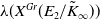 $\lambda (X^{Gr}(E_2/\tilde {K}_{\infty }))$
is bounded as
$\lambda (X^{Gr}(E_2/\tilde {K}_{\infty }))$
is bounded as $\tilde {K}_{\infty }$
runs over the elements of
$\tilde {K}_{\infty }$
runs over the elements of $V$
. So by Proposition 7.10,
$V$
. So by Proposition 7.10, ${\pi (g_2) \not \equiv 0 \pmod {p}}$
. Since
${\pi (g_2) \not \equiv 0 \pmod {p}}$
. Since $K_\infty$
was arbitrary, we have thus shown that
$K_\infty$
was arbitrary, we have thus shown that $\widehat {l_{0,2}}=0$
. The proof in the reverse direction is the same. This proves (1).
$\widehat {l_{0,2}}=0$
. The proof in the reverse direction is the same. This proves (1).
Now we prove assertion (2) of the theorem. We show that $l_{0,2} \le l_{0,1}$
(the reverse inequality will follow from a symmetric argument). To this purpose, suppose that
$l_{0,2} \le l_{0,1}$
(the reverse inequality will follow from a symmetric argument). To this purpose, suppose that $\overline {T}^e \mid \overline {g}$
but
$\overline {T}^e \mid \overline {g}$
but $\overline {T}^{e+1} \nmid \overline {g}$
for some variable
$\overline {T}^{e+1} \nmid \overline {g}$
for some variable $T$
(here
$T$
(here $g_1 = g(X^{Gr}(E_1/\mathbb{L}_\infty ))$
, as in the first part of the proof). Note that we allow
$g_1 = g(X^{Gr}(E_1/\mathbb{L}_\infty ))$
, as in the first part of the proof). Note that we allow $e = 0$
here. Let
$e = 0$
here. Let $K_\infty$
be any
$K_\infty$
be any ${\mathbb{Z}}_p$
-extension of
${\mathbb{Z}}_p$
-extension of $K$
contained in
$K$
contained in $\mathcal{E}_{\mu }$
as in Proposition 7.9(b). Then we can choose a sequence of
$\mathcal{E}_{\mu }$
as in Proposition 7.9(b). Then we can choose a sequence of ${\mathbb{Z}}_p$
-extensions
${\mathbb{Z}}_p$
-extensions $\tilde {K}_\infty ^{(n)}$
of
$\tilde {K}_\infty ^{(n)}$
of $K$
such that
$K$
such that
 \begin{align} \lambda (X^{Gr}(E/\tilde {K}_\infty ^{(n)})) \le e \cdot p^n + C' \end{align}
and $\tilde {K}_\infty ^{(n)} \in \mathcal{E}(K_\infty ,n) \setminus \mathcal{E}(K_\infty , n+1)$
for each
$\tilde {K}_\infty ^{(n)} \in \mathcal{E}(K_\infty ,n) \setminus \mathcal{E}(K_\infty , n+1)$
for each $n \in {\mathbb{N}}$
and some fixed constant
$n \in {\mathbb{N}}$
and some fixed constant $C'$
. As in the first part of the proof, the differences
$C'$
. As in the first part of the proof, the differences $|\lambda (X^{Gr}(E_1/\tilde {K}_\infty ^{(n)})) - \lambda (X^{Gr}(E_2/\tilde {K}_\infty ^{(n)}))|$
are bounded for these
$|\lambda (X^{Gr}(E_1/\tilde {K}_\infty ^{(n)})) - \lambda (X^{Gr}(E_2/\tilde {K}_\infty ^{(n)}))|$
are bounded for these $\tilde {K}_\infty ^{(n)} \in \mathcal{E}_\mu$
.
$\tilde {K}_\infty ^{(n)} \in \mathcal{E}_\mu$
.
Now suppose that $\overline {g_2}$
,
$\overline {g_2}$
, $g_2 = g(X^{Gr}(E_2/\mathbb{L}_\infty ))$
, is divisible by a higher power of
$g_2 = g(X^{Gr}(E_2/\mathbb{L}_\infty ))$
, is divisible by a higher power of $\overline {T}$
. Then Proposition 7.9(a) implies that for
$\overline {T}$
. Then Proposition 7.9(a) implies that for $m \gg 0$
 \begin{equation*} \lambda (X^{Gr}(E_2/\tilde {K}_\infty ^{(m)})) \ge (e+1) \cdot p^m\end{equation*}
for each $\tilde {K}_\infty ^{(m)} \in \mathcal{E}(K_\infty ,m)$
which is contained in
$\tilde {K}_\infty ^{(m)} \in \mathcal{E}(K_\infty ,m)$
which is contained in $\mathcal{E}_\mu$
. For any
$\mathcal{E}_\mu$
. For any $m$
which is strictly larger than
$m$
which is strictly larger than $n$
and the sum of the constant
$n$
and the sum of the constant $C'$
from equation (15) and the constant bounding the above difference of
$C'$
from equation (15) and the constant bounding the above difference of $\lambda$
-invariants, this yields a contradiction.
$\lambda$
-invariants, this yields a contradiction.
Since $T = \gamma - 1$
and
$T = \gamma - 1$
and $e \in {\mathbb{N}}$
had been chosen arbitrarily, this shows that indeed
$e \in {\mathbb{N}}$
had been chosen arbitrarily, this shows that indeed $l_{0,2} \le l_{0,1}$
.
$l_{0,2} \le l_{0,1}$
.
8. The
$\mathfrak{M}_H(G)$
-property

Finally, we mention an application to the $\mathfrak{M}_H(G)$
-property. This property, motivated by the
$\mathfrak{M}_H(G)$
-property. This property, motivated by the $\mathfrak{M}_H(G)$
-conjecture (see [Reference Coates and Sujatha9]), has been studied before in [Reference Kleine, Matar and Sujatha36]. We adapt the following notation from [Reference Kleine, Matar and Sujatha36] to our purposes.
$\mathfrak{M}_H(G)$
-conjecture (see [Reference Coates and Sujatha9]), has been studied before in [Reference Kleine, Matar and Sujatha36]. We adapt the following notation from [Reference Kleine, Matar and Sujatha36] to our purposes.
Definition 8.1.
We let $ {\mathcal{H} \subseteq \mathcal{E}}$
denote the subset of
$ {\mathcal{H} \subseteq \mathcal{E}}$
denote the subset of ${\mathbb{Z}}_p$
-extensions
${\mathbb{Z}}_p$
-extensions $L \subseteq \mathbb{L}_\infty$
which satisfy the following hypotheses:
$L \subseteq \mathbb{L}_\infty$
which satisfy the following hypotheses:
-
(a)
$L \in \mathcal{E}_{p} \cap \mathcal{E}_{ns}$
, that is, each prime of
$K$
above
$p$
ramifies in
$L$
, and no prime in
$S$
splits completely in
$L/K$
, -
(b)
$X(E_1/L)$
and
$X(E_2/L)$
are both
$\Lambda$
-torsion.


Definition 8.2.
Let $L \in \mathcal{H}$
, and write
$L \in \mathcal{H}$
, and write $G = \textrm {Gal}(\mathbb{L}_\infty /K)$
and
$G = \textrm {Gal}(\mathbb{L}_\infty /K)$
and $H = \textrm {Gal}(\mathbb{L}_\infty /L)$
. Then
$H = \textrm {Gal}(\mathbb{L}_\infty /L)$
. Then $H \cong {\mathbb{Z}}_p^{d-1}$
, and we say that the
$H \cong {\mathbb{Z}}_p^{d-1}$
, and we say that the $\mathfrak{M}_H(G)$
-property holds for
$\mathfrak{M}_H(G)$
-property holds for $X(E_i/\mathbb{L}_\infty )$
if the quotient
$X(E_i/\mathbb{L}_\infty )$
if the quotient
 \begin{equation*} X_f(E_i/\mathbb{L}_\infty ) \,:\!=\, X(E_i/\mathbb{L}_\infty )/X(E_i/\mathbb{L}_\infty )[p^\infty ] \end{equation*}
is finitely generated as a ${\mathbb{Z}}_p[[H]]$
-module.
${\mathbb{Z}}_p[[H]]$
-module.
Before stating the main results in this section, we need two lemmas.
Lemma 8.3.
Let $i \in \{1,2\}$
,
$i \in \{1,2\}$
, $E=E_i$
,
$E=E_i$
, $g=g_i$
, and
$g=g_i$
, and $K_{\infty } \in \mathcal{H}$
. Suppose that we have
$K_{\infty } \in \mathcal{H}$
. Suppose that we have $\pi (g) \not \equiv 0 \pmod {p}$
, where
$\pi (g) \not \equiv 0 \pmod {p}$
, where $\pi$
corresponds to
$\pi$
corresponds to $K_{\infty }$
as in the beginning of Section 7. Furthermore, if
$K_{\infty }$
as in the beginning of Section 7. Furthermore, if $d \gt 2$
, suppose that the maximal pseudo-null submodule of
$d \gt 2$
, suppose that the maximal pseudo-null submodule of $X(E/\mathbb{L}_{\infty })$
is finitely generated over
$X(E/\mathbb{L}_{\infty })$
is finitely generated over $\mathbb{Z}_p$
.
$\mathbb{Z}_p$
.
Let $H=\textrm {Gal}(\mathbb{L}_{\infty }/K_{\infty })$
. Then
$H=\textrm {Gal}(\mathbb{L}_{\infty }/K_{\infty })$
. Then $X_f(E/\mathbb{L}_\infty )$
is finitely generated as a
$X_f(E/\mathbb{L}_\infty )$
is finitely generated as a ${\mathbb{Z}}_p[[H]] \cong \Lambda _{d-1}$
-module.
${\mathbb{Z}}_p[[H]] \cong \Lambda _{d-1}$
-module.
Proof.
For simplicity, we denote $X_f(E/\mathbb{L}_{\infty })$
by
$X_f(E/\mathbb{L}_{\infty })$
by $X_f$
. We have an exact sequence
$X_f$
. We have an exact sequence
 \begin{equation*}0 \longrightarrow A \longrightarrow X_f \longrightarrow E\end{equation*}
where $A$
is a pseudo-null
$A$
is a pseudo-null $\Lambda _d$
-module and
$\Lambda _d$
-module and $E$
is an elementary
$E$
is an elementary $\Lambda _d$
-module. Assume that
$\Lambda _d$
-module. Assume that $\pi (g) \not \equiv 0 \pmod {p}$
.
$\pi (g) \not \equiv 0 \pmod {p}$
.
If $d=2$
, then as
$d=2$
, then as $A$
is pseudo-null it has Krull dimension at most one. Multiplication by
$A$
is pseudo-null it has Krull dimension at most one. Multiplication by $p$
is injective on
$p$
is injective on $X_f$
by definition. Therefore,
$X_f$
by definition. Therefore, $A/p$
has Krull dimension zero by [Reference Atiyah and Macdonald1, Corollary 11.9], that is,
$A/p$
has Krull dimension zero by [Reference Atiyah and Macdonald1, Corollary 11.9], that is, $A/p$
is finite whence
$A/p$
is finite whence $A$
is a finitely generated
$A$
is a finitely generated ${\mathbb{Z}}_p$
-module.
${\mathbb{Z}}_p$
-module.
Since $X(E/\mathbb{L}_\infty )[p^\infty ] = X(E/\mathbb{L}_\infty )[p^n]$
for some
$X(E/\mathbb{L}_\infty )[p^\infty ] = X(E/\mathbb{L}_\infty )[p^n]$
for some $n \in {\mathbb{N}}$
, we have an isomorphism
$n \in {\mathbb{N}}$
, we have an isomorphism
 \begin{equation*} X_f \cong p^n \cdot X(E/\mathbb{L}_\infty ) \subseteq X(E/\mathbb{L}_\infty ).\end{equation*}
Therefore, if $d \gt 2$
, the maximal pseudo-null
$d \gt 2$
, the maximal pseudo-null $\Lambda _d$
-submodule of
$\Lambda _d$
-submodule of $X_f$
is finitely generated as a
$X_f$
is finitely generated as a ${\mathbb{Z}}_p$
-module by assumption. Since this former statement is also true for
${\mathbb{Z}}_p$
-module by assumption. Since this former statement is also true for $d=2$
by the above, we see from the above exact sequence that
$d=2$
by the above, we see from the above exact sequence that $X_f$
will be finitely generated over
$X_f$
will be finitely generated over ${\mathbb{Z}}_p[[H]]$
if we can show that
${\mathbb{Z}}_p[[H]]$
if we can show that $E$
is finitely generated over
$E$
is finitely generated over ${\mathbb{Z}}_p[[H]]$
.
${\mathbb{Z}}_p[[H]]$
.
To this end, we first note that $E_H$
is a finitely generated torsion
$E_H$
is a finitely generated torsion ${\mathbb{Z}}_p[[\Gamma ]] \cong \Lambda$
-module, where
${\mathbb{Z}}_p[[\Gamma ]] \cong \Lambda$
-module, where $\Gamma = \textrm {Gal}(K_\infty /K)$
. To see this, we first remark that since characteristic power series are multiplicative in exact sequences (this can be shown by localizations at height one primes ideals of
$\Gamma = \textrm {Gal}(K_\infty /K)$
. To see this, we first remark that since characteristic power series are multiplicative in exact sequences (this can be shown by localizations at height one primes ideals of $\Lambda _d$
), the characteristic power series of
$\Lambda _d$
), the characteristic power series of $X_f$
(and hence
$X_f$
(and hence $E$
) is
$E$
) is $g$
. The assumption
$g$
. The assumption $\pi (g) \not \equiv 0 \pmod {p}$
certainly implies that
$\pi (g) \not \equiv 0 \pmod {p}$
certainly implies that $\pi (g) \neq 0$
. As
$\pi (g) \neq 0$
. As $g$
annihilates
$g$
annihilates $E$
, we see that
$E$
, we see that $E_H$
is a finitely generated torsion
$E_H$
is a finitely generated torsion $\Lambda$
-module.
$\Lambda$
-module.
Now we claim that $\mu (E_H)=0$
. This can be seen from the following sequence of equivalences. Assume that
$\mu (E_H)=0$
. This can be seen from the following sequence of equivalences. Assume that $E=\bigoplus _{j=1}^t \Lambda _d/(h_j^{n_j})$
so that
$E=\bigoplus _{j=1}^t \Lambda _d/(h_j^{n_j})$
so that $g=\prod h_j^{n_j}$
. Let
$g=\prod h_j^{n_j}$
. Let $\Omega _d\,:\!=\,\Lambda _d/p$
be the ‘mod
$\Omega _d\,:\!=\,\Lambda _d/p$
be the ‘mod $p$
’ Iwasawa algebra. We have
$p$
’ Iwasawa algebra. We have
 \begin{align*} &\mu (E_H)=0 \\ \Longleftrightarrow \,&\mu ((\Lambda _d/(h_j^{n_j}))_H)=0 \text{ for }j=1,\ldots ,t\\ \Longleftrightarrow \, &(\Omega _d)_H/(\pi (\overline {h_j}^{n_j})) \text{ is finite for }j=1,\ldots ,t\\ \Longleftrightarrow \, &\pi (h_j^{n_j}) \not \equiv 0 \pmod {p} \text{ for }j=1,\ldots ,t\\ \Longleftrightarrow \, &\pi (g) \not \equiv 0 \pmod {p}. \end{align*}
Therefore, we see that $\mu (E_H)=0$
. So,
$\mu (E_H)=0$
. So, $E_H$
is a finitely generated torsion
$E_H$
is a finitely generated torsion $\Lambda$
-module with
$\Lambda$
-module with $\mu =0$
. Therefore,
$\mu =0$
. Therefore, $E_H$
is finitely generated over
$E_H$
is finitely generated over $\mathbb{Z}_p$
. This proves the lemma.
$\mathbb{Z}_p$
. This proves the lemma.
Lemma 8.4.
Let $E$
be
$E$
be $E_1$
or
$E_1$
or $E_2$
,
$E_2$
, $K_{\infty } \in \mathcal{H}$
and
$K_{\infty } \in \mathcal{H}$
and $H=\textrm {Gal}(\mathbb{L}_{\infty }/K_{\infty })$
. Assume that
$H=\textrm {Gal}(\mathbb{L}_{\infty }/K_{\infty })$
. Assume that $X_f(E/\mathbb{L}_{\infty })$
is finitely generated over
$X_f(E/\mathbb{L}_{\infty })$
is finitely generated over ${\mathbb{Z}_p}[[H]]$
and that
${\mathbb{Z}_p}[[H]]$
and that $E(\mathbb{L}_{\infty })[p^{\infty }]$
is finite. Then
$E(\mathbb{L}_{\infty })[p^{\infty }]$
is finite. Then $\mu (X(E/K_{\infty }))=m_0(X(E/\mathbb{L}_{\infty }))$
.
$\mu (X(E/K_{\infty }))=m_0(X(E/\mathbb{L}_{\infty }))$
.
Proof.
Since $X_f(E/\mathbb{L}_{\infty })$
is finitely generated over
$X_f(E/\mathbb{L}_{\infty })$
is finitely generated over ${\mathbb{Z}_p}[[H]]$
, it is easy to see that
${\mathbb{Z}_p}[[H]]$
, it is easy to see that $X(E/\mathbb{L}_{\infty })$
is
$X(E/\mathbb{L}_{\infty })$
is $\Lambda$
-torsion. Since
$\Lambda$
-torsion. Since $X(E/\mathbb{L}_{\infty })$
is
$X(E/\mathbb{L}_{\infty })$
is $\Lambda _d$
-torsion and
$\Lambda _d$
-torsion and $E(\mathbb{L}_{\infty })[p^{\infty }]$
is finite, it follows from [Reference Hachimori and Venjakob25, Theorem 7.2] that
$E(\mathbb{L}_{\infty })[p^{\infty }]$
is finite, it follows from [Reference Hachimori and Venjakob25, Theorem 7.2] that $H^2(G_S(\mathbb{L}_{\infty }), E[p^{\infty }])=0$
and that the map
$H^2(G_S(\mathbb{L}_{\infty }), E[p^{\infty }])=0$
and that the map
 \begin{equation*}H^1(G_S(\mathbb{L}_{\infty }), E[p^{\infty }]) \longrightarrow \bigoplus _{v \in S} J_v(E/\mathbb{L}_{\infty })\end{equation*}
is surjective. Here, $J_v(E/\mathbb{L}_{\infty })=\mathop {\varinjlim }\limits \bigoplus _{w|v} H^1(F_w,E)[p^{\infty }]$
where the direct limit runs over the finite extensions
$J_v(E/\mathbb{L}_{\infty })=\mathop {\varinjlim }\limits \bigoplus _{w|v} H^1(F_w,E)[p^{\infty }]$
where the direct limit runs over the finite extensions $F$
of
$F$
of $K$
contained in
$K$
contained in $\mathbb{L}_{\infty }$
.
$\mathbb{L}_{\infty }$
.
Consider the map
 \begin{equation*}s_{K_{\infty }}\,:\, X(E/\mathbb{L}_{\infty })_H \longrightarrow X(E/K_{\infty })\end{equation*}
whose dual is induced by restriction. Since $K_{\infty } \in \mathcal{H} \subseteq \mathcal{E}_p \cap \mathcal{E}_{ns}$
, it follows from [Reference Kleine and Matar35, Lemma 3.14, Corollary 3.15] that
$K_{\infty } \in \mathcal{H} \subseteq \mathcal{E}_p \cap \mathcal{E}_{ns}$
, it follows from [Reference Kleine and Matar35, Lemma 3.14, Corollary 3.15] that $\ker s_{K_{\infty }}$
and
$\ker s_{K_{\infty }}$
and $\textrm {coker} s_{K_{\infty }}$
are finitely generated torsion
$\textrm {coker} s_{K_{\infty }}$
are finitely generated torsion $\Lambda$
-modules with
$\Lambda$
-modules with $\mu =0$
and therefore are finitely generated over
$\mu =0$
and therefore are finitely generated over $\mathbb{Z}_p$
.
$\mathbb{Z}_p$
.
The previous results mentioned allow us to use Lim’s result [Reference Lim38, Proposition 4.7]:
 \begin{equation} m_0(X(E/\mathbb{L}_{\infty }))=\mu (X(E/K_{\infty })) + \sum _{i=0}^{d-2} (-1)^{i+1} \mu (H_i(H, X_f(E/\mathbb{L}_{\infty }))). \end{equation}
Note that Lim proved this result when $K_{\infty }$
is the cyclotomic
$K_{\infty }$
is the cyclotomic $\mathbb{Z}_p$
-extension of
$\mathbb{Z}_p$
-extension of $K$
. The same proof works for arbitrary
$K$
. The same proof works for arbitrary $K_{\infty } \in \mathcal{H}$
because as mentioned above
$K_{\infty } \in \mathcal{H}$
because as mentioned above $\ker s_{K_{\infty }}$
and
$\ker s_{K_{\infty }}$
and $\textrm {coker} s_{K_{\infty }}$
are finitely generated over
$\textrm {coker} s_{K_{\infty }}$
are finitely generated over $\mathbb{Z}_p$
.
$\mathbb{Z}_p$
.
By assumption, $X(E/\mathbb{L}_\infty )_f$
is finitely generated over
$X(E/\mathbb{L}_\infty )_f$
is finitely generated over $\Lambda (H) = {\mathbb{Z}}_p[[H]]$
. Therefore for any
$\Lambda (H) = {\mathbb{Z}}_p[[H]]$
. Therefore for any $i \geq 0$
, we have that
$i \geq 0$
, we have that $H_i(H, X_f(E/\mathbb{L}_{\infty }))$
is finitely generated over
$H_i(H, X_f(E/\mathbb{L}_{\infty }))$
is finitely generated over $\mathbb{Z}_p$
(see the proof of [Reference Howson26, Theorem 1.1]). So from (16), we have
$\mathbb{Z}_p$
(see the proof of [Reference Howson26, Theorem 1.1]). So from (16), we have $\mu (X(E/K_{\infty }))=m_0(X(E/\mathbb{L}_{\infty }))$
. This completes the proof.
$\mu (X(E/K_{\infty }))=m_0(X(E/\mathbb{L}_{\infty }))$
. This completes the proof.
The following criterion for the $\mathfrak{M}_H(G)$
-property generalizes part of the main result from [Reference Kleine, Matar and Sujatha36] from the setting of
$\mathfrak{M}_H(G)$
-property generalizes part of the main result from [Reference Kleine, Matar and Sujatha36] from the setting of ${\mathbb{Z}}_p^2$
-extensions to
${\mathbb{Z}}_p^2$
-extensions to ${\mathbb{Z}}_p^d$
-extensions,
${\mathbb{Z}}_p^d$
-extensions, $d \ge 2$
.
$d \ge 2$
.
Lemma 8.5.
Let $E$
be an elliptic curve defined over
$E$
be an elliptic curve defined over $K$
, with good ordinary reduction at
$K$
, with good ordinary reduction at $p$
. Let
$p$
. Let $\mathbb{L}_\infty /K$
be a
$\mathbb{L}_\infty /K$
be a ${\mathbb{Z}}_p^d$
-extension such that
${\mathbb{Z}}_p^d$
-extension such that $E(\mathbb{L}_\infty )[p^\infty ]$
is finite. If
$E(\mathbb{L}_\infty )[p^\infty ]$
is finite. If $d \gt 2$
, then we moreover assume that the maximal pseudo-null
$d \gt 2$
, then we moreover assume that the maximal pseudo-null $\Lambda _d$
-submodule of
$\Lambda _d$
-submodule of $X(E/\mathbb{L}_\infty )$
is finitely generated over
$X(E/\mathbb{L}_\infty )$
is finitely generated over ${\mathbb{Z}}_p$
.
${\mathbb{Z}}_p$
.
Write the characteristic power series of $X(E/\mathbb{L}_\infty )$
as
$X(E/\mathbb{L}_\infty )$
as $f = p^{m_0(X(E/\mathbb{L}_\infty ))} g$
. Let
$f = p^{m_0(X(E/\mathbb{L}_\infty ))} g$
. Let $K_\infty \in \mathcal{H}$
,
$K_\infty \in \mathcal{H}$
, $H = \textrm {Gal}(\mathbb{L}_\infty /K_\infty )$
and let
$H = \textrm {Gal}(\mathbb{L}_\infty /K_\infty )$
and let
 \begin{equation*} \pi \colon \Lambda _d \twoheadrightarrow \Lambda = {\mathbb{Z}}_p[[\textrm {Gal}(K_\infty /K)]]\end{equation*}
be the canonical surjection.
Then the following conditions are equivalent.
-
(a)
$X(E/\mathbb{L}_\infty )$
has the
$\mathfrak{M}_H(G)$
-property.
-
(b)
$\mu (X(E/K_\infty )) = m_0(X(E/\mathbb{L}_\infty ))$
. -
(c)
$\pi (g) \not \equiv 0 \pmod {p}$
.


Proof. $(a) \Longrightarrow (b)$
: Lemma 8.4.
$(a) \Longrightarrow (b)$
: Lemma 8.4. $(b) \Longrightarrow (c)$
: Let
$(b) \Longrightarrow (c)$
: Let $X = X(E/\mathbb{L}_\infty )$
for brevity, and write
$X = X(E/\mathbb{L}_\infty )$
for brevity, and write $X_\pi = X/\ker (\pi )$
. Since
$X_\pi = X/\ker (\pi )$
. Since $K_\infty \in \mathcal{H}$
, we have that
$K_\infty \in \mathcal{H}$
, we have that $X_\pi$
is torsion as a
$X_\pi$
is torsion as a $\Lambda$
-module. Therefore, we can apply Corollary 7.4(b) to
$\Lambda$
-module. Therefore, we can apply Corollary 7.4(b) to $X$
and
$X$
and $X_\pi$
.
$X_\pi$
.
Suppose now that $\pi (g) \equiv 0 \pmod {p}$
. Then
$\pi (g) \equiv 0 \pmod {p}$
. Then $\mu (X_H) \gt m_0(X)$
by Corollary 7.4(b). But since
$\mu (X_H) \gt m_0(X)$
by Corollary 7.4(b). But since $K_\infty \in \mathcal{H}$
and therefore no prime in
$K_\infty \in \mathcal{H}$
and therefore no prime in $S$
is totally split in
$S$
is totally split in $K_\infty /K$
, it follows from [Reference Kleine and Matar35, Corollary 3.15(b)] that
$K_\infty /K$
, it follows from [Reference Kleine and Matar35, Corollary 3.15(b)] that $\mu (X_H) = \mu (X(E/K_\infty ))$
.
$\mu (X_H) = \mu (X(E/K_\infty ))$
. $(c) \Longrightarrow (a)$
: This follows from Lemma 8.3.
$(c) \Longrightarrow (a)$
: This follows from Lemma 8.3.
Corollary 8.6.
In the setting of the previous lemma suppose that the equivalent conditions hold for some $K_\infty \in \mathcal{H}$
. Then there exists a Greenberg neighborhood
$K_\infty \in \mathcal{H}$
. Then there exists a Greenberg neighborhood $U$
of
$U$
of $K_\infty$
such that the conditions are satisfied for each
$K_\infty$
such that the conditions are satisfied for each $\tilde {K}_\infty \in U$
.
$\tilde {K}_\infty \in U$
.
Proof.
We have seen in Lemma 7.1 that the validity of condition $(c)$
from Lemma 8.5 implies that this condition is true for each
$(c)$
from Lemma 8.5 implies that this condition is true for each $\tilde {K}_\infty$
in a certain neighborhood
$\tilde {K}_\infty$
in a certain neighborhood $U$
of
$U$
of $K_\infty$
. Note that Lemma 7.1 has been proven for Greenberg Selmer groups. However, since
$K_\infty$
. Note that Lemma 7.1 has been proven for Greenberg Selmer groups. However, since $K_\infty \in \mathcal{H} \subseteq \mathcal{E}_p \cap \mathcal{E}_{ns}$
, it follows from Proposition 2.2 and 2.3(c) that
$K_\infty \in \mathcal{H} \subseteq \mathcal{E}_p \cap \mathcal{E}_{ns}$
, it follows from Proposition 2.2 and 2.3(c) that $U$
can be chosen small enough to ensure that
$U$
can be chosen small enough to ensure that $X^{Gr}(E/\tilde {K}_\infty ) = X(E/\tilde {K}_\infty )$
for each
$X^{Gr}(E/\tilde {K}_\infty ) = X(E/\tilde {K}_\infty )$
for each $\tilde {K}_\infty \in U$
.
$\tilde {K}_\infty \in U$
.
We can now prove the main result of this section. One should compare this result to results of Lim (see [Reference Lim39, Proposition 5.1.3] and the main result from [Reference Lim41]), which need additional hypotheses. Moreover, our approach will also yield Corollary 8.8.
Theorem 8.7.
Let $\mathbb{L}_\infty /K$
be a
$\mathbb{L}_\infty /K$
be a ${\mathbb{Z}}_p^d$
-extension, and let
${\mathbb{Z}}_p^d$
-extension, and let $K_\infty \in \mathcal{H}$
. Write
$K_\infty \in \mathcal{H}$
. Write $H = \textrm {Gal}(\mathbb{L}_\infty /K_\infty )$
. We assume that
$H = \textrm {Gal}(\mathbb{L}_\infty /K_\infty )$
. We assume that
-
(i) both
$E_1(\mathbb{L}_\infty )[p^\infty ]$
and
$E_2(\mathbb{L}_\infty )[p^\infty ]$
are finite,
-
(ii)
$E_1[p^{i}] \cong E_2[p^{i}]$
as Galois modules, where
$i \gt m_{0,1} = m_0(X(E_1/\mathbb{L}_\infty ))$
.



If $d \gt 2$
, then we moreover assume that the maximal pseudo-null
$d \gt 2$
, then we moreover assume that the maximal pseudo-null $\Lambda _d$
-submodules of
$\Lambda _d$
-submodules of $X(E_1/\mathbb{L}_\infty )$
and
$X(E_1/\mathbb{L}_\infty )$
and $X(E_2/\mathbb{L}_\infty )$
are finitely generated
$X(E_2/\mathbb{L}_\infty )$
are finitely generated ${\mathbb{Z}}_p$
-modules.
${\mathbb{Z}}_p$
-modules.
If the $\mathfrak{M}_H(G)$
-property holds for
$\mathfrak{M}_H(G)$
-property holds for $E_1$
, then it also holds for
$E_1$
, then it also holds for $E_2$
.
$E_2$
.
Proof.
Let $K_\infty = \mathbb{L}_\infty ^H$
. First, since
$K_\infty = \mathbb{L}_\infty ^H$
. First, since $K_\infty \in \mathcal{H}$
by assumption and thus
$K_\infty \in \mathcal{H}$
by assumption and thus $X(E_i/K_\infty )$
are
$X(E_i/K_\infty )$
are $\Lambda$
-torsion,
$\Lambda$
-torsion, $i = 1,2$
, it follows from [Reference Kleine and Matar35, Lemma 3.17] that both
$i = 1,2$
, it follows from [Reference Kleine and Matar35, Lemma 3.17] that both $X(E_i/\mathbb{L}_\infty )$
,
$X(E_i/\mathbb{L}_\infty )$
, $i = 1,2$
, are finitely generated and
$i = 1,2$
, are finitely generated and $\Lambda _d$
-torsion. Moreover, since
$\Lambda _d$
-torsion. Moreover, since $H \in \mathcal{H}$
, it follows from [Reference Kleine32, Theorem 4.11] that we can choose a neighbourhood
$H \in \mathcal{H}$
, it follows from [Reference Kleine32, Theorem 4.11] that we can choose a neighbourhood $U$
of
$U$
of $K_\infty$
such that
$K_\infty$
such that $X(E_i/\tilde {K}_\infty )$
is
$X(E_i/\tilde {K}_\infty )$
is $\Lambda$
-torsion for both
$\Lambda$
-torsion for both $i = 1,2$
, and
$i = 1,2$
, and
 \begin{equation*} \mu (X(E_1/\tilde {K}_\infty )) \le \mu (X(E_1/K_\infty )), \quad \mu (X(E_2/\tilde {K}_\infty )) \le \mu (X(E_2/K_\infty ))\end{equation*}
hold for each $\tilde {K}_\infty \in U$
. In addition, we may assume that
$\tilde {K}_\infty \in U$
. In addition, we may assume that $U \subseteq \mathcal{E}_p \cap \mathcal{E}_{ns}$
(indeed, it suffices if
$U \subseteq \mathcal{E}_p \cap \mathcal{E}_{ns}$
(indeed, it suffices if $U = \mathcal{E}(K_\infty ,n)$
has been chosen small enough such that each prime of
$U = \mathcal{E}(K_\infty ,n)$
has been chosen small enough such that each prime of $K$
above
$K$
above $p$
ramifies in the
$p$
ramifies in the $n$
-th layer
$n$
-th layer $K_n$
of
$K_n$
of $K_\infty$
and such that no prime of
$K_\infty$
and such that no prime of $S$
is totally split in
$S$
is totally split in $K_n/K$
. Both conditions can be ensured for large
$K_n/K$
. Both conditions can be ensured for large $n$
since
$n$
since $K_\infty \in \mathcal{H}$
).
$K_\infty \in \mathcal{H}$
).
Now suppose that the $\mathfrak{M}_H(G)$
-property holds for
$\mathfrak{M}_H(G)$
-property holds for $E_1$
. Then it follows from Lemma 8.5 and Corollary 8.6 that
$E_1$
. Then it follows from Lemma 8.5 and Corollary 8.6 that
 \begin{equation*} \mu (X(E_1/\tilde {K}_\infty )) = m_{0,1}\end{equation*}
for each $\tilde {K}_\infty \in U$
(it might be necessary here to make
$\tilde {K}_\infty \in U$
(it might be necessary here to make $U$
slightly smaller).
$U$
slightly smaller).
Since $U \subseteq \mathcal{E}_p \cap \mathcal{E}_{ns}$
, we have by Propositions 2.2 and 2.3 that
$U \subseteq \mathcal{E}_p \cap \mathcal{E}_{ns}$
, we have by Propositions 2.2 and 2.3 that $X(E_i/\tilde {K}_{\infty })=X^{Gr}(E_i/\tilde {K}_{\infty })$
for each
$X(E_i/\tilde {K}_{\infty })=X^{Gr}(E_i/\tilde {K}_{\infty })$
for each $\tilde {K}_{\infty } \in U$
. Therefore, Theorem4.3(b) implies that for any
$\tilde {K}_{\infty } \in U$
. Therefore, Theorem4.3(b) implies that for any $\tilde {K}_\infty \in U$
we have a pseudo-isomorphism
$\tilde {K}_\infty \in U$
we have a pseudo-isomorphism
 \begin{equation*} X(E_1/\tilde {K}_\infty )[p^\infty ] \longrightarrow X(E_2/\tilde {K}_\infty )[p^\infty ]. \end{equation*}
In particular, $\mu (X(E_1/\tilde {K}_\infty )) = \mu (X(E_2/\tilde {K}_\infty )) = m_{0,1}$
for each
$\mu (X(E_1/\tilde {K}_\infty )) = \mu (X(E_2/\tilde {K}_\infty )) = m_{0,1}$
for each $\tilde {K}_\infty \in U$
.
$\tilde {K}_\infty \in U$
.
As we have seen in the proof of Lemma 5.1, we have $\mu (X(E_2/F)) = m_{0,2}$
for each
$\mu (X(E_2/F)) = m_{0,2}$
for each $F \in \mathcal{E}_p \cap \mathcal{E}_{ns}$
which is not contained in a finite number of
$F \in \mathcal{E}_p \cap \mathcal{E}_{ns}$
which is not contained in a finite number of ${\mathbb{Z}}_p^{d-1}$
-extensions of
${\mathbb{Z}}_p^{d-1}$
-extensions of $K$
(here we again apply Propositions 2.2 and 2.3). Therefore from Lemma 7.8, we see that
$K$
(here we again apply Propositions 2.2 and 2.3). Therefore from Lemma 7.8, we see that $U$
contains a
$U$
contains a ${\mathbb{Z}}_p$
-extension
${\mathbb{Z}}_p$
-extension $F$
of
$F$
of $K$
such that
$K$
such that $\mu (X(E_2/F)) = m_{0,2} \,:\!=\, m_0(X(E_2/\mathbb{L}_\infty ))$
. This concludes the proof of the theorem. Indeed, it follows that
$\mu (X(E_2/F)) = m_{0,2} \,:\!=\, m_0(X(E_2/\mathbb{L}_\infty ))$
. This concludes the proof of the theorem. Indeed, it follows that
 \begin{equation*} \mu (X(E_2/\tilde {K}_\infty )) = \mu (X(E_2/F)) = m_{0,2}\end{equation*}
for each $\tilde {K}_\infty \in U$
, that is, the
$\tilde {K}_\infty \in U$
, that is, the $\mathfrak{M}_{\tilde {H}}(G)$
-property holds for
$\mathfrak{M}_{\tilde {H}}(G)$
-property holds for $E_2$
and every
$E_2$
and every $\tilde {H}= \textrm {Gal}(\mathbb{L}_\infty /\tilde {K}_\infty )$
in view of Lemma 8.5. In particular, it holds for
$\tilde {H}= \textrm {Gal}(\mathbb{L}_\infty /\tilde {K}_\infty )$
in view of Lemma 8.5. In particular, it holds for $\tilde {K}_\infty = K_\infty$
.
$\tilde {K}_\infty = K_\infty$
.
In the above proof, we also showed the following
Corollary 8.8.
Let $\mathbb{L}_\infty$
be as in Theorem
8.7
. We assume that
$\mathbb{L}_\infty$
be as in Theorem
8.7
. We assume that $\mathcal{H} \ne \emptyset$
. Then the
$\mathcal{H} \ne \emptyset$
. Then the $\mathfrak{M}_H(G)$
-property holds for a dense subset of
$\mathfrak{M}_H(G)$
-property holds for a dense subset of $\mathcal{E}$
.
$\mathcal{E}$
.
Proof.
If $\mathcal{H} \ne \emptyset$
, then the decomposition field of any
$\mathcal{H} \ne \emptyset$
, then the decomposition field of any $v \in S$
is contained in some
$v \in S$
is contained in some ${\mathbb{Z}}_p^{d-1}$
-extension of
${\mathbb{Z}}_p^{d-1}$
-extension of $K$
, and the inertia subfield
$K$
, and the inertia subfield $\mathbb{L}^{(v)} \subseteq \mathbb{L}_\infty$
of any
$\mathbb{L}^{(v)} \subseteq \mathbb{L}_\infty$
of any $v \mid p$
is contained in a
$v \mid p$
is contained in a ${\mathbb{Z}}_p^{d-1}$
-extension of
${\mathbb{Z}}_p^{d-1}$
-extension of $K$
. Moreover, it follows from [Reference Kleine and Matar35, Lemma 3.17] that both
$K$
. Moreover, it follows from [Reference Kleine and Matar35, Lemma 3.17] that both $X(E_1/\mathbb{L}_\infty )$
and
$X(E_1/\mathbb{L}_\infty )$
and $X(E_2/\mathbb{L}_\infty )$
are finitely generated and
$X(E_2/\mathbb{L}_\infty )$
are finitely generated and $\Lambda _d$
-torsion. Therefore, [Reference Kleine and Matar35, Lemma 3.1 and Corollary 3.15] (see also the proof of Lemma 5.1) imply that
$\Lambda _d$
-torsion. Therefore, [Reference Kleine and Matar35, Lemma 3.1 and Corollary 3.15] (see also the proof of Lemma 5.1) imply that $X(E_i/K_\infty )$
is
$X(E_i/K_\infty )$
is $\Lambda$
-torsion and
$\Lambda$
-torsion and $\mu (X(E_i/K_\infty )) = m_0(X(E_i/\mathbb{L}_\infty ))$
for both
$\mu (X(E_i/K_\infty )) = m_0(X(E_i/\mathbb{L}_\infty ))$
for both $i$
as long as
$i$
as long as $K_\infty$
is not contained in a certain finite number of
$K_\infty$
is not contained in a certain finite number of ${\mathbb{Z}}_p^{d-1}$
-extensions.
${\mathbb{Z}}_p^{d-1}$
-extensions.
The assertion now follows from Lemma 7.8.
9. Pseudo-null submodules
Now we prove two sufficient criteria for the hypothesis (ii) of Theorem1.5 on the maximal pseudo-null submodules of $X(E_1/\mathbb{L}_\infty )$
and
$X(E_1/\mathbb{L}_\infty )$
and $X(E_2/\mathbb{L}_\infty )$
. In fact, we describe two settings where these pseudo-null submodules are even trivial.
$X(E_2/\mathbb{L}_\infty )$
. In fact, we describe two settings where these pseudo-null submodules are even trivial.
Lemma 9.1.
Let $\mathbb{L}_\infty /K$
be a
$\mathbb{L}_\infty /K$
be a ${\mathbb{Z}}_p^d$
-extension,
${\mathbb{Z}}_p^d$
-extension, $d \ge 3$
, and let
$d \ge 3$
, and let $E$
be an elliptic curve defined over
$E$
be an elliptic curve defined over $K$
which has good ordinary reduction at
$K$
which has good ordinary reduction at $p$
. We assume that the following conditions are met.
$p$
. We assume that the following conditions are met.
-
(i) Every prime
$v \in S_p$
ramifies in
$\mathbb{L}_{\infty }/K$
, -
(ii)
$E(\mathbb{L}_\infty )[p^\infty ]$
is finite,
-
(iii)
$X(E/\mathbb{L}_{\infty })$
is
$\Lambda _d$
-torsion,
-
(iv) The decomposition subgroups
$D_v(\mathbb{L}_\infty /K) \subseteq \textrm {Gal}(\mathbb{L}_\infty /K)$
are open for each
$v \in S_p$
, and
-
(v)
$E$
has good reduction everywhere.





Then $X(E/\mathbb{L}_\infty )$
does not contain any nontrivial pseudo-null submodules.
$X(E/\mathbb{L}_\infty )$
does not contain any nontrivial pseudo-null submodules.
Proof.
In view of the hypotheses (ii) and (iii), it follows from [Reference Hachimori and Venjakob25, Theorem 7.2] that the weak Leopoldt conjecture holds for $E$
over
$E$
over $\mathbb{L}_\infty$
, that is, that
$\mathbb{L}_\infty$
, that is, that $H^2(\textrm {Gal}(K_S/\mathbb{L}_\infty ), E[p^\infty ]) = 0$
. Condition (i) implies by Propositions 2.2 and 2.3 that
$H^2(\textrm {Gal}(K_S/\mathbb{L}_\infty ), E[p^\infty ]) = 0$
. Condition (i) implies by Propositions 2.2 and 2.3 that $X(E/\mathbb{L}_{\infty })=X^{str}(E/\mathbb{L}_{\infty })$
. Therefore, we prove the desired result for
$X(E/\mathbb{L}_{\infty })=X^{str}(E/\mathbb{L}_{\infty })$
. Therefore, we prove the desired result for $X^{str}(E/\mathbb{L}_{\infty })$
.
$X^{str}(E/\mathbb{L}_{\infty })$
.
Since the elliptic curve $E$
has good reduction everywhere, the assertion of the lemma follows from [Reference Lim41, Proposition 5.1]. Indeed, since
$E$
has good reduction everywhere, the assertion of the lemma follows from [Reference Lim41, Proposition 5.1]. Indeed, since $E$
has good reduction everywhere, we can take the set
$E$
has good reduction everywhere, we can take the set $S$
to be the primes of
$S$
to be the primes of $K$
above
$K$
above $p$
. Let
$p$
. Let $S_{\infty }$
be the set of primes of
$S_{\infty }$
be the set of primes of $\mathbb{L}_{\infty }$
above those in
$\mathbb{L}_{\infty }$
above those in $S$
. By assumption (iv), the set
$S$
. By assumption (iv), the set $S_{\infty }$
is finite. By [Reference Hachimori and Venjakob25, Theorem 7.2], we have an exact sequence
$S_{\infty }$
is finite. By [Reference Hachimori and Venjakob25, Theorem 7.2], we have an exact sequence
 \begin{equation*} 0 \longrightarrow \textrm {Sel}^{str}(E/\mathbb{L}_\infty ) \longrightarrow H^1(G_S(\mathbb{L}_\infty ), E[p^\infty ]) \longrightarrow \bigoplus _{w \in S_{\infty }} H^1(\mathbb{L}_{\infty ,w}, \tilde {E}[p^{\infty }])\longrightarrow 0.\end{equation*}
Here, $\tilde {E}$
denotes the reduction of
$\tilde {E}$
denotes the reduction of $E$
over the residue field.
$E$
over the residue field.
Now we conclude as in the proof of [Reference Lim41, Proposition 5.1]: Taking Pontryagin duals of the above exact sequence, we get
 \begin{equation*} 0 \longrightarrow \left ( \bigoplus _{w \in S_{\infty }} H^1(\mathbb{L}_{\infty ,w}, \tilde {E}[p^{\infty }]) \right )^\vee \longrightarrow H^1(G_S(\mathbb{L}_\infty ), E[p^\infty ])^\vee \longrightarrow X^{str}(E/\mathbb{L}_\infty ) \longrightarrow 0. \end{equation*}
The first module in this exact sequence is reflexive by [Reference Ochi and Venjakob48, Lemma 5.4] (this again uses assumption $(iv)$
). It follows from the validity of the weak Leopoldt conjecture that
$(iv)$
). It follows from the validity of the weak Leopoldt conjecture that $H^1(G_S(\mathbb{L}_\infty ), E[p^\infty ])^\vee$
does not contain any nonzero pseudo-null
$H^1(G_S(\mathbb{L}_\infty ), E[p^\infty ])^\vee$
does not contain any nonzero pseudo-null $\Lambda _d$
-submodules (see [Reference Ochi and Venjakob48, Theorem 4.7]). Therefore, the same holds true for
$\Lambda _d$
-submodules (see [Reference Ochi and Venjakob48, Theorem 4.7]). Therefore, the same holds true for $X^{str}(E/\mathbb{L}_\infty )$
by [Reference Hachimori and Ochiai24, Proposition 3.5].
$X^{str}(E/\mathbb{L}_\infty )$
by [Reference Hachimori and Ochiai24, Proposition 3.5].
Lemma 9.2.
Let $\mathbb{L}_\infty /K$
be a
$\mathbb{L}_\infty /K$
be a ${\mathbb{Z}}_p^d$
-extension,
${\mathbb{Z}}_p^d$
-extension, $d \ge 2$
, and let
$d \ge 2$
, and let $E$
be an elliptic curve defined over
$E$
be an elliptic curve defined over $K$
which has good ordinary reduction at
$K$
which has good ordinary reduction at $p$
. We assume that the following conditions are met.
$p$
. We assume that the following conditions are met.
-
(i) Every prime of
$K$
above
$p$
ramifies in
$\mathbb{L}_{\infty }/K$
and no prime in
$S$
splits completely in
$\mathbb{L}_{\infty }/K$
, -
(ii)
$E(K)[p]=0$
, -
(iii)
$X(E/\mathbb{L}_{\infty })$
is
$\Lambda _d$
-torsion.


Then $X(E/\mathbb{L}_\infty )$
does not contain any nontrivial pseudo-null submodules.
$X(E/\mathbb{L}_\infty )$
does not contain any nontrivial pseudo-null submodules.
Proof.
The proof is based on the work of Greenberg [Reference Greenberg19]. Condition (i) implies by Propositions 2.2 and 2.3 that $X(E/\mathbb{L}_{\infty })=X^{str}(E/\mathbb{L}_{\infty })$
. Therefore, we prove the desired result for
$X(E/\mathbb{L}_{\infty })=X^{str}(E/\mathbb{L}_{\infty })$
. Therefore, we prove the desired result for $X^{str}(E/\mathbb{L}_{\infty })$
.
$X^{str}(E/\mathbb{L}_{\infty })$
.
Let us denote the absolute Galois group of $K$
by
$K$
by $G_K$
, recall that
$G_K$
, recall that $G\,:\!=\,\textrm {Gal}(\mathbb{L}_{\infty }/K)$
, and
$G\,:\!=\,\textrm {Gal}(\mathbb{L}_{\infty }/K)$
, and $\Lambda _d={\mathbb{Z}_p}[[G]]$
. Let
$\Lambda _d={\mathbb{Z}_p}[[G]]$
. Let $\Psi \,:\, G_K \twoheadrightarrow G \hookrightarrow \Lambda _d^{\times }$
be the natural character and let
$\Psi \,:\, G_K \twoheadrightarrow G \hookrightarrow \Lambda _d^{\times }$
be the natural character and let $\Lambda _d(\Psi ^{-1})$
be the free rank one
$\Lambda _d(\Psi ^{-1})$
be the free rank one $\Lambda _d$
-module with
$\Lambda _d$
-module with $G_K$
action by
$G_K$
action by $\Psi ^{-1}$
. Denote the
$\Psi ^{-1}$
. Denote the $p$
-adic Tate module of
$p$
-adic Tate module of $E$
by
$E$
by $T_p(E)$
. We define
$T_p(E)$
. We define
 \begin{equation*}\mathcal{T}\,:\!=\,T_p(E) \otimes _{{\mathbb{Z}_p}} \Lambda _d(\Psi ^{-1}) \quad \text{and} \quad \mathcal{D}\,:\!=\,\mathcal{T} \otimes _{\Lambda _d} \Lambda _d^{\vee }, \end{equation*}
where $\Lambda _d^{\vee }$
is the Pontryagin dual of
$\Lambda _d^{\vee }$
is the Pontryagin dual of $\Lambda _d$
. We let
$\Lambda _d$
. We let $G_K$
act diagonally on
$G_K$
act diagonally on $\mathcal{T}$
and with left action on
$\mathcal{T}$
and with left action on $\mathcal{D}$
.
$\mathcal{D}$
.
Now let $v$
be a prime of
$v$
be a prime of $K$
above
$K$
above $p$
. Let
$p$
. Let $\overline {K}_v$
be an algebraic closure of
$\overline {K}_v$
be an algebraic closure of $K_v$
and
$K_v$
and $k_v$
the residue field. We let
$k_v$
the residue field. We let $\tilde {E}(k_v)$
be the reduction of
$\tilde {E}(k_v)$
be the reduction of $E$
over the residue field and denote by
$E$
over the residue field and denote by $E^1(\overline {K}_v)$
the kernel of the reduction map
$E^1(\overline {K}_v)$
the kernel of the reduction map $E(\overline {K}_v) \longrightarrow \tilde {E}(k_v)$
. We let
$E(\overline {K}_v) \longrightarrow \tilde {E}(k_v)$
. We let $T^+_{v,p}(E)$
and
$T^+_{v,p}(E)$
and $T^-_{v,p}(E)$
to be the Tate modules of
$T^-_{v,p}(E)$
to be the Tate modules of $E^1(\overline {K}_v)$
and
$E^1(\overline {K}_v)$
and $\tilde {E}(k_v)$
, respectively. Then similarly to the above, we define
$\tilde {E}(k_v)$
, respectively. Then similarly to the above, we define
 \begin{equation*}\mathcal{T}_v^{\pm }\,:\!=\,T^{\pm }_{v,p}(E) \otimes _{{\mathbb{Z}_p}} \Lambda _d(\Psi ^{-1}) \quad \text{and} \quad \mathcal{D}_v^{\pm }\,:\!=\,\mathcal{T}_v^{\pm } \otimes _{\Lambda _d} \Lambda _d^{\vee }. \end{equation*}
It follows from Shapiro’s lemma (see [Reference Skinner and Urban58, Prop. 3.4]) that $\textrm {Sel}^{str}(E/\mathbb{L}_{\infty })$
is
$\textrm {Sel}^{str}(E/\mathbb{L}_{\infty })$
is $G$
-isomorphic to the kernel of the map
$G$
-isomorphic to the kernel of the map
 \begin{equation*}H^1(G_S(K), \mathcal{D}) \longrightarrow \prod _{v \in S \setminus S_p} H^1(K_v, \mathcal{D}) \times \prod _{v \in S_p} H^1(K_v, \mathcal{D}_v^-). \end{equation*}
Let $v \in S_p$
. It follows from [Reference Neukirch, Schmidt and Wingberg47, Theorem 7.1.8(i)] and Shapiro’s lemma that
$v \in S_p$
. It follows from [Reference Neukirch, Schmidt and Wingberg47, Theorem 7.1.8(i)] and Shapiro’s lemma that $H^2(K_v, \mathcal{D}_v^+)=0$
. Therefore, if we let
$H^2(K_v, \mathcal{D}_v^+)=0$
. Therefore, if we let
 \begin{equation*} L(K_v, \mathcal{D})=\textrm {img}(H^1(K_v, \mathcal{D}_v^+) \longrightarrow H^1(K_v, \mathcal{D})), \end{equation*}
we see that $H^1(K_v, \mathcal{D}_v^-)=H^1(K_v, \mathcal{D})/L(K_v, \mathcal{D})$
.
$H^1(K_v, \mathcal{D}_v^-)=H^1(K_v, \mathcal{D})/L(K_v, \mathcal{D})$
.
For any $v \in S \setminus S_p$
define
$v \in S \setminus S_p$
define $L(K_v, \mathcal{D})=0$
. Let
$L(K_v, \mathcal{D})=0$
. Let $P(K, \mathcal{D})=\prod _{v \in S} H^1(K_v, \mathcal{D})$
and
$P(K, \mathcal{D})=\prod _{v \in S} H^1(K_v, \mathcal{D})$
and $L(K, \mathcal{D})=\prod _{v \in S} L(K_v, \mathcal{D})$
. With these definitions let
$L(K, \mathcal{D})=\prod _{v \in S} L(K_v, \mathcal{D})$
. With these definitions let
 \begin{equation*} Q_{\mathcal{L}}(K, \mathcal{D})=P(K, \mathcal{D})/L(K, \mathcal{D}).\end{equation*}
From the above, we see that $\textrm {Sel}(E/\mathbb{L}_{\infty })$
is
$\textrm {Sel}(E/\mathbb{L}_{\infty })$
is $G$
-isomorphic to
$G$
-isomorphic to $S_{\mathcal{L}}(K, \mathcal{D})$
which is defined as:
$S_{\mathcal{L}}(K, \mathcal{D})$
which is defined as:
 \begin{equation*}0 \longrightarrow S_{\mathcal{L}}(K, \mathcal{D}) \longrightarrow H^1(G_S(K), \mathcal{D}) \longrightarrow Q_{\mathcal{L}}(K, \mathcal{D}). \end{equation*}
We now list various hypotheses in Greenberg’s paper:
-
•
$\text{RFX}(\mathcal{D})$
: The module
$\mathcal{T}$
is a reflexive
$\Lambda _d$
-module. -
•
$\text{LOC}_v^{(1)}(\mathcal{D})\,:\, (\mathcal{T}^{\vee })^{G_{K_v}}=0$
for
$v \in S$
. -
•
$\text{LOC}_v^{(2)}(\mathcal{D})$
: The
$\Lambda _2$
-module
$\mathcal{T}^{\vee }/(\mathcal{T}^{\vee })^{G_{K_v}}$
is reflexive for
$v \in S$
. -
•
$\text{LEO}(\mathcal{D})$
: The discrete, co-finitely generated
$\Lambda _d$
-moduleis cotorsion.
\begin{equation*}\mathrm{III}(K, S, \mathcal{D})=\ker \Big (H^2(G_S(K), \mathcal{D}) \longrightarrow \prod _{v \in S} H^2(K_v, \mathcal{D}) \Big )\end{equation*}
-
•
$\text{CRK}(\mathcal{D}, \mathcal{L})$
: We have
\begin{equation*}\textrm {corank}_{\Lambda _d}(H^1(G_S(K), \mathcal{D}))=\textrm {corank}_{\Lambda _d}(S_{\mathcal{L}}(K, \mathcal{D}))+\textrm {corank}_{\Lambda _d}(Q_{\mathcal{L}}(K, \mathcal{D})).\end{equation*}





Greenberg calls a discrete $\Lambda _d$
-module
$\Lambda _d$
-module $M$
almost divisible if
$M$
almost divisible if $\Pi M=M$
for almost all height one prime ideals
$\Pi M=M$
for almost all height one prime ideals $\Pi$
in
$\Pi$
in $\text{Spec}(\Lambda _d)$
. This is equivalent to the Pontryagin dual of
$\text{Spec}(\Lambda _d)$
. This is equivalent to the Pontryagin dual of $M$
having no nonzero pseudo-null submodules. Using the notation from Greenberg’s paper [Reference Greenberg19], we say that
$M$
having no nonzero pseudo-null submodules. Using the notation from Greenberg’s paper [Reference Greenberg19], we say that $\mathcal{L}$
is almost
$\mathcal{L}$
is almost $\Lambda _d$
-divisible if
$\Lambda _d$
-divisible if $L(K_v, \mathcal{D})$
is almost
$L(K_v, \mathcal{D})$
is almost $\Lambda _d$
-divisible for each
$\Lambda _d$
-divisible for each $v \in S$
.
$v \in S$
.
Let $\mathfrak{m}$
be the maximal ideal of
$\mathfrak{m}$
be the maximal ideal of $\Lambda _2$
. Proposition 4.1.1 of Greenberg’s paper [Reference Greenberg19] states that
$\Lambda _2$
. Proposition 4.1.1 of Greenberg’s paper [Reference Greenberg19] states that $S_{\mathcal{L}}(K, \mathcal{D})$
is almost divisible if the following are met:
$S_{\mathcal{L}}(K, \mathcal{D})$
is almost divisible if the following are met:
-
(a)
$\text{RFX}(\mathcal{D})$
,
$\text{LEO}(\mathcal{D})$
, and
$\text{CRK}(\mathcal{D}, \mathcal{L})$
are satisfied. -
(b)
$\mathcal{L}$
is almost
$\Lambda _d$
-divisible. -
(c)
$\text{LOC}_v^{(2)}(\mathcal{D})$
is satisfied for all
$v \in S$
, and there exists a nonarchimedean prime
$v \in S$
such that
$\text{LOC}_v^{(1)}(\mathcal{D})$
is satisfied. -
(d)
$\mathcal{D}$
is a co-free
$\Lambda _d$
-module, and
$\mathcal{D}[\mathfrak{m}]$
has no quotient isomorphic to
$\mu _p$
for the action of
$G_K$
.


We now check each of the conditions above. Clearly, $\text{RFX}(\mathcal{D})$
is true. Since
$\text{RFX}(\mathcal{D})$
is true. Since $E(K)[p]=0$
, we have
$E(K)[p]=0$
, we have $E(\mathbb{L}_{\infty })[p^{\infty }]=0$
and so
$E(\mathbb{L}_{\infty })[p^{\infty }]=0$
and so $\text{LEO}(\mathcal{D})$
and
$\text{LEO}(\mathcal{D})$
and $\text{CRK}(\mathcal{D}, \mathcal{L})$
follow from [Reference Hachimori and Venjakob25, Theorem 7.2]. This takes care of (a). Condition (b) is true by [Reference Greenberg19, Prop. 4.3.2]. Since no prime
$\text{CRK}(\mathcal{D}, \mathcal{L})$
follow from [Reference Hachimori and Venjakob25, Theorem 7.2]. This takes care of (a). Condition (b) is true by [Reference Greenberg19, Prop. 4.3.2]. Since no prime $v \in S$
splits completely in
$v \in S$
splits completely in $\mathbb{L}_{\infty }/K$
, we get by [Reference Greenberg18, Lemma 5.2.2] that
$\mathbb{L}_{\infty }/K$
, we get by [Reference Greenberg18, Lemma 5.2.2] that $\text{LOC}_v^{(1)}(\mathcal{D})$
is satisfied for all
$\text{LOC}_v^{(1)}(\mathcal{D})$
is satisfied for all $v \in S$
. This implies that
$v \in S$
. This implies that $\text{LOC}_v^{(2)}(\mathcal{D})$
is satisfied for all
$\text{LOC}_v^{(2)}(\mathcal{D})$
is satisfied for all $v \in S$
. Therefore, (c) is true. Finally, as explained on pg. 48 of [Reference Greenberg19], properties of the Weil pairing
$v \in S$
. Therefore, (c) is true. Finally, as explained on pg. 48 of [Reference Greenberg19], properties of the Weil pairing $E[p] \times E[p] \longrightarrow \mu _p$
imply that if
$E[p] \times E[p] \longrightarrow \mu _p$
imply that if $E(K)[p]=0$
, then (d) is satisfied. This completes the proof.
$E(K)[p]=0$
, then (d) is satisfied. This completes the proof.
10. Examples for Theorems 1.4 and 1.5
In this final section, we show two examples that satisfy the conditions of Theorems1.4 and 1.5. First, we fix some notation. As in the introduction, let $p$
be a an odd prime. If
$p$
be a an odd prime. If $F$
is a number field, let
$F$
is a number field, let $F_{cyc}$
denote the cyclotomic
$F_{cyc}$
denote the cyclotomic $\mathbb{Z}_p$
-extension of
$\mathbb{Z}_p$
-extension of $\mathbb{Q}$
. If
$\mathbb{Q}$
. If $E$
is an elliptic curve over
$E$
is an elliptic curve over $\mathbb{Q}$
and
$\mathbb{Q}$
and $L/{\mathbb{Q}}$
is an algebraic extension, we let
$L/{\mathbb{Q}}$
is an algebraic extension, we let $\textrm {Sel}(E/L)$
denote the
$\textrm {Sel}(E/L)$
denote the $p$
-primary classical Selmer group for
$p$
-primary classical Selmer group for $E/L$
and we let
$E/L$
and we let $X(E/L)$
denote its Pontryagin dual.
$X(E/L)$
denote its Pontryagin dual.
Now let $E/F\,:\, y^2=x^3+ax+b$
be an elliptic curve. If
$E/F\,:\, y^2=x^3+ax+b$
be an elliptic curve. If $d$
is a non-square in
$d$
is a non-square in $F$
, then the quadratic twist of
$F$
, then the quadratic twist of $E$
by
$E$
by $d$
, denoted
$d$
, denoted $E^d$
, is the elliptic curve defined by the equation
$E^d$
, is the elliptic curve defined by the equation $E^d\,:\, y^2=x^3+d^2ax+bd^3$
. We have the following well-known result.
$E^d\,:\, y^2=x^3+d^2ax+bd^3$
. We have the following well-known result.
Lemma 10.1.
Let $F$
be a number field,
$F$
be a number field, $E$
be an elliptic curve over
$E$
be an elliptic curve over $F$
and
$F$
and $d$
a non-square in
$d$
a non-square in $F$
. Let
$F$
. Let $L=F(\sqrt {d})$
. Then we have an isomorphism
$L=F(\sqrt {d})$
. Then we have an isomorphism
 \begin{equation*}\textrm {Sel}(E/L) \cong \textrm {Sel}(E/F) \oplus \textrm {Sel}(E^d/F). \end{equation*}
Proof. See the proof of [Reference Ono, Papanikolas and Peters49, Lemma 3.1].
In the setup of the previous lemma, we note that since $p$
is odd, the extensions
$p$
is odd, the extensions $F_{cyc}/F$
and
$F_{cyc}/F$
and $L/F$
are linearly disjoint over
$L/F$
are linearly disjoint over $F$
. Therefore, we may identify the Galois groups
$F$
. Therefore, we may identify the Galois groups $\textrm {Gal}(L_{cyc}/L)=\textrm {Gal}(F_{cyc}/F)=\Gamma _{cyc}$
. The proof of loc. cit, shows that the map defining the isomorphism of the previous lemma commutes with
$\textrm {Gal}(L_{cyc}/L)=\textrm {Gal}(F_{cyc}/F)=\Gamma _{cyc}$
. The proof of loc. cit, shows that the map defining the isomorphism of the previous lemma commutes with $\Gamma _{cyc}$
. Therefore, we have
$\Gamma _{cyc}$
. Therefore, we have
Lemma 10.2.
Let $F$
be a number field,
$F$
be a number field, $E$
be an elliptic curve over
$E$
be an elliptic curve over $F$
and
$F$
and $d$
a non-square in
$d$
a non-square in $F$
. Let
$F$
. Let $L=F(\sqrt {d})$
. Then we have an isomorphism of
$L=F(\sqrt {d})$
. Then we have an isomorphism of ${\mathbb{Z}_p}[[\Gamma _{cyc}]]$
-modules
${\mathbb{Z}_p}[[\Gamma _{cyc}]]$
-modules
 \begin{equation*}X(E/L_{cyc}) \cong X(E/F_{cyc}) \oplus X(E^d/F_{cyc}). \end{equation*}
For one of our examples, we need a similar result to the previous lemma but for quartic twists. First, we define these. Let $F$
be a number field and let
$F$
be a number field and let
 \begin{equation} E\,:\, y^2=x^3+ax \end{equation}
be an elliptic curve over $F$
with
$F$
with $j$
-invariant
$j$
-invariant $1728$
. If
$1728$
. If $d \in F^{\times }$
, then the quartic twist of
$d \in F^{\times }$
, then the quartic twist of $E$
by
$E$
by $d$
, denoted
$d$
, denoted $E_d$
, is the elliptic curve defined by the equation
$E_d$
, is the elliptic curve defined by the equation
 \begin{equation*} E_d\,:\, y^2=x^3+dax. \end{equation*}
Let $\zeta$
be a primitive fourth root of unity in
$\zeta$
be a primitive fourth root of unity in $\bar {{\mathbb{Q}}}$
.
$\bar {{\mathbb{Q}}}$
.
Lemma 10.3.
Let $F$
be a number field containing
$F$
be a number field containing $\zeta$
,
$\zeta$
, $E$
an elliptic curve over
$E$
an elliptic curve over $F$
with
$F$
with $j$
-invariant
$j$
-invariant $1728$
and
$1728$
and $d \in F^{\times }$
. Let
$d \in F^{\times }$
. Let $L=F(\sqrt [4]{d})$
and assume that
$L=F(\sqrt [4]{d})$
and assume that $[L:F]=4$
. Then we have an isomorphism
$[L:F]=4$
. Then we have an isomorphism
 \begin{equation*}\textrm {Sel}(E/L) \cong \textrm {Sel}(E/F) \oplus \textrm {Sel}(E_d/F) \oplus \textrm {Sel}(E_{d^2}/F) \oplus \textrm {Sel}(E_{d^3}/F). \end{equation*}
Proof.
Let $G=\textrm {Gal}(L/F)$
and choose
$G=\textrm {Gal}(L/F)$
and choose $c \in L$
with
$c \in L$
with $c^4=d$
. Note that
$c^4=d$
. Note that $G$
is a cyclic group of order 4. Let
$G$
is a cyclic group of order 4. Let $\sigma$
be a generator of
$\sigma$
be a generator of $G$
such that
$G$
such that $\sigma (c)=\zeta c$
. Let
$\sigma (c)=\zeta c$
. Let $[\zeta ] \in \textrm {Aut}(E)$
be defined as
$[\zeta ] \in \textrm {Aut}(E)$
be defined as $[\zeta ](x,y)=(\zeta ^2x, \zeta y)$
. This makes
$[\zeta ](x,y)=(\zeta ^2x, \zeta y)$
. This makes ${\textrm {Sel}_p}(E/L)$
a
${\textrm {Sel}_p}(E/L)$
a ${\mathbb{Z}}[\mu ]$
-module, where
${\mathbb{Z}}[\mu ]$
-module, where $\mu$
is the group of fourth roots of unity. We define
$\mu$
is the group of fourth roots of unity. We define
 \begin{equation*}\textrm {Sel}(E/L)^i=\{s \in \textrm {Sel}(E/L) \, | \, \sigma (s)=[\zeta ^i]_*(s)\}. \end{equation*}
We can write $\textrm {Sel}(E/L)$
as a direct sum of eigenspaces
$\textrm {Sel}(E/L)$
as a direct sum of eigenspaces
 \begin{equation*}\textrm {Sel}(E/L)=\textrm {Sel}(E/L)^0 \oplus \textrm {Sel}(E/L)^1 \oplus \textrm {Sel}(E/L)^2 \oplus \textrm {Sel}(E/L)^3. \end{equation*}
Let $E\,:\, y^2=x^3+ax$
, so that
$E\,:\, y^2=x^3+ax$
, so that $E_{d^i}\,:\, y^2=x^3+d^iax$
. Then we have an isomorphism defined over
$E_{d^i}\,:\, y^2=x^3+d^iax$
. Then we have an isomorphism defined over $L$
:
$L$
:
 \begin{align*}\phi ^i\,:\, E \longrightarrow E_{d^i},\end{align*}
defined as $\phi ^i(x,y)=(c^{2i}x, c^{3i}y)$
. Then we have
$\phi ^i(x,y)=(c^{2i}x, c^{3i}y)$
. Then we have
 \begin{equation*}\sigma (\phi ^i(x,y))=\sigma (c^{2i}x,c^{3i}y)=(\zeta ^{2i}c^{2i}\sigma (x), \zeta ^{3i}c^{3i}\sigma (y))=\phi ^i([\zeta ^{-i}]\sigma (x,y)).\end{equation*}
This shows that for $0 \leq i \leq 3$
, we have an isomorphism
$0 \leq i \leq 3$
, we have an isomorphism
 \begin{equation*}\textrm {Sel}(E/L)^i \cong \textrm {Sel}(E_{d^i}/F)^G. \end{equation*}
The restriction map induces a map $\psi ^i\,:\, \textrm {Sel}(E_{d^i}/F) \longrightarrow \textrm {Sel}(E_{d^i}/F)^G$
. Using the snake lemma and the inflation restriction sequence (see e.g. the proof of [Reference Hachimori and Matsuno22, Lemma 3.3]), we see that the kernel and cokernel of the map
$\psi ^i\,:\, \textrm {Sel}(E_{d^i}/F) \longrightarrow \textrm {Sel}(E_{d^i}/F)^G$
. Using the snake lemma and the inflation restriction sequence (see e.g. the proof of [Reference Hachimori and Matsuno22, Lemma 3.3]), we see that the kernel and cokernel of the map $\psi ^i$
are both annihilated by
$\psi ^i$
are both annihilated by $p$
and
$p$
and $4$
. Since
$4$
. Since $p$
is odd, the map
$p$
is odd, the map $\psi ^i$
is an isomorphism. By putting the above facts together, we get the desired isomorphism in the statement of the lemma.
$\psi ^i$
is an isomorphism. By putting the above facts together, we get the desired isomorphism in the statement of the lemma.
If $L/F$
is an extension of number fields with
$L/F$
is an extension of number fields with $[L\,:\,F]=4$
, then since
$[L\,:\,F]=4$
, then since $p$
is odd, the extensions
$p$
is odd, the extensions $F_{cyc}/F$
and
$F_{cyc}/F$
and $L/F$
are linearly disjoint over
$L/F$
are linearly disjoint over $F$
. Therefore, we may identify the Galois groups
$F$
. Therefore, we may identify the Galois groups $\textrm {Gal}(L_{cyc}/L)=\textrm {Gal}(F_{cyc}/F)=\Gamma _{cyc}$
. All the maps in the previous lemma commute with
$\textrm {Gal}(L_{cyc}/L)=\textrm {Gal}(F_{cyc}/F)=\Gamma _{cyc}$
. All the maps in the previous lemma commute with $\Gamma _{cyc}$
. Therefore, we get:
$\Gamma _{cyc}$
. Therefore, we get:
Lemma 10.4.
Let $F$
be a number field containing
$F$
be a number field containing $\zeta$
,
$\zeta$
, $E$
an elliptic curve over
$E$
an elliptic curve over $F$
with
$F$
with $j$
-invariant
$j$
-invariant $1728$
and
$1728$
and $d \in F^{\times }$
. Let
$d \in F^{\times }$
. Let $L=F(\sqrt [4]{d})$
and assume that
$L=F(\sqrt [4]{d})$
and assume that $[L:F]=4$
. Then we have an isomorphism of
$[L:F]=4$
. Then we have an isomorphism of ${\mathbb{Z}_p}[[\Gamma _{cyc}]]$
-modules
${\mathbb{Z}_p}[[\Gamma _{cyc}]]$
-modules
 \begin{equation*}X(E/L_{cyc}) \cong X(E/F_{cyc}) \oplus X(E_d/F_{cyc}) \oplus X(E_{d^2}/F_{cyc}) \oplus X(E_{d^3}/F_{cyc}). \end{equation*}
We would like to prove a similar result to the above in the case when $\zeta \not \in L$
. To do this, we use a trick similar to [Reference Kim30, Proposition 4.2] using [Reference Sato56, Corollary 3.5].
$\zeta \not \in L$
. To do this, we use a trick similar to [Reference Kim30, Proposition 4.2] using [Reference Sato56, Corollary 3.5].
Lemma 10.5.
Let $F$
be a number field,
$F$
be a number field, $E$
an elliptic curve over
$E$
an elliptic curve over $F$
with
$F$
with $j$
-invariant
$j$
-invariant $1728$
and
$1728$
and $d \in F^{\times }$
. Let
$d \in F^{\times }$
. Let $L=F(\sqrt [4]{d})$
and assume that
$L=F(\sqrt [4]{d})$
and assume that $[L\,:\,F]=4$
and
$[L\,:\,F]=4$
and $\zeta \not \in L$
. Then we have the following relations of Iwasawa invariants of
$\zeta \not \in L$
. Then we have the following relations of Iwasawa invariants of $\Lambda \,:\!=\,{\mathbb{Z}_p}[[\Gamma _{cyc}]]$
-modules.
$\Lambda \,:\!=\,{\mathbb{Z}_p}[[\Gamma _{cyc}]]$
-modules.
-
(1)
\begin{equation*}\textrm {rank}_{\Lambda }(X(E/L_{cyc}))=\sum _{i=0}^3 \textrm {rank}_{\Lambda }(X(E_{d^i}/F_{cyc})). \end{equation*}
-
(2) If the
$\Lambda$
-ranks in (1) are all zero, then
\begin{equation*}\mu (X(E/L_{cyc}))=\sum _{i=0}^3 \mu (X(E_{d^i}/F_{cyc})). \end{equation*}


Proof.
Let $L'=L(\zeta )$
and
$L'=L(\zeta )$
and $F'=F(\zeta )$
. Then
$F'=F(\zeta )$
. Then $[L':F']=4$
and
$[L':F']=4$
and $\zeta \in F'$
. Therefore by Lemma 10.4, we have
$\zeta \in F'$
. Therefore by Lemma 10.4, we have
 \begin{equation} X(E/L'_{cyc}) \cong X(E/F'_{cyc}) \oplus X(E_d/F'_{cyc}) \oplus X(E_{d^2}/F'_{cyc}) \oplus X(E_{d^3}/F'_{cyc}). \end{equation}
In order to get a result over $L_{cyc}$
and
$L_{cyc}$
and $F_{cyc}$
, we use the following observation: If
$F_{cyc}$
, we use the following observation: If $E$
is an elliptic curve over a field
$E$
is an elliptic curve over a field $K$
with
$K$
with $j$
-invariant
$j$
-invariant $1728$
and
$1728$
and $\zeta \not \in K$
, then its quadratic twist
$\zeta \not \in K$
, then its quadratic twist $E^{-1}$
is equal to
$E^{-1}$
is equal to $E$
(recall that
$E$
(recall that $b = 0$
in equation (17)) and hence from Lemma 10.2 we have
$b = 0$
in equation (17)) and hence from Lemma 10.2 we have
 \begin{equation*}X(E/K_{cyc}(\zeta )) \cong X(E/K_{cyc})\oplus X(E/K_{cyc}). \end{equation*}
Using this with each of the terms in the isomorphism (18), we obtain the desired result.
For the remainder of this section, let $\mathbb{L}_{\infty }$
be a fixed
$\mathbb{L}_{\infty }$
be a fixed $\mathbb{Z}_p^d$
-extension of
$\mathbb{Z}_p^d$
-extension of $K$
that contains
$K$
that contains $K_{cyc}$
. Theorems1.4 and 1.5 require that we know
$K_{cyc}$
. Theorems1.4 and 1.5 require that we know $m_{0,1}$
. As we will explain later, we use the Iwasawa main conjecture to find the value of
$m_{0,1}$
. As we will explain later, we use the Iwasawa main conjecture to find the value of $\mu (X(E/K_{cyc}))$
. The following proposition then allows us to get an upper bound on
$\mu (X(E/K_{cyc}))$
. The following proposition then allows us to get an upper bound on $m_{0,1}$
.
$m_{0,1}$
.
Proposition 10.6.
Let $E$
be an elliptic curve defined over
$E$
be an elliptic curve defined over $K$
. Assume that
$K$
. Assume that $X(E/K_{cyc})$
is
$X(E/K_{cyc})$
is $\Lambda$
-torsion. Then we have
$\Lambda$
-torsion. Then we have
-
(1)
$X(E/\mathbb{L}_{\infty })$
is
$\Lambda _d$
-torsion,
-
(2)
$m_0(X(E/\mathbb{L}_{\infty })) \leq \mu (X(E/K_{cyc}))$
.


Proof.
Let $H=\textrm {Gal}(\mathbb{L}_{\infty }/K_{cyc})$
. By [Reference Kleine and Matar35, Corollary 3.15], we have
$H=\textrm {Gal}(\mathbb{L}_{\infty }/K_{cyc})$
. By [Reference Kleine and Matar35, Corollary 3.15], we have
 \begin{equation*}\textrm {rank}_{\Lambda }(X(E/K_{cyc}))=\textrm {rank}_{\Lambda }(X(E/\mathbb{L}_{\infty }))_H).\end{equation*}
By [Reference Lim40, Lemma 4.7], the hypothesis that $X(E/K_{cyc})$
is
$X(E/K_{cyc})$
is $\Lambda$
-torsion therefore implies that
$\Lambda$
-torsion therefore implies that
 \begin{equation*}\textrm {rank}_{\Lambda _d}(X(E/\mathbb{L}_\infty )) =0.\end{equation*}
Therefore, we get (1).
The proof of Corollary 7.4 shows that the image of the characteristic power series of $X(E/\mathbb{L}_{\infty })$
under the canonical surjection
$X(E/\mathbb{L}_{\infty })$
under the canonical surjection $\pi \,:\, \Lambda _d \longrightarrow \Lambda$
divides the characteristic power series of
$\pi \,:\, \Lambda _d \longrightarrow \Lambda$
divides the characteristic power series of $X(E/\mathbb{L}_{\infty })_H$
. Since no prime splits completely in
$X(E/\mathbb{L}_{\infty })_H$
. Since no prime splits completely in $K_{cyc}/K$
, loc. cit. shows that
$K_{cyc}/K$
, loc. cit. shows that $\mu (X(E/K_{cyc}))=\mu (X(E/\mathbb{L}_{\infty }))_H)$
. We then deduce (2) from these facts.
$\mu (X(E/K_{cyc}))=\mu (X(E/\mathbb{L}_{\infty }))_H)$
. We then deduce (2) from these facts.
Let $\Gamma _{cyc}=\textrm {Gal}({\mathbb{Q}}_{cyc}/{\mathbb{Q}})$
and fix the Iwasawa algebra
$\Gamma _{cyc}=\textrm {Gal}({\mathbb{Q}}_{cyc}/{\mathbb{Q}})$
and fix the Iwasawa algebra $\Lambda \,:\!=\,{\mathbb{Z}_p}[[\Gamma _{cyc}]]={\mathbb{Z}_p}[[T]]$
. Let
$\Lambda \,:\!=\,{\mathbb{Z}_p}[[\Gamma _{cyc}]]={\mathbb{Z}_p}[[T]]$
. Let $E$
be an elliptic curve defined over
$E$
be an elliptic curve defined over $\mathbb{Q}$
with good ordinary reduction at
$\mathbb{Q}$
with good ordinary reduction at $p$
. Let
$p$
. Let $\mathcal{L}_p(E)$
be the
$\mathcal{L}_p(E)$
be the $p$
-adic L-function of
$p$
-adic L-function of $E$
defined by Mazur and Swinnerton-Dyer [Reference Mazur and Swinnerton-Dyer43]. By results of Kato [Reference Kato27] and Rohrlich [Reference Rohrlich52],
$E$
defined by Mazur and Swinnerton-Dyer [Reference Mazur and Swinnerton-Dyer43]. By results of Kato [Reference Kato27] and Rohrlich [Reference Rohrlich52], $X(E/{\mathbb{Q}}_{cyc})$
is a torsion
$X(E/{\mathbb{Q}}_{cyc})$
is a torsion $\Lambda$
-module. Let
$\Lambda$
-module. Let $f_{cyc} \in {\mathbb{Z}_p}[[T]]$
be the characteristic polynomial of
$f_{cyc} \in {\mathbb{Z}_p}[[T]]$
be the characteristic polynomial of $X(E/{\mathbb{Q}}_{cyc})$
. The Iwasawa main conjecture is the following
$X(E/{\mathbb{Q}}_{cyc})$
. The Iwasawa main conjecture is the following
Conjecture 10.7.
We have an equality of ideals in ${\mathbb{Z}_p}[[T]]$
:
${\mathbb{Z}_p}[[T]]$
: $(f_{cyc})=(\mathcal{L}_p(E))$
.
$(f_{cyc})=(\mathcal{L}_p(E))$
.
Assuming that $\textrm {Gal}({\mathbb{Q}}(E[p])/{\mathbb{Q}})=GL_2({\mathbb{F}_p})$
, Kato [Reference Kato27, Theorem 17.4] shows the inclusion of ideals
$\textrm {Gal}({\mathbb{Q}}(E[p])/{\mathbb{Q}})=GL_2({\mathbb{F}_p})$
, Kato [Reference Kato27, Theorem 17.4] shows the inclusion of ideals $(\mathcal{L}_p(E)) \subseteq (f_{cyc})$
. Assuming that there is a prime
$(\mathcal{L}_p(E)) \subseteq (f_{cyc})$
. Assuming that there is a prime $q$
where
$q$
where $E$
has multiplicative reduction and which ramifies in
$E$
has multiplicative reduction and which ramifies in ${\mathbb{Q}}(E[p])/{\mathbb{Q}}$
, Skinner and Urban [Reference Skinner and Urban58] establish the reverse inclusion thus proving Conjecture 10.7. Other cases that establish Conjecture 10.7 are Kim-Kim-Sun [Reference Kim, Kim and Sun29] and Wan [Reference Wan59]. For our examples, we need two remaining cases listed below.
${\mathbb{Q}}(E[p])/{\mathbb{Q}}$
, Skinner and Urban [Reference Skinner and Urban58] establish the reverse inclusion thus proving Conjecture 10.7. Other cases that establish Conjecture 10.7 are Kim-Kim-Sun [Reference Kim, Kim and Sun29] and Wan [Reference Wan59]. For our examples, we need two remaining cases listed below.
Theorem 10.8.
If $E$
has complex multiplication, then Conjecture 10.7 is true.
$E$
has complex multiplication, then Conjecture 10.7 is true.
Proof. This is proven by Rubin [Reference Rubin53, Theorem 12.3].
If $E$
has an isogeny of degree
$E$
has an isogeny of degree $p$
defined over
$p$
defined over $\mathbb{Q}$
, we have an isogeny character
$\mathbb{Q}$
, we have an isogeny character $\phi \,:\, G_{{\mathbb{Q}}} \longrightarrow {\mathbb{F}_p}^{\times }$
. This is the character describing the action of
$\phi \,:\, G_{{\mathbb{Q}}} \longrightarrow {\mathbb{F}_p}^{\times }$
. This is the character describing the action of $G_{{\mathbb{Q}}}=\textrm {Gal}(\bar {{\mathbb{Q}}}/{\mathbb{Q}})$
on the kernel
$G_{{\mathbb{Q}}}=\textrm {Gal}(\bar {{\mathbb{Q}}}/{\mathbb{Q}})$
on the kernel $C \subseteq E[p]$
of the underlying
$C \subseteq E[p]$
of the underlying $p$
-isogeny. Let
$p$
-isogeny. Let $\chi \,:\, G_{{\mathbb{Q}}} \longrightarrow {\mathbb{F}_p}^{\times }$
be the mod-
$\chi \,:\, G_{{\mathbb{Q}}} \longrightarrow {\mathbb{F}_p}^{\times }$
be the mod- $p$
cyclotomic character and let
$p$
cyclotomic character and let $G_p \subseteq G_{{\mathbb{Q}}}$
be a decomposition group at
$G_p \subseteq G_{{\mathbb{Q}}}$
be a decomposition group at $p$
. We have the following theorem.
$p$
. We have the following theorem.
Theorem 10.9.
Assume that $E$
has an isogeny of degree
$E$
has an isogeny of degree $p$
defined over
$p$
defined over $\mathbb{Q}$
. Assume that
$\mathbb{Q}$
. Assume that $\phi |_{G_p}\neq 1, \chi$
. Then Conjecture 10.7 is true.
$\phi |_{G_p}\neq 1, \chi$
. Then Conjecture 10.7 is true.
Proof. This is proven by Castella, Grossi, and Skinner [Reference Castella, Grossi and Skinner5, Theorem A].
We first show an example for Theorem1.4. Let $E_1\,:\, y^2+xy+y=x^3+296x+1702$
be the elliptic curve 110c2 with Cremona labeling [Reference Cremona10]. Let
$E_1\,:\, y^2+xy+y=x^3+296x+1702$
be the elliptic curve 110c2 with Cremona labeling [Reference Cremona10]. Let $K={\mathbb{Q}}(\sqrt {-7})$
and
$K={\mathbb{Q}}(\sqrt {-7})$
and $\mathbb{L}_{\infty }$
be the
$\mathbb{L}_{\infty }$
be the $\mathbb{Z}_3^2$
-extension of
$\mathbb{Z}_3^2$
-extension of $K$
so that
$K$
so that $p=3$
. The quadratic twist of
$p=3$
. The quadratic twist of $E_1$
by
$E_1$
by $-7$
is
$-7$
is $(E_1)^{-7}\,:\, y^2 + xy = x^3 + x^2 + 14528x - 569344$
(5390s2). Both
$(E_1)^{-7}\,:\, y^2 + xy = x^3 + x^2 + 14528x - 569344$
(5390s2). Both $E_1$
and
$E_1$
and $(E_1)^{-7}$
have good ordinary reduction at
$(E_1)^{-7}$
have good ordinary reduction at $3$
. Computations in SAGE [55] and data from the LMFDB database [42] show that
$3$
. Computations in SAGE [55] and data from the LMFDB database [42] show that $E_1$
and
$E_1$
and $(E_1)^{-7}$
have isogenies of degree
$(E_1)^{-7}$
have isogenies of degree $3$
with characters of their isogenies satisfying Theorem10.9. Also we have
$3$
with characters of their isogenies satisfying Theorem10.9. Also we have $\mu (\mathcal{L}(E_1))=1$
and
$\mu (\mathcal{L}(E_1))=1$
and $\mu (\mathcal{L}((E_1)^{-7}))=0$
. Therefore by Theorem10.9, we have
$\mu (\mathcal{L}((E_1)^{-7}))=0$
. Therefore by Theorem10.9, we have $\mu (X(E_1/{\mathbb{Q}}_{cyc}))=1$
and
$\mu (X(E_1/{\mathbb{Q}}_{cyc}))=1$
and $\mu (X((E_1)^{-7}/{\mathbb{Q}}_{cyc}))=0$
. By Lemma 10.2, this implies that
$\mu (X((E_1)^{-7}/{\mathbb{Q}}_{cyc}))=0$
. By Lemma 10.2, this implies that $\mu (X(E_1/K_{cyc}))=1$
. As
$\mu (X(E_1/K_{cyc}))=1$
. As $K/{\mathbb{Q}}$
is an abelian extension results of Kato [Reference Kato27] and Rohrlich [Reference Rohrlich52] imply that
$K/{\mathbb{Q}}$
is an abelian extension results of Kato [Reference Kato27] and Rohrlich [Reference Rohrlich52] imply that $X(E_1/K_{cyc})$
is
$X(E_1/K_{cyc})$
is $\Lambda$
-torsion. Lemma 10.2 then implies that
$\Lambda$
-torsion. Lemma 10.2 then implies that $\mu (X(E_1/K_{cyc}))=1$
. Proposition 10.6 in turn implies that
$\mu (X(E_1/K_{cyc}))=1$
. Proposition 10.6 in turn implies that $X(E_1/\mathbb{L}_{\infty }))$
is a torsion
$X(E_1/\mathbb{L}_{\infty }))$
is a torsion $\Lambda _2$
-module with
$\Lambda _2$
-module with $m_{0,1} \leq 1$
.
$m_{0,1} \leq 1$
.
Now consider the elliptic curve
 \begin{equation*}E_2\,:\, y^2+xy+y=x^3-41279995994x+3252655872050692 \; \; \text{(60610m2)}.\end{equation*}
From the tables in Tom Fisher’s paper [Reference Fisher13], $E_1$
and
$E_1$
and $E_2$
are
$E_2$
are $9$
-congruent. Since
$9$
-congruent. Since $3$
is unramified in
$3$
is unramified in $K/{\mathbb{Q}}$
, it is clear that condition
$K/{\mathbb{Q}}$
, it is clear that condition $(\Delta )$
in the introduction is satisfied (note that by Remark 1.6 we actually do not have to check condition
$(\Delta )$
in the introduction is satisfied (note that by Remark 1.6 we actually do not have to check condition $(\Delta )$
here because
$(\Delta )$
here because $E_1$
and
$E_1$
and $E_2$
are defined and congruent over
$E_2$
are defined and congruent over $\mathbb{Q}$
). Finally since
$\mathbb{Q}$
). Finally since $K_{cyc} \subseteq \mathbb{L}_{\infty }$
and
$K_{cyc} \subseteq \mathbb{L}_{\infty }$
and $K_{cyc} \in \mathcal{E}_p \cap \mathcal{E}_{ns}$
, this data satisfies the conditions of Theorem1.4.
$K_{cyc} \in \mathcal{E}_p \cap \mathcal{E}_{ns}$
, this data satisfies the conditions of Theorem1.4.
Now we show an example for Theorem1.5. Let $E_1\,:\, y^2=x^3+x$
be the elliptic curve 64a4. Let
$E_1\,:\, y^2=x^3+x$
be the elliptic curve 64a4. Let $K={\mathbb{Q}}(\sqrt [4]{-13})$
and let
$K={\mathbb{Q}}(\sqrt [4]{-13})$
and let $\mathbb{L}_{\infty }$
be the
$\mathbb{L}_{\infty }$
be the $\mathbb{Z}_5^3$
-extension of
$\mathbb{Z}_5^3$
-extension of $K$
so that
$K$
so that $p=5$
. Now consider the three quartic twists of
$p=5$
. Now consider the three quartic twists of $E_1$
:
$E_1$
: $(E_1)_{-13}\,:\, y^2=x^3-13x$
(5408e1),
$(E_1)_{-13}\,:\, y^2=x^3-13x$
(5408e1), $(E_1)_{169}\,:\, y^2=x^3+169x$
(10816bb1), and
$(E_1)_{169}\,:\, y^2=x^3+169x$
(10816bb1), and $(E_1)_{-2197}\,:\, y^2=x^3-2197x$
(5408k1).
$(E_1)_{-2197}\,:\, y^2=x^3-2197x$
(5408k1). $E_1$
and its three quartic twists have good ordinary reduction at
$E_1$
and its three quartic twists have good ordinary reduction at $5$
. In the LMFDB database, we see that the
$5$
. In the LMFDB database, we see that the $\mu$
-invariants of the 5-adic L-functions of all four curves are zero. As all of these curves have complex multiplication, Theorem10.8 shows that
$\mu$
-invariants of the 5-adic L-functions of all four curves are zero. As all of these curves have complex multiplication, Theorem10.8 shows that $\mu (X(A/{\mathbb{Q}}_{cyc}))=0$
where
$\mu (X(A/{\mathbb{Q}}_{cyc}))=0$
where $A$
is any of the four curves. By the results of Kato [Reference Kato27] and Rohrlich [Reference Rohrlich52]
$A$
is any of the four curves. By the results of Kato [Reference Kato27] and Rohrlich [Reference Rohrlich52] $X(A/{\mathbb{Q}}_{cyc})$
is
$X(A/{\mathbb{Q}}_{cyc})$
is $\Lambda$
-torsion for each curve
$\Lambda$
-torsion for each curve $A$
. Therefore by Lemma 10.5 we have that
$A$
. Therefore by Lemma 10.5 we have that $X(E_1/K_{cyc})$
is
$X(E_1/K_{cyc})$
is $\Lambda$
-torsion with
$\Lambda$
-torsion with $\mu$
-invariant zero. Then by Proposition 10.6
$\mu$
-invariant zero. Then by Proposition 10.6 $X(E_1/\mathbb{L}_{\infty })$
is
$X(E_1/\mathbb{L}_{\infty })$
is $\Lambda _3$
-torsion with
$\Lambda _3$
-torsion with $m_{0,1}=0$
.
$m_{0,1}=0$
.
Now consider the elliptic curve
 \begin{equation*}E_2\,:\, y^2 = x^3 - 262140x^2 + 638353031830801x - 134326647870701706899652.\end{equation*}
This elliptic curve is the curve with $D=-1$
and
$D=-1$
and $t=4$
described in [Reference Rubin and Silverberg54, Theorem 5.3]. Loc. cit. shows that
$t=4$
described in [Reference Rubin and Silverberg54, Theorem 5.3]. Loc. cit. shows that $E_1$
and
$E_1$
and $E_2$
are
$E_2$
are $5$
-congruent which implies that condition (iv) of Theorem1.5 is satisfied. Let
$5$
-congruent which implies that condition (iv) of Theorem1.5 is satisfied. Let $S$
be the set of primes of
$S$
be the set of primes of $K$
above
$K$
above $p$
and where either
$p$
and where either $E_1$
or
$E_1$
or $E_2$
have bad reduction. Our computations in SAGE reveal that both
$E_2$
have bad reduction. Our computations in SAGE reveal that both $E_1$
and
$E_1$
and $E_2$
satisfy condition
$E_2$
satisfy condition $({\star})$
for all
$({\star})$
for all $v \in S$
. The prime
$v \in S$
. The prime $5$
is inert in
$5$
is inert in $K/{\mathbb{Q}}$
which implies that condition (iii) is satisfied. Also we have
$K/{\mathbb{Q}}$
which implies that condition (iii) is satisfied. Also we have $E_1(K)[5]=E_2(K)[5]=0$
. This implies that
$E_1(K)[5]=E_2(K)[5]=0$
. This implies that $E_1(\mathbb{L}_{\infty })[5^{\infty }]=E_2(\mathbb{L}_{\infty })[5^{\infty }]=0$
so condition (i) is satisfied. Since
$E_1(\mathbb{L}_{\infty })[5^{\infty }]=E_2(\mathbb{L}_{\infty })[5^{\infty }]=0$
so condition (i) is satisfied. Since $K_{cyc} \subseteq \mathbb{L}_{\infty }$
and
$K_{cyc} \subseteq \mathbb{L}_{\infty }$
and $K_{cyc} \in \mathcal{E}_p \cap \mathcal{E}_{ns}$
, we also see that the conditions of Lemma 9.2 are satisfied for both
$K_{cyc} \in \mathcal{E}_p \cap \mathcal{E}_{ns}$
, we also see that the conditions of Lemma 9.2 are satisfied for both $E_1$
and
$E_1$
and $E_2$
(note that
$E_2$
(note that $X(E_2/\mathbb{L}_{\infty })$
is
$X(E_2/\mathbb{L}_{\infty })$
is $\Lambda _3$
-torsion because
$\Lambda _3$
-torsion because $X(E_1/\mathbb{L}_{\infty })$
is
$X(E_1/\mathbb{L}_{\infty })$
is $\Lambda _3$
-torsion and Theorem1.4 applies). Thus condition (ii) is satisfied. Finally since
$\Lambda _3$
-torsion and Theorem1.4 applies). Thus condition (ii) is satisfied. Finally since $5$
is unramified in
$5$
is unramified in $K/{\mathbb{Q}}$
, it is clear that condition
$K/{\mathbb{Q}}$
, it is clear that condition $(\Delta )$
in the introduction is satisfied.
$(\Delta )$
in the introduction is satisfied.
Acknowledgements
We would like to thank Tom Fisher, Sam Frengley, and Meng Fai Lim for helpful correspondences during the preparation of this article. Moreover, we are grateful to the anonymous referee and to the editor Alex Bartel for providing valuable comments and suggestions.
Competing interests
The authors declare none.


 Open access

