Skip to main content Accessibility help
×
Hostname: page-component-5f7774ffb-skdtg Total loading time: 0 Render date: 2026-02-20T10:54:33.252Z Has data issue: false hasContentIssue false

Appendices

Published online by Cambridge University Press:  20 February 2026

Robert Gavin Strand
Affiliation:
University of California, Berkeley

Information

Type
Chapter
Information
Nordic Capitalism
Lessons for Realizing Sustainable Capitalism
, pp. 346 - 350
Publisher: Cambridge University Press
Print publication year: 2026
Creative Commons
Creative Common License - CCCreative Common License - BYCreative Common License - NC
This content is Open Access and distributed under the terms of the Creative Commons Attribution licence CC-BY-NC 4.0 https://creativecommons.org/cclicenses/

Appendix A: Remember the People behind the Numbers

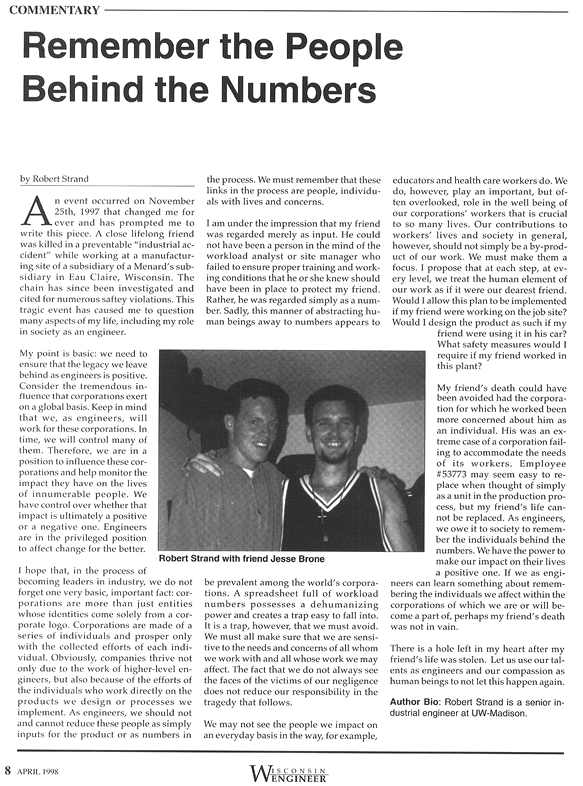
Scanned magazine page from Wisconsin Engineer showing a 1998 commentary titled Remember the People Behind the Numbers by Robert Strand, including a photo of two young men. See long description.

Figure A.1 Wisconsin Engineer: “Remember the People behind the Numbers.”
Source: Robert Strand, “Remember the People behind the Numbers,” The Wisconsin Engineer 102, no. 3 (April 1998): 8, accessed May 13, 2020, https://search.library.wisc.edu/digital/AHKDY4BQ56Q6MJ8P/pages/ADRSAKXFPL3QV48E. Reproduced with permission from The Wisconsin Engineer.
Figure A.1Long description

Image is a scanned page from The Wisconsin Engineer magazine, dated April 1998. The article is titled Remember the People Behind the Numbers and was written by Robert Strand. It is formatted in two columns of serif text on a light background. A small photo appears at the bottom of the first column, captioned Robert Strand with friend Jesse Brone. The photo shows two young men standing closely together, smiling. The article discusses the death of the author’s close friend in a workplace accident and urges engineers to consider the human consequences of their professional decisions.

Figure A.1 reproduces a 1998 commentary I wrote for The Wisconsin Engineer after the death of my close friend Jesse Brone in a workplace accident.

Appendix B: The Manifesto of Nordic Capitalism

The Manifesto of Nordic Capitalism

A commitment to making everyday life better for the many and securing freedom for current and future generations.

  • We reject denial. We face complex challenges head-on, guided by scientific evidence and a sense of responsibility for current and future generations. We champion education that cultivates critical thinking and informed decision-making, recognizing that lasting solutions require an educated, engaged citizenry.

  • We invest in children. We strive to ensure that every child grows up in a safe, nurturing environment with opportunities to thrive. By investing in a good childhood for all, we strengthen the foundations for individual and collective flourishing.

  • We expand freedoms. We uphold equality of opportunity, ensuring everyone has access to the tools and conditions needed to pursue a meaningful life with dignity and purpose.

  • We celebrate stewards. We elevate those who exhibit decency, embrace humanistic values, and demonstrate ethical leadership in stewarding enterprises that create long-term societal value.

  • We practice good governance. We build trust through transparency, accountability, democratic processes, and stakeholder dialogue – shaping institutions that serve the interests of society.

  • We balance cooperation and competition. We design systems that foster cooperation where it strengthens society and embrace competition where it drives efficiency, sparks innovation, and serves the common good.

  • We anchor capitalism in democracy. We see capitalism as a tool to serve society – not an end in itself. We disperse power in line with democratic principles.

  • We embrace a Me–We–Me mindset. We preserve and enhance individual freedom through strong collective institutions – so each person can flourish with dignity and opportunity. We uphold the principle that a flourishing society depends on individuals who take responsibility for themselves and for one another. We recognize that individual and collective prosperity reinforce one another.

  • We are pragmatic. We choose what works over ideology, approaching challenges with humility and curiosity to learn from experience – our own and others’ – as we continuously improve systems to better serve the common good.

  • We aspire to live within planetary boundaries. We embrace our responsibility to live within the Earth’s limits – and to demonstrate that it is possible to meet the needs of the present without compromising the ability of future generations to meet their own needs. Though small in scale, the Nordic nations show what can be done, offering examples to inspire action well beyond their borders. We commit to the ongoing pursuit of sustainable capitalism – through continued cooperation across the Nordic region and in willing collaboration with partners worldwide to secure lasting peace and prosperity.

The Manifesto of Nordic Capitalism is inspired by the New Nordic Cuisine Manifesto, which offered a clear vision and sparked meaningful dialogue and change across the Nordic region – and beyond.Footnote 1

1 Nordic Council of Ministers, New Nordic Food Manifesto, accessed May 24, 2025, www.norden.org/en/information/new-nordic-food-manifesto.

Footnotes

1 Nordic Council of Ministers, New Nordic Food Manifesto, accessed May 24, 2025, www.norden.org/en/information/new-nordic-food-manifesto.

Accessibility standard: WCAG 2.0 A

Why this information is here

This section outlines the accessibility features of this content - including support for screen readers, full keyboard navigation and high-contrast display options. This may not be relevant for you.

Accessibility Information

The HTML of this book conforms to version 2.0 of the Web Content Accessibility Guidelines (WCAG), ensuring core accessibility principles are addressed and meets the basic (A) level of WCAG compliance, addressing essential accessibility barriers.

Content Navigation

Table of contents navigation
Allows you to navigate directly to chapters, sections, or non‐text items through a linked table of contents, reducing the need for extensive scrolling.
Index navigation
Provides an interactive index, letting you go straight to where a term or subject appears in the text without manual searching.

Reading Order & Textual Equivalents

Single logical reading order
You will encounter all content (including footnotes, captions, etc.) in a clear, sequential flow, making it easier to follow with assistive tools like screen readers.
Short alternative textual descriptions
You get concise descriptions (for images, charts, or media clips), ensuring you do not miss crucial information when visual or audio elements are not accessible.
Full alternative textual descriptions
You get more than just short alt text: you have comprehensive text equivalents, transcripts, captions, or audio descriptions for substantial non‐text content, which is especially helpful for complex visuals or multimedia.

Structural and Technical Features

ARIA roles provided
You gain clarity from ARIA (Accessible Rich Internet Applications) roles and attributes, as they help assistive technologies interpret how each part of the content functions.

Save book to Kindle

To save this book to your Kindle, first ensure no-reply@cambridge.org is added to your Approved Personal Document E-mail List under your Personal Document Settings on the Manage Your Content and Devices page of your Amazon account. Then enter the ‘name’ part of your Kindle email address below. Find out more about saving to your Kindle.

Note you can select to save to either the @free.kindle.com or @kindle.com variations. ‘@free.kindle.com’ emails are free but can only be saved to your device when it is connected to wi-fi. ‘@kindle.com’ emails can be delivered even when you are not connected to wi-fi, but note that service fees apply.

Find out more about the Kindle Personal Document Service.

Available formats
×

Save book to Dropbox

To save content items to your account, please confirm that you agree to abide by our usage policies. If this is the first time you use this feature, you will be asked to authorise Cambridge Core to connect with your account. Find out more about saving content to Dropbox.

Available formats
×

Save book to Google Drive

To save content items to your account, please confirm that you agree to abide by our usage policies. If this is the first time you use this feature, you will be asked to authorise Cambridge Core to connect with your account. Find out more about saving content to Google Drive.

Available formats
×