




1. Introduction
Language education is experiencing a significant transformation as a result of developments in generative artificial intelligence (GenAI). GenAI features personalized, tailored, adaptive, and creative capabilities to provide diverse options for language learners and teachers (Barrot, Reference Barrot2023). While studies have investigated the effects of GenAI-mediated technologies on students’ linguistic competence and emotional experiences in formal and structured classroom environments (Wu, Hapsari & Huang, Reference Wu, Hapsari and Huang2025), the exploration of GenAI-mediated informal digital learning of English (GenAI-IDLE) is limited. Especially in informal learning, AI literacy, defined as the ability to recognize the affordances of AI and critically evaluate AI-generated content, is crucial (Liu, Zou, Soyoof & Chiu, Reference Liu, Zou, Soyoof and Chiu2025; Ng, Wu, Leung, Chiu & Chu, Reference Ng, Wu, Leung, Chiu and Chu2024). Also, in informal learning, an especially important skill is learners’ ability to self-regulate their emotions, particularly in response to the increasingly ubiquitous and personalized presence of GenAI.
While a body of literature has investigated the roles of affective factors in the relationship between informal digital learning of English (IDLE) and willingness to communicate (WTC) (Lee, Yeung & Osburn, Reference Lee, Yeung and Osburn2024; Zadorozhnyy & Lee, Reference Zadorozhnyy and Lee2025), it is limited in its exploration of how second language (L2) students’ AI literacy and emotions mediate the association between GenAI-mediated IDLE participation and L2 WTC. In addition, while several studies related to IDLE focus on Vietnamese, Indonesian, Kazakhstani, Saudi Arabian, and Moroccan EFL contexts (Global South contexts), less attention has been paid to the Pakistani EFL context.
Pakistan illustrates the many educational challenges being faced. While English is one of the two official languages (Urdu is the other), recent figures by Education First show the country only ranks 67 out of 116 with an EPI score of 493, which is categorized as “low proficiency” (Education First, Reference First2025). With a population of 247 million, the burden on the English language education system is enormous. A wide range of issues have been reported in recent years, including a lack of clear policy and guidelines, a lack of resources, and numerous socioeconomic challenges (Shamim, Reference Shamim2008). Language education has been shown to have to contend with issues such as unequal access (Tayyab, Hassan & Akmal, Reference Tayyab, Hassan and Akmal2023), poor-quality teacher education and subsequent language instruction (Malik & Nayab, Reference Malik and Nayab2024), and the use of traditional teaching methods that result in low student engagement (Shamim, Reference Shamim2008). The government has turned to technology to solve these problems (Asad, Hussain, Wadho, Khand & Churi, Reference Asad, Hussain, Wadho, Khand and Churi2021). However, many schools lack the necessary infrastructure, with especially rural schools suffering from poor internet connections and electricity outages (Taimur-ul-Hassan, Reference Taimur-ul-Hassan2013). In addition, many teachers are unprepared for or even fearful of the integration of technology into their practice (Asad et al., Reference Asad, Hussain, Wadho, Khand and Churi2021; Taimur-ul-Hassan, Reference Taimur-ul-Hassan2013).
Given these shortcomings in formal education in Pakistan, GenAI-IDLE may offer an alternative for students seeking more accessible, engaging, and autonomous learning opportunities, especially as a majority of students (at least those in higher education) already carry mobile phones (Rashid et al., Reference Rashid, Cunningham, Watson and Howard2018). However, the interplay mechanism of these factors (including GenAI-IDLE, AI literacy, L2 emotions, and L2 WTC), especially in the Global South, remains unclear. Hence, this study aims to bridge these research gaps to explore how GenAI-IDLE interacts with AI literacy and L2 emotions – that is, foreign language enjoyment (FLE) and foreign language boredom (FLB) – to make impacts on L2 WTC. This is the first attempt to examine the predictive impact of GenAI-IDLE on L2 WTC in the Global South context.
2. Literature review
2.1 Informal digital learning of English (IDLE) and GenAI
With the continuing adoption of technology in education, IDLE has become a well-established field in its own right (Lee & Dressman, Reference Lee and Dressman2018; Lee et al., Reference Lee, Yeung and Osburn2024; Soyoof, Reynolds, Vazquez-Calvo & McLay, Reference Soyoof, Reynolds, Vazquez-Calvo and McLay2023). IDLE investigates self-directed learning with the help of technology, with AI-mediated informal digital learning of English (AI-IDLE) focusing on “how language learners negotiate access to AI tools for self-directed learning of English outside the classroom” (Liu et al., Reference Liu, Zou, Soyoof and Chiu2025: 2). In contrast, traditional computer-assisted language learning (CALL) studies more commonly focus on structured, teacher-led activities within formal educational settings (Reinders, Lai & Sundqvist, Reference Reinders, Lai and Sundqvist2022; Sundqvist & Sylvén, Reference Sundqvist and Sylvén2014). Recent studies have investigated EFL learners’ engagement in AI-IDLE (Liu, Darvin & Ma, Reference Liu, Darvin and Ma2024a, Reference Liu, Darvin and Ma2024b; Liu et al., Reference Liu, Zou, Soyoof and Chiu2025), showing a number of benefits, such as promoting communication behaviors and willingness (Zou, Azari Noughabi, Sabouri & Zhou, Reference Zou, Azari Noughabi, Sabouri and Zhou2025a), improving FLE (Liu et al., Reference Liu, Zou, Soyoof and Chiu2025), and increasing their learning motivation (Liu et al., Reference Liu, Darvin and Ma2024a, Reference Liu, Darvin and Ma2024b; Zou, Liu, Li & Chen, Reference Zou, Liu, Li and Chen2025c ; Zou et al., Reference Zou, Soyoof, Chiu and He2025h). These studies have evidenced that AI-IDLE has played a significant role in L2 education in a digital realm where L2 learners can mobilize their learning psychological factors and negotiate other contextual factors to leverage AI technologies and obtain benefits from self-guided autonomous language learning practices (Guan, Zhang & Gu, Reference Guan, Zhang and Gu2025). It is important to note that AI-IDLE and GenAI-IDLE are used interchangeably because we regard GenAI as an element of AI.
In the context of the Global South, IDLE and (Gen)AI-IDLE have been adopted to address the limitations of formal education systems and provide learners with more accessible, engaging, and autonomous learning opportunities (Zadorozhnyy & Lee, Reference Zadorozhnyy and Lee2025; Zou, Soyoof & Amjad, Reference Zou, Soyoof and Amjad2025e). A number of factors have been shown to play a particularly important role in the adoption and successful application of IDLE. Some of these act as prerequisites, such as access to technological resources (hardware, software, stable internet access). Within this study, particular emphasis is placed on the ways in which L2 learners mobilize GenAI technologies to enact IDLE practices beyond the classroom.
2.2 AI literacy
As new technologies play an ever-greater role in education, learners require an increasingly sophisticated toolkit to navigate their impact. Digital literacy is conceptualized as “the practices of communicating, relating, thinking and being associated with digital media” (Jones & Hafner, Reference Jones and Hafner2021: 12), as well as “the wide range of technology-mediated social practices that learners enact by assembling and interweaving their linguistic, semiotic, and technical resources” (Liu, Reference Liu, McCallum and Tafazoli2025: 1). Considering new technologies (e.g. generative AI) continue to grow and reframe the digital realm (Liu et al., Reference Liu, Darvin and Ma2024a), digital literacy should also advance to include AI literacy to prepare students to become responsible digital citizens in the digital era (Ng et al., Reference Ng, Wu, Leung, Chiu and Chu2024). AI literacy encompasses (1) knowing and understanding AI, (2) using and applying AI, (3) evaluating and corroborating AI-generated content, and (4) incorporating AI-generated content ethically and effectively (Ng et al., Reference Ng, Wu, Leung, Chiu and Chu2024). Studies have shown that incorporating AI in language learning can boost learners’ self-efficacy and motivation (Wang & Wang, Reference Wang and Wang2025), strengthen their learning enjoyment (Liu et al., Reference Liu, Zou, Soyoof and Chiu2025; Zou et al., Reference Zou, Soyoof and Amjad2025e), foster communication behaviors (Liu & Fan, Reference Liu and Fan2025), facilitate linguistic performance (Guan et al., Reference Guan, Zhang and Gu2025), and increase engagement (Zou, Soyoof, Teng & Chen, Reference Zou, Soyoof, Teng and Chen2025f).
2.3 Foreign language enjoyment (FLE) and foreign language boredom (FLB)
The control-value theory (CVT), pivotal in educational psychology research, has seen an increasingly important role in second language acquisition (SLA) studies. CVT focuses on the complicated associations between various academic emotions, their antecedents, and their consequences (Pekrun, Reference Pekrun2006). In light of the three-dimensional taxonomy of CVT, FLE is recognized as a positive, physiologically and psychologically activating, and activity-oriented academic emotion (Dewaele & MacIntyre, Reference Dewaele and MacIntyre2014), while FLB is identified as a negative, deactivation-focused, and activity-related academic emotion (Pekrun et al., Reference Pekrun, Goetz, Daniels, Stupnisky and Perry2010). FLE as a positive emotion with a high level of activation can positively impact language learning, such as by improving learners’ linguistic performance (Dewaele, Botes & Greiff, Reference Dewaele, Botes and Greiff2023), fostering communication behaviors (Lee et al., Reference Lee, Yeung and Osburn2024), enhancing academic engagement (Zou et al., Reference Zou, Azari Noughabi and Peng2025b), and mitigating anxiety (Dewaele et al., Reference Dewaele, Botes and Greiff2023). FLE has been shown to affect informal digital language learning behaviors (Liu et al., Reference Liu, Darvin and Ma2024b; Zou et al., Reference Zou, Soyoof and Amjad2025e, Reference Zou, Soyoof, Teng and Chen2025f) and thus requires further exploration of its antecedents and outcomes.
In contrast, FLB, as a negative emotion characterized by low arousal, adversely affects academic achievement, as it tends to diminish learners’ motivation (Li, Feng, Zhao & Dewaele, Reference Li, Feng, Zhao and Dewaele2024), leading them to rely on superficial learning strategies (Zou, Azari Noughabi & Peng, Reference Zou, Azari Noughabi and Peng2025b) and reducing their enthusiasm and productivity in learning (Wang, Peng & Patterson, Reference Wang, Peng and Patterson2021). A body of literature has corroborated that individuals who experience boredom are more likely to have diverse outcomes: behavioral avoidance (e.g. avoiding communicating with others in English), affective discomfort (e.g. the feeling of monotony), and cognitive dilapidation (e.g. the awareness of time moving sluggishly) (Li et al., Reference Li, Feng, Zhao and Dewaele2024). Specifically, IDLE may trigger learners’ boredom because learners may lack teachers’ support or peers’ discussion in autonomous and self-directed learning environments (Zou et al., Reference Zou, Azari Noughabi and Peng2025b). Research is very limited in exploring the antecedents and consequences of FLB in an informal digital language learning context (Dewaele et al., Reference Dewaele, Botes and Greiff2023). As such, this study aims to bridge this gap by investigating the roles of FLE and FLB with the affordance of GenAI technologies for language learning purposes beyond the classroom.
While research investigating the association among GenAI-IDLE, AI literacy, and L2 emotions remains limited, a body of studies has displayed (AI-mediated) IDLE’s impact on L2 English learners’ emotions (Lee & Drajati, Reference Lee and Drajati2019; Liu et al., Reference Liu, Zou, Soyoof and Chiu2025) and presented AI literacy’s positive influence on FLE (Liu & Fan, Reference Liu and Fan2025). To be specific, the relationship between AI-IDLE and FLE has been corroborated by several studies. Liu and his colleagues found that students who engage in AI-IDLE practices frequently are more likely to present a clearer ideal L2 self-image and a higher level of FLE (n = 299). Wu et al. (Reference Wu, Hapsari and Huang2025) employed quasi-experimental research and found that students’ participation in AI-mediated language learning activities can saliently mitigate their negative emotions, strengthen their positive emotions, and enhance their speaking competence. Moreover, AI literacy may serve as an important predictor of L2 emotions (Liu & Fan, Reference Liu and Fan2025). Specifically, Liu and Fan (Reference Liu and Fan2025) found that AI literacy significantly and positively influences students’ FLE (n = 637). Although these studies mainly focus on EFL formal and structured classrooms, these insights may translate into informal language learning environments outside the classroom with the affordance of GenAI technologies. Given the tight relationship between GenAI-IDLE, AI literacy, and L2 emotions, this study proposes the following five hypotheses:
H1. GenAI-IDLE participation positively predicts AI literacy.
H2. GenAI-IDLE participation positively predicts FLE.
H3. GenAI-IDLE participation negatively predicts FLB.
H4. AI literacy positively predicts FLE.
H5. AI literacy negatively predicts FLB.
2.4 L2 willingness to communicate (WTC) in L2
WTC refers to “a willingness to engage in discourse at a given moment with a particular individual or group utilising L2” (MacIntyre, Clément, Dörnyei & Noels, Reference MacIntyre, Clément, Dörnyei and Noels1998: 547). L2 learners with a higher level of WTC interact more frequently with others in English (Zou et al., Reference Zou, Azari Noughabi, Sabouri and Zhou2025a), create more opportunities to immerse themselves in an authentic L2 usage environment (Dewaele & Dewaele, Reference Dewaele and Dewaele2018), and become more confident and autonomous over time (Zou, Teng, Soyoof & He, Reference Zou, Teng, Soyoof and He2025d). In addition, there have been some studies that have explored the antecedents of WTC in the IDLE environment (Lee & Chiu, Reference Lee and Chiu2023; Lee & Drajati, Reference Lee and Drajati2019). For instance, Lee and Chiu (Reference Lee and Chiu2023) found that Korean EFL students who have a higher level of self-perceived English ability are more likely to reduce offline communication anxiety, thereby yielding higher L2 WTC (n = 1,269). L2 students with a stronger L2 motivation are inclined to display weak anxiety, which in turn elicits a higher level of L2 WTC in digital learning contexts. Thus, it is important to explore the antecedents of L2 WTC, especially some psychological factors (e.g. L2 emotions) and informal digital learning practices. This study combines EFL learners’ AI-IDLE practices, AI literacy, their L2 emotions, and L2 WTC to understand the interactive mechanism of these variables, thereby enriching the theoretical literature.
While previous studies did not validate the predictive power of GenAI-IDLE on L2 WTC, several studies have examined the positive impact of IDLE on WTC in the Global South, including in Iranian, Indonesian, Thai, and Kazakhstani EFL contexts (Zadorozhnyy & Lee, Reference Zadorozhnyy and Lee2025). For example, Zadorozhnyy and Lee (Reference Zadorozhnyy and Lee2025) found that while IDLE did not directly influence L2 WTC in Kazakhstan, self-efficacy beliefs functioned as a full mediator between IDLE and L2 WTC. IDLE has the potential to influence L2 WTC, which is mediated by cognitive or emotional variables. In the same vein, Lee and Drajati (Reference Lee and Drajati2019) found that Indonesian EFL students’ productive IDLE had a significant impact on students’ L2 WTC (n = 183), which echoes the study by Reinders and Wattana (Reference Reinders and Wattana2015) on the effects of Thai university students’ digital game-based language learning behaviors on L2 WTC. In addition, given the positive impact of IDLE on L2 WTC in previous literature (e.g. Lee & Drajati, Reference Lee and Drajati2019; Lee et al., Reference Lee, Yeung and Osburn2024) and how these affective factors can serve as catalysts of L2 WTC within and beyond the formal instruction environments (Lai, Zhu & Gong, Reference Lai, Zhu and Gong2015; Lee et al., Reference Lee, Yeung and Osburn2024), we pose that:
H6. GenAI-IDLE participation positively predicts WTC.
While research on the predictive role of AI literacy in L2 emotions and L2 WTC respectively is very limited, a few studies have explored how L2 English students’ attitudes toward AI affect L2 WTC (Zhi & Wang, Reference Zhi and Wang2024). Zhi and Wang (Reference Zhi and Wang2024) found that Chinese English major students’ attitudes toward AI made a positive and significant impact on L2 WTC (n = 1,090), which echoed Liu and Fan (Reference Liu and Fan2025) by confirming that EFL students with a higher level of AI literacy are more likely to leverage AI technologies to communicate with others in English. Moreover, a large body of literature has examined the predictive roles of L2 emotion in L2 WTC (e.g. Dewaele et al., Reference Dewaele, Botes and Greiff2023; MacIntyre et al., Reference MacIntyre, Clément, Dörnyei and Noels1998), offering empirical evidence for postulating hypotheses regarding the emotional pattern underlying the involvement of AI-mediated digital activities and L2 WTC. For instance, Alrabai (Reference Alrabai2024) found that Saudi EFL students’ FLB fails to directly predict L2 WTC, while FLE significantly and directly predicts L2 WTC (n = 328). However, Wang et al. (Reference Wang, Peng and Patterson2021) found that Chinese EFL learners’ enjoyment and boredom both positively influence L2 WTC within and beyond the classroom (n = 811). To our best knowledge, regarding the interaction between FLB and L2 WTC in digital language learning environments, it is worth further exploring it, especially in AI-mediated digital contexts, because the findings of prior studies were inconsistent (Alrabai, Reference Alrabai2024; Wang et al., Reference Wang, Peng and Patterson2021):
H7. AI literacy positively predicts WTC.
H8. FLE positively predicts WTC.
H9. FLB negatively predicts WTC.
Taken together, the nine hypotheses are vividly demonstrated in Figure 1.
The hypothesized structural model.

2.5 Theoretical framework
As digital technologies have become pervasive and increasingly sophisticated, it is recognized that individuals seek digital experiences that facilitate, rather than impede, the fulfillment of their goals and psychological needs. In this study, we drew upon self-determination theory (SDT) as conceptualized within the framework of technology design by Peters, Calvo and Ryan (Reference Peters, Calvo and Ryan2018). SDT, one of the pioneering theories to integrate psychological constructs into the domain of technology, provides a foundational perspective on motivation, well-being, and autonomy, thereby offering valuable insights into the dynamics of human–computer interaction. The “Motivation, Engagement, and Thriving in User Experience” (METUX) model, which operationalizes SDT in the context of technology use, delineates six distinct “spheres of technology experience”: adoption, interface, task, behavior, life, and society. The “adoption” sphere pertains to users’ autonomous motivation to engage with a given technology. The “interface” sphere addresses how user interaction with technological interfaces (e.g. navigational controls) affects their psychological states. The “task” sphere focuses on the extent to which technologies fulfill users’ psychological needs during task engagement. The “behavior” sphere involves users’ need for satisfaction in relation to the functional affordances of the technology. The “life” sphere encompasses the broader psychological impacts that extend beyond immediate usage.
In our study, the variables are mapped to the METUX spheres according to their theoretical alignment with SDT’s key psychological needs:
-
1. GenAI-IDLE participation is mapped onto the “Behavior” sphere as it demonstrates learners’ autonomous engagement with AI technologies for informal language learning beyond the classroom. This mapping reflects how learners exercise autonomy in selecting and using AI tools that align with their personal learning goals. The theoretical pathway here indicates that when AI tools satisfy learners’ psychological needs during informal learning activities, this promotes sustained engagement and self-directed learning behaviors.
-
2. AI Literacy is mapped onto the “Adoption” sphere. The adoption sphere pertains to users’ autonomous motivation to engage with a given technology. We position AI literacy within this sphere because learners’ competencies in critically evaluating and ethically using AI tools directly influence their initial decision to adopt these technologies. This theoretical pathway suggests that AI literacy serves as a prerequisite for autonomous adoption, as learners must understand AI capabilities and limitations before meaningfully engaging with these tools.
-
3. L2 Emotions (FLE and FLB) are mapped onto the “Life” sphere. The life sphere encompasses the broader psychological impacts that extend beyond immediate usage. We associate L2 emotions with this sphere because FLE and FLB display enduring emotional states that influence learners’ overall quality of life. The theoretical pathway suggests that positive experiences with AI-enhanced language learning can generate enjoyment that transcends specific learning activities, while negative experiences may lead to boredom that affects learners’ WTC.
-
4. WTC is mapped onto the “Task” sphere, which focuses on the extent to which technologies fulfill users’ psychological needs during task engagement. WTC is positioned within this sphere because it directly relates to learners’ readiness to engage in communicative tasks using the target language. The theoretical pathway indicates that when AI tools effectively support communicative practice (satisfying competence and relatedness needs), learners experience increased WTC, which reinforces their engagement with language learning tasks.
In summary, the integration of SDT with technology design theory aligns closely with the constructs examined in this study (see Figure 2) and allows us to propose our research questions:
Variables mapped to the Motivation, Engagement, and Thriving in User Experience (METUX) spheres.

RQ1. In what ways, if any, does GenAI-IDLE affect Pakistani L2 English learners’ AI literacy and L2 emotions?
RQ2. In what ways, if any, does GenAI-IDLE interact with AI literacy and L2 emotions to impact Pakistani L2 English learners’ WTC?
3. Methodology
3.1 Research context and participants
The study was conducted in tertiary-level EFL institutions across Pakistan. Participants were recruited through convenience sampling (Creswell & Creswell, Reference Creswell and Creswell2017) from institutions located in different regions of the country from October 2024 to March 2025 (after the public release of ChatGPT). Invitations to participate were distributed via social media platforms (WhatsApp, LinkedIn, and Facebook), and some teachers assisted in circulating the questionnaire QR code among their students. The sole eligibility criterion was current enrolment at a Pakistani tertiary institution. It should be noted that English is a national language in Pakistan. In Pakistani institutes, teachers use English to teach diverse subjects. To ensure that respondents had relevant GenAI usage experience for English learning purposes, the demographic section included a screening question: “Do you use GenAI to learn English?” Of the 501 questionnaires initially collected, 359 were retained for analysis – those indicating “Yes.”
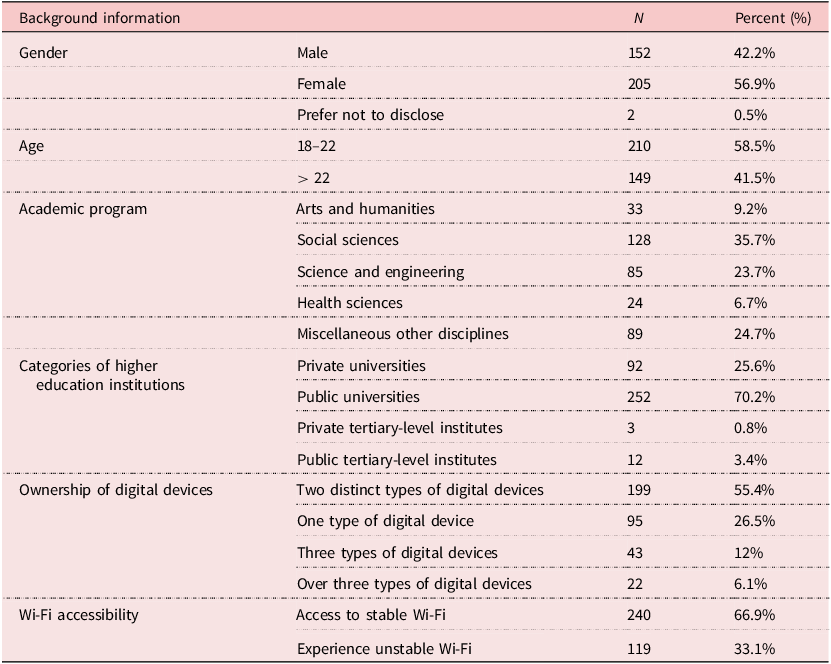
Due to space limitations, demographic details are shown in Table 1. Ethics approval was obtained from the third author’s institutional review board, and all participants gave their informed consent to voluntarily participate in this study.
Background information of participants

3.2 Data collection and analysis
The questionnaire was administered in English using Google Forms (see Appendix in the supplementary material for the questionnaire), achieving cross-cultural validity. It began with a mandatory consent question, before requesting some demographic information, followed by a number of psychometric measurement scales. The scales segment encompassed 37 items assessing five key constructs: GenAI-IDLE, AI Literacy, FLE, FLB, and WTC. Participants evaluated each item utilising a 6-point Likert scale, with responses ranging from 1 (strongly disagree) to 6 (strongly agree) (with the absence of a midpoint in order to reduce central tendency bias):
-
1. GenAI-IDLE (8 items): We used the 8-item instrument developed and validated by Liu et al. (Reference Liu, Darvin and Ma2024a, Reference Liu, Darvin and Ma2024b, Reference Liu, Zou, Soyoof and Chiu2025) to enquire about respondents’ use of AI in their independent language learning. The AI-IDLE scale exhibited robust internal consistency in our study, with a Cronbach’s alpha coefficient of .90. An example item reads, “I use AI technologies to simulate real-life English language use situations beyond the classroom.”
-
2. AI Literacy (6 items): We used the scale initially constructed by Chai, Wang and Xu (Reference Chai, Wang and Xu2020) and subsequently validated by Liu and Fan (Reference Liu and Fan2025) within the Chinese EFL context. The reliability of the comprehensive AI literacy scale yielded a Cronbach’s alpha coefficient of .89, indicating robust internal consistency. An example item reads, “I understand how AI technology optimizes the translation output for online translation.”
-
3. FLE (7 items): We adapted Liu, Zhao and Yang’s (Reference Liu, Zhao and Yang2024d) FLE scale (7 items) within the context of informal digital language learning and incorporated Liu et al.’s (Reference Liu, Darvin and Ma2024b) FLE scale, validated in AI-mediated contexts. Because Liu et al.’s FLE scale was related to online informal engagement with a target language other than English (LOTE), we modified the expressions of their FLE scale to suit the informal engagement within an EFL context. For example, “Learning the target LOTE is fun” was modified into the item “Learning English is fun.” The items on the FLE scale were checked by three experienced experts in applied linguistics and CALL to ensure the content validity of the scale. The reliability of the comprehensive FLE scale yielded a Cronbach’s alpha coefficient of .90, exemplifying excellent internal consistency.
-
4. FLB (11 items): We used the Foreign Language Boredom Scale developed and validated by Li et al. (Reference Li, Feng, Zhao and Dewaele2024). This scale was validated in the IDLE context by Zou et al. (Reference Zou, Azari Noughabi and Peng2025b). After the content validity of the FLB scale was checked by three experienced experts, 11 items were retained. A Cronbach’s alpha coefficient of .94 indicates excellent internal consistency. An example item reads, “Studying (English) is dull in general.”
-
5. WTC (5 items): We used the 5-item WTC in the informal digital language learning scale developed and validated by Lee and Lu (Reference Lee and Lu2023). A Cronbach’s alpha coefficient of .90 exemplifies excellent internal consistency. An example item reads, “When I have an opportunity to explain my own culture online in English to other English speakers, I am willing to communicate in English.”
Adhering to the five-step structural equation modeling (SEM) procedure recommended by Collier (Reference Collier2020), data were analyzed using SPSS 29.0 and AMOS 29.0. After data cleaning and screening (e.g. removal of incomplete or invalid responses), normality was assessed through descriptive statistics (means, standard deviations, skewness, and kurtosis). Reliability was examined via Cronbach’s α, and construct validity was evaluated through confirmatory factor analysis. A structural model was then specified to test the relationships among GenAI-IDLE participation, AI literacy, FLE, FLB, and WTC. SEM enables us to model complex relationships between observed and latent variables and direct and indirect (i.e. mediating roles) simultaneously. It should be noted that it can only establish statistical associations between variables, not causal relationships.
4. Research results
In the following sections, we first report descriptive statistics of participation in GenAI-IDLE, their AI Literacy, FLE, FLB, and WTC. Next, the reliability and validity of the data are examined. Finally, structural and mediation model analyses are reported.
4.1 Descriptive statistics
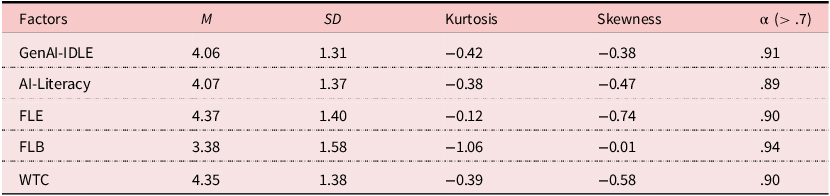
Table 2 showed participants’ self-perception of their engagement in GenAI-IDLE, and their levels of AI Literacy, FLE, FLB, and WTC. The mean values of all constructs ranged from 3.38 to 4.35 (out of a maximum of 6), signifying that respondents exhibited a relatively high level of AI-IDLE, AI Literacy, FLE, FLB, and WTC. FLE showed the highest mean value (4.37), while FLB demonstrated the lowest mean value (3.38). The standard deviations of the items varied from 1.31 to 1.58, indicating an acceptable degree of data dispersion. The kurtosis and skewness values of each item fall within the ranges of < |8| and < |3|, respectively (see Table 2), suggesting that the data set did not substantially deviate from normality (Kline, Reference Kline2023).
Descriptive statistics

4.2 Reliability and validity checking
The Cronbach’s α values of the five variables were calculated and found to be .91 (GenAI-IDLE), .89 (AI Literacy), .90 (FLE), .94 (FLB), and .90 (WTC), which all exceeded the benchmark of .70 (see Table 2), thus suggesting excellent internal consistency (Kline, Reference Kline2023). The high internal consistency adds confidence to subsequent SEM outcomes.
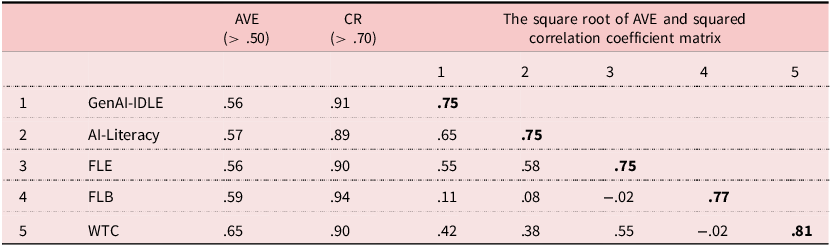
To assess the validity of the constructs, both convergent and discriminant validity were evaluated. Following the recommendation by Collier (Reference Collier2020), composite reliability (CR) and average variance extracted (AVE) were employed to examine convergent validity. The high AVE indicates the high proportion of variance explained by each construct. As illustrated in Table 3, the CRs of the five factors surpassed the threshold value of .70, while the AVEs exceeded the cut-off value of .50 (Hair, Black, Babin & Anderson, Reference Hair, Black, Babin and Anderson2009). To ascertain discriminant validity, the square root of AVE for each construct was compared with their respective inter-factor correlation coefficients, which is a conventional analysis method (i.e. Fornell–Larcker criterion). Table 3 shows that the square roots of AVE were greater than their corresponding correlation coefficients, indicating that discriminant validity was established.
Convergent and discriminant validity of GenAI-IDLE, AI Literacy, FLE, FLB, and WTC

Note. The values in bold along the diagonal represent the square root of the average variance extracted (AVE). CR = composite reliability.
In a measurement model constructed using AMOS, five constructs and their corresponding observed variables were employed to enhance the construct validity of the adapted questionnaire. To evaluate the degree of model fit between the measurement model and the data set, seven indices were utilized: the ratio of χ2 to degrees of freedom (χ2/df < .5), comparative fit index (CFI > .90), incremental fit index (IFI > .90), Tucker–Lewis index (TLI > .90), parsimony goodness-of-fit index (PGFI > .50), root-mean-square error of approximation (RMSEA < .10), and standardized root-mean-square residual (SRMR < .08) (Kline, Reference Kline2023). All model indices fall within the recommended ranges, indicating a satisfactory model fit (Table 4). Hence, the questionnaire data exhibited excellent construct validity.
Model fit indices of GenAI-IDLE, AI Literacy, FLE, FLB, and WTC

Note. CFI = comparative fit index; IFI = incremental fit index; TLI = Tucker–Lewis index; PGFI = parsimony goodness-of-fit index; RMSEA = root-mean-square error of approximation; SRMR = standardized root-mean-square residual.
4.3 The structural equation model and mediation model measurement
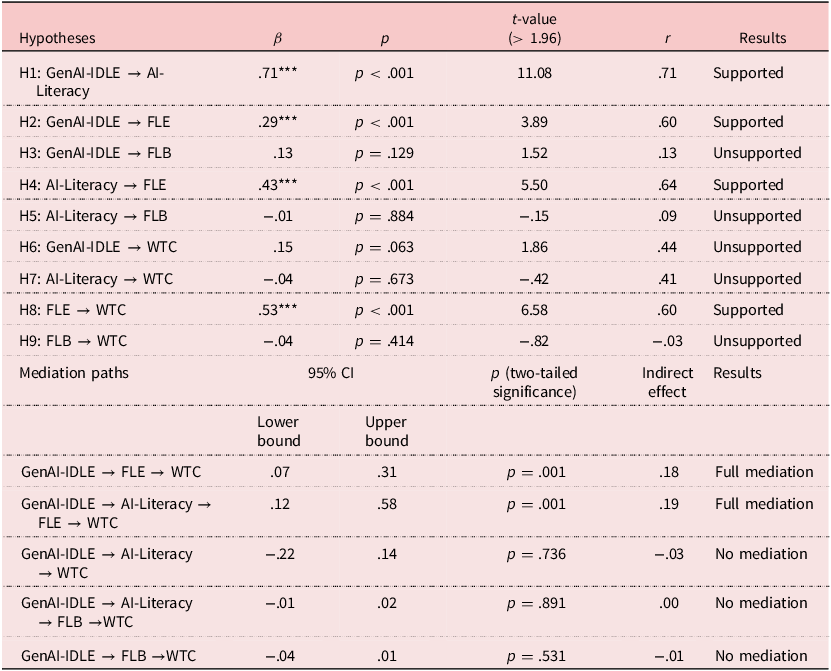
Employing AMOS 29, we conducted an SEM analysis. Good fit indices met all thresholds recommended by Kline (Reference Kline2023) (Table 5). Learners’ GenAI-IDLE participation significantly and positively predicted AI Literacy (H1: β = .71, p < .001, t-value = 11.08, r = .71). Learners’ GenAI-IDLE involvement made a positive and significant impact on FLE in a direct way (H2: β = 29, p < .001, t-value = 3.89, r = .60), while GenAI-IDLE participation did not predict FLB (H3: β = .13, p = .129, t-value = 1.52, r = .13). AI Literacy exerted a significant and positive role in FLE (H4: β = .43, p < .001, t-value = 5.50, r = .64), while AI Literacy did not predict FLB (H5: β = −.01, p = .884, t-value = −.15, r = .09). GenAI-IDLE did not predict WTC (H6: β = .15, p = .063, t-value = 1.86, r = .44). AI Literacy did not predict WTC (H7: β = −.04, p = .673, t-value = −.42, r = .41). FLE had a significant and positive influence on WTC (H8: β = .53, p < .001, t-value = 6.58, r = .60), while FLB did not have a direct influence on WTC (H9: β −.04, p = .414, t-value = −.82, r = −.03). As illustrated by the R2 values in Figure 3, GenAI-IDLE and AI Literacy collectively accounted for 45% of the variance (moderate to high R² values) in FLE and 2% of the variance in FLB. These four variables (GenAI-IDLE, AI Literacy, FLE, FLB) explained 37% of the variance (moderate to high R² values) in WTC. The R² values and correlation coefficients (r) revealed weak effect sizes for three hypothesized relations and large effect sizes for the remaining six hypothesized relationships (Plonsky & Oswald, Reference Plonsky and Oswald2014), indicating the structural model’s robust explanatory power.
Hypotheses testing results of direct and indirect paths

Note. r < .25 = small effect size, .25 < r < .5 = medium effect size, while r > .5 = large effect size (Plonsky & Ghanbar, Reference Plonsky and Ghanbar2018). CI = confidence interval. ***p < .001.
The structural equation model of GenAI-IDLE, AI Literacy, FLE, FLB, and WTC Note. n.s. = non-significance; R2: FLE = 45%; FLB = 2%; WTC = 37%. ***p < .001.

To examine the mediating roles of AI Literacy, FLE, and FLB in the association between GenAI-IDLE and WTC, a bootstrapping test with 2,000 samples was performed at a 95% confidence level using AMOS. It was found that FLE played a fully mediating role between GenAI-IDLE and WTC (95% CI [.07, .31], p = .001). AI Literacy and FLE played a full chain-mediating role between GenAI-IDLE and WTC (95% CI [.12, .58], p = .001) because the lower and upper bounds of the two mediating paths were above zero and their indirect effects were both significant, which provided empirical support for a dual pathway model linking behavior, cognition, and affect (Collier, Reference Collier2020). However, AI Literacy did not exert a mediating effect on the relationship between GenAI-IDLE and WTC (95% CI [−.22, .14], p = .736). AI Literacy and FLB did not play a chain-mediating role in the link between GenAI-IDLE and WTC (95% CI [−.01, .02], p = .891) (Collier, Reference Collier2020). FLB did not play a mediating role in the association between GenAI-IDLE and WTC (95% CI [−.04, .01], p = .531).
5. Discussion and pedagogical implications
This study employed the SEM to investigate the interactions between GenAI-IDLE participation, AI Literacy, L2 emotions (i.e. FLE and FLB), and WTC in the Pakistani EFL context. The results of the mediation analyses are now presented in order to answer our two research questions.
5.1 RQ1. In what ways, if any, does GenAI-IDLE affect Pakistani L2 English learners’ AI literacy and L2 emotions?
Our results show that Pakistani L2 English learners’ participation in GenAI-IDLE activities has a significant, positive impact on their AI literacy (r = .71, a large effect size). This finding indicates that GenAI not only is sufficiently user-friendly to allow independent and self-guided use for language learning purposes (the “behavioral sphere” in Peters et al.’s, Reference Peters, Calvo and Ryan2023, METUX model) but also provides enough scaffolded support for learners to improve technical skills on their own. A substantial number of studies have shown similar findings in the context of IDLE (Guan et al., Reference Guan, Zhang and Gu2025; Lee & Sylvén, Reference Lee and Sylvén2021; Liu, Zhang & Zhang, Reference Liu, Zhang and Zhang2024c; Zou et al., Reference Zou, Teng, Soyoof and He2025d). However, it is important to note that correlation does not imply causation. While a strong relationship between GenAI-IDLE engagement and AI literacy was evident in our study, further experimental research is needed to establish causal effects.
Another finding was that participants’ involvement in GenAI-IDLE had a significant, positive impact on their FLE (r = .60, a large effect size). This indicates that GenAI-IDLE practices are perceived as enjoyable and meet learners’ psychological needs (the “life sphere” in the METUX model) (Peters & Calvo, Reference Peters, Calvo and Ryan2023). This is important for language learning in general, but especially so in independent learning, where learners need to regulate their emotions (e.g. Zimmerman, Reference Zimmerman, Boekaerts, Pintrich and Zeidner2000). Maintaining long-term motivation and regulating emotions are crucial to achieving success in IDLE. For example, Liu et al.’s (Reference Liu, Zou, Soyoof and Chiu2025) study of Chinese undergraduate students’ AI-IDLE activities found that the gamification and interactive aspects of the AI tools students used improved their enjoyment levels. Others have reported similar benefits of GenAI-IDLE activities to personalization (Barrot, Reference Barrot2023) and collaborative learning support (Wu et al., Reference Wu, Hapsari and Huang2025). Although we did not investigate what types of activities our respondents engaged in, it is likely that their use of GenAI had similar features, contributing to their increased positive emotions.
However, we found GenAI-IDLE did not have an impact on FLB (r = .13, a small effect size). This finding highlights the complex nature of emotions in language learning, as positive and negative emotions can coexist during language learning and have different triggers (Dewaele & MacIntyre, Reference Dewaele and MacIntyre2014). It is possible that the impact of the novelty and the interactive features of GenAI may enhance enjoyment but not necessarily alleviate the long-term challenges of maintaining interest. This may be attributed to the nature of independent and self-directed learning, which can be a lonely pursuit, often characterized by boredom (Zou et al., Reference Zou, Azari Noughabi, Sabouri and Zhou2025a). This emotional ambivalence has been observed in previous studies, where certain tasks were enjoyed for their social interaction but simultaneously perceived as boring due to being predictable or undemanding (Pekrun et al., Reference Pekrun, Goetz, Daniels, Stupnisky and Perry2010). Boredom was linked with tasks that are either cognitively unchallenging or over-challenging (Zou et al., Reference Zou, Azari Noughabi and Peng2025b), suggesting that GenAI-IDLE practices may not yet be optimally calibrated in terms of cognitive workload. Given the small effect size between AI-IDLE participation and FLB, future research is required to better understand factors influencing boredom in the GenAI-IDLE context.
5.2 RQ2. In what ways, if any, does GenAI-IDLE interact with AI literacy and L2 emotions to impact Pakistani L2 English learners’ WTC?
First, the SEM model shows a strongly predictive role for students’ AI literacy levels in their FLE (r = .13). In other words, the greater one’s ability to use GenAI, the more likely this will result in enjoyment in the language learning process. This aligns with the “adoption sphere” in the METUX model, where learners need to have a degree of autonomous ability to engage with GenAI technologies. This finding is consistent with Liu and Fan’s (Reference Liu and Fan2025) research showing that AI literacy exerts a positive and direct role in FLE within AI-mediated English communication classrooms. Additionally, students who experience a stronger sense of enjoyment are more likely to engage in communication practices in AI-mediated learning contexts, which is supported by the significant and positive predictor of FLE on L2 WTC (r = .60, a large effect size). Aligned with the previous studies (Alrabai, Reference Alrabai2024; Wang et al., Reference Wang, Peng and Patterson2021), this study suggests that FLE of Pakistani EFL tertiary students can foster their communication willingness outside the classroom by leveraging diverse GenAI-mediated learning platforms or tools.
Moreover, this study demonstrates that while GenAI-IDLE involvement did not directly predict L2 WTC (r = .44, a medium effect size), GenAI-IDLE participation has an indirect impact on L2 WTC through the mediation roles of AI literacy and FLE. These results not only are consistent with prior studies on other Global South countries, such as Kazakhstan (Zadorozhnyy & Lee, Reference Zadorozhnyy and Lee2025) showing that the relationship between IDLE engagement and L2 WTC may be mediated by other variables (e.g. L2 grit and emotions), but also provide evidence for the pivotal roles of AI literacy and positive emotions in conditioning GenAI-IDLE activities and L2 English communication willingness across contexts (Liu et al., Reference Liu, Zou, Soyoof and Chiu2025; Zhi & Wang, Reference Zhi and Wang2024). In contrast, FLB did not predict L2 WTC (r = −.03) and did not play any mediating role between GenAI-IDLE and L2 WTC, which diverges from the case by Wang et al. (Reference Wang, Peng and Patterson2021), who found that boredom positively predicted L2 WTC in class, while there was no link with L2 WTC out of class. One possible explanation is that the significantly different research populations and contexts may play a role. As such, more research is needed to explore this link. Another possible reason is that students may have developed effective boredom-coping strategies to alleviate learning boredom (Li et al., Reference Li, Feng, Zhao and Dewaele2024). Furthermore, the observation that FLB (a negative emotion) scores are only slightly lower than those of FLE (a positive emotion) suggests that participants who frequently engage with GenAI technologies tend to derive more enjoyment from the language learning experience. Meanwhile, their negative feelings (FLB) appear to be mitigated through the use of personalized and versatile AI-mediated language learning tools.
Finally, the results indicate that participation in GenAI-mediated IDLE activities can indirectly promote Pakistani EFL learners’ WTC. This aligns with previous research conducted in other Global South contexts (e.g. Saudi Arabia), which has shown that involvement in IDLE practices can improve online engagement (Almohesh & Altamimi, Reference Almohesh and Altamimi2024).
5.3 Pedagogical implications
The results carry a number of pedagogical implications. First, recognizing the powerful role of GenAI-IDLE participation in enhancing L2 learners’ AI literacy in the era of AI empowerment, it behooves educators and other stakeholders to foster students’ AI literacy development by assigning collaborative group GenAI projects that require students to learn about and critically assess GenAI-IDLE resources. Teachers can encourage students to compare diverse GenAI-mediated language learning tools, analyze those GenAI technologies’ features or capabilities, and demonstrate their findings or share thoughts in class (Zou et al., Reference Zou, Soyoof and Amjad2025e). Second, regarding the positive predictor of GenAI-IDLE in strengthening students’ enjoyment, language teachers should incorporate GenAI technologies that provide personalized learning experiences along with a gamification element and encourage students to leverage GenAI applications outside the classroom. For example, teachers organize students to use GenAI-mediated conversation practice tools to select their favorite roles to conduct role-play activities in class. Third, given the direct and positive impact of AI literacy on FLE, teachers and educators may offer dedicated AI literacy training workshops to help students evaluate AI-generated content, customize GenAI-mediated learning experiences, troubleshoot some issues they encountered when using GenAI technologies, and nurture their critical thinking ability (Zou et al., Reference Zou, Soyoof, Teng and Chen2025f). Finally, considering the link between GenAI-IDLE participation and L2 WTC, language teachers should focus on both GenAI technical skills and critical thinking training to teach students how to effectively evaluate and create GenAI-mediated language learning resources and also create a non-judgmental and supportive classroom environment that commends and values students’ various GenAI-IDLE practices or experiences (Liu et al., Reference Liu, Zou, Soyoof and Chiu2025). This approach encourages students to leverage GenAI applications to conduct self-directed and autonomous language learning activities beyond the classroom, improve AI literacy and sustain a positive emotional experience, thus leading to proactive communication willingness in English.
6. Conclusion
In conclusion, the present study employed an SEM approach with mediation analysis to explore the interplay among GenAI-IDLE, AI literacy, L2 emotions, and L2 WTC among Pakistani L2 English learners. The participants’ GenAI-IDLE engagement positively predicts AI literacy and FLE. Their AI literacy and FLE play a chain-mediating role in the association between GenAI-IDLE and L2 WTC. However, their FLB lacks predictive power over L2 WTC.
The results suggest that curriculum designers, policymakers, and non-government organizations could benefit from considering GenAI-IDLE as one potential approach to support L2 learners’ language learning in Global South contexts, although further research is needed to fully understand its effectiveness across diverse settings. It would be particularly helpful if resources were made available that address the issue of boredom. Finally, as reported above, Pakistan faces numerous challenges (e.g. limited access to stable digital infrastructure, uneven exposure to GenAI technologies, and disparities in teacher training and intuitional support) in providing language instruction for its approximately 55 million students (Pakistan Institute of Education, 2024). (GenAI-)IDLE has the potential to alleviate some of this burden, with technology playing a fundamental role in ensuring access to learning opportunities and resources, especially in under-resourced areas. It means that providing learners with AI tools to support their (GenAI-)IDLE can be beneficial. For populations that are unable to access AI literacy training, this is a major boon (UNESCO, 2022). This case can have broader impacts for similar Global South contexts or regions (e.g. Vietnam, Saudi Arabia, Kazakhstan, and Indonesia) and it calls for the need for infrastructure-focused policy responses alongside GenAI tool provision.
Meanwhile, our study still has limitations. First, the variables – GenAI-IDLE, AI literacy, FLE, FLB, and WTC – were guided by existing literature highlighting their relevance to effective GenAI-IDLE. Nonetheless, other important constructs (e.g. L2 grit) warrant further exploration. Additionally, while AI literacy and FLE are valuable outcomes, we did not examine how GenAI-IDLE might directly influence actual language learning achievements. For instance, it remains unclear whether students’ successful engagement in GenAI-IDLE activities was supported by school or university instruction. Based on our understanding of the educational context in Pakistan, this seems unlikely to have had a significant impact; however, future research should account for this factor to better investigate the interaction between formal and informal learning environments. Furthermore, self-reported data may introduce bias, thereby suggesting the need for mixed-methods research design to provide more comprehensive and nuanced evidence for the research. In addition, it is important to acknowledge that learners’ opportunities to engage in GenAI-IDLE activities may vary substantially depending on their geographic and institutional variation. Such variation may have influenced participants’ GenAI-IDLE engagement and thus should be considered when interpreting the findings, especially in relation to equity concerns within the Global South contexts. Finally, while SEM provides valuable analytical power, our cross-sectional, quantitative design cannot capture the evolving nature of students’ GenAI-IDLE practices, AI literacy, L2 emotions, and WTC. We call for future studies to employ longitudinal research to understand these intricate and dynamic mechanisms.
Supplementary material
To view supplementary material for this article, please visit https://doi.org/10.1017/S0958344025100360
Data availability statement
Data not available due to privacy/ethical restrictions.
Acknowledgements
We are thankful to all the participants who willingly took part in this research. We also greatly appreciate the editor’s and anonymous peer-reviewers’ professional, constructive, and insightful suggestions.
Authorship contribution statement
Minlin Zou: Writing – original draft, Conceptualization, Methodology, Data curation, Formal analysis, Investigation, Project administration, Resources, Visualization, Writing – review & editing; Hayo Reinders: Writing – original draft, Formal analysis, Investigation, Resources, Supervision, Writing – review & editing; Faisal Amjad: Data curation, Resources, Investigation, Project administration.
Funding disclosure statement
This research is funded by a PhD scholarship awarded by the University of Exeter and the China Scholarship Council of the Ministry of Education of China [grant number CSC. NO. 202308430033] to the first and corresponding author, Minlin Zou.
Competing interests statement
The authors declare no competing interests.
Ethical statement
Anonymity was used to protect participants’ identities. No conflicts of interest were identified. The study also adhered to the ethical guidelines of Pakistan, ensuring participants’ anonymity and voluntary participation.
GenAI use disclosure statement
The authors declare no use of generative AI.
About the authors
Minlin (Minny) Zou is a PhD candidate in language education and applied linguistics at the School of Education, University of Exeter, the United Kingdom. Her research interests include (AI-mediated) informal digital language learning, individual differences in SLA, L2 writing, written feedback, evaluation and assessment in writing, and IELTS testing. Her recent work appears in leading SSCI-indexed journals, such as System, RELC Journal, Language Teaching Research, Journal of Multilingual and Multicultural Development, and others. She is an editorial board member of TESOL Quarterly and Innovation in Language Learning and Teaching.
Hayo Reinders (PhD) (https://innovationinteaching.org/) is Distinguished Professor and Director of Research at Anaheim University, USA, and Professor of Applied Linguistics at KMUTT in Thailand. He is the founder of the global Institute for Teacher Leadership and editor of Innovation in Language Learning & Teaching as well as Language Learning & Technology. He has published 34 books and over 200 articles in the areas of out-of-class learning, technology, and language teacher leadership.
Faisal Amjad is a PhD candidate in special education in the Department of Special Education, Division of Education, University of Education, Lahore, Punjab, Pakistan. His research interests include (AI-mediated) informal digital language learning, special education, inclusive education, and leadership. He has published in international peer-reviewed journals, such as Journal of Positive School Psychology, Russian Law Journal, Qualitative Research, and Global Educational Studies Review.





 Open access

