




Who were the nine men in the photograph in Figure 1 and what do their histories mean for the ‘big picture’ of the history of science?Footnote 1 The photograph was taken in 1874 and shows a group of Polish scientific professionals working in Peru at the time. They shared between them expertise in civil engineering, mathematics, geology, topography, architecture and natural history. Most of them stayed in Peru for at least five years, with a couple staying for the rest of their lives. Not pictured in this photograph are the other Poles who were also in Peru in the 1870s, nor the expansive network of acquaintances, friends and family with whom they maintained contact while living and working in Latin America. It is possible to re-create, to a certain degree, the social networks that linked the Poles living and working in scientific professions in Latin America in the nineteenth century. This can be achieved thanks to sources such as the photograph in Figure 1; the letters the migrants sent to their contacts; shared publications; and mentions of two or more Polish migrants together in the same letter, newspaper or periodical article attesting acquaintanceship. It is possible to situate these individuals within a bigger picture, as evidence indicates that there were active social connections between the Polish people scattered across Latin America as well as with those back in the partitioned territories of the Polish–Lithuanian Commonwealth, and other parts of Europe.
A group of Polish scientific professionals working in Peru. Photograph taken in 1874 in Lima. From the left, standing: Ksawery Wakulski, Aleksander Babiński, Władysław Kluger and Jan Sztolcman. From the left, sitting: Tadeusz Stryjeński, Władysław Folkierski, Ernest Malinowski, Edward Jan Habich and Leonard Laskowski.

For decades debates have continued among those interested in the history of science and knowledge regarding the perceived tension between the global and the local focus. More recently those engaging in such debates have identified a need for a more polyvocal history of science. These two issues converge on the related question of how best to approach the matter of embracing the hybridity of the ways of knowing, while retaining the coherence of the field.Footnote 2 In 1993 James Secord argued that the history of science was dominated by localized case studies, which, while useful for challenging the idea that science was universal, also made it harder to appreciate how knowledge travels, as well as what the ‘big pictures’ are within the field.Footnote 3 Over twenty years later, writing in 2014, Maeve Olohan observed that local case studies still remained dominant in history of science.Footnote 4 The lack of a sense of the ‘big picture’ within the history of science was also a subject of discussion at the conference dedicated to this topic held at the University of Warwick in June 2022. Arguably, localized and regional studies still dominate now, but questions of a transnational nature, or those encompassing more extensive regions, attract increased attention.Footnote 5 Crucially, the very methods chosen by the historians can contribute towards a better appreciation of the ‘big pictures’ within history of science. Sujit Sivasundaram, in exploring the ‘how-to’ of global history of science, has argued that as historians we need to scrutinize not only historiographical terms, but also our methodology and theoretical tools.Footnote 6 In this regard, the dynamic discipline of the digital humanities offers a methodological critique and programme useful for historians. It prompts a reconsideration of research methods, as the shift from analogue to digital involves a transition from unstructured to discrete representations, which often highlights the limitations of available sources and missing information. At its core, digital humanities is about getting us to rethink methods.
The article begins with a brief discussion of the current place of digital methods within history, arguing, like Michelle DiMeo and Andrew R. Ruis, that ‘historians need not abandon qualitative strategies or traditional research questions in order to embrace new technologies and tools’.Footnote 7 The focus is then shifted specifically to social network analysis and its applications to ‘big-picture’ questions within the history of science. I argue that methods such as social network analysis, especially when implemented digitally, can help historians of science generate alternative perspectives for analysis, and that this can be helpful in revealing elusive patterns obscured by dominant narratives, such as the apparent centre/periphery dichotomy. Examples taken from the study of the knowledge networks of Polish migrants to Latin America between 1830 and 1889 are used to demonstrate how historians of science can apply such techniques to their research.
Digital humanities, digital history and social network analysis
Historians’ craft is being transformed by the digital. Our research tools, methods and practices are changing due to the prevalence of digital infrastructure in our professional environment. Historians regularly use the Internet and word-processing programs, make digital presentations, download articles, and take digital photographs in museums, libraries and archives. Many scholars choose to take the engagement with the digital and the application of computational methods to their research materials further. Laurie N. Taylor defined digital humanities as ‘the humanities in and for a digital age’ – this being one of 817 characterizations collected over five years from participants in the Day of DH workshops.Footnote 8 As Claire Brennan pointed out, while digital humanities is by now an established field, with dedicated centres, publications and large-scale conferences, its exact meaning and focus remain the subject of continued debate.Footnote 9 Those working in digital history, on the other hand, according to Brennan, focus much more on the pragmatic questions of expanding digital access to historical sources and the new methods of extracting meaning from them.Footnote 10 Programmatic differences aside, digital humanities and the related digital history are both enjoying increased acceptance in academia.Footnote 11
Turning primary sources into data sets is a key characteristic of digital history today.Footnote 12 Textual sources, images, maps and sources of many other types can be analysed using digital methods. The difficulty lies not so much in the lack of suitable primary sources for digital analysis, but rather, as DiMeo and Ruis point out, in ‘learning how to translate the many nuances required in historical research into data that can be processed by computer’.Footnote 13 If adequate care is not taken in the process, it is easy, for example, to misinterpret and misrepresent the sources or to lose the finer points of the data. It is worth reiterating here Barbara Bordalejo and Roopika Risam's point regarding the need for the intersectional perspective within digital humanities, that ‘biases are often hidden, deeply embedded within the methods subtending scholarly practices, encoded by human actors who have failed to explore how their own biases are translating to the technologies they are designing’.Footnote 14 Digital methods, despite their clean outputs, require as much time and critical inquiry from the researcher as non-digital methods. History remains a challenging field for computer science, but, as developments within computational analysis, modelling and visualization methods and tools show, not an impossible one.Footnote 15
As the above hints, the many heterogeneous methods employed in digital humanities do not have to be a closed black box. The newly established Journal of Digital History works towards demystifying the digital-history research process by using a new interactive three-layer format of the scholarly article, consisting of the interconnected narrative, hermeneutic and data layers.Footnote 16 This allows the reader to understand the what, the why and the how of the research process. The sharing of the data, the rationale behind the method and a step-by-step overview of the process make it possible not only to replicate the study, but also to ask other questions using the data and to apply the method to different sources with ease and confidence. As William G. Thomas III articulated, ‘To do digital history … is to create a framework, an ontology, through the technology for people to experience, read, and follow an argument about a historical problem.’Footnote 17 Digital-humanities methods naturally have their limitations, just like other research methods. Researcher-introduced biases, gaps in the archives and employing digital methods on partial primary-source material can lead to misleading conclusions. Thus it is advisable to use them alongside other approaches, rather than as the definitive approach, for studying the history of science.
To substantiate the preceding points, I will now focus on just one method which is gaining increased appreciation among digital historians – social network analysis – which I argue is particularly well suited for answering ‘big-picture’ questions within the history of science.Footnote 18 While small-scale social network analysis can be performed qualitatively without digital tools, much of the current research in this area relies on statistical or graph analysis software. There is a significant advantage to using digital methods when conducting social network analysis, particularly in studies dealing with large numbers of historical actors. Digitally implemented social network analysis can be effectively employed to identify important figures or communities of practice that have often been overlooked and hence understudied. Etienne C. Wenger and William M. Snyder define communities of practice as groups of people informally bound together by joint expertise who share their experiences and knowledge.Footnote 19 Identified using social network analysis, such communities can be studied to provide new insights into how knowledge is produced and circulated collectively.
There are three main reasons contributing to the suitability of social network analysis for addressing ‘big-picture’ questions. First, connections are imperative to the methods of social network analysis. Second, social network analysis has a strong hermeneutic function, as representation of social connections as a network structure helps to organize research findings in a way that is verifiable and open to scrutiny. Third, social network analysis approaches account for endeavours that are simultaneously local and global. This helps underline the importance of historical actors at a micro and a macro level – that is, as individuals and as part of the collective. Every individual mapped, with their personal histories, impacts on the overall structure of the network and the big picture of scientific knowledge production.
The idea of using networks to understand the developments of scientific knowledge has a long historiography rooted in sociologically oriented histories of science. In 1923, according to Giovanni Paoloni, ‘an editorial in the Polish journal Nauka Polska [Polish Science] noted the emergence of a new field of study, consisting of scientific research about science’.Footnote 20 In anglophone scholarship, in 1934 Jacob Moreno and Helen Hall Jennings mapped the relationships of girls at New York Training School for Girls in Hudson and analysed their social networks, which according to Martin Grandjean was the first instance of a formal analysis of social networks.Footnote 21 Later, in 1963, Derek J. De Solla Price, in Little Science, Big Science, ‘turn[ed] the tools of science on science itself’ in an ‘attempt to develop a calculus of scientific manpower, literature, talent, and expenditure on a national and on an international scale’.Footnote 22 While De Solla Price focused on exploring citation networks rather than social networks, his conceptualization of the term ‘invisible colleges’ came to be influential among scholars interested in circulation of ideas within scientific communities.Footnote 23
Indeed, since the 1960s the question of how new scientific ideas travel has attracted the attention of many social scientists, which led to the development of methods, such as social network analysis, used to quantify and visualize the social structures enabling the movement of, for example, new ideas.Footnote 24 These methods are backed by theories, developed, tested and substantiated with evidence by sociologists. Since John F. Padgett and Christopher K. Ansell's influential 1993 paper, in which the authors applied social network analysis to interpret the rise of the Medici family in Renaissance Florence, the method has been gaining purchase among historians.Footnote 25 Those who use this sociological method for historical research need to adapt it to make it appropriate for their needs. What differentiates standard social network analysis and its historical variant (sometimes called historical network analysis), according to Melanie Conroy and Kimmo Elo, is that the latter ‘must engage with questions of historiography and the use of sources in a way that is different from sociological methods’.Footnote 26 That is, in the context of historical networks, the sociological network methods need also to meet the requirements of the traditional hermeneutics of historical research.
As John Edward Terrell has pointed out, social network analysis ‘is a set of exploratory techniques for data analysis, not a predetermined view of history programmed into the analyses done by the computational methods employed’.Footnote 27 The output of such analysis, just like the outcomes of historical analysis, is contingent on the input – that is, historical sources – and on the interpretation of these as historians tease out ‘historical truths’ or data points. The analysis starts and ends with archival data: first, information from archives is coded (made readable to the machine), then the coded data are used to create and visualize the network, and finally a return to the archival sources is made to better understand the communities or important individuals detected through the network model. Returning to the primary sources and literature allows the historian using social network analysis to critically reflect on the method and make any necessary adjustments for accuracy.Footnote 28
Among many of its applications, social network analysis can be used by those interested in knowing whether the renowned historical figures to whom much attention and scholarship has been dedicated are really more important to advances in sciences than those who attract less interest. Within social network analysis, the concept of ‘centrality’ is used to measure this. However, there are many different measures of centrality used to determine who are the most significant individuals in a network – that is, measures of just how crucial certain individuals within the network were for particular purposes – for example for knowledge formation or communication.Footnote 29 The network framework facilitates interpreting certain individuals as brokers of knowledge – that is, as defined by Ronald Burt, people who build bridges across structural holes, or in other words those who connect communities and transmit information between them – and examining their role in the formation of sites of collective knowledge making.Footnote 30 In this sense, the eponymous go-betweens of Simon Schaffer's edited volume can be understood as brokers of knowledge.Footnote 31 It is also possible to determine which individuals were particularly important for group cohesion and for the generation of new ideas. For example, it could be assumed that a node (individual) is important if it is linked to other important nodes. In other words, those individuals who know many influential people are themselves considered influential. Persons who score highly in this measure are important for generating and developing ideas within the group. According to this theory, their ideas would also be influential and more likely to be accepted by others within the group due to the individual's high standing within their immediate community. The study of the position of individuals within the structure of the network also allows us to bring to the fore obscured communities of practice, as will be illustrated in the following section.
Before that, however, let us turn our attention briefly to the potential criticisms of historical social network analysis. We need to recognize that social network analysis always involves an interpretive element, such as what exactly the nodes and edges represent. Social network analysis offers one way to make claims and seek answers about influence and acceptance, or generating ideas, that could also be explained in different ways. The number of data points on which a network is built does not automatically render the resulting analysis reliable. In fact, to the uninitiated, the tidy graphs and visualizations produced using digital methods can indicate greater robustness and completeness of source historical material than is really available. As scholars we make inferences based on assumptions about the world. Mathematical models and statistical tests rely on these assumptions. Hence it is necessary to remain cautious about how modifying these assumptions can affect the results. Various robustness checks and sensitivity analyses have been developed across disciplines, to afford scholars more confidence in the results obtained through quantitative research methods. A good grasp of the digital methods employed, including their strengths and weaknesses, is necessary to read the research outputs accurately. Training in the interpretation of social network analysis outputs is therefore key. Further, the observer can only see the elements that the historian has chosen to present in the visualization. Historians are right, then, to remain vigilant about the biases and limitations of the methods and, when they engage with digital methods, to apply the same scrutiny as they would to non-digital methods. According to Ted Underwood, the humanities are defined not just by their subject domains, but by specific sets of qualitative methods.Footnote 32 From such an assumption, he continues, quantitative digital methods can be viewed as ‘subverting the humanities’ true purpose, which is presumably to serve as a counterweight to science’.Footnote 33 But as the boundaries between the qualitative and the quantitative, the digital and the analogue, are blurring, digital humanists like Underwood invite us to ‘welcome new forms of curiosity about the past’.Footnote 34
How does this look in practice?
To illustrate the ideas already discussed, in this section I will set out how I used social network analysis equipped with digital tools as part of a study into how Polish professionals participated in scientific projects across Latin America in the nineteenth century. This will demonstrate the potential of the method, associated practical concerns and limitations, and how it complements more classical historical research methods. As part of my prior research, I have reconstructed, as far as possible given the constraints of time and available historical sources, the social networks connecting Polish migrants to Latin America with one another and with other persons important to their professional practice for the period between 1830 and 1889.Footnote 35 I have then visualized said networks to aid in the examination of the channels of communication the migrants used to collaborate across national borders and across the Atlantic – linking those across Latin America with those in the partitioned territories.Footnote 36 Mapping the networks of Polish migrants allowed the study of the structural features – for example, the closely connected groups within the broader community – which in turn enabled the study of the structural positions of specific individuals within it.Footnote 37 In other words, it was possible to observe who was connected to whom and how the individuals clustered into communities of practice (referred to as ‘groups’ or ‘modules’ in social network analysis). This then aided me in thinking about how the arrangements of the connections between people impacted on how scientific knowledge was formed and how it traveled within and between communities of practice, and in figuring out the most influential figures in those processes.
In the networks I reconstructed, I elected to include only 147 migrants, even though I have found evidence of over two hundred Polish professional migrants to Latin America.Footnote 38 The migrants I included matched the following criteria: they were figures public enough for there to be records attesting to their presence in Latin America, they were individuals working in skilled professions (jobs that required prior training and/or education), and they were in Latin America for a period of at least a year between 1830 and 1889, inclusive. When selecting whether to include a specific family member or friend, I made the decision on a case-by-case basis, including only those where there was clear evidence of their being involved in the professional lives of the migrants. I was gathering evidence of social connections, of at least acquaintanceship level, between the individuals to include in the network.Footnote 39 It is not always obvious which friendships and kinships facilitated the transfer of scientific knowledge; therefore, it is highly likely that more friends and family members could have been included in the network. However, to limit the uncertainty in the network, only those who were overtly involved in the migrants’ professional work have been included.
Once I had a list of individuals to be included in the networks, it was necessary to identify who knew whom among these figures, and hence who belonged to the knowledge network. I determined that looking for evidence of collective consciousness among these migrants would not only be difficult but also unnecessary, as many scholars across disciplines, from historian Benedict Anderson to psychologists such as Marilynn B. Brewer and Wendi Gardner, have argued that it is possible for our collective identities to include people we have never met, based simply on some shared attributes, like nationality or occupation.Footnote 40 Further, even if the migrants did not articulate a sense of belonging to a particular group, or if the evidence of such self-identification is not available, this does not necessarily negate the existence of a community of practice. The inclusion of the migrants in the knowledge network is, therefore, based on my interpretation of their role, based in turn on the assessment of information from both secondary and primary sources.
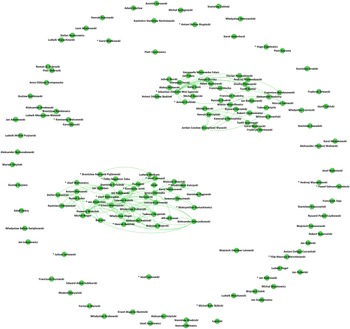
The social connections that are the building blocks of communities can be mapped as a network and represented in graph form. To produce a digital graph visualization, a historian can select from an array of programs, or build a network using a programming language such as R or Python. The visualizations in this article have been produced with an open-source program called Gephi, using information about the migrants collected from literature and historical sources and recorded in CSV (comma-separated values) file format.Footnote 41 The most basic information necessary to produce a social network graph is a list of nodes – here this is a list of migrants and their acquaintances – and an edge list – in this case a list of who knew whom. To begin with I have produced a visualization that shows the connections between just the Poles in Latin America (Figure 2), and then, second, an expanded version showing connections between Poles and others in their communities of practice (Figure 3).Footnote 42 To emphasize, the visualizations record social connections, not spatial ones. I wanted to get a broad overview and idea of the structure of the network based on the connections I found evidence for in the primary and secondary sources for the entirety of the study period; that is, from 1830 to 1889. Even though the networks would change and look different over time as people joined it or left (died, severed relationships or otherwise separated themselves from the group), the information and knowledge in these networks would remain, and could be transferred at different times through the connections mapped.
Network mapping connections between Polish migrants in Latin America, 1830–89. Copyright A. Kaye.

Network mapping connections between Polish migrants and others in Latin America, 1830–89. Green represents Polish people in Latin America and pink represents everyone else. Copyright A. Kaye.

Within the Polish-only networks there are several different connected components – that is, groups for which nodes are directly or indirectly linked. Specifically, in the Polish-only network there are two big distinct clusters, one triad, three dyads and sixty-three unconnected individuals. The broader network encompassing the Poles and others is visibly more interconnected and there are fewer nodes with no connections. There are twenty-nine connected components of two or more nodes and only thirty-two nodes with no ascertained connections. It is not possible that the unconnected individuals did not have any acquaintances; rather, this is a reflection of gaps in knowledge about these people, resulting from limited information about them in sources and historiography. Among the connected nodes the two biggest components have 195 and ninety-four members. For these connected individuals the information is more complete and we can be more confident about the extent of their social connections. What the most complete section of the network indicates is that, theoretically, information from any one of the 195 individuals could have reached all the other 194 people via personal channels of communication, like word of mouth.
Within this network some groups of people were more interconnected than others, which suggests that they were likely to have formed a community of practice and worked closely together. The ‘modularity’ measure can be used to determine mathematically these tightly knit groups. The modularity of a network refers to how well it can be divided or separated into smaller, more cohesive groups or modules. The popular Louvain method is one of the procedures available for determining communities within networks by finding a partition (a set of communities) with high modularity.Footnote 43 A partition's modularity is defined as ‘a scalar value between −1 and 1 that measures the density of links inside communities as compared to links between communities’.Footnote 44 To determine each community, the Louvain algorithm first assigns each node to its own community; it then goes through all the individual nodes and attempts to place each in the community of a neighbouring node, every time recording the modularity value resulting from such a placement. Each node is placed in a community which increases the modularity of the partition by the highest amount or is left in its own community if moving it does not increase modularity. Second, a new network is created using the communities from the first stage as nodes, to which the first step can then be applied again. These two steps are repeated until there is no possible increase in modularity by moving ‘nodes’ (the currently identified communities) into new communities. In essence, the algorithm merges communities to increase modularity until merging them does not result in any further increase in modularity. Then, ‘the communities found are aggregated to build a new network of communities’.Footnote 45 The modularity measure of this final partition is used as the modularity measure of the overall network. I have run the modularity calculations on the Polish-only and the expanded networks (illustrated by Figures 2 and 3) and then used the results to colour-code the different communities in Figures 4 and 5. The closer the modularity is to 1 the more likely the individuals in the network were in fact in communities proposed through the algorithm, and for the Polish-only network the modularity value is 0.654. This number suggests that Polish migrants formed close-knit communities within their knowledge networks. Further, it is also possible to use modularity to calculate the likely impact of different factors on division into communities, such as professional affiliation, geographical location or another feature chosen by the historian.
The Polish-only knowledge network (by modularity) – a variation of the network-mapping connections between Polish migrants in Latin America, 1830–89. The colours of the nodes represent an individual's belonging to different communities as determined by applying the Louvain algorithm. The size of the node indicates its influence on community cohesion – the bigger the node, the higher its eigenvector-centrality score. Copyright A. Kaye.

The expanded Polish knowledge network (by modularity) – a variation of the network-mapping connections between Polish migrants and others in Latin America, 1830–89. The colours of the nodes represent individuals belonging to different communities as determined through the application of the Louvain algorithm. The sizes of the nodes indicate their influence on community cohesion – the bigger the node, the higher its eigenvector-centrality score. Copyright A. Kaye.

Figures 4 and 5 illustrate the communities that emerged using the modularity measure. I inspected these communities to see whether the quantitatively derived findings would be corroborated by qualitative research – to check that the algorithm had not gone awry. To do so, I returned to primary sources to assess the extent of collaborations and exchanges of knowledge, such as joint projects and publications by the people in the specified communities, validating that the people in the communities determined algorithmically not only knew each other personally but also regularly collaborated professionally. It is noteworthy to point out that most of the connections I identified were between those from Latin America and the partitioned territories. While this might seem obvious given the subject of my investigation, what it highlights is that those in marginalized regions did not necessarily rely on those in North America and Western Europe for scientific collaborations.
Further, by using the network method, some communities that had previously been concealed came to the fore. In particular, a case study of Polish oil engineers serves to highlight how historical understanding can be deepened by a combination of quantitative and qualitative methods. In the following section, I will explore how the network approach led to identifying a true community of practice substantiated by close reading of published accounts produced by the historical actors in question. This dual approach showed evidence for both knowledge transfer from Argentina to Galicia, and the broader generation of knowledge related to petroleum prospecting. This case study illustrates further how collecting historical data needed for network analysis highlights the limitations of the methodology used, particularly the absence of a complete network. However, I argue that this method has the potential to open up avenues for deeper and more nuanced exploration within a particular research domain, in this case critically examining and questioning the challenges and issues related to the development of transnational networks specifically connected to mining resources.
Locating obscured communities of practice: Polish oil professionals in Argentina
Referring to Figure 5, there is a small community, made of just eight nodes coloured in navy blue, at the left bottom corner of the main big cluster. That community, upon closer inspection, turned out to consist principally of Polish oil professionals working in Argentina. Among these individuals Rudolf Zuber arrived first. He had a strongly established career in the Austrian partition of the Polish–Lithuanian Commonwealth, working as a docent in geology at Uniwersytet Lwowski (Lviv University) before he set out to look for petroleum deposits in Argentina in 1886. Oil deposits in the northern Carpathian mountains in Galicia were plentiful and, locally, have been intensely studied. The Bóbrka oil mine, which opened in 1854, was amongst the first modern oil mines in the world, and the location of the first petroleum extraction company.Footnote 46 Yet, according to Alison Fleig Frank, the history of Galician oil production is one of oil pioneers and entrepreneurs, which nonetheless to this day remains little studied.Footnote 47 The role of Polish engineers from Galicia in the early stages of the oil industry in Latin America has received yet less attention.
Zuber was contracted by Carlos Fader, a German living in Argentina from 1868, as the technical and administrative director of the Compañía Mendocina de Petróleo (Mendoza Oil Company), when the two met during Fader's visit to the oil mines in the northern Carpathian mountains. Once in Latin America, Zuber went about mapping bituminous coal deposits in the Andes, visiting also Bolivia and Chile for these purposes, and published his findings in Spanish in the Argentinian professional publication Boletin de la Academia Nacional de Ciencias en Córdoba (Bulletin of the Academy of Sciences in Cordoba), and in the Polish popular magazine Kosmos (The Cosmos) and in Rozprawy (Trials), the academic journal associated with the Faculty of Mathematics and Natural Sciences of the Polska Akademia Umiejętności (Polish Academy of Learning).Footnote 48 Just a few years after the well-known commercial oil wells were opened in Titusville in the United States in 1859, Argentina began drilling for oil from 1865, and, according to Daniel Barneda, began developing local expertise.Footnote 49 The Mendoza Oil Company, which opened in April 1886, is often noted as the first Argentinian oil company to gain commercial success and longevity.
Fader, as well as employing the twenty-eight-year-old Zuber, also hired a number of other young Polish engineers: Kazimierz Odrzywolski (who came with his wife Zofia Wolska), Antoni Błażowski, Michał Rieger, and later Stefan Czerwiński and Jan Zeitleben and six other Polish workers.Footnote 50 Together they formed the community marked out in the network. These Poles, further to bringing their expertise, also took with them equipment such as the Polish–Canadian drilling derricks from Galicia, and used those to drill for oil deposits in Argentina.Footnote 51
It is possible to expand the network method to include other factors that influence knowledge production, circulation and acceptance, such as material culture, infrastructure and semantic meaning. For example, the framework of socio-epistemic networks, as defined by scholars at the Max Planck Institute for the History of Science, considers knowledge networks to be composed of three different layers: the social network, the semiotic network (also known as the material network) and the semantic network.Footnote 52 Here, however, only the social layer is analysed. Most of these migrants only stayed in Argentina for a couple of years; nonetheless the involvement of Poles in Argentinian oil extraction at that time was substantial enough to result in one of the oil fields in Jujuy near the Argentine border with Bolivia being named Nueva Polonia (New Poland), as seen in Figure 6.Footnote 53
Photograph from Nueva Polonia, taken by Rudolf Zuber in 1891. It was one of six that originally accompanied Jan Zeitleben's article series, which appeared over four issues of Nafta in January and February of 1895. The original caption read (in translation), ‘“Nueva Polonia” and her inhabitants’.

Despite the name, the community working at Nueva Polonia was truly transnational. In 1895, Zeitleben, one of the oil engineers who worked in Argentina, recalled on the pages of the Lviv periodical Nafta: Organ Towarzystwa techników naftowych we Lwowie (Petroleum: The Organ of the Association of Petroleum Technicians in Lviv), that the ‘forty-something inhabitants of Nueva Polonia represented 11 nations that communicated using 7 languages. It was a true Tower of Babel’.Footnote 54 While the exact nationalities are not listed by Zeitleben, it is clear from the rest of the article that the Poles and Argentinians formed a majority among this group of people. Figure 5 illustrates how this community fitted within the broader Polish knowledge networks in Latin America. By comparing the network in Figure 5 with the information in Zeitleben's article and its accompanying photograph (Figure 6), it can be noted that more historical figures should be incorporated into the network.Footnote 55 Historians interpret and connect information from primary and secondary sources to produce plausible historical narratives, using their own subject knowledge and judgement to craft convincing and accurate historical arguments. If the information found in the sources does not support an expected hypothesis, it is necessary to ask why that is, to conduct further research and perhaps to change the line of argumentation. The same reflection is essential when analysing research findings obtained through digital methods. With the aim of producing robust research outputs, using social network analysis alongside other research methods is preferable to seeing it as the sole, definitive method. The comment about the international nature of the group working at Nueva Polonia, in particular, suggests that more connections existed than are mapped in my network, which in turn points towards a direction for future research – overlooked early periphery-to-periphery cooperation and how that fit into the wider international development of the oil industry.
What is further noteworthy with regard to networking among the Polish oil professionals in Argentina, is that there is an indication that these engineers saw themselves as a sort of community, not only while working in Latin America and establishing a mining settlement named after their motherland, but also upon their return to Galicia. In an 1894 eulogy of Błażowski, Zuber recounted that the former wanted to unite and organize the Polish workers in the oil industry in Galicia, who typically were a dispersed group.Footnote 56 According to Zuber, Błażowski ‘in this effort was supported, among many others, above all by his [Latin] American colleagues, Dr Zuber who returned to the country in July 1892 and Odrzywolski, who returned at the beginning of 1893’.Footnote 57 The ties and a sense of professional community were important to these migrants regardless of location.
During his six years in Latin America, Zuber kept in contact with colleagues, and reminded those who remained in Galicia of his work through publications and visits. On 25 October 1887, when visiting Galicia, Zuber gave a lecture at the meeting of the Towarzystwo Przyrodników im. Kopernika we Lwowie (Copernicus Society of Naturalists in Lviv), about his time in Latin America and about the search for, and later extraction of, oil in Argentina. The lecture, transcribed later on the pages of the periodical Kosmos, ended with a promise of a richly illustrated book, based on Zuber's photographs and accounts, and a number of academic publications to be produced with the help of two Polish geologists based in Kraków: Dr Feliks Kreutz and Dr Władysław Szajnocha.Footnote 58 Zuber clearly had plans to share the knowledge he gained in Latin America with a Polish readership. According to fellow engineer Zeitleben, Zuber went back to Galicia in 1892 to ‘use his knowledge and expertise gained [in Argentina] for the purposes of [Poland]’.Footnote 59 He returned with expanded professional experience from his time working in Latin America, and substantial geological and mineralogical collections, which he donated to universities in Kraków and Lviv.Footnote 60
The fact that Zuber and other oil experts went on to use the professional experience they gained in Argentina in their work back in Poland illustrates that the exchange of knowledge and expertise was important for the development of the oil industry, and of geology more broadly, in both regions. The experience and knowledge Zuber gained in Latin America stayed with him as he resumed his professional practice in Galicia. In his 1894 lecture on the future of geology in Poland, presented to the naturalists’ society in Lviv, Zuber argued that theoretical geological knowledge could inform practical mining and engineering projects.Footnote 61 The accounts of the things he saw and did while working abroad, in Latin America and later in other parts of the world, served him as teaching tools shaping the next generations of Polish geologists. Professor Julian Tokarski, a former student of Zuber's, recounted in 1950 that his academic mentor
had great enthusiasm for delivering lectures, which were always characterized by świetna forma [great style] and were richly illustrated with specimens and slides, which often came from the professor's distant journeys. He liked to talk about them [his journeys], often inserting anecdotes; he was a master storyteller.Footnote 62
The experiences he had in Latin America evidently left a lasting impression on Zuber and shaped his scientific practice.
As this case study of Polish oil professionals working in Latin America indicates, there is merit in the network methodology as it highlights communities of practice that could have otherwise been overlooked, but which nonetheless were important for the advancement of scientific disciplines. In combination with archival research and other methods, social network analysis can be used to explore big-picture questions, such as the transnational development of the petroleum industry. It should be noted that Argentina and Poland, both marginalized spaces, collaborated in pioneering the development of oil production. It was only later that this industry came to be dominated by the United States and the Russian Empire.
Conclusion
Often in the histories of scientific progress the focus is placed on prominent individuals, but construction of scientific knowledge is a collective process. Social network mapping is a useful method for directing attention to the connections between people and considering the collective aspect of knowledge production and presenting circulation as something generative and constructive. This is in line with the general move within the history of knowledge, and the history of science, away from narratives of extraordinary individuals advancing knowledge in near isolation. The focus on a specific group of people and the network of connections between them and others allows for a different, intermediate framing, oscillating between the local and global. It accounts both for individuals at a micro scale and for the macro themes of how these connected individuals fitted into the transnational community of science practitioners. The majority of the connections that I found were periphery-to-periphery connections between the migrants and those in their proximity and in different parts of Latin America, followed by connections across the Atlantic with those in the partitioned territories, and to people in other parts of the world. The knowledge networks model of conceptualizing scientific co-production, as well as being helpful in navigating the local–global scale, shifts the focus onto the productive connections that might have otherwise been omitted from analysis, such as the community of oil professionals from Galicia working in Argentina in the 1880s. Social network analysis, aided by digital tools, therefore, provides a means to make meaningful connections between the ‘big picture’ and individual case studies.
Acknowledgements
I would like to thank Emily Erikson and Nicola Miller for their invaluable comments on earlier drafts of the material that became this article. I am also grateful to all the members of the ModelSEN team for sharing their knowledge and expertise with me, and to James Poskett for inviting me to the History of Science and the ‘Big Picture’ conference, and for the enthusiasm he showed for this article. I am appreciative of the two anonymous reviewers for their insights.



 Open access

