


Three related early Imperial reliefs with architectural façades, generally referred to as the Valle-Medici reliefs, have been subjected to a wide range of interpretations during their unusually peripatetic life.Footnote 1 Two of them, each consisting of two large slabs of a longer sequence representing sacrificial processions in front of the temples of Mars Ultor (Fig. 1) and Magna Mater (Fig. 2), have been known since the 16th c. They were reportedly discovered in and around the Via Lata (the modern Via del Corso) in the 16th c., and embedded in the façade of the Villa Medici in the last quarter of that century, where they remain today.Footnote 2 The third relief (Figs. 3–4), a single slab representing a tetrastyle Ionic temple, was discovered in 1923, also on the Via Lata, and is now displayed in the Museum of the Ara Pacis.Footnote 3
Cast of the relief with the temple of Mars Ultor attributed to Diocletian’s Arcus Novus. (Rome, Museo della Civiltà Romana. Digital image courtesy of the American Academy in Rome, Photographic Archive–Fototeca Unione: FU.Roma.ARAPI.8.)

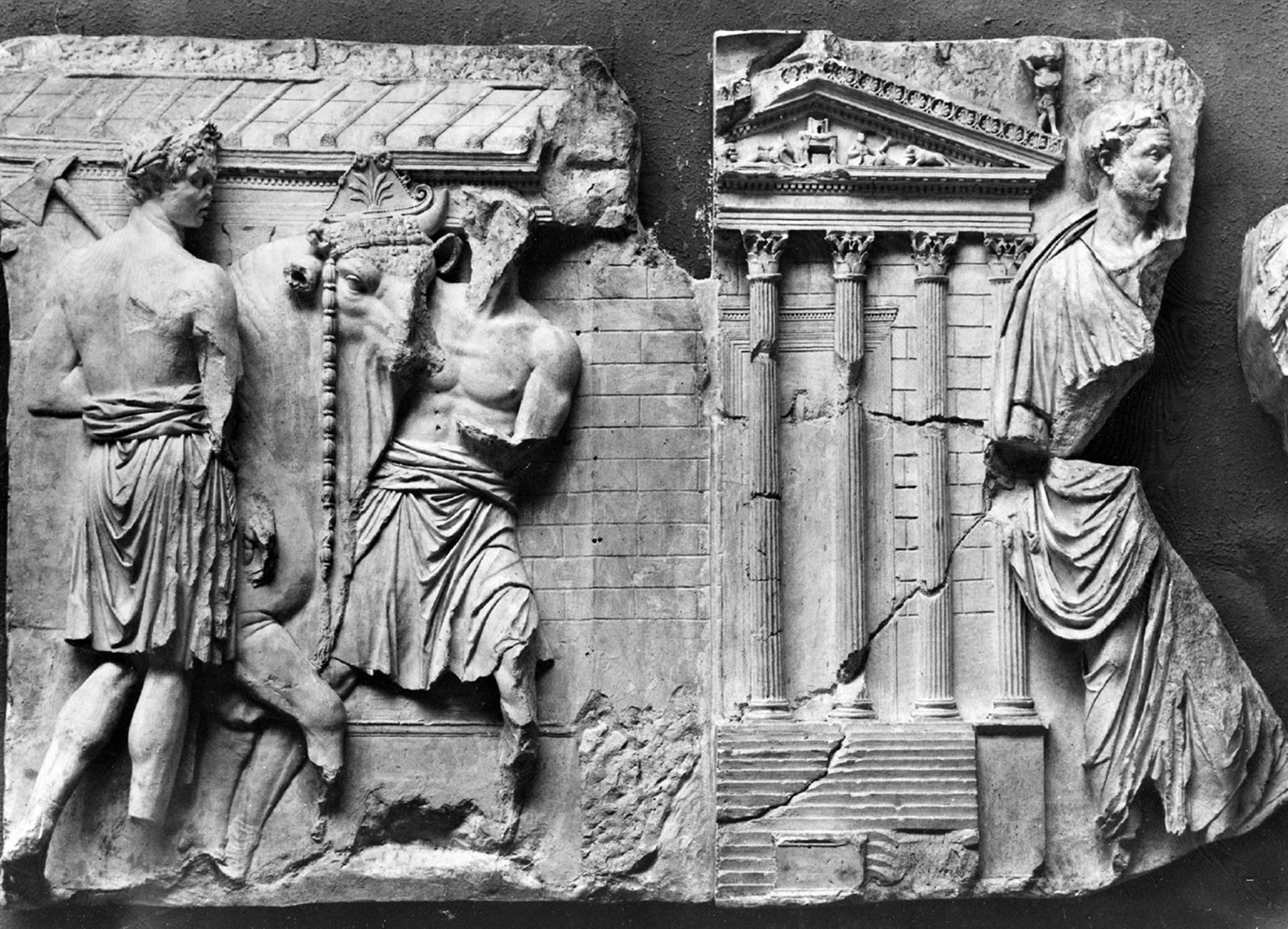
Cast of the relief with the temple of Magna Mater attributed to Diocletian’s Arcus Novus. (Rome, Museo della Civiltà Romana. Digital image courtesy of the American Academy in Rome, Photographic Archive–Fototeca Unione: FU.Roma.ARAPI.7.)
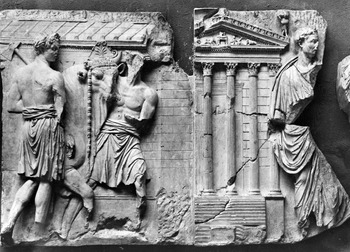
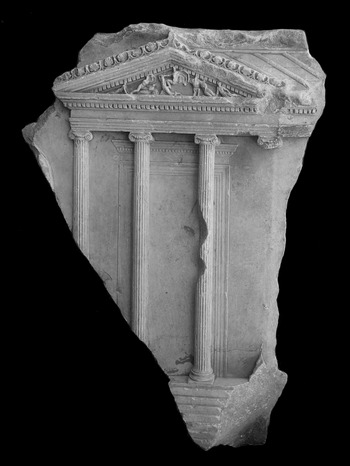
Relief with an Ionic tetrastyle temple from the Via Lata, now in the Museum of the Ara Pacis. (DAIR 29.266.)

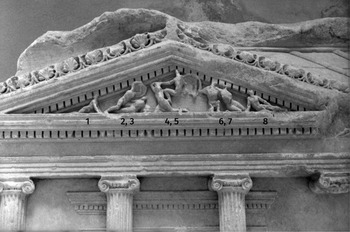
Detail of the pediment from the Ionic tetrastyle temple from the Via Lata. (DAIR 37.588.)

All three reliefs have usually been regarded as components of the same monument due to their similarities in size, carving style, and composition. There is general agreement on an early Imperial date, probably Claudian, but the appearance of the monument that these reliefs decorated remains uncertain, as does the identity of the tetrastyle Ionic temple on the Via Lata relief. It is the latter temple that forms the focus of this article. I identify it as the aedicula of Victoria Virgo on the southwest Palatine, flanked by the temples of Magna Mater and Victoria, and I assign all three reliefs to the precinct wall of an altar of Claudian date that was analogous to the Augustan Ara Pacis (Figs. 5–6).
Plan of the southwest Palatine during the early empire. (Rendered by Ardeth Anderson after Atlas Tab. 70.)

Plan of the temples of Magna Mater and Victoria, with the aedicula of Victoria Virgo between them. (Rendered by Ardeth Anderson after Atlas Tab. 70.)

One of the reasons why the function of the reliefs is so difficult to decipher is that they were reused in a Tetrarchic monument ca. 300 CE, and there is no way to determine where they were first installed. Since they were discovered near the Via Lata, where Diocletian’s Arcus Novus was reportedly located, the reliefs have often been assigned to that arch, but there is no reason to assume that they initially formed part of a monument in this area.Footnote 4
The iconography of the Mars Ultor and Magna Mater reliefs is relatively straightforward. In the case of the former, the sacrifice of a bull occurs in front of the Mars temple in the Forum of Augustus, dedicated by him in 2 BCE, which is represented as an octastyle Corinthian building with drafted margin masonry (Fig. 1).Footnote 5 The temple is shown frontally, unlike the other temples in this series which are flattened and presented obliquely. The sculpted pediment features Mars flanked by Venus, Fortuna, Romulus, and Roma, while personifications of the Tiber and Palatine occupied the corners. Although the left end of the temple has been damaged, it is clear that Victories were used as corner acroteria.
The Magna Mater temple on the Palatine hill shown in the second relief was begun in 204 BCE, dedicated 13 years later in 191, and restored by Augustus in 3 CE (Fig. 2).Footnote 6 In this scene, a bull wearing a diadem and infula is led by two victimarii to a sacrifice at the right of the temple. The pediment was filled with sculpture: at the center stood an empty throne with mural crown that was flanked by two galli, or eunuch priests, reclining on drums; in the corners were lions and kraters, while armed dancers with swords and shields, known as corybantes, served as corner acroteria.Footnote 7
None of these elements is particularly surprising: the empty throne was occasionally used for mystery cults focused on an agent tied to rebirth, as it would be in Christian imagery.Footnote 8 The mural crown was often worn by the Magna Mater, who was generally flanked by lions and her consort Attis, clad in the same costume as the galli. The temple is hexastyle Corinthian with the same kind of drafted margin masonry that had appeared on the Mars Ultor temple dedicated five years earlier, while a palmette course decorates the raking sima. The left side of the temple does not survive, but the side wall of the temple has been depicted behind the victimarii. The latter, in turn, are clearly moving toward the right, to a site of sacrifice located to the east of Magna Mater’s temple.
Before considering the third relief, it is worth noting that the relief reproductions of these temples are largely accurate, and that is true for other early Imperial temples that were rendered in Roman sculpture.Footnote 9 The Magna Mater temple is shown as hexastyle Corinthian on a high podium, and the Mars Ultor temple as octastyle Corinthian with Victory acroteria and drafted margin masonry, all of which were discovered during the temple’s excavation.Footnote 10 These carefully structured relief reproductions of the actual buildings facilitated their recognition by viewers, who could then understand where in Rome the illustrated sacrifices were being staged.
The third relief (the “Via Lata relief”) is the most fragmentary of the group, although clearly the same size as the others (Figs. 3–4) and found in the same area of the Via Lata. Preserved on the relief is a tetrastyle Ionic temple with the right side shown obliquely, thereby complementing the presentation of the Magna Mater temple.Footnote 11 The palmette course on the Ionic temple’s raking sima duplicates the one on the Magna Mater temple, as do the door moldings, so it looks as if the sculptors were intending to highlight a connection between the two buildings. The Ionic temple was depicted as more diminutive, however; there were no more than nine steps, of which seven are preserved, whereas the Magna Mater temple was shown with 14 of them.
There are eight figures in the pediment, comprising three pairs of combatants, and a reclining figure in each corner (Fig. 4).Footnote 12 The extensive wear on the figures has made it difficult to determine both gender and dress so it is not surprising that there are various opinions about the subject of the battle represented. Scholars have consistently shifted between myth and history in their identifications, favoring either an Amazonomachy, a Celtomachy, or the Trojan War.Footnote 13 The Celtomachy is the least likely of these since there are no known pediments in Rome that featured scenes from Republican armed conflicts, while the other two proposals are primarily related to the combatants’ gender, which I consider below. For ease of discussion, I have numbered the figures from 1 to 8 in Figure 4, and I begin with nos. 6 and 7 since they provide the key to the interpretation.
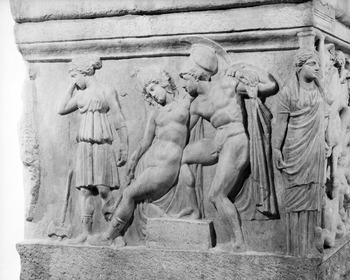
This is a scene involving a man at the left and a woman at the right. The gender of the latter is clearly indicated by her breasts and fleshy thighs, while the man is heavily muscled and his phallus is visible.Footnote 14 Although the head is missing and the right arm damaged, it is clear that his left arm encircles the seemingly lifeless body of the woman as he pulls her right arm around his shoulders with his right hand. Her body leans against that of the man, and her left arm hangs limply across her body. This is a well-known type representing Achilles and Penthesileia, which suggests that the subject of the pediment is the Trojan War (Fig. 7).Footnote 15
Sarcophagus with Achilles and Penthesileia, ca. 180 CE. (Louvre. Inv. no: LP2584; Ma 2119.)

The central pair of combatants (nos. 4, 5) is also in accord with this interpretation. A nude male with billowing cape pulls the long hair of a draped, unarmed figure at the left while pressing his foot against his opponent’s lower back (Fig. 4). The bulge of male genitals is visible beneath the drapery of the figure, who reaches back to grab the hand of his attacker.Footnote 16 Such hair-pulling scenes appear in both Trojan War and Amazonomachy iconography, but in this context, the long hair and male genitals suggest Priam being slain by Neoptolemus, son of Achilles, during the fall of Troy.Footnote 17
The scene to the left of this (nos. 2, 3) is the most enigmatic of the three. A nude male combatant with shield raised behind his head lunges toward a foe who has fallen against a rocky outcropping and raises a right arm to fend off the attack. The latter figure has been called both male and female since the abraded surface makes it nearly impossible to discern the gender. There are no indications that the fallen figure is armed, nor are there any clear signs of breasts or genitals.Footnote 18 It does look, however, as if the body of the fallen foe is larger than the attacker, especially the arms and thighs. This suggests that he is male rather than female, since women in scenes of armed conflict – even Amazons – are not shown larger than their opponents. His position in the pediment ties him to the Trojan War, and the rocky outcropping suggests that his death occurred outside the citadel walls. The closest comparandum I can find is that of Hector and Patroclus in one of the scenes on the early Imperial Iliac tablets. Hector raises his shield-bearing arm while lunging with a dagger toward Patroclus, who appears to be unarmed and has fallen on the ground, leaning back from his attacker as on the Via Lata pediment.Footnote 19
The figures in the corner may be place personifications, although the format of their bodies is rather unusual.Footnote 20 Normally such figures recline on one side, as in the Magna Mater and Mars Ultor pediments (Figs. 1–2). Here, however, the left figure lifts himself up on both outstretched arms, while the figure at the right supports himself on one straight arm (Fig. 4). One of them could conceivably personify the river Scamandrus, although on Megarian bowls of the 3rd/2nd c. BCE he is shown sitting on a rock.Footnote 21
The identifications proposed above illustrate the idiosyncrasy of the overall design of the pediment, with three scenes representing different moments in the Trojan War. As far as we know, this was one of the few examples of sequential narration within a single pediment, which generally involved unity of time and space. The only other known example from Rome appears on the relief of a decastyle temple, almost certainly representing the Agrippan Pantheon, where the pediment features three sequential scenes from the life of Romulus: Mars and Rhea Silvia in the center, the Lupercal at left, and likely the divinized Romulus in the missing section at right.Footnote 22 The Achilles and Penthesileia pairing on the Ionic temple was well known and would probably have supplied viewers with the key to understanding the scenes, but the design of both this temple and the Agrippan Pantheon represented a new way of reading a pedimental narrative.
How securely can we pinpoint the topographical location of this tetrastyle Ionic temple? To answer that question, we first have to consider the type of monument to which the Via Lata relief belonged, as well as the original position of the relief on that monument. I begin this analysis by noting again that all three reliefs must have formed part of the same monument. The overall heights of the slabs (1.55 m) are the same, as are the heights of the temples, and each of the pediments features elaborate sculptural decoration. All three also evince the same style and carving techniques, which are readily apparent on the drapery, coiffures, and animals. Especially noteworthy are the architectural elements that are shared among the reliefs: as noted above, the door moldings of all three temples are nearly identical, as are the palmette simas of the Magna Mater and Ionic temples, while the drafted margin blocks on the temples of Magna Mater and Mars Ultor are essentially the same size. Although only the shoulder of a standing figure survives at the left of the Ionic temple, he is nearly the same height as the other figures on the Valle-Medici reliefs. More unusual is the fact that these human figures are almost the same size as the temples next to which they stand – a format that is otherwise rare in Roman sculpture with historical scenes.Footnote 23
There is enough evidence to reconstruct the general format of the monument to which these reliefs belonged. The movement in the Mars Ultor relief seems to be from right to left, and in the Magna Mater relief, from left to right (Figs. 1–2). These contrasting directions, coupled with the different topographic locations of the temples, suggest that we are dealing with two sides of a single monument: one side that included a sacrifice in front of the temple of Mars Ultor, and a second side focused on the southwest corner of the Palatine where the Magna Mater temple was located (Figs. 4–5). Moreover, the reliefs’ height of 1.55 m matches that of the processional friezes on the precinct wall of the Ara Pacis, so it seems likely that these reliefs decorated a similar type of altar enclosure (Fig. 8).Footnote 24 Such altars were located in the open air, which would fit with the considerable wear on the reliefs, especially the pedimental figures. If the sacrifice reliefs were also the same length as those on the Ara Pacis, then there would have been two long panels, ca. 9.45 m long; these, in turn, may have been complemented by four shorter panels, two on each face of the precinct wall, with a length of ca. 2.40 m.
Reconstruction drawing of Magna Mater relief and Ionic temple relief. (Rendering by Ardeth Anderson after Rehak Reference Rehak1990, fig. 4b.)

It looks as if one long side focused on a sacrifice in the Forum of Augustus, and the fact that the Mars Ultor temple was depicted frontally rather than obliquely, with the sacrifice placed in front of it, suggests that it formed the center of the panel (Fig. 1). Nor could the relief have been positioned on one of the short sides on this conjectural altar since it is already 2.46 m wide, and there were clearly more figures to the left and right.
The panel depicting the southwest side of the Palatine is missing its right side, where the bull was intended to be sacrificed, but this too can be plausibly restored since the topography of the early Imperial Palatine is now relatively clear (Figs. 5–6).Footnote 25 I describe the southwest corner of the Palatine in some detail below, since the assemblage of buildings in this area is directly related to a reconstruction of the monument to which the Via Lata relief belongs.
The earliest of the temples in this area, that of Victoria, was constructed in the wake of Rome’s successful conclusion of the Second Samnite War in 294.Footnote 26 The design differed from that of its predecessors in that it was the first hexastyle temple with lateral colonnades to have been built since the temple of Jupiter Optimus Maximus two centuries earlier, although the podium measured only 33 x 20 m.Footnote 27 It was also built to last: the temple featured the first stone columns in Rome for which we have evidence, and apparently the city’s first stone entablature supporting a closed pediment with sculptural decoration.
The surviving terracottas of the pediment are unfortunately very fragmentary, but preliminary analysis suggests that the program represented a narrative of Mars, Rhea Silvia, and Romulus.Footnote 28 The lacunose nature of the evidence makes such an identification impossible to prove conclusively, but it would be perfectly in keeping with the temple’s context: it was located above the Lupercal, the cave where Romulus and Remus were suckled by the she-wolf, and adjacent to a thatched hut that was believed to have belonged to Romulus.Footnote 29 It was also here, in a nearby shrine of Mars, that Camillus reportedly discovered the lituus of Romulus after the Gallic sack of 390.Footnote 30 The temple was joined to the Lupercal by the Scalae Caci, where Hercules had fought the giant Cacus, and the settlement of Evander described in Vergil’s Aeneid was believed to have lain at the Scalae’s base.Footnote 31 A pedimental theme that capitalized on the site’s heroic associations therefore seems likely, and the legendary aura that embraced the Victoria Temple may be evoked in a painting from the House of Fabius Secundus in Pompeii that appears to show the temple of Victoria above a narrative of Romulus’s life.Footnote 32
The neighbor of the Victoria temple was the sanctuary of the Magna Mater, which was dedicated in 191 BCE, rebuilt after a fire in 111 BCE, and rebuilt yet again by Augustus in 3 CE following another fire. The decision to construct the temple was made in 205, toward the end of the Second Punic War, when the priests of Rome consulted the Sibylline Books and prophesied that Hannibal would be driven out of Italy if the cult of the Magna Mater were to be brought from Asia Minor to Rome.Footnote 33 In essence, the Magna Mater had two homes in Asia Minor: one in the west-central region, at Pessinus, and another on Mt. Ida, southeast of Troy. The cult image was embodied in a black stone, almost certainly the fragment of a meteorite, which was transported to Rome and temporarily installed in the Victoria temple until an adjacent temple for the cult could be constructed.Footnote 34 The new temple was hexastyle, like that of Victoria, with a podium measuring ca. 33 x 17 m and an internal colonnade in the cella.
Although the Magna Mater would remain associated with Rome’s triumph over Carthage, the assistance of a foreign goddess in war was not the primary point. The cult’s durable significance lay instead in the goddess’s close association with Troy, and therefore with the origins of the Roman people. The transfer of her cult was an overtly political act calculated to assert Rome’s identity as scion of Troy, both in Italy and abroad.Footnote 35 To drive home the goddess’s Trojan associations, her new temple was placed on the southwest corner of the Palatine, where the Lupercal and the hut of Romulus lent it more ties to Rome’s legendary ancestry than any other part of the city would.
Augmenting the triumphal aura that surrounded both temples was an aedicula dedicated to Victoria Virgo that lay between the two temples and effectively linked them to one another.Footnote 36 The evidence for the aedicula’s identification lies in a passage in Livy coupled with references to August 1 in two calendars of the late Republic and early empire, The Livy passage reads: Iisdem diebus aediculam Victoriae Virginis prope aedem Victoriae M. Porcius Cato dedicavit biennio post quam vovit.Footnote 37 In other words, the aedicula of Victoria Virgo is located either beside or near the Palatine temple of Victoria. This matches the architectural organization on the southwest Palatine, where the aedicula is turned toward the Victoria temple and actually abuts it. A similarly close connection between the two buildings appears in the Fasti Antiates and Praenestini, which indicate that they shared the same dedication day of August 1. In the former calendar they are referred to as “the two Victories,” and they are joined in the latter one as well (“Victoriae, Victoriae Virgini in Palatio”).Footnote 38
The Victoria Virgo aedicula was vowed by M. Porcius Cato in 195 BCE, prior to a military campaign in Spain for which he was voted a triumph, and dedicated two years later in 193 (Fig. 6).Footnote 39 The dedicator’s emphasis on public morality may explain why the epithet Virgo was applied to Victoria, an unprecedented linkage that effectively transformed the personification into an amalgamation of both triumph and traditional Roman virtues.Footnote 40 Only the footprint of the temple survives, measuring ca. 12 x 7.40 m, but a tetrastyle prostyle building would easily fit on its foundations, and it has been restored as such in the Atlas of Ancient Rome (Fig. 4).Footnote 41 Moreover, the passage of two years between vow and dedication suggests a building of some prominence, and since the aedicula abutted the Victoria temple, which burned at the end of the 1st c. BCE along with the Magna Mater temple, it too must have been reconstructed by Augustus.
By 28 BCE, the area to the east and south contained a terraced sanctuary dominated by a temple of Apollo, the cult statues of which represented Apollo, Diana, and their mother Latona/Leto, below which were the Sibylline Books.Footnote 42 These had been transferred from the Capitoline to the newly dedicated Apollo temple, where they were kept in gilded cases within a vaulted passage below the cult statues.Footnote 43 The Sibylline prophecies were directly connected to Apollo, and one of those prophecies had led to the import of the Magna Mater, who was now Apollo’s neighbor. In sum, the Palatine’s southwest corner featured a plethora of ties to the legendary history of Rome and the Romans, and those legends served as a bonding agent for the principal temples in the area.
Returning to the missing section of the Via Lata relief to the right of the Magna Mater temple, it looks as if we are justified in restoring there the aedicula of Victoria Virgo as well as the adjacent temple of Victoria, all of which were rebuilt by Augustus (Fig. 8).Footnote 44 There would surely have been a group assembled around the altar where the sacrifice was intended to occur, as in the Mars Ultor relief, and presumably the emperor as well. It is less likely that the precinct of Apollo Palatinus was also represented in the relief, for two reasons. There was no easy conduit from the temple of Victoria to that of Apollo, and if the length of the frieze did match that of the Ara Pacis, then there would have been enough space for the sacrificial procession, altar group, and the three temples presented obliquely, but not for much more. In this reconstruction, then, the procession would have been shown marching toward the temple of Victoria where the bull was intended to be sacrificed, thereby complementing the sacrifice to Mars Ultor on the opposite side.
How does the Ionic temple relief fit into this reconstruction, and where might it have been positioned? The relief’s width of .90 m would preclude its placement on one of the short sides of the putative altar: in addition to the temple façade, there would have been one full oblique side of the temple and at least one standing figure, all of which would have occupied more than the likely available 2.40 m. Moreover, the action depicted in the panel was not self-contained; it clearly belonged to a larger, more complex scene, one that would not have formed part of the Mars Ultor panel since no tetrastyle Ionic temple existed in the Augustan forum.Footnote 45 It therefore looks as if the Ionic temple relief must have belonged to the altar’s second long side, which was focused on the Magna Mater temple and the area to the east of it (Fig. 8).
In 1990, Paul Rehak reached the same conclusion but chose to identify the tetrastyle Ionic temple as that of Victoria. During the last 35 years, however, further excavation and research on the southwest Palatine have shown that Victoria’s temple was hexastyle Corinthian, which removes it from consideration as the Ionic temple in the relief.Footnote 46 However, the sacred structure adjacent to it, the likely tetrastyle aedicula of Victoria Virgo, is a strong candidate, and fits the depiction of the temple as smaller than the others.Footnote 47
During excavations in and around the temple of Victoria, two Ionic capitals were discovered, and Patrizio Pensabene was unsure where to place them.Footnote 48 In the end he assigned them to an interior colonnade in the Magna Mater’s cella, but this seems unlikely.Footnote 49 As far as we know, there were no temples in Republican or Imperial Rome in which the order of the interior columns differed from those of the exterior, which would preclude their placement in either of the two adjacent temples, both of which were Corinthian.Footnote 50 Consequently, based on size, plan, and the Ionic capitals, the Victoria Virgo aedicula is the most likely candidate for the tetrastyle temple, since these three buildings were the only ones on the Palatine’s southwest corner.Footnote 51 This would mean that the Via Lata relief should be placed at the right of the Magna Mater relief, after which one can probably restore the temple of Victoria along with the altar where the sacrifice would have taken place (Fig. 8).
The Trojan War scenes in the pediment of the Victoria Virgo aedicula (Fig. 4), as I will now call it, should be seen as a complement to and comment on the cult of Magna Mater, whose homeland lay in the Troad. As many have noted, her cult was originally brought to Rome from Asia Minor due to Rome’s increasing emphasis on its Trojan ancestry, so the incorporation of a Trojan War pediment on an adjacent sacred structure would have reinforced that connection, as did the eastern costumes of the galli and corybantes in the Magna Mater’s pediment.Footnote 52 Nor was there anything discordant about the insertion of scenes from the Trojan War on a sacred structure whose name included “Victoria.” As I noted above, the southwest Palatine featured more associations with the Romans’ legendary origins than any other part of the city, and by this point in time, the most effective visual evocations of Homeric Troy featured scenes from the war.Footnote 53 Even the residents of Ilion used such scenes in the decorative program of their Athena temple, and it is worth noting that Cato’s treatise on Roman history, the Origines, provided the first Latin account of Aeneas’s arrival in Italy.Footnote 54
As an Ionic building sandwiched between two Corinthian temples, the aedicula of Victoria Virgo would have had a more prominent appearance than one might have expected considering its small size. The majority of new buildings in Augustan Rome were Corinthian, and as far as I know, there were only a handful of Ionic temples in the city: Jupiter Stator and Juno Regina in the Porticus Metelli, Mars in the Circus Flaminius, Portunus in the Forum Boarium, and the temples of Divus Iulius and Divus Augustus.Footnote 55 Tetrastyle temples were also rare in early Imperial Rome: other than the temple depicted on the relief, the only others known still to have been standing were those dedicated to Portunus, Veiovis, and Divus Augustus.Footnote 56
Unfortunately, we cannot supply a name for the altar that contained this intricate architecture, although several attempts have been made over the years. The original suggestion by Bloch in 1939 assigned the reliefs to an Ara Pietatis, but Gerhard Koeppel successfully demonstrated in 1982 that there was no evidence for such a monument.Footnote 57 At the same time, Mario Torelli proposed that they belonged to the Ara Gentis Iuliae that had been erected on the Capitoline by 43 CE, perhaps in connection with Livia’s deification.Footnote 58 A decade later, Eugenio La Rocca advanced the hypothesis that they decorated an altar celebrating the victorious return of Claudius from his campaign in Britain and his triumph in 44 CE, an “Ara Reditus Claudii.”Footnote 59 We may never be able to determine conclusively the impetus for the altar’s erection, but the style does favor a date in or around the Claudian period, and the dedication date of both the temple of Victoria and the aedicula of Victoria Virgo was August 1, the birthday of Claudius.Footnote 60
Conclusions
This discussion has admittedly involved considerable speculation, since the monument with which we are dealing had already been spoliated by the Tetrarchic period, but the reliefs that decorated it still provide valuable information about the topography of Rome. The tetrastyle Ionic temple with Trojan War scenes in the pediment can most plausibly be identified as the aedicula of Victoria Virgo that was rebuilt by Augustus along with the adjacent temples of Victoria and the Magna Mater. The Trojan War was probably chosen as the subject of the pediment to highlight Rome’s recognition of its Trojan ancestry, which was likely one of the reasons why the Magna Mater cult was imported from Asia Minor.
This panel probably formed one long side of a monumental altar depicting the Victoria and Magna Mater temples as well as a sacrificial procession that moved toward the main altar of the former temple.Footnote 61 The opposite side of the altar featured a sacrifice in front of the Mars Ultor temple in the Forum of Augustus, and the sculptors working on both sides of the monument meticulously represented the pedimental sculptures so that the temples could be easily recognizable. Since both panels rose to the same height as the processional friezes on the Ara Pacis, we are probably dealing with an altar of similar size and shape, ca. 11 x 10 m. The circumstances leading to the altar’s construction are uncertain, although a date in the Claudian period shortly after the emperor’s victory in Britain seems possible.Footnote 62
Perhaps the most distinctive feature of the reliefs is that both the buildings and the people moving around them rise to the full height of the panel, regardless of the structures’ actual size. This suggests that the designers considered the buildings to be just as important as the people, and since all of them were constructed or restored by Augustus, his victories and temple sponsorship must be tied to the overall program. It is striking that the monument presents a map of at least two different parts of Rome – the Augustan Forum and the Palatine – rather than focusing on a single locale. This makes it difficult to determine whether the two sacrifices depicted are contemporaneous or sequential, and whether the emperor was present at both of them. Further excavation in Rome may someday yield the foundations of this monument, which probably lay near one of the temples depicted in the reliefs, and, in turn, could shed light on the reasons behind the monument’s spoliation in the 3rd c. CE.
Acknowledgments
For assistance in the preparation of this article, I thank Ann Kuttner, Mantha Zarmakoupi, and Alan Shapiro. I also thank Ardeth Anderson, who created the drawings, and Daria Lanzuolo in the Fototeca of the German Archaeological Institute in Rome.





 Open access

