


Introduction
Russia’s full-blown invasion of Ukraine caused a worldwide shockwave and an outpouring of support from Western countries to Kyiv. This was powerfully illustrated with the gathering of 41 states at the Ramstein Air Base in Germany in April 2022 to coordinate support to Ukraine.Footnote 1 This group became known as the Ukraine Defense Contact Group and has grown to 54 members, including all NATO allies. The Russo-Ukraine war has arguably led to the resurrection of Western unity and purpose after what French president Emmanuel Macron called the ‘brain death’ of NATO in the autumn of 2019.Footnote 2 At the Washington summit in July 2024, NATO allies professed that a ‘strong, independent, and democratic Ukraine is vital for the security and stability of the Euro-Atlantic area’.Footnote 3 Towards that objective, allies institutionalised their provision of military support toUkraine with the creation of NATO Security Assistance and Training for Ukraine (NSATU) and the establishment of the NATO–Ukraine Joint Analysis, Training, and Education Centre (JATEC), and pledged a minimum of $43 billion in military aid to Ukraine for 2025.
Despite such a portrait of unity, significant disparity remains in actual support for Ukraine. Where Estonia and Denmark lead the rankings of military assistance, with contributions surpassing 2 per cent of their GDP, other allies such as Spain, Italy, and Greece lag far behind.Footnote 4 Even allies of a relatively similar size, military capacity, and proximity to Russia diverge in their policy on Ukraine. Nowhere is this more profound than in the Visegrád Group, where policy ranges from sustained military support in Poland to vocal opposition in Hungary, symbolic support in Czechia, and a shift from overwhelming to no support in Slovakia.
What explains the disparity in military assistance by Western security partners to Ukraine? Scholarly discussion of military assistance to Ukraine has understandably been rare given its recentness – with limited aid provided prior to 2022 compared to about $140 billion allocated since – and the fact that the West has not engaged in arms transfer of this scale for decades since the Second World War.Footnote 5 In a first study of military support to Ukraine, Lanoszka and Becker show that the considerable expansion of military assistance in 2022 by NATO members is unrelated to the level of aid provided prior to Russia’s full-scale invasion.Footnote 6 They rather find that expenditures in military operations and maintenance best explain post-February 2022 support to Ukraine. Other studies of aid to Ukraine have highlighted geographical distance, freedom level, wealth, population size, and trade with Russia as principal determinants.Footnote 7 Whether these results hold asymmetrically across countries and as part of a combination of factors remains to be appreciated. For instance, the deviant cases found by Lanoszka and Becker – Latvia, Türkiye, the United States, and to a lesser extent Norway, Poland, and the United Kingdom – may be better understood through a more fine-grained method than multivariate regression analysis.
This paper assesses the variation in the level of NATO members’ military assistance to Ukraine in 2022 and widens its scope to include four major non-NATO US allies, namely Australia, Japan, New Zealand, and South Korea. As such, we focus on the level of military assistance supplied to Ukraine rather than the decision to provide, nor not, weapons to Ukraine. We begin by discussing the potential motivations behind supporting Kyiv militarily, drawing on the literature on arms transfers and alliance burden-sharing. The paper then proceeds with a fuzzy-set Qualitative Comparative Analysis (fsQCA) of the conditions best explaining the extent of military support to Ukraine in the form of arms transfers. More specifically, the paper examines whether defence spending, economic incentives, geographical proximity, threat perceptions, government ideology, public support, and executive autonomy help make sense of the extent to which Western allies have come to Ukraine’s help to fend off Russia’s aggression.
The paper makes two contributions to the literature on burden-sharing and alliance commitments. First, it provides a mapping of Western aid to Ukraine in the first year of the full-scale war, whose contributions ranged from heavy weaponry to non-lethal military support. During that period, over €65 billion worth of military aid was supplied to Ukraine by Western allies.Footnote 8 Second, through fsQCA, it offers a configurational account of Western military contributions based on a multicausal framework that combines international and domestic incentives, capacities, and constraints for arms transfers. In addition to considering factors omitted in past studies, this framework challenges the assumption that explanatory conditions are expected to be individually necessary and/or sufficient.Footnote 9 Our results notably indicate that defence spending, economic incentives, geography, and threat perceptions shape the level of military assistance provided to Ukraine during the first year of the war. Overall, the paper identifies causal paths covering 9 of the 13 greatest military aid contributors to Ukraine, as well as 14 of the 19 token aid donors. It reveals the Baltic states and Poland as the most typical military supporters, and Belgium, Romania, and Canada as typical token contributors.
Military support and burden-sharing
Why do states supply military aid? Arms transfers are part of a bundle of security goods that serve as alternative or complementary signals of support from one state to another.Footnote 10 They are aimed at deterring an adversary, defending and reassuring a client, exerting influence, signalling resolve, and/or achieving transactional gains.Footnote 11 The decision to provide weapons rests upon a wider assessment of the capacity for and benefits and risks of providing military assistance to another state, compared to alternative means. As with other types of military support, arms transfers are costly, but they often represent cheaper substitutes to alternative security commitments, such as troop deployments and formal alliance arrangements. To provide for a client state’s security, a patron may prefer to offer military equipment instead of intervening directly with its own troops, thereby achieving its security goals without bearing the costs of sustaining its own troops abroad and potentially putting them in harm’s way. Arms transfers may also be more lucrative, for they can be gifted, loaned, or sold, although troop commitments may also involve side-payments.Footnote 12
Scholarship on arms transfers has largely been divorced from the literature on alternative forms of security assistance such as the provision of military troops. This is surprising given that the rich literature on troop contributions has delved into the motivations behind military assistance such as train and assist programmes. In particular, the vast literature on why allies unevenly deploy military troops within collective security efforts can help shed light on the security dilemma providers face when choosing the best military assistance to supply.Footnote 13 A better understanding of the incentives, capacity, and constraints surrounding military assistance can help explain the asymmetrical burden-sharing outcomes of the provision of collective security goods by allies, such as the imbalanced supply of weapons to Ukraine by NATO members and their major partners since Russia’s full-scale invasion.
By examining the drivers behind arms transfers and troop deployments, this section mobilises the literature on military support in general and arms transfers in particular. It argues that the decision to supply arms, like any other forms of security commitment, involves a combination of strategic, economic, and domestic considerations that enable and constrain the provision of military support. Focusing on the military assistance provided by Western allies to a security partner, it further highlights the intra-alliance dynamics that shape contributions to common security efforts such as arming Ukraine.
Collective action theory expects potential security providers to contribute meaningfully to multilateral security efforts when they derive private benefits outweighing the costs of its supply.Footnote 14 Prior studies have emphasised the importance of several major incentives to provide security goods, including threat perceptions, economic benefits, political ideology, and strategic alignment, as well as constraints inhibiting the commitment level, such as legislative veto powers, fear of electoral punishment, and military capabilities. Building on previous efforts combining international- and domestic-level explanations,Footnote 15 we propose a theoretical framework integrating these factors to explain the varying levels of arms provision to Ukraine. We begin by reviewing the enabling and constraining factors before outlining our integrated framework.
Strategic incentives
One of the most important drivers of security cooperation is the degree to which states fear for their national security interests. Threat perceptions have indeed been found integral to several types of security cooperation, from joining alliances to participating in multilateral military interventions.Footnote 16 With regards to arms transfers, they are most likely in situations where recipient and donor states perceive a common security threat as well as an imbalance of capability between the recipient state and the source of threat.Footnote 17 The less favourable the military balance in circumstances of shared threats, the greater the level of military aid to be expected. Inversely, differential threat perceptions are likely to lead to limited security commitments, notwithstanding the military (im)balance.Footnote 18 Given the obvious asymmetry of military power between Ukraine and Russia at the onset of the war,Footnote 19 the most important strategic consideration shaping the level of military support allocated to Ukraine consists in threat perceptions.
Threat perceptions are rarely measured directly. Scholars have used proxies to assess the degree to which states feel threatened. The most common indirect measures consist in proximity to the source of threat, military capabilities, and voting alignment. First, the more exposed a patron is to the source of threat against a client, the more willing it is expected to be to supply extensive security goods. The security provider’s threat exposure has indeed been found to influence the level of military commitment against the source of threat.Footnote 20 Building on this perspective, Lanoszka and Becker argue that geographical proximity and historical legacies made the Baltic countries and Poland ‘more apprehensive towards Russia and more attuned to Ukraine’s security needs’ and, hence, more likely than others to provide Ukraine with weapons.Footnote 21 Similar logic could be extended to Finland and Sweden, as well as countries bordering Ukraine (Romania, Hungary, and Slovakia).Footnote 22
A second proxy used to measure threat perception consists in defence spending. Lanoszka and Becker argue that the countries worried about Russian attempts at redrawing European borders and undermining political sovereignty are those that have tended to invest in military expenditures and, more specifically, in operations, maintenance, and infrastructure spending.Footnote 23 The reason is that states perceiving acute threats – including from, but not restricted to, Russian revisionism – have invested in military preparedness and readiness to face such threats and are prone to supply military assistance to address them. Indeed, scholarship indicates that past military expenditures are strongly associated with greater deployability and sustainability of forces, including through operational burden-sharing in NATO operations.Footnote 24 In short, states that provide military assistance tend to do so because they can, having invested in the capabilities to do so. Indeed, Lanoszka and Becker find that the share of GDP allocated to operations, maintenance, and infrastructure spending in 2019 is significantly and positively correlated with the level of aid provided to Ukraine following the February 2022 invasion.Footnote 25 They do not, however, test military investments in equipment, which could arguably also influence the extent to which states are capable of providing weapons to Ukraine given that a sizable share of the military aid supplied to Ukraine was directly drawn out of allied military stocks.
Third, threat perceptions are also expressed by a country’s strategic alignment, most notably revealed by its voting behaviour in the United Nations General Assembly. Countries aligned with Russia are generally expected to be less likely to support Ukraine, while countries aligned with the United States are expected to be more generous aid donors.Footnote 26 Even amongst US allies, extant research has found significant divergences in strategic alignment based on national security strategies. Atlanticist allies, in contrast to Europeanist allies, tend to support a US-led international order, US military engagement in Europe, and NATO as the principal organisational platform for force planning and operational deployment.Footnote 27 Indeed, Becker and Malesky find that the more a state’s strategic alignment is Atlanticist, the greater the proportion of its military resources will be devoted to NATO’s military operations.Footnote 28 It is reasonable to expect this to be true with regards to arms transfers to Ukraine, whose coordination has been led by the United States and institutionalised in NSATU.
In sum, extant research has used proxies to ascertain the impact of threat perceptions on the provision of military assistance. While it is reasonable to imagine that the fear of Russian revisionism is strongly associated with geographic proximity to Russia, past defence spending and strategic alignment towards the United States revealed in national security strategies, as well as in UNGA voting patterns, these explanatory factors are distinct from one another, may vary from one ally to another and represent indirect measures of threat perception. We thus develop below our own database of perceptions of Russia as a threat based on allies’ national security strategies.
Economic incentives
Arms transfers may also be determined by economic interests, with arms-producing countries seeking to profit from the war through arms exports. Even gifted weapons may benefit economic growth by sustaining domestic defence industries and developing technologies.Footnote 29 Moreover, there is a cumulative effect that may increase the gains of institutionalising arms transfers. They notably produce expectations of future weapons transfers, reduce transaction costs, and increase the client’s dependence on the patron’s weapons systems. For example, the provision of sophisticated weapons such as tanks to Ukraine comes with considerable logistical charges, from maintenance to ammunition, spare parts, training, and upgrades. As such, there is a path dependency effect to consider in the life-cycle benefits of arms transfers.
Indeed, scholarship has shown that the ties that bind two states together are found predictive of their future security cooperation. The more embedded a client state is in the patron’s security and economic hierarchies, the more likely it is to receive future military aid.Footnote 30 Economically dependent, formal treaty allies and dense security partners are the most likely recipients of military assistance from their patron given their institutionalided shared interests.Footnote 31 In other words, the greater past military assistance, the more significant the level of arms transfers to be expected.Footnote 32 Similarly, arms-producing countries hold a comparative advantage to provide weapons to prospective clients. Economic prospects create strong incentives for countries to showcase their national arms industries by supplying weapons to Ukraine.
Government ideology
The notion of threat perceptions as the main driver of arms transfers rests on the assumption of nationally homogeneous readings of the international environment. Yet a growing body of scholarship has demonstrated that political parties diverge substantively over international security cooperation.Footnote 33 Indeed, elected officials have been demonstrated to hold differing sets of beliefs regarding national interests, the sources of armed conflicts, and the appropriateness of using military force, as well as the value of multilateralism and alliance commitments. These differing belief systems are rooted in contrasting political ideologies: right and left parties hold different values about international security, consistent with the preferences of their supporters.
Broadly speaking, left parties are more anti-military and right parties more pro-military. Left-oriented political parties tend to share a more altruistic conception of national interests, greater scepticism of the efficacy of military force, reluctance towards defence spending, more favourable views of multilateral cooperation to resolve international disputes, and less concern over alliance commitments and their country’s reputation for reliability.Footnote 34 Inversely, right-oriented parties tend to hold a more egoistic conception of national interests, greater confidence in the efficacy of military force, more favourable views of defence spending and unilateralism, and greater concerns over their country’s alliance reliability. As a result, right parties have been found more likely to initiate armed conflicts and support operations aimed at addressing national security threats, while left parties have been found more susceptible to supporting humanitarian interventions.Footnote 35
Furthermore, ideological preferences regarding the military follow a curvilinear pattern: support for the military is lowest on the far left, grows towards the centre-left, reaches its peak at the centre-right, and declines at the far right, but still above the radical left.Footnote 36 But to our knowledge, there have been no studies of the curvilinear relationship between government ideology and arms transfers, despite the former shaping international security policy.Footnote 37 There is no reason to doubt that executive ideology influences arms transfers differently from other forms of military support. Put simply, centre-right parties should be expected to hold the most militant attitudes (i.e. pro-arms transfers), followed by the centre left, while radical left parties are expected to hold the most cooperative views (i.e. anti-arms transfers), followed by radical right parties.
This expectation is consistent with scholarship on pro-Russia and anti-US sentiments. Indeed, anti-Americanism is stronger amongst radical and left parties than the moderate right.Footnote 38 Similarly, radical parties hold more positive views of Russia than mainstream parties.Footnote 39 This trend is not new. Greater antipathy towards the United States was found positively correlated with support for the Soviet Union during the Cold War.Footnote 40 As Chryssogelos put it, ‘anti-Americanism and pro-Russianism reflect the populist parties’ efforts to update their ideological traditions of authoritarian politics and unitary social and economic policies with reference to modern problems of European security. The populists’ preference for a Europe independent of American influence and accommodationist to Russian demands corresponds to this specific model of domestic politics.’Footnote 41 A sort of ‘marriage of convenience’ appears to have taken shape between Putin’s Russia and European radical parties.Footnote 42
Executive autonomy
Apart from responding to incentives, democratic executives are often constrained in their freedom to implement their preferred foreign policy by institutional as well as domestic factors. Recent scholarship on executive war powers examines the impact of parliamentary veto rights on executive autonomy.Footnote 43 The strongest expression of these rights allows for an ex ante veto over foreign policy decisions. By contrast, an ex post veto grants parliaments a vote on decisions that have already been made, which constitutes a weaker form of influence. At the other end of the spectrum are informational rights, which task the executive with informing parliament about its decisions, and full executive autonomy, with the absence of any parliamentary war power whatsoever.
Overall, the impact of legislative oversight of foreign policy has been primarily studied in the context of participation in multilateral warfare and troop deployments.Footnote 44 We argue that the same logic can be extended to arms transfers, particularly when it comes to aiding Ukraine, which represent a divisive issue in several Western democracies. For instance, differences in opinions between the executive and legislators in Germany and the United States have led to opposing political push-and-pull dynamics, with some German legislators advocating for greater military support to Ukraine and some Republican representatives opposing greater military assistance.Footnote 45 Low executive autonomy can thus either empower legislators to press for support or prevent governments from supplying military aid to Ukraine.
Public opinion
Another key domestic factor shaping states’ foreign policy is the fear of electoral punishment. Building on Kant, extant scholarship has operationalised public opposition to war as a fixed cost that democratic leaders face when considering the use of force.Footnote 46 Others emphasise a more dynamic view of public opinion. Governments are constrained by the need to consider popular will as well as to gather citizens’ support for decisions on war and peace.Footnote 47 In its absence, a government’s ability to implement its preferred foreign policy is hindered by the fear of electoral punishment, whereas public support provides a permissive environment for an executive’s foreign policy preferences.Footnote 48
Some have pointed out that public opposition alone rarely alters foreign policy decisions as it is often ignored by executives.Footnote 49 According to Rosato, since war affects only a small proportion of citizens directly, their cost–benefit calculations should not lead to significant opposition to military commitments.Footnote 50 Furthermore, public opinion is often the product of elite cues, suggesting an interactive effect with political elites.Footnote 51 From that perspective, Mello finds that public opposition constitutes a meaningful constraint on executives only when combined with strong legislative powers.Footnote 52 Consequently, we should expect such a conjunction to limit an executive’s ability to aid Ukraine.
Integrated framework
Like most foreign policy matters, the decision to support Ukraine involves both domestic and international drivers as well as economic considerations and ideational factors. Our analytical approach integrates strategic and economic incentives, government ideology, executive autonomy, and public opinion into a multicausal framework of capacities, incentives, and constraints on the provision of military aid to Ukraine. We expect these to interact, making it difficult to isolate the impact of individual factors on states’ decisions to aid Ukraine. Although we recognise that some factors might be more significant than others and are interested in the magnitude of their effects, we forgo multivariate regression in favour of fsQCA. This allows us to analyse the relationships between our explanatory factors and identify necessary and sufficient conditions that lead to the provision and non-provision of aid, as well as to uncover cross-case patterns and irregularities.Footnote 53
Developed by Ragin, fsQCA is a case-oriented method used to investigate the conditions under which an outcome occurs.Footnote 54 As a set-theoretic tool, it expresses causal relationships in terms of necessity and sufficiency using Boolean algebra. Blending both qualitative and quantitative methods, fsQCA allows for systemic cross-case comparison while preserving within-case complexity.Footnote 55 The underlying methodological assumptions include equifinality, conjunctural causation, and causal asymmetry, reflecting that different causal pathways may lead to the same outcome, conditions can collectively contribute to an outcome, and identifying a causal connection does not necessarily negate alternative causes.Footnote 56 In practice, fsQCA operates on the basis of membership scores. Unlike traditional Boolean algebra which only uses binaries, the fuzzy-set kind allows for degrees of membership expressed as values between 0 and 1, providing finer-grained results.
The analytical procedure involves two primary steps: testing conditions for sufficiency using a truth table and minimising the table using the Boolean-based Quine–McCluskey algorithm. The results yield three solution terms, each with different levels of complexity and combinations of conditions sufficient for an outcome. The complex solution term includes every condition present in the truth table for a particular outcome, while the parsimonious solution term is the most specific and simplest. This is often favoured in substantive interpretation as it provides a clear and concise explanation for the outcome while minimising complexity. The intermediate solution term falls between these two and includes some but not all conditions in the truth table. These terms use Boolean notation: conditions and outcomes are expressed in capital letters, and conventional logical operators are used to describe relations between them, where [∼] denotes negation, [*] means logical and/or conjunction, [+] means disjunction, and [←] refers to necessary and [→] to sufficient conditions.
Figure 1 visualises our analytical framework, with military aid to Ukraine representing our outcome of interest. The leftmost set of conditions captures the four kinds of incentives motivating military support, the rightmost set the two domestic enablers or constraints, while defence spending represents a factor of capacity. Broadly speaking, we expect incentivised, capable, and unconstrained allies to provide military support to Ukraine. Inversely, we expect unwilling and/or unable allies to forgo supplying weapons to Ukraine.
Integrated framework.

Military aid
We examine the level of military aid provided to Ukraine in 2022 by 32 countries: all NATO allies but Albania, Iceland, Montenegro, and North Macedonia, due to a lack of data, as well as four major non-NATO US allies, namely Australia, Japan, New Zealand, and South Korea. We limit our analysis to the first year of the war because QCA is an inappropriate method to capture change in the dependent variable. The level of military aid provided to Ukraine has varied significantly through time, ranging from €65 billion in 2022 to €42 billion in 2023 and €32 billion in the first four months of 2024.Footnote 57 As such, the motivations behind providing aid in the first year of the war may differ from those driving aid in the following years. Moreover, some explanatory factors have remained constant since the onset of the full-scale invasion of Ukraine (e.g. geographic proximity, executive autonomy), while several others may have evolved endogenously with our dependent variable (e.g. defence spending, threat perceptions, economic incentives). A year-based assessment of the determinants of military aid to Ukraine thus represents the most appropriate approach.
We measure the level of military aid to Ukraine using the Ukraine Support Tracker developed by the Kiel Institute for the World Economy. We include the bilateral military commitments of all countries and the share of the European Peace Facility (EPF) commitments made by European allies from 24 January 2022 to 15 January 2023.Footnote 58 To standardise this for all states in our sample, we divide each contribution by national GDP, creating a relative measure of military aid to Ukraine which better captures the level of the country-specific commitment. This is expressed in the following formula, where MA stands for the outcome and M for the Kiel indicators of military aid:
 \begin{equation*}MA = \frac{M}{{GDP}}\end{equation*}
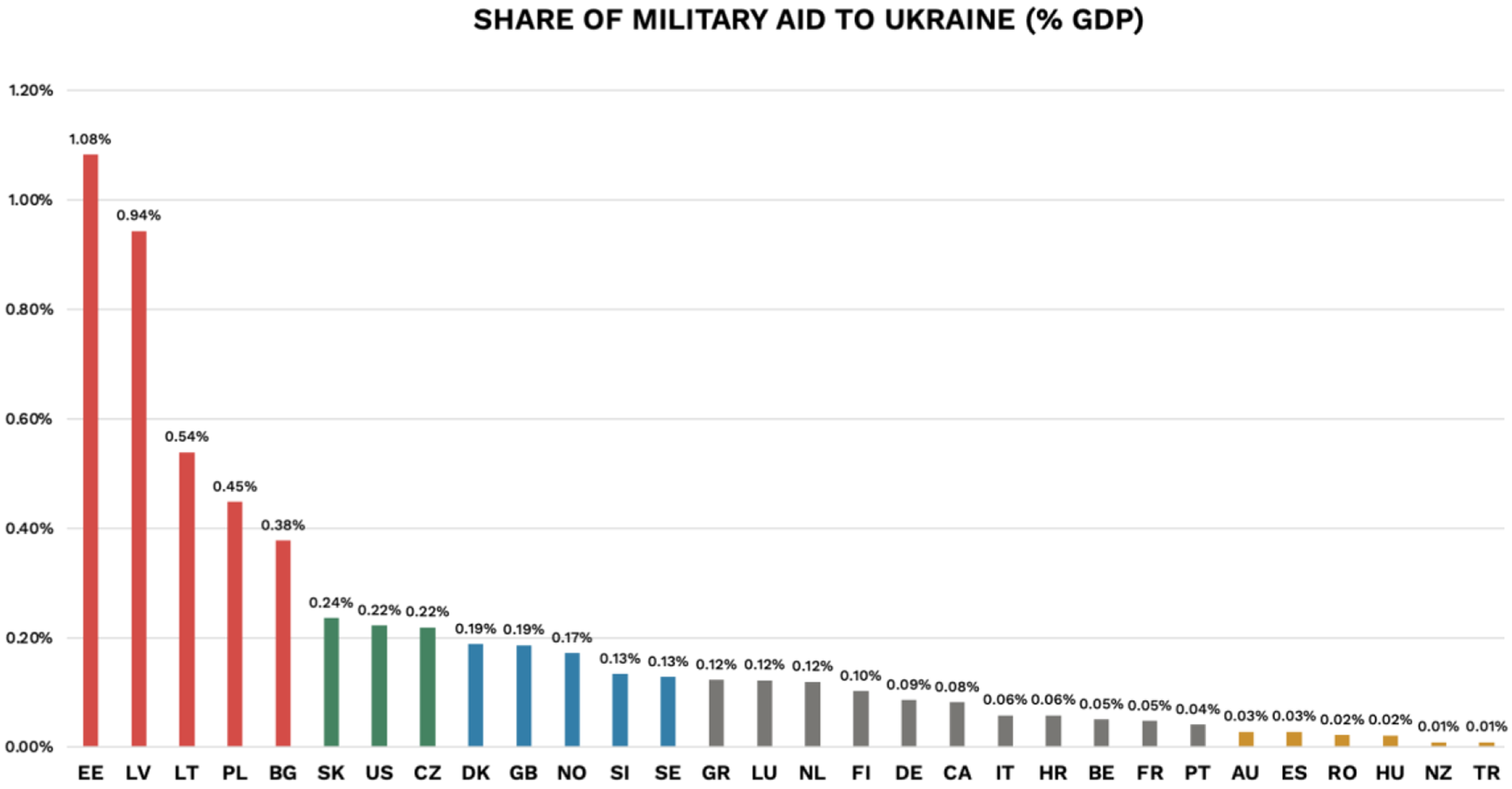
The final indicator is transformed into fuzzy-set scores using the direct method of calibration. For the thresholds, we use 0.00% as the exclusion, 0.125% as the crossover, and 0.25% as the inclusion points. The rationale for these thresholds follows our interpretation of the raw values. The threshold for exclusion is straightforward. To be considered a non-contributor, i.e. outside the outcome set completely, countries must not contribute any military aid whatsoever. This applies to none of the 32 countries under study. At the other end of the spectrum, we consider the 0.25% of GDP in military aid an appropriate inclusion threshold, as it separates countries that provide overwhelming contributions, like the Baltics, Poland, and Bulgaria, from countries like Slovakia, the United States, and Czechia, which are still considered high supporters. The 0.125 marks a natural crossover, capturing the point of maximum ambiguity when it comes to membership in the set of contributors. Countries just below this point include Greece, Luxembourg, and the Netherlands.
Figure 2 visualises the relative distribution of military commitments to Ukraine during the first year of the war, as well as our thresholds. Given their relative levels of military aid for Ukraine, countries fall into one of several categories. At one end of the spectrum are those with full (1.00, red) (the Baltic states, Bulgaria, and Poland) and high (0.90, green) membership scores (Slovakia and the United States). On the other end are those with low (0.10, yellow) to zero degrees of membership, including all four major non-NATO US allies, as well as Spain, Hungary, Romania, Türkiye, and Iceland. The above-the-middle category (>0.50, blue) includes countries like Denmark, the United Kingdom, and Norway, while the below-the-middle category (<0.50, black) notably comprises four G7 allies, namely Germany, Canada, Italy, and France.
Outcome condition.

Defence spending
To operationalise defence spending, we depart from Lanoszka and Becker’s use of operation, maintenance, and infrastructure spending.Footnote 59 We rather focus on the proportion of the defence budget allocated to equipment, operations, and maintenance combined. We exclude spending on personnel and infrastructure as they can hardly translate into a state’s capacity to provide military weapons to Ukraine. Again, we divide the absolute defence spending by GDP, creating a relative measure. Our data on defence budgets and their composition comes from the annual report entitled ‘Defense Expenditure of NATO Countries’ published by NATO in 2024.Footnote 60 To code our non-NATO cases, we rely on the Military Expenditure Database published by the Stockholm International Peace Research Institute (SIPRI), and on specific national budget breakdowns (see Appendix). Our final indicator is obtained using the following formula, where D stands for defence spending and O & M + E for the proportion of the defence budget allocated to operation and maintenance as well as equipment:
 \begin{equation*}D = \frac{{O\,\&\, M + E}}{{GDP}}\end{equation*}
Following Ragin, we directly transformed the results to fuzzy-set scores, using the first and third quartiles as the respective points of exclusion and inclusion, setting the crossover point at the median.Footnote 61 Table 1, which summarises the scores for each indicator, shows that countries vary in the level of importance they place on defence spending. The United States, the United Kingdom, Greece, and South Korea hold full membership, while Belgium, Bulgaria, Luxembourg, Slovenia, and Spain hold none given their little O&M + E defence spending in 2021. Countries above the 0.50 membership score include countries such as Poland, France, Germany, the Baltics, while countries below the crossover include Czechia, the Netherlands, Denmark, and Canada.
Set-theoretic membership scores in conditions and outcome.

Note: Defence spending [D], Economic incentives [E], Geographic proximity [G], Threat perceptions [T], Government ideology [I], Public support [P], Executive autonomy [A].
Economic incentives
To examine whether economic incentives feature in the causal paths to aiding Ukraine, we use the Arms Transfer Database by SIPRI. This allows us to rank our cases based on their relative arms exports, expressed as a proportion of GDP. The relationship is captured in the following formula, where E stands for economic incentives and A for the financial sum of arms exports:
 \begin{equation*}E = \frac{A}{{GDP}}\end{equation*}
Again, the results were directly transformed into fuzzy-set scores, setting quartile-based thresholds. States absent from the SIPRI database were checked against alternative sources and subsequently coded as non-exporting, which corresponds to a fuzzy-set score of 0.00. From those that qualify as exporters, Table 1 shows that France, Türkiye, Spain, the United States, Italy, Sweden, the Netherlands, South Korea, Norway, Germany, and the United Kingdom score above 0.90, indicating high to full membership. Belgium and Australia follow with scores above 0.75. Next, Bulgaria, Canada, Denmark, and Finland fall into the lower bound of the set of contributors, while all other countries do not meet the threshold for membership and are coded as non-exporters.
Geographic proximity
Rather than measuring the distance between capitals, geographic proximity is operationalised as a qualitative indicator, as this captures the threat environment more accurately. We use six qualitative anchors. States that share a land border with Russia are assigned full membership, namely Estonia, Finland, Latvia, Lithuania, and Poland. Those that share a land border with Ukraine but not with Russia are assigned a score of 0.80. These include Hungary, Romania, and Slovakia. States that share a maritime border with Russia or whose Exclusive Economic Zones (EEZs) overlap are assigned a score of 0.60, including Bulgaria, Canada, Denmark, Japan, Norway, Sweden, Türkiye, and the United States. Scores of 0.40, 0.20, and 0.00 are assigned to states which are two, three, and more borders removed from Russia, respectively.
Threat perceptions
Existing literature on strategic alignment has focused on the extent to which states value their alliance with the United States, ranking them based on degrees of Atlanticism and Europeanism.Footnote 62 This distinction is problematic when examining non-NATO US allies. Moreover, the most important denominator of threat perceptions regarding the war in Ukraine is Russia rather than the United States. Therefore, we develop our own coding of threat perceptions, based on how states view Russia, as expressed in their latest national security strategy or defence policy prior to the war. Conducted in both English and native languages, we isolated mentions of Russia and coded these based on a spectrum of sentiments ranging from designations of Russia as an explicit threat, a potential threat, or a destabilising actor, to expressions of interest in maintaining dialogue, strategic cooperation, or partnership, as well as indifference (for details, see the Appendix).
While the Baltic states, Finland, Poland, and Romania manifested the russophobic end of the spectrum, Japan, Greece, Hungary, Türkiye, and others either characterised Russia as a prospective partner or ignored it altogether. Between the two poles are those emphasising cooperation, (e.g. Australia, Portugal, and Sweden) or dialogue (e.g. Canada, Spain, and Germany), and those qualifying Russia as a destabilising actor (e.g. Italy, Norway, and Slovakia) or a potential threat or competition (France, Germany, and the United States). Some official documents include various expressions of threat perceptions. For instance, while Estonia classifies Russia as an existential threat, it also emphasises dialogue, most likely because of its sizable Russian minority. In those cases, we adjusted scores according to our coding rules, available in the Appendix.Footnote 63
Government ideology
This condition operates on the basis of the ParlGov scale ranging from 0 to 10.Footnote 64 Our coding is based on Wagner et al., who find that the proclivity to use force follows a curvilinear trend: it is the lowest at the far right, grows as one moves further to the left, peaks at centre-right, and decreases again towards the far left.Footnote 65 Since the trend does not follow the same direction across the board, we employ a piecewise linear function to transform individual segments of the trend. The transformation is based on the following function, where I stands for the fuzzy-set value of government ideology, x for the raw value to be transformed, Rmax and Rmin for extremes in each interval of our raw data, and fsmax and fsmin for extremes in our new, fuzzy ranges:
 \begin{equation*}I = \frac{{f{s_{max{\text{ }}}} - f{s_{min}}}}{{{R_{max{\text{ }}}} - {R_{min}}}} \times \left( {x - {R_{max}}} \right) + f{s_{max}}\end{equation*}
This requires us to translate terms like far left or centre-right into numerical ranges (see the Appendix and Annotated R Code for Replication). Table 1 one shows that roughly half (15 out of 32) of all states fall within the range of right (from 0.61 to 0.79) ideology, including Poland and the United Kingdom. Nine fall into centre-left (>0.80) and centre-right range (>0.81), where the provision of military support is most likely, including Canada, France, and Germany. No countries fall into either the radical right or far left categories. The most left-oriented countries are Norway (0.48) and Sweden (0.49) and the most right-oriented country is Japan (0.70). This suggests that very few countries had an ideological inclination to refrain from providing military aid to Ukraine.Footnote 66
Public opinion
For public opinion, we averaged the earliest and the latest poll for each state in our sample available between February and December 2022. Our data comes from international polling agencies, including Gallup, IPSOS, Eurobarometer, and YouGov. Where data was not available, we relied on local polling agencies and news reports (see the Appendix). In choosing our thresholds, we follow Mello, who considers uncertainty in polling data.Footnote 67 The average share of respondents who gave no or indecisive answer was 6 per cent across our considered polls, setting the point of maximum ambiguity at 47 per cent. Accordingly, we consider 77 per cent to mark full inclusion in the set of public support and 17 per cent fully outside of it. Table 1 shows considerable variation in levels of public support. While Poland, Denmark, Sweden, and 13 other Western European countries favour supplying military aid to Ukraine, support is very low in Japan, Bulgaria, South Korea, Greece, Türkiye, and Slovakia. Public support is slightly above our inclusion threshold in Czechia, Slovenia, Hungary, and Australia.
Executive autonomy
The operationalisation of this condition required an in-depth analysis of national constitutions and legal codes. We first conducted text analyses of all constitutions and arms-related legislatures, relying on native speakers to produce a qualitative coding of these documents in most of our cases. Searching for a set of keywords, coders were asked to determine the level of executive autonomy based on four degrees of parliamentary oversight: ex ante veto, ex post veto, informational rights, and no veto rights. Where results were inconclusive, we based our coding on information about how executive–legislative relations are practised, drawing on scholarship as well as news reports covering the approval process of arms transfers or donations of military material.Footnote 68
We find full executive autonomy in half of our cases, including Canada, France, Poland, Slovakia, and Türkiye. Conversely, we note parliamentary ex ante veto in 13 cases, including Bulgaria, Greece, Hungary, Germany, Denmark, and the Netherlands. The remaining parliaments are either vested with ex post veto (Italy and South Korea) or hold the right to be informed of government action (Spain and the United Kingdom). Given its combination of presidential drawdown authority and active scrutiny by Congress, the United States is assigned a score of 0.33, the same score as ex post veto. For our newly created data set of executive autonomy over arms transfers, see the Appendix.
Results
The fsQCA identifies causal pathways that led states to aid Ukraine against the Russian invasion. Given the assumption of causal asymmetry, the analysis entails separate procedures for the outcome and its negation. Conducting both helps us understand not only what influenced states’ decisions to militarily aid Ukraine, but also what led them to refrain from doing so. Before proceeding with the analysis of sufficient conditions, we test for necessary conditions. The conventional thresholds for necessity are a consistency of > 0.90 and coverage of > 0.50, above which a condition must be present for the outcome to occur. The tests do not reveal any such conditions.
Explaining military aid for Ukraine
Which combination of conditions led countries to aid Ukraine in its defence against Russia? To examine whether the identified causal pathways resonate with our integrated framework, the fuzzy-set analysis proceeds through several steps, the core performed using the QCA package for R.Footnote 69 First, membership scores are transformed into a truth table reported in Table 2. Rows that do not contain empirical cases are omitted for reasons of space. The consistency column reflects the degree to which the fuzzy-set values of all cases in a conjunction are enough to produce the outcome of military aid. Using these consistency scores, we determine a threshold to separate combinations that meet the fuzzy-set sufficiency criteria from those that do not. Here, we opt for a consistency threshold of 0.802, excluding cases below row 8.Footnote 70 While a lower consistency cut-off point would result in higher empirical coverage, it would have also diluted the coherence of the resulting explanation.
Truth table for military aid.

Note: Defence spending [D], Economic incentives [E], Geographic proximity [G], Threat perceptions [T], Government ideology [I], Public support [P], Executive autonomy [A].
In the second step, the truth table is minimised using the Quine–McCluskey algorithm. Table 3 shows the intermediate solution and its respective conjunctions of conditions.Footnote 71 The solution terms are made up of four different causal conjunctions. First, the conjunction of high defence spending, geographic proximity, high threat perceptions, government ideology, and public support (D * G * T * I * P) captures the cases of Latvia, Lithuania, Poland, Estonia, the United States, and Finland. Second, a similar causal path, where the condition of public support is replaced by executive autonomy, captures the cases of Poland, Slovakia, and Finland (D * G * T * I * A). Third, the conjunction of high defence spending, economic incentives, geographic proximity, and public opinion (D * E * G * P) captures the causal path of military aid from Sweden, Norway, and the United States. Lastly, the fourth path of economic incentives, geographic proximity, government ideology, and low executive autonomy captures the cases of Bulgaria, Denmark, and the United States. Several cases including Finland, Poland, and the United States feature in multiple conjunctions, pointing to equifinality as one of the key tenets of QCA.
Analytical results for military aid.

Note: Defence spending [D], Economic incentives [E], Geographic proximity [G], Threat perceptions [T], Government ideology [I], Public support [P], Executive autonomy [A].
Table 3 further explains values for consistency and coverage, with raw coverage referring to how much of the outcome can be explained by a particular path. Conversely, unique coverage discounts any empirical overlap between paths to indicate only the specific explanatory contribution of a given path. For instance, path 1 covers 44 per cent of meaningful aid contributors, with 14.3 per cent being uniquely covered by this path. This includes the Baltics, since the rest of the cases covered by Path 1 are also covered elsewhere.
While we reserve the substantive discussion of results for the following section, two observations are worth noting considering the composition of the solution terms and the cases they cover. First, geographic proximity appears in all conjunctions, suggesting that it is a common and important factor across different paths. Second, most cases covered by the first path hold high memberships in the conjunction, indicating a robust finding. This is particularly important considering that these cases include Eastern European states, the most important aid providers relative to GDP, as well as the largest aid provider in absolute terms, i.e. the United States, which provided more than 68 per cent of all military aid supplied to Ukraine in the first year of the war. As such, Path 1 explains military support by the greatest aid contributors to Ukraine. Since it also includes the most conditions, this finding also points to the robustness of our theoretical framework as a whole.
On their own, solution terms are rather abstract. To understand the distribution pattern of cases, an x–y plot can be constructed to assess the empirical fit of the framework. Figure 3 plots membership in the intermediate solution against membership in the outcome, showing the position of each country. The green points placed in the upper-right corner represent typical cases, of which Poland, Latvia, and Estonia are the most archetypal, given their proximity to the main diagonal. Conversely, the grey points located in the lower-left corner are irrelevant cases as they hold low membership in the outcome, i.e. they are not meaningful military aid providers.
Military support for Ukraine and solution term.

While the solution terms prove sufficient in most cases, the presence of cases in the upper-left and lower-right quadrants suggests need for further investigation. Out of the 13 countries providing significant military support to Ukraine relative to GDP, 3 are unaccounted for by the solution, suggesting deviance in degree. While Czechia and the United Kingdom both hold high membership in the outcome, our solution term fails to capture them, a phenomenon that might be caused by incomplete theory, wrong calibration, or the idiosyncrasy of the cases. Further, Slovenia remains a highly ambiguous case. While this still merits investigation, the fact that our solution term does not cover it is less troubling than in the previous case. On the other hand, Finland represents a case that is deviant in kind. This means that it holds membership in the solution term, but not in the outcome. In other words, given its traits, Finland should have provided more military aid than it did. Ultimately, while our solution term covers most aid contributors and uncovers deviant behaviour, the existence of cases we have yet to explain calls for improvements to existing burden-sharing theory.
Explaining the absence of military aid for Ukraine
Which conditions led some Western allies to refrain from providing significant military aid to Ukraine in its defence against Russia? In answering this question, we follow the exact same procedure as above, this time applied to the negation of the outcome. Table 4 shows the corresponding truth table. As such, this is identical to the truth table describing the outcome, albeit with different consistency scores. Overall consistency here is only slightly lower than in the previous process. Considering the higher number of non-outcomes, we opted to increase our coverage at the marginal expense of consistency. The latter is set at the threshold of 0.816, covering 13 cases of non-meaningful aid contributors and excluding those below Japan.
Truth table for the absence of military aid.

Note: Defence spending [D], Economic incentives [E], Geographic proximity [G], Threat perceptions [T], Government ideology [I], Public support [P], Executive autonomy [A].
Again, the truth table is minimised using the fsQCA software which operates on the Boolean-based Quine–McCluskey algorithm. The resulting intermediate solution term consists of four distinct combinations of conditions. First, the conjunction of low defence spending, geographic proximity, and executive autonomy (∼D * G * A) accounts for the cases of Romania, Japan, Türkiye, and Canada. The second path contains high defence spending, low geographic proximity, and low threat perceptions (D * ∼G * ∼T), capturing the decisions of Greece, Australia, Croatia, and South Korea to provide little to no support. Third, low defence spending, economic incentives, and low geographic proximity (∼D * E * ∼G) describe the cases of the Netherlands, Spain, Italy, and Belgium. The fourth path contains low geographic proximity, low threat perceptions, and low executive autonomy (∼G * ∼T * ∼A), capturing the cases of Greece, the Netherlands, Portugal, and South Korea.
Table 5 shows that while most cases are uniquely covered by a single causal path, a few are present in several conjunctions at once, including Greece, the Netherlands, and South Korea. Further and in contrast to the solution term for the outcome, the causal paths leading to the non-outcome feature conditions in both qualitative states. This poses a challenge to some of our directional expectations, particularly regarding defence spending and geographic proximity. In other words, both high and low defence spending or geographic proximity and distance explain non-meaningful military support to Ukraine. We return to this issue in the discussion below.
Analytical results for no military aid.

Note: Defence spending [D], Economic incentives [E], Geographic proximity [G], Threat perceptions [T], Government ideology [I], Public support [P], Executive autonomy [A].
* Note that the analysis yields several models that fit our data equally well, resulting in model ambiguity. Similarly to the previous procedure, we opted for M1 for reasons of case coverage. See the replication file for complete results.
To visualise our results and illustrate the empirical fit of the parsimonious solution term for the absence of the outcome, we construct another x–y plot. Figure 4 shows 13 typical cases while leaving 6 cases unaccounted for by our solution term and a single deviant case. This suggests that our understanding of why states provide underwhelming support needs further enhancement. However, it might also point to the idiosyncrasy of some of these cases, most importantly Finland, France, and Germany. All three states substantively changed their foreign policy following February 2022, with Finland ending decades of neutrality, Germany undertaking a Zeitenwende, and France moving from fear of humiliating Russia to considering deploying troops in Ukraine.
Absence of military support for Ukraine and solution term.

Discussion
The findings from our analysis of military support to Ukraine among US democratic allies yield interesting implications for theory and generate several policy-relevant insights. First, the condition of geographic proximity emerges as the most robust within the causal paths to the provision of military support, both in conjunction with other strategic incentives and non-material factors like ideology or threat perceptions. It features in each of the four identified causal paths, covering 10 of the 13 meaningful contributors of military aid. This confirms the causal importance of geography to aid Ukraine.
Second, high defence spending and ideology each feature in three paths. These paths highlight the complementarity of strategic, economic, and domestic factors in foreign and security policymaking. The first path shows that high defence spending proves jointly sufficient for the outcome when combined with economic incentives, geographic proximity, and public opinion. The same holds in the case of ideology when combined with economic incentives, geographic proximity, and low executive autonomy. This is exemplified in the case of Bulgaria, whose geographic proximity to Russia and growing arms industry seem sufficient for its commitment when combined with low executive autonomy. Bulgarian arms exports have surged by 200% since the war, and even during the interim government appointed by President Radev, known for his anti-Ukrainian rhetoric, arms transfers to Ukraine continued.Footnote 72 The third and fourth path shows that high defence spending and ideology prove jointly sufficient for the outcome when combined with geographic proximity, threat perceptions, and either public opinion or high executive autonomy. This confirms the importance of economic and domestic incentives as powerful drivers of foreign policy. In the case of domestic incentives, it is important to note that executive autonomy appears jointly sufficient for the outcome when it is both high and low. This shows that even where governments face empowered legislative bodies, the latter may result as much in enabling (such as in Denmark) or constraining (such as in Portugal) the supply of military goods.
Third, the conditions of defence spending, geographic proximity, and executive autonomy seem to jointly cause the non-outcome in both qualitative states, i.e. presence and absence. Indeed, the intermediate paths towards limited military support to Ukraine hold a combination of high defence spending, geographic distance, and low threat perceptions (D * ∼G * ∼T), or low defence spending, geographic proximity, and executive autonomy (∼D * G * A), or low defence spending, economic incentives, and low geographic proximity (∼D * E * ∼G), or geographic distance, low threat perceptions, and low executive autonomy (∼G * ∼T * ∼A). This makes sense given the specific geostrategic situation of US allies. The conjunction of high defence spending, geographic distance, and low threat perceptions covers countries that have other national security priorities than Russia, including Greece, which is more preoccupied by Türkiye, South Korea, which is concerned about its northern neighbour, and Australia, which has singled out China as its main national security threat.
Moreover, proximity with Russia does not necessarily translate into military aid, especially when combined with low defence spending such as in Canada. Nevertheless, distance from Russia appears in three causal paths towards token support, whether combined with low defence spending and economic incentives, such as with Italy and Spain, or with low threat perceptions and low executive autonomy, such as in the case of the Netherlands.
Fourth, threat perceptions appear crucial when there are both incentives and capacity to provide military assistance. On its own, the presence of the condition is not sufficient to bring about the outcome. Instead, cases where this emerges as a powerful driver exhibit both economic power and close geographic proximity to Russia, such as Denmark, Norway, and the United States. Furthermore, the absence of threats is quite indicative of the decision to refrain from supporting Ukraine. As such, our results indicate the considerable importance of threat perceptions, whether measured by proximity to the source of threat and the level of past defence spending in operations, maintenance, and equipment, as well as national security documents.
Empirical fit
In terms of the empirical fit of our model, the identified causal paths cover several cases that can be considered typical. Importantly, the model proves successful in explaining the decisions to aid Ukraine adopted by 10 out of 12 positive cases: the Baltic states and Poland, states of high importance when it comes to their position within the European security landscape, as well as the Scandinavian states, Bulgaria, Slovakia, and the United States. Moreover, the cases of Poland, Latvia, and Estonia appear the most typical, as evidenced by their proximity to the main diagonal (see Figure 3), making them suitable for further process-tracing. As already mentioned, the case of Bulgaria is particularly interesting. Despite facing fierce public opposition, exhibiting low defence spending, and with strong legislative oversight of arms transfers, the Bulgarian government matches the relative level of military aid supplied by cases such as Poland or the United States, where domestic circumstances are less grudging. In addition to theoretical implications regarding our understanding of legislative war powers, the case of Bulgaria might teach us more about the impact of public opposition on the executive, particularly where economic incentives are involved – Bulgaria being a significant arms exporter.
Our solution term for the provision of military aid does not properly capture three cases: Czechia, Slovenia, and the United Kingdom. Among them, Slovenia holds the lowest membership in both the outcome and the solution term. Turning back to our analysis of the outcome, Table 2 shows that Slovenia shares its configuration with New Zealand and Luxembourg, both negative cases, which could point to a true deviance in degree. However, as a case, Slovenia is also highly ambiguous. With its membership in the outcome barely passing the 0.5 score, it should not be expected to fit the solution terms perfectly. However, both Czechia and the United Kingdom hold high membership scores in the outcome. While Czechia scores low on both defence spending and economic incentives, two prominent features of the causal path towards the outcome, the same cannot be said of the United Kingdom. Here, we suspect the issue might lie in the way our framework treats threats. Since the United Kingdom does not share a maritime border with Russia and is quite far removed, it scores low on geographic proximity. Similarly, its national security strategy combines expressions of threat ranging from the level of strategic dialogue to competition, resulting in lower threat perceptions than cases better captured by the solution terms. It could also be that these cases are simply too idiosyncratic to fit or that we are missing important causal conditions. For instance, in the case of the United Kingdom, its assertive position could be explained by the traditional view of itself as a ‘moral leader’, pointing to role conceptions as an important factor.Footnote 73
Finally, the lower-right quadrant of Figure 1 shows Finland as deviant, meaning that it holds membership in the solution term but not in the outcome. In other words, given the conditions in this case, Finland should have contributed more. Here, we should recall the dramatic change of foreign and security policy amid the Russian invasion, with Helsinki joining NATO in April 2023, and the subsequent increase in Finish commitments to Ukrainian defence.
Similarly, the empirical fit for the non-outcome inspires interesting observations. The solution term covers most cases with low membership in the outcome, particularly typical being Belgium or Romania. While there are no deviant cases in this model, six cases remain unaccounted for, including Finland. Its deviance in the analysis of both the outcome and non-outcome suggests a true inability of the model to capture its specificities. Furthermore, our model does not account for the cases of France, Germany, Hungary, New Zealand, and Luxembourg, albeit the latter assumes a highly ambiguous status, similarly to Sweden. Like Finland, Germany and France have also experienced dramatic changes in their foreign and defence policy, which might explain idiosyncrasies in these cases. Future studies investigating later stages of the war in Ukraine would do well to examine whether these strategic shifts have materialised into greater aid to Ukraine. Preliminary data certainly suggests so, with Germany having provided the greatest amount of military aid to Ukraine in 2023, and France the second-most in the first four months of 2024.Footnote 74
Conclusion
The Russian invasion has mobilised widespread military support for Ukraine. While the war has strengthened the unity of the West and its partners, it has also revealed divisions regarding the right level of commitment to Ukraine. To explain this variation, this paper relied on an integrated theoretical framework of incentives and constraints and tested those using a configurational approach. This has revealed four causal paths to the provision of military support for Ukraine, namely the conjunction of high defence spending, geographic proximity, high threat perceptions, government ideology, and public support or executive autonomy, the conjunction of high defence spending, economic incentives, geographic proximity, and public opinion, and that of economic incentives, geographic proximity, government ideology, and low executive autonomy. Our framework has also revealed four causal paths towards token military aid to Ukraine, namely the conjunction of low defence spending, geographic proximitym and executive autonomy, that of high defence spending, low geographic proximity, and low threat perceptions, the conjunction of low defence spending, economic incentives, and low geographic proximity, and lastly low geographic proximity, low threat perceptions, and low executive autonomy.
As such, geographic proximity, defence spending, and ideology feature prominently across all causal paths, pointing to the importance of both material and ideological factors when it comes to states’ foreign policy on Ukraine and Russia. Threat perceptions and executive autonomy also feature prominently in the causal paths shaping the level of military commitments to Ukraine. Importantly, both low and high levels of executive autonomy and defence spending, as well as proximity and distance to Russia, feature in our solution terms. This suggests these factors represent important enabling as well as constraining determinants of arms transfers.
Our framework identified causal paths covering 9 of the 13 greatest military aid contributors to Ukraine, as well as 14 of the 19 token aid donors. It seems particularly apt at making sense of Eastern Europe, North America, the Mediterranean, and major non-NATO US allies. Unaccounted or deviant cases include one of the new Scandinavian allies (Finland), as well as three major European allies in France, Germany, and the United Kingdom. Interestingly, our model seems to have encountered the same difficulty in making sense of the United Kingdom as Lanoszka and Becker’s study, but is better at accounting for Eastern Europe and Mediterranean allies. While our model captures most of our cases, some deviance remains, warranting further evidence and process-tracing. Indeed, this should be done on both typical and deviant cases in the continuation of this research endeavour.
Apart from theory, our results yield implications for the regional and organisational cohesion of the West as well as the future of the war in Ukraine. When it comes to NATO members, levels of military support show a regional divide, with the Eastern flank contributing the most in relative terms. Given the importance of geography established through our results, we could expect them to uphold their level of commitment in the future. At the same time, however, the importance of military capability will likely act as a major constraint, particularly when it comes to small states like the ones in question. While we expect them to remain incentivised, the prominence of material conditions for our causal paths suggests a likely decrease in commitment. Similarly, arms-exporting states are expected to remain incentivised through economic benefits. However, their relative distance from the threat will likely prevent them from increasing their commitment to Ukraine. Increases in defence spending since 2022 make act in the opposite direction, enabling greater assistance by larger West European allies such as France and Germany. These two countries’ strategic upheaval since 2022 may indeed result in more equitable burden-sharing with regards to military assistance to Ukraine in the future.
Supplementary material
The supplementary material for this article can be found at https://doi.org/10.1017/eis.2025.13.
Justin Massie is a professor and Head of the Department of Political Science at the Université du Québec à Montréal. He is also the Co-director of the Network for Strategic Analysis and of Le Rubicon.
Barbora Tallová is a data and policy analyst in the Government of Slovakia and a future member of the Public Diplomacy Division at NATO. She holds an MPhil in International Relations from the University of Oxford.
Acknowledgements
The authors would like to thank participants at the 2023 Annual Convention of the International Studies Association in Montréal for their helpful comments on an early draft and Patrick A. Mello for his methodological guidance.



 Open access

