Introduction
Located at the biogeographical crossroads of the western Amazon and Andes ecosystems, Manu National Park is the gem in Peru's protected area network. It is the only park in South America that protects the entire watershed of a major Amazonian tributary, encompassing a range of habitats from high Andean grasslands to lowland rainforests. Manu is also the only large remaining tract of land at the juxtaposition of the Andes with lowland Amazonia where plant communities, including those at the treeline, are not prevented by human activity from colonizing areas of greater altitude in response to climate change (e.g. Rehm & Feeley, Reference Rehm and Feeley2015), and therefore its importance to the maintenance of biodiversity and evolutionary processes in the Andes–Amazon region cannot be overstated.
Dominated by the Andes to the west and south, which rise to > 4,000 m above the Manu River floodplain in the Amazonian lowlands, Manu's geography is also characterized by its remoteness and, until recently, its inaccessibility. With its wide elevational gradient, large area, isolation, and wilderness character, the Park is not only highly biodiverse but is also home to large and wide-ranging vertebrate species that are rare or declining elsewhere in Amazonia. For example, the protection of Manu's vast floodplain was a key factor in the stabilization of the region's population of the Endangered giant otter Pteronura brasiliensis after decades of overhunting along the lower Manu River (Groenendijk et al., Reference Groenendijk, Hajek, Johnson, Macdonald, Calvimontes, Staib and Schenck2014). The Park and its surrounding forests also contain other abundant top predators, including as many as 6,000 jaguars Panthera onca (Tobler et al., Reference Tobler, Carrillo-Percastegui, Hartley and Powell2013).
Manu National Park spans Peru's Cusco and Madre de Dios Departments, and forms the core area of a larger UNESCO Biosphere Reserve and World Heritage Site. Known in Peru as an Intangible Zone, only a few scattered Matsigenka, Yora and Quechua indigenous communities and several small groups of voluntarily isolated Mashco-Piro (fewer than several thousand people in total) reside within this 1.5 million ha core area (Shepard et al., Reference Shepard, Rummenhoeller, Ohl-Schacherer and Yu2010). The south-eastern edge of the Park is bordered by a Cultural Zone, which is intended to serve as a protective buffer, and where colonization, development and limited resource extraction are allowed (and occur). The Park's other borders are shared with large expanses of sparsely populated rainforest and several other protected areas, including Alto Purus National Park to the north-east and the Amarakaeri Communal Reserve to the south-east (Fig. 1).
The Manu Road, and the route of its proposed expansion to connect Nuevo Eden with Boca Manu and Boca Colorado in Peru's Madre de Dios Department.
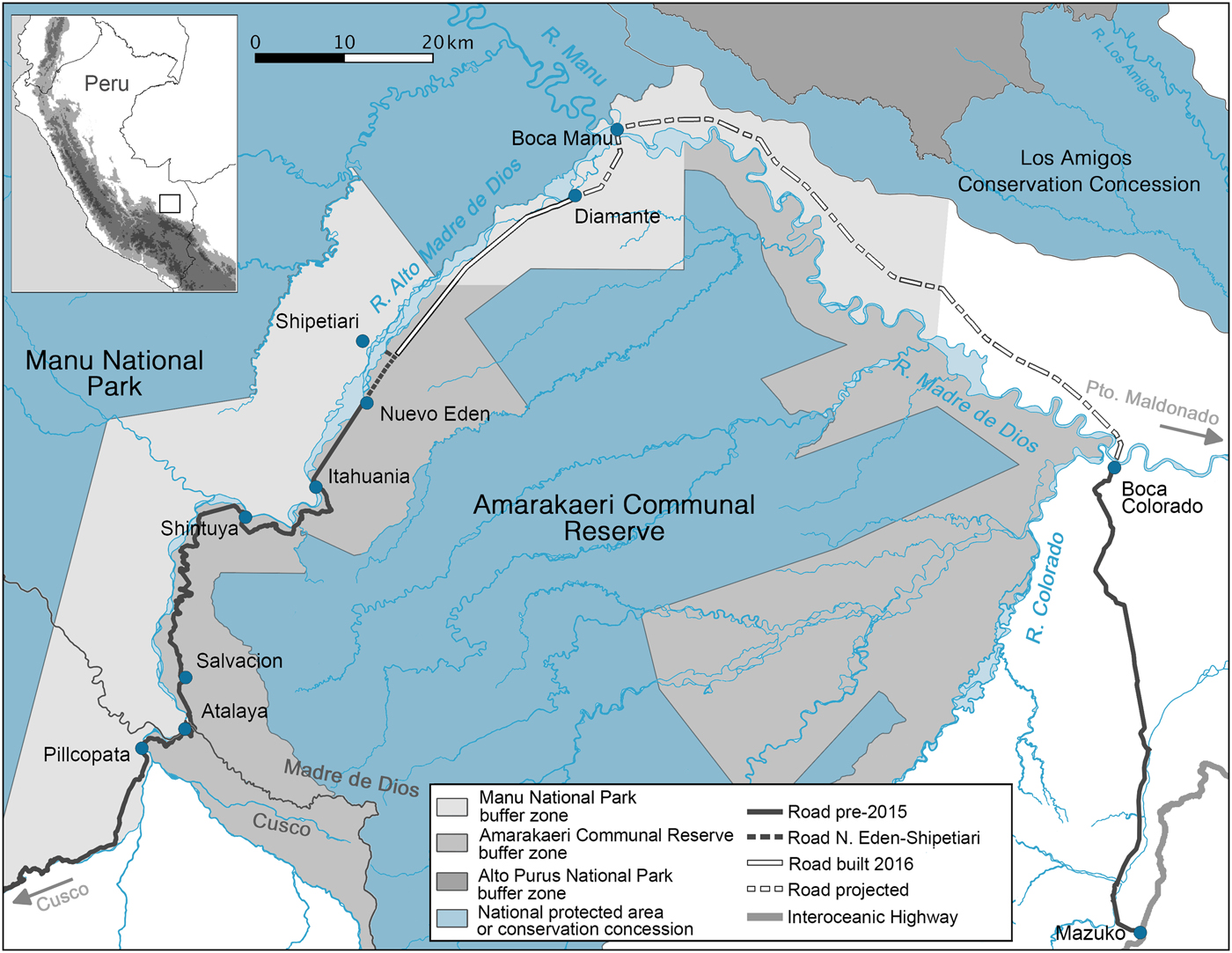
Historically, the Manu region's isolation has kept it relatively guarded from the effects of uncontrolled resource extraction and colonization that have devastated rainforests and biological and cultural diversity in other parts of Amazonia (e.g. Laurance et al., Reference Laurance, Cochrane, Bergen, Fearnside, Delamônica and Barber2001). The construction of the so-called Manu Road, however, which began in the 1960s and currently traverses the buffer zones of both Manu National Park and the Amarakaeri Communal Reserve, has increased access to the region (Fig. 1). The population of Andean migrants along the road, in particular, has increased, resulting in increased pressure on the region's natural resources. A proposed expansion of the road aims to connect the end of the existing road with the town of Boca Manu, at the mouth of the Manu River and the entrance to the core area of Manu National Park; the project would also connect Boca Manu with the illegal gold mining hub of Boca Colorado to the south-east (Fig. 1). Construction of the first section of the Nuevo Eden–Boca Manu–Boca Colorado road, from Nuevo Eden to Boca Manu, has proceeded rapidly and, as a variety of observers have pointed out, illegally, as the project has lacked the environmental impact assessment and prior consultation of local indigenous residents that are required by Peruvian law.
If the road network envisioned for the Manu region is completed, resource extractors and probably an influx of new colonists will gain access to immense areas of currently pristine rainforest, and deforestation, logging, mining and other illicit activity will continue to erode the ecological and cultural integrity of the region's mosaic of protected areas, as has happened following new road construction elsewhere in Amazonia (e.g. Laurance et al., Reference Laurance, Cochrane, Bergen, Fearnside, Delamônica and Barber2001).
Our goals here are threefold. Firstly, we discuss the history of the Manu Road, to place the contemporary debate about current plans for expansion in the appropriate historical context. Secondly, we provide an overview of the various complex direct and indirect social and environmental risks of expansion, which is intended to provide the project's diverse stakeholders with the information necessary to engage in an informed debate about, and accurately assess, the various potential costs and benefits of road development. Thirdly, we argue that these costs greatly outweigh the benefits of road expansion, and outline a potential compromise solution that acknowledges the needs and demands of local residents while also preserving the globally important biological and cultural capital of the Manu region.
A brief history of the Manu Road
Early history
Transit along the path of the Manu Road began at least as early as the height of the Incan empire, in the late 16th century. Trade was facilitated by the construction of a road from the capital city of Cusco, in the high Andes, east to the settlement of Paucartambo and then onwards, down the eastern Andean slopes of the Kosñipata Valley to the outpost of Pillcopata, at the edge of the Incan domain in the Amazonian lowlands. In 1760, nearly 2 centuries after the Spanish conquest, a bridge was erected across the Mapacho River in Paucartambo to consolidate colonial access to the rainforest resources coming from Pillcopata (Ramos Carpio, Reference Ramos Carpio1996). Thus, the first major effects of the construction of road infrastructure along the route appeared hundreds of years ago, as people gradually populated the area surrounding the road and farmed the adjacent countryside, especially in and around what became the Andean city of Paucartambo.
Although the Inca and later the Spanish maintained some trade in rainforest goods via Pillcopata, the presence of fiercely resistant tribes further east mostly prevented the incursion of outsiders. The onset of so-called rubber fever (c. 1880–1912), however, changed the situation in the Peruvian Amazon rapidly, drawing hundreds of entrepreneurial rubber barons and their workforces (Shepard et al., Reference Shepard, Rummenhoeller, Ohl-Schacherer and Yu2010). Among the most influential of the Peruvian barons was Carlos Fitzcarrald, who gained notoriety after having a European steamship dismantled and portaged through > 12 km of remote rainforest to the previously unexplored Manu River watershed (Reyna, Reference Reyna1941). Fitzcarrald's pioneering voyage down the Manu met with intense violent opposition by native peoples referred to colloquially as Mashcos. Fitzcarrald launched a brutal counterattack, killing as many as 300 Mashcos and effectively ending the period of a settled Indian presence in Manu for decades to come (Reyna, Reference Reyna1941).
A small number of semi-nomadic, Piro-speaking peoples currently inhabit the core area of Manu National Park, probably descendants of Mashcos who escaped Fitzcarrald's slaughter more than a century ago (Kaplan & Hill, Reference Kaplan and Hill1984). Although often referred to as being uncontacted, these people are, rather, living as hunter–gatherers in a state of voluntary isolation, having abandoned agriculture to escape the violence inflicted upon them by outside resource extractors. The rubber boom had other impacts on Manu's cultural layout; for example, Dominican missionaries established the mission of San Luis del Manu at the confluence of the Manu and Alto Madre de Dios Rivers in 1908 and, although the missionaries departed when the Peruvian rubber economy collapsed several years later, the outpost survives today as the village of Boca Manu (Fig. 1).
By the 1960s the first modern road penetrated into the lowland rainforest surrounding Manu, having been built incrementally by a variety of authorities. Although the road was narrow and unpaved, the town of Pillcopata quickly grew as Andean colonists arrived to exploit newly accessible natural resources, particularly timber. The construction of a bridge across the Pillcopata River by the Peruvian Army Corps of Engineers in the early 1970s facilitated the expansion of the road to the populated centres of Atalaya and Salvación, and later the indigenous community of Shintuya, c. 60 km away. During 2000–2007 the regional government of Madre de Dios extended the road by c. 29 km, first to Itahuania and then to Nuevo Eden (Fig. 1). Collectively, these gradual advancements marked a renewed interest in the economic prospects of the southern Peruvian Amazon, decades after the end of the rubber boom (Paredes-Pando, Reference Paredes-Pando and del Río2012).
As road development and agricultural expansion proceeded towards the mouth of the Manu River from the foothills of the Andes in the 1960s, loggers moved into the river's floodplain to remove abundant big-leaf mahogany Swietenia macrophylla and Spanish cedar (Cedrela spp.). The area was also invaded by hunters eager to exploit wildlife that had rebounded after the withdrawal of the rubber tappers: giant otter, jaguar and black caiman Melanosuchus niger skins were being exported from Peru in the thousands annually, and Manu offered an abundant yet untapped resource.
The creation of Manu National Park
In response to the threats of uncontrolled resource extraction, in 1968 the Peruvian government declared the entire Manu watershed a National Reserve, prohibiting hunting and timber extraction. On 29 May 1973, Manu National Park was created by Supreme Decree No. 644-73-AG, granting the 1,532,806 ha protected area stronger legal status and greater protection. In 1977, the UN designated Manu National Park and a 2,570 km2 buffer zone (the Cultural Zone) a Biosphere Reserve, thus protecting its biological and cultural diversity while also permitting the sustainable development (at least in theory) of the indigenous and colonist communities living at its periphery. The final major legal distinction granted upon Manu was its declaration in 1987 as a UNESCO World Heritage Site.
Recent developments
In 2007 the regional government of Madre de Dios submitted to the Peruvian Ministry of Economy and Finance a proposal to improve the footpath extending from Nuevo Eden to the small indigenous community of Shipetiari, 8 km downstream along the Alto Madre de Dios River (Fig. 1). Work began in June 2015, although it was halted temporarily soon thereafter following a complaint filed against the regional governor of Madre de Dios denouncing the widening of the path beyond the specifications stipulated in the project's proposal (and thus its lack of an adequate environmental impact assessment). The field inspection by the national prosecutor for Madre de Dios in September 2015 coincided with a paro (a strike or stoppage, common in Peru, which is designed to attract and/or force attention to an issue by government officials), attended by > 200 regional residents of Boca Manu. The event made headlines in Peru, with the local press reporting that a group of international tourists and researchers were kidnapped while on their way to the Cocha Cashu Biological Station inside the National Park (El Comercio, 2015). Although the event was sensationalized by the media (the visitors were unable to travel because local transportation had been suspended, and ultimately moved on following meetings between the protesters, the prosecutor and the national police), the incident nevertheless highlighted the intensity of sentiment among many local residents in favour of road expansion. The illegal widening of the Nuevo Eden–Shipetiari path resumed quickly following the departure, after 3 days, of national authorities from the region.
As these events unfolded, the regional government led a second, ostensibly unrelated push for road expansion in Manu. In 2009 it submitted a proposal to the Ministry of Economy and Finance to expand the Manu Road by 136 km, to connect Nuevo Eden with Boca Manu and then extend from there to Boca Colorado. However, the PEN 100,000,000 (c. USD 30 million) proposal was rejected based on inadequacies in its feasibility analysis. Employing an alternative strategy, in June 2013 a bill (Proyecto de Ley No. 2320/2012-CR) was brought before the Congress in Lima mandating the construction of the Nuevo Eden–Boca Manu–Boca Colorado road. After a contentious and highly publicized journey through the bureaucracy in Lima, and having been reviewed negatively by several government agencies for improper procedures, the bill was rejected by the president and ultimately archived as of June 2016.
Despite the project's official rejection by the relevant Peruvian authorities, it appears that work on the expansion of the Manu Road has nevertheless continued illegally: an analysis of satellite imagery by Finer et al. (Reference Finer, Novoa and Olexy2016) indicates that at least 21.8 km of forest along the proposed road trajectory, beyond the already completed Nuevo Eden–Shipetiari section, was cleared during December 2015–April 2016 (Fig. 1).
The trouble with the road
The environmental and social problems associated with expansion of the Manu Road are numerous and diverse: deforestation and forest degradation, the implications of these for global climate change and Peru's ability to honour international agreements, the expansion of illicit extractive activities, and the threats posed to indigenous communities are those that we consider to be the most important.
Deforestation and forest degradation
Road construction has proceeded rapidly worldwide and is expected to increase as countries continue to harness the economic benefits of road networks. In some cases, for example, roads promote economic development by integrating rural markets (Escobal, Reference Escobal2001) and facilitating the extraction of raw materials from remote areas. So alluring are these perceived benefits that 25 million km of new roads are expected by 2050, mostly (c. 90%) in developing countries (Dulac, Reference Dulac2013).
However, the advantages of road construction often come with unintended costs, including to the physical environment, biological communities, and ecosystems (e.g. Forman et al., Reference Forman, Sperling, Bissonette, Clevenger, Cutshall and Dale2003; Laurance et al., Reference Laurance, Goosem and Laurance2009). Of these, perhaps the greatest threat to tropical ecosystems are the indirect impacts of road construction, especially deforestation and forest degradation resulting from uncontrolled logging and colonization. The Brazilian Amazon, for example, lost > 55 million ha of forest during 1990–2005 (FAO, 2010), with 95% of forest loss occurring within 50 km of a road (Laurance et al., Reference Laurance, Cochrane, Bergen, Fearnside, Delamônica and Barber2001). In Peru, 83% of deforestation in the country's Amazon region during 1999–2005 occurred within 20 km of a road (Oliveira et al., Reference Oliveira, Asner, Knapp, Almeyda, Galván-Gildemeister and Keene2007). As much as 23% of that loss occurred in close proximity to just one short section of the Interoceanic Highway, a binational project with Brazil aiming to connect the south-western Amazon region (including Madre de Dios) with ports on the Atlantic and Pacific coasts. That trend is continuing, with a new deforestation hotspot emerging in Peru near the Brazilian border (Finer & Novoa, Reference Finer and Novoa2016).
Although no studies have thoroughly explored deforestation associated with road construction in the Manu region, Peru's environmental ministry released a report denouncing the current expansion of the Manu Road, citing, among other impacts, a projected loss of > 43,000 ha of rainforest (MINAM, 2016). Given the well-documented fates of other Amazonian forests facing similar pressures, this projection seems entirely plausible.
Peru's forests and climate change
By signing the Paris Agreement on 22 April 2016, Peru committed to reducing greenhouse gas emissions by 31% below business-as-usual levels by 2030. Most of Peru's proposed reductions (c. 70%) are to be met by changes in land use and improvements to the forestry sector, including improved agricultural efficiency and afforestation. Furthermore, the government considers increasing the resilience of forests throughout the country to be a Priority Action Area (Republic of Peru, 2015), and has pledged to attain zero deforestation by 2021 (UNFCCC, 2010).
As much as 79% of Peru's above-ground carbon is stored in only three of its Amazonian regions, including Madre de Dios (Asner et al., Reference Asner, Knapp, Martin, Tupayachi, Anderson and Mascaro2014). Given this, and considering what is known about the association between road building and deforestation in Amazonia, the Peruvian government needs to strengthen its efforts to prevent the construction of roads through carbon-rich rainforests in its Amazonian regions. The illegal expansion of a road in the buffer zones of two important protected areas demonstrates the government's failure to enforce anti-deforestation policies even in areas of theoretically high protection status, undermining the country's credibility as a leader in climate change mitigation efforts. It also threatens the implementation of external funding mechanisms such as REDD (Reducing Emissions from Deforestation and forest Degradation), on which c. one-third of Peru's commitments are reliant (Piu & Menton, Reference Piu and Menton2014; Republic of Peru, 2015).
Illegal gold mining and other illicit activities
Gold mining
Approximately 30,000 illegal gold miners, mostly recent Andean migrants, are operating in Madre de Dios (Fraser, Reference Fraser2009), including within the Tambopata National Reserve. In addition to ongoing deforestation (e.g. Swenson et al., Reference Swenson, Carter, Domec and Delgado2011), contamination from mercury, which is used by miners to bind gold particles contained within alluvial deposits, has reached crisis levels (Ashe, Reference Ashe2012; Fraser, Reference Fraser2016). After a series of studies found elevated levels of mercury in people, fish and sediments in Madre de Dios, in May 2016 the Peruvian government declared a 60-day public-health emergency. The Ministry of Environment has expressed concern that road expansion into Manu from neighbouring areas of Madre de Dios would result in an increase in illegal mining in the buffer zones of Manu National Park and the Amarakaeri Reserve, and in the associated dangers to the environment and public health (MINAM, 2016). The national government has imposed fuel restrictions in Madre de Dios (where most of the fuel usage is in mining) to contain the crisis. MINAM (2016) noted that road expansion in Manu was intended partly to avoid these restrictions by avoiding established control points, as well as to reduce the transportation costs of fuel and other supplies from Cusco to mining areas that are not accessible via the existing road network. The regional governor is a former leader of an organization of informal gold miners, and the congressman who put forward both road proposals submitted to the national government has been denounced for ties to illegal mining in the region (and was a member of a national Commission of Energy and Mining at the time of his denunciation). These relationships between regional politicians and mining interests bring into question whether, under the guise of integrating rural agricultural areas, the project's proponents intend to give a boost to illegal gold mining in the region.
Coca production
The cultivation of coca leaves, the source of cocaine, in Peru is second in volume only to Colombia and, although permitted in some quantity for traditional use, is mostly illegal (UNODC, 2015a,b). Cultivation is closely linked to road development in the western Amazon: during the 1960s–1970s, government-sponsored road projects and colonization schemes drew farmers to the region, many of whom later turned to coca as an alternative cash crop in the face of dwindling government support and falling prices for their legal commodities (Dávalos et al., Reference Dávalos, Sanchez and Armenteras2016). Although currently in general decline nationwide, coca production in Madre de Dios has increased by > 52% in recent years; Cusco's Kosñipata district (of which Pillcopata is the capital) has also seen production increase, from 338 ha in 2010 to 1,322 ha in 2014. Much of this production is destined for Brazil, the world's second largest market for cocaine (UNODC, 2015b). The most direct route to Brazil from Madre de Dios is either across an expansive, mostly uncontrolled border with Bolivia to the east or directly into the Brazilian state of Acre, to the north; both of these are accessed easily by the newly paved Interoceanic Highway. The improved connection of coca-producing areas in Manu to the Interoceanic Highway via Boca Colorado (Fig. 1) could therefore have a dramatic impact on illicit coca production and cocaine trafficking in the region.
Threats to local communities
The indigenous tribes of Manu have a long history of violent conflict with outsiders, and this trend continues. A number of violent encounters, including the killing of indigenous peoples by illegal loggers, have occurred since previously unknown groups began appearing on the banks of the Manu River, inside the national park, c. 1996 (Shepard et al., Reference Shepard, Rummenhoeller, Ohl-Schacherer and Yu2010; Plate 1). These events coincided approximately with a period of oil exploration that began in the Las Piedras River basin to the north-east, although conflicts appear to have intensified as loggers moved into Las Piedras as oil exploration activities were abandoned, and especially after Brazil banned exports of big-leaf mahogany, in 2001, which resulted in an increase in illegal logging in Peru (Grogan et al., Reference Grogan, Blundell, Landis, Youatt, Gullison and Martinez2010). These are not isolated incidents: across the various countries spanning Amazonia, 562 environmental and land rights activists, many of whom belonged to indigenous groups, were murdered during 2002–2013, usually in remote, resource-rich areas (Global Witness, 2014). Increased access to the Manu region via an improved road network could be expected to magnify these conflicts.
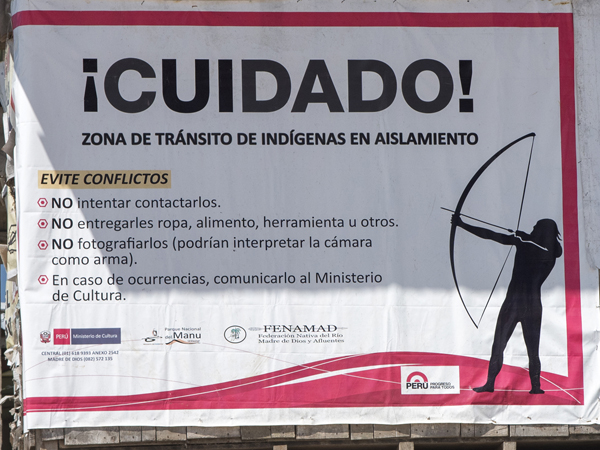
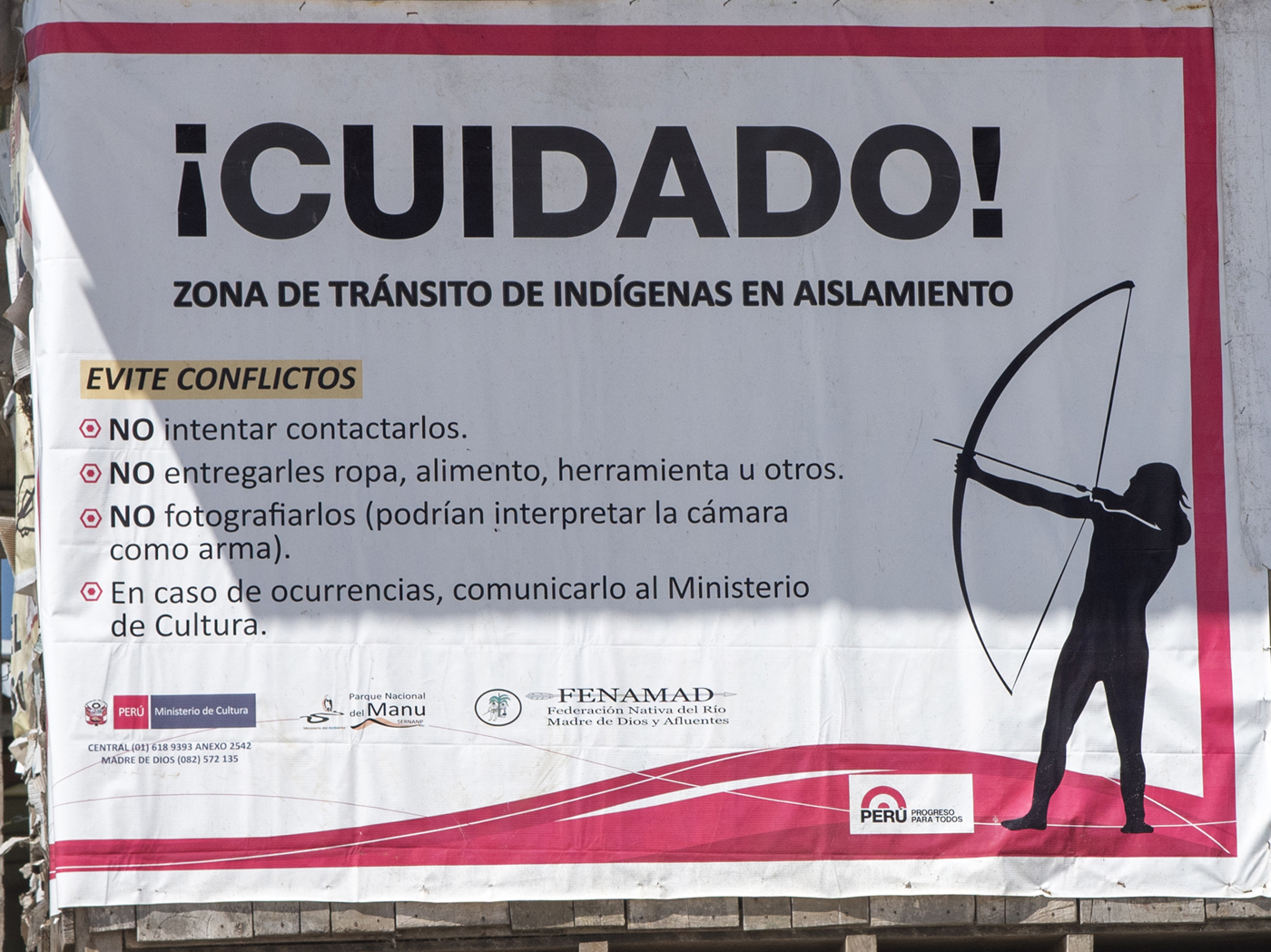
A sign supplied by the Peruvian Ministry of Culture and posted on a riverfront building in Boca Manu warns residents to avoid conflicts with voluntarily isolated indigenous groups by not attempting contact, not providing goods or supplies, and not photographing them, and to report any encounters to the Ministry. Sightings are becoming increasingly frequent on river banks in the Manu region.
Although there is significant local support for illegal road expansion, there is also opposition. Federación Nativa del Río Madre de Dios y Afluentes (FENAMAD), an organization representing 33 indigenous groups in Madre de Dios, has denounced the project, based on its lack of environmental impact assessment and the failure to consult the local communities through whose territories the road would pass (SPDA, 2015). This has been a point of contention not only in Manu but also in the wider Amazonian region.
The legal requirement of prior consultation stems from a law passed in 2011, in the aftermath of a series of violent clashes between indigenous peoples and police in the Bagua Province of Peru's Amazonas Department that left dozens of people dead. At the heart of the clashes was the fact that the national government had opened up large areas of land in the region to oil exploration, without the informed consent of local residents. Lack of prior consultation is also a central factor in the opposition to a similar road project that has been proposed to the north of Manu, to connect the small, remote town of Puerto Esperanza, in the Ucayali Department, with the town of Iñapari in Madre de Dios, along the Interoceanic Highway at the border with Brazil. The road would cross through several protected areas and indigenous reserves, including the Madre de Dios Territorial Reserve for Peoples in Voluntary Isolation, potentially opening up vast tracts of forested land to illicit resource extraction. This common theme of a failure to consult local indigenous residents, who often suffer negative social and environmental consequences yet arguably benefit little economically from major infrastructure or resource extraction projects, hints at the true motivations of some of the most influential backers of such projects.
Two of the largest tourism organizations in Peru have announced their opposition to the project, citing the direct and indirect damage road expansion would do to the sector (MINAM, 2016). Tourism is a growth industry in Peru, with an estimated contribution of nearly 10% of total gross domestic product in 2014 (WTTC, 2015). Although data are mostly lacking for the Manu region, ecotourism in the nearby Tambopata National Reserve and its environs generated USD 11.6 million in 2005 (Kirkby et al., Reference Kirkby, Giudice, Day, Turner, Soares-Filho, Oliveira-Rodrigues and Yu2011). Importantly, the industry generates this revenue while conserving, rather than degrading, rainforest ecosystems.
Uncertainties in the social benefits of road development
Although deforestation and other negative environmental impacts following road expansion in Manu are virtually assured, the economic benefits to local residents are less certain. We do not argue that road development will not lead to economic growth; the general relationship between regional economic integration and growth is relatively well documented at the national scale (see the review by Straub, Reference Straub2008). The important point is where exactly, or to whom, the benefits will accrue. This point is illustrated by FENAMAD's observation that, although the Manu Road was opened to the town of Shintuya > 30 years ago, it has, so far, failed to deliver noticeable economic progress, and the area is now devoid of natural resources (SPDA, 2015). The current lack of marketable timber in the town's immediate vicinity (and along the present length of the Manu Road generally), coupled with limited economic growth, suggests that wealth generated by logging was accumulated externally rather than retained by the local community.
In analysing a similar situation in the Petén region of Guatemala, Shriar (Reference Shriar2009) found that the improvement of access roads into a previously remote agricultural region led to an increase in poverty among many local farmers, who were unable to compete with better-capitalized outsiders moving into the region. It is likely that the problem was compounded by limited government support to small farmers (Shriar, Reference Shriar2009). Currently no assessment of possible outcomes is available for the Manu region; we urge that they be considered carefully, given the comparable lack of government support in Manu and the failure of road expansion, thus far, to improve local livelihoods significantly despite widespread deforestation and conversion to agriculture.
The way forward
Despite the existence of environmental laws intended to prevent the implementation of such risky infrastructure projects, road expansion in Manu has proceeded illegally. The situation is not a failing of Peruvian law per se, but rather is a failing of enforcement, the result of a complex interaction of social, economic and political forces within Peru and between the country and its global trade network. These forces include rampant corruption, a lack of institutional capacity, and an ongoing and disorderly movement towards decentralization of power within the country, as well as conflicts between national and regional development policies and other national and international obligations. Although the problem is contentious and complex, it is nevertheless in the country's interest to reconcile these competing forces to achieve a coherent development policy that maximizes economic growth but that also avoids unnecessary environmental and social harm. In the case of the Manu Road, without having to contend with a strong, coordinated response by national authorities to illegal road development, the regional government's strategy of incremental road expansion, and of submitting proposals to the appropriate authorities but then proceeding with expansion regardless of the government's decision, appears to be proving successful. Rectifying the institutional root causes of this situation will require a long-term strategy to prevent the completion of this project, and also to avoid road development in other sensitive areas.
With business-as-usual scenarios for deforestation in Peru of 7.3–19.6 million ha by 2050 (Piu & Menton, Reference Piu and Menton2014), it is clear that much forest will soon be lost to development. Furthermore, given the expected expansion of the global road network in the coming decades, the expansion of the Manu Road is a microcosm of the broader challenge facing the Amazon basin and other rainforests in developing countries across the tropics. Prioritization is therefore a necessary short-term strategy for the protection of biodiversity and other natural resources. If there is one place in the Peruvian Amazon that should be kept free from roads, we contend it is the carbon-rich and hyper-diverse Manu region. If not in Manu, one of the world's most isolated and biodiverse regions, inhabited by vulnerable indigenous peoples, in a country committed to the protection of its biological, cultural and natural resources, then where can biodiversity be preserved? A decline in the conservation value of this unique region would be especially unfortunate given the limited local benefits of road expansion.
Nevertheless, many local residents in Manu have expressed their desire for road expansion, and any strategy aimed at conservation in the region is likely to fail if it does not address their reasonable demands for economic development. Intensification of land already under cultivation, for instance, could boost local incomes without the environmental costs associated with creating access to undisturbed forests (Laurance et al., Reference Laurance, Clements, Sloan, O'Connell, Mueller and Goosem2014); this could be achieved through increased technical support to local farmers, which is, at present, minimal. Improved ecological and economic zoning and implementation could further enhance this approach by promoting efficient local land-use patterns (e.g. Mäki et al., Reference Mäki, Kalliola and Vuorinen2001). Although a zoning plan has been approved for Madre de Dios (IIAP, 2001), few of its recommendations are being heeded in Manu. In some other developing countries agricultural intensification and effective land-use zoning have facilitated a land-use transition and increased forest cover and agricultural production (Lambin & Meyfroidt, Reference Lambin and Meyfroidt2011), a target that should be attainable in Peru.
Alternative transport methods should also be considered, especially for the uncompleted road section from Boca Manu to Boca Colorado. A companion study by Larrea-Gallegos et al. (Reference Larrea-Gallegos, Vázquez-Rowe and Gallice2016), for example, showed that per-vehicle environmental impacts of the newly completed road section are high, given the low projected traffic volumes. A less invasive transportation network centred on large canoes equipped with outboard motors already exists in the region, although the costs are currently prohibitive for most local residents. If the goal of road expansion is improved mobility of goods and people, then a subsidy programme for fluvial transportation by the national or regional government could satisfy the modest needs of local communities at a fraction of the financial, environmental and social costs of road expansion.
These are several of many possible alternatives to road expansion to achieve local economic development in Manu, all of which have successful precedents in other tropical, developing regions. Detailed programmatic proposals, however, are beyond the scope of this article; the creation of these should involve input from the various stakeholders spanning government and civil society.
In light of the current situation regarding road expansion in Manu, we conclude with two recommendations. Firstly, activities along the existing road from Nuevo Eden to Diamante (and possibly soon to Boca Manu) must be controlled. An authority presence is needed to ensure that activities following road expansion are in accordance with Peruvian law, and that deforestation, colonization and resource extraction do not threaten the integrity of Manu National Park or the Amarakaeri Communal Reserve or their buffer zones. This should be achievable and relatively uncontroversial; it is hard to imagine a legitimate argument against controlling the trade in illegally harvested natural resources and other illicit goods. The existing road can provide for the modest needs of local residents along its route and, if controlled properly, should do so in a manner that limits environmental and social harm.
Secondly, completion of the road section joining Boca Manu with Boca Colorado must be prevented. This road would connect the Manu region with one of the most active centres of illegal gold mining in Amazonia, and could be disastrous for biodiversity and indigenous peoples in the region. The cancellation of the project by the national government is a positive development but we urge against complacency; interested stakeholders should learn from the failure, thus far, to prevent the illegal expansion of road infrastructure in the region. Given that the road is now nearly complete to Boca Manu, connecting the region with the major city of Cusco, this further stretch is unnecessary to satisfy the local need for communication with outside markets.
We plan to make the information presented here available to the relevant stakeholders in Peru's government and civil society, an approach that will be complemented by further work to quantify and predict the environmental effects of road expansion in the region. We urge all those concerned with the conservation of globally important Amazonian biodiversity to unite in their opposition to the continued development of road infrastructure in Manu.
Acknowledgements
GLG thanks the Dirección de Gestión de la Investigación at the Pontificia Universidad Católica del Perú for partially funding this project. We thank the anonymous donors who supported field data collection through the Indiegogo crowdfunding website, and the project engineers who provided valuable discussion and logistical support during field research.
Author contributions
GRG conceived the study and wrote the article. IVR contributed to the writing and review of the article. GLG and IVR conducted interviews in the field. GLG contributed to the literature review and located official documentation.
Biographical sketches
Geoffrey Gallice is interested in the diversity and ecology of western Amazonia, and the drivers of biodiversity loss in the region. Gustavo Larrea-Gallegos and Ian Vázquez-Rowe are environmental engineers, and apply techniques such as life-cycle analysis to promote sustainable development and the sustainable use of natural resources, primarily in Peru.