



Computers and the internet have become indispensible elements of life in this, the age of technology. The internet came into being for the purpose of facilitating interactions with other people and to provide easy, fast, and reliable access to information. Sadly, however, the failure to prevent some people's desire to use it to excess has also led to a number of negative outcomes (Barthakur & Sharma Reference Barthakur and Sharma2012; Çelik, Odacı, & Bayraktar, Reference Çelik, Odacı and Bayraktar2015; Odacı & Çıkrıkçı, Reference Odacı and Çıkrıkçı2014). Internet dependency, which has assumed its place among newly emerging concepts of dependence in the literature, is generally described as an inability to prevent excessive internet use, the feeling that time spent offline is wasted, extreme irritability and aggression when deprived of the internet, and increasing impairment of a person's family, social, and work life (Caplan, Reference Caplan2005; Turel & Serenko, Reference Turel and Serenko2010; Turel, Serenko, & Bontis, Reference Turel, Serenko and Bontis2011; Young, Reference Young1998).
Internet Dependency
Internet dependency is described as a control impairment not involving drug use and resembling pathological gambling. Studies on the subject also refer to internet dependency as internet addiction, problematic internet use, pathological internet use, excessive internet use, and compulsive internet use (Kim, Reference Kim2008; Odacı, Reference Odacı2013a; Young, Reference Young1998). The term ‘internet dependence’ was first used by Goldberg (Reference Goldberg1996), who initiated a debate and proposed indicators of internet dependence based on the diagnostic criteria for alcohol dependence in the Diagnostic and Statistical Manual of Mental Disorders, 4th Edition (DSM-IV; American Psychiatric Association, 1994). Immediately after that publication by Goldberg, some clinicians reported cases meeting those criteria. Young (Reference Young1998) reported clinical cases in the light of indicators adapted from the DSM IV’s ‘pathological gambling’ diagnostic criteria and established a ‘Center for On-Line Addiction’ for these individuals (Cohen, Braver, & O'Reilly, Reference Cohen, Braver and O'Reilly1996; Griffiths, Reference Griffiths1999). Pathological use of any substance or stimulant is not described as ‘addiction’ in the DSM-IV. For example, ‘pathological gambling’ is preferred to ‘gambling addiction’.
Studies performed both in the West (Kaltiala-Heino, Lintonen, & Rimpela, Reference Kaltiala-Heino, Lintonen and Rimpela2004; Johansson & Gotestam, Reference Johansson and Götestam2004) and in Asia (Yadav, Banwari, Parmar, & Maniar, Reference Yadav, Banwari, Parmar and Maniar2013) reveal that the risk of problematic internet use is higher among young people (Çelik & Odacı, Reference Çelik and Odacı2013; Odacı, Reference Odacı2013b). There is an urgent need for various treatment programs aimed at eliminating or reducing the risky outcomes and negative effects of problematic internet use. The limited number of programs, such as cognitive-behavioural therapy (Chou, Condron, & Belland, Reference Chou, Condron and Belland2005; Davis, Reference Davis2001; Hall & Parsons Reference Hall and Parsons2001; King, Delfabbro, Griffiths, & Gradisar, Reference King, Delfabbro, Griffiths and Gradisar2012; Van Schaik, & Ling, Reference Van Schaik and Ling2012; Wieland, Reference Wieland2005; Yellowless, Reference Yellowless2001), reality therapy group counselling (Kim, Reference Kim2007, Reference Kim2008), psychopharmacology (Wieland, Reference Wieland2005), multimodal approaches (Yang & Hao, Reference Yang and Hao2005), family-based prevention of internet addiction (Yen, Ko, & Yen, Reference Yen, Ko and Yen2007), and preventing problematic internet use through video-based interventions (Turel, Mouttapa, & Donato, Reference Turel, Mouttapa and Donato2015) in the literature is striking.
Problematic internet use does not simply mean spending a long time online. It also means the individual experiencing disorders and negativities in significant areas of life, such as entertainment, relaxation, and the social, professional, financial, physical and cognitive spheres. Problematic internet use has been found to be correlated with such disorders as loss of self-control, low self-esteem, mental hygiene and self-efficacy, reduced decision-making ability, depression, hostility, anxiety, decreased life satisfaction, stress, and loneliness (Odacı & Çelik, Reference Odacı and Çelik2013; Çelik & Odacı, Reference Çelik and Odacı2013; Ko, Yen, Chen, Chen, & Yen, Reference Ko, Yen, Chen, Chen and Yen2006; Wang, Reference Wang2001).
Therapy Programs on Internet Dependence
Davis (Reference Davis2001) recommended an 11-week cognitive-behavioural therapy program for the treatment of internet dependence. The steps in program involved identifying whether the individual was able to keep away from the internet, relocating the computer and moving it to where people are present, going online with other people, changing the timing of going online, keeping an internet notebook, putting an end to personal use, keeping internet-related problems from friends and family, participation in sporting activities, internet holidays, consideration of automatic thoughts, relaxation exercises, writing down feelings experienced when online, and the acquisition of new social skills. Young (Reference Young, Vande, Creek and Jackson1999), on the other hand, stated that prohibiting going online was not a particularly appropriate solution in cognitive-behavioural treatment of internet dependence and that the aim of treatment should be to control internet use rather than completely prohibit it. We encountered no studies to date involving group therapy aimed at testing the effectiveness of either pharmacotherapy or cognitive-behavioural therapy in internet dependence. However, various techniques used in the treatment of internet dependence based on the experience of therapists working in the field and research into other addictions can be summarised as moving internet use to completely different times, determining internet-use-related objectives, avoiding one particularly used online function, using reminder cards, using an individual notebook instead of the internet for recording tasks one wishes to perform, joining a support group, and family therapy (Arısoy, Reference Arısoy2009).
Life Satisfaction
Life satisfaction is defined as an individual regarding his or her entire life positively on the basis of criteria set out by him or herself (Diener, Emmons, Larsen, & Griffin, Reference Diener, Emmons, Larsen and Griffin1985; Veenhoven, Reference Veenhoven1996). Life satisfaction is a subjective component of wellbeing and involves comparisons between the criteria adopted by the individual and perception of life conditions; in other words, the evaluation of one's own life (Pavot & Diener, Reference Pavot and Diener1993). Studies about life satisfaction show that individual tendencies, close relations, and the culture one lives in are particularly influential in accounting for life satisfaction (Myers & Diener, Reference Myers and Diener1995). We therefore expected to see a direct correlation between life satisfaction and problematic internet use. This was adopted as one of the study's dependent variables.
Present Study
Although there have been a number of descriptive studies investigating the relations between problematic internet use and variables such as loneliness, depression, anxiety, stress, computer-self efficacy, academic self-efficacy, social self-efficacy, academic procrastination, academic locus of control, dating anxiety, and attitudes toward eating (Çelik, Odacı, & Bayraktar, Reference Çelik, Odacı and Bayraktar2015; İskender & Akın, Reference İskender and Akin2010; Odacı, Reference Odacı2011; Odacı & Kalkan, Reference Odacı and Kalkan2010), the number of experimental studies aimed at reducing and eliminating problematic internet use is limited. Those studies that have been performed have concentrated more on individual therapy (Cumurcu & Kaya, Reference Cumurcu and Kaya2004). This study was planned on the assumption that the majority of difficulties experienced in association with problematic internet use are primarily cognitive and that failures in self-control lead to this problem, and on the basis that no previous psychological group counselling study had been performed on the subject.
On this basis, the authors prepared a reality therapy-based group counselling program for college students aimed at reducing problematic internet use and increasing satisfaction with life. Reality therapy is based on the view that people are free to choose their behaviours; in other words, that they are able to control their own lives and behaviours and are at all times responsible as individuals for their actions (Corey, Reference Corey2008). On the basis of that view, reality therapy was selected for coping with internet dependence, considering that internet use turning into internet dependence is the individual's own choice and that the individual must assume responsibility for adverse situations experienced as a result of that dependence. Whether or not excessive internet use is an effective choice in a reality therapy-based program for coping with internet dependence and the teaching of making effective choices regarding internet use were investigated. The aim of the study was to observe the efficacy of this program. Two main research questions were examined in this study:
-
Research Question 1: Does the reality therapy-based group counseling program significantly reduce problematic internet use on the part of university students?
-
Research Question 2: Does the reality therapy-based group counseling program significantly increase college students’ satisfaction with life?
Method
Design of the Research
This was an experimental study intended to investigate the efficacy of reality therapy-based group counselling on college students’ problematic internet use and life satisfaction. A pretest, posttest, experimental, and control group design was employed. The independent variable of the research was the reality therapy-based group psychological counselling program. Dependent variables were subjects’ problematic internet use and levels of satisfaction with life.
Participants
The Online Cognition Scale (OCS; Davis, Flett, & Besser, Reference Davis, Flett and Besser2002)) and Life Satisfaction Scale (LSS; Diener et al., Reference Diener, Emmons, Larsen and Griffin1985) were administered to 418 students studying in various departments of the Karadeniz Technical University, Fatih Education Faculty in Turkey. Students with higher than average scale scores — in other words, with high problematic internet use and low life satisfaction — were identified. These students were then interviewed in person and their willingness to participate was evaluated. Finally, study and control groups were established on the basis of that willingness. Ten of the 20 students meeting the inclusion criteria were enrolled into the study group (6 females, 4 males) and 10 into the control group (2 females, 8 males). Students’ mean age was 20.7, ranging between 18 and 23. Twelve participants reported using the internet for 4 hours a day or more, and eight reported using it for 6 hours a day or more. The members of the experimental and control groups also reported having intense use of the internet for purposes of entertainment, gaming, shopping, and communication.
Procedure
The independent variable of the study was the reality therapy-based group psychological counselling program developed by the authors. The program consists of 90-minute group psychological counselling sessions over 8 weeks (Table 1). Sessions were held once a week in the group psychological counselling room at a time when participants were available. The aim of the program administered to the study group was to enable the participants to recognise their problematic internet use behaviour, see the negative impacts of the internet on their lives, and use their time more effectively by learning to use the internet in a healthy manner. Data regarding the reality therapy-based group psychological counselling program are presented in the tables. Nothing was administered to the control group during this process. The OCS and LSS were administered before these procedures.
Detailed Psychological Counselling Sessions Held Once a Week in the Group Psychological Counselling Room

The OCS was developed by Davis et al. (Reference Davis, Flett and Besser2002) in order to assess problematic internet use. The OCS is a 7-point Likert-type scale consisting of 36 items that evaluate four problematic internet-use subdimensions. Investigation of validity and reliability of the scale revealed a validity and reliability coefficient of .93, and test–retest reliability was r = .87. The scale has been employed in numerous studies in the literature (e.g., İskender & Akın, Reference İskender and Akin2010; Nalwa & Anand, Reference Nalwa and Anand2003; Odacı & Kalkan, Reference Odacı and Kalkan2010). The scale was later adapted into Turkish by Özcan and Buzlu (Reference Özcan and Buzlu2005). It consists of four subscales: loneliness-depression, reduced impulse control, social support, and distraction. The OCS is a 7-point multiple choice Likert-type scale consisting of 36 items. High scores represent problematic internet use. The internal consistency coefficient was .91 and the item total reliability coefficient was .17-.66. Analysis in this study was performed using the total scale score.
The LSS was developed by Diener et al. (Reference Diener, Emmons, Larsen and Griffin1985) and adapted into Turkish by Köker (Reference Köker1991). This is a scale that measures objective wellbeing. It has five items evaluated over a Likert scale of seven degrees. Each item scores from 1 to 7, and the total score can vary between 1 and 35. High scores represent a high level of life satisfaction. Its coefficiency varies between .80 and .89. The test–retest coefficient was .85 and item test–retest correlation coefficients were between .71 and .80.
Statistical Analyses
The data were analysed using SPSS 15.00. Means and standard deviations were calculated for the study and control groups. Covariance analysis was then used to measure the effect of the program on problematic internet use and life satisfaction.
Results
Research Question 1: Does the Reality Therapy-Based Group Counselling Program Reduce Significantly Problematic Internet Use on the Part of University Students?
The results in Table 2 show a mean study group problematic internet use pretest score of 144.50, compared to 140.20 for the control group. The mean posttest score was 76.70 for the study group and 137.10 for the control group. Covariance analysis was applied to subjects’ problematic internet use scores, and the results are given in Table 3. These show that the difference between the mean pre- and posttest problematic internet use scores for the study and control groups is significant to a level of .05. The reality therapy-based group psychological counselling program significantly reduces problematic internet use levels among college students.
Means and Standard Deviations of Study and Control Groups’ Problematic Internet Use and Life Satisfaction Scores
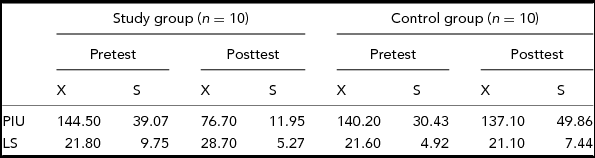
Note: PIU = problematic internet use; LS = life satisfaction.
Covariance Analysis Results for Study and Control Groups’ Life Satisfaction and Problematic Internet Use Scores
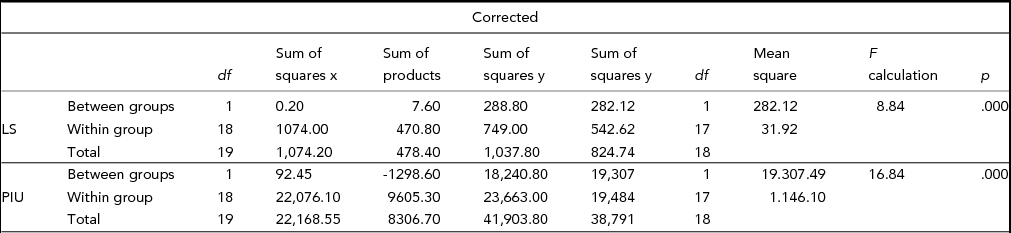
Note: PIU = problematic internet use; LS = life satisfaction.
Research Question 2: Does the Reality Therapy-Based Group Counselling Program Increase Significantly College Students’ Satisfaction With Life?
The results in Table 2 show a mean pretest life satisfaction score of 21.80 for the study group and 21.60 for the control group. Mean posttest scores were 28.70 for the study group and 21.10 for the control group. Covariance analysis was applied to subjects’ problematic internet use scores, and the results are given in Table 3. These show that the difference between the mean pre- and life satisfaction scores for the study and control groups is significant to a level of .05. The reality therapy-based group psychological counselling program significantly increases life satisfaction levels among college students.
Discussion
Looking at programs intended to reduce or eliminate problematic internet use, reality therapy-based group counselling programs are quite common and valuable (Kim, Reference Kim2007). Reality therapy emphasises the individual's own personal responsibility for his life (Corey, Reference Corey1996; Wubbolding, Reference Wubbolding2000), and the counsellor bases the client-counsellor relationship on the client's wishes, needs, and perceptions. The components of this model are wishes, actions, analysis, and plan-making (Wubbolding, Reference Wubbolding2000).
Reality therapy clients meet their own basic needs by establishing a sound road map by inquiring into their actions, wishes, self-analyses, and plans in order to select effective behaviour. Clients are encouraged to draw up their own plans for change and treatment. Later on during the therapy process, they are enabled to make their own plans for improvement by asking themselves questions. These include ‘What are you doing now and what were you doing the other day or month?,’ ‘What do you want to do or stop doing?,’ and ‘What will you do tomorrow and in the future?’ Some theorists maintain that choice theory, which occupies a broad place in reality therapy, is effective in treating various dependence-associated disorders (e.g., drugs, sex, food, and work; Glasser, Reference Glasser1985; Howatt, Reference Howatt2003). This model is based on people assuming responsibility for what they do, feel, and think in their lives. It emphasises that individuals can control their own behaviour and make new and difficult choices (Glasser, Reference Glasser1985). Therefore, the authors prepared a reality therapy-based group counselling program for college students aimed at reducing problematic internet use and increasing satisfaction with life.
On the basis of the results obtained, the reality therapy-based group psychological counselling program emerges as an effective one that reduces college students’ problematic internet use and increases their life satisfaction. The findings of the study support those from other researches investigating the effect of a reality therapy-based group psychological counselling program in reducing problematic internet use (Kim, Reference Kim2008). The literature shows that cognitive-behavioural group therapies have mainly been used in reducing problematic internet use (Chou et al., Reference Chou, Condron and Belland2005; Davis, Reference Davis2001; Wieland, Reference Wieland2005). We encountered no previous research examining the effect of reality therapy-based group psychological counselling on life satisfaction. The studies performed have mainly investigated the relationship between problematic internet use and life satisfaction (Ko et al., Reference Ko, Yen, Chen, Chen and Yen2005).
Reality therapy-based group counselling enabled participants to realise that they themselves elect to use the internet in an unhealthy way and that they are themselves are responsible for the physiological and psychological problems that arise in the individual as a result of spending hours online (Corey, Reference Corey1996; Wubbolding, Reference Wubbolding2000). In addition, by concentrating on needs, participants perform activities regarding the kind of need represented by the internet and how they can plan their time in the light of their desires and basic needs by understanding how such fundamental needs are neglected when online. We think that participants will thus attain greater satisfaction with their lives by using the internet in a healthier manner and by meeting all their needs.
Limitations and Future Research
This study involves a number of limitations. First, no follow-up data were obtained from the subject and control groups, making it impossible to evaluate long-term outcomes. Additionally, the lack of a control group receiving an alternative program restricted our ability to compare the efficacy of this program and other therapeutic models. No such steps were taken because of the difficulty in finding volunteer students willing to take part in the program and the time limitations involved. Another limitation is that the sessions concentrated more on the negative effects of the internet than on the positive ones. Sessions containing regular and controlled internet use and alternative activities keeping participants away from the internet within the program might have enhanced its efficacy. Further studies should investigate the effects of different therapeutic models on problematic internet use bearing these limitations in mind. Additionally, we recommend that the effectiveness of the program be tested with wider groups involving larger subject numbers and consisting of individuals with higher levels of problematic internet use and lower levels of life satisfaction. In conclusion, the findings of the research reveal that reality therapy-based group counselling significantly reduces the level of problematic internet use among college students and increases their life satisfaction levels.
Declaration of Conflicting Interests
The authors declared no potential conflicts of interest with respect to the research, authorship, and/or publication of this article.
Funding
The authors received no financial support for the research, authorship, and/or publication of this article.



