





1 Introduction
The search for monochromatic patterns within colourings of algebraic structures has been a longstanding theme in Ramsey theory. Among the fundamental results in this area, the celebrated van der Waerden theorem guarantees the existence of monochromatic arithmetic progressions for any finite partition of the natural numbers. This theorem illustrates that the family of arithmetic progressions is partition regular. The van der Waerden theorem is a finitary Ramsey-type result relying solely on the additive structure of $\mathbb {N}$
. Its infinitary counterpart, Hindman’s theorem, asserts that for any finite colouring of
$\mathbb {N}$
. Its infinitary counterpart, Hindman’s theorem, asserts that for any finite colouring of $\mathbb {N}$
, there exists an injective sequence whose finite sums are all monochromatic.
$\mathbb {N}$
, there exists an injective sequence whose finite sums are all monochromatic.
A natural direction in Ramsey theory is the transition from additive to multiplicative structures. One such transition can be achieved via the transformation $n \mapsto p^n$
for a prime p, leading to the multiplicative van der Waerden theorem, which states that for any finite partition of
$n \mapsto p^n$
for a prime p, leading to the multiplicative van der Waerden theorem, which states that for any finite partition of $\mathbb {N}$
, a monochromatic geometric progression of arbitrary length exists.
$\mathbb {N}$
, a monochromatic geometric progression of arbitrary length exists.
Patterns that intertwine the additive and multiplicative structures of natural numbers present greater challenges. The pioneering work of Bergelson [Reference Bergelson, Bergelson, Blass, Nasso and Jin5] and Hindman [Reference Hindman15] independently established the monochromaticity of the configuration ${a, b, c, d}$
where
${a, b, c, d}$
where $a + b = c \cdot d$
. Further progress was made by Moreira [Reference Moreira18], who demonstrated that the pattern
$a + b = c \cdot d$
. Further progress was made by Moreira [Reference Moreira18], who demonstrated that the pattern ${a, a + b, a \cdot b}$
is monochromatic. Subsequently, Barrett et al. [Reference Barrett, Lupini and Moreira1] extended this result by proving the monochromaticity of
${a, a + b, a \cdot b}$
is monochromatic. Subsequently, Barrett et al. [Reference Barrett, Lupini and Moreira1] extended this result by proving the monochromaticity of ${a, a + b, a + b + a \cdot b}$
. In [Reference Sahasrabudhe19], Sahasrabudhe proved rich exponential patterns in
${a, a + b, a + b + a \cdot b}$
. In [Reference Sahasrabudhe19], Sahasrabudhe proved rich exponential patterns in $\mathbb {N}$
, showing in particular that the sets
$\mathbb {N}$
, showing in particular that the sets $\{a,b, a^b \}$
and
$\{a,b, a^b \}$
and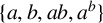 $\{a,b, ab, a^b\}$
are monochromatic where
$\{a,b, ab, a^b\}$
are monochromatic where $b>1$
. Subsequently, Goswami in [Reference Goswami13] established the result that
$b>1$
. Subsequently, Goswami in [Reference Goswami13] established the result that $\{a, b, ab, (a+1)b\}$
is monochromatic. However, the question of whether the set
$\{a, b, ab, (a+1)b\}$
is monochromatic. However, the question of whether the set $\{a, b, a + b, a \cdot b\}$
is always monochromatic remains an open problem.
$\{a, b, a + b, a \cdot b\}$
is always monochromatic remains an open problem.
Recently, in [Reference Di Nasso12], Di Nasso found many new additive and multiplicative monochromatic patterns by introducing the notions of symmetric polynomials. Polynomial extension of some important classical results, particularly the polynomial van der Waerden theorem and the polynomial Deuber theorem for symmetric polynomials, have been explored by Chakraborty and Goswami in [Reference Chakraborty and Goswami10].
Given these advances, it is natural to examine the Ramsey-theoretic properties of well-structured subsets of natural numbers. Define $S(m,n)$
as the set
$S(m,n)$
as the set
 $$ \begin{align*} S(m,n):=\{x_1^m+\cdots + x_n^m: x_1, \ldots, x_m \in \mathbb{N}_0\}. \end{align*} $$
From elementary number theory, it is well known that $S(2,4) = \mathbb {N}_0$
, while
$S(2,4) = \mathbb {N}_0$
, while $S(2,3)$
consists of natural numbers that are not of the form
$S(2,3)$
consists of natural numbers that are not of the form $4^a(8b+7)$
for some
$4^a(8b+7)$
for some $a, b \in \mathbb {N}_0$
. The set
$a, b \in \mathbb {N}_0$
. The set $S(2,3)$
lacks multiplicative closure, whereas
$S(2,3)$
lacks multiplicative closure, whereas $S(2,4)$
is multiplicatively closed but trivial in the sense that it encompasses all natural numbers. Thus, our focus is on
$S(2,4)$
is multiplicatively closed but trivial in the sense that it encompasses all natural numbers. Thus, our focus is on $\Sigma = S(2,2)$
, the set of all natural numbers whose prime factors of the form
$\Sigma = S(2,2)$
, the set of all natural numbers whose prime factors of the form $4k+3$
(if any) have even exponents.
$4k+3$
(if any) have even exponents.
We introduce a new algebraic structure on the natural numbers derived from the set of sums of two squares and, employing the Stone–Čech compactification, establish analogues of several classical results, including Hindman’s theorem, Deuber’s theorem, Brauer’s theorem, Milliken–Taylor’s theorem, the existence of geo-arithmetic progressions and a polynomial variant of van der Waerden’s theorem.
2 A new structure and Stone–Čech compactification
Let $\Sigma = \{a^2 + b^2 : a, b \in \mathbb {N}_0\} \subseteq \mathbb {N}_0$
denote the set of nonnegative integers expressible as sums of two squares. Under standard multiplication,
$\Sigma = \{a^2 + b^2 : a, b \in \mathbb {N}_0\} \subseteq \mathbb {N}_0$
denote the set of nonnegative integers expressible as sums of two squares. Under standard multiplication, $\Sigma $
forms a commutative semigroup, as the product of two elements in
$\Sigma $
forms a commutative semigroup, as the product of two elements in $\Sigma $
remains in
$\Sigma $
remains in $\Sigma $
by the identity
$\Sigma $
by the identity
 $$ \begin{align*} (a^2 + b^2)(c^2 + d^2) = (ad - bc)^2 + (ac + bd)^2. \end{align*} $$
We order $\Sigma $
increasingly as
$\Sigma $
increasingly as
 $$ \begin{align*} \Sigma = \{s_0 < s_1 < s_2 < s_3 < \cdots\}; \end{align*} $$
the first few elements are $s_0 = 0$
,
$s_0 = 0$
, $s_1 = 1$
,
$s_1 = 1$
, $s_2 = 2$
,
$s_2 = 2$
, $s_3 = 4$
,
$s_3 = 4$
, $s_4 = 5$
,
$s_4 = 5$
, $s_5 = 8$
,
$s_5 = 8$
, $s_6 = 9$
,
$s_6 = 9$
, $s_7 = 10$
,
$s_7 = 10$
, $s_8 = 13$
,
$s_8 = 13$
, $s_9 = 16$
,
$s_9 = 16$
, $s_{10} = 17$
,
$s_{10} = 17$
, $s_{11} = 18$
,
$s_{11} = 18$
, $s_{12} = 20$
,
$s_{12} = 20$
, $s_{13} = 25$
,
$s_{13} = 25$
, $s_{14} = 26$
,
$s_{14} = 26$
, $s_{15} = 29$
,
$s_{15} = 29$
, $s_{16} = 32$
.
$s_{16} = 32$
.
For $s \in \Sigma $
, define the predecessor set
$s \in \Sigma $
, define the predecessor set $\Sigma _{<s} = \{y \in \Sigma : y < s\}$
. Let
$\Sigma _{<s} = \{y \in \Sigma : y < s\}$
. Let $g: \Sigma \to \mathbb {N}_0$
be the function
$g: \Sigma \to \mathbb {N}_0$
be the function
 $$ \begin{align*} g(s) = |\Sigma_{<s}|, \end{align*} $$
which counts the number of elements in $\Sigma $
strictly less than s; g is a bijection, with inverse
$\Sigma $
strictly less than s; g is a bijection, with inverse $f: \mathbb {N}_0 \to \Sigma $
given by
$f: \mathbb {N}_0 \to \Sigma $
given by $f(n) = s_n$
, the nth term in the ordered sequence of
$f(n) = s_n$
, the nth term in the ordered sequence of $\Sigma $
.
$\Sigma $
.
Definition 2.1 (Induced operation)
The operation $\ast _f$
on
$\ast _f$
on $\mathbb {N}_0$
is defined by
$\mathbb {N}_0$
is defined by
 $$ \begin{align*} m \ast_f n = g(f(m) \cdot f(n)) = |\Sigma_{<s_m \cdot s_n}|. \end{align*} $$
Example 2.2. Let $m = 2$
and
$m = 2$
and $n = 5$
. Then,
$n = 5$
. Then, $s_m = 2$
and
$s_m = 2$
and $s_n = 8$
. Their product is
$s_n = 8$
. Their product is ${s_m \cdot s_n = 16 = s_9}$
. The set
${s_m \cdot s_n = 16 = s_9}$
. The set $\Sigma _{<16}$
contains the first nine elements of
$\Sigma _{<16}$
contains the first nine elements of $\Sigma $
(that is,
$\Sigma $
(that is, $s_0, s_1, \ldots , s_8$
), so
$s_0, s_1, \ldots , s_8$
), so $|\Sigma _{<16}| = 9$
. Hence,
$|\Sigma _{<16}| = 9$
. Hence, $2 \ast _f 5 = 9$
.
$2 \ast _f 5 = 9$
.
Remark 2.3. Note that $\Sigma $
is multiplicatively closed, that is, the product
$\Sigma $
is multiplicatively closed, that is, the product $ s_i \cdot s_j = s_k $
is an element of
$ s_i \cdot s_j = s_k $
is an element of $ \Sigma $
for some
$ \Sigma $
for some $ k \in \mathbb {N} \cup \{0\} $
. The value of
$ k \in \mathbb {N} \cup \{0\} $
. The value of $ k $
depends on the ordering (based on the numerical value) of
$ k $
depends on the ordering (based on the numerical value) of $ \Sigma $
, which is not uniquely determined by
$ \Sigma $
, which is not uniquely determined by $ i $
and
$ i $
and $ j $
alone.
$ j $
alone.
Proposition 2.4. $(\mathbb {N}_0, \ast _f)$
is a commutative semigroup with identity element
$(\mathbb {N}_0, \ast _f)$
is a commutative semigroup with identity element $1$
and
$1$
and $f: (\mathbb {N}_0, \ast _f) \to (\Sigma , \cdot )$
is a semigroup isomorphism.
$f: (\mathbb {N}_0, \ast _f) \to (\Sigma , \cdot )$
is a semigroup isomorphism.
Proof. The operation $\ast _f$
inherits associativity and commutativity from the semigroup
$\ast _f$
inherits associativity and commutativity from the semigroup $(\Sigma , \cdot )$
via the bijection f. Moreover:
$(\Sigma , \cdot )$
via the bijection f. Moreover:
-
• for all $n \in \mathbb {N}_0$
, since
$$ \begin{align*} 1 \ast_f n = g(f(1) \cdot f(n)) = g(s_1 \cdot s_n) = g(s_n) = |\Sigma_{<s_n}| = n, \end{align*} $$
$s_1 = 1$
is the multiplicative identity in
$\Sigma $
;
$n \in \mathbb {N}_0$
, since
$$ \begin{align*} 1 \ast_f n = g(f(1) \cdot f(n)) = g(s_1 \cdot s_n) = g(s_n) = |\Sigma_{<s_n}| = n, \end{align*} $$
$s_1 = 1$
is the multiplicative identity in
$\Sigma $
;
-
• by definition,
confirming f is a homomorphism; as f is bijective, it is an isomorphism.
$$ \begin{align*} f(m \ast_f n) = f(g(s_m \cdot s_n)) = s_{g(s_m \cdot s_n)} = s_m \cdot s_n = f(m) \cdot f(n), \end{align*} $$


Define the power $x^{(n)}$
in
$x^{(n)}$
in $(\mathbb {N}_0, \ast _f)$
recursively by:
$(\mathbb {N}_0, \ast _f)$
recursively by:
-
•
$x^{(0)} = 1$
; -
•
$x^{(n)} = x \ast _f x^{(n-1)} = x \ast _f x \ast _f \cdots \ast _f x = |\Sigma _{<s_x^n}|$
.


We briefly recall the algebraic structure of the Stone–Čech compactification $\beta S$
for a discrete semigroup
$\beta S$
for a discrete semigroup $(S, \cdot )$
. The elements of
$(S, \cdot )$
. The elements of $\beta S$
are the ultrafilters on S. By identifying the principal ultrafilters with the points of S, we may regard S as a subset of
$\beta S$
are the ultrafilters on S. By identifying the principal ultrafilters with the points of S, we may regard S as a subset of $\beta S$
, that is,
$\beta S$
, that is, $S \subseteq \beta S$
.
$S \subseteq \beta S$
.
For a subset $A \subseteq S$
, define
$A \subseteq S$
, define
 $$ \begin{align*} \overline{A} = \{p \in \beta S \mid A \in p\}. \end{align*} $$
The collection $\{\overline {A} \mid A \subseteq S\}$
forms a basis for a topology on
$\{\overline {A} \mid A \subseteq S\}$
forms a basis for a topology on $\beta S$
. The semigroup operation
$\beta S$
. The semigroup operation $\cdot $
on S can be extended to
$\cdot $
on S can be extended to $\beta S$
, making
$\beta S$
, making $(\beta S, \cdot )$
a compact right topological semigroup. This means:
$(\beta S, \cdot )$
a compact right topological semigroup. This means:
-
• for any
$p \in \beta S$
, the right translation map
$\rho _p: \beta S \to \beta S$
defined by
$\rho _p(q) = q \cdot p$
is continuous; -
• the semigroup S is contained in the topological centre of
$\beta S$
, meaning that for any
$x \in S$
, the left translation map
$\lambda _x: \beta S \to \beta S$
defined by
$\lambda _x(q) = x \cdot q$
is continuous.







The extended operation on $\beta S$
is characterised as follows: for
$\beta S$
is characterised as follows: for $p, q \in \beta S$
and
$p, q \in \beta S$
and $A \subseteq S$
,
$A \subseteq S$
,
 $$ \begin{align*} A \in p \cdot q \quad\mbox{if and only if}\quad \{x \in S \mid x^{-1} A \in q\} \in p, \end{align*} $$
where $x^{-1} A = \{y \in S \mid x \cdot y \in A\}$
. A fundamental result due to Ellis states that every compact right topological semigroup contains an idempotent element. Thus, there exists an idempotent ultrafilter
$x^{-1} A = \{y \in S \mid x \cdot y \in A\}$
. A fundamental result due to Ellis states that every compact right topological semigroup contains an idempotent element. Thus, there exists an idempotent ultrafilter $p \in \beta S$
satisfying
$p \in \beta S$
satisfying $p \cdot p = p$
.
$p \cdot p = p$
.
For a sequence $\langle x_n \rangle _{n=1}^\infty $
in
$\langle x_n \rangle _{n=1}^\infty $
in $(S, \cdot )$
, the set of finite products is defined by
$(S, \cdot )$
, the set of finite products is defined by
 $$ \begin{align*} \textit{FP}(\langle x_n \rangle_{n=1}^\infty) = \{x_{n_1} \cdot x_{n_2} \cdots x_{n_k} \mid n_1 < n_2 < \cdots < n_k\}. \end{align*} $$
Idempotent ultrafilters play a crucial role in Ramsey theory. This is exemplified by Galvin’s theorem, which states that for any semigroup $(S, \cdot )$
and an idempotent ultrafilter
$(S, \cdot )$
and an idempotent ultrafilter $p = p \cdot p$
in
$p = p \cdot p$
in $(\beta S, \cdot )$
, every set
$(\beta S, \cdot )$
, every set $A \in p$
contains the set of finite products
$A \in p$
contains the set of finite products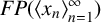 $\textit {FP}(\langle x_n \rangle _{n=1}^\infty )$
for some sequence
$\textit {FP}(\langle x_n \rangle _{n=1}^\infty )$
for some sequence $\langle x_n \rangle _{n=1}^\infty $
in S. For further details on the Stone–Čech compactification and its applications in Ramsey theory, see [Reference Hindman and Strauss16, Reference Todorcevic21].
$\langle x_n \rangle _{n=1}^\infty $
in S. For further details on the Stone–Čech compactification and its applications in Ramsey theory, see [Reference Hindman and Strauss16, Reference Todorcevic21].
Since $(\mathbb {N}_0, \ast _f)$
is a discrete commutative semigroup, its Stone–Čech compactification
$(\mathbb {N}_0, \ast _f)$
is a discrete commutative semigroup, its Stone–Čech compactification $(\mathbb {N}_0, \ast _f)$
gives rise to numerous Ramsey-type results in
$(\mathbb {N}_0, \ast _f)$
gives rise to numerous Ramsey-type results in $\mathbb {N}_0$
induced by the operation
$\mathbb {N}_0$
induced by the operation $\ast _f$
.
$\ast _f$
.
3 Monochromatic configurations
In this section, we introduce new monochromatic configurations within the semigroup $(\mathbb {N}, \ast _f)$
, which encodes information about sums of two squares. We begin with the following definition.
$(\mathbb {N}, \ast _f)$
, which encodes information about sums of two squares. We begin with the following definition.
For any infinite sequence of natural numbers $\langle x_n \rangle _{n=1}^{\infty }$
, the corresponding set of finite sums is denoted and defined by
$\langle x_n \rangle _{n=1}^{\infty }$
, the corresponding set of finite sums is denoted and defined by
 $$ \begin{align*}\textit{FS}(\langle x_n\rangle_{n=1}^{\infty}) = \{ x_{n_1} + x_{n_2} + \cdots + {x_{n_k}} : n_1 < n_2 < \cdots < n_k \}.\end{align*} $$
A fundamental result in arithmetic Ramsey theory due to Hindman guarantees the existence of infinite monochromatic patterns within such sets of finite sums.
Theorem 3.1 (Hindman’s finite sum theorem, [Reference Hindman14])
Let $r \geq 1$
. For every r-colouring of the natural numbers,
$r \geq 1$
. For every r-colouring of the natural numbers, $\mathbb {N} = C_1 \cup C_2 \cup \cdots \cup C_r$
, there exists a colour
$\mathbb {N} = C_1 \cup C_2 \cup \cdots \cup C_r$
, there exists a colour $C_i$
and a sequence
$C_i$
and a sequence $\langle x_n \rangle _{n=1}^{\infty }$
in
$\langle x_n \rangle _{n=1}^{\infty }$
in $\mathbb {N}$
such that
$\mathbb {N}$
such that $\textit {FS}(\langle x_n \rangle _{n=1}^{\infty }) \subseteq C_i.$
A similar result holds when considering finite products instead of finite sums and, more generally, in any semigroup [Reference Hindman and Strauss16, Theorem 5.8]. Analogously, for the semigroup $(\mathbb {N}_0, \ast _f)$
, we define the set of finite
$(\mathbb {N}_0, \ast _f)$
, we define the set of finite $\ast _f$
-operations by
$\ast _f$
-operations by
 $$ \begin{align*} \mathfrak{FP}_f(\langle x_n \rangle_{n=1}^{\infty}) & = \{x_{n_1} \ast_f x_{n_2} \ast_f \cdots \ast_f x_{n_k} : n_1 < n_2 < \cdots < n_k\} \\ & = \{|\Sigma_{< s_{x_{n_1}} s_{x_{n_2}} \cdots s_{x_{n_k}}}| : n_1 < n_2 < \cdots < n_k\}, \end{align*} $$
where $\Sigma $
denotes the set of sums of two squares.
$\Sigma $
denotes the set of sums of two squares.
Theorem 3.2. For any $r \geq 1$
and any finite r-colouring of the nonnegative integers,
$r \geq 1$
and any finite r-colouring of the nonnegative integers, $\mathbb {N}_0 = C_1 \cup C_2 \cup \cdots \cup C_r$
, there exist a colour
$\mathbb {N}_0 = C_1 \cup C_2 \cup \cdots \cup C_r$
, there exist a colour $C_i$
and a sequence
$C_i$
and a sequence $\langle x_n \rangle _{n=1}^{\infty }$
in
$\langle x_n \rangle _{n=1}^{\infty }$
in $\mathbb {N}$
such that
$\mathbb {N}$
such that
 $$ \begin{align*}\mathfrak{FP}_f(\langle x_n \rangle_{n=1}^{\infty}) = |\Sigma_{< s_{x_{n_1}} s_{x_{n_2}} \cdots s_{x_{n_k}}}| : n_1 < n_2 < \cdots < n_k\} \subseteq C_i.\end{align*} $$
Proof. The proof is verbatim from the proof of the Hindman’s theorem [Reference Hindman and Strauss16, Theorem 5.8], replacing the usual addition with the associative operation $\ast _f$
.
$\ast _f$
.
A cornerstone result in arithmetic Ramsey theory is van der Waerden’s theorem (1927), which guarantees the existence of arbitrarily long monochromatic arithmetic progressions. A year later, Brauer strengthened this result by showing that one can also ensure that the common difference belongs to the same colour class as the elements of the progression.
Theorem 3.3 (van der Waerden’s theorem, [Reference van der Waerden22])
For every finite colouring ${\mathbb {N} = C_1 \cup C_2 \cup \cdots \cup C_r}$
and for every
${\mathbb {N} = C_1 \cup C_2 \cup \cdots \cup C_r}$
and for every $L \in \mathbb {N}$
, there exists a monochromatic arithmetic progression of length L; that is, there exist a colour
$L \in \mathbb {N}$
, there exists a monochromatic arithmetic progression of length L; that is, there exist a colour $C_i$
and elements
$C_i$
and elements $a, b \in \mathbb {N}$
such that
$a, b \in \mathbb {N}$
such that $a, a+b, a+2b, \ldots , a+Lb \in C_i.$
Theorem 3.4 (Brauer’s theorem, [Reference Brauer9])
For every finite colouring $\mathbb {N} = C_1 \cup C_2 \cup \cdots \cup C_r$
and for every
$\mathbb {N} = C_1 \cup C_2 \cup \cdots \cup C_r$
and for every $k \in \mathbb {N}$
, there exist a colour
$k \in \mathbb {N}$
, there exist a colour $C_i$
and elements
$C_i$
and elements $a, b \in \mathbb {N}$
such that
$a, b \in \mathbb {N}$
such that ${\{a, b, a+b, a+2b, \ldots , a+kb\} \subseteq C_i.}$
We establish an analogous version of Brauer’s theorem in our setting.
Theorem 3.5. For every finite colouring $\mathbb {N}_0 = C_1 \cup C_2 \cup \cdots \cup C_r$
and for every
$\mathbb {N}_0 = C_1 \cup C_2 \cup \cdots \cup C_r$
and for every ${k \in \mathbb {N}}$
, there exist a colour
${k \in \mathbb {N}}$
, there exist a colour $C_i$
and elements
$C_i$
and elements $x, z \in \mathbb {N}$
such that
$x, z \in \mathbb {N}$
such that
 $$ \begin{align*}\{x, z, |\Sigma_{<{s_x^j}s_z}|: j=1,2, \ldots, k\} \subseteq C_i.\end{align*} $$
Deuber established a result concerning the generalised partition regularity of homogeneous systems of linear Diophantine equations. In particular, he demonstrated the partition regularity of the so-called $(m,p,c)$
-sets.
$(m,p,c)$
-sets.
Theorem 3.6 (Deuber’s theorem, [Reference Deuber11])
For every $m, p, c \in \mathbb {N}$
and for every finite colouring
$m, p, c \in \mathbb {N}$
and for every finite colouring $\mathbb {N}= C_1 \cup C_2 \cup \cdots \cup C_r$
, there exists a monochromatic
$\mathbb {N}= C_1 \cup C_2 \cup \cdots \cup C_r$
, there exists a monochromatic $(m,p,c)$
-set. That is, there exists a colour
$(m,p,c)$
-set. That is, there exists a colour $C_i$
and elements
$C_i$
and elements $a_0, a_1, \ldots , a_m \in C_i$
such that
$a_0, a_1, \ldots , a_m \in C_i$
such that $ca_j + \sum _{s=0}^{j-1} n_s a_s \in C_i \mbox {for every } j \in \{1,2, \ldots , m \} \mbox { and for all } n_0, n_1, \ldots , n_{j-1} \in \{-p, \ldots , p\}$
,
$ca_j + \sum _{s=0}^{j-1} n_s a_s \in C_i \mbox {for every } j \in \{1,2, \ldots , m \} \mbox { and for all } n_0, n_1, \ldots , n_{j-1} \in \{-p, \ldots , p\}$
,
We present an analogous version of Deuber’s theorem in our context.
Theorem 3.7. Let $m, p, r \in \mathbb {N}$
. For every r-colouring
$m, p, r \in \mathbb {N}$
. For every r-colouring $\mathbb {N}_0 = C_1 \cup C_2 \cup \cdots \cup C_r$
, there exists a colour
$\mathbb {N}_0 = C_1 \cup C_2 \cup \cdots \cup C_r$
, there exists a colour $C_i$
and elements
$C_i$
and elements $x_0, x_1, \ldots , x_m \in C_i$
such that
$x_0, x_1, \ldots , x_m \in C_i$
such that
 $$ \begin{align*} \{|\Sigma_{<{s_{x_0}^{n_0}}{s_{x_1}^{n_1}} \cdots {s_{x_{j-1}}^{n_{j-1}}} {s_{x_j}}}| : n_0, n_1, \ldots, n_{j-1} \in \{0,1, \ldots, p\} \mbox{ and } j=1,2, \ldots, m \} \subseteq C_i .\end{align*} $$
Proof. We prove this theorem using a generalisation of Deuber’s theorem for commutative semirings, recently established by Bergelson et al. in [Reference Bergelson, Johnson and Moreira7, Corollary 3.7]. This result can be stated as follows.
Let $(S, \ast )$
be a commutative semigroup and, for each
$(S, \ast )$
be a commutative semigroup and, for each $j=1,2, \ldots , m$
, let
$j=1,2, \ldots , m$
, let $\mathfrak {F}_j$
be a finite set of endomorphisms
$\mathfrak {F}_j$
be a finite set of endomorphisms $\psi : S^j \to S$
. Then, for every r-colouring
$\psi : S^j \to S$
. Then, for every r-colouring $S=C_1 \cup C_2 \cup \cdots \cup C_r$
, there exist a colour
$S=C_1 \cup C_2 \cup \cdots \cup C_r$
, there exist a colour $C_i$
and elements
$C_i$
and elements $x_0, x_1, \ldots , x_m$
distinct from the identity such that
$x_0, x_1, \ldots , x_m$
distinct from the identity such that $x_0 \in C_i$
and
$x_0 \in C_i$
and
 $$ \begin{align*} \psi(x_0, x_1, \ldots, x_{j-1}) \ast x_j \in C_i \quad \mbox{ for every } j=1,2, \ldots, m \mbox{ and for every } \psi \in \mathfrak{F}_j.\end{align*} $$
This statement generalises Theorem 3.6 for the case $c=1$
. We apply the Bergelson–Johnson–Moreira result with
$c=1$
. We apply the Bergelson–Johnson–Moreira result with $(S, \ast ) = (\mathbb {N}_0, \ast _f)$
. For each j-tuple
$(S, \ast ) = (\mathbb {N}_0, \ast _f)$
. For each j-tuple $\bar {n}=(n_0, n_1, \ldots , n_{j-1}) \in (\mathbb {N}_0)^j$
, define
$\bar {n}=(n_0, n_1, \ldots , n_{j-1}) \in (\mathbb {N}_0)^j$
, define
 $$ \begin{align*} \psi_{\bar{n}} : (x_0, x_1, \ldots, x_{j-1})\mapsto {x_0}^{(n_0)} \ast_f {x_1}^{(n_1)} \ast_f \cdots \ast_f {x_j}^{(n_j)}. \end{align*} $$
Since $(\mathbb {N}_0, \ast _f)$
is a commutative semigroup, each
$(\mathbb {N}_0, \ast _f)$
is a commutative semigroup, each $\psi _{\bar {n}}$
is a semigroup homomorphism. Define
$\psi _{\bar {n}}$
is a semigroup homomorphism. Define
 $$ \begin{align*} \mathfrak{F}_j= \{\psi_{\bar{n}} : \mathbb{N}^j \rightarrow \mathbb{N} : \bar{n}=(n_0, n_1, \ldots, n_{j-1}) \in \{0,1,2, \ldots, p\}^j\}, \end{align*} $$
which consists of homomorphisms for each $j{\kern-1pt}={\kern-1pt}1,{\kern-1pt}2, \ldots , m$
. By the Bergelson–Johnson–Moreira theorem, for every finite colouring
$j{\kern-1pt}={\kern-1pt}1,{\kern-1pt}2, \ldots , m$
. By the Bergelson–Johnson–Moreira theorem, for every finite colouring $\mathbb {N}= C_1 \cup C_2 \cup \cdots \cup C_r$
, there exist a colour
$\mathbb {N}= C_1 \cup C_2 \cup \cdots \cup C_r$
, there exist a colour $C_i$
and elements
$C_i$
and elements $x_0, x_1, \ldots , x_m$
distinct from the identity such that:
$x_0, x_1, \ldots , x_m$
distinct from the identity such that:
-
•
$x_0 \in C_i$
; -
•
$\psi _{\bar {n}}(x_0, x_1, \ldots , x_{j-1}) \ast _f x_j \in C_i$
for every
$j=1,2, \ldots , m$
and all
$\bar {n} \in \{0,1,2, \ldots , p\}^j$
.




From the second condition, we deduce that
 $$ \begin{align*} \psi_{\bar{n}}(x_0,x_1, \ldots, x_{j-1}) \ast_f x_j = {x_0}^{(n_0)} \ast_f {x_1}^{(n_1)} \ast_f \cdots \ast_f {x_j}^{(n_j)} \ast_f x_j \in C_i. \end{align*} $$
Therefore, for all $(n_0, n_1, \ldots , n_{j-1}) \in \{0,1, \ldots , p\}^j \mbox { and } j=1,2, \ldots , m$
, we obtain
$(n_0, n_1, \ldots , n_{j-1}) \in \{0,1, \ldots , p\}^j \mbox { and } j=1,2, \ldots , m$
, we obtain
 $$ \begin{align*}|\Sigma_{<{s_{x_0}^{n_0}}{s_{x_1}^{n_1}} \cdots {s_{x_{j-1}}^{n_{j-1}}} {s_{x_j}}}| \in C_i.\end{align*} $$
Hence, the result follows.
Proof of Theorem 3.5
The proof follows from the Bergelson–Johnson–Moreira theorem, as in Theorem 3.7. For $j=0,1,2, \ldots , k+1$
, let
$j=0,1,2, \ldots , k+1$
, let $\psi _j : (\mathbb {N}, \ast _f) \to (\mathbb {N}, \ast _f)$
be the endomorphism defined by
$\psi _j : (\mathbb {N}, \ast _f) \to (\mathbb {N}, \ast _f)$
be the endomorphism defined by $\psi _j(x) = x^{(j)}$
. Then, for every r-colouring
$\psi _j(x) = x^{(j)}$
. Then, for every r-colouring $\mathbb {N}= C_1 \cup C_2 \cup \cdots \cup C_r$
, there exist a colour
$\mathbb {N}= C_1 \cup C_2 \cup \cdots \cup C_r$
, there exist a colour $C_i$
and elements
$C_i$
and elements $x, y \neq 1$
such that
$x, y \neq 1$
such that
 $$ \begin{align*} \{x, \psi_0(x) \ast_f y, \psi_1(x) \ast_f y, \psi_2(x) \ast_f y , \ldots, \psi_{k+1}(x) \ast_f y\} \subseteq C_i. \end{align*} $$
Setting $z:= x \ast _f y$
, we obtain
$z:= x \ast _f y$
, we obtain
 $$ \begin{align*} \{x, z, x\ast_f z, x^{(2)} \ast_f z, x^{(3)} \ast_f z , \ldots, x^{(k)} \ast_f z \} = \{x, z, |\Sigma_{<s_x^js_z}|: j=1,2, \ldots, k\} \subseteq C_i. \end{align*} $$
Hence, the result follows.
4 Milliken–Taylor theorem
The Milliken–Taylor theorem simultaneously generalises Hindman’s finite sums theorem and Ramsey’s theorem. It has been widely applied in combinatorial number theory, including extensions of Szemerédi’s theorem on arithmetic progressions.
To state the theorem, we first establish some notation. Let $\mathcal {P}_f(\mathbb {N})$
denote the set of all finite nonempty subsets of
$\mathcal {P}_f(\mathbb {N})$
denote the set of all finite nonempty subsets of $\mathbb {N}$
. For
$\mathbb {N}$
. For $m \in \mathbb {N}$
, define
$m \in \mathbb {N}$
, define $[\mathbb {N}]^m = \{A \subseteq \mathbb {N} : |A| = m\}$
. For
$[\mathbb {N}]^m = \{A \subseteq \mathbb {N} : |A| = m\}$
. For $F, G \in \mathcal {P}_f(\mathbb {N})$
, we write
$F, G \in \mathcal {P}_f(\mathbb {N})$
, we write $F < G$
if
$F < G$
if $\max F < \min G$
.
$\max F < \min G$
.
Theorem 4.1 (Milliken–Taylor theorem [Reference Milliken17, Reference Taylor20])
Let $r, m \in \mathbb {N}$
and let
$r, m \in \mathbb {N}$
and let $[\mathbb {N}]^m = C_1 \cup \cdots \cup C_r$
be an r-colouring. There exist an injective sequence
$[\mathbb {N}]^m = C_1 \cup \cdots \cup C_r$
be an r-colouring. There exist an injective sequence $\langle x_n \rangle _{n=1}^\infty $
in
$\langle x_n \rangle _{n=1}^\infty $
in $\mathbb {N}$
and a colour
$\mathbb {N}$
and a colour $C_i$
such that
$C_i$
such that
 $$ \begin{align*} \{(x_{F_1}, \ldots, x_{F_m}) : F_1 < \cdots < F_m\} \subseteq C_i, \end{align*} $$
where for $F = \{n_1 < \cdots < n_k\} \in \mathcal {P}_f(\mathbb {N})$
, we define
$F = \{n_1 < \cdots < n_k\} \in \mathcal {P}_f(\mathbb {N})$
, we define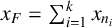 $x_F = \sum _{i=1}^k x_{n_i}$
.
$x_F = \sum _{i=1}^k x_{n_i}$
.
Remark 4.2. When $m=1$
, this reduces to Hindman’s theorem. If each
$m=1$
, this reduces to Hindman’s theorem. If each $F_i$
is a singleton, we recover Ramsey’s theorem.
$F_i$
is a singleton, we recover Ramsey’s theorem.
4.1 Ultrafilter formulation
The theorem admits an ultrafilter-theoretic formulation using tensor products. Let $(S_i, \cdot )$
be semigroups and
$(S_i, \cdot )$
be semigroups and $p_i \in \beta S_i$
ultrafilters. The tensor product
$p_i \in \beta S_i$
ultrafilters. The tensor product $\bigotimes _{i=1}^k p_i \in \beta (\times _{i=1}^k S_i)$
is defined inductively:
$\bigotimes _{i=1}^k p_i \in \beta (\times _{i=1}^k S_i)$
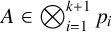
is defined inductively:
-
• for
$k=1$
,
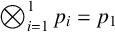
$\bigotimes _{i=1}^1 p_i = p_1$
; -
• for
$k \geq 1$
,
$A \in \bigotimes _{i=1}^{k+1} p_i$
if and only if
$$ \begin{align*} \{(x_1, \ldots, x_k) \in \times_{i=1}^k S_i : \{x_{k+1} \in S_{k+1} : (x_1, \ldots, x_{k+1}) \in A\} \in p_{k+1}\} \in \bigotimes_{i=1}^k p_i. \end{align*} $$



Theorem 4.3 (Bergelson–Hindman–Williams [Reference Bergelson, Hindman and Williams6])
Let S be a semigroup, $m \in \mathbb {N}$
and
$m \in \mathbb {N}$
and $A \subseteq \times _{i=1}^m S$
. The following statements are equivalent.
$A \subseteq \times _{i=1}^m S$
. The following statements are equivalent.
-
• There exists a sequence
$\langle x_n \rangle _{n=1}^\infty $
in S with
$\{(x_{F_1}, \ldots , x_{F_m}) : F_1 < \cdots < F_m\} \subseteq A$
. -
• There exists an idempotent ultrafilter
$p \in \beta S$
such that
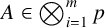
$A \in \bigotimes _{i=1}^m p$
.



For a function $\phi : X \to Y$
, the induced map
$\phi : X \to Y$
, the induced map $\phi _*: \beta X \to \beta Y$
is defined by
$\phi _*: \beta X \to \beta Y$
is defined by $\phi _*(p) = \{B \subseteq Y : \phi ^{-1}(B) \in p\}$
. Note that
$\phi _*(p) = \{B \subseteq Y : \phi ^{-1}(B) \in p\}$
. Note that $A \in p$
implies
$A \in p$
implies $\phi (A) \in \phi _*(p)$
, but the converse fails.
$\phi (A) \in \phi _*(p)$
, but the converse fails.
Corollary 4.4. Let $(S, \cdot )$
be a semigroup,
$(S, \cdot )$
be a semigroup, $m \in \mathbb {N}$
,
$m \in \mathbb {N}$
, $\phi : S^m \to S$
and
$\phi : S^m \to S$
and $B \subseteq S$
. The following statements are equivalent.
$B \subseteq S$
. The following statements are equivalent.
-
• There exists a sequence
$\langle x_n \rangle _{n=1}^\infty $
in S with
$\{\phi (x_{F_1}, \ldots , x_{F_m}) : F_1 < \cdots < F_m\} \subseteq B$
. -
•
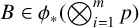
$B \in \phi _*(\bigotimes _{i=1}^m p)$
for some idempotent
$p \in \beta S$
.



Proof. Apply Theorem 4.3 with $A = \phi ^{-1}(B)$
. For details, see [Reference Di Nasso12, Corollary 5.4].
$A = \phi ^{-1}(B)$
. For details, see [Reference Di Nasso12, Corollary 5.4].
Theorem 4.5. Let $r, m \in \mathbb {N}$
,
$r, m \in \mathbb {N}$
, $\phi : (\mathbb {N}_0)^m \to \mathbb {N}_0$
and
$\phi : (\mathbb {N}_0)^m \to \mathbb {N}_0$
and $\mathbb {N}_0 = C_1 \cup \cdots \cup C_r$
be an r-colouring. There exists a sequence
$\mathbb {N}_0 = C_1 \cup \cdots \cup C_r$
be an r-colouring. There exists a sequence $\langle x_n \rangle _{n=1}^\infty $
in
$\langle x_n \rangle _{n=1}^\infty $
in $\mathbb {N}$
and a colour
$\mathbb {N}$
and a colour $C_i$
such that
$C_i$
such that
 $$ \begin{align*} \{\phi(|\Sigma_{<F_1}|, \ldots, |\Sigma_{<F_m}|) : F_1 < \cdots < F_m \} \subseteq C_i,\end{align*} $$
where for $F_j = \{n_{j_1} < \cdots < n_{j_{k_j}}\} \in \mathcal {P}_f(\mathbb {N})$
, we define
$F_j = \{n_{j_1} < \cdots < n_{j_{k_j}}\} \in \mathcal {P}_f(\mathbb {N})$
, we define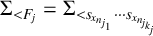 $\Sigma _{<F_j} = \Sigma _{<s_{x_{n_{j_1}}} \cdots s_{x_{n_{j_{k_j}}}}}$
.
$\Sigma _{<F_j} = \Sigma _{<s_{x_{n_{j_1}}} \cdots s_{x_{n_{j_{k_j}}}}}$
.
Proof. Let $(S, \cdot ) = (\mathbb {N}_0, \ast _f)$
, where
$(S, \cdot ) = (\mathbb {N}_0, \ast _f)$
, where $\ast _f$
is defined by
$\ast _f$
is defined by $x \ast _f y = |\Sigma _{<s_x s_y}|$
. Let
$x \ast _f y = |\Sigma _{<s_x s_y}|$
. Let $p \in \beta \mathbb {N}_0$
be an idempotent ultrafilter. By Corollary 4.4, with
$p \in \beta \mathbb {N}_0$
be an idempotent ultrafilter. By Corollary 4.4, with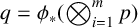 $q = \phi _*(\bigotimes _{i=1}^m p)$
, there exist
$q = \phi _*(\bigotimes _{i=1}^m p)$
, there exist $C_i \in q$
and a sequence
$C_i \in q$
and a sequence $\langle x_n \rangle _{n=1}^{\infty }$
such that
$\langle x_n \rangle _{n=1}^{\infty }$
such that
 $$ \begin{align*} \{\phi(x_{F_1}, \ldots, x_{F_m}) : F_1 < \cdots < F_m\} \subseteq C_i. \end{align*} $$
For $F_j = \{n_{j_1} < \cdots < n_{j_{k_j}}\}$
, compute
$F_j = \{n_{j_1} < \cdots < n_{j_{k_j}}\}$
, compute
 $$ \begin{align*} x_{F_j} = x_{n_{j_1}} \ast_f \cdots \ast_f x_{n_{j_{k_j}}} = |\Sigma_{<s_{x_{n_{j_1}}} \cdots s_{x_{n_{j_{k_j}}}}}| = |\Sigma_{<F_j}|. \end{align*} $$
Substituting into $\phi $
yields the result.
$\phi $
yields the result.
5 Application of the Hales–Jewett theorem
We start this section with the definition of a partial semigroup.
Definition 5.1. A partial semigroup is a triple $(S, X \subseteq S \times S, \ast )$
of a set S, a subset
$(S, X \subseteq S \times S, \ast )$
of a set S, a subset $X \subseteq S \times S$
and an operation
$X \subseteq S \times S$
and an operation $\ast $
defined on X, satisfying
$\ast $
defined on X, satisfying
 $$ \begin{align*} (x \ast y) \ast z = x \ast (y \ast z) \quad \mbox{for all } x,y,z \in G, \end{align*} $$
in the sense that if either side is defined, so is the other and they are equal.
Let $\mathcal {A}$
be a nonempty, finite set called the alphabet and
$\mathcal {A}$
be a nonempty, finite set called the alphabet and $v \notin \mathcal {A}$
be a symbol called a variable. A located word in the alphabet
$v \notin \mathcal {A}$
be a symbol called a variable. A located word in the alphabet $\mathcal {A}$
is a finitely supported function
$\mathcal {A}$
is a finitely supported function $b : \mathrm {Dom}(b) \rightarrow \mathcal {A}$
, where
$b : \mathrm {Dom}(b) \rightarrow \mathcal {A}$
, where $\mathrm {Dom}(b)$
is a (possibly empty) finite subset of
$\mathrm {Dom}(b)$
is a (possibly empty) finite subset of $\mathbb {N}_0.$
Similarly, a located variable word in the alphabet
$\mathbb {N}_0.$
Similarly, a located variable word in the alphabet $\mathcal {A}$
for a variable v is a finitely supported function
$\mathcal {A}$
for a variable v is a finitely supported function $b : \mathrm {Dom}(b) \rightarrow \mathcal {A} \cup \{v\}$
whose range contains v. Let
$b : \mathrm {Dom}(b) \rightarrow \mathcal {A} \cup \{v\}$
whose range contains v. Let $L(\mathcal {A})$
be the set of located words in
$L(\mathcal {A})$
be the set of located words in $\mathcal {A}$
and let
$\mathcal {A}$
and let $L(\mathcal {A} v)$
be the set of located variable words in
$L(\mathcal {A} v)$
be the set of located variable words in $\mathcal {A}$
for the variable
$\mathcal {A}$
for the variable $v.$
Then,
$v.$
Then, $S:= L(\mathcal {A}) \cup L(\mathcal {A} v)$
has a natural partial semigroup operation, obtained by letting
$S:= L(\mathcal {A}) \cup L(\mathcal {A} v)$
has a natural partial semigroup operation, obtained by letting $b_0 \ast b_1$
be defined whenever the domains of
$b_0 \ast b_1$
be defined whenever the domains of $b_0$
and
$b_0$
and $b_1$
are disjoint. In such a case,
$b_1$
are disjoint. In such a case, $b_0 \ast b_1$
is just
$b_0 \ast b_1$
is just $b_0 \cup b_1.$
Theorem 5.2 (Hales–Jewett theorem)
Let $ L(\mathcal {A}) $
be finitely coloured. Then, there exist
$ L(\mathcal {A}) $
be finitely coloured. Then, there exist $ \alpha \in L(\mathcal {A}) $
and
$ \alpha \in L(\mathcal {A}) $
and $ \gamma \in \mathcal {P}_f(\mathbb {N}) $
such that
$ \gamma \in \mathcal {P}_f(\mathbb {N}) $
such that $ \mathrm {Dom}(\alpha ) \cap \gamma = \emptyset $
and
$ \mathrm {Dom}(\alpha ) \cap \gamma = \emptyset $
and $ \{\alpha \cup (\gamma \times \{s\}) : s \in \mathcal {A}\} $
is monochromatic.
$ \{\alpha \cup (\gamma \times \{s\}) : s \in \mathcal {A}\} $
is monochromatic.
In 2008, M. Beiglböck extended the Hales–Jewett theorem, obtaining a result stronger than the one above. His extension involves partition regular families of $ \mathbb {N}$
. A partition regular family
$ \mathbb {N}$
. A partition regular family $ \mathcal {F} $
of
$ \mathcal {F} $
of $ \mathbb {N} $
is a subset of
$ \mathbb {N} $
is a subset of $ \mathcal {P}_f(\mathbb {N}) $
such that for any partition
$ \mathcal {P}_f(\mathbb {N}) $
such that for any partition $ \mathbb {N} = C_1 \cup \cdots \cup C_r $
, there exists an
$ \mathbb {N} = C_1 \cup \cdots \cup C_r $
, there exists an $ i \in \{1, \ldots , r\} $
such that
$ i \in \{1, \ldots , r\} $
such that $ C_i \in \mathcal {F} $
.
$ C_i \in \mathcal {F} $
.
Theorem 5.3 (Beiglböck, 2008)
Let $ \mathcal {F} $
be a partition regular family of finite subsets of
$ \mathcal {F} $
be a partition regular family of finite subsets of $ \mathbb {N} $
that contains no singletons and let
$ \mathbb {N} $
that contains no singletons and let $ \mathcal {A} $
be a finite alphabet set. For any finite colouring of
$ \mathcal {A} $
be a finite alphabet set. For any finite colouring of $ L(\mathcal {A}) $
, there exist
$ L(\mathcal {A}) $
, there exist $ \alpha \in L(\mathcal {A}) $
,
$ \alpha \in L(\mathcal {A}) $
, $ \gamma \in \mathcal {P}_f(\mathbb {N}) $
and
$ \gamma \in \mathcal {P}_f(\mathbb {N}) $
and $ F \in \mathcal {F} $
such that
$ F \in \mathcal {F} $
such that $ \mathrm {Dom}(\alpha ) $
,
$ \mathrm {Dom}(\alpha ) $
, $ \gamma $
and
$ \gamma $
and $ F $
are pairwise disjoint sets, and
$ F $
are pairwise disjoint sets, and
 $$ \begin{align*} \{\alpha \cup (\gamma \cup \{t\} \times \{s\}) : s \in \mathcal{A}, t \in F\} \end{align*} $$
is monochromatic.
5.1 Geo-arithmetic progressions
Bergelson proved that for any finite colouring of $ \mathbb {Z} $
, there exists a monochromatic geo-arithmetic progression of arbitrary length. This result can be viewed as a combined extension of the additive and multiplicative versions of van der Waerden’s theorem. Bergelson initially proved this property using ergodic theory [Reference Bergelson4]. Later, Beiglböck et al. [Reference Beiglböck, Bergelson, Hindman and Strauss3] provided an alternative proof using the algebra of the Stone–Čech compactification.
$ \mathbb {Z} $
, there exists a monochromatic geo-arithmetic progression of arbitrary length. This result can be viewed as a combined extension of the additive and multiplicative versions of van der Waerden’s theorem. Bergelson initially proved this property using ergodic theory [Reference Bergelson4]. Later, Beiglböck et al. [Reference Beiglböck, Bergelson, Hindman and Strauss3] provided an alternative proof using the algebra of the Stone–Čech compactification.
Theorem 5.4 (Geo-arithmetic progression)
If $ n, r \in \mathbb {N} $
and
$ n, r \in \mathbb {N} $
and $ \mathbb {Z} $
is
$ \mathbb {Z} $
is $ r $
-coloured, then there exist
$ r $
-coloured, then there exist $ a, b, d \in \mathbb {N} $
such that the set
$ a, b, d \in \mathbb {N} $
such that the set $ \{a \cdot (b + i \cdot d)^j : 0 \leq i, j \leq n\} $
is monochromatic.
$ \{a \cdot (b + i \cdot d)^j : 0 \leq i, j \leq n\} $
is monochromatic.
In [Reference Beiglböck2], Beiglböck demonstrated that the extension of the Hales–Jewett theorem is sufficiently strong to imply Theorem 5.4. We will use this variant of the Hales–Jewett theorem (Theorem 5.3) to prove a geo-arithmetic result in our structure.
Theorem 5.5. If $ k, r \in \mathbb {N} $
and
$ k, r \in \mathbb {N} $
and $ \mathbb {N} $
is
$ \mathbb {N} $
is $ r $
-coloured, then there exist
$ r $
-coloured, then there exist $ a, b, d \in \mathbb {N} $
and
$ a, b, d \in \mathbb {N} $
and $ {\gamma \in \mathcal {P}_f(\mathbb {N}) }$
such that the set
$ {\gamma \in \mathcal {P}_f(\mathbb {N}) }$
such that the set
 $$ \begin{align*} \{|\Sigma_{<s_b (\prod_{t \in \gamma} s_t \cdot s_{a + i d})^j}| : i, j = 0, 1, 2, \ldots, k\} \end{align*} $$
is monochromatic, where $ \Sigma $
is the set of sums of two squares.
$ \Sigma $
is the set of sums of two squares.
Proof. Assume that $ \mathbb {N} $
is finitely coloured. Fix
$ \mathbb {N} $
is finitely coloured. Fix $ k \in \mathbb {N} $
and consider the set
$ k \in \mathbb {N} $
and consider the set $ {\mathcal {F} = \{\{a, a + d, \ldots , a + k d\} : a, d \in \mathbb {N}\} }$
of all
$ {\mathcal {F} = \{\{a, a + d, \ldots , a + k d\} : a, d \in \mathbb {N}\} }$
of all $ (k + 1) $
-term arithmetic progressions. Let
$ (k + 1) $
-term arithmetic progressions. Let $ \mathcal {A} = \{0, 1, \ldots , k\} $
and define the function
$ \mathcal {A} = \{0, 1, \ldots , k\} $
and define the function
 $$ \begin{align*} h : L(\mathcal{A}) \rightarrow \mathbb{N} \quad \text{by} \quad h(\alpha) = \underset{t \in \mathrm{Dom}(\alpha)}{\ast_f} t^{(\alpha(t))}. \end{align*} $$
We colour each $ \alpha \in L(\mathcal {A}) $
with the colour of
$ \alpha \in L(\mathcal {A}) $
with the colour of $ h(\alpha ) $
, and choose
$ h(\alpha ) $
, and choose $ \alpha $
,
$ \alpha $
, $ \gamma $
and
$ \gamma $
and ${F = \{a, a + d, \ldots , a + k d\}}$
.
${F = \{a, a + d, \ldots , a + k d\}}$
.
By Theorem 5.3, the set
 $$ \begin{align*} \{h(\alpha \cup (\gamma \cup \{a + i d\}) \times \{j\}) : i, j \in \{0, 1, \ldots, k\}\} \end{align*} $$
is monochromatic. Expanding $ h $
, we obtain
$ h $
, we obtain
 $$ \begin{align*} h(\alpha \cup (\gamma \cup \{a + i d\}) \times \{j\}) & = \Big(\underset{t \in \mathrm{Dom}(\alpha)}{\ast_f} t^{(\alpha(t))}\Big) \ast_f \Big(\underset{t \in \gamma}{\ast_f} t^{(j)}\Big) \ast_f (a + i d)^{(j)} \\ & = |\Sigma_{<(\prod_{t \in \mathrm{Dom}(\alpha)} s_t^{\alpha(t)}) (\prod_{t \in \gamma} s_t \cdot s_{a + i d})^j}|. \end{align*} $$
Let $ s_b = \prod _{t \in \mathrm {Dom}(\alpha )} s_t^{\alpha (t)} $
. Then, the set
$ s_b = \prod _{t \in \mathrm {Dom}(\alpha )} s_t^{\alpha (t)} $
. Then, the set
 $$ \begin{align*} \{|\Sigma_{<s_b (\prod_{t \in \gamma} s_t \cdot s_{a + i d})^j}| : i, j \in \{0, 1, \ldots, k\}\} \end{align*} $$
is monochromatic, as required.
5.2 Polynomial van der Waerden’s theorem
The polynomial extension of van der Waerden’s theorem relies on the polynomial version of the Hales–Jewett theorem. In 1988, Bergelson and Liebman proved the polynomial extension of the Hales–Jewett theorem by introducing and developing the apparatus of set-polynomials (polynomials whose coefficients are finite sets), and applying the methods of topological dynamics [Reference Bergelson and Leibman8]. Later, Walters provided short and purely combinatorial proofs of those results in [Reference Walters23]. Let us begin with the statement of the polynomial Hales–Jewett theorem, along with some relevant notation.
For fixed positive numbers $ q, N, d $
, consider the set
$ q, N, d $
, consider the set $ X(q, N, d) = \prod _{i=1}^d [q]^{N^i} $
, where
$ X(q, N, d) = \prod _{i=1}^d [q]^{N^i} $
, where $ [q] = \{1, \ldots , q\} $
. An element
$ [q] = \{1, \ldots , q\} $
. An element $ x \in X(q, N, d) $
is of the form
$ x \in X(q, N, d) $
is of the form $ (\mathbf {b}_1, \ldots , \mathbf {b}_d) $
, where
$ (\mathbf {b}_1, \ldots , \mathbf {b}_d) $
, where $ {\mathbf {b}_i : [N]^i \to [q] }$
. For
$ {\mathbf {b}_i : [N]^i \to [q] }$
. For $ a = (\mathbf {a}_1, \ldots , \mathbf {a}_d) $
,
$ a = (\mathbf {a}_1, \ldots , \mathbf {a}_d) $
, $ \gamma \subseteq [N] $
and
$ \gamma \subseteq [N] $
and $ (x_1, \ldots , x_d) \in [q]^d $
, define an element
$ (x_1, \ldots , x_d) \in [q]^d $
, define an element $ x = a \oplus x_1 \gamma \oplus \cdots \oplus x_d \gamma ^d $
as follows: if
$ x = a \oplus x_1 \gamma \oplus \cdots \oplus x_d \gamma ^d $
as follows: if $ x = (\mathbf {b}_1, \ldots , \mathbf {b}_d) $
, then
$ x = (\mathbf {b}_1, \ldots , \mathbf {b}_d) $
, then
 $$ \begin{align*} \mathbf{b}_j((i_1, \ldots, i_j)) = \begin{cases} x_j & \text{if } (i_1, \ldots, i_j) \in \gamma^j, \\ \mathbf{a}_j((i_1, \ldots, i_j)) & \text{otherwise.} \end{cases} \end{align*} $$
Theorem 5.6 (Polynomial Hales–Jewett (PHJ) theorem)
For any $ q, k, d \in \mathbb {N} $
, there exists
$ q, k, d \in \mathbb {N} $
, there exists $ N \in \mathbb {N} $
such that whenever
$ N \in \mathbb {N} $
such that whenever $ X(q, N, d) $
is
$ X(q, N, d) $
is $ k $
-coloured, there exist
$ k $
-coloured, there exist $ a \in X(q, N, d) $
and
$ a \in X(q, N, d) $
and $ \gamma \subseteq [N] $
such that the set
$ \gamma \subseteq [N] $
such that the set
 $$ \begin{align*} \{ a \oplus x_1 \gamma \oplus \cdots \oplus x_d \gamma^d : (x_1, \ldots, x_d) \in [q]^d \} \end{align*} $$
is monochromatic.
We will use Theorem 5.6 to derive our version of the polynomial van der Waerden theorem, which is stated next.
Theorem 5.7. Let $ d, k, \ell \in \mathbb {N} $
and
$ d, k, \ell \in \mathbb {N} $
and $ \{F_1, \ldots , F_\ell \} \subset \mathcal {P}_f(\mathbb {N}) $
with
$ \{F_1, \ldots , F_\ell \} \subset \mathcal {P}_f(\mathbb {N}) $
with $ F_i = \{a_{i1}, \ldots , a_{id}\} $
for all
$ F_i = \{a_{i1}, \ldots , a_{id}\} $
for all $ i \in \{1, \ldots , \ell \} $
. Then, for any
$ i \in \{1, \ldots , \ell \} $
. Then, for any $ k $
-colouring of
$ k $
-colouring of $ \mathbb {N} $
, there exist
$ \mathbb {N} $
, there exist $ b, c \in \mathbb {N} $
such that the set
$ b, c \in \mathbb {N} $
such that the set
 $$ \begin{align*} \{|\Sigma_{<s_b s_{a_{i1}}^{c} \cdots s_{a_{id}}^{c^d}}| : i = 1, \ldots, \ell\} \end{align*} $$
is monochromatic, where $ \Sigma $
is the set of sums of two squares.
$ \Sigma $
is the set of sums of two squares.
Proof. Let $ q, k, d \in \mathbb {N} $
be as in the statement of the polynomial Hales–Jewett theorem. Let
$ q, k, d \in \mathbb {N} $
be as in the statement of the polynomial Hales–Jewett theorem. Let $ N = N(q, k, d) $
be the natural number given by that theorem. Suppose that
$ N = N(q, k, d) $
be the natural number given by that theorem. Suppose that $ {\chi : (\mathbb {N}, \ast _f) \to [k] }$
is a
$ {\chi : (\mathbb {N}, \ast _f) \to [k] }$
is a $ k $
-colouring of
$ k $
-colouring of $ \mathbb {N} $
, and let
$ \mathbb {N} $
, and let $ m : X(q, N, d) \to (\mathbb {N}, \ast _f) $
be the canonical map defined by
$ m : X(q, N, d) \to (\mathbb {N}, \ast _f) $
be the canonical map defined by
 $$ \begin{align*} m((\mathbf{b}_1, \ldots, \mathbf{b}_d)) = \overset{d}{\underset{j=1}{\ast_f}} \Big(\underset{(i_1, \ldots, i_j) \in [N]^j}{\ast_f} \mathbf{b}_j((i_1, \ldots, i_j)) \Big). \end{align*} $$
The composite $ \chi \circ m $
is a
$ \chi \circ m $
is a $ k $
-colouring of
$ k $
-colouring of $ X(q, N, d) $
. By the polynomial Hales–Jewett theorem, there exist
$ X(q, N, d) $
. By the polynomial Hales–Jewett theorem, there exist $ a \in X(q, N, d) $
and
$ a \in X(q, N, d) $
and $ \gamma \subseteq [N] $
such that the set
$ \gamma \subseteq [N] $
such that the set
 $$ \begin{align*} \{ a \oplus x_1 \gamma \oplus \cdots \oplus x_d \gamma^d : (x_1, \ldots, x_d) \in [q]^d \} \end{align*} $$
is monochromatic. Therefore, the image
 $$ \begin{align*} m(\{ a \oplus x_1 \gamma \oplus \cdots \oplus x_d \gamma^d : (x_1, \ldots, x_d) \in [q]^d \}) \end{align*} $$
is monochromatic for the colouring $ \chi $
of
$ \chi $
of $ \mathbb {N} $
. Note that
$ \mathbb {N} $
. Note that
 $$ \begin{align*} m&(a \oplus x_1 \gamma \oplus \cdots \oplus x_d \gamma^d) \\ & = \overset{d}{\underset{j=1}{\ast_f}} \Big( \underset{(i_1, \ldots, i_j) \in \gamma^j}{\ast_f} \mathbf{b}_j((i_1, \ldots, i_j)) \Big) \ast_f \Big( \overset{d}{\underset{j=1}{\ast_f}} \Big( \underset{(i_1, \ldots, i_j) \in [N]^j \setminus \gamma^j}{\ast_f} \mathbf{b}_j((i_1, \ldots, i_j)) \Big) \Big). \end{align*} $$
This can be rewritten as
 $$ \begin{align*} x_1^{(c)} \ast_f \cdots \ast_f x_d^{(c^d)} \ast_f b = |\Sigma_{< s_b s_{x_1}^{c} \cdots s_{x_d}^{c^d}}|, \end{align*} $$
where $ c = |\gamma | $
and
$ c = |\gamma | $
and
 $$ \begin{align*} b = \overset{d}{\underset{j=1}{\ast_f}} \Big( \underset{(i_1, \ldots, i_j) \in [N]^j \setminus \gamma^j}{\ast_f} \mathbf{a}_j((i_1, \ldots, i_j)) \Big).\\[-47pt] \end{align*} $$
Remark 5.8. Let $ (P, <) $
be a countably infinite poset. Then, there is a canonical bijection
$ (P, <) $
be a countably infinite poset. Then, there is a canonical bijection
 $$ \begin{align*} \phi : P \to \mathbb{N} \quad \text{given by}\quad \phi(x) = |\{ y \in P : y < x \}|, \end{align*} $$
with an inverse $ \psi $
given by the
$ \psi $
given by the $ \psi (n) = (n+1){\text {st}} $
smallest element of
$ \psi (n) = (n+1){\text {st}} $
smallest element of $ P $
. Since
$ P $
. Since $ \psi $
does not preserve the multiplication of
$ \psi $
does not preserve the multiplication of $ \mathbb {N} $
, if
$ \mathbb {N} $
, if $ P $
is a countable multiplicative subgroup of
$ P $
is a countable multiplicative subgroup of $ \mathbb {N} $
, then the pullback
$ \mathbb {N} $
, then the pullback $ \psi $
is not a semigroup homomorphism with respect to the usual multiplication. Thus, we obtain a new operation on
$ \psi $
is not a semigroup homomorphism with respect to the usual multiplication. Thus, we obtain a new operation on $ \mathbb {N} $
via
$ \mathbb {N} $
via
 $$ \begin{align*} m \ast_\psi n = \phi(\psi(m) \cdot \psi(n)) \end{align*} $$
(as we did before for the case of $ \Sigma $
). Note that
$ \Sigma $
). Note that $ (\mathcal {P}_f(\mathbb {N}), <) $
is a countable ordered poset and, for the map
$ (\mathcal {P}_f(\mathbb {N}), <) $
is a countable ordered poset and, for the map $ \sigma : \mathcal {P}_f(\mathbb {N}) \to \mathbb {N} $
given by
$ \sigma : \mathcal {P}_f(\mathbb {N}) \to \mathbb {N} $
given by $ \sigma (F) = \sum _{n \in F} 2^n $
, this map is not of the above form, although it induces operations on
$ \sigma (F) = \sum _{n \in F} 2^n $
, this map is not of the above form, although it induces operations on $ \mathcal {P}_f(\mathbb {N}) $
.
$ \mathcal {P}_f(\mathbb {N}) $
.
Remark 5.9. The set $ \Sigma = \{ a^2 + b^2 : a, b \in \mathbb {N}_0 \} $
is symmetric with respect to
$ \Sigma = \{ a^2 + b^2 : a, b \in \mathbb {N}_0 \} $
is symmetric with respect to $ a, b $
, so there is a canonical bijection between the set
$ a, b $
, so there is a canonical bijection between the set $ T := \{(a, b) \in \mathbb {N}_0^2 : a \leq b \} $
and
$ T := \{(a, b) \in \mathbb {N}_0^2 : a \leq b \} $
and $ \Sigma $
. Then, the map
$ \Sigma $
. Then, the map $ \psi : T \to \mathbb {N} $
given by
$ \psi : T \to \mathbb {N} $
given by
 $$ \begin{align*} \psi(m, 2n) = (n+1)^2 - m \quad \text{and} \quad \psi(m, 2n+1) = (n+1)(n+2) - m \end{align*} $$
is a bijection that induces a new operation on $ T $
. Hence, one may find many different monochromatic configurations in
$ T $
. Hence, one may find many different monochromatic configurations in $ \mathbb {N} $
.
$ \mathbb {N} $
.
Acknowledgement
The first author would like to thank the Department of Mathematics, University of Haifa, for her position.


 Open access

