


Introduction
Zoos utilize ambassador animal programming to connect visitors with wildlife, promote empathy, and offer educational opportunities in the hope that the connection formed will inspire visitors to adopt conservation-friendly behaviours (Miller et al., Reference Miller, Zeigler-Hill, Mellen, Koeppel, Greer and Kuczaj2013; Akerman, Reference Akerman2019; Jerger et al., Reference Jerger, Acker, Gibson and Young2022; AZA, 2023b). An ambassador animal is defined by the Animal Ambassador Scientific Advisory Group of the Association of Zoos and Aquaria (AZA) as an animal that either leaves their primary enclosure to be presented to visitors or has direct contact with visitors inside their enclosure (D’Cruze et al., Reference D’Cruze, Khan, Carder, Megson, Coulthard and Norrey2019; AZA, 2023b). A 2020 survey of zoos and aquariums in the USA estimated that c. 170 institutions utilized ambassador animals, with > 800 species being represented in these programmes (Ambassador Animal Resource and Information Center, 2021). Despite the popularity of live animal encounters, there is a concern they may be unintentionally promoting perceptions in visitors that conflict with the conservation goals of zoos (Association of Zoos & Aquariums, 2023b) through the promotion of unintended social norms (Schultz et al., Reference Schultz, Nolan, Cialdini, Goldstein and Griskevicius2007).
Descriptive and injunctive norms
When visitors experience live animal encounters, they usually observe people handling the ambassador animal. They may be led to believe that these animals make good pets and they may even consider purchasing exotic pets as a consequence (Ross et al., Reference Ross, Vreeman and Lonsdorf2011; Cronin et al., Reference Cronin, Leahy, Ross, Wilder Schook, Ferrie and Alba2022). The belief that wild animals make good pets could be a result of the unintentional illustration of descriptive norms in these educational presentations. Descriptive norms are what most members of a group appear to do, in contrast to injunctive norms, which attach a moral value to the action being performed and describe what society thinks one should do (Schultz et al., Reference Schultz, Nolan, Cialdini, Goldstein and Griskevicius2007; Göckeritz et al., Reference Göckeritz, Schultz, Rendón, Cialdini, Goldstein and Griskevicius2010). Descriptive norms signal what society actually finds acceptable (Göckeritz et al., Reference Göckeritz, Schultz, Rendón, Cialdini, Goldstein and Griskevicius2010). In the case of ambassador animal presentations, the descriptive norm would be that the animal can be handled by people, even as the injunctive norm of ‘these are wild animals, not pets’ is being issued.
By handling and allowing ambassador animals to be touched, zoos may be promoting unintended descriptive norms such as those depicted in visual media studies. For example, visual media studies have found that primates presented in entertaining commercials, an anthropomorphic setting, or even adjacent to people, increased agreement with the statement that people should be allowed to own those animals as pets (Schroepfer et al., Reference Schroepfer, Rosati, Chartrand and Hare2011; Leighty et al., Reference Leighty, Valuska, Grand, Bettinger, Mellen and Ross2015) or that primates make good pets (Ross et al., Reference Ross, Vreeman and Lonsdorf2011). This effect is not limited to a single taxon; young adults were more likely to report an interest in owning reticulated pythons Malayopython reticulatus, a species found throughout Indonesia and categorized as Least Concern on the IUCN Red List (Stuart et al., Reference Stuart, Thy, Chan-Ard, Nguyen, Grismer and Auliya2018), when viewing images of them juxtaposed with people (Cronin et al., Reference Cronin, Leahy, Ross, Wilder Schook, Ferrie and Alba2022). A recent study found that an informative caption about a picture of a person and a primate positioned together in a research setting did not decrease the viewers’ perceptions of pet ownership (Freund et al., Reference Freund, Cronin, Huang, Robinson, Yoo and DiGiorgio2024). In this case, the descriptive norm of the image had a stronger effect than the injunctive norm of the text.
Younger children are more susceptible to descriptive norms than injunctive norms (Roberts et al., Reference Roberts, Gelman and Ho2017), which means there is a greater concern that animal handling could influence the desire to own an exotic pet in young children. This is of concern because of the 180 million visitors annually to AZA-accredited institutions, 50 million are children (i.e. under the age of 18; AZA, Reference Stuart, Thy, Chan-Ard, Nguyen, Grismer and Auliya2023b), meaning that these institutions have the potential to have a large impact on this demographic group.
Emotional connection and conservation attitudes
Live animal encounters often aim to promote empathy in participants (AZA, 2023a). Empathy involves different components of perspective-taking and it relies on other cognitive abilities such as theory of mind (Batson et al., Reference Batson, Early and Salvarani1997; Bensalah et al., Reference Bensalah, Caillies and Anduze2016), which is defined as how people understand their own mind and the minds of others (Carlson et al., Reference Carlson, Koenig and Harms2013). This generally starts to develop in pre-school-aged children but it is still developing in 6–8 year olds (Calero et al., Reference Calero, Salles, Semelman and Sigman2013). Similarly, children’s ability to adopt the emotions of others may still be developing between the ages of 5 and 7 (Bensalah et al., Reference Bensalah, Caillies and Anduze2016; Dorris et al., Reference Dorris, Young, Barlow, Byrne and Hoyle2022), so it is unclear to what degree younger children will develop empathy for the animals after interactions with ambassador animals.
Ambassador animal presentations can be educational for both adults (Spooner et al., Reference Spooner, Eric, Louise and Marshall2021) and children (Kimble, Reference Kimble2014) by increasing pro-environmental attitudes (Jerger et al., Reference Jerger, Acker, Gibson and Young2022). However, there are contradictory results on how effective it is in educating participants or in changing their conservation attitudes. Some studies suggest these programmes have positive outcomes (Hacker & Miller, Reference Hacker and Miller2016; Minarchek et al., Reference Minarchek, Skibins and Luebke2021; Rank et al., Reference Rank, Roberts and Manion2021; Neves et al., Reference Neves, Teixeira, Guerreiro, Nascimento, Araújo and Pontes2023) but others have found mixed effects (Clifford-Clarke et al., Reference Clifford-Clarke, Whitehouse-Tedd and Ellis2022; Kirsch et al., Reference Kirsch, MacPherson, Meyers, Bowser and Kross2025). When zoos and aquariums present ambassador animals and describe how some species are sought after in the pet market, they may be unintentionally prompting visitors to consider purchasing exotic pets because they believe they are commonly purchased. Although some studies have investigated the impact of human–animal images on young adults (Cronin et al., Reference Cronin, Leahy, Ross, Wilder Schook, Ferrie and Alba2022), none we are aware of have examined the impacts of live animal encounters on children’s conservation attitudes and desire to own exotic pets.
Study goals and hypotheses
We investigated the impact of educational programmes using live animal encounters in a children’s summer camp. We focused specifically on the children’s perception of ambassador tortoises by looking at both the age of the children and the presentation style as possible moderators of children’s experience with wildlife. We utilized two protocols that are typical for presenting ambassador animals at The Living Desert Zoo and Gardens, California, USA, to reflect accurate and current practices at zoos at the time of writing. The children all saw a tortoise and were educated about tortoise conservation and their unsuitability as pets; some children were assigned to the protocol of just observing the tortoise and some to the protocol of touching the tortoise.
We evaluated three hypotheses and investigated several research questions. We hypothesized that applying the injunctive norm that people should not own tortoises as pets will affect childrens’ attitudes and beliefs about owning tortoises. We predicted that after experiencing the camp, children will have a reduced desire to own tortoises as pets and will be less likely to think that others should be able to own them. However, because of the descriptive norm provided by the animal encounter, we predicted that the degree of change will be dampened for children who were allowed to touch the tortoise when compared to those who did not touch the tortoise. Similarly, we hypothesized that educating children about tortoise conservation will affect their attitudes about conservation, and predicted that all children will have an increased interest in conserving tortoises after experiencing the camp, whereas the children allowed to touch the tortoise will be more interested in conserving tortoises than those in the no-touch group. Furthermore, we hypothesized that the ability to touch the tortoise will impact children’s attitudes around liking and empathy. We predicted that children who touch the tortoise will like the tortoise more and will be more likely to empathize with it. We also explore the relationship between liking the tortoise, ownership of a tortoise and conservation intent.
We formulated an additional exploratory hypothesis that children’s age will moderate the effects of the educational programming and the presentation style. Therefore, we also explored the impact of children’s age on their desire to own a tortoise, their belief that others should be able to own a tortoise, their empathy with the tortoise, and their interest in conserving the ambassador animal. In particular, we believe that younger children, who are more susceptible to descriptive norms, will be less influenced by the exotic pet messaging and more influenced by the presentation style used in the live animal encounter.
Methods
Participants
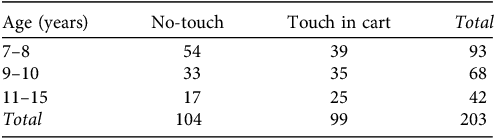
We conducted our study at The Living Desert Zoo and Gardens in Palm Desert, California, an AZA-accredited institution that offers a day-time camp to children aged 7–15 years. The participants of the study attended The Living Desert’s 3-day summer camps running from mid June to the start of August 2023, with two or three camps running each week. There were 10–24 children in each camp, with a median age of 8 years old. We divided children into three age groups: youngest (7–8 years), middle (9–10 years) and oldest (11–15 years; Table 1).
Number of participants in each age group who were not allowed to touch (no-touch presentation style) or were allowed to touch (touch presentation style) the tortoise in a mobile cart during the live animal encounter in the ambassador animal programme.

The study involved two surveys: a pre-survey at the beginning of the camp and a post-survey after the encounter with a live tortoise (see details below). All children in the youngest group (7–8 years) required assistance with reading the surveys; older children (9–15 years) were given assistance if needed. All surveys took c. 6 minutes to complete. Data from children who attended more than one week of camp were removed, only keeping data collected during their first attendance. Children with missing pre-survey data but viable post-survey responses were included in the study because there were several post-survey-only questions. After removing participants who did not have a post-survey response and those whose parents declined consent, 187 children remained in the pre-survey group and 203 children in the post-survey group for analysis.
Surveys
We developed two surveys for this project using Qualtrics survey software (Qualtrics, USA): a pre-survey given at the beginning of the camp and a post-survey that was distributed to the children directly after their live animal encounter with a tortoise (Supplementary Material 1). The pre-survey asked the children their age and included specific questions about tortoises as pets. Two statements, ‘I personally want to own a tortoise as a pet’ and ‘I think people should be able to buy a tortoise as a pet’ were presented, with responses collected on a 5-point Likert scale from 1 (definitely not) to 5 (definitely yes). We measured conservation intent from responses to a third question ‘How interested are you in helping save tortoises in the wild?’ on a 5-point Likert scale from 1 (not at all) to 5 (a great deal).
The post-survey repeated the three pre-survey questions about owning and conserving the tortoise, and added five connection-related questions. One general statement (‘My feelings are more important than animals’ feelings’) and two that were specific to the tortoise (‘I liked the tortoise I saw today’, ‘I think the tortoise enjoyed being in today’s presentation’) were all presented on a 5-point Likert scale from 1 (definitely not) to 5 (definitely yes). A final empathy question, ‘How do you think the tortoise you just saw was feeling?’, allowed participants to choose one of eight suggested emotions (calm, nervous, scared, excited, happy, surprised, mad, sad).
On their first day of camp, we asked all children to participate in an activity that introduced them to using a Likert scale. After completing the activity, we distributed the pre-survey to the children on zoo-owned tablet computers. We assigned children randomly to a presentation style: the ‘touch’ presentation style, wherein the children were allowed to touch the tortoise in the live animal encounter, and the ‘no-touch’ presentation style, wherein children were not allowed to touch the tortoise. The presentation style was alternated across camps such that all children in the same session received the same style and ensuring that the touch and no-touch presentation styles had similar numbers of participants. The live animal encounters were otherwise identical, and the presenters refrained from touching the tortoise in front of the children. The species used in this study were the Mojave desert tortoise Gopherus agassizii, an important keystone species in the Mojave Desert, California, USA, categorized as Critically Endangered on the IUCN Red List (Berry et al., Reference Berry, Allison, McLuckie, Vaughn and Murphy2021), the Indian star tortoise Geochelone elegans of northern and southern India, categorized as Vulnerable (Choudhury et al., Reference Choudhury, de Silva and Shepherd2020) and the pancake tortoise Malacochersus tornieri of Tanzania and Kenya, categorized as Critically Endangered (Mwaya et al., Reference Mwaya, Malonza, Ngwava, Moll, Schmidt and Rhodin2019).
Prior to each encounter an instructor gave a pre-scripted chat that explained why tortoises do not make good pets, to establish an injunctive norm regarding pet ownership (Supplementary Material 2). All tortoises were presented on a wheeled cart that had tall plexiglass walls around the perimeter of the tank, creating a mobile enclosure. Whilst the tortoise was in the classroom, a second instructor gave a non-scripted talk on natural history including conservation information about the species being presented. Children in the touch presentation style (n = 99) were then given the opportunity to touch the tortoise after the end of the educational talk. One hundred and four children did not touch the tortoise. All children then had Polaroid photographs taken of them next to the tortoise in the enclosure, irrespective of whether they were allowed to touch the tortoise or not. After the live animal encounter, participants completed the post-survey (Supplementary Material 2).
Data analysis
We analysed all data using SPSS 29.0 (IBM, USA). We used three-way repeated measures ANOVAs to analyse data across both surveys, with interactions between the independent variables of presentation style (touch or no-touch) and age groupings (7–8, 9–10, 11–15). Given that we were exploring the interaction between several variables, the Likert items were treated as parametric data. If interactions were insignificant, they were removed, and the repeated measures ANOVAs were run without them. For those measures that were included in the post-survey only, we conducted 2-way ANOVAs by presentation style (touch or no-touch) and the childrens’ age group.
Results
Pet ownership variables
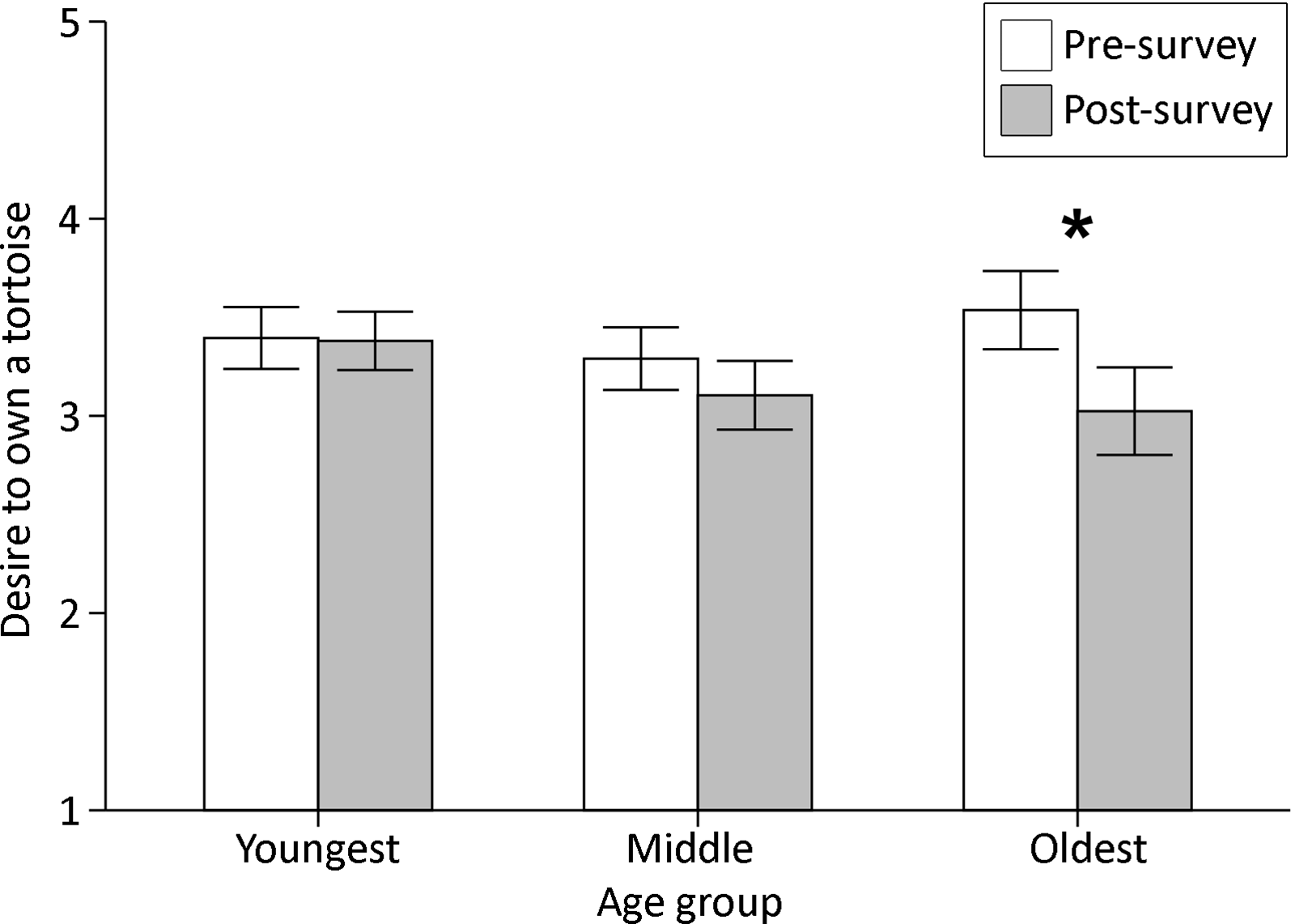
We conducted a mixed three-way repeated measures ANOVA to determine if age and presentation style (touch or no-touch) influenced the childrens’ desire to want to own the tortoise personally after their live animal encounter. There were no effects or interactions with any other variables as a result of presentation style so it was removed from the personal ownership analysis. There was a main effect for time of survey (before or after the encounter with the tortoise) such that the children’s desire to own the tortoise after the encounter was significantly lower than their desire before the encounter (Table 2), and there was a significant interaction between the time of the survey (before or after the encounter with the tortoise) and the children’s ages (Fig. 1). Post-hoc paired-samples t-tests revealed that the scores representing the older (11–15) children’s desire to own a tortoise significantly decreased after the encounter, and there was a non-significant decrease for the children in the middle age group (9–10; Table 2). The youngest children did not change in their desire to own the tortoise after the live animal encounter (Table 2).
Repeated measures ANOVA comparing children’s survey scores for the question ‘I personally want to own a tortoise as a pet’ before and after their encounter with a tortoise in an ambassador animal programme. A lower mean score indicates that children were less interested in personally owning a tortoise. The results of a paired-samples t-test on each age group’s pre- and post-test scores are given with the respective effect sizes (Cohen’s d).

Results of a mixed three-way ANOVA to determine if age influenced children’s desire to personally own a tortoise after a live animal encounter in an ambassador animal programme. Written questions were answered by the children before (pre-survey) and after (post-survey) they had attended the live animal encounter with a tortoise. Age groups: youngest, 7–8 years; middle, 9–10 years; oldest, 11–15 years. *Significant at P < 0.05.

We conducted a mixed three-way repeated measures ANOVA to determine if presentation style and age influenced the children’s belief that other people should be able to own tortoises as pets. There were no significant interactions between age and presentation style, so presentation style was removed from other’s ownership analysis. There was a significant main effect for time of survey (before or after the encounter with the tortoise; F
(1,164) = 16.46, P < 0.001, ${\eta _{partial}}$
= 0.09) where children’s scores after the encounter (mean 3.19 ± SE 0.12) were significantly lower than they were before the encounter (mean 3.66 ± SE 0.10).
${\eta _{partial}}$
= 0.09) where children’s scores after the encounter (mean 3.19 ± SE 0.12) were significantly lower than they were before the encounter (mean 3.66 ± SE 0.10).
Conservation
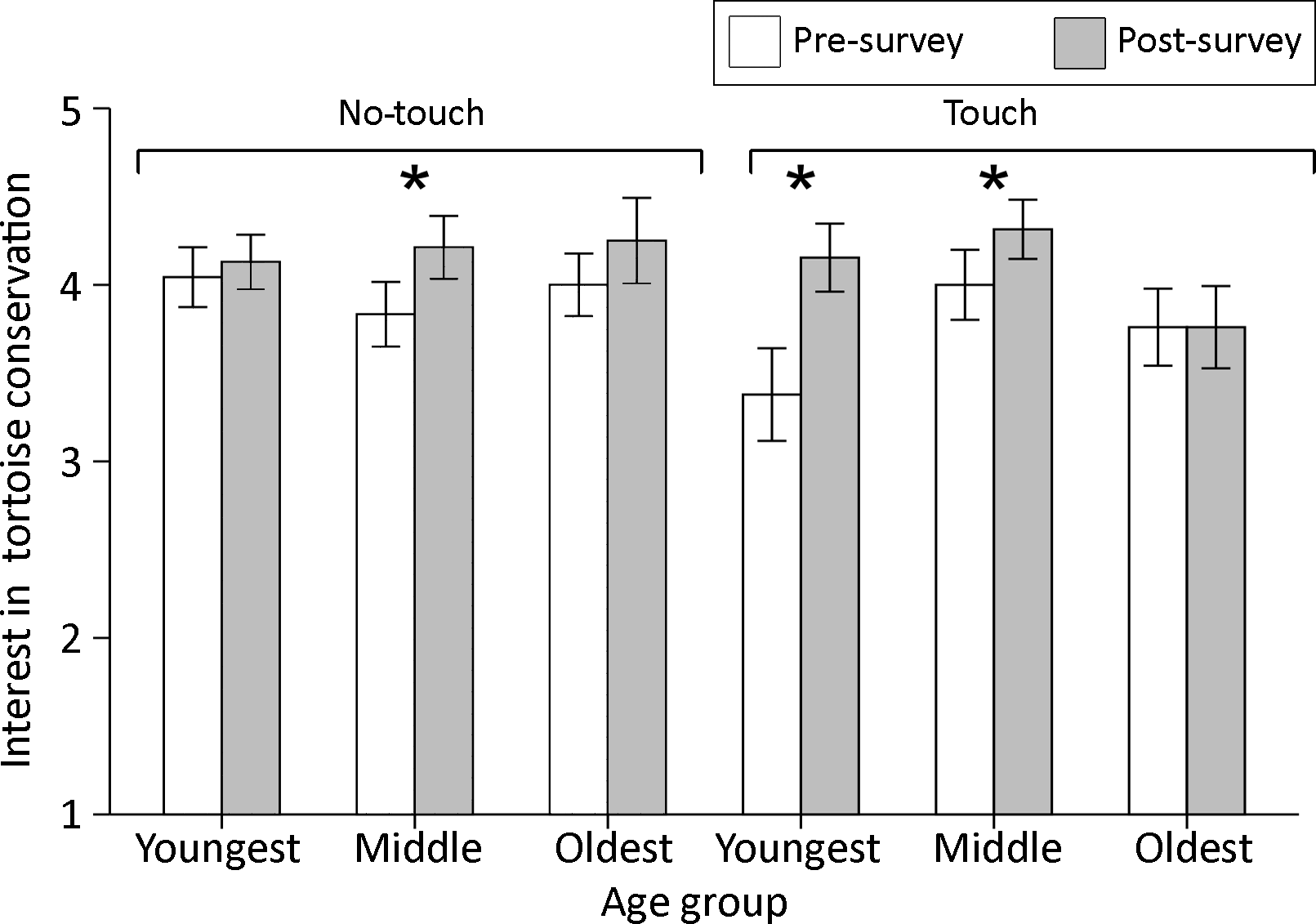
We conducted a mixed three-way repeated measures ANOVA to examine if presentation style (touch or no-touch) and children’s age influenced their interest in participating in conservation action for tortoises after the animal encounter. Overall, there was a significant increase in conservation intent from before the ambassador animal encounter (mean 3.84 ± SE 0.10) to after the encounter (mean 4.15 ± SE 0.09; F
(1,180) = 15.63, P < 0.001, ${\eta _{partial}}$
= 0.08). This was qualified by a significant three-way interaction between time of survey (before or after the encounter with the tortoise), age and presentation style (touch or no-touch; F
(2,181) = 2.96, P = 0.054,
${\eta _{partial}}$
= 0.08). This was qualified by a significant three-way interaction between time of survey (before or after the encounter with the tortoise), age and presentation style (touch or no-touch; F
(2,181) = 2.96, P = 0.054, ${\eta _{partial}}$
= 0.03; Fig. 2).
${\eta _{partial}}$
= 0.03; Fig. 2).
Results of a mixed three-way repeated measures ANOVA to examine if presentation style and children’s age influenced their interest in tortoise conservation before and after a live animal encounter in an ambassador animal programme. This was based on the mean response of children in three age groups to the question ‘How interested are you in helping save tortoises in the wild?’, broken down by age and presentation style. The children answered the question on a 5-point Likert scale before (pre-survey) and after (post-survey) they had attended the live animal encounter with a tortoise. Equal numbers of children were allocated to the touch or no-touch presentation style. Age groups: youngest, 7–8 years; middle, 9–10 years; oldest, 11–15 years. *Significant at P < 0.05.

Follow up post-hoc tests demonstrated that children in the youngest group who were allowed to touch the tortoise (t = –3.947, df = 42, P < 0.001) had significantly increased Likert scores from before the encounter to after the encounter, whereas the scores of the youngest children in the no-touch presentation style did not increase. However, children in the youngest group had significantly different pre-survey scores in the touch and no-touch presentation styles (t = 2.10, df = 81, P = 0.039), with children in the no-touch group scoring higher than children in the touch group. The impact of presentation style for children in the middle age group (9–10) did not differ; those in both the no-touch (t = −3.44, df = 32, P = 0.002) and touch presentation style (t = −2.78, df = 36, P = 0.009) had significantly increased scores from the pre-survey to the post-survey. The oldest children showed no significant increases in either presentation style.
Liking and empathy
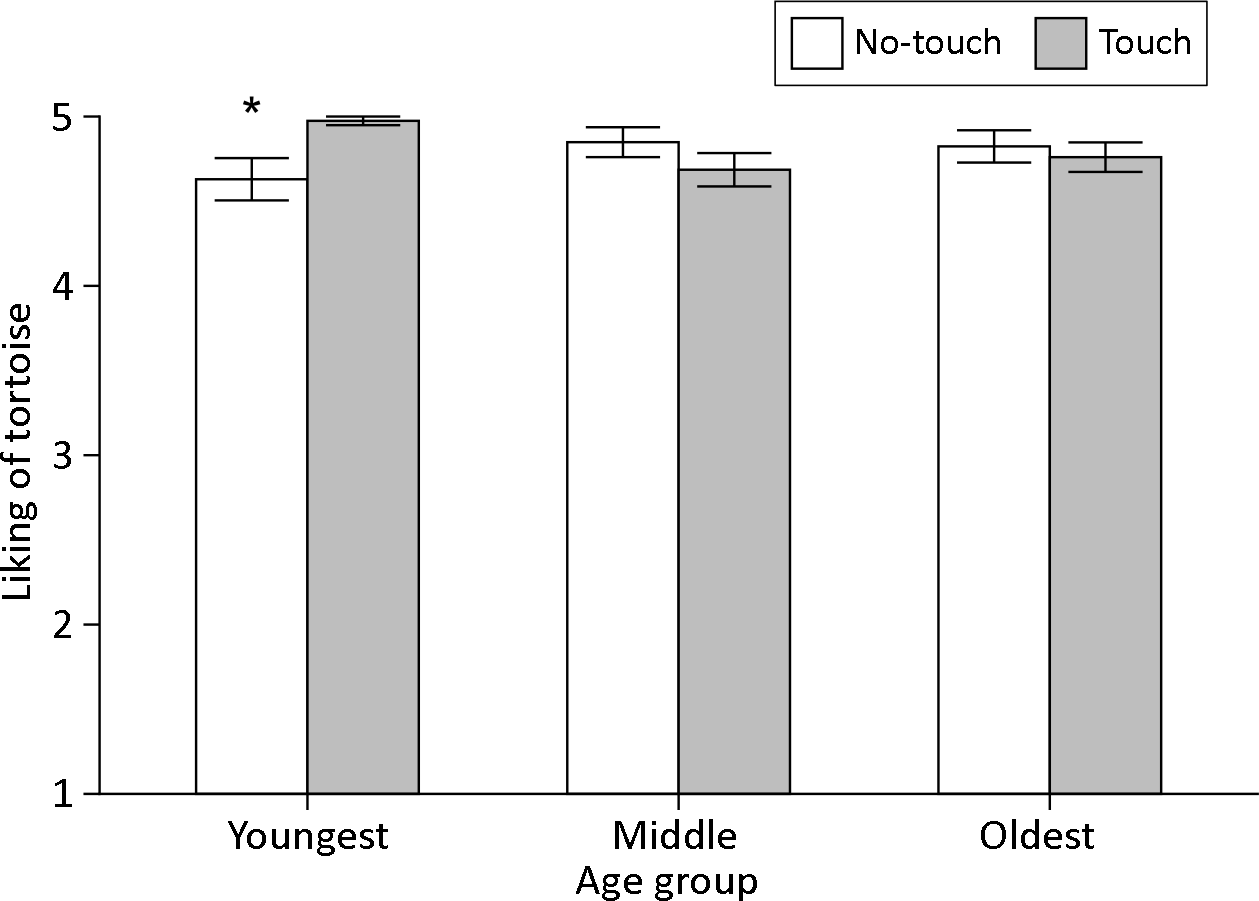
We conducted a two-way univariate ANOVA on the post-survey statement ‘I liked the tortoise I saw today’ using the mean score in the touch (n = 104) and the no-touch (n = 99) presentation styles, categorized by children’s age and presentation style. The analysis revealed a significant interaction between age and presentation style (F
(2,197) = 3.80, P = 0.024, $\;{\eta _{partial}}$
= 0.04; Fig. 3). However, a post-hoc independent samples t-test indicated a significant difference for the 7–8 year-old children only (t = −2.35, df = 92, P = 0.021), with those in the touch presentation style (mean ± SE = 4.98 ± 0.16) indicating they liked the tortoise more than those in the no-touch presentation style (mean 4.63 ± SE 0.13).
$\;{\eta _{partial}}$
= 0.04; Fig. 3). However, a post-hoc independent samples t-test indicated a significant difference for the 7–8 year-old children only (t = −2.35, df = 92, P = 0.021), with those in the touch presentation style (mean ± SE = 4.98 ± 0.16) indicating they liked the tortoise more than those in the no-touch presentation style (mean 4.63 ± SE 0.13).
The results of a two-way univariate ANOVA to examine if presentation style and children’s age influenced their degree of liking a tortoise after a live animal encounter in an ambassador animal programme. This was based on the mean response of children in three age groups to the statement ‘I liked the tortoise I saw today’, broken down by age and presentation style. The children responded to the statement on a 5-point Likert scale after (post-survey) they had attended the live animal encounter with a tortoise. Age groups: youngest, 7–8 years; middle, 9–10 years; oldest, 11–15 years. *Significant at P < 0.05.

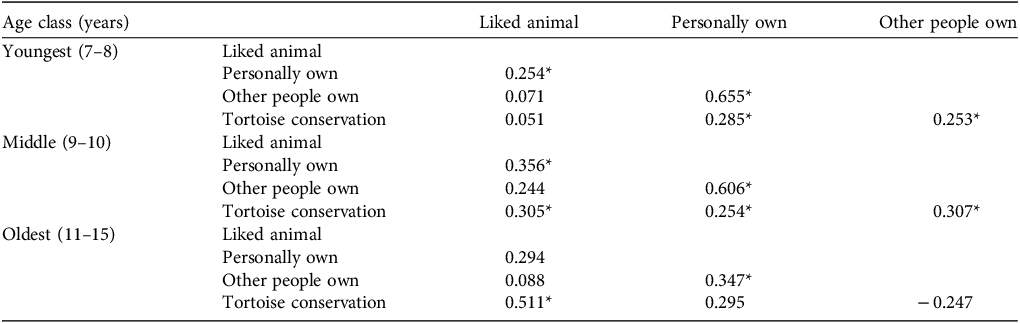
We used Pearson correlations to examine the relationship between liking the tortoise, pet ownership and conservation intent, separately by age. For children aged 7–8, liking was significantly correlated only with their desire to personally own the tortoise (Table 3). For children aged 9–10, their liking of the animal significantly and positively correlated with their desire to personally own the tortoise, but also their interest in conserving tortoises. For children aged 11–15, their liking of the tortoise did not correlate with their desire to own the tortoise. However, it significantly and positively correlated with their interest in conserving the tortoise. Desire to own was significantly correlated with conservation intent for the younger two groups (7–8, 9–10), but not for the older children (11–15).
Correlation matrix of the relationship between liking the animal, ownership desire (personally own) and acceptability (other people own), and conservation intent (helping save tortoises in the wild) after participation in a live animal encounter in an ambassador animal programme as a function of children’s age.

*P < 0.05
We conducted a univariate ANOVA for the post-survey statement ‘My feelings are more important than animals’ feelings’. There was a significant main effect for age (F
(2,197) = 3.19, P = 0.043, ${\eta _{partial}}$
= 0.03) but there was no impact of presentation style (touch or no-touch) or interaction with presentation style and age. A post-hoc pairwise comparison found that the youngest group (7–8 years; mean 2.78 ± SE 0.13) prioritized their feelings over animals’ feelings more than the older group (11–15 years; mean 2.24 ± SE 0.19, P = 0.020).
${\eta _{partial}}$
= 0.03) but there was no impact of presentation style (touch or no-touch) or interaction with presentation style and age. A post-hoc pairwise comparison found that the youngest group (7–8 years; mean 2.78 ± SE 0.13) prioritized their feelings over animals’ feelings more than the older group (11–15 years; mean 2.24 ± SE 0.19, P = 0.020).
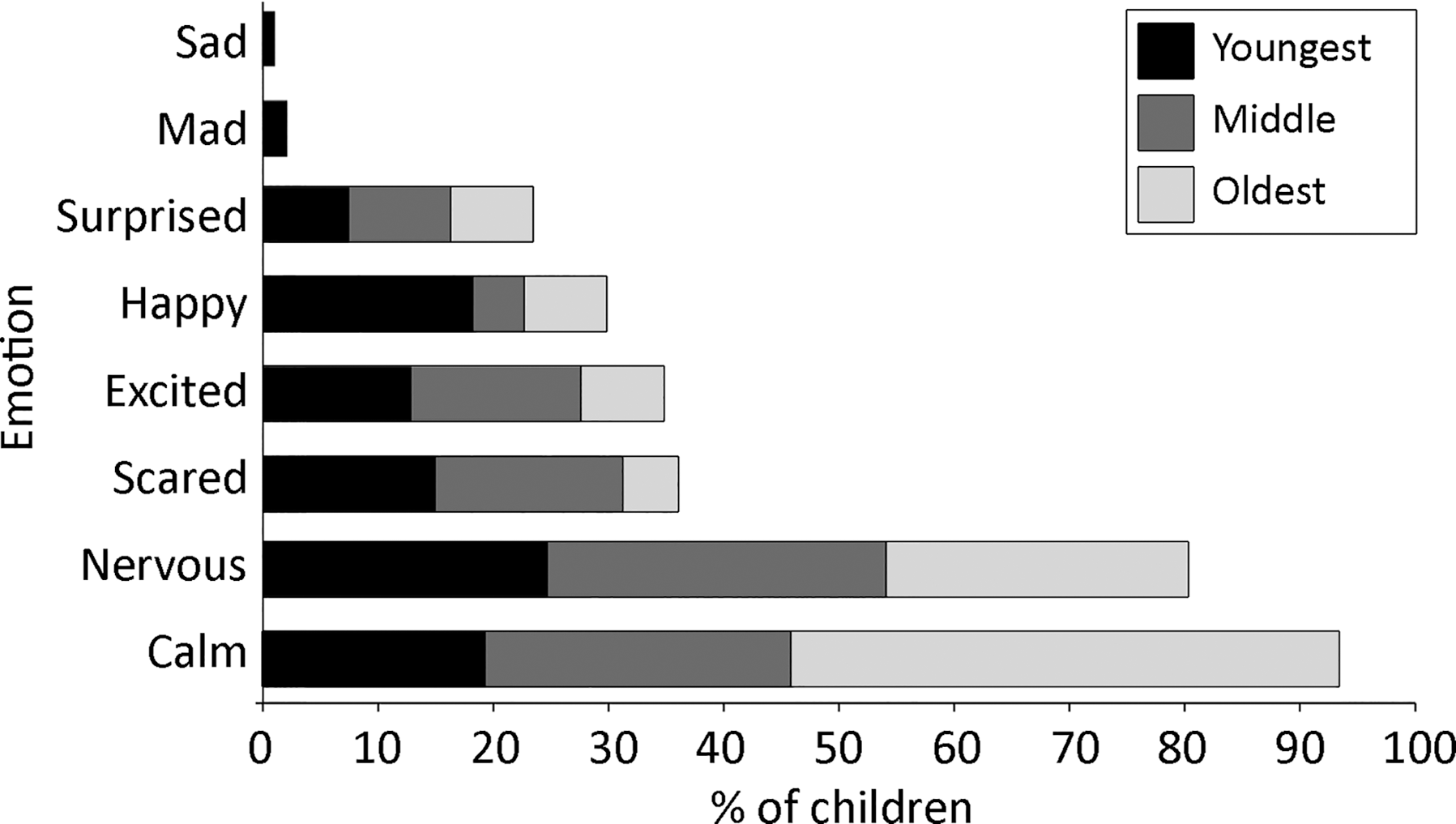
We conducted a univariate ANOVA to determine if age and presentation style affected children’s response to the post-survey statement ‘I think the tortoise enjoyed being in today’s presentation’. There was no difference between the responses from children of different ages or those subject to touch or no-touch presentation styles for this statement and there were no interactions with age and presentation style. Across ages and presentation styles, children believed that the tortoise enjoyed the encounter (mean 3.64 ± SE 1.00). However, when children were asked to identify the different emotions they thought the tortoise was feeling there was a large amount of variability amongst children in the youngest group compared to the oldest group, where the results were less variable and favoured either ‘calm’ (47%) or ‘nervous’ (26%; Fig. 4).
The per cent of children in the 7–8 (n = 93), 9–10 (n = 68) and 11–15 (n = 42) age range that chose each of the eight emotions to describe how they thought the tortoise was feeling during the live animal encounter in the ambassador animal programme.

Discussion
The purpose of this study was to examine the effect of educational programming using ambassador animals in zoos on the conservation attitudes and desire to own an exotic pet amongst visiting children. In particular, we investigated the impact of allowing children to touch the ambassador animal, in this case a tortoise. Although the educational programming emphasized the injunctive norm that tortoises make poor pets, the concern was that allowing children to touch ambassador animals would provide a descriptive norm of the animal being treated as a pet, and therefore making a good pet. Furthermore, we were concerned that informing children about the prevalence of reptiles as pets could lead to a boomerang effect where highlighting a negative behaviour unintentionally creates a descriptive norm, which then increases its occurrence (Cialdini, Reference Cialdini2003; Schultz et al., Reference Schultz, Nolan, Cialdini, Goldstein and Griskevicius2007), in this case tortoise ownership.
The results of this study supported the hypothesis that the injunctive norm of educational programming about the unsuitability of tortoises as pets affected children’s attitudes towards personally owning a pet tortoise, but only for children aged 11 years and older. Children aged 7–10 years did not become less likely to want to own a tortoise after their encounter with the animal, suggesting that either the descriptive norm overpowered the injunctive norm, or neither had an effect. All children, regardless of age, were less likely to believe that others should be able to own tortoises after the educational programming, suggesting that the injunctive norm of the educational talk was effectively conveyed to all the children and clearly stated what others should do with regard to tortoise ownership. This is probably indicative of knowledge acquisition versus attitude change, as children would have learnt what should and should not be allowed through the injunctive talk and were reflecting on what others should be able to do when they answered the question relating to tortoise ownership.
Our data did not support our hypothesis that the descriptive norm of being able to touch the tortoise would increase children’s desire to personally own tortoises or their beliefs that other people should be allowed to own tortoises. In our study it seems that the injunctive norm was stronger than the descriptive norm in most cases. Importantly, the desire to personally own a tortoise and the belief that others should be allowed to own a tortoise were significantly influenced by participating in the camp and learning about the tortoise. After the camp, the older children had less interest in owning a tortoise themselves and felt more strongly that others should not be allowed to own them. This finding is of importance to zoos and nature centres that present live animal programming, and it underlines the importance of including injunctive norms about the unsuitability of ambassador animals as pets to override any unintended descriptive norm messaging about handling wildlife.
One caveat is that most of the participants in the current study were younger children who generally have less opportunity to purchase their own pets. Extending this research to adolescents and adults who may be most interested and able to purchase exotic pets, makes them a demographic of interest for future studies. A recent study by Kirsch et al. (Reference Kirsch, MacPherson, Meyers, Bowser and Kross2025) found that adults who viewed an ambassador parrot and python were not significantly influenced with regard to exotic pet ownership. Our study only investigated children’s desire to own tortoises; future research should incorporate other species typically seen in ambassador animal programming. Further research should also investigate the impact of educational talks that omit pet ownership messaging during ambassador animal presentations to determine how descriptive norms without an injunctive norm affect children’s desire to own exotic animals.
In general, the educational programming with the tortoises at The Living Desert Zoo and Gardens increased the children’s interest in conservation. This approach has demonstrated changes in conservation knowledge, attitudes and engagement amongst children in other contexts and in other countries (Kruse & Card, Reference Kruse and Card2004; Børresen et al., Reference Børresen, Ulimboka, Nyahongo, Ranke, Skjaervø and Røskaft2023; Jerger et al., Reference Jerger, Acker, Gibson and Young2022; Christodoulou & Grace, Reference Christodoulou and Grace2024). We found a significant difference between children’s pre- and post-survey scores for interest in conservation even though the majority of children in our sample were self-selected, as they had chosen to attend a nature-based camp and had positive conservation attitudes in their pre-survey scores. Nevertheless, the impact of the conservation messaging varied by age and presentation style. Being able to touch the tortoise had different impacts on children’s conservation interest by age; touching increased the desire to save tortoises in the wild for the youngest group but did not change conservation interest amongst the oldest children. It is unclear why the youngest and the oldest children followed a different pattern, but it suggests that the age of the audience matters and that presentation style can have different effects on visitors of different demographic groups. Touching the tortoise did not increase conservation intent for older children, so zoos should reconsider their decision to allow visitors to touch an animal if they are only doing so because they believe that it is necessary for driving conservation action.
Touching the tortoise had a positive effect on liking the tortoise for the youngest children only. Liking the tortoise was positively correlated with wanting to personally own it for the youngest children, with wanting to own and to conserve it for the 9–10 year olds, and with just wanting to conserve it for the 11–15 years old group. This suggests that as children grow older, they are more inclined to want to save an animal they like and less inclined to want to own them as pets. This is consistent with research with adults that shows people are more likely to conserve that which they like (Stokes, Reference Stokes2007; Colleony et al., Reference Colléony, Clayton, Couvet, Saint Jalme and Prévot2017) but also underscores the need to consider the age of children when designing educational programming so as not to increase the unintended consequences of children wishing to own an exotic animal as a pet.
The answers to the question in our survey that juxtaposed the importance of children’s feelings and animal feelings demonstrated that the youngest children reported their feelings mattered more than those of the animals, whereas older children did not make that distinction. Notably, children scored highly on the question about the tortoise enjoying the presentation, despite also differing amongst themselves in their judgement of how the tortoise felt, including the adjectives nervous and scared. This suggests that children struggled to empathize with the tortoise as they identified it as experiencing a negative emotion but still believed it enjoyed the encounter. If zoo education practitioners choose to use an empathy-based approach to conservation education, they will probably have better success with children of ages 9 years and older, when empathy is more fully developed (Bensalah et al., Reference Bensalah, Caillies and Anduze2016).
In summary, we explored the consequences of animal programming in an authentic context and demonstrated that age matters in regard to the impact of educational programming and live animal presentation styles. Animal-based programming has become a popular tool to educate and connect zoo and aquarium visitors with wildlife. Whilst these programmes may provide many benefits in terms of visitor learning, connections to animals and positive perceptions of wildlife, care should be taken to ensure they do not promote unintended perceptions that exotic ambassador animals make good pets. Audience age demographics should be taken into consideration, especially for children under 9 years old who may not be as receptive to injunctive educational norms and connote liking an animal with owning it as a pet. Touching an ambassador animal did not increase conservation intent nor liking of the animal in older children, but also did not drive pet ownership desire, as long as an injunctive educational message was given.
Our work attempts to provide insight into two of the AZA Animal Ambassador Scientific Advisory Group’s future research questions: what messages are audiences taking away from experiences with ambassador animals, and does the way the animal is handled affect the outcomes of the experience (AZA, 2022)? We hope that our findings will provide support for evidence-based decision-making in other zoological institutions that utilize animal handling practices. Zoos should reflect upon their goals for their ambassador animal programmes; if the goal is to increase the degree to which their audience likes the animal and to inspire greater conservation intent for the species, our findings do not provide evidence that touching ambassador animals improves those outcomes for visitors aged 9–15 years. The picture is less clear for 7–8 year olds, for whom touching ambassador animals resulted in increased liking and greater interest in conservation; however, liking was also positively correlated with interest in pet ownership. Given this trade-off, alongside the concern for ambassador animal wellbeing (AZA, 2023a), we posit that programmes that allow children to touch animals may not be the most effective way to inspire conservation intent and, for younger children, may also promote the desire to own exotic pets. We believe that our findings are likely to be transferable to other species but further research is needed; the effects of touching animals on conservation intent in adults also warrants investigation. Irrespective of other variables, messaging about exotic animals not making good pets should be included with all live animal handling demonstrations to provide an injunctive norm.
Author contributions
Study conception, study design, data curation, revision: all authors; data collection: SP; data analysis: SP, MA; writing: SP; funding acquisition: SP; project oversight and administration: MA, AY.
Acknowledgments
We thank The Living Desert Zoo and Gardens, especially the Learning & Impact staff, Animal Care staff and volunteers who made this research possible. Funding was provided by Otterbein University’s Five Cards award, Student Research Fund’s Travel award and a Zoo and Conservation Science Internship Grant.
Competing interests
Authors AY and SP are employed or have been employed by the Living Desert Zoo and Gardens.
Ethical standards
This study was approved by Otterbein University (IRB#-HS#21/22-71) and abided by the Oryx guidelines on ethical standards. Informed consent was obtained from guardians upon signing their child up for the summer camp and assent was obtained from the children during the camp. All data were anonymized.
Data availability
Data are available from the authors upon reasonable request.
Supplementary material
The supplementary material for this article is available at doi.org/10.1017/S0030605325102482



 Open access

