





1. Introduction
Bubbles present in liquids are commonplace in a wide spectrum of natural and industrial processes. From formation, through motion, until bursting, bubbles inevitably interact with the surrounding liquid. As a consequence of the ubiquitous heterogeneity of the liquids in nature and industry, bubbles may collect impurities or pollutants in bulk liquids, finally forming structurally compound bubbles. For instance, rising bubbles in the ocean have been found to capture surface-active materials from the water column (Walls, Bird & Bourouiba Reference Walls, Bird and Bourouiba2014) and facilitate the formation of an organic-enriched air–sea interface known as the sea surface microlayer (Tseng et al. Reference Tseng, Viechnicki, Skop and Brown1992; Wang et al. Reference Wang2017). Other examples include oil-laden bubbles released from natural seeps in the deep sea (Johansen, Todd & MacDonald Reference Johansen, Todd and MacDonald2017), froth flotation with oily bubbles (Su, Xu & Masliyah Reference Su, Xu and Masliyah2006; Zhou et al. Reference Zhou, Wang, Xu, Liu, Deng and Chi2014) and material processing using compound bubbles (Visser et al. Reference Visser, Amato, Mueller and Lewis2019; Behrens Reference Behrens2020). In the context of a bursting bubble at a liquid–air interface, most previous studies have focused on the dynamics of clean bubbles (Lhuissier & Villermaux Reference Lhuissier and Villermaux2012; Deike et al. Reference Deike, Ghabache, Liger-Belair, Das, Zaleski, Popinet and Séon2018). Only recently has the bursting dynamics of such compound bubbles attracted considerable attention (Ji, Yang & Feng Reference Ji, Yang and Feng2021b; Yang et al. Reference Yang, Ji, Ault and Feng2023). The structurally compound interface has been shown to profoundly modify the bubble-mediated mass and momentum transport across the interface, and thus requires further investigation.
In particular, our recent work highlights that oil-coated, free-surface bubble bursting enhances aerosol formation and transmission by producing upward jets that are smaller and faster than those formed by pristine bubbles (Yang et al. Reference Yang, Ji, Ault and Feng2023). Bursting of bubbles at liquid surfaces refers to the rupture of the bubble cap film and the following collapse of the bubble cavity. The associated dynamics has remained a canonical research topic in interfacial flows due to its importance in mediating the mass transport across the interface, such as sea spray aerosol generation impacting the climate (Wilson et al. Reference Wilson2015), aerosolization of contaminated water for airborne disease transmission (Poulain & Bourouiba Reference Poulain and Bourouiba2018) and even vegetative reproduction over natural bodies of water (Hariadi, Winfree & Yurke Reference Hariadi, Winfree and Yurke2015). Specifically, during cavity collapse, capillary waves are excited and propagate toward the bottom of the bubble cavity. When the capillary waves collide at the bubble cavity bottom, the upward jet is produced (Duchemin et al. Reference Duchemin, Popinet, Josserand and Zaleski2002). The morphology of the upward jet has been extensively studied (Deike Reference Deike2022), but the dynamics and transport associated with the bulk flow under the bubble cavity have received much less attention.
With the focusing of capillary waves at the bubble cavity nadir, a region characterized as a ‘downward jet’ is produced with downward velocity below the bubble bottom. The flow field in this region was first experimentally characterized by the pioneering work of MacIntyre (Reference MacIntyre1972). Later work further showed that the downward jet region exhibited features of an elongational flow (Garcia-Briones & Chalmers Reference Garcia-Briones and Chalmers1994), and it was reported that the high hydrodynamic stress associated with the elongational flow could cause cell damage in biological industry (Boulton-Stone & Blake Reference Boulton-Stone and Blake1993). Indeed, bubble bursting is one of the main mechanisms for cell death in sparging bioreactors (Walls et al. Reference Walls, McRae, Natarajan, Johnson, Antoniou and Bird2017). The energy dissipation rates in the downward jet region during bubble bursting were found to be strong enough to even kill the cells (Boulton-Stone & Blake Reference Boulton-Stone and Blake1993; Garcia-Briones, Brodkey & Chalmers Reference Garcia-Briones, Brodkey and Chalmers1994; Walls et al. Reference Walls, McRae, Natarajan, Johnson, Antoniou and Bird2017). In addition, it has been suggested that cells in bioreactors tend to be killed by the presence of small bubbles since both the maximum extensional stress and the energy dissipation rate decrease with the bubble radius (MacIntyre Reference MacIntyre1972; Boulton-Stone & Blake Reference Boulton-Stone and Blake1993; Garcia-Briones et al. Reference Garcia-Briones, Brodkey and Chalmers1994; Tran et al. Reference Tran, Lee, Lee, Woo, Han, Kim and Hwang2016).
Here, we investigate a distinct feature related to the downward jet and bulk extensional flow induced by a bursting oil-coated bubble, regarding the daughter oil droplet entrainment below the bubble cavity. With systematic experiments, we demonstrate that oil-coated bubble bursting results in the breakup of the oil coating into smaller droplets in the bulk aqueous liquid. We further provide a scaling law to correlate the daughter oil droplet size to the oil coating fraction and the physical properties of the bulk liquid, which captures the experimental results well. This paper is structured as follows. Our experimental set-up is described in § 2. In § 3, we first present the experimental observations for the daughter oil droplet formation in § 3.1, and then show the spatio-temporal evolution of the oil blob in the extensional flow in § 3.2. We further derive the scaling law for the size of the entrained daughter oil droplet by illustrating the mechanism of end pinching in § 3.3, and also provide a discussion of the regime without daughter oil droplet entrainment with a high bulk liquid viscosity in § 3.4. Finally, we summarize the main conclusions in § 4.
2. Experimental methods
The oil-coated bubbles are produced using a custom-designed coaxial orifice system (Ji, Yang & Feng Reference Ji, Yang and Feng2021c), in a square transparent acrylic container with dimensions of  $20\,{\rm mm}\times 20\,{\rm mm}\times 25\,{\rm mm}$. The system consists of a small stainless inner needle with an inner diameter of 0.41 mm, plugged in a stainless outer needle with an outer diameter of 3.43 mm. The bubbles are formed by injecting air through the inner needle to a sessile oil drop formed through the injection of the outer needle, until the oil-coated bubble detaches because of buoyancy. The equilibrium bubble radius $R$ is measured to be $2.1 \pm 0.3$ mm, consistent with the previous model prediction in our work (Ji et al. Reference Ji, Yang and Feng2021c). By adjusting the volume of the sessile oil drop above the outer needle before air injection, we can control the oil volume fraction of the generated oil-coated bubble (Ji, Singh & Feng Reference Ji, Singh and Feng2021a). The bubble then rises to the free air–water surface and ultimately bursts. The bursting process is captured by a high-speed camera (Photron Mini AX200) from the bottom-side view, under the illumination of a white LED backlight (Phlox $100\times 100$ HSC), and with a frame rate of 6400 frames per second and a magnification of 2–4. The magnification corresponds to a spatial resolution of 5– $10\,\mathrm {\mu }$m pixel $^{-1}$, which can serve as a reference of the error limits. In all figures, the error bars are smaller than the size of the data points.
Regarding the working liquids, we use glycerine–water mixtures with a glycerine weight fraction  $w_{g} =0\,\%\unicode{x2013}84.2\,\%$ (corresponding to a viscosity range of $\mu _{w} = 1.1\unicode{x2013}94$ mPa s) as the bulk liquid, and silicone oils with viscosity $\mu _{o} = 0.9\unicode{x2013}20$ mPa s (Sigma-Aldrich) as the bubble coating liquids. The viscosities of the liquids are measured using a controlled stress rheometer (DHR-3, TA Instrument) with a cone–plate geometry (40.0 mm diameter, cone angle $0.993^\circ$, $28\,\mathrm {\mu }$m truncation), at a controlled temperature of 20 $^{\circ }$C. In our experiments, the silicone oils fully engulf the gas bubbles due to the positive spreading coefficient $S=\gamma _{wa}-\gamma _{ow}-\gamma _{oa}$. Here, $\gamma$ is the interfacial tension, and the subscripts ${wa}$, ${ow}$ and ${oa}$ represent aqueous solution–air, aqueous solution–oil and oil–air, respectively. The interfacial tensions are measured by pendant drop method with in-house MATLAB codes (Song & Springer Reference Song and Springer1996). All the liquid properties are listed in table 1. The volume of the oil coating $V_{o}$ engulfing the bubble is estimated by measuring the volume of the oil blob before jet formation, and the oil volume fraction is calculated as $\psi _{o} = 3V_{o}/(4{\rm \pi} R^3)$. Specifically, we focus on the dynamics of bubbles coated with a thin layer of oil. Thus, the oil fraction $\psi _o$ is controlled between 0.12 % and 10.0 % (spanning two orders of magnitude) with the maximum oil layer thickness less than $0.2R$.
Physical properties of liquids used in the experiments ( $w_{g}$: weight fraction of glycerine in the aqueous solution; $\rho _{o}$: oil density; $\rho _{w}$: aqueous solution density; $\mu _{o}$: oil viscosity; $\mu _{w}$: aqueous solution viscosity; $\gamma _{ow}$: oil–aqueous solution interfacial tension; $\gamma _{oa}$: oil–air interfacial tension; $\gamma _{wa}$: aqueous solution–air interfacial tension).

3. Results and discussion
3.1. Daughter oil droplet entrainment in water
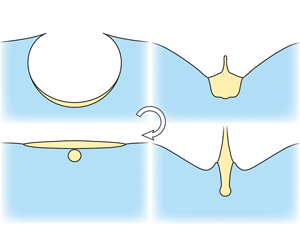
Figure 1(a–c) shows the experimental observation for the entrainment of a daughter oil droplet in the bulk liquid during oil-coated bubble bursting. Here, the origin of time  $t=0$ is defined as the moment when the curvature of the oil–air surface at the bottom pole reverses during the collapse of the bubble cavity. The cavity collapse starts after the bubble cap ruptures, and capillary waves are excited by the capillary retraction of the liquid film following the cap rupture and propagate along both the air–oil and water–oil interfaces ( $t=-1.2$ ms in figure 1a). The oil coating is swept by the capillary waves downwards, forming an oil blob ( $t=0$ ms in figure 1a). At the same time, the wave focusing during cavity collapse produces an extensional flow around the cavity nadir. The extensional flow not only produces an upward jet at the oil–air interface, which ejects tiny oil droplets in the air (Yang et al. Reference Yang, Ji, Ault and Feng2023), but also generates a downward jet in the liquid phase (MacIntyre Reference MacIntyre1972; Boulton-Stone & Blake Reference Boulton-Stone and Blake1993). The downward jet stretches the oil blob ( $t=0\unicode{x2013}3.5$ ms in figure 1a), where the oil blob elongates and decreases in width until a bulbous end develops at its bottom part ( $t=5.3$ ms in figure 1a). The bulbous end moves faster than the oil in the blob located just above it, and thus the oil gets into the bulbous end and inflates it. A neck forms above the bulbous end, and narrows progressively until a daughter oil droplet pinches off ( $t=10.2$ ms in figure 1a). These hydrodynamic features, summarized in figure 1(d), are similar to the dynamics of deformation and end pinching of a droplet under an extensional flow in previous studies (Stone, Bentley & Leal Reference Stone, Bentley and Leal1986; Schulkes Reference Schulkes1996; Li, Renardy & Renardy Reference Li, Renardy and Renardy2000; Anthony et al. Reference Anthony, Kamat, Harris and Basaran2019). From the above observations, we consider the daughter oil droplet entrainment as two successive processes, i.e. oil blob elongation under the extensional flow followed by end pinching of the oil bulb. While multiple oil droplets could be observed in some cases, in the current work we only focus on the largest daughter droplet pinching off from the end of the elongated oil blob.
(a–c) High-speed images showing the bottom-side view of the daughter oil droplet entrainment during oil-coated bubble bursting, with different bulk liquid viscosity  $\mu _{w}$ and oil volume fraction $\psi _{o}$: (a) $\mu _{w} = 2.1$ mPa s, $\psi _{o} = 5.6\,\%$; (b) $\mu _{w} = 2.1$ mPa s, $\psi _{o} = 4.0\,\%$; and (c) $\mu _{w} = 9.5$ mPa s, $\psi _{o} = 4.0\,\%$. The oil viscosity is $\mu _{o} = 0.9$ mPa s for all images. Here, $t=0$ is defined as the moment when the curvature of the oil–air surface at the bottom pole reverses during cavity collapse. The scale bar represents 1 mm. (d) Schematics of daughter oil droplet entrainment by a bursting oil-coated bubble.

We perform systematic experiments to first investigate the relationship of the daughter oil droplet radius  $R_{d}$ to the oil coating fraction $\psi _{o}$ and liquid viscosities. As shown in figure 2(a), the dimensionless daughter oil droplet radius $R_{d}/R$ increases with $\psi _{o}$ at a fixed liquid combination. Meanwhile, for the same $\psi _{o}$, $R_{d}$ decreases dramatically when the bulk viscosity $\mu _{w}$ increases from 1.1 to 9.5 mPa s (figure 2a), while it barely changes when the oil viscosity $\mu _{o}$ increases from 0.9 to 20.0 mPa s (figure 2b). We demonstrate that the non-dimensionalized droplet radius follows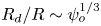 $R_{d}/R \sim \psi _{o}^{1/3}$ regarding a wide range of $\psi _{o}$ (figure 2). This proportionality shows that the droplet size $R_{d}$ directly scales with the global size of the blob $R_{o}=R\psi _{o}^{1/3}$ in the current experiments. The characteristic length scale for the daughter oil droplet pinch-off in this situation mainly depends on the global geometry of the blob rather than any local feature or perturbation of the blob shape. Such an observation has also been supported in previous studies for the end-pinching process of a drop under an extensional flow (Stone et al. Reference Stone, Bentley and Leal1986; Stone & Leal Reference Stone and Leal1989b). In addition, the strong dependence of $R_{d}$ on $\mu _{w}$ instead of $\mu _{o}$ suggests that the droplet pinch-off process is mainly driven by the viscous stress generated on the water–oil interface from the bulk liquid. This observation is also consistent with previous experimental observations for droplet break-up, showing that the role of the drop viscosity is minor under an extensional flow with similar viscosity ratios as in our experiments (i.e. $0.1<\mu _{o}$/ $\mu _{w}<18$) (Grace Reference Grace1982).
Daughter oil droplet radius scaled with bubble radius,  $R_{d}/R$, as a function of $\psi _{o}$: (a) at the same oil viscosity $\mu _{o}$ of 0.9 mPa s and different bulk viscosity $\mu _{w}$; (b) at the same $\mu _{w}$ of 1.1 mPa s and different $\mu _{o}$. The dashed lines represent the lines of best fit using $R_{d}/R=C\psi _{o}^{1/3}$.

Using dimensional analysis and the above experimental observations, we expect that the dimensionless daughter oil droplet size could be determined by multiple dimensionless groups as
 \begin{equation} \frac{R_{d}}{R} = F\left({Oh}_{w},\psi_{o},{Bo}_{b}, \frac{\rho_{o}}{\rho_{w}},\frac{\gamma_{oa}}{\gamma_{ow}}\right), \end{equation}
where
 \begin{equation} {Oh}_{w}=\frac{\mu_{w}}{\sqrt{\rho_{w}\gamma_{ow}R}},\quad {Bo}_{b}=\frac{\rho_{w}gR_{o}^2}{\gamma_{ow}}. \end{equation}
Here g is the gravitational acceleration. The effect of gravity is negligible with  ${Bo}_{b}\ll 1$ (the ratio between the gravitational and capillary effects). Due to the limitation of the experimentally available liquids, $\rho _{o}/\rho _{w}$ and $\gamma _{oa}/\gamma _{ow}$ remain almost constant, so their variation is not considered yet in the current work. We note that, in the current range of ${Oh}_{w}$ (ratio between inertia-capillary and visco-capillary velocities) between 0.004 and 0.04, the bubble cavity collapsing is considered as an inertia-capillary process (Gordillo & Rodríguez-Rodríguez Reference Gordillo and Rodríguez-Rodríguez2019). Thus, we expect to obtain $R_{d}/R$ as a function of
 \begin{equation} \frac{R_{d}}{R} = F({Oh}_{w},\psi_{o}). \end{equation}
In the following, we aim to derive the scaling law for  $R_{d}/R$ by considering the oil blob elongation process and the subsequent end-pinching process.
3.2. Oil blob elongation under the extensional flow developed by cavity collapsing
With high-speed observation, we further characterize the oil blob deformation under the extensional flow developed by bubble cavity collapsing. To track the thinning of the oil blob, we measure the maximum width of oil blob  $2W$ as illustrated in figure 3(a,b). The initial oil blob width $2W_{{0}}$ is measured as the maximum horizontal dimension of the oil blob at $t=0$, while the subsequent evolution of $2W$ is determined below the oil–air interface at $t=0$ (figure 3a,b). We note that during the oil blob elongation, $W$ is measured at the same horizontal location with $W_0$ (figure 3a), while after the neck of the bulbous end starts to form, $W$ is defined as the maximum width of the bulbous end (figure 3b). The submerged part of the oil blob can be approximated as a semi-spheroid shape before a neck initiates (figure 3c). Figure 3(d) shows that $W/W_{{0}}$ first decreases and then increases with $t$. The initial decrease of $W$ represents the overall thinning of the blob, while the later increase of $W$ indicates that the width of the bulbous end exceeds that of the central portion of the blob. The regimes for the decrease and increase of $W/W_{{0}}$ are thus referred to as elongation and end-pinching regimes, respectively, in the later discussion.
(a) Schematics of oil blob formation and elongation under an extensional flow induced by cavity collapse, starting from the moment when the upward jet is initiated. (b) Schematics showing the further blob evolution and end pinching following (a). The red arrows in (a) and (b) indicate the flow directions, and the green arrows in (a) sketch the forces. (c) The comparison between the blob shape in the experiment and a spheroid approximation (blue dashed line). The experimental image is obtained from an oil-coated bubble bursting with  $\mu _{w} = 2.1$ mPa s, $\mu _{o} = 0.9$ mPa s and $\psi _{o} = 5.6\,\%$ at $t = 2.1\,\mathrm {ms}$. The scale bar represents 0.5 mm. (d) Evolution of $W/W_0$ with $t$ at different $\psi _{o}$ with $\mu _{w} = 2.1$ mPa s and $\mu _{o} = 0.9$ mPa s.

In the elongation regime,  $W/W_0$ initially decreases quickly because the oil blob keeps thinning as it is elongated by the extensional flow. To understand how the extensional flow affects the early thinning process of the blob, we consider the characteristic strain rate $\dot {\epsilon }$ of the flow, which was shown to be crucial for the characterization of a drop deformation in an extensional flow (Stone et al. Reference Stone, Bentley and Leal1986). Here, the elongation flow is caused by the focusing of the capillary waves during cavity collapse, where the capillary wave propagation velocity $U$ scales with the inertia-capillary velocity $U_{c}$ as $U\sim U_{c}=\sqrt {\gamma /(\rho _{w} R)}$ (Krishnan, Hopfinger & Puthenveettil Reference Krishnan, Hopfinger and Puthenveettil2017; Gordillo & Rodríguez-Rodríguez Reference Gordillo and Rodríguez-Rodríguez2019). For bare bubble bursting, the characteristic length scale is the bubble radius $R$, suggesting that the strain rate scales as $\dot {\epsilon }\sim U/R\sim \sqrt {\gamma /(\rho _{w} R^3)}$. This is in agreement with the scaling law for the maximum extensional strain rate in bare bubble bursting, $\dot {\epsilon }_{max}\sim \gamma ^{0.46}R^{-1.68}$, numerically reported by Tran et al. (Reference Tran, Lee, Lee, Woo, Han, Kim and Hwang2016). However, in our experiments of oil-coated bubble bursting, our previous work (Yang et al. Reference Yang, Ji, Ault and Feng2023) shows that the capillary wave propagation speed scales with $\sqrt {\gamma _{e}/(\rho _{w} R)}$, where $\gamma _{e}=\gamma _{ow}+\gamma _{oa}$ is the effective surface tension of the compound interface. In addition, the oil blob introduces a local length scale that sets the strain rate of the oil blob elongation. Using the characteristic length scale of effective oil blob radius $R_{o}$, we obtain the characteristic strain rate on the oil blob from the extensional flow as
 \begin{equation} \dot{\epsilon} \sim \frac{U}{R_{o}} \sim \sqrt{\frac{\gamma_{e}}{\rho_{w} R^3}}\psi_{o}^{-1/3}. \end{equation}
 At the later stage of the elongation regime, the oil blob deformation becomes significant and the thinning slows down (figure 3d), which indicates that a resistant force develops and weakens the elongation rate driven by the viscous stress. The oil blob finally reaches a maximum deformation, which sets the initial condition of the subsequent end-pinching process. The characteristic Weber number in this stage, defined as the ratio between inertial and capillary effects, can be estimated as  ${We} = \rho _{w} U_{c}^2(2W_{min})/\gamma _{ow}=O(10^{-1})$. In addition, the local Reynolds number ${Re}= \rho _{w} U_{c}(2W_{min})/\mu _{w}$ (ratio between inertial and viscous effects) is estimated to $\leq O(10^2)$. It has been shown that, in this range of dimensionless groups with the density ratio at approximately 1, the deformation of the blob is mainly driven by the viscous stress since contributions of the dynamic pressure (inertial effect) across the interface essentially cancel each other (Ramaswamy & Leal Reference Ramaswamy and Leal1997). Thus, we consider the viscous force as the dominant driving force in the blob thinning process. We observe the curvature of the oil blob at the bottom end keeps increasing, resulting in a larger capillary pressure, $\gamma _{ow}{\Delta \kappa }$, where ${\Delta \kappa }$ is the maximum curvature variation along the oil blob interface. Therefore, the capillary pressure variation between the bottom end and the central portion of the blob tends to resist the deformation driven by the viscous stress $\mu _{w}\dot {\epsilon }$ induced by the extensional outer flow (Stone et al. Reference Stone, Bentley and Leal1986; Stone & Leal Reference Stone and Leal1989a). When the thinning ceases and $W$ approaches its minimum value $W_{min}$ (figure 3d), the viscous stress and the capillary pressure are balanced as
 \begin{equation} \mu_{w}\dot{\epsilon}\sim \gamma_{ow}{\Delta\kappa}. \end{equation}
 The submerged part of the oil blob can be approximated as a semi-spheroid shape before a neck initiates (figure 3c). Previous experimental studies have also reported that a drop elongated by an extensional outer flow can be estimated as a spheroidal shape before a neck forms (Stone et al. Reference Stone, Bentley and Leal1986; Li et al. Reference Li, Renardy and Renardy2000). Therefore,  $\Delta \kappa$ is estimated as the curvature difference between the tip and the equator of the spheroid. Considering $W_{min}$ as the characteristic half-width, we then estimate $\Delta \kappa \sim 2L_{max}/W_{min}^2(1+O(W_{min}/L_{max}))$, where $L_{max}$ is the characteristic half-length of the elongated oil blob. While we cannot directly visualize the upper part of the blob above the air–water surface to obtain $L_{max}$, we estimate $L_\mathrm {max}$ by considering the mass conservation of the oil blob, i.e. $W_{min}^2L_{max}\sim V_{o}\sim R^3\psi _{o}$. This estimation is consistent in order of magnitude with the experimentally visible length of the oil blob under the interface. In our experiments, $W_{min}/R_{o}$ ranges between 0.2 and 0.6, so we further obtain that $W_{min}/L_{max}\sim (W_{min}/R_{o})^3\leq O(10^{-1})$. Neglecting the higher-order terms of $O(W_{min}/L_{max})$, the characteristic curvature variation of the oil blob is eventually estimated as
 \begin{equation} \Delta\kappa \sim \frac{R^3\psi_{o}}{W_{min}^4}. \end{equation}
Combining (3.4)–(3.6), we obtain
 \begin{equation} \frac{W_{min}}{R}\sim \left(\frac{\mu_{w}}{\sqrt{\gamma_{ow}\rho_{w}R}}\right)^{-1/4} \left(\frac{\gamma_{ow}}{\gamma_{e}}\right)^{1/8}\psi_{o}^{1/3}, \end{equation}
which describes the oil blob width at the end of the elongation process as well as at the beginning of the end-pinching process.
3.3. End pinching and scaling law for the daughter droplet size
When the elongation rate of the oil blob becomes marginal and the oil blob reaches a maximum deformation, a bulbous end forms and grows in size, a typical feature previously reported for end pinching (Stone et al. Reference Stone, Bentley and Leal1986; Stone & Leal Reference Stone and Leal1989b). This regime is associated with the increase of  $W/W_0$ (figure 3d). The consequent convex region produces a local capillary pressure minimum, and the flow into the region initiates a neck above it. Next, the high capillary pressure at the neck continues to drive oil away from this neck, and therefore the neck continues to thin until pinch-off. This is referred to as the end-pinching process (figure 3b). We note that the entire contraction and breakup dynamics for end pinching has also been modelled by simulations (Notz & Basaran Reference Notz and Basaran2004; Anthony et al. Reference Anthony, Kamat, Harris and Basaran2019; Wang et al. Reference Wang, Contò, Naz, Castrejón-Pita, Castrejón-Pita, Bailey, Wang, Feng and Sui2019). We believe that such an end-pinching instability is the main mechanism for the daughter droplet to form at the end of the blob, given the similar experimental observations with previously reported retractive end pinching (Stone et al. Reference Stone, Bentley and Leal1986; Marks Reference Marks1998; Li et al. Reference Li, Renardy and Renardy2000). Here, retractive end pinching refers to the pinch-off that develops at the end of a stretched drop retracting due to a decaying outer flow. We experimentally observe the flow features that the oil bulb radius grows in time, similar to retractive end pinching, and that the produced daughter droplet size is directly related to the blob deformation.
In addition, such retractive end pinching is controlled by both the drop/bulk viscosity ratio and the drop elongation ratio, the latter being defined as the ratio between the maximum half-length  $L_{max}$ of the stretched drop and the initial radius of the drop (Stone et al. Reference Stone, Bentley and Leal1986; Stone & Leal Reference Stone and Leal1989a). Considering $R_{o}$ as the initial radius of the oil blob, the elongation ratio is estimated as $L_{max}/R_{o}\sim (W_{min}/R_{o})^{-2}$ from mass conservation, which is found to be $\geq$3 in our experiments. It has been suggested that the smallest critical elongation ratio that produces retractive end pinching is $\approx$3.4 regarding the viscosity ratio range in our study (Stone et al. Reference Stone, Bentley and Leal1986). Thus, the retractive end pinching could be reasonably initiated in the elongated blob at the bubble cavity bottom. We note that the extensional flow produced by cavity collapse is not stopped abruptly when the oil blob deforms, which also facilitates end pinching, as suggested by Stone & Leal (Reference Stone and Leal1989a). Furthermore, the Ohnesorge number for the oil blob at breakup, ${Oh}_{ob}=\mu _{o}/\sqrt {\rho _{o}\gamma _{ow}W_{min}}$, is estimated to be $O(0.01)$. This is consistent with the value expected in the end-pinching regime for filament breakup in air (Notz & Basaran Reference Notz and Basaran2004; Anthony et al. Reference Anthony, Kamat, Harris and Basaran2019).
Now we derive the scaling law for the entrained daughter oil droplets from end pinching. It has been shown that, for end pinching from a slender cylinder, the radius of the daughter droplet is proportional to the radius of the slender cylinder (Schulkes Reference Schulkes1996; Wang & Bourouiba Reference Wang and Bourouiba2018). Thus, we obtain  $R_{d}\sim W_{min}$, which can be rationalized as follows. The daughter droplet size from end pinching is directly related to the growth rate of the bulbous end and the time for pinch-off. For ${Oh}_{ob}=O(0.01)$, as in our case, the tip retraction velocity scales as $U_{tip}\sim \sqrt {\gamma _{ow}/(\rho _{o}W_{min})}$ (Anthony et al. Reference Anthony, Kamat, Harris and Basaran2019). Meanwhile, the breakup time scale depends on the inertia-capillary dynamics and scales as $t_{cap}\sim \sqrt {\rho _{o}W_{min}^3/\gamma _{ow}}$ (Gordillo & Gekle Reference Gordillo and Gekle2010; Anthony et al. Reference Anthony, Kamat, Harris and Basaran2019). Therefore, the retraction length of the tip for the daughter droplet before breakup is estimated to be $L_{c}\sim U_{tip}t_{cap}\sim W_{min}$. Using volume conservation, we confirm that $R_{d}\sim (W_{min}^2L_{c})^{1/3}\sim W_{min}$. Indeed, figure 4(a) shows that $R_{d}/W_{min}=1.4\pm 0.3$, consistent with the value of $\approx$1.5 for the end-pinching dynamics reported by Gordillo & Gekle (Reference Gordillo and Gekle2010) and Wang & Bourouiba (Reference Wang and Bourouiba2018). Therefore, the dimensionless daughter oil drop radius follows
 \begin{equation} \frac{R_{d}}{R}\sim\frac{W_{min}}{R}\sim \left(\frac{\mu_{w}}{\sqrt{\gamma_{ow} \rho_{w}R}}\right)^{-1/4}\left(\frac{\gamma_{ow}}{\gamma_{e}}\right)^{1/8}\psi_{o}^{1/3}. \end{equation}
Noting that  $(\gamma _{ow}/\gamma _{e})^{1/8}\approx 1$ in our experiments (table 1), (3.8) reduces to
 \begin{equation} \frac{R_{d}}{R}\sim {Oh}_{w}^{-1/4}\psi_{o}^{1/3}. \end{equation}
Figure 4(b) shows a reasonably good collapse (with a coefficient of determination  ${R}^2=0.89$) of the scaled daughter droplet radius in all our experiments onto the master curve described by (3.9), over a wide range of ${Oh}_{w}$ ( $\approx$0.004–0.04) and $\psi _{o}$ ( $\approx$0.1 %–10 %). The comparison indicates that our scaling law captures well the physical feature of daughter oil droplet formation. Our model suggests that the daughter droplet radius is related to the blob size determined by the global geometry during end pinching. In addition, with the increase of ${Oh_{w}}$, the viscous stress from the bulk aqueous solution becomes stronger than the resisting capillary pressure, which results in a stronger deformation of the oil blob and a smaller daughter oil droplet.
(a) The ratio between the daughter oil droplet radius and the minimum half-width of the blob,  $R_{d}/W_{min}$, as a function of $\psi _{o}$, regarding the largest, intermediate and smallest oil-to-water viscosity ratio in the experiments. The dashed line represents the average value of ${R_{d}}/W_{min}=1.4.$ (b) Collapsing of the experimentally measured daughter oil droplet radius on the master curve $R_{d}/R =0.16 {Oh}_{w}^{-1/4}\psi _{o}^{1/3}$, as shown by the grey dashed line.

3.4. Discussion for high viscosity regime
In this section, we will briefly discuss some distinct features of the daughter droplet entrainment by oil-coated bubble bursting in the high viscosity regime, regarding the limitation of our scaling analysis. We note that our current study focuses on the inertia-capillary collapse of the bubble cavity given the low bulk Ohnesorge number of  ${Oh}_{w}\le 0.037$. With a further increase of the viscosity of the aqueous solution $\mu _{w}$ and thus ${Oh}_{w}$, we observe no oil droplet entrainment when $\mu _{w}\ge 50$ mPa s, with $\mu _{o}= 0.9$ mPa s and $\psi _{o}$ between 0.1 % and 10 % (figure 5a). Specifically, $R_{d}/R$ increases with $\mu _{w}$ when ${Oh}_{w}\approx 0.037\unicode{x2013}0.1$ at a fixed $\psi _{o}$, and there is no droplet entrainment when ${Oh}_{w}>0.1$ (figure 5b). We denote this regime of ${Oh}_{w}>0.037$ as the high viscosity regime, in which the daughter droplet size shows an opposite trend compared with the cases with smaller ${Oh}_{w}$ in the inertia-capillary regime. We note that the non-monotonic transition occurs at ${Oh}_{w}\approx 0.037$. In fact, a similar non-monotonic dependence of the upward jet size on the Ohnesorge number of the bulk liquid has also been observed in the context of bare bubble bursting. The critical Ohnesorge number at transition is determined to be $\approx$0.03–0.04 by experiments and simulations (Brasz et al. Reference Brasz, Bartlett, Walls, Flynn, Yu and Bird2018; Deike et al. Reference Deike, Ghabache, Liger-Belair, Das, Zaleski, Popinet and Séon2018; Gordillo & Rodríguez-Rodríguez Reference Gordillo and Rodríguez-Rodríguez2019), similar to our observation in figure 5(b). Following the flow characterization by bubble bursting, at a similar high viscosity regime, it has been shown that the strain rate in the bulk extensional flow will be limited by the strong viscous effect (Gañán-Calvo & López-Herrera Reference Gañán-Calvo and López-Herrera2021), leading to a deviation from (3.4). Hence, the decrease in viscous stress with an increasing ${Oh}_{w}$ results in an increasing daughter droplet size. Ultimately, the extensional flow will be significantly weakened, resulting in insufficient viscous stress to elongate the oil blob and thus no daughter oil droplets. Although the daughter oil droplet size increases in a relatively narrow range of ${Oh}_{w}$, we believe that further studies in this high viscosity regime might provide more mechanistic insights into the dynamics of compound bubble bursting.
(a) Phase diagram of daughter oil droplet entrainment at different  $\psi _{o}$ and $\mu _{w}$ with $\mu _{o}=0.9$ mPa s. Cases with daughter droplet and no daughter droplet are indicated by orange circles and blue triangles, respectively. (b) Dimensionless daughter oil droplet radius $R_{d}/R$, as a function of ${Oh}_{w}$ at selected $\psi _{o}$, with $\mu _{o}=0.9$ mPa s. The dashed line indicates a critical Ohnesorge number ${Oh}_{c}=0.037$. The shaded region represents the regime where no daughter oil droplet is entrained.

4. Concluding remarks
In this paper, we investigate the daughter oil droplet entrainment during oil-coated bubble bursting. The oil coating around the bubble surface is swept downward by the capillary wave focusing during cavity collapse, forming an oil blob at the cavity nadir. This oil blob first elongates vertically under the extensional flow induced by the capillary wave focusing during bubble cavity collapse, then undergoes an end-pinching process that tears the daughter oil droplets off from the blob end. We find that the daughter droplet size increases with the oil coating volume fraction  $\psi _{o}$ and decreases with the Ohnesorge number of the bulk liquid ${Oh}_{w}$. We highlight that the daughter oil droplet size is set by the maximum deformation of the elongated oil blob under the extensional flow, which is determined by the visco-capillary balance at the late stage of oil blob elongation. Furthermore, our scaling law based on $\psi _{o}$ and ${Oh_{w}}$ well describes the daughter droplet size measured experimentally for ${Oh}_{w}$ between 0.004 and 0.04. In addition, when ${Oh}_{w}$ is further increased, the daughter oil droplet increases in size and eventually vanishes because of stronger viscous effects. A detailed characterization of the flow field in the oil and the bulk liquid with particle image velocimetry will help better characterize the effect of viscous stresses leading to end pinching, which could be carried out in future work. Our results not only advance the fundamental understanding of multiphase flow physics related to free-surface bubbles, but might also shed light on the transport and fate of oil and other bulk contaminants in natural water bodies. Furthermore, our experimental study can serve as a benchmark for future simulation studies of the oil-coated bubble bursting.
Although in the current work we only focus on the formation of the largest daughter droplet, other flow physics may need to be further considered to fully describe multiple smaller oil droplets formed during the pinch-off of the oil blob. Such smaller droplets may be induced by Rayleigh–Plateau instability (Stone & Leal Reference Stone and Leal1989b) or capillary wave breakup (Anthony et al. Reference Anthony, Kamat, Harris and Basaran2019), which is beyond the scope of this study. In addition, surfactant, either as an additive or a contaminant, presents in a multitude of natural and industrial set-ups, such as contaminated water bodies and inkjet printing. When surfactants are included in the experimental system, we observe a significant increase of the daughter droplet size compared with the surfactant-free case in our preliminary experiments. In addition to reducing the surface tension, the non-uniform distribution of surfactants at the interface under the fluid motion has been shown to produce an extra Marangoni stress, allowing flows into the bulbous end during the neck evolution and opposing the end pinching, thus promoting larger droplet formation (Constante-Amores et al. Reference Constante-Amores, Kahouadji, Batchvarov, Shin, Chergui, Juric and Matar2020; Kamat et al. Reference Kamat, Wagoner, Castrejón-Pita, Castrejón-Pita, Anthony and Basaran2020). More systematic experiments on the effects of surfactant will be conducted in the near future.
In addition, previous studies show that the hydrodynamic stresses produced during bubble bursting can damage living organisms (Chalmers & Bavarian Reference Chalmers and Bavarian1991; Boulton-Stone & Blake Reference Boulton-Stone and Blake1993; Walls et al. Reference Walls, McRae, Natarajan, Johnson, Antoniou and Bird2017), while our study also exemplifies that the hydrodynamic stresses produced in oil-coated, contaminated bubble bursting can effectively tear the oil coating into droplets as small as  $\sim$100 $\,\mathrm {\mu }$m. This dispersal dynamics may facilitate biodegradation because of the high surface-to-volume ratio and long residence time of the droplets (Feng et al. Reference Feng, Roché, Vigolo, Arnaudov, Stoyanov, Gurkov, Tsutsumanova and Stone2014; Socolofsky et al. Reference Socolofsky, Gros, North, Boufadel, Parkerton and Adams2019). We note that our current study concerns bubbles coated with a Newtonian fluid layer. Considering the physicochemically complex contaminants in nature and engineering, further investigation for bubbles coated with non-Newtonian complex fluids would also be of interest.
Declaration of interests
The authors report no conflict of interest.


 Open access

