


Introduction
Bipolar disorder (BD) is a severe mental illness characterized by recurrent episodes of mania and depression, whose complex pathophysiology remains only partially understood [Reference Vieta, Berk, Schulze, Carvalho, Suppes and Calabrese1]. Among the emerging mechanistic frameworks, immune-inflammatory dysregulation has gained increasing attention as a central pathophysiological feature of BD and its relapsing–remitting course [Reference McIntyre, Berk, Brietzke, Goldstein, López-Jaramillo and Kessing2, Reference Rosenblat and McIntyre3]. A growing body of evidence indicates that BD is associated with abnormal levels of pro-inflammatory cytokines, chemokines, and acute-phase proteins, increased oxidative and nitrosative stress, and activation of the kynurenine pathway [Reference Bartoli, Cioni, Cavaleri, Callovini, Crocamo and Misiak4–Reference Berk, Kapczinski, Andreazza, Dean, Giorlando and Maes7].
In recent years, inflammatory parameters derived from the complete blood count (CBC) have been recognized as a valuable source of information for assessing immune-inflammatory processes [Reference Zhou, Yang, Zeng, Yang, Guo and Cui8]. In particular, CBC-based ratios – including the neutrophil-to-lymphocyte ratio (NLR), the monocyte-to-lymphocyte ratio (MLR), and the platelet-to-lymphocyte ratio (PLR) – have emerged as particularly informative, significantly correlating with established inflammatory markers such as C-reactive protein (CRP) and interleukin-6 (IL-6) [Reference Guo, Chen, Chen, Li and Xu9]. These ratios are routinely available in healthcare settings, making them practical and cost-effective for both research and clinical monitoring [Reference Misiewicz and Dymicka-Piekarska10, Reference Balta, Demirkol, Unlu, Arslan and Celik11]. Conceptually, such markers provide proxy indices of immune-cell balance (e.g., innate/adaptive leukocyte distribution and platelet-related inflammatory activity), thereby offering information that complements cytokines and acute-phase protein patterns. For these reasons, NLR, MLR, and PLR are increasingly being investigated also in several mental health conditions, such as schizophrenia [Reference Cavaleri, De Pietra, Gazzola, Crocamo, Bartoli and Carrà12], affective disorders [Reference Wei, Feng, Ma, Chen, Xu and Yin13], and obsessive-compulsive disorder [Reference Herdi, Sayar-Akaslan, İlhan, Çolak and Duman14].
In BD, emerging evidence suggests that NLR, MLR, and PLR may distinguish patients from healthy controls (HCs) [Reference Gui, Yu, Wei, Huang, Liu and Fu15–Reference Özdin, Sarisoy and Boke17]. Nonetheless, single studies have yielded inconclusive findings, especially concerning MLR [Reference Dallaspezia, Cardaci, Mazza, De Lorenzo, Rovere Querini and Colombo18–Reference Dadouli, Janho, Hatziefthimiou, Voulgaridi, Piaha and Anagnostopoulos20]; how inflammatory profiles differ across various mood states in BD is not clearly established; and no systematic comparison between bipolar and unipolar depressive states has been conducted yet. As these key questions remain unanswered, the nature of the association between CBC-derived ratios and BD needs to be fully elucidated.
To fill this gap, we conducted a systematic review and meta-analysis of observational studies investigating NLR, MLR, and PLR in subjects with BD compared to HCs and to those with major depressive disorder (MDD), as well as across different mood states within BD, i.e., mania (BD-M), bipolar depression (BD-D), and euthymia (BD-E). We also explored the potential moderating role on effect sizes of key clinical variables such as age, sex, and body mass index (BMI). The aim of this work was to test whether these indices may represent accessible trait or state markers of BD that could inform clinical practice, also integrating evidence certainty ratings to contextualize findings and guide priorities for future translational research.
Methods
This systematic review and meta-analysis was conducted following the Meta-analyses Of Observational Studies in Epidemiology (MOOSE) Reporting Guidelines [Reference Brooke, Schwartz and Pawlik21]. The protocol was registered in Open Science Framework (OSF) Registries on 23 June 2025 (doi:10.17605/OSF.IO/NPCX6).
Eligibility criteria
We included any observational study: (i) investigating participants diagnosed with BD as per standardized diagnostic criteria, such as those of the Diagnostic and Statistical Manual of Mental Disorders (DSM), fourth [22] or fifth [23] editions, or the International Classification of Diseases (ICD), 10th [24] or 11th [25] revisions; (ii) featuring at least one of the following comparison groups: HCs, MDD, or internal comparisons across BD mood states (e.g., BD-M versus BD-D); (iii) with a mean age ≥ 18 years; (iv) reporting on at least one among NLR, MLR, and PLR; (v) published after 1994 (i.e., following the release of DSM-IV) to ensure diagnostic consistency.
We excluded studies: (i) sampling from mixed clinical populations without separate data for BD; (ii) with a mean age < 18 years; (iii) focusing on participants with medical inflammatory conditions; (iv) with less than 10 subjects per diagnostic group; (v) not undergoing peer-review, i.e., gray literature.
When multiple publications reported data from the same sample, the most comprehensive report was included to avoid data duplication. However, if the same cohort was described in separate reports focusing on different ratios or comparisons, these reports were included in distinct analyses.
Search and screening
We searched Embase (via Embase), MEDLINE (via Ovid), and APA PsycInfo (via EBSCOhost) for articles indexed from 1994 to 23 June 2025, without language restrictions. The search string used was (neutrophil OR monocyte OR platelet OR thrombocyte) AND lymphocyte AND (bipolar OR mania OR manic), validated before protocol registration using the Peer Review of Electronic Search Strategies (PRESS) 2015 Evidence-Based Checklist [Reference McGowan, Sampson, Salzwedel, Cogo, Foerster and Lefebvre26]; the full search strategy, adapted for each database, is reported in Supplementary Table 1. Moreover, a supplemental search of Google Scholar (first 20 pages of results) was conducted. The reference lists of relevant reviews [Reference Gui, Yu, Wei, Huang, Liu and Fu15, Reference Bhikram and Sandor27] were also searched.
After a preliminary screening of titles and abstracts, full texts were independently screened and read in full text by four authors (DC, GCu, MC, MM). Disagreements were resolved by discussion and consensus involving all authors. Articles excluded after full text review, along with reasons for exclusion, were noted.
Data extraction
Four authors (DC, GCu, MC, MM) independently extracted data and blindly cross-checked them for accuracy. A data extraction template was used to collect key information, including author(s) and year of publication, country, main sample characteristics, and NLR, MLR, and PLR values. When studies reported central tendency and dispersion measures other than means and standard deviations (SDs) (e.g., medians with interquartile ranges or means with 95% confidence intervals [CIs]), data were converted to means and SDs using established methods [Reference Higgins, Li, Deeks, Higgins, Thomas, Chandler, Cumpston, Li and Page28, Reference Wan, Wang, Liu and Tong29]. When results were reported separately for subgroups within the same comparison group, means and SDs were pooled using standard formulae [Reference Higgins, Li, Deeks, Higgins, Thomas, Chandler, Cumpston, Li and Page28]. Disagreements were resolved by discussion and re-evaluation of the included articles. When necessary, one author (DC) contacted the corresponding authors of potentially eligible articles for additional information.
Quality assessment
Study quality was evaluated using a relevant assessment tool specifically designed to assess biomarker-based cross-sectional studies (BIOCROSS) [Reference Wirsching, Graßmann, Eichelmann, Harms, Schenk and Barth30]. BIOCROSS includes 10 items grouped into 5 domains. Items 1–7, divided into 4 different domains (namely “Study rational,” “Design/Methods,” “Data analysis,” and “Data interpretation”), deal with quality features applicable to any cross-sectional analyses. Items 8–10 represent the “Biomarker measurement” domain, specifically assessing biomarker-associated issues. Three “Issues to consider” are provided for each item: the mentioning of all issues leads to a score of 2; if one or two issues are missing, a reduced score of 1 is awarded; not mentioning any of the issues leads to a score of 0.
Data analysis
Random-effects meta-analyses, using restricted maximum likelihood method were performed. Standardized mean differences (SMDs) (Hedges’ g) and their 95%CIs were used to compare NLR, MLR, and PLR between BD (overall, BD-M, BD-D, and BD-E) and HCs, between BD (overall, BD-M, BD-D, and BD-E) versus MDD, and across bipolar mood states (BD-M versus BD-D, BD-M versus BD-E, and BD-D versus BD-E).
To ensure robustness, meta-analyses were conducted when at least five studies were available for each outcome. Statistical significance was set at p < 0.05 (two-tailed). Effect sizes were evaluated according to standard cut-offs for SMDs (0.2: small; 0.5: medium; 0.8: large; 1.3: very large) [Reference Rosenthal31]. Forest plots were used to summarize results.
Egger’s test [Reference Egger, Davey-Smith, Schneider and Minder32] was used to evaluate the risk of publication bias when at least 10 studies were available [Reference Page, Higgins, Sterne, Higgins, Thomas, Chandler, Cumpston, Li and Page33], considering p < 0.1 to be suggestive of potential publication bias. In cases when publication bias was likely, the trim-and-fill method was used to estimate the number of potentially missing studies and the adjusted SMDs [Reference Mavridis and Salanti34].
To assess the influence of study quality on meta-analytic estimates, sensitivity analyses including only high-quality studies were conducted. Consistently with previous approaches [Reference Moallemi, Lloyd and Rodrigo35], a BIOCROSS threshold score of ≥14 was used to define high study quality.
Heterogeneity across studies was estimated using standard cut-offs for the I 2 statistic: 0–40%: might not be important; 30–60%: may represent moderate heterogeneity; 50–90%: may represent substantial heterogeneity; 75–100%: considerable heterogeneity [Reference Deeks, Higgins, Altman, McKenzie, Veroniki, Higgins, Thomas, Chandler, Cumpston, Li and Page36]. When heterogeneity was substantial, we implemented heterogeneity-based sensitivity analyses as per Patsopoulos’ method [Reference Patsopoulos, Evangelou and Ioannidis37] with a desired pre-set I 2 threshold of 50%.
Moreover, to assess the potential influence of participant- and study-level characteristics, random-effects meta-regression analyses were conducted when at least 10 studies were available for a given variable [Reference Deeks, Higgins, Altman, McKenzie, Veroniki, Higgins, Thomas, Chandler, Cumpston, Li and Page36]. Group differences in age, sex (proportion of males), and BMI [Reference Olivieri, Marchegiani, Matacchione, Giuliani, Ramini and Fazioli38–Reference Lin, Hottenga, Abdellaoui, Dolan, de Geus and Kluft40], as well as BIOCROSS scores, were accounted for as moderators.
Analyses were performed with Stata, release 19 (StataCorp. 2025, College Station, TX, USA).
Grading of the evidence
Following established methodologies in recent meta-analyses of observational studies [Reference Bartoli, Bassetti, Gazzola, Gianfelice, Cavaleri and Crocamo41, Reference Bartoli, Nasti, Palpella, Piacenti, Di Lella and Mauro42], evidence certainty was assessed using an adaptation of the Grades of Recommendation, Assessment, Development and Evaluation (GRADE) approach [Reference Schünemann, Higgins, Vist, Glasziou, Akl, Skoetz, Higgins, Thomas, Chandler, Cumpston, Li and Page43]. GRADE specifies four levels of certainty: high, moderate, low, and very low. Since observational studies are considered appropriate to answer an association question, the assessment of evidence certainty started with a high-certainty rating [Reference Brignardello-Petersen and Guyatt44]. Five factors could reduce the certainty of a body of evidence: (i) risk of bias; (ii) inconsistency; (iii) indirectness of evidence; (iv) imprecision; (v) publication bias. On the other hand, a large magnitude of effect, increasing confidence in the existence of a robust association, could justify upgrading the certainty of evidence. A detailed description of the adapted GRADE domains is reported in Supplementary Table 2.
Results
Study selection and characteristics
Our systematic search generated 602 records (Embase: 445; Ovid MEDLINE: 85; APA PsycInfo: 72), reduced to 464 unique articles after deduplication. The additional search on Google Scholar yielded 13 further records. No other articles were retrieved from the reference lists of relevant reviews [Reference Gui, Yu, Wei, Huang, Liu and Fu15, Reference Bhikram and Sandor27]. One additional study, unpublished at the time of literature search, was considered [Reference Cavaleri, Crocamo, Riboldi, Guzzi, Bartoli and Carrà45].
The screening of titles and abstracts comprehensively identified 74 potentially eligible studies.
After a full-text review, 51 studies, based on 49 independent samples – accounting for a total of 38,309 participants (13,581 with BD, 10,202 HCs, and 14,526 with MDD) – met eligibility criteria and were included [Reference Wei, Feng, Ma, Chen, Xu and Yin13, Reference Zhang, Ma, Gao, Luo, Feng and Wei16–Reference Dadouli, Janho, Hatziefthimiou, Voulgaridi, Piaha and Anagnostopoulos20, Reference Cavaleri, Crocamo, Riboldi, Guzzi, Bartoli and Carrà45–Reference Çakır, Tuman and Yıldırım89].
We used additional, unpublished data provided by the authors of 10 articles [Reference Cavaleri, Crocamo, Riboldi, Guzzi, Bartoli and Carrà45–Reference Ozkaya, Grbzer, Tozoglu, Akyildirim and Mercantepe47, Reference Küçükkarapınar, Erbil, Keles and Karadag55, Reference Lyu, Wang, Zhao, Fu, Li and Yue56, Reference Raj, Wani, Dar, Dilawar, Altaf and Beigh59, Reference Koureta, Asimakopoulos, Bozikas and Agorastos66, Reference Paniagua, González-Blanco, Siz, Moya-Lacasa, Gutiérrez and Martínez-Bota68, Reference Zeng, Zhang, Xiang, Liang, Xue and Zhang70, Reference Çatak, Uzmez, Ozturk and Ugur82].
The study selection process is described in Figure 1.
Flow chart of study selection process.

The 23 articles excluded after full-text review, with reasons for exclusion, are listed in Supplementary Table 3.
The included studies were all in English but one [Reference Oh, Im, Shin, Lee, Kim and Kim57] and were published between 2015 and 2025.
Two sets of studies involved partially overlapping samples (Özdin et al. [Reference Özdin, Sarisoy and Boke17] and Özdin and Usta [Reference Özdin and Usta78]; Wei et al. [Reference Wei, Feng, Ma, Chen, Xu and Yin13] and Zhang C et al. [Reference Zhang, Ma, Gao, Luo, Feng and Wei16]).
The characteristics of the included studies, along with total BIOCROSS scores, are reported in Table 1.
Characteristics of the included studies and BIOCROSS total score

Abbreviations: BD-D: participants with bipolar disorder in a depressive episode; BD-E: participants with bipolar disorder in the euthymic phase; BD-M: participants with bipolar disorder in a manic episode; NLR: neutrophile-to-lymphocyte ratio; MLR: monocyte-to-lymphocyte ratio; PLR: platelet-to-lymphocyte ratio; N: number of participants for each group; N/R: not reported; SD: standard deviation.
a On antidepressant treatment for at least 3 months.
b Total sample including 33 participants with a mixed episode.
c 50% (40/80) with first-episode mania.
d Same participants evaluated in mania and later in euthymia.
e All participants with BD type I.
f Drug-free for at least 2 weeks.
g First-episode mania.
h Not receiving psychopharmacological treatment for the previous 3 months.
i Total sample including 20 participants with a mixed episode.
j Treatment-resistant, candidate to electroconvulsive therapy.
k Recurrent depressive disorder.
l 50% of the participants (20/40) with first-episode mania.
m Not receiving pharmacological treatment.
n Not using antidepressants/antipsychotics (the use of classic mood stabilizers such as lithium or valproic acid was allowed).
o In the euthymic phase for at least 6 months.
p All participants in a first episode or drug-free for at least 2 weeks; total sample including 43 participants with a mixed episode.
q Drug-naive.
Additional study information is reported in Supplementary Table 4.
Detailed BIOCROSS scoring is reported in Supplementary Table 5.
Comparison of ratios between people with bipolar disorder and healthy controls
Subjects with BD showed higher NLR (k = 35; SMD = 0.44, 95%CI: 0.30, 0.59, p < 0.001; I 2 = 92.2%) and MLR (k = 20; SMD = 0.28, 95%CI: 0.14, 0.42, p < 0.001; I 2 = 88.1%) than HCs, with medium and small effect sizes, respectively. No significant differences in PLR emerged (k = 29; SMD = 0.05, 95%CI: −0.06, 0.16, p = 0.373; I 2 = 85.5%). The heterogeneity-based sensitivity analyses produced consistent results. Egger’s test indicated potential publication bias in the NLR analysis (p = 0.061); the trim-and-fill analysis imputed one study (adjusted SMD = 0.41, 95%CI: 0.25, 0.57). Meta-regressions showed that older age in the BD group was associated with smaller effect sizes for MLR (β = −0.06, p = 0.012), higher male proportion with larger effect sizes for MLR (β = 2.38, p = 0.001), and higher BMI with smaller effect sizes for PLR (β = −0.12, p = 0.020), although not substantially reducing I 2 values.
In subjects with BD-M, all ratios were higher than in HCs, with medium-to-large effect size for NLR (k = 24; SMD = 0.62, 95%CI: 0.41, 0.83, p < 0.001; I 2 = 93.7%), medium for MLR (k = 14; SMD = 0.51, 95%CI: 0.37, 0.65, p < 0.001; I 2 = 78.3%), and small for PLR (k = 21; SMD = 0.18, 95%CI: 0.04, 0.33, p = 0.014; I 2 = 85.8%). Heterogeneity-based sensitivity analyses corroborated the significance and magnitude of the main findings. Although Egger’s test indicated publication bias for NLR (p = 0.015), the trim-and-fill method did not impute additional studies. Meta-regressions did not show any moderating effect of group differences in age or sex, nor of study quality, for any of the three ratios.
In subjects with BD-D, PLR was significantly lower than in HCs, with a small effect size (k = 10; SMD = –0.14, 95%CI: −0.22, −0.06, p < 0.001; I 2 = 27.2%) and non-important heterogeneity, while no significant differences emerged for NLR (k = 12; SMD = 0.19, 95%CI: −0.03, 0.42, p = 0.091; I2 = 91.2%) and MLR (k = 8; SMD = 0.11, 95%CI: −0.11, 0.32, p = 0.342; I 2 = 88.5%). The risk of publication bias was low in both the NLR and PLR analyses, while it could not be assessed in the MLR analysis due to the limited number of studies (k = 8). Meta-regression analyses, where possible, revealed no moderating effects of group differences in age or sex, nor of study quality.
In subjects with BD-E, NLR was higher than in HCs, with a small-to-medium effect size (k = 15; SMD = 0.37, 95%CI: 0.14, 0.61, p = 0.002; I 2 = 86.8%), while no significant differences were found in MLR (k = 8; SMD = 0.11, 95%CI: −0.19, 0.42, p = 0.459; I 2 = 85.9%) and PLR (k = 13; SMD = –0.03, 95%CI: −0.23, 0.16, p = 0.756; I 2 = 77.3%). The heterogeneity-based sensitivity analysis on MLR contradicted the null finding of the primary analysis, estimating higher MLR in BD-E than in HCs (k = 6; SMD = 0.34, 95%CI: 0.18, 0.50, p < 0.001; I 2 = 35.9%). NLR and PLR analyses showed no evidence of publication bias, while the small number of MLR studies (k = 8) precluded a formal assessment. Where data allowed, meta-regression analyses found no evidence that differences in age and sex or study quality moderated the results.
Comparison of ratios between bipolar disorder and major depressive disorder
Subjects with BD had higher NLR (k = 18; SMD = 0.21, 95%CI: 0.09, 0.33, p < 0.001; I 2 = 82.2%) and MLR (k = 15; SMD = 0.18, 95%CI: 0.09, 0.27, p < 0.001; I 2 = 63.6%) than those with MDD, in both cases with a small effect size and substantial heterogeneity that however did not seem to influence the results according to sensitivity analyses. No significant differences in PLR were observed (k = 16; SMD = –0.05, 95%CI: −0.13, 0.03, p = 0.222; I 2 = 60.3%). Egger’s tests suggested potential publication bias for both MLR (p = 0.002) and PLR (p = 0.014); the trim-and-fill method imputed six additional studies for MLR, yielding a non-significant estimate (SMD = 0.09, 95%CI: −0.02, 0.20), while none for PLR. Meta-regression analyses showed that older BD groups were associated with larger effect sizes for both NLR (β = 0.04, p = 0.030) and PLR (β = 0.03, p = 0.015).
Subjects with BD-M had significantly higher NLR compared to those with MDD (k = 9; SMD = 0.53, 95%CI: 0.26, 0.80, p < 0.001; I 2 = 81.3%), with a medium effect size and substantial heterogeneity affecting the finding, as shown by the relevant sensitivity analysis, which found a smaller – though still significant – effect (k = 6; SMD = 0.28, 95%CI: 0.11, 0.44, p < 0.001; I 2 = 28.3%). Subjects with BD-M also had significantly higher MLR (k = 7; SMD = 0.41, 95%CI: 0.24, 0.58, p < 0.001; I 2 = 47.0%), with a small-to-medium effect size and moderate heterogeneity. No significant differences in PLR emerged (k = 9; SMD = 0.06, 95%CI: −0.08, 0.20, p = 0.414; I 2 = 62.9%). The heterogeneity-based sensitivity analysis was not consistent with the main analysis, revealing a marginally but significantly elevated PLR in BD-M relative to MDD (k = 8; SMD = 0.11, 95%CI: 0.001, 0.23, p = 0.049; I 2 = 0.0%). The limited number of studies precluded additional analyses.
Subjects with BD-D showed significantly lower PLR than those with MDD (k = 13; SMD = –0.15, 95%CI: −0.22, −0.07, p < 0.001; I 2 = 22.6%), with a small effect size and non-important heterogeneity, but did not differ in terms of NLR (k = 14; SMD = 0.01, 95%CI: −0.04, 0.06, p = 0.740; I 2 = 1.4%) or MLR (k = 15; SMD = 0.05, 95%CI: −0.04, 0.14, p = 0.311; I 2 = 36.8%). Egger’s test showed potential publication bias only for the PLR analysis (p = 0.035); the trim-and-fill analysis imputed two studies, producing an adjusted SMD = –0.18 (95%CI: −0.24, −0.12). Meta-regressions indicated that, for PLR, studies with a higher proportion of males in the BD-D group relative to the MDD group reported smaller effect sizes (β = −0.54, p = 0.020), while studies of higher quality showed larger effect sizes (β = 0.11, p = 0.005).
Comparison of ratios across bipolar mood states
NLR (k = 19; SMD = 0.32, 95%CI: 0.17, 0.48, p < 0.001; I 2 = 82.9%), MLR (k = 14; SMD = 0.32, 95%CI: 0.23, 0.42, p < 0.001; I 2 = 38.3%), and PLR (k = 17; SMD = 0.14, 95%CI: 0.02, 0.27, p = 0.028; I 2 = 73.0%) were all found significantly higher in BD-M than in BD-D, with small-to-medium effect sizes. In NLR and PLR analyses, heterogeneity, albeit substantial, did not undermine the stability of the findings according to sensitivity analyses. Egger’s tests suggested potential publication bias for NLR (p = 0.028) and MLR (p < 0.001), however the trim-and-fill analyses imputed no additional studies. Meta-regressions showed that studies where the BD-M group was older than the BD-D group tended to report more negative effect sizes for both NLR (β = −0.05, p = 0.016) and PLR (β = −0.05, p < 0.001). Also, studies with a higher proportion of males in the BD-M group showed larger effect sizes for NLR (β = 1.39, p = 0.015).
Compared to BD-E, significantly higher MLR was found in subjects with BD-M (k = 5; SMD = 0.44, 95%CI: 0.05, 0.83, p = 0.027; I 2 = 87.1%), with a medium effect size and considerable heterogeneity yet not affecting the findings, as shown by the sensitivity analysis, while significantly lower NLR (k = 6; SMD = –0.28, 95%CI: −0.50, −0.06, p = 0.012; I 2 = 64.6%) and PLR (k = 6; SMD = –0.22, 95%CI: −0.35, −0.09, p < 0.001; I 2 = 0%) were found in individuals with BD-D, with small effect sizes. No other significant differences were observed. The limited number of studies did not allow additional analyses.
A synthesis of meta-analytic results is reported in Table 2.
Summary of meta-analytic findings with evidence certainty ratings
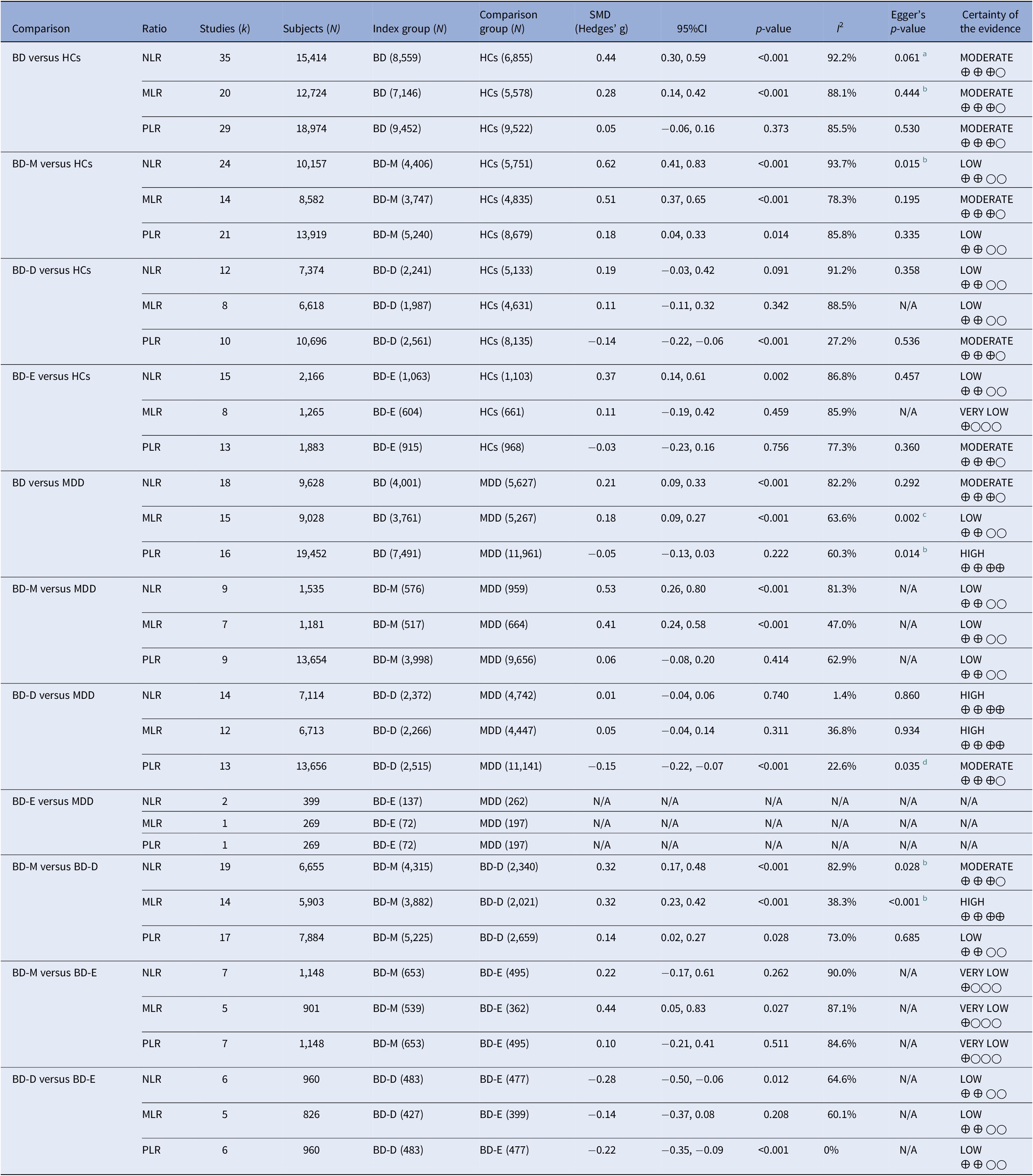
Abbreviations: 95%CI: 95% confidence interval; BD: participants with bipolar disorder (regardless of mood phase); BD-D: participants with bipolar disorder in a depressive episode; BD-E: participants with bipolar disorder in the euthymic phase; BD-M: participants with bipolar disorder in a manic episode; HC: healthy control group; NLR: neutrophile-to-lymphocyte ratio; MLR: monocyte-to-lymphocyte ratio; PLR: platelet-to-lymphocyte ratio; k: number of studies. N: number of participants; N/A: not applicable; SMD: standardized mean difference.
a Trim-and-fill adjusted SMD = 0.41, 95%CI: 0.25, 0.57.
b Trim-and-fill method imputed no additional studies.
c Trim-and-fill adjusted SMD = 0.09, 95%CI: −0.02, 0.20.
d Trim-and-fill adjusted SMD = –0.18, 95%CI: −0.24, −0.12.
A graphical summary of findings is depicted in Figure 2.
Graphical summary of findings * p < 0.05; ** p < 0.01; *** p < 0.001.

The results of the quality-based sensitivity analyses, heterogeneity-based sensitivity analyses, and meta-regression analyses are reported in Supplementary Tables 6–8.
Forest plots and trim-and-fill funnel plots are reported in Supplementary Figures 1–37.
Grading of the evidence
High-certainty evidence supported the presence of higher MLR in BD-M than in BD-D. High certainty also characterized some null findings, namely the absence of significant differences in PLR between BD and MDD, and in both NLR and MLR between BD-D and MDD.
Moderate-certainty evidence indicated higher NLR and MLR in subjects with BD compared to HCs, higher MLR in individuals with BD-M relative to HCs, lower PLR in those with BD-D compared to HCs, and lower PLR in BD-D versus MDD. Moderate certainty also supported a higher NLR in BD-M compared to BD-D. Similarly, some null findings were rated as moderate-quality, including the absence of significant differences in PLR between subjects with BD and HCs (especially in euthymia), as well as in NLR between BD-D and MDD.
Evidence certainty for most remaining comparisons was low, with only a few findings – mainly in BD-M versus BD-E comparisons – rated very low.
Evidence certainty ratings are reported in Table 2.
The full GRADE assessment is detailed in Supplementary Table 9.
Discussion
Summary and interpretation of findings
This systematic review and meta-analysis of 51 studies comparing CBC-based ratios between individuals with BD versus HCs, versus MDD, and across different mood states within BD found distinct alterations in NLR, MLR, and PLR. By integrating mood-state stratification with certainty-of-evidence ratings, our findings allow a more informed interpretation of CBC-derived ratios in BD.
First, individuals with BD exhibited moderately higher NLR and slightly higher MLR compared to HCs; younger age and male sex were associated with larger effect sizes for MLR. Both findings were supported by moderate-certainty evidence. These findings reflect an overactivation of innate immunity (neutrophils and monocytes) coupled with a relative suppression of adaptive immunity (lymphocytes) [Reference Hua, Sun, Lou, Sun and Kong90–Reference Song, Graubard, Rabkin and Engels92]. These, along with other peripheral markers such as CRP, IL-6, and tumor necrosis factor-alpha (TNF-α) [Reference Solmi, Sharma, Osimo, Fornaro, Bortolato and Croatto93, Reference Fernandes, Steiner, Molendijk, Dodd, Nardin and Gonçalves94], point to an increased systemic and central inflammation in BD. NLR and MLR may thus represent reliable – though non-specific – markers of BD, at least when compared to healthy subjects. Such an inflammatory phenotype seems particularly evident in the manic phase: moderate-to-large elevations in NLR and MLR in BD-M, along with a small – yet significant – increase in PLR, support the prominent role of systemic and neural inflammation in manic states [Reference Queissner, Pilz, Dalkner, Birner, Bengesser and Platzer95]. On the other hand, only a modest reduction in PLR in subjects with BD-D compared to HCs was found, while no differences were observed in NLR and MLR. As regards euthymic states, the higher NLR observed in individuals with BD-E relative to HCs partly supports the hypothesis that inflammatory dysregulation in BD is not exclusively state-related but may also reflect a trait vulnerability or residual immune activation. In sum, while BD-M emerges as the state with the most robust inflammatory signature, depressive and euthymic states in BD seem characterized by a more subtle and selective inflammatory profile [Reference Huang, Huang, Shang and Xie96, Reference Strawbridge, Carter, Saldarini, Tsapekos and Young97]. As a whole, the comparisons between subjects with BD and HCs were supported by low-to-moderate-certainty evidence. This indicates that, even though these findings strengthen the hypothesis of immune-inflammatory involvement in BD pathophysiology, caution is warranted in drawing definitive conclusions about their diagnostic specificity.
Second, when compared to MDD, we found significantly higher NLR in BD regardless of the mood phase, though with an effect estimate of small magnitude likely driven by age differences between the two groups. In addition, after adjusting for publication bias, MLR was not significantly different. Comprehensively, CBC-derived ratios seem to offer minimal discriminatory capacity between subjects with BD and those with MDD. When focusing on specific mood phases, BD-M exhibited a more pronounced inflammatory profile than MDD, with a larger effect size for NLR and significantly higher MLR as well. Conversely, no similar differences were observed for BD-D. This latter finding diverges from our initial hypothesis and reflects the clinical challenge of differentiating unipolar and bipolar depressive states based solely on immune-inflammatory biomarkers [Reference Tomasik, Harrison, Rustogi, Olmert, Barton-Owen and Han98], reinforcing the notion that CBC-derived ratios are currently not suitable as stand-alone differential diagnostic tests in depressive presentations. The only tentative indication of a biological divergence between these two conditions is the significantly lower PLR in BD-D, which may tentatively suggest a distinct profile of platelet reactivity or vascular involvement compared to MDD. Nonetheless, despite the moderate-quality evidence supporting this finding, the small effect size does not allow clinical discrimination. Also, this result should be interpreted with caution since PLR is particularly susceptible to residual confounding, including the lowering effect on platelet count that psychotropic drugs – in particular mood stabilizers – may have [Reference Wysokiński and Szczepocka99]. Accordingly, our findings do not support the use of CBC-derived ratios as stand-alone tools for differential diagnosis in depressive states. Overall, although immune-inflammatory markers capture relevant pathophysiological processes in mood disorders, their ability to discriminate across specific diagnostic categories remains limited. This is underscored by the fact that evidence certainty was high for some null findings (e.g., PLR in BD versus MDD and both NLR and MLR in BD-D versus MDD), but only low-to-moderate for significant ones, particularly when attempting to delineate the biological boundaries between bipolar and unipolar depression.
Finally, as regards state-to-state comparisons within BD, all three ratios were significantly higher in BD-M than in BD-D, and MLR was also higher in BD-M compared with BD-E; notably, the differences in MLR between BD-M and BD-D were supported by high-certainty evidence. This suggests that inflammation is most pronounced in manic states not only relative to HCs and MDD but also compared with other bipolar phases, further confirming BD-M as the state of peak inflammation [Reference Dargél, Godin, Kapczinski, Kupfer and Leboyer100]. Conversely, BD-D showed significantly lower NLR and PLR than BD-E, which, despite low certainty, suggests a relatively immunosuppressed state compared to the low-grade inflammation observed during free intervals [Reference Fernandes, Steiner, Molendijk, Dodd, Nardin and Gonçalves94].
Translational implications
CBC-derived ratios represent proxy indices of systemic inflammation and immune-cell distribution that may complement established inflammatory markers in BD – including cytokines and acute-phase proteins – by capturing aspects of innate-adaptive balance and platelet-immune interplay. Also, an important added value lies in their feasibility, scalability, and repeatability: NLR, MLR, and PLR are derived from standard CBC panels, which are routinely performed across virtually all healthcare settings, rapidly available, and low-cost, making them practical tools for clinical monitoring and enabling large-scale implementation [Reference Misiewicz and Dymicka-Piekarska10]. Nonetheless, given the predominantly small-to-moderate effect sizes and the limited number of findings supported by high-certainty evidence, these indices should probably be interpreted as non-specific, group-level correlates of immune-inflammatory dysregulation rather than clinically useful biomarkers for differential diagnosis. In particular, the BD-D versus MDD contrast implies marked overlap between groups, limiting any individual-level interpretability and constraining diagnostic usefulness. Future work should focus on multivariable and longitudinal approaches (e.g., within-person change across mood transitions) rather than single-threshold applications and test their incremental utility over established markers (e.g., CRP, IL-6).
On the other hand, consistently higher ratios observed in BD – particularly during BD-M – suggest that, with more refined investigations, these markers may provide valuable support to clinical assessment in the future. In contexts of diagnostic uncertainty, integrating such accessible inflammatory indices with sociodemographic and clinical information may enhance diagnostic precision and treatment decisions when managing affective disorders. To this end, given the well-established association between inflammatory dysregulation and relapse risk in mood disorders [Reference Liu, Zhang, Li, Li, Woelfer and Walter101], CBC-derived ratios may offer clinically relevant predictive value for identifying individuals at heightened risk of mood episode recurrence. This ability to prospectively identify relapse vulnerability is particularly important, as every relapse in BD progressively increases the risk of chronicity, treatment refractoriness, functional deterioration, and prolonged recovery periods [Reference Vázquez, Holtzman, Lolich, Ketter and Baldessarini102]. Longitudinal and prospective studies should explicitly test whether baseline or serially monitored CBC-derived inflammatory ratios predict the timing, frequency, or severity of future mood episodes, and whether these indices can stratify patients into differential relapse risk categories to enable early intervention strategies.
Furthermore, given the well-established role of chronic, low-grade inflammation in the pathogenesis of atherosclerosis and endothelial dysfunction, inflammatory activation in BD may contribute to its increased cardiovascular and cognitive burden [Reference Tseng, Chang, Wei, Lu, Hsieh and Yang103], supporting the potential value of early metabolic screening as well as of adjunctive anti-inflammatory treatment [Reference Bartoli, Cavaleri, Bachi, Moretti, Riboldi and Crocamo104]. Nonetheless, the pragmatic value of CBC-derived ratios as readily available components of broader cardiometabolic and inflammatory risk profiling must be further investigated before their integration into clinical practice.
Limitations
Some limitations should be acknowledged. First, the cross-sectional nature of the included studies does not allow any causal inference. Second, although the included samples seemed consistent in terms of main characteristics, substantial heterogeneity, albeit expected in biomarker studies, remained largely unexplained despite meta-regressions testing the influence of some possible confounders (age, sex, BMI, and study quality). Future studies should investigate additional moderators that may account for the observed heterogeneity; these should include symptom severity, which has shown complex relationships with NLR, MLR, and PLR in both BD-M and BD-D [Reference Kirlioglu Balcioglu, Kilictutan, Ozer, Guclu and Namli46], pharmacological treatment (antipsychotic exposure has been shown to correlate dose-dependently with inflammatory marker reductions) [Reference Bhatt, Dhar, Samanta and Suttee105], and lifestyle/metabolic factors beyond BMI, including smoking, dietary patterns, physical inactivity, and metabolic syndrome components [Reference Bartoli, Carrà, Crocamo, Carretta and Clerici106], which independently influence inflammation. Moreover, potential publication bias may have influenced the results of some of our analyses, although in most cases the trim-and-fill analyses did not impute additional studies. Finally, while evidence certainty was integrated using an adapted GRADE approach, several findings remained supported by low/very-low certainty.
Conclusions
Comprehensively, our systematic review and meta-analysis strengthens the case for higher inflammation in people with BD compared to HCs, with the most marked inflammatory profile observed in BD-M and also residual, trait-like inflammation in BD-E. Heterogeneity in evidence certainty implies that NLR, MLR, and PLR are more likely to serve as state-sensitive markers within BD (particularly for BD-M), while only subtle differences were observed between BD-D and MDD, underscoring the limited discriminatory power of these markers to distinguish between unipolar and bipolar depressive states. Taken together, our findings support the potential role of CBC-based indices as both trait- and state-related markers in BD, which – given their wide availability and low cost – could be feasibly implemented on a large scale. However, considering that the observed effects were predominantly small-to-moderate and several comparisons were supported by low/very-low certainty, they should currently be interpreted as non-specific, group-level correlates of immune-inflammatory dysregulation rather than clinically useful biomarkers for differential diagnosis, especially regarding the comparison between bipolar and unipolar depression. Notably, the presence of high-certainty null findings further argues against overinterpreting these indices as diagnostic discriminators, especially in depressive presentations. Future research with longitudinal designs is needed to delineate the trajectories of NLR, MLR, and PLR across diagnostic groups and mood phases. A deeper understanding of the mechanistic links between immune dysregulation and clinical outcomes will be essential to advance precision medicine approaches in BD, integrating clinical evaluation with pathophysiology-based data.
Supplementary material
The supplementary material for this article can be found at http://doi.org/10.1192/j.eurpsy.2026.10174.
Data availability statement
This is a systematic review and meta-analysis. All data for the meta-analyses were extracted from the articles included in the review or obtained from their corresponding authors. The codes used for the meta-analyses in Stata 19 are available from the corresponding author upon reasonable request.
Acknowledgements
The authors thank Zekiye Çatak [Reference Çatak, Uzmez, Ozturk and Ugur82], Katerina Dadouli [Reference Dadouli, Janho, Hatziefthimiou, Voulgaridi, Piaha and Anagnostopoulos20], Simge Seren Kirlioglu Balcioglu [Reference Kirlioglu Balcioglu, Kilictutan, Ozer, Guclu and Namli46], Anastasia Koureta [Reference Koureta, Asimakopoulos, Bozikas and Agorastos66], Filiz Karadağ [Reference Küçükkarapınar, Erbil, Keles and Karadag55], Ling Zhang [Reference Lyu, Wang, Zhao, Fu, Li and Yue56], Filiz Mercantepe [Reference Ozkaya, Grbzer, Tozoglu, Akyildirim and Mercantepe47], Leticia González-Blanco [Reference Paniagua, González-Blanco, Siz, Moya-Lacasa, Gutiérrez and Martínez-Bota68], Rajnish Raj [Reference Raj, Wani, Dar, Dilawar, Altaf and Beigh59], Deng Wei [Reference Zeng, Zhang, Xiang, Liang, Xue and Zhang70] for providing additional data through correspondence. During the preparation of this work the authors used ChatGPT (GPT-5.1) [OpenAI, 2025. Available from: https://www.openai.com/] in order to assist with language and manuscript revision. After using this tool, the authors reviewed and edited the content as needed and take full responsibility for the content of the published article.
Author contribution
Daniele Cavaleri: Conceptualization, Data curation, Formal analysis, Investigation, Methodology, Project administration, Software, Validation, Visualization, Writing – original draft. Giorgio Cucchi: Data curation, Investigation, Writing – review & editing. Martina Citton: Data curation, Investigation, Writing – review & editing. Martina Monti: Data curation, Investigation, Writing – review & editing. Cristina Crocamo: Conceptualization, Formal analysis, Methodology, Supervision, Validation, Writing – review & editing. Francesco Bartoli: Conceptualization, Methodology, Supervision, Validation, Writing – review & editing. Giuseppe Carrà: Conceptualization, Supervision, Validation, Writing – review & editing.
Financial support
This research received no specific grant from any funding agency, commercial or not-for-profit sectors.
Competing interests
All authors declare none.


 Open access


Comments
No Comments have been published for this article.