




Introduction
Agroecosystem research and innovation (R&I) needs to evolve for addressing the pressing, complex, global, social–environmental challenges. Traditionally, research agendas have been following established pathways toward specific innovations. What research is, how it is conducted, and by whom it is conducted are tacitly held assumptions by individuals, institutions, and society. Research paradigms are socially acceptable bounded performative spaces meant for science and innovation to occur (Schlaile et al., Reference Schlaile, Urmetzer, Blok, Andersen, Timmermans, Mueller, Fagerberg and Pyka2017). This includes scientific behavioral norms that determine the who, what, when, how, where, and why science is conducted. Research paradigms define acceptable challenges that need to be tackled and also provide the necessary methods, modes, and modalities of stakeholder engagement for this. Research paradigms define a specific range of solutions and also highlight the scope for innovations (Vanloqueren and Baret, Reference Vanloqueren and Baret2009; Darnhofer, Reference Darnhofer, Sutherland, Darnhofer, Wilson and Zagata2015). Examples of research paradigms in food system sustainability include efficiency, genetic engineering, consumer demand-driven aspects, food system transformation, and agroecology (Vanloqueren and Baret, Reference Vanloqueren and Baret2009; El Bilali, Reference El Bilali2018).
These paradigms define what research problems are acceptable for solving and further identify the appropriate methods to solve those problems, who should be conducting the research, and what solutions are possible to obtain (Vanloqueren and Baret, Reference Vanloqueren and Baret2009). Barriers that maintain the established research paradigms are known as lock-ins. Lock-ins are self-reinforcing mechanisms that keep the current research trajectory or paradigm in place, impeding change in direction, scope, agency, methods, stakeholders, value, and/or orientation of the research paradigm (Cowan and Gunby, Reference Cowan and Gunby1996; De Herde, Maréchal and Baret, Reference De Herde, Maréchal and Baret2019). Lock-ins include societal discrimination, institutional structure, access to resources, existing research equipment, educational pathways, and funding resources (Meynard et al., Reference Meynard, Charrier, Fares, Le Bail, Magrini, Charlier and Messéan2018). Lock-ins prevent research from changing and adopting new paradigms that address new problems, incorporate alternative methodologies, are more inclusive, and address inequality in terms of who benefits from the research.
Transformative agroecosystems require a reimagining of how R&I is being conducted, as well as future pathways that need to be developed from multiple perspectives by researchers, business, and policy sectors (Spielman and Birner, Reference Spielman and Birner2008). For example, Jacquet et al. (Reference Jacquet, Jeuffroy, Jouan, Le Cadre, Litrico, Malausa, Reboud and Huyghe2022) propose that plant disease-management challenges are not adequately solved by R&I introducing new pesticides. Alternatively, they require multitiered, dynamic solutions that redesign agricultural systems that will (1) enhance prophylaxis, (2) diversify business models, (3) provide agricultural technologies that support not large monocultures but small diversified fields, (4) allow plant breeding to support functional biodiversity, and (4) support private–public policy initiatives. These R&Is require coordination, communication, and parallel efforts by multiple sectors to improve sustainable plant disease management (Jacquet et al., Reference Jacquet, Jeuffroy, Jouan, Le Cadre, Litrico, Malausa, Reboud and Huyghe2022). In addition, these multitiered solutions cannot be completed in isolation, therefore requiring effective stakeholder engagement as critical to achieving change.
A considerable volume of literature has articulated the idealized transformative research and stakeholder engagement strategies to achieve change, but limited research has documented this shift with empirical data (Fazey et al., Reference Fazey, Schäpke, Caniglia, Patterson, Hultman, van Mierlo, Säwe, Wiek, Wittmayer, Aldunce, Al Waer, Battacharya, Bradbury, Carmen, Colvin, Cvitanovic, D’Souza, Gopel, Goldstein, Hämäläinen, Harper, Henfry, Hodgson, Howden, Kerr, Klaes, Lyon, Midgley, Moser, Mukherjee, Müller, O’Brien, O’Connell, Olsson, Page, Reed, Searle, Silvestri, Spaiser, Strasser, Tschakert, Uribe-Valvo, Waddell, Rao-Williams, Wise, Wolstenholme, Woods and Wyborn2018). To fill this research gap, the Long-Term Agroecosystem Research (LTAR) network was chosen as a case study because it is North America’s largest and most comprehensive agricultural field -based research network examining environmental and social outcomes of field-level agroecosystem R&I (Donovan et al., Reference Donovan, Spiegal, Kaplan, Archer, Bean, Beebout, Bestelmeyer, Clark, DeLong, Fortuna, Friedrichsen, Hoover, Huggins, Kleinman, McIntosh, Renschler, Ritten, Smith, Webb and Wulfhorst2025). Officially founded in 2015, the full history of the LTAR network can be found in Robertson et al. (Reference Robertson, Allen, Boody, Boose, Creamer, Drinkwater, Gosz, Lynch, Havlin, Jackson, Pickett, Pitelka, Randall, Reed, Seastedt, Waide and Wall2008) and Tsegaye et al. (Reference Tsegaye, Eve, Hapeman, Kleinman, Baffaut, Browning, Coffin and Spiegal2024). At the time of data collection in 2019, the LTAR had 18 research sites pursuing a common mission through a common experiment across the United States (now the research network has 19 sites) (Tsegaye et al., Reference Tsegaye, Eve, Hapeman, Kleinman, Baffaut, Browning, Coffin and Spiegal2024). Each LTAR research site is a subset of network actors learning, experimenting, exploring, and pursuing a specific innovation or a set of innovations advancing the common research mission of the LTAR network (Kemp, Schot and Hoogma, Reference Kemp, Schot and Hoogma1998).
Research paradigms
In North America’s agricultural systems, there have been several research paradigm shifts within agroecosystem R&I, paralleling paradigm shifts in innovation policy (Table 1) (Schot and Steinmueller, Reference Schot and Steinmueller2018). Following World War I, the Green Revolution focused on developing agronomic crop varieties that increased yield so as to increase production and reduce hunger. However, a paradigm concentrated on efficiency resulted in a reductionist research paradigm, engrossed only on the yield outcomes, and this resulted in many negative environmental impacts. This efficiency paradigm was centered around scientists developing innovations that were economically adaptable at the field level by agriculturists. The innovations sought to control the environment, but they did not address the multidimensional aspects of food security (Klerkx, van Mierlo and Leeuwis, Reference Klerkx, van Mierlo, Leeuwis, Darnhofer, Gibbon and Dedieu2012).
Efficiency, eco-technology, and transformative paradigm research characteristics

Table 1. Long description
From left to right, the columns are Efficiency, Eco-technology, and Transformative. The first row, R and I process, lists stakeholders as recipients with one-way communication for Efficiency, stakeholders as collaborators with two-way communication for Eco-technology, and stakeholders drive decisions within learning and adaptive management processes for Transformative. The second row, Outcome of R and I process, shows increased profits and environmental conservation for Efficiency, adoption of new digital technology for Eco-technology, and systems-level innovations and social outcomes for Transformative. The third row, Perception of the agroecosystem, describes the agroecosystem as objective for Efficiency, the environment as understandable and controllable through digital agriculture for Eco-technology, and multiple ways of knowing with change needed throughout the system for Transformative.
As a consequence of externalities from the Green Revolution, a research paradigm known as the eco-technology paradigm evolved. The eco-technology paradigm focuses on technology as a tool to mediate the environmental externalities of agricultural systems. This broader perspective considers environmental drivers in its framework, and outcomes are targeted for providing ecosystem services to society. The eco-technology paradigm perceives the environment as an entity separate from the society and as a resource for society (Vanloqueren and Baret, Reference Vanloqueren and Baret2009; Tilman et al., Reference Tilman, Balzer, Hill and Befort2011; Klerkx, van Mierlo and Leeuwis, Reference Klerkx, van Mierlo, Leeuwis, Darnhofer, Gibbon and Dedieu2012).
From the eco-technology paradigm, a transformative research process has emerged. It focuses on supporting the socio-ecological system’s well-being drivers, processes, and outcomes. The transformative paradigm encompasses ecosystem services plus supports dynamic and interdependent individual and community well-being in agricultural systems (Bentley Brymer et al., Reference Bentley Brymer, Toledo, Spiegal, Pierson, Clark and Wulfhorst2020). This R&I paradigm first arose from the practice of international development in the global south (Ashley and Carney, Reference Ashley and Carney1999). The transformative paradigm considers multiple sources of knowledge to understand system dynamics. Under this paradigm, researchers and research programs perceive production, environment, and society as integrally linked. It is because they are inseparable from one another that this paradigm creates conditions to provide environmental and social well-being outcomes of research (Vanloqueren and Baret, Reference Vanloqueren and Baret2009; Holt-Gimenez, Reference Holt-Gimenez2010; El Bilali, Reference El Bilali2019).
These research paradigms create parameters that determine acceptable challenges to tackle; provide the methods, modes, and modalities of stakeholder engagement; and define the range of solutions as well as scope of R&I (Vanloqueren and Baret, Reference Vanloqueren and Baret2009; Darnhofer, Reference Darnhofer, Sutherland, Darnhofer, Wilson and Zagata2015). In the next sections, we define transformative R&I, the role of stakeholder engagement in transformative R&I, and effective stakeholder engagement.
Transformative agroecosystem R&I
The rapid development of technology, access to information, expanding social learning, and multidimensional global change require a new approach to how R&I is conducted—a transformative approach. Transformative R&I includes the incorporation of the complex, compounding social and environmental drivers, processes, and outcomes of agricultural systems (Meynard et al., Reference Meynard, Jeuffroy, Le Bail, Lefèvre, Magrini and Michon2017; Schot and Steinmueller, Reference Schot and Steinmueller2018). Transformative research needs to be democratic, inclusive, and action-oriented and must integrate multiple ways of knowing (Fazey et al., Reference Fazey, Schäpke, Caniglia, Patterson, Hultman, van Mierlo, Säwe, Wiek, Wittmayer, Aldunce, Al Waer, Battacharya, Bradbury, Carmen, Colvin, Cvitanovic, D’Souza, Gopel, Goldstein, Hämäläinen, Harper, Henfry, Hodgson, Howden, Kerr, Klaes, Lyon, Midgley, Moser, Mukherjee, Müller, O’Brien, O’Connell, Olsson, Page, Reed, Searle, Silvestri, Spaiser, Strasser, Tschakert, Uribe-Valvo, Waddell, Rao-Williams, Wise, Wolstenholme, Woods and Wyborn2018). Transformative R&I creates radical change that disrupts power dynamics and requires fundamental reflexivity on how to rebuild systems to address the fundamental social inequality and environmental degradation externalities of our global agroecosystem. Many concepts and frameworks have been developed to understand how science and society interact with one another to create change. However, R&I is a blanket term that can encompass many terms (that is, national innovation systems, agricultural innovation systems, mission-oriented agricultural innovation systems) that are embedded within specific research disciplines and paradigms (Kok et al., Reference Kok, den Boer, Cesuroglu, van der Meij, de Wildt-Liesveld, Regeer and Broerse2019).
Transformative research must be reflexive and address current power dynamics in order to create radical change (Schot and Steinmueller, Reference Schot and Steinmueller2018). Four dimensions to reflect upon within a transformative R&I are (1) Directionality—What futures will be created by a R&I pathway? (2) Diversity—Are a variety of R&I pathways taken to address the challenge? (3) Distribution—To what extent will the impact of R&I be just? and (4) Democracy—How can the R&I process be egalitarian? (Kok and Klerkx, Reference Kok and Klerkx2023). This reflexivity will help researchers transcend current R&I methods and disrupt our current systems to create the necessary change to meet pressing global challenges (Fazey et al., Reference Fazey, Schäpke, Caniglia, Patterson, Hultman, van Mierlo, Säwe, Wiek, Wittmayer, Aldunce, Al Waer, Battacharya, Bradbury, Carmen, Colvin, Cvitanovic, D’Souza, Gopel, Goldstein, Hämäläinen, Harper, Henfry, Hodgson, Howden, Kerr, Klaes, Lyon, Midgley, Moser, Mukherjee, Müller, O’Brien, O’Connell, Olsson, Page, Reed, Searle, Silvestri, Spaiser, Strasser, Tschakert, Uribe-Valvo, Waddell, Rao-Williams, Wise, Wolstenholme, Woods and Wyborn2018).
Efficiency and the eco-technology R&I literature emphasize the importance of stakeholder engagement in increasing the adoption and improving the relevance of the R&I being conducted. Recently, there is a shift toward seeing stakeholder engagement as an adaptive learning process with stakeholders (Schmidt et al., Reference Schmidt, Falk, Siegmund-Schultze and Spangenberg2020). At first, stakeholders were only identified as producers and then also as environmental conservationists (El Bilali, Reference El Bilali2018). Currently, the understanding is to create a radical change wherein the stakeholders need to represent the holistic agroecosystem (Table 2) and work together to implement change through a reflexive approach (Schlaile et al., Reference Schlaile, Urmetzer, Blok, Andersen, Timmermans, Mueller, Fagerberg and Pyka2017; Schot and Steinmueller, Reference Schot and Steinmueller2018; Kok et al., Reference Kok, den Boer, Cesuroglu, van der Meij, de Wildt-Liesveld, Regeer and Broerse2019). However, this shift in stakeholder engagement within R&I has had limited implementation due to the disciplinary nature of research, lack of funding for action research, lack of skill capacity by research to creating change, an ineffective evaluation and award system for researchers, lack of clear methodology, and limitations for stakeholders from engaging for extended periods of time (Kok et al., Reference Kok, den Boer, Cesuroglu, van der Meij, de Wildt-Liesveld, Regeer and Broerse2019).
Example typologies or categories of stakeholders that may provide a more holistic agroecosystem perspective, adapted from Worldlink (2026)
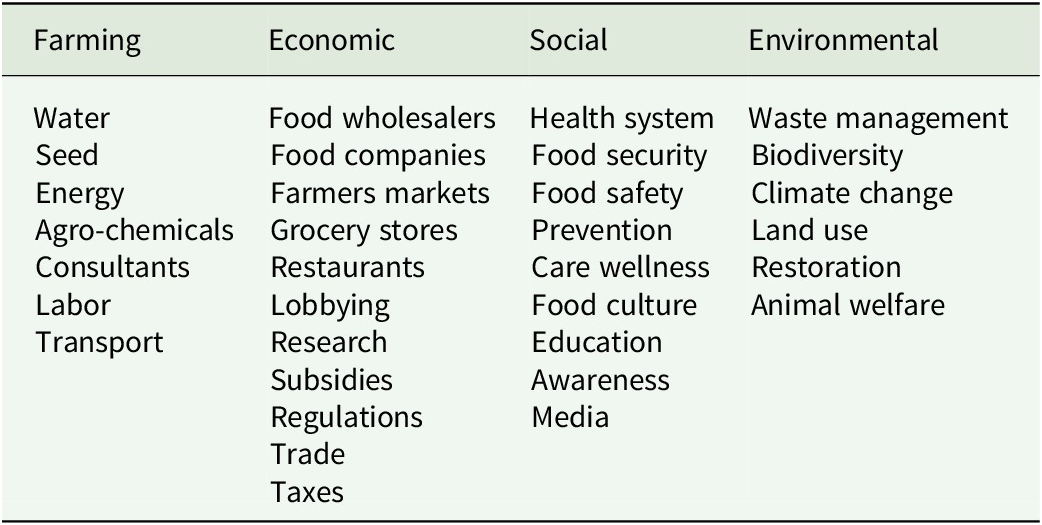
Table 2. Long description
From left to right, the first column is Farming, listing Water, Seed, Energy, Agro-chemicals, Consultants, Labor, and Transport. The second column is Economic, listing Food wholesalers, Food companies, Farmers markets, Grocery stores, Restaurants, Lobbying, Research, Subsidies, Regulations, Trade, and Taxes. The third column is Social, listing Health system, Food security, Food safety, Prevention, Care wellness, Food culture, Education, Awareness, and Media. The fourth column is Environmental, listing Waste management, Biodiversity, Climate change, Land use, Restoration, and Animal welfare.
Effective stakeholder engagement
The degree of stakeholder empowerment and the scope and methodology within R&I are key determinants of the research paradigm (Vanloqueren and Baret, Reference Vanloqueren and Baret2009; Klerkx, van Mierlo and Leeuwis, Reference Klerkx, van Mierlo, Leeuwis, Darnhofer, Gibbon and Dedieu2012). Stakeholders are individuals or organizations who may have the power to either facilitate the implementation of innovations or be impacted by innovations. Stakeholder engagement is any process that integrates stakeholders’ perspectives, values, and ways of knowing within the innovation system (Schmidt et al., Reference Schmidt, Falk, Siegmund-Schultze and Spangenberg2020). Transformative R&I requires the integration of the values, worldviews, epistemologies, and ontologies of stakeholders across the agri-food system within the research process (Schmidt et al., Reference Schmidt, Falk, Siegmund-Schultze and Spangenberg2020). Effective stakeholder engagement includes open communication, diverse participation, unrestrained thinking, constructive conflict, democratic structure, multiple sources of knowledge, extended engagement, and facilitation’ (Schulser, Decker and Pfeffer, Reference Schulser, Decker and Pfeffer2003). Each stakeholder has different needs and desires on how, when, where, and why they would or would not like to be engaged in the process. Additionally, the stakeholders’ interest and their power and influence to create change are important considerations moving forward (Eaton et al.,Reference Eaton, Burnham, Robertson, Arbuckle, Brasier, Burbach, Church, Hart-Fredeluces, Jackson-Smith, Wildermuth, Canfield, Córdova, Chatelain, Fowler, Hendawy, Kirchhoff, Manheim, Martinez, Mook, Mullin, Murrah-Hanson, Onabola, Parker, Redd, Schelly, Schoon, Sigler, Smit, van Huysen, Worosz, Eberly and Rogers2022).
One common pitfall of stakeholder engagement within agri-food R&I is the over reliance on replicating a particular best methodology without reflecting on the impacts of the chosen methodology and the desired outcomes of the engagement (Schmidt et al., Reference Schmidt, Falk, Siegmund-Schultze and Spangenberg2020; Turnhout et al., Reference Turnhout, Metze, Wyborn, Klenk and Louder2020). For example, the current literature base tacitly assumes the best method of stakeholder engagement is by a group of individuals sitting around a table and making decisions by consensus. This assumed methodology limits the number of worldviews that can be incorporated into the research process because it requires significant time and resource commitment on the part of stakeholders to participate (Wilmer et al., Reference Wilmer, Derner, Fernandez-Gimenez, Briske, Augustine and Porensky2017). Consequently, stakeholders who lack the time, resources, power, or interest to be involved in research do not have their beliefs, values, and worldviews incorporated into the research process. This may reinforce rather than mitigate uneven power relationships by developing R&I that caters to a specific group of elite stakeholders who show up at the table (Turnhout et al., Reference Turnhout, Metze, Wyborn, Klenk and Louder2020).
Addressing power, politics, and empowerment is essential to stakeholder engagement in order to create transformative social change. One way to do this is to recognize that stakeholder engagement is political (Turnhout et al., Reference Turnhout, Metze, Wyborn, Klenk and Louder2020). Additionally, effective stakeholder engagement requires unique professional skillsets. However, in agriculture, there is a considerable knowledge gap in improving the effectiveness of stakeholder engagement. Often times, stakeholders are left to stumble through the process via inexperienced facilitation and long, drawn-out processes without clear outcomes (Eaton et al., Reference Eaton, Burnham, Robertson, Arbuckle, Brasier, Burbach, Church, Hart-Fredeluces, Jackson-Smith, Wildermuth, Canfield, Córdova, Chatelain, Fowler, Hendawy, Kirchhoff, Manheim, Martinez, Mook, Mullin, Murrah-Hanson, Onabola, Parker, Redd, Schelly, Schoon, Sigler, Smit, van Huysen, Worosz, Eberly and Rogers2022). Retention and long-term engagement due to resource and time requirements by stakeholders are major barriers to their inclusion within the R&I process (Kok et al., Reference Kok, den Boer, Cesuroglu, van der Meij, de Wildt-Liesveld, Regeer and Broerse2019).
R&I network structure
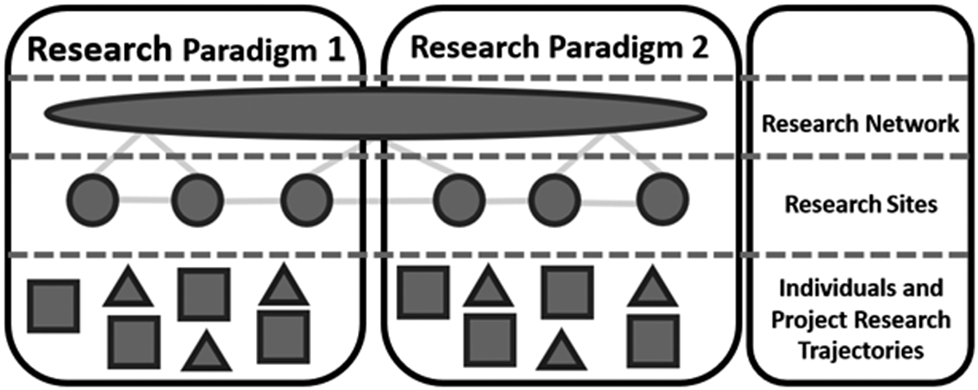
A research network consists of self-organizing research sites, actors, stakeholders, institutions, resources, rules, and mechanisms that demand and supply innovation within a hierarchical structure (Fig. 1) (Hall et al., Reference Hall, Janssen, Pehu and Rajalahti2006). A shared vision and mission facilitate effective coordination of R&I across a breadth of research trajectories in a network (Johnson and Macy, Reference Johnson and Macy2001; Klerkx, van Mierlo and Leeuwis, Reference Klerkx, van Mierlo, Leeuwis, Darnhofer, Gibbon and Dedieu2012; Schlaile et al., Reference Schlaile, Urmetzer, Blok, Andersen, Timmermans, Mueller, Fagerberg and Pyka2017; Pigford, Hickey and Klerkx, Reference Pigford, Hickey and Klerkx2018).
The figure depicts the hierarchical levels of an R&I network and how multiple research paradigms and trajectories exist within a research system. The two outlined squares show how a research paradigm is all encompassing in how a research network, research sites, individuals, and research trajectories approach science, creating this top down force in how science is conducted. The next level is the research network, which sets a common mission for research sites, individuals, and projects trajectories to align with. The next hierarchical level down is the research sites, which create a bounded space through infrastructure of what and how research can be conducted. And finally, individuals and research project trajectories are at the bottom hierarchy receiving a preconceived bounded space in which science can occur based upon the research paradigm, research network, and research site. Figure adapted from Kok et al. (Reference Kok, den Boer, Cesuroglu, van der Meij, de Wildt-Liesveld, Regeer and Broerse2019).

Figure 1. Long description
At the top, two large outlined rectangles labeled Research Paradigm 1 and Research Paradigm 2 span the left and right halves. Within each paradigm, a horizontal oval labeled Research Network sits below the paradigm label. Under the network, a row of circles represents Research Sites, connected by lines to the network above. Below the sites, a row of squares and triangles represents Individuals and Project Research Trajectories. The right side of the diagram contains three horizontal labels, aligned with the layers: Research Network at the top, Research Sites in the middle, and Individuals and Project Research Trajectories at the bottom. Dashed lines horizontally separate each hierarchical level, visually reinforcing the top-down structure.
A research paradigm drives who, what, when, where, and how R&I is conducted and is a system of institutional and social structures. For transformative research to happen, a shift toward a transformative research paradigm away from eco-technology and efficiency paradigms needs to occur. How to cause a research paradigm shift is complex but it can be driven by multiple drivers within the agricultural system. Research sites face complex conditions when considering a transformative approach to overcome perceived lock-ins to support innovation (Elzen et al., Reference Elzen, Barbier, Cerf, Grin, Darnhofer, Gibbon and Dedieu2012; Darnhofer, Reference Darnhofer, Sutherland, Darnhofer, Wilson and Zagata2015; El Bilali, Reference El Bilali2019). Lock-ins prevent an agroecosystem from shifting to a new R&I paradigm, maintaining the system’s directionality and research trajectory. Leverage points are actions within a system that can cause a cascading change in the fundamental structure of a system, overcoming lock-ins (De Herde, Maréchal and Baret, Reference De Herde, Maréchal and Baret2019). There are several leverage points for supporting a shift toward a new R&I paradigm—expanding or changing social networks so that they support and provide new opportunities and potential leverage points; facilitation of ‘outside-the-box’ thinking; exposure to external systems; or technical, financial, or institutional changes (De Herde, Maréchal and Baret, Reference De Herde, Maréchal and Baret2019).
Despite identifying leverage points in the literature, there is limited empirical information about what and who influence a research network, how to support a paradigm shift of a agri-food research network, and what methodologies can be used to study changes of an R&I system (Elzen et al., Reference Elzen, Barbier, Cerf, Grin, Darnhofer, Gibbon and Dedieu2012; Schlaile et al., Reference Schlaile, Urmetzer, Blok, Andersen, Timmermans, Mueller, Fagerberg and Pyka2017; Klerkx and Begemann, Reference Klerkx and Begemann2020). How to foster transformative R&I remains challenging and has not yet been accomplished within the agri-food system (Kok et al., Reference Kok, den Boer, Cesuroglu, van der Meij, de Wildt-Liesveld, Regeer and Broerse2019; Khan et al., Reference Khan, Ray, Kassem, Hussain, Zhang, Khayyam, Ihtisham and Asongu2021). Additionally, most of the research on supporting agroecosystem transformation recently has been limited to case studies in Europe and Australia (Kok and Klerkx, Reference Kok and Klerkx2023). Also, much of the literature is aspirational, discussing what should happen instead of analyzing empirical data to determine how transformative R&I occurs (Turnhout et al., Reference Turnhout, Metze, Wyborn, Klenk and Louder2020). Therefore, our research question is what is the potential for stakeholder engagement to support a shift toward a transformative agroecosystem R&I system within a research network? Our objectives to answer this question are:
-
(1) determine if a site discreetly fits within one R&I paradigm;
-
(2) identify characteristics of a transformative agroecosystem R&I system;
-
(3) determine how lock-ins manifest across and within various levels of a hierarchical R&I system; and
-
(4) discuss the potential for stakeholder engagement as a leverage point to shift toward a transformative paradigm.
As society navigates as to how to overcome dynamic and complex environmental, social, and economic challenges, the need for transformative R&I is imperative. This research seeks to make a compelling case for embracing stakeholder engagement as a strategic tool for catalyzing a paradigm shift in research to create the transformative and radical change necessary to address urgent global challenges.
Methods
Context
The LTAR network was established to be a transformative leader in US. agriculture in the wake of the exponential impact of global change drivers threatening the resiliency of agroecosystems. The original mission of the LTAR was to promote sustainable intensification, which morphed into supporting production, environmental quality, and rural prosperity (Robertson et al., Reference Robertson, Allen, Boody, Boose, Creamer, Drinkwater, Gosz, Lynch, Havlin, Jackson, Pickett, Pitelka, Randall, Reed, Seastedt, Waide and Wall2008). LTAR provides an important resource by conducting long-term research to support the transition to sustainable agriculture. Currently, LTAR’s mission is ‘finding solutions that maintain or increase agricultural productivity, environmental quality, and people’s well-being’ (LTAR Research Network Home, 2023). In 2011 and 2012, all 18 sites joined the LTAR network. Sites receive funding (~ USD $1 million annually) from the USDA Agricultural Research Service to support infrastructure, data management, research, outreach, and stakeholder engagement. LTAR is governed by a rotating board consisting of research leaders from selected sites. The network consists of a group of USDA-Agricultural Research Service experimental farms, not-for-profit agricultural research farms/ranches (i.e., Archbold Biological Station), and university experimental farms/ranches (i.e., Kellogg Biological Station and University of Florida).
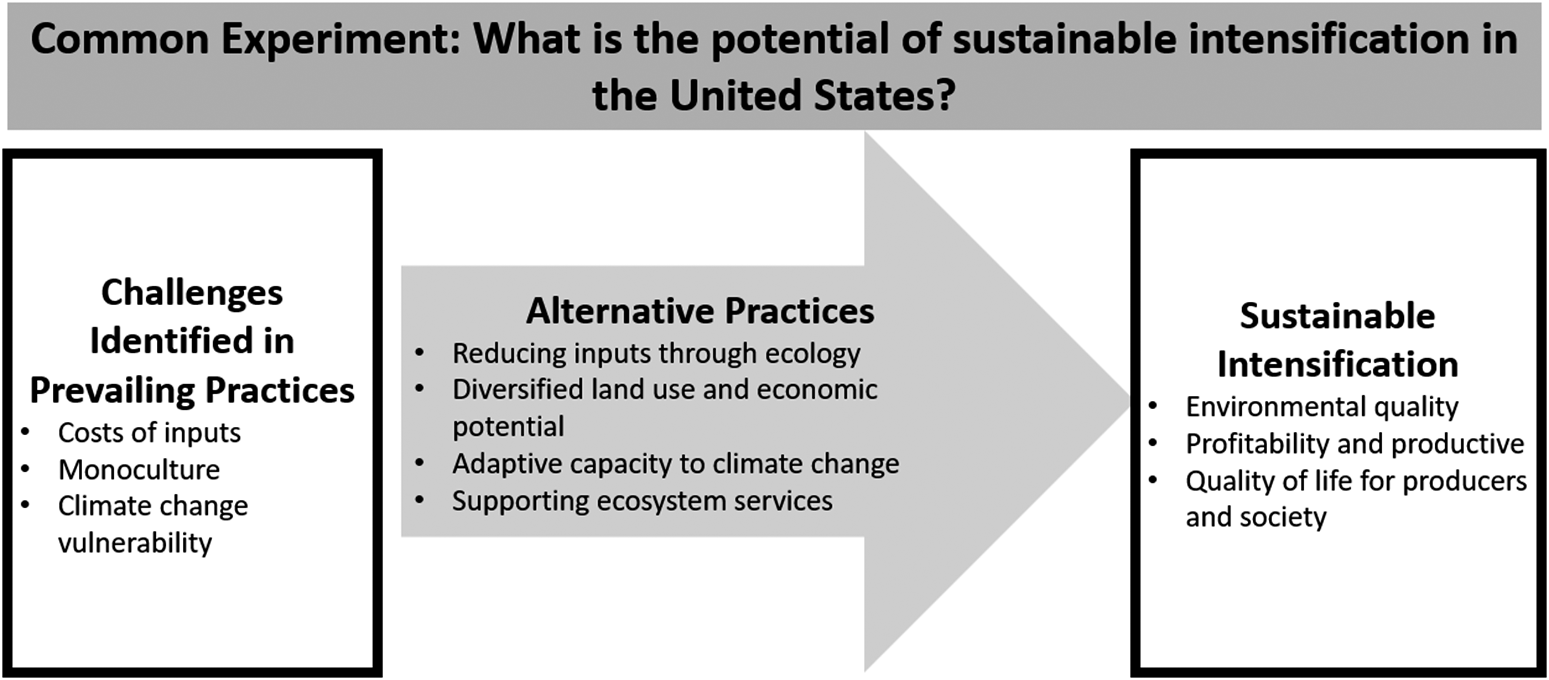
To create a united research effort, all sites conduct a common experiment (CE), which allows for a comparable data set to assess the potential for experimental innovations across the continental United States (Fig. 2). The CE was designed to compare two field level treatments: prevailing practices and alternative practices (Liebig et al., Reference Liebig, Abendroth, Robertson, Augustine, Boughton, Bagley, Busch, Clark, Coffin, Dalzell, Dell, Fortuna, Freidenreich, Heilman, Helseth, Huggins, Johnson, Khorchani, King, Kovar, Locke, Mirsky, Schantz, Schmer, Silveira, Smith, Soder, Spiegal, Stinner, Toledo, Williams and Yost2024) (Fig. 2). The prevailing practices reflect the local dominant agricultural system. The alternative practices treatment advances the sustainable intensification mission of the LTAR at the field scale (Spiegal et al., Reference Spiegal, Bestelmeyer, Archer, Augustine, Boughton, Boughton, Cavigelli, Clark, Derner, Duncan, Hapeman, Harmel, Heilman, Holly, Huggins, King, Kleinman, Liebig, Locke, McCarty, Millar, Mirsky, Moorman, Pierson, Rigby, Robertson, Steiner, Strickland, Swain, Wienhold, Wulfhorst, Yose and Walthall2018). Efforts are underway to develop indicators and metrics (e.g., Spiegal et al., Reference Spiegal, Webb, Boughton, Boughton, Brymer, Clark, Collins, Hoover, Kaplan, McCord, Meredith, Porensky, Toledo, Wilmer, Wulfhorst and Bestelmeyer2022) and stakeholder engagement strategies (e.g., Reimer et al., Reference Reimer, Doll, Boring and Zimnicki2023) for facilitating deliberation of tradeoffs between innovations among stakeholders.
LTAR common experiment—challenges, solutions, and vision. Adapted from Spiegal et al. (Reference Spiegal, Bestelmeyer, Archer, Augustine, Boughton, Boughton, Cavigelli, Clark, Derner, Duncan, Hapeman, Harmel, Heilman, Holly, Huggins, King, Kleinman, Liebig, Locke, McCarty, Millar, Mirsky, Moorman, Pierson, Rigby, Robertson, Steiner, Strickland, Swain, Wienhold, Wulfhorst, Yose and Walthall2018). The figure aims to show how LTAR will address problems within the current agricultural system to their envisioned common mission of what agriculture should look like in the future. The LTAR envisions two worlds—the current agricultural system, the prevailing practice, which is an agricultural system challenged by cost of inputs, monoculture, and climate change vulnerability. And a sustainably intensified system where new R&I are able to advance equally environmental quality, profitability, and productivity, as well as quality of life for producers and society. LTAR envisions that their R&I [arrow in the middle] will shift the agricultural system from the prevailing to alternative practices.

Figure 2. Long description
On the left, a box lists challenges in Prevailing Practices: costs of inputs, monoculture, and climate change vulnerability. In the center, a right-pointing arrow labeled Alternative Practices lists reducing inputs through ecology, diversified land use and economic potential, adaptive capacity to climate change, and supporting ecosystem services. On the right, a box labeled Sustainable Intensification lists environmental quality, profitability and productive, and quality of life for producers and society.
Sampling and data collection
This study followed the Consolidated Criteria for Reporting Qualitative Research (COREQ) reporting guidelines (Tong, Sainsbury and Craig, Reference Tong, Sainsbury and Craig2007). All authors belonged to the Human Dimensions working group of LTAR and the first three coauthors were newly hired into the role of network-wide human dimensions postdoctoral research fellows (within six months of employment) at the time of data collection and analysis (Meredith et al., Reference Meredith, Bean, Brymer, Friedrichsen and Hurst2021). We interviewed each of the 18 LTAR site leaders, as a list of site leaders existed and they would have the capacity to see bigger picture trends of the R&I capacity and the direction of the research network (Bernard and Ryan, Reference Bernard and Ryan2009). We chose to interview the site leader in order to standardize and capture the research paradigm and the research trajectory of each LTAR site. Therefore, interviewing research site leaders would capture site and network trends, and stakeholders. Interviewing only research site leaders created a bias toward only understanding the bigger picture, limiting the ability to understand day-to-day decision-making and the ability to determine the exact extent of interaction with all stakeholders. It was outside the scope of this study to snowball interview other individuals who might play a central role in the R&I at each site, such as stakeholders, partners, and collaborators. Demographic information of the participants was not collected as part of the interview process in order to maintain as much confidentiality as possible when engaging a limited pool of individuals. All site leaders had terminal degrees and were considered an expert in their field of agriculture. This research was approved by the University of Idaho Institutional Review Board (Project #19–223).
We used a cross-sectional design to compare the research paradigm of each LTAR site as separate, independent research sites. This design allowed us to investigate the breadth and diversity of each LTAR site and compare innovation processes across the research network through interviews with leadership for a glimpse of the shift toward transformative research paradigms (Bernard, Reference Bernard2011).
We conducted semistructured interviews with 18 participants. Participants were recruited via email. Semistructured interviews elicited the participants’ perceptions of who and what influences their choice of alternative practice treatment, the process they went through to determine their alternative practices, and the meaningfulness of stakeholder engagement and outreach (that is, ‘Explain the current alternative practice treatment you are working on and the research process you went through to get to where you are?’) Interviews lasted between 0.5 and 2 hours, and 15 were conducted via videoconferencing and 3 of them in person. The interview guide consisted of eight main questions and specific follow-up prompts for each response (Table 3). We prompted participants with a list of potential influences by category to encourage full elicitation of all perceived influences involved in determining the alternative practices (Johnson-Laird, Reference Johnson-Laird2013).
Interview guide
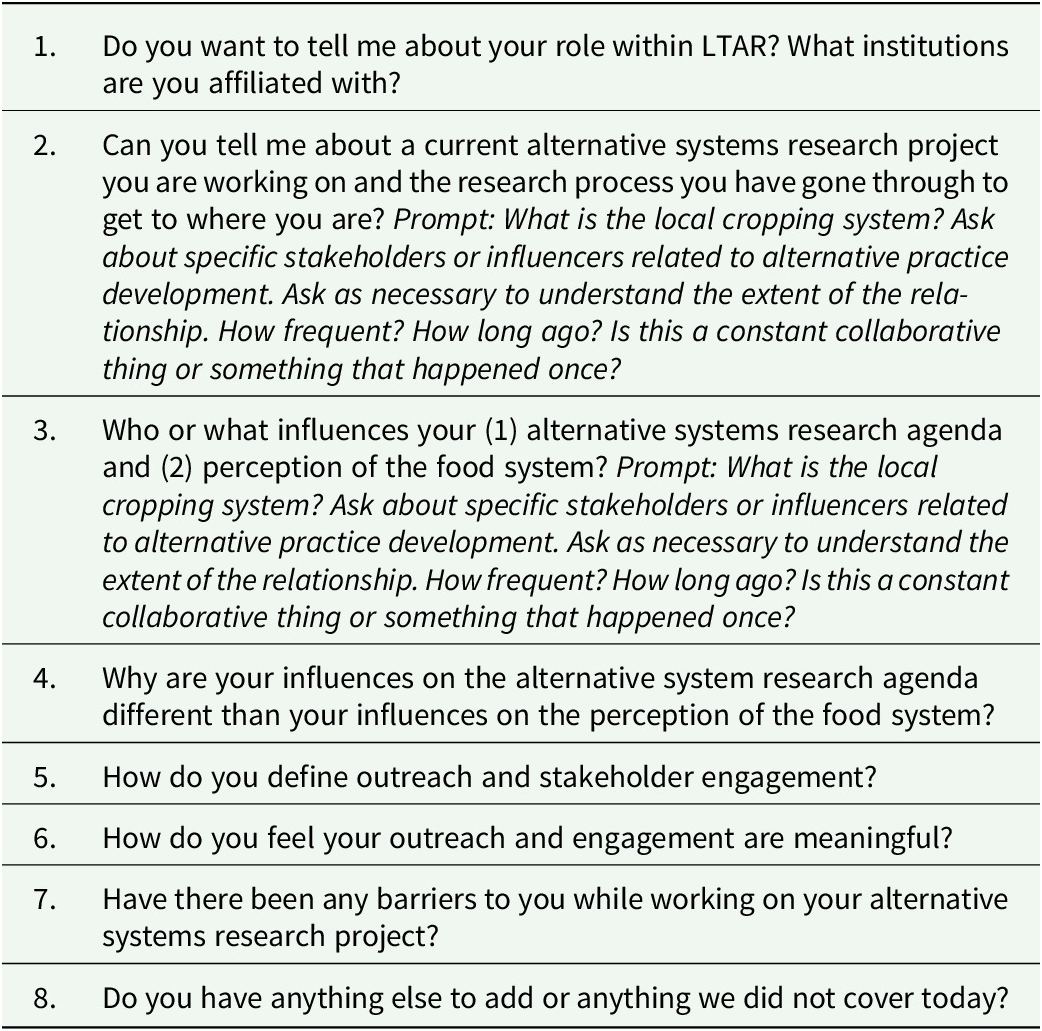
Table 3. Long description
Starting at the top, the table contains eight rows, each with a numbered interview question. Question 1 asks about the participant's role within L T A R and institutional affiliations. Question 2 requests details about a current alternative systems research project and the research process, with prompts about the local cropping system and stakeholders or influencers related to A S P development, including frequency and duration of collaboration. Question 3 explores influences on the alternative systems research agenda and perception of the food system, with similar prompts about local cropping systems and stakeholders. Question 4 asks why influences differ between the research agenda and food system perception. Question 5 seeks definitions of outreach and stakeholder engagement. Question 6 asks how outreach and engagement are meaningful. Question 7 inquires about barriers encountered during alternative research projects. Question 8 invites additional comments or topics not covered. Each question occupies a single row, with italicized prompts included for questions 2 and 3.
The first three authors each conducted one-third of the interviews based on their expertise area in agriculture and geographic focus: rangeland, cropping, or integrated cropland livestock systems. The quality of coding was enhanced across the three interviewers by: codeveloping a semistructured interview guide, listening to and reflecting upon each other’s first interview, and iteratively adjusting the interview guide (Bernard and Ryan, Reference Bernard and Ryan2009; Charmaz, Reference Charmaz2014). All interviews were audio recorded, transcribed, and the transcripts were checked by the interviewer (Bernard, Reference Bernard2011).
Data analysis
The data analysis process was an emergent, inductive, and iterative process in order to develop transformative R&I characteristics and also the barriers to transformative R&I (Bernard and Ryan, Reference Bernard and Ryan2009; Charmaz, Reference Charmaz2014). The data were analyzed by the same group of researchers who conducted the interviews and collected the data. To establish the code book during the first round of coding, each researcher inductively coded one of their own interviews and identified emergent inductive themes. These potential codes were subsequently discussed by coauthors, grouped together into categories, and a standard list of codes were agreed upon (Bernard and Ryan, Reference Bernard and Ryan2009).
After the first round of coding, these themes were presented at a member check with LTAR scientists and site leaders (Bernard, Reference Bernard2002). The participants’ reactions and feedback were recorded to the preliminary themes. Following the member check, a second round of coding occurred, using the coding tree developed from the first round of coding and the member check. Next, we discussed the differences in coding between coders, developed claims, and identified direct quotes to support our claims (Bernard, Reference Bernard2002; Charmaz, Reference Charmaz2014).
Finally, a standardized code book was created based upon theoretical constructs from Klerkx et al. (Reference Klerkx, van Mierlo, Leeuwis, Darnhofer, Gibbon and Dedieu2012). The third round of coding identified a typology for each site by identifying the research site paradigm (Klerkx, van Mierlo and Leeuwis, Reference Klerkx, van Mierlo, Leeuwis, Darnhofer, Gibbon and Dedieu2012). One-third (n = 6) of the sites had to express a lock-in for it to be included as a culturally held belief within the LTAR (Vuillot et al., Reference Vuillot, Coron, Calatayud, Sirami, Mathevet and Gibon2016). Additionally, during the third round of coding, stakeholder engagement typologies were operationalized and categorized as provided in Table 4.
Perceived stakeholder engagement typologies revealed through interviews with LTAR research leaders

Table 4. Long description
Beginning at the top row, the table has four columns: Type of stakeholder engagement, Amount of new research capacity to establish and maintain, Definition, and Representative quote. The first row lists Passive network, requiring conscious assertive effort, defined as influencers regularly interacted with who passively shape worldview, with the quote ‘You go to the supermarket now and you there’s this whole organic section’ from Participant 5. The second row is Passive environment, also requiring conscious assertive effort, defined as the dominant agronomic context shaping researchers’ perceptions, with the quote ‘We take a lot of our research directions from those kind of consistent interactions we have’ from Participant 7. The third row is Key stakeholder, requiring normal capacity, defined as individuals with high interest and power driving research direction, with the quote about using soil moisture and temperature data from Participant 16. The fourth row is Active network engagement, requiring normal capacity, defined as active participation in organizations or events, with the quote about advisory committee engagement from Participant 14. The fifth row is Active environment, requiring normal capacity, defined as actively seeking agronomic contexts, with the quote about meeting end users from Participant 5. The sixth row is Partner, requiring normal capacity, defined as mutually beneficial colleague relationships, with the quote about farmer groups reaching out from Participant 4. The seventh row is Customer focus group, requiring medium capacity and regular meetings, defined as exclusive formal groups for feedback, with the quote about strong farmer groups from Participant 4. The eighth row is Collaborative adaptive management, requiring high capacity and changes in scientific approach, defined as formal relationships with stakeholders responding to data, with the quote about involving stakeholders throughout the experimental process from Participant 3. The ninth row is Social science, requiring high capacity and new positions, defined as research collecting stakeholder worldviews, ranging from qualitative to quantitative, with the quote about farmer surveys influencing treatment from Participant 1. The tenth row is Community action research, requiring exceptionally high capacity and institutional change, defined as research aiming for community change, relationship building, and active adoption, with the quote about stronger community from Participant 10.
Triangulation of results occurred through the member check, repeat presentations of results to the entire LTAR network, receiving informal reflections from network members, reflection of the first three coauthors over the course of a three-year process of serving in the role of human dimension research capacity development for the LTAR network, and multiyear involvement in the LTAR stakeholder engagement working group (Bernard, Reference Bernard2002).
Results
The results are organized around three claims on how to support a shift toward a transformative research paradigm by increasing R&I capacity.
Research sites are not found discretely within one research paradigm
Research sites were not discretely found within one research paradigm (efficiency, eco-technology, transformative), but the data reveal that a research site’s R&I process, desired outcome of the R&I process, and perception of the agroecosystem could all fall within different paradigms. For example, site 3. Their desired outcome was environment conservation (efficiency) and social learning (transformative), but their perception of the agroecosystem was focused only at the production scale (efficiency) and not on the holistic food system scale (transformative). However, their stakeholder engagement was collaborative adaptive management, which empowered stakeholders to make decisions for the research design, questions, and analysis (transformative). Not only did sites fall within multiple research paradigms, it is difficult to categorize and describe what paradigm each part of their R&I process falls within. For example, site 1 used to collaborate with partners on social science aspects to drive their research experiments, but had not done it in 25 years; yet, those survey results still impact their research direction now and they really would like to integrate social science. What is consistent is each site’s desire to increase their capacity and continue to strengthen their research capacity.
Shift toward a transformative paradigm requires increasing diversified capacity
We identified four characteristics of transformative research processes that can be supported through increasing research capacity: (1) systems-level innovation and social outcomes, (2) emphases on R&I that fosters learning and adaptation processes, (3) incorporation of multiple ways of knowing within R&I, and (4) perceived agency to create systems-level change. To achieve these transformative R&I characteristics, sites expressed a need for increased R&I capacity.
Characteristic 1: systems-level innovation and social outcomes
A research capacity that focuses on the systems-level innovations and social outcomes allows sites to work across complex challenges and global change to create the positive, far-reaching impact of their research and to take a complex-adaptive systems lens to their R&I.
I’ve tried to orient the solutions around not just what you can implement on the farm or field, but to address larger challenges within production systems or watershed policies. [Research] pursues things to look at root causes…. Invariably you end up looking at the structure of agriculture, the way it relates to markets, and the role of the consumer. (Participant 14)
For participant 14 to take this approach required them to increase their capacity from single disciplined, siloed thinking to a holistic systems-level awareness.
Probably need somebody with a broad perspective like you (interviewer) to help us do that. That is one of the things that we are a little bit limited. We don’t have a [social scientist] in house that [can bring that] sort of perspective and we probably should think about how we should broaden [our capacity}. (Participant 1)
Participant 1 also noted the lack of human capacity and the necessary skillsets to conduct research beyond the field or plot level so that their research can create a systems-level impact.
Characteristic 2: fostering learning and adaptation
A site with the research capacity that can indulge in learning and adapt to the managing or experimenting with stakeholders allows the site to act in line with global change and the rapid changes in knowledge and technology taking place over time. However, this requires specific skillsets and personnel to do so. Participant 1 talks about their site’s intention to create a stakeholder engagement process to incorporate adaptive management and learning.
I imagine what we will try to do, is, you know, bring in a group, about 6–8 external people which includes 2–3 producers, extension, maybe 1–2 extension people, and 1–2 from NRCS. What we should do, I think, is try to lean on some of our university colleagues that have some training as facilitators to try to keep this going and try to make sure it is not us trying to drive, drive the discussion so much. (Participant 1)
Participant 1 noted the need for R&I capacity to effectively conduct stakeholder engagement that supports adaptive learning across stakeholders without falling back on one-directional decision-making. For an R&I process to focus on learning and adaptation, it requires the R&I capacity to be increased by incorporating new human skillsets for supporting effective learning with stakeholders.
Characteristic 3: incorporating multiple ways of knowing
Participants expressed three research capacities to incorporate multiple ways of knowing agroecosystems within the research process: (1) collaboration with Black or Indigenous institutions and organizations, (2) incorporation of social science to understand social drivers and outcomes, and (3) representation of varied agricultural systems within their alternative practice treatment (e.g., organic).
We try and engage the tribal colleges quite a bit. That’s one thing that we’ve done a fair amount of learning and we’ve engaged in some collaborative research, and have been learning more about native knowledge and information on the land and ecosystem. I think this has been helpful for us in broadening our understanding. (Participant 9)
However, participant 9 said this collaboration has been limited by their R&I capacity, such as funding cycles. The inclusion of multiple ways of knowing of agroecosystems allowed for a wider breadth and diversity of innovations across the research network. Sites that were able to incorporate multiple ways of knowing within their alternative practice treatment had trained personnel and devoted resources to do so.
Characteristic 4: perceived agency
Perceived agency to make a systems-level change is the final transformative R&I characteristic. Sites ranged in their perceived agency from a protectionist approach to a change-making perspective. In a protectionist view, participants perceived they must protect the environment from society, an identity where they perceived they were part of the current system and helping to make the existing system better. For changemakers, perceived agency meant that the current agroecosystem must undergo change and that they are the change agents creating a new, more effective system.
This idea of a circular economy where you constrain the energy flows—to some extent, and energy can be tracked as water, you could track carbon, etc. But the idea being is that you tighten up that loop and do a better job of mimicking more natural systems so that the energies, the nutrients, we think about these systems—we just don’t have the resources to do a better job of tracing the nutrients. (Participant 15)
Here the participant indicated an intention to work toward building a new circular agroecosystem but was constrained by the current research capacity.
Framing a research paradigm shift as an increase in the breadth of research capacity is an insightful and useful lens that may help innovation systems change. A transformative paradigm supports creating goals to foster change in the R&I process instead of labeling them deficient. Instead, it helps to identify where to devote the needed R&I resources. The key insights we have highlighted in this section are participants’ identifying characteristics of the R&I process that, through increased capacity, allowed the sites to pursue transformation research.
Hierarchical lock-ins limit transformative research implementation
Participants perceived that hierarchical structures of lock-ins often created a cascade of barriers that limited their ability to implement alternative practice innovations. The lock-ins were found at each hierarchical level—the research paradigm, research network (LTAR), research site, and participants’ own cognitive barriers. Both real and perceived imposed barriers resulted in limitations on the type of research process that was possible and the range of acceptable innovation outcomes.
At the research paradigm level, perceived lock-ins included: (1) uncertainty on how to manage personal values at a systems-level to remain objective and (2) the availability of scientific methods to work holistically and at larger scales. Participant 3 pondered, ‘The kind of conundrum of—how do we conduct experimental research in highly controlled environments with multiple replications, etc. that is relevant for producers at large scales?’ Here, the research leader expresses their concerns about how to retain the acceptable reductionistic scientific rigor while working on larger, more complex (i.e., messier) scales that directly benefit LTAR’s stakeholders and end users.
At the institutional level, perceived lock-ins included available funding, human capacity and skillset, and institutional inertia. The formation of LTAR and site selection itself created a lock-in that perpetuates efficiency and eco-technological paradigms. One criterion for inclusion in the LTAR was pre-existing long-term data sets on management practices. This criterion for inclusion has become a lock-in to changing the alternative practice treatment to embody the transformative R&I paradigm characteristics. Long-term research has its own challenges. LTAR’s value of long-term data has led site scientists to hesitate to change their Altnerative Practices. ‘Over the years, we’ve worked on residue management, tillage management, crop production, and now we’re refocusing that project on our LTAR activities’ said Participant 2. Participant 11 said, ‘We had to start our alternative practice treatment on something that we were working on already because we didn’t have any money from LTAR to do this work.’ Here the participant notes how the institutional inertia lock-in was further perpetuated by lack of funding.
At the research site level, several participants perceived the following barriers that perpetuated lock-ins: reliance on external collaborators for stakeholder engagement, lack of formal processes for stakeholder engagement, and land access and tenure. Five participants explicitly mentioned land tenure as a lock-in for implementing their alternative practice treatment over a long-term basis as originally envisioned. Some sites lost their land access or relied on on-farm research for their alternative practice treatment, which limited their control and consistent long-term experimentation of management practices.
We don’t own land. So we can’t control the studies… An elderly lady was managing the estate of her husband but she died. Once the heirs of the estate stop squabbling over to sell or to continue, if they sell it and then we’ve got to go somewhere else, then I’ve lost continuity of my experiment. (Participant 16)
Most site leaders reported that the alternative practices were influenced by organizations creating demand for agricultural innovations (e.g., producers and commodity boards, federal and regional boundary organizations, environmental NGOs, agricultural input industries, and food value chain conglomerates), and institutions that could provide the data, skillsets, or resources (e.g., state and federal agencies, university collaborations). ‘It’s those people whose farms I’m working on because they’re the ones I talked to more, and it’s their problems I hear more, and it’s their problems that I think about solutions to, and that may or may not be representative of the broader stakeholder,’ said Participant 16. The participant articulated how a limited capacity to interact with multiple stakeholders narrows what innovations they pursue with their R&I. Of the 18 sites, only two sites actively worked with stakeholders that could provide them multiple ways of knowing about the agroecosystem, such as tribal nations or 1890s land grant institutions. Various forms of stakeholder engagement arose from the interviews during the second round of coding (Table 4). These various forms of perceived stakeholder engagement demonstrate the breadth of the R&I paradigm expressed across the LTAR network with some stakeholder engagement types being perceived as more desirable, beneficial, and influential than others.
Finally, perceived individual cognitive barriers created lock-ins that limited the ability to conduct transformative aspirational innovations. These barriers included scientific identity, career trajectories, fear of failure, perception of systems-level influences as subjective, and functional fixedness. Participant 18 expressed the compounding cognitive and human capacity perceived barriers. ‘We could go out with an organic system out there and just fail miserably because we don’t know how to do organic agriculture very well, quite frankly.’ Participants reported that their food systems-level knowledge, compared to their alternative practice treatment, was mostly influenced by subjective factors (e.g., personal identity, personal values, media, life experiences, and personal connections) or secondary demand influences (e.g., producer’s perception of market demands, and environmental NGO perception of market demands). This meant that participants felt like they did not have primary stakeholders who could inform them of how to incorporate systems-level knowledge into their alternative practice treatment. However, three sites did work directly with primary stakeholders (that is, the processing and distribution industries). Functional fixedness, a cognitive bias, led to sites taking incremental and pragmatic steps toward changing their alternative practice innovation and focusing on field-level management changes instead of holistic systems-level change.
I guess that’s not my research area. We look at the natural resources in general. That is the mission of our research and so, within a given direction/system, how can we sustain our resources, such as water and soil? We don’t try to change what is being grown here or look at necessarily different things. (Participant 4)
Participants feared that researching radical innovations could fail and negatively affect their career. A lack of expertise to effectively carry out the innovation could result in no or poor data, an inability to publish the results, and failure.
Perceived hierarchical barriers at multiple scales within the R&I systems led to lock-ins when conducting the alternative practice treatment that would support transformative research. An increase in research innovation capacity within agroecosystems may allow agroecosystems research to keep pace with the rapid development of technology, access information, and expand social learning and multidimensional global change. ‘Challenges may be the same, but the groups attacking them at the different sites hopefully bring different perspectives and solutions,’ said one participant during a member check. This statement indicates the participant saw the potential of the LTAR network to tackle sustainable large-scale innovations.
Discussion
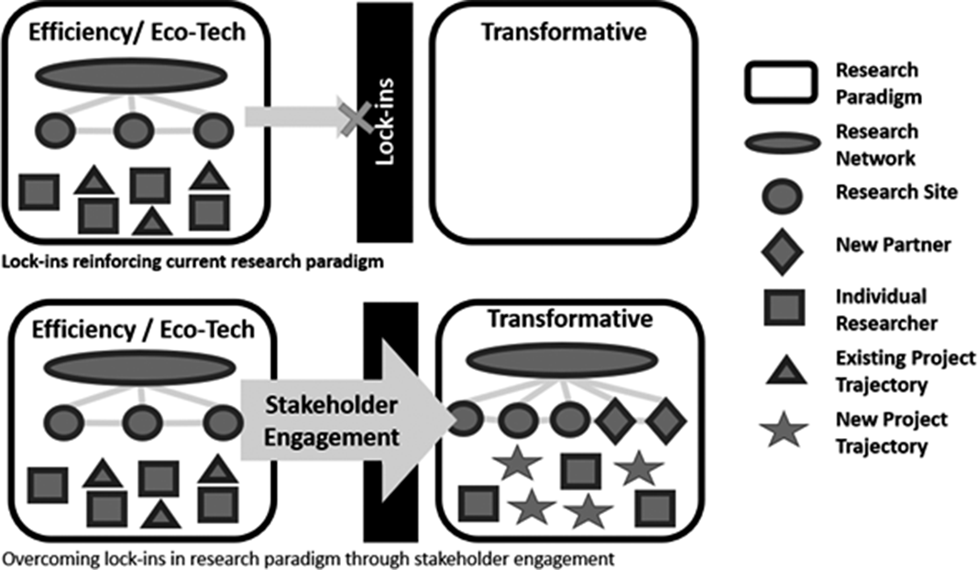
This research provides a novel case study of an R&I research network adopting a multidimensional mission to address complex systems and global change within a North American, publicly funded research context. These empirical results characteristics align with the ideal characteristics of transformative R&I identified by Fazey et al. (Reference Fazey, Schäpke, Caniglia, Patterson, Hultman, van Mierlo, Säwe, Wiek, Wittmayer, Aldunce, Al Waer, Battacharya, Bradbury, Carmen, Colvin, Cvitanovic, D’Souza, Gopel, Goldstein, Hämäläinen, Harper, Henfry, Hodgson, Howden, Kerr, Klaes, Lyon, Midgley, Moser, Mukherjee, Müller, O’Brien, O’Connell, Olsson, Page, Reed, Searle, Silvestri, Spaiser, Strasser, Tschakert, Uribe-Valvo, Waddell, Rao-Williams, Wise, Wolstenholme, Woods and Wyborn2018), Kok and Klerkx (Reference Kok and Klerkx2023), and Schot and Steinmueller (Reference Schot and Steinmueller2018). However, perceived barriers to the alternative practice treatment occurred at various R&I hierarchical levels and compounded upon one another to create lock-ins that limited the ability of the research sites to effectively establish alternative practice innovations. In the following sections, we discuss the potential of stakeholder engagement as a leverage point to support transformative R&I. We also address lock-ins within the R&I system and how stakeholder engagement can broaden influences at the systems level to facilitate co-innovation (Fig. 3.)
The top model shows how lock-ins prevent the research network from transitioning to a transformative research paradigm. The bottom model shows how stakeholder engagement can be a leverage point for overcoming research paradigm lock-ins. With the incorporation of new partners at the research site level, a new project trajectory will develop that fits within the transformative paradigm.

Figure 3. Long description
The diagram contains two horizontal panels. The top panel shows two adjacent boxes. The left box is labeled Efficiency forward slash Eco-Tech and contains an oval labeled Research Network at the top, connected by lines to three circles labeled Research Site. Each circle connects downward to a square labeled Individual Researcher and a triangle labeled Existing Project Trajectory. A thick vertical bar labeled Lock-ins separates this box from the right box, labeled Transformative, which is empty. A gray arrow with an X crosses from the left box toward the right but is blocked by the Lock-ins bar. The bottom panel mirrors the top but adds a large arrow labeled Stakeholder Engagement crossing the Lock-ins bar. In the right Transformative box, the Research Network oval connects to circles, diamonds labeled New Partner, squares, triangles, and stars labeled New Project Trajectory, showing expanded connections. The legend on the right defines all shapes and labels.
What potential does stakeholder engagement provide to support a transformative paradigm?
Paradigms act as a lens for each level (research network, research site, and individual) of the R&I, influencing how R&I is conducted. In this study, we initially started by trying to categorize the paradigm of each participant. What we found was that participants did not discretely fit within a paradigm category as they were transitioning and shifting to a new paradigm—transformative. In the following section, we discuss how stakeholder engagement may facilitate each of the four identified characteristics of transformative R&I.
Resources need to be focused on capacity building and supporting R&I, where various collaborators can come together to innovate and support the integration of knowledge of social drivers and the outcomes of agricultural systems within a transformative paradigm (Busse et al., Reference Busse, Schwerdtner, Siebert, Doernberg, Kuntosch, König and Bokelmann2015). Representation of stakeholders across multiple scales and activities of agroecosystems could fill knowledge and expertise gaps in systems level and social outcomes of the agroecosystem (Elzen et al., Reference Elzen, Barbier, Cerf, Grin, Darnhofer, Gibbon and Dedieu2012; Schlaile et al., Reference Schlaile, Urmetzer, Blok, Andersen, Timmermans, Mueller, Fagerberg and Pyka2017; Pigford, Hickey and Klerkx, Reference Pigford, Hickey and Klerkx2018). Increasing partnerships with external boundary organizations such as extension specialists are important as they can connect stakeholders across the agricultural system (Hall and Clark, Reference Hall and Clark2010; Klerkx, Aarts and Leeuwis, Reference Klerkx, Aarts and Leeuwis2010; Lubell, Niles and Hoffman, Reference Lubell, Niles and Hoffman2014).
Learning and adaptive R&I processes could foster co-innovation with stakeholders. Extension can serve as a boundary organization where they are able to create meaningful, collaborative learning environments across food system stakeholders, catalyzing knowledge exchange (Lubell, Niles and Hoffman, Reference Lubell, Niles and Hoffman2014). Story visioning is one collaborative tool to spur interest in innovations that are outside of the current research trajectory (Klerkx, Aarts and Leeuwis, Reference Klerkx, Aarts and Leeuwis2010). The R&I ability to support co-innovation is dependent upon stakeholders; their influence on the system; an effectively supported process with sufficient financial, cultural, and resource capital, as well as the support of the involved stakeholders (Turner et al., Reference Turner, Klerkx, Rijswijk, Williams and Barnard2016).
Including stakeholders and their multiple worldviews within the innovation process is essential for improving innovation effectiveness (Busse et al., Reference Busse, Schwerdtner, Siebert, Doernberg, Kuntosch, König and Bokelmann2015; De Herde, Maréchal and Baret, Reference De Herde, Maréchal and Baret2019). Table 2 provides multiple ways to incorporate multiple worldviews within R&I. This research shows that if researchers interact with stakeholders with similar worldviews then there is a self-reinforcing vision, and the R&I process may limit the ability to integrate multiple ways of knowing within the R&I process (Meynard et al., Reference Meynard, Jeuffroy, Le Bail, Lefèvre, Magrini and Michon2017; Rotz, Reference Rotz2018). Sites that collaborated with tribal nations and land-grant institutions indicated that stakeholder engagement can facilitate the integration of multiple ways of knowing throughout the R&I process. Additionally, stakeholder engagement could increase knowledge and exposure to alternative agricultural systems. For example, participant 18 expressed interest in organic agriculture but they had limited knowledge to implement it. Increasing resources to support multiple ways of knowing through stakeholder engagement may help spur effective innovation (Busse et al., Reference Busse, Schwerdtner, Siebert, Doernberg, Kuntosch, König and Bokelmann2015; De Herde, Maréchal and Baret, Reference De Herde, Maréchal and Baret2019).
Finally, stakeholder engagement may increase perceived agency to create systems-level change to supportive transformative R&I. The transformative characteristic of perceived agency to make change is a contribution of the study. It suggests that more research needs to examine behavioral change variables and theories to understand R&I evolution over time. Systems-level stakeholders provide primary information about how the agroecosystem functions and how stakeholders with power to create change may help spread the adoption of the innovation. Stakeholder engagement can be a leverage point for transformation, as they may be a pivotal gate keeper or have power within the agriculture system (Klerkx, Aarts and Leeuwis, Reference Klerkx, Aarts and Leeuwis2010).
Shifting toward transformative R&I requires a conscious stakeholder engagement strategy. Reflecting upon what categories of stakeholders are represented and who is missing can be facilitated through the list of the categories presented in Table 2. Additionally, Table 4 provides a resource for reflection on choosing what methods and types of stakeholder engagement to pursue within R&I. The 4D reflectivity strategy (Directionality, Diversity, Distribution, and Democracy) can help evaluate the power dynamics impacting the R&I process (Kok and Klerkx, Reference Kok and Klerkx2023). Additionally, Fazey et al. (Reference Fazey, Schäpke, Caniglia, Patterson, Hultman, van Mierlo, Säwe, Wiek, Wittmayer, Aldunce, Al Waer, Battacharya, Bradbury, Carmen, Colvin, Cvitanovic, D’Souza, Gopel, Goldstein, Hämäläinen, Harper, Henfry, Hodgson, Howden, Kerr, Klaes, Lyon, Midgley, Moser, Mukherjee, Müller, O’Brien, O’Connell, Olsson, Page, Reed, Searle, Silvestri, Spaiser, Strasser, Tschakert, Uribe-Valvo, Waddell, Rao-Williams, Wise, Wolstenholme, Woods and Wyborn2018) identifies 10 essential characteristics of transformative R&I: focus on transformation, focus on solution processes, focus on ‘how to’ practical knowledge, approach research as occurring from within, work with normative aspects, seek to transcend current thinking and approaches, take a multifaceted approach to change, acknowledge the value of alternative roles of researchers, encourage second-order experimentation and change, and be reflexive.
These resources can be used to reflect on current and future representation of stakeholders. For example, are consumption stakeholders represented within your stakeholder engagement strategy? Are stakeholders who represent diverse dietary preferences included within your stakeholder engagement? A diversity of stakeholder sectors and types are necessary to spur R&I to system-level innovation and social outcomes (Schlaile et al., Reference Schlaile, Urmetzer, Blok, Andersen, Timmermans, Mueller, Fagerberg and Pyka2017).
Stakeholder engagement may foster a transformative R&I paradigm by broadening the representation of knowledge across the agroecosystem, facilitating learning and adaptive R&I, incorporating multiple ways of knowing of the agroecosystem, and increasing agency for the alternative practice innovations to create transformative agroecosystems (Fazey et al., Reference Fazey, Schäpke, Caniglia, Patterson, Hultman, van Mierlo, Säwe, Wiek, Wittmayer, Aldunce, Al Waer, Battacharya, Bradbury, Carmen, Colvin, Cvitanovic, D’Souza, Gopel, Goldstein, Hämäläinen, Harper, Henfry, Hodgson, Howden, Kerr, Klaes, Lyon, Midgley, Moser, Mukherjee, Müller, O’Brien, O’Connell, Olsson, Page, Reed, Searle, Silvestri, Spaiser, Strasser, Tschakert, Uribe-Valvo, Waddell, Rao-Williams, Wise, Wolstenholme, Woods and Wyborn2018).
Potential of stakeholder engagement to address hierarchical lock-ins
Because the participants were facing the challenge of shifting paradigms, they were able to easily articulate barriers to implementing innovations. Stakeholder involvement may help address several barriers at the research paradigm, institutional, research site, and individual cognitive level. These barriers may be hierarchical in scale across the research network, and thus the impact from different lock-ins may not be equal.
At the research network institutional level, stakeholder engagement could address institutional inertia, increase human capacity and skillset, and integrate multiple ways of knowing. For example, integrating and collaborating with diverse stakeholders across agroecosystems could increase the human skillset of an institution. Or inclusion of diverse stakeholders previously excluded from the R&I could break the institutional inertia and support new radical innovations that may provide new pathways to work toward its mission. However, it would be necessary to prioritize effective stakeholder involvement as a value within the research network with appropriate allocation of financial, cultural, and resource capital (Turner et al., Reference Turner, Klerkx, Rijswijk, Williams and Barnard2016). Additionally, leveraging the research network governance to prioritize and devote resources to stakeholder engagement may cause a larger impact than addressing scientific level barriers that limit transdisciplinary R&I. Creating an institutional norm that stakeholder engagement occurs in different forms with specific outcomes is necessary for supporting behavioral change at the individual cognitive level (Turner et al., Reference Turner, Klerkx, Rijswijk, Williams and Barnard2016).
Stakeholder engagement may occur at various points during the R&I process (Busse et al., Reference Busse, Schwerdtner, Siebert, Doernberg, Kuntosch, König and Bokelmann2015), involving a diversity of stakeholders depending upon their ability to lead transformative change in sustainable food systems (Schlaile et al., Reference Schlaile, Urmetzer, Blok, Andersen, Timmermans, Mueller, Fagerberg and Pyka2017) at each stage (Eastwood et al., Reference Eastwood, Klerkx, Ayre and Dela Rue2019). Stakeholder involvement is not a panacea for overcoming lock-ins but a potential leverage point toward shifting paradigms and must occur at multiple levels of the research network hierarchy to cause a shift in research paradigms.
Advancing R&I within networked science
This research begins to fill knowledge gaps on methodology for studying agroecosystem research networks, the effect of stakeholders on their research paradigm, and how to facilitate a research network to implement a multidimensional mission that includes environmental, production, and well-being outcomes (Klerkx and Begemann, Reference Klerkx and Begemann2020). The conceptualization has typically been one dominant paradigm present within an organization or field of research (Vanloqueren and Baret, Reference Vanloqueren and Baret2009), or that paradigms are layered upon each other within an institution (Schot and Steinmueller, Reference Schot and Steinmueller2018). The findings of this study demonstrate that such conceptualizations may be an oversimplification, particularly concerning networked science. A research network may have multiple research paradigms and research trajectories to diversify the breadth of innovations being pursued. It might be better to view paradigms along a continuum rather than in discrete categories.
There is limited knowledge about a methodology for studying R&I within a networked science context. However, this cross-sectional comparison of research sites across a research network provides an understanding of a shift in research paradigms across a research network mission. Qualitative interviews provided a useful methodology for providing a snapshot in time of the spectrum of research paradigms across a network, science context, and barriers to conducting transformative R&I.
Limitations
Limitations to this study include the sampling structure of one snapshot of the current research leader at each site as the representative for the entire research site. A longitudinal effort of data collection may help improve our understanding of how the network of research sites evolve and shift their research paradigm to advance one common mission. Additionally, snowball sampling to capture other researchers at each site who may have more direct or varied stakeholder engagement activities, and expanding the sample to include stakeholders to understand their perspective would provide a holistic perspective of effective stakeholder engagement.
Additionally, this case study evolved from existing established long-term research plots and therefore their evolution in R&I paradigm may be different from research networks that are newly established without perceived lock-ins.
Conclusion
A transformative research paradigm is one that has systems-level innovation and social outcomes, a learning and adaptive R&I process, includes multiple ways of knowing, and supports perceived agency to create systems-level change. Stakeholder engagement is one method for supporting the transition to a transformative research paradigm. Additionally, stakeholder engagement builds trust, capacity, and adoption of innovations. For an effective R&I transformation, stakeholder engagement must incorporate the beliefs, values, and worldviews of stakeholders from across the agricultural system. There is no one bullet proof stakeholder engagement strategy. The context, stakeholder type, preference, and research site will determine what type of stakeholder engagement is most effective. Stakeholder engagement ranges from passive networks to customer focus groups to community action research. The main goal of stakeholder engagement should not be a specific method but instead should focus on the desired outcomes of incorporating multiple worldviews within the research process to support transformative R&I and overcome barriers and lock-ins.
Data availability statement
Due to the nature of the research, due to human ethics, supporting data are not available.
Acknowledgements
No generative AI tools were used during the entire research process, analysis, and writing.
Author contribution
C.N.F., G.M., and Z.H. formulated the research question, designed the research study, carried out the study, analyzed the data, interpreted findings, writing, and editing. A.D. interpreted findings and was involved in writing and editing. J.D.W. secured funding, interpreted findings, and was involved in writing and editing.




 Open access

