


Angiosperms are the most diverse group of land plants, comprising > 350,000 recorded species in 416 families (APG IV, 2016; Christenhusz & Byng, Reference Christenhusz and Byng2016). Although several angiosperm lineages have undergone substantial diversification, others persist as monotypic lineages, represented by a single extant species within an entire genus or family (Beaulieu & O’Meara, Reference Beaulieu and O’Meara2016). Our recent estimates suggest that c. 3,000 genera and 25 families of Angiosperms are monotypic (Pandi et al., unpubl. data). Although the conservation status of most of these lineages remains unassessed, a significant proportion of those evaluated are categorized as threatened (IUCN, 2024). Inherently narrow ecological niches, restricted distributions, and small, isolated populations make monotypic taxa particularly susceptible to disturbance. Consequently, their limited and fragmented populations face an elevated risk of localized extinction, especially under escalating pressures from habitat degradation, climate change and other, region-specific, threats (Cazalis et al., Reference Cazalis, Di Marco, Butchart, Akçakaya, González-Suárez, Meyer and Possingham2022; Vargas, Reference Vargas2023).
Indianthus virgatus is a monotypic taxon endemic to the wet forest understories of the Western Ghats–Sri Lanka biodiversity hotspot (there is a spurious record on the Andaman Islands, but this is based on a misidentification; Vishnu et al., Reference Vishnu, Pandi, Gopallawa, Gayathri, Mahim, Yakandawala and Muthusamy2025). The species exhibits a disjunct distribution within the highly diverse family Marantaceae (Andersson, Reference Andersson and Kubitzki1998; Suksathan et al., Reference Suksathan, Gustafsson and Borchsenius2009; Vishnu et al., Reference Vishnu, Pandi, Madola, Gopallawa, Abraham and Gayathri2024), highlighting its evolutionary distinctiveness and biogeographical significance. The Marantaceae, commonly known as the prayer plant family, belong to the order Zingiberales and comprise c. 31 genera and > 530 species globally. They are prominent components of the tropical forest understory, particularly in humid and wet forest ecosystems (Kennedy, Reference Kennedy, Wilson and Morrison2000; Ley & Claßen-Bockhoff, Reference Ley and Claßen-Bockhoff2011). Although pantropical in distribution, the family is more diverse in the Neotropics, comprising c. 80% (420 species) of its known diversity, followed by c. 58 species (c. 11%) in tropical Asia and c. 48 species (c. 9%) in tropical Africa (Kennedy, Reference Kennedy, Wilson and Morrison2000; Ley & Claßen-Bockhoff, Reference Ley and Claßen-Bockhoff2011). Within the Asian tropics, the Indian subcontinent, including Sri Lanka, hosts comparatively few species of Marantaceae, with 11 species in seven genera in India, and three species in three genera in Sri Lanka (The National Red List, 2020; Vishnu et al., Reference Vishnu, Pandi, Madola, Gopallawa, Abraham and Gayathri2024). This limited representation may reflect historical climatic fluctuations and the fragmented nature of rainforests in the region, which likely constrained opportunities for diversification (Andersson, Reference Andersson and Kubitzki1998).
The three species occurring in Sri Lanka are I. virgatus, Phrynium pubinerve Blume, and Stachyphrynium spicatum (Roxb.) K. Schum. (≡ Schumannianthus virgatus (Roxb.) Rolfe; Stachyphrynium zeylanicum (Benth. & Hook.f.) K. Schum.; Phrynium rheedei Suresh & Nicolson). All three species are categorized as threatened in Sri Lanka’s National Red List (2020), with the first two Critically Endangered (Possibly Extinct). In India, I. virgatus typically inhabits moist, swampy areas and stream edges (Bhat, Reference Bhat2014; Vishnu et al., Reference Vishnu, Pandi, Madola, Gopallawa, Abraham and Gayathri2024; Supplementary Fig. 1), where it is known from c. 150 localities. The earliest verified herbarium specimen from Sri Lanka dates from 1855, collected by G.H.K. Thwaites (specimen no. 3465), and is in the National Herbarium, Royal Botanic Gardens, Peradeniya (PDA) (Supplementary Plate 1), with an isotype at the National Botanic Garden of Belgium (BR) (Supplementary Plate 2). With no records since, it was presumed extinct in its natural habitat, surviving only as a living specimen at the Royal Botanic Gardens, Peradeniya. Indianthus virgatus has not yet been evaluated for the IUCN Red List or nationally in India. In Sri Lanka, the species is categorized as Critically Endangered on The National Red List (2020).
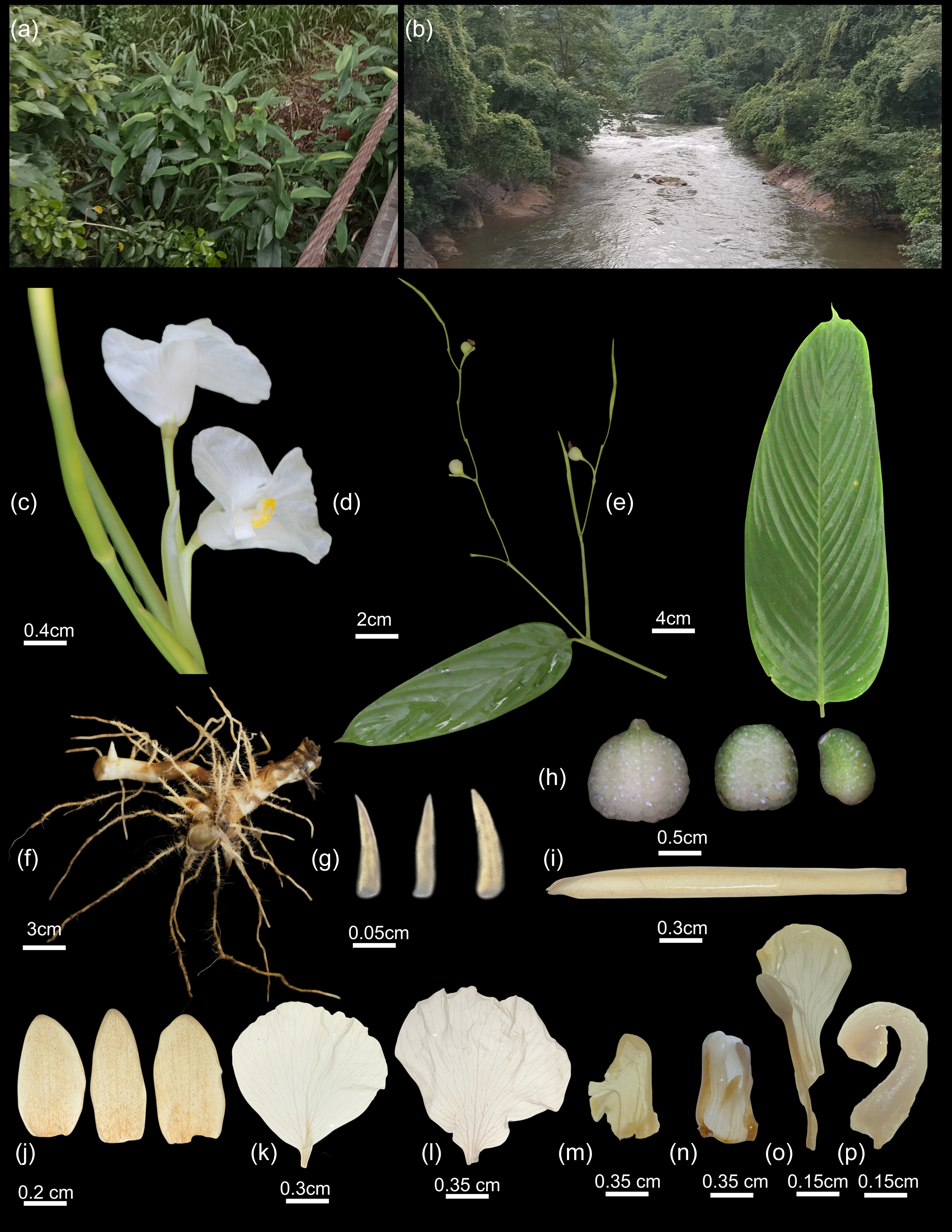
As part of a broader investigation into the biogeographical patterns of Indianthus in India and Sri Lanka, we surveyed the wet zone forests of south-western Sri Lanka, in Sabaragamuwa Province, during October 2023–January 2025. Survey sites were selected based on historical herbarium records (Thwaites, Reference Thwaites1855) and ecological niche modeling incorporating occurrence data from both India and Sri Lanka to predict potential habitats (Vishnu et al., Reference Vishnu, Pandi, Madola, Gopallawa, Abraham and Gayathri2024). In January 2025, a population of I. virgatus was rediscovered near the Sitawaka Ganga River, within a lowland evergreen forest fragment in Sabaragamuwa Province, comprising 70–100 clonal individuals (ramets). This locality corresponds to the most suitable habitat patches predicted by Vishnu et al. (Reference Vishnu, Pandi, Madola, Gopallawa, Abraham and Gayathri2024). This rediscovery demonstrates that despite extensive land-use change, small climatically buffered forest fragments may continue to harbour relict populations, and reinforces the utility of predictive modeling as a tool for directing field exploration and detecting presumed extinct taxa. We recorded the location of the rediscovery with a GPS (Fig. 1), and flowers, leaves and rhizomes of I. virgatus were collected and photographed (Plate 1). Voucher specimens (IV 001 and IV 002) were deposited at PDA. The species’ identity was confirmed by comparing it with herbarium material and taxonomic keys (Dassanayake & Clayton, Reference Dassanayake and Clayton2000).
Location of the historical collection of Indianthus virgatus at Kitulgala along the Kelani Ganga River by Thwaites in 1855, and the rediscovered population at Reucastle Estate, Deraniyagala, near the Sitawaka Ganga River in Ratnapura District, Sabaragamuwa Province, Sri Lanka.

(a) Indianthus virgatus growing along a shaded streambank in lowland forest at Reucastle Estate (Fig. 1); (b) riverine corridor with vegetation, near the rediscovery site; (c) paired white flowers of I. virgatus; (d) Inflorescence with fruit and leaf; (e) leaf with margin entire, petiolate and acuminate apex (f) rhizomatous–fibrous roots; (g) three bracts; (h) 3-seeded, 2-seeded and 1-seeded capsule; (i) transparent prophyll; (j) three outer sepals; (k–l) lateral petals, free; (m–n) petaloid staminodes; (o) single fertile stamen with petaloid appendage; (p) curved stigma.
The historical collection of I. virgatus was from Kitulgala, at c. 150 m altitude, beside the Kelani Ganga River, whereas our rediscovery was at Reucastle Estate, Deraniyagala, near the Sitawaka Ganga River and the wire bridge in Ratnapura District, within Sabaragamuwa Province, c. 15 km from the historical collection site. In the Western Ghats I. virgatus occurs at altitudes of 900–1,200 m, whereas the rediscovery was at c. 65 m. This lower-elevation occurrence may be attributed to the high rainfall in Ratnapura District, which lies in the south-western wet zone of Sri Lanka, where annual rainfall is 2,500–3,000 mm (Perera & Rathnayake, Reference Perera and Rathnayake2019; Perera et al., Reference Perera, Ranasinghe, Gunathilake and Rathnayake2020), supporting rainforest vegetation even at low altitudes. Alternatively, the occurrence at low altitude could indicate the species has persisted in isolated lowland refugia over time, or a range shift from previously suitable montane habitats, potentially driven by land-use changes or climate-related factors.
Indianthus virgatus has been well-characterized in regional floras, including Flora of British India (Hooker, Reference Hooker1894), Flora of Ceylon (Trimen, Reference Trimen1895), and by Suksathan et al. (Reference Suksathan, Gustafsson and Borchsenius2009), who confirmed its current generic placement. It is morphologically distinct within Marantaceae because of its caulescent, bamboo-like stems, bifariously arranged leaves, and dichotomously branched panicles, distinguishing it from related genera such as Schumannianthus and Halopegia. Our observations reveal additional diagnostic traits not previously reported: a conspicuous prophyll with minute spiny trichomes and fine pubescence on pedicels, and, although earlier descriptions noted three-seeded capsules, we observed fruits with 1–3 seeds (Plate 1), similar to that of related genera such as Phrynium and Stachyphrynium.
Most of the suitable habitats for Indianthus in Sri Lanka have been lost as a result of extensive land conversion (Vishnu et al., Reference Vishnu, Pandi, Madola, Gopallawa, Abraham and Gayathri2024). In the Central and Sabaragamuwa Provinces, large tracts of natural forests have been replaced by tea and rubber plantations (Wickramagamage, Reference Wickramagamage1998). This widespread transformation has left only a few intact forest patches with the conditions necessary for the survival of this relict species.
Conservation of narrowly endemic taxa such as I. virgatus requires consideration of the threats particular to their location and the protection of their microhabitats. Rediscovery of other narrowly endemic species, such as Begonia jocelinoi in Brazil (Paglia et al., Reference Paglia, Mansano and Freitas2018), Porroglossum parsonsii in the Colombian Andes (Parra-Sánchez et al., Reference Parra-Sánchez, Vieira-Uribe, Moreno, Baquero and Edwards2021), and Nymphaea thermarum in Rwanda (Abeli et al., Reference Abeli, Müller and Seidel2023), have been followed, for example, by habitat protection and reinforcement measures. The rediscovery of I. virgatus extends beyond a single species, highlighting the vulnerability of monotypic lineages (Niissalo et al., Reference Niissalo, Leong-Škorničková, Khew and Webb2017; Alverga et al., Reference Alverga, Miranda, Oliveira and Morato2021). The persistence of I. virgatus is inseparable from the integrity of wet evergreen microhabitats (De Zoysa & Makoto Reference De Zoysa and Makoto2008; Surasinghe et al., Reference Surasinghe, Kariyawasam, Sudasinghe and Karunarathna2019; The National Red List, 2020). Safeguarding this rediscovered population, therefore, requires habitat protection through the Forest Department and Department of Wildlife Conservation of Sri Lanka, coupled with ex situ safeguarding at the National Botanical Gardens to establish genetically representative living collections (Panaticla-Hilario & Altamirano, Reference Banaticla-Hilario and Altamirano2023).
Indianthus virgatus is a high conservation priority because of its evolutionary distinctiveness as a monotypic lineage, its habitat specificity, fragmented distribution and ongoing anthropogenic pressures across the Western Ghats–Sri Lanka landscape. Assessment for the IUCN Red List is essential to evaluate its global extinction risk, improve its conservation visibility, and facilitate integration into national and regional biodiversity action plans. Such recognition, combined with science-based habitat management, population reinforcement and long-term monitoring, would safeguard this species and establish a framework for conserving other range-restricted understorey taxa facing similar ecological constraints.
Supplementary material
The supplementary material for this article is available at doi.org/10.1017/S0030605326102841
Author contributions
Fieldwork, specimen documentation, data collection: SBV, BG, IM, AP; study design, supervision: VP, DY; writing: all authors.
Acknowledgements
We thank the Dr T.M.A. Pai Fellowship for financial support; and the University of Peradeniya and the Director General, Department of National Botanic Gardens, Sri Lanka, for facilities and permissions.
Competing interests
None.
Ethical standards
This research abided by the Oryx guidelines on ethical standards.
Data availability
The data are available from the corresponding author upon reasonable request.


 Open access

