




Introduction
Historical traumas stemming from colonization and war often generate deep-rooted grievances that hinder reconciliation and cooperation between nations. Political apologies have thus emerged as vital mechanisms for addressing these grievances and promoting pathways toward reconciliation. Numerous studies have shown that political apologies can positively affect victimized groups, facilitating healing and sometimes opening the door to future cooperation (Kitagawa and Chu Reference Kitagawa and Chu2021; Kohama et al. Reference Kohama, Himichi, Inamasu, Mifune, Ohtsubo and Tago2023; Wenzel et al. Reference Wenzel, Okimoto, Hornsey, Lawrence-Wood and Coughlin2017). Yet the effectiveness of such apologies is not guaranteed. For instance, Japan has issued multiple apologies to China and South Korea for wartime aggression and colonial rule, but doubts regarding Japan’s sincerity persist in both countries (Gustafsson and Hall Reference Gustafsson and Hall2021; Jo Reference Jo2022). Similarly, Germany’s apologies to Namibia for the Herero and Nama genocide have not fully resolved historical grievances between the two nations (Boehme Reference Boehme2020; Kössler Reference Kössler2008). These inconsistencies underscore the complexities of crafting effective apologies, particularly in contexts marked by profound historical injustice.
Scholarship on political apologies debates whether verbal statements alone can convey sincerity or whether reparative measures are required. While expressions of shame or remorse may elicit favorable responses, statement-only apologies are often dismissed as symbolic in low-trust contexts. Reparative measures are therefore viewed as crucial signals, yet their effects remain contested. Financial compensation, for instance, promotes healing in domestic settings (Levy and Sznaider Reference Levy, Sznaider, Barkan and Karn2006) but has often failed internationally—for example, Japan’s reparations to South Korean “comfort women” were widely condemned as insincere (Son Reference Son2024). These mixed outcomes highlight a central puzzle: whether and how reparative measures credibly enhance perceptions of sincerity in international apologies.
This study argues that perceived effort is the central mechanism through which the public in a recipient country evaluates the sincerity of an international apology. Political apologies are often drafted from a perpetrator-centered perspective, tailored more to the apologizer’s domestic constraints than to the victim’s expectations. Such statements can therefore appear expedient, conveying the impression that the apologizer seeks to achieve its goals through the least demanding means. As a result, they risk being perceived as strategic and deceptive rather than genuinely remorseful (Govier and Verwoerd Reference Govier and Verwoerd2002; Kampf Reference Kampf2008). To dispel such doubts, an apologizer must demonstrate effort—deliberate investment of attention, coordination, and judgment in the design and delivery of an apology—that audiences recognize as unlikely to occur without genuine intent (Franco-Watkins et al. Reference Franco-Watkins, Edwards and Acuff2013; Inzlicht et al. Reference Inzlicht, Shenhav and Olivola2018). Accordingly, I hypothesize that apologies accompanied by reparative measures requiring visible effort will be perceived as more effortful, and thus more credible and sincere, than simple statement-based apologies.
To test the hypothesis, I conducted two pre-registered survey experiments in South Korea using the same survey instrument and vignette treatments.Footnote 1 The two waves were fielded at different time points—before and after the Japan–South Korea agreement on the forced labor issue—providing additional leverage for assessing the stability of the findings across political contexts. The study examines how different forms of Japan’s apology to South Korea for its colonial rule—ranging from a simple statement-based apology, to an apology that promises a concrete reparative measure (specifically, the joint production of a history textbook), to an apology that fulfills that promise—shape public perceptions of effort and sincerity in the recipient country. The findings largely support the theoretical argument: when South Koreans perceive Japan’s apology as involving high effort, they also tend to view it as more credible and sincere. Contrary to expectations, however, apologies that merely promise future actions were not seen as more effortful or sincere than simple statement-based apologies. This suggests that while public pledges may expose the apologizing state to political costs, within an effort-centered framework such promises are less likely to be perceived as involving genuine exertion. In contexts of deep mistrust between perpetrator and victim states, credibility ultimately hinges on the capacity to demonstrate effort through concrete implementation.
In conclusion, the findings demonstrate that credibility and sincerity in interstate apologies hinge on whether audiences perceive them as bearing the marks of deliberate effort in their design and delivery. This focus on effort moves beyond the conventional view that higher costs automatically guarantee effectiveness and instead highlights the interpretive process through which observers diagnose intent. While the study centers on a single case, the results suggest that credible apologies do not always require maximal or unilateral concessions: they can emerge from forms of effort that are both meaningful to victims and politically feasible for apologizers. In this way, the study contributes to theoretical debates on the mechanisms of political apologies and offers practical insights for designing reconciliation strategies in historically contentious contexts.
Why sincerity matters in interstate apologies
Scholars have widely underscored the importance of political apologies in addressing historical injustices, yet such efforts often fall short of intended outcomes. This raises the question of how to assess an apology’s “success” in interstate contexts. Prior work has relied chiefly on two metrics—perceived sincerity and acceptance—but these are frequently conflated. Despite their connection, they capture different phenomena.
Acceptance does not necessarily imply high perceived sincerity, as recipients may accept an apology even while doubting its sincerity (Choi and Severson Reference Choi and Severson2009; Risen and Gilovich Reference Risen and Gilovich2007). Acceptance can be shaped by material benefits, empowerment, social recognition, external pressure, or the perceived strategic value of maintaining a cooperative relationship. In domestic settings, where victims are identifiable groups within national borders, resolution often hinges on their acceptance; psychological healing, dignity restoration, and social acknowledgment can motivate acceptance even amid lingering doubts about sincerity (David and Choi Reference David and Susanne2005; Murphy Reference Murphy2011; Weyeneth Reference Weyeneth2001).
By contrast, a large body of research emphasizes that sincerity is central to rebuilding trust between former adversaries (Gkinopoulos Reference Gkinopoulos2022; Hornsey and Wohl Reference Hornsey and Michael2013; Wenzel et al. Reference Wenzel, Okimoto, Hornsey, Lawrence-Wood and Coughlin2017). Whereas acceptance may be influenced by strategic or instrumental considerations, sincerity operates in a narrower domain: it turns on whether the apologizer is perceived to acknowledge wrongdoing and to commit credibly to non-recurrence (Tavuchis Reference Tavuchis1991). This distinction becomes especially salient under low trust and limited willingness to compromise, where audiences are more likely to demand convincing signs of remorse before moving forward.
The importance of sincerity is arguably heightened in international historical disputes. Grievances rooted in war or colonialism are often embedded in collective memory and national identity (Jo Reference Jo2022), and are frequently treated as indivisible issues resistant to partial or cosmetic remedies (Fang and Li Reference Fang and Li2020; Fang et al. Reference Fang, Li, Tago and Chiba2022). As a result, acceptance becomes more difficult: publics in the victim state tend to demand stronger and more credible demonstrations of remorse. Even when a recipient government accepts an apology for diplomatic or strategic reasons, persistent public skepticism about sincerity can continue to impede progress.
The Japan–South Korea case illustrates the point. Despite diplomatic normalization in 1965 and the 2015 bilateral agreement on the “comfort women” issue—both accompanied by official apologies—large segments of the South Korean public continue to view Japan’s apologies as insufficiently sincere, limiting prospects for substantial improvement in bilateral relations.
In sum, in interstate apologies, successfully conveying sincerity to the recipient public is crucial—especially where the grievance is salient in national memory. In polities where public opinion can be sidelined, acceptance may be easier to secure; where public opinion is consequential, leaders cannot ignore widespread dissatisfaction (Chu and Recchia Reference Chu and Recchia2022). If an apology is judged insincere by the recipient public, disputes are likely to persist or re-emerge, complicating any subsequent efforts at improvement.
Rethinking the impact of reparative measures in political apologies
To ensure terminological clarity, this paper defines a political apology as a composite category that may consist of an apology statement—the speech act by which a state representative acknowledges wrongdoing and expresses remorse—or reparative measures, understood as nonverbal, material, symbolic, or institutional steps of redress (e.g., monetary compensation, commemorations and memorials, educational or curricular reforms, and institutional reforms)—or a combination of both (Smith Reference Smith2022; Zoodsma and Schaafsma Reference Zoodsma and Schaafsma2022). For analytical precision, I distinguish these components: statement-based apology refers to the verbal act alone; reparative measures to concrete policy-based concessions or other nonverbal steps; and political apology—without qualification—to the overarching category encompassing one or both.
Within this delineation, scholars have sought to identify which elements most shape perceptions of sincerity. Research in social psychology has primarily examined the verbal content of apology statements—e.g., shame, guilt, and remorse—to identify cues of sincerity (Nunney and Manstead Reference Nunney and Antony2021; Philpot and Hornsey Reference Philpot and Hornsey2008; Yeung and David Reference Yeung and David2023), yet many studies indicate that statement-based apologies are often dismissed as merely symbolic and rarely persuade victims to view the apology as genuine (Cunningham Reference Cunningham1999; Gibney and Roxstrom Reference Gibney and Roxstrom2001; Thompson Reference Thompson2012; Trouillot Reference Trouillot2000). Relatedly, intergroup research shows that preexisting levels of trust shape reception, with skepticism toward apologetic statements particularly pronounced in low-trust settings (Hornsey and Wohl Reference Hornsey and Michael2013; Nadler and Liviatan Reference Nadler and Liviatan2006). At the interstate level, apologies have been conceptualized as reassurance signals, and within this framework, concrete actions can be especially effective in conveying sincerity when mutual trust is lacking (Lind Reference Lind2011, 15). Taken together, these strands suggest that in interstate apologies, particularly under conditions of low trust, concrete and visible reparative measures carry greater weight than verbal statements alone in conveying sincerity.
Reflecting this focus, scholars often highlight financial compensation as a representative reparative measure, though its effectiveness varies across domestic and international settings. Domestically, a well-established literature finds that compensation can promote psychological healing and acceptance (e.g., Levy and Sznaider Reference Levy, Sznaider, Barkan and Karn2006; Weyeneth Reference Weyeneth2001). Internationally, however, effects remain contested. For example, Kohama et al. (Reference Kohama, Himichi, Inamasu, Mifune, Ohtsubo and Tago2023) show in conjoint experiments that monetary remedies had little effect on Japanese acceptance of US apologies for the atomic bombings, though they were more effective in cases of less severe wrongdoing. Similarly, Japan’s repeated apologies and reparations to South Korean “comfort women” have often failed to mollify public opinion, with victims and NGOs condemning them as insincere (Son Reference Son2024).
These debates highlight a central puzzle: whether reparative measures in international apologies substantively strengthen perceptions of sincerity and, if so, through what mechanisms. Two obstacles complicate inference. First, clear cases of reconciliation achieved through political apologies are rare, making it difficult to empirically assess effects on perceived sincerity (Karn Reference Karn2022). Even purported successes—such as West Germany’s reparations to Israel—are ambiguous: while the Israeli government accepted the reparations, large segments of the public denounced them as “blood money” rather than sincere contrition (Bachleitner Reference Bachleitner2023), underscoring the gap between governmental endorsement and popular reception and the challenge of isolating the effect of reparative measures.
Second, apparent successes may reflect reverse causality. As Yang and Diehl (Reference Yang and Diehl2025) point out, it remains unclear whether apologies actively foster reconciliation, or whether they are issued because bilateral relations have already improved to the point where the domestic backlash costs of apologizing are more manageable. In this view, favorable public responses in the recipient country may likewise stem from the improved context that makes such gestures possible, rather than from the measures themselves.
Overall, while many accounts emphasize the importance of reparative forms relative to simple statement-based apologies, robust evidence of their causal impact on perceived sincerity remains limited. This motivates a more systematic investigation of how such measures shape perceptions of sincerity. The following section presents a theoretical framework to examine these mechanisms.
Theory
For an interstate apology to be judged sincere, observers must believe that the apologizing state is credibly committing both to refrain from future exploitation and to restore the relationship. The central question is how audiences assess such credibility. This study advances the claim that perceived effort—the extent to which recipients believe the state deliberately exerted itself throughout the apology process—constitutes the diagnostic criterion linking apologies to credibility and, in turn, to perceived sincerity. Apologies that align with victims’ preferences and take concrete, visible form are therefore more likely to be judged effortful, credible, and sincere. Below, I elaborate on the logic of this argument.
Political apologies are often drafted from a perpetrator-centered perspective. In interstate contexts, leaders face reputational risks: apologies may be framed domestically as shameful or humiliating, and they risk provoking political backlash (Kitagawa and Chu Reference Kitagawa and Chu2021; Mihai Reference Mihai2013; Schaafsma et al. Reference Schaafsma, Zoodsma and Sagherian-Dickey2021). Anticipating these risks, governments tend to narrow the scope of their apologies, favoring cautious wording and limited commitments. The result is frequently an apology calibrated to the apologizer’s domestic constraints rather than to the victim’s preferences, producing statements that victims often reject as misaligned with their expectations (Bentley Reference Bentley2018; Yeung and David Reference Yeung and David2023).
Such rejection, however, cannot be explained merely in terms of unmet demands. Perpetrator-centered apologies are commonly perceived as reluctant and self-protective, prioritizing the apologizer’s convenience over serious consideration of the victim’s perspective (Govier and Verwoerd Reference Govier and Verwoerd2002). In contexts where high sincerity is required, apologies function less as transactions than as communicative acts intended to clarify intent. This is especially salient in international relations, where the subject of conflict is often sacred and inalienable to the victim. When an apologizer pursues its goals—such as avoiding responsibility or securing forgiveness—through the least burdensome form of apology, audiences may, if they discern this intent, interpret the act as strategic and deceptive rather than genuinely remorseful (Kampf Reference Kampf2008; Smith Reference Smith2008, 17).
To alleviate such doubts, an apologizer seeking to demonstrate sincerity may deliberately bear costs (Bottom et al. Reference Bottom, Gibson, Daniels and Murnighan2002; Ho Reference Ho2012; Ohtsubo and Watanabe Reference Ohtsubo and Watanabe2009). However, incurring greater costs does not necessarily dispel concerns about deception. For instance, when a national leader accepts the risk of substantial domestic criticism to issue an apology, the act can serve as a costly signal that enhances its credibility (Berenji Reference Berenji2020). Yet pronounced domestic backlash may instead reflect the absence of social consensus on historical reflection, creating the impression of a perfunctory apology delivered under pressure and thereby undermining its perceived sincerity (Borinca et al. Reference Borinca, Falomir-Pichastor, Andrighetto and Halabi2021; Lind Reference Lind2009). Notably, monetary compensation—while often regarded as one of the clearest and most readily identifiable forms of cost—is also among the easiest options for perpetrator states to conceive and implement (Walker Reference Walker, MacLachlan and Speight2013, 219). Financial payments are therefore often interpreted less as genuine repair than as attempts to close the matter quickly (Hamber and Wilson Reference Hamber and Wilson2002). Indeed, when offered alone, they risk insult and are frequently perceived as a buy-off (Giner-Sorolla et al. Reference Giner-Sorolla, Castano, Espinosa and Brown2008; Blatz and Philpot Reference Blatz and Philpot2010).
These complexities suggest that simply bearing greater costs is not a sufficient condition for effectively signaling genuine remorse. Cost is not an objective measure but depends on the recipient’s subjective interpretation (Kertzer et al. Reference Kertzer, Rathbun and Rathbun2020). The core issue, then, is not whether any cost suffices, but which kinds of costs reliably enable a diagnosis of intent. Summarizing the preceding discussion, it is crucial that apologies reflect serious consideration of victims’ expectations and convey a sense of careful deliberation, rather than appearing unilaterally convenient or reliant on stopgap solutions. In this respect, I argue that it is effort that enables observers to more reliably diagnose the intent underlying an apology.
What makes effort probative is not merely that it is costly, but that it reflects an intentional investment of political attention, coordination, and judgment under the apologizer’s discretionary control. Relatedly, research on psychology suggests that observers generally recognize that effort is unlikely to be undertaken without genuine will (Franco-Watkins et al. Reference Franco-Watkins, Edwards and Acuff2013; Inzlicht et al. Reference Inzlicht, Shenhav and Olivola2018; Kruger et al. Reference Kruger, Wirtz, Van Boven and Altermatt2004). When observers encounter an apology that bears the marks of careful construction rather than expedient templating, they infer that the sender deliberately chose to forgo easier, more self-protective paths in order to address the recipient’s harm. Effort therefore becomes a key indicator for discerning the apologizer’s intent: a lack of effort indicates limited will and may backfire, whereas substantial effort enhances credibility.
A broader body of international relations research both directly and indirectly suggests the importance of effort in signaling. McManus and Sendinç (Reference McManus and Sendinç2025), for example, show in deterrence contexts that “lesser signals” can backfire—sometimes performing worse than silence—because observers interpret them as deliberate choices of weaker options despite the availability of stronger ones, thereby spotlighting limited resolve. This logic supports the view that credibility is undermined less by the limited strength of a signal itself than by the impression that stronger alternatives were consciously withheld. More directly, Tago and Ikeda (Reference Tago and Ikeda2015) find that it is not only the outcome of obtaining UN Security Council authorization for military action but also the very act of making the effort to seek such authorization that is positively evaluated, with public support increasing when states go through the UN process even if authorization ultimately fails.
In sum, perceived effort is a key factor in judging the credibility of an apology, and higher perceived credibility in turn enhances perceived sincerity. Effort, however, is difficult to observe directly; audiences must instead infer the level of effort from outcomes (Robertson Reference Robertson2024). To design an apology that credibly conveys effort in an international context, two requirements must therefore be met. First, its content must align—at least in part—with victims’ preferences; otherwise, it risks being interpreted as unilateral convenience. Second, the more concrete and visible the form of an apology, the more readily observers can infer the underlying exertion. Prior studies have underscored both the limitations of simple statement-based apologies and the importance of tangible, observable measures, yet they have offered relatively little insight into why such measures sometimes fail and by what mechanisms they succeed. Thus, this study contends that reparative actions can be effective insofar as they create the perception that the apology required substantial effort.
Although this study focuses on reparative forms, the same logic implies that some statements can also convey a certain degree of perceived effort—for example, when phrasing is emotionally explicit and recipient-specific. Accordingly, I expect perceived effort, the credibility of the apology, and perceived sincerity to be positively associated as apologies become more demanding, ranging from a simple statement-based apology to one accompanied by reparative measures. Thus, Hypothesis 1 is proposed as follows:
Hypothesis 1: The public in the recipient state will perceive the apologizing state’s attitude as more sincere when it issues an apology, compared to when it does not, because the act of apologizing signals effort and willingness to improve bilateral relations.
With regard to reparative actions, variation arises not only in their inclusion but also in the stage of implementation—specifically, whether they are merely promised or already carried out. Promises, while less demanding than implementation, may nevertheless be perceived as requiring greater effort than statements alone. This is because issuing a public pledge typically entails prior deliberation, negotiation, and coordination across domestic constituencies, exposing leaders to the risk of opposition and requiring them to craft language that anticipates and manages such reactions. In this sense, the process of formulating a promise can itself signal exertion, distinguishing it from a simple statement. Implementation, by contrast, entails realized expenditures of time, administrative resources, and political capital, and thus more clearly demonstrates effort already undertaken. Crucially, the substantive content of the measure remains constant, with the only difference lying in its timing (promised vs. implemented). This distinction allows for a more precise test of whether perceptions of effort increase once a prior commitment is realized. Therefore, the following hypotheses are formulated:
Hypothesis 2: The public in the recipient state will perceive a political apology as more sincere when the apologizing state supplements a statement-based apology with promises of reparative measures, compared to issuing only a statement, because promises signal greater effort and commitment to improving bilateral relations.
Hypothesis 3: The public in the recipient state will perceive a political apology as more sincere when the apologizing state fulfills promised reparative measures, compared to merely making promises, because fulfillment demonstrates greater effort and commitment to improving bilateral relations.
Case: The Japan–South Korea historical dispute
As a case study to test the hypotheses, the historical dispute between Japan and South Korea offers a highly relevant context. The deep-seated animosity between the two nations stems largely from Japan’s colonization of Korea from 1910 to 1945. Anti-Japanese sentiment, rooted in these historical injustices, remains a prominent force in South Korean politics and continues to shape bilateral relations (Jo Reference Jo2022).
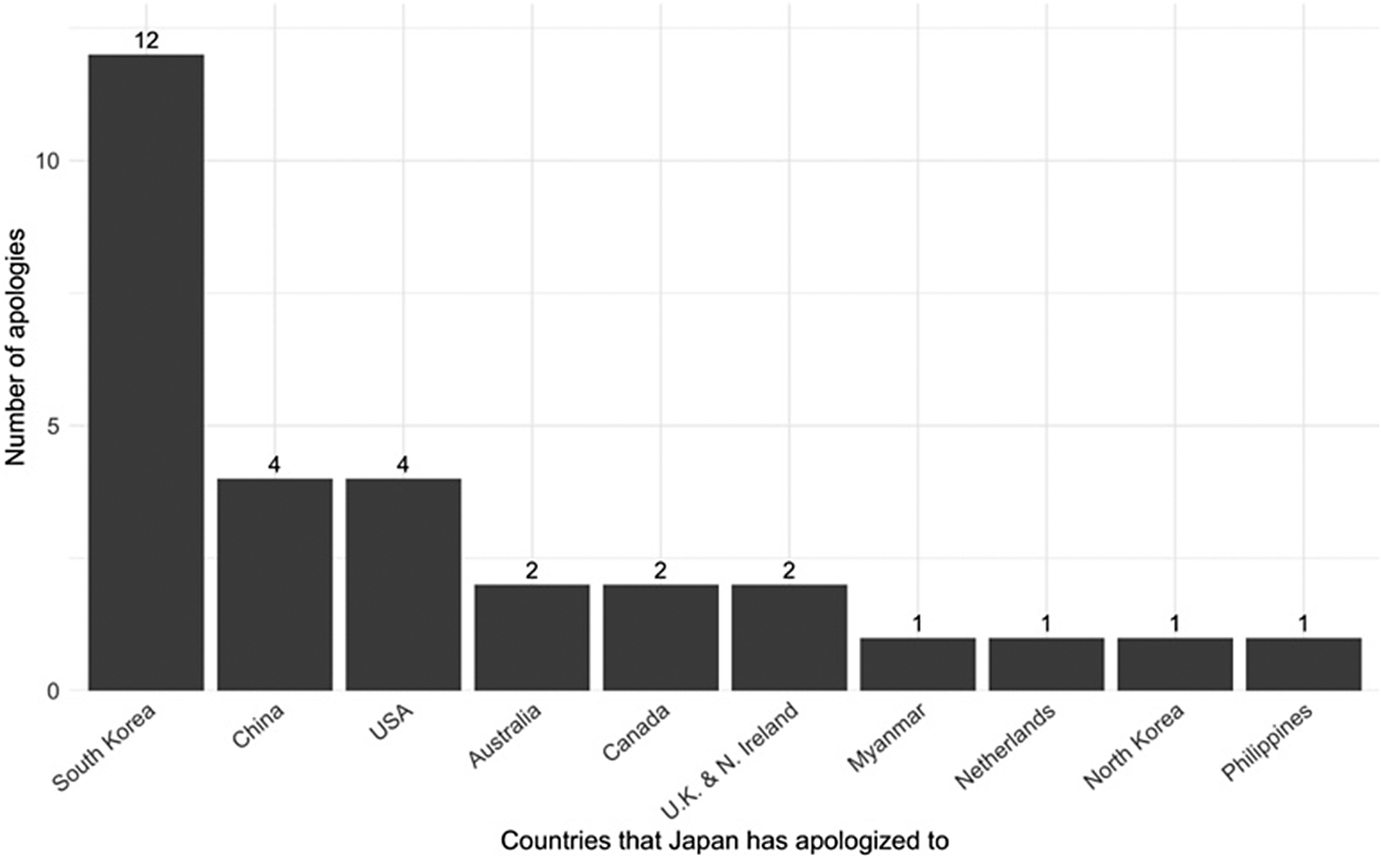
According to a global database of political apologies, Japan has issued more formal apologies than any other country (Zoodsma and Schaafsma Reference Zoodsma and Schaafsma2022), including 12 directed specifically at South Korea for its colonial actions (see Figure 1). Nonetheless, South Korean public opinion consistently reflects skepticism, suggesting that the large number of apologies has not led to reconciliation. For example, a 2015 poll conducted by South Korea’s national television network indicated that 93.1 percent of South Koreans believed Japan had not apologized sufficiently.Footnote 2 By 2022, 81.3 percent of respondents still argued that the South Korean government should not make concessions to Japan on historical issues.Footnote 3 These findings imply that factors beyond the number of apologies contribute to the persistence of tensions.
Political apologies issued by Japan to other countries. Data from Political Apologies Across Cultures.Footnote 4

One principal explanation for Japan’s perceived failure to reconcile lies in doubts about the sincerity of its apologies, particularly the absence of concrete measures to signal genuine remorse. For instance, some Japanese publishers have produced history textbooks reflecting conservative viewpoints, which are often perceived in South Korea as downplaying or even glorifying Japan’s militaristic past (Fukuoka Reference Fukuoka2018; Jeffery Reference Jeffery2011). In addition, statements by certain conservative politicians suggesting that colonial rule benefited South Korea’s economic development have been perceived as justifying or trivializing historical wrongs. Such instances have reinforced perceptions among many South Koreans that apologies unaccompanied by tangible actions are merely perfunctory gestures, heightening demands for concrete measures that more clearly demonstrate intent.
This does not imply that verbal statements are inconsequential. Scholars note that Japan has often employed ambiguous language in its apologies for wartime aggression and colonial rule. Yeung and David (Reference Yeung and David2023), for example, show that South Koreans place great importance on explicit admissions of wrongdoing, yet such clarity has frequently been absent or insufficient in Japan’s statements of remorse. At the same time, more direct language, including explicit admissions of guilt, has occasionally appeared in past apologies. In other words, as discussed previously in this paper, apologies incorporating emotional and symbolic elements have at times been issued, but such expressions alone have not sufficed to demonstrate full sincerity.
In light of this historical context and the enduring public skepticism in South Korea toward Japan’s apologies, South Korea represents an especially suitable experimental setting for examining how more concrete reparative measures shape perceptions of sincerity.
Joint history textbooks as a proxy for reparative measures
In the context of interstate apologies, reparative measures are diverse and encompass a wide spectrum of actions. Given that the primary objective of this study is to assess how statement-based apologies, with and without reparative actions, influence both perceived effort and sincerity, it does not attempt to examine every possible measure. As discussed previously, apologies perceived as effortful should align with victims’ preferences and be concrete and tangible. Accordingly, the study adopts a single, theoretically grounded proxy rather than devising and testing multiple alternatives: the joint production of history textbooks by Japan and South Korea.
The issue of Japanese history textbooks has long been among the most contentious sources of bilateral tension. Since 1982, South Korea has consistently raised objections to their content, arguing that they present a biased perspective on Japan’s past acts of aggression (Fukuoka Reference Fukuoka2018). Most recently, in March 2025, the South Korean government strongly protested the Japanese government’s approval of high school textbooks that, in its view, downplay the history of Japanese imperialism, and demanded corrective action.Footnote 5 This concern has remained salient in public opinion: in the 2022 Japan–South Korea Joint Public Opinion Survey, South Korean respondents ranked the textbook issue as their top concern in bilateral disputes for the third consecutive year.Footnote 6
In Japan, all history textbooks are produced and published by private publishers. However, for textbooks to be adopted in public schools, their content must undergo a rigorous screening process and receive approval from the Ministry of Education, Culture, Sports, Science and Technology (Suh Reference Suh2013). This process is intended to ensure that content aligns with the government’s official stance. Consequently, the South Korean government and its citizens regard the Japanese government—not merely private publishers—as directly responsible.
One approach frequently proposed for addressing disputes over historical narratives is the joint writing of history textbooks (e.g., Bentrovato Reference Bentrovato, Psaltis, Carretero and Čehajić‐Clancy2017; Pingel Reference Pingel2008). In fact, a precedent exists in the Franco-German case: their jointly authored textbook contributed to mutual understanding and reconciliation, showing that such initiatives are both feasible and impactful (Siegel and Harjes Reference Siegel and Harjes2012). When implemented at the governmental level, such an initiative entails not only reconciling divergent historical perspectives but also establishing the administrative and procedural frameworks necessary for its implementation in public education. These requirements impose a considerable burden of coordination and negotiation, underscoring the substantial effort involved.
Importantly, this proxy is among the more feasible options in the Japan–South Korea context. While a government-led joint textbook initiative has not yet been realized, the idea has figured prominently in regional discourse. Non-state actors have often spearheaded such efforts; for example, in 2005, scholars and civil society groups from China, Japan, and South Korea collaborated on a textbook aimed at mitigating tensions stemming from divergent historical narratives (Wang Reference Wang2009). Although its impact was limited by its non-binding nature, the initiative brought the idea of a shared historical understanding into political discourse. For instance, Socialist Party politician Wataru Kubo highlighted the value of joint textbooks in a 1993 Diet session, and in 2010,Footnote 7 former Foreign Minister Katsuya Okada likewise alluded to the possibility of jointly producing a history textbook with South Korea (Sakaki Reference Sakaki2012). Following these discussions, in 2014, Democratic Party of Japan member Masaharu Nakagawa stressed that such initiatives should be led at the state level, with the Japanese government taking the initiative in working with its South Korean counterpart.Footnote 8 These cases suggest that both countries recognize the importance of resolving the acute conflict over history textbooks and that there is at least some degree of feasibility for such a project in Japan.
Nevertheless, this proxy may not be perceived as conveying the highest degree of effort. Japan’s past apologies have often been rejected because they failed to address multiple, deeply interconnected issues. For instance, two major government-led initiatives concerning the “comfort women” issue—the 1995 Asian Women’s Fund and the 2015 bilateral agreement—did not gain broad acceptance in South Korea. Scholars argue that the principal obstacle has been the Japanese government’s refusal to acknowledge direct legal responsibility for the comfort women system (Kim Reference Kim2022). Thus, while joint textbook production would constitute a significant effort, it may not be viewed as demonstrating the highest level of commitment compared to acknowledging legal responsibility. Nevertheless, this study posits that the proxy represents a pragmatic balance between actions that can credibly signal effort and those that are politically achievable, a point elaborated further in the conclusion.
Experimental design
To test the hypotheses, two pre-registered survey experiments were conducted in South Korea using the same survey instrument and vignette treatments. Experiment 1 was conducted from October 27 to November 2, 2022. Experiment 2 took place on March 7, 2023, immediately after the announcement of a forced labor agreement between Japan and South Korea on March 6, 2023. As forced labor during Japan’s colonial period remains highly contentious, news of the agreement triggered significant controversy in South Korea, where approximately 60 percent of respondents in a public opinion survey viewed it unfavorably.Footnote 9 Given the potential influence of this development on public opinion and the findings of the first experiment, Experiment 2 was administered to assess whether the results from Experiment 1 would persist despite this real-world event.
In Experiment 1, 2,068 respondents aged 19 to 69 were recruited from Datamond Inc.’s online panel. In Experiment 2, 694 respondents in the same age range were sourced from a pre-registered online panel on Purespectrum.Footnote 10 Respondents were randomly assigned to one of four groups: No Apology, Apology, Apology with Promise, and Apology with Fulfillment. Regardless of group assignment, all respondents read two common statements in the scenario: first, that on August 15, 2025—Korea’s Independence Day—attention was focused on whether the Japanese government would issue an apology for its colonial rule over Korea; and second, that Japan would spare no effort to build a bright future with Korea.
In the No Apology group, respondents were informed that the Japanese Prime Minister made no reference to remorse or apology regarding colonial rule. In the Apology, Apology with Promise, and Apology with Fulfillment groups, respondents read that the Prime Minister stated during a press conference, “The colonial rule was against the will of the Korean people. I would like to express my deep regret and heartfelt apology.” This quotation was drawn from a 2010 statement by former Prime Minister Naoto Kan. Compared to the influential Murayama Statement of 1995, Kan’s apology explicitly addressed South Korea and, for the first time, acknowledged that colonial rule was against the will of the Korean people, representing a notable progression in Japan’s expressions of apology. At the time, the South Korean government responded positively, underscoring the significance of Kan’s remarks (Chun and Cho Reference Chun and Cho2016). Because emotionally well-articulated statement-based apologies can themselves convey a degree of effort, incorporating an actual, historically significant statement was intended to maximize the perceived weight of the verbal expression and illustrate how reparative measures could further enhance perceived effort and sincerity.
In the Apology with Promise and Apology with Fulfillment groups, respondents received additional information concerning a planned joint history textbook project between Japan and South Korea. In the Apology with Promise group, the Japanese government pledged to collaborate with South Korea on creating a co-written history textbook, with the aim of accurately presenting their shared history and reflecting it in public education. In the Apology with Fulfillment group, respondents read that this promise had already been fulfilled: a joint research committee had been established, and government guidelines had been prepared so that the completed textbook content could be incorporated into the public curriculum. Full descriptions of all scenarios are provided in Appendix B.
Outcome variables
Perceived credibility and effort
After reading the scenarios, respondents answered two questions designed to assess their perceptions of the Japanese government’s statement in terms of credibility and effort. The first question asked, “To what extent do you think Japan will spare no effort to build a bright future with South Korea?” (hereafter, Credibility). This measure captures respondents’ perceptions of Japan’s willingness to improve relations with South Korea. In all scenarios, whether or not Japan issued an apology, the Japanese government expressed its intention to “spare no effort to build a bright future with South Korea”; this question assessed how respondents evaluated that statement.
The second question asked, “To what extent do you think it took time and effort for the Japanese Prime Minister to prepare for this announcement?” (hereafter, Effort). This item reflects respondents’ perceptions of the degree of effort associated with the Japanese government’s issuance of the statement.
According to the theoretical framework of this study, perceived effort enhances the credibility of an apology, which in turn increases its perceived sincerity. Thus, Effort and Credibility are expected to be correlated. Both variables were measured on a 7-point scale, and the Spearman’s rank correlation coefficients between them were approximately 0.59 and 0.57 in Experiments 1 and 2, respectively (p < 0.001). In the subsequent analysis, these variables function as mediators that elucidate the mechanism through which apologies influence perceptions of sincerity.
Perceived sincerity
In the final stage of the survey, respondents evaluated the sincerity of Japan’s statement using three questions: (1) “How do you think South Korean society would perceive Japan’s attitude toward its past colonial rule?” (hereafter Sincerity 1); (2) “How do you think South Korean society would perceive Japan’s apology?” (hereafter Sincerity 2); and (3) “How do you perceive Japan’s apology?” (hereafter Sincerity 3). All three questions were answered using a four-point scale: “Sincere,” “Somewhat sincere,” “Somewhat not sincere,” and “Not sincere.”
It is important to note that in the No Apology group, only Sincerity 1 was measured, as Japan did not issue an apology in that scenario. Additionally, when responding to Sincerity 1 and Sincerity 2, participants were asked to evaluate how they believed South Korean society would perceive Japan’s statement, rather than to express their own personal views. This approach was based on the premise that respondents might find it difficult to offer candid evaluations of Japan’s apology due to the prevalence of critical societal attitudes in South Korea, as indicated by previous public opinion polls. By contrast, Sincerity 3 explicitly asked respondents to provide their own personal assessment of Japan’s apology.
Regression analysis and dataset
To test the hypotheses and estimate average treatment effects, I employed a linear regression model estimated via Ordinary Least Squares (OLS) with heteroscedasticity-consistent (HC2) standard errors. In addition, a causal mediation analysis was conducted to assess the role of perceived credibility and effort as mediator variables between the treatments and perceived sincerity. Furthermore, all statistical models estimated in this study included covariates such as trust in the Japanese government, political ideology, perceptions of Japan’s past apologies, the perceived importance of economic and military relations with Japan, and demographic variables (age, gender, and education level).
For hypothesis testing, the dataset was divided into three subsets, as summarized in Table 1.
Summary of control and treatment groups for hypothesis testing

Table 1. Long description
The table consists of three columns: Hypothesis, Control Group, and Treatment Group or Groups.
Row 1: Hypothesis H 1 compares a Control Group of No Apology against a Treatment Group of Apology.
Row 2: Hypothesis H 2 compares a Control Group of Apology against two Treatment Groups: Apology w forward slash Promise and Apology w forward slash Fulfillment.
Row 3: Hypothesis H 3 compares a Control Group of Apology w forward slash Promise against a Treatment Group of Apology w forward slash Fulfillment.
Findings
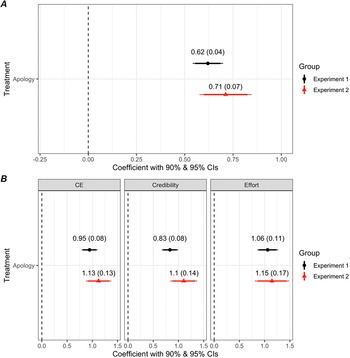
This section presents the results of the hypothesis tests. Figure 2 reports the findings for Hypothesis 1, with Sincerity 1 as the outcome variable. The figure is divided into two panels: Panel A shows the hypothesis testing results, while Panel B compares perceived credibility and effort between the two groups.
The effects of apologizing relative to not apologizing. The baseline category is No Apology. Panel A reports the results for Hypothesis 1, with Sincerity 1 as the outcome variable. Panel B presents the results for mediator variables across groups. Sincerity 1 is measured on a 4-point scale. Credibility and Effort are measured on a 7-point scale, and CE denotes their simple average. Bars represent 90% and 95% confidence intervals. Robust standard errors (HC2) are reported in parentheses.
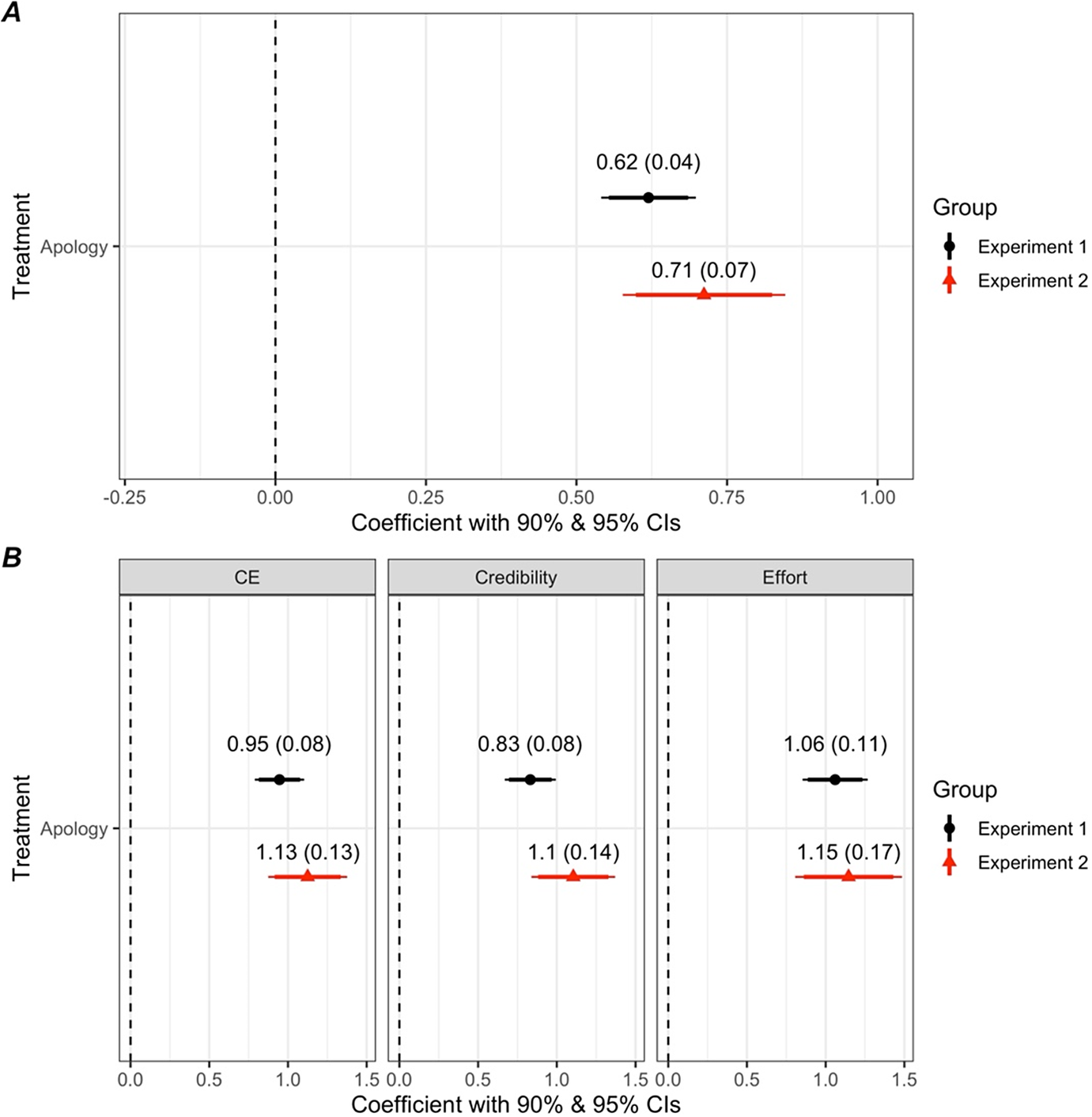
Figure 2. Long description
Panel A is a single plot titled Sincerity 1. The y-axis is labeled Treatment with a single category Apology. The x-axis is labeled Coefficient with 90% and 95% C I s, ranging from negative 0.25 to 1.00. A vertical dashed line marks the zero baseline. Two data points are plotted. Experiment 1, represented by a black circle, shows a coefficient of 0.62 with a standard error of 0.04. Experiment 2, represented by a red triangle, shows a coefficient of 0.71 with a standard error of 0.07. Both points are positioned to the right of the zero line.
Panel B contains three side-by-side sub-plots labeled C E, Credibility, and Effort. The y-axis remains Treatment with the category Apology. The x-axes range from 0.0 to 1.5.
In the C E sub-plot, Experiment 1 has a coefficient of 0.95 with a standard error of 0.08, and Experiment 2 has a coefficient of 1.13 with a standard error of 0.13.
In the Credibility sub-plot, Experiment 1 has a coefficient of 0.83 with a standard error of 0.08, and Experiment 2 has a coefficient of 1.1 with a standard error of 0.14.
In the Effort sub-plot, Experiment 1 has a coefficient of 1.06 with a standard error of 0.11, and Experiment 2 has a coefficient of 1.15 with a standard error of 0.17.
In all plots, horizontal bars represent the confidence intervals, and all coefficients are positive and statistically significant as they do not cross the zero baseline.
As shown in Panel A of Figure 2, the simple act of apologizing is perceived as more sincere than offering no apology, thus supporting Hypothesis 1. Moreover, an apology is also judged to entail greater effort and credibility, suggesting that recipients interpret even a basic statement-based apology as entailing some degree of effort.
Figure 3 presents the findings for Hypotheses 2 and 3, which compare different types of apologies across three measures of perceived sincerity. The Apology with Fulfillment condition is evaluated as more sincere, with statistically significant effects at the 0.05 level relative to both Apology and Apology with Promise. In Experiment 2, however, two effects of Apology with Fulfillment on Sincerity 2 do not reach the 0.05 level, although they are marginally significant at the 0.10 level. By contrast, the Apology with Promise condition does not differ significantly from a simple statement-based apology, leading to rejection of Hypothesis 2 but support for Hypothesis 3.
Testing Hypotheses 2 and 3. Outcome variables are measured on a 4-point scale. The top panel reports the treatment effects of Apology with Promise and Apology with Fulfillment relative to the baseline Apology. The bottom panel reports the treatment effect of Apology with Fulfillment relative to Apology with Promise. Bars represent 90% and 95% confidence intervals. Robust standard errors (HC2) are reported in parentheses.

Figure 3. Long description
The figure consists of two main horizontal panels. Each panel contains three sub-plots labeled Sincerity 1, Sincerity 2, and Sincerity 3. The x-axis for all plots is Coefficient with 90% and 95% C Is, with a vertical dashed line at 0.0. A legend on the right identifies black circles as Experiment 1 and red triangles as Experiment 2.
Top Panel: Apology with Reparative Measure minus Apology Only.
* Sincerity 1: Promise treatment shows coefficients of 0.06 for Experiment 1 and 0 for Experiment 2. Fulfillment treatment shows 0.32 for Experiment 1 and 0.19 for Experiment 2.
* Sincerity 2: Promise treatment shows 0.07 for Experiment 1 and 0.01 for Experiment 2. Fulfillment treatment shows 0.3 for Experiment 1 and 0.17 for Experiment 2.
* Sincerity 3: Promise treatment shows 0.04 for Experiment 1 and 0.07 for Experiment 2. Fulfillment treatment shows 0.23 for Experiment 1 and 0.28 for Experiment 2.
Bottom Panel: Apology with Fulfillment minus Apology with Promise.
* Sincerity 1: Fulfillment treatment shows 0.25 for Experiment 1 and 0.19 for Experiment 2.
* Sincerity 2: Fulfillment treatment shows 0.22 for Experiment 1 and 0.16 for Experiment 2.
* Sincerity 3: Fulfillment treatment shows 0.18 for Experiment 1 and 0.21 for Experiment 2.
All values are followed by robust standard errors H C 2 in parentheses. Horizontal bars indicate confidence intervals, with thicker bars for 90% and thinner bars for 95%.
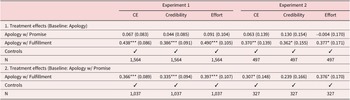
Table 2 extends these results by comparing perceived credibility and effort across the different apology conditions. Consistent with the hypothesis tests, Apology with Fulfillment is associated with higher credibility and effort than the other types. In Experiment 2, however, its effect relative to Apology with Promise on Credibility is positive but statistically insignificant (p = 0.15). Notably, there is no significant difference in Credibility or Effort between Apology and Apology with Promise, reinforcing the null result for Hypothesis 2.
Comparison of perceived credibility and effort
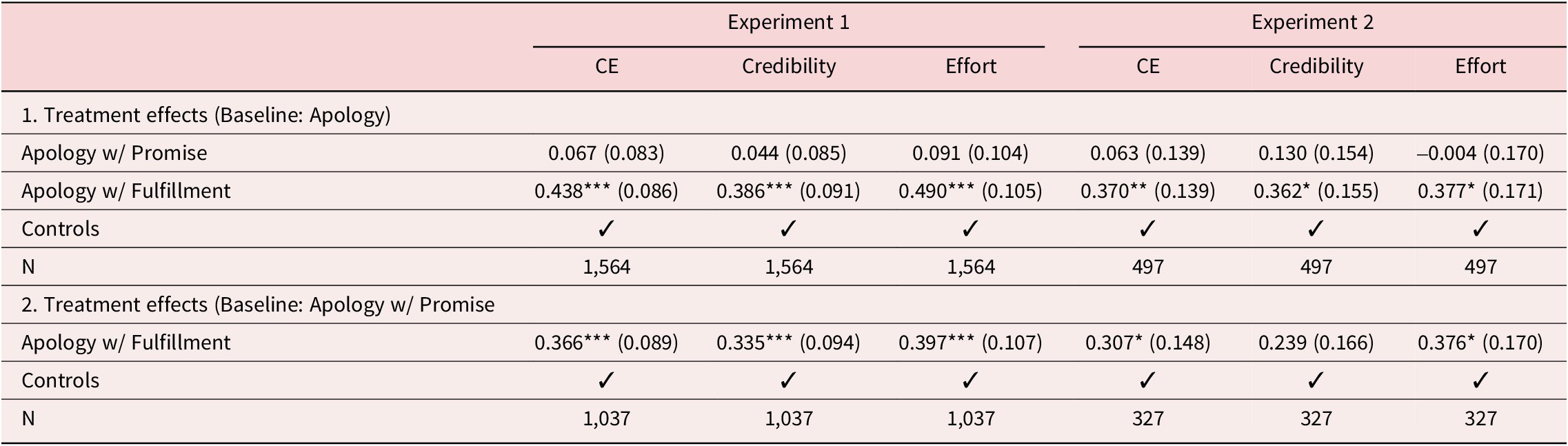
Table 2. Long description
The table is divided into two main sections based on treatment effects. The header identifies two experiments, each with three metrics: C E, Credibility, and Effort.
Section 1: Treatment effects with Apology as the baseline.
- Apology with Promise: In Experiment 1, C E is 0.067, Credibility is 0.044, and Effort is 0.091. In Experiment 2, C E is 0.063, Credibility is 0.130, and Effort is minus 0.004.
- Apology with Fulfillment: In Experiment 1, C E is 0.438, Credibility is 0.386, and Effort is 0.490, all significant at p less than 0.001. In Experiment 2, C E is 0.370 p less than 0.01, Credibility is 0.362 p less than 0.05, and Effort is 0.377 p less than 0.05.
- Sample size N is 1,564 for Experiment 1 and 497 for Experiment 2.
Section 2: Treatment effects with Apology with Promise as the baseline.
- Apology with Fulfillment: In Experiment 1, C E is 0.366, Credibility is 0.335, and Effort is 0.397, all significant at p less than 0.001. In Experiment 2, C E is 0.307 p less than 0.05, Credibility is 0.239, and Effort is 0.376 p less than 0.05.
- Sample size N is 1,037 for Experiment 1 and 327 for Experiment 2.
All models include controls and use Ordinary Least Squares O L S with robust standard errors reported in parentheses.
Note: Credibility and Effort are measured on a 7-point scale, and CE denotes their simple average. Estimates are obtained from linear regression models estimated via Ordinary Least Squares (OLS). Robust standard errors (HC2) are reported in parentheses
+ p < 0.1, * p < 0.05, ** p < 0.01, *** p < 0.001
The null findings in Experiment 2—specifically, cases where effects significant in Experiment 1 did not replicate—require clarification regarding the reasons for this discrepancy. Although one might consider conducting a post hoc power analysis to explore their cause, Heckman et al. (Reference Heckman, Davis and Crowson2022) emphasize that interpreting completed results through such analyses is methodologically inappropriate. A more suitable approach is to evaluate the findings in terms of effect sizes and confidence intervals. Accordingly, no additional post hoc power analysis is provided here. Overall, the results of Experiment 2 are broadly consistent with those of Experiment 1: treatment effects on sincerity are statistically significant for all dependent variables except Sincerity 2. While the effect on Sincerity 2 is not significant, it is positive in direction. Moreover, although the effect size for Credibility in the Promise versus Fulfillment condition is somewhat smaller than in Experiment 1, the similar pattern suggests that this difference may be attributable to the modest sample size in Experiment 2.
Causal mediation analysis
Because the jointly produced history textbook serves as the experimental proxy for a reparative measure, it is important to determine whether respondents’ judgments of sincerity were shaped by perceived effort and credibility rather than solely by the scenario’s substantive content. To this end, I conducted a causal mediation analysis to assess whether perceived effort and credibility mediated the effect of apologies on perceived sincerity and to evaluate the magnitude of these mediation effects. Given that mediation analysis assumes random assignment of the mediators—a condition difficult to satisfy in practice—the models include the same covariates as in the main hypothesis tests. The analytic framework follows the methodology proposed by Tingley et al. (Reference Tingley, Yamamoto, Hirose, Keele and Imai2014).
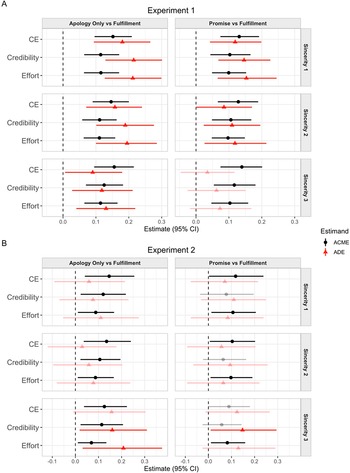
Figure 4 reports the results of the mediation analysis.Footnote 11 To assess the role of each mediator, I estimated distinct models for each variable. The total effects closely follow the treatment effects reported in the hypothesis tests.Footnote 12 For brevity, Figure 4 displays only the average causal mediation effects (ACMEs) and average direct effects (ADEs). As shown, most ACMEs are statistically significant. However, in Experiment 2, when comparing Apology with Promise and Apology with Fulfillment, none of the ACMEs of Credibility are statistically significant. This pattern is consistent with the nonsignificant effect of Apology with Fulfillment compared to Apology with Promise on Credibility in Experiment 2, as noted earlier.
Causal mediation analysis. Indirect effects were estimated using 1,000 simulations with a Quasi-Bayesian approximation. Panel A reports the results for Experiment 1, and Panel B reports the results for Experiment 2. Bars indicate 95% confidence intervals. Estimates not statistically significant at the 0.05 level are displayed in a semi-transparent color.

Figure 4. Long description
The multi-panel forest plot is divided into Panel A for Experiment 1 and Panel B for Experiment 2. Each panel contains a 2 by 3 grid of subplots. The X-axis represents the Estimate with 95 percent C I, ranging from negative 0.1 to 0.3. The Y-axis lists three mediators: C E, Credibility, and Effort. Columns compare Apology Only versus Fulfillment and Promise versus Fulfillment. Rows are labeled Sincerity 1, Sincerity 2, and Sincerity 3.
A legend on the right identifies two estimands: A C M E represented by black circles and A D E represented by red triangles.
In Panel A, Experiment 1, most estimates for both A C M E and A D E are positive and statistically significant, as indicated by solid colors and error bars that do not cross the dashed vertical zero line. In the Sincerity 3 row for Promise versus Fulfillment, the A D E estimates are semi-transparent, indicating they are not statistically significant.
In Panel B, Experiment 2, there is a higher frequency of non-significant results shown in semi-transparent colors, particularly in the Apology Only versus Fulfillment column for Sincerity 1 and 2, and the Promise versus Fulfillment column for Sincerity 3. Significant positive effects for A C M E remain consistent across most conditions, while A D E shows more variability in significance compared to Experiment 1.
To evaluate the magnitude of the ACMEs, I calculated the proportion of the total effect mediated, which provides insight into the substantive significance of the mediation pathway. While statistically significant ACMEs are informative, high mediation proportions strengthen the interpretation of the findings, whereas small proportions suggest more limited impact. Table 3 reports the mediation proportions under the CE specification. Although the proportions vary—ranging from roughly 44 percent to 81 percent—they consistently indicate a substantial degree of mediation. These values underscore the central role of perceived effort and credibility in shaping judgments of sincerity.Footnote 13
Proportion mediated

Table 3. Long description
The table is organized into two main comparison categories, each with three sub-columns for Sincerity 1, Sincerity 2, and Sincerity 3.
Row 1: Experiment 1.
- Apology Only versus Fulfillment: Sincerity 1 is 45.9 percent triple asterisk, Sincerity 2 is 47.9 percent triple asterisk, and Sincerity 3 is 64.3 percent triple asterisk.
- Promise versus Fulfillment: Sincerity 1 is 51.8 percent triple asterisk, Sincerity 2 is 61.1 percent double asterisk, and Sincerity 3 is 80.4 percent double asterisk.
Row 2: Experiment 2.
- Apology Only versus Fulfillment: Sincerity 1 is 71.2 percent asterisk, Sincerity 2 is 81 percent plus, and Sincerity 3 is 44.9 percent asterisk.
- Promise versus Fulfillment: Sincerity 1 is 61.4 percent plus, Sincerity 2 is 63.2 percent, and Sincerity 3 is 44.1 percent plus.
Note: plus indicates p less than 0.1, asterisk indicates p less than 0.05, double asterisk indicates p less than 0.01, and triple asterisk indicates p less than 0.001.
Note: + p < 0.1, * p < 0.05, ** p < 0.01, *** p < 0.001
Discussion
The experimental findings are broadly consistent with the study’s theoretical argument. When South Korean respondents perceive that a Japanese apology entails substantial effort, they evaluate Japan’s willingness to improve bilateral relations more favorably, which in turn increases perceived sincerity. Some results, however, merit closer examination.
The first concerns Apology with Promise, which respondents did not judge to be more effortful or more sincere than a simple statement-based apology. From the standpoint of the effort-centered framework, this result becomes comprehensible: a promise pertains to future action and, at issuance, does not instantiate observable effort. Its credibility would have to rest on a tying-hands logic—that is, on expectations that leaders in the apologizing state would face domestic political punishment if they reneged on the commitment (Fearon Reference Fearon1997). In the Japan–South Korea context, however, observers in the recipient country may reasonably anticipate weak—or even reversed—audience costs in Japan, where segments of the public resist further apologies and might welcome backtracking. Given this belief structure and a low baseline of trust toward Japan among many South Koreans, a pledge provides little assurance: it is retractable, entails minimal sunk investment at the point of delivery, and thus offers scant reason to upgrade assessments of sincerity.
To further probe the underlying processes, a causal mediation analysis was conducted to examine how apology treatments influence perceived sincerity. The results generally support the proposed mechanism in this study, indicating that perceived effort and credibility operate as key mediators linking apologies to sincerity judgments. At the same time, the estimated average direct effects are statistically insignificant in some specifications but positive and statistically distinguishable from zero in others. This pattern suggests that perceived effort and credibility may not fully capture all the pathways through which observers evaluate apologies.
One plausible alternative pathway for this non-mediated component is novelty. Long and Brecke (Reference Long and Brecke2003) argue that reconciliation moves can shift audience evaluations when they are dramatic, unexpected, and thought-provoking—features conceptually distinct from costliness. In this study, one source of novelty likely stems from the Apology vs. No Apology comparison for Hypothesis 1: the apology wording explicitly addressed South Korea and used notably direct and affective phrasing relative to many prior Japanese statements. Although the mediation analysis for this comparison shows that perceived effort and credibility significantly mediate the treatment effect, the average direct effect is larger on balance (see Appendix C.1). Within the effort-centered framework, this is consistent: because a purely statement-based apology does not embody concrete, visible actions, it is less likely to be recognized as effortful, leaving greater room for non-mediated channels. Respondents may therefore have interpreted the notably explicit and affective language as a departure from established interaction scripts, elevating perceived sincerity beyond effort.
By the same token, the joint textbook initiative represents an unprecedented policy concession in this dyad. Against the backdrop of longstanding and salient disputes over Japanese history textbooks—an issue many South Koreans regard as urgent—and persistent skepticism toward Japan’s apologies, such a concession may have struck respondents as inherently unexpected, generating a sense of novelty apart from effort.
A second pathway concerns irreversibility. The Apology with Fulfillment scenario specified the establishment of a joint research committee and government guidelines for incorporating the material into the public curriculum—design features that make policy reversal difficult. These institutionalized arrangements not only signaled considerable effort but also created a degree of policy lock-in by embedding administrative and political investments that are costly to reverse. By signaling substantial prior administrative and political investment, these features may have conveyed that maintaining the policy would entail comparatively lower additional costs than reversing course, which in turn could have reduced perceived uncertainty about its continuity (Altman and Quek Reference Altman and Quek2024).
Taken together, these analyses suggest that while perceived effort and credibility serve as central mediators, alternative pathways can also shape public evaluations of apology sincerity. Identifying and disentangling these mechanisms remains an important task for future research, which could further illuminate how multiple pathways operate in shaping public evaluations of interstate apologies.
Conclusion
Political apologies have become a global phenomenon, prompting a growing body of research on how to enhance their effectiveness. This study contributes to this discourse by examining perceived effort—an aspect that has received relatively limited attention in the literature on political apologies. While many studies emphasize that political apologies must extend beyond symbolic gestures and include concrete reparative measures, there remains a lack of empirical evidence on how such measures increase perceived sincerity among the publics of recipient countries. In this regard, the study suggests that reparative measures may enhance perceptions of sincerity when they are viewed by recipients as reflecting meaningful effort on the part of the apologizing state.
The effort-centered framework offers a useful lens for understanding how recipient publics evaluate sincerity in low-trust historical disputes. South Korea—where skepticism toward Japanese apologies is especially entrenched—provides a hard test of the theory; observing clear effects in this setting suggests its broader relevance. Future research can extend this approach to other dyads and issue domains to delineate contextual scope conditions.
Despite their potential benefits, effortful apologies face obstacles of political feasibility: while they can enhance perceived sincerity, they may simultaneously provoke significant domestic backlash, creating a trade-off between effectiveness and feasibility. Domestic publics tend to resist unilateral concessions in international settings, particularly when such gestures are directed toward rivals (Chilton et al. Reference Chilton, Milner and Tingley2020; Lim and Tanaka Reference Lim and Tanaka2022). In the Japan–South Korea context, “apology fatigue” and rising public resentment toward South Korea among the Japanese public have made further apologies increasingly difficult (Chun Reference Chun2015; Kobayashi et al. Reference Kobayashi, Madrid-Morales, Asaba and Tago2020). From a practical standpoint, it may be difficult to expect Japan to adopt apology measures entailing substantial unilateral concessions and significant political risk.
Nevertheless, this study’s findings suggest a more optimistic implication from a policy-oriented perspective. While the joint production of history textbooks may not represent the most effortful form of apology—since collaborative reconciliation projects can dilute the unilateral nature of sacrifice and thus lower perceived effort—it was nonetheless received favorably by the South Korean public. Even if these effects do not represent the upper bound of more effortful measures, they demonstrate that collaborative initiatives can nonetheless generate meaningful gains in credibility and sincerity.
Importantly, such collaborative approaches may also offer greater political feasibility. To implement foreign policies that risk triggering domestic discontent, political leaders must provide credible justifications to secure public support and reduce resistance (Chu et al. Reference Chu, Ko and Liu2021). Interestingly, while South Koreans identified the issue of Japanese history textbooks as the most pressing concern in bilateral historical disputes—as noted above—the same joint public opinion survey also found that Japanese respondents viewed South Korea’s anti-Japanese education as the most serious problem.Footnote 14 In this context, the Japanese government could reduce domestic resistance by emphasizing that joint textbook initiatives are not unilateral investments of effort but collaborative endeavors that also address concerns among the Japanese public regarding South Korea’s historical narratives.
More broadly, rather than insisting that the apologizing country unilaterally shoulder significant burdens and overcome domestic resistance to deliver an apology tailored exclusively to the recipient’s preferences, policymakers and practitioners might approach the issue through a framework of cooperation rather than unilateral sacrifice. As Kim (Reference Kim2024) argues, when victims pursue ideal or maximalist forms of redress—particularly those framed as indivisible or non-negotiable—it can inadvertently hinder resolution by escalating expectations and constraining political flexibility. On this basis, a cooperative approach would provide the apologizing country with some political leeway while enabling the design of an apology that—while not fully satisfying to the recipient—could nonetheless achieve broader acceptability among both the apologizing and recipient publics.
Supplementary material
The supplementarymaterial for this article can be found at http://doi.org/10.1017/jea.2025.10028.
Data availability statement
Replication data and code for this article are available at https://doi.org/10.7910/DVN/HDHP00.
Acknowledgments
I would like to thank the editor and the two anonymous reviewers for their constructive comments. I also thank Atsushi Tago, Yohsuke Ohtsubo, Masaru Kohno, Songying Fang, Seiki Tanaka, Sou Shinomoto, Jiyoung Ko, and Ukyo Kanetaka for their helpful comments and suggestion.
Ethical standard
This study received ethical approval from the Waseda University IRB (approval 2022–260).
Competing interests
The author declares none.
Funding
This work was supported by JSPS kakenhi 21H00931.





 Open access

