


Introduction
The family Kogiidae includes two extant species of elusive cetaceans: the pygmy sperm whale K. breviceps (de Blainville, 1838) and the dwarf sperm whale K. sima (Owen, 1866). Both species are widely distributed in offshore and continental slope waters worldwide (Plön Reference Plön2022; Plön and Baird Reference Plön and Baird2022). Chivers et al. (Reference Chivers, Leduc, Robertson, Barros and Dizon2005) described genetic differences between K. sima populations in the Atlantic and those in the Indo-Pacific (from where K. sima was described). They suggested that the Atlantic population (including the Azores) may represent a third, still undescribed, cryptic sister species to those in the Indo-Pacific. Both currently recognised species are among the least observed cetaceans, owing to their preference for deep-water habitats, small body size, unobtrusive surface behaviour, and relatively long dive durations. Opportunistic live sightings of both species are therefore rare, typically occurring only under calm sea conditions (Plön Reference Plön2022; Plön and Baird Reference Plön and Baird2022). These live observations are particularly valuable, as they provide insight into the natural habitats and behaviours of these species in situ, rather than post-mortem data alone.
Here, we report (i) the largest group of K. breviceps ever documented, (ii) a sighting of a single K. sima in the Azores, and (iii) an updated overview of the distribution and frequency of kogiid whale records in the Macaronesian archipelago.
Materials and methods
From 20 to 24 July 2025, the authors chartered ten dedicated whale-watching trips with the company Espaço Talassa (Lajes do Pico, Pico Island, Azores). Each trip lasted approximately three hours and was conducted aboard a 12-seat rigid inflatable boat operated by a skipper and a guide. The company employs land-based observers in constant radio contact with vessels to direct them to cetacean sightings. Surveys were conducted in sea states up to Beaufort 3.
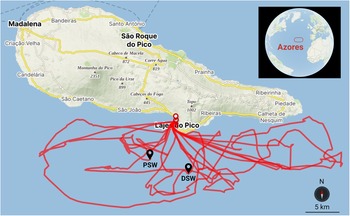
The geographic coordinates of each sighting were recorded using a GPS device. The corresponding vessel tracks are shown in Figure 1, which illustrates the survey effort conducted south of Pico Island. The depth at the sighting locations was estimated using the ‘Add DEM elevation data’ tool on GPS Visualizer (gpsvisualizer.com), with Google [worldwide] as the data source. Photographs of the animals were taken with a digital single-lens reflex SLR camera, enabling subsequent species identification and external expert verification. Individual identification was based on photographic comparison of distinctive dorsal fin features, including overall shape, the presence and position of nicks or notches, and visible damage.
Map of the study area showing vessel GPS tracks from ten dedicated whale-watching surveys conducted by Espaço Talassa between 20 and 24 July 2025. Surveys departed from Lajes do Pico, Pico Island (Azores), and were primarily conducted south of the island. Locations of pygmy sperm whale (PSW, K. breviceps) and dwarf sperm whale (DSW, K. sima) sightings are indicated. The base map was obtained from Mapy.cz (Seznam.cz, a.s.).

Results
The authors recorded 12 cetacean species during the 5-day survey (Supplementary Table 1), including both K. breviceps and K. sima.
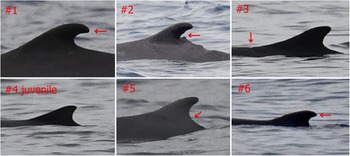
A notable sighting of a group of six K. breviceps (Figure 2) was made on 21 July 2025. The group was located at 38°20.74′ N–28°18.17′ W, approximately 6.8 km southwest of Lajes do Pico, in waters approximately 1,410 m deep. The sea state was Beaufort 1. The whales were observed during three surface intervals (15:33–15:37, 15:43–15:45, and 16:35–16:39 local time), resting at the surface and occasionally rolling, with the group including at least one juvenile. The six individuals were confirmed at sea and subsequently distinguished in photographs based on dorsal fin characteristics (Figure 3).
Group of six K. breviceps observed south of Pico Island, Azores. The top image shows five of the six animals (individuals marked with arrows); the juvenile, second from the left, is more clearly visible in the second image from the top. Photographs by Daniel Benak and Jonathan Ben Simon.

Dorsal fin characteristics of six K. breviceps observed within a single group. Individual #1 had a curved, rounded fin; #2 showed a distinctly damaged fin; #3 had an inconspicuous fin with a small dent at its base; #4 was a juvenile; #5 had a narrow fin with a nick along the trailing edge; and #6 displayed a curved, pointed fin. Characteristic features are marked with red arrows. Individuals #2, #3, #4, and #6; #2, #3, #4, and #5 (top photo in Figure 2); and individuals #1, #2, and #4 were photographed together, confirming their occurrence in the same group. Photographs by Daniel Benak and Paul Carter.

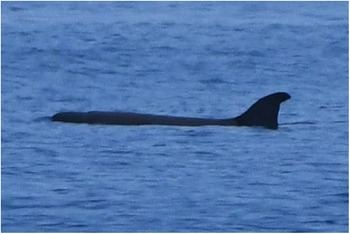
The sighting of the single K. sima occurred on 23 July 2025, at ∼ 16:10 local time. This encounter occurred ∼8.1 km south-southeast of Lajes do Pico (38°19.76′ N, 28°14.15′ W) at the surface of waters 1,264 m deep. The sea state was Beaufort 1. The individual was logging (resting) at the surface for several minutes. At the time of the sighting, it was initially identified as K. breviceps, the same species observed two days previously, and the only Kogia species previously recorded by Espaço Talassa from the waters off the southern coast of Pico Island. Subsequent examination of photographs revealed a disproportionately tall dorsal fin relative to the exposed body length during logging – a diagnostic feature of K. sima (Figure 4). Images of the individual were uploaded to iNaturalist (https://www.inaturalist.org/observations/300527923), where the identification as K. sima was confirmed by Dr. Robert Pitman (Marine Mammal Institute, Oregon State University, Newport, Oregon, USA) based on dorsal fin height, with further agreement from other iNaturalist users familiar with the genus. The identification was additionally confirmed by Dr. Robin Baird (Cascadia Research, Olympia, Washington, USA).
A single K. sima observed by the authors off Pico Island, Azores. The relatively tall dorsal fin, in proportion to the exposed body length during logging at the surface, is characteristic of this species (compare with K. breviceps in Figure 2). Photograph by Daniel Benak.

Discussion
The distribution ranges of Kogia species are primarily inferred from stranding records, due to the paucity of live observations. The larger K. breviceps inhabits tropical to temperate regions roughly between 50°S and 50–60°N, reaching higher latitudes than the smaller K. sima, which appears to favour slightly warmer waters (Plön Reference Plön2022; Plön and Baird Reference Plön and Baird2022). Both species are rarely encountered around Europe, with the highest likelihood of sightings being in the Macaronesian region (Plön Reference Plön2022; Plön and Baird Reference Plön and Baird2022).
Kogia occurrence in the Azores
The earliest report of a kogiid whale in the Azores dates to 1899, when whalers near Lajes do Pico described a ‘very small sperm whale’ (Chaves Reference Chaves1924). The first confirmed record of K. breviceps was a carcass found floating off the coast of São Miguel Island in 1976 (Teixeira Reference Teixeira1978), followed by a stranding on Faial in 1984 (Martins et al. Reference Martins, Clarke, Reiner and Santos1985). There were at least four more strandings between 1990 and 2010 (Silva et al. Reference Silva, Prieto, Cascao, Seabra, Machete, Baumgartner and Santos2014). Since the cessation of commercial whaling in 1987 (Hoyt Reference Hoyt2001) and the growth of whale-watching tourism, K. breviceps has been observed more frequently; however, sightings are still relatively uncommon.
Analysis of the MONICET database (Azevedo et al. Reference Azevedo, Fernandez and Gonzales Garcia2023), covering whale-watching records from 2009 to 2020, revealed only two live sightings of K. breviceps (July 2017 and July 2019, both south of Pico Island) and one unidentified Kogia observation (October 2017, south of São Miguel Island) among 28,319 encounters, underscoring the rarity of the genus in Azorean waters. Four additional at-sea sightings are recorded on the Global Biodiversity Information Facility (GBIF) between 2007 and 2024 (GBIF.org 2025a) in the Azores. By contrast, publicly available statistics from the whale-watching company Espaço Talassa (2025) report 50 K. breviceps sightings between 2003 and 2025 (Table 1); however, some of the sightings may represent K. sima, as the two species can be difficult to distinguish when observations are brief or distant. Although more numerous, these still represent a very small fraction of encounters and display a strongly uneven temporal distribution, with most observations concentrated during the summer months. This seasonality likely reflects higher whale-watching effort and more favourable sea conditions, as stranding data suggest that Kogia occur year-round in the Azores (Silva et al. Reference Silva, Prieto, Cascao, Seabra, Machete, Baumgartner and Santos2014). Notably, while Espaço Talassa contributed data to MONICET in 2019–2020, only one K. breviceps sighting is reflected in the database, whereas its internal statistics list seven sightings for the same period. This discrepancy may reflect differences in reporting practices, data selection criteria, or database integration, underscoring both the possibility of gaps and the need for caution when interpreting whale-watching datasets.
Number of K. breviceps sightings recorded by Espaço Talassa between 1994 and 2025, based on publicly available internal statistics. Data are presented by month and year, with totals provided at the bottom. Years without sightings are not shown

K. breviceps is usually solitary or observed in groups of two individuals (Plön Reference Plön2022). In the Eastern Tropical Pacific, the species is most often solitary (Wade and Gerrodette Reference Wade and Gerrodette1993); in the Gulf of Mexico it occurs either alone or in pairs, with a mean group size of 1.2 (Davis et al. Reference Davis, Scott, Würsig, Fargion, Evans, Hansen, Benson, Mullin, Leming, May, Mate, Norris, Jefferson, Peake, Lynn, Sparks and Schroeder1995); off Hawai’i, the mean group size is 1.5 (Baird Reference Baird2016); and in the Canary Islands, a recent study also reported groups of one to two animals, with a mean of 1.46 (Martín et al. Reference Martín, Tejedor, Carrillo, Pérez-Gil, Arbelo, Servidio, Pérez-Gil, Varo-Cruz, Fusar Poli, Aliart, Tejera, Lorente and Fernández2024). Our observation of a group comprising six individuals represents the largest reported group size of this species (Baird et al. Reference Baird, Nelson, Lien and Nahorsen1996; Carwardine Reference Carwardine2020). To the best of our knowledge, the only report in the primary literature of a comparably large group is by Yamada (Reference Yamada1954), who described six or seven animals from one group, tentatively assigned to K. breviceps. However, subsequent morphological analyses suggest that these specimens more likely represent K. sima, based on diagnostic features such as dorsal fin height, tooth counts, and skull morphology (Nagorsen Reference Nagorsen1985; Plön Reference Plön2004; Yamada Reference Yamada1954). Yamada’s (Reference Yamada1954) publication appears to be the sole primary source for the frequently cited group size of six to seven individuals often mentioned in marine mammal handbooks.
The observation of a juvenile in our group, as well as the regularity of the sightings, indicates the suitability of this area south of the Azores for this species.
The first confirmed record of K. sima in the Azores was a live stranding (and rescue) on Faial Island in 1996 (Gonçalves et al. Reference Gonçalves, Barreiros, Azevedo and Norberto1996). An additional stranding was recorded in 2014 (Silva et al. Reference Silva, Prieto, Cascao, Seabra, Machete, Baumgartner and Santos2014), and two living solitary individuals were recorded in 2000 (Plön and Baird Reference Plön and Baird2022). The most recent record is a single observation in 2023 (GBIF.org 2025b). These records indicate that K. sima is infrequently recorded in Azorean waters, with only a few confirmed occurrences. Nonetheless, this apparent scarcity may reflect the species’ elusive nature and potential misidentification with K. breviceps rather than a genuinely low abundance. Our July 2025 observation appears to represent the sixth confirmed record for the Azores and the first from the waters south of Lajes do Pico. The paucity of K. sima sightings in the Azores, despite extensive whale-watching operations, underscores the cryptic nature of this species in the North Atlantic. The photographic documentation and crowdsourced confirmation highlight the important role of whale-watching platforms and citizen science initiatives, such as iNaturalist, in detecting and identifying elusive cetaceans. Continued efforts in photo-documentation and species-level validation are essential to improving our understanding of K. sima distribution in European waters. This observation also highlights the need for careful identification of Kogia species, since both can occur during whale-watching trips.
Kogia occurrence in other Macaronesian archipelagos
In Madeira, the first record of K. breviceps dates back to 1941 (Maul and Sergeant Reference Maul and Sergeant1977). Since then, live sightings, captures, and strandings of this species have all been documented in the region (Freitas et al. Reference Freitas, Dinis, Nicolau, Ribeiro and Alves2012). Between 1991 and 2007, four strandings were recorded (Ribeiro et al. Reference Ribeiro, Alves, Nicolau and Freitas2008), and six sightings at sea were recorded between 2007 and 2023 (GBIF.org 2025a). The only confirmed record of K. sima from the Madeira Archipelago is a stranding of a juvenile at Madalena do Mar in 2000 (Freitas et al. Reference Freitas, Dinis, Nicolau, Ribeiro and Alves2012).
In the Canary Islands, the first recorded stranding of K. breviceps occurred in 1973 (Casinos Reference Casinos1977). Since then, multiple strandings were reported in this area (Jaber et al. Reference Jaber, Pérez, Arbelo, Andrada, Hidalgo, Gómez-Villamandos, T and Fernández2004; Puig-Lozano et al. Reference Puig-Lozano, Fernández, Saavedra, Tejedor, Sierra, De la Fuente, Xuriach, Díaz-Delgado, Rivero, Andrada, de Quirós Y and Arbelo2020). Martín et al. (Reference Martín, Tejedor, Carrillo, Pérez-Gil, Arbelo, Servidio, Pérez-Gil, Varo-Cruz, Fusar Poli, Aliart, Tejera, Lorente and Fernández2024) reported 88 K. breviceps stranded in 86 separate events between 1977 and 2024, and documented 14 live sightings between 1999 and 2024. Visual-acoustic surveys between 2007 and 2010 detected 15 individuals off the eastern coast of Lanzarote and Fuerteventura (Pérez Gil et al. Reference Pérez Gil, Martín, Pérez-Gil, Tejedor, Servidio, Neves, Ruiz Sancho, Reyes and Castrillon2011). On GBIF, there are three records from 1995 to 2011 (GBIF.org 2025a). K. sima appears to be more frequently recorded in the Canary Islands than in Madeira or the Azores. The first known record in the region was a stranded individual on Fuerteventura in 1987 (Hutterer Reference Hutterer1994). Martín et al. (Reference Martín, Tejedor, Carrillo, Pérez-Gil, Arbelo, Servidio, Pérez-Gil, Varo-Cruz, Fusar Poli, Aliart, Tejera, Lorente and Fernández2024) reported 15 strandings of K. sima in 14 separate events, and live sightings of nine individuals between 1999 and 2024 (Martín et al. Reference Martín, Tejedor, Carrillo, Pérez-Gil, Arbelo, Servidio, Pérez-Gil, Varo-Cruz, Fusar Poli, Aliart, Tejera, Lorente and Fernández2024). In addition, a visual–acoustic survey conducted off the eastern coasts of Lanzarote and Fuerteventura between 2007 and 2010 detected three individuals (Pérez Gil et al. Reference Pérez Gil, Martín, Pérez-Gil, Tejedor, Servidio, Neves, Ruiz Sancho, Reyes and Castrillon2011). Two records from 2008 are documented on GBIF (GBIF.org 2025b).
In Cape Verde, K. breviceps has not yet been recorded. Given its warmer waters, the archipelago might be expected to host relatively higher numbers of K. sima. However, the only confirmed record of this species is a carcass found at Ponta Forno Cal on the coast of Boavista Island in 2004 (Hazevoet et al. Reference Hazevoet, Monteiro, Lopez-Suarez, Varo, Torda, Berrow and Gravanita2010). The only other reported kogiids in the region were two unidentified individuals observed off São Nicolau Island in 2013 (Berrow et al. Reference Berrow, Lopez-Suarez, Jann, O’Brien, Ryan, Varela and Hazevoet2015).
Challenges in detecting kogiid whales and future perspectives
Kogiid whales are among the least-documented cetaceans, a pattern largely attributable to their inconspicuous behaviour. Their small body size, long dive durations, and unobtrusive surfacing make visual detection difficult, especially outside of calm sea states. Furthermore, whale-watching operations, which have become an important source of live cetacean records, typically focus on larger and more demonstrative species that are more appealing to tourists, resulting in limited targeted search effort for kogiids. Nonetheless, increasing attention to these elusive whales is warranted, as climate-driven oceanographic changes may alter their distributions (Lambert et al. Reference Lambert, MacLeod, Hall, Brereton, Dunn, Wall, Jepson, Deaville and Pierce2011) and potentially increase their occurrence in regions such as Macaronesia. Emerging tools such as environmental DNA sampling offer promising opportunities to detect their presence independently of visual encounters (Foote et al. Reference Foote, Thomsen, Sveegaard, Wahlberg, Kielgast, Kyhn, Salling, Galatius, Orlando and Gilbert2012), providing a complementary method to refine our understanding of kogiid occurrence and distribution in offshore waters.
Supplementary material
The supplementary material for this article can be found at https://doi.org/10.1017/S0025315425100830.
Acknowledgements
We thank the whale-watching company Espaço Talassa, including the spotters, guide Becky Milligan, and skipper Inês Clara, for facilitating the Kogia observations and the company’s ongoing contributions to marine mammal research. We are also grateful to Dr. Robert Pitman and Dr. Robin Baird for their valuable assistance in confirming the identification of the observed individual as K. sima.
Ethical standards
This research was based on opportunistic field observations and did not involve the capture, handling, or experimental use of animals. Therefore, no ethical approval was required.
Author contributions
All authors participated in the survey and contributed to the conception of the study. A. Meyer organised the survey. D. Benak prepared the original draft of the manuscript, with input from V. Moser and P. Carter. Photographs were provided by D. Benak, P. Carter, and J. Ben Simon. All authors contributed to species identification, data processing, and to revising and editing the manuscript. All authors read and approved the final version.
Financial support
This research received no specific grant from any funding agency, commercial or not-for-profit sectors.
Conflict of interest
The authors declare none.
Data availability statement
All data supporting the results of the present study are available within the article (figures and supplementary table).



 Open access

