




1. Introduction
Early childhood (ages 3 to 5) is a perid of accelerated vocabulary growth, characterized by both the expansion of word categories and an increasing grasp of abstract, relational, and multiple-meaning words (Hansen & Broekhuizen, Reference Hansen and Broekhuizen2021). This development occurs in tandem with advancing cognitive, social, and emotional skills, which allow children to use vocabulary in more complex and varied contexts (Denham et al., Reference Denham, Blair, DeMulder, Levitas, Sawyer, Auerbach–Major and Queenan2003; Rhoades et al., Reference Rhoades, Warren, Domitrovich and Greenberg2011). Vocabulary plays a crucial role in literacy skills, with vocabulary acquisition processes predicting literacy abilities at later developmental stages (Duff et al., Reference Duff, Reen, Plunkett and Nation2015). Numerous studies have explored vocabulary acquisition in early childhood from various angles, such as lexicon size at each age (Asaridou et al., Reference Asaridou, Demir-Lira, Goldin-Meadow and Small2017), the types of words acquired (e.g. verbs, nouns, or adjectives) (Sandhofer & Smith, Reference Sandhofer and Smith2007), the role of memory and cognitive abilities (Nicolay & Poncelet, Reference Nicolay and Poncelet2013), the impact of enrichment programs on vocabulary (Gonzalez et al., Reference Gonzalez, Goetz, Hall, Payne, Taylor, Kim and McCormick2011), and more.
However, a unique subset of vocabulary – multiple-meaning words (ambiguous words) – has received relatively limited attention, particularly in Hebrew. This group includes words with multiple semantic representations (e.g. the English word network, equivalent to the Hebrew reshet, can mean a fishing net, a social network, a computer network, or a broadcasting network), and these words are typically more challenging to acquire than single-meaning words (Eddington & Tokowicz, Reference Eddington and Tokowicz2015; Jalongo & Sobolak, Reference Jalongo and Sobolak2011). While single-meaning words involve encoding a single semantic representation, multiple-meaning words require the encoding and integration of multiple, distinct representations for the same lexical item. This added complexity can increase cognitive demands for storage, retrieval, and processing within the mental lexicon, as the brain must manage and differentiate between meanings based on context (Klepousniotou et al., Reference Klepousniotou, Pike, Steinhauer and Gracco2012; MacGregor et al., Reference MacGregor, Bouwsema and Klepousniotou2015). The current study therefore aims to focus on multiple-meaning words, examining the extent to which young children acquire varied meanings of multiple meanings of words, and investigating how acquisition progresses across the three age groups (3- to 5-year-olds) in the expressive lexicon. Additionally, the study seeks to assess the effectiveness of an intervention program in enhancing multiple-meaning vocabulary, with a specific focus on evaluating its impact separately for each age group.
1.1. Vocabulary of words with multiple meanings
The growth of multiple-meaning words in a person’s mental lexicon occurs as existing words take on new, distinct meanings. These words represent a range of meanings associated with a single word form (Aitchison, Reference Aitchison2012). Such words can be divided into two primary semantic categories: polysemy and homonymy (Murphy, Reference Murphy2010). Polysemous words include different meanings that are conceptually related by a shared underlying idea. For example, in the word network, mentioned above, all the meanings relate to the core idea of a “structured web of connections.” Speakers may extend word meanings based on this underlying concept, as seen in the evolution from “network of people” (i.e. social network) to “computer network” (Saeed, Reference Saeed2015). In contrast, homonymous words often develop through lexical borrowing or historical change, leading to meanings that are unrelated. For example, the English word bat can mean “a flying mammal” or “a piece of equipment used in sports,” with no conceptual connection between these meanings. Similarly, in Hebrew, the word bar primarily means “grain,” but also acquired additional meanings such as “a place that serves drinks” from English and “outside” from Aramaic (Crystal, Reference Crystal2010; Haspelmath, Reference Haspelmath, Haspelmath and Tadmor2009).
Brain imaging studies (magnetoencephalography, MEG) reveal distinct patterns in how ambiguous words are stored and organized in the mental lexicon, specifically between polysemous and homonymous words. In polysemous words, which have multiple related meanings, these meanings are represented by a single, abstract lexical entry (Pylkkänen et al., Reference Pylkkänen, Llinás and Murphy2006). In contrast, each meaning of a homonymous word – where meanings are unrelated – is stored separately, with its own lexical entry (Beretta et al., Reference Beretta, Fiorentino and Poeppel2005). Furthermore, these types of words are processed differently in the brain: when an ambiguous word appears, the activation duration for polysemous words is longer than for homonymous words (Klepousniotou et al., Reference Klepousniotou, Pike, Steinhauer and Gracco2012). A possible explanation is that the related meanings of polysemous words reinforce one another, while the unrelated meanings of homonymous words compete, leading to faster decay in brain representations (MacGregor et al., Reference MacGregor, Bouwsema and Klepousniotou2015).
Polysemous words are more common than homonymous words, though estimates vary by measurement method. Using the Wordsmyth dictionary, 7% of words are homonymous and 84% are polysemous (Srinivasan et al., Reference Srinivasan, Rabagliati and Snedeker2019). In contrast, an analysis based on frequently used words estimates that 4% are homonymous and 40% are polysemous (Barak et al., Reference Barak, Floyd and Goldberg2019).
1.2. Acquisition of multiple-meaning words in childhood
The process of acquiring multiple-meaning words in childhood differs significantly between polysemy and homonymy (Doherty, Reference Doherty2000). Research shows that toddlers as young as 2 years old can recognize and respond to multiple meanings of polysemous words. For instance, when hearing the word cap, they looked at both a bottle cap and a hat, demonstrating an ability to link related meaning (Floyd et al., Reference Floyd, Goldberg and Lew-Williams2020).
In contrast, the acquisition of homonymous words, which involve recognizing unrelated meanings for the same word, typically begins around age four (Doherty, Reference Doherty2000). This process requires metalinguistic ability – the capacity to distinguish between a word and its referents – which develops later than the ability to process polysemous words. Peters and Zaidel (Reference Peters and Zaidel1980) and Backscheider and Gelman (Reference Backscheider and Gelman1995) found that by acknowledging that distinct objects can share the same name, children could reliably identify homonym pairs. Peters and Zaidel reported that children aged 3;10 performed at ~50% accuracy, improving to 84% by age 4;9. Similarly, Backscheider and Gelman observed ~75% accuracy among children aged 3;9 when using explicit prompts. These findings suggest that homonym processing relies on developing metalinguistic skills, with significant refinement occurring after age 4.
While the acquisition of homonyms relies on metalinguistic ability to distinguish unrelated meanings, the process of generalization plays a central role in acquiring polysemous words. Researchers have found that the semantic closeness between meanings in polysemous words facilitates the acquisition of additional meanings (Srinivasan et al., Reference Srinivasan, Al-Mughairy, Foushee and Barner2017). For example, English words like hammer and shovel can be understood as having dual representations: one as a noun (e.g. hammer) and another as an action (e.g. hammering). This ability to generalize meanings extends to novel words; when children encountered a new noun like dax, they readily inferred that it could also represent an action, demonstrating their capacity for semantic extension (Srinivasan & Rabagliati, Reference Srinivasan and Rabagliati2015).
As language development advances, children’s ability to generalize becomes more sophisticated, enabling them to group meanings from different categories under a single word. For example, the word chicken can represent both an animal (taxonomy of “animal”) and a type of meat (taxonomy of “food”), and glass can mean both a material and a drinking vessel, each with its own category. These words share a semantic relationship of material and use, allowing this relationship to extend from one word to another (Srinivasan & Snedeker, Reference Srinivasan and Snedeker2014). Early in language acquisition, the meanings of polysemous words tend to be concrete and tangible – such as bow meaning a hair bow. Later, these meanings often expand to abstract (“network” as in a “broadcast network”), metaphorical (“bow” as in “bow of emotions”), or psychological interpretations (“stream” as in “life stream”) (Berman, Reference Berman, Hoff and Shatz2007).
The expansion of semantic representations is facilitated by various factors, such as exposure to words in diverse contexts and the generalization of semantic relationships from one word to another (Floyd & Goldberg, Reference Floyd and Goldberg2021; Srinivasan & Rabagliati, Reference Srinivasan and Rabagliati2015), frequent exposure to varied language in the home and educational settings (Hoff, Reference Hoff2006), interactions with adults and other children (Tomasello, Reference Tomasello2003), as well as role-playing and storytelling activities in which children actively participate (Weisberg et al., Reference Weisberg, Zosh, Hirsh-Pasek and Golinkoff2013).
The rate of polysemous word acquisition is rapid in early stages, with a sharp increase in acquisition rate by 31 months, which then moderates but continues through later ages (Casas et al., Reference Casas, Català, Ferrer-i-Cancho, Hernández-Fernández and Baixeries2018). However, homonymous words present more complex acquisition challenges and are sometimes even harder to learn than completely new words. A possible reason is the interference and delay caused by the competing meanings within homonymous words (Srinivasan et al., Reference Srinivasan, Rabagliati and Snedeker2019). While young children, particularly those aged 4 to 8, may initially rely on a single, dominant meaning of homonymous words, their ability to interpret multiple meanings improves with age as they develop greater metalinguistic awareness and learn to use contextual cues (Mazzocco, Reference Mazzocco1997). Additionally, explicit instruction can aid in the acquisition of homonymous words even at a young age (Zipke, Reference Zipke2011).
A distinct aspect of vocabulary acquisition involves the type of lexicon – expressive or receptive. Early vocabulary development predominantly occurs within the receptive lexicon, as children first comprehend words before using them. Research highlights that the receptive lexicon develops earlier and more rapidly than the expressive lexicon, following a universal sequence of language acquisition. This foundational vocabulary is critical for later language skills, including grammar and phonology. For instance, Stolt et al. (Reference Stolt, Haataja, Lapinleimu and Lehtonen2008) demonstrated that receptive vocabulary growth surpasses that of expressive vocabulary and plays a pivotal role in achieving subsequent linguistic milestones. Similarly, Patrucco-Nanchen et al. (Reference Patrucco-Nanchen, Friend, Poulin-Dubois and Zesiger2019) emphasized that early receptive vocabulary is a strong predictor of later language abilities, underscoring its importance in overall language development.
However, the expressive lexicon gains increasing prominence between ages 3 and 5, particularly in relation to pre-literacy skills. A longitudinal study of 66 monolingual children assessed vocabulary skills at 18 months and 2 years, with follow-up at 5 years, and revealed that receptive vocabulary at age 2 strongly predicted later language outcomes, including phonological awareness, grammar, and letter knowledge. By age 5, however, the expressive lexicon emerged as a significant factor, directly influencing pre-literacy skills and overall language development (Vehkavuori et al., Reference Vehkavuori, Kämäräinen and Stolt2021). Accordingly, the current study focuses on the expressive lexicon, given its dominant role in language development during the ages 3 to 5.
1.3. Intervention programs to promote vocabulary knowledge in early childhood
Language intervention programs designed to enhance vocabulary in early childhood can have a significant impact. During the preschool years, children are in the midst of an important stage for language acquisition (Al-Harbi, Reference Al-Harbi2020), and tailoring these programs to their developmental needs ensures optimal language growth (Marulis & Neuman, Reference Marulis and Neuman2010), fostering both cognitive and social skills that are foundational for future success (Wilson et al., Reference Wilson, Dickinson and Rowe2013).
Most intervention studies related to vocabulary improvement have tested basic and regular vocabulary and demonstrated significant advancements in young learners. For instance, a meta-analysis by Marulis and Neuman (Reference Marulis and Neuman2010) revealed that interventions incorporating explicit and implicit instructional strategies delivered by trained adults significantly enhanced vocabulary learning in kindergarten children. Similarly, Silverman (Reference Silverman2007) compared three methods of vocabulary instruction during storybook reading, finding that anchored (explicit explanations and use of concrete referents) and analytical (discussion of word parts, categories, and relationships) methods were significantly more effective than contextual approaches (inferring word meanings from story context alone) in promoting word learning. Kindergarteners with higher baseline language abilities demonstrated significant improvements in language skills after focusing on the subcomponents of vocabulary and decoding (Johanson et al., Reference Johanson, Justice and Logan2016). Many other studies have explored the impact of interventions on children with lower-level vocabulary, demonstrating their effectiveness in improving vocabulary skills and emphasizing the value of tailored approaches for early language development (e.g. Coyne et al., Reference Coyne, McCoach, Ware, Austin, Loftus-Rattan and Baker2019; Korat et al., Reference Korat, Atishkin and Segal-Drori2022; Lefebvre et al., Reference Lefebvre, Trudeau and Sutton2011).
However, intervention studies specifically addressing multiple-meaning vocabulary in typically developing preschoolers are relatively uncommon. While they often report the benefits of the intervention, they typically either do not differentiate between the developmental stages of ages 3, 4, and 5 or focus on only one age group. For example, Storkel et al. (Reference Storkel, Maekawa and Aschenbrenner2013) examined how preschoolers aged 3–5 learn homonyms in comparison with novel words. The study found that high-frequency exposure to homonyms in adult speech facilitated the understanding of their multiple meanings, as repetition reinforced associations with different contexts. Homonyms were learned more rapidly than novel words, particularly when articulation matched between adult and child. High-frequency homonyms were also learned more accurately than low-frequency ones, underscoring the role of familiarity in building lexical representations. Notably, these findings were reported for the group as a whole, without separating results by age.
Other studies targeted specific age groups. For instance, a study on kindergarteners’ ability to detect lexical ambiguities and homophones involved children aged 5;5–6;6, with half the participants receiving training on lexically ambiguous sentences and homophones (experimental group), while the other half received vocabulary training (control group). Pre-tests and post-tests evaluated their abilities, revealing that training significantly improved detection of homophones and lexical ambiguities (Kamowski-Shakibai & Cairns, Reference Kamowski-Shakibai and Cairns2016).
Similarly, Casenhiser (Reference Casenhiser2005) reported improvements in multiple-meaning vocabulary when working with 4-year-olds. The study examined the children’s challenges with homonymy, focusing on their ability to assign multiple unrelated meanings to familiar words. It consisted of two experiments: experiment 1 showed that while children could successfully assign novel meanings to nonsense words, they struggled to associate an additional, unrelated meaning with a known word. However, experiment 2 demonstrated that their performance improved when the known word appeared in a syntactic frame that indicated a new meaning was required (e.g. presenting a verb in a noun frame).
Expanding upon the gaps identified in previous research, this study aims to address the limited research on how an identical intervention program specifically affects children aged 3, 4, or 5. By implementing the same program across these age groups, the study offers a systematic examination of its effectiveness in enhancing multiple-meaning vocabulary within the expressive lexicon across these three developmental stages.
1.4. A gamification-based intervention program
To investigate the impact of an identical intervention program on multiple-meaning vocabulary across ages 3, 4, and 5 separately, this study employed a gamification-based approach, utilizing the memory game (a card-matching game) that is both familiar and engaging for children in these age groups.
Play, a fundamental educational tool in early childhood, facilitates enjoyable and natural learning experiences. It stimulates children’s motivation while fostering the development of critical skills in an informal, free, and creative learning environment (Irvin, Reference Irvin2017). Theorists such as Freud, Erikson, Piaget, and Vygotsky have highlighted various aspects of play, recognizing it as an essential component of a child’s personality and developmental growth (Piaget & Inhelder, Reference Piaget and Inhelder1969; Winther-Lindqvist, Reference Winther-Lindqvist2013).
From a developmental perspective, play significantly contributes to cognitive, social, emotional, and sensorimotor abilities, fostering essential skills such as problem-solving, critical thinking, creativity, and interpersonal communication (Winther-Lindqvist, Reference Winther-Lindqvist2013). Cognitively, play enhances imagination, classification, and hypothesis generation, allowing children to explore and understand physical and conceptual properties (Magid et al., Reference Magid, Sheskin and Schulz2015). Emotionally, it offers a safe space for self-expression and resilience-building (Savina, Reference Savina2014). Socially, play promotes cooperation, negotiation, and tolerance, while sensorimotor development is strengthened through activities that refine physical skills (Harris, Reference Harris2000).
Pedagogically, play is a powerful tool for experiential learning, tailored to the developmental needs of young children. It nurtures their natural curiosity, promotes engagement, and provides a creative outlet for self-expression, fostering skill acquisition in an enjoyable and informal way (Veličković, Reference Veličković2013). Research highlights the vital role of play in learning across all ages, offering authentic learning opportunities through exploration, improvisation, and individuality (Nilsson et al., Reference Nilsson, Ferholt and Lecusay2018; Zosh et al., Reference Zosh, Hirsh-Pasek, Hopkins, Jensen, Liu, Neale and Whitebread2018). As an intervention strategy, play creates a structured yet safe environment, encouraging risk-taking and challenges without fear of failure. It stimulates biological rewards, such as dopamine release, enhancing motivation and engagement (Wise, Reference Wise2004). Additionally, play supports indirect learning by simulating real-world scenarios, while promoting creativity and critical thinking through controlled, competitive elements (Gray, Reference Gray2013). Play, therefore, functions as both an educational strategy and an intervention tool, offering structured yet flexible opportunities for children to learn, grow, and thrive in a supportive environment.
Building on the limited research on multiple-meaning words, this study has three primary goals: first, to monitor the progress in the acquisition of multiple-meaning words within the expressive lexicon across age groups (3–5 years); second, to investigate whether this progress differs between polysemous (related meanings) and homonymous (unrelated meanings) words; and third, to evaluate the effectiveness of a gamified intervention program in enhancing multiple-meaning vocabulary, with a focus on its impact on each age group – 3, 4, or 5 – individually.
2. Methods
2.1. Participants
The study involved 92 Hebrew-speaking children between the ages of 3;0 and 6;0, including 48 girls and 44 boys (see Tables 1 and 2). Participants were selected from state kindergartens where college students conducted their teaching practicum. The children came from families with middle to upper-middle socioeconomic status and were distributed across three age groups: nursery class (for 3-year-olds, referred to in the paper as age 3), pre-kindergarten (Pre-K, referred to as age 4), and kindergarten (referred to as age 5). Three children who were not native speakers were excluded and are not included in the count of 92 participants. The study received approval from the Chief Scientist of the Ministry of Education.
Participants and group distribution

Estimated means and standard errors (SEs) of meaning retrieval by age group

2.2. Materials
The Peabody Picture Vocabulary Test (PPVT) – shortened version: PPVT-IV (Dunn & Dunn, Reference Dunn and Dunn2007) is a widely used standardized assessment tool designed to measure receptive vocabulary and assess verbal ability in both children and adults. In this study, due to limited session time with the children, which did not allow for administering the full test, a shortened version of the PPVT (S-PPVT) was used. This abbreviated version comprised 14 words selected according to the following criteria: first, two representative items were sampled from each of the first seven original sets, ensuring that the final selection preserved the breadth and structure of the source material. Second, the chosen items reflected substantial semantic diversity, encompassing body parts, familiar objects from the immediate environment (such as personal accessories and tools), occupations and work-related actions (which require greater cognitive complexity), social actions (pertinent to socio-emotional development), and cultural artefacts (including musical instruments and toys). Third, all items were judged by an expert to be developmentally appropriate, grounded in concepts familiar and relevant to the children’s everyday environments and experiences. Fourth, the internal consistency of the adapted scale was examined, with Cronbach’s alpha yielding a reliability coefficient of α = .72. The 14 items were as follows: Flower, Mouth, Belt, To paint, To dance, Whistle, Penguin, Gift, Ruler, Arrow, To float, Horseshoe, Violin, Vegetable. The score reflected the raw number of correct responses out of 14.
Multiple-Meaning Retrieval Questionnaire (MMRQ): The questionnaire assesses lexical knowledge of multiple-meaning nouns within the expressive lexicon by prompting the retrieval of various meanings. Adapted from our former studies (Raviv, Reference Raviv2022; Raviv & Avraham, Reference Raviv and Avraham2024), MMRQ includes a sample of 18 multiple-meaning noun words, demonstrating high reliability (α = .846; α = .851), and in the current study, Cronbach’s alpha was α = .874. Each word is presented with a two-part prompt. An example is: “(A) What is the meaning of the word MAP? (B) This word has additional meanings. Can you provide more?” (Anglin et al., Reference Anglin, Miller and Wakefield1993; and for preschoolers see: Gavriilidou, Reference Gavriilidou, Chatzopoulou, Ioannidou and Yoon2011; Tippenhauer et al., Reference Tippenhauer, Sun, Jimenez, Green and Saylor2020). The MMRQ features an equal number of polysemous words (meanings are related) and homonymous words (meanings are unrelated), with nine words in each category (see Appendix A for details and statistical balance). Semantic classification (polysemy/homonymy) was based on the Hebrew dictionary Rav-Milim, which also served as the source for validating the different meanings of each word (Table A1). Both categories were balanced for word frequency (p = .39) and the number of meanings per word (p = .39). Frequencies were obtained from the online archive of the School of Informatics, The University of Edinburgh (accessed from the online dictionary www.doitinhebrew.com). This balanced design allows the researchers to examine multiple-meaning word acquisition in a more comprehensive manner, capturing nuances in how children process words with related versus unrelated meanings.
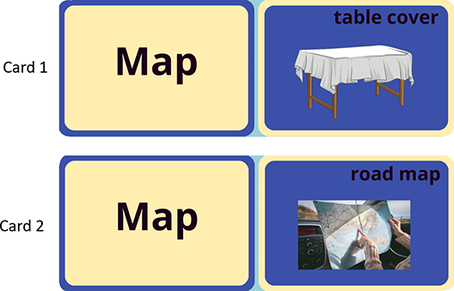
Multiple-Meaning Word Cards game: As part of the study, a memory game was developed to promote the repeated use and retrieval of multiple-meaning nouns. The words used in this game were selected from the MMRQ. This pedagogical game tool consisted of a set of colourful cards, each displaying a word along with visual representations of its two most common meanings. These meanings were selected based on research findings from pre-tests conducted with multiple-meaning words (Raviv et al., Reference Raviv, Mashal and Peleg2024). Each multiple-meaning word was represented by two cards: one card featured the word alongside an image illustrating one meaning, while the second card showed the same word with an image depicting the other meaning. For instance, the word “map” had one card displaying the word “map” along with an image of a road map, and another card showing the word “map” with an image illustrating a tablecloth (Figure 1).
Example of two matching cards for the multiple-meaning word MAP. One card depicts a table cover, and the other illustrates a road map.

To fit the game within the 25-minute time frame allocated for each intervention session, 11 words (22 cards) – five polysemous (rainbow, moon, mouse, liquid flow, circumcision) and six homonymous (leg, bush, steering wheel, road, map, brother) – were selected from the 18 words in MMRQ. This number allows for approximately 2 minutes per word, enabling in-depth exposure and learning while maintaining a balance between engagement and educational pace, rather than superficial exposure to all 18 words. The words were selected based on their potential for visual representation – each of the two meanings can be clearly illustrated on the game cards. The remaining seven words (ball, cup, movie, net, bar, wave, garden), not included in the intervention game, served as control words for post-intervention measurement. The game was identical for all age groups.
The game is structured into two main stages (see details in Appendix B and Figure 2). The first stage, the exposure phase, takes place over one session and involves showing the children the cards, providing guidance on the images and their meanings, and teaching them how to match pairs of cards associated with the same word. The second stage, the application phase, may take several sessions and consists of an interactive memory game. In this phase, all the cards are placed face down on the table, and each child takes turns flipping over two cards, aiming to find the matching pairs for each word. This tool is designed to improve children’s ability to recognize and understand the various meanings of multiple-meaning words, integrating elements of visual learning and play.
Overview of the six sessions comprising the study; all were spaced one week apart. Sessions 1 and 6 were conducted individually and involved oral pre- and post-assessments, respectively. Session 2, conducted in small groups of four to six children, marked the beginning of the gamified intervention by introducing the game. Sessions 3, 4, and 5, also conducted in groups of four to six children, continued the gamified intervention phase.

2.3. Procedure
The study consisted of six sessions (see Figure 2 and Appendix B). The first session was conducted individually with each child and involved administering the S-PPVT and completing the “Multiple-Meaning Retrieval Questionnaire.” Both assessments were given orally. The computation of valid retrievals for each word involved recording the number of accurate meanings (see Appendix A) retrieved by participants, which served as a measure of retrieval proficiency. This count included both literal meanings (e.g. mouse as a computer device) and metaphorical meanings (e.g. wave as a heat wave). However, associative meanings (e.g. mouse as something disgusting) were excluded from the analysis. For each participant, the mean number of retrieved meanings was then calculated by averaging the total number of valid retrievals across all words, as well as separately for polysemous and homonymous words.
The second session introduced the children to the game, familiarizing them with its rules by showing them the cards, providing guidance on the images and their meanings, and teaching them how to match pairs of cards associated with the same word. Sessions 3 through 5 lasted 25 min each (e.g. Ruston & Schwanenflugel, Reference Ruston and Schwanenflugel2010) and focused on playing the game, where each time a child found a matching pair of cards, they were prompted to recall and verbalize the different meanings of the word, providing repeated retrieval practice throughout the game. These sessions were held in groups of four to six children, with research assistants guiding and facilitating the activities. Attendance and participation were monitored to ensure that all children took part in every session type. The sixth and final session was individual and involved re-administering the “Multiple-Meaning Retrieval Questionnaire” to measure the effectiveness of the intervention program in improving the children’s ability to retrieve multiple meanings. All sessions were spaced one week apart.
2.4. Statistical analysis
Item-level data were analysed using mixed-effects models to account for the fact that responses to the 18 MMRQ items were nested within participants, resulting in multiple observations per participant (see Appendix A). The data were organized in long format, with each row representing a single word response, along with the number of validated retrievals for that word. Random intercepts were specified for both participants and items to model variability at both levels.
Since the dependent variable comprises count outcomes, a generalized linear mixed-effects model (GLMM) with a Poisson distribution was evaluated for its adequacy. However, the outcome distribution indicated underdispersion: the mean number of retrievals per word was relatively low (M = 0.69) and the variance was smaller than the mean (Var = 0.31), violating the Poisson assumption of equal mean and variance. Model fit comparison further supported this: a linear mixed-effects model (LMM) yielded substantially lower AIC and BIC values (AIC = 3685.14, BIC = 3745.29) than the Poisson GLMM (AIC = 5502.99, BIC = 5569.16), indicating superior fit to the observed data. Given this evidence, final analyses were conducted using LMM. Models included fixed effects for age, gender, and general vocabulary level and were fitted using restricted maximum likelihood (REML) estimation. All analyses were conducted in R using the lme4 and lmerTest packages.
3. Results
3.1. Acquisition of multiple-meaning vocabulary in the expressive lexicon of children aged 3 to 5
Children’s acquisition of multiple-meaning vocabulary in the expressive lexicon was assessed using the MMRQ, administered at baseline. To examine whether retrieval performance varied across the 18 target words – and specifically between polysemous (related meanings) and homonymous (unrelated meanings) items – as a function of age and vocabulary level, an LMM was fitted to the pre-intervention data. The model included semantic category, age (dummy-coded; see Table 1 ), and their interaction as fixed effects, with vocabulary level (S-PPVT score; continuous) and gender entered as covariates. Random intercepts for participant and item were specified to account for repeated measures and item-level variability. The model was specified in R as [retrievalRate ~ semanticCategory * age + vocabulary + gender + (1 | participant) + (1 | item)].
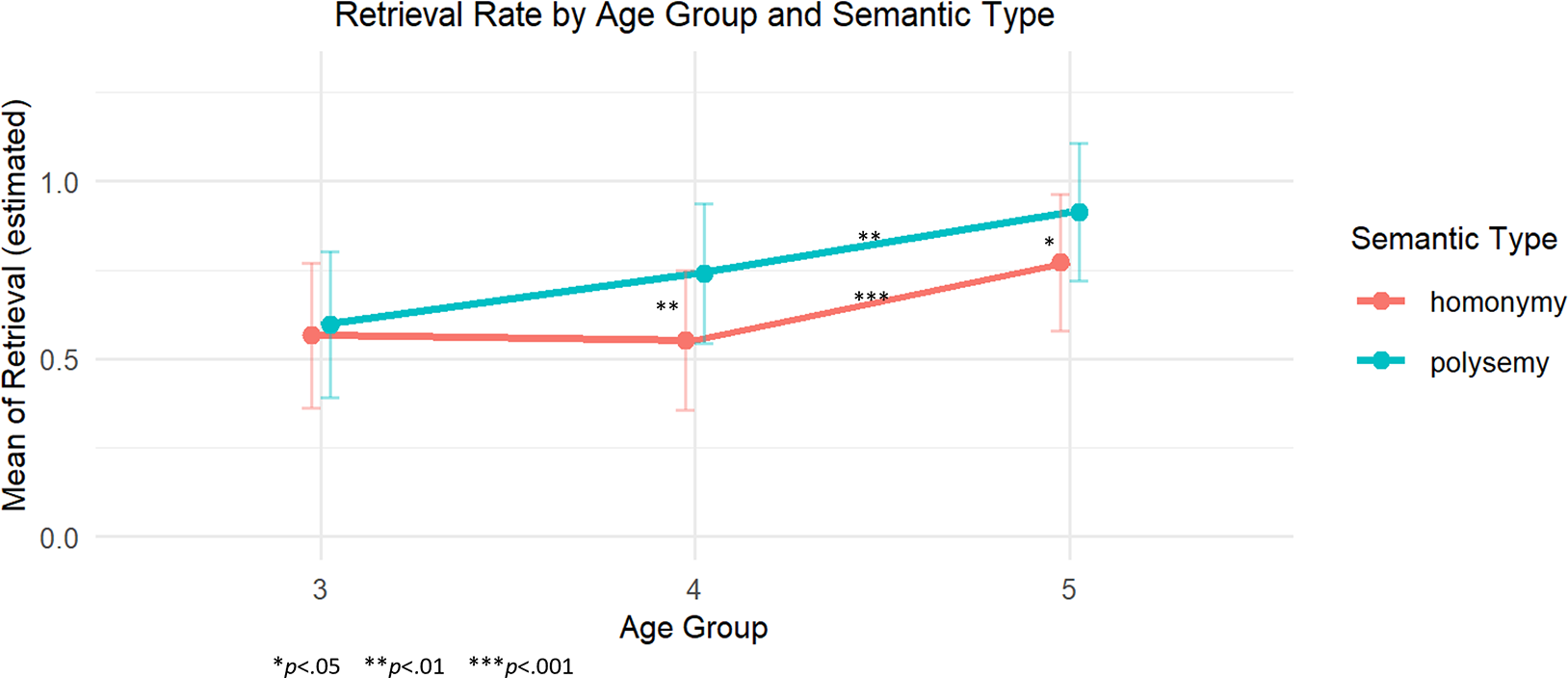
The model revealed a significant effect of age, with age 5 differing significantly (β = 0.331, SE = 0.105, t(78.9) = 3.14, p = .002) from the reference group (age 3), but not for age 4 (p = 0.84). No significant effect of semantic category was demonstrated (p = 0.81); however, a significant interaction between semantic category and age group emerged, with children aged 4 retrieved significantly more meanings for polysemous words than for homonymous ones (β = 0.157, SE = 0.056, t(1477) = 2.76, p = .005) as did 5-year-olds (β = 0.111, SE = 0.052, t(1477) = 2.13, p = .033), whereas no significant difference was observed for 3-year-olds (p = 0.813). These findings suggest increasing sensitivity to semantic relatedness with age. To directly compare performance across age groups within each semantic type, pairwise comparisons with Bonferroni correction were conducted. These showed that children aged 5 outperformed those aged 4 in both polysemous words (β = 0.173, SE = 0.055, t(128) = 3.09, p = .007) and homonymous words (β = 0.219, SE = 0.055, t(128) = 3.91, p < .001), while controlling for vocabulary level. No significant difference was found between ages 4 and 3 for homonymous word retrieval (p = 1.00), while in polysemous words, a non-significant trend suggested slightly higher performance for age 4 compared with age 3 (p = .104) (see Table 2 and Figure 3). Vocabulary level was also a significant positive predictor of retrieval (β = 0.049, p < .001), whereas gender was not significant (p = 0.88).
Mean number of retrieved meanings with standard errors (SEs) by age group and semantic category (polysemy versus homonymy).

3.2. Assessing the impact of an intervention program on the multiple-meaning vocabulary
To assess the impact of the intervention program on vocabulary knowledge, an LMM was conducted to examine retrieval performance before and after the intervention, comparing experimental words (the 11 words included in the intervention) with control words (the seven words not included in the intervention). The dependent variable was the extent of word retrieval. The fixed effects included time (pre- and post-intervention; within-subject), word group (included versus not-included; within-subject), and age group (dummy variable; see Table 1), along with all two- and three-way interactions. Vocabulary level (S-PPVT scores) was included as a covariate. Random intercepts were included for both participants and items to account for repeated measures and item-level variability. The model formula in R was [retrievalRate ~ time * wordGroup * age + vocabulary + (1 | participant) + (1 | item)].
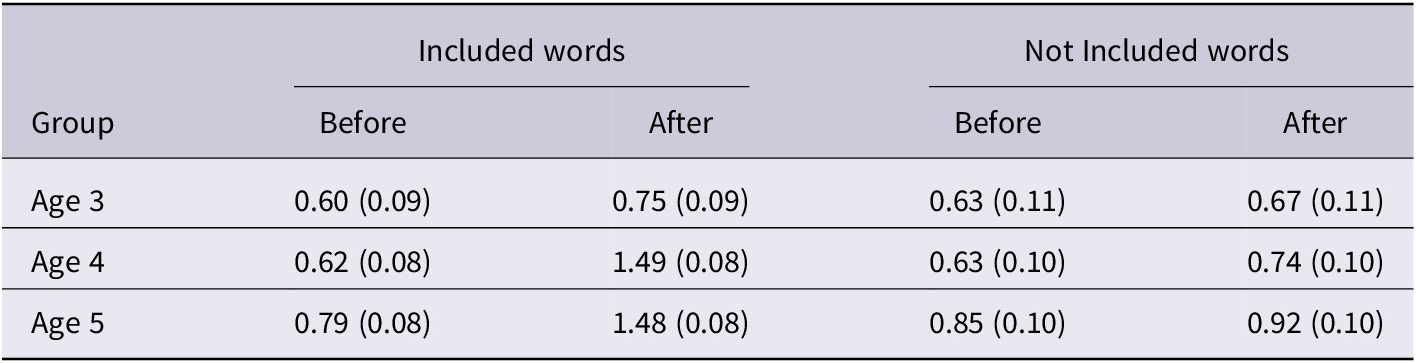
The analysis revealed a significant effect of time (β = 0.148, SE = 0.043, t(312509) = 3.44, p < .001), indicating overall improvement in retrieval performance. Importantly, a significant three-way interaction between time, word group, and age was also observed, for both age 4 (β = 0.645, SE = 0.092, t(3125) = 6.98, p < .001) and age 5 (β = 0.510, SE = 0.086, t(3125) = 5.92, p < .001) compared with the reference group (age 3), suggesting that the effect of time and word group on retrieval performance differed across age groups, while controlling for vocabulary level. Pairwise comparisons with Bonferroni correction revealed that all age groups benefited from the intervention (included words), although the magnitude of the effect differed. The improvement was highly significant for ages 5 (β = 0.697, SE = 0.032, t(3125) = 21.81, p < .001) and 4 (β = 0.873, SE = 0.038, t(3125) = 22.84, p < .001), while for age 3 the effect was also significant, though smaller (β = 0.148, SE = 0.043, t(3125) = 3.44, p = .006). In contrast, no significant improvement was observed for the control words (i.e. items not included in the intervention) for age 3 (p = .54) and age 5 (p = .07), whereas a significant effect was found for age 4 (p = .02) (see Table 3 and Figure 4). Importantly, an examination of the post-test responses revealed that 98% of the meanings produced by children corresponded to the meanings explicitly taught during the intervention, suggesting that the observed improvement primarily reflected learning of the trained meanings rather than spontaneous generation of new, untrained meanings (see Supplementary Material).
Estimated means and standard errors (SEs) of retrieved meanings before and after the intervention program

Effect of intervention program on meaning retrieval by age group.

4. Discussion
Multiple-meaning words represent a unique and complex aspect of language acquisition, particularly during the critical preschool years. This study aimed to investigate the acquisition of multiple-meaning vocabulary within the expressive lexicon, focusing on children aged 3 to 5. Specifically, it examined age-related differences in retrieving meanings for multiple-meaning words overall, as well as separately for polysemous and homonymous words. It also assessed the effectiveness of a gamified intervention program designed to enhance multiple-meaning vocabulary.
Our first goal was to examine the overall progression in the acquisition of multiple-meaning words. The findings reveal that significant development in expressive lexical abilities occurs between ages 3 and 5, while no significant growth occurs in between. This pattern suggests that notable growth in expressive lexical access may emerge primarily during the fifth year of life. These results are consistent with prior research pointing to a marked expansion in the expressive lexicon around this age (Vehkavuori et al., Reference Vehkavuori, Kämäräinen and Stolt2021). This developmental leap reflects a shift towards more sophisticated and intentional expressive language use, which appears to accelerate after age 4 (Patrucco-Nanchen et al., Reference Patrucco-Nanchen, Friend, Poulin-Dubois and Zesiger2019; Stolt et al., Reference Stolt, Haataja, Lapinleimu and Lehtonen2008). The limited gains among 3-year-olds may reflect developmental challenges in retrieving and articulating word meanings at this early stage. At the same time, prior studies have shown that preschoolers, including 3-year-olds, can begin to engage with word-meaning tasks, demonstrating early signs of definitional ability (e.g. Gavriilidou, Reference Gavriilidou, Chatzopoulou, Ioannidou and Yoon2011; Tippenhauer et al., Reference Tippenhauer, Sun, Jimenez, Green and Saylor2020).
The ability to assign and retrieve multiple meanings reflects both linguistic and cognitive advancements, including improved memory, conceptual mapping, and metalinguistic awareness (Eddington & Tokowicz, Reference Eddington and Tokowicz2015; Jalongo & Sobolak, Reference Jalongo and Sobolak2011). These findings expand the knowledge about expressive lexicon development, particularly in the context of multiple-meaning words, which demand more advanced semantic processing and retrieval capabilities than single-meaning words (Klepousniotou et al., Reference Klepousniotou, Pike, Steinhauer and Gracco2012; MacGregor et al., Reference MacGregor, Bouwsema and Klepousniotou2015).
Interestingly, the observed main effect for general vocabulary level further emphasizes the interplay between overall vocabulary knowledge and the ability to retrieve multiple meanings. Children with higher general vocabulary proficiency demonstrated greater retrieval success, suggesting that a robust vocabulary foundation supports more effective semantic processing and retrieval (Denham et al., Reference Denham, Blair, DeMulder, Levitas, Sawyer, Auerbach–Major and Queenan2003; Rhoades et al., Reference Rhoades, Warren, Domitrovich and Greenberg2011). Notably, the absence of a main effect for gender indicates that the ability to retrieve multiple meanings is consistent across boys and girls, reinforcing the notion that gender does not influence this specific aspect of lexical development (e.g. Rinaldi et al., Reference Rinaldi, Pasqualetti, Volterra and Caselli2023).
The second aim was to further explore the progression in the expressive lexicon by distinguishing between polysemous (related meanings) and homonymous words (unrelated meanings), which represent two distinct semantic categories (Murphy, Reference Murphy2010). The findings revealed a significant interaction between semantic category and age group, highlighting distinct developmental patterns for words with related versus unrelated meanings. For polysemous words, which share conceptual connections among their multiple meanings, a trend of improvement in retrieval was observed between ages 3 and 4, with a significant increase between ages 4 and 5. This pattern supports the notion that semantic relatedness may facilitate word learning by strengthening associative links in the mental lexicon during encoding, consolidation, retention, and retrieval (Klepousniotou et al., Reference Klepousniotou, Pike, Steinhauer and Gracco2012; Pylkkänen et al., Reference Pylkkänen, Llinás and Murphy2006), and aligns with theories that generalization and taxonomic expansion develop incrementally during early childhood (Srinivasan et al., Reference Srinivasan, Al-Mughairy, Foushee and Barner2017; Srinivasan & Snedeker, Reference Srinivasan and Snedeker2014). In contrast, homonymous words, which have unrelated meanings, posed greater challenges for children. Significant developmental gains for homonymous word retrieval were found only between ages 4 and 5, with no notable difference between ages 3 and 4. This suggests that acquiring unrelated meanings requires more advanced metalinguistic skills, such as managing lexical ambiguity and dissociating competing meanings (Doherty, Reference Doherty2000), abilities that consolidate around age 4 (Backscheider & Gelman, Reference Backscheider and Gelman1995; Peters & Zaidel, Reference Peters and Zaidel1980). These results underscore the role of semantic relatedness in shaping how children learn to retrieve multiple meanings during early language development. Future studies should aim to disentangle the relative contributions of encoding, consolidation, retention, and retrieval processes to children’s learning and processing of polysemous and homonymous words.
Our third goal was to evaluate the effectiveness of a gamified intervention program in enhancing overall multiple-meaning vocabulary by comparing pre- and post-intervention retrievals for words included in the program versus those that were not. Specifically, this part of the study sought to determine how the intervention impacted retrieval performance across different age groups – 3, 4, and 5 – providing insights into its role in supporting expressive lexicon development at distinct developmental stages. The findings revealed a significant three-way interaction between age group, time, and word group, indicating that the intervention program effectively enhanced retrieval for words included in the program. Significant improvements were observed across all age groups, with greater gains for children aged 4 and 5. These results align with evidence from the literature, which emphasizes the importance of structured, targeted interventions in supporting vocabulary acquisition during early childhood. For instance, Marulis and Neuman’s (Reference Marulis and Neuman2010) meta-analysis, which reviewed 67 studies evaluating the impact of language and vocabulary interventions, reported a substantial average effect size of 0.88, emphasizing that well-designed interventions can significantly enhance word learning during this critical developmental period. Specifically for the expressive lexicon, Ruston and Schwanenflugel’s (Reference Ruston and Schwanenflugel2010) study demonstrated the effectiveness of structured conversational interactions in fostering expressive vocabulary growth among children aged 4 and 5. Rooted in theories of mediated learning and social interaction, the intervention involved intentional and cognitively stimulating conversations facilitated by trained adults. Results indicated significant gains in expressive vocabulary for children in the intervention group compared with controls.
Notably, the group of 3-year-old children, which showed no significant expressive vocabulary gains compared with 4-year-olds in the pre-assessment, demonstrated significant improvement after the intervention, with marked gains in retrieval performance for words included in the program. Previous studies have shown improved language performance in 3-year-old children following interventions that typically used relatively simple tasks (e.g. Fricke et al., Reference Fricke, Bowyer-Crane, Haley, Hulme and Snowling2013, Reference Fricke, Burgoyne, Bowyer-Crane, Kyriacou, Zosimidou, Maxwell, Lervåg, Snowling and Hulme2017; West et al., Reference West, Snowling, Lervåag, Buchanan-Worster, Duta and Hall2021). These often included storytelling, picture-based discussions, object naming, and basic phonological awareness activities such as clapping syllables or matching sounds. In contrast, the current intervention involved a somewhat more complex task – an adapted memory game requiring children to match different visual representations of a word’s multiple meanings (e.g. “map” as a road map and as a tablecloth). Despite the increased demands, 3-year-olds showed meaningful gains, suggesting that young children can benefit from more challenging tasks when appropriately supported.
This study has several limitations that should be acknowledged. It focused mainly on retrieval performance, leaving other dimensions of multiple-meaning vocabulary, such as receptive knowledge, unexplored. Additionally, in the MMRQ, one of the balancing measures, word frequency, was based on digital text archives rather than data derived from children. A further limitation concerns the use of the S-PPVT as a covariate. Because this version included only 14 items, it may have provided a less comprehensive estimate of children’s vocabulary knowledge compared with the full standardized test. Future research could address these limitations by incorporating broader vocabulary measures and child-based frequency norms.
Supplementary material
The supplementary material for this article can be found at http://doi.org/10.1017/S030500092610066X.
Acknowledgements
The study was approved by the Chief Scientist of the Israeli Ministry of Education (Approval No. 13454). Written informed consent was obtained from the children’s parents or legal guardians prior to participation, and assent was obtained from the children. Participation was voluntary, and all data were collected anonymously. During the preparation of this manuscript, the authors used the GPT-5 model for the purpose of improving English phrasing. The authors have reviewed and edited the output and take full responsibility for the content of this publication.
Competing interests
The authors declare none.
Appendix A. Multiple-meaning retrieval questionnaire (MMRQ): Structure and statistical details
List of words included in the multiple-meaning retrieval questionnaire – MMRQ (Raviv, Reference Raviv2022), along with their frequency of use (measured in occurrences per million words) and the number of semantic meanings associated with each word. Statistical analyses confirmed that the words are balanced across semantic categories in terms of frequency (p = .39) and number of meanings (p = .39)

Appendix B. Gamified intervention program
This appendix outlines the six study sessions, with a focus on the four gamified intervention sessions. All sessions were spaced one week apart. Sessions 1 and 6 involved individual pre- and post-assessments. Sessions 2 to 5 focused on a gamified activity conducted in groups of 4–6 children. Table B1 shows how the game was introduced and played, highlighting typical interactions and the facilitator’s role in guiding the activity.
Overview of the six study sessions with a focus on the gamified intervention






 Open access

