





1. Introduction and statement of the results
In quantitative optical imaging, the goal is to estimate the optical properties, as the permittivity function, from the optical signal response of the object to image after excitation with coherent or incoherent incident electromagnetic fields, see [Reference Ammari3, Reference Arridge10, Reference Gibson, Hebden and Arridge32, Reference Hebden, Arridge and Delpy35, Reference Stefanov and Uhlmann56]. The optical response is measured at receivers located away from the object to image. Such inversion requires multiple emitters-receivers, i.e. many measurements, and it is known to be highly unstable [Reference Isakov39] and hence one is unable to recover low contrasting permittivity functions using such remote measurements. To overcome such difficulties, it is proposed in the engineering literature, see [Reference Ghandriche and Sini26, Reference Anderson, Hu, Zhang, Tlaxca, Declèves, Houghtaling, Sharma, Lawrence, Ferrara and Rychak36–Reference Ilovitsh, Ilovitsh, Foiret, Caskey, Kusunose, Fite, Zhang, Mahakian, Tam, Butts-Pauly, Qin and Ferrara38, Reference Li and Chen43, Reference Prost, Poisson and Bossy50–Reference Quaia52], to perturb the medium with small-scaled inhomogeneities to create such missing contrast to render the imaging more accurate. In optics, such contrast agents are given by nanoparticles which enjoy appropriate contrasting properties. We have two classes of such nanoparticles: dielectric and plasmonic nanoparticles. The dielectric nanoparticles are highly localized as they are nano-scaled and have high contrast permittivity. Under these scales, we can choose the incident frequency so that we excite the dielectric resonances, which are related to the eigenvalues of the vector Newtonian operator, see [Reference Ammari, Li and Zou5, Reference Cao, Ghandriche and Sini13] for a mathematical justification. Moreover, in practice, optically induced waves by dielectric nanoparticles have been examined and extensively studied, see for instance [Reference Kuznetsov, Miroshnichenko, Brongersma, Kivshar and Luk’yanchuk42, Reference Tzarouchis and Sihvola57, Reference Zograf, Timin, Muslimov, Shishkin, Nominé, Ghanbaja, Ghosh, Li, Zyuzin and Makarov59, Reference Zograf, Petrov, Makarov and Kivshar60]. The main feature of the plasmonic nanoparticles is that they enjoy negative values of the real part of their permittivity if we choose incident frequencies close to the plasmonic frequencies of the nanoparticle. With such negative permittivity, we can excite the plasmonic resonances, which are related to the eigenvalues of the Magnetization operator, see [Reference Ammari and Millien4, Reference Ammari, Ruiz, Yu and Zhang6, Reference Ghandriche and Sini25]. These plasmonic nanoparticles show an ability to manipulate light at the nano-scale size due to their support for these resonant optical modes, see [Reference Baffou, Quidant and Girard11, Reference Catchpole and Polman14, Reference Fan, Zheng and Singh20, Reference Hao and Schatz34, Reference Johnson and Christy40, Reference Liberman, Rothschild, Bakr and Stellacci44, Reference Maier45, Reference Novotny and Hecht47, Reference Zeman and Schatz58] for an extensive description and studies of their properties. Such unique properties are the reasons behind the increase of interest in the study of plasmonic nanoparticles, in particular those made of gold or silver, as demonstrated in [Reference Novotny and Hecht47]. These optical properties of plasmonic nanoparticles have been utilized, in the engineering community, in numerous applications, including bio-sensors, thermo-therapy and solar cells, etc. To learn more on these two types of nanoparticles about their common as well as different properties, the interested reader can see the references [Reference Kuznetsov, Miroshnichenko, Brongersma, Kivshar and Luk’yanchuk42, Reference Zograf, Timin, Muslimov, Shishkin, Nominé, Ghanbaja, Ghosh, Li, Zyuzin and Makarov59, Reference Zograf, Petrov, Makarov and Kivshar60]. At the mathematical side, let us mention the works [Reference Ammari, Ruiz, Yu and Zhang7, Reference Ammari, Ruiz, Yu and Zhang8], where a method for reconstructing the shapes of molecules using the plasmonic resonances generated by the mixture of molecules and nanoparticles, as measurements, was introduced.
The present work is a continuation of our efforts in proposing an original framework to mathematically modelling and analysing imaging modalities using contrast agents. These contrast agents can be bubbles, nanoparticles, elastic inclusions, etc, and the imaging modalities could be the ultrasound imaging applying bubbles, optical and photo-acoustic imaging with nanoparticles and elastography using inclusions, to cite a few. In the subsequent discussions, we provide an overview of our results in this direction and we referee the interested reader to [Reference Ghandriche, Senapati, Sini, Morassi and Kawano27] for more details. Here, we mainly focus on optical imaging using plasmonic nanoparticles. To describe the material properties of these nanoparticles, we use the Lorentz model where the permeability $\mu$
is kept constant as the one of the homogeneous background while the permittivity has the form:
$\mu$
is kept constant as the one of the homogeneous background while the permittivity has the form:
 \begin{equation} \epsilon _{p}(\omega ) = \epsilon _\infty \left ( 1+\frac {\omega ^2_p}{\omega ^2_0-\omega ^2-i \gamma \omega } \right ) \end{equation}
where $\omega _p$
is the electric plasma frequency,
$\omega _p$
is the electric plasma frequency, $\omega _0$
is the undamped frequency and
$\omega _0$
is the undamped frequency and $\gamma$
is the electric damping frequency, which is assumed to be small, i.e.,
$\gamma$
is the electric damping frequency, which is assumed to be small, i.e., $0 \leq \gamma \ll 1$
, and its order of smallness will be discussed later, see (3.37). We refer [Reference Akyurtlu and Kussow2, Formula (4)] or [Reference Engheta and Ziolkowski19, Formula (1.3)] for the derivation of this model. It is observed that if we choose the incident frequency
$0 \leq \gamma \ll 1$
, and its order of smallness will be discussed later, see (3.37). We refer [Reference Akyurtlu and Kussow2, Formula (4)] or [Reference Engheta and Ziolkowski19, Formula (1.3)] for the derivation of this model. It is observed that if we choose the incident frequency $\omega$
so that
$\omega$
so that $\omega ^2$
is larger than
$\omega ^2$
is larger than $\omega _0^2$
, then the real part becomes negative. For such choices of the incident frequency, the nanoparticle behaves as a plasmonic nanoparticle. In the current work, we focus on the use of these properties for quantitative imaging. As mentioned before, these nanoparticles are used as contrast agents. Few scenarios and assumptions on the distribution of the contrast agents can be considered. These scenarios are of course not exhaustive as the reality might be more complicated. Nevertheless, we state the following classes of distributions under which we can perform rigorous analysis.
$\omega _0^2$
, then the real part becomes negative. For such choices of the incident frequency, the nanoparticle behaves as a plasmonic nanoparticle. In the current work, we focus on the use of these properties for quantitative imaging. As mentioned before, these nanoparticles are used as contrast agents. Few scenarios and assumptions on the distribution of the contrast agents can be considered. These scenarios are of course not exhaustive as the reality might be more complicated. Nevertheless, we state the following classes of distributions under which we can perform rigorous analysis.
-
(1) The contrast agents are injected in isolation, i.e. they are injected one after another. In addition, we need to assume them well separated to insure weak multiple scattering between them.
-
(2) They are injected as a cluster, i.e. all-at-once. In this case, we have full strong multiple scattering between them. Here also, we can handle the following situations.
-
(a) The distribution is regular, i.e. periodic or following a given density of distribution. In this case, we can expect deterministic estimations.
-
(b) The distribution is random. In this case, we aim for probabilistic estimations.
-
The approach we propose to analyse these families of imaging modalities using contrast agents can be summarized as follows. Contrasting the measured fields collected before and after injecting the small agents, we propose the following solutions.
-
(1) Case when we inject the contrast agents one after another, under the weak scattering assumption.
-
(a) We can recover the related resonances. From these resonances, we derive the values of the ’high order’ coefficient (i.e. the mass density in acoustics). This idea works in the time-harmonic regimes.
-
(b) We can recover the internal values of the travel time function. Using the Eikonal equation, we recover the speed of propagation. This idea works in time-domain regimes.
-
(c) In addition, we can recover the internal values of the total fields generated only by the background medium. This allows to recover the lower order coefficients (as the bulk modulus in acoustics). This idea works for both the time-harmonic and the time-domain regimes.
These ideas were applied to the time-harmonic as well as the time domain imaging for acoustics, i.e. ultrasound imaging using bubble as contrast agents, see [Reference Dabrowski, Ghandriche and Sini30, Reference Senapati and Sini54, Reference Senapati, Sini and Wang55].
-
-
(2) Case when we inject the contrast agents all-at-once, as a cluster.
-
(a) using the resonant character of the contrast agents, we can linearize the measured boundary-map, i.e. the Dirichlet–Neumann map.
-
(b) then we solve the linearized inverse problem.
This idea was applied in [Reference Ghandriche and Sini28] to the Calderón problem using resonant perturbations modelling the acoustic imaging with droplets as contrast agents.
-
So far, this approach was applied to acoustic waves based imaging, i.e. for the ultrasound imaging modality using bubbles or droplets as contrast agents and also photo-acoustic imaging using nanoparticles, see [Reference Ghandriche and Sini25, Reference Ghandriche and Sini29].
Our goal in the current work is to extend this approach to the electromagnetic waves based imaging as the case of quantitative optical imaging using nanoparticles. To describe the mathematical model behind the optical experiment, we set the electric field $E({\cdot})$
to be solution of the following system
$E({\cdot})$
to be solution of the following system
 \begin{equation} \left \{ \begin{array}{l@{\quad}l@{\quad}l} \nabla \times \nabla \times (E ) - \omega ^2 \; \varepsilon \; \mu \; E = 0, \quad \; \qquad \, \text{in} \ \mathbb{R}^{3}, \\[3pt] E \,:\!= E^{s} + E^{i}, \qquad \qquad \qquad \qquad \qquad\!\! \mbox{ in } \mathbb{R}^{3},\\[3pt] \underset {\vert x \vert \rightarrow + \infty }{\lim } \vert x \vert \; (\nabla \times ( E^{s}(x) ) \times x - E^{s}(x) ) = 0, \end{array} \right . \end{equation}
with the last condition known as the Silver–Müller radiation conditions. Here, $\omega$
is the incident frequency,
$\omega$
is the incident frequency, $\mu$
is the permeability parameter, which will be taken to be constant in the whole space
$\mu$
is the permeability parameter, which will be taken to be constant in the whole space $\mathbb{R}^{3}$
, and
$\mathbb{R}^{3}$
, and $\varepsilon ({\cdot})$
is the permittivity function defined as
$\varepsilon ({\cdot})$
is the permittivity function defined as
 \begin{equation} \varepsilon (x) \,:\!= \begin{cases} \epsilon _{\infty } & \mathrm{in} \quad \mathbb{R}^{3} \setminus \Omega , \\ \epsilon _{0}(x) & \mathrm{in} \quad \Omega \setminus D, \\ \epsilon _{p}(\omega ) & \mathrm{in} \quad D, \end{cases} \end{equation}
with $\epsilon _{\infty }$
being a positive constant used to represent the permittivity of the background (outside
$\epsilon _{\infty }$
being a positive constant used to represent the permittivity of the background (outside $\Omega$
),
$\Omega$
), $\epsilon _{p}(\omega )$
is given by (1.1) and the permittivity
$\epsilon _{p}(\omega )$
is given by (1.1) and the permittivity $\epsilon _0({\cdot})$
is variable and it is supposed to be smooth of class
$\epsilon _0({\cdot})$
is variable and it is supposed to be smooth of class $\mathcal{C}^{1}$
inside
$\mathcal{C}^{1}$
inside $\Omega$
. Besides, we assume that
$\Omega$
. Besides, we assume that $Im ( \epsilon _{0}({\cdot}) )$
is small such that
$Im ( \epsilon _{0}({\cdot}) )$
is small such that
 \begin{equation} \Vert Im( \epsilon _{0}({\cdot}) ) \Vert _{\mathbb{L}^{\infty }(\Omega )} = \mathcal{O}( \gamma ), \end{equation}
where $\gamma$
is the electric damping frequency parameter of the Lorentz model, see (1.1). The domain
$\gamma$
is the electric damping frequency parameter of the Lorentz model, see (1.1). The domain $D$
is given as a collection of
$D$
is given as a collection of $\aleph$
connected and
$\aleph$
connected and $\mathcal{C}^{2}$
-smooth nanoparticles
$\mathcal{C}^{2}$
-smooth nanoparticles $D_{i}$
’s, i.e.
$D_{i}$
’s, i.e. $D \,:\!= \overset {\aleph }{\underset {i=1}\cup } D_{i}$
. In addition
$D \,:\!= \overset {\aleph }{\underset {i=1}\cup } D_{i}$
. In addition $D \subset \Omega$
, where
$D \subset \Omega$
, where $\Omega$
is a bounded and
$\Omega$
is a bounded and $\mathcal{C}^{2}$
-smooth domain in
$\mathcal{C}^{2}$
-smooth domain in $\mathbb{R}^{3}$
. Related to the permittivity function given by (1.3), we set the index of refraction
$\mathbb{R}^{3}$
. Related to the permittivity function given by (1.3), we set the index of refraction $\boldsymbol{n}$
, in
$\boldsymbol{n}$
, in $\mathbb{R}^{3}$
, given by
$\mathbb{R}^{3}$
, given by
 \begin{align} \boldsymbol{n} \,:\!= \begin{cases} \sqrt {\epsilon _{p} \, \mu } & \text{in $D$} \\[4pt] \boldsymbol{n}_{0} & \text{in $\mathbb{R}^{3} \setminus D$} \end{cases} \qquad \text{and} \qquad \boldsymbol{n}_{0} \,:\!= \begin{cases} \sqrt {\epsilon _{0}({\cdot}) \, \mu } & \text{in $\Omega $} \\[4pt] \sqrt {\epsilon _{\infty } \, \mu } & \text{in $\mathbb{R}^{3} \setminus \Omega $} \end{cases}. \end{align}
Each nanoparticle $D_{j}$
, for
$D_{j}$
, for $1 \leq j \leq \aleph$
, is taken of the form
$1 \leq j \leq \aleph$
, is taken of the form $D_{j} \,:\!=a \; B_{j} \, +z_{j}$
where
$D_{j} \,:\!=a \; B_{j} \, +z_{j}$
where $z_{j}$
models its location and
$z_{j}$
models its location and $a$
signifies its relative radius with
$a$
signifies its relative radius with $B_{j}$
as
$B_{j}$
as $\mathcal{C}^2$
-smooth domain of maximum radius
$\mathcal{C}^2$
-smooth domain of maximum radius $1$
such that
$1$
such that $B_{j} \subset B(0,1)$
, where
$B_{j} \subset B(0,1)$
, where $B(0,1)$
is the unit ball centred at the origin. The parameter
$B(0,1)$
is the unit ball centred at the origin. The parameter $a$
is defined by
$a$
is defined by
 \begin{equation*} a \,:\!= \underset {1 \leq j \leq \aleph }{\max } \; \mathrm{diam}( D_{j} ), \end{equation*}
and we denote $d$
as the minimal distance between any two of the distributed nanoparticles, i.e.
$d$
as the minimal distance between any two of the distributed nanoparticles, i.e.
 \begin{equation*} d = \underset {1 \leq i, j \leq \aleph \atop i \neq j}{\min } \; \mathrm{dist} ( D_{i}, D_{j} ). \end{equation*}
The parameters $d$
and
$d$
and $\aleph$
are linked to the parameter
$\aleph$
are linked to the parameter $a$
through the following behaviours
$a$
through the following behaviours
 \begin{equation*} d \sim a^{t} \quad \text{and} \quad \aleph \sim [a^{-s}], \quad \text{with} \quad 0 \lt t, s \lt 1, \end{equation*}
where $ [ \cdot ]$
stands for the entire part function. Moreover, for short notations, we denote
$ [ \cdot ]$
stands for the entire part function. Moreover, for short notations, we denote $d_{mj}$
as the distance between
$d_{mj}$
as the distance between $z_{m}$
and
$z_{m}$
and $z_{j}$
, where
$z_{j}$
, where $z_{m}$
(respectively,
$z_{m}$
(respectively, $z_{j}$
) is the centre of
$z_{j}$
) is the centre of $D_{m}$
(respectively,
$D_{m}$
(respectively, $D_{j}$
), i.e.
$D_{j}$
), i.e.
 \begin{equation*} d_{mj} \,:\!= \vert z_{m} - z_{j} \vert , \quad \text{with} \quad 1\leq m, j\leq \aleph ,\quad m\neq j. \end{equation*}
In the sequel, without losing generalities, we assume that
 \begin{equation*} B_{j} \, \equiv B \, \subset \, B(0,1), \qquad \text{for} \quad 1 \, \leq j \leq \aleph . \end{equation*}
The problem (1.2) is well-posed in appropriate Sobolev spaces, see, for example, [Reference Kirsch41, Theorem 2.1]. We assume that the incident field $E^{Inc}({\cdot} , \cdot , \cdot )$
is given by
$E^{Inc}({\cdot} , \cdot , \cdot )$
is given by
 \begin{equation} E^{Inc} ( x, \theta , q ) = ( \theta \times q ) \, e^{i \, k \, x \cdot \theta }, \quad \text{for} \quad \theta , q \in \mathbb{S}^{2} \quad \text{and} \quad x \in \mathbb{R}^{3}, \end{equation}
with $\mathbb{S}^{2}$
being the unit sphere,
$\mathbb{S}^{2}$
being the unit sphere, $\theta$
is the incident direction vector and
$\theta$
is the incident direction vector and $q$
is the polarization vector such that
$q$
is the polarization vector such that $q \cdot \theta = 0$
. The incident field
$q \cdot \theta = 0$
. The incident field $E^{Inc}( \cdot , \cdot , \cdot )$
is the solution to
$E^{Inc}( \cdot , \cdot , \cdot )$
is the solution to
 \begin{equation*} \underset {x}{\nabla } \times \underset {x}{\nabla } \times ( E^{Inc} ( x, \theta , q ) ) - k^{2} \, E^{Inc}( x, \theta , q ) = 0, \quad x \in \mathbb{R}^{3}, \end{equation*}
where the wave number $k$
is given by the positive constant
$k$
is given by the positive constant $k = \omega \, \sqrt {\epsilon _{\infty } \, \mu }$
. Besides, the scattered wave
$k = \omega \, \sqrt {\epsilon _{\infty } \, \mu }$
. Besides, the scattered wave $E^{s}( \cdot , \cdot , \cdot )$
has the following asymptotic behaviour,
$E^{s}( \cdot , \cdot , \cdot )$
has the following asymptotic behaviour,
 \begin{equation*} E^{s}( \hat {x}, \theta , q ) = \frac {e^{i \, k \, \vert x \vert }}{ \vert x \vert } \, \left( E^{\infty } ( \hat {x}, \theta , q ) + \mathcal{O}\left ( \frac {1}{\vert x \vert } \right) \right), \quad \vert x \vert \rightarrow + \infty , \end{equation*}
where $E^{\infty }( \hat {x}, \theta , q )$
is the corresponding electromagnetic far-field pattern of (1.2) in the propagation direction
$E^{\infty }( \hat {x}, \theta , q )$
is the corresponding electromagnetic far-field pattern of (1.2) in the propagation direction $\hat {x}$
.
$\hat {x}$
.
Motivated by the use of integral equations to represent solutions to Maxwell’s equations, and for future use, we introduce the Newtonian operator $N^{k}_{B}({\cdot})$
and the Magnetization operator
$N^{k}_{B}({\cdot})$
and the Magnetization operator $\nabla M^{k}_{B}({\cdot})$
, both acting on vector fields
$\nabla M^{k}_{B}({\cdot})$
, both acting on vector fields
 \begin{equation} N^{k}_{B}(F)(x) \,:\!= \int _{B} \Phi _{k}(x,y) \, F(y)dy \quad \text{and} \quad \nabla M^{k}_{B}(F)(x) \,:\!= \nabla \int _{B}\underset {y}{\nabla }\Phi _{k}(x,y) \cdot F(y)dy, \end{equation}
where
 \begin{equation} \Phi _{k}(x,y) \,:\!= \frac {e^{i \, k \, \vert x-y \vert }}{4\pi \vert x-y \vert }, \quad x \neq y, \end{equation}
is the fundamental solution to the Helmholtz equation in the entire space. Particularly, for $k = 0$
, we obtain
$k = 0$
, we obtain
 \begin{equation} N_{B}(F)(x) \,:\!= \int _{B} \frac {1}{4\pi \vert x-y\vert } F(y)dy \quad \text{and} \quad \nabla M_{B}(F)(x) \,:\!= \nabla \int _{B} \underset {y}{\nabla }\left ( \frac {1}{4\pi \vert x-y\vert } \right ) \cdot F(y)dy. \end{equation}
We will observe later that the introduced operators, see (1.7), appear after taking convolution of vector fields with the Green’s kernel $G_{k}({\cdot} , \cdot )$
associated with the problem (1.2). More precisely,
$G_{k}({\cdot} , \cdot )$
associated with the problem (1.2). More precisely, $G_{k}({\cdot} , \cdot )$
is the solution, in the distributional sense, to
$G_{k}({\cdot} , \cdot )$
is the solution, in the distributional sense, to
 \begin{equation} \underset {y}{\nabla } \times \underset {y}{\nabla } \times G_{k}(x, y) - \omega ^{2} \, \boldsymbol{n}_{0}^{2}(y) \, G_{k}(x,y) = \delta (x,y) \, I, \quad x, y \; \in \mathbb{R}^{3}, \end{equation}
such that each column of $G_{k}(x,\cdot )$
satisfies the outgoing radiation condition
$G_{k}(x,\cdot )$
satisfies the outgoing radiation condition
 \begin{equation*} \underset { \vert x \vert \rightarrow + \infty }{\lim } \vert x \vert \; \left ( \underset {y}{\nabla } \times G_{k}(x, y) \times \frac {x}{ \vert x \vert } - i \, k \, G_{k}(x, y) \right ) = 0. \end{equation*}
When dealing with vector fields, it is crucial to recall the Helmholtz decomposition for $\mathbb{L}^{2}(B)$
-space given by
$\mathbb{L}^{2}(B)$
-space given by
 \begin{equation} ( \mathbb{L}^2(B) )^{3} = \mathbb{H}_{0}({\mathrm{div}\,} = 0)(B) \oplus \mathbb{H}_{0}(Curl = 0)(B) \oplus \nabla \mathcal{H}armonic(B) \end{equation}
where
 \begin{align*} \mathbb{H}_{0}({\mathrm{div}\,} = 0)(B) &\,:\!= \{u \in ( \mathbb{L}^{2}(B) )^{3} \big | \nabla \cdot ( u ) = 0, \nu \cdot u=0 \mbox{ on } \partial B\}, \\ \mathbb{H}_{0}(Curl = 0)(B) &\,:\!= \{u \in ( \mathbb{L}^{2}(B) )^{3}\big | \nabla \times u = 0, \nu \times u=0 \mbox{ on } \partial B\} \end{align*}
and
 \begin{equation*} \nabla \mathcal{H}armonic(B) \,:\!= \{u \in ( \mathbb{L}^{2}(B) )^{3} \big |u=\nabla \phi ,\,\, \Delta \phi =0 \mbox{ in } B\}, \end{equation*}
see for instance [Reference Dautray and Lions17, Chapter IX, Table I, Page 314].
Of all possible $( \mathbb{L}^2(B) )^{3}$
-space decompositions, (1.11) is the most natural one, as we know that
$( \mathbb{L}^2(B) )^{3}$
-space decompositions, (1.11) is the most natural one, as we know that $N{|_{\mathbb{H}_{0}({\mathrm{div}\,} = 0)(B)}}$
and
$N{|_{\mathbb{H}_{0}({\mathrm{div}\,} = 0)(B)}}$
and $N{|_{\mathbb{H}_{0}(Curl = 0)(B)}}$
generate a complete orthonormal bases
$N{|_{\mathbb{H}_{0}(Curl = 0)(B)}}$
generate a complete orthonormal bases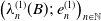 $\big(\lambda _{n}^{(1)}(B);\, e_{n}^{(1)} \big)_{n \in \mathbb{N}}$
and
$\big(\lambda _{n}^{(1)}(B);\, e_{n}^{(1)} \big)_{n \in \mathbb{N}}$
and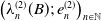 $\big(\lambda _{n}^{(2)}(B);\, e_{n}^{(2)} \big)_{n \in \mathbb{N}}$
, respectively. In addition, it is known that
$\big(\lambda _{n}^{(2)}(B);\, e_{n}^{(2)} \big)_{n \in \mathbb{N}}$
, respectively. In addition, it is known that $\nabla M : \, \nabla \mathcal{H}armonic(B) \rightarrow \nabla \mathcal{H}armonic(B)$
has a complete basis
$\nabla M : \, \nabla \mathcal{H}armonic(B) \rightarrow \nabla \mathcal{H}armonic(B)$
has a complete basis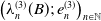 $\big(\lambda _{n}^{(3)}(B);\, e_{n}^{(3)} \big)_{n \in \mathbb{N}}$
, see [Reference Ghandriche and Sini25, Proposition 5.1]. For an in-depth study of the properties of the Magnetization operator, the reader can refer to [Reference Ahner, Dyakin, Raevskii and Ritter1, Reference Dyakin and Rayevskii18, Reference Friedman21–Reference Friedman and Pasciak23] and [Reference Raevskii53].
$\big(\lambda _{n}^{(3)}(B);\, e_{n}^{(3)} \big)_{n \in \mathbb{N}}$
, see [Reference Ghandriche and Sini25, Proposition 5.1]. For an in-depth study of the properties of the Magnetization operator, the reader can refer to [Reference Ahner, Dyakin, Raevskii and Ritter1, Reference Dyakin and Rayevskii18, Reference Friedman21–Reference Friedman and Pasciak23] and [Reference Raevskii53].
In the sequel, we fix an $n_{0} \in \mathbb{N}$
, and we let the used incident frequency
$n_{0} \in \mathbb{N}$
, and we let the used incident frequency $\omega$
to be of the form
$\omega$
to be of the form
 \begin{equation*} \omega ^{2} = \omega ^{2}_{P_{\ell },n_{0},j} \, \pm \, C \, a^{h}, \quad h \in (0,1) \quad \text{and} \quad 1 \leq j \leq \aleph , \end{equation*}
where $\omega ^{2}_{P_{\ell },n_{0},j}$
is the plasmonic resonance related to the eigenvalue
$\omega ^{2}_{P_{\ell },n_{0},j}$
is the plasmonic resonance related to the eigenvalue $\lambda _{n_{0}}^{(3)}(B)$
, see (3.36), and
$\lambda _{n_{0}}^{(3)}(B)$
, see (3.36), and $C$
is a constant independent on the parameter
$C$
is a constant independent on the parameter $a$
.
$a$
.
We are now in a position to state the primary outcome of this work.
Theorem 1.1.
Under the regularity assumptions on $\Omega , D, \epsilon _{0}({\cdot})$
and
$\Omega , D, \epsilon _{0}({\cdot})$
and $\mu$
described above, we have the following expansions.
$\mu$
described above, we have the following expansions.
-
(1) For the scattered fields, with $x$
is away from
$D$
,(1.12)
\begin{align} & ( E^{s} - V^{s})(x, \theta )\nonumber \\ & \quad = - \, \mu \, a^{3} \, \omega ^{2} \, \sum _{j=1}^{\aleph } \, \frac {\epsilon _{0}(z_{j}) \, \big(\epsilon _{0}(z_{j}) - \Lambda _{n_{0},j}( \omega ) \big)}{\lambda _{n_{0}}^{(3)}(B) \, \Lambda _{n_{0},j} ( \omega )} \, \left \langle V(z_{j}, \theta , q), \int _{B} e_{n_{0}}^{(3)}(y) \, dy \right \rangle \, G_{k}(x,z_{j}) \cdot \int _{B} e_{n_{0}}^{(3)}(y) \, dy \nonumber \\ & \qquad + \mathcal{O}\big( a^{\min \left ( (3-s), \left(6-3t-2h-\frac {3s}{2}\right) \right )}\big). \end{align}
$x$
is away from
$D$
,(1.12)
\begin{align} & ( E^{s} - V^{s})(x, \theta )\nonumber \\ & \quad = - \, \mu \, a^{3} \, \omega ^{2} \, \sum _{j=1}^{\aleph } \, \frac {\epsilon _{0}(z_{j}) \, \big(\epsilon _{0}(z_{j}) - \Lambda _{n_{0},j}( \omega ) \big)}{\lambda _{n_{0}}^{(3)}(B) \, \Lambda _{n_{0},j} ( \omega )} \, \left \langle V(z_{j}, \theta , q), \int _{B} e_{n_{0}}^{(3)}(y) \, dy \right \rangle \, G_{k}(x,z_{j}) \cdot \int _{B} e_{n_{0}}^{(3)}(y) \, dy \nonumber \\ & \qquad + \mathcal{O}\big( a^{\min \left ( (3-s), \left(6-3t-2h-\frac {3s}{2}\right) \right )}\big). \end{align}
-
(2) For the far fields
(1.13)
\begin{align} & \langle ( E^{\infty } - V^{\infty } )(\hat {x}) , ( \hat {x} \times q ) \rangle\nonumber \\ & \quad = \frac { \mu \, a^{3}}{4 \, \pi } \, \sum _{j=1}^{\aleph } \, \frac {\omega ^{2}_{P_{\ell },n_{0},j} \, \epsilon _{0}(z_{j}) \, \big (\epsilon _{0}(z_{j}) - \Lambda _{n_{0},j}\big( \omega _{P_{\ell },n_{0},j}\big) \big )}{\lambda _{n_{0}}^{(3)}(B) \, \Lambda _{n_{0},j} ( \omega )}\nonumber\\ & \qquad \times \left\langle V(z_{j}, \theta , q), \int _{B} e_{n_{0}}^{(3)}(y) \, dy \right\rangle \, \left\langle V(z_{j}, - \hat {x}, q ), \int _{B} e_{n_{0}}^{(3)}(y) \, dy \right\rangle + \mathcal{O}\big( a^{\min \left ( (3-s), \left(6-3t-2h-\frac {3s}{2}\right)\right )}\big). \end{align}


In particular, the far field, in the back-scattered direction $\hat {x}=-\theta$
, has the approximation
$\hat {x}=-\theta$
, has the approximation
 \begin{align} & \left \langle \left ( E^{\infty } - V^{\infty }\right )({-} \theta ) , \left ( \theta \times q \right ) \right \rangle \nonumber\\& \quad = - \frac {\mu \, a^{3}}{4 \, \pi } \, \sum _{j=1}^{\aleph } \, \frac {\omega ^{2}_{P_{\ell },n_{0},j} \, \epsilon _{0}(z_{j}) \, \big (\epsilon _{0}(z_{j}) - \Lambda _{n_{0},j}\big( \omega _{P_{\ell },n_{0},j}\big) \big)}{\lambda _{n_{0}}^{(3)}(B) \, \Lambda _{n_{0},j} ( \omega )} \, \left ( \left \langle V (z_{j}, \theta , q ), \int _{B} e_{n_{0}}^{(3)}(y) \, dy \right \rangle \right )^{2} \nonumber \\& \qquad + \mathcal{O}\big( a^{\min \left ( (3-s), \left(6-3t-2h-\frac {3s}{2}\right) \right )}\big). \end{align}
The above expansions are valid under the conditions $0 \leq h, t, s \lt 1$
such that
$0 \leq h, t, s \lt 1$
such that
 \begin{equation} h \lt \min \left ( 1 - \frac {s}{2}; - \, s + 3 \, (1-t) \right )\!, \end{equation}
with $\hat {x}, q \, \in \mathbb{S}^{2}$
and
$\hat {x}, q \, \in \mathbb{S}^{2}$
and $\Lambda _{n_{0},j}\left ( \cdot \right )$
is the dispersion function given by
$\Lambda _{n_{0},j}\left ( \cdot \right )$
is the dispersion function given by
 \begin{equation} \Lambda _{n_{0},j} ( \omega ) \,:\!= \left ( \epsilon _{0}(z_{j}) - \lambda _{n_{0}}^{(3)}(B) ( \epsilon _{0}(z_{j}) - \epsilon _{p}(\omega ) ) \right )\!, \end{equation}
where $\epsilon _{p}(\omega )$
is the Lorentz model for the permittivity given by (
1.1
).
$\epsilon _{p}(\omega )$
is the Lorentz model for the permittivity given by (
1.1
).
The field $V({\cdot} , \cdot , \cdot )$
(as its related scattered and far-field pattern) is the solution of the problem (
1.2
) in the absence of the nanoparticles.
$V({\cdot} , \cdot , \cdot )$
(as its related scattered and far-field pattern) is the solution of the problem (
1.2
) in the absence of the nanoparticles.
In (1.13), the expression
 \begin{equation*} \gimel \left (j, \theta , q, - \, \hat {x}, n_{0} \right ) \,:\!= \left \langle V(z_{j}, \theta , q), \int _{B} e_{n_{0}}^{(3)}(y) \, dy \right \rangle \,\, \left \langle V\left (z_{j}, - \hat {x}, q \right )\!, \int _{B} e_{n_{0}}^{(3)}(y) \, dy \right \rangle , \end{equation*}
can be rewritten as
 \begin{equation} \gimel \left (j, \theta , q, - \, \hat {x}, n_{0} \right ) = \left \langle V(z_{j}, \theta , q), \left ( \int _{B} e_{n_{0}}^{(3)}(y) \, dy \otimes \int _{B}e_{n_{0}}^{(3)}(y) \, dy \right ) \cdot V\left (z_{j}, - \hat {x}, q \right ) \right \rangle , \end{equation}
which should be understood in the following sense
 \begin{equation*} \gimel \left (j, \theta , q, - \, \hat {x}, n_{0} \right ) = \sum _{m} \left \langle V(z_{j}, \theta , q), \left ( \int _{B} e_{n_{0},m}^{(3)}(y) \, dy \otimes \int _{B}e_{n_{0},m}^{(3)}(y) \, dy \right ) \cdot V\left (z_{j}, - \hat {x}, q \right ) \right \rangle , \end{equation*}
where $e_{n_{0},m}^{(3)}({\cdot})$
are the eigenfunctions of the Magnetization operator
$e_{n_{0},m}^{(3)}({\cdot})$
are the eigenfunctions of the Magnetization operator $\nabla M_B$
such that
$\nabla M_B$
such that
 \begin{equation*} \nabla M_{B} \big( e_{n_{0},m}^{(3)} \big) = \lambda _{n_{0}}^{(3)}(B) \; e_{n_{0},m}^{(3)}, \quad \text{in} \quad B. \end{equation*}
In the case of a unit ball, i.e. $B = B(0,1)$
, an explicit computation of
$B = B(0,1)$
, an explicit computation of $\int _{B} e^{(3)}_{1}(y) \, dy$
has been given in [Reference Ghandriche24, Section 4.5.3], and it was established that
$\int _{B} e^{(3)}_{1}(y) \, dy$
has been given in [Reference Ghandriche24, Section 4.5.3], and it was established that
 \begin{equation*} \int _{B} e^{(3)}_{1}(y) \, dy \otimes \int _{B} e^{(3)}_{1}(y) \, dy = \frac {4 \, \pi }{27} \, I_{3}. \end{equation*}
Hence, (1.17) becomes,
 \begin{equation} \gimel \left (j, \theta , q, - \, \hat {x}, n_{0}=1 \right ) = \frac {4 \, \pi }{27} \; \left \langle V(z_{j}, \theta , q), V\left (z_{j}, - \hat {x}, q \right ) \right \rangle . \end{equation}
Consequently, for the case of a unit ball and $n_{0}=1$
, the formula (1.13) becomes
$n_{0}=1$
, the formula (1.13) becomes
 \begin{align*} \left \langle \left ( E^{\infty } - V^{\infty }\right )(\hat {x}) , ( \hat {x} \times q ) \right \rangle & = \frac { \mu \, a^{3}}{27} \, \sum _{j=1}^{\aleph } \, \frac {\omega ^{2}_{P_{\ell },1,j} \, \epsilon _{0}(z_{j}) \, \big(\epsilon _{0}(z_{j}) - \Lambda _{1,j}\big ( \omega _{P_{\ell },1,j} \big) \big)}{\lambda _{1}^{(3)}(B) \, \Lambda _{1,j} ( \omega )} \; \left \langle V(z_{j}, \theta , q), V\left (z_{j}, - \hat {x}, q \right ) \right \rangle \\ &\quad + \mathcal{O}\big( a^{\min \left ( (3-s), \left(6-3t-2h-\frac {3s}{2}\right)\right )}\big). \end{align*}
The expansion (1.14) describes the field generated by the collection of nanoparticles neglecting the mutual interaction between them, i.e. the Born approximation. This Born approximation is valid under the condition (1.15). Avoiding the mutual interaction between the nanoparticles makes it easier to state an imaging functional for the optical inversion. The details are provided in Section 2. The condition (1.15) can be relaxed. In this case, the approximation (1.14) becomes the Foldy-approximation (instead of the Born approximation) which involves the multiples scattering effects. Recall that the number of injected nanoparticles is $\aleph \sim a^{-s}$
, where
$\aleph \sim a^{-s}$
, where $s$
satisfies (1.15). Therefore, this set of nanoparticles is dense in
$s$
satisfies (1.15). Therefore, this set of nanoparticles is dense in $\Omega$
. Indeed, as
$\Omega$
. Indeed, as $\aleph \sim d^{-3} \sim a^{-3t}$
, recalling that
$\aleph \sim d^{-3} \sim a^{-3t}$
, recalling that $d \sim a^{t}$
, then
$d \sim a^{t}$
, then $s=3t$
and hence (1.15) becomes
$s=3t$
and hence (1.15) becomes $t \lt \frac {1}{2} - \frac {h}{6}$
. Since
$t \lt \frac {1}{2} - \frac {h}{6}$
. Since $h \lt 1$
, then we need the condition
$h \lt 1$
, then we need the condition $t \lt \frac {1}{3}$
. Therefore, the nanoparticles can be distributed with a minimum distance between them of the order at least
$t \lt \frac {1}{3}$
. Therefore, the nanoparticles can be distributed with a minimum distance between them of the order at least $d \ll a^{\frac {1}{3}}$
.
$d \ll a^{\frac {1}{3}}$
.
The remaining part of the manuscript is divided as follows. In Section 2, we provide a detailed explanation of how the results in Theorem1.1 can be used to propose an algorithm in optical imaging to reconstruct the permittivity function $\epsilon _{0}({\cdot})$
, in the bounded medium
$\epsilon _{0}({\cdot})$
, in the bounded medium $\Omega$
. In Section 3, we prove Theorem1.1 while postponing the justification for the Mixed Electromagnetic Reciprocity Relation and an a priori estimate related to the total electric field to the next section. In Section A, which will be given as an appendix, we show the Mixed Electromagnetic Reciprocity Relation in Subsection A.1, and derive an a-priori estimate of the electric total field in Subsection A.2. Furthermore, Subsection A.3 and Subsection A.4 are included to finish Subsection A.1.
$\Omega$
. In Section 3, we prove Theorem1.1 while postponing the justification for the Mixed Electromagnetic Reciprocity Relation and an a priori estimate related to the total electric field to the next section. In Section A, which will be given as an appendix, we show the Mixed Electromagnetic Reciprocity Relation in Subsection A.1, and derive an a-priori estimate of the electric total field in Subsection A.2. Furthermore, Subsection A.3 and Subsection A.4 are included to finish Subsection A.1.
2. Application to the optical imaging using plasmonic contrast agents
We develop a quantitative imaging procedure that can reconstruct the permittivity function $\epsilon _{0}({\cdot})$
within the bounded medium
$\epsilon _{0}({\cdot})$
within the bounded medium $\Omega$
, to be imaged, using the expansion given in Theorem1.1, formula (1.14). To do this, we start by recalling (1.14) that
$\Omega$
, to be imaged, using the expansion given in Theorem1.1, formula (1.14). To do this, we start by recalling (1.14) that
 \begin{align*} & \langle ( E^{\infty } - V^{\infty } )({-} \theta , \theta , q, \omega ) , ( \theta \times q ) \rangle \\ &\quad = - \frac {\mu \, a^{3}}{4 \, \pi } \, \sum _{j=1}^{\aleph } \, \frac {\omega ^{2}_{P_{\ell },n_{0},j} \, \epsilon _{0}(z_{j}) \, \big(\epsilon _{0}(z_{j}) - \Lambda _{n_{0},j}\big( \omega _{P_{\ell },n_{0},j} \big) \big)}{\lambda _{n_{0}}^{(3)}(B) \, \Lambda _{n_{0},j} ( \omega )} \, \left ( \left \langle V (z_{j}, \theta , q ), \int _{B} e_{n_{0}}^{(3)}(y) \, dy \right \rangle \right )^{2} \\ &\qquad + \mathcal{O}\big( a^{\min \left ( (3-s), \left(6-3t-2h-\frac {3s}{2}\right), (4 - h - s) \right )}\big), \end{align*}
which, by keeping only its dominant term, becomes
 \begin{equation} \left \langle \left ( E^{\infty } - V^{\infty }\right )({-} \theta , \theta , q, \omega ) , \left ( \theta \times q \right ) \right \rangle \simeq - \frac {\mu \, a^{3}}{4 \, \pi \, \lambda _{n_{0}}^{(3)}(B) } \, \sum _{j=1}^{\aleph } \, \mathcal{J}(\omega , z_{j}), \end{equation}
where the imaging functional $\mathcal{J}\left ({\cdot} , \cdot \right )$
, depending on both the frequency parameter
$\mathcal{J}\left ({\cdot} , \cdot \right )$
, depending on both the frequency parameter $\omega$
and the location points
$\omega$
and the location points $\{ z_{j} \}_{j=1}^{\aleph }$
, is given by
$\{ z_{j} \}_{j=1}^{\aleph }$
, is given by
 \begin{equation} \mathcal{J}(\omega , z_{j}) \,:\!= \frac {\omega ^{2}_{P_{\ell },n_{0},j} \, \epsilon _{0}(z_{j}) \, \big(\epsilon _{0}(z_{j}) - \Lambda _{n_{0},j}\big( \omega _{P_{\ell },n_{0},j}\big) \big)}{ \Lambda _{n_{0},j} ( \omega )} \, \left ( \left \langle V (z_{j}, \theta , q ), \int _{B} e_{n_{0}}^{(3)}(y) \, dy \right \rangle \right )^{2}, \end{equation}
with $\Lambda _{n_{0},j} ( \cdot )$
being the dispersion equation given by (1.16). It is evident from the imaging functional expression, see (2.2), that the reconstruction of the permittivity function
$\Lambda _{n_{0},j} ( \cdot )$
being the dispersion equation given by (1.16). It is evident from the imaging functional expression, see (2.2), that the reconstruction of the permittivity function $\epsilon _{0}({\cdot})$
on the location points, i.e.
$\epsilon _{0}({\cdot})$
on the location points, i.e. $\{ \epsilon _{0}(z_{j}) \}_{j=1}^{\aleph }$
, can be derived from the reconstruction of the imaging functional on the same location points, i.e.
$\{ \epsilon _{0}(z_{j}) \}_{j=1}^{\aleph }$
, can be derived from the reconstruction of the imaging functional on the same location points, i.e. $\{ \mathcal{J}(\omega , z_{j}) \}^{\aleph }_{j=1}$
, with
$\{ \mathcal{J}(\omega , z_{j}) \}^{\aleph }_{j=1}$
, with
 \begin{equation*} \omega \in \mathbf{I} \,:\!= \left ( \omega _{0}\, , \, \sqrt {\omega _{0}^{2} + \frac {\omega _{p}^{2}}{\lambda ^{(3)}_{n_{0}}(B)}} \right )\!. \end{equation*}
More details will be provided later in Subsection 3.3. Furthermore, the contrast between the two far fields $V^{\infty }({\cdot})$
and
$V^{\infty }({\cdot})$
and $E^{\infty }({\cdot})$
, given by (2.1), measured in the back-scattered direction, i.e.
$E^{\infty }({\cdot})$
, given by (2.1), measured in the back-scattered direction, i.e. $\hat {x} = - \, \theta$
, provides us with
$\hat {x} = - \, \theta$
, provides us with
 \begin{equation} \mathcal{F}(\omega , \aleph ) \,:\!= \sum _{j=1}^{\aleph } \, \mathcal{J}(\omega , z_{j}), \end{equation}
up to a known multiplicative constant given by $-\dfrac {\mu \, a^{3}}{4 \, \pi \, \lambda _{n_{0}}^{(3)}(B) }$
. Unfortunately, we cannot determine the
$-\dfrac {\mu \, a^{3}}{4 \, \pi \, \lambda _{n_{0}}^{(3)}(B) }$
. Unfortunately, we cannot determine the $\aleph$
imaging functional
$\aleph$
imaging functional $\mathcal{J}(\omega , z_{j})$
, for
$\mathcal{J}(\omega , z_{j})$
, for $1 \leq j \leq \aleph$
, from the mean (sum) of the imaging functional
$1 \leq j \leq \aleph$
, from the mean (sum) of the imaging functional $\mathcal{F}(\omega , \aleph )$
, given by (2.3), as the problem is not uniquely solvable. Hence, the reconstruction of the permittivity function
$\mathcal{F}(\omega , \aleph )$
, given by (2.3), as the problem is not uniquely solvable. Hence, the reconstruction of the permittivity function $\epsilon _{0}({\cdot})$
on the location points
$\epsilon _{0}({\cdot})$
on the location points $\{ z_{j} \}_{j=1}^{\aleph }$
cannot be done, in a straightforward manner, as explained above. In order to solve this issue, we propose employing an iterative method that requires knowledge of
$\{ z_{j} \}_{j=1}^{\aleph }$
cannot be done, in a straightforward manner, as explained above. In order to solve this issue, we propose employing an iterative method that requires knowledge of $\left \{ \mathcal{F}(\omega , \ell ) \right \}_{\ell = 1}^{\aleph }$
, given by (2.3). In this case, each imaging functional
$\left \{ \mathcal{F}(\omega , \ell ) \right \}_{\ell = 1}^{\aleph }$
, given by (2.3). In this case, each imaging functional $\mathcal{J}(\omega , z_{j})$
can be obtained as
$\mathcal{J}(\omega , z_{j})$
can be obtained as
 \begin{align*} \mathcal{J}\left (\omega , z_{1} \right ) &= \mathcal{F}(\omega , 1) = \text{Initial Reconstructed Term}, \\ \mathcal{J}(\omega , z_{j}) &= \mathcal{F}(\omega , j) - \mathcal{F}(\omega , j-1), \quad \text{for} \quad 2 \leq j \leq \aleph . \end{align*}
Based on the explanations mentioned above, our proposed imaging procedures follow as below.
-
(1) Step 1). Reconstructing
$\mathcal{J}\left (\omega , z_{1} \right )$
.-
(a) Collect the far field before injecting any plasmonic nanoparticle inside
$\Omega$
, in the back-scattered direction at a single incident wave
$\theta$
, i.e.
$V^{\infty }({-} \theta , \theta , q, \omega )$
, where
$\omega \in \mathbf{I}$
. -
(b) Collect the far field after injecting the first plasmonic nanoparticle
$D_{1}$
, in the back-scattered direction at a single incident wave
$\theta$
, i.e.
$E^{\infty }({-} \theta , \theta , q, \omega )$
, where
$\omega \in \mathbf{I}$
.
At this stage, since we have inserted only one single plasmonic nanoparticle inside
$\Omega$
, the equation (2.1) will collapse to the following single termwhere the left-hand side is a known (measured) term, see for instance (1a) and (1b). In addition, as stated previously, the constant
\begin{equation*} \left \langle \left ( E^{\infty } - V^{\infty }\right )({-} \theta , \theta , q, \omega ) , \left ( \theta \times q \right ) \right \rangle \simeq -\frac {\mu \, a^{3}}{4 \, \pi \, \lambda _{n_{0}}^{(3)}(B) } \, \mathcal{J}(\omega , z_{1} ), \end{equation*}
$-\dfrac {\mu \, a^{3}}{4 \, \pi \, \lambda _{n_{0}}^{(3)}(B) }$
appearing on the right-hand side is known. Consequently, we deduce the reconstruction of the first imaging functional(2.4)
\begin{equation} \omega \longrightarrow \mathcal{J}(\omega , z_{1}), \quad \text{with} \quad \omega \in \mathbf{I}. \end{equation}
-
-
(2) Step 2). Reconstructing
$\epsilon _{0}(z_{1})$
.As we have reconstructed the first imaging functional
$\mathcal{J}\left (\omega , z_{1} \right )$
, see for instance (2.4), and by recalling its analytical expression given by (2.2),which can be rewritten, by introducing the proportional symbol
\begin{equation*} \mathcal{J}\left (\omega , z_{1} \right ) = \frac {\omega ^{2}_{P_{\ell },n_{0},1} \, \epsilon _{0}(z_{1}) \, \big(\epsilon _{0}(z_{1}) - \Lambda _{n_{0},j}\big( \omega _{P_{\ell },n_{0},1}\big) \big) \, \left ( \left \langle V(z_{1}, \theta , q ), \int _{B} e_{n_{0}}^{(3)}(y) \, dy \right \rangle \right )^{2}}{ \Lambda _{n_{0},1} ( \omega )}, \end{equation*}
$\propto$
, like(2.5)since, with respect to the parameter
\begin{equation} \mathcal{J} (\omega , z_{1} ) \propto \frac {1}{ \Lambda _{n_{0},1} ( \omega )}, \quad \omega \in \mathbf{I}, \end{equation}
$a$
, we know thatClearly, from (2.5), we observe that the argmax (i.e. the input point at which a function’s output value is maximized) of the function
\begin{equation*} \omega ^{2}_{P_{\ell },n_{0},1} \, \epsilon _{0}(z_{1}) \, \big(\epsilon _{0}(z_{1}) - \Lambda _{n_{0},j}\big( \omega _{P_{\ell },n_{0},1}\big) \big) \, \left( \left\langle V(z_{1}, \theta , q ), \int _{B} e_{n_{0}}^{(3)}(y) \, dy \right\rangle \right )^{2} \sim 1 . \end{equation*}
$\mathcal{J}\left ({\cdot} , z_{1} \right )$
is exactly the “quasi-root” of the first dispersion equation
$\Lambda _{n_{0},1}\left ( \cdot \right )$
, given by (1.16), and vice versa.Footnote
1
Here, “quasi-root” is referred to as the root of the real part of the disperison equation
$\Lambda _{n_{0},1}\left ( \cdot \right )$
, noting that it contains a small imaginary part. Thus, we can estimate the first plasmonic resonance
$\omega _{P_{\ell },n_{0},1}$
. Moreover, by solving (1.16), we deduceThis justifies the reconstruction of
\begin{equation*} \epsilon _{0}( z_{1}) = \epsilon _{p}\big( \omega _{P_{\ell },n_{0},1}\big) \, \frac {\lambda _{n_{0}}^{(3)}\left (B\right )}{\left ( \lambda _{n_{0}}^{(3)}\left (B\right ) - 1 \right )}. \end{equation*}
$\epsilon _{0}( z_{1})$
.
-
(3) Step 3). Reconstructing
$\mathcal{J}(\omega , z_{j})$
and
$\epsilon _{0}( z_{j})$
, for
$2 \leq j \leq \aleph$
.As explained through Step 1, by injecting the first plasmonic nanoparticle
$D_{1}$
and measuring the contrast between the far fields that we obtain before injecting
$D_{1}$
and after injecting
$D_{1}$
, we can reconstruct the first imaging functional
$\mathcal{J}\left ({\cdot} , z_{1} \right )$
, see for instance (2.4). After that, we inject the second plasmonic nanoparticle
$D_{2}$
and we return to (2.1), to obtainor, equivalently,
\begin{equation*} \langle ( E^{\infty } - V^{\infty })({-} \theta , \theta , q, \omega ) , ( \theta \times q ) \rangle \simeq - \frac {\mu \, a^{3}}{4 \, \pi \, \lambda _{n_{0}}^{(3)}(B) } \, \sum _{j=1}^{2} \, \mathcal{J}(\omega , z_{j}), \end{equation*}
The right-hand side of the formula above is already known (measured). Therefore, we deduce the reconstruction of the second imaging functional, i.e.
\begin{equation*} \mathcal{J}\left (\omega , z_{2} \right ) \simeq - \mathcal{J}\left (\omega , z_{1} \right ) - \frac {4 \, \pi \, \lambda _{n_{0}}^{(3)}(B)}{\mu \, a^{3}} \, \left \langle \left ( E^{\infty } - V^{\infty }\right )({-} \theta , \theta , q, \omega ) , \left ( \theta \times q \right ) \right \rangle . \end{equation*}
(2.6)Additionally, by using the same arguments as those used in Step (2), we can determine the reconstruction of
\begin{equation} \omega \longrightarrow \mathcal{J}(\omega , z_{2} ), \quad \text{with} \quad \omega \in \mathbf{I}. \end{equation}
$\epsilon _{0}(z_{2})$
from
$\mathcal{J}\left ({\cdot} , z_{2} \right )$
, see for instance (2.6). Hence, we have reconstructedFinally, through an iterative process, as explained in Steps (1–3), we can reconstruct
\begin{equation*} (\mathcal{J}({\cdot} , z_{2} );\ \epsilon _{0}(z_{2}) ). \end{equation*}
\begin{equation*} (\mathcal{J}({\cdot} , z_{j} );\ \epsilon _{0}(z_{j}) )_{j=2}^{\aleph }. \end{equation*}
-
(4) Step 4). Reconstructing
$\epsilon _{0}({\cdot})$
within
$\Omega$
.To reconstruct the permittivity function
$\epsilon _{0}({\cdot})$
, inside
$\Omega$
, or at least approximate it, from its already reconstructed point-wise values
$\{ \epsilon _{0}( z_{j} ) \}_{j=1}^{\aleph }$
, we can use the Dual Reciprocity Method. Other interpolation methods can also be used. For a more detailed study of the Dual Reciprocity Method and its application, [Reference Cruse16, Reference Ghassemi, Fazelifar and Nadery31] and [Reference Partridge, Brebbia and Wrobel48] are recommended. In what follows, we provide a detailed explanation for Step 4) to accomplish the imaging procedures.We start by assuming that
$\epsilon _{0}\left ({\cdot} \right )$
is smooth enough, and we approximate it by a linear combination of a finite number of basis functions, i.e.(2.7)with
\begin{equation} \epsilon _{0}\left ( z \right ) \simeq \sum _{k=1}^{\aleph } \beta _{k} \, f_{k}(z),\quad z \in \Omega , \end{equation}
$\left (\beta _{1}, \cdots , \beta _{\aleph } \right ) \in \mathbb{C}^{\aleph }$
being a vector to be determined, and
$\left (f_{1}({\cdot}), \cdots , f_{\aleph }({\cdot})\right )$
are suitably chosen basis functions. The accuracy of the approximation (2.7) depends on the choice of
$\left \{ f_{k}({\cdot}) \right \}_{k=1}^{\aleph }$
and the number
$\aleph$
. The Dual Reciprocity Method has been applied by using various types of basis functions in different literature. Among them, without being exhaustive, we can list-
(a) A linear basis function given by
$f_{k}({\cdot}) = 1 + \left \vert \cdot - x_{k} \right \vert$
; -
(b) A Gaussian basis function given by
$f_{k}({\cdot}) = e^{\left \vert \cdot - x_{k} \right \vert ^{2}}$
; -
(c) A thin plate spline basis function given by
$f_{k}({\cdot}) = \left \vert \cdot - x_{k} \right \vert ^{2}\ln \left (\left \vert \cdot - x_{k} \right \vert \right )$
,
where the set of points
$\left \{ x_{k} \right \}_{k=1}^{\aleph }$
, called collocation points, is generated randomly inside
$\Omega$
. Thus, we know the set of points
$\left \{ x_{k} \right \}_{k=1}^{\aleph }$
.Now, by choosing a type for the basis functions, generating randomly a set of collocations points
$\left \{ x_{k} \right \}_{k=1}^{\aleph }$
inside
$\Omega$
and evaluating both sides of (2.7) at the a priori assumed known location
$\{ z_{j} \}_{j=1}^{\aleph }$
, we obtain the following algebraic system,(2.8)Thanks to Steps (1–3), the right-hand side of (2.8) is a known vector. Moreover, by its construction, the matrix appearing on the left-hand side of (2.8) can be computed explicitly. Then, by solving (2.8), we can determine the unknown vector
\begin{equation} \begin{pmatrix} f_{1}(z_{1}) & \quad \cdots & \quad f_{\aleph }(z_{1}) \\ \vdots & \quad \ddots & \quad \vdots \\ f_{1}(z_{\aleph }) & \quad \cdots & \quad f_{\aleph }(z_{\aleph }) \end{pmatrix} \cdot \begin{pmatrix} \beta _{1} \\ \vdots \\ \beta _{\aleph } \end{pmatrix} = \begin{pmatrix} \epsilon _{0}(z_{1}) \\ \vdots \\ \epsilon _{0}(z_{\aleph }) \end{pmatrix}. \end{equation}
$\left (\beta _{1}, \cdots , \beta _{\aleph } \right )$
. The final stage involves inserting the obtained vector into (2.7), to come up with an approximation of the permittivity function
$\epsilon _{0}({\cdot})$
inside
$\Omega$
.
-









3. Proof of the main result, i.e. Theorem1.1
We divide this section into four subsections. In the first subsection, we will focus on deriving the algebraic system related to the solution of the electromagnetic problem (1.2). In the second subsection, we derive the dominant term related to the optical electric field and show its dependence on the eigen-system related to the Magnetization operator, the permittivity of the medium to be imaged, i.e $\epsilon _{0}({\cdot})$
and the permittivity of the used plasmonic nanoparticles, i.e.
$\epsilon _{0}({\cdot})$
and the permittivity of the used plasmonic nanoparticles, i.e. $\epsilon _{p}(\omega )$
. In the third subsection, we shall use the results from the first and the second subsections to estimate the scattered fields connected to the electric field. In the last subsection, we will use the derived result on the scattered fields to estimate the corresponding far-fields. To clear the structure, before moving forward to the main proof, we shall briefly summarize its key steps as follows.
$\epsilon _{p}(\omega )$
. In the third subsection, we shall use the results from the first and the second subsections to estimate the scattered fields connected to the electric field. In the last subsection, we will use the derived result on the scattered fields to estimate the corresponding far-fields. To clear the structure, before moving forward to the main proof, we shall briefly summarize its key steps as follows.
-
• Step 1: We derive the algebraic system satisfied by the solution of (1.2). The expression of the algebraic system is given by (3.15).
-
• Step 2: On basis of Step 1, under appropriate conditions for the used parameters, we deduce the dominant term related to the solution of (1.2). The formula is given by (3.29).
-
• Step 3: We provide the expression of the contrast between the scattered fields (solution of (1.2)), before and after inserting the plasmonic nanoparticles, by using the dominant terms obtained in Step 2. See the expression (3.40).
-
• Step 4: From the precise form of the contrast between the scattered fields which has been deduced in Step 3, we formulate the corresponding far-fields contrast representation. This will be achieved after proving the Mixed Electromagnetic Reciprocity Relation, see Proposition 3.1.
3.1. Deriving the algebraic system satisfied by the solution of (1.2)
As shown in [Reference Ghandriche and Sini25, Section 3.2], the solution of (1.2) can be written as the solution to the following Lippmann–Schwinger system of equations
 \begin{equation} u_{1}(x) + \omega ^{2} \, \int _{D} G_{k}(x,y) \cdot u_{1}(y) \, \big(\boldsymbol{n}_{0}^{2}(y) - \boldsymbol{n}^{2}(y) \big) \, dy = u_{0}(x), \quad x \in \mathbb{R}^{3}, \end{equation}
where $u_0({\cdot}) {\,:\!=V}$
(respectively.
$u_0({\cdot}) {\,:\!=V}$
(respectively. $u_1({\cdot}) {\,:\!=E}$
) denotes the electromagnetic field before (respectively. after) injecting the nanoparticles,
$u_1({\cdot}) {\,:\!=E}$
) denotes the electromagnetic field before (respectively. after) injecting the nanoparticles, $D = \overset {\aleph }{\underset {j=1}\cup } D_{j}$
, with
$D = \overset {\aleph }{\underset {j=1}\cup } D_{j}$
, with $\aleph \sim a^{-s}$
,
$\aleph \sim a^{-s}$
, $s \gt 0$
, and
$s \gt 0$
, and $G_{k}({\cdot} ,\cdot )$
is solution to (1.10). To give sense of the integral appearing on the left-hand side of (3.1), i.e.
$G_{k}({\cdot} ,\cdot )$
is solution to (1.10). To give sense of the integral appearing on the left-hand side of (3.1), i.e.
 \begin{equation} Int(x) \,:\!= \int _{D} G_{k}({x},y) \cdot u_{1}(y) \, \big(\boldsymbol{n}_{0}^{2}(y) - \boldsymbol{n}^{2}(y) \big) \, dy, \quad x \in \mathbb{R}^{3}, \end{equation}
we start by recalling that
 \begin{equation} G_{k}(x, \cdot ) = \Pi _{k}(x, \cdot ) + {\Gamma _{1}}(x, \cdot ), \end{equation}
see [Reference Ghandriche and Sini25, Subsection 3.2], where
 \begin{equation} \Pi _{k}(x,y) \,:\!= \frac {1}{k^{2}} \, \underset {y}{\nabla } \, \underset {y}{\nabla } \, \Phi _{k}(x,y) + \Phi _{k}(x,y) \, I_{3}, \end{equation}
and $\Gamma _{1}(x, \cdot ) \in \mathbb{L}^{\frac {3}{2} - \delta }\left ( \Omega \right )$
stands for the remainder term of the Green’s kernel, with
$\Gamma _{1}(x, \cdot ) \in \mathbb{L}^{\frac {3}{2} - \delta }\left ( \Omega \right )$
stands for the remainder term of the Green’s kernel, with $\delta$
being a small positive real number. Then, using (3.3), (3.4) and the definition of both the Magnetization operator and the Newtonian operator in (1.7), (3.2) should be understood as
$\delta$
being a small positive real number. Then, using (3.3), (3.4) and the definition of both the Magnetization operator and the Newtonian operator in (1.7), (3.2) should be understood as
 \begin{align} Int(x) &= - \frac {1}{k^{2}} \, \nabla M^{k}_{D}\left ( u_{1}({\cdot}) \, \big(\boldsymbol{n}_{0}^{2}({\cdot}) - \boldsymbol{n}^{2}({\cdot}) \big)\right )(x) + N^{k}_{D}\big( u_{1}({\cdot}) \, \big(\boldsymbol{n}_{0}^{2}({\cdot}) - \boldsymbol{n}^{2}({\cdot}) \big)\big)(x) \nonumber\\ &\quad +\int _{D} {\Gamma _{1}}(x,y) \cdot u_{1}(y) \, \big(\boldsymbol{n}_{0}^{2}(y) - \boldsymbol{n}^{2}(y) \big) \, dy, \quad x \in \mathbb{R}^{3}. \end{align}
It is clear that the first term and the second term on the right-hand side of (3.5) are well defined. In addition, the existence of the third term on the right-hand side of (3.5) can be deduced by using the fact that ${\Gamma _{1}}(x, \cdot ) \in \mathbb{L}^{\frac {3}{2} - \delta }\left ( \Omega \right )$
. This provides an explanation of how (3.2) can be interpreted. Therefore, from now on whenever we use the notation (3.2), it should be understood as (3.5).
${\Gamma _{1}}(x, \cdot ) \in \mathbb{L}^{\frac {3}{2} - \delta }\left ( \Omega \right )$
. This provides an explanation of how (3.2) can be interpreted. Therefore, from now on whenever we use the notation (3.2), it should be understood as (3.5).
Recalling the definition of the index of refraction $\boldsymbol{n}({\cdot})$
, see (1.5), we rewrite (3.1) as
$\boldsymbol{n}({\cdot})$
, see (1.5), we rewrite (3.1) as
 \begin{equation} u_{1}(x) + \omega ^{2} \, \mu \, \int _{D} G_{k}(x,y) \cdot u_{1}(y) \, (\epsilon _{0}(y)-\epsilon _{p}(\omega )) \, dy = u_{0}(x), \quad x \in \mathbb{R}^{3}, \end{equation}
where $\epsilon _{p}({\cdot})$
is the given permittivity of the injected nanoparticles, through the Lorentz model, by (1.1). Then, by restricting
$\epsilon _{p}({\cdot})$
is the given permittivity of the injected nanoparticles, through the Lorentz model, by (1.1). Then, by restricting $x \in D_{m}$
, we rewrite (3.6) as
$x \in D_{m}$
, we rewrite (3.6) as
 \begin{align*} u_{1}(x) & + \omega ^{2} \, \mu \, \int _{D_{m}} G_{k}(x,y) \cdot u_{1}(y) \, (\epsilon _{0}(y)-\epsilon _{p}(\omega )) \, dy + \omega ^{2} \, \mu \, \sum _{j=1 \atop j \neq m}^{\aleph } \int _{D_{j}} G_{k}(x,y) \cdot u_{1}(y) \, (\epsilon _{0}(y)-\epsilon _{p}(\omega )) \, dy \\&\quad = u_{0}(x). \end{align*}
By expanding the function $(\epsilon _{0}({\cdot}) - \epsilon _{p}(\omega ))$
near the centres, we obtain
$(\epsilon _{0}({\cdot}) - \epsilon _{p}(\omega ))$
near the centres, we obtain
 \begin{align} u_{1}(x) &+ \omega ^{2} \, \mu \, (\epsilon _{0}(z_{m})-\epsilon _{p}(\omega )) \, \int _{D_{m}} G_{k}(x,y) \cdot u_{1}(y) \, dy + \omega ^{2} \, \mu \, \sum _{j=1 \atop j \neq m}^{\aleph } \, (\epsilon _{0}(z_{j})-\epsilon _{p}(\omega )) \, \int _{D_{j}} G_{k}(x,y) \cdot u_{1}(y) \, dy \nonumber\\ &\quad = u_{0}(x) - \omega ^{2} \, \mu \, \int _{D_{m}} G_{k}(x,y) \cdot u_{1}(y) \, \int _{0}^{1} \nabla \epsilon _{0}(z_{m}+t(y-z_{m})) \cdot (y - z_{m}) \, dt \, dy \nonumber \\ &\qquad - \omega ^{2} \, \mu \, \sum _{j=1 \atop j \neq m}^{\aleph } \, \int _{D_{j}} G_{k}(x,y) \cdot u_{1}(y) \, \int _{0}^{1} \nabla \epsilon _{0}(z_{j}+t(y-z_{j})) \cdot (y - z_{j}) \, dt \, dy. \end{align}
Thanks to [Reference Ghandriche and Sini25, Theorem 2.1, Formula (2.3)], regarding the Green’s kernel $G_{k}({\cdot} ,\cdot )$
, we have the following expansion
$G_{k}({\cdot} ,\cdot )$
, we have the following expansion
 \begin{equation} G_{k}(x,y) = \frac {1}{\omega ^{2} \, \mu \, \epsilon _{0}(y)} \, \underset {x}{\nabla } \, \underset {x}{\nabla } \Phi _{0}(x,y) + {\Gamma _{2}}(x,y), \quad x \neq y, \end{equation}
where the term ${\Gamma _{2}}({\cdot} , \cdot )$
Footnote
2
is given by
${\Gamma _{2}}({\cdot} , \cdot )$
Footnote
2
is given by
 \begin{equation} {\Gamma _{2}}(x,y) = \frac {- \, 1}{\omega ^{2} \, \mu \, \left ( \epsilon _{0}(y) \right )^{2}} \underset {x}{\nabla } \underset {x}{\nabla } M\left ( \Phi _{0}({\cdot} , y) \nabla \epsilon _{0}(y) \right )(x) + \Xi (x,z) , \end{equation}
with $\nabla M({\cdot})$
being the Magnetization operator defined by (1.9) and
$\nabla M({\cdot})$
being the Magnetization operator defined by (1.9) and $\Xi ({\cdot} ,z) \in \mathbb{L}^{3-\delta }(D)$
, where
$\Xi ({\cdot} ,z) \in \mathbb{L}^{3-\delta }(D)$
, where $\delta$
is a small positive parameter. The decomposition (3.8) here can be utilized to comprehend (3.2). Then, by denoting
$\delta$
is a small positive parameter. The decomposition (3.8) here can be utilized to comprehend (3.2). Then, by denoting
 \begin{equation*}\tau _{m} \,:\!= \frac {(\epsilon _{0}(z_{m}) - \epsilon _{p}(\omega ))}{\epsilon _{0}(z_{m})},\end{equation*}
using (3.8) and (3.9), we derive from (3.7) the following equation
 \begin{equation} \left [ I - \tau _{m} \, \nabla M_{D_{m}} \right ](u_{1})(x) + \omega ^{2} \, \mu \, \sum _{j=1 \atop j \neq m}^{\aleph } \tau _{j} \, \epsilon _{0}(z_{j}) \, \int _{D_{j}} G_{k}(x,y) \cdot u_{1}(y) \, dy = u_{0}(x) + Err_{0}(x), \end{equation}
where
 \begin{align} Err_{0}(x) &\, :\!= - \, \omega ^{2} \, \mu \, \sum _{j=1 \atop j \neq m}^{\aleph } \int _{D_{j}} G_{k}(x,y) \cdot u_{1}(y) \int _{0}^{1} \nabla (\epsilon _{0})(z_{j}+t(y-z_{j})) \cdot (y - z_{j}) \, dt \, dy \nonumber\\ &\quad - \omega ^{2} \, \mu \, \int _{D_{m}} G_{k}(x,y) \cdot u_{1}(y) \int _{0}^{1} \nabla (\epsilon _{0})(z_{m}+t(y-z_{m})) \cdot (y - z_{j}) \, dt \, dy \nonumber \\ &\quad - \omega ^{2} \, \mu \, ( \epsilon _{0}(z_{m}) - \epsilon _{p}(\omega ) ) \, \int _{D_{m}} {\Gamma _{2}}(x,y) \cdot u_{1}(y) \, dy \nonumber \\ &\quad + (\epsilon _{0}(z_{m}) - \epsilon _{p}(\omega )) \, \nabla M_{D_{m}} \left (u_{1}({\cdot}) \, \int _{0}^{1} \nabla \big(\epsilon _{0}^{-1}\big)(z_{m}+t({\cdot} - z_{m})) \cdot ({\cdot} - z_{m}) \, dt \right )(x). \end{align}
We have the invertibility of the operator $[ I - \tau _{m} \, \nabla M_{D_{m}} ]$
due to the fact that
$[ I - \tau _{m} \, \nabla M_{D_{m}} ]$
due to the fact that $\tau ^{-1}_{m} \notin \sigma \left ( \nabla M_{D_{m}} \right ) \cup \left \{ 1 \right \}$
, where
$\tau ^{-1}_{m} \notin \sigma \left ( \nabla M_{D_{m}} \right ) \cup \left \{ 1 \right \}$
, where $\sigma \left ({\cdot} \right )$
stands for the spectrum set. Successively, by taking the inverse of the operator
$\sigma \left ({\cdot} \right )$
stands for the spectrum set. Successively, by taking the inverse of the operator $[ I - \tau _{m} \, \nabla M_{D_{m}} ]$
on the both sides of the equation (3.10), integrating over the domain
$[ I - \tau _{m} \, \nabla M_{D_{m}} ]$
on the both sides of the equation (3.10), integrating over the domain $D_{m}$
and using the definition
$D_{m}$
and using the definition
 \begin{equation*} W_{m}({\cdot}) \,:\!= \left [ I - \tau _{m} \, \nabla M_{D_{m}} \right ]^{-1}(I)({\cdot}), \quad \text{in} \; D_{m}, \end{equation*}
we obtain
 \begin{align} \int _{D_{m}} u_{1}(x) \, dx &+ \omega ^{2} \, \mu \, \sum _{j=1 \atop j \neq m}^{\aleph } \tau _{j} \, \epsilon _{0}(z_{j}) \, \int _{D_{m}} W_{m}(x) \cdot \int _{D_{j}} G_{k}(x,y) \cdot u_{1}(y) \, dy \, dx \nonumber\\[3pt] &= \int _{D_{m}} W_{m}(x) \cdot u_{0}(x) \, dx + \int _{D_{m}} W_m(x) \cdot Err_{0}(x) \, dx. \end{align}
Next, by setting
 \begin{equation*} \mathcal{C}_{m} \,:\!= \int _{D_{m}} W_{m}(x) \, dx, \end{equation*}
and expanding both the Green’s kernel $G_{k}({\cdot} , \cdot )$
and the vector field
$G_{k}({\cdot} , \cdot )$
and the vector field $u_{0}({\cdot})$
near the centres, we derive from (3.12) the following algebraic system
$u_{0}({\cdot})$
near the centres, we derive from (3.12) the following algebraic system
 \begin{equation} \mathcal{C}_{m}^{-1} \cdot \int _{D_{m}} u_{1}(x) \, dx + \omega ^{2} \, \mu \, \sum _{j = 1 \atop j \neq m}^{\aleph } \tau _{j} \, \epsilon _{0}(z_{j}) \, G_{k}(z_{m}, z_{j}) \cdot \mathcal{C}_{j} \cdot \mathcal{C}_{j}^{-1} \cdot \int _{D_{j}} u_{1}(y) \, dy = u_{0}(z_{m}) + \mathcal{C}_{m}^{-1} \cdot Error_{1,m}, \end{equation}
where
 \begin{align} Error_{1,m}\, &:\!= - \omega ^{2} \, \mu \, \sum _{j=1 \atop j \neq m}^{\aleph } \tau _{j} \, \epsilon _{0}(z_{j}) \, \int _{D_{m}} W_{m}(x) \cdot \int _{D_{j}} \int _{0}^{1} \nabla G_{k}(x,z_{j}+t(y-z_{j})) \cdot (y - z_{j}) \, dt \cdot u_{1}(y) \, dy \, dx\nonumber \\[2pt] &\quad - \omega ^{2} \, \mu \, \sum _{j=1 \atop j \neq m}^{\aleph } \tau _{j} \, \epsilon _{0}(z_{j}) \, \int _{D_{m}} W_{m}(x) \cdot \int _{0}^{1} \nabla G_{k}(z_{m}+t(x-z_{m}),z_{j}) \cdot (x - z_{m}) \, dt \, dx \cdot \int _{D_{j}} u_{1}(y) \, dy \nonumber \\[2pt] &\quad + \int _{D_{m}} W_{m}(x) \cdot \int _{0}^{1} \nabla u_{0}(z_{m}+t(x-z_{m})) \cdot (x - z_{m}) \, dt \, dx + \int _{D_{m}} W_{m}(x) \cdot Err_{0}(x) \, dx. \end{align}
Moreover, for (3.13), we correspond to the following matrix form,
 \begin{equation} \begin{pmatrix} \mathcal{Q}_{1} \\ \mathcal{Q}_{2} \\ \vdots \\ \mathcal{Q}_{\aleph } \end{pmatrix} + \omega ^{2} \, \mu \, \mathcal{M} \cdot \begin{pmatrix} \mathcal{Q}_{1} \\ \mathcal{Q}_{2} \\ \vdots \\ \mathcal{Q}_{\aleph } \end{pmatrix} = \begin{pmatrix} u_{0}(z_{1}) \\ u_{0}(z_{2}) \\ \vdots \\ u_{0}(z_{\aleph }) \end{pmatrix} + \begin{pmatrix} \mathcal{C}_{1}^{-1} \cdot Error_{1,1} \\ \mathcal{C}_{2}^{-1} \cdot Error_{1,2} \\ \vdots \\ \mathcal{C}_{\aleph }^{-1} \cdot Error_{1,\aleph } \end{pmatrix}, \end{equation}
where $\mathcal{M}$
is the matrix given by
$\mathcal{M}$
is the matrix given by
 \begin{equation*} \mathcal{M} \,:\!= \begin{pmatrix} 0 & \quad G_{k}(z_{1},z_{2}) \cdot \tau _{2} \epsilon _{0}(z_{2}) \, \mathcal{C}_{2} & \quad \cdots & \quad G_{k}(z_{1},z_{\aleph }) \cdot \tau _{\aleph } \epsilon _{0}(z_{\aleph }) \, \mathcal{C}_{\aleph } \\[4pt] G_{k}(z_{2},z_{1}) \cdot \tau _{1} \, \epsilon _{0}(z_{1}) \mathcal{C}_{1} & \quad 0 & \quad \cdots & \quad G_{k}(z_{2},z_{\aleph }) \cdot \tau _{\aleph } \epsilon _{0}(z_{\aleph }) \, \mathcal{C}_{\aleph } \\[4pt] \vdots & \quad \vdots & \quad \ddots & \quad \vdots \\[4pt] G_{k}(z_{\aleph },z_{1}) \cdot \tau _{1} \epsilon _{0}(z_{1})\, \mathcal{C}_{1} & \quad G_{k}(z_{\aleph },z_{2}) \cdot \tau _{2} \epsilon _{0}(z_{2})\, \mathcal{C}_{2} & \quad \cdots & \quad 0 \\ \end{pmatrix}, \end{equation*} $Error_{1,m}$
is given by (3.14), and
$Error_{1,m}$
is given by (3.14), and
 \begin{equation} \mathcal{Q}_{m} \,:\!= \mathcal{C}_{m}^{-1} \cdot \int _{D_{m}} u_{1}(x) \, dx, \quad 1 \leq m \leq \aleph . \end{equation}
3.2. Deriving the dominant term of the optical field
To extract the dominant term related to the optical field, we start by proving the invertibility of the algebraic system (3.15). To achieve this, it is sufficient to derive a condition such that the matrix appearing on the L.H.S of (3.15) is a diagonal dominant block matrix, i.e.
 \begin{equation} \omega ^{2} \, \mu \, \sum _{j=1 \atop j \neq m}^{\aleph } \left \vert G_{k}(z_{m},z_{j}) \cdot \tau _{j} \epsilon _{0}(z_{j}) \, \mathcal{C}_{j} \right \vert \lt \left \vert I_{3} \right \vert . \end{equation}
To do this, we have
 \begin{equation*} \omega ^{2} \, \mu \, \sum _{j=1 \atop j \neq m}^{\aleph } \left \vert G_{k}(z_{m},z_{j}) \cdot \tau _{j} \epsilon _{0}(z_{j})\, \mathcal{C}_{j} \right \vert \lesssim \sum _{j=1 \atop j \neq m}^{\aleph } \left \vert G_{k}(z_{m},z_{j}) \right \vert \, \left \vert \tau _{j} \right \vert \, \left \vert \epsilon _{0}(z_{j}) \right \vert \, \left \vert \mathcal{C}_{j} \right \vert \lesssim \sum _{j=1 \atop j \neq m}^{\aleph } \left \vert G_{k}(z_{m},z_{j}) \right \vert \, \left \vert \mathcal{C}_{j} \right \vert . \end{equation*}
In addition, thanks to [Reference Ghandriche and Sini25, Proposition 2.2], we know that
 \begin{equation} \mathcal{C}_{j} = \mathcal{O}( a^{3-h} ), \end{equation}
and this implies
 \begin{equation*} \omega ^{2} \, \mu \, \sum _{j=1 \atop j \neq m}^{\aleph } \left \vert G_{k}(z_{m},z_{j}) \cdot \tau _{j} \epsilon _{0}(z_{j}) \, \mathcal{C}_{j} \right \vert \lesssim a^{3-h} \, \sum _{j=1 \atop j \neq m}^{\aleph } \frac {1}{d^{3}_{mj}} = \mathcal{O}( a^{3-h} \, d^{-3} \, \aleph ) = \mathcal{O}( a^{3 - h - 3 t - s} ). \end{equation*}
Hence, under the condition
 \begin{equation} 3 - h - 3 t - s \, \gt \, 0, \end{equation}
the condition (3.17) will be satisfied. By using Born series and keeping the dominant terms, we get
 \begin{equation} \begin{pmatrix} \mathcal{Q}_{1} \\ \mathcal{Q}_{2} \\ \vdots \\ \mathcal{Q}_{\aleph } \end{pmatrix} = \begin{pmatrix} u_{0}(z_{1}) \\ u_{0}(z_{2}) \\ \vdots \\ u_{0}(z_{\aleph }) \end{pmatrix} + \begin{pmatrix} Error_{2,1} \\ Error_{2,2} \\ \vdots \\ Error_{2,\aleph } \end{pmatrix}, \end{equation}
where
 \begin{equation*} \begin{pmatrix} Error_{2,1} \\ Error_{2,2} \\ \vdots \\ Error_{2,\aleph } \end{pmatrix} :\!= \begin{pmatrix} \mathcal{C}_{1}^{-1} \cdot Error_{1,1} \\ \mathcal{C}_{2}^{-1} \cdot Error_{1,2} \\ \vdots \\ \mathcal{C}_{\aleph }^{-1} \cdot Error_{1,\aleph } \end{pmatrix} - \omega ^{2} \, \mu \, \mathcal{M} \cdot \begin{pmatrix} \mathcal{Q}_{1} \\ \mathcal{Q}_{2} \\ \vdots \\ \mathcal{Q}_{\aleph } \end{pmatrix}, \end{equation*}
which can be rewritten as
 \begin{equation*} \begin{pmatrix} Error_{2,1} \\ Error_{2,2} \\ \vdots \\ Error_{2,\aleph } \end{pmatrix} = \begin{pmatrix} \mathcal{C}_{1}^{-1} \cdot Error_{1,1} - \omega ^{2} \, \mu \, \sum _{j=1 \atop j \neq 1}^{\aleph }G_{k}(z_{1},z_{j}) \cdot \tau _{j} \epsilon _{0}(z_{j}) \, \mathcal{C}_{j} \, \mathcal{Q}_{j} \\[8pt] \mathcal{C}_{2}^{-1} \cdot Error_{1,2} - \omega ^{2} \, \mu \, \sum _{j=1 \atop j \neq 2}^{\aleph }G_{k}(z_{2},z_{j}) \cdot \tau _{j} \epsilon _{0}(z_{j}) \, \mathcal{C}_{j} \, \mathcal{Q}_{j} \\[4pt] \vdots \\[4pt] \mathcal{C}_{\aleph }^{-1} \cdot Error_{1,\aleph } - \omega ^{2} \, \mu \, \sum _{j=1 \atop j \neq \aleph }^{\aleph }G_{k}(z_{\aleph },z_{j}) \cdot \tau _{j} \epsilon _{0}(z_{j}) \, \mathcal{C}_{j} \, \mathcal{Q}_{j} \end{pmatrix}. \end{equation*}
Next, we need to estimate the term $Error_{2,k}$
, for
$Error_{2,k}$
, for $k = 1, \cdots , \aleph$
. To do this, we recall that
$k = 1, \cdots , \aleph$
. To do this, we recall that
 \begin{align*} Error_{2,k} \, &:\!= \mathcal{C}_{1}^{-1} \cdot Error_{1,k} - \omega ^{2} \, \mu \, \sum _{j=1 \atop j \neq k}^{\aleph }G_{k}(z_{k},z_{j}) \cdot \tau _{j} \epsilon _{0}(z_{j}) \, \mathcal{C}_{j} \, \mathcal{Q}_{j} \\ Error_{2,k} &\!\overset {(3.16)}{=} \mathcal{C}_{1}^{-1} \cdot Error_{1,k} - \omega ^{2} \, \mu \, \sum _{j=1 \atop j \neq k}^{\aleph } \tau _{j} \, \epsilon _{0}(z_{j}) \, G_{k}(z_{k},z_{j}) \cdot \int _{D_{j}} u_{1}(x) \, dx \\ \left \vert Error_{2,k} \right \vert \; & \lesssim \left \vert \mathcal{C}_{1}^{-1} \right \vert \, \left \vert Error_{1,k} \right \vert + \sum _{j=1 \atop j \neq k}^{\aleph } \, \left \vert G_{k}(z_{k},z_{j}) \right \vert \, \left \Vert 1 \right \Vert _{\mathbb{L}^{2}(D_{j})} \, \Vert u_{1} \Vert _{\mathbb{L}^{2}(D_{j})} \\ &\!\! \overset {(3.18)}{\lesssim } a^{h-3} \, \left \vert Error_{1,k} \right \vert + a^{\frac {3}{2}} \, \sum _{j=1 \atop j \neq k}^{\aleph } \, \frac {1}{d^{3}_{kj}} \, \Vert u_{1} \Vert _{\mathbb{L}^{2}(D_{j})} \\ & \lesssim a^{h-3} \, \left \vert Error_{1,k} \right \vert + a^{\frac {3}{2}} \, \Vert u_{1} \Vert _{\mathbb{L}^{2}(D)} \, \left ( \sum _{j=1 \atop j \neq k}^{\aleph } \, \frac {1}{d^{6}_{kj}} \right )^{\frac {1}{2}} \\ & \lesssim a^{h-3} \, \left \vert Error_{1,k} \right \vert + a^{\frac {3}{2}} \, \Vert u_{1} \Vert _{\mathbb{L}^{2}(D)} \, d^{-3} \, \aleph ^{\frac {1}{2}}. \end{align*}
Knowing that
 \begin{equation} \Vert u_{1} \Vert _{\mathbb{L}^{2}(D)} = \mathcal{O}\big( a^{\frac {3}{2}-h-\frac {s}{2}} \big), \end{equation}
see Proposition A.1 for its justification, we deduce that
 \begin{equation} \left \vert Error_{2,k} \right \vert \; \lesssim \; a^{h-3} \, \left \vert Error_{1,k} \right \vert + a^{3-h-3t-{s}}. \end{equation}
To accomplish the estimation of (3.22), we need to estimate $\left \vert Error_{1,k} \right \vert$
. For (3.14), we take the modulus on its both sides to get
$\left \vert Error_{1,k} \right \vert$
. For (3.14), we take the modulus on its both sides to get
 \begin{align*} \vert Error_{1,m} \vert & \lesssim \Vert W_{m} \Vert _{\mathbb{L}^{2}(D_{m})} \left [ \left \Vert 1 \right \Vert _{\mathbb{L}^{2}(D_{m})} \sum _{j=1 \atop j \neq m}^{\aleph } \Vert u_{1} \Vert _{\mathbb{L}^{2}(D_{j})} \frac {1}{d^{4}_{mj}} \left [ \int _{D_{j}} \vert y - z_{j} \vert ^{2} dy \right ]^{\frac {1}{2}}\right. \\ &\quad+ \left. \left \Vert 1 \right \Vert _{\mathbb{L}^{2}(D_{m})}\, \left [ \int _{D_{m}} \left \vert x - z_{m} \right \vert ^{2} dx \right ]^{\frac {1}{2}} \sum _{j=1 \atop j \neq m}^{\aleph } \frac {1}{d^{4}_{mj}} \Vert u_{1} \Vert _{\mathbb{L}^{2}(D_{j})} + \left [ \int _{D_{m}} \left \vert x - z_{m} \right \vert ^{2} \, dx \right ]^{\frac {1}{2}} + \left \Vert Err_{0} \right \Vert _{\mathbb{L}^{2}(D_{m})}\right], \end{align*}
where we have used the fact that $u_{0}({\cdot})\in \mathcal{C}^1$
and the singularity of the Green’s kernel
$u_{0}({\cdot})\in \mathcal{C}^1$
and the singularity of the Green’s kernel $G_{k}({\cdot} , \cdot )$
is of order 3. Besides, by the use of
$G_{k}({\cdot} , \cdot )$
is of order 3. Besides, by the use of
 \begin{equation*} \int _{D_{j}} \vert x - z_{j} \vert ^{2} \, dx = \mathcal{O}( a^{5}), \quad 1 \leq j \leq \aleph , \end{equation*}
we obtain
 \begin{align} \vert Error_{1,m} \vert & \lesssim \left \Vert W_{m} \right \Vert _{\mathbb{L}^{2}(D_{m})} \, \left [ a^{4} \, \sum _{j=1 \atop j \neq m}^{\aleph } \Vert u_{1} \Vert _{\mathbb{L}^{2}(D_{j})} \frac {1}{d^{4}_{mj}} \, + a^{\frac {5}{2}} + \left \Vert Err_{0} \right \Vert _{\mathbb{L}^{2}(D_{m})} \right ] \nonumber\\[3pt] & \lesssim \left \Vert W_{m} \right \Vert _{\mathbb{L}^{2}(D_{m})} \, \big[ a^{4} \, d^{-4} \, \Vert u_{1} \Vert _{\mathbb{L}^{2}(D)} \, \aleph ^{\frac {1}{2}} + a^{\frac {5}{2}} + \left \Vert Err_{0} \right \Vert _{\mathbb{L}^{2}(D_{m})} \big] \nonumber \\[3pt] &\!\! \overset {(3.21)}{\lesssim } \left \Vert W_{m} \right \Vert _{\mathbb{L}^{2}(D_{m})} \, \big[ a^{\frac {11}{2}-h-4t-s} + a^{\frac {5}{2}} + \left \Vert Err_{0} \right \Vert _{\mathbb{L}^{2}(D_{m})} \big]. \end{align}
To estimate of $\left \Vert Err_{0} \right \Vert _{\mathbb{L}^{2}(D_{m})}$
, we go back to (3.11) and take the
$\left \Vert Err_{0} \right \Vert _{\mathbb{L}^{2}(D_{m})}$
, we go back to (3.11) and take the $\left \Vert \cdot \right \Vert _{\mathbb{L}^{2}(D_{m})}$
-norm on the both sides of the equation to obtain
$\left \Vert \cdot \right \Vert _{\mathbb{L}^{2}(D_{m})}$
-norm on the both sides of the equation to obtain
 \begin{align*} \left \Vert Err_{0} \right \Vert _{\mathbb{L}^{2}(D_{m})} & \lesssim \sum _{j=1 \atop j \neq m}^{\aleph } \left \Vert \int _{D_{j}} G_{k}({\cdot} ,y) \cdot u_{1}(y) \int _{0}^{1} \nabla (\epsilon _{0})(z_{j}+t(y-z_{j})) \cdot (y - z_{j}) \, dt \, dy \right \Vert _{\mathbb{L}^{2}(D_{m})} \\ &\quad + \left \Vert \int _{D_{m}} G_{k}({\cdot} ,y) \cdot u_{1}(y) \int _{0}^{1} \nabla (\epsilon _{0})(z_{m}+t(y-z_{m})) \cdot (y - z_{j}) \, dt \, dy \right \Vert _{\mathbb{L}^{2}(D_{m})} \\ &\quad + \left \Vert \int _{D_{m}}\!\! {\Gamma _{2}}({\cdot} , y) \cdot u_{1}(y)\, dy \right \Vert _{\mathbb{L}^{2}(D_{m})} \!+ \left \Vert \nabla M_{D_{m}} \!\left (u_{1}\! \int _{0}^{1}\!\! \nabla (\epsilon _{0}^{-1})(z_{m}\!+t({\cdot} - z_{m})) \cdot ({\cdot} - z_{m})\, dt \right )\right \Vert _{\mathbb{L}^{2}(D_{m})}\!, \end{align*}
and, by using the smoothness of the function $\epsilon _{0}({\cdot})$
, the dominant term related to the Green’s kernel, see (3.8), and the dominant term related to the kernel
$\epsilon _{0}({\cdot})$
, the dominant term related to the Green’s kernel, see (3.8), and the dominant term related to the kernel ${\Gamma _{2}}({\cdot} , \cdot )$
, see (3.9), we reduce the previous estimation to
${\Gamma _{2}}({\cdot} , \cdot )$
, see (3.9), we reduce the previous estimation to
 \begin{align*} \left \Vert Err_{0} \right \Vert _{\mathbb{L}^{2}(D_{m})} & \lesssim a \, \sum _{j=1 \atop j \neq m}^{\aleph } \Vert u_{1} \Vert _{\mathbb{L}^{2}(D_{j})} \, \left [ \int _{D_{m}} \, \int _{D_{j}} \vert G_{k}(x,y) \vert ^{2} \, dy \, dx \right ]^{\frac {1}{2}} \\ &\quad + \left \Vert \nabla M_{D_{m}}\left ( \frac {u_{1}({\cdot})}{\epsilon _{0}({\cdot})} \int _{0}^{1} \nabla (\epsilon _{0})(z_{m}+t({\cdot} -z_{m})) \cdot ({\cdot} - z_{j}) \, dt \right ) \right \Vert _{\mathbb{L}^{2}(D_{m})} \\ &\quad + \left \Vert \int _{D_{m}} \nabla \nabla M \big ( \Phi _{0}({\cdot} ,y) \nabla \epsilon _{0}^{-1}(y) \big )({\cdot}) \cdot u_{1}(y) \, dy \right \Vert _{\mathbb{L}^{2}(D_{m})} \\ &\quad + \left \Vert \nabla M_{D_{m}} \left (u_{1}({\cdot}) \, \int _{0}^{1} \nabla \big(\epsilon _{0}^{-1}\big)(z_{m}+t({\cdot} - z_{m})) \cdot ({\cdot} - z_{m}) \, dt \right )\right \Vert _{\mathbb{L}^{2}(D_{m})}. \end{align*}
Moreover, since $\left \Vert \nabla M_{D_{m}} \right \Vert _{\mathcal{L}\left (\mathbb{L}^{2}(D_{m});\mathbb{L}^{2}(D_{m})\right )} = 1$
, see [Reference Ghandriche and Sini25, Lemma 5.5], and using the fact that from singularity point of view we have
$\left \Vert \nabla M_{D_{m}} \right \Vert _{\mathcal{L}\left (\mathbb{L}^{2}(D_{m});\mathbb{L}^{2}(D_{m})\right )} = 1$
, see [Reference Ghandriche and Sini25, Lemma 5.5], and using the fact that from singularity point of view we have
 \begin{equation*} \nabla \nabla M \left ( \Phi _{0}({\cdot} ,y) \nabla \epsilon _{0}^{-1}(y) \right )({\cdot}) \sim \nabla \left ( \Phi _{0}({\cdot} , y) \, \nabla \epsilon _{0}^{-1}(y) \right )\!, \end{equation*}
we deduce the following estimation
 \begin{align*} \left \Vert Err_{0} \right \Vert _{\mathbb{L}^{2}(D_{m})} & \lesssim a \, \sum _{j=1 \atop j \neq m}^{\aleph } \Vert u_{1} \Vert _{\mathbb{L}^{2}(D_{j})} \, \left [ \int _{D_{m}} \, \int _{D_{j}} \vert G_{k}(x,y) \vert ^{2} \, dy \, dx \right ]^{\frac {1}{2}} + a \, \Vert u_{1} \Vert _{\mathbb{L}^{2}(D_{m})} \\ &\quad + \left \Vert \int _{D_{m}} \nabla \big ( \Phi _{0}({\cdot} ,y) \nabla \epsilon _{0}^{-1}(y) \big ) \cdot u_{1}(y) \, dy \right \Vert _{\mathbb{L}^{2}(D_{m})} \, + a \, \Vert u_{1} \Vert _{\mathbb{L}^{2}(D_{m})}. \end{align*}
On the R.H.S, to evaluate the first term we expand the Green’s kernel $G_{k}({\cdot} ,\cdot )$
near the centres, together with the explicit computation for the third term, we end up with the following estimation
$G_{k}({\cdot} ,\cdot )$
near the centres, together with the explicit computation for the third term, we end up with the following estimation
 \begin{equation*} \Vert Err_{0} \Vert _{\mathbb{L}^{2}(D_{m})} \lesssim a^{4} \, \sum _{j=1 \atop j \neq m}^{\aleph } \Vert u_{1} \Vert _{\mathbb{L}^{2}(D_{j})} \, \vert G_{k}(z_{m},z_{j}) \vert + a \, \Vert u_{1} \Vert _{\mathbb{L}^{2}(D_{m})} + \big\Vert \nabla N_{D_{m}}\big( \nabla \epsilon _{0}^{-1} \cdot u_{1} \big) \big\Vert _{\mathbb{L}^{2}(D_{m})}. \end{equation*}
Now, by using the fact that
 \begin{equation*} \big \Vert \nabla N_{D_{m}} \big \Vert _{\mathcal{L}\big (\mathbb{L}^{2}(D_{m}), \mathbb{L}^{2}(D_{m}) \big )} = \mathcal{O} ( a ) \quad \text{and} \quad \vert G_{k}(z_{m},z_{j}) \vert \sim \frac {1}{d^{3}_{mj}}, \end{equation*}
we obtain
 \begin{align} \left \Vert Err_{0} \right \Vert _{\mathbb{L}^{2}(D_{m})} & \lesssim a^{4} \, \sum _{j=1 \atop j \neq m}^{\aleph } \Vert u_{1} \Vert _{\mathbb{L}^{2}(D_{j})} \, \frac {1}{d^{3}_{mj}} + a \, \Vert u_{1} \Vert _{\mathbb{L}^{2}(D_{m})} \nonumber\\ & \lesssim a^{4} \, \left ( \sum _{j=1 \atop j \neq m}^{\aleph } \Vert u_{1} \Vert ^{2}_{\mathbb{L}^{2}(D_{j})} \right )^{\frac {1}{2}} \, \left ( \sum _{j=1 \atop j \neq m}^{\aleph } \frac {1}{d^{6}_{mj}} \right )^{\frac {1}{2}} + a \, \Vert u_{1} \Vert _{\mathbb{L}^{2}(D_{m})} \nonumber \\ & \lesssim \big( a^{4} \, d^{-3} \, \aleph ^{\frac {1}{2}} + \, a \big) \, \Vert u_{1} \Vert _{\mathbb{L}^{2}(D)} \nonumber \\ &\!\! \overset {(3.21)}{=} \mathcal{O}\big( a^{\frac {5}{2}-h-\frac {s}{2}} \big) + \mathcal{O}\big( a^{\frac {11}{2}-3t-s-h}\big) \overset {(3.19)}{=} \mathcal{O}\big( a^{\frac {5}{2}-h-\frac {s}{2}} \big). \end{align}
By returning to (3.23) and using (3.24), we deduce that
 \begin{equation*} \left \vert Error_{1,m} \right \vert \lesssim \left \Vert W_{m} \right \Vert _{\mathbb{L}^{2}(D_{m})} \, a^{\frac {5}{2}-h + \min \left (3 - 4 t - s; -\frac {s}2 \right )}. \end{equation*}
In addition, thanks to [Reference Ghandriche and Sini25, Proposition 2.2], we know that $\left \Vert W_{m} \right \Vert _{\mathbb{L}^{2}(D_{m})} = \mathcal{O} ( a^{\frac {3}{2}-h} )$
, and this implies
$\left \Vert W_{m} \right \Vert _{\mathbb{L}^{2}(D_{m})} = \mathcal{O} ( a^{\frac {3}{2}-h} )$
, and this implies
 \begin{equation*} \left \vert Error_{1,m} \right \vert = \mathcal{O}\big( a^{(4 - 2 h) + \min \left (3 - 4 t - s; -\frac {s}2 \right )} \big). \end{equation*}
Finally, by plugging the previous estimation into (3.22), we obtain
 \begin{equation} \left \vert Error_{2,m} \right \vert = \mathcal{O}\left ( a^{\min ((3 - 3t - h - s);(1 - h-\frac {s}{2}))} \right )\!. \end{equation}
Hence, by gathering (3.20) and (3.25), we conclude that
 \begin{equation*} \mathcal{Q}_{m} = u_{0}(z_{m}) + \mathcal{O}\left ( a^{\min ((3 - 3t - h - s);(1 - h - \frac {s}{2}))} \right )\!. \end{equation*}
Consequently, by using (3.16) and (3.18), we obtain
 \begin{equation*} \int _{D_{m}} u_{1}(x) \, dx = \mathcal{C}_{m} \cdot u_{0}(z_{m}) + \mathcal{O}\left ( a^{\min ((6 - 3t - 2 h - s);(4 - 2 h -\frac {s}{2}))} \right )\!. \end{equation*}
Furthermore, from [Reference Ghandriche and Sini25, Proposition 2.2], we know that
 \begin{equation} \mathcal{C}_{m} = \frac {a^{3} \, \epsilon _{0}(z_{m})}{\big (\epsilon _{0}(z_{m}) - \lambda _{n_{0}}^{(3)}(B) \, (\epsilon _{0}(z_{m}) - \epsilon _{p}(\omega ) ) \big )} \, \int _{B} e_{n_{0}}^{(3)}(x) \, dx \otimes \int _{B} e_{n_{0}}^{(3)}(x) \, dx + \mathcal{O}(a^{3}). \end{equation}
This implies,
 \begin{equation} \int _{D_{m}} u_{1}(x)\, dx = \frac {a^{3} \; \epsilon _{0}(z_{m}) \, \left \langle u_{0}(z_{m}) , \int _{B} e^{(3)}_{n_{0}}(x) \, dx \right \rangle }{(\epsilon _{0}(z_{m}) - (\epsilon _{0}(z_{m}) - \epsilon _{p}(\omega ) ) \, \lambda ^{(3)}_{n_{0}}(B) )} \, \int _{B} e^{(3)}_{n_{0}}(x) \, dx + \, \mathcal{O}\left ( a^{\min (3;(6 - 3t - 2 h - s);(4 - 2 h - \frac {s}{2}))} \right )\!, \end{equation}
where $h$
is taken to be
$h$
is taken to be
 \begin{equation} h \lt \min \left ( 1 - \frac {s}{2}; - s + 3 (1-t) \right )\!. \end{equation}
It is important to note that if $\omega ^{2} - \omega ^{2}_{p_{\ell }, n_{0}, m} \sim a^{h}$
is satisfied, we get
$\omega ^{2} - \omega ^{2}_{p_{\ell }, n_{0}, m} \sim a^{h}$
is satisfied, we get $(\epsilon _{0}(z_{m}) - (\epsilon _{0}(z_{m}) - \epsilon _{p}(\omega ) ) \lambda ^{(3)}_{n_{0}}(B) ) \sim a^{h}$
, see (3.39), thus the first term on the R.H.S of (3.27) will be of order
$(\epsilon _{0}(z_{m}) - (\epsilon _{0}(z_{m}) - \epsilon _{p}(\omega ) ) \lambda ^{(3)}_{n_{0}}(B) ) \sim a^{h}$
, see (3.39), thus the first term on the R.H.S of (3.27) will be of order $ \sim a^{3-h}$
. Furthermore, the condition (3.28) is added to ensure that the R.H.S of (3.27) is well defined and, of course, to also satisfy (3.19).
$ \sim a^{3-h}$
. Furthermore, the condition (3.28) is added to ensure that the R.H.S of (3.27) is well defined and, of course, to also satisfy (3.19).
In the subsequent discussions, we will use the notation $V \,:\!= u_{0}$
, respectively
$V \,:\!= u_{0}$
, respectively $E \,:\!= u_{1}$
for the solutions to (1.2) signifying the electric field respectively before and after injecting the nanoparticles
$E \,:\!= u_{1}$
for the solutions to (1.2) signifying the electric field respectively before and after injecting the nanoparticles $D$
inside
$D$
inside $\Omega$
. Taking into account the introduced notation, we rewrite (3.27) as
$\Omega$
. Taking into account the introduced notation, we rewrite (3.27) as
 \begin{equation} \int _{D_{m}} E(x)\, dx = \frac {a^{3} \; \epsilon _{0}(z_{m}) \, \big\langle V ( z_{m}, \theta , q ) , \int _{B} e^{(3)}_{n_{0}}(x) \, dx \big\rangle }{\big(\epsilon _{0}(z_{m}) - (\epsilon _{0}(z_{m}) - \epsilon _{p}(\omega ) ) \, \lambda ^{(3)}_{n_{0}}(B) \big )} \, \int _{B} e^{(3)}_{n_{0}}(x) \, dx + \, \mathcal{O}\big ( a^{\min (3;(6 - 3t - 2 h - s);(4 - 2 h - \frac {s}{2}))} \big ). \end{equation}
3.3. Estimation of the scattered fields
To derive the estimate of the scattered field, we take $x$
away from
$x$
away from $D$
in (3.6),
$D$
in (3.6),
 \begin{equation*} E(x) + \omega ^{2} \, \mu \, \int _{D} G_{k}(x,y) \cdot E(y) \, ( \epsilon _{0}(y) - \epsilon _{p}(\omega ) ) \, dy = V(x). \end{equation*}
In addition, as $E = E^{I} + E^{s}$
and
$E = E^{I} + E^{s}$
and $V = V^{I} + V^{s}$
, with
$V = V^{I} + V^{s}$
, with $V^{I} = E^{I}$
, we obtain
$V^{I} = E^{I}$
, we obtain
 \begin{align} E^{s}(x) - V^{s}(x) &= - \omega ^{2} \, \mu \, \int _{D} G_{k}(x,y) \cdot E(y) \, ( \epsilon _{0}(y) - \epsilon _{p}(\omega ) ) \, dy \nonumber\\ &= - \omega ^{2} \, \mu \, \sum _{j=1}^{\aleph } \int _{D_{j}} G_{k}(x,y) \cdot E(y) \, ( \epsilon _{0}(y) - \epsilon _{p}(\omega ) ) \, dy, \end{align}
which, by Taylor expansion for the permittivity function $\epsilon _{0}({\cdot})$
, gives us
$\epsilon _{0}({\cdot})$
, gives us
 \begin{equation*} E^{s}(x) - V^{s}(x) = - \, \omega ^{2} \, \mu \, \sum _{j=1}^{\aleph } ( \epsilon _{0}(z_{j}) - \epsilon _{p}(\omega ) ) \, \int _{D_{j}} G_{k}(x,y) \cdot E(y) \, dy \; - \; T_{1}(x), \end{equation*}
where
 \begin{equation*} T_{1}(x) \,:\!= \omega ^{2} \, \mu \, \sum _{j=1}^{\aleph } \int _{D_{j}} G_{k}(x,y) \cdot E(y) \, \int _{0}^{1} \, \nabla \epsilon _{0}(z_{j}+t(y-z_{j})) \cdot (y-z_{j}) \, dt \, dy. \end{equation*}
We need to estimate the term $T_{1}({\cdot})$
. We have
$T_{1}({\cdot})$
. We have
 \begin{align*} \left \vert T_{1}(x) \right \vert & \lesssim \sum _{j=1}^{\aleph } \, \int _{D_{j}} \left \vert G_{k}(x,y) \cdot E(y) \, \int _{0}^{1} \, \nabla \epsilon _{0}(z_{j}+t(y-z_{j})) \cdot (y-z_{j}) \, dt \, \right \vert \, dy \\ & \lesssim \sum _{j=1}^{\aleph } \, \left \Vert G_{k}(x,\cdot ) \right \Vert _{\mathbb{L}^{2}(D_{j})} \, \left \Vert E \right \Vert _{\mathbb{L}^{2}(D_{j})} \, \left \Vert \int _{0}^{1} \, \nabla \epsilon _{0}(z_{j}+t({\cdot} -z_{j})) \cdot ({\cdot} -z_{j}) \, dt \, \right \Vert _{\mathbb{L}^{\infty }(D_{j})} \\ & \lesssim a \, \sum _{j=1}^{\aleph } \, \left \Vert G_{k}(x,\cdot ) \right \Vert _{\mathbb{L}^{2}(D_{j})} \, \left \Vert E \right \Vert _{\mathbb{L}^{2}(D_{j})} \lesssim a \, \left ( \sum _{j=1}^{\aleph } \, \left \Vert G_{k}(x,\cdot ) \right \Vert ^{2}_{\mathbb{L}^{2}(D_{j})} \right )^{\frac {1}{2}} \, \left \Vert E \right \Vert _{\mathbb{L}^{2}(D)}\!, \end{align*}
which, by knowing that $x$
is away from
$x$
is away from $D$
, such that the Green’s kernel
$D$
, such that the Green’s kernel $G_{k}(x,\cdot )$
is smooth, allows us to get
$G_{k}(x,\cdot )$
is smooth, allows us to get
 \begin{equation*} \left \vert T_{1}(x) \right \vert = \mathcal{O}\big( a^{\frac {5-s}{2}} \; \left \Vert E \right \Vert _{\mathbb{L}^{2}(D)}\big). \end{equation*}
Then,
 \begin{equation*} E^{s}(x) - V^{s}(x) = - \, \omega ^{2} \, \mu \, \sum _{j=1}^{\aleph } ( \epsilon _{0}(z_{j}) - \epsilon _{p}(\omega ) ) \, \int _{D_{j}} G_{k}(x,y) \cdot E(y) \, dy + \mathcal{O}\big( a^{\frac {5-s}{2}} \; \left \Vert E \right \Vert _{\mathbb{L}^{2}(D)}\big ). \end{equation*}
In addition, by Taylor expansion for $G_{k}(x,\cdot )$
, we obtain
$G_{k}(x,\cdot )$
, we obtain
 \begin{align*} E^{s}(x) - V^{s}(x) &= - \omega ^{2} \, \mu \, \sum _{j=1}^{\aleph } ( \epsilon _{0}(z_{j}) - \epsilon _{p}(\omega ) ) \, G_{k}(x,z_{j}) \cdot \int _{D_{j}} E(y) \, dy \\ &\quad - T_{2}(x) + \mathcal{O}\big( a^{\frac {5-s}{2}} \; \left \Vert E \right \Vert _{\mathbb{L}^{2}(D)}\big), \end{align*}
where
 \begin{equation*} T_{2}(x) \,:\!= \omega ^{2} \, \mu \, \sum _{j=1}^{\aleph } \, ( \epsilon _{0}(z_{j}) - \epsilon _{p}(\omega ) ) \, \int _{D_{j}} \int _{0}^{1} \nabla G_{k}(x,z_{j}+t(y-z_{j})) \cdot (y-z_{j}) \, dt \cdot E(y) \, dy. \end{equation*}
We estimate the above term as
 \begin{equation*} \left \vert T_{2}(x) \right \vert \lesssim \sum _{j=1}^{\aleph } \vert \epsilon _{0}(z_{j}) - \epsilon _{p}(\omega ) \vert \, \left \vert \int _{D_{j}} \int _{0}^{1} \nabla G_{k}(x,z_{j}+t(y-z_{j})) \cdot (y-z_{j}) \, dt \cdot E(y) \, dy \right \vert , \end{equation*}
which, by using the fact that $\left \vert \epsilon _{0}(z_{j}) - \epsilon _{p}(\omega ) \right \vert \sim 1$
and the Hölder inequality, gives us
$\left \vert \epsilon _{0}(z_{j}) - \epsilon _{p}(\omega ) \right \vert \sim 1$
and the Hölder inequality, gives us
 \begin{align*} \left \vert T_{2}(x) \right \vert & \lesssim \sum _{j=1}^{\aleph } \left \Vert \int _{0}^{1} \nabla G_{k}(x,z_{j}+t({\cdot} -z_{j})) \cdot ({\cdot} -z_{j}) \, dt \right \Vert _{\mathbb{L}^{2}(D_{j})} \, \left \Vert E \right \Vert _{\mathbb{L}^{2}(D_{j})} \\ & \lesssim \left ( \sum _{j=1}^{\aleph } \left \Vert \int _{0}^{1} \nabla G_{k}(x,z_{j}+t({\cdot} -z_{j})) \cdot ({\cdot} -z_{j}) \, dt \right \Vert ^{2}_{\mathbb{L}^{2}(D_{j})} \right )^{\frac {1}{2}} \, \left \Vert E \right \Vert _{\mathbb{L}^{2}(D)}. \end{align*}
Again, using the smoothness of $\nabla G_{k}(x, \cdot )$
, for
$\nabla G_{k}(x, \cdot )$
, for $x$
away from
$x$
away from $D$
, allows us to deduce that
$D$
, allows us to deduce that
 \begin{equation*} \left \vert T_{2}(x) \right \vert = \mathcal{O}\big( a^{\frac {5-s}{2}} \; \left \Vert E \right \Vert _{\mathbb{L}^{2}(D)}\big). \end{equation*}
Then,
 \begin{align} E^{s}(x) - V^{s}(x) &= - \omega ^{2} \, \mu \, \sum _{j=1}^{\aleph } ( \epsilon _{0}(z_{j}) - \epsilon _{p}(\omega ) ) \, G_{k}(x,z_{j}) \cdot \int _{D_{j}} E(y) \, dy + \mathcal{O}\big ( a^{\frac {5-s}{2}} \; \left \Vert E \right \Vert _{\mathbb{L}^{2}(D)}\big ) \nonumber\\ &\!\!\overset {(3.21)}{=} - \omega ^{2} \, \mu \, \sum _{j=1}^{\aleph } ( \epsilon _{0}(z_{j}) - \epsilon _{p}(\omega ) ) \, G_{k}(x,z_{j}) \cdot \int _{D_{j}} E(y) \, dy + \mathcal{O}( a^{4 -h -s} ). \end{align}
In addition, by plugging (3.29) into (3.31), we derive that
 \begin{align} & E^{s}(x) - V^{s}(x) \nonumber\\&\quad = - \, \mu \, a^{3} \, \omega ^{2} \, \sum _{j=1}^{\aleph } \frac {\epsilon _{0}(z_{j}) \, ( \epsilon _{0}(z_{j}) - \epsilon _{p}(\omega ) )}{\Lambda _{n_{0},j}(\omega )} \, \left \langle V (z_{j}, \theta , q ), \int _{B} e_{n_{0}}^{(3)}(y) \, dy \right \rangle \, G_{k}(x,z_{j}) \cdot \int _{B} e_{n_{0}}^{(3)}(y) \, dy \nonumber\\ &\qquad + \mathcal{O}\big( a^{\min \left ((3-s);\left(6-3t-2h-\frac {3s}{2}\right)\right )}\big), \end{align}
where $\Lambda _{n_{0},j}(\omega )$
is a family of dispersion equations given by
$\Lambda _{n_{0},j}(\omega )$
is a family of dispersion equations given by
 \begin{equation} \Lambda _{n_{0},j}(\omega ) \,:\!= \big ( \epsilon _{0}(z_{j}) - \lambda _{n_{0}}^{(3)}(B) \, ( \epsilon _{0}(z_{j}) - \epsilon _{p}(\omega )) \big). \end{equation}
Next, we solve the real part of the above dispersion equation. More precisely, we set $\omega _{P_{\ell },n_{0},j}$
to be solution to
$\omega _{P_{\ell },n_{0},j}$
to be solution to
 \begin{equation} Re\big(\Lambda _{n_{0},j}\big(\omega _{P_{\ell },n_{0},j}\big)\big) = \big ( Re(\epsilon _{0}(z_{j})) - \lambda _{n_{0}}^{(3)}(B) \, \big ( Re(\epsilon _{0}(z_{j})) - Re\big (\epsilon _{p}\big(\omega _{P_{\ell },n_{0},j}\big)\big ) \big ) \big ) = 0, \end{equation}
which gives us
 \begin{equation} Re\big(\epsilon _{p}\big(\omega _{P_{\ell },n_{0},j}\big)\big) = Re(\epsilon _{0}(z_{j})) \, \frac {\big(\lambda _{n_{0}}^{(3)}(B) - 1 \big)}{\lambda _{n_{0}}^{(3)}(B)}. \end{equation}
The existence and uniqueness of the solution $ \omega _{P_{\ell },n_{0},j}$
to (3.34), or equivalently to (3.35), have already been discussed in [Reference Ghandriche and Sini25, Lemma 5.7]. We have,
$ \omega _{P_{\ell },n_{0},j}$
to (3.34), or equivalently to (3.35), have already been discussed in [Reference Ghandriche and Sini25, Lemma 5.7]. We have,
 \begin{equation} \omega ^{2}_{P_{\ell },n_{0},j} = \frac {1}{2} \, \left [ 2 \, \omega ^{2}_{0} - \gamma ^{2} + \frac {\omega ^{2}_{p} \, \lambda ^{(3)}_{n_{0}}(B) \, \epsilon _{\infty }}{ \left [ {{\mathrm{Re\,}}}(\epsilon _{0}(z_{j})) \, \big(1 - \lambda ^{(3)}_{n_{0}}(B) \big ) + \lambda ^{(3)}_{n_{0}}(B) \, \epsilon _{\infty } \right ]} + \sqrt {\Delta } \right ], \end{equation}
where $\Delta$
is such that
$\Delta$
is such that
 \begin{align*} \Delta &= \left ( \frac {\omega ^{2}_{p} \, \lambda ^{(3)}_{n_{0}}(B) \, \epsilon _{\infty }}{ \left [ {{\mathrm{Re\,}}}(\epsilon _{0}(z_{j})) \, \left (1 - \lambda ^{(3)}_{n_{0}}(B) \right ) + \lambda ^{(3)}_{n_{0}}(B) \, \epsilon _{\infty } \right ]} \right )^{2} \\[5pt] &\quad - \gamma ^{2} \left ( 4 \, \omega ^{2}_{0} - \gamma ^{2} + \frac {2 \, \omega ^{2}_{p} \, \epsilon _{\infty } \, \lambda ^{(3)}_{n_{0}}(B)}{\left [ {{\mathrm{Re\,}}}(\epsilon _{0}(z_{j})) \left (1 - \lambda ^{(3)}_{n_{0}}(B) \right ) + \lambda ^{(3)}_{n_{0}}(B) \, \epsilon _{\infty } \right ]} \right )\!. \end{align*}
Furthermore, the frequency $\omega _{P_{\ell },n_{0},j}$
satisfies
$\omega _{P_{\ell },n_{0},j}$
satisfies
 \begin{align*} \Lambda _{n_{0},j}\big( \omega _{P_{\ell },n_{0},j}\big) &= Im ( \epsilon _{0}(z_{j}) ) \, \big( 1 - \lambda ^{(3)}_{n_{0}}(B) \big) + \lambda ^{(3)}_{n_{0}}(B) \, Im\left ( \epsilon _{p}\big(\omega _{P_{\ell },n_{0},j}\big) \right ) \\[3pt] \left \vert \Lambda _{n_{0},j}\big( \omega _{P_{\ell },n_{0},j}\big) \right \vert & \lesssim \left \Vert Im\left ( \epsilon _{0} \right ) \right \Vert _{\mathbb{L}^{\infty }(\Omega )} + \left \vert Im\left ( \epsilon _{p}\big(\omega _{P_{\ell },n_{0},j}\big) \right ) \right \vert \overset {(1.1)}{\underset {(1.4)}{=}} \mathcal{O}( \gamma ), \end{align*}
Consequently, if we assume that
 \begin{equation} \gamma = \mathcal{O}( a^{h}), \end{equation}
we derive from (3.37) the coming estimation
 \begin{equation*} \Lambda _{n_{0},j}\big( \omega _{P_{\ell },n_{0},j}\big) = \mathcal{O}( a^{h}). \end{equation*}
In addition, if we let $\omega$
such that
$\omega$
such that
 \begin{equation} \omega ^{2} = \omega ^{2}_{P_{\ell },n_{0},j} \, \pm \, a^{h}, \end{equation}
we get
 \begin{align*} \Lambda _{n_{0},j} ( \omega ) & \overset {(3.33)}{=} \epsilon _{0}(z_{j}) - \lambda _{n_{0}}^{(3)}(B) \, ( \epsilon _{0}(z_{j}) - \epsilon _{p}(\omega ) ) \\[2pt] &\ = Re ( \epsilon _{0}(z_{j}) ) - \lambda _{n_{0}}^{(3)}(B) \, Re\left ( \epsilon _{0}(z_{j}) - \epsilon _{p}\big(\omega _{P_{\ell },n_{0},j}\big) \right ) - \lambda _{n_{0}}^{(3)}(B) \, Re\left ( \epsilon _{p}\big(\omega _{P_{\ell },n_{0},j}\big) - \epsilon _{p}(\omega ) \right ) \\[2pt] &\quad + i \, Im(\epsilon _{0}(z_{j})) - \lambda _{n_{0}}^{(3)}(B) \, i \, ( Im ( \epsilon _{0}(z_{j}) ) - Im ( \epsilon _{p}(\omega )))\\[2pt] &\!\overset {(3.34)}{=} \lambda _{n_{0}}^{(3)}(B) \, Re\left (\epsilon _{p}(\omega ) - \epsilon _{p}\big(\omega _{P_{\ell },n_{0},j}\big) \right ) + i \, Im(\epsilon _{0}(z_{j})) \left ( 1 - \lambda _{n_{0}}^{(3)}(B) \right ) + i \, \lambda _{n_{0}}^{(3)}(B) \, \, Im (\epsilon _{p}(\omega )). \end{align*}
Hence, by taking the modulus, we obtain
 \begin{align*} \left \vert \Lambda _{n_{0},j} ( \omega ) \right \vert &\lesssim \left \vert Re\left (\epsilon _{p}(\omega ) - \epsilon _{p}\big(\omega _{P_{\ell },n_{0},j}\big) \right ) \right \vert + \left \Vert Im\left (\epsilon _{0} \right ) \right \Vert _{\mathbb{L}^{\infty }(\Omega )} + \vert Im (\epsilon _{p}(\omega )) \vert \\[4pt] & \overset {(1.1)}{\underset {(1.4) } \lesssim } , \left \vert Re\left (\epsilon _{p}(\omega ) - \epsilon _{p}\big(\omega _{P_{\ell },n_{0},j}\big) \right ) \right \vert + \gamma \, \overset {(1.1)}{\lesssim } \left \vert \omega ^{2} - \omega ^{2}_{P_{\ell },n_{0},j} \right \vert + \gamma , \end{align*}
and, by using (3.37) and (3.38), we deduce that
 \begin{equation} \Lambda _{n_{0},j} ( \omega ) = \mathcal{O}( a^{h}), \end{equation}
with $\omega$
satisfying (3.38). Now, by returning to (3.32) and using (3.33), we derive the following relation on the scattered fields
$\omega$
satisfying (3.38). Now, by returning to (3.32) and using (3.33), we derive the following relation on the scattered fields
 \begin{align} & E^{s}(x) - V^{s}(x)\nonumber\\ & \quad = - \, \mu \, a^{3} \, \omega ^{2} \, \sum _{j=1}^{\aleph } \, \frac {\epsilon _{0}(z_{j}) \left (\epsilon _{0}(z_{j}) - \Lambda _{n_{0},j} ( \omega ) \right )}{\lambda _{n_{0}}^{(3)}(B) \, \Lambda _{n_{0},j} ( \omega )} \, \left \langle V(z_{j}, \theta , q) , \int _{B} e_{n_{0}}^{(3)}(y) \, dy \right \rangle \, G_{k}(x,z_{j}) \cdot \int _{B} e_{n_{0}}^{(3)}(y) \, dy \nonumber\\ &\qquad + \mathcal{O}\big( a^{\min \left ( (3-s), \left(6-3t-2h-\frac {3s}{2}\right) \right )}\big). \end{align}
This proves (1.12).
3.4. Estimation of the far fields
For the L.H.S of (3.40), in order to get the corresponding far-field expressions, we return to (3.30) that
 \begin{equation} E^{s}(x) - V^{s}(x) = - \, \omega ^{2} \, \mu \, \sum _{j=1}^{\aleph } \int _{D_{j}} G_{k}(x,y) \cdot E(y) \, ( \epsilon _{0}(y) - \epsilon _{p}(\omega ) ) \, dy. \end{equation}
Furthermore, thanks to [Reference Colton and Kress15, Theorem 6.9], we know that the following asymptotic relation holds
 \begin{equation} G_{k}(x,y) = \frac {e^{i \, k \, \vert x \vert }}{ \vert x \vert } \, \left ( G_{k}^{\infty }(\hat {x},y) + \mathcal{O}\left ( \frac {1}{ \vert x \vert } \right ) \right )\!, \quad \vert x \vert \rightarrow + \infty . \end{equation}
Then, by plugging (3.42) into (3.41), we obtain
 \begin{align*} E^{s}(x) - V^{s}(x) &= \frac {e^{i \, k \, \vert x \vert }}{ \vert x \vert } \, \Bigg [ {-} \omega ^{2} \, \mu \, \sum _{j=1}^{\aleph } \int _{D_{j}} G_{k}^{\infty }(\hat {x},y) \cdot E(y) \, ( \epsilon _{0}(y) - \epsilon _{p}(\omega ) ) \, dy \\ &\quad + \mathcal{O}\left ( \frac {1}{ \vert x \vert } \sum _{j=1}^{\aleph } \int _{D_{j}} E(y) \, ( \epsilon _{0}(y) - \epsilon _{p}(\omega ) ) \, dy \right ) \Bigg ]. \end{align*}
By estimating the second term on the R.H.S, we obtain
 \begin{align*} T_{0}(x) \, &:\!= \frac {1}{ \vert x \vert } \sum _{j=1}^{\aleph } \int _{D_{j}} E(y) \, ( \epsilon _{0}(y) - \epsilon _{p}(\omega ) ) \, dy \\ \left \vert T_{0}(x) \right \vert & \leq \frac {1}{ \vert x \vert } \sum _{j=1}^{\aleph } \left \vert \int _{D_{j}} E(y) \, ( \epsilon _{0}(y) - \epsilon _{p}(\omega ) ) \, dy \right \vert \\ & \leq \frac {1}{ \vert x \vert } \sum _{j=1}^{\aleph } \left \Vert E \right \Vert _{\mathbb{L}^{2}(D_{j})} \; \Vert \epsilon _{0}({\cdot}) - \epsilon _{p}(\omega ) \Vert _{\mathbb{L}^{\infty }(D_{j})} \, \vert D_{j} \vert ^{\frac {1}{2}}, \end{align*}
which, by knowing that $\left \Vert \epsilon _{0}({\cdot}) - \epsilon _{p}(\omega ) \right \Vert _{\mathbb{L}^{\infty }(D_{j})} \sim 1$
, gives
$\left \Vert \epsilon _{0}({\cdot}) - \epsilon _{p}(\omega ) \right \Vert _{\mathbb{L}^{\infty }(D_{j})} \sim 1$
, gives
 \begin{equation*} \left \vert T_{0}(x) \right \vert \lesssim \frac {1}{ \vert x \vert } \sum _{j=1}^{\aleph } \left \Vert E \right \Vert _{\mathbb{L}^{2}(D_{j})} \; \vert D_{j} \vert ^{\frac {1}{2}} \lesssim \frac {1}{ \vert x \vert } \, \left \Vert E \right \Vert _{\mathbb{L}^{2}(D)} \; \left \vert D \right \vert ^{\frac {1}{2}} \overset {(3.21)}{=} \mathcal{O}\left ( \frac {a^{3-h-s}}{ \vert x \vert } \right )\!. \end{equation*}
Hence,
 \begin{equation*} E^{s}(x) - V^{s}(x) = \frac {e^{i \, k \, \vert x \vert }}{ \vert x \vert } \, \left [ - \, \omega ^{2} \, \mu \, \sum _{j=1}^{\aleph } \int _{D_{j}} G_{k}^{\infty }(\hat {x},y) \cdot E(y) \, ( \epsilon _{0}(y) - \epsilon _{p}(\omega ) ) \, dy + \mathcal{O}\left ( \frac {a^{3-h-s}}{ \vert x \vert } \right ) \right ]\!. \end{equation*}
This implies,
 \begin{equation*} E^{\infty }(\hat {x}) - V^{\infty }(\hat {x}) = - \, \omega ^{2} \, \mu \, \sum _{j=1}^{\aleph } \int _{D_{j}} G_{k}^{\infty }(\hat {x},y) \cdot E(y) \, ( \epsilon _{0}(y) - \epsilon _{p}(\omega ) ) \, dy. \end{equation*}
Furthermore, by repeating the same arguments used to derive (3.40) and letting $ \vert x \vert \gg 1$
in (3.40), we obtain
$ \vert x \vert \gg 1$
in (3.40), we obtain
 \begin{align*} & E^{\infty }(\hat {x}) - V^{\infty }(\hat {x}) \\ & \quad = - \mu \, a^{3} \, \omega ^{2} \, \sum _{j=1}^{\aleph } \, \frac {\epsilon _{0}(z_{j}) \, \big (\epsilon _{0}(z_{j}) - \Lambda _{n_{0},j} ( \omega ) \big )}{\lambda _{n_{0}}^{(3)}(B) \, \Lambda _{n_{0},j} ( \omega )} \, \left \langle V(z_{j}, \theta , q ), \int _{B} e_{n_{0}}^{(3)}(y) \, dy \right \rangle \, G^{\infty }_{k}(\hat {x},z_{j}) \cdot \int _{B} e_{n_{0}}^{(3)}(y) \, dy \\ & \qquad + \mathcal{O}\big( a^{\min \left ( (3-s), \left(6-3t-2h-\frac {3s}{2}\right) \right )}\big) , \end{align*}
which by using (3.38) further indicates,
 \begin{align*} & E^{\infty }(\hat {x}) - V^{\infty }(\hat {x}) \\ &\quad = - \mu \, a^{3} \, \sum _{j=1}^{\aleph } \frac { \omega ^{2}_{P_{\ell },n_{0},j} \, \epsilon _{0}(z_{j}) \, \left (\epsilon _{0}(z_{j}) - \Lambda _{n_{0},j} ( \omega ) \right )}{\lambda _{n_{0}}^{(3)}(B) \, \Lambda _{n_{0},j} ( \omega )} \, \left \langle V(z_{j}, \theta , q), \int _{B} e_{n_{0}}^{(3)}(y) \, dy \right \rangle \, G^{\infty }_{k}(\hat {x},z_{j}) \cdot \int _{B} e_{n_{0}}^{(3)}(y) \, dy \\ &\qquad + \mathcal{O}\big( a^{\min \left ( (3-s), \left(6-3t-2h-\frac {3s}{2}\right) \right )}\big), \end{align*}
with $\hat {x} \in \mathbb{S}^{2}$
and
$\hat {x} \in \mathbb{S}^{2}$
and $G^{\infty }_{k}({\cdot} ,z)$
being the far field associated to the Green’s kernel solution to (1.10). Besides, we have
$G^{\infty }_{k}({\cdot} ,z)$
being the far field associated to the Green’s kernel solution to (1.10). Besides, we have
 \begin{align*} \frac {\epsilon _{0}(z_{j}) \, \left (\epsilon _{0}(z_{j}) - \Lambda _{n_{0},j} ( \omega ) \right )}{\lambda _{n_{0}}^{(3)}(B) \, \Lambda _{n_{0},j} ( \omega )} &= \frac {\epsilon _{0}(z_{j}) \, \big(\epsilon _{0}(z_{j}) - \Lambda _{n_{0},j}\big( \omega _{P_{\ell },n_{0},j}\big) \big)}{\lambda _{n_{0}}^{(3)}(B) \, \Lambda _{n_{0},j} ( \omega )} + \frac {\epsilon _{0}(z_{j}) \, \big(\Lambda _{n_{0},j}\big( \omega _{P_{\ell },n_{0},j}\big) - \Lambda _{n_{0},j} ( \omega ) \big)}{\lambda _{n_{0}}^{(3)}(B) \, \Lambda _{n_{0},j} ( \omega )} \\[5pt] &= \frac {\epsilon _{0}(z_{j}) \, \big(\epsilon _{0}(z_{j}) - \Lambda _{n_{0},j}\big( \omega _{P_{\ell },n_{0},j}\big) \big)}{\lambda _{n_{0}}^{(3)}(B) \, \Lambda _{n_{0},j} ( \omega )} + \mathcal{O}\left ( 1 \right )\!. \end{align*}
Then,
 \begin{align} & E^{\infty }(\hat {x}) - V^{\infty }(\hat {x}) \nonumber\\ &\quad = - \mu \, a^{3} \, \sum _{j=1}^{\aleph } \, \frac {\omega ^{2}_{P_{\ell },n_{0},j} \, \epsilon _{0}(z_{j}) \, \big(\epsilon _{0}(z_{j}) - \Lambda _{n_{0},j}\big( \omega _{P_{\ell },n_{0},j}\big) \big)}{\lambda _{n_{0}}^{(3)}(B) \, \Lambda _{n_{0},j} ( \omega )} \, \left \langle V(z_{j}, \theta , q), \int _{B} e_{n_{0}}^{(3)}(y) \, dy \right \rangle \, G^{\infty }_{k}(\hat {x},z_{j}) \cdot \int _{B} e_{n_{0}}^{(3)}(y) \, dy \nonumber \\ &\qquad + \mathcal{O}\big( a^{\min \left ( (3-s), \left(6-3t-2h-\frac {3s}{2}\right) \right )}\big).\end{align}
We will delay the proof of Theorem1.1 until we announce and comment on a technical result named Mixed Electromagnetic Reciprocity Relation. Because the kernel $G^{\infty }_{k}({\cdot} , \cdot )$
is unknown on the right-hand side of (3.43), since the kernel
$G^{\infty }_{k}({\cdot} , \cdot )$
is unknown on the right-hand side of (3.43), since the kernel $G_{k}({\cdot} ,\cdot )$
is unknown, we need to substitute it with a known (measured) term. To achieve this, we propose setting the following result.
$G_{k}({\cdot} ,\cdot )$
is unknown, we need to substitute it with a known (measured) term. To achieve this, we propose setting the following result.
Proposition 3.1. The following Mixed Electromagnetic Reciprocity Relation holds,
 \begin{equation} \left (G_{k}^{\infty }\right )^{\top }( \hat {x},z) \cdot ( \hat {x} \times q ) = -\frac {1}{4 \, \pi } \, V(z, - \, \hat {x},q), \quad z \in \mathbb{R}^{3} \quad \text{and} \quad \hat {x}, q \in \mathbb{S}^{2}. \end{equation}
Proof. See Subsection A.1. To avoid confusion, let us recall that the electromagnetic reciprocity relation refers to the relationship between two existing electromagnetic wave fields in terms of their incident, propagation and polarization directions. As per the proposition above, there is a correlation between the total field $V({\cdot} ,\cdot ,\cdot )$
and the far field corresponding to the Green’s kernel
$V({\cdot} ,\cdot ,\cdot )$
and the far field corresponding to the Green’s kernel $G_{k}({\cdot} ,\cdot )$
, solution of (1.10) for the heterogeneous medium, and it is named the Mixed Electromagnetic Reciprocity Relation. It’s worth to emphasize that for the case of a homogeneous medium a reciprocity relation has been proved in [Reference Nédélec46, Section 5.1], and for the particular case of an exterior domain with specific boundary conditions, the mixed reciprocity relation has already been proved in [Reference Potthast49, Theorem 5]. Here, we extend this mixed reciprocity relation to our transmission problem.
$G_{k}({\cdot} ,\cdot )$
, solution of (1.10) for the heterogeneous medium, and it is named the Mixed Electromagnetic Reciprocity Relation. It’s worth to emphasize that for the case of a homogeneous medium a reciprocity relation has been proved in [Reference Nédélec46, Section 5.1], and for the particular case of an exterior domain with specific boundary conditions, the mixed reciprocity relation has already been proved in [Reference Potthast49, Theorem 5]. Here, we extend this mixed reciprocity relation to our transmission problem.
By taking the inner product on each side of the equation given by (3.43) with the vector $ ( \hat {x} \times q )$
, we obtain
$ ( \hat {x} \times q )$
, we obtain
 \begin{align*} & \langle ( E^{\infty } - V^{\infty })(\hat {x}) , ( \hat {x} \times q ) \rangle \\[2pt] &\quad = - \mu \, a^{3} \, \sum _{j=1}^{\aleph } \, \frac {\omega ^{2}_{P_{\ell },n_{0},j} \, \epsilon _{0}(z_{j}) \, \big(\epsilon _{0}(z_{j}) - \Lambda _{n_{0},j}\big( \omega _{P_{\ell },n_{0},j}\big) \big)}{\lambda _{n_{0}}^{(3)}(B) \, \Lambda _{n_{0},j} ( \omega )} \, \left \langle V(z_{j}, \theta , q), \int _{B} e_{n_{0}}^{(3)}(y) \, dy \right \rangle \\[2pt] &\qquad\cdot \left \langle G^{\infty }_{k}(\hat {x},z_{j}) \cdot \int _{B} e_{n_{0}}^{(3)}(y) \, dy , ( \hat {x} \times q ) \right \rangle + \mathcal{O}\big( a^{\min \left ( (3-s), \left(6-3t-2h-\frac {3s}{2}\right) \right )}\big), \end{align*}
or, equivalently
 \begin{align*} & \left \langle \left ( E^{\infty } - V^{\infty }\right )(\hat {x}) , ( \hat {x} \times q ) \right \rangle \\ &\quad = - \mu \, a^{3} \, \sum _{j=1}^{\aleph } \, \frac {\omega ^{2}_{P_{\ell },n_{0},j} \, \epsilon _{0}(z_{j}) \, \big(\epsilon _{0}(z_{j}) - \Lambda _{n_{0},j}\big( \omega _{P_{\ell },n_{0},j}\big) \big)}{\lambda _{n_{0}}^{(3)}(B) \, \Lambda _{n_{0},j} ( \omega )} \, \left \langle V(z_{j}, \theta , q), \int _{B} e_{n_{0}}^{(3)}(y) \, dy \right \rangle \\ &\qquad\cdot \left \langle \int _{B} e_{n_{0}}^{(3)}(y) \, dy , \left ( G^{\infty }_{k}\right )^{\top }(\hat {x},z_{j}) \cdot ( \hat {x} \times q ) \right \rangle +\mathcal{O}\big( a^{\min \left ( (3-s), \left(6-3t-2h-\frac {3s}{2}\right) \right )}\big). \end{align*}
Thanks to the Mixed Electromagnetic Reciprocity Relation in Proposition 3.1, formula (3.44), the above equation becomes
 \begin{align*} & \langle ( E^{\infty } - V^{\infty } )(\hat {x}) , ( \hat {x} \times q ) \rangle \\ &\quad = \frac { \mu \, a^{3}}{4 \, \pi } \, \sum _{j=1}^{\aleph } \, \frac {\omega ^{2}_{P_{\ell },n_{0},j} \, \epsilon _{0}(z_{j}) \, \big(\epsilon _{0}(z_{j}) - \Lambda _{n_{0},j}\big( \omega _{P_{\ell },n_{0},j}\big) \big)}{\lambda _{n_{0}}^{(3)}(B) \, \Lambda _{n_{0},j} ( \omega )} \, \left \langle V(z_{j}, \theta , q), \int _{B} e_{n_{0}}^{(3)}(y) \, dy \right \rangle\\ &\qquad \cdot\left \langle V(z_{j}, - \hat {x}, q ), \int _{B} e_{n_{0}}^{(3)}(y) \, dy \right \rangle + \mathcal{O}\big( a^{\min \left ( (3-s), \left(6-3t-2h-\frac {3s}{2}\right) \right )}\big), \end{align*}
which proves (1.13). In the particular case for the back-scattered direction, i.e. $ \hat {x} = - \, \theta$
, we deduce
$ \hat {x} = - \, \theta$
, we deduce
 \begin{align*} & \left \langle \left ( E^{\infty } - V^{\infty }\right )({-} \theta ) , \left ( \theta \times q \right ) \right \rangle \\ &\quad= - \frac {\mu \, a^{3}}{4 \, \pi } \, \sum _{j=1}^{\aleph } \, \frac {\omega ^{2}_{P_{\ell },n_{0},j} \, \epsilon _{0}(z_{j}) \, \big (\epsilon _{0}(z_{j}) - \Lambda _{n_{0},j}\big( \omega _{P_{\ell },n_{0},j}\big) \big)}{\lambda _{n_{0}}^{(3)}(B) \, \Lambda _{n_{0},j} ( \omega )} \, \left ( \left \langle V (z_{j}, \theta , q ), \int _{B} e_{n_{0}}^{(3)}(y) \, dy \right \rangle \right )^{2} \\ &\qquad+ \mathcal{O}\big( a^{\min \left ( (3-s), \left(6-3t-2h-\frac {3s}{2}\right) \right )}\big). \end{align*}
This ends the proof Theorem1.1.
4. Conclusion
In the recent years, there has been a growing interest, in the engineering community, in using contrast agents for different imaging modalities as ultrasound, optic tomography, elastography and different hybridized modalities. Such contrast agents are usually given by micro-scaled bubbles, nano-scaled particles or micro-mechanical inclusions. In this work, we described and analysed a quantitative optical imaging modality using plasmonic nanoparticles as contrast agents. We provided with a novel method to reconstruct the permittivity distribution, of an object to image, from the remotely measured electromagnetic fields.
The key principle is that these nanoparticles enjoy resonant effects and hence have the potential in enhancing the applied incident fields, while excited at certain particular frequencies called plasmonic resonances. We characterized these resonances, at the subwavelenght regime, as related to the eigenvalues of the Magnetization operator and then derived the generated electromagnetic fields in a heterogeneous medium containing multiple of such plasmonic nanoparticles. Based on these expansions, we designed an imaging functional, built-up from the remotely measured electric fields, that depends solely on the used incident frequencies. We showed that such a functional reaches its maximum values, in terms of the used incident frenquencies, only on the related plasmonic resonances. This allowed us to recover these resonances from which we extract the values of the electric permittivity distribution.
The proposed idea looks to be original and promising as it is fundamentally based on the resonant character of the contrast agents. As next steps, we need to confirm this approach computationally by providing numerical tests. In addition, we need to improve it in a number of directions. For example, we plan to study this approach while injecting the nanoparticles all-at-once and not one-by-one as it is proposed currently. To tackle this, we propose first to consider the case when these contrast agents are distributed regularly following a given density of distribution. In this case, we expect deterministic estimates. The ultimate step is to handle the case where such contrast agents are sent randomly and then derive probabilistic estimates.
Funding statement
M.S. was partially supported by the Austrian Science Fund FWF: P 30756-NBL and P 32660. X. C. is partially supported by The Hong Kong Polytechnic University Type 2.6 Internal Research Fund: P0050307 and The Research Centre for Nonlinear Analysis.
Competing interests
No conflict of interest exists in the submission of this manuscript.
Appendix
This section will be divided into four parts. The first subsection is devoted to demonstrate the Mixed Electromagnetic Reciprocity Relation that was announced in Proposition 3.1. In the second subsection, we prove an a priori estimate related to the electric field that is used in Section 3. In the third subsection, we give sense of the formula (A.5). The last subsection is dedicated to justifying formula (A.12), which is related to the Green’s kernel $G_{k}({\cdot} , \cdot )$
and used in the proof of the Mixed Electromagnetic Reciprocity Relation.
$G_{k}({\cdot} , \cdot )$
and used in the proof of the Mixed Electromagnetic Reciprocity Relation.
A.1. Proof Proposition 3.1 (Mixed Electromagnetic Reciprocity Relation)
We start by recalling, from (1.10), that the Green’s kernel associated to heterogeneous medium is the solution to
 \begin{equation} \nabla \times \nabla \times \left (G_{k}({\cdot} ,z)\right ) - k^{2}({\cdot}) \, G_{k}({\cdot} ,z) = \delta \left ({\cdot} , z \right ) \, I_{3}, \quad \text{in} \quad \mathbb{R}^{3}, \end{equation}
where $k^{2}({\cdot}) = k^{2}$
in
$k^{2}({\cdot}) = k^{2}$
in $\mathbb{R}^{3} \setminus \overline {\Omega }$
. The corresponding Green’s kernel to the homogeneous medium is given by
$\mathbb{R}^{3} \setminus \overline {\Omega }$
. The corresponding Green’s kernel to the homogeneous medium is given by
 \begin{equation} \nabla \times \nabla \times \left (\Pi _{k}({\cdot} ,z)\right ) - k^{2} \, \Pi _{k}({\cdot} ,z) = \delta \left ({\cdot} , z \right ) \, I_{3}, \quad \text{in} \quad \mathbb{R}^{3}. \end{equation}
It is known that
 \begin{equation} \Pi _{k}(x,z) = \frac {1}{k^{2}} \, \underset {x}{\nabla } \, \underset {x}{\nabla } \, \Phi _{k}(x,z) + \Phi _{k}(x,z) \, I_{3}, \quad x \neq z, \end{equation}
where $\Phi _{k}({\cdot} , \cdot )$
is the fundamental solution to the Helmholtz equation given by (1.8). Subtracting (A.2) from (A.1), it yields
$\Phi _{k}({\cdot} , \cdot )$
is the fundamental solution to the Helmholtz equation given by (1.8). Subtracting (A.2) from (A.1), it yields
 \begin{equation} \nabla \times \nabla \times ( ( G_{k} - \Pi _{k} )({\cdot} ,z) ) - k^{2} \, ( G_{k} - \Pi _{k} )({\cdot} ,z) = ( k^{2}({\cdot}) - k^{2} ) \, G_{k}({\cdot} ,z), \quad \text{in} \quad \mathbb{R}^{3}, \end{equation}
and its solution is given by
 \begin{equation} ( G_{k} - \Pi _{k} )(x,z) = \int _{\Omega } \Pi _{k}(x,y) \cdot ( k^{2}(y) - k^{2} ) \, G_{k}(y,z) \, dy, \quad x \in \mathbb{R}^{3}, \end{equation}
which will be provided later, see Subsection A.3. $\Omega$
represents the support of the right-hand side of (A.4). Hence, by taking its transpose and using the fact that
$\Omega$
represents the support of the right-hand side of (A.4). Hence, by taking its transpose and using the fact that $\Pi _{k}^{\top }({\cdot} ,\cdot ) = \Pi _{k}({\cdot} ,\cdot )$
, we obtain
$\Pi _{k}^{\top }({\cdot} ,\cdot ) = \Pi _{k}({\cdot} ,\cdot )$
, we obtain
 \begin{equation} \big ( G_{k}^{\top } - \Pi _{k} \big )(x,z) = \int _{\Omega } G_{k}^{\top }(y,z) \cdot ( k^{2}(y) - k^{2} ) \, \Pi _{k}(x,y) \, dy, \quad x \in \mathbb{R}^{3}. \end{equation}
The corresponding far-field to (A.6) will be given by
 \begin{equation} \big ( G_{k}^{\top } - \Pi _{k} \big )^{\infty }(\hat {x},z) = \int _{\Omega } G_{k}^{\top }(y,z) \cdot ( k^{2}(y) - k^{2} ) \, \Pi _{k}^{\infty }(\hat {x},y) \, dy, \quad x \in \mathbb{R}^{3}. \end{equation}
Moreover, from (A.3), we know that
 \begin{equation} \Pi _{k}^{\infty }(\hat {x},y) = \frac {e^{- i \, k \, \hat {x} \cdot y}}{4 \, \pi } \, ( {I_{3}} - \hat {x} \otimes \hat {x} ). \end{equation}
Then, by plugging the above expression into (A.7), we obtain
 \begin{equation*} \big ( G_{k}^{\top } - \Pi _{k} \big )^{\infty }(\hat {x},z) = \hat {x} \times \left ( \int _{\Omega } \frac {e^{- \, i \, k \, \hat {x} \cdot y}}{4 \, \pi } \, ( k^{2}(y) - k^{2} ) \, G_{k}^{\top }(y,z) \, dy \times \hat {x} \right )\!. \end{equation*}
Besides, by multiplying each side with the vector $(\hat {x} \times q)$
, with the relation
$(\hat {x} \times q)$
, with the relation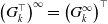 $\left (G_{k}^{\top }\right )^{\infty } = \left (G_{k}^{\infty }\right )^{\top }$
, we obtain
$\left (G_{k}^{\top }\right )^{\infty } = \left (G_{k}^{\infty }\right )^{\top }$
, we obtain
 \begin{align} \big (G_{k}^{\infty }\big )^{\top }(\hat {x},z) \cdot (\hat {x} \times q) &= \Pi _{k}^{\infty }(\hat {x},z) \cdot (\hat {x} \times q) + \int _{\Omega } \frac {e^{- \, i \, k \, \hat {x} \cdot y}}{4 \, \pi } \, ( k^{2}(y) - k^{2} ) \, G_{k}^{\top }(y,z) \cdot (\hat {x} \times q) \, dy\nonumber\\ &\!\overset {(4.8)}{=} \frac {e^{- \, i \, k \, \hat {x} \cdot z}}{4 \, \pi } \, ( \hat {x} \times q ) + \int _{\Omega } \frac {e^{- \, i \, k \, \hat {x} \cdot y}}{4 \, \pi } \, ( k^{2}(y) - k^{2} ) \, G_{k}^{\top }(y,z) \cdot (\hat {x} \times q) \, dy. \end{align}
Now, from (1.6), we recall that
 \begin{equation*} V^{Inc}( z, d, q ) = ( d \times q ) \, e^{i \, k \, z \cdot d}, \quad \text{for} \quad d , q \in \mathbb{S}^{2}, \end{equation*}
we deduce, from (A.9), the following equation
 \begin{equation} \big ( G_{k}^{\infty } \big )^{\top }(\hat {x},z) \cdot ( \hat {x} \times q ) = - \frac {1}{4 \, \pi } \, V^{Inc}(z, - \hat {x}, q) - \frac {1}{4 \, \pi } \int _{\Omega } ( k^{2}(y) - k^{2} ) \, G_{k}^{\top }(y,z) \cdot V^{Inc}(y, - \hat {x}, q) \, dy. \end{equation}
The total field equation should be recalled to analyse the second term on the R.H.S of the above equation. We have
 \begin{equation*} \underset {z}{\nabla } \times \underset {z}{\nabla } \times ( V(z, \hat {x}, q) ) - k^{2}(z) \, V(z, \hat {x}, q) = 0, \quad z \in \mathbb{R}^{3} \quad \text{and} \quad \hat {x}, q \in \mathbb{S}^{2}, \end{equation*}
and, by knowing that $V({\cdot} , \cdot , \cdot ) = V^{s}({\cdot} , \cdot , \cdot ) + V^{Inc}({\cdot} , \cdot , \cdot )$
with
$V({\cdot} , \cdot , \cdot ) = V^{s}({\cdot} , \cdot , \cdot ) + V^{Inc}({\cdot} , \cdot , \cdot )$
with
 \begin{equation*} \underset {z}{\nabla } \times \underset {z}{\nabla } \times (V^{Inc}(z, \hat {x}, q)) - k^{2} \, V^{Inc}(z, \hat {x}, q) = 0, \quad z \in \mathbb{R}^{3}, \end{equation*}
we deduce
 \begin{equation*} \underset {z}{\nabla } \times \underset {z}{\nabla } \times ( V^{s}(z,\hat {x}, q) ) - k^{2}(z) \, V^{s}(z,\hat {x}, q) = (k^{2}(z) - k^{2} ) \, V^{Inc}(z, \hat {x}, q). \end{equation*}
The solution to the above equation will be given by
 \begin{equation} V^{s}(z, \hat {x}, q) = \int _{\Omega } G_{k}(z,y) \cdot ( k^{2}(y) - k^{2} ) \, V^{Inc}(y, \hat {x}, q) \, dy. \end{equation}
Then, as we have
 \begin{equation} G_{k}(z,y) = G^{\top }_{k}(y,z), \quad y \neq z, \end{equation}
see Subsection A.4, we rewrite (A.11) as
 \begin{equation} V^{s}(z, \hat {x}, q) = \int _{\Omega } G_{k}^{\top }(y,z) \cdot ( k^{2}(y) - k^{2} ) \, V^{Inc}(y, \hat {x}, q) \, dy. \end{equation}
By gathering (A.10) and (A.13), we end up with the following equation
 \begin{equation*} \big ( G_{k}^{\infty } \big )^{\top }(\hat {x},z) \cdot ( \hat {x} \times q ) = - \, \frac {1}{4 \, \pi } \, V^{Inc}(z, -\hat {x}, q) - \frac {1}{4 \, \pi } \, V^{s}(z, -\hat {x}, q) = - \, \frac {1}{4 \, \pi } \, V(z, -\hat {x}, q). \end{equation*}
This proves (3.44) and justifies the proof of Proposition 3.1.
A.2. A-priori estimate
Proposition A.1. Under the condition
 \begin{equation*} 3 - 3 \, t \, - s - h \gt 0, \end{equation*}
we have,
 \begin{equation} \Vert u_{1} \Vert _{\mathbb{L}^{2}(D)} \lesssim a^{-h} \, \Vert u_{0} \Vert _{\mathbb{L}^{2}(D)}. \end{equation}
where the parameter $h$
is such that
$h$
is such that $0 \lt h \lt 1$
, the parameter
$0 \lt h \lt 1$
, the parameter $s$
fulfills
$s$
fulfills $\aleph \sim a^{-s}$
and the parameter
$\aleph \sim a^{-s}$
and the parameter $t$
is such that
$t$
is such that $d \sim a^{t}$
.
$d \sim a^{t}$
.
Proof. We assume that $D = \overset {\aleph }{\underset {j=1} \cup }D_{j}$
with
$D = \overset {\aleph }{\underset {j=1} \cup }D_{j}$
with $\aleph \sim a^{-s}$
. To investigate Proposition A.1, we recall, from (3.6), that the total field
$\aleph \sim a^{-s}$
. To investigate Proposition A.1, we recall, from (3.6), that the total field $u_{1}({\cdot})$
is the solution to
$u_{1}({\cdot})$
is the solution to
 \begin{equation*} u_{1}(x) + \omega ^{2} \, \mu \, \int _{D} G_{k}(x,y) \cdot u_{1}(y) \, (\epsilon _{0}(y)-\epsilon _{p}(\omega )) \, dy = u_{0}(x), \quad x \in \mathbb{R}^{3}. \end{equation*}
Now, we let $x \in D_{m}$
and we rewrite the above equation as
$x \in D_{m}$
and we rewrite the above equation as
 \begin{align} u_{1}(x) & + \omega ^{2} \, \mu \, \int _{D_{m}} G_{k}(x,y) \cdot u_{1}(y) \, (\epsilon _{0}(y)-\epsilon _{p}(\omega )) \, dy \nonumber\\ &+ \omega ^{2} \, \mu \, \sum _{j=1 \atop j \neq m}^{\aleph } \int _{D_{j}} G_{k}(x,y) \cdot u_{1}(y) \, (\epsilon _{0}(y)-\epsilon _{p}(\omega )) \, dy = u_{0}(x), \quad x \in D_{m}.\end{align}
In addition, thanks to [Reference Ghandriche and Sini25, Theorem 2.1], we know that
 \begin{equation} G_{k}(x,y) = \frac {1}{\omega ^{2} \, \mu \, \epsilon _{0}(y)} \, \underset {y}{\nabla } \, \underset {y}{\nabla } \Phi _{0}(x,y) + {\Gamma _{2}}(x,y), \qquad x \neq y. \end{equation}
Then, by plugging (A.16) into (A.15), we obtain
 \begin{align} u_{1}(x) &- \nabla M_{D_{m}} ( u_{1}({\cdot}) \, \tau ({\cdot}) )(x) + \omega ^{2} \, \mu \, \sum _{j=1 \atop j \neq m}^{\aleph } \int _{D_{j}} G_{k}(x,y) \cdot u_{1}(y) \, (\epsilon _{0}(y)-\epsilon _{p}(\omega )) \, dy \nonumber\\ &= u_{0}(x) - \omega ^{2} \, \mu \, \int _{D_{m}} {\Gamma _{2}}(x,y) \cdot u_{1}(y) \, (\epsilon _{0}(y)-\epsilon _{p}(\omega )) \, dy, \qquad x \in D_{m}, \end{align}
where
 \begin{equation*} \tau (y) \,:\!= \frac {(\epsilon _{0}(y) -\epsilon _{p}(\omega ))}{\epsilon _{0}(y)}, \end{equation*}
and $\nabla M_{D_{m}}\left ( \cdot \right )$
is the Magnetization operator defined by (1.9). Furthermore, using Taylor expansion, the equation (A.17) becomes,
$\nabla M_{D_{m}}\left ( \cdot \right )$
is the Magnetization operator defined by (1.9). Furthermore, using Taylor expansion, the equation (A.17) becomes,
 \begin{align*} & \big [ I - \tau (z_{m}) \, \nabla M_{D_{m}}\big ]( u_{1})(x) \\&\quad= u_{0}(x) - \omega ^{2} \, \mu \, \sum _{j=1 \atop j \neq m}^{\aleph } (\epsilon _{0}(z_{j}) - \epsilon _{p}(\omega )) \, G_{k}(z_{m},z_{j}) \cdot \int _{D_{j}} u_{1}(y) \, \, dy \\ &\qquad - \omega ^{2} \, \mu \, \sum _{j=1 \atop j \neq m}^{\aleph } (\epsilon _{0}(z_{j}) - \epsilon _{p}(\omega )) \, \int _{0}^{1} \nabla _{x}G_{k}(z_{m}+t(x-z_{m}),z_{j}) \cdot (x - z_{m}) \, dt \cdot \int _{D_{j}} u_{1}(y) \, \, dy \\ &\qquad - \omega ^{2} \, \mu \, \sum _{j=1 \atop j \neq m}^{\aleph } (\epsilon _{0}(z_{j}) - \epsilon _{p}(\omega )) \, \int _{D_{j}} \int _{0}^{1} \nabla _{y} G_{k}(z_m,z_{j}+t(y-z_{j})) \cdot (y - z_{j}) \, dt \cdot u_{1}(y) \, \, dy \\ &\qquad - \omega ^{2} \, \mu \, \sum _{j=1 \atop j \neq m}^{\aleph } \int _{D_{j}} G_{k}(x,y) \cdot u_{1}(y) \, \int _{0}^{1} \nabla \epsilon _{0}(z_{m}+t(y-z_{m})) \cdot (y - z_{m}) \, dt \, dy \\ &\qquad + \nabla M_{D_{m}}\left ( u_{1}({\cdot}) \, \int _{0}^{1} \nabla \tau (z_{m}+t({\cdot} -z_{m})) \cdot ({\cdot} - z_{m}) \, dt \right)(x) \\ &\qquad - \omega ^{2} \, \mu \, \int _{D_{m}} {\Gamma _{2}}(x,y) \cdot u_{1}(y) \, (\epsilon _{0}(y)-\epsilon _{p}(\omega )) \, dy, \qquad x \in D_{m}. \end{align*}
Besides, by scaling the above equation from the domain $D_{m}$
to the domain
$D_{m}$
to the domain $B$
, i.e. we let
$B$
, i.e. we let $x = z_{m} \, + a \, \eta$
and
$x = z_{m} \, + a \, \eta$
and $y = z_{j} \, + a \, \xi$
with
$y = z_{j} \, + a \, \xi$
with $\eta , \, \xi \in B \, \subset \, B(0,1)$
, we obtain
$\eta , \, \xi \in B \, \subset \, B(0,1)$
, we obtain
 \begin{align*} & \big [ I - \tau (z_{m}) \, \nabla M_{B}\big ] ( \tilde {u}_{1,m} )(\eta ) \\ &\quad = \tilde {u}_{0,m}(\eta ) - \omega ^{2} \, \mu \, a^{3} \, \sum _{j=1 \atop j \neq m}^{\aleph } (\epsilon _{0}(z_{j}) - \epsilon _{p}(\omega )) \, G_{k}(z_{m},z_{j}) \cdot \int _{B} \tilde {u}_{1,j}(\xi ) \, d\xi \\ &\qquad - \omega ^{2} \, \mu \, a^{4} \, \sum _{j=1 \atop j \neq m}^{\aleph } (\epsilon _{0}(z_{j}) - \epsilon _{p}(\omega )) \, \int _{0}^{1} \nabla _{\eta }G_{k}(z_{m} + t \, a \eta , z_{j}) \cdot \eta \, dt \cdot \int _{B} \tilde {u}_{1,j}(\xi ) \, d\xi \\ &\qquad - \omega ^{2} \, \mu \, a^{4} \, \sum _{j=1 \atop j \neq m}^{\aleph } (\epsilon _{0}(z_{j}) - \epsilon _{p}(\omega )) \, \int _{B} \int _{0}^{1} \nabla _{\xi } G_{k}(z_{m},\, z_{j}+t \, a \, \xi ) \cdot \xi \, dt \cdot \tilde {u}_{1,j}(\xi ) \, d\xi \\ &\qquad - \omega ^{2} \, \mu \, a^{4} \, \sum _{j=1 \atop j \neq m}^{\aleph } \int _{B} G_{k}(z_{m} + a \, \eta , z_{j} + a \, \xi ) \cdot \tilde {u}_{1,j}(\xi ) \, \int _{0}^{1} \nabla \epsilon _{0}(z_{m} + t \, a \, \xi ) \cdot \xi \, dt \, d\xi \\ &\qquad + a \, \nabla M_{B}\left ( \tilde {u}_{1,m}({\cdot}) \, \int _{0}^{1} \nabla \tau (z_{m} + t \, a \, \cdot ) \cdot \, dt \right )(\eta ) \\ &\qquad - \omega ^{2} \, \mu \, a^{3} \, \int _{B} {\Gamma _{2}}(z_{m} + a \eta ,z_{m}+a\xi ) \cdot \tilde {u}_{1,m}(\xi ) \, (\epsilon _{0}(z_{m} + a \, \xi )-\epsilon _{p}(\omega )) \, d\xi , \qquad \eta \in B, \end{align*}
where $\tilde {u}_{k,j}(\eta ) \,:\!= u_{k}(z_{j} + a \, \eta )$
, for
$\tilde {u}_{k,j}(\eta ) \,:\!= u_{k}(z_{j} + a \, \eta )$
, for $k = 0 \,, \,1$
and
$k = 0 \,, \,1$
and $1 \leq j \leq \aleph$
. For the above equation, we successively take the inverse of the operator
$1 \leq j \leq \aleph$
. For the above equation, we successively take the inverse of the operator $\left [ I - \tau (z_{m}) \, \nabla M_{B}\right ]$
, and then the
$\left [ I - \tau (z_{m}) \, \nabla M_{B}\right ]$
, and then the $\left \Vert \cdot \right \Vert _{\mathbb{L}^{2}(B)}$
-norm on the both sides, by using the fact that
$\left \Vert \cdot \right \Vert _{\mathbb{L}^{2}(B)}$
-norm on the both sides, by using the fact that $\left \Vert \nabla M_{B} \right \Vert _{\mathcal{L}\left ( \mathbb{L}^{2}(B); \mathbb{L}^{2}(B) \right )} = 1$
and
$\left \Vert \nabla M_{B} \right \Vert _{\mathcal{L}\left ( \mathbb{L}^{2}(B); \mathbb{L}^{2}(B) \right )} = 1$
and
 \begin{equation*} \left \Vert \left [ I - \tau (z_{m}) \, \nabla M_{B}\right ]^{-1} \right \Vert _{\mathcal{L}\left ( \mathbb{L}^{2}(B); \mathbb{L}^{2}(B) \right )} = \mathcal{O}( a^{-h} ), \end{equation*}
see for instance [Reference Ghandriche and Sini25, Subsection 4.1], to obtain
 \begin{align*} \Vert \tilde {u}_{1,m} \Vert _{\mathbb{L}^{2}(B)} & \lesssim a^{-h} \, \Bigg [ \Vert \tilde {u}_{0,m} \Vert _{\mathbb{L}^{2}(B)} + a^{3} \, \sum _{j=1 \atop j \neq m}^{\aleph } \left \vert G_{k}(z_{m},z_{j}) \right \vert \, \left \Vert \tilde {u}_{1,j} \right \Vert _{\mathbb{L}^{2}(B)} \\ &\quad + a^{4} \, \sum _{j=1 \atop j \neq m}^{\aleph } \left \vert \nabla G_{k}(z_{m}, z_{j}) \right \vert \, \left \Vert \tilde {u}_{1,j} \right \Vert _{\mathbb{L}^{2}(B)} + a \, \Vert \tilde {u}_{1,m} \Vert _{\mathbb{L}^{2}(B)} \\ &\quad + a^{3} \, \left \Vert \int _{B} {\Gamma _{2}}(z_{m} + a \cdot , z_{m}+a\xi ) \cdot \tilde {u}_{1,m}(\xi ) \, (\epsilon _{0}(z_{m} + a \, \xi )-\epsilon _{p}(\omega )) \, d\xi \right \Vert _{\mathbb{L}^{2}(B)}\Bigg ]. \end{align*}
In addition, knowing that $h \lt 1$
and
$h \lt 1$
and
 \begin{equation*} {\Gamma _{2}}(z_{m} + a \cdot , z_{m}+a\xi ) \sim \Phi _{0}^{2}(z_{m} + a \cdot , z_{m}+a\xi ) = a^{-2} \, \frac {1}{\left \vert \cdot - \xi \right \vert ^{2}}, \end{equation*}
from singularity analysis point of view, see for instance [Reference Ghandriche and Sini25, Theorem 2.1], we deduce that
 \begin{align*} \Vert \tilde {u}_{1,m} \Vert _{\mathbb{L}^{2}(B)} & \lesssim a^{-h} \, \Bigg [ \Vert \tilde {u}_{0,m} \Vert _{\mathbb{L}^{2}(B)} + a^{3} \, \sum _{j=1 \atop j \neq m}^{\aleph } \left \vert G_{k}(z_{m},z_{j}) \right \vert \, \left \Vert \tilde {u}_{1,j} \right \Vert _{\mathbb{L}^{2}(B)} \\ &\quad + a^{4} \, \sum _{j=1 \atop j \neq m}^{\aleph } \left \vert \nabla G_{k}(z_{m}, z_{j}) \right \vert \, \left \Vert \tilde {u}_{1,j} \right \Vert _{\mathbb{L}^{2}(B)} + a \, \Vert \tilde {u}_{1,m} \Vert _{\mathbb{L}^{2}(B)}\Bigg ]. \end{align*}
Moreover, using the fact that
 \begin{equation*} \left \vert G_{k}(z_{m},z_{j}) \right \vert \sim \frac {1}{d^{3}_{mj}} \quad \text{and} \quad \left \vert \nabla G_{k}(z_{m},z_{j}) \right \vert \sim \frac {1}{d^{4}_{mj}}, \end{equation*}
we deduce that
 \begin{equation*} \Vert \tilde {u}_{1,m} \Vert _{\mathbb{L}^{2}(B)} \lesssim a^{-h} \, \left [ \Vert \tilde {u}_{0,m} \Vert _{\mathbb{L}^{2}(B)} + \sum _{j=1 \atop j \neq m}^{\aleph } \left ( \frac {a^{3}}{d^{3}_{mj}} + \frac {a^{4}}{d^{4}_{mj}} \right ) \, \left \Vert \tilde {u}_{1,j} \right \Vert _{\mathbb{L}^{2}(B)} \right ]\!. \end{equation*}
Besides, we have
 \begin{equation*} \left ( \frac {a^{3}}{d^{3}_{mj}} + \frac {a^{4}}{d^{4}_{mj}} \right ) = \frac {a^{3}}{d^{3}_{mj}} \, \left ( 1 + \frac {a}{d_{mj}} \right ) \leq \frac {a^{3}}{d^{3}_{mj}} \, \left ( 1 + \frac {a}{d} \right ) = \frac {a^{3}}{d^{3}_{mj}} \, \left ( 1 + a^{1-t} \right ) = \mathcal{O}\left ( \frac {a^{3}}{d^{3}_{mj}} \right )\!, \end{equation*}
where the last equality is due to the fact that $t \lt 1$
. Then,
$t \lt 1$
. Then,
 \begin{equation*} \Vert \tilde {u}_{1,m} \Vert _{\mathbb{L}^{2}(B)} \lesssim a^{-h} \, \left [ \Vert \tilde {u}_{0,m} \Vert _{\mathbb{L}^{2}(B)} + a^{3} \, \sum _{j=1 \atop j \neq m}^{\aleph } \frac {1}{d^{3}_{mj}} \, \left \Vert \tilde {u}_{1,j} \right \Vert _{\mathbb{L}^{2}(B)} \right ]\!. \end{equation*}
By taking the square and summing up with respect to the index $m$
on the both sides, we end up with the following estimation
$m$
on the both sides, we end up with the following estimation
 \begin{equation*} \sum _{m=1}^{\aleph } \Vert \tilde {u}_{1,m} \Vert ^{2}_{\mathbb{L}^{2}(B)} \lesssim a^{-2h} \, \left [ \sum _{m=1}^{\aleph } \Vert \tilde {u}_{0,m} \Vert ^{2}_{\mathbb{L}^{2}(B)} + a^{6} \, \sum _{m=1}^{\aleph } \sum _{j=1 \atop j \neq m}^{\aleph } \frac {1}{d^{6}_{mj}} \, \sum _{j=1}^{\aleph }\left \Vert \tilde {u}_{1,j} \right \Vert ^{2}_{\mathbb{L}^{2}(B)} \right ]\!. \end{equation*}
Since
 \begin{equation*} \sum _{m=1}^{\aleph } \sum _{j=1 \atop j \neq m}^{\aleph } \frac {1}{d^{6}_{mj}} \, \leq \, d^{-6} \, \aleph ^{2} = \mathcal{O}( a^{- 6 t - 2 s } ). \end{equation*}
Then,
 \begin{equation*} \sum _{m=1}^{\aleph } \Vert \tilde {u}_{1,m} \Vert ^{2}_{\mathbb{L}^{2}(B)} \lesssim a^{-2h} \, \sum _{m=1}^{\aleph } \Vert \tilde {u}_{0,m} \Vert ^{2}_{\mathbb{L}^{2}(B)} + a^{6-6t-2s-2h} \, \sum _{j=1}^{\aleph }\left \Vert \tilde {u}_{1,j} \right \Vert ^{2}_{\mathbb{L}^{2}(B)}\!, \end{equation*}
and, under the condition
 \begin{equation*} 3 - 3 \, t - s - h \, \gt \, 0, \end{equation*}
we deduce that
 \begin{align*} \sum _{m=1}^{\aleph } \Vert \tilde {u}_{1,m} \Vert ^{2}_{\mathbb{L}^{2}(B)} & \lesssim a^{-2h} \, \sum _{m=1}^{\aleph } \Vert \tilde {u}_{0,m} \Vert ^{2}_{\mathbb{L}^{2}(B)} \\ \left \Vert \tilde {u}_{1} \right \Vert _{\mathbb{L}^{2}(B)} & \lesssim a^{-h} \, \Vert \tilde {u}_{0} \Vert _{\mathbb{L}^{2}(B)}. \end{align*}
This implies, by scaling back to the domain $D$
,
$D$
,
 \begin{equation*} \Vert u_{1} \Vert _{\mathbb{L}^{2}(D)} \lesssim a^{-h} \, \Vert u_{0} \Vert _{\mathbb{L}^{2}(D)}. \end{equation*}
This proves (A.14) and completes the proof of Proposition A.1.
A.3. Comprehending the formula (A.5)
In order to finish the proof of Proposition 3.1, it is necessary to comprehend (A.5). Recall (A.5) that
 \begin{equation*} ( G_{k} - \Pi _{k} )(x,z) = \int _{\Omega } \Pi _{k}(x,y) \cdot ( k^{2}(y) - k^{2} ) \, G_{k}(y,z) \, dy. \end{equation*}
To give sense to the R.H.S of the above equation, we use the explicit expression of the Green dyadic function $\Pi _{k}({\cdot} ,\cdot )$
given by (A.3), to obtain
$\Pi _{k}({\cdot} ,\cdot )$
given by (A.3), to obtain
 \begin{align*} \int _{\Omega } \Pi _{k}(x,y) \cdot ( k^{2}(y) - k^{2} ) \, G_{k}(y,z) \, dy & = - \frac {1}{k^{2}} \, \underset {x}{\nabla } \int _{\Omega } \underset {y}{\nabla } \, \Phi _{k}(x,y) \cdot ( k^{2}(y) - k^{2} ) \, G_{k}(y,z) \, dy \\ &\quad + \int _{\Omega } \Phi _{k}(x,y) \, ( k^{2}(y) - k^{2} ) \, G_{k}(y,z) \, dy, \end{align*}
which, by using the definition of the Magnetization operator and the Newtonian operator, see (1.7), can be rewritten as
 \begin{align} \int _{\Omega } \Pi _{k}(x,y) \cdot ( k^{2}(y) - k^{2} ) \, G_{k}(y,z) \, dy & = - \frac {1}{k^{2}} \, \underset {x}{\nabla } M_{\Omega }^{k}\left ( ( k^{2}({\cdot}) - k^{2} ) \, G_{k}({\cdot} ,z) \right )(x) \nonumber\\ &\quad + N_{\Omega }^{k}\left ( ( k^{2}({\cdot}) - k^{2} ) \, G_{k}({\cdot} ,z) \right )(x). \end{align}
Now, for an arbitrary fixed point $z$
, write
$z$
, write
 \begin{equation} G_{k}({\cdot} , z) \,= \, \Pi _{k}({\cdot} , z) + (G_{k} - \Pi _{k} )({\cdot} , z), \end{equation}
in $\Omega$
with
$\Omega$
with $ (G_{k} - \Pi _{k} )({\cdot} , z)$
being a regular function, see for instance [Reference Ghandriche and Sini25, Theorem 2.1]. More precisely, based on the proof of [Reference Ghandriche and Sini25, Theorem 2.1], we know that
$ (G_{k} - \Pi _{k} )({\cdot} , z)$
being a regular function, see for instance [Reference Ghandriche and Sini25, Theorem 2.1]. More precisely, based on the proof of [Reference Ghandriche and Sini25, Theorem 2.1], we know that
 \begin{equation} (G_{k} - \Pi _{k} )({\cdot} , z) \in \mathbb{L}^{\frac {3}{2}-\delta }(\Omega ), \quad \text{with} \; \delta \, \rightarrow \, 0^{+}. \end{equation}
Then, using (A.19), the equation (A.18) takes the following form,
 \begin{align} \int _{\Omega } \Pi _{k}(x,y) \cdot ( k^{2}(y) - k^{2} ) \, G_{k}(y,z) \, dy &= - \frac {1}{k^{2}} \, \underset {x}{\nabla } M_{\Omega }^{k}\big( ( k^{2}({\cdot}) - k^{2} ) \, \Pi _{k}({\cdot} ,z) \big)(x) \nonumber\\ &\quad + N_{\Omega }^{k}( ( k^{2}({\cdot}) - k^{2} ) \, \Pi _{k}({\cdot} ,z) )(x) \nonumber \\ &\quad- \frac {1}{k^{2}} \, \underset {x}{\nabla } M_{\Omega }^{k} ( ( k^{2}({\cdot}) - k^{2} ) \, (G_{k}-\Pi _{k} )({\cdot} ,z) )(x) \nonumber \\ &\quad+ N_{\Omega }^{k}( ( k^{2}({\cdot}) - k^{2} ) \, (G_{k}-\Pi _{k})({\cdot} ,z) )(x).\end{align}
The third term and the fourth term on the R.H.S are well defined, as we know that $ (G_{k} - \Pi _{k} )({\cdot} , z)$
is a regular function and both the Magnetization operator and the Newtonian operator are bounded from
$ (G_{k} - \Pi _{k} )({\cdot} , z)$
is a regular function and both the Magnetization operator and the Newtonian operator are bounded from $\mathbb{L}^{p}(\mathbb{R}^{3})$
to
$\mathbb{L}^{p}(\mathbb{R}^{3})$
to $\mathbb{L}^{p}(\mathbb{R}^{3})$
, with
$\mathbb{L}^{p}(\mathbb{R}^{3})$
, with $p \gt 1$
. Consequently, based on (A.20), we deduce that
$p \gt 1$
. Consequently, based on (A.20), we deduce that
 \begin{align} T_{0}(x,z)\, & :\!= - \frac {1}{k^{2}} \, \underset {x}{\nabla } M_{\Omega }^{k}( ( k^{2}({\cdot}) - k^{2} ) \, (G_{k}-\Pi _{k})({\cdot} ,z) )(x)\nonumber\\&\quad + N_{\Omega }^{k}( ( k^{2}({\cdot}) - k^{2} ) \, (G_{k}-\Pi _{k} )({\cdot} ,z) )(x) \; \in \; \mathbb{L}^{\frac {3}{2}-\delta }(\Omega ). \end{align}
Hence, to give sense of the L.H.S of (A.21), it is enough to study the first term and the second term on the R.H.S accordingly. To accomplish this, we set
 \begin{align*} T_{1}(x,z)\, &:\!= \underset {x}{\nabla } M_{\Omega }^{k} ( ( k^{2}({\cdot}) - k^{2} ) \, \Pi _{k}({\cdot} ,z) )(x) \\ &\!\overset {(4.3)}{=} \frac {1}{k^{2}} \underset {x}{\nabla } M_{\Omega }^{k}\big ( ( k^{2}({\cdot}) - k^{2} ) \, \nabla \nabla \Phi _{k}({\cdot} ,z) \big)(x) + \underset {x}{\nabla } M_{\Omega }^{k}\big( ( k^{2}({\cdot}) - k^{2} ) \, \Phi _{k}({\cdot} ,z) I_{3} \big)(x). \end{align*}
Observe that the second term on the R.H.S is well defined as $\Phi _{k}({\cdot} ,z) I_{3} \in \mathbb{L}^{3-\delta }(\Omega )$
and
$\Phi _{k}({\cdot} ,z) I_{3} \in \mathbb{L}^{3-\delta }(\Omega )$
and $\nabla M_{\Omega }^{k}\left ( \cdot \right )$
is bounded from
$\nabla M_{\Omega }^{k}\left ( \cdot \right )$
is bounded from $\mathbb{L}^{p}(\mathbb{R}^{3})$
to
$\mathbb{L}^{p}(\mathbb{R}^{3})$
to $\mathbb{L}^{p}(\mathbb{R}^{3})$
, with
$\mathbb{L}^{p}(\mathbb{R}^{3})$
, with $p \gt 1$
. Then,
$p \gt 1$
. Then,
 \begin{equation} T_{1,2}({\cdot} ,z) \; :\!= \underset {x}{\nabla } M_{\Omega }^{k}\big( ( k^{2}({\cdot}) - k^{2} ) \, \Phi _{k}({\cdot} ,z) I_{3} \big) \in \mathbb{L}^{3-\delta }(\Omega ), \end{equation}
which implies,
 \begin{align*} T_{1}(x,z) &= \frac {1}{k^{2}} \underset {x}{\nabla } M_{\Omega }^{k}\big ( ( k^{2}({\cdot}) - k^{2} ) \, \nabla \nabla \Phi _{k}({\cdot} ,z) \big)(x) + T_{1,2}(x,z) \\ &= - \, \frac {1}{k^{2}} \underset {x}{\nabla } M_{\Omega }^{k}\Big( ( k^{2}({\cdot}) - k^{2} ) \, \underset {z}{\nabla } \nabla \Phi _{k}({\cdot} ,z) \Big)(x) + T_{1,2}(x,z) \\ &= - \, \frac {1}{k^{2}} \underset {z}{\nabla } \, \left ( \underset {x}{\nabla } M_{\Omega }^{k}\big ( ( k^{2}({\cdot}) - k^{2} ) \, \nabla \Phi _{k}({\cdot} ,z) \big )(x) \right) + T_{1,2}(x,z). \end{align*}
Next, we need to analyse the regularity of the term
 \begin{equation} T_{1,1}(x,z) \,:\!= -\frac {1}{k^{2}} \, \underset {z}{\nabla } \left ( \underset {x}{\nabla } M_{\Omega }^{k}\left ( ( k^{2}({\cdot}) - k^{2} ) \, \nabla \Phi _{k}({\cdot} ,z) \right )(x) \right )\!. \end{equation}
In order to avoid lengthy computation, we only examine the reduced formula given by
 \begin{align} T_{1,1,r}(x,z) &= \underset {z}{\nabla } \left ( \underset {x}{\nabla } M_{\Omega }^{k}\left ( \nabla \Phi _{k}({\cdot} ,z) \right )(x) \right ) \nonumber\\ &\! \overset {(1.9)}{=} \underset {z}{\nabla } \, \underset {x}{\nabla } \int _{\Omega } \, \underset {y}{\nabla } \Phi _{k}(x,y) \cdot \underset {y}{\nabla } \Phi _{k}(y,z) \, dy \nonumber \\ &= \underset {x}{\nabla } \left ( \underset {z}{\nabla } \left ( \underset {z}{\nabla } \cdot \left ( \underset {x}{\nabla } \cdot \left ( N^{k}_{\Omega }\left ( \Phi _{k}({\cdot} ,z) \, I_{3} \right )(x) \right ) \right ) \right ) \right )\!, \end{align}
where $N^{k}({\cdot})$
is the Newtonian operator defined by (1.7). By using the Helmholtz decomposition (1.11), we have
$N^{k}({\cdot})$
is the Newtonian operator defined by (1.7). By using the Helmholtz decomposition (1.11), we have
 \begin{equation*} \Phi _{k}({\cdot} ,z) \, I_{3} = \sum _{j=1}^{3} \sum _{n \in \mathbb{N}} \big\langle \Phi _{k}({\cdot} ,z) \, I_{3}, e_{n}^{(j)} \big\rangle _{\mathbb{L}^{2}(\Omega )} \otimes e_n^{(j)}({\cdot}) \overset {(1.7)}{=} \, \sum _{j=1}^{3} \, \sum _{n \in \mathbb{N}} N^{k}_{\Omega }\big(e_{n}^{(j)}\big)(z) \otimes e_n^{(j)}({\cdot}). \end{equation*}
Hence,
 \begin{equation} N^{k}_{\Omega }\left ( \Phi _{k}({\cdot} ,z) \, I_{3} \right )(x) = \sum _{j=1}^{3} \, \sum _{n \in \mathbb{N}} N^{k}_{\Omega }\big (e_{n}^{(j)}\big)(z) \otimes N^{k}_{\Omega }\big(e_n^{(j)}\big)(x). \end{equation}
Then, by plugging (A.26) into (A.25), we deduce
 \begin{align*} T_{1,1,r}(x,z) &= \sum _{j=1}^{3} \, \sum _{n \in \mathbb{N}} \, \underset {x}{\nabla } \left ( \underset {z}{\nabla } \left ( \underset {z}{\nabla } \cdot \left ( \underset {x}{\nabla } \cdot \big ( N^{k}_{\Omega }\big(e_{n}^{(j)}\big )(z) \otimes N^{k}_{\Omega }\big(e_n^{(j)}\big)(x) \big ) \right ) \right ) \right ) \\ &= \sum _{j=1}^{3} \, \sum _{n \in \mathbb{N}} \, \underset {x}{\nabla } \left ( \underset {z}{\nabla } \left ( \underset {z}{\nabla } \cdot \left ( N^{k}_{\Omega }\big(e_{n}^{(j)}\right )(z) \big) \underset {x}{\nabla } \cdot \big( N^{k}_{\Omega }\big(e_n^{(j)}\big)(x) \big) \right ) \right )\!, \end{align*}
and, using the fact that for an arbitrary vector field $F$
, there holds
$F$
, there holds
 \begin{equation*} \nabla M^{k}_{\Omega }( F ) = - \, \nabla \nabla \cdot N^{k}_{\Omega }( F ), \end{equation*}
we derive that
 \begin{equation*} T_{1,1,r}(x,z) = \sum _{j=1}^{3} \, \sum _{n \in \mathbb{N}} \, \nabla M^{k}_{\Omega }\big(e_{n}^{(j)}\big)(z) \otimes \nabla M^{k}_{\Omega }\big(e_n^{(j)}\big)(x). \end{equation*}
Furthermore, knowing that $\nabla M^{k}_{\Omega }$
restricted to
$\nabla M^{k}_{\Omega }$
restricted to $\mathbb{H}_{0}({\mathrm{div}\,} = 0)$
is a vanishing operator, we obtain
$\mathbb{H}_{0}({\mathrm{div}\,} = 0)$
is a vanishing operator, we obtain
 \begin{equation*} T_{1,1,r}(x,z) = \sum _{j=2}^{3} \, \sum _{n \in \mathbb{N}} \, \nabla M^{k}_{\Omega }\big (e_{n}^{(j)}\big)(z) \otimes \nabla M^{k}_{\Omega }\big (e_n^{(j)}\big)(x). \end{equation*}
By recalling that $e_n^{(2,3)}({\cdot}) \in \mathbb{L}^{2}(\Omega )$
and
$e_n^{(2,3)}({\cdot}) \in \mathbb{L}^{2}(\Omega )$
and $\nabla M^{k}_{\Omega }({\cdot})$
is a bounded operator from
$\nabla M^{k}_{\Omega }({\cdot})$
is a bounded operator from $\mathbb{L}^{2}(\Omega )$
to
$\mathbb{L}^{2}(\Omega )$
to $\mathbb{L}^{2}(\Omega )$
, we deduce that, for
$\mathbb{L}^{2}(\Omega )$
, we deduce that, for $z$
fixed in
$z$
fixed in $\Omega$
,
$\Omega$
,
 \begin{equation*} T_{1,1,r}({\cdot} , z) \in \mathbb{L}^{2}(\Omega ). \end{equation*}
Hence, for (A.24),
 \begin{equation} T_{1,1}({\cdot} , z) \in \mathbb{L}^{2}(\Omega ). \end{equation}
Then, by gathering (A.23) and (A.27), we deduce that
 \begin{equation} T_{1}({\cdot} , z) \in \mathbb{L}^{2}(\Omega ). \end{equation}
In a similar way, for $z$
fixed in
$z$
fixed in $\Omega$
, we set
$\Omega$
, we set
 \begin{align*} T_{2}(x,z)\, &:\!= N_{\Omega }^{k} ( ( k^{2}({\cdot}) - k^{2} ) \, \Pi _{k}({\cdot} ,z) )(x) \\ &\! \overset {(4.3)}{=} \frac {1}{k^{2}} \, N_{\Omega }^{k} ( ( k^{2}({\cdot}) - k^{2} ) \, \nabla \nabla \Phi _{k}({\cdot} ,z) )(x) + N_{\Omega }^{k}( ( k^{2}({\cdot}) - k^{2} ) \, \Phi _{k}({\cdot} ,z) \, I_{3} )(x). \end{align*}
Since the second term on the R.H.S fulfills $\Phi _{k}({\cdot} ,z) I_{3} \in \mathbb{L}^{3-\delta }(\Omega )$
, we deduce that
$\Phi _{k}({\cdot} ,z) I_{3} \in \mathbb{L}^{3-\delta }(\Omega )$
, we deduce that
 \begin{equation*} N_{\Omega }^{k}\left ( ( k^{2}({\cdot}) - k^{2} ) \, \Phi _{k}({\cdot} ,z) \, I_{3} \right )(x) \in \mathbb{W}^{2,3-\delta }(\Omega ) \subset \mathbb{L}^{3-\delta }(\Omega ). \end{equation*}
Hence, in the sequel, to write short formulas, we denote it by $T_{2,2}(x,z)$
. Then,
$T_{2,2}(x,z)$
. Then,
 \begin{align*} T_{2}(x,z) &= \frac {1}{k^{2}} \, N_{\Omega }^{k}\left ( ( k^{2}({\cdot}) - k^{2} ) \, \nabla \nabla \Phi _{k}({\cdot} ,z) \right )(x) + T_{2,2}(x,z) \\ &= \frac {1}{k^{2}} \, \underset {x}{\nabla } \, \underset {x}{\nabla } N_{\Omega }^{k}\left ( ( k^{2}({\cdot}) - k^{2} ) \, \Phi _{k}({\cdot} ,z) \right )(x) + T_{2,2}(x,z). \end{align*}
Now, using the Calderon–Zygmund inequality, see [Reference Gilbarg and Trudinger33, Theorem 9.9], we deduce that
 \begin{equation*} \underset {x}{\nabla } \, \underset {x}{\nabla } N_{\Omega }^{k}\left ( ( k^{2}({\cdot}) - k^{2} ) \, \Phi _{k}({\cdot} ,z) \right )(x) \in \mathbb{L}^{3 - \delta }(\Omega ). \end{equation*}
This implies,
 \begin{equation} T_{2}({\cdot} , z) \in \mathbb{L}^{3 - \delta }(\Omega ). \end{equation}
Gathering (A.22), (A.28) and (A.29) allows us to deduce
 \begin{equation*} \int _{\Omega } \Pi _{k}({\cdot} ,y) \cdot ( k^{2}(y) - k^{2} ) \, G_{k}(y,z) \, dy \in \mathbb{L}^{\frac {3}{2}-\delta }(\Omega ), \end{equation*}
and proves the well-posed character of (A.5).
A.4. Justification of A.12
Let $E$
and
$E$
and $F$
be two compactly supported smooth vector fields. We consider the solutions to the two following problems:
$F$
be two compactly supported smooth vector fields. We consider the solutions to the two following problems:
 \begin{align} \nabla \times \nabla \times \left ( V^{E}(x) \right ) - k^{2}(x) \, V^{E}(x) = E(x), \quad \text{in} \quad \mathbb{R}^{3}, \end{align}
 \begin{align} \nabla \times \nabla \times \left ( V^{F}(x) \right ) - k^{2}(x) \, V^{F}(x) = F(x), \quad \text{in} \quad \mathbb{R}^{3}, \end{align}
where $V^E$
and
$V^E$
and $V^F$
satifsfy the Silver–Müller radiation conditions. Based on (1.10), the solution
$V^F$
satifsfy the Silver–Müller radiation conditions. Based on (1.10), the solution $V^{E}({\cdot})$
can be given by
$V^{E}({\cdot})$
can be given by
 \begin{equation*} V^{E}(x) \,:\!= \left ( G_{k} \, \star \, E \right )(x), \quad x \in \mathbb{R}^{3}, \end{equation*}
where the convolution operator should be understood in the following sense,
 \begin{equation} V^{E}(x) = \int _{\mathbb{R}^{3}} G_{k}(x,y) \cdot E(y) \, dy. \end{equation}
The formula above can be comprehended as explained in Section 3, formula (3.2). In the same manner, we have
 \begin{equation} V^{F}(x) \,:\!= \left ( G_{k} \, \star \, F \right )(x) = \int _{\mathbb{R}^{3}} G_{k}(x,y) \cdot F(y) \, dy, \quad x \in \mathbb{R}^{3}. \end{equation}
Since the vector fields $E$
and
$E$
and $F$
are compactly supported, then we can replace the integral set by a ball of centre zero and radius
$F$
are compactly supported, then we can replace the integral set by a ball of centre zero and radius $R$
, i.e.
$R$
, i.e. $B(0,R)$
, with
$B(0,R)$
, with $R$
large enough such that
$R$
large enough such that $\Omega \subset B(0,R)$
. In
$\Omega \subset B(0,R)$
. In $\mathbb{L}^{2}(B(0,R))$
, by taking the inner product for (A.31) with
$\mathbb{L}^{2}(B(0,R))$
, by taking the inner product for (A.31) with $V^E$
and for (A.30) with
$V^E$
and for (A.30) with $V^F$
, we can obtain that
$V^F$
, we can obtain that
 \begin{equation*} \langle E, V^{F} \rangle _{\mathbb{L}^{2}(B(0,R))} - \langle V^E, F \rangle _{\mathbb{L}^{2}(B(0,R))} = \int _{B(0,R)} \underset {x}{\nabla } \cdot [ ( \nabla \times ( V^{E} ) ) \times V^{F} + V^{E} \times ( \nabla \times (V^{F})) ] \, dx. \end{equation*}
Moreover, for the same reason that $E$
and
$E$
and $F$
are of compact support, we can replace the inner product
$F$
are of compact support, we can replace the inner product $\left \langle \cdot , \cdot \right \rangle _{\mathbb{L}^{2}(B(0,R))}$
, appearing on the L.H.S, by
$\left \langle \cdot , \cdot \right \rangle _{\mathbb{L}^{2}(B(0,R))}$
, appearing on the L.H.S, by $\left \langle \cdot , \cdot \right \rangle _{\mathbb{L}^{2}(\mathbb{R}^{3})}$
. Then,
$\left \langle \cdot , \cdot \right \rangle _{\mathbb{L}^{2}(\mathbb{R}^{3})}$
. Then,
 \begin{equation*} \langle E, V^{F} \rangle _{\mathbb{L}^{2}(\mathbb{R}^{3})} - \langle V^E, F \rangle _{\mathbb{L}^{2}(\mathbb{R}^{3})} = \int _{B(0,R)} \underset {x}{\nabla } \cdot \left [ \left ( \nabla \times ( V^{E} ) \right ) \times V^{F} + V^{E} \times \left ( \nabla \times ( V^{F} )\right ) \right ] \, dx. \end{equation*}
In addition, since the L.H.S is independent on the parameter $R$
, by taking the limit as
$R$
, by taking the limit as $R\rightarrow \infty$
, we obtain
$R\rightarrow \infty$
, we obtain
 \begin{equation} \langle E, V^{F} \rangle _{\mathbb{L}^{2}(\mathbb{R}^{3})} - \langle V^E, F \rangle _{\mathbb{L}^{2}(\mathbb{R}^{3})} = J, \end{equation}
where
 \begin{equation*} J \,:\!= \lim _{R \rightarrow + \infty } \int _{B(0,R)} \underset {x}{\nabla } \cdot [ ( \nabla \times ( V^{E} ) ) \times V^{F} + V^{E} \times ( \nabla \times ( V^{F} )) ] \, dx. \end{equation*}
Now, we show that $J$
is vanishing. By using the divergence theorem to rewrite
$J$
is vanishing. By using the divergence theorem to rewrite $J$
as,
$J$
as,
 \begin{align*} J &= \lim _{R \rightarrow + \infty } \int _{\partial B(0,R)} (\nabla \times ( V^{E} ) \cdot ( V^{F} \times \nu ) - \nabla \times ( V^{F} ) \cdot ( V^{E} \times \nu ) )\, d\sigma \\ &= \lim _{R \rightarrow + \infty } \int _{\partial B(0,R)} (\nabla \times ( V^{E} ) \cdot ( V^{F} \times \nu - \nabla \times ( V^{F} ) ) + \nabla \times (V^{E} ) \cdot \nabla \times ( V^{F} ) ) \, d\sigma \\ &\quad - \lim _{R \rightarrow + \infty } \int _{\partial B(0,R)} ( \nabla \times ( V^{F} ) \cdot ( V^{E} \times \nu - \nabla \times ( V^{E} ) ) + \nabla \times ( V^{F} ) \cdot \nabla \times ( V^{E} ) ) \, d\sigma , \end{align*}
which can be simplified as
 \begin{align} J &= \lim _{R \rightarrow + \infty } \int _{\partial B(0,R)} \nabla \times ( V^{E} ) \cdot ( V^{F} \times \nu - \nabla \times ( V^{F} ) ) \, d\sigma \nonumber\\ &\quad - \lim _{R \rightarrow + \infty } \int _{\partial B(0,R)} \, \nabla \times (V^{F}) \cdot ( V^{E} \times \nu - \nabla \times ( V^{E} ) ) \, d\sigma . \end{align}
We set and estimate the second term on the R.H.S. as
 \begin{align} J_{2} &\,:\!= \lim _{R \rightarrow + \infty } \int _{\partial B(0,R)} \nabla \times V^{F} \cdot ( V^{E} \times \nu - \nabla \times V^{E} ) \, d\sigma\nonumber \\ \ \vert J_{2} \vert & \leq \lim _{R \rightarrow + \infty } \Vert \nabla \times V^{F} \Vert _{\mathbb{L}^{2} ( \partial B(0,R) )} \, \Vert V^{E} \times \nu - \nabla \times V^{E} \Vert _{\mathbb{L}^{2} ( \partial B(0,R) )}.\end{align}
Since $V^{E}({\cdot})$
is a radiating solution to the Maxwell equation, the following Silver–Müller radiation condition holds,
$V^{E}({\cdot})$
is a radiating solution to the Maxwell equation, the following Silver–Müller radiation condition holds,
 \begin{equation} \lim _{\vert x \vert \rightarrow + \infty } \vert x \vert \, ( V^{E} \times \nu - \nabla \times V^{E} )(x) = 0, \end{equation}
see [Reference Colton and Kress15, Definition 6.6]. The formula (A.37), for $ \vert x \vert \gg 1$
, implies
$ \vert x \vert \gg 1$
, implies
 \begin{equation} \vert ( V^{E} \times \nu - \nabla \times V^{E} )(x) \vert \lesssim \frac {1}{ \vert x \vert ^{1+\alpha }}, \quad \alpha \in \mathbb{R}^{+}, \end{equation}
hence, for $R \gg 1$
, we deduce
$R \gg 1$
, we deduce
 \begin{align*} \Vert V^{E} \times \nu - \nabla \times V^{E} \Vert ^{2}_{\mathbb{L}^{2} ( \partial B(0,R) )} \, &:\!= \int _{\partial B(0,R)} \vert V^{E} \times \nu - \nabla \times V^{E} \vert ^{2}(x) \, d\sigma (x) \\ &\! \overset {(4.38)}{\lesssim } \int _{\partial B(0,R)} \frac {1}{ \vert x \vert ^{2(1+\alpha )}} \, d\sigma (x) = \frac {4 \, \pi }{ \vert R \vert ^{2 \, \alpha }}. \end{align*}
Using the above estimation, the inequality (A.36) becomes,
 \begin{equation} \vert J_{2} \vert \lesssim \lim _{R \rightarrow + \infty } \Vert \nabla \times V^{F} \Vert _{\mathbb{L}^{2} ( \partial B(0,R) )} \, \frac {1}{R^{\alpha }}. \end{equation}
Now, we are in a position to estimate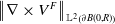 $\left \Vert \nabla \times V^{F} \right \Vert _{\mathbb{L}^{2}\left ( \partial B(0,R) \right )}$
. By taking the Curl operator on the both sides of (A.33), there holds
$\left \Vert \nabla \times V^{F} \right \Vert _{\mathbb{L}^{2}\left ( \partial B(0,R) \right )}$
. By taking the Curl operator on the both sides of (A.33), there holds
 \begin{align*} \underset {x}{\nabla } \times (V^{F}(x) )& = \underset {x}{\nabla } \times \int _{\Omega } G_{k}(x,y) \cdot F(y) \, dy\\& = \underset {x}{\nabla } \times \int _{\Omega } \Pi _{k}(x,y) \cdot F(y) \, dy + \underset {x}{\nabla } \times \int _{\Omega } ( G_{k} - \Pi _{k} )(x,y) \cdot F(y) \, dy. \end{align*}
Now, by using the $\Pi _{k}({\cdot} ,\cdot )$
’s expression given by (A.3), the definition of both the Magnetization and the Newtonian operators given by (1.7) as well as the expression of
$\Pi _{k}({\cdot} ,\cdot )$
’s expression given by (A.3), the definition of both the Magnetization and the Newtonian operators given by (1.7) as well as the expression of $\left ( G_{k} - \Pi _{k} \right )({\cdot} ,\cdot )$
given by (A.5), we can rewrite the above equation as
$\left ( G_{k} - \Pi _{k} \right )({\cdot} ,\cdot )$
given by (A.5), we can rewrite the above equation as
 \begin{equation*} \nabla \times ( V^{F} ) = \nabla \times \big( N^{k}_{\Omega } (F ) \big) + \nabla \times \big( N^{k}_{\Omega } ( (k^{2}({\cdot}) - k^{2} ) \, V^{F}({\cdot}) ) \big). \end{equation*}
Now, using the fact that
 \begin{equation*} \nabla \times N^{k}_{\Omega } (E ) = N^{k}_{\Omega } ( \nabla \times E ) - SL^{k}_{\partial \Omega } ( \nu \times E ), \end{equation*}
where $SL^{k}_{\partial \Omega }$
is the single-layer operator defined by
$SL^{k}_{\partial \Omega }$
is the single-layer operator defined by
 \begin{equation*} SL^{k}_{\partial \Omega } (f )(x) \,:\!= \int _{\partial \Omega } \phi _{k}(x,y) \, f(y) \, d\sigma (y), \quad x \in \mathbb{R}^{3}, \end{equation*}
we deduce
 \begin{align*} \nabla \times ( V^{F} ) & = N^{k}_{\Omega } ( \nabla \times F ) - SL^{k}_{\partial \Omega } ( \nu \times F ) + N^{k}_{\Omega } ( \nabla \times ((k^{2}({\cdot}) - k^{2} ) V^{F}({\cdot}) ) ) \\&\quad - SL^{k}_{\partial \Omega }( (k^{2}({\cdot}) - k^{2} ) \nu \times V^{F}({\cdot}) ). \end{align*}
Then, by taking $\left \Vert \cdot \right \Vert _{\mathbb{L}^{2}(\partial B(0,R))}$
-norm on the both sides of the above equation, we obtain
$\left \Vert \cdot \right \Vert _{\mathbb{L}^{2}(\partial B(0,R))}$
-norm on the both sides of the above equation, we obtain
 \begin{align*} \Vert \nabla \times V^{F} \Vert ^{2}_{\mathbb{L}^{2}(\partial B(0,R))} & \lesssim \Vert N^{k}_{\Omega } ( \nabla \times F ) \Vert ^{2}_{\mathbb{L}^{2}(\partial B(0,R))} + \Vert SL^{k}_{\partial \Omega } ( \nu \times F ) \Vert ^{2}_{\mathbb{L}^{2}(\partial B(0,R))} \\ &\quad + \Vert N^{k}_{\Omega } ( \nabla \times ( (k^{2}({\cdot}) - k^{2} ) \, V^{F}({\cdot}) ) ) \Vert ^{2}_{\mathbb{L}^{2}(\partial B(0,R))} \\ &\quad + \Vert SL^{k}_{\partial \Omega }( (k^{2}({\cdot}) - k^{2} ) \nu \times V^{F}({\cdot}) ) \Vert ^{2}_{\mathbb{L}^{2}(\partial B(0,R))} \\ & \lesssim \int _{\partial B(0,R)} \int _{\Omega } \vert \Phi _{0}(x,y) \vert ^{2} \, dy \, d\sigma (x) \;\; \rho _{1} + \, \int _{\partial B(0,R)} \int _{\partial \Omega } \vert \Phi _{0}(x,y) \vert ^{2} \, d\sigma (y) \, d\sigma (x) \; \; \rho _{2}, \end{align*}
where
 \begin{align*} \rho _{1} &\,:\!= \Vert \nabla \times F \Vert ^{2}_{\mathbb{L}^{2}(\Omega )} + \Vert \nabla \times ( (k^{2}({\cdot}) - k^{2} ) V^F({\cdot}) ) \Vert ^{2}_{\mathbb{L}^{2}(\Omega )} \\ \rho _{2} &\,:\!= \Vert \nu \times F \Vert ^{2}_{\mathbb{L}^{2}(\partial \Omega )} + \Vert (k^{2}({\cdot}) - k^{2} ) \nu \times V^F \Vert ^{2}_{\mathbb{L}^{2}(\partial \Omega )} \end{align*}
As we have assumed the vector field $F({\cdot})$
to be smooth, hence
$F({\cdot})$
to be smooth, hence $V^F({\cdot})$
will also be smooth and the following relation holds
$V^F({\cdot})$
will also be smooth and the following relation holds
 \begin{equation*} \max ( \rho _{1} \, ; \, \rho _{2} ) = \mathcal{O} ( 1 ). \end{equation*}
This implies that
 \begin{equation*} \Vert \nabla \times V^{F} \Vert ^{2}_{\mathbb{L}^{2}(\partial B(0,R))} \lesssim \int _{\partial B(0,R)} \int _{\Omega } \vert \Phi _{0}(x,y) \vert ^{2} \, dy \, d\sigma (x) + \int _{\partial B(0,R)} \int _{\partial \Omega } \vert \Phi _{0}(x,y) \vert ^{2} \, d\sigma (y) \, d\sigma (x) . \end{equation*}
Since $ \vert x \vert \gg 1$
, we obtain
$ \vert x \vert \gg 1$
, we obtain
 \begin{equation*} \Vert \nabla \times V^{F} \Vert ^{2}_{\mathbb{L}^{2}(\partial B(0,R))} \lesssim \int _{\partial B(0,R)} \frac {1}{ \vert x \vert ^{2}} \, d\sigma (x) = 4 \, \pi . \end{equation*}
Therefore, in (A.39), we deduce that
 \begin{equation*} \vert J_{2} \vert \lesssim \lim _{R \rightarrow + \infty } \, \frac {1}{R^{\alpha }} = 0. \end{equation*}
Similar arguments allow us to justify that
 \begin{equation*} J_{1} \,:\!= \lim _{R \rightarrow + \infty } \int _{\partial B(0,R)} Curl(V^{E}) \cdot ( V^{F} \times \nu - Curl( V^{F} )) \, d\sigma = 0. \end{equation*}
Then, as $ J = J_{1} - J_{2}$
, see (A.35), we deduce that
$ J = J_{1} - J_{2}$
, see (A.35), we deduce that
 \begin{equation*} J = 0, \end{equation*}
from (A.34), which further indicates that
 \begin{equation*} \langle E, V^{F} \rangle _{\mathbb{L}^{2}(\mathbb{R}^{3})} = \langle V^E, F \rangle _{\mathbb{L}^{2}(\mathbb{R}^{3})}. \end{equation*}
By using (A.32) and (A.33), we can know that
 \begin{align*} \int _{\mathbb{R}^{3}} E(x) \cdot \int _{\mathbb{R}^{3}} G_{k}(x,y) \cdot F(y) \, dy \, dx &= \int _{\mathbb{R}^{3}} \int _{\mathbb{R}^{3}} G_{k}(x,y) \cdot E(y) \, dy \cdot F(x)\, dx \\ & = \int _{\mathbb{R}^{3}} \int _{\mathbb{R}^{3}} G_{k}(x,y) \cdot E(y) \cdot F(x)\, dy \, dx \\ & = \int _{\mathbb{R}^{3}} \int _{\mathbb{R}^{3}} E(y) \cdot G_{k}^{\top }(x,y) \cdot F(x) \, dy \, dx \\ & = \int _{\mathbb{R}^{3}} E(y) \cdot \int _{\mathbb{R}^{3}} G_{k}^{\top }(x,y) \cdot F(x) \, dx \, dy \\ & = \int _{\mathbb{R}^{3}} E(x) \cdot \int _{\mathbb{R}^{3}} G_{k}^{\top }(y,x) \cdot F(y) \, dy \, dx. \end{align*}
Since $E$
and
$E$
and $F$
are two arbitrary vector fields, we deduce that
$F$
are two arbitrary vector fields, we deduce that
 \begin{equation*} G_{k}(x,y) = G_{k}^{\top }(y,x), \quad x \neq y. \end{equation*}
This justifies (A.12).


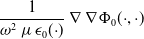

 Open access

