

Introduction
Education in the 21st century must be adaptable to address the diverse needs arising from developments in science, technology, and the arts (Darling-Hammond et al. Reference Darling-Hammond, Flook, Cook-Harvey, Barron and Osher2020). Modern education should focus on teaching students how to actively engage in the learning process through exploration. It should aim to equip them with the ability to pose questions, organise and construct observations, formulate hypotheses, and identify their own sources of information. Consequently, the educational paradigm must shift towards a learning-centred model. Learning can no longer be conceived as a process of transmitting knowledge from teacher to student; rather, it must place emphasis on the cultivation of skills. A key competency within contemporary educational frameworks is critical thinking. In this study, critical thinking is understood as the ability to explain and analyse information, evaluate evidence, make reasoned judgements, and monitor one’s own thinking. It involves both cognitive and metacognitive processes, such as reflection, inference, and problem-solving. Critical thinking enables students to exercise careful judgement and solve everyday problems (Zubaidah et al. Reference Zubaidah, Corebima, Mahanal and Mistianah2018). By engaging in these higher-order cognitive processes, students actively mobilise and expand their intellectual capacities, as they are required not only to recall information but to question, connect, and generate new insights. It not only enhances students’ academic capabilities but also prepares them for their professional careers.
In recent years, schools have been increasingly criticised for failing to teach students how to think critically, a concern supported by professional and academic discussions regarding student performance in international assessment studies. The results of PISA 2022 indicate a significant decline in reading comprehension scores in most countries compared to 2018. During this period, OECD countries experienced an average drop of 10 points in reading comprehension. This remarkable decline, unprecedented in the history of PISA, is undoubtedly attributable, to a large extent, to the pandemic and its impact on the educational systems of all participating countries. In Greece, the decline in scores is greater than the OECD average. Specifically, the reading comprehension score decreased by 19 points compared to 2018. Within this framework, reading comprehension is not merely a basic literacy skill but a complex cognitive process that necessarily entails core components of critical thinking, such as inference-making, evaluation of information, recognition of implicit meanings, and the integration of textual evidence with prior knowledge. International assessment frameworks, including PISA, conceptualise reading comprehension as the ability to understand, interpret, reflect on, and critically engage with texts, rather than as simple decoding or recall. Consequently, persistent weaknesses in reading comprehension provide empirical evidence of students’ limited engagement with higher-order cognitive processes, directly indicating deficits in critical thinking. Such results suggest that many students lack the ability to move beyond lower-order cognitive skills, highlighting the urgent need for educational approaches that deliberately foster the activation of higher-order thinking and intellectual engagement.
One approach to enhancing students’ critical thinking skills is to implement an educational model that encourages them to think critically and solve problems. In the context of teaching Ancient Greek, this can be achieved through the study and in-depth analysis of Ancient Greek texts. The teaching of such texts is, after all, an integral component of fostering critical thinking because the interpretative and analytical work required to understand a text in its historical, linguistic, and cultural dimensions demands the activation of students’ reasoning, reflection, and evaluative judgement – key elements of intellectual engagement. Reading comprehension in this context presupposes not merely understanding what a text says but critically examining how meaning is constructed, how linguistic choices shape interpretation, and how texts invite multiple, context-dependent readings.
Therefore, it is imperative for teachers, when teaching Ancient Greek texts, to establish the appropriate conditions that allow the form and content of the ancient text to be deeply understood through the study and analysis of its entirety (Vertsetis Reference Vertsetis2003). This involves integrating the reflective elements inherent in the text with its linguistic structure. However, empirical research in the Greek educational context demonstrates that these pedagogical objectives – although explicitly articulated in curricula and policy documents – are systematically undermined in everyday classroom practice. OPEK (Reference Sippitanou2008) explicitly acknowledges a persistent gap between curricular intentions and instructional reality, stressing the urgent need for innovative, student-centred approaches that have long been prescribed by curricula but remain largely unapplied.
A significant issue observed in Greece is that teachers often approach Ancient Greek texts in a formalistic or technocratic manner, marginalising their critical analysis (Markoglou Reference Markoglou2022; Rizou Reference Rizou2011; Tsiotras Reference Tsiotras2012). The critical approach to interpretation, meaningful exploration, and the content of the text has been supplanted by a language-centred method rooted in an exam-oriented logic, which limits the interpretative reading of Ancient Greek texts. In this context, the translation of Ancient Greek texts has become a mechanical process derived from exhaustive grammatical and syntactical analysis of the original text (Polkas, Reference Polkasn.d.), sidelining critical analysis, aesthetic appreciation, and the timeless messages that the text itself has to offer. As a result, reading comprehension is reduced to accuracy at the level of form, rather than functioning as a site for interpretative judgement, evaluation, and critical engagement. Empirical studies substantiate this observation. Research indicates that instructional time is disproportionately devoted to word-for-word translation and exhaustive grammatical parsing, often at the expense of textual interpretation and meaning-making. This practice not only exhausts students cognitively but also produces a hybrid, artificial target text that functions exclusively within the school context, offering little support for genuine comprehension or critical engagement (Markoglou Reference Markoglou2022; Papaoikonomou Reference Papaoikonomou2022; OPEK Reference Sippitanou2008; Rizou Reference Rizou2011; Tsiotras Reference Tsiotras2012; Tsiotras Reference Tsiotras2013).
The main factors contributing to this phenomenon appear to be threefold (Markoglou Reference Markoglou2022). First, there is a persistent adherence to the ‘Attic’ teaching model,Footnote 1 rooted in long-standing cultural and historical traditions (Kakridis Reference Kakridis1994; Kazazis Reference Kazazis and Christidis2001; Makris Reference Makris2000). Second, the inadequate pedagogical and didactic preparation of both pre-service and in-service teachers reflects a structural weakness in the system (Anastassiadis-Symeonidis and Fliatouras Reference Anastassiadis-Symeonidis and Fliatouras2018; Bista et al. Reference Bista, Kokkinos and Markoglou2016; Bilioni Reference Bilioni2003; Frydaki Reference Frydaki2015; Kazamias et al. Reference Kazamias, Kassotakis, Kladis, Kazamias and Kassotakis1996; Kassotakis Reference Kassotakis2010). Third, an institutional factor reinforces this practice: many teachers remain convinced that a language-centred approach best prepares students for success in the National Exams (Tsiotras Reference Tsiotras2008, p. 42; Varmazis Reference Varmazis2008). Collectively, these factors perpetuate a model of instruction that privileges formal analysis over holistic, critical engagement with the texts.
The aim of this teaching scenario is to adopt a critical approach to the instruction of Ancient Greek texts, aiming to move – where feasible – away from the prevailing language-centred and formalistic perception of text analysis. It seeks to encourage teachers to explore and implement teaching practices that enable a holistic approach to Ancient Greek texts, fostering students’ critical thinking, delving deeper into the content, and avoiding rote memorisation and reproductive practices. Within this framework, reading comprehension is reconceptualised as an active, interpretative process through which students are invited to analyse, evaluate, and negotiate meaning, thereby functioning as a core mechanism for the cultivation of critical thinking. In this way, the role of the student as a critical thinker will be reinforced, and the teaching process has the potential to become a more meaningful and pedagogically productive experience for both teachers and students. The proposed methodology focuses on interpretative and extratextualFootnote 2 elements, foregrounding meaning-making and interpretation (how meaning is generated, negotiated, and re-evaluated within and beyond the text), rather than grammatical decoding or word-for-word translation. Texts are approached as dynamic networks of interpretative relationships shaped by linguistic choices, historical context, and reader engagement. The methodology therefore, provides structured interpretative support that is gradually withdrawn as students develop autonomy and the ability to construct and justify their own readings. This pedagogical intervention is thus grounded not merely in theoretical advocacy but in well-documented empirical shortcomings of current instructional practices, which consistently fail to actualise the intended transition from content mastery to skills-oriented, interpretative learning.Footnote 3
In this context, it is essential to remember that texts do not exist in a vacuum but are interpreted within the reader’s historical, cultural, and intellectual framework. Acknowledging this perspective aligns with Jäger’s (Reference Jäger1987) concept of a ‘structure of prejudices’, according to which each reader assigns new or nuanced meanings to a text based on contemporary experiences and concerns. Consequently, the notion of timelessness does not suggest a fixed or immutable meaning, but rather the continued interpretative potential of classical texts to generate meaningful insights across different historical and cultural contexts. This understanding further reinforces the proposed critical and holistic approach, as it encourages students to engage with Ancient Greek texts not only as linguistic artefacts but also as living works that resonate with modern perspectives.
Literature review
Definitions of critical thinking
The concept of critical thinking originated in antiquity with the sophists (740–399 BC) and Socrates (5th century BC) engaging in profound explorations of ethics and societal governance. Socrates, in his effort to understand opinions on specific issues, emphasised the necessity of first defining the issue with clarity and subsequently evaluating the validity of that definition. He maintained that critical thinking is not an innate faculty but a skill that can be cultivated through education (Bryan Reference Bryan1987).
Since then, numerous definitions of critical thinking reveal a plethora of dimensions. According to Dewey (Reference Dewey1910), critical thinking involves an active, persistent, and meticulous examination of beliefs or purported forms of knowledge, taking into account the underlying justifications and the potential outcomes it may lead to. A widely cited definition is offered by Ennis (Reference Ennis, Baron and Sternberg1987, Reference Ennis2013), who defines critical thinking as a reasonable and reflective form of thinking focused on making informed decisions about what to believe or how to act. Paul and Elder (Reference Paul and Elder2006) and Nosich (Reference Nosich2022) expand on this notion, defining critical thinking as an intellectually disciplined process that encompasses various cognitive skills such as conceptualising, applying, analysing, synthesising, and evaluating information derived from observation, experience, reflection, reasoning, or communication. These skills are used as a guide to inform both belief and action.
Van Gelder (Reference Van Gelder, Davies and Barnett2015) delves into the cognitive aspect of critical thinking, proposing that it encompasses both analytical and creative thinking processes. By evaluating information, generating insights, and making reasoned judgements, individuals can engage in critical thinking. Bailin and Battersby (Reference Bailin and Battersby2016) view critical thinking as a transformative process that involves reflection, analysis, and evaluation of beliefs and assumptions. They argue that critical thinking extends beyond reasoning and problem-solving, encompassing the development of a broader perspective and engagement with ethical and moral dimensions of issues. Other scholars similarly emphasise that critical thinking involves a combination of expertise, complex cognitive abilities, and affective tendencies (Hyytinen et al. Reference Hyytinen, Toom, Shavelson, Murtonen and Balloo2019; Shavelson Reference Shavelson2010).
Critical thinking has been defined as the ability to analyse and evaluate information and arguments systematically and logically, enabling individuals to make well-reasoned judgements and decisions (Facione Reference Facione2011). Facione’ s framework elaborates on the importance of developing and cultivating specific skills and dispositions that enhance the ability to think critically in various contexts. These critical thinking skills and dispositions are considered essential for effective and reasoned thinking, decision-making, and problem-solving. Facione identifies the following core skills: interpretation (to comprehend and explain the meaning of information, data, or situations), analysis (to identify the underlying components, relationships, or patterns in information), evaluation (to assess the credibility, relevance, and quality of information or arguments), inference (to draw logical and reasonable conclusions based on available evidence and information), explanation (to provide clear and coherent justifications or reasons for beliefs or decisions), and self-regulation (to monitor and reflect on one’s own thinking, identify biases or assumptions, and make necessary adjustments).
Facione (Reference Facione2011) also highlights the significance of dispositions that foster critical thinking, such as truth-seeking (a commitment to seeking accurate information, facts, and evidence), open-mindedness (the willingness to consider different perspectives, ideas, or viewpoints), analytical thinking (the inclination to approach problems or situations in a systematic and logical manner), systematic thinking (the tendency to organise and plan one’s thinking process, considering all relevant factors), critical thinking self-confidence (the belief in one’s own ability to think critically and solve problems effectively), and inquisitiveness (a natural curiosity and eagerness to explore and learn new information).
The development of critical thinking skills is a fundamental aspect of education, as it enables individuals to effectively respond to the demands of the modern world. In order to cultivate these skills, teachers must have a thorough understanding of their students’ cognitive processes. When teachers are aware of how their students think and process information, they can design more effective instructional approaches that align with diverse cognitive styles and promote deeper learning (Anggraeni et al. Reference Anggraeni, Prahani, Suprapto, Shofiyah and Jatmiko2023; Heong et al. Reference Heong, Hamdan, Ching, Kiong and Azid2020). By integrating critical thinking into teaching practices, teachers can move beyond traditional rote learning methods and encourage students to analyse, evaluate, and synthesise information. This approach fosters an active learning environment in which students develop their ability to reason, solve problems, and engage critically with complex ideas, ultimately enhancing their overall academic performance and intellectual growth.
The importance of developing critical thinking skills in schools
Critical thinking is among the most crucial skills that 21st-century citizens must possess. For this reason, modern educational practices must prioritise the cultivation and enhancement of critical thinking skills (Walter and Walter Reference Walter and Walter2018). Research underscores the vital importance of critical thinking both for academic success (D’alessio et al. Reference D’alessio, Avolio and Charles2019; Fong et al. Reference Fong, Kim, Davis, Hoang and Kim2017; Veliz & Veliz-Campos Reference Veliz and Veliz-Campos2019) and for effectiveness and innovation in professional contexts (Jafarigohar et al. Reference Jafarigohar, Hemmati, Rouhi and Divsar2016; Li Reference Li2023).
The importance of fostering the development of these skills within the school environment is widely recognised, as they play a decisive role in equipping individuals to respond effectively to complex and constantly evolving contexts (Wendland et al. Reference Wendland, Robinson, Williams, Davies and Barnett2015; Van Gelder Reference Van Gelder, Davies and Barnett2015). Critical thinking is an essential skill that enables students to solve problems and make well-informed, rational decisions (Özgenel Reference Özgenel2018). Through this process, students gain the ability to construct logical interpretations and achieve the best possible outcomes in diverse situations. Thus, the cultivation of critical thinking is not merely an educational priority but a vital skill that empowers students to address the challenges of the modern era effectively.
The modern pedagogical approach advocates for students to become critical thinkers. Through critical thinking, students broaden their horizons, both inwardly and outwardly, creating opportunities to view the ancient world through a contemporary lens. Students are encouraged to comprehend the text through a collective effort, employing their reading skills and independently exploring the text, either directly or indirectly. This process is facilitated by their personal experiences, literary knowledge, and the contextual concerns of the time (Tsafos Reference Tsafos2004, p. 127). In doing so, they affirm the notion that a critical reader approaches a text through a ‘structure of prejudices’, which assigns a different meaning to the text each time (Jäger Reference Jäger1987). In this framework, independent thinking operates within critical thinking, as students’ interpretative autonomy is grounded in evidence-based reasoning, contextual analysis, and evaluative judgement rather than in a purely subjective response.
The analysis of a text should not be subjected to a rigid and non-negotiable framework of critical analysis that restricts it to the discovery of a single, authentic meaning. Instead, there must be a liberation of the participants in the educational process, fostering an exploratory and reflective environment in which both students and teachers employ a variety of instructional strategies. This approach aims to cultivate a critical stance towards the text, the methods of its examination, and its interpretations.
Critical analysis of the Ancient Greek text
The critical analysis of the text must aim to facilitate the student’s understanding in a personal and meaningful way. Consequently, in the teaching of Ancient Greek texts, the teacher should focus on helping students cultivate the skills necessary to deconstruct and reconstruct their own personal meaning, based on both objective and subjective experiential inputs. This approach represents a step towards the meaningful emancipation of students from societal stereotypes and the cultivation of freedom in engaging with the text, grounded in socio-cultural contexts and individual reading histories. The critical analysis of Ancient Greek texts is closely tied to both the literary and the cultural-historical perspectives of these works. Students’ engagement with diverse interpretations supports the formation of their subjectivity and, by extension, their personal identity. In this context, students are encouraged to explore social, cultural, linguistic, and other issues of the ancient Greek world.
As a result of this approachFootnote 4 :
-
✓ Texts should be treated as products of communication, as linguistic structures, and as carriers of ideological and socio-cultural meanings (Vakaloudi Reference Vakaloudi2012). Grammatical and syntactic phenomena should be examined alongside the textual categories to which they belong. It is suggested that students engage in activities that focus on the comprehension and critical analysis of texts, thereby cultivating their communicative and critical skills (language-critical literacy).
-
○ The steps in text interpretation that can foster critical reading in students are as follows:
-
a) Direct interaction with the text: During the initial reading, the goal is for the student to become familiar with the text, prioritising the ‘narrated story’ rather than its morphological structure.
-
b) Enrichment with the contexts of human experience and history: This step involves stimulating the student’s intellectual and emotional development as they identify, explore human issues raised in the text, and reconstruct their personal experiences.
-
c) Connection to the historical and cultural context of the text: Providing essential information to enhance the understanding and highlighting of the text’s meaning.
-
d) Exploration of stylistic elements: Identifying stylistic features that add depth and substance to the interpretation of the text (Tsafos Reference Tsafos2004, p. 129).
-
-
-
✓ The study and comparative analysis of texts expressing similar or opposing viewpoints facilitate deeper understanding and critical examination of thematic areas, enabling students to comprehend and interpret them more effectively. Simultaneously, the contrasting perspectives of the texts are highlighted, allowing students to understand, substantiate, and discuss their deeper meaning and content. This approach offers students the opportunity to develop both written and oral discourse on the subject.
-
○ Parallel readings hold a significant place in the interpretative approach to an Ancient Greek text. During these readings, the teacher aims to provide a socio-cultural framework for the text, present its historical context, cultivate students’ reflective thinking, and familiarise them with new interpretative pathways. This teaching process is designed to gradually lead students to construct their own understanding of the text, under the guidance of the teacher, with intermediate steps involving the exploration of various interpretative perspectives from others. Through this approach, students develop and refine their reading skills, discovering new interpretative routes that may align with or challenge their initial assumptions.
-
-
✓ The literary analysis of texts can provide an opportunity for the development of both oral and written expression, encompassing the substantiation of opinions as well as the expression of students’ aesthetic preferences.
-
○ In the study of Ancient Greek texts, this engagement with literature can play a significant role in cultivating a wide range of students’ reading and communication skills while highlighting the cultural production of the Ancient Greek world and its connection to timelessness. This timelessness emerges from the universal human concerns, ethical dilemmas, and social values that these texts address – such as justice, freedom, heroism, and the search for meaning – that remain relevant across centuries. By exploring these enduring themes, students are encouraged to draw parallels between the ancient world and contemporary society, recognising the persistent influence of classical thought on modern cultural and intellectual life. Within this context, students are encouraged to interpretively approach the text, striving for understanding and deeper engagement. The application of literary theory in teaching practices can lead to the renewal of educational goals and methods, introducing activities that can spark students’ interest while fostering their critical thinking and discourse. This approach promotes reflection on the enduring values presented in Ancient Greek texts.
-
-
✓ The utilisation of printed and electronic dictionaries, as well as online text corpora, is considered valuable as literacy practices that enhance both language comprehension and production.
-
○ The use of printed and electronic dictionaries represents an important strategy (Bishop Reference Bishop2000; Rahini and Miri Reference Rahimi and Miri2014) for learning and teaching the Ancient Greek language. Their supplementary use in the teaching process is deemed beneficial, as they provide a comprehensive overview of words, offer illustrative examples, and contribute to fostering students’ autonomy and self-directed learning. In this context, dictionaries function not merely as reference tools but as cognitive supports for critical thinking, as they require students to analyse, compare, and evaluate semantic possibilities within specific contexts. Their use promotes learner autonomy and metacognitive awareness, encouraging evidence-based interpretation rather than mechanical decoding or unreflective translation.
-
The case of the Ancient Greek language course in the last year of Lyceum in Greece
In the teaching of Ancient Greek, students are encouraged to explore human actions, understand human personality, engage with the essence of humanity, identify dilemmas and concerns, empathise with successes and failures, share anxieties and reflections, evaluate choices, and acknowledge human weaknesses (Markoglou Reference Markoglou2022). This process invites students to investigate human emotions, thoughts, and life purposes, extracting timeless messages and inevitably emphasising the humanistic essence of the education they receive.
This teaching scenario aligns with the principles of the new curriculum for the Ancient Greek course in the last year of Lyceum in Greece (Government Gazette 9739/2023 Footnote 5 ). According to the curriculum, the teaching of Ancient Greek in the final year of high school should focus on ‘the critical reception’ of Ancient Greek culture in response to the demands of contemporary societies and should ‘always provide fertile ground for timely and meaningful inquiries in the fields of letters and the arts’. It emphasises the study of ‘Ancient Greek culture through a multidimensional, comprehensive, and critical process of interpretation … within the framework of an open and productive dialogue with Greek antiquity’. Consequently, the teaching of Ancient Greek should foster in students ‘essential abilities and skills, such as critical thinking … aesthetic awareness, deeper reflection on issues of ethics, politics, and social life, with the ultimate goal of preparing them for integration into the society of active citizens’.
Additionally, taking into account that ‘each text functions differently within various historical and cultural contexts and contains the potential for multiple interpretations’, students, through the teaching of Ancient Greek texts, can ‘cultivate and develop their critical thinking. This includes comparison, observation, categorization, explanation of causal relationships, creativity, originality, data collection and organization, transformative reasoning, and more’.
Among the core objectives is for students to ‘engage in dialogue with the Ancient Greek text, address the requirements related to its comprehension, interpretation, and translation into Modern Greek, approaching it as a ‘problem to be solved, while avoiding rote memorization of pre-existing knowledge’. This approach aims to strengthen ‘students’ critical and comparative abilities’ and enhance ‘their capacity to develop personal perspectives and attitudes’. Therefore, it is essential that ‘the Modern Greek translation should neither become an obstacle to interpreting the texts nor be treated as an end in itself in ways that hinder or obstruct engagement with the content. This must be avoided in favor of a technocratic linguistic rendering that neither conveys the text adequately nor allows for its experiential understanding’.
At the same time, ‘considering the diverse needs, the unique cognitive structures and functions of students, their varying aptitudes and preferences, the new multicultural social reality, the need to cultivate a wide range of skills in students to support new literacies, and the ongoing discussion on modernizing the teaching and learning approach to Ancient Greek, the exclusivity and “authority” of a single perspective over others appears, at the very least, ineffective. Therefore, the learning process must be characterized by an open pedagogical framework, which aligns with the interdisciplinary approach to knowledge and active learning, thereby offering opportunities to strengthen the knowledge and skills of every student’.
In conclusion, the new curriculum (Government Gazette 9739/2023) recommends the implementation of a range of teaching practices that incorporate elements ‘from the text-centered, interpretative, and exploratory methods, with the primary aim of utilizing the teaching principles of autonomy, supervision, and experiential learning’.
Teaching scenario
Lesson Plan Title: Critical and interpretative analysis of the ancient Greek text.
Teaching Unit: Isocrates, On the Peace (Ἰσοκράτης, Περὶ εἰρήνης), 19–21 (Appendix 1)
Student Classroom: Last year of Lyceum
Recommended number of students: 25
Recommended teaching timeFootnote 6 : 120 minutes
Aim: For students to (a) delve deeper into the meaning and content of the text, seeking to develop their critical thinking; (b) interpret the text in relation to its morphological elements; and (c) appreciate the timeless relevance of humanistic messages from antiquity to the present through the study of extratextual elements.
Goals:
Students must be able
With regard to knowledge to:
-
✓ Explain the modes of persuasion used by the orator to convince his audience (explanation, analysis).
-
✓ Describe the emotions of the protagonists during times of war and peace (explanation, analysis).
-
✓ Compare the advantages of peace and the disadvantages of war according to the text (analysis).
-
✓ Interpret and evaluate the text as a whole, considering its meaning and content (interpretation, evaluation).
-
✓ Translate the ancient Greek text into their mother tongue (interpretation, analysis, inference).
With regard to attitudes to:
-
✓ Analyse and organise the arguments presented by the orator, seeking to cultivate their critical thinking (explanation, analysis).
-
✓ Draw conclusions regarding the importance of peace for the continuity of both individuals and nations, in comparison to the negative consequences of war (inference).
-
✓ Evaluate the timeless significance of peace from antiquity to the present, based on the orator’s arguments and extratextual references (evaluation).
With regard to skills to:
-
✓ Evaluate their own understanding by confirming or rejecting their initial assumptions (self-regulation).
-
✓ Familiarise themselves with seeking information through printed and electronic sources in order to develop critical skills and abilities (analysis).
-
✓ Practise critical text analysis, selecting the elements necessary to provide information for their research (inference, evaluation).
Teaching stages
First teaching stage: Motivation of students’ interest (engagement) (5 minutes)
At the beginning of the lesson, the teacher presents David Burliuk’s (1882–1967) painting The horror of the war to the students and asks them to hypothesise about its subject, encouraging them to suggest a suitable title. The students’ responses are expected to focus on war, its negative consequences, the displacement of victims, and their need for livelihood and security, among other themes. The teacher then reveals that the title of the painting is The Horror of War and asks the students to list wars they are familiar with, spanning from antiquity to the present day. The students are encouraged to focus on wars such as the Trojan War, the Peloponnesian War, World War I and II, the Social War, and the Syrian and Iraqi Wars.
Second teaching stage: Identification of the topic and connection to the historical-social context (exploration) (15 minutes)
The teacher, taking into account the students’ responses, focuses on the Social War (considered prior knowledge) and poses the following questions:
-
✓ When did the Social War take place? (357–355 BCE),
-
✓ Who participated and why? (The Athenians confronted Rhodes, Chios, and Kos, which had seceded from the Second Athenian League, refusing to pay the exorbitant allied contributions (tributes) demanded by the Athenians),
-
✓ What was the outcome? (The Athenians suffered a devastating defeat, and the revolting cities regained their autonomy).
In light of this event, the teacher invites the students to share their knowledge regarding the Second Athenian League and the rhetorical style of the orator Isocrates. After the students express their views, the teacher presents Isocrates’ text ‘On the Peace’ (Appendix 1) on the board and asks them to hypothesise about its content based on the title, recording their hypotheses on the board. Subsequently, the teacher informs them that they will study an excerpt from this speech in the current lesson.
The teacher, using a strong and clear voice, conducts the first reading of the text, having provided the following reading instruction: ‘As I read the text, I would like you to identify words and phrases that highlight its theme’. After the first reading, the teacher, along with the students, records on the board the words and phrases they noted regarding the theme of the text. Thus, their initial hypotheses are confirmed or rejected. At this stage, students are expected to discuss the disadvantages of war and the positive effects during periods of peace.
Aiming to foster the development of students’ critical thinking skills, the teacher may continue by posing questions such as:
-
✓ Were your initial hypotheses confirmed or disproved? (self-regulation)
-
✓ In what historical context was the speech ‘On the Peace’ written, and how does it relate to this particular excerpt? (explanation, analysis)
-
✓ What do you believe is the purpose of this specific passage? (interpretation, analysis, inference)
-
✓ Why do you think some cities chose to secede? (interpretation, analysis, inference, evaluation)
-
✓ What was the role of Athens during the First and Second Athenian Leagues, and how would you assess it? (explanation, evaluation)
The above questions aim to engage students in critical thinking by introducing them to the orator’s desire to persuade his fellow citizens to establish peace with the member cities, emphasising the necessity imposed by the current historical context. Students come to recognise that Isocrates, through his protreptic discourse, expresses his opposition to the political trajectory of Athens and the warlike faction of his city, simultaneously emphasising his belief in the benefits of peace with the former member cities and advocating for the limitation of their naval hegemony. Furthermore, students delineate the historical and social context that highlights Athens’ stance towards other cities, acknowledging that during the First and Second Athenian Leagues, the Athenians’ behaviour was detrimental towards other member cities, resulting in those cities forming a hostile attitude against Athens and seeking to secede. This element ultimately proved to be a catastrophic error for Athens, as evidenced by the outcome.
Third teaching stage: Interpretative analysis of the text and first translation (interpretation) (30 minutes)
After the initial reflections of the students on the text and its historical context, a more thorough analysis follows. Specifically, a second reading of the text is conducted by the teacher, during which the students are instructed to highlight, using different colours, the words and phrases in the text that pertain to:
-
a) the prerequisites for the prosperity of the city of Athens,
-
b) the arguments concerning war, and
-
c) the arguments concerning peace.
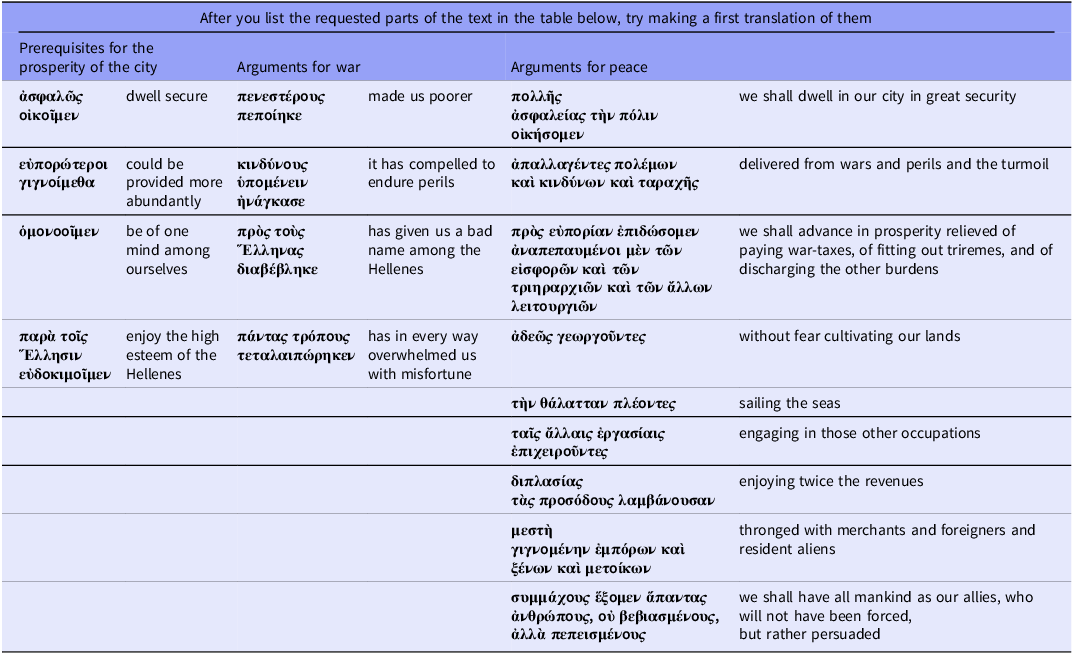
Upon the completion of the second reading, the following schematic representation is expected to be created (Figure 1):
Representation of the text based on key themes.

Subsequently, the students list the prerequisites and arguments related to war and peace as outlined in the text. This is followed by a discussion focusing on the prerequisites and significance of peace for the city of Athens and other city-states, as well as the dire conditions they face during times of war. At this point, the teacher elicits from the students the relevance and value of Isocrates’ protreptic discourse in the given historical context and addresses them by stating:
-
✓ How would you approach persuading your interlocutor about the content of your discourse?
The students are encouraged to identify features of the text’s rhetorical literacy, focusing on the methods and means of persuasion. The teacher continues:
-
✓ What methods and means of persuasion does the orator employ to convince the people of Athens?
In this context, an interdisciplinary approach can be implemented with the subject of Modern Greek Language, focusing on identifying the methods and means of persuasion employed in the text, such as appeals to logic (arguments) and appeals to emotion (emotionally charged words, rhetorical questions, vivid descriptions, and pairs of contrasting images).
Advancing in the learning and teaching process, students are encouraged to focus on the linguistic and stylistic features of the text, addressing questions aimed at enhancing their interpretive understanding and deepening their engagement with the Ancient Greek text. Indicatively:
-
✓ ‘What expressive devices does the orator employ in the text, and what is their functional role?’
-
○ Rhetorical question (ἆρ’ οὖν ἂν ἐξαρκέσειεν […] εὐδοκιμοῖμεν), strongly emphasising the orator’s affirmative stance regarding the contribution of these characteristics to the prosperity of the city.
-
○ Polysyndeton (εἰ τήν τε πόλιν […] οἰκοῖμεν καὶ […] γιγνοίμεθα καὶ […] τά τε πρὸς ἡμᾶς […] ὁμονοοῖμεν καὶ […] εὐδοκιμοῖμεν;), highlighting that the prosperity of the city is not a simple matter but rather the result of numerous and significant factors, such as security, prosperity, unity, and esteem. This rhetorical device is also employed to underscore the negative consequences of war ([…] πεποίηκε, καὶ […] ἠνάγκασε, καὶ […] διαβέβληκε, καὶ […] τεταλαιπώρηκεν).
-
○ Antithesis, emphasising the negative consequences of war and the positive aspects of peace (ἀσφαλῶς οἰκοῖμεν, εὐπορώτεροι γιγνοίμεθα, ὁμονοοῖμεν, εὐδοκιμοῖμεν, τὴν πόλιν εὐδαιμονήσειν vs. ὁ πόλεμος ἀπεστέρηκεν, πενεστέρους πεποίηκε, κινδύνους ὑπομένειν, ἠνάγκασε, διαβέβληκε, τεταλαιπώρηκεν).
-
-
✓ ‘Identify the grammatical form of ἂν ἐξαρκέσειεν’.
-
○ It is an optative form accompanied by the potential particle ἂν (potential optative), expressing something that could occur in the present or future. It is translated as: ‘it would be possible to…
-
-
✓ What is the rationale behind the use of the personal pronoun ἐγὼ in conjunction with the verb ἡγοῦμαι?
-
○ Aiming to highlight his personal opinion, which he has the courage to articulate publicly during a critical and challenging period for Athens.
-
Focusing on a text-centred approach, the teacher instructs the students (in pairs) to attempt an initial translation and/or interpretation of the specific words and phrases, using their print or electronic dictionaries, and completing Table 1:
Key Elements of the Text

At this stage, the students are encouraged to identify the key elements of the text and attempt an initial translation. The teacher, aiming to facilitate a deeper understanding of the text, may give special attention to the terms λειτουργία (liturgical service), τριηραρχία (trierarchy), and μέτοικος (metic). This approach aims to provide a comprehensive – as far as possible – social contextualisation concerning the functioning of the Athenian state.
Fourth teaching stage: Collaborative work/critical comparative analysis of parallel texts and sources (deepening) (50 minutes)
In the next phase, students are divided into mixed groups of four and directed to teaching stations, where extratextual materials are provided for further exploration of the topic under study (Appendix 2). At these stations, the groups will be asked to engage in a more detailed exploration of the thematic area “Peace-War’ through multimodal texts, focusing on aspects such as:
-
a) analysing and evaluating the consequences of war,
-
b) drawing conclusions regarding the significance of peace,
-
c) describing the emotions of key figures during periods of war,
-
d) describing the emotions of key figures during periods of peace, and
-
e) assessing the timeless relevance of peace from antiquity to the present day.
The primary aim is to equip students with a variety of resources (literary texts, testimonies from key figures, images) that will help them develop a well-rounded perspective on the consequences of war and the benefits of peace.
Fifth teaching stage: Final rendering (evaluation) (20 minutes)
Upon completing their in-depth exploration of the thematic area under examination, the students return to Isocrates’ text On the Peace, which they are tasked with translating into their native language.Footnote 7
Therefore, students, working in pairs, are tasked with creating a hypothetical dialogue between Isocrates (Student A) and a member of the pro-war faction (Student B). Student A supports, with arguments, the idea that Athens should establish peace with its allies, while Student B argues, with counterarguments, that Athens should not pursue peace with its allies. Such dialogic tasks may further function as an introduction to creative engagement with rhetorical discourse, allowing students to experiment with persuasive speech in structured role-play contexts.
Conclusion
The present teaching proposal was implemented within the context of the instruction of Ancient Greek to students in the final year of Lyceum in the Humanities orientation. Its implementation confirmed the pedagogical value of an interpretative and text-centred approach, yielding particularly positive results with regard to students’ cognitive engagement, interpretative competence, and the development of their critical thinking. Initially, students demonstrated active participation in the process of interpretative analysis and clear progress in their comprehension of the text. They were able to explain and analyse the modes of persuasion employed by the orator to convince his audience, to identify and describe the emotions of the protagonists in conditions of war and peace, and to compare the advantages of peace with the negative consequences of war, as these are presented in the text. Moreover, the majority of students succeeded in interpreting and evaluating the text as a whole, taking into account its meaning, content, and rhetorical techniques. Their translations into their mother tongue demonstrated a satisfactory level of understanding of the linguistic and morphological features of Ancient Greek.
In addition, students displayed an increased willingness to analyse and organise the orator’s arguments, drawing well-supported conclusions regarding the significance of peace for the continuity of both individuals and societies. The connection of the text with extratextual elements enhanced their reflection on the timeless value of the humanistic messages of antiquity, facilitating meaningful connections with the present. This interpretative engagement indicates the cultivation of critical thinking and evaluative judgement, in line with the objectives of critical pedagogy. Furthermore, students appear to have developed greater metacognitive awareness, as they were encouraged to confirm or revise their initial assumptions through systematic textual analysis. Engagement with the critical analysis of the text strengthened their ability to select, analyse, and evaluate the necessary elements for interpretative purposes.
Despite the positive outcomes, certain challenges were also identified. Some students initially demonstrated hesitation when responding to higher-order thinking questions, particularly when they were required to formulate evaluative judgements or draw more general conclusions. In addition, the emphasis on in-depth analysis and reflective dialogue renders the teaching process particularly time-consuming, occasionally necessitating adjustments to the pacing of the lesson.
Within this context, the question arises as to the extent to which this teaching methodology can be transferred and adapted to other texts and to different student cohorts. Despite these challenges, it appears that the proposed methodology can be transferred and applied by teachers to other texts, with the aim of enhancing students’ critical thinking through targeted questioning. Such questions can be effectively employed with any Ancient Greek text, provided that the teacher possesses adequate pedagogical training and engages in continuous professional development in order to cultivate and refine the relevant teaching skills. Equally important is the teacher’s in-depth knowledge of the historical and cultural context of each text, as well as the ability to meaningfully connect the content of the text with students’ prior knowledge, derived both from their school experience and from their everyday lives. This presupposes a thorough understanding of the students on the part of the teacher, enabling the design of questions and activities that are cognitively appropriate, contextually relevant, and genuinely engaging.
At this point, it is important to emphasise that the pedagogical issue examined in the present article is situated primarily within the Greek (and Cypriot) educational context, where Ancient Greek is taught to native speakers of Modern Greek and is institutionally regarded as part of the linguistic continuity of the Greek language. This particular condition allows – at least at a theoretical level – for a shift towards an interpretative, meaning-centred approach to Ancient Greek texts, beyond an exclusive emphasis on grammatical and syntactical recognition. However, as this article demonstrates, this potential remains largely unrealised in everyday classroom practice.
At the same time, the study draws on international perspectives, including the British educational context, where Ancient Greek is taught as a foreign language and is approached primarily as a discipline of reading and interpretation rather than as a means of achieving linguistic accuracy or grammatical mastery. This comparison highlights that different pedagogical aims emerge depending on whether Ancient Greek is taught as a heritage language or as a foreign language, while simultaneously underscoring a shared concern with interpretation, meaning-making, and critical engagement with texts.
In light of the above findings, it is considered appropriate that the teaching of Ancient Greek texts should enable students to attain a deeper comprehension of the idea examined in the original text. In this way, students are able to engage with the dialogue between texts, enhancing their interpretive approach and, consequently, their critical thinking, while practising various forms of critical reading. This process aids students in developing reading skills essential for their daily lives, as the comparative examination of texts is regarded as a fundamental prerequisite for making informed judgements. In this way, they become acquainted with the concept of intertextuality and illuminate personal, social, and cultural aspects of antiquity. They are encouraged to draw upon their reading experience and critical thinking to seek alternative interpretations of the myth that the text and its reading present (Tsafos Reference Tsafos2004), fostering their development into critically thinking students.
Supplementary material
The supplementary material for this article can be found at https://doi.org/10.1017/S2058631026101081
Author biography
Angeliki Markoglou holds a PhD in Methodology of Teaching (University of Athens) and works as Special Scientist at the Department of Education at the University of Cyprus. Her studies include a BA in Philosophy, Pedagogy and Psychology and an MA in Theory, Praxis and Evaluation of Educational Work with specialisation in Educational Design and Instruction (University of Athens). She is a teacher trainer at Cyprus Pedagogical Institute, conducting school-based seminars in the methodology of teaching in language learning and an external collaborator of the Ministry of Education and Culture (Cyprus), conducting professional development seminars for qualified teachers. She was a member of the team who designed the guidelines for the implementation of the subject of Ancient Greek Language Curriculum (2018). She has also worked as a Scientific Collaborator at the European University Cyprus, Nicosia University, and University of Athens and has participated in a number of conferences and research projects and has published work in journals and edited books.



 Open access

