





Introduction: governing education at the planetary threshold
The accelerating convergence of climate disruption, biodiversity collapse and ecosystem degradation (IPBES, 2019) poses existential challenges that demand transformative responses from all societal sectors. These ecological crises reveal how conventional educational models designed for anthropocentric growth are inadequate for fostering the ecological literacy and adaptive governance needed in an era of planetary boundary transgression. This misalignment exposes a critical paradox in education governance: while Earth systems breach planetary boundaries (Stockholm Resilience Centre, 2025), education policies remain entrenched in paradigms that treat nature as a passive resource (Bangay & Blum, Reference Bangay and Blum2010). This study advances a posthumanist transformative governance theory, proposing three shifts to realign education policy with ecological imperatives: from human exceptionalism to Barad’s (Reference Barad2007) relational ontology; from neoliberal temporalities to Indigenous kincentric frameworks (Whyte, Reference Whyte2017); and from human-capital metrics to multispecies justice (Tsing, Reference Tsing2015). A comparative analysis of Sámi (Norway), Haida Gwaii (Canada) and Alaska cases demonstrates that Indigenous-led policies operationalising nonhuman agency through land-based education enhance both ecological resilience and educational equity. In Haida Gwaii, cultural revitalisation programs like traditional fisheries co-management deepened youth connections to ancestral lands, improving educational participation (Corntassel & Bryce, Reference Corntassel and Bryce2011). Similarly, Sámi education integrating traditional knowledge (eallin) fosters ecological understanding, as seen in resistance to assimilation (Minde, Reference Minde2005). Later studies further develop this through relational ontological frameworks (Whyte, Reference Whyte2017). These cases align with Barad’s framework, showing that decolonising education necessitates multispecies justice.
The crisis of anthropocentric policy design
The planetary boundaries framework, as updated by Stockholm Resilience Centre (2025), shows that seven of nine critical Earth systems including climate and biosphere integrity now operate outside safe thresholds, highlighting the accelerated pace of ecological degradation. Recent policy advances, such as OECD PISA Science Framework 2025 (OECD, 2023) and Climate Literacy Framework 2029 (OECD, 2025), prioritise climate change education and Earth systems competencies for 15-year-olds, aligning with calls for ecological literacy. However, these frameworks remain anthropocentric, reducing complex ecological relations to instrumental skills. UNESCO (2021) reports reveal significant implementation gaps, only 30% of Technical and Vocational Education and Training (TVET) programmes and higher education institutions, and 45% of teacher training programmes, address climate change, highlighting the need for transformative governance across all education levels to achieve genuine ecological transition. This dissonance reflects what Jickling and Sterling (Reference Jickling, Sterling, Jickling and Sterling2017) term the neoliberal sustainability paradox: education systems designed to address ecological crises inadvertently reinforce the very economic structures driving them.
Theoretical foundations: rational policy ontologies
My framework synthesises three transformative lenses:
The first lens is posthumanist governance. Building on Barad’s (Reference Barad2007) agential realism and Haraway’s (Reference Haraway2016) sympoiesis, I demonstrate how policies materialise through human-nonhuman assemblages. In the context of Haida Gwaii, the ecological framework for environmental education recognises the interconnectedness of human societies and natural systems, emphasising the embeddedness of cultural values within local environment (Zandvliet & Brown, Reference Zandvliet and Brown2006). This approach aligns with the Haida worldview, which views the land and its resources as an indivisible part of their identity and mandates educational practices that reflect this holistic perspective.
The second aspect highlights indigenous temporalities. Whyte’s (Reference Whyte2017) “kincentric time” challenges Western policy cycles through Sámi boazodoallu (reindeer herding) calendars that enhance ecological literacy. Sámi educational institutions embody what Keskitalo (Reference Keskitalo2019) conceptualises as place-conscious pedagogy. This integration of seasonal rhythms into institutional temporality constitutes a fundamental spatial practice that centres Sámi relationality with the Arctic landscape, a practice that has been empirically demonstrated to improve place-based ecological knowledge. This synchronisation not only reflects deep connection between Sámi culture and their environment but also underscores the effectiveness of integrating traditional ecological practices into modern educational frameworks.
And finally, material-discursive metrics are critical to deconstructing the modernist illusion of nature as a passive resource. Applying Latour’s (Reference Latour2005) actor-network theory, I analyse how Korea’s state-led forest school policies, despite their ecological rhetoric often replicate instrumental logic by reducing forests to “teaching backdrops.”
Research gaps and contributions
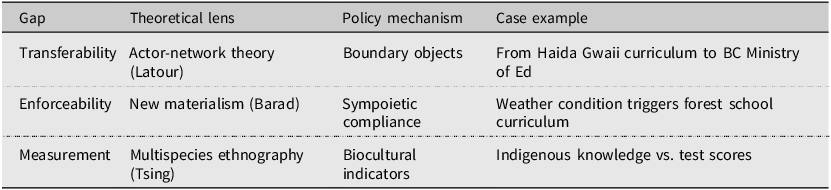
While indigenous education models have been extensively analysed (Battiste, Reference Battiste2013), existing scholarship remains constrained by three critical theoretical and empirical gaps, which this study addresses through a posthumanist policy framework.
Firstly, previous research predominantly examines indigenous education in isolated contexts, lacking scalable governance models for broader policy adaptation (McCarty & Lee, Reference McCarty and Lee2014). For instance, while land-based pedagogies are well-documented (Simpson, Reference Simpson2021), few studies theorise how they might be institutionalised in non-Indigenous systems.
In order to tackle the policy transferability issue, I develop a relational policy transfer framework, demonstrating how nature education related to Haida Gwaii’s marine indigenous stewardship (Zandvliet & Brown, Reference Zandvliet and Brown2006) can be adapted through boundary objects (e.g., seasonal calendars, multispecies indicators) that bridge Indigenous and Western governance systems.
Secondly, despite global rise of Rights of Nature laws (Kauffman & Martin, Reference Kauffman and Martin2021), most studies focus on legal rhetoric rather than implementation barriers (Gudynas, Reference Gudynas2011). For example, Ecuador’s constitutional reforms 2008 continue to face significant implementation challenges, with intercultural education policies remaining ineffective in rural schools due to fundamental tensions between state development frameworks and indigenous cosmologies (Martínez Novo, Reference Martínez Novo2014; Radcliffe, Reference Radcliffe2012).
To fill the legal enforceability gap, I reframe the nature policy from symbolic recognition to material compliance. I propose sympoietic compliance protocols as adaptive governance mechanisms where policy enforcement co-evolves through dynamic human-nonhuman interactions. For example, in forest schools, extreme weather events acting as material agents automatically trigger curriculum adjustments, such as shifting lessons to ecological resilience practices. This approach challenges top-down legal models by centring material agency (Latour, Reference Latour2005), effectively recognising nonhuman entities as active participants in compliance processes.
Finally, while recent dominant education metrics have begun to address ecological outcomes, they often prioritise human-centric competencies, thereby reinforcing anthropocentrism by overlooking multispecies well-being (Jickling et al., Reference Jickling, Sterling, Jickling and Sterling2017). Even “sustainability” assessments rarely engage nonhuman stakeholders.
To address outcome measurement gaps, I introduce multispecies indicators metrics that assess educational success through the wellbeing of human and nonhuman entities, shifting evaluation from anthropocentric achievement to ecological reciprocity. For example, soil microbiome diversity in school gardens serves as a proxy for student ecological literacy, reflecting a governance approach that prioritises multispecies justice over limited instrumental strategies.
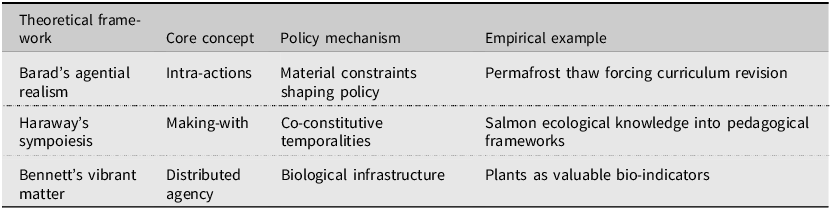
In conclusion, as illustrated in Table 1, I framework advances three key theoretical interventions:
Research gaps, contributions and empirical anchors

Policy as more-than-human assemblage: Rejecting static “implementation” models, I theorise policies as dynamic negotiations between humans, institutions and ecological actors.
Temporal multiplicity in governance: Unlike linear policy cycles, I integrate Indigenous cyclical time and geological timescales into decision-making.
Epistemic justice through materiality: By treating nonhuman entities (e.g., rivers, pollutants) as policy co-authors, I challenge Western epistemic dominance.
This reframing moves beyond critique to offer practicable tools for posthuman education governance.
Research questions
How can education policy be reconceptualised as sympoietic systems co-produced by human and nonhuman actors?
What institutional innovations enable polychronic governance that respects ecological temporalities?
How do Indigenous land-as-pedagogy models challenge neoliberal policy assumptions?
Article structure
Following introduction, this article is organised as follows:
Next section critiques dominant paradigms. Further sections present our theoretical framework, incorporate empirical cases and proposes transformative applications. Finally, the conclusion summarises the outcomes of the paper and suggests implications for future research.
Critiques of dominant paradigms in education policy
Contemporary education policy remains entrenched in anthropocentric and neoliberal paradigms that exclude more-than-human actors (Tsing, Reference Tsing2015). This critique interrogates these frameworks through posthumanist and Indigenous lenses, revealing their incompatibility with planetary boundaries. Grounded in agential realism (Barad, Reference Barad2007), sympoiesis (Haraway, Reference Haraway2016) and kincentric philosophies (Whyte, Reference Whyte2017), it demonstrates their perpetuation of epistemic violence while proposing relational alternatives.
The limits of anthropocentric policy design
The modernist ontological divide between nature and culture manifests in education policy through three primary mechanisms:
Epistemic Erasure
Anthropocentric frameworks reduce more-than-human entities to passive resources rather than agentic policy participants. UNESCO’s (2021) climate education guidelines exemplify this by positioning ecosystems as “teaching contexts” while simultaneously acknowledging the lack of “ecocultural approaches.” Barad’s concept of “agential cuts” explains how such policy language materially excludes nonhuman actors from decision-making processes.
For instance, the OECD’s (2018) Education 2030 framework emphasises “green skills” but fails to recognise forests, rivers, or pollinators as co-constructors of knowledge. This epistemic erasure mirrors what Plumwood (Reference Plumwood2002) terms “backgrounding” a process where ecological relationships are systematically marginalised and treated as irrelevant to human affairs. Kim’s (Reference Kim2007) study of Korean government-led forest schools revealed that most state-mandated activities (e.g., fixed-date tree planting) disregarded local phenological conditions, directly contradicting the ecological principles these programs purported to teach.
Temporal myopia
Human-centred policies operate within compressed political cycles that bear no relation to ecological timescales (Adam, Reference Adam1998). The five-year implementation horizons of most national education strategies are fundamentally misaligned with: forest regeneration cycles (50+ years; Kimmerer, Reference Kimmerer2013), climate feedback loops (centuries; Steffen et al., Reference Steffen, Richardson, Rockström, Cornell, Fetzer, Bennett, Biggs, Carpenter, de Vries, de Wit, Folke, Gerten, Heinke, Mace, Persson, Ramanathan, Reyers and Sörlin2015) and indigenous generation decision-making (Corntassel, Reference Corntassel and Bryce2011). This temporal dissonance produces what Adam calls “timescape conflicts.”
Material disconnection
Policies premised on nature–culture binaries fail to account for the co-constitutive materiality of learning environments. Kim’s (Reference Kim2007) study of Korean forest schools reveals how rigid infrastructure designs (e.g., concrete pathways bisecting root systems) disrupt soil ecologies that sustain pedagogical landscapes. Lövbrand et al. (Reference Lövbrand, Beck, Chilvers, Forsyth, Hedrén, Hulme, Lidskog and Vasileiadou2015) term this “infrastructural alienation,” the material exclusion of nonhuman agency from built environments.
The phenomenon of “biodiversity blindness” (Tsing, Reference Tsing2015) is particularly pronounced in urban school gardens, where aesthetic order is prioritised at the expense of pollinator habitats. In contrast, Indigenous land-based pedagogies, such as the Haida’s tll’sda (ecological temporality), conceptualise schoolyards as interconnected multispecies communities, challenging anthropocentric paradigm (Ojeda et al., Reference Ojeda, McNeill, Guujaaw, Yakgujanaas, Rhodes and Ban2025).
Neoliberalism’s epistemic violence
The neoliberalisation of education policy produces three forms of ecological alienation:
Metrication of learning
Standardised assessments such as PISA enact what Ball (Reference Ball2021) terms terrible simplifications of learning into marketisable skills. This manifests by: (1) reducing ecological knowledge to 21 broadly defined competencies, only 6 of which address ecological systems (OECD, 2019); (2) erasing Indigenous land-based pedagogies through epistemic violence (Simpson, Reference Simpson2017); and (3) privileging human capital theory outcomes over ecosystem health (Battiste, Reference Battiste2013).
Au’s (Reference Au2009) analysis demonstrates how standardised testing reduces ecological systems to decontextualised fragments (e.g., water cycle diagrams stripped of watershed contexts), with 82% of teachers omitting local examples to “teach to the test.” This epistemic violence (Battiste, Reference Battiste2013) is compounded when indigenous students are forced to validate Eurocentric ecological taxonomies that contradict their kincentric relationships with land (McCarty & Lee, Reference McCarty and Lee2014).
Commodification of nature
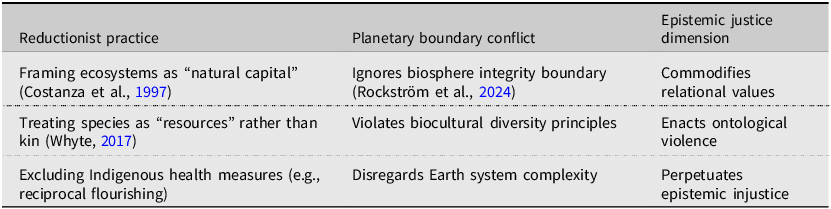
The neoliberal transformation of ecosystems into “natural capital” (Costanza et al., Reference Costanza, d’Arge, de Groot, Farber, Grasso, Hannon, Limburg, Naeem, O’Neill, Paruelo, Raskin, Sutton and van den Belt1997) has been rigorously critiqued as a form of fictitious commodification that obscures socio-ecological relations. This manifests in education policy through three interlocking mechanisms:
The first mechanism is carbon pedagogies. School sustainability programs increasingly adopt carbon credit schemes that reduce complex climate systems to transactional metrics (Böhm et al., Reference Böhm, Misoczky and Moog2012). For instance, the UK’s Natural Connections program trains students to calculate personal carbon footprints while omitting: the colonial legacy of emissions (e.g., 73% of historical CO2 originates from Global North industries; Hickel, Reference Hickel2020) and Indigenous stewardship practices that enhance carbon sequestration (Whyte, Reference Whyte2017).
Another mechanism is biodiversity offsetting curricula. Curriculum frameworks such as Scotland’s Curriculum for Excellence (Education Scotland, Reference Scotland2023) promote biodiversity “banking” exercises where students quantify species as “ecological credits” (e.g., tree-planting offsets). This neoliberal pedagogical approach commodifies ecological relationships and reduce complex ecological networks.
The last mechanism is ecotourism as erasure. Outdoor education models appropriate Indigenous land practices (e.g., forest schools) while displacing native stewardship (Tuck & Yang, Reference Tuck and Yang2012) and reducing sacred groves to “team-building spaces” (Simpson, Reference Simpson2017).
This triple instrumentalisation exemplifies Plumwood’s (Reference Plumwood2002) backgrounding, where: epistemic violence: Indigenous knowledge is extracted without ontological reciprocity (Simpson, Reference Simpson2017) and temporal alienation: short-term skill outcomes (e.g., employability metrics) override generational ecological knowledge. This dual process mirrors what Whyte (Reference Whyte2017) terms “kincentric alienation” the simultaneous epistemic and temporal distancing of education from more-than-human kinship networks.
Temporal dispossession
Neoliberal temporalities accelerate educational rhythms beyond ecological limits. Adam’s theory of “temporal conflict” explains how this creates: curriculum schedules incompatible with seasonal knowledge (Whyte, Reference Whyte2017), assessment cycles disrupting intergenerational learning (McCarty & Lee, Reference McCarty and Lee2014) and professional development timelines precluding place-attachment (Gruenewald, Reference Gruenewald2003).
For Sámi reindeer-herding communities, standardised school calendars that ignore boazodoallu (reindeer migration cycles) effectively sever education from livelihood practices. The resulting “temporal dispossession” mirrors what Whyte calls “kincentric alienation” the rupture of human–nonhuman temporal relationships.
Toward relational policy frameworks
Posthumanist and Indigenous paradigms offer three transformative alternatives:
Sympoietic governance
Haraway’s concept of sympoiesis suggests policies must emerge from human-more-than-human collaborations, as seen in: Haida Gwaii’s abalone-coordinated curricula (Ojeda et al., Reference Ojeda, McNeill, Guujaaw, Yakgujanaas, Rhodes and Ban2025) and Sámi place-conscious pedagogy (Keskitalo, Reference Keskitalo2019).
These cases demonstrate what Barad calls “intra-active” policymaking where syllabi, abalone runs jointly determine educational trajectories.
Polychronic policy design
Whyte’s kincentric time and Adam’s polychronicity combine to propose: ecological pulse-synchronised schedules (e.g., planting cycles dictating science units), Indigenous cyclical time integration and geological timescale accommodation.
The Sámi Parliament’s education strategy exemplifies this approach by aligning school terms with distinct reindeer herding seasons (Minde, Reference Minde2005). As documented in the Sámediggi’s Supplementary Report (2017), this approach explicitly challenges the Norwegian Ministry of Education’s calendrical practices that disregard Sámi seasonal migrations. The policy mandates avoidance of examinations during critical periods including Gáranas (spring calving, April–May) and Čakčamánnu (autumn slaughter, September-October), as formalised in the parliamentary submission on new education legislation (Sámi Parliament, 2020).
Material-discursive indicators
Extending Barad’s (Reference Barad2007) framework, this article advocates integrating more-than-human indices such as pollinator activity (Kimmerer, Reference Kimmerer2013), soil microbiome diversity (Ojeda et al., Reference Ojeda, McNeill, Guujaaw, Yakgujanaas, Rhodes and Ban2025) and watershed health (Simpson, Reference Simpson2021) into education metrics. This shift is supported by legal precedents like Ecuador’s constitutional Rights of Nature, mandating school-based ecosystem monitoring (Kauffman & Martin, Reference Kauffman and Martin2021), as well as rulings on India’s Ganges and Yamuna rivers and Colombia’s Atrato River, which institutionalised pollution control and community guardianship (Pecharroman, Reference Pecharromán2018). These cases show how legal frameworks operationalise material-discursive practices in policy.
In conclusion, this analysis reveals the need for education policy to: acknowledge more-than-human agency through material-discursive practices, develop temporally flexible governance structures and create evaluation systems honouring epistemic plurality.
The path forward requires dismantling the artificial boundaries between policy, pedagogy and ecology, recognising that forests, rivers and microorganisms are not just contexts for learning, but active participants in education’s future.
Introduction of posthumanist transformative governance
This theoretical section advances a posthumanist transformative governance framework, synthesising three transformative intellectual traditions: (1) posthumanist philosophy’s deconstruction of human exceptionalism (Barad, Reference Barad2007; Haraway, Reference Haraway2016), (2) Indigenous epistemologies’ relational ontologies (Simpson, Reference Simpson2017; Whyte, Reference Whyte2017) and (3) critical policy sociology’s analysis of power-knowledge regimes (Ball, Reference Ball2021; Biermann, Reference Biermann2014).
Our framework proposes three foundational innovations to reconfigure nature education policy within planetary boundaries:
-
1. Planetary Policy Ecologies: Rejecting human-centric governance models, I conceptualise policies as emergent phenomena from dynamic networks of human and more-than-human actors (e.g., migratory species patterns influencing curriculum timing, climate thresholds triggering policy adaptations)
-
2. Material-Discursive Practices: Building on Barad’s agential realism, I argue that policies are co-enacted through embodied, multisensory engagements with land and nonhuman agency, where matter itself exercises discursive force (e.g., soil microbiomes shaping science curricula, invasive species forcing redesign of schoolyard infrastructures).
-
3. Sympoietic Policy Systems: Challenging linear governance models, I propose that education policies must arise from multispecies co-creation practices, what Haraway terms “making-with” nonhuman entities, rejecting static human-centric policy design in favour of adaptive, relationally accountable systems.
This theoretical integration provides the foundation for empirical analysis of education policy in real world, offering tools to diagnose and transform anthropocentric policy regimes.
Transformation planetary policy ecologies: reassembling governance beyond the human
Posthumanist foundations: from agency to assemblage
Posthumanist scholarship fundamentally dismantles the nature–culture binary that has underpinned Western policy frameworks for centuries. Rather than treating policy as a human-imposed structure upon passive natural environments, this theoretical paradigm repositioning policy as relational processes emerging from continuous negotiations between multiple human and nonhuman actors. This ontological shift demands reconceptualising governance as dynamic assemblages where agency is distributed across networks of human institutions, ecological forces, material infrastructures and more-than-human entities.
Three theoretical anchors provide foundation for this reformulation:
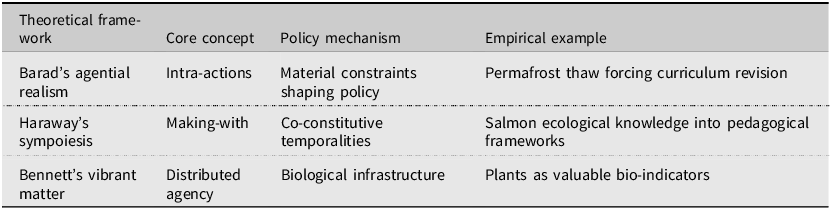
Barad’s Agential Realism challenges conventional policy implementation models by arguing that policies materialise through what she terms “intra-actions” – mutually constitutive engagements between human and nonhuman entities. For example, in Scandinavian Forest schools, the material reality of permafrost thaw (attributed to climate change forcing by IPCC, 2023) actively reshapes educational practices. As thawing ground destabilises school infrastructure and alters local ecosystems, educators must continually revise outdoor curricula and safety protocols, demonstrating how geological processes become active policy participants rather than passive backdrops (Lövbrand et al., Reference Lövbrand, Beck, Chilvers, Forsyth, Hedrén, Hulme, Lidskog and Vasileiadou2015).
Haraway’s Sympoiesis introduces the concept of “making-with” to describe world-building through collaborative partnerships across species boundaries. Indigenous education models exemplify the integration of ecological temporalities into learning processes. In Alaska Native communities, educational activities are often synchronised with seasonal cycles and animal migrations, reflecting a holistic worldview where “all things are connected” (Barnhardt & Kawagley, Reference Barnhardt and Kawagley2005). While not dictating school schedules in the literal sense, salmon migration patterns inform culturally grounded science curricula that combine traditional ecological knowledge with Western scientific approaches.
Bennett’s Vibrant Matter (Reference Bennett, Cheah, Orlie and Grosz2010) argues for the inherent agentic capacity of nonhuman entities, from trees to rivers to synthetic materials. In urban environmental education, plants serve as valuable bio-indicators rather than active sensors. Species such as Ginkgo biloba show visible foliar damage under high ozone concentrations, while Pinus densiflora demonstrates reduced growth under nitrogen oxide exposure. These physiological responses provide tangible learning opportunities for students to monitor air quality, though urban pollution management primarily relies on conventional monitoring systems (Chaudhuri & Kumar, Reference Chaudhuri and Kumar2022). This approach acknowledges vegetal agency while maintaining scientific accuracy, creating educational experiences that connect students to urban ecosystems through observable phenomena. This policy innovation demonstrates how vegetal agency becomes incorporated into environmental governance through what Bennett terms “distended agency.”
Case evidence: more-than-human policy in practice
Empirical evidence from diverse contexts illustrates how planetary policy ecologies are already operating in practice, though often unrecognised by conventional policy frameworks:
-
1. Scandinavian Forest Schools & Permafrost Thaw
The material impacts of climate change on educational infrastructure provide a compelling case of more-than-human policy emergence. In Swedish and Norwegian forest schools located within the Arctic Circle, accelerating permafrost thaw has necessitated fundamental redesign of both physical infrastructure and curricular practices. School buildings require specialised pilings to accommodate ground instability, while traditional outdoor learning sites become inaccessible or hazardous due to landscape transformation (Lövbrand et al., Reference Lövbrand, Beck, Chilvers, Forsyth, Hedrén, Hulme, Lidskog and Vasileiadou2015). These material constraints force continuous curriculum adaptations, exemplifying Barad’s concept of material-discursive policy emergence where geological processes intra-act with educational planning.
-
2. Alaska Native Salmon-Centric Curriculum: Indigenous Temporalities in Education
The Alaska Native educational system exemplifies what Corntassel (Reference Corntassel and Bryce2011) identifies as sustainable self-determination through its sophisticated integration of salmon ecological knowledge into pedagogical frameworks. This curriculum enacts a temporal governance model that synchronises academic activities with five distinct phenological phases of Pacific salmon (Oncorhynchus spp.) life cycles (Kawagley, Reference Kawagley1995). Rather than imposing artificial academic calendars, lesson planning follows what Whyte terms kincentric temporality, structuring human activities around more-than-human rhythms.
This pedagogical approach demonstrates what Harawayconceptualises as sympoiesis (“making-with”) by positioning salmon as active pedagogical agents rather than passive educational content. The curriculum creates temporal alignment (Whyte, Reference Whyte2017) between institutional schedules and ecological patterns, maintaining academic rigour while challenging industrialised education’s temporal constraints. Empirical studies consistently demonstrate that culturally grounded curricula significantly enhance both ecological understanding and cultural identity formation among Indigenous students. For instance, Demmert et al. (Reference Demmert, Grissmer and Towner2006) confirm that Native American education models improve environmental stewardship, while Lipka’s (Reference Lipka2020) work with Yup’ik communities shows strengthened cultural connections through place-based learning.
The policy significance lies in its operationalisation of biocultural governance: regulatory frameworks that recognise more-than-human agencies through institutional mechanisms. By granting salmon ecological cycles formal authority over educational sequencing, the system demonstrates how Bennett’s (Reference Bennett, Cheah, Orlie and Grosz2010) vibrant matter concept translates into practice: nonhuman entities become policy actors rather than policy objects. This case offers a replicable model for transforming anthropocentric education systems through what Barnhardt and Kawagley (Reference Barnhardt and Kawagley2005) terms indigenous-to-place policy design.
As demonstrated in Table 2, reconceptualisation of policy ecologies demands fundamental shifts in how I understand agency, responsibility and efficacy in environmental governance. By recognising active participation of more-than-human entities in policy formation and implementation, I open possibilities for more responsive, adaptive and ecologically attuned governance approaches that respect planetary boundaries and multispecies justice.
Theoretical foundations and policy applications
Temporal multiplicity: governing across ecological timescales
Critique of neoliberal temporality: the tyranny of the short-term
Contemporary education policy operates within what Adam conceptualises as “timescape conflict” – a fundamental dissonance between the compressed temporalities of neoliberal governance and the extended rhythms of ecological systems. This temporal misalignment manifests through three distinct yet interconnected dimensions:
Political Cycle Compression epitomised by OECD’s (2018) five-year planning horizons creates what Harvey (Reference Harvey1989) terms “time–space compression,” where electoral cycles and fiscal years override ecological temporalities. This neoliberal temporality privileges metrics that are immediately measurable (standardised test scores, annual budget allocations) while systematically excluding considerations that operate on longer timescales (Steffen et al., Reference Steffen, Richardson, Rockström, Cornell, Fetzer, Bennett, Biggs, Carpenter, de Vries, de Wit, Folke, Gerten, Heinke, Mace, Persson, Ramanathan, Reyers and Sörlin2015).
The consequences of this temporal dissonance are empirically demonstrable across multiple ecological dimensions as illustrated in Table 3:
Timescape conflicts in education policy

Forest Regeneration Cycles (50–100+ years) are fundamentally incompatible with political timelines. Kimmerer’s (Reference Kimmerer2013) research on temperate forest ecosystems demonstrates that true ecological literacy requires understanding successional processes that span human generations. Yet current policy frameworks, particularly accountability measures like England’s Ofsted inspection cycles, force schools to prioritise immediately measurable outcomes over long-term ecological understanding (Ball, Reference Ball2021).
Climate Feedback Loops operating on centennial scales create what Steffen et al. (Reference Steffen, Richardson, Rockström, Cornell, Fetzer, Bennett, Biggs, Carpenter, de Vries, de Wit, Folke, Gerten, Heinke, Mace, Persson, Ramanathan, Reyers and Sörlin2015) term “planetary boundaries temporalities.” The lag between carbon emissions and climatic responses (often 30–50 years) means educational decisions made today will impact ecological systems beyond conventional policy horizons. This temporal disconnect is exacerbated by assessment regimes that reward short-term performance metrics over sustainability competencies (Jickling et al., Reference Jickling, Sterling, Jickling and Sterling2017).
Intergenerational Justice Imperatives embedded in Indigenous decision-making frameworks highlight ethical dimensions of temporal conflict. Whyte’s analysis of Anishinaabe seven-generation planning reveals how neoliberal temporality systematically privileges present generations while imposing ecological debts on future ones. This constitutes what Adam identifies as “temporal appropriation” – the colonisation of future time for present benefit.
Indigenous and posthumanist alternatives: timescape integration
Emerging alternatives demonstrate how educational governance might better align with ecological and cultural temporalities through what Adam (Reference Adam1998) terms “timescape responsiveness,” the institutional capacity to recognise and adapt to multiple temporal rhythms. This conceptual framework challenges homogenised temporal structures of modernist education systems by acknowledging what Kvamme (Reference Kvamme2024) identifies as the fundamental situatedness of ecological knowledge within specific cultural and environmental contexts. Polychronic governance, defined as institutional capacity to coordinate multiple temporal rhythms, provides a critical lens for understanding how institutions can simultaneously engage with diverse temporal frameworks without subordinating ecological timescales to bureaucratic schedules.
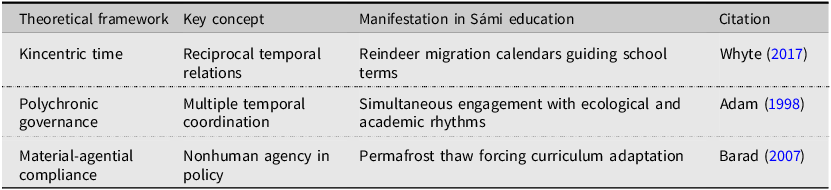
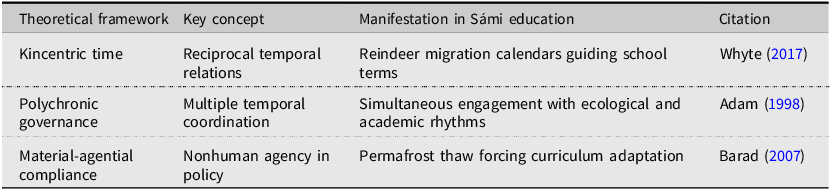
Sámi Boazodoallu (Reindeer Herding) Calendars exemplify what Whyte conceptualises as “kincentric time,” temporal frameworks that synchronise human activities with more-than-human rhythms through sophisticated ecological monitoring systems that position humans within networks of reciprocal responsibility. As documented by Inga (Reference Inga2007) and Inga and Danell (Reference Inga and Danell2012), Sámi herders maintain detailed TEK regarding reindeer (Rangifer tarandus tarandus) foraging behaviours across seasonal cycles, including their consumption of over 350 vascular plant species and 100 lichen varieties. This knowledge system, embedded within the siida organisational structure (Sara, Reference Sara2009), represents a complex governance model where temporal decisions emerge from continuous observation of reindeer-plant interactions rather than abstract academic calendars.
The EALÁT research initiative (Oskal et al., Reference Oskal, Turi, Mathiesen and Burgess2009) further demonstrates how Sámi temporal frameworks incorporate climate change adaptation through what Buhre and Bjork (Reference Buhre and Bjork2021) term “temporal braiding,” the interweaving of ancestral knowledge with contemporary environmental monitoring. This approach enacts what Barad would call “material-agential compliance” by recognising how environmental changes (thawing permafrost, shifting vegetation patterns) actively reshape educational practices and temporal structures. Rather than merely responding to climate change, Sámi educators participate in what Barad terms “intra-active becoming” where reindeer, herders, vegetation and climate co-constitute educational temporalities through their entangled agency.
This approach challenges what Fabian (Reference Fabian2014) critiqued as the “denial of coevalness” in Western temporal frameworks, instead creating educational practices that recognise multiple temporalities as equally valid and simultaneous. As Casi et al. (Reference Casi, Guttorm, Virtanen, Krieg and Toivanen2021) argue, such TEK systems represent “situated sustainability” where knowledge remains anchored in specific ecological relationships rather than abstracted universal principles.
In practice, this temporal integration manifests in Sámi teacher education programs that employ what Keskitalo and Jannok Nutti (Reference Keskitalo, Jannok Nutti, Harju-Luukkainen, Garvis, Kangas, Maroco, Maunula and Maunumaki2025) identify as “two-eyed seeing,” braiding Sámi temporal frameworks with Western scientific approaches. For instance, reindeer migration patterns inform school calendar design, while ice formation cycles shape science curriculum sequencing, creating what Kvamme (Reference Kvamme2024) describes as “educative distantiation” the critical capacity to understand one’s own temporal positioning within broader ecological systems. This represents the operationalisation of Adam’s (Reference Adam1998) polychronic governance through Whyte’s kincentric framework, mediated by Barad’s material-discursive practice, a theoretical integration that offers transformative potential for reconceptualising educational governance beyond anthropocentric constraints.
In conclusion, as illustrated in Table 4, These alternatives collectively challenge what Greenhouse (Reference Greenhouse1996) identified as “tyranny of the moment” in modernist policy-making, instead offering models of temporal governance that respect ecological rhythms, honour cultural temporalities and respond to material conditions. They represent not merely technical adjustments to scheduling, but fundamental reorientations in how educational systems conceptualise and value time itself.
Theoretical integration in Sámi temporal governance
Epistemic justice: decolonising policy knowledge
Mainstream environmental education policy systematically perpetuates epistemic hierarchies through what Santos (Reference Santos2014) terms “epistemicide,” the destruction of alternative knowledge systems via imposition of Western scientific paradigms. This analysis reframes this epistemic violence through the lens of planetary boundaries theory (Rockström et al., Reference Rockström, Donges, Fetzer, Martin, Wang-Erlandsson and Richardson2024), examining how knowledge governance structures intersect with Earth system stability across three dimensions of injustice.
Assessment hegemony and epistemic dominance
While standardised tests like PISA seek to gauge educational quality and increasingly prioritise socio-ecological issues, their design focused on cross-national comparability often privileges reductionist epistemologies. This can marginalise ecological and Indigenous knowledge systems by favouring abstract generalisations over situated knowledge, quantitative metrics over qualitative relationships and individual achievement over community wellbeing. Such an approach risks contributing to testimonial injustice when Indigenous students’ knowledge is discredited by assessment biases, though PISA cannot control result misinterpretation. Ultimately, this preference for universal metrics conflicts with Rockström et al.’s (Reference Rockström, Donges, Fetzer, Martin, Wang-Erlandsson and Richardson2024) planetary boundaries framework, which calls for context-specific responses to Earth system processes.
Reductionism in sustainability metrics
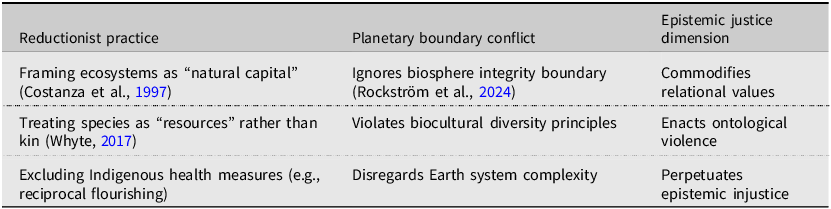
Conventional indicators exemplify what Kimmerer (Reference Kimmerer2013) critiques as “ecological amnesia” through three forms of reductionism as demonstrated in Table 5:
Three forms of biophysical reductionism
The OECD’s (2018) “green growth” indicators typify this approach by measuring carbon sequestration while ignoring cultural–spiritual relationships with land, reproducing what Plumwood (Reference Plumwood2002) termed “backgrounding,” rendering ecological relationships invisible to policy consideration.
Transformative biocultural frameworks: operationalising planetary boundary governance
Firstly, from legal and policy innovations perspective, constitutional recognition of rights of Nature Ecuador’s 2008 constitutional reforms established legal personhood for ecosystems (Pachamama), creating what Boyd (Reference Boyd2017) identifies as a “paradigm shift in environmental law.” This approach: Grants standing to ecosystems in legal proceedings through defensorías (community guardians), mandates educational institutions to monitor and report on ecological wellbeing and requires policy impact assessments to consider effects on more-than-human communities.
The implementation of these rights in educational settings demonstrates material-discursive governance (Barad, Reference Barad2007) where students participate in: water quality monitoring that combines scientific instruments with TEK, forest health assessments that integrate biodiversity metrics with cultural indicators and climate adaptation planning that values both technical and Indigenous adaptation strategies.
From resistance and transformation strategies perspective, the creation of boundary objects – artefacts that maintain coherence across social worlds while enabling flexible interpretations - facilitates knowledge integration through: seasonal calendars that combine meteorological data with phenological observations, species field guides that include both scientific classifications and Indigenous taxonomies and curriculum frameworks that accommodate multiple knowledge validation methods.
In conclusion, transformative biocultural frameworks offer pathways for addressing the interconnected crises of ecological degradation and epistemic injustice. These approaches represent what Escobar (Reference Escobar2018) terms “pluriversal governance” – acknowledging multiple ontologies coexisting in policy space while fundamentally challenging neoliberal and colonial underpinnings of conventional environmental education.
Conclusion
This article advances three transformative pathways for reconceptualising education policy beyond anthropocentric constraints, offering a coherent alternative to the neoliberal and colonial paradigms that currently dominate environmental education governance.
Transformative pathways
Drawing on Latour’s actor-network theory and Barad’s agential realism, this pathway challenges the nature–culture binary by proposing an integrated approach where policies are recognised as dynamic assemblages emerging from negotiations between human and more-than-human actors. This ontological reframing allows for gradual adaptation within existing governance structures.
-
1. Temporal Justice: Phased Moves to Polychronic Governance
Building on Adam’s critique of the “tyranny of the moment,,” this pathway incorporates multiple time scales into policy-making through incremental steps. Whyte’s “kincentric time” and Indigenous decision-making principles offer practical alternatives to short-term cycles, enabling phased alignment with ecological rhythms.
-
2. Epistemic Equity: Bridging TEK and Science through Hybridity
To counteract Santos’s (Reference Santos2014) “epistemicide,” this pathway fosters epistemic plurality by creating “knowledge bridges” (Kimmerer, Reference Kimmerer2013) between Traditional Ecological Knowledge and Western science. This integration prioritises collaborative dialogue over wholesale replacement, allowing for context-sensitive implementation.
Policy implications
-
1. Integrate Biocultural Indicators into Existing OECD Metrics
I propose a phased integration of biocultural indicators, such as soil microbiome diversity in school grounds, species richness recovery rates, and intergenerational knowledge transmission indices into existing evaluation systems. This could begin with pilot programmes in regions with strong ecological governance, drawing on principles from Ecuador’s Buen Vivir framework (Radcliffe, Reference Radcliffe2012) and gradually scale as evidence demonstrates their value in enhancing educational and ecological outcomes.
-
2. Invite Multispecies Integration in Policy Assessments
Extending environmental impact assessments, we propose integrating multispecies perspectives to evaluate policy effects on more-than-human communities. This approach is inspired by Sámi place-based ecological knowledge and aligns with Haraway’s “multispecies flourishing” as a core policy concern. Framed as an invitation, it prioritises collaborative steps that build on emerging evaluation practices.
Operationalisation involves a stepwise approach: first, pilots in regions with strong Indigenous governance (e.g., Sámi) can test frameworks using metrics like species diversity on school grounds; second, partnerships with educational and environmental agencies would refine tools before phased scaling to national policy reviews. This ensures adaptation while challenging anthropocentric norms.
-
3. Grant Legal Standing to Ecosystems in Education Law
Following Ecuador’s pioneering constitutional reform (2008) and subsequent juridical developments in India (Ganges/Yamuna) and Colombia (Atrato River), education legislation should recognise ecosystems as legal persons in policy decisions (Pecharroman, Reference Pecharromán2018). Such recognition would enable judicial review of ecologically harmful policies, create guardianship roles for students and communities and institutionalise what Kauffman and Martin (Reference Kauffman and Martin2021) term “jurisdictional innovation.”
This model’s viability rests on its dual foundation in planetary boundaries science (Steffen et al., Reference Steffen, Richardson, Rockström, Cornell, Fetzer, Bennett, Biggs, Carpenter, de Vries, de Wit, Folke, Gerten, Heinke, Mace, Persson, Ramanathan, Reyers and Sörlin2015) and Indigenous sovereignty principles (Simpson, Reference Simpson2017). Thus, it offers an ecologically grounded, decolonising approach to education governance.
Future research directions
Scaling Mechanisms: How to translate localised innovations into national policy frameworks without losing contextual sensitivity
Intersectional Policy Design: How climate justice, racial justice and multispecies justice intersect in education policy implementation
Resistance Navigation: How to overcome inevitable resistance from entrenched interests benefiting from anthropocentric paradigms
This framework provides not merely theoretical critique but practical pathways for transforming education governance to address complex challenges of the Anthropocene. By situating education within broader ecological and epistemic communities, it offers hope for developing educational systems capable of nurturing more just and sustainable futures for all planetary inhabitants (Figure 1).
Transforming education governance through a post-anthropocentric lens. This figure illustrates complete theoretical pathway from an old paradigm characterised by Anthropocene crises and policy failure, through three core interventions, towards a new paradigm grounded in Planetary Boundaries and Indigenous Sovereignty, ultimately achieving a transformation in education governance.

Acknowledgements
I extend my sincere gratitude to the editors and reviewers of the Australian Journal of Environmental Education for their insightful engagement and constructive feedback, which significantly strengthened this manuscript. I am particularly indebted to Dr Peta White for the generous guidance, scholarly dialogue and steadfast support throughout the development of this work. My thanks also go to the wider collaborative networks and critical colleagues whose thinking on posthumanist, decolonial and more-than-human scholarship continues to inspire and challenge my own.
Ethical standards
Nothing to note.
Financial support
This research received no specific grant from any funding agency, commercial, or not-for-profit sectors.
Author Biography
Chenyang Yin holds a Msc degree in Comparative Public Policy from University of Edinburgh. Her research interests mainly focus on nature education, education policy and with a particular interest in political issues in education reform.



 Open access

