



High fruit and vegetable intake is associated with reduced risk of future chronic diseases( Reference Slavin and Lloyd 1 ). Despite the considerable evidence that eating vegetables has various health benefits, children’s intake is less than recommended in many countries worldwide( Reference Guenther, Dodd and Reedy 2 , Reference Van Rossum, Fransen and Verkaik-Kloosterman 3 ).
Strategies are needed to increase vegetable intake among children. Traditional educational interventions may not be very successful and sometimes even counter-effective. For example, research suggests that telling children to eat a certain food because it is good for them may actually lower taste evaluations and consumption( Reference Maimaran and Fishbach 4 ). Yet, alternative intervention strategies are necessary and environmental-level changes have been advocated as promising in encouraging healthy eating habits( Reference De Vet, De Ridder and De Wit 5 ).
In the present paper we examine such an environmental-level intervention by focusing on the portion and unit size of food. Many studies have shown that larger portions lead to higher intake without people compensating for this increased intake or reporting feeling more satisfied( Reference Ello-Marin, Ledikwe and Rolls 6 – Reference Van Kleef, Shimizu and Wansink 8 ). A key underlying mechanism driving the portion size effect is the unit size (i.e. the number of pieces into which a given amount of food is divided). A unit of food, such as a chocolate bar or piece of bread, represents the norm of what is acceptable or reasonable to eat in one go( Reference Geier, Rozin and Doros 9 ). Experimental research shows that given equal energy and volumetric content, larger units of food tend to increase food consumption( Reference Marchiori, Waroquier and Klein 10 – Reference Wansink, Payne and Shimizu 12 ). People have the tendency to complete the unit that they start to eat (i.e. completion compulsion) and even deem it less extraordinary if people eat larger units (e.g. one large chocolate bar) compared with when they would eat the exact same amount from smaller units (e.g. five small chocolates)( Reference Van Kleef, Kavvouris and Van Trijp 13 ).
A key question to ask is whether factors such as portion and unit size, known to encourage consumption of high-energy, low-nutrient-dense foods, can effectively be applied to encourage consumption of healthier foods. Therefore, the aim of the present study was to examine whether providing larger portions of vegetables in larger units would increase their consumption as a snack among elementary-school children during a break at school.
In the study we investigate whether unit and portion size can be exploited to seduce children to eat more snack vegetables. We expected consumption in children to increase when portions are doubled. We furthermore hypothesized that an increase in consumption would occur when the unit size of the snack vegetable was large. Finally, we have no prior hypothesis about a potential interaction effect because although larger units tend to increase consumption, sliced vegetables may be more appealing to children because they are easier and tidier to eat( Reference Olsen, Ritz and Kramer 14 , Reference Wansink, Just and Hanks 15 ).
Methods
Participants, design and procedure
We carried out a two (portion size: small, large) by two (unit size: small, large) between-subjects experiment (n 255; 142 females, 112 males, gender unknown for one participant) at two primary schools in the centre of the Netherlands. Each school participated with six classes each, ranging from grade 5 (with 8–9-year-old children) to grade 8 (11–12-year-old children). Classes were assigned to the experimental conditions. So, all children in one class were assigned to the same condition to prevent awareness of the experimental manipulations.
The study was presented as a taste test of cucumbers. Based on a small-scale pilot test,Footnote * cucumber was chosen as a generally familiar and well-liked vegetable among children. The study was conducted in the children’s own classroom just before their morning break at about 09.30 hours, reflecting the natural snack moment in schools. Children sat behind their usual desk and each child was presented with a plastic plate with cucumber.
The serving of the large portion size of cucumber consisted of two-thirds of a cucumber and was on average 248 (sd 14) g per portion. The small portion of cucumber consisted of about one-third of a cucumber and weighed on average 127 (sd 11) g per portion. In the large unit size conditions, these cucumbers were served in one piece. For the small unit size conditions, the portion was cut in either six pieces in the small portion or twelve pieces in the large portion.
Before they could start eating, children first completed questions on relevant control variables, i.e. age, gender, appetite before consumption and general cucumber liking. Next, children were told they could start eating and it was stressed that the children could decide for themselves how much they wanted to eat. No refills were served. When they felt that they were done eating, instructions were given to put any leftovers in a sandwich bag in front of them. Next, they continued with the last part of the questionnaire that assessed estimations of the amount of food consumed, opinions about the serving size and perceived difficulties with eating.
Data collection took place in June 2013. Two classes participated per day, which means that data collection was finished after six school days. The study was conducted according to the guidelines laid down in the Declaration of Helsinki and all procedures were approved by the Social Sciences Ethical Committee of Wageningen University. Parents of the children in the participating classes received a letter with detailed information about the study and were asked to indicate when they did not allow their children to participate (passive consent).
Measures
The key dependent variable was children’s consumption of cucumber in grams. Each individual portion of cucumber was weighed before consumption. Unbeknownst to the children, leftover cucumber was weighed afterwards to calculate the grams of cucumber eaten.
Cucumber liking was measured before consumption by two items: ‘The cucumber looks tasty’ and ‘I like cucumbers’ (α=0·81). Feelings of hunger and desire were measured by three items: ‘I am hungry’, ‘I think I can finish it all’ and ‘I cannot wait to start’ (α=0·76). Scores were averaged into a single appetite scale. Also before eating, perceptions of what the children considered a normal portion of cucumber to eat was assessed with the item ‘There is more on my plate than I normally snack’.
After consumption, children responded to the item ‘I ate more than I would usually snack’. Eating difficulty was assessed by the single item ‘It was hard to eat the cucumber’. All statements were preceded by the phrase ‘Show your opinion by crossing the correct box’ and were scored on a scale from 1 (‘not at all’) to 5 (‘very much’). Smiley faces showing ‘thumbs up’ or ‘thumbs down’ were added to the response categories to make the questionnaire child friendly.
Finally, children were also asked to indicate (i) the amount of cucumber they ate and (ii) the amount they think is an appropriate amount to eat as a snack. A scaled picture of a cucumber accompanied by a tape measure was presented to them and children were asked to draw a line and colour in the area (i) they thought to have eaten and (ii) what they would consider appropriate. Consumption and consumption norm estimations are expressed in centimetres.Footnote † Finally, children were given the opportunity to write down anything they wanted about the study in an empty box at the end of the questionnaire.
Data analysis
We checked for differences across conditions regarding age, gender, appetite and liking of cucumber using ANOVA and χ
2 analysis. Consumption data were also checked for normality of distribution (skewness and kurtosis). Statistical analysis of the consumed cucumber data was performed using ANCOVA with grams of cucumber consumed as the dependent variable and portion size (small v. large) and unit size (small v. large) as between-subjects factors. Data were analysed using the statistical software package IBM SPSS Statistics 19·0. A significance level of P<0·05 was used. Effect sizes ( $\eta _{{\mathop{\rm p}\nolimits} }^{2} $
) are reported for statistically significant outcome measures.
$\eta _{{\mathop{\rm p}\nolimits} }^{2} $
) are reported for statistically significant outcome measures.
Results
Descriptive information and randomisation check
The average age of the sample was 10·1 (sd 1·3) years (range 8–13 years). Gender was equally balanced across conditions and participants across conditions did not differ in cucumber liking (all P>0·27). However, there was a difference across conditions in age (interaction unit size by portion size: F(1,250)=15·0; P<0·01, $\eta _{{\mathop{\rm p}\nolimits} }^{2} $
=0·04). ANOVA with unit size and package size as independent variables and the appetite scale as dependent variable revealed a main effect of unit size (F(1,251)=5·4, P=0·02,
$\eta _{{\mathop{\rm p}\nolimits} }^{2} $
=0·04). ANOVA with unit size and package size as independent variables and the appetite scale as dependent variable revealed a main effect of unit size (F(1,251)=5·4, P=0·02, $\eta _{{\mathop{\rm p}\nolimits} }^{2} $
=0·02) in that children being presented with small units of cucumber had a stronger appetite to eat (mean 3·8 (sd 1·0)) than children being presented with large units (mean 3·5 (sd 1·1)). No other main or interaction effects were observed. Therefore, in all analyses (see Table 1), we included age and appetite as covariates to control for influence.
$\eta _{{\mathop{\rm p}\nolimits} }^{2} $
=0·02) in that children being presented with small units of cucumber had a stronger appetite to eat (mean 3·8 (sd 1·0)) than children being presented with large units (mean 3·5 (sd 1·1)). No other main or interaction effects were observed. Therefore, in all analyses (see Table 1), we included age and appetite as covariates to control for influence.
Cucumber intake and ratings as a function of portion and unit size among pupils (n 255) aged 8–13 years from two primary schools in the centre of the Netherlands, June 2013
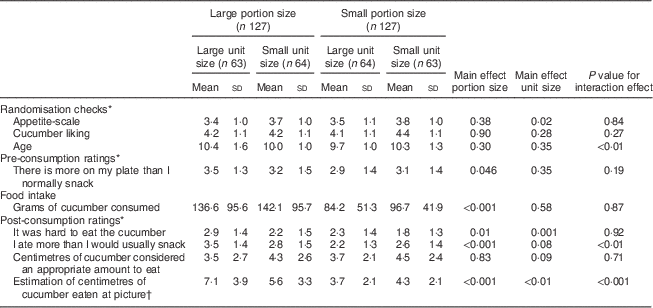
* Numbers (except age and centimetres of cucumber) represent mean scores on each of the scales (5-point scales).
† In this analysis, the covariate ‘grams of cucumber eaten’ was included to correct for true consumption.
Amount of cucumber consumed
On average, children ate 115 (sd 79) g of cucumber. Consumption of cucumber was normally distributed (skewness=0·28; kurtosis=−0·75). Thirty children in total did not eat any of the cucumber. These non-eaters were equally distributed across conditions (P=0·18; Fisher’s exact test). Almost half of all children (127 children out of 255) finished the entire portion that was served to them. These ‘plate cleaners’ were also equally distributed across conditions (P=0·51; Fisher’s exact test).
ANCOVA with unit size and package size as independent variables and grams of cucumber consumed as dependent variable revealed a main effect of portion size (F(1,248)=47·5, P<0·001, $\eta _{{\mathop{\rm p}\nolimits} }^{2} $
=0·16) in that participants in the large portion size conditions ate more than participants in the small portion size conditions (large portion size: mean 139·4 (sd 95·3) g; small portion size: mean 90·4 (sd 47·1) g). So, participants being presented with the large portion size ate about 54 % more cucumber relative to the small portion size. No main effect of unit size (F(1,248)=0·3, P=0·58,
$\eta _{{\mathop{\rm p}\nolimits} }^{2} $
=0·16) in that participants in the large portion size conditions ate more than participants in the small portion size conditions (large portion size: mean 139·4 (sd 95·3) g; small portion size: mean 90·4 (sd 47·1) g). So, participants being presented with the large portion size ate about 54 % more cucumber relative to the small portion size. No main effect of unit size (F(1,248)=0·3, P=0·58, $\eta _{{\mathop{\rm p}\nolimits} }^{2} $
=0·001) or interaction effects between unit and portion size (F(1,248)=0·03, P=0·87,
$\eta _{{\mathop{\rm p}\nolimits} }^{2} $
=0·001) or interaction effects between unit and portion size (F(1,248)=0·03, P=0·87, $\eta _{{\mathop{\rm p}\nolimits} }^{2} $
<0·001) on amount of cucumber consumed was observed. After excluding from the analysis all participants who finished their plate (plate cleaners), we still observed the effect of portion size on intake (P<0·001). Similarly, when excluding non-eaters from the analysis, the portion size effect was still there (P<0·001).Footnote *
$\eta _{{\mathop{\rm p}\nolimits} }^{2} $
<0·001) on amount of cucumber consumed was observed. After excluding from the analysis all participants who finished their plate (plate cleaners), we still observed the effect of portion size on intake (P<0·001). Similarly, when excluding non-eaters from the analysis, the portion size effect was still there (P<0·001).Footnote *
Effects on pre- and post-consumption evaluations of cucumber
There was a significant main effect of portion size on perceptions of the amount served (F(1,246)=4·0, P=0·046, $\eta _{{\mathop{\rm p}\nolimits} }^{2} $
=0·02), but not of unit size (F(1,246)=0·9, P=0·35,
$\eta _{{\mathop{\rm p}\nolimits} }^{2} $
=0·02), but not of unit size (F(1,246)=0·9, P=0·35, $\eta _{{\mathop{\rm p}\nolimits} }^{2} $
=0·004) or of the interaction between unit size and portion size (F(1,246)=1·7, P=0·19,
$\eta _{{\mathop{\rm p}\nolimits} }^{2} $
=0·004) or of the interaction between unit size and portion size (F(1,246)=1·7, P=0·19, $\eta _{{\mathop{\rm p}\nolimits} }^{2} $
=0·007). Children who were served the large portion more strongly reported that they were served a larger portion than they would normally snack (mean 3·3 (sd 1·4)) compared with children who were served a small portion (mean 3·0 (sd 1·4)).
$\eta _{{\mathop{\rm p}\nolimits} }^{2} $
=0·007). Children who were served the large portion more strongly reported that they were served a larger portion than they would normally snack (mean 3·3 (sd 1·4)) compared with children who were served a small portion (mean 3·0 (sd 1·4)).
Main effects of portion size (F(1,247)=6·6, P=0·01, $\eta _{{\mathop{\rm p}\nolimits} }^{2} $
=0·03) and unit size (F(1,247)=11·8, P=0·001,
$\eta _{{\mathop{\rm p}\nolimits} }^{2} $
=0·03) and unit size (F(1,247)=11·8, P=0·001, $\eta _{{\mathop{\rm p}\nolimits} }^{2} $
=0·05) on eating difficulty were found, but no interaction (F(1,247)=0·01, P=0·92,
$\eta _{{\mathop{\rm p}\nolimits} }^{2} $
=0·05) on eating difficulty were found, but no interaction (F(1,247)=0·01, P=0·92, $\eta _{{\mathop{\rm p}\nolimits} }^{2} $
<0·001) was observed. Children felt that larger portions and units were harder to eat.
$\eta _{{\mathop{\rm p}\nolimits} }^{2} $
<0·001) was observed. Children felt that larger portions and units were harder to eat.
Both portion and unit size did not affect consumption norms of what children considered to be an appropriate amount to eat (main effect portion size: F(1,222)=0·05, P=0·83, $\eta _{{\mathop{\rm p}\nolimits} }^{2} $
<0·001; main effect unit size: F(1,222)=2·8, P=0·09,
$\eta _{{\mathop{\rm p}\nolimits} }^{2} $
<0·001; main effect unit size: F(1,222)=2·8, P=0·09, $\eta _{{\mathop{\rm p}\nolimits} }^{2} $
=0·013; interaction: F(1,222)=0·1, P=0·71,
$\eta _{{\mathop{\rm p}\nolimits} }^{2} $
=0·013; interaction: F(1,222)=0·1, P=0·71, $\eta _{{\mathop{\rm p}\nolimits} }^{2} $
=0·001).
$\eta _{{\mathop{\rm p}\nolimits} }^{2} $
=0·001).
Significant main effects of portion size and unit size, and a significant interaction effect, were found on children’s estimation of their own consumption in centimetres of cucumber. In this analysis, the actual amount of cucumber eaten in grams was added as a covariate to account for true consumption. Irrespective of the actual amount eaten, children felt they ate more cucumber when served a large portion (main effect portion size: F(1,234)=16·8, P<0·001, $\eta _{{\mathop{\rm p}\nolimits} }^{2} $
=0·07) or in large units (main effect unit size: F(1,234)=10·1, P<0·01,
$\eta _{{\mathop{\rm p}\nolimits} }^{2} $
=0·07) or in large units (main effect unit size: F(1,234)=10·1, P<0·01, $\eta _{{\mathop{\rm p}\nolimits} }^{2} $
=0·04). There was an interaction effect between portion and unit size (F(1,234)=12·8, P<0·001,
$\eta _{{\mathop{\rm p}\nolimits} }^{2} $
=0·04). There was an interaction effect between portion and unit size (F(1,234)=12·8, P<0·001, $\eta _{{\mathop{\rm p}\nolimits} }^{2} $
=0·05) in that children in the large portion size and unit size condition felt that they had eaten the most cucumber.
$\eta _{{\mathop{\rm p}\nolimits} }^{2} $
=0·05) in that children in the large portion size and unit size condition felt that they had eaten the most cucumber.
Our unit and portion size manipulations impacted scores on the item ‘I ate more than I would usually snack’. On average, children felt they ate more than they would usually do in the large portion size conditions (main effect portion size: F(1, 246)=23·1, P<0·001, $\eta _{{\mathop{\rm p}\nolimits} }^{2} $
=0·09). No main effect of unit size was observed (F(1,246)=3·2, P=0·08,
$\eta _{{\mathop{\rm p}\nolimits} }^{2} $
=0·09). No main effect of unit size was observed (F(1,246)=3·2, P=0·08, $\eta _{{\mathop{\rm p}\nolimits} }^{2} $
=0·013). There was an interaction effect between portion and unit size (F(1,246)=8·4, P<0·01,
$\eta _{{\mathop{\rm p}\nolimits} }^{2} $
=0·013). There was an interaction effect between portion and unit size (F(1,246)=8·4, P<0·01, $\eta _{{\mathop{\rm p}\nolimits} }^{2} $
=0·03) in that children in the large portion size and unit size condition most strongly felt that they ate more than they would normally do.
$\eta _{{\mathop{\rm p}\nolimits} }^{2} $
=0·03) in that children in the large portion size and unit size condition most strongly felt that they ate more than they would normally do.
Discussion
The present study showed that serving more vegetables increases their consumption as a snack by about 54 % among primary-school children. Intake of cucumber increased from 90 g to about 139 g, which is approximately two-thirds of the recommended daily intake of vegetables in the Netherlands (150–200 g).
A recent review of 104 portion size studies among a wide variety of consumers, types of foods and situations showed that doubling of portion size leads to an average consumption increase of 35 %, although the effect is weaker among children, people with a high BMI and women( Reference Zlatevska, Dubelaar and Holden 16 ). Our findings extend this previous research by showing that the same results may be achieved in children when presented a healthy snack.
Only a few studies have investigated the portion size effect for healthy products among children. One study showed that doubling of portions led to an increase of vegetable intake by 37 % and an increase of fruit intake by 70 %( Reference Mathias, Rolls and Birch 17 ), although effects were limited to children who liked the particular food. Similarly, doubling the portion size of fruit and vegetable side dishes added to a meal resulted in a 43 % increased intake of the fruit side dish, although no effect on intake was found for doubling vegetable side dishes( Reference Kral, Kabay and Roe 18 ). In other studies, it was found that adding more vegetables to a meal, for example as a first-course vegetable soup or as a hidden ingredient in pasta sauce, are effective strategies to increase vegetable consumption and decrease meal energy intake due to substitution of other energy-dense meal components( Reference Leahy, Birch and Fisher 19 – Reference Spill, Birch and Roe 22 ). Most of these studies, however, were conducted in laboratory meal settings with small samples of young children aged 4–6 years. The portion size effect as a driver of healthy consumption has not well been investigated in a natural snacking situation among older children.
Moreover, compared with the portion size effect, the unit size effect has received even less attention. While there have been several studies demonstrating that larger units increase consumption, these studies primarily used unhealthy foods, such as cookies and candy( Reference Marchiori, Waroquier and Klein 10 , Reference Marchiori, Waroquier and Klein 11 , Reference Van Kleef, Kavvouris and Van Trijp 13 ). Interestingly, in a study where 9–12-year-olds indicated their liking for snack vegetables it was suggested that children preferred to be served vegetables sliced in small units, which would actually undermine the unit size effect( Reference Olsen, Ritz and Kramer 14 ). Moreover, little is known about how the effects of portion and unit size combine to impact children’s consumption of vegetables as a snack.
Although portion size did influence consumption, serving larger units seemed ineffective in increasing intake in the present study. It may be that serving a larger unit unjustly created the feeling that children had eaten more (even when actual consumption was accounted for). Moreover, pre-slicing did not alter perceptions of how much food is appropriate to eat and available on the plate before eating, but did influence eating convenience. In line with a study by Olsen et al.( Reference Olsen, Ritz and Kramer 14 ), pre-sliced foods were perceived as more convenient to eat and should therefore be favoured over serving larger units. Despite the fact that the unit size effect has been replicated in various studies on unhealthy food intake( Reference Marchiori, Waroquier and Klein 10 , Reference Marchiori, Waroquier and Klein 11 , Reference Van Kleef, Kavvouris and Van Trijp 13 ), more research is needed to explore conditions under which the unit size effect takes place. A potential influencing factor could be the contrast between small and large unit sizes of the food, as this has not been constant across studies. Some unit sizes may make eating more difficult, although in the present study eating difficulty had only a marginal effect on how much children ate.
Strengths and limitations
The present study has some strengths and limitations that need to be acknowledged. Two strengths of the study are the focus on actual eating of snacks in a natural school setting and the large sample size. Nevertheless, as the experiment was conducted in the classroom in which children ate in groups, group dynamics or social influences may have played a role. When being presented with a larger portion size, children felt they ate more than they would usually do. Importantly, the present study investigated only immediate effects on consumption. Future research may also examine potential (negative) delayed effects. It could be that if children perceive that they ate a lot of healthy foods, they may compensate for this later on by eating less (healthy foods) or by eating more unhealthy foods. Furthermore, almost half of the children finished their portion while at the same time no refills were allowed. It is unclear how this may have impacted results. For example, plate cleaners in small portion size conditions may have wanted to eat more, contrary to children in large portion size conditions. Future research could examine the effect of allowing participants to refill their plate as many times as desired.
Implications
The present study has some implications for the development of nutritional advice and interventions to encourage consumption of fruit and vegetables. The key message is to offer larger portions, preferably cut in smaller pieces. For example, presenting children with larger bowls of cucumber, carrots or other raw vegetables and fruit could encourage greater consumption. In this way, children will eat more without verbal encouragement or ‘pushing’ them to eat. We used cucumber to illustrate the influence of portion and unit size cues in consumption in the present study. Although it is likely that our results also apply for other fruits and vegetables, future research could study the generalizability of our findings. Future research also should establish the optimal size of a portion: we used a relatively large portion size in our study in order to allow for variation in consumption. Yet a potential downside of serving larger portions is that children leave vegetables uneaten and food will be wasted. Hence, it is important to identify the optimal portion size a child is comfortable with.
To conclude, the present study showed that children eat more from a healthy vegetable snack when served more, but not more when served in larger pieces.
Acknowledgements
Acknowledgements: The authors thank the children and teachers of the schools for participation in this project. Financial support: This research received no specific grant from any funding agency in the public, commercial or not-for-profit sectors. Conflict of interest: None. Authorship: All authors contributed to the design of the study and critical revision of the manuscript. I.B. was responsible for data collection. E.v.K. carried out the statistical analyses and drafted the manuscript. All authors read and approved the final manuscript. Ethics of human subject participation: The Social Sciences Ethical Committee of Wageningen University approved the study.



