

1. INTRODUCTION
It is standardly assumed that certain types of syntactic structures are islands in the sense that extraction from them is blocked due to universal syntactic constraints. Classic examples include the Complex NP Constraint and the Wh-island Constraint (Ross Reference Ross1967, Phillips Reference Phillips2013):
(1) Complex NP: Complement clause
a. She got the [NP idea [CP that he needed a haircut]].
b. *What1 did she get the [NP idea [CP that he needed __1]]?
(2) Complex NP: Relative clause
a. She wanted to meet [DP the [NP man] [CP who recorded the conversation]]?
b. *What1 did she want to meet [DP the [NP man] [CP who recorded __1]]?
(3) Wh-island
a. He knew [CP where1 she left the car __1].
b. *What2 did he know [CP where1 she left __2 __1]]?
Both the Complex NP Constraint and the Wh-island Constraint are subsumed under the notion of subjacency (Chomsky Reference Chomsky, Anderson and Kiparsky1973, Reference Chomsky, Culicover, Wasow and Akmajian1977) and the phase impenetrability condition (Chomsky Reference Chomsky and Kenstowicz2001). In essence (leaving aside details irrelevant for the present paper), subjacency and the phase impenetrability condition both state that any phrasal extraction from an embedded CP must proceed in successive cyclic steps via the local Spec-CP. Extracting, say, a wh-element from an embedded clause must stop over at the left edge (i.e. Spec-CP) of the embedded clause. If this structural position is already filled, e.g. by another wh-element, as in (3b) above, such extraction is ungrammatical.
However, it has been argued that the Scandinavian languages allow extractions from certain types of islands, including relative clauses and wh-questions (e.g. Erteschik-Shir Reference Erteschik-Shir1973, Reference Erteschik-Shir1982; Engdahl Reference Engdahl1982, Reference Engdahl1997). Christensen, Kizach & Nyvad (Reference Christensen, Kizach and Nyvad2013a, Reference Christensen, Kizach and Nyvadb) examined wh-movement and extraction from wh-islands; short extraction (within the embedded clause), shown in (4a) below, was found to be significantly more acceptable than long extraction (out of the embedded clause to Spec-CP in the matrix clause), illustrated in (4b). In turn, long extraction was significantly more acceptable than extraction across an intervening wh-element (a so-called ‘wh-island violation’), see (4c).
(4)

According to Christensen et al. (Reference Christensen, Kizach and Nyvad2013a, Reference Christensen, Kizach and Nyvadb), wh-islands do not block extraction (and hence, are not islands) in Danish and the patterns of graded acceptability in long extractions are better explained by a processing account than a syntactic approach with island constraints. Apparent wh-island violations are not ungrammatical but, rather, they are degraded due to working memory load, as indeed is long extraction in general. (Working memory load can, for example, be measured in terms of the number of discourse referents between antecedent and trace (Gibson Reference Gibson1998, Reference Gibson, Marantz, Miyashita and O'Neil2000), or in terms of the number of intervening maximal projections (Hawkins Reference Hawkins1994, Reference Hawkins2004).)Footnote 1 In other words, extraction from an embedded clause is associated with decreased acceptability. Since the apparent degraded acceptability in violations of the Wh-island Constraint can be accounted for by working memory load, and since such violations are arguably grammatical in Danish (at least), it is natural to explore whether other cases of island violations can be accounted for in similar ways. Furthermore, since it is argued that syntactic constraints on extraction from islands are universal (e.g. Ross Reference Ross1967, Kush & Lindahl Reference Kush and Lindahl2011, Phillips Reference Phillips2013), the fact that there is evidence (Christensen et al. Reference Christensen, Kizach and Nyvad2013a) that extraction from wh-islands is possible in Danish, a language which is structurally very similar to English (and Swedish), seriously weakens the basis for universality. In this paper we provide evidence to suggest that extraction from another type of island, namely relative clauses, is indeed also possible in Danish.
Kush & Lindahl (Reference Kush and Lindahl2011) assume that the constraints that bar extractions from islands are universal, and that any violations are only apparent (see also Kush, Omaki & Hornstein Reference Kush, Omaki, Hornstein, Sprouse and Hornstein2013). Specifically, Kush & Lindahl argue that Swedish relative clauses that allow extraction have a structure different from otherwise parallel ones that block extraction. According to Kush & Lindahl, verbs such as träffa ‘meet’, as in (5), take a normal DP object containing an NP modified by a CP relative clause, which is a ‘true relative’ that blocks extraction.
(5)
This is the standard analysis for relative clauses. Verbs such as känna ‘know’, as in (6), on the other hand, are argued to select a small clause (SC), that is a Predicate Phrase (PredP) complement headed by the relative complementizer som with the DP en man ‘a man’ in its specifier.
(6)
A small clause (PredP) is not assumed to block extraction. This analysis makes it possible to maintain a universal account of islands: escapable islands are not really islands, they are small clauses (see also Kush et al. Reference Kush, Omaki, Hornstein, Sprouse and Hornstein2013). However, Kush & Lindahl (Reference Kush and Lindahl2011) tested only two verbs, namely, se ‘see’ and träffa ‘meet’, a fact that significantly weakens their argument to begin with.Footnote 2
In Danish, as in Swedish, som is ambiguous. It can either introduce a subject relative clause (SUBJ REL) or an object relative clause (OBJ REL; som in C°), as in (7) below, or head a small clause (SC), a PredP with som in Pred° and the subject in Spec-PredP, as in (8).
(7)
(8)

Furthermore, small clauses with som are often ambiguous with respect to scope (narrow scope: modifying the NP in the object DP, wide scope: modifying the entire VP), as in (9), where the SC som lingvist(er) ‘as (a) linguist(s)’ is a free predicative.
(9)
Kush et al. (Reference Kush, Omaki, Hornstein, Sprouse and Hornstein2013:254) argue that the lexical ambiguity of som (or rather, the syncretism between som as C° and som as Pred°) has an ameliorating effect on acceptability. In Danish, subject relative clauses can also be introduced by der instead of som (Vikner Reference Vikner1991); that is, der can replace som in (7a), but not in (7b), (8) or (9). Subject relative clauses with der are more frequent than those with som. A corpus search in the Danish online corpus KorpusDK (which consists of 56 million words) resulted in 7,937 hits for som ikke ‘that not’ and 13,086 for der ikke ‘that not’; som/der + ikke is unambiguously the beginning of a subject relative clause. As illustrated in (10a) below, both som and der may introduce a subject relative.
(10)
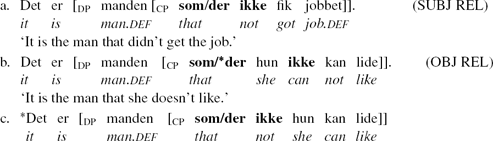
The example in (10b) shows that der is ungrammatical as the head of an object relative. In embedded clauses, sentential adverbials, e.g. negation as shown in (10b), intervene between the subject and the verbs.Footnote 3 As shown in (10c), placing negation before the subject is ungrammatical.
The complementizer der unambiguously introduces a subject relative clause, whereas som is (locally) ambiguous between introducing either a subject or object relative, and a small clause. Hence, any apparent ameliorating effect (i.e. increased acceptability) due to the ambiguous nature of som should not be found with der, because only som can be the head of a small clause. Furthermore, if extraction is indeed possible only from small clauses (‘apparent’ relative clauses) headed by som, then otherwise parallel examples with der should be significantly less acceptable because they must be ‘true’ relative clauses. In other words, sentences that differ only with respect to the presence of either som or der should have significantly different acceptability ratings.
This paper presents data from a survey of the acceptability of extractions from Danish relative clauses with both som and der. In order to avoid potential artifacts of lexical idiosyncrasies of particular verbs, we included 16 different matrix verbs. We made the following three main predictions:
Prediction 1. Extraction from an embedded clause reduces acceptability
Based on prior findings, we predict extraction to be a significant predictor of acceptability. Sentences with extraction, [+Extraction], from relative clauses are less acceptable than corresponding examples without extraction, [–Extraction]. (Note that this prediction is independent of the choice of any particular syntactic theory because the asymmetry also follows from, e.g., linearization requirements, word order preference, frequency, derivational complexity, working memory, etc.).
Prediction 2. The acceptability of extraction from a relative clause is not dependent on the SC-selecting ability [±SC] of the matrix verb
From a processing point of view, when comparing a number of different verbs, we predict that there is no significant interaction between [±Extraction] and [±SC]. Individual differences between particular verbs may stem from idiosyncratic semantic or pragmatic differences, as well as from differences in frequency of occurrence. (All things being equal, more frequent items, sentence types as well as words, are more acceptable than less frequent items, assuming that acceptability, just like response time, reflects processing cost, see Fanselow & Frisch Reference Fanselow, Frisch, Fanselow, Fery and Schlesewsky2006; Christensen et al. Reference Christensen, Kizach and Nyvad2013a, b).
Prediction 3. The acceptability of extraction from a relative clause is not dependent on the choice of complementizer COMP
All things being equal, we predict that there is no significant difference in acceptability between sentences with som and with der, because they introduce otherwise identical relative clauses. On the other hand, if som introduces a small clause instead of a relative clause, as argued by Kush & Lindahl (Reference Kush and Lindahl2011), sentences with som should be significantly more acceptable than corresponding sentences with der (which is incompatible with a small-clause reading).
2. NORMING STUDY
In order to ensure that the matrix verbs in our stimuli were categorized correctly as either SC-selecting ([+SC]) or not SC-selecting ([–SC]), we conducted a norming study prior to the actual acceptability study. Thirty-two participants (all native speakers of Danish) answered a questionnaire on Google Drive (https://drive.google.com) in which they were asked to rate sentences on a Likert scale, ranging from 1 (ugrammatisk ‘ungrammatical’) to 7 (helt OK ‘perfectly OK’). The list of sentences contained 36 target sentences and 44 unrelated fillers in randomized order.
In each target sentence, in order to prevent a wide scope reading of som, as in (9b) above, the subject was plural while the SC predicate was singular:
(11)
(12)

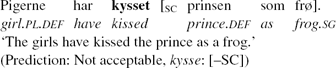
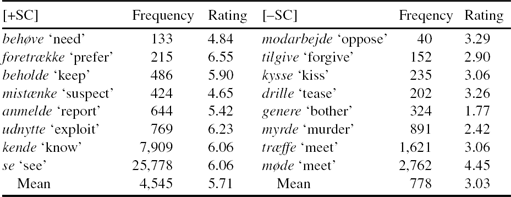
The verbs in sentences with a mean rating ≤ 3.5 (eight verbs) were categorized as [–SC], and those with a mean rating ≥ 4.5 (12 verbs), were categorized as [+SC]. Seven of these eight [–SC] verbs were then pseudo-matched with seven [+SC] verbs based on the frequency of occurrence of each of the verbs (the exact word form) in the Danish online corpus Korpus.dk, see Table 1. (The verb overtale ‘convince’, [–SC], freq. = 245, rating = 2.39, was excluded from the final set because there is a strong preference for it to occur as a ditransitive verb.) Because møde ‘meet’ is the natural Danish translation of the Swedish träffa, which is one of the two verbs tested by Kush & Lindahl and which they categorized as [–SC], we included møde in the [–SC] category, and paired it with a [+SC] verb, even though it received an intermediate acceptability rating. Below we also test the effects of placing møde in the [+SC] category and of leaving it out.
Verbs included in the target stimuli, their respective [±SC] classification, frequency (number of occurrences in the Danish online corpus, KorpusDK, consisting of 56 million words), and mean acceptability rating (on a seven-point Likert scale). Verbs on the same row were subsequently paired in the stimulus for the acceptability survey and appeared as matrix verbs in the stimulus in otherwise identical sentences.

3. ACCEPTABILITY SURVEY
On the basis of the results of the norming study, we constructed a number of sentences similar to the examples cited in Kush & Lindahl (Reference Kush and Lindahl2011), keeping constant sentence length (11 words), matrix tense (present) and aspect (perfect), and animacy of subject and object ([+Animate]). We chose to use the present perfect in the matrix clause in order to avoid potential subject/object ambiguities that might influence acceptability. Our stimuli consisted of 16 sets of four sentences as in (13), eight sets with som and eight sets with der, i.e. 64 test sentences in total plus 18 unrelated fillers (nine simple, grammatical fillers and nine clearly ungrammatical, complex fillers).
(13)
In each [+Extraction] sentence the extracted object was compatible with being temporarily attached as the object of the matrix verb (matrix verb compatibility, see Christensen et al. Reference Christensen, Kizach and Nyvad2013a, Kizach, Nyvad & Christensen Reference Kizach, Nyvad and Christensen2013). Keeping this factor constant is important because matrix verb incompatibility would otherwise lower acceptability. In addition, semantic cohesion between matrix and embedded clause was kept constant to ensure that potential reductions in acceptability would not be due to lack of semantic cohesion. For example, She'll get totally drunk if she drinks that whisky before the game is significantly more acceptable in English than She'll get totally drunk if she loses that comb before the game; for Danish data, see Poulsen (Reference Poulsen2008). In our stimuli, all sentences were cohesive (e.g. both se ‘see’ ([+SC]) and møde ‘meet’ ([–SC] cohere with a pensioner who had such a dog). Similarly, the well-formedness of the information structure is kept constant. According to Engdahl (Reference Engdahl1997), the possibility of extracting from so-called islands in the Scandinavian languages is due to a preference for utterance structures that involve the fronting of either contrastive or continuous topics. Thus, in order for an extraction to be acceptable, two pragmatic factors have to be respected: (i) topicalization must be motivated by the context, and (ii) the remainder of the utterance has to be an appropriate (i.e. coherent and relevant) comment on the fronted topic. In other words, if a sentence is pragmatically ill-formed without extraction, it will also be ill-formed with extraction. (See also the point about semantic cohesion above.) For example, in ??Den teorin känner jag mannen som tror på ‘That theory, I know the man who believes in’, the embedded predicate tror på ‘believes in’ denotes a ‘many-to-one relation’, which, according to Engdahl (Reference Engdahl1997:28), makes the sentence odd out of context (usually there are more than one believers of a theory), whereas Den teorin känner jag ingen som tror på ‘That theory, I do not know anyone who believes in’ is pragmatically more appropriate (see also Allwood Reference Allwood1982). In our experiment, all sentences were presented without context, but all of them conformed to the requirement that the comment must be appropriate.
The stimuli were distributed over four lists such that each participant saw each matrix verb only once, and such that [±SC], [±Extraction] as well as COMP (som/der) were distributed evenly. The same 18 fillers occurred on all four lists, such that each list consisted of 34 sentences in randomized order. The four lists were presented as online surveys using Google Drive. The task consisted of acceptability judgments on a seven-point Likert scale (1 = helt uacceptabel ‘completely unacceptable, 7 = helt acceptabel ‘completely acceptable’).
The online survey was sent to staff and student forums on Aarhus University's intranet. In total, 112 people (all native speakers of Danish) participated in the survey (22 male, 90 female; participants per list: 22, 32, 28, 30), mean age 26.07 years (range = 18–71, SD = 7.57).
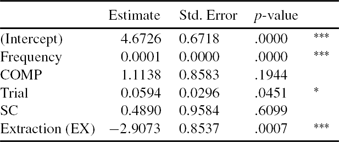
The results were subjected to a linear mixed-effects analysis using the lme4-package for R (R Development Core Team 2009; Bates, Maechler, & Bolker Reference Bates, Maechler and Bolker2011). The model included random intercepts and slopes for items and participants (Barr et al. Reference Barr, Levy, Scheepers and Tily2013). The results of the analysis are presented in Table 2.
Summary of fixed effects. ‘Estimate’ indicates the relationship between acceptability rating (the output) and each of the predictors (Trial, Frequency, Extraction, SC, COMP, and possible interactions).
*** p < .001; * p < .05
As shown in Table 2, when extraction increases by one unit (i.e. from [–Extraction] to [+Extraction], acceptability decreases (the estimate is negative) by 2.9073 units (when the other factors are kept constant), which is a significant change (p = .0007). Likewise, when SC increases by one unit (i.e. from [–SC] to [+SC]), acceptability increases by 0.4890 units, a non-significant change, p = .6099. Trial refers to the order of presentation, the position of a sentence on the randomized list; a positive effect of Trial on acceptability, as evidenced by the positive estimate value, 0.0594, indicates a significant repetition effect (p = .0451). All things being equal, the more sentences the participants saw, the higher their acceptability ratings.
As outlined in Section 1 above, we made three predictions about extraction from relative clauses. Prediction 1, that extraction from an embedded clause reduces acceptability; Prediction 2, that the acceptability of extraction from a relative clause is not dependent on the SC-selecting ability [±SC] of the matrix verb; and Prediction 3, that the acceptability of extraction from a relative clause is not dependent on the choice of complementizer COMP (som/der). As the statistical analysis in Table 1 above shows, all three predictions were borne out: While the effect of [±Extraction] was significant (p = .0007) (Prediction 1), there were no significant effects of [SC] (Prediction 2) or COMP (Prediction 3). In addition, none of the potential (two-, three-, or four-way) interactions between Trial, Extraction, SC, and COMP factors was significant (p ≥ .1811) indicating that the participants did not change their judgments as a function of exposure. That acceptability was more or less stable is also illustrated in Figure 1. From mere visual inspection it is clear that there was not even a (non-significant) trend or consistent [±SC] contrast across the individual participants (the slopes of the lines are very flat and go in different directions), whereas the effect of Extraction had a very stable (and statistically significant) effect across participants (a steep negative slope).
By-subject plots of acceptability (Rating) as the function of [±SC] (left) and [±Extraction] (right). On the x-axis, 0 = [–SC/Extraction], 1 = [+SC/Extraction]. The numbers (1–112) above each sub-plot refer to individual participants.
As explained above, we included the verb møde ‘meet’ as [– SC] (see Table 1) even though it received an intermediate acceptability rating in the norming study. The reason for this was that it corresponds to one of the two verbs examined in Kush & Lindahl (Reference Kush and Lindahl2011). To see if the [±SC] status of møde affected the overall results, we ran the mixed-effects model again, with møde categorized as [+SC]. The results were basically the same – Trial (i.e. the structural repetition effect): p = .0041, Frequency and Extraction: p < .0001, and all the other effects p > 0.05.
We also ran the model with both møde ‘meet’ and se ‘see’ left out (since they form a pair in Table 1), but again, the results were essentially the same – Trial: p = .0008, Frequency and Extraction: p < .0001, and all other effects p > .33. However, in this model, the Trial × Extraction interaction was significant (estimate = –.0556, p = .0405), which renders the main effects of Trial and Extraction uninterpretable. The effect of [±SC] was still not significant, p = .6524. Since changing the [SC] value of møde did not change the overall results and since we have no theoretical or other reason to exclude møde and se (the two verbs tested by Kush & Lindahl), we kept both in the model. Below we thus only refer to the results in Table 2.
To explore the relative distribution of the acceptability of the 16 individual verbs, we plotted the mean acceptability of each verb along [–Extraction], the x-axis in Figure 2, and [+Extraction], the y-axis. From mere visual inspection, it is clear that [±SC] does not manifest itself as distinct categories, whereas [±Extraction] does.
The 16 matrix verbs plotted against the mean acceptability rating without extraction (x-axis) and with extraction (y-axis). Red circles indicate [–SC] verbs, blue triangles [+SC] verbs. Error bars ±1 standard error. The grey dotted lines correspond to the cut-off points for acceptability used in the norming study.
4. DISCUSSION
According to Kush & Lindahl (Reference Kush and Lindahl2011), extractions from (apparent) relative clauses under verbs that are [+SC] should be significantly more acceptable than extractions from clauses under [–SC] verb. However, our results do not support Kush & Lindahl's hypothesis for Danish. As shown in Table 2, there is a significant main effect of extraction independent of [±SC], COMP and Trial: [+Extraction] is associated with a significant decrease in acceptability (p < .0001), recall Prediction 1. This result is exactly what is predicted from a processing perspective (Christensen et al. Reference Christensen, Kizach and Nyvad2013a, b).
As is also evident from Table 2, neither [±SC] nor COMP, nor any of the interaction effects involving these factors, are statistically significant. Hence, our Predictions 2 and 3 are also borne out. As observed, there is no significant difference between sentences headed by [+SC] and [–SC] verbs, and there is no difference between extractions from relative clauses headed by som and those headed by der. Even though there was a main effect of Trial (all things being equal, the more sentences the participants saw, the higher their acceptability ratings), the absence of any significant interaction between Trial and SC also shows that the participants’ acceptability judgment of [+SC] versus [–SC] did not change over time as a result of repeated exposure. Figure 1 also shows that acceptability is stable across participants when it comes to extraction, whereas [±SC] did not show any consistent contrast or trend.
As is clear from Figure 2, the verbs cluster in the high end (towards the right) of the [–Extraction] acceptability scale (x-axis), whereas acceptability is distributed on a continuum along the [–Extraction] (vertical) acceptability scale (y-axis). This distribution is fully compatible with a processing model, while it seems incompatible with the absolute model of Kush & Lindahl (Reference Kush and Lindahl2011) without additional stipulations. Interestingly, the three most frequent verbs, se ‘see’, kende ‘know’, and møde ‘meet’, also have the highest ranking, while they do not seem to form a distinct category that separates them from the other verbs. It should also be noted that the [–SC] verb møde received the highest mean rating, which contrasts with Kush & Lindahl's results from Swedish.
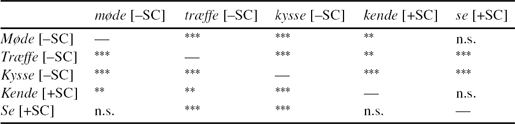
To see whether the acceptability of [+Extraction] of the individual verbs was significantly different, we fitted post hoc mixed-effects models to the [+Extraction] (the y-axis in Figure 2) subset and focused on the differences between the four individual verbs corresponding to those mentioned in Kush & Lindahl (Reference Kush and Lindahl2011), se ‘see’, kende ‘know’, møde ‘meet’, and kysse ‘kiss’, as well as træffe, which also means ‘meet’ (møde and træffe differ in style and may or may not differ in [SC] value).Footnote 4 The results are summarized in Table 3.
Summary of post hoc mixed-effects models fitted to the [+Extraction] condition with verb as predictor. The table shows only five verbs, but the rest of the 16 verbs were included in the analysis.
*** p < .001, **p < .01; n.s. = not significant (p > .05)
As the results in Table 3 show, se and møde do not differ significantly from each other though they have different [SC] values, and kysse differs from the others regardless of [±SC]. In other words, had we chosen to include only two verbs with opposite [SC] values, as Kush & Lindahl (Reference Kush and Lindahl2011) did, such as kysse and kende, we would have found a significant result, but this result would probably have been due to the selection of verbs alone, not to a real contrast in [±SC]. Overall, our results strongly suggest that Kush & Lindahl's claims about Swedish do not hold for Danish and that the result in Kush & Lindahl (Reference Kush and Lindahl2011) may be an artifact of the particular choice of verbs (i.e. selection bias).
There are at least two possible interpretations of the data presented here. The first interpretation (to be dismissed) is that all the sentences with extraction are actually ungrammatical – they all involve a violation of the Complex NP Constraint; nevertheless, the exceptionally high frequency of the matrix verbs has a positive effect on the overall acceptability of the sentences in which they occur. That is, frequency (not the lexical ambiguity of som) has an ameliorating effect on acceptability. However, it seems unlikely that high frequency alone would make an ungrammatical sentence grammatical; such an effect would presumably only be possible with grammatical strings (as Sprouse Reference Sprouse2007 argues for priming/repetition effects). As far as we can ascertain, frequency has no ameliorating effect on the ungrammaticality of the examples in (14) (se is highly frequent, frequency in KorpusDK = 25,778, whereas kysse is not, frequency = 235, see Table 1), as both examples are starkly ungrammatical:
(14)
Frequency can be interpreted as a type of repetition effect that does not ameliorate ungrammaticality, as illustrated in (14) above. Similarly, Christensen et al. (Reference Christensen, Kizach and Nyvad2013a) report that extractions from wh-islands, such as (4c) above, showed a repetition effect (the acceptability of particular structures increased slightly as a result of repeated exposure during the experiment), whereas ungrammatical fillers showed no such effect. Following Sprouse (Reference Sprouse2007:124), who argues that repetition effects on acceptability are only possible with grammatical structures, Christensen et al. (Reference Christensen, Kizach and Nyvad2013a) argue that island extractions are indeed grammatical, though highly degraded.
The second interpretation is that extractions from relative clauses are in fact grammatical with varying degrees of acceptability. The factor/feature that separates examples with a high acceptability rating from those with a low acceptability rating remains to be discovered (our results clearly suggest that [±SC] is not the crucial factor). This interpretation is also compatible with the amelioration effect of frequency, since amelioration presumably only works with grammatical strings. However, there is no need to stipulate a different type of structure in order to enable extraction. In Danish, extraction from, e.g., embedded interrogatives, which are normally taken to be islands (for example in English), is also possible, which independently suggests that there is an ‘escape hatch’, see (15).
(15)
This ‘escape hatch’ is an optional specifier position that can only contain an empty category, such as a silent copy/trace of movement. In other words, this escape hatch is independently motivated (see Nyvad, Christensen & Vikner Reference Nyvad, Christensen and Vikner2014 for a detailed account of stacked complementizers, embedded V2, and island extractions). As shown in (15a) above, in Danish as in English, clause-internal (short) wh-extraction is ungrammatical in an embedded interrogative clause headed by om ‘if’. However, as shown in (15b), Danish is different from English when it comes to long extraction: in Danish, extraction from an embedded interrogative clause headed by om ‘if’ is perfectly grammatical.
There is no structural contrast because escapable and inescapable islands (i.e. acceptable and unacceptable extractions from relative clauses) both have the same structure with the available escape hatch. Similarly, extraction from an embedded wh-question, as in (4c) above, repeated here as (16b), also requires an ‘escape hatch’, an additional Spec-CP that is incompatible with an overt operator, as illustrated in (16a):
(16)
The factors that make extraction possible/acceptable are presumably extra-syntactic, e.g. definiteness (Allwood Reference Allwood1982, Engdahl Reference Engdahl1982), semantic dominance (Erteshik-Shir Reference Erteschik-Shir1973, Reference Erteschik-Shir1982), or pragmatic salience (Deane Reference Deane1991) – all of which are fully compatible with a processing account.
Whatever factor separates the verbs that facilitate extraction from relative clauses from those that do not, it cannot be the lexical ambiguity of som; in our results, there was no difference between the potentially ambiguous som and the unambiguous der.
The null hypothesis must be that two strings that on the surface appear to have the same structure, indeed do have the same structure. Our data show that there is insufficient evidence to support the alternative hypothesis, namely, that there is a structural contrast between acceptable and unacceptable extractions from subject relative clauses, in particular, that some ‘apparent’ relative clauses are small clauses (PredPs headed by som), whereas ‘real’ relative clauses are full clauses (CPs headed by som). Consequently, all the relative clauses, at the very least the ones investigated here, are in fact CPs, which is also the standard analysis.
Finally, we would like to emphasize that our results are compatible with a parameterized approach as well as with a universalist approach. In certain cases, such as Danish wh-islands, locality effects (and reduced acceptability) arise due to working memory load, not due to a grammatical filter or a wh-constraint. It is perfectly possible for the principle of locality in syntax as well as cyclic derivation to be universal; in that case, the fact that the Scandinavian languages allow extractions from islands is most likely due to recursive CP-structures in embedded clauses, a structural feature that may be subject to parametric variation (Nyvad et al., Reference Nyvad, Christensen and Vikner2014). In other words, some islands have bridges that allow elements to escape, and this seems to be the case in the Scandinavian languages in particular.
ACKNOWLEDGEMENTS
We would like to thank Johannes Kizach for working with us on the pilot studies for this study, and for discussing the statistical models. We would also like to thank Ole Togeby, Sten Vikner, Johanna Wood, and four anonymous reviewers for valuable comments. Any remaining errors and/or lack of clarity are clearly our own fault.