


Introduction
Human–elephant conflict is a complex and intractable problem in sub-Saharan Africa, especially where farmland lies adjacent to land managed for conservation (Thouless, Reference Thouless1994; Kangwana, Reference Kangwana1995; Barnes, Reference Barnes1996). Although the range and numbers of the African elephant Loxodonta africana declined significantly in the 20th century (Douglas-Hamilton, Reference Douglas-Hamilton1987), expansion of settled agriculture onto rangelands and the fragmentation of areas of open savannah have created conditions for an increase in human–elephant conflict, including damage to property, risk to human life, significant crop damage and loss of livestock (Thouless, Reference Thouless1994; Hoare, Reference Hoare1995; Lee & Graham, Reference Lee and Graham2006).
Crop raiding mostly takes place at night and raiding elephants present real dangers to smallholders protecting crops. Although elephants are attracted to well-grown or ripe crops (Osborn, Reference Osborn2004; Chiyo et al., Reference Chiyo, Cochrane, Naughton and Basuta2005) and the location of crop-raiding can be broadly predicted with knowledge of the location of determining factors (Sitati et al., Reference Sitati, Walpole, Smith and Leader-Williams2003; Graham et al., Reference Graham, Notter, Adams, Lee and Ochieng2010), at the level of the individual farmer or set of fields it is unpredictable in space and time. Elephants often raid in groups, and individual farmers cannot scare them away on their own, even with improved technologies and techniques (Walpole & Linkie, Reference Walpole and Linkie2007). Cooperative guarding is critical in these circumstances (Graham & Ochieng, Reference Graham and Ochieng2008; Hedges & Gunaryadi, Reference Hedges and Gunaryadi2009) yet it is hard to coordinate action with neighbours at night. Similarly, although there are wildlife authorities in many countries to help scare away or even kill raiding elephants, it is hard to call them out whilst raids are taking place, and action in subsequent days does not address the problem of crop loss and is likely to target the wrong animals (Osborn & Parker, Reference Osborn and Parker2003).
Early warning of crop raiding has been identified as an important element in successful deterrence of elephant crop raids (Sitati et al., Reference Sitati, Walpole and Leader-Williams2005; Sitati & Walpole, Reference Sitati and Walpole2006; Hedges & Gunaryadi, Reference Hedges and Gunaryadi2009). Therefore the effectiveness and timeliness of communication among farmers and between farmers and wildlife management authorities could be critical for successful management of human–elephant conflict. Effective communication among rural resource users, and between communities and outside agents (whether market or state), is important in the creation of social capital (Bebbington, Reference Bebbington, Potter and Desai2008), in effective common pool resource management (Becker & Ostrom, Reference Becker and Ostrom1995) and in the creation of relations of trust between conservationists and resource users through collective cognitive action (Pretty, Reference Pretty, O’Riordan and Stoll-Kleeman2002). However, such communications can be fraught with misunderstanding, suspicion and delay (Mahanty, Reference Mahanty2002).
The importance of information and communication technologies in development is now widely recognized (UNCTAD, 2010). The total number of mobile subscriptions globally is rising rapidly, and was expected to reach 5 billion in the course of 2010. In sub-Saharan Africa the number of cell phone subscribers increased from 10 million to 110 million users between 2000 and 2006 (Buys et al., Reference Buys, Dasgupta, Thomas and Wheeler2009). By 2006, 57% of Africans were living in areas covered by mobile phone networks (Mayer et al., Reference Mayer, Figueredo, Jensen, Kely, Green and Barra2008). The spread of mobile phones into rural Africa is changing patterns of communication and transforming the way rural as well as urban Africans live, learn and carry out business (Melkote & Steeves, Reference Melkote, Steeves, Okigbo and Eribo2004; van Binsbergen, Reference van Binsbergen, van Binsbergen and van Dijk2004), as illustrated by the spread of mobile phone-based applications for uses such as money transfer (M-PESA; Vaughan, Reference Vaughan2006; Morawczynski & Miscione, Reference Morawczynski, Miscione, Avgerou, Smith and van den Besselaar2008), election monitoring (Mbarika & Mbarika, Reference Mbarika and Mbarika2006) and providing market prices in rural areas (Ananthaswamy, Reference Ananthaswamy2009). It is therefore an obvious question to consider whether mobile phones could have a role in reducing human–elephant conflict by improving communications in rural areas.
The use of mobile phone technology in tracking of elephants with global positioning systems, whereby smart collars fitted on elephants relay location information over the mobile phone network (Graham et al., Reference Graham, Gichohi, Kamau, Aike, Craig, Douglas-Hamilton and Adams2009a) demonstrates its potential in the management of human–elephant conflict (Boyle, Reference Boyle2010) but there have been few empirical studies of the effectiveness and timeliness of communication among farmers and between farmers and wildlife management authorities in management of human–elephant conflict. Here we analyse the evolution of communication about human–elephant conflict among various types of landholders and conservation organizations in Laikipia County, Kenya, and assess the potential of mobile phone communication in human–elephant conflict management through analysis of a 1-month intensive trial.
Study area
Laikipia comprises a 10,000 km2 plateau located on the equator between Mount Kenya, the Aberdare Mountains and the Rift Valley in north-central Kenya (Fig. 1a). Rainfall declines from 800 mm per annum in the south to 300 mm in the north. A single permanent river, the Ewaso Ngiro, drains northwards into the dry Samburu rangelands. Laikipia has no formally protected wildlife areas but contains a large number and diversity of wild mammals including Kenya’s second largest population of elephants, numbering > 7,000 animals (Litoroh et al., Reference Litoroh, Ihwagi, Mayienda, Bernard and Douglas-Hamilton2010). Wildlife numbers in Laikipia have been relatively stable over the last 30 years (Georgiadis et al., Reference Georgiadis, Olwero, Ojwang and Romnach2007), in contrast to the decline nationally in Kenya (Western et al., Reference Western, Russel and Cuthill2009).
Location of Laikipia County, showing (a) crop-raiding and trial sites and (b) the location of the 163-km West Laikipia Fence. KWS, Kenya Wildlife Service.
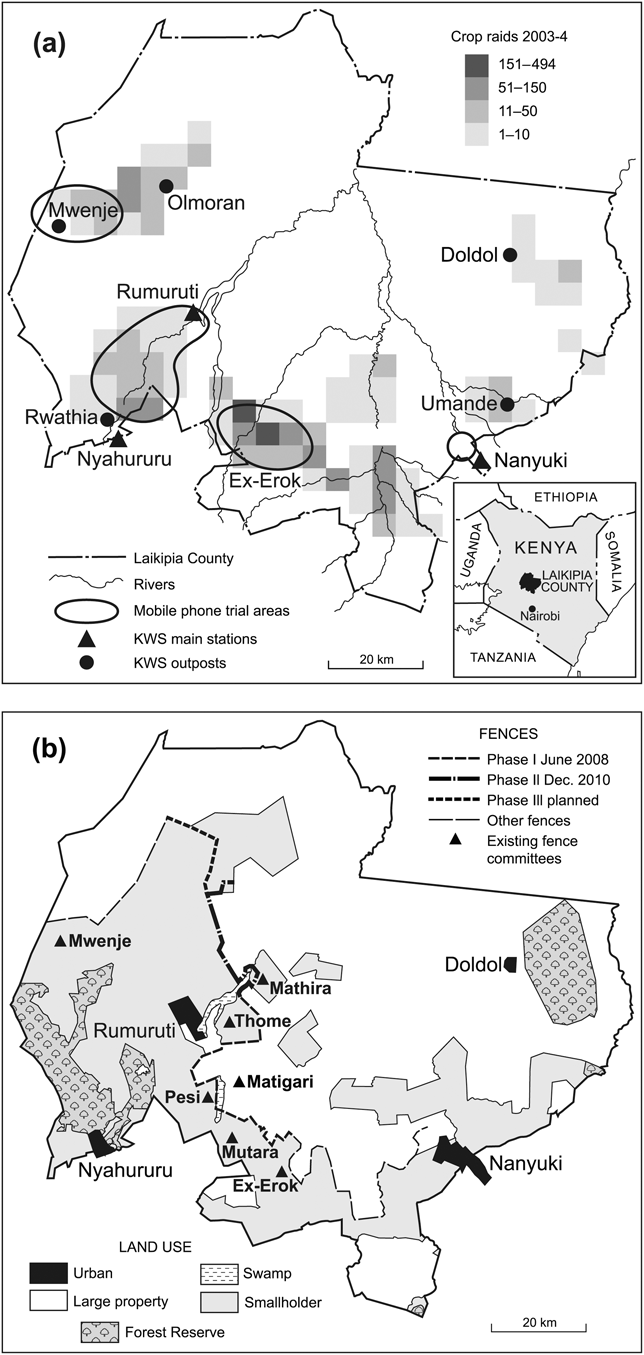
Laikipia is a patchwork of different land uses and forms of land tenure, including smallholder farms, large ranches, privately owned wildlife conservancies, government ranch land and communal rangeland (group ranches). Maasai pastoralists were evicted by the colonial government in 1911 and the land subdivided for European settlement (Hughes, Reference Hughes2005). After Kenyan independence in 1963 many properties were purchased and subdivided in government and non-governmental land buying schemes for smallholder agriculture (Kohler, Reference Kohler1987; Graham, Reference Graham2007). Some large properties persisted (currently covering 42% of the County); these mostly tolerate elephants and many engage in wildlife tourism enterprises. Largely unplanned processes of land subdivision and settlement of former ranches have left large areas of smallholder farms surrounded by private and group ranches, informal grazing areas and forests containing substantial elephant populations (Fig. 1a). Human–elephant conflict is a significant problem when elephants leave land where they are tolerated and move into areas of smallholder cultivation (Thouless, Reference Thouless1994; Gadd, Reference Gadd2005; Graham, Reference Graham2007). Between 2003 and 2004, 2,429 crop-raiding incidents were recorded in southern Laikipia (Graham et al., Reference Graham, Notter, Adams, Lee and Ochieng2010).
Methods
Assessment of the role of mobile phones in human–elephant conflict reporting
We assessed the evolving nature of reporting of human-elephant conflict incidents in Laikipia before the arrival of mobile phone technology in 2002, after the establishment of a formal system for reporting crop raiding (2002–2007), and after the creation of a district-wide electric elephant fence (2008). We analysed the interactions among smallholder farmers, managers of large-scale ranches and wildlife conservancies, conservation NGOs and the Kenya Wildlife Service. We drew on our personal observations from participation in human–elephant conflict management over this period with the Laikipia Elephant Project. Our analysis was informed by project reports and regular discussions with local conservation staff.
Trial of the use of mobile phones in human–elephant conflict mitigation
We assessed the use of mobile phones in human–elephant conflict management in an intensive trial in three study areas between November and December 2007, a time of year when human–elephant conflict is generally high. At the time of this trial Safaricom Ltd was the only major service provider in the study area.
Selection of study sites
The case study sites (Mwenje, Rumuruti and Ex-Erok; Fig. 1a) all had the following characteristics: high levels of human–elephant conflict; existence of a network of individuals collectively addressing human–elephant conflict either within, or with the potential to work within, a single management structure; good mobile phone coverage; and accessible by vehicle.
At Mwenje elephants break through the electrified perimeter fence of the 40,000-ha Laikipia Nature Conservancy to raid crops on intensively farmed smallholder land immediately south of the boundary. Up to six Conservancy guards patrol the fence to prevent breakthroughs and an alarm fitted in each fence energizer house alerts guards of breakages. The guards have access to a vehicle during times of high pressure by elephants on the perimeter fence. Neighbouring small-scale farmers recruit scouts to help scare fence-breaking elephants, assisted by two rangers (who operate on foot) from a Kenya Wildlife Service post located within 1 km of the fence.
At Rumuruti elephants from the Forest Reserve raid surrounding smallholder farms at night. Community scouts from the Rumuruti Forest Association patrol the forest to stop illegal logging and report human–elephant conflict. There are Kenya Wildlife Service stations at Rumuruti Town (c. 3 km from Rumuruti Forest) and at Nyaharuru Town (c. 2 km from Rumuruti Forest), both equipped with at least one vehicle and relatively large teams of rangers (> 10 in each station).
At Ex-Erok elephants from the Ol Pejeta Conservancy and ADC Mutara Ranch raid scattered smallholder farms to the south. A community security group was formed in Ex-Erok primarily in response to the problem of livestock theft by transient pastoralists but this group also works cooperatively to scare away crop-raiding elephants. The group calls on support from the Conservancy, the Kenya Wildlife Service and local administrative police to respond to security and crop-raiding incidents.
Monitoring mobile phone communication
At each of the three sites and at the respective Laikipia Elephant Project and Kenya Wildlife Service headquarters in Nanyuki, mobile phone handsets were issued (50 in total across all three sites and in Nanyuki Town) to individuals that could report, respond to or monitor potential or actual incidents of human–elephant conflict or other security incidents (Table 1). Users were given a unique ID code and trained how to use the handsets and follow a simple protocol for voice communication among users. Over the course of the trial all mobile phone communication costs were covered by Safaricom Ltd.
Distribution of the 50 mobile phones across the three trial sites and Nanyuki Town (Fig. 1).

Because of the particular mobile phone communication provided by the network provider (Push-to-Talk), all calls made by trial participants over the course of the trial could be listened into by a defined user group, including research assistants, and monitored. Details of all communication were recorded and scored in relation to the type of incident reported and the associated response.
Questionnaire survey
In the month after the trial 37 participants were interviewed using a short semi-structured questionnaire. Results were coded and a simple descriptive analysis carried out. Results are presented as response frequencies. In addition a group interview with relevant trial participants and associated stakeholders was held in each trial site. A simple check-list of issues was used to generate open discussion with each group. These qualitative data were used to cross-check and contextualize the questionnaire results.
Results
Reporting of human–elephant conflict incidents
Before the use of mobile phones
Prior to the use of mobile phones the system for reporting human–elephant conflict in Laikipia was rudimentary (Fig. 2a). From its establishment in 1989 the Kenya Wildlife Service has been responsible for managing human–wildlife conflict in Laikipia, with some support provided from the managers of large ranches. Kenya Wildlife Service rangers were posted across the County, directed by a Warden in the County headquarters in Nanyuki. In theory armed rangers would turn out to scare crop-raiding elephants away, or if necessary to shoot problem animals. Human–elephant conflict incidents were reported to County headquarters and recorded in an Occurrence Book (Thouless, Reference Thouless1994).
Human–elephant conflict reporting system (a) before and (b) after the introduction of mobile phones, and (c) after the construction of the West Laikipia Fence. KWS, Kenya Wildlife Service.

However, the system for reporting human–elephant conflict incidents did not provide Kenya Wildlife Service with reliable information fast enough for them to reach a site in time either to scare away the elephants, or know which animals were responsible. The large distances between sites of conflict incidents and Wildlife Service posts meant that reports would often only come in during market days when farmers would travel to urban centres. Therefore information flow from farmers to the Wildlife Service was sporadic and inefficient, relying on messages by hand or word of mouth, and timely and effective response was difficult. In some cases the managers of large ranches neighbouring small-scale farms would attempt to provide support to farmers to keep elephants out of crops but poor communication meant that this also was difficult.
After the introduction of mobile phones
When mobile phone coverage was extended across Laikipia in 2002 by Safaricom Ltd, uptake was rapid in farming communities and mobile phones started to be used in an ad hoc way to report human–elephant conflict incidents. However, while the speed of communication about conflict incidents increased, information flow remained erratic and Kenya Wildlife Service officers and the managers of large ranches and wildlife conservancies were beset by demands whose accuracy could not be gauged.
In November 2002 the Laikipia Elephant Project was established as part of a research programme into human–elephant conflict (Graham, Reference Graham2007). A team of scouts were recruited from communities in Laikipia County known to be hot spots of human–elephant conflict from previous research (Thouless, Reference Thouless1994), Kenya Wildlife Service reports and interviews with local people. Scouts were nominated by local community leaders, and had basic writing skills and arithmetic (having completed primary and in some cases secondary school education). In some locations there was a high turnover of candidates until a reliable person was found.
Scouts were trained to visit the location of any reported crop-raiding or human–elephant conflict incident and record information on a standard schedule, using an adapted version of IUCN’s Training package for enumerators of elephant damage (Hoare, Reference Hoare1999b). Scouts were provided with a mobile phone and a hand-held GPS, and trained to send text message reports about the incident, with the time and location in Universal Transverse Mercator coordinates, to the Laikipia Elephant Project office and the Kenya Wildlife Service County headquarters in Nanyuki. These text message reports improved communication between the Wildlife Service and local people. Data were checked for errors and entered into a database by the Laikipia Elephant Project (Graham et al., Reference Graham, Notter, Adams, Lee and Ochieng2010).
The key feature of this upgraded reporting system (Fig. 2b) was the ease of communications provided by mobile phones, combined with a clear protocol for incident verification and reporting. The text messages provided Kenya Wildlife Service rangers with information that they could trust from a source that they knew and could contact for further information. The scouts provided a contact point for the community that ensured rapid and effective communication with the Kenya Wildlife Service. Because the scouts were known and trusted by the Kenya Wildlife Service complaints from farmers were much more likely to receive attention.
After construction of the West Laikipia Electric Fence
In late 2007 management of human–elephant conflict in Laikipia was transformed by the commencement of construction of an electrified fence, 163 km long, across the southern part of the County to separate the open rangeland and ranchland to the North and smallholder farmland to the South (Fig. 1b). The fence was initiated by the Laikipia Wildlife Forum, with funding from the Dutch Government, Kenya Wildlife Service and Kenyan Government, with in kind resources committed by local communities and large ranches. The fence realized a human–elephant conflict alleviation strategy proposed in 2002 (Thouless et al., Reference Thouless, Georgiadis and Olwero2002). This fence changed both the nature of human–elephant conflict incidents and the pattern of communication about it.
In terms of the conflict, the fence did not end crop raiding. In places elephants broke the fence, particularly as early configurations (six wire strands) proved ineffective and had to be rebuilt with outriggers (1-m lengths of electrified wire protruding from the fence at elephant chest height) to prevent elephants reaching and destroying posts (Graham et al., Reference Graham, Gichohi, Kamau, Aike, Craig, Douglas-Hamilton and Adams2009b). The fence also suffered deliberate vandalism (particularly by people wanting to move livestock), and there were issues with maintaining voltage and with components such as solar panels and energizers. Both crop-raiding incidents and problems with the fence itself needed to be reported so they could be addressed.
A series of new groups became involved in the management of human–elephant conflict as a result of the fence (Fig. 2c). The fence management teams of the large ranches and conservancies along the fence line undertook fence construction, inspection and maintenance (of varying effectiveness), and carried out patrols to discourage elephants from breaking through the fence onto smallholder farms. The Laikipia Elephant Project helped establish six community fence management committees in communities along the fence (Mutara, Ex-Erok, Pesi Kiambogo, Matigari, Thome and Mwenje; Fig. 1b). The scouts provided liaison between these committees and adjacent ranches, the Kenya Wildlife Service and the Laikipia Wildlife Forum, and reported fence breakages, crop-raiding and the need for meetings. The Forum appointed a Fence Officer to oversee the work of the scouts (Fig. 2c).
Mobile phones and responses to human–elephant conflict
The mobile phones issued in the intensive trial were used to report, discuss and respond to 83 separate incidents in total (Table 2). The phones were most used in Mwenje (90% of days) and least in Ex-Erok, where human–elephant conflict was less severe. Most incidents (83%) involved human–elephant conflict, almost all of which was crop raiding, although phones were also used to report a farmer killed by an elephant and other incidents, including livestock theft, damage to fences by people, and other wildlife management incidents (e.g. livestock loss to predators).
Use of mobile phones over the trial, showing the number and type of incidents reported and the percentage of reports that were responded to by management authorities.

All interviewees reported that the phones were useful. Reasons included improved communication among all groups (42%), improved response by authorities to incidents reported (33%), and improved communication with the authorities (25%). Seventy-three percent of interviewees reported that mobile phones provided early warning of fence breaking and crop raiding, allowing individuals on the ground to take preventative action. Thus at Mwenje the Laikipia Nature Conservancy fence patrol rangers were able to warn that an elephant had broken out of the Conservancy and tell community members where to go to scare it out of farms and back through the fence.
Twenty-one percent of users felt that the use of mobile phones improved the response of non-community groups, in particular the Kenya Wildlife Service, to reports of crop raiding. Phones also allowed the community to guide the Kenya Wildlife Service to specific sites of conflict, saving time and resources. Kenya Wildlife Service rangers reported that with reliable information on the location of incidents from designated mobile phone users they could work more efficiently across a larger area.
Interviewees also reported that enhanced communication improved relationships, reduced tension and improved trust among farmers, the Kenya Wildlife Service, private landowners, and local law enforcement officials. Thus at Mwenje negative relations between the Laikipia Nature Conservancy and neighbouring communities were said to have improved during the trial and attitudes improved within both the community and Conservancy. Users reported that the relationship between the Kenya Wildlife Service and communities in each of the trial sites also improved.
Sixty-five percent of users reported that mobile phones helped to prevent theft of livestock or the recovery of livestock stolen. For example, on 30 November 2007 livestock stolen at the Ex-Erok trial site were quickly recovered because community members used mobile phones to direct the administrative police and Ol Pejeta Conservancy security personnel to where the livestock theft took place. Within the Rumuruti Forest trial site users reported that the use of mobile phones allowed community scouts to report incidents of illegal timber extraction to the local Kenya Forest Service post. Scouts used a camera in the mobile phone handsets to photograph illegal activities in the Rumuruti Forest to help verify incidents reported.
Discussion
Communication around the problem of human–elephant conflict in Laikipia has transformed since the arrival of mobile phones in 2002. Mobile phones are now fundamental to communications between managers of human–elephant conflict, and between those managers and members of the local community. Our research suggests that over and above improved reporting, mobile phones can directly improve human–elephant conflict management in three key ways.
Firstly, mobile phone communication was effective in providing early warning of human–elephant conflict. Sitati et al. (Reference Sitati, Walpole and Leader-Williams2005) identified early detection of elephants before they entered a farm as a key part of mitigating crop-raiding. This is because once elephants enter a cultivated field they cause significant damage and can be difficult to drive away, even using novel active deterrents (Osborn & Parker, Reference Osborn and Parker2003). The use of mobile phone technology described here allowed elephants to be detected before they reached a field, enabling an appropriate response to be mobilized.
Secondly, mobile phone communication improved coordination of responses to incidents, particularly among the authorities. Crop-raiding by elephants can be difficult to predict in space and time (Hoare, Reference Hoare1999a) and therefore the provision of timely information among different stakeholders is clearly important to help them locate, prevent or respond to incidents. Hedges & Gunaryadi (Reference Hedges and Gunaryadi2009) emphasized the importance of effective communication between farmers in effective farm-based deterrence of elephant attacks. Previously, in the absence of effective communication this was impossible to do and, at best, those involved in management of human–elephant conflict, particularly the wildlife authorities, played a reactive rather than preventative role.
Thirdly, mobile phone communication helped to bridge potentially problematical communication between the various groups involved (Kenya Wildlife Service, the community, private landowners, and police). Individuals within these groups were resourced and trained to communicate regularly with one another in ways they had not done in the past, creating an effective local network of people and enabling inclusive social learning (Pretty, Reference Pretty, O’Riordan and Stoll-Kleeman2002). This did much to build trust, which is vitally important not just in the uptake of information and communication technologies (Morawczynski & Miscione, Reference Morawczynski, Miscione, Avgerou, Smith and van den Besselaar2008) but in addressing wider conservation problems.
This suggests that mobile phone technology can play an important role in addressing challenges to the management of human–elephant conflict and other problems in conservation. However there are several caveats to this conclusion. Firstly, mobile phone signal coverage (the share of the population that is within range of a mobile network base station) remains a constraint. Globally, coverage continues to grow (86% in 2008), yet almost half of the rural population in the least developed countries have no access to a mobile signal (UNCTAD, 2010). Mobile penetration is inversely related to poverty and is affected by the structure and competitiveness of markets (UNCTAD, 2010).
Secondly, the application of mobile phone technology to management of human–elephant conflict depends on the availability of training, the creation of communication protocols, the selection of people to participate in a management network, and ongoing supervision of the activity. The existence of information and communication technologies alone does not create the trust that makes it effective. It is notable that mobile phones had been available in Laikipia for several years without being applied to the human–elephant conflict problem. Time is needed to train people to use mobile phones in ways that facilitate effective reporting of human–elephant conflict and coordinated management responses. These issues suggest the need for a facilitating partner to identify and draw together user groups and establish protocols and rules for communication.
Thirdly, use of information and communication technologies brings financial costs of handset charging and call charges (talk time). Thus our intensive trial used handsets with a new small pin socket and users had to visit charging stations several kilometres away, incurring additional travel and charging costs (USD 0.30 per charge). Mobile phone talk time is relatively expensive and there may be a need for financial support and a role for a facilitating partner to arrange payment of phone bills (e.g. in areas lacking banking facilities). However, there are a range of low-cost technologies that enable the open and transparent sharing of mobile phone communications within a user group, such as the group application FrontlineSMS (Mahmud et al., Reference Mahmud, Rodriguez and Nesbit2010). In Kenya several new mobile phone providers are now operating and mobile phone use is continuing to diversify, potentially creating more effective and less costly ways of communicating.
Mobile phone use is rising rapidly in almost all developing countries and being applied to a wide range of areas of public life. Mobile phones have a potentially important role in fostering the creation of actor-networks through which effective outcomes to conservation and development challenges can be enabled (Mahanty, Reference Mahanty2002). However, mobile phone technology is not yet available everywhere. Not all areas exposed to elephant crop-raiding have good mobile coverage and penetration, and there is a cost constraint on access to telephones.
Clearly mobile phones are no panacea for development or conservation. However, the technology is highly relevant to management of human–elephant conflict and to conservation more broadly. This should be recognized and project design adapted accordingly. Conservation has much to gain from the wider revolution in information and communication technology in developing countries and its potential for empowering poor rural people.
Acknowledgements
Fieldwork for this paper was undertaken in collaboration with Christina Greenwood and staff of the Laikipia Elephant Project. The research was supported by the UK Darwin Initiative for the Survival of Species (grant no. 15/040), the GSMA Development Fund, Safaricom Ltd, Wireless ZT, Nokia, the Nokia Siemens Networks, the Kenya Wildlife Service and the Laikipia Wildlife Forum. Nokia provided 50 Nokia 3110c mobile phone handsets for the trial by Wireless ZT, with network coverage and talk time provided free of charge by Safaricom Ltd. Institutional support was provided by the Centre for Training and Research in Arid and Semi-Arid Lands Development, and logistical support by the Laikipia Nature Conservancy. The figures were re-drawn by Philip Stickler.
Biographical sketches
Max Graham has spent the last decade developing models to address human–elephant conflict. He is the founder and CEO of Space for Giants, an international conservation initiative based in Kenya, and a visiting academic at the University of Cambridge, UK. Bill Adams’ research addresses the problems of sustainability, conservation and development, and particularly the political ecology of landscape-scale conservation projects. Gabriel Kahiro has worked on community-based conservation projects in north-central Kenya for the last 5 years, first as livelihoods officer for the UK Darwin Initiative funded Laikipia Elephant Project and currently as Community Liaison Officer for the Zeitz Foundation based in Laikipia, Kenya.



