


I. Introduction
Over recent decades, the European Union (EU) has begun developing and implementing policies with increasingly complex value trade-offs – for instance, in areas such as migration, terrorism, border control and criminal law cooperation.Footnote 1 Such value trade-offs introduce significant new practical implementation challenges, as measures taken to uphold one value (eg the protection of migrants or defendants) might adversely affect the other (eg the overall efficiency or deterrence effect of the system).Footnote 2 Although legal implementation studies have made substantial advances in examining these trade-offs and safeguarding fundamental rights in value-laden legal systems, we still lack quantitative assessments that empirically demonstrate to what degree trade-offs occur in practice. Drawing on the Dutch implementation of the European Arrest Warrant (EAW) – a simplified form of extradition introduced post-9/11 aimed at efficient and swift cross-border justice within the EUFootnote 3 – this study empirically examines practical implementation in the face of complex trade-offs between two core objectives of the system: efficiency and the legal protection of requested persons. This is done through a quantitative (regression) analysis of the predictors of turnover time in over 1,000 coded EAW cases from the Netherlands.
More specifically, this study focuses on two issues. First, we quantitatively analyse how complex value trade-offs can impact the frequently competing measures of effectiveness defined by EU legislation. We examine how the aim to protect requested persons’ fundamental rights can adversely affect compliance with the EAW’s stated goal of speeding up extradition (although it is important to note that we do not wish to argue that speeding up extradition is always normatively desirable – here we are chiefly interested in the empirical phenomenon). It is possible that, for example, information exchange for the purposes of examining the applicability of the nationality refusal ground requires postponing EAW hearings, reducing the efficiency of the system on average. Second, we quantitatively analyse whether such value trade-offs have changed over time, increasing or decreasing the focus of the system on either fundamental rights protection or efficiency – and thereby gradually altering the value balance originally made by the EU legislator. The Court of Justice of the European Union (CJEU) has been an active “judicial policymaker” with regard to the rights of persons requested for surrender.Footnote 4 Although this jurisprudence has often been beneficial to protecting requested persons’ rights, we posit that the tests introduced by new jurisprudence could also drive up administrative caseloads and surrender times, reducing the efficiency of the system – despite such efficiency being a core policy objective of the EAW.
We operationalise these trade-offs by examining the role played by a number of potential determinants of EAW turnover times (ie time until a decision on the surrender of the requested person is taken) before national courts. To investigate whether value trade-offs in the EAW Framework Decision influence turnover times, we analyse the effect of tests applied by national courts for two refusal grounds: the refusal ground for nationals of the executing Member State and the refusal ground for trials at which the defendant was absent and thus not capable of conducting their defence (trials in absentia).Footnote 5 We argue that these tests – although benefitting defendants – could increase turnover times, as their design often requires extensive communication between judicial authorities in the executing state and authorities in issuing countries, communication with other public authorities within the executing Member State and high burdens of proof on the part of the individual.Footnote 6
Second, we explore the impact of the gradually developing CJEU case law. This case law has introduced novel tests for national courts to protect defendants’ rights.Footnote 7 Specifically, we attempt to quantify the impact of the Wolzenburg jurisprudence, which requires a more involved test to determine whether a requested person can be considered a resident for the purposes of the nationality refusal ground than the Dutch authorities had applied up until then. In doing so, we explore the respective roles played by legislative choices and subsequent jurisprudence developments on the practical implementation of the EAW.
This contribution’s theoretical relevance lies in the quantitative insight it provides on the practical implementation of complex legislation based on multiple values that are sometimes in tension within one another. The implementation of such legislation needs to find a balance between protecting individuals on the one hand and efficiency and/or effective supervision and enforcement on the other.Footnote 8 Judicial authorities implementing the EAW face strict sixty- and ninety-day time limits (an expression of the efficiency value) and are simultaneously also faced with a gradually increasing set of legal tests to apply (and obtain information on) to safeguard requested persons’ fundamental rights.Footnote 9 Although these tests are commendable in that they aid in upholding suspects’ rights, they also imply that judicial authorities may more frequently infringe upon current EAW time limits. Moreover, efficiency is an important value in its own right – as quicker turnover times can be important both in terms of reducing levels of uncertainty and stress associated with criminal justice proceedings and in terms of bringing justice within a reasonable timeframe.Footnote 10 Therefore, understanding whether and how trade-offs between efficiency and other values affect practical implementation by Member State judicial authorities is essential.
This is also a timely contribution, as mutual trust between Member States is under increasing pressure, straining procedures in EU migration and criminal law.Footnote 11 In the early 2000s, the EU assumed that a high amount of trust existed between Member States based on the similarity of values and the fact that each state was subject to stringent fundamental rights and rule-of-law obligations.Footnote 12 This assumption of trust is what legitimated the idea of fast-track extradition procedures in the EU in the first place.Footnote 13 Political and rule-of-law developments in Poland and Hungary, as well as political divisions over migration policies along the eastern and southern borders of the EU, have increasingly cast doubt on the validity of this assumption.Footnote 14 Examining how such developments affect the value trade-offs made during practical implementation is therefore of the utmost importance.
Section II provides an overview of the EU policy implementation literature and an introduction of the relevant aspects of the EAW legal regime. Subsequently, we delve into a number of legal aspects of the EAW that are essential in order to understand the quantitative analyses. Section III then describes our data-gathering strategy and dataset (of ∼1,000 EAW cases from the Netherlands), after which Section IV presents the results of the negative binomial regressions. This large-N approach allows us to go beyond the landmark cases and also to incorporate the practice of “typical” cases. Section IV describes which factors predict turnover time in Dutch EAW cases, finding that cases applying the nationality refusal ground, cases subject to an preliminary reference and cases decided upon in later years display longer average turnover times. At the same time, cases featuring the retrial guarantee did not display a longer average turnover time – a surprising deviation from our expectations. Section V offers a discussion of our results, arguing that ongoing developments towards greater fundamental rights protection are to be lauded, but that the design of tests achieving said protection should perhaps not be of such a burdensome nature that they exceed national judicial authorities’ operational capacities.
II. The European Arrest Warrant, its implementation in the Netherlands and challenges for turnover times
1. State of the art in the political science and legal implementation literature
The topic addressed in this article is relevant to both dimensions classically addressed by the political science and legal EU implementation literature: transposition of the EAW framework decision with its underlying efficiency goal on the one hand and the consequences of both supranational and national implementation choices on turnover time – and therefore on the “implementation in practice” – on the other. Implementation research within EU multi-level governanceFootnote 15 thoroughly addresses the transition from a top-town, nation-centric approach towards investigating the variation in transposition across countriesFootnote 16 and the outcomes of the implementation within countries.Footnote 17
Within the political science literature, the goodness-of-fit approach investigates the correspondence between the legislation as originally formulated and the way it is transposed. Even with correct implementationFootnote 18 and with motivation on behalf of national legislators,Footnote 19 the outcomes of the transposition of EU legal provisions can (and usually do) vary across countries.Footnote 20 While substantial insight has thus been produced on the transposition of EU law by national legislators, the current political science literature regarding the effectiveness of practical implementation within countries remains incipient.Footnote 21 Only a small number of existing studies deal with this administrative and operational side, with the few existing articles being devoted to cases such as administrative capacity-building in the maritime sector,Footnote 22 migration,Footnote 23 safety data sheetsFootnote 24 and air quality directives.Footnote 25 In this context, the EAW’s position within the Area of Freedom Security and Justice (AFSJ) provides a particularly relevant setting, as it combines complex value trade-offs with a hard-law turnover time efficiency criterion,Footnote 26 multilateral cooperation between Member States and the ongoing influence of European institutions (in particular the CJEU).
Legal implementation studies help to fill the gap. These studies shed light on various practical implementation challenges, such as difficulties in obtaining guarantees (see Sections II.3, II.4 and II.5 on the return guarantee), ambiguous requests for further informationFootnote 27 and other communication challenges.Footnote 28 More recent studies have observed that new jurisprudence (with a specific role for the seminal Aranyosi judgment on the impermissibility of surrender in the face of an imminent and specific risk that the prohibition on degrading treatment is violated) can lead to delays and reductions in executed warrants.Footnote 29 These studies implicitly or explicitly do recognize the value trade-offs that must be considered during practical implementation.Footnote 30 Despite these advances, no social studies have attempted to bridge the gap with legal studies,Footnote 31 and no attempts have been made to quantify whether there is empirical evidence for such value trade-offs – a gap this contribution aims to address.
As will be seen in Section II.2, measures in areas such as criminal law and migration are subject to complex and often conflicting values.Footnote 32 In a borderless EU, an efficient extradition system can be normatively attractive to ensure that justice is carried out in a timely manner, and this was indeed a key motivation underlying the EAW.Footnote 33 However, speeding up extradition without due regard to the requested person’s rights may also bring about inadvertent consequences.Footnote 34 An excessive focus on efficiency may mean that requested persons’ individual positions are not considered sufficiently. On the other hand, excessive turnover times are themselves often experienced as administrative burdens and sources of uncertainty by requested persons, making the equation even more complex.Footnote 35 Our core proposition is that turning the “fundamental rights protection dial” during practical implementation may affect performance in terms of efficiency – and vice versa. Investigating the balance between partially opposing values is therefore essential to understanding how normatively complex measures are practically implemented in the EU multi-level system. This study’s main aim is to examine this mutual interdependence between the EAW’s complex, value-laden aims during practical implementation.
2. Introducing the European Arrest Warrant
In the early 2000s, fuelled by the events of 9/11, the EU embarked on one of its most ambitious projects yet: improving EU criminal and migration law cooperation through the creation of an AFSJ.Footnote 36 One of its landmark instruments is undoubtedly the EAW, a measure simplifying and replacing older extradition procedures.Footnote 37 As a symbol of the automaticity and efficiency that would characterise the new EAW, the term “extradition” was replaced with “surrender”. Being based on the principles of mutual trust and mutual recognition, the EAW requires near-automatic judicial decisions on the transfer of requested persons, taken within a strict sixty-day time limit with a narrow possibility for a thirty-day extension.Footnote 38 Today, the EAW remains a cornerstone measure in EU criminal law.Footnote 39 Not only do national authorities report an EU-wide total of over 6,500 effective surrenders in 2014 alone, the EAW has been used for suspects in prominent cases such as the 2016 terrorist attacks in Belgium and FranceFootnote 40 and the requested surrender of former Catalan prime minister Charles Puigdemont.Footnote 41
While the EAW is often considered a successful and efficient instrument,Footnote 42 scholars have already identified numerous legal challenges stemming from the multi-level nature of the measure, such as a lack of mutual trust between authorities and various fundamental rights concerns.Footnote 43 These challenges include whether the principle of mutual recognition should be transplanted to a context where the state arguably has more to gain from automaticity than the citizen (as opposed to the internal market,Footnote 44 where the market operators are usually beneficiaries of mutual recognition), constitutional concerns,Footnote 45 concerns arising from abolished refusal grounds and fundamental rights issues (eg risks of degrading treatment in some executing Member States),Footnote 46 practical challenges related to, for example, information exchange and the request of guaranteesFootnote 47 and concerns related to whether mutual trust may be assumed to exist between Member State authorities in the first place.Footnote 48
3. Innovations introduced by the European Arrest Warrant
As was mentioned earlier, the Framework Decision on the EAW replaces earlier extradition treaties between the EU Member States (eg the European Convention on Extradition) with a new system of “surrender”, based on the principle of mutual recognition.Footnote 49 To that end, Member State judicial authorities are required to execute EAWs issued by other EU Member States’ judicial authorities, subject to several exceptions provided by a limited set of refusal grounds and the gradually developed EAW case law of the CJEU.Footnote 50 The surrender system established by the Framework Decision incorporates several innovations distinguishing it from earlier extradition treaties under public international law.Footnote 51 Although a full discussion of the details of the EAW system is not possible here, several innovations are worth highlighting.
First, the EAW attempts to accelerate the surrender procedure and to emphasise efficiency as a value by incorporating strict time limits.Footnote 52 Authorities are in principle obliged to decide on surrender requests within sixty days of a person’s arrest, with the possibility for a thirty-day extension – which is markedly faster than under traditional extradition systems. The importance of swift surrender proceedings as a policy goal is underpinned by its inclusion in the first preamble to the EAW Framework Decision, which states that “extradition procedures should be speeded up in respect of persons suspected of having committed an offence”. This is further reinforced by preamble 5, stating that the simplified procedure offered by the EAW should “remove the complexity and potential for delay inherent in present extradition procedures”, as well as jurisprudence by the CJEU.Footnote 53
Second, the EAW reduces the amount of available refusal grounds on which a surrender request may be rejected.Footnote 54 The normative goal of protecting the position of individuals meant that some refusal grounds were retained, however, leading to the necessity of applying rigorous legal tests where these refusal grounds may be relevant.Footnote 55 Our research focuses on the two refusal grounds with the most elaborate communication procedures with either issuing authorities or other public authorities in the executing Member State (ie the nationality and the trials in absentia refusal grounds).
Given that efficiency was the primary aim underlying both the EAW’s time limits and the choice to reduce the amount of available refusal grounds, it is remarkable that subsequent jurisprudence by the CJEU has gradually expanded the amount of possible derogations againFootnote 56 – even if they remain carefully controlled exceptions to the general rule of automaticity.Footnote 57 The 2008 Wolzenburg jurisprudence in particular introduced a more complex test to establish whether a requested person was a resident of the Netherlands (ie a person with a long-term stay in the Netherlands, which may constitute a reason to refuse surrender or request a guarantee that the person will be returned after conviction). More recently, similar developments have occurred in the area of fundamental rights protection: while a refusal ground for breaches of fundamental rights was initially excluded from the EAW, the CJEU reintroduced it (limitedly) in 2018, requiring executing Member State judicial authorities to test whether the situation in the issuing Member State is sufficiently safe for surrender towards that state.Footnote 58 Through its jurisprudence, the CJEU is thus gradually rebalancing the importance of the goals underlying the EAW, introducing a shift from an emphasis on efficiency to a greater emphasis on fundamental rights protection. We expect that the elaborate procedures implied by the greater emphasis on the latter goal may have served to reduce the degree to which the efficiency goal is attained.
Finally, it is notable that the EAW Framework Decision takes extradition out of the political and diplomatic context that characterized previous extradition treaties, instead requiring that both the competence to issue and the competence to execute EAWs are attributed to judicial actors.Footnote 59 This shift to judicial actors has been seen as a major benefit, as it prevents the cumbersome and drawn-out diplomatic disputes that characterise extradition under international law.Footnote 60 However, it also introduces an administrative and judicial apparatus in every Member State (for details on the Dutch apparatus, see Appendix 2) that has to cooperate with its counterparts in other Member States within strict time limits, resulting in new challenges for the practical implementation of EU law.Footnote 61
4. The impact of legislative value trade-offs on practical implementation
As discussed above, the EAW and similar mutual legal assistance measures deal with complex value trade-offs. In their daily practice, judicial authorities must thus attempt to balance the legal protection of requested individuals and efficiency. Without arguing that efficiency should prevail over the legal protection of requested persons, we are interested in whether there is empirical evidence that measures and tests aimed at attaining legal protection as a policy goal may adversely affect compliance in terms of efficiency (ie the EAW’s time limits) in practice.
We therefore now turn to a more specific discussion of potential determinants. We examine several factors that may increase turnover time and see these as practical implementation challenges. As mentioned in Section II.3, a first potential challenge to adhering to the sixty- and ninety-day turnover time requirements is provided by the system of refusal grounds retained to protect individuals’ positions, despite the EAW’s aim of increasing efficiency on the basis of the principles of mutual trust and mutual recognition.Footnote 62 Thus, refusal grounds form manifestations of the goal of protecting individuals, whose accurate and consistent implementation is in potential conflict with the EAW’s efficiency goal.
Two refusal grounds expected to be particularly relevant are tested, as they (1) often require supplementary information from issuing authorities and (2) require unambiguous guarantees specific to the requested person in Dutch or English (the two languages officially accepted by the Amsterdam District Court (ADC)Footnote 63 ). As will be elaborated on below, this requires both executing and issuing authorities to communicate, coordinate and understand each other’s requests, national legal terminology and limitations.Footnote 64 Moreover, it requires well-drafted warrants and supplementary information in Dutch or English in order for the ADC to be able to unambiguously interpret the consequences of surrender to another Member State.Footnote 65 Given the involved nature of complying with these criteria, the nationality and trial in absentia refusal grounds may be particularly prone to additional information requests to the issuing authorities from the Dutch public prosecutor, postponements of cases already at the court stage, delays in the response from the issuing authority, unsatisfactory additional information due to misunderstandings or linguistic errors, etc. Thus, cases in which these refusal grounds are relevant should be particularly likely to result in higher turnover times. By contrast, other refusal grounds often allow for an assessment during a hearing on the basis of readily available information supplied in all EAWs (eg determining whether the facts took place on the territory of the executing Member State) and are thus less likely predictors of turnover time.
The nationality refusal ground laid down in Article 4(6) of the Framework Decision allows Member States to refuse surrender for their nationals, provided the issuing authority cannot guarantee the requested person’s return to the executing state to serve the sentence imposed.Footnote 66 The Dutch implementation of this refusal ground requires mandatory refusal of the EAW barring the provision of a return guarantee by the issuing authorities. Such a guarantee should specify that, should the requested person be sentenced in the issuing state, they will be returned to the Netherlands, and that their sentence will be transformed to meet Dutch standards.Footnote 67 Thus, should this refusal ground be triggered, additional communication in the form of a written guarantee from the issuing authorities is necessary. Sometimes, such a guarantee is immediately attached to the original warrant, but at other times, the Dutch prosecutor has to specifically request one from the issuing authorities. Moreover, guarantees not fully compliant with the ADC’s standards or with ambiguities in them may require additional follow-up information. Accordingly, we argue that postponements and delays may result from triggering the nationality refusal ground. If correct, this argument would imply that a combination of the European legislator’s and the Dutch legislator’s choices aimed at the goal of protecting an individual’s position is adversely affecting the EAW’s efficiency goal, suggesting that a trade-off exists between both goals in the practical implementation of criminal law and enforcement. This is captured in the following hypothesis:
H1: Cases concerning requests for nationals will have a higher average turnover time than cases not concerning either nationals or individuals that claim residency (irrespective of whether this claim is considered founded).
The trial in absentia refusal ground concerns cases in which the individual has been tried in the issuing Member State without having had an opportunity to be present or represented by legal counsel at the trial and without being personally summoned or informed of the proceedings against them in such a manner that they may effectively be able to conduct their defence.Footnote 68 In this context, it is important to note that EAWs may be issued either for the prosecution of individuals (ie cases in which a sentence has not yet been imposed) or for the execution of a previously imposed sentence, with the trial in absentia refusal ground only being relevant for the latter category of cases. Thus, once EAWs concerning the execution of a previously imposed sentence reach the court stage, the Dutch prosecutor and court determine whether the individual concerned has had the opportunity to conduct a defence pursuant to the conditions outlined above. At this stage, the Dutch authorities may have to gather additional information from the issuing authorities. Should it be determined that the individual was indeed tried in absentia, the court will request a retrial guarantee from the issuing authorities before allowing surrender.Footnote 69 Such a guarantee should unequivocally establish the right of the requested person to new proceedings in which the facts of the case are reconsidered and in which the defendant may enter new arguments.Footnote 70 As with the return guarantee pursuant to the nationality refusal ground, the retrial guarantee may be prone to misunderstandings and/or linguistic errors, delays due to the process being held up in communication between the authorities of both Member States, etc. We therefore formulate the following hypothesis:
H2: EAWs requesting the surrender of a requested person for the purposes of the execution of a custodial sentence on average have a higher average turnover time than EAW cases requesting surrender for prosecution purposes.
Similar to the nationality refusal ground, the labour-intensive and misunderstanding-prone test for trials in absentia laid down in hard law is a manifestation of the EAW instrument’s goal of appropriately protecting requested individuals, in this case against potential violations of the principle of effective judicial protection in issuing Member States.Footnote 71 If our argument for Hypothesis 2 is correct, this institutionalised distrust may impede other goals underpinning the EAW, including achieving efficiency in turnover times.
5. Court of Justice of the European Union jurisprudence and its temporal effect on the goals prioritised in the European Arrest Warrant system
Originally, the nationality refusal ground applied to all Dutch nationals and residents with a permanent residence permit and having lawfully resided in the Netherlands for at least five years.Footnote 72 However, in the seminal 2008 Wolzenburg case the CJEU established that, although a Member State may apply various objective criteria in determining which individuals constitute residents with a strong connection to Dutch society, such a determination may not be made conditional on the fulfilment of a single administrative requirement such as the possession of a permanent residence permit.Footnote 73 Pursuant to the CJEU’s jurisprudence, the current regime requires the requested person to demonstrate having an uninterrupted stay in the Netherlands for at least five years to be considered a resident for the purposes of this refusal ground.Footnote 74 This development marked a shift towards greater protection of citizens at the cost of some degree of automaticity of surrender, with potential consequences for the efficiency of the EAW system.
Thus, in addition to issues in the communication with the issuing Member State regarding guarantees, determining the applicability of this refusal ground to potential residents of the Netherlands may result in delays due to the ADC waiting for information from the requested person and various Dutch services regarding the person’s stay in the Netherlands. Therefore, in addition to a hypothesis measuring the effect on efficiency of EU and national legislators protecting nationals, we are also able to construct a hypothesis regarding the influence of new tests designed by the CJEU. Such a finding would imply a trade-off between values when implementing a criminal law measure in a multilateral setting. Only this time, it would suggest a temporal shift in the balance of the EAW in favour of the protection of fundamental rights, at the cost of efficiency. To analyse these propositions, we formulate the following hypothesis:
H3: Cases concerning requests for individuals that claim residency (irrespective of whether this claim is considered founded) will have a higher average turnover time than cases concerning other types of individuals.
III. Data
The dataset used comprises 1,052 manually coded cases brought before the ADC, comprising all publicly available EAW cases that reached a final court decision on surrender in the period 2004–November 2018. ADC online case recordsFootnote 75 were checked for EAW cases by searching for the name of the issuing Member State in the categories criminal law, international criminal law and European criminal law (the categories that could include an EAW case). See Figure 1 for an overview of the number of EAW cases per issuing Member State.
Number of European Arrest Warrant cases per Member State in the dataset.

The nationality refusal ground was measured as applicable or not applicable. Combined with the origin of a requested person (Dutch or non-Dutch), it was possible to further discern in each case whether this refusal ground applied to Dutch nationals or residents under the Wolzenburg jurisprudence (necessary for Hypothesis 3). Ascertaining whether the court tests for a trial in absentia (required to answer Hypothesis 2) was done by coding EAWs as 1 if the EAW concerns a request for the execution of a previously imposed custodial sentence (at which point the court applies the test). Furthermore, as EAW cases in which prejudicial questions arose that were addressed to the CJEU may cause heightened turnover times, we include this variable as a control. Similarly, we code which Member State issued the EAW to be able to account for possible differences in turnover times between them. Finally, surrenders that were allowed were entered as 1 in a dummy variable, as such cases could have a high probability of being non-exceptional, causing lowered turnover times.
For the dependent variable we utilize the publicly available turnover times of ADC cases, with the starting point being the date when the case was brought before the ADC.Footnote 76 This yields a slightly conservative indicator of turnover time, as pursuant to the Dutch Surrender Act (DSA) time limits start running on the day of the arrest (arrest dates were not publicly available). However, as a case should be brought before the ADC at most three days after receiving the EAW, the dates we observe form a reasonable approximation of turnover times pursuant to the EAW.Footnote 77 Moreover, these turnover times offer the benefit that they more directly observe the case characteristics included in our hypotheses, instead of issues relating to, for example, the transfer of the requested person to the Amsterdam prosecutor immediately following apprehension. See Table 1 for the descriptive statistics of our variables and Table 2 for the correlation matrix.
Descriptive statistics.

Member State dummies with fewer than ten observations and 2004 dummy excluded, as these variables were not included in the regression analysis.
EAW = European Arrest Warrant.
Correlation matrix.
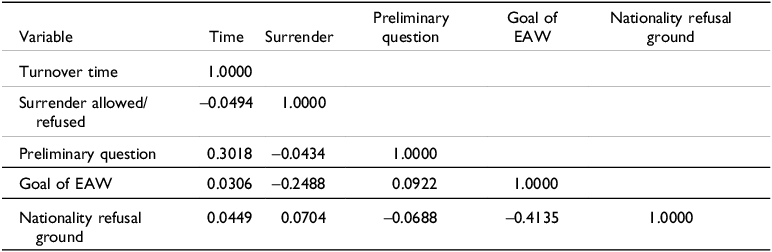
Mean variance inflation factor equals 1.16, with a highest value of 1.29, indicating that multicollinearity is not an issue.
EAW = European Arrest Warrant.
Representativeness checks were also performed, which have been included in Appendix 1.
IV. Analyses and results
Since our dependent variable is a count variable, we employ a count regression model – more specifically, negative binomial regression – to test our hypotheses.Footnote 78 Issuing Member States with fewer than ten cases were excluded from the analysis to retain a sufficient amount of observations per country dummy. Furthermore, as 2004 is an atypical start-up year for the ADC and turnover times were affected by EAWs already transmitted before the entry into force of the Surrender Act (and could thus not immediately be acted upon), we considered that cases from 2004 were difficult to compare to later cases and removed them from the dataset. These choices resulted in a final sample of 950 EAW cases being entered into our models.
The results are shown in Table 3. Model 1 shows the results for all country and year dummies. France was chosen as the reference category for the country dummies as it is a sizable source of EAWs but is not adjacent to the Netherlands, does not adhere to the common law system and has no exceptional history in the implementation of the EAW (eg such as Greek detention condition issues). The χ2 tests for the joint significance of the country dummies and the year dummies are significant at the 0.01 level, indicating that annual differences and country-level differences are both relevant for explaining the variance in turnover times of cases brought before the ADC. Thus, we see evidence of a difference in average turnover times between issuing Member States. With regard to individual country dummies, the significant results for Hungary and Portugal are notable, although it must be added that Portugal, with twelve cases, was one of the countries with the smallest number of cases included in the analysis, warranting caution regarding this interpretation.
Negative binomial regression results.

Standard errors in parentheses: ***p < 0.01, **p < 0.05, *p < 0.1.
EAW = European Arrest Warrant; LR = likelihood ratio.
Plotting average turnover rates over time provides more insights into our results for the year dummies, with the plot revealing a gradual upward slope (see Figure 2). Our measure suggests, especially in recent years, an increasing number of cases have approached or exceeded the ninety-day extended time limit included in the EAW Framework Decision.
Quarterly evolution of average European Arrest Warrant turnover times (days) of cases brought before the Amsterdam District Court. Solid line represents the winsorised variable that accounts for the disproportionate influence of outliers on averages (p = 0.05). Dotted line represents the uncorrected variable.

Model 2 adds the regressors describing case-specific characteristics, with a likelihood ratio test indicating an improvement of model fit over Model 1 – implying that case-specific characteristics explain a relevant part of the variation in turnover times. The nationality refusal ground is strongly significant, providing support for Hypothesis 1 (ie that legislative choices designed to protection the position of individuals may indeed detrimentally affect turnover times). Simultaneously, whether a case was transmitted for the purposes of prosecution or the execution of a sentence does not produce significant results, providing no support for Hypothesis 2. The control variable measuring whether preliminary questions posed to the CJEU caused the postponement of a case is also strongly significant and yields a sizeable coefficient. This is unsurprising given that even fast-tracked preliminary reference questions take an average of 2.7 months to complete,Footnote 79 after which national-level proceedings continue.Footnote 80
While Model 2 combined Dutch nationals and foreigners submitting that they are a resident of the Netherlands in one group, a more fine-grained analysis is needed to provide an appropriate answer to Hypothesis 3 (ie that foreigners arguing to be a resident will exhibit a higher turnover time than both Dutch nationals and other foreigners due to the CJEU’s jurisprudence). Thus, Model 3 incorporates a factor variable distinguishing between both groups. A likelihood ratio test again indicates significant improvement of model fit, and both the coefficient for Dutch nationals and the coefficient for foreigners arguing to be a resident are positive and significant. This suggests that Dutch nationals and foreigners requesting to be considered a resident should indeed be considered different groups for the purposes of analysing their effects on turnover time. Moreover, the coefficient for foreigners arguing to be a resident is higher than the coefficient for Dutch nationals, suggesting that establishing residency status under the Wolzenburg jurisprudence is a factor that causes higher turnover times on average.
V. Discussion and conclusion
Hypothesis 1 receives strong support from both Model 2 and Model 3, suggesting that value trade-offs made in the context of the nationality refusal ground have a sizeable and significant impact on turnover times before the ADC. Hypothesis 1 specifically expects Dutch individuals to have a higher average turnover time than requested persons without Dutch nationality and not claiming residency in the Netherlands. Finding support for this hypothesis suggests that the added complexities of communicating with issuing authorities on the return guarantee increases turnover time. On a deeper level, it provides empirical support for the notion that legislative design choices protecting one objective (legal protection of requested individuals) may adversely affect attainment of the efficiency goals underlying a criminal law or administrative enforcement measures – sometimes to the degree that practical implementation cannot adhere to the sixty- and ninety-day time limits set out by formal EU-level requirements. This is relevant for future studies addressing the implementation of measures in areas such as supranational criminal and migration law, as these often incorporate multiple goals (in this case, efficiency and the protection of individual rights) that may be in tension with one another.Footnote 81 In such instances, policy recommendations or measures aimed at improving one of these goals should take into account whether and to what degree another goal is sacrificed.
Hypothesis 2, which expects EAWs issued for the execution of sentence cases to exhibit higher average turnover times than EAWs issued for cases in the prosecution stage, did not receive support. This is a surprising result given the similarity of the retrial guarantee to the return guarantee. We speculate that potential issues in trial in absentia cases are easier to predict and prevent by the authorities involved. Alternatively, it may be that the coding choice to examine all cases in which Dutch judicial authorities check whether a trial in absentia occurred was too broad, and that a more narrow focus on cases in which, for example, additional information needed to be requested would produce a different result.
We do find support for Hypothesis 3, which expects requested persons that claim residency in the Netherlands to have a higher turnover time than both requested persons with Dutch nationality and other foreigners that do not claim residency. Similar to the results for Hypothesis 1, our findings in the context of Hypothesis 3 suggest that the more complex test devised by the CJEUFootnote 82 shifted the balance of goals underpinning the EAW slightly towards the protection of individualsFootnote 83 and had a detrimental effect on turnover rates in EAW cases that apply this jurisprudence. The key difference is that Hypothesis 3 reflects a temporal development in which values are emphasised in the EAW system, as it is based on a new test devised by the CJEU six years after the EAW Framework Decision originally entered into force. Thus, developments in jurisprudence safeguarding the position of requested persons – while beneficial to ensuring the instrument’s adherence to fundamental and/or citizenship rights – may have an adverse effect on the overall efficiency of the EAW system, in particular when relatively complex tests are introduced. Similar to our findings for Hypothesis 1, a first implication is that a trade-off exists between jurisprudence introducing tests aimed at the protection of individuals’ positions on the one hand and the smooth and efficient mutual recognition of decisions from issuing Member States on the other.Footnote 84 A second implication is that EU-level developments may affect the practical implementation of EU instruments already implemented in Member States, potentially causing reductions in national formal compliance levels through causes at the supranational level. Although lawyers extensively study the legal consequences of CJEU decisions, the impact of landmark jurisprudence on policy implementation and public management issues (eg efficiency and throughput times) remains severely underexplored. Our study represents a first step in addressing this gap.
Moreover, with the Polish and Hungarian rule-of-law crises, the balance between efficiency and fundamental rights protection is likely to keep on shifting.Footnote 85 Several recent CJEU cases illustrate this point. In the Aranyosi & Căldăraru, LM and L and P cases, the CJEU developed and introduced cumbersome and involved two-step tests to evaluate whether flagrant breaches of fundamental rights occur in the context of detention circumstances and effective judicial protection.Footnote 86 First, it is necessary to collect reliable, specific and properly updated material indicating a systemic and generalised risk to fundamental rights,Footnote 87 which may require entering into dialogue with the issuing authorities.Footnote 88 Second, judicial authorities must be able to use this material to determine specifically and precisely whether there are substantial grounds that the requested person in concreto runs the risk of such a fundamental rights breach after surrender,Footnote 89 which places the onerous task on issuing authorities of assessing local situations on the ground in a different country. The high-cost design of these tests – in particular when they pertain to, for example, detention conditions in very specific prisons on the other side of the EU – could well have similar delaying effects to the Wolzenburg jurisprudence studied here. Thus, while the protection of individual rights is certainly important, care must be taken in jurisprudence to appropriately balance an improvement to individual positions with other goals underpinning the EAW and the AFSJ – for instance, by designing novel legal tests to be easily manageable by national authorities.
This is especially true as turnover times are not just technical matters but are likely to impose severe uncertainty and psychological costs on requested persons.Footnote 90 Previous contributions have shown that uncertainty is a characteristic feature of individual experiences of the pre-trial period. Uncertainty can, for instance, exist over the various outcomes that the procedure may have (will I be surrendered to undergo trial in another country?), disruptions to daily life and navigating the court case.Footnote 91 Longer waiting times in the justice system can begin to feel like a situation of limbo (ie being stuck in a stressful, unresolvable situation without having a idea as to its duration).Footnote 92 Because the EAW decision may only be the start of longer proceedings in the issuing state, as many requested persons have not (yet) been sentenced and as many EAWs are issued for relatively minor infractions when compared to other extradition instruments, minimising such psychological costs should be an important consideration. This is not an argument to lower fundamental rights protection standards, but it is an argument to design tests aimed at upholding these standards to be relatively unlikely to introduce severe delays during national-level proceedings.
Reasoning further, one may wonder where the optimal balance between fundamental rights protection and efficiency lies. Although a definitive answer is beyond the scope of this contribution, there is a strong argument to be made that the EAW in its inception phase (before the additional protection developed over time by EAW case law and through several supporting directives) provided insufficient protection for individuals and made overoptimistic assumptions on the degree to which mutual trust exists between Member States.Footnote 93 Case law developments such as, first, Wolzenburg and, later, Aranyosi and LM and L and P have gradually rectified a number of shortcomings in the system.Footnote 94 Even with case law developments up until now, the system arguably still requires additional safeguards. Amongst other issues, the bar for serious risk of degrading treatment under the Aranyosi standard remains incredibly high. For now, the CJEU seems to be sticking to the Aranyosi approach, not only applying it to the right to a fair trial in LM and L and PFootnote 95 but perhaps extending it more broadly in the near future. At the same time, the European legislator remains clear through an unrevised Article 17 EAW Framework Decision that sixty- and ninety-day time limits should be the norm for turnover times. Formally, any deviation from them must be exceptional, even if our analysis suggests that they may increasingly become normal.
Considering this discussion, two further implications follow from our findings. First, in a context in which the trend is moving towards more sophisticated tests aimed at the legal protection of requested persons,Footnote 96 the sixty- and ninety-day time limits may no longer be realistic. In even somewhat complicated cases that have to be resolved under the Wolzenburg and Aranyosi case law lines, it is likely that some executing states will breach these time limits due to the (rightfully) increasingly complex design of the legal protection system. Efforts must be undertaken to ensure that both prosecutors and judges are not under pressure from the sixty- to ninety-day time limits in more complicated cases (eg by not seeing compliance with the sixty- and/or ninety-day time limit as an indicator of good performance). In the long term, if the trend towards greater legal protection continues and is considered desirable, a looser interpretation of the efficiency goal than high automaticity accompanied by the sixty- and ninety-day time limits may have to be incorporated in the revision of the Framework Decision.
Although not included in the hypotheses, it is notable that Portugal and Hungary in particular stood out as countries with a higher average turnover time than the reference category (France). This finding contributes to a longer line of literature that questions the unqualified assumption that all European legal orders are equal in their functioning.Footnote 97 In this context, it is important to recall that the European Commission initially promoted the idea that Member States’ relationships were sufficiently robust to apply strict mutual recognition instruments. This suggests that cases that breach the EAW’s time limits, thereby resulting in a degree of non-compliance during the implementation in practice phase, are perhaps in part a function of the EU institutions and legislation underestimating the enduring differences between Member States’ legal orders.
Finally, it is worth devoting some attention to the temporal development of turnover times of cases brought before the ADC. Our findings suggest a gradual and sizeable increase in turnover times over the years and that a striking amount of cases exceed both the sixty-day and the extended ninety-day time limits provided for in the EAW Framework Decision. What is perhaps most striking is that this upward trend is not an EU-wide phenomenon. The European Commission’s and Council of the European Union’s annual EAW reports suggest that average turnover times in most Member States are stable, whereas those of the Netherlands, Ireland, the Czech Republic and Denmark are rising (see Appendix 3 for the EU’s average turnover rates per Member State).
We tentatively speculate that an explanation lies in the centralised system used for the execution of EAWs by the Netherlands. The Netherlands opted to centralise the execution of incoming EAWs in the International Legal Aid Chamber of the ADC and the International Legal Aid Centre of the Amsterdam Public Prosecutor (see Appendix 2), whereas most other Member States have opted for a decentralised system.Footnote 98 While this centralised implementation may offer benefits in terms of learning and expertise,Footnote 99 we speculate that focusing workloads in one court and one prosecutor creates issues that a decentralised system would otherwise be able to dispense with. This would be consistent with other contributions in the practical implementation literature, which have emphasised the importance of sufficient administrative capacity and resources to achieve compliance with enforcement norms in EU law.Footnote 100
A number of limitations of this study should be mentioned. First, although we possess a sizeable sample size of publicly available EAW cases, not all EAW cases in the Netherlands are openly available. Although we tested whether our turnover times align with overarching trends seen across all EAW cases, an ideal examination would contain all EAWs decided on in a given time period. Second, future studies should examine similar phenomena for other Member States, particularly to determine whether our results hold in more decentralised EAW systems. Finally, a qualitative examination of the exact underlying mechanism through which turnover times were higher for cases incorporating the nationality refusal ground (including the impact of the Wolzenburg jurisprudence) was beyond the scope of this paper – a follow-up interview analysis therefore seems desirable.
Supplementary material
To view supplementary material for this article, please visit https://doi.org/10.1017/err.2024.3.
Data availability
Data are available on request from the authors.
Financial support
This project was supported by Research Foundation – Flanders (FWO; grant number FN 7028).
Competing interests
The authors declare none.


 Open access

