


Introduction
The conservation of global biodiversity alongside economic development is a key challenge for the 21st century. Human societies depend on diverse, functioning ecosystems in innumerable ways that are not fully understood (Lubchenco, Reference Lubchenco1997), yet there are few mechanisms that facilitate the accounting of biodiversity within development activities. Consequently, conservation concerns are ineffectively integrated into development and risk being perceived as incompatible with economic growth. Biodiversity offsets offer an approach that links conservation with industry, potentially providing improved ecological outcomes along with development.
Legislation mandating compensatory biodiversity conservation mechanisms (including offsets) exists in 45 countries and is under development in another 27 (Madsen et al., Reference Madsen, Carroll, Kandy and Bennett2011). Voluntary offsets, meanwhile, although not legally required, offer a number of potential attractions to developers, as discussed in TEEB (2010) and ten Kate et al. (Reference ten Kate, Bishop and Bayon2004). Consequently, there has been a proliferation of voluntary offsets in recent years.
From a conservation perspective, biodiversity offsets may present a conceptually attractive approach (Gibbons & Lindenmayer, Reference Gibbons and Lindenmayer2007; Bekessy et al., Reference Bekessy, Wintle, Lindenmayer, McCarthy, Colyvan and Burgman2010). However, substantial problems exist with the perception, design and implementation of offsets. In this review, we first discuss the use of the term biodiversity offset, and ambiguities surrounding the way it is defined. We bring together and discuss the disparate theoretical problems identified in the literature, which need addressing for biodiversity offsets to attain their potential (we define ‘theoretical’ to mean problems that could in principle be resolved through improved scientific understanding). This leads to a discussion of the practical challenges that have arisen from the implementation of offset schemes; i.e. those that could be addressed through better governance and existing science. Whereas practical challenges have also been discussed in the literature, we bring them together for elaboration, and also for the first time combine empirical estimates of implementation success from different national offset policies. Finally, we propose how these problems could be integrated to allow the development of offset methodologies in a more systematic way.
What is a biodiversity offset?
One definition of biodiversity offsets (‘offsets’) is given by the Business and Biodiversity Offsets Programme, an international collaboration for the development of offset methodologies. Guidance from this Programme is widely cited in the literature, providing a useful basis for discussing offsets. The Programme's definition states ‘Biodiversity offsets are measurable conservation outcomes resulting from actions designed to compensate for significant residual adverse biodiversity impacts arising from project development after appropriate prevention and mitigation measures have been taken. The goal of biodiversity offsets is to achieve no net loss and preferably a net gain of biodiversity on the ground with respect to species composition, habitat structure, ecosystem function and people's use and cultural values associated with biodiversity’ (BBOP, 2009a). These documents provide one interpretation of biodiversity offsets, and the term offset actually encompasses a range of mechanisms. Note that, unless otherwise stated, we use the term ‘biodiversity’ in the broadest sense (i.e. total biotic variation, from the level of genes to ecosystems).
In line with the Business and Biodiversity Offsets Programme definition, offsets are commonly viewed as actions to create additional and/or comparable biodiversity gains (Fig. 1) to compensate for losses caused by development. They are intended as a last resort for developers seeking to compensate for unavoidable damage, after having applied some form of mitigation hierarchy (Kiesecker et al., Reference Kiesecker, Copeland, Pocewicz and McKenney2010). This might require, for example, that developers ‘avoid, minimize and rehabilitate’ any biodiversity impacts as far as possible, before offsets are then applied to residual impacts (BBOP, 2012). A distinguishing characteristic of biodiversity offsetting is the common inclusion of a ‘no net loss’ requirement (Fig. 1). An alternative interpretation of this stipulation is to say that offset policies require in-kind compensation that balances biodiversity losses. Some mechanisms go further, aiming for a ‘net gain’ in biodiversity. All such outcomes are pursued by quantifying residual ecological impacts arising from development, and creating equivalent biodiversity components elsewhere (BBOP, 2009a). In reality, phrases such as ‘no net loss’ and ‘in-kind compensation’ have different meanings for different stakeholders, and offset schemes consequently vary significantly in their objectives, methodologies and delivery.
Schematic of the offsetting principle for development impacts. A development that will damage biodiversity is contemplated (top left). Potential options are: (1) development only, resulting in net loss (−) of biodiversity; (2) protect existing biodiversity elsewhere, resulting in a compensated net loss (large − and smaller +); or (3) create or restore additional comparable biodiversity elsewhere, resulting in no net loss, i.e. a biodiversity offset (− and + same size).

Offsets is a term given to a family of related policies, also known as compensatory habitat creation (Morris et al., Reference Morris, Alonso, Jefferson and Kirby2006), mitigation banks (Gibbons & Lindenmayer, Reference Gibbons and Lindenmayer2007), conservation banking, habitat credit trading, complementary remediation, and more (Madsen et al., Reference Madsen, Carroll, Kandy and Bennett2011). Offset ‘banks’ are essentially where providers have created offset project/s in exchange for biodiversity credits, which can subsequently be sold to compensate for developments with comparable residual ecological impacts. The concept of utilizing a banking mechanism for offset schemes lags behind the concept of offsets itself by 10 years (Environmental Law Institute, 2002). The Business and Biodiversity Offsets Programme guidance further characterizes offsets as primarily one-off conservation projects tied to a given development, that specifically require: ‘measurable conservation gains, deliberately achieved to balance any significant biodiversity losses that cannot be countered by avoiding or minimizing impacts from the start, or restoring the damage done’, and ‘no net loss of biodiversity from the perspective of all relevant stakeholders’ (BBOP, 2009a).
Offsets are often considered a market-based instrument for conservation of biodiversity, enabling a ‘baseline and credit’ market (eftec et al., 2010; Parker & Cranford, Reference Parker and Cranford2010; Wissel & Wätzold, Reference Wissel and Wätzold2010) for the trade of biodiversity ‘value’. Systems such as Wetland Banking in the USA (US NRC, 2001) and BioBanking in Australia (DECCW, 2009) specifically create markets for biodiversity credits. But the impossibility of defining a consistent, fungible unit that comprehensively captures biodiversity (Purvis & Hector, Reference Purvis and Hector2000) means that biodiversity itself is not a tradable market commodity (Salzman & Ruhl, Reference Salzman and Ruhl2000; Walker et al., Reference Walker, Brower, Stephens and Lee2009), hence the need for proxies such as credits. Credits are complicated by the fact that the conservation value of any one component of biodiversity is not fixed or intrinsic; e.g. its value depends partly upon a spatial relationship with other components of biodiversity elsewhere (Drechsler & Wätzold, Reference Drechsler and Wätzold2009). Offsets therefore do not facilitate a market for biodiversity as readily as they do for pollution (Godden & Vernon, Reference Godden and Vernon2003). Rather, offsets are effectively a mechanism for pricing certain negative environmental externalities into development projects.
Three criteria can be distilled, common to key legal offset policies (McKenney & Kiesecker, Reference McKenney and Kiesecker2010) and Business and Biodiversity Offsets Programme guidance, which in combination make offsets unique: (1) they provide additional substitution or replacement for unavoidable negative impacts of human activity on biodiversity, (2) they involve measurable, comparable biodiversity losses and gains, and (3) they demonstrably achieve, as a minimum, no net loss of biodiversity.
We use these criteria to define offsets, finding them to be consistent, in principle, with the majority of offset schemes. There is value in conceptualizing offsets with consistent, comparable terms such as these. If schemes could be compared under a common conceptual framework this would provide a more effective means for scientific evaluation and development of best practice methodologies, enable comparison of strengths and weaknesses across offset programmes, and facilitate ongoing improvement to schemes. These criteria can result in a variety of different interpretations and assumptions at the implementation level. It is from these that a host of theoretical and practical challenges arise, and these are the subject of this review.
Theoretical problems for biodiversity offsets
The three criteria outlined above raise a number of issues, including the necessity to define biodiversity and choose a metric for measuring it. We summarize our view of these unresolved theoretical problems (Table 1), and here expand upon each, making management recommendations.
A summary of the main theoretical challenges, with design recommendations, for biodiversity offsets. See text for further details.

Currency
There exists no single metric that objectively captures the full extent of biodiversity, which itself has no universal, unambiguous definition. Any measure of biodiversity is therefore a proxy (Humphries et al., Reference Humphries, Williams and Vane-Wright1995). However, offsets ostensibly rely upon the accurate quantification of losses and gains, and therefore require robust metrics (Burgin, Reference Burgin2008).
Various metrics are being used. The use of single metrics such as ‘area of habitat’ to represent biodiversity losses and gains has been widely discredited (TEEB, 2010). Compound metrics can be used; e.g. those used in offset schemes in Victoria, Australia, where the basic currency is a composite metric, habitat hectares (DSE, 2002). The habitat hectare score summarizes information about an area, including the relative condition of the vegetation and its spatial context within the landscape, making this score useful for management (McCarthy et al., Reference McCarthy, Parris, van der Ree, McDonnell, Burgman and Williams2004), but it does not capture information about other elements of biodiversity such as genetic diversity. The use of multiple metrics may result in a more comprehensive understanding of biodiversity losses and gains (e.g. Kiesecker et al., Reference Kiesecker, Copeland, Pocewicz, Nibbelink, McKenney and Dahlke2009), and all offset designers should be increasingly expected to employ multiple or compound metrics.
An important question is whether offsets should be intended to provide compensation for biodiversity, ecosystem function, ecosystem services, or all three. Different stakeholders might desire no net loss of biodiversity (e.g. in Australian grasslands), ecosystem function (e.g. in US wetlands), or the provision of services such as carbon sequestration. US conservation banking focuses on species diversity but Bruggeman et al. (Reference Bruggeman, Jones, Lupi and Scribner2005, Reference Bruggeman, Jones, Scribner and Lupi2009) explore how function and genetic diversity could be used as alternatives. The topic of measuring diversity as well as function is the subject of ongoing research (Cadotte et al., Reference Cadotte, Carscadden and Mirotchnick2011) and we recommend that offsets should not target diversity alone.
No net loss
The requirements for demonstrably achieving no net loss are often undefined. In particular, the baseline against which to measure no net loss is rarely specified. The implicit assumption is often that the biodiversity baseline is fixed at the point of the development project. However, as ecosystems are dynamic, no net loss should be defined against prevailing trends in biodiversity condition. For example, native Australian grassland is deteriorating because of aggressive invasive species, so managing grassland to prevent further degradation could deliver a gain against a baseline that incorporated predicted landscape trends (Gordon et al., Reference Gordon, Langford, Todd, White and Mullerworth2011). Thus, if clearing grassland for development, an offset maintaining current grassland condition in other areas could be said to deliver no net loss. This is a different form of additionality to active habitat creation; e.g. creation of new wetlands under US wetland banking (US EPA, 2008), which results in no net loss against a fixed baseline. We recommend that, as is ostensibly the case for European environment impact assessment legislation (eftec et al., 2010), no net loss be defined against a dynamic baseline that incorporates trends.
It is not clear how best to aggregate biodiversity losses and gains across a landscape and thereby assess the efficacy of an offset policy. No net loss could be measured against change at project level, or across the wider landscape. For example, in the landscape of New South Wales, Australia, there has been an absolute net loss in native vegetation since the 2005 Vegetation Act (Gibbons & Lindenmayer, Reference Gibbons and Lindenmayer2007). But in the same time period, a reduction in approvals for vegetation clearance was achieved (Gibbons, Reference Gibbons2010), which was a net gain against a business-as-usual scenario at the project level. Despite an increasing emphasis on landscape-scale outcomes in conservation, in general when the policy objective is no net loss this implicitly means no net loss at project level. It is important that the scale used in a given offset scheme be made explicit. Concurrently, the possibility for leakage of development impacts outside the area evaluated under the offset policy should be considered.
The trading of biodiversity losses against gains in a dynamic system should include the application of a discount rate (Moilanen et al., Reference Moilanen, van Teeffelen, Ben-Haim and Ferrier2009). The application of discount rates enables appropriate trading of future gains against current losses (Dunford et al., Reference Dunford, Ginn and Desvousges2004). Although often ignored, some approaches do incorporate time discounting (Pouzols et al., Reference Pouzols, Burgman and Moilanen2012).
Equivalence
It is difficult to argue ecological equivalence between biodiversity components that differ in type, location, time, or ecological context. This is the case even when trading in kind (e.g. for the same habitat type); for instance, a man-made wetland is demonstrably not equivalent to a naturally established wetland (Moreno-Mateos et al., Reference Moreno-Mateos, Power, Comin and Yockteng2012), although equivalence is implied under US Wetland Banking.
Arguing the case for ecological equivalence becomes more difficult when trading ‘out of kind’; e.g. trading losses of adult seabirds from fishing bycatch for gains in nesting habitat (Wilcox & Donlan, Reference Wilcox and Donlan2007), or trading losses for spatially distant gains. Different biodiversity components are traded under some schemes; e.g. habitat types are exchangeable in the UK (Defra, 2011). The fact that biodiversity is not fungible calls into question the use of out of kind offsets (Salzman & Ruhl, Reference Salzman and Ruhl2000; Godden & Vernon, Reference Godden and Vernon2003). But by allowing out of kind offsets, trading up is possible; i.e. trading losses in habitat of low conservation significance for gains in threatened habitats (Quetier & Lavorel, Reference Quetier and Lavorel2012). This case is one in which we see a compelling argument for out of kind trades. Importantly, recreating biodiversity does not necessarily result in restoring the functional performance of the previously existing system (Ambrose, Reference Ambrose2000). This reinforces the recommendation that offsets should incorporate some measure of function as well as diversity.
Longevity
There are two distinct challenges in relation to the issue of longevity: defining how long offsets are expected to last (i.e. the time horizon for evaluation) and ensuring offsets are designed to endure for that time horizon in a dynamic environment.
Offsets could be required to last for as long as the impacts of development, or in perpetuity (BBOP 2009a). ‘In perpetuity’ is not necessarily considered ‘forever’: e.g. the REMEDE toolkit (Lipton et al., Reference Lipton, le Jeune, Calewaert and Ozdemiroglu2008) approximates in perpetuity to 50–75 years, based on a positive discount rate. Given difficulties in agreeing the meaning of ‘in perpetuity’, let alone the management implications, requiring offsets to last as long as development impacts seems a more practical goal. This would, however, depend upon development impacts being reversible (see Reversibility, below) against the project baseline, and therefore depends ultimately on other elements of an offset policy.
The long-term persistence of any offset project could be threatened by environmental change (Bull et al., in press). Of course, this same environmental change may have affected the original habitat for which the offset was created. How best to account for and incorporate change is a theoretical challenge. But, additionally, it is not always clear how an offset should be maintained, by whom, and for how long. Addressing these issues becomes a problem of implementation, and is vital if a scheme is to achieve no net loss in the long term.
Time lag
There can be a temporal gap between development impacts occurring and the benefits associated with the offset scheme accruing. Therefore, whereas biodiversity losses are guaranteed, future gains may be realized late or not at all; i.e. the condition of restored habitat is increasingly uncertain further into the future (Bekessy et al., Reference Bekessy, Wintle, Lindenmayer, McCarthy, Colyvan and Burgman2010). For example, because of the time associated with grassland restoration, offset schemes in Victoria can result in temporary losses in total grassland condition across the landscape, as measured in habitat hectares (Gordon et al., Reference Gordon, Langford, Todd, White and Mullerworth2011). Alternatively, the political or legal landscape can change at any time, as in the case of the Brazilian Forest Code, which has recently been modified, and significantly weakened in terms of compensatory requirements (Madsen et al., Reference Madsen, Carroll, Kandy and Bennett2011).
Time lags interact with fluctuations in biodiversity credit prices to cause reduced efficiency in biodiversity markets (Drechsler & Hartig, Reference Drechsler and Hartig2011). In addition, interim losses of biodiversity may be unacceptable either because they have detrimental impacts upon the wider ecosystem, or because they represent a temporary lack of ecosystem service provision. Solutions to this include requiring offsets to be implemented before development (Bekessy et al., Reference Bekessy, Wintle, Lindenmayer, McCarthy, Colyvan and Burgman2010), or applying time discount rates.
Uncertainty
The outcomes of offset schemes are uncertain. This is often accounted for simplistically by increasing the amount of compensation required; i.e. using multipliers. A multiplier increases the amount of biodiversity gains required based on various factors, such as theoretical uncertainty in the definition and measurement of biodiversity, and the need for a discount rate for future gains. The largest obligatory multipliers come under South Africa's Western Cape offset policy, requiring compensation of 30 ha of land for every ha cleared in critically endangered habitats (DEADP, 2007). Arbitrary multipliers such as this take a risk averse approach but may be insufficient to address correlated losses or total failure of an offset scheme (Moilanen et al., Reference Moilanen, van Teeffelen, Ben-Haim and Ferrier2009). Although investigation into managing uncertainty in offsets continues (e.g. Pouzols et al., Reference Pouzols, Burgman and Moilanen2012), research is required on the development of a comprehensive framework for treating uncertainty in offsets.
Reversibility
The impacts of development on biodiversity could in some situations be reversed through restoration. For example, clearance of shrubby vegetation by vehicles for gas exploration in semi-arid regions in Uzbekistan is generally reversible in the short term through restoration (Bull et al., in press). However, if the same exploration activity created roads that facilitate access for poachers to extirpate a threatened species, this could be irreversible.
Reversibility is considered a prerequisite for the viability of offsets as a general policy tool (Godden & Vernon, Reference Godden and Vernon2003), so ideally all biodiversity losses addressed through offsets should be reversible. However, reversibility has no objective definition, and policy must define it explicitly. An example of such a policy is that in South Africa's Western Cape, which specifies that ‘ecosystems that have undergone severe degradation of ecological structure, function or composition as a result of human intervention and are subject to an extremely high risk of irreversible transformation’ cannot be offset (DEADP, 2007).
Thresholds
Defining thresholds, beyond which the use of offsets is considered inappropriate, involves making value judgements. For example, extirpation of a species could be considered unacceptable, and therefore something that cannot be offset, whereas temporary impacts on grassland could be deemed acceptable. Consequently, it is difficult to create protocols for setting thresholds (BBOP, 2012). Society might accept a scheme that treats some habitat types as interchangeable, as in UK offsets (Defra, 2011). However, the same scheme may not be acceptable if it involves the loss of charismatic fauna. Wilcox & Donlan (Reference Wilcox and Donlan2007) explored the possibility of offsetting seabird bycatch in fisheries, provoking heated debate. The explicit definition of thresholds is therefore fundamental to offset design.
Practical challenges for biodiversity offsets
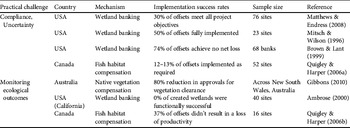
The theoretical problems outlined above are compounded by practical challenges, which we broadly group into three categories: compliance, measuring ecological outcomes, and uncertainty (Table 2). As a result of these practical challenges, the implementation record for offsets to date is less than perfect (Table 3). Information for compiling a global implementation record for offsets is limited and mainly available for developed countries but offsets are increasingly being explored in the developing world, where issues of implementation may be even more acute.
A summary of the practical challenges for biodiversity offsets. See text for discussion of the examples.

Implementation record for biodiversity offsets in Canada, the USA and Australia.

Compliance
Non-compliance with offset requirements is a significant challenge and takes a variety of forms (Table 2). Developers may not comply with the mitigation hierarchy: for example, a proposed development in Germany involves impacts on Mühlenburger Loch, a protected area. Planning permission was applied for on the grounds of ‘no alternative sites’, with proposals for compensation. The EU Commission placed the case under examination, concluding that the developer had not sufficiently considered alternative sites (Kramer, Reference Kramer2009).
The Mühlenburger Loch case also provides an example of a developer not proposing sufficient compensation. The proposals entailed replacing c. 170 ha of wetland with comparable habitat across four sites. However the proposals would have resulted in 100 ha of comparable habitat (Pritchard et al., Reference Pritchard, Pienkowski and Salathé2001). This problem could have arisen through a lack of clarity in defining no net loss and equivalence, or poor practice by the developer.
Alternatively, non-compliance can lead to offset projects being implemented partially or not at all. This has long occurred in the case of wetlands in the USA (Race & Fonseca, Reference Race and Fonseca1996; Mack & Micacchion, Reference Mack and Micacchion2006; Matthews & Endress, Reference Matthews and Endress2008). Effective wetland banking is thus considered achievable in principle but not yet in practice (e.g. Fox & Nino-Murcia, Reference Fox and Nino-Murcia2005). Offsetting is similarly considered feasible in principle, but yet to be effectively achieved, for Canadian fish habitat compensation (Quigley & Harper, Reference Quigley and Harper2006a) and the Brazilian Forest Code (Hirakuri, Reference Hirakuri2003).
Revision of legislation after compensation schemes have begun further complicates the issue of legal compliance. An example is the Brazilian Forest Code, which allows trade in forest set-asides (McKenney & Kiesecker, Reference McKenney and Kiesecker2010) but which has undergone significant amendment, reducing requirements on mandatory forest preservation reserve size, and now exempting small-scale farmers (Madsen et al., Reference Madsen, Carroll, Kandy and Bennett2011).
Measuring ecological outcomes
There is limited quantitative information available on the outcomes of offset projects. This is part of a broader problem: the lack of post-implementation evaluation in conservation (Ferraro & Pattanayak, Reference Ferraro and Pattanayak2006). Even if offsets are monitored it is not necessarily clear whether the ecological outcomes have been positive. Confer & Niering (Reference Confer and Niering1992) recorded similar total diversity across created and natural US wetlands but higher floral species richness in created sites vs increased wildlife sightings and fewer invasive species at natural sites. The problem of measuring outcomes is partially associated with the lack of a comprehensive biodiversity currency.
Similarly, different parties may evaluate project success differently, dependent upon motivation, analytical techniques, or methodology. The Basslink marine pipeline project in Australia (Westerweller & Price, Reference Westerweller and Price2006) resulted in impacts that were managed for net gain in native vegetation, and some treat the project as successful (BBOP, 2009b). But other studies conclude that overall impact was negative, with offsets not achieving project objectives (Duncan & Hay, Reference Duncan and Hay2007).
A lack of robust information on outcomes may also result from a failure to monitor offsets adequately. In Canada offsets were only monitored for an average of 3.7 years post construction (Harper & Quigly, Reference Harper and Quigly2005), and it is not known whether Canadian compensation policy objectives were achieved (Rubec & Hanson, Reference Rubec and Hanson2008). In the USA similar conclusions were reached for Conservation Banking after a decade of implementation (Carroll et al., Reference Carroll, Fox and Bayon2008).
Rigorous post-implementation evaluation is the only way to know whether losses and gains are balanced in the long term and no net loss ensured. Equally, a track record of successful implementation is necessary to demonstrate that offsets can work in practice. Currently there is no publicly available global register of the outcomes of offset projects but such a register would aid understanding of the long-term effectiveness of offsets.
In part, the challenge of effectively monitoring outcomes relates to responsibility and the burden of proof. It is not always clear who is responsible for delivery of offsets during and after implementation. Uncertainty over the burden of proof could be avoided if responsibilities throughout the full project life cycle are defined from project inception.
Uncertainty
A concern for offsetting, as well as for conservation in general, is to ensure that interventions incorporate consideration of uncertainty (Hilderbrand et al., Reference Hilderbrand, Watts and Randle2005; Langford et al., Reference Langford, Gordon and Bastin2009). Uncertainty arises at every stage of offsetting and the lack of any sophisticated framework for the treatment of uncertainty is a major shortfall, although the RobOff software (Pouzols et al., Reference Pouzols, Burgman and Moilanen2012) is beginning to address this need. We utilize the taxonomy of uncertainty developed by Regan et al. (Reference Regan, Colyvan and Burgman2002; Table 4) to give an example of how a basic framework could be structured. This is only intended as one example of a possible framework for dealing with uncertainty, and does not necessarily cover every conceivable uncertainty (e.g. Kujala et al., Reference Kujala, Burgman and Moilanen2012).
Example of a structured classification of uncertainty in offsets, using the taxonomy developed by Regan et al. (Reference Regan, Colyvan and Burgman2002).

Uncertainty in offset implementation is widely managed through multipliers or via conservation banking (Bekessy et al., Reference Bekessy, Wintle, Lindenmayer, McCarthy, Colyvan and Burgman2010). Information is often insufficient to generate realistic multipliers. There may also (for practical or financial reasons) be insufficient motivation to use large enough multipliers to achieve what are termed ‘robustly fair’ offsets, if they would need to be as large as those derived by Moilanen et al. (Reference Moilanen, van Teeffelen, Ben-Haim and Ferrier2009).
There may be uncertainty around whether the offset provider is competent to establish successful offsets, or whether sufficient land exists in an area to provide offsets for all developers who require it. Finally, the future gains from offsets contain significant uncertainties. Restored or created habitats might fail to establish or provide sufficient ecological function (Ambrose, Reference Ambrose2000), or impacts may be greater and compensation less than planned (Table 3). This is a combination of ecological uncertainty and uncertainty in the actions of developers and offset providers.
Management of theoretical and practical challenges
Offsets are faced with both theoretical (Tables 1, 4) and practical (Tables 2–4) challenges. Research could focus on resolving theoretical problems and developing universally applicable principles for offset design. Alternatively, researchers could concentrate upon monitoring and evaluating implementation of the various approaches designed to resolve locally specific practicalities. Whilst BBOP (2012) is pursuing the former path, the offsetting community is in practice perhaps moving towards the latter.
These theoretical and practical challenges are intertwined and must be resolved in conjunction. For example, the problem of choosing a metric for biodiversity complicates the problem of defining no net loss and equivalence. A lack of definition for no net loss results in ambiguity about the required longevity of the offset and the acceptability of time lags. If time lags are permitted then ensuring offsets are delivered at all becomes a practical challenge in terms of uncertainty in offset outcomes and in ensuring that offset providers deliver those outcomes. Subsequently, if ecological outcomes are not monitored then it is difficult to demonstrate no net loss or improve knowledge on appropriate multipliers and thresholds.
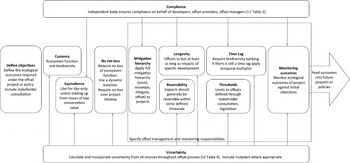
A simple conceptual framework that integrates consideration of all of these problems could facilitate a common approach to managing the challenges associated with offsets, and allow systematic development of the offset methodology. We propose such a framework (Fig. 2), which is intended as a template for comparing, contrasting and improving methodologies. By systematically examining an existing offset policy or project against each section in this framework (e.g. equivalence, compliance, thresholds), in the order shown, it would immediately become clear whether important gaps in that biodiversity offset scheme exist. By completing this process for multiple offset schemes, common key elements (e.g. the choice of currency, or approach to monitoring outcomes) could then be compared across the different schemes. Finally, this framework is potentially useful in designing a new offset policy or project as, in following the process through and responding to each section in turn, a systematic and transparent approach to recognizing key challenges would be ensured.
Conceptual framework for integrating theoretical and practical problems in offsets. Process reads from left to right.

Discussion
This review highlights the many theoretical and practical challenges that face those using offsets. In the case of some of these challenges management recommendations can be made, for others there are aspects of offsetting that require further research. We believe that to ensure robust offsetting, research is required on three issues.
Biodiversity, ecosystem function or ecosystem services? The commonly stated intention of offsets is to ensure no net loss of biodiversity. However no net loss can also mean no loss in ecosystem function, or in the value provided to society by ecosystem services. Biodiversity is said to underpin ecosystem function (CBD, 2010) or be closely related to it (Nelson et al., Reference Nelson, Mendoza, Regetz, Polasky, Tallis and Cameron2009). However, biodiversity of high conservation value does not necessarily coincide with provision of particular ecosystem services (Naidoo et al., Reference Naidoo, Balmford, Costanza, Fisher, Green and Lehner2008). Consequently, an offset scheme could be targeted to retain biodiversity, function, services or all three, but these are not always compatible goals. More research is required to determine when it is possible to conserve all three simultaneously (Cadotte et al., Reference Cadotte, Carscadden and Mirotchnick2011). It is important that offset schemes are clear about which aspect or aspects they aim to conserve.
Dynamic baselines and multiple metrics Offsets could use fixed or dynamic baselines against which to measure no net loss. The latter would account for drivers such as climate change (Bull et al., in press). However, predicting future biodiversity trajectories accurately is difficult and managing for them perhaps impractical. Furthermore, overcomplicating the theoretical basis of offsets in this way may also risk undermining one of the key benefits to the approach: the flexibility and perceived simplicity that appeals to business and policy-makers. Consequently, research that explores how to specify dynamic baselines, and what conservation actions would be required under different baselines, would be useful. Similar arguments apply to the use of multiple metrics. Additional metrics result in additional complication and expense, and beyond some point will not justifiably reduce uncertainty further in quantifying biodiversity. Therefore, exploration of how to optimize the use of multiple metrics for offsets is necessary.
Implementation of offsets in the developing world Offsets have been used since the 1970s but at best have been only modestly successful (Table 3). The issues facing the implementation of offsets in highly industrialized nations could potentially be magnified in developing countries (ten Kate et al., Reference ten Kate, Bishop and Bayon2004), where global conservation priorities may coexist with intense natural resource use, and there may be differences in the language of legislation, policy and expertise. Designers of voluntary offsets in developing countries may need to incorporate different perspectives on, or highlight a lack of, environmental legislation and environmental impact assessment, environmental management, policy or regulatory frameworks, information on biodiversity, indicators and threats, monitoring capability or funding, enforcement resources or infrastructure, and local technical expertise or capacity. This applies equally to the creation of biodiversity markets through tradable credits, which necessitate some of these elements (Wissel & Wätzold, Reference Wissel and Wätzold2010). The use of offsets in emerging economies is by no means impossible or even inadvisable. A number of countries (e.g. Uzbekistan) currently host offset pilot schemes, or have related legislation (e.g. Brazil; UNDP, 2010; Madsen et al., Reference Madsen, Carroll, Kandy and Bennett2011). Equally, offsets offer collateral benefits that could be magnified in developing nations. These include promoting stakeholder engagement in conservation, leveraging funding to meet strategic conservation objectives and catalysing improvements in environmental legislation. They could also increase baseline ecological knowledge and expand scientific capacity.
Benefits aside, the potential exacerbation of the issues discussed in this review should be taken into consideration at the design stage when considering offsets in more challenging contexts. Under some conditions offsets may simply not be appropriate. Examples of these conditions include the absence of transparent definitions in relation to theoretical challenges such as no net loss, overwhelming ecological uncertainty and, in particular, if compliance cannot be assured. Our simple conceptual framework (Fig. 2) provides a template for examining the conditions under which any new offset scheme is proposed, and for exploring whether the main challenges to offsetting (as identified in this review) can feasibly be overcome.
Acknowledgements
JWB is funded by a Natural Environmental Research Council CASE award, with Fauna & Flora International. NJS was funded by the thematic programme in Wildlife and Forestry at the Swedish University of Agricultural Sciences. EJM-G acknowledges the support of a Royal Society Wolfson Research Merit Award. W. Langford, P. Hotham, A. Moilanen and four anonymous reviewers provided commentary and advice in the preparation of this manuscript. This research was conducted with the support of funding from the Australian Research Council Centre of Excellence for Environmental Decisions.
Biographical sketches
Joseph W. Bull investigates natural resource use and ecosystem function in ecosystems of conservation relevance. K. Blake Suttle's research focuses on the uncertainties involved in prediction of ecological responses to environmental change. Ascelin Gordon's interests are in modelling and simulation approaches to address interdisciplinary problems in conservation science. Much of his research has focused on understanding conservation interventions in human dominated landscapes. Navinder J. Singh currently researches the drivers of animal migrations, particularly movements under the influence of management, land use and climate change. E.J. Milner-Gulland works at the interface between ecology and human behaviour.




 Open access

