




Introduction
Quantitative analysis of ancient shipwreck databases has developed into an important method of research with which to address broad questions about past socio-economic organisation. A case in point concerns the substantial shipwreck dataset from the Mediterranean (e.g. Parker Reference Parker1992; Strauss Reference Strauss2013), which has been the recent focus of sophisticated analyses of regional connectivities (e.g. Wilson Reference Wilson, Robinson and Wilson2011; McCormick Reference McCormick and Morrisson2012; Leidwanger Reference Leidwanger2020). These studies, for example, have used histograms to model variation in the number of shipwrecks over time as a proxy for economic activity. Such studies acknowledge the uncertainties in the dating of shipwrecks by employing techniques such as the probability of a ship sinking in any one year of a date range or the grouping of wrecks by time-intervals (e.g. half centuries). Yet, there is one area of critical concern: the dating of many of these shipwrecks is, at best, approximate (Figure 1).
Date and dating error (± around mid-point of range) of 1717 ancient Mediterranean shipwrecks with a date listed in Strauss (Reference Strauss2013) (figure by S. Manning).

Most ancient shipwrecks are undocumented—that is, without any associated textual or inscriptional evidence to provide information about the dates of their construction or loss. The visible remains of cargoes, usually transport containers, are the most common dating evidence available, both prior to and often even following excavation. Even when sufficient preserved wood is recovered to enable dendrochronological dating, relevant long and absolutely dated tree-ring chronologies for direct dating prior to the medieval period are rare in the Mediterranean. Moreover, maritime archaeologists have been cautious in their use of rare organic material for radiocarbon dating, since unmodelled dates on single samples often yield wide, imprecise date ranges (>50 years: Pomey & Rieth Reference Pomey and Rieth2005: 140). As a result, the unavoidably uncertain and uneven relative chronologies of transport amphorae (Lawall & Tzochev Reference Lawall and Tzochev2020) have been widely accepted as the basis for dating Mediterranean shipwrecks.
The underlying chronological imprecision is evident if we examine the Oxford Roman Economy Project (OXREP) Shipwreck Database (n = 1717, with stated date ranges: Strauss Reference Strauss2013). Only 20 per cent of the OXREP corpus is dated within a total range of ≤49/50 years, and 42.6 per cent within a total range of ≤99/100 years, leaving 57.4 per cent with a range of >100 years (Figure 1). This implies that most ancient Mediterranean shipwrecks are only very approximately dated—a matter of great concern for the accurate analysis and modelling of these data, and thus a severe limitation on how shipwreck evidence can be used to investigate key social, economic and historical topics. Although there has been a transformation over the last decade in the aspirations and sophistication of archaeological theory and in the economic modelling of shipwreck data (e.g. Leidwanger et al. Reference Leidwanger2014), approaches to the dating of shipwrecks have remained comparatively stagnant.
An important question, therefore, is whether dendrochronology and radiocarbon dating should remain as a last resort in the dating of shipwrecks or should be implemented wherever appropriate organic materials are preserved. We examine one test case: the Mazotos ship, discovered off the southern coast of Cyprus. Published accounts date the shipwreck to 350–325 BC (see below). The OXREP database lists a date of 350 BC, with a 0-year date range, inadvertently giving a false sense of precision that is indicative of a wider problem.
The Mazotos shipwreck
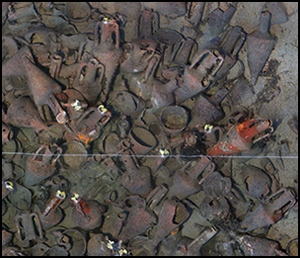
Investigation of the Mazotos shipwreck began in 2007 with surface survey, followed by excavation since 2010 (Demesticha Reference Demesticha2009, Reference Demesticha2011; Demesticha et al. Reference Demesticha, Skarlatos and Neophytou2014; Secci et al. Reference Secci2021). The ship lies at a depth of 44m and the site is defined by a dense concentration of more than 500 visible transport amphorae spread across an area of approximately 16 × 6m (Figure 2). Nearly all the amphorae are of Chian type, with long, straight necks and sharp-edged shoulders, but a few others have also been recovered, including North Aegean types and Mushroom-rim/Solokha I forms from the south-eastern Aegean (Demesticha Reference Demesticha2011: 41–46) (Figures S1–S2 in the online supplementary material (OSM)). The majority probably carried wine (Briggs et al. Reference Briggs2022), but considerable quantities of olive pits were found inside six amphorae (out of more than 250 minimum number of individual (MNI) cargo amphorae that were recovered), ranging between 58 and 2712 pits per amphora. The small number of amphorae containing olives suggests that these were provisions for the crew rather than a cargo (Demesticha Reference Demesticha2011: 48; Briggs et al. Reference Briggs2022). Excavation has also revealed part of the hull and planking, as well as the remains of three anchors. No other shipwreck of the Classical period with a homogeneous Aegean cargo has been investigated in the Eastern Mediterranean thus far, so the placement of the Mazotos wreck in its proper historical and economic context is of particular importance. Preliminary dating of the wreck rests primarily on an assessment of the cargo of Chian amphorae (see Figure S1). While noting a number of caveats, typological observations of the amphorae assemblage pointed to a tentative dating estimate in the third quarter of the fourth century BC (see also Demesticha Reference Demesticha2009: 390; Demesticha et al. Reference Demesticha, Skarlatos and Neophytou2014: 139).
Orthophotomosaic of the fourth-century BC Mazotos shipwreck (photogrammetric processing by M. Vlachos; photography by B. Hartzler).

As we discuss below, however, the application of a method for dating shipwrecks that combines tree-ring information (including limited or short-sequence timber samples) and radiocarbon dating indicates a much earlier date for the Mazotos ship. This has a key impact on the discussion of the ship's historical context and significance. In contrast to harbours and terrestrial sites, such as settlements or sanctuaries, which often have multiple phases of occupation and where a dating resolution of up to 50 years might be comfortably accepted, shipwrecks are single-event assemblages that require high-resolution dating for their proper contextualisation and narration. The example of the Mazotos ship presented below illustrates the need for the wider and more general application of this method for the independent dating of ancient shipwrecks, whenever possible.
Dating a shipwreck
Assuming there is extant wood from a ship's hull, then the outermost/most recent preserved tree-ring sets a terminus post quem (TPQ) either for the construction of the ship, or possibly for a repair, and in all cases for the last voyage (LV) of the ship (Pomey & Rieth Reference Pomey and Rieth2005: 139). In later periods, depending on the species used and whether samples with sufficient numbers of tree-rings can be recovered, dendrochronology can potentially yield a direct date for the last preserved tree-ring. When bark or waney edge—or sapwood in the case of oak (Quercus sp.)—is preserved, it is possible to ascertain the timber's felling date, and probably a close estimate of the construction date (Domínguez-Delmas et al. Reference Domínguez-Delmas2019). Timber provenance is also an active area of research, whether via growth pattern comparisons (e.g. Bridge Reference Bridge2012), geochemical tracers (e.g. Domínguez-Delmas et al. Reference Domínguez-Delmas2020), or aDNA (e.g. Akhmetzyanov et al. Reference Akhmetzyanov2020). Dendrochronological dating, however, is not always possible if a region lacks suitable tree-ring reference chronologies or the shipwreck timbers are unsuitable for dendrochronology. As noted above, calibrated radiocarbon dates in isolation often yield relatively wide calendar age ranges and are insufficiently precise compared with dates based on material culture typologies.
Bayesian chronological modelling techniques offer a transformative means for independently dating ancient shipwrecks by integrating tree-ring and radiocarbon dates with archaeological data to dramatically refine age estimates (e.g. Manning et al. Reference Manning, Manning and Bruce2009; Lorentzen et al. Reference Lorentzen, Manning, Cvikel and Kahanov2014, Reference Lorentzen, Manning and Cvikel2020). First, radiocarbon (14C) ‘wiggle-matching’ can be employed on timber samples with at least a few decades’ worth or more of tree-rings, including timbers whose tree-ring sequences are considered too short for dendrochronological analysis (<50–100 rings). A tree-ring defined sequence of radiocarbon dates can thus be matched against the radiocarbon calibration curve to give a relatively precise and accurate date (Bronk Ramsey et al. Reference Bronk Ramsey, van der Plicht and Weninger2001; Galimberti et al. Reference Galimberti, Bronk Ramsey and Manning2004). In such a case, the last extant tree ring offers a TPQ for a ship's construction or repair date. Second, any shorter-lived organic material recovered from a shipwreck—for example, from fittings, rigging and other equipment (e.g. ropes, wicker fencing, or baskets), or from the cargo, dunnage or provisions on board—can provide direct evidence for the ship's outfitting during its service period, or its likely cargo and provisioning during its final voyage (Figure 3). Such materials can be radiocarbon dated and, critically, constrained within a temporal sequence: (i) the construction TPQ must be before (ii) the shorter/short-lived samples from the service period or last cargo, and (iii) the LV and wrecking is immediately after.
A schematic model showing the ship biographical events, potential datable materials, and the chronological relationships involved in dating an ancient shipwreck (TPQ = terminus post quem) (figure by S. Manning).

The LV and wrecking (iii) represents a sudden event in the archaeological record. The contents of the ship will generally belong to the current or recent voyage(s) very shortly before this disaster, although there may be some older, residual material from previous voyages, or even because of storage practices or types of cargo (Adams Reference Adams2001). The service period of an ancient ship, which was contingent on many variables, such as type, construction, usage and maintenance, is also a crucial but intractable facet of its biography. So, unless the data themselves can provide evidence (e.g. an historically dated object associated with the ship, such as a coin or a scarab, that sets an additional TPQ, or qualitative observations on hull timber condition and repair), an average of 20–30 years can be estimated, based on reasonable historical or ethnographic comparisons (e.g. Dodds & Moore Reference Dodds and Moore2005: 17; Pomey & Rieth Reference Pomey and Rieth2005: 142). Thus, assuming there are (ideally) several samples available for dating, then, rather than averaging their radiocarbon dates (unless the dates are all on an identical sample), a more appropriate and robust approach is to assume an exponential distribution of sample dates approaching the time immediately before the LV and wrecking (iii). This approach has the advantage of accommodating the reality of potentially one, or even a few, samples being—for whatever reason—older or even residual, without leading us to overestimate the date of the shipwreck. In the OxCal Bayesian chronological modelling software (Bronk Ramsey Reference Bronk Ramsey2009a), this can be achieved using a Tau_Boundary paired with a Boundary. Such modelling further enables quantification of queries, such as calculation of the period of time between the ship's construction TPQ and the LV, therefore producing a probable maximum estimate (unless the ship timber's bark/waney edge was present) of the overall service period of the ship.
To demonstrate the general utility of Bayesian chronological modelling methods, and specifically their application in dating ancient Mediterranean shipwrecks and interrogating conventional ceramics-based dating, we consider the Mazotos ship as a case study.
Dating the Mazotos ship
Apart from hundreds of amphorae, the Mazotos shipwreck preserved timbers from the ship's hull. The preserved wooden elements included a pine (Pinus nigra) plank (W0056) from the stern area with 47 preserved tree-rings but lacking bark (Figures S2–S3). Other organic samples recovered from the ship's cargo included dunnage consisting of short-lived (<5 years), complete twigs in the Lamiaceae family (W0051-IV and W0051-VI) (Figure S4) and olive pits (Figure S5). Radiocarbon dates were run on tree-ring sequenced samples from W0056 for a 14C wiggle-match, as well as on the two dunnage samples and the olive pits (Table S1). A dating model using OxCal v4.4.3 (Bronk Ramsey Reference Bronk Ramsey2009a; Bronk Ramsey et al. Reference Bronk Ramsey, van der Plicht and Weninger2001) and the Northern Hemisphere IntCal20 radiocarbon calibration curve (Reimer et al. Reference Reimer2020) was constructed following the chronological framework described above (Table S2):
(1) a wiggle match on the ship timber defines a minimum TPQ for the ship's construction;
(2) while the LV date is defined as after the above TPQ and:
a. after the date of the dunnage: the modelled date range for the outermost preserved ring for these two samples, and
b. immediately after an exponential distribution describing the probable dating from the olive pits.
Further, since both (2)a and (2)b should define the same event (the LV), the model cross-references these so that each informs the other. Unlike ceramics-based date assessments, we can also quantitatively test the quality of the data and model structure by applying outlier models that both identify possible outlier dates and appropriately down-weight them (Bronk Ramsey Reference Bronk Ramsey2009b).
Figure 4 shows the Mazotos dating model. Figure 5 shows the placement of the modelled data against the radiocarbon calibration curve. Figure 6 shows the dating probabilities for (a) the TPQ for ship construction, (b) the LV of the Mazotos ship and (c) the estimated period of time between (a) and (b). The LV is dated to 390–382 BC at 68.3% highest posterior density (hpd) (393–374 BC at 95.4% hpd). The previous preliminary dating of the Mazotos ship in the third quarter of the fourth century BC on the basis of the ceramic evidence is therefore incongruous. If we use the 95.4% hpd range, the ship sank 23–67 years earlier than the ceramics-based date estimate. This is not the first time that radiocarbon dating has suggested that dating estimates based on Chian amphorae might require re-assessment. Foley et al. (Reference Foley2009: 294–95), for example, have previously reported a radiocarbon date on a resin sample from inside a Chian amphora that suggested a late fifth-century BC date, rather than the expected date in the second half of the fourth century BC (although in this case, Foley et al. suggested that the wine may have been aged and the resin older than the standard date for Chian amphorae).
OxCal dating model (modelled in Oxcal v4.4.3 using the IntCal20 atmospheric curve; Bronk Ramsey Reference Bronk Ramsey2009a, Reference Bronk Ramsey2009b; Bronk Ramsey et al. Reference Bronk Ramsey, van der Plicht and Weninger2001; Reimer et al. Reference Reimer2020). The structure shown and OxCal keywords describe the model exactly. Note an interval of 1.75±0.25 years is inserted after the dunnage samples and before the Boundary LV. Solid distributions show the modelled probability date range (lines under indicate 68.3% and 95.4% highest posterior density (hpd) ranges); light shaded distributions indicate the non-modelled dating probability range (figure by S. Manning).

Fit of the Figure 4 model against the IntCal20 (Bronk Ramsey Reference Bronk Ramsey2009a, Reference Bronk Ramsey2009b; Bronk Ramsey et al. Reference Bronk Ramsey, van der Plicht and Weninger2001; Reimer et al. Reference Reimer2020) calibration curve (68.3% probability) (figure by S. Manning).

(a) TPQ (terminus post quem) for ship construction; (b) last voyage (LV) Boundary; and (c) maximum ship service period (which may become shorter, depending on number of missing rings from the last extant ring to the original outermost ring on the tree; see Figure S7 in the online supplementary material) (figure by S. Manning).

For the Mazotos ship, the olive pits and the dunnage twigs yield a closely defined LV date range. What is not well defined is the ship's likely launch date. The number of years (tree-rings) between the last extant tree-ring of the W0056 plank and its waney edge/original bark and the cutting date is unknown. As excavation continues, other ship timbers might inform this knowledge gap in the future. Consideration of the possible numbers of missing rings versus the ship's estimated maximum service period (between launch and wrecking), however, leads to the observation that some 10–20 rings are probably missing from W0056 to the original bark (see the OSM; Figures S6–S7). This suggests a more precise TPQ for the launch to be somewhere c. 409–387 BC (overall 68.3% hpd ranges, considering 10–20 missing rings) (Figure S6) and a maximum ship service period between two and 27 years (overall 68.3% hpd ranges, considering 10–20 missing rings) (Figure S7). In this case, because of the tree species involved, the effect of any possible modest East Mediterranean growing season radiocarbon offset is minimal (see the OSM; Figures S6 & S8). The most likely (68.3% hpd) LV date estimates remain stable across the range of plausible scenarios considered (Figures S6–S7), at some time between 390 and 377 BC. Thus, the LV date proposed here for the Mazotos ship is probably robust.
Conclusion
Shipwrecks are defined by a moment in time—single events that focus attention on the need for a precise date to facilitate proper contextualisation and analysis. Every ship further possesses a biography, typically written in years to decades, from construction through use, to wrecking. The use of approximate date estimates based on ceramic typologies—which are often neither well defined nor independent—to date excavated shipwrecks that preserve organic remains is an imperfect method to define and describe these potentially rich and high-resolution narratives. Date ranges of 50 or more years may prove accurate, but there is neither control nor precision without independent dating evidence. As this initial assessment using independent scientific techniques to date the Mazotos ship highlights, wreck dates based on established ceramic chronologies can be substantially refined. The integrated application of dendrochronology and radiocarbon dating via a Bayesian chronological modelling framework offers an important route to achieving precise and more robust dates for ancient shipwrecks, even when only limited numbers of organic samples are available for analysis. Precise dating provides not only a secure basis for subsequent analytical work, but also unique insights into the organisation of ancient maritime trade, such as a ship's service period. The application of the method of integrated tree-ring analysis and radiocarbon dating presented here could be applied widely in the Mediterranean, and beyond, to provide a more robust and precise database for the quantitative analysis of the shipwrecks (now anchored in time).
Acknowledgements
The authors would like to thank the Department of Antiquities of the Republic of Cyprus for their continuous support during the 14-year long Mazotos Shipwreck Project and acknowledge the work of many project team members over the years. We thank both the Oxford Radiocarbon Accelerator Unit and the Vienna Environmental Research Accelerator (VERA) teams for the radiocarbon dates.
Funding statement
We thank the University of Cyprus, The Honor Frost Foundation, and the College of Arts and Sciences, Cornell University, for support.
Supplementary material
To view supplementary material for this article, please visit https://doi.org/10.15184/aqy.2022.76.


 Open access

