




Introduction
The bicentenary celebration of Queen Victoria in 2019 prompted a proliferation of scholarly works in recent Victorian scholarship that examined her image and reception in British colonies. However, since Qing China was not completely under British colonial rule, there has not been a comprehensive study on her image in the Chinese context in both anglophone and sinophone academia. Therefore, this essay addresses a lacuna in global nineteenth-century studies by investigating the perception of Queen Victoria in China, a dominant superpower in the East for a millennium, particularly in the context of its defeat by the British army over the span of half a century.
The mid-nineteenth century was a transformative era for both the Chinese and British Empires. As Britain expanded its global influences under Queen Victoria, Qing China grappled with internal rebellions and foreign invasions. The interactions between these two empires, shaped by conflicts, negotiations, and cultural exchanges, produced shifting images of Victoria in China, filtered through divergent political, ethnic, and social perspectives.
The core factor influencing Chinese perceptions of Queen Victoria was the deeply embedded Sinocentric worldview. Originating from Han Confucian traditions, this ideology divided the world into a “Hua–Yi” dichotomy, namely “Hua” (civilized China proper) and “Yi” (barbarians), with the Han identifying themselves as guardians of the advanced Chinese civilization. However, in 1644 the Manchus, a Tungusic people from beyond the Hua sphere, conquered Ming China and established the Qing Empire, enforcing brutal assimilation policies on the Han. Footnote 1 Despite Qing dominance, many Han continued to view the Manchu as foreign usurpers, brooding lasting ethnic resentment that affected their views on foreign relations. Footnote 2 For example, in some coastal Han regions, anti-Manchu sentiment even led communities to support the British troops during the Opium Wars, hoping to weaken Qing authority. Footnote 3
To legitimize their rule, the Manchu elites appropriated Han rhetoric, labeling Western nations—including Britain—as “Yi” in official discourse. For instance, the British were consistently referred to as “Ying Yi” (English barbarians), as seen in the dismissive handling of the Macartney Embassy in 1793. This hierarchical mindset intensified tensions, eventually leading to the Opium Wars.
After the First Opium War (1839–42) and the imposition of 268 unequal treaties with various Western powers in the following decades, Footnote 4 the Manchu dynasty’s perception of Britain underwent a dramatic shift. The Qing’s military defeat forced its rulers to reckon with their superior military technology and growing global power. Despite the official narrative framing British merchants and soldiers as greedy and ruthless invaders, Footnote 5 Queen Victoria’s image was surprisingly nuanced and at times positively received.
Early Qing documents initially dismissed her as insignificant, but by the 1860s, envoys like Binchun praised her hospitality and the grandeur of the British court. Later observers, such as Zhang Zuyi, adopted a more critical perspective, acknowledging Britain’s technological achievements but portraying its wealth and power as superficial. These oscillating views reflect deeper anxieties regarding Western moral and cultural values during China’s modernization.
Beyond official perspectives, Queen Victoria’s image among the Han was often more favorable, especially as tensions with the Manchu escalated toward the end of the nineteenth century. To many Han intellectuals and reformers, British power, as embodied in Queen Victoria’s image, offered an example of effective governance that stood in stark contrast to what they perceived as the corrupt rule of the Qing. By the 1890s, as Western influence strengthened in treaty ports like Shanghai, Queen Victoria gained significant admiration among the Chinese. Celebrations of her Golden and Diamond Jubilees drew extensive local participation, surpassing even foreign authorities’ involvement, and revealing growing interest in Western governance models and women’s liberation.
This essay exclusively investigates Queen Victoria’s image in China, rather than studying the well-established comparisons between Victoria and Empress Dowager Cixi. Footnote 6 It explores the broader sociopolitical and cultural significance of the British queen’s image, moving beyond the art historical focus of previous studies. Footnote 7 It offers novel insights into elite and popular Chinese perceptions of the British queen during a period of rapid transformation, emphasizing how her evolving image became a symbolic site for negotiating modernity, governance, and cultural identity in late Qing China.
Early Perceptions of Queen Victoria during the Opium Wars (1839–60)
The First Opium War was the beginning of the contentious interactions between the British Empire and Qing China. During this period, the Manchu rulers of China were forced to confront Western power in ways that completely challenged their worldview. Queen Victoria, as sovereign of the enemy state, was perceived by the Qing court through a lens of cultural superiority, skepticism, and deliberate neglect. A thorough review of the Qing Veritable Records reveals only a single mention during the Daoguang reign (1820–50), despite the escalation of Sino–British conflicts throughout the 1840s to the 1860s. Later records, such as the Draft History of Qing (Reference Zhao1928) compiled after the dynasty’s fall, mentions Queen Victoria only three times in passing: noting that the Qing court sent envoys to celebrate her Golden (1887) and Diamond (1897) Jubilees and her ceremonial gift of a clock to mark Emperor Guangxu’s wedding in 1889. Footnote 8
The few references to her in Qing official documents reflected ideological resistance entrenched with the “Hua–Yi” dichotomy, in which “Yi” peoples were unworthy of discussion. From Emperor Daoguang to Emperor Tongzhi, official documents, memorials to the throne, and imperial edicts concerning foreign affairs were generally compiled in an official record titled the Complete Record of Managing Barbarian Affairs (1820–74). The title alone indicates that the rulers regarded foreign relations as dealing with “barbarians.”
In these records, transliterated foreign names were intentionally written with pejorative radicals, such as the “mouth” (口), “dog” (犭), and “insect” (虫) radicals, signaling something alien and primitive. Footnote 9 Early renditions of “England” appeared as “□英咭唎” throughout the Qing Veritable Records, before being standardized as “英吉利” in modern Chinese. In Diary of Appeasing Barbarians (Reference Zhang1936 [1842]), Zhang Xi (?–?), the leading Chinese delegate during the treaty negotiations, rendered the name of the British plenipotentiary Henry Pottinger (1789–1856) as “噗□鼎喳,” a phonetic approximation later standardized as “璞鼎查.” Footnote 10 Similarly, Queen Victoria’s name was written as “域多喇” and “域多唎”, Footnote 11 using the characters “喇” and “唎”, which carried these pejorative connotations. For the literate ruling class, seeing her name written with such radicals could reinforce their cultural superiority, reaffirming the Qing’s sense that a foreign ruler will remain beneath China in the civilizational order.
Moreover, Victoria’s gender also posed an ideological challenge. Confucian thought viewed female sovereignty as an anomaly linked to disorder and decline, often recalling rulers like Empress Dowager Lü Zhi (241–180 bce) of the Han dynasty and female Emperor Wu Zetian (627–701) of the Tang dynasty, both perceived usurpers who dared to violate the male primogeniture system. The Qing records referred to Queen Victoria as a “nǚ zhǔ” (lit. “female sovereign”), a term carrying deeply negative connotations associated with Lü and Wu in traditional historiography. Across both the Ming Veritable Records and the Qing Veritable Records, the title “nǚ zhǔ” consistently appears in contexts where a woman is seen as illegitimately seizing power. For instance, a Qing historian commented on Wu Zetian: “because Emperor Taizong failed to maintain the Confucian patriarchal order, a ‘nǚ zhǔ’ seized control of the state, causing widespread calamity and unrest.” Footnote 12 Such historical memory made the notion of Victoria’s legitimate rule incomprehensible to the Qing establishment.
When Emperor Daoguang first heard of Victoria, for instance, he expressed open astonishment and skepticism. On May 1, 1842, he posed a series of pointed questions to General Yijing:
This nǚ zhǔ is only twenty-two years old. How did she come to be the ruler of a nation? Is she married or not? What is her husband’s name? Where is he from? What position does he currently hold in that country? Footnote 13
General Yijing, after interrogating two British captives through two Han interpreters from Canton, replied in his memorial to the throne:
The British nǚ zhǔ, named 域多唎 (Victoria), was the niece of the late king, who had no sons. She is innately intelligent, hence she was appointed as the new ruler. Her consort, 鼻嗹士阿喇拔 (Prince Albert), is a prince from a British vassal state named 渣□罵喇 (Saxe-Coburg-Gotha). He is referred to as the “法是□滿” (husband), an official first-class title, though he does not participate in state affairs. Footnote 14
Despite the use of pejorative radicals in transliterating foreign names, Yijing preserved the reference to Queen Victoria’s intelligence, keeping the information faithful to the original testimony. However, in a subsequent entry (June 6, 1842) in the Qing Veritable Records, the phrase “she is innately intelligent” is quietly omitted. Instead, the text merely stated that she was appointed ruler simply because there were no male heirs, Footnote 15 without mention of personal merit. This editorial adjustment reveals the Qing court’s discomfort with legitimizing female authority based on competence rather than bloodline. Acknowledging her meritocratic ascent could have led to dangerous associations with the alleged “shanrang” (lit. “abdicate the throne for the wise”) system, an ancient concept in which rulers were chosen based on virtue and intelligence rather than bloodlines. Footnote 16 Victoria’s legitimacy to rule by intelligence certainly posed a threat to the social and moral norms demanded by Qing leaders.
Moreover, Daoguang’s inquiry into Prince Albert’s role may have been driven by more than idle curiosity. In the Chinese historical imagination, female rulers’ authority mostly came from marital ties to emperors and was solidified through palace coups, most famously in the case of Wu Zetian. By probing into Albert’s background, Daoguang may have sought to cast the young queen as a usurper, thus framing Qing resistance to British aggression as a morally justified act sanctioned by the Neo-Confucian metaphysical basis with the mandate of Heaven. Footnote 17
Unsurprisingly, following this incident, Qing official histories make no further mention of Daoguang’s reply to Yijing’s report. Since then, Queen Victoria was never mentioned again for over four decades, not until her Golden Jubilee in 1887. This conspicuous silence is telling, given the continued conflicts with Britain, including the Second Opium War, and numerous diplomatic interactions that followed. The omission is indicative of a deeper political discomfort within the Qing establishment. Faced with a foreign monarch who was not only a woman but also unusually young and intelligent, the Qing court may have found her presence too unsettling to acknowledge, choosing instead to erase her presence from the official record.
It is worth noting that foreign observers also noticed China’s anxiety about female rulers. British naval officer John Elliot Bingham (1804–1878), for instance, writing in the aftermath of the First Opium War, reported hearing a Chinese prophecy that the country would one day be vanquished by “a female hand.” Footnote 18 Though not explicitly connected to Queen Victoria, Bingham interpreted the victory of Britain as a fulfillment of this prophecy, suggesting that the Manchu dynasty’s defeat might be ominously linked to the rise of Queen Victoria. Footnote 19
Outside the imperial inner documents, early semi-official compilations such as Wei Yuan’s Haiguo Tuzhi (Reference Wei1843) preserved General Yijing’s original words as cited above, suggesting that slightly more open attitudes could exist at the margins of the imperial bureaucracy. Nevertheless, across official documents, the dominant strategy was clear: minimize the ideological threat posed by the British female monarch.
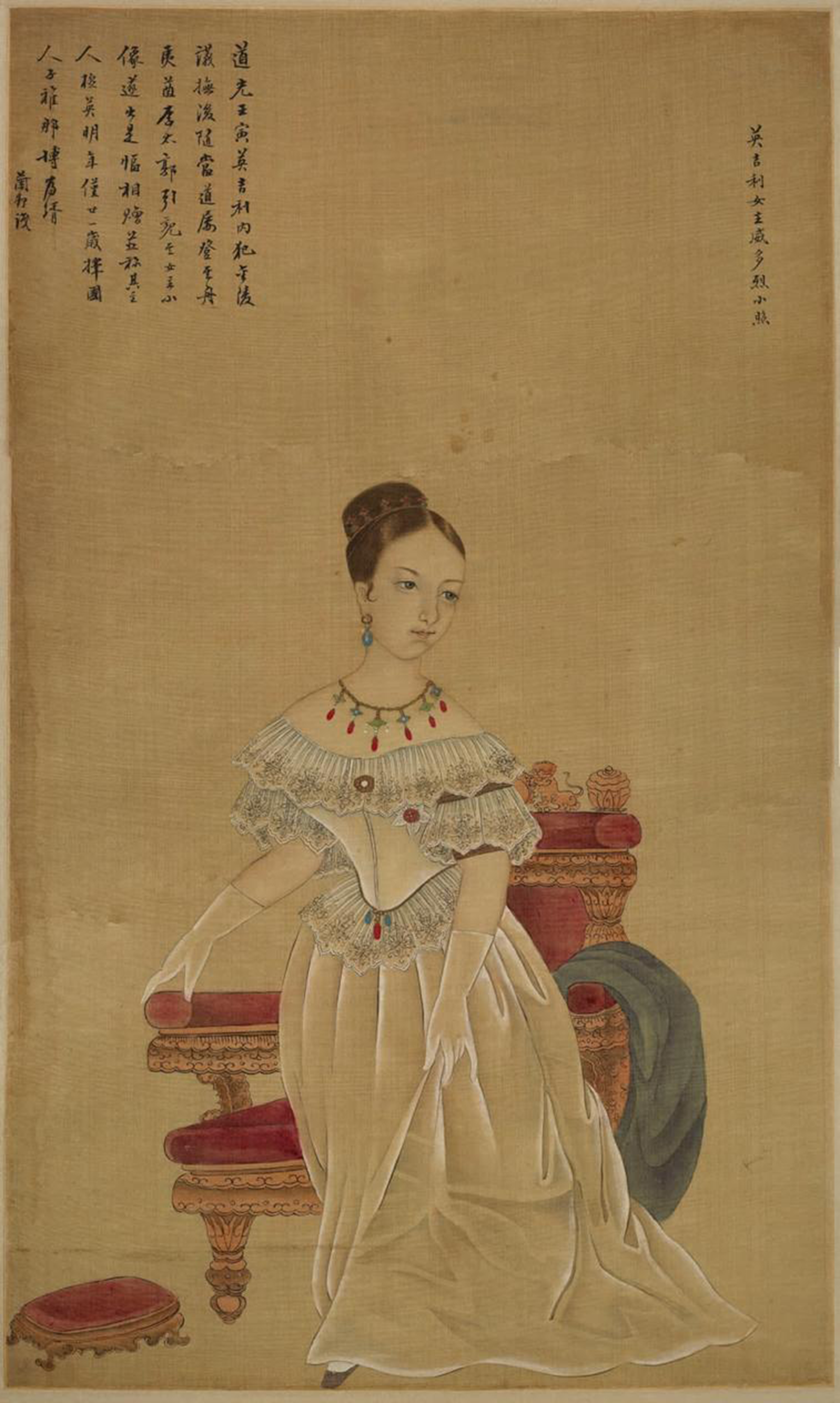
While official written records marginalized her presence, artistic evidence suggests that perceptions beyond the imperial court may have been more varied. A silk painting of Queen Victoria in Chinese style, produced during the First Opium War (fig. 1), survives as one of the earliest known Chinese visual depictions of the British monarch. This piece is currently housed in the British Museum.
Portrait of Queen Victoria of England. 1842. Hanging scroll, ink and colors on silk. Courtesy of the British Museum (1954,1009,0.14).

According to its inscription, the painting was presented as a gift from the British side to a Chinese delegate. It records officer George Tradescant Lay (1800–1845) welcoming Chinese representatives aboard a British vessel in August 1842, during discussions leading to the Treaty of Nanking. On this occasion, Lay presented a portrait of Queen Victoria to the Chinese recipient, who later recorded the event directly on the artwork.
Notably, the painting preserves a reference to the Queen’s intelligence and uses a respectful and masculinized transliteration of her name: “威多烈”. Composed of characters meaning “威” (majestic) and “烈” (fierce), this transliteration contrasts sharply with the pejorative renderings in imperial documents of the same period. Visually, the queen is portrayed in her famous wedding dress with coy feminine posture, rather than her famous imperial posture widely circulated in the colonies. Footnote 20 It is perhaps an intentional gesture to render her image less politically domineering in the wake of Qing defeat. Although the precise identity of the recipient is difficult to ascertain, the painting’s textual and visual choices suggest a more admiring perception of Victoria within certain circles outside the Qing court. Footnote 21
Collectively, these early representations, or strategic omissions, of Queen Victoria reveal the Qing court’s discomfort with acknowledging a foreign female sovereign, particularly as she is associated with military defeat and Western imperialism. Within official discourse, Victoria was framed through a lexicon of cultural otherness, gender anxiety, and dynastic orthodoxy, making her both strange and threatening. Yet the survival of visual materials such as the silk painting and the semi-official account suggests that beyond the formal state apparatus, other modes of perception were beginning to emerge. These traces, though fragmentary, point to a growing awareness of Victoria’s symbolic significance and foreshadow the more nuanced portrayals that would arise in the following decades.
It was only with the expansion of diplomatic travel under the Yangwu Movement, also known as the Self-Strengthening Movement, that Qing officials began to engage with Queen Victoria not as an abstract symbol of Western threat but as a living political figure encountered in person. The next section turns to these firsthand travel accounts, beginning with Binchun’s 1866 mission, to examine how Qing envoys dealt with the task of representing a monarch whose presence increasingly demanded interpretation rather than dismissal.
The Changing Perceptions During the Yangwu Movement (1861–95)
After China’s defeats in the two Opium Wars, the Qing court gradually recognized the urgent need for reform. By the 1860s, an influential group within China’s leadership began changing their view of the West, from contemptuously viewing it as an uncivilized threat to regarding it, however reluctantly, as a potential source of knowledge and innovation. This pragmatic reevaluation initiated the Yangwu Movement, encapsulated by the pragmatic mantra, “studying from the barbarians to defeat the barbarians.” Footnote 22 Under this initiative, Qing envoys and students were dispatched abroad to observe and report on Western science, politics, and society, producing a body of travel writings that reflected both curiosity and caution.
Among late Qing travelers to the West, few commented directly on Queen Victoria. The most notable exception is Binchun (1804–1871), who led the 1866 mission to Europe and became the first Qing official to meet the British monarch. He documented the encounter in his official diary, Jottings from a Raft (1981[1871]), commissioned by the Zongli Yamen, the foreign office of the late Qing, and in two privately circulated poetry collections, Jottings on Joyous Travels to the Western Seas (1985[1869]) and Sails Returning from Beyond the Sky (1985[1869]). While his diary maintains the cautious tone of formal diplomacy, his poems express a more open admiration for Western grandeur. His interpreter, Zhang Deyi (1847–1918), offered additional observations in Maritime Accounts of the Marvelous (Reference Zhang1866), noting Queen Victoria’s mourning attire and cordial demeanor. Footnote 23
Other envoys took a more reserved stance. Zhigang (?–?), a Manchu official in the 1868 Burlingame Mission, briefly mentioned a formal audience with the queen in Record of the First Mission to the West (1985[1868]) but withheld personal reflections. Guo Songtao (1818–1891), the first Qing ambassador to Britain, wrote extensively on British institutions but avoided any comments on Victoria. By contrast, Zhang Zuyi (1849–1917), writing under a pseudonym during his 1887 post in London, included satirical and ambivalent remarks about the queen in his travelogue London Zhuzhici ( Reference Zhang2016[1888]), composed during her Golden Jubilee.
This section does not attempt a comprehensive survey, a task already accomplished by Jenny Huangfu Day’s award-winning Qing Travelers to the Far West (Reference Day2018). Instead, it focuses on how Queen Victoria was represented in Qing diplomatic writings. Of these accounts, only Binchun and Zhang Zuyi engaged her image with sustained literary attention, revealing how late Qing envoys used the figure of the queen to articulate broader tensions around Western power, imperial identity, and modernity.
A Qing Traveler’s First Encounter with the Queen
In 1865 Robert Hart (1835–1911), inspector-general of China’s Imperial Maritime Custom Service, proposed sending a delegation to Europe to observe Western society and institutions. Footnote 24 Prince Gong (1833–1898), the regent and leader of the Yangwu Movement, endorsed the initiative. Binchun, a sixty-three-year-old bannerman official, was selected and accompanied by four students from Tongwenguan, the premier language-training institute, including his son and the future diplomat Zhang Deyi.
In 1866 Binchun’s delegation sailed from Hong Kong to Europe, spending thirty-eight days in Britain before traveling on to other European capitals. They visited dignitaries, official institutions such as the Royal Mint, the armory, and Parliament, and enjoyed various leisure activities in Britain. Binchun’s diary reveals that he was deeply impressed by the technological and infrastructural advancements of Britain.
On June 5, 1866, the Chinese delegation attended a ball held in their honor at Buckingham Palace, but Queen Victoria was absent due to mourning for Prince Albert. Footnote 25 Binchun vividly described the magnificence of the evening: lavish floral arrangements along the staircases, dazzling chandeliers, and a distinguished crowd of “over 800 guests” from the British aristocracy, including the crown prince and princess. The royal couple greeted Binchun warmly and asked for his impressions of London. He replied that it was the first time a “Chinese envoy” had witnessed such splendor abroad.
The following day, the delegation finally met Queen Victoria. During the audience, the queen expressed regret about China’s geographic distance and hoped for stronger Sino–British relations. She also inquired about how Binchun was adjusting to life in London and what differences he had observed between Britain and China. His reply, cautious and diplomatic:
The houses and tools of London are crafted with a precision surpassing that of China. The governance and systems here are exemplary in many respects. We have been honored by the monarch’s gracious hospitality, allowing us to witness such marvelous sights, for which we are deeply thankful. Footnote 26
The queen responded warmly, expressing the hope that their journey would strengthen ties between China and Britain. Binchun expressed his gratitude once again and took his leave.
The brevity and formality of Binchun’s official account were deliberate here. As Day has argued, his diary was intended not only for the reform-minded officials within the Zongli Yamen but also Emperor Tongzhi and conservative officials. Footnote 27 Too much open praise for Western advancements risked accusations of cultural self-denigration. Accordingly, Binchun balanced careful diplomatic wording, acknowledging Western advancements while tempering his praise. For example, Binchun portrayed westerners as culturally inferior, emphasizing Europe’s gender dynamics as inappropriate, Footnote 28 describing European women as domineering, promiscuous, and lacking Confucian virtues. Moreover, when recognizing Western cultural and artistic achievements, he often traced their elegance back to presumed Chinese influences and noted Europeans’ admiration of Chinese arts and Confucianism. Footnote 29 This rhetorical balancing act—that is, sincere admiration calibrated by cultural pride—became a template for later Qing travel writers.
Binchun’s caution appears especially prescient when contrasted with Guo Songtao’s experience. Guo openly praised British technological achievements, political and educational systems, and cultural strengths, directly challenging Qing scholarly pride. His reformist writings provoked severe backlash from conservatives in the Qing court. His deputy, Liu Xihong (?–1891), later ambassador to Germany, publicly accused Guo of excessive flattery detrimental to Chinese dignity. Liu only supported selective Western learning but considered Western commercialism morally incompatible with Confucian ethics, Footnote 30 whereas Guo, from a wealthy merchant background, argued China’s weaknesses stemmed from rigid Neo-Confucianism, advocating deeper systemic reforms. Guo repeatedly praised Japan’s foresight in undertaking comprehensive political reforms, Footnote 31 criticizing Qing leaders’ superficial adoption of Western technology without any ideological reform. Footnote 32 Guo’s provocative stance ultimately alienated other officials, forcing his resignation and self-imposed exile, and leading conservatives from the Qingyi Movement to order the burning of his “traitorous” writings. Footnote 33 Therefore, it is safe to say that Binchun’s diplomatic reserve was clearly strategic. His public travel diary reflects a careful balance between sincere admiration for Western prosperity and the necessity of reaffirming Chinese cultural pride.
In contrast, Binchun’s privately circulated poetry reveals a more candid and admiring response to Western culture. Freed from the constraints of court protocol and political scrutiny, his poems express a genuine fascination with the architectural grandeur, the opulence of royal ceremonies, and, most notably, the beauty and refinement of Western women. Contradictory to his diary’s critical attitude toward European women, his poetry highly praised the grace, beauty, and, particularly, the education of Western women, whom he likens to celestial maidens from Chinese mythology. Footnote 34
Binchun’s poems also reflect a more humanistic view of the West. Rather than portraying non-Chinese as monstrous—as he did in his diary, comparing them to strange creatures from the Classic of Mountains and Seas (fourth century bce)—his poetry emphasized shared human emotions and sensibilities, Footnote 35 suggesting a greater cultural affinity than his official writings. These verses, circulated only among his literati friends, offer a compelling counterpoint to his diplomatic account and reveal a deeper and more personal appreciation for Western civilization.
His private admiration is evident in the following verses about Queen Victoria:
Long dresses, slim sleeves, the fabric was light as feathers,
Precious necklaces above chests glistening in our eyes.
Guests swayed to the rhythms of Rainbow Garments,
With Phoenix songs we danced to the Penglai fairylands. Footnote 36
…
Jujubes big as melons, peaches of a thousand years,
From jade plates the Queen Mother bestows us grapes.
Returned, I boast to companions of the wonders I have seen:
To reach Jasper Lake alone proves my grandeur and esteem. Footnote 37
In these verses, Binchun draws on familiar Chinese imagery to translate the exotic spectacle of the British court into culturally resonant terms. Motifs such as “Penglai fairyland,” “peaches of a thousand years,” “Queen Mother,” and “Jasper Lake” all allude to the tale of the Queen Mother of the West, a female deity in Chinese mythology associated with divine authority and transcendence. The legendary banquet between the Queen Mother and King Mu of Zhou (ca. 1027–922 bce), where the mortal king journeyed west to meet the Queen Mother in her fairyland and was bestowed a peach of immortality, Footnote 38 forms the mythological backdrop against which Binchun frames his own experience in England. By comparing Buckingham Palace to the Queen Mother’s residence in the “Penglai fairyland” and alluding to the Peaches of Immortality, Binchun casts his own meeting with British royalty as a transformative and enlightening journey. In this light, the “peaches of a thousand years” could be interpreted as the Western knowledge that Binchun was commissioned to take back to China to restore the Qing Empire.
Additionally, the imagery of feathered dresses and the term “Rainbow Garments” further emphasize this Sinicized portrayal. They allude to the “Dance of the Rainbow Garment and Feathered Robe,” a famous dance and musical composition attributed to Emperor Xuanzong of Tang dynasty (685–762). This performance drew inspiration from Kucha, Persia, and India, Footnote 39 representing a fusion of various cultural influences that reflect the cosmopolitan nature of Tang China. Binchun uses such a familiar motif to link the grandeur of the British court to an exoticized ideal of refinement from China’s own golden era. His analogy of Queen Victoria as a modern Queen Mother and Emperor Xuanzong avoids gendered and racialized stereotypes that characterized earlier Qing views of the West and even those found in his own diary.
Considering Binchun’s elder status, the prevalent Sinocentric worldview among Qing officials, and the broader context of China’s defeats in the two Opium Wars, his willingness to engage diplomatically and aesthetically with Western monarchs reveals a surprisingly cosmopolitan and adaptive sensibility for a Qing official of his generation.
Nevertheless, this altered perspective was shaped more by political expediency than genuine ideological transformation. As Jacques Gernet argues, portrayals of foreigners often reflect a society’s internal anxieties. Footnote 40 Binchun’s cautiously favorable portrayal of Victoria in his diary mirrored Qing elites’ pragmatic openness to Western models during the early Yangwu Movement. His privately circulated poetry, however, reveals greater enthusiasm, reflecting sincere admiration and personal aspirations. As Yunrui Lin notes, Binchun strategically used these poetic depictions of Western splendor to enhance his prestige among literati circles increasingly fascinated by foreign experiences. Footnote 41 His poems thus served a dual purpose: expressing genuine appreciation and performing social distinction, subtly aligning himself with emerging cosmopolitan values among Qing intellectuals.
Binchun’s writings eventually had limited influence on Qing policymaking. His official diary focused largely on ceremonial details, offering little in the way of technical analyses that reform-minded officials sought, as both Prince Gong and Li Hongzhang found Binchun’s diary too vague and repetitive. Footnote 42 Others in the Zongli Yamen decided to use Binchun’s experience to push a modernization agenda anyway, even distorting his narrative. For example, General Secretary Zhou Jiamei wrote a memo to Emperor Tongzhi soon after Binchun’s return to advocate immediate political reform. Footnote 43 He cited aspects of Binchun’s words not found in the diary, such as his supposed observations on Western military system and arsenals. Footnote 44 This incident suggests that some ambitious reformists used Binchun’s report to press reform, regardless of its actual content, based on their preconceived notions. On the other hand, literati read his works primarily for leisure, delighting in the exotic imagery and curious details of Western life rather than seeking political meaning.
Therefore, Binchun’s travel writings reveal the selective nature of cross-cultural representation. His portrayals of Queen Victoria reflect the internal realities and desires of the reader more than the external world they describe. The British queen was presented in a familiar, Sinicized image, tailored to what a Chinese audience would expect and appreciate. His account was a cultural mirror, reflecting each reader’s preoccupations and aspirations. Here, Queen Victoria became a figure of fascination and a symbol strategically appropriated into the Chinese worldview.
London Zhuzhici and the Queen’s Golden Jubilee
While Binchun’s writings reflected a cautiously admiring engagement with Queen Victoria during the early years of the Yangwu Movement, the Chinese perception of the British monarch would continue to evolve over the following decades. As the political power shifted under the regency of Empress Dowager Cixi and the reign of Emperor Guangxu (r. 1875–1909), Queen Victoria became an even more prominent figure in the Chinese political imagination. Against this backdrop, new forms of literary engagement with her image appeared. They are no longer bound by the decorum of diplomatic missions but instead unfold through more ambivalent, critical, and at times ironic perspectives. The following section examines Zhang Zuyi’s London Zhuzhici, a poem anthology composed during Queen Victoria’s Golden Jubilee celebration, to study how later Qing observers negotiated admiration and cultural resistance in their portrayals of the British Queen.
The London Zhuzhici, a collection combining poems and travel observations, was published in 1888 under the pseudonym “Juzhong Menwaihan” (lit. “outsider/layman of the bureau”). The author was first identified as Zhang Zuyi (1849–1917) by literary master Qian Zhong-shu, Footnote 45 a conclusion later corroborated through independent research by the historian Dexiang Yin. Footnote 46 Zhang arrived in London in 1886 as an attaché to Liu Ruifen (active 1872–92), the Qing ambassador to Britain. Composed during his two-year tenure in Britain, Zhang’s poems documented not only the city’s technological advancements but also its everyday life. Among extant Qing travel writings, London Zhuzhici arguably is the most detailed account of late nineteenth-century London produced by a Chinese observer.
Zhuzhici provides a drastically different view of Britain compared to earlier Qing travelers. Zhang’s authorship was deliberately concealed because the collection contained many derogatory remarks that might have caused diplomatic tensions. Footnote 47 Whereas earlier Qing travelers tended to emphasize Britain’s advancements in largely positive terms—Guo’s writings, in particular, even approaching an Anglophile enthusiasm—Zhang’s work is far more critical and ambivalent.
To be more precise, Zhang’s attitude toward Britain oscillated drastically between admiration and contempt, often within a single passage. For instance, Zhang praised the convenience of tap water in one moment, only to dismiss it in the next as incapable of cleansing London of its metaphorical “dirty business,” a remark he left unexplained. Footnote 48 Another time, he marveled at the rare animals in the London Zoo but criticized the city’s inhabitants as being more barbaric than the creatures on display. Footnote 49 Yet again, in the accompanying notes to the poem, Zhang would quickly return to praising the remarkable spectacle of Britain.
This shifting narrative demonstrates a state of psychological turmoil. On one hand, Zhang could not deny Western advancement and the material abundance presented in the city; on the other, he felt compelled to defend Chinese national pride, critiquing Britain on spiritual or cultural grounds as inferior to China.
His defensive attitude is most prominently manifested in Zhang’s negative view of London women, whose perceived lack of modesty clashed with Confucian norms. Shocked by their revealing clothing, Footnote 50 and public displays of affection between couples, Footnote 51 Zhang concluded that British women were promiscuous. Moreover, for the first time, Zhang met professional women in roles strange to him. Businesswomen’s casual use of phrases like “my darling” when addressing male customers further shocked him. Footnote 52 He even suspected inappropriate relationships between nurses and patients, and governesses and students, revealing his deep discomfort with London’s gender dynamics. Footnote 53 By emphasizing London as morally decadent, Zhang reinforced his belief in the superiority of Chinese civilization.
His conflicted view extended to his criticism of Queen Victoria in his record of the Golden Jubilee, who, although admired for her popularity, was also subtly criticized within Zhang’s framework of gender and moral expectations.
I
Fifty years ago, a beauty bold,
Who dared to wear the kuí-yīn’s crown of gold.
Now in the church, she sits on high,
Receiving blessings from those who sigh.
She’s won the hearts of the common folk,
Who kneels and chants beneath her yoke.
II
Athletic crossbowmen lead the way,
Her eight-horse carriage in grand display,
In robes of silk and wheels of red,
The royal splendor moves ahead.
But these barbarians lack all grace,
They cheer and crowd on either side,
With boisterous zeal, as she rides by. Footnote 54
Note: The Queen’s procession from the palace to the chapel was led by several hundred horsemen, followed by over a hundred musicians and several hundred foot soldiers. […] Along the route, spaces on the roadside were partitioned off with colorful banners, offering seating for sale, with the best seats costing as much as ten pounds. […] As the procession passed, women and children removed their hats, and the cheers could be heard for tens of miles, without any sign of solemnity. Footnote 55
Linguistically speaking, the term “kuí-yı¯n” (魁阴) in the first poem, a transliteration for “queen,” has long been praised for its ingenuity, Footnote 56 skillfully combining the ideas of “alpha female” (“kuí” meaning leadership, and “yı¯n” referring to femininity) while mimicking the pronunciation of “queen.” However, this clever wordplay, similar to the term “nǚ zhǔ,” actually underscores the absence of a direct equivalent to a ruling queen in the Chinese language. This linguistic gap reveals the cultural dissonance in accepting female political authority within China’s male-dominated political framework.
Zhang’s depictions of the jubilee celebration clearly demonstrate a complex mix of admiration and criticism rooted in Confucian values. The first poem starts by focusing on the queen’s former beauty, reducing her to an object of the male gaze rather than recognizing her as a political leader. Then the word “dared” in the second line implies disbelief in a woman who could maintain supreme power for fifty years without causing the calamity traditionally associated with female rulers in Chinese historiography. However, by the conclusion of the poem, Zhang acknowledges the queen’s popularity among the public, suggesting grudging respect for her achievements.
The second poem and its note overtly demonstrate Zhang’s shifting tone, moving from admiration to criticism. After praising the grandeur of the procession, he condemns the British public’s “improper” behavior. He labels them as “barbarians,” a term that had been officially banned in the Treaty of Tientsin in 1885. Footnote 57 Writing anonymously, Zhang, nevertheless, took the liberty to use the term to express his disapproval. He contrasts the British crowd’s unrestrained enthusiasm with the Qing’s hierarchical customs, where commoners must kneel with heads bowed and avoid eye contact with the emperor. He thought this closeness to the monarch was improper and barbaric, reinforcing his belief in Chinese civilization’s superiority.
In addition, the note criticizes the commercialization of the event, where the best seats were sold for ten pounds, a detail that echoes his earlier critique of Britain’s capitalist nature. Footnote 58 He found this pervasive commercialism distasteful, lamenting that even royal celebrations were treated as opportunities for profit, a phenomenon he viewed as symptomatic of a deeper moral decline, where commerce and greed eclipsed nobility and tradition. His view is rooted in Neo-Confucian norms, especially the Cheng-Zhu school, which long placed merchants at the bottom of the social hierarchy as figures of low character. Footnote 59 Zhang’s criticism resonates with those of other Qing travelers, including the conservative official Liu Xihong and the scholar-official Yuan Zuzhi (1827–1898). While praising Britain’s material prosperity, they similarly deplored the commercial ethos that permeated all levels of British society. Footnote 60 They viewed such a profit-driven culture as a sign of inevitable decline.
Zhang’s writings about the queen’s Golden Jubilee contrasts with the diplomatic rhetoric of earlier envoys such as Binchun. Binchun’s diary maintained a careful balance in the public, while admiring Western society privately in his poems; Zhang’s Zhuzhici reverses this dynamic. Written privately, Zhang’s poems express sustained critique toward Britain and its monarch, suggesting that his private sentiments were considerably less admiring than those conveyed in the formal accounts of his predecessors.
Shiru Chen has argued that Zhang’s critiques stemmed from a psychological defense mechanism, where “the act of portraying a negative image of the ‘Other’ is, in fact, another way of reinforcing one’s own identity.” Footnote 61 Xiaofei Tian further notes the polarized depictions in Chinese travelers’ accounts of the West, often framed through a “paradise/hell” dichotomy, Footnote 62 a pattern evident in the writings of Zhang.
I believe that other factors also contributed to this divergence. Unlike earlier envoys who visited for brief periods and confined themselves to prosperous areas in London, Zhang resided in London for two years. His extended tenure allowed him to encounter dimensions of British society largely hidden from ceremonial observations. His excursions into the East End exposed poverty and social fragmentation that undercut Britain’s glamorous image. Footnote 63 The contrast between the opulence of royal ceremonies and the squalor of the East End would have reinforced Zhang’s critical attitude toward British civilization.
Moreover, Zhang’s poetry hints at experiences of racial discrimination, a reality his predecessors may have been shielded from during their short and ceremonial visits. In one poem, Zhang recorded a group of British children following him and calling him “qing qing Chinese,” Footnote 64 which modern Chinese literary critic Zhu Ziqing (1898–1948) identified as a racial slur. Footnote 65 Although Zhang misunderstood the meaning of “qing qing” as the Chinese word for “invitation,” this event reveals the subtle yet pervasive racial tensions he likely encountered. His choice of pseudonym, “menwaihan” (meaning “layman” or “outsider”), further suggests an acute awareness of his marginalization in British society.
Furthermore, Zhang’s critical stance should be understood within the broader political climate of the late Qing. By the late 1880s, the Yangwu Movement was facing mounting resistance from conservative factions within the Qing court, notably the influential Qingyi movement, which condemned what they perceived as excessive concessions to foreign powers. The Treaty of Tientsin, signed with France in 1885 after China’s defeat in the Sino–French War (1884–85), intensified domestic dissatisfaction, fueling xenophobic sentiments among both officials and the broader populace, and undermining confidence in the reformation agenda promoted by Li Hongzhang. Although there is no definitive evidence that Zhang formally aligned himself with the Qingyi clique, his rigid attitudes toward Western gender norms, and his persistent use of the term “barbarians” despite its prohibition, all suggest an attitude less enamored with Western modernity than that of earlier envoys. His portrayal of Britain reflects not merely personal disillusionment but an emerging ideological resistance within late Qing officialdom, which questioned the cultural and moral foundations of Western modernity. In this context, London Zhuzhici reveals not only an individual traveler’s impressions but also the deepening tensions within late Qing perceptions of the West. It captures a complex mix of tensions between admiration, resentment, and the emerging politics of cultural self-defense.
Queen Victoria’s Jubilees in Chinese Print Culture
Entering into the 1890s, Chinese society was experiencing rapid changes. The Yangwu Movement had failed to modernize China’s military and economy, as demonstrated by the loss of the Beiyang Fleet to the Japanese navy in the First Sino–Japanese War (1894–95). Chinese intellectuals who had studied in the West struggled to reconcile their admiration for Western culture with the harsh reality of China’s continued weakness. Despite these material failures, modernization took root, as Western political, scientific, and cultural ideas continued to penetrate Chinese society, particularly through the rise of the newspaper and print industry in treaty port cities like Shanghai.
This section examines how Queen Victoria’s jubilees were represented in two different media outlets, Dianshizhai Pictorial and Shenbao. These sources not only reveal the ideological framing of the queen as a symbolic figure in late Qing China but also offer insight into how different segments of Chinese society engaged with her presence and the broader idea of Western governance and modernity.
Both publications had significant influence in China with wide circulation. Founded in 1872 by British businessman Ernest Major (1864–1950), Shenbao quickly became the most widely read Chinese-language newspaper in Shanghai, reaching a daily circulation of approximately 30,000 copies, with about 9,000 distributed in Shanghai and the remainder circulated throughout rest of China by the early twentieth century. Footnote 66 Its reputation for political seriousness, accurate translations of international news, and reprinted imperial decrees made it particularly influential among educated elites.
On the other hand, Dianshizhai Pictorial, which first appeared in 1884, was a powerful medium for spreading Western ideas through images. Published biweekly as a supplement to Shenbao, the pictorial illustrated contemporary news, folktales, and foreign affairs in more than 4,000 vivid lithographic illustrations between 1884 and 1898. Though exact circulation figures for Dianshizhai are difficult to ascertain, scholars estimate that each issue likely had a print run of approximately 10,000 to 15,000 copies among readers across Shanghai, the Yangtze River delta, and even into inland provinces. Footnote 67 Given the common practice of sharing newspapers in public reading rooms and often read aloud in teahouses, the actual readership was likely much higher than the immediate subscribers. Therefore, the combined reach of these two publications with both elite and popular readerships makes them a compelling lens through which to assess Chinese perceptions of Queen Victoria through their reports about her two jubilees.
My discussion begins with Dianshizhai Pictorial because it offers both an earlier and more socially expansive view of Queen Victoria’s reception in late Qing. Dianshizhai reached beyond the educated elite to include semiliterate and even illiterate viewers, as its publisher Ernest Major grandly claimed that the pictorial aimed to reach “the workers of Shanghai, and farmers and tradesmen beyond.” Footnote 68 The lithographs themselves were often viewed independently of the text among illiterate readers, Footnote 69 especially in teahouses, reading rooms, and street displays, where they were discussed aloud or simply admired. Because of this visual accessibility, Dianshizhai provides valuable insight into how Queen Victoria was presented to a wide range of viewers. The section will then turn to Shenbao, which catered to a more elite, literate audience and offered a different lens on the queen through classical prose and moral commentary.
Dianshizhai Pictorial: Popular Visualizations of the Queen
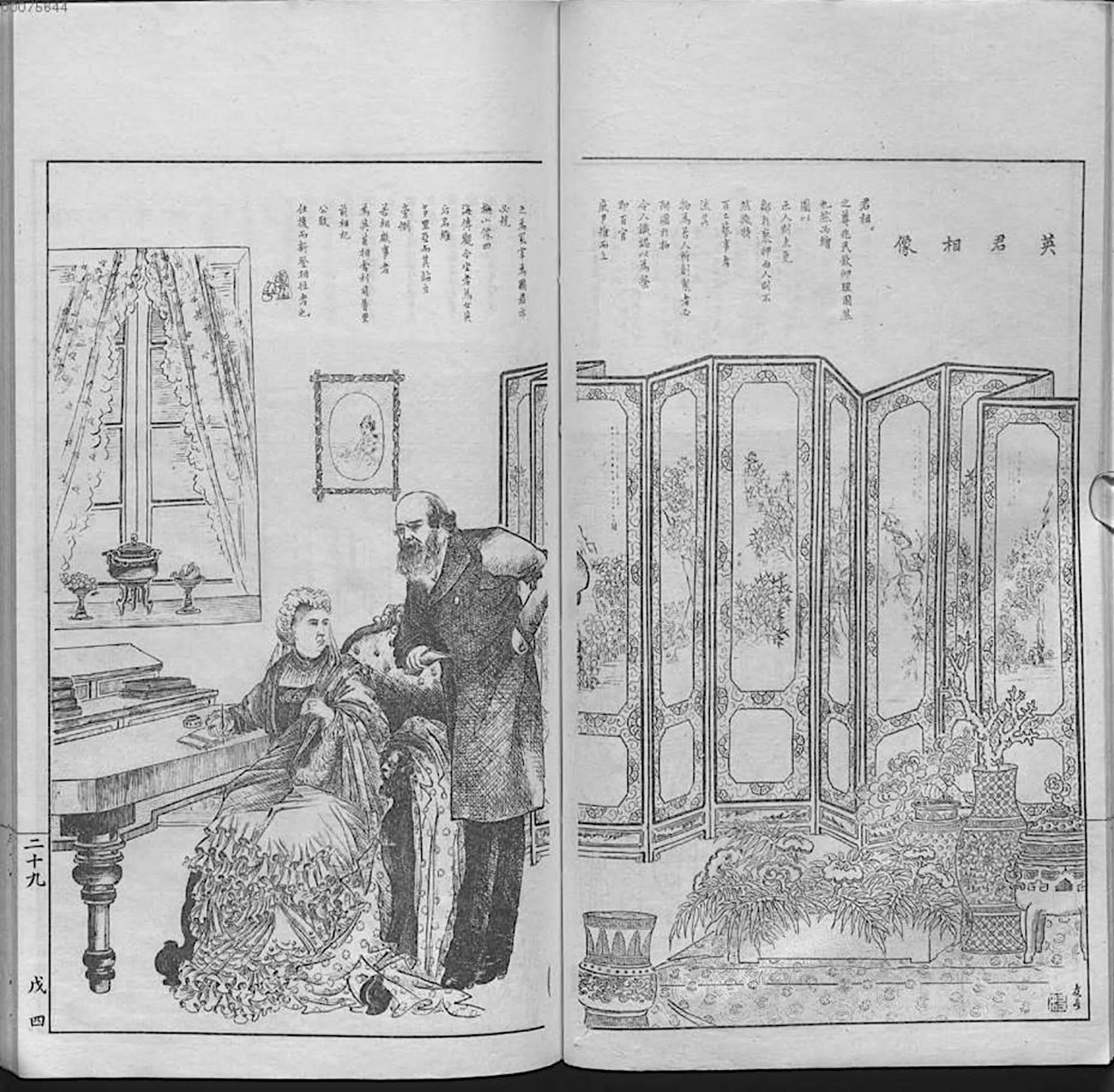
One early example of Dianshizhai’s portrayal of Victoria appears in an 1885 illustration that depicts her seated beside Prime Minister Robert Gascoyne-Cecil (fig. 2). The accompanying caption makes explicit the cultural contrast being drawn for Chinese readers:
Displaying a monarch’s portrait to the public has long been considered a violation of respect in China, but such norms do not apply in Western societies. In the West, the public dissemination of one’s image is viewed as a mark of honor, and these portraits circulate widely among all social classes, from commoners to royalty. This image portrays Queen Victoria sitting, with her Prime Minister standing beside her. Footnote 70
“Portrait of the British Monarch and the Prime Minister,” by Wu Youru, Dianshizhai Pictorial 5, no. 4 (1885): 29.

The image and its caption together emphasize a political norm that would have appeared radical to a late Qing audience. In traditional China, the visibility of imperial portraits was heavily restricted. Throughout China’s premodern history, the general populace was largely unaware of their rulers’ appearances. Portraits of Qing emperors were once reserved for the imperial family and select Manchu, Mongol, and Tibetan aristocrats. Footnote 71 By contrast, Dianshizhai presented Queen Victoria as a highly visible and accessible monarch. The radical idea that common people could own an image of a ruler symbolized an evolving view of leadership, where rulers were no longer distant, untouchable, semidivine figures but accessible, visible humans serving their subjects. In this context, the circulation of Victoria’s portraits in Dianshizhai, available for public consumption, represented a dramatic shift toward this more open and accountable form of governance.
This openness, not just in showing the physical appearance of national leaders but also in illustrating how they conducted political affairs, materialized the principles of modern governance. The transparency that the British monarchy demonstrated was in direct contrast to the secrecy of the Qing court. Not until 1904’s St. Louis World’s Fair did Empress Dowager Cixi began distributing her own portraits to enhance her image and the Qing’s international reputation. Footnote 72 Cheng-hua Wang argues that this democratization of Cixi’s image effectively “dispelled the mystic and sacred aura of the imperial system,” Footnote 73 opening a crack in the once impenetrable imperial despotism, allowing the first glimmers of modern democracy to seep in. Indeed, merely seven years later, the Qing dynasty was ultimately overthrown in the Xinhai Revolution (1911), leading to the establishment of a republic and conclusively terminating China’s two millennia of dynastic autocracy.
Moreover, this illustration also marks a significant shift in Chinese visual culture by portraying, for the first time, a woman actively involved in political affairs. In contrast to traditional Chinese depictions of women—such as in “meirenhua” (paintings of beautiful women) and “shinvtu” (paintings of court ladies), which often confined women to passive, domestic roles for decorative purposes—Queen Victoria is shown at the heart of governance and power.
This portrayal challenges conventional Chinese gender roles, offering a role model for educated women to emulate. Indeed, it resonates with broader depictions of women in Dianshizhai, which increasingly highlighted the societal transformations and gender dynamics of the late Qing. As Juan Wang observes, the awakening of female consciousness and the emergence of Chinese women’s liberation were central to societal change, and Western women were a vital “reference model” for Chinese reformers. Footnote 74 Newspapers and magazines of the time extensively reported on the education, careers, and marriages of Western women, often emphasizing gender equality in the West and contrasting it with the limited roles of Chinese women. In fact, Dianshizhai played an active role in introducing this new gender dynamic to a Chinese audience. Of the nearly six hundred illustrations related to the West, fifty were focused on Western women. Footnote 75 These visual portrayals not only highlighted the prominence of women in public life but also pointed out the differences between Western and Chinese gender relations, subtly suggesting that reform was imperative for China. As the 1900s approached, Chinese women were increasingly depicted as stepping into public and professional domains in Dianshizhai, which featured illustrations of women working, founding schools, and attending public meetings. Footnote 76
The portrayal of Queen Victoria as an active political figure challenged the entrenched views of female leadership in China. This visual representation paved the way for future activists to motivate young women to envision a role in political life. Even if a young, illiterate Chinese girl did not recognize the foreign woman in the picture, seeing her confidently converse with a standing male counterpart would provide a glimpse into a world in which women could hold political authority.
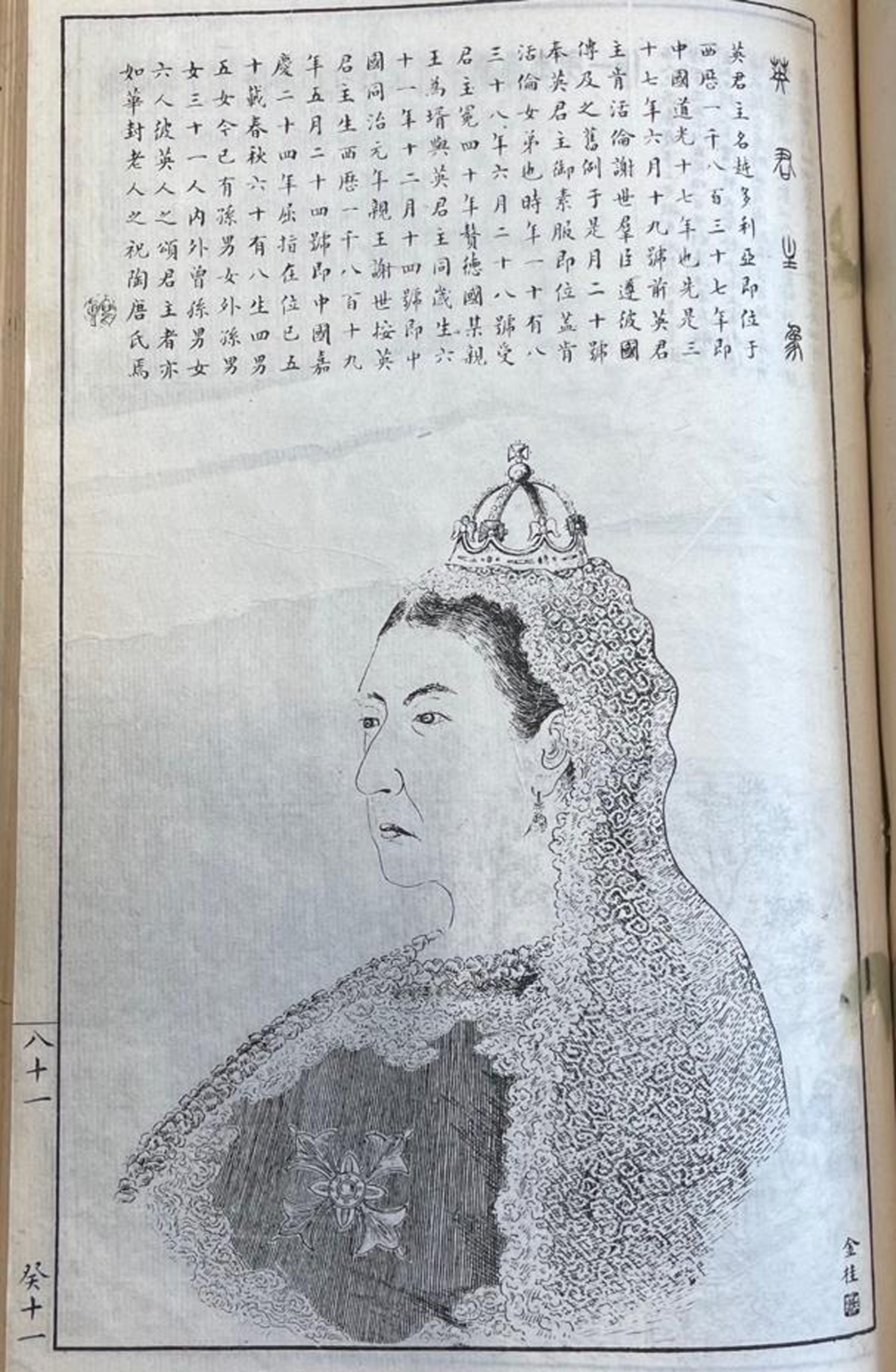
Despite this progressive depiction, to assert that Queen Victoria was a modern icon of female leadership in China would be overly optimistic. The other illustrations of her, which commemorate her Golden and Diamond Jubilees, emphasize her longevity and fertility, which are consistent with traditional Chinese values. Both portraits accentuate her role as a mother and grandmother, with the accompanying captions listing her four sons, five daughters, and more than thirty grandchildren. Footnote 77 These images clearly emphasize her role as a maternal figure, embodying the Confucian ideals of family continuity and the veneration of motherhood. Additionally, Prince Albert’s premature death is explicitly noted in the Golden Jubilee portrait (fig. 3). Footnote 78 The Confucian ideal of chaste widowhood, which is frequently celebrated in China with the prestigious memorial arch for virtuous women, was reflected in her devotion to her husband, long widowhood, and her continued wearing of mourning attire for decades after Prince Albert’s death.
“Portrait of the British Monarch,” by Jingui, Dianshizhai Pictorial 10, no. 11 (1887): 81.

This nuanced depiction of Victoria as a political leader, mother, and devoted wife allowed her to connect with various segments of Chinese society, potentially explaining her popularity among the Chinese, despite British colonial actions in China since the 1840s. Progressive reformers regarded her as an exemplar of contemporary governance and female leadership, while her extensive offspring, which earned her the title “Grandmother of Europe,” along with her faithfulness to her deceased husband, could bolster her favorable perception even among the most conservative Chinese audiences.
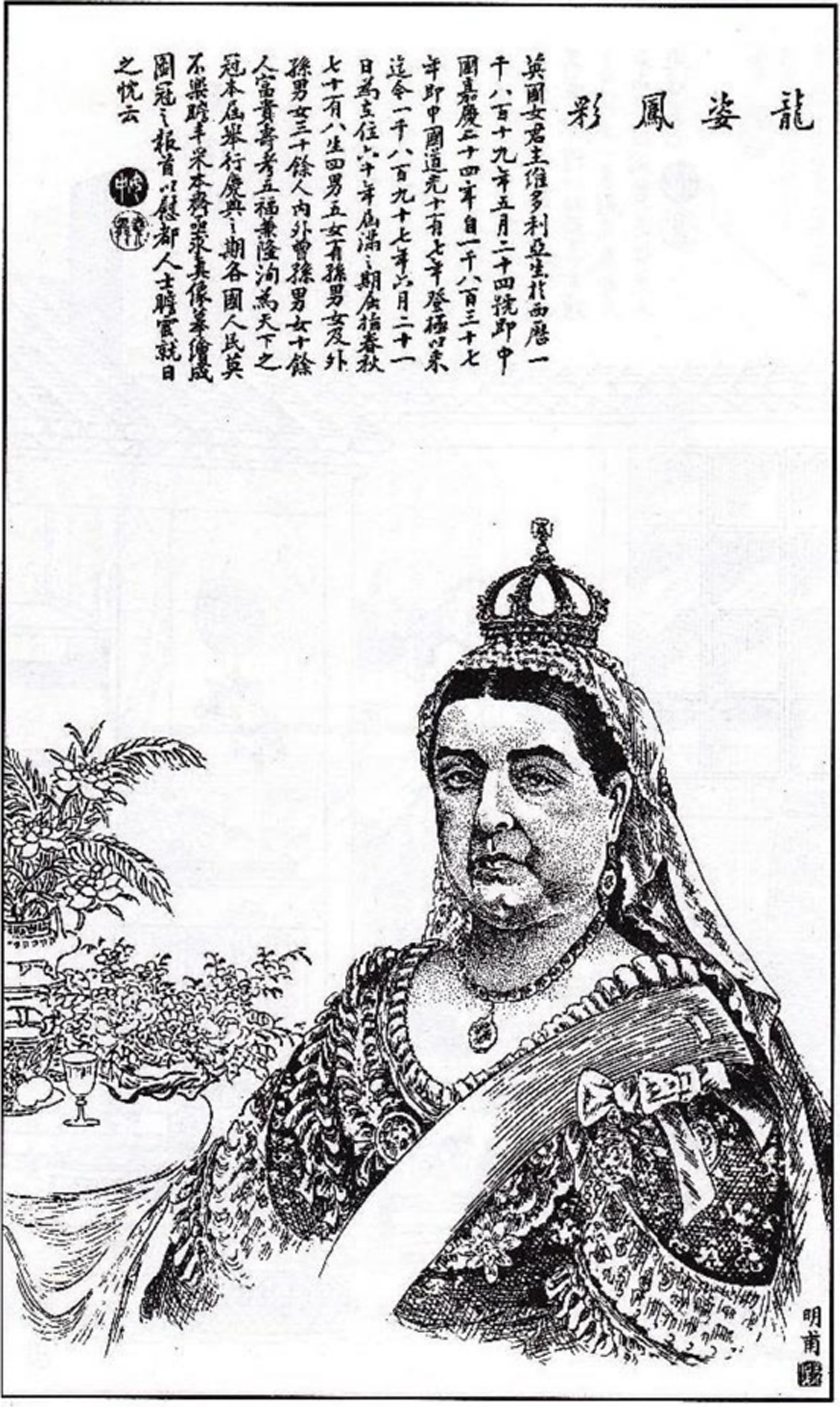
By the time of her Diamond Jubilee in 1897, Queen Victoria had achieved an almost semidivine status in China. The caption accompanying her portrait characterized her as a sovereign “unmatched in the world,” endowed with longevity, affluence, and a substantial family (fig. 4). By referencing the idiom “瞻云就日” (lit. “to behold the clouds and approach the sun”), which metaphorically signifies being graced by the presence of a sagacious ruler, the editors described their effort to obtain a photograph of the queen to accurately draw her likeness. Footnote 79 This usage likened her to the revered Emperor Yao of Chinese mythology. Footnote 80 Not to mention that this illustration was featured on the front page to satisfy the Chinese public’s aspiration to view this extraordinary monarch.
“Dragon Posture with Phoenix Appearance,” by Mingfu, in Dianshizhai Pictorial 14 (2001 [1897]): 173.

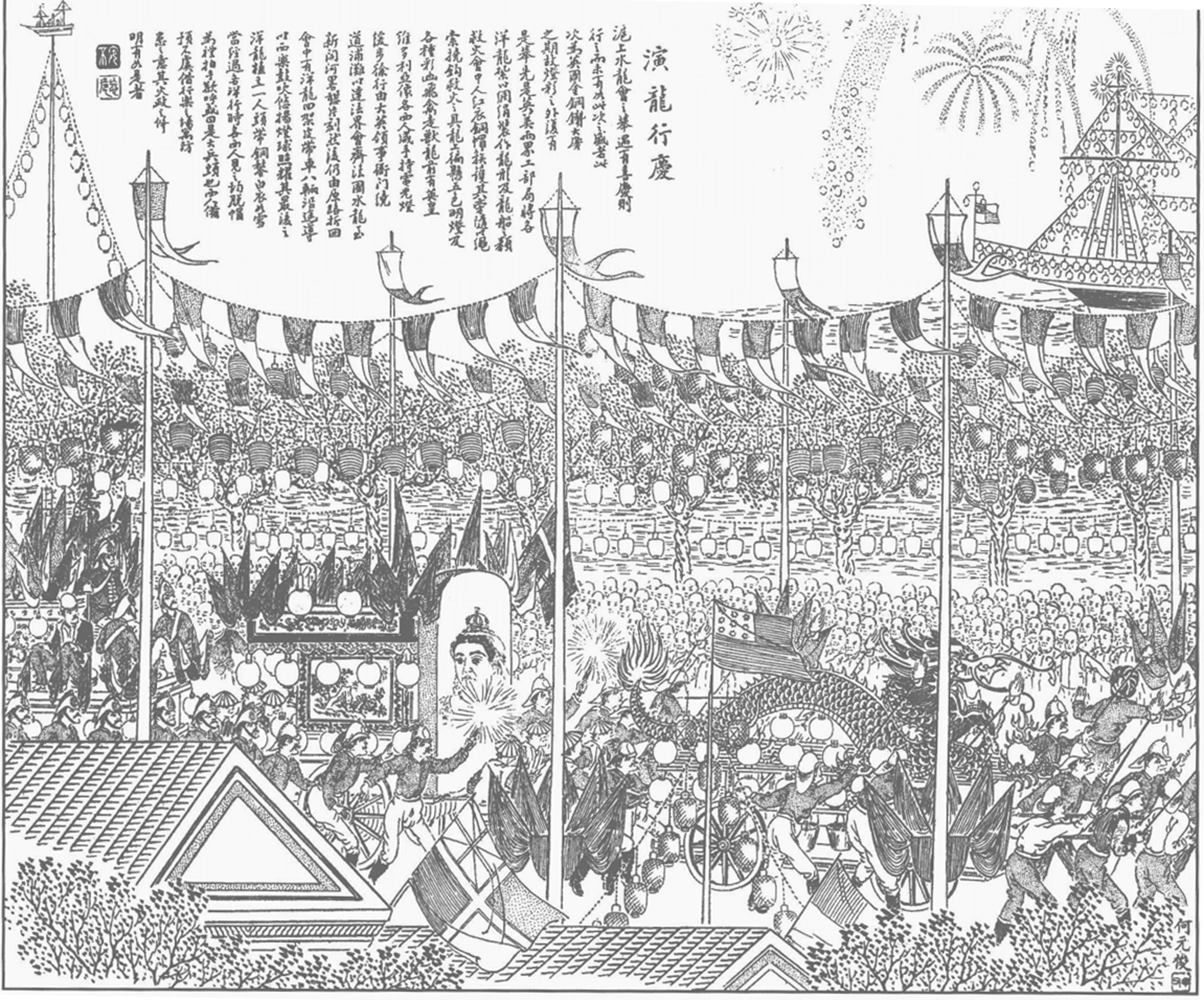
Moreover, this portrait was immediately followed by five more illustrations depicting the grand parades and festivities of the jubilee celebration in Shanghai. In one image (fig. 5), crowds of Chinese onlookers fill the streets as British and Qing military officers lead a procession. At its center is a dragon-adorned water cart, a symbol of prosperity in Chinese culture, followed by a large float bearing Victoria’s portrait. The float is framed by screens painted with pine trees, a traditional emblem of longevity, and topped with colorful flags, blending Chinese symbolism with Western pageantry. Hundreds of lanterns line the streets, while flags and ribbons flutter in the breeze. In the background, an illuminated three-masted ship on the Huangpu River and fireworks overhead emphasize the celebration’s scale and spectacle.
“Dragon Lantern Parade,” by Mingfu, Dianshizhai Pictorial 14 (2001 [1897]): 174.

It is intriguing that commemorations in Shanghai for Queen Victoria’s jubilees substantially exceeded those for Empress Dowager Cixi’s sixtieth birthday. Local Chinese guilds and wealthy merchants provided most of the funding for the queen’s jubilee celebrations, which included celebratory cannon firings, military parades, fireworks displays, dragon-light parades, and a circus show. Bryna Goodman has observed that the Chinese guilds expended significantly more on these celebrations than the concession authorities. Footnote 81 Moreover, Xiaoqing Ye’s thorough investigation of Shanghai residents’ attitudes toward foreigners demonstrates that they are significantly less enthusiastic about celebrating Cixi’s birthday than they are about the jubilees. Footnote 82 Dianshizhai also only provided a single, modest illustration for Cixi’s birthday, whereas the queen’s two jubilees respectively featured an additional five images that depicted their grandeur.
All these depictions portrayed Queen Victoria as a symbol of moral leadership, prosperity, and good governance. These are values that many in China aspired to see in their own national leaders. Most importantly, Dianshizhai was a popular, nonofficial publication catering to the general public, in contrast to the official historical records, government envoy diaries, and formal travelogues previously discussed in this essay. Its portrayals are indicative of the sentiments of the general populace. Its extensive coverage of Queen Victoria’s jubilees poignantly illustrated the increasing public dissatisfaction with Qing rulers and an openness to new models of leadership found in Western governance.
In a society that was grappling with internal instability and external pressures, Queen Victoria’s image ironically became a beacon of hope and stability, combining Western political strength with traditional Chinese moral virtues. Her symbolic significance suggested a future in which effective governance could be in harmony with tradition, qualities that China desperately sought during this period of transformation.
Shenbao: Queen Victoria’s Image among the Educated
An analysis based solely on Dianshizhai’s representations of the queen risks oversimplifying the complexity of her perceptions among the Chinese populace. To gain a more nuanced understanding, this section also investigates contemporary reports from Shenbao, whose literary sophistication and textual detail targeted an educated readership. Unlike Dianshizhai’s predominantly visual and concise narrative style, Shenbao’s articles were written in Classical Chinese with complex diction and reliance on intertextual allusion, which made it largely inaccessible to the lower classes. For China’s literate elite, Shenbao offered a sophisticated platform for engaging with global politics and cultural developments. Its coverage of two jubilees provides a complementary perspective to Dianshizhai.
Shenbao’s front-page coverage of Queen Victoria’s Golden Jubilee on June 21, 1887, featured a translation of a long congratulatory speech. Originally composed by a British official hosting the jubilee ceremony, the text was written in Classical Chinese using a familiar Confucian format: a dialogue between the British host and a Chinese guest. This question-and-answer structure, echoed by the Analects and other classical Chinese philosophical texts, made the article more culturally endearing to its elite readership.
In this exchange, the queen is praised as “a ruler of wisdom, benevolence, intelligence, and strategic foresight.” Footnote 83 For wisdom, she is said to have responded to an African envoy’s inquiry into Britain’s success, not by boasting arms and wealth, but by offering the Bible. The host explains this moral emphasis was intended to enlighten the visitor, much like the Chinese belief that good government rests on virtue. Benevolence is shown in her personal care for the sick and reading Scriptures to comfort them. Her intelligence is demonstrated through her accomplishments in music, poetry, painting, and physics as well as her fluency in several European languages. For strategic acumen, the host points to Britain’s military actions in Egypt and Afghanistan, and especially the Geomundo island incident in which Britain thwarted Russia’s attempt to occupy it and returned the territory to the Qing. The host interpreted this act as proof of the queen’s farsighted respect for Chinese sovereignty and good wishes for a stronger Sino–British relation. Together, these examples present Queen Victoria as an ideal monarch who possesses the virtues found among China’s sagacious monarchs.
Like Dianshizhai, this report also pays special attention to Victoria’s marriage, prolific offspring, and widowhood. The host remarks: “At age twenty-one, the Queen married a German prince named Albert, as her consort (當君主年廿一時,納德國一部君主之子,名曰亞爾倍爾德,以為贅婿).” Footnote 84 Notably, the verb “納” (to bring in) is quite striking in this context. Traditionally used to describe a man taking concubines of lower social status, it is almost never applied to a marital alliance. Its usage here clearly places Victoria in a dominant, masculine role, with Albert described as a “赘婿”— an uxorilocal husband who enters his wife’s lineage and is often viewed as subordinate. In Confucian tradition, such a role was considered emasculating and humiliating, as it disrupted the normative patrilineal order. Here the translator not only reinterprets the royal couple’s dynamic to suit a Chinese interpretive framework but also attributes to Queen Victoria a form of masculine sovereignty within the domestic sphere.
The article presents itself as a translation of a British speech, but such word choices are certainly the translator’s own. They refract the Western royal marriage through a Chinese cultural lens, rendering the unfamiliar in familiar terms. This could serve both to domesticate the image of a female ruler and to gently satirize the perceived inversion of gender roles in the West.
The translator’s choice to masculinize the queen is reinforced in the latter part of the passage, which recounts Prince Albert’s premature death and the queen’s enduring mourning. The text emphasizes Victoria’s emotional devotion to Albert: “She beautifully decorated his grave to express her lasting sorrow, and has worn mourning garments ever since.” Footnote 85 It also notes that “each death anniversary of Albert renews her grief,” Footnote 86 and that “even the nine children she bore could not fill the void in her heart.” Footnote 87 The host concludes with praise: “Her treatment of her consort was thus quite generous (則所以待婿者,可謂厚矣).” Footnote 88
The word “厚”, here translated as “generous,” implies deep emotional attachment and moral sincerity. In traditional Chinese historiography, such diction is typically used to describe an emperor’s exceptional favor toward a beloved concubine, rather than a widow’s chastity or fidelity. A comparable expression appears in the Draft History of Qing, which records Emperor Shunzhi’s devotion to his favored consort, Dong E: “The emperor’s favor toward her was exceptionally generous; she was the most cherished in the imperial harem (上眷之特厚,宠冠后宫).” Footnote 89 In this rhetorical framing, Queen Victoria is imagined not as a grieving widow but as a male emperor, emotionally expressive and ethically magnanimous. The gender dynamic is again inverted. Victoria assumes the masculine imperial role, while Albert is cast in the feminized position of the beloved consort.
This portrayal contrasts sharply with Dianshizhai’s Golden Jubilee report. Victoria in Dianshizhai is praised as a chaste widow who fulfilled her reproductive duty for her family lineage and for the country by bearing numerous children and grandchildren—a model of womanhood grounded in fertility and continuity. Shenbao, however, portrays her as a wise, strategic, affectionate, and moral sovereign, not merely a devoted wife and fertile mother conforming to Confucian ideals. This difference may reflect differing target readerships: Dianshizhai, catering to a more traditional, lower-literacy audience, reinforces familiar gender ideals for women; with a more elite, reform-minded readership, Shenbao does not refrain from praising the queen in the same way China’s ancient sagacious monarchs were deified. More importantly, it also frames Victoria’s mourning not as a passive virtue that a woman must abide by, but as an active, sovereign expression of personal devotion. This different framing points to the hierarchical nature of late Qing print culture, where different media outlets tailored the British queen to the ideological comfort zones of their respective audiences.
A decade later, Shenbao reported on the Diamond Jubilee celebrations in its June 23, 1897 issue. This report, however, did not appear on the front page but was placed on page 3. Nevertheless, it received substantial coverage and detailed narration. This time, the focus shifted from the queen’s personal character to the grandeur and social diversity of the festivities held in Shanghai. The queen is not described in moral or philosophical terms. Instead, the report captures how her celebration became a cultural event that reflected Shanghai’s cosmopolitan transformation.
The Diamond Jubilee celebrations featured church services, military parades, musical performances, fireworks, and illuminated fountain displays along the Bund. Participants included Qing officials invited by the British consul-general. Festivities began at Holy Trinity Church, where Freemasons led a symbolic procession. At noon, Western schoolchildren hosted a tea fair with songs and dances, followed by equestrian events at the racecourse. By evening, Western residents gathered at the British consulate for a garden party featuring hymns, magic shows, and choir performances. As night fell, thousands of lanterns and lights illuminated the city. Foreign institutions decorated their buildings lavishly, and dragon-shaped water carts and glowing towers transformed Shanghai into a vibrant spectacle, drawing crowds of both foreign and Chinese spectators well into the night. Footnote 90
One of the most striking features of this report is its attention to Chinese women’s unprecedented participation, especially those from elite families who attended events like the British consulate’s garden party “to broaden their horizons.” Footnote 91 Traditionally confined to the domestic realm, their presence at these international festivities signaled a significant shift influenced by westernization, for which Queen Victoria’s prominent image was partly responsible.
As the evening progressed, the report vividly described “renowned beauties, courtesans, and noble ladies from the inner chambers” being forced to walk through crowded streets on foot to watch the light show due to carriage restrictions:
Like slender jade, they moved delicately, leaning on young handmaids; with careful steps, their dainty, phoenix-tipped embroidered slippers were inevitably sullied by mud. Footnote 92
This depiction, though marking women’s emerging visibility in public spaces, is heavily aestheticized, underscoring their presence through the voyeuristic gaze of male narrators. The detailed focus on footwear, an erotically charged aspect of female attire in traditional Chinese aesthetics, emphasizes their passive role as objects of visual consumption.
However, regardless of this aesthetic framing, the event signified genuine progress. Queen Victoria’s highly visible reign and the widespread celebration of her jubilee provided a context that made the notion of women’s participation in civic life more imaginable for Chinese society. Thus, these festivities did not merely showcase imperial grandeur; they catalyzed subtle but meaningful changes in the public perception of women’s roles, foreshadowing the widespread women’s emancipation movements of the Republican era.
Conclusion
Queen Victoria’s image in nineteenth-century China underwent a fascinating evolution, moving from an initially marginal and often derogatory figure in Qing court records to a more complex and multifaceted icon in popular Chinese publications. By exploring these representations across official, intellectual, and popular media, my research demonstrates how Queen Victoria’s image embodied both the contradictions and the aspirations of a China undergoing rapid transformation during the late Qing era. The nuanced depictions of Victoria encapsulated China’s own struggle with political reform, cultural exchange, and global-power paradigm shifts in this epoch.
This research adds a new dimension to Victorian studies by showing that Queen Victoria’s image did not merely reflect British imperial power but was actively reshaped and reinterpreted by Chinese for their own purposes. This perspective enhances our understanding of the global reach of Victorian culture and its influence, not just through direct political or economic power, but also through symbolic and cultural means. In doing so, this essay contributes to a growing body of scholarship that decenters Victorian studies from its Western origins and explore how key figures like Queen Victoria were imagined and adapted by non-Western cultures.
To conclude, Victoria’s image in late Qing China reveals not only the complexities of Sino–British relations but also the ways in which foreign leaders could serve as symbols for internal debates about governance, modernization, and gender roles. Her evolving image, as both a modern leader and an embodiment of Confucian virtues, demonstrates that fin de siècle China experienced dramatic cultural exchange, which continues to inform our understanding of both Victorian Britain and China’s path toward modernity.
Acknowledgements
My sincere thanks to Jessica Harrison-Hall, head of the China Section and curator of Chinese Ceramics, Decorative Arts, and the Sir Percival David Collection at the British Museum. She kindly guided me to the Dianshizhai Pictorial depictions of Queen Victoria and generously shared her photographs to support my research.
Di Cotofan Wu is assistant professor of English and comparative literature at the University of Kurdistan Hewlêr. She previously held a lectureship at Sun Yat-sen University, a postdoctoral fellowship at the Beijing Foreign Studies University and an Early Career Fellowship at University of Warwick, where she also earned her MA and PhD with full doctoral funding. Her research focuses on British Decadence, fin de siècle Victorian culture, and transnational modernism in East Asia. She has published in Volupté, Cusp, and Journal of Popular Culture and contributed to The Oxford Handbook of Oscar Wilde (Oxford University Press, 2025). She is also the guest editor of the special issue “Symbiotic Empires: Britain and East Asia in the Long Nineteenth Century” for the Journal of Global Nineteenth-Century Studies (Liverpool University Press, 2025).

 Open access

