




Introduction
The adoption of silver currency in north-west Europe from c. AD 660/70 marked a profound transformation in the early medieval economy. The replacement of gold with large silver coinages stimulated interregional trade networks, fuelled the development of proto-urban emporia and widened the use of coined money. But what were the origins of the metal that underpinned the introduction and rapid expansion of silver coinage in early medieval north-west Europe? Several suggestions have been advanced: that silver was released (at least initially) through the melting down of Roman plate (Grierson & Blackburn Reference Grierson and Blackburn1986: 96–7) or the recycling of Roman scrap metal (Scull Reference Scull, Hines and Bayliss2013: 546); that silver was imported from the Byzantine and/or Islamic worlds, where silver was used as currency and plate (Naismith Reference Naismith2012a: 159–60); and, most recently, that silver was sourced from a revival of mining in Europe. The latter suggestion relates specifically to the large lead-silver mine at Melle in Aquitaine, France, with a recent study arguing that increases in lead pollution in Alpine ice in the late seventh century AD reflect increased production at this source (Loveluck et al. Reference Loveluck2018).
Determining the origins of the silver used may demonstrate tangible long-distance exchange routes, help account for periods of economic expansion and contraction and generate new insights into the origins of silver minting in the region. Here, we aim to identify not only the silver sources that supported the re-introduction of a north-west European silver coinage in the mid-seventh century, but also those underpinning its development over the course of the ‘long eighth century’ c. AD 660–820. We do so via a systematic geochemical method not previously applied to coins of this era: the combined lead isotope and trace element analysis of 49 silver pennies and denarii.
Methods
When used in combination, lead (Pb) isotope ratios and the concentrations of technologically and source-related elements, particularly gold and bismuth, provide a powerful means of characterising metal stocks and isolating potential silver sources (Kershaw & Merkel Reference Kershaw and Merkel2021). There are, of course, issues to consider in the interpretation of results. The recycling of metals can homogenise geochemical values, while the addition of lead during refining (cupellation) of silver introduces the potential for foreign lead contamination. The elemental and Pb-isotope datasets are thus interpreted using a framework that accounts for mixing and refining and is sensitive in identifying changes in metal stocks (Kershaw & Merkel Reference Kershaw and Merkel2021).
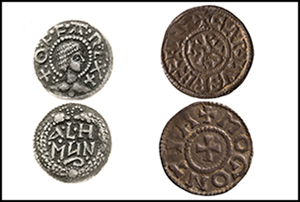
We sampled 49 coins from the Fitzwilliam Museum, Cambridge (Figure 1, see online supplementary material (OSM) 1 for a full list of the coins sampled). The coins provide a representative selection from England, the Netherlands and eastern Francia during two key periods of interest and focus on the regions surrounding the North Sea; they do not, however, enable insights into the origins of silver in coinage from other European regions, including western/southern Francia. To avoid the confounding effects resulting from debasement, the sample comprises coin series known to be of high-quality silver: consequently, there is a gap in the sequence of English coins between c. AD 715 and 760, a period of known reduced metal fineness (Metcalf & Northover Reference Metcalf and Northover1989, Reference Metcalf1993–4; Sarah Reference Sarah2008a & Reference Sarahb). Techniques used to partially bridge this gap through the use of legacy data are discussed below.
A selection of coins analysed for this study: Early Period coins a) Series A early penny (Coin List no. 2); b) Series E early penny (no. 23); c) Frankish denarius, Rheims (no. 26); Late Period coins d) penny of Offa (AD 757–796) (no. 32); e) denarius of Charlemagne (AD 768–814), Mainz (after AD 792/3) (no. 42); f) denarius of Charlemagne, Quentovic (after c. AD 812) (no. 44) (all images © The Fitzwilliam Museum, Cambridge).

We first analysed the coins using in situ laser ablation inductively coupled plasma mass spectrometry (LA-ICPMS) at the Department of Earth Sciences, University of Cambridge, using a NWR193 laser ablation system coupled with a Nexion 350D ICP-MS. Elemental measurements of samples and reference materials are provided in OSM2. For Pb-isotope analysis, we then sampled the same coins by portable laser ablation (pLA) in the Coins and Medals Department of the Fitzwilliam Museum, Cambridge. This recently developed method ablates microscopic samples of material, collecting them on Teflon filters for wet-chemical processing: it is thus both minimally destructive and capable of highly precise measurements of Pb-isotope ratios (Merkel et al. Reference Merkel, D'Imporzano, van Zuilen, Kershaw and Davies2022). Pb-isotope ratios were measured using a Thermo Scientific™ Neptune™ Series multi-collector ICP-MS at the Vrije Universiteit Amsterdam (see OSM3). Detailed presentation of analytical methods and results are provided in OSM4 sections B and C.
The dataset of 49 coins is large in the context of lead isotope studies of archaeological material, but relatively small considering the volume of early northern European silver coinage. Therefore, we compare the analytical coin data with existing elemental datasets of contemporaneous coinages from England, Frisia and Francia, in addition to Pb-isotope and trace element analyses relating to older late antique metal and analyses of ore from sources across Britain, the Frankish Empire and the Mediterranean region (see OSM4, section A).
Results
The coin data separate into two groups, discernible in both the Pb-isotope ratios and the source-related elements (OSM4 section D). These groups represent distinct metal stocks either side of c. AD 750. We characterise these as an early period (pre-750) of pennies from England and Frisia and denarii from eastern Francia (n = 29), and a late period (post-750) consisting of northern Carolingian denarii and Anglo-Saxon coins of Offa and Coenwulf (n= 20) (Figure 2, see also OSM4 Figures S2 & S3).
The gold content and Pb-isotope ratios of the coins investigated in this study. For gold content <1 wt. %, 2SD are smaller than the symbol. For >1 wt. % gold, 2SD are typically less than ± 10%. Errors for 206Pb/204Pb are approximately the size of the symbol, and errors for the other ratios are shown (figure by authors).

Early period: a surge of eastern silver c. 660–750
The first group of coins were produced in the period AD 660–750 in England, Frisia and, to a lesser extent, Francia. In England and Frisia, a substantial Primary minting phase (c. 660–710) of fine silver coins was followed by an even larger Secondary phase of minting (c. 710–750, later in Frisia). The coins became progressively debased and minting contracted (at least in England) after c. 735. This was a period of substantial minting: there are more coin finds per year for the period c. AD 660–750 in England than for any other period of equivalent length between the fourth and twelfth centuries (Blackburn Reference Blackburn, Pestell and Ulmschneider2003: 32, fig. 3.2; Naismith Reference Naismith2017: 106). Within this early group, however, the date of the coinage is often uncertain: Frankish coins cannot be closely dated within the period c. 660–750 (Schliesser & Sarah Reference Schliesser, Sarah, Bompaire and Sarah2017), while English and Frisian coins can usually only be assigned to the Primary or Secondary phase. They are conventionally referred to by a lettered series A–Z (Grierson & Blackburn Reference Grierson and Blackburn1986: 138–54, 164–89).
The coins from the first group comprise 18 early pennies of types traditionally attributed to England, six of types attributed to Frisia and four coins of types attributed to eastern and northern Francia (Grierson & Blackburn Reference Grierson and Blackburn1986: 138–89; Metcalf Reference Metcalf1993–4; Naismith Reference Naismith2017: 63–110) (Figure 1a–c, see also OSM1). Due to known inconsistencies in the silver content of English and Frisian coins minted during the Secondary phase (apparent from Metcalf & Northover Reference Metcalf, Northover and Metcalf1993–94: 639–41, 660–79), none were analysed as part of this study.
Despite their sometimes imprecise geographical and chronological attributions, all of these coins display a homogeneous composition, with silver characterised by high gold values (typically 0.6–2%) and consistent lead isotopic range, without distinguishable regional variations (Figure 3). The only exceptions are a few of the earliest coins (English Primary phase Series A and B and some Frankish coins), which possess higher lead isotope ratios. Nonetheless, strong compositional similarities suggest that these coins shared the same pool of bullion.
The Pb-isotope ratios of early phase coins by region (A) and the early pennies by series (B). A breakdown of the pennies by series suggests that there might be a chronological trend: four coins from Series A/B, some of the earliest analysed, have the highest isotope ratios. Errors in (A) are the same in (B) (figure by authors).

Given recent arguments that the introduction of silver coinage in north-west Europe was facilitated by mining at Melle in the late seventh century (Loveluck et al. Reference Loveluck2018), we first assessed the use of Melle silver in the pre-750 coin group. The Melle deposit is well characterised geochemically and isotopically, with extensive lead isotope data derived from ore, slag and glass (49 analyses after Téreygeol et al. Reference Téreygeol, Hoelzl and Horn2005; Gratuze et al. Reference Gratuze, Guerrot, Foy, Arles, Téreygeol, Baron, Bompaire and Sarah2017; Guillaume Sarah pers. comm.). These data derive from eighth- and ninth-century galleries within the mine but, given that Melle is a low-temperature ore field (96–155°C) and carbonate-replacement deposit with only one ore-forming fluid and one host rock (Cathelineau et al. Reference Cathelineau2012), it is unlikely that isotopic values of galena (lead sulphide also containing silver) from other, earlier contexts within the mine would differ. The absence of secondary ore enrichment (Bettenay Reference Bettenay2022) and the basic ore formation conditions are unfavourable for the presence of gold, thus it is expected that silver produced from Melle galena would be poor in gold. Existing archaeometric evidence indicates that Melle silver, identifiable by its lead isotope ratios and low gold levels, was used to mint some of the silver coins in its vicinity (i.e. western and central Francia, at mints such as Tours, Paris and Poitiers), albeit inconsistently and on a limited scale (Téreygeol et al. Reference Téreygeol, Hoelzl and Horn2005; Téreygeol Reference Téreygeol and Henning2007; Sarah & Schiesser Reference Sarah and Schiesser2013).
Crucially, however, the Pb-isotope ratios and elemental profiles of the early coins from eastern Francia and the North Sea area rule out Melle as a silver source for coinage in this region (Figure 4A; compare gold contents in Sarah et al. Reference Sarah, Bompaire, Téreygeol and Gratuze2012: 22). In fact, the Pb-isotope data for the early period coins are distinct in a northern European context (reference data, see OSM4 section A). No known European ore source matches the elemental and isotopic characteristics of these early silver coins. This includes ore from Britain: lead ores mined in Britain give a low silver yield making it unlikely that they were targeted for silver production, but our data indicate that the sampled coins were also not refined (cupelled) using British, or indeed north-west European, lead (compare Rohl Reference Rohl1996 and reference data, see OSM4 section A). Nor is there any meaningful overlap with late Western Roman silver coins and objects (Figure 4B). This finding makes it unlikely that late Roman metal was recycled to produce the earliest coinages. We also consider it unlikely that Islamic silver made a significant contribution to this coinage. Comparing the lead isotope ratios of the coins against those of contemporaneous Umayyad dirhams indicates that, while there is partial overlap, the Umayyad coins have higher 208Pb/206Pb ratios (compare with Merkel et al. Reference Merkel, Oravisjärvi and Kershaw2023).
Comparison of early Anglo-Saxon and Frisian pennies and north Frankish denarii (c. AD 670–715) with: A) ore from Melle; B) West Roman silver (Ag), late second–fourth century AD and C) Roman and early Byzantine silver and lead (Pb) from the eastern Mediterranean, late second to seventh century AD (for references see OSM4). Error smaller than the symbol (figure by authors).

Instead, there is a strong correlation in isotopic and chemical features with available data relating to Eastern Roman/Byzantine silver of the third to early seventh centuries AD from the eastern Mediterranean, and with Byzantine lead seals of the fourth to seventh centuries from Constantinople and Syria (Figure 4C). The similarity with these Eastern Roman/Byzantine objects is sufficiently close to suggest that Byzantine silver was the dominant source of the silver powering the great seventh-century surge of minting around the North Sea. This has previously been suggested (Naismith Reference Naismith2012a: 159–60), but the results presented here offer the first physical confirmation of the use of Byzantine silver.
Within our results, we note that the lowest gold contents found in the early pennies (approximately 0.6–0.7 wt. %) are typical for Byzantine silver (average 0.66: Ströbele Reference Ströbele, Daim, Forlas, Horst and Tsamakda2017). However, there is an occasional occurrence of very high proportions of gold (1.5–10 wt. %), in both early silver coins (e.g. Series B) and those from later in the Primary phase (e.g. Series F) (see OSM2; Metcalf Reference Metcalf1993–4: 164, Reference Metcalf2014: 54–5). This is consistent with the recycling of gilded plate: a characteristic of Byzantine metalwork. Such high, but erratic, gold content offers further confirmation that the silver did not stem from fresh mining but must have been drawn from recycled metal. The fact that we continue to see high gold content later on in the series suggests that stocks of silver (presumably in plate form) were not liquidated immediately but continued to be fed into the supply chain over time.
It is unclear at present how silver stocks evolved during the early to mid-eighth century, that is, the Secondary phase. In England, the Secondary phase is characterised by debasement, meaning increased copper content (Figure 5). No English coins from this phase were included in our analyses. We note, however, that the gold:silver ratio remained stable in the entire sample of several hundred early Anglo-Saxon and Frisian pennies, from the Primary and Secondary phases, analysed by Metcalf and Northover (Reference Metcalf, Northover and Metcalf1993–94, see Figure 5). This indicates that no new stock of silver was introduced at this time, as any large admixture of silver from another source would have affected the gold:silver ratio. Melle silver, for instance, is very low in gold (see Sarah et al. Reference Sarah, Bompaire, Téreygeol and Gratuze2012: 22) but there is no evidence for a decrease in the gold:silver ratios in coins in England or Frisia before c. AD 750. We also note that there is currently no evidence for a similarly severe debasement in the Frankish or Frisian coinage (Metcalf & Northover Reference Metcalf, Northover and Metcalf1993–94: 664–9; Naismith Reference Naismith2012b: 313), suggesting that these areas maintained a healthier supply of silver.
Results of analyses of copper and gold in early pennies from the Primary phase (c. AD 670–715) and Secondary phase (c. AD 715–750). Electron probe microanalysis (EPMA) results of Metcalf and Northover (Reference Metcalf1993–4) (figure by authors).

In sum, Byzantine silver seems to have served as the bullion for early coinages in regions bordering the North Sea for the entirety of the period c. AD 660–750. We make a case below that this silver was drawn from existing stocks: an argument with implications for understanding changing attitudes towards the use of precious metal, and the decision to mint.
Late period: the rise of Melle (c. 750–820)
In the mid-eighth century AD, new coin issues minted from finer silver appear, bearing the names of kings. Our data indicate that these ‘regal’ coins, and subsequent issues, were made from a new source of silver, characterised by low gold content. The combined geochemical data point to a silver source at Melle, the impact of which initially varied by region before coinage reforms by Charlemagne in AD 793 saw the widespread use of Melle silver throughout the study area.
Our analyses of 20 coins of this period feature both pre- and post-reform types, including a pre-reform coin of Pippin III (AD 751–768) and five of Offa of Mercia (AD 757–796), and, post-reform, two coins of Charlemagne (Monogram and Portrait types AD 793–814), a Danish Charlemagne imitation, seven coins of Louis the Pious (two portrait, five class II/AD 814–822/3), all from northerly mints, and five pennies of Coenwulf of Mercia (AD 796–821) (Figure 1d–f, see also OSM1).
Our own analyses can be set alongside earlier elemental analyses of coins from this period (Metcalf & Northover Reference Metcalf and Northover1989; Sarah Reference Sarah2008a & Reference Sarahb, Reference Sarah2010) to demonstrate the novel occurrence, in the North Sea region, of a low-gold silver source after c. 750. By tracing gold content in early Carolingian coinage from c. 750 until the time of Charlemagne's reform in 793, we see that the impact of the low-gold silver varied region by region. In Aquitaine and the west, the very low proportion of gold in almost all coins (below 0.01%) indicates the widespread use of low-gold silver, especially in the time of Charlemagne (Figures 6 & 7). Coins from mint-places in Neustria and central Francia had a wider range of gold content, from under 0.01 per cent up to 1 per cent. Finally, mint-places in Austrasia and elsewhere in northern and eastern Francia had an even wider range, up to 1.5 per cent.
Results of analyses of gold in early Carolingian silver coins (Sarah Reference Sarah2008, Reference Sarah2010) divided by chronology (x-axis) and region (see map, Figure 7) (figure by authors).

Locations of the mints of analysed Carolingian coins. The mints are divided into three regions broadly relating to the Frankish kingdoms of Austrasia and Swabia, Neustria and Aquitaine (figure by authors).

The most likely source of this silver is Melle. Silver from Melle is characterised by very low gold content (below 0.1%), with the lowest gold content occurring in coins minted in the region of Aquitaine, within which Melle was situated (Sarah Reference Sarah, Clairand and Hollard2009; Sarah et al. Reference Sarah, Bompaire, Téreygeol and Gratuze2012: 22). A series of radiocarbon dates indicate that significant exploitation of the Melle mine began in the late seventh century and reached its peak in the eighth and ninth centuries (Téreygeol Reference Téreygeol, Bompaire and Sarah2017: fig. 2). Nevertheless, it is commonly agreed that, even at its height, Melle did not produce silver on a scale sufficient to supply all the mints of the Carolingian Empire (Sarah Reference Sarah, Kershaw, Williams, Sindbæk and Graham-Campbell2019: 196; Bettenay Reference Bettenay2022): the data presented here show that the extent to which coins of central and eastern Francia were supplied with low-gold silver was modest before 793. For now, however, we propose that Melle, or Melle-like, silver permeated regional silver stocks to a greater (but still variable) extent after c. 750, being mixed with other (presumably relict, higher-gold) stocks of metal.
In England, coins minted by Offa in the late eighth century show similar decreases in the proportion of gold. Out of a total of 18 coins of Offa analysed in our study and by Metcalf and Northover (Reference Metcalf and Northover1989), just two contain over 0.5 per cent gold (one from our study is shown in Figure 2). One Offa coin, from early in his reign, is high in gold, and may reflect the use of an older, higher-gold silver stock. It has long been thought that Continental silver provided the bullion for pennies of Offa of Mercia (Metcalf & Northover Reference Metcalf and Northover1989: 105–6). Our data accord with this view, with the regional picture developed here (Figure 6) pointing to Neustria or, more likely, Aquitaine, as the probable place of export.
From 793, both Charlemagne and Offa undertook reforms of their respective coinages, raising their weight while maintaining a consistent fineness of 92–95 per cent (Metcalf & Northover Reference Metcalf and Northover1989; Garipzanov Reference Garipzanov2016). From this point, our data, together with existing elemental data of coins from this period (Sarah Reference Sarah2008b: 214–40), point to a marked increase in the availability of low-gold silver across the survey region. However, in Aquitaine and the south—the areas closest to Melle—the gold content of the silver coins increased slightly. This seems counter intuitive but could be explained by the recycling at Melle of older, higher-gold coinage drawn from a wider region, which was then mixed with freshly mined silver and redistributed. England, too, continued to receive Melle-like silver. The pennies of Coenwulf (AD 796–821) have comparable gold and bismuth contents to coins of north Francia analysed in our study (OSM2).
Given the likelihood that Melle is the primary source of the low-gold silver, we might expect lead isotope ratios of coins in the late group to match Melle. We note, however, that post-750 coins maintain a fine silver standard. Since fine silver was added to an existing, debased stock, cupellation is likely to have been widespread. Certainly, most coins are low in tin and zinc (< 0.01%), a pattern consistent with recent cupellation. Within the data we do see a correspondence with Melle isotope signatures: all five coins of Coenwulf of Mercia match Melle isotopically, as do most of the post-reform Frankish issues. However, Melle lead products were widely distributed, and it is not possible to tell from lead isotope values alone if the data reflect the use of Melle lead, Melle silver, or both (Pedersen et al. Reference Pedersen, Andersen, Simonsen and Erambert2016; Gratuze et al. Reference Gratuze, Guerrot, Foy, Arles, Téreygeol, Baron, Bompaire and Sarah2017). Other coins appear to match alternative, local lead ore sources. The five pre-reform coins of Offa match British ore sources, including Cumbria, Derbyshire and Mendip/Avon (Figure 8). Three post-reform coins from Dorestad also match British lead, a likely indication of the use of imported lead in local manufacturing processes (Kershaw & Merkel Reference Kershaw and Merkel2023). Finally, a coin from Mainz may have been made using local supplies of lead and/or silver, perhaps from the Mosel region (compare Hunsrück: Krahn & Baumann Reference Krahn and Baumann1996; Durali-Müller Reference Durali-Müller2005).
Lead-isotope diagrams of: A) Offa pennies compared with British and Melle ore (for references see OSM4); B) Coenwulf pennies and Carolingian denarii of Charlemagne and Louis the Pious compared with ore from Melle and Derbyshire (for references see OSM4). Error for the coins is smaller than the symbol or otherwise shown. The 0.1% error bars show the maximum error of the reference data from the literature (figure by authors).

In sum, the period from c. AD 750 saw the introduction of low-gold, Melle-like silver across the study region. While its initial impact varied regionally, being less pronounced in central and northern Francia than in the south, the 793 coin reform of Charlemagne witnessed significant and widespread growth in the use of Melle silver. At all times, England appears to have been in receipt of Melle silver, initially refining it with English lead. The spread of Melle silver should be read as the result of a conscious administrative decision, which has significant implications for understanding of how silver was distributed within the Carolingian Empire.
Discussion
Two important shifts in the supply and distribution of silver used in coinage stand out from these results, one in the late seventh century AD and the second about a century later. The first is the use of Byzantine silver as bullion for the earliest North Sea silver coinages. A key question is whether Byzantine silver was newly arrived in northern Europe or drawn from existing stockpiles. It is firmly established that Byzantine silver coin and plate production collapsed in the mid- to late seventh century: the system of state-controlled stamping of plate (a marker of silver quality) ended in AD 661, while the minting of silver hexagram coins all but ceased by 685 (Hendy Reference Hendy1985: 495; Mango Reference Mango, Boyd and Mango1993: 215). Stores of ecclesiastical plate had largely been consumed by this time (Mango Reference Mango, Boyd and Mango1993). Given the corresponding decline in the movement of goods from east to west in the Mediterranean (McCormick Reference McCormick2001: esp. 565–9), we consider it most likely that the Byzantine silver fuelling the earliest northern European medieval coins was already available in a massive, but finite, reserve of bullion that had been imported and accumulated, probably during the sixth and early seventh centuries. The assemblage of 16 pieces of Byzantine silver from the early seventh-century ship burial (Mound One) at Sutton Hoo, Suffolk, England, represents one survival from this stockpile. The earliest of these items go back to the reign of Anastasius I (AD 491–518) and in total the silver objects weigh just over 10kg (Bruce-Mitford & Care Evans Reference Bruce-Mitford and Evans1983: 1–201). Had it been melted down, the Sutton Hoo silverware would have produced some 10 000 early pennies. Supplies of silver of similar form would have been mobilised and recycled at a high pace in the late seventh century, but thereafter the stock appears to have diminished and was used up at different rates in various regions around the North Sea.
The likelihood that existing stockpiles of silver were used in early coin production means that new availability of bullion was not in itself a motive for minting. To liquidate such a vast stock of silver and turn it into coin points, instead, to a significant underlying shift in economic behaviour, most immediately on the part of secular and ecclesiastical elites who held silver stocks and were therefore in a position to support minting. These motives can be debated; contributing factors may include the resurgence of inter-regional exchange across the North Sea (Loveluck Reference Loveluck2013: 178–212), the economic consequences of plague in north-west Europe (Maddicott Reference Madicott and Little2007), the emergence of urban and rural settlements focused on production and trade (Naylor Reference Naylor, Gelichi and Hodges2012; Blair Reference Blair2018) and the establishment of the church as an institutional force in the late seventh century (Blair Reference Blair2005: 79–108)—all of which impacted on the need for, and availability of, lower-value silver coinage. The point to emerge from the data presented here is that minting was not initially reliant on recently produced European silver, but on an already-available silver stock.
In the middle of the eighth century, however, the silver stock was replenished. The data indicate a marked geochemical shift towards a new, low-gold source of silver, attributable primarily to the Melle mine. What was the fate of the old, now debased silver? It is likely that from c. 750, what remained of it was captured and refined for re-minting, being absorbed within the new, Melle-based stock. Silver with a Melle-like profile occurred to some degree across Francia from the second half of the eighth century. It also became the dominant source in England, based on relatively direct importation. Yet it was only following the major reform of coinage by Charlemagne in 793, that coins from all surveyed mints show a strong shift towards Melle-like silver.
It is possible that this was accomplished through a process similar to that recorded for Charles the Bald's reform of the coinage in West Francia in 864 (Boretius & Krause Reference Boretius and Krause1897: 316). The king assembled all the counts who had mints under their jurisdiction, together with the moneyers who ran them, and gave to each five pounds of silver from the royal treasury to act as a float in the opening stages of the recoinage. If Charlemagne did something similar in the early 790s, Melle would be a plausible source for his silver supply. The pattern within Aquitaine itself hints at a dual role for Melle in this process, as mints in this region—closest to the source—show a slightly weaker Melle signature in their silver after 793 than before. This is explicable if Melle served as both a mine and a centre for reminting old coins.
These results reinforce a general point remarked upon in other assessments of the Carolingian coinage at this time (e.g. Coupland Reference Coupland, Screen and West2018: 228–9): that the state had a clear and firm grip on its currency. What assessment of the silver reveals is that this involved a new and strong swing towards centralisation of the bullion supply as well as standardisation of coin type and weight. By the end of the eighth century, a substantial proportion of the bullion used across the Carolingian Empire—and in England—stemmed from the mines and workshops of Melle, and the speed and extent of this change are best accounted for by a conscious and far-reaching decision at the apex of the Frankish government.
Conclusion
The combined use of lead isotope and trace element analyses enables new insights into long-standing debates in early medieval archaeology. Our analysis of 49 coins from the North Sea zone indicates that Byzantine silver plate was the source of silver for the initial minting of the first post-Roman silver coins in England, Frisia and parts of Francia. From c. AD 750, freshly mined silver from Melle, Aquitaine, was introduced to this North Sea zone, becoming the dominant source following the coinage reforms of AD 793. Many further questions arise from this analysis. Did other low-gold sources contribute to the pool of silver besides Melle? How did silver circulate between these three areas in the seventh and eighth centuries? And in what ways does the northern European focus of the material presented here intersect with developments in western Francia, or the contemporaneous Mediterranean?
There is huge scope for such questions to be addressed in future research. Beyond the results relating to this specific case-study, we hope to have demonstrated the potential for harnessing minimally invasive sampling techniques to expand analytical datasets on the basis of existing museum collections, and thereby resolve long-standing questions over metal origins. Geochemical signatures in precious metal can be unlocked to reveal patterns of resource acquisition and movement in the deep past.
Acknowledgements
We are grateful to staff at the Fitzwilliam Museum, Cambridge, for facilitating access to the coins and to Dr Jason Day at the Department of Earth Sciences, Cambridge, for the elemental analysis.
Funding
This research was carried out under an ERC Starter Grant awarded to JK (Action number 802349) and an AHRC Leadership Fellowship (AH/S005498/1) awarded to RN.
Supplementary material
To view supplementary material for this article, please visit https://doi.org/10.15184/aqy.2024.33.


 Open access

