




Introduction
One of the most significant shifts in the music industry has been the rise of Do-It-Yourself (DIY) artists. The origins of the DIY movement can be traced back to post-World War II Britain, where citizens were encouraged to rebuild war-torn cities independently, without relying on government funding (Sugimoto, Reference SUGIMOTO2024). In the 1990s, the DIY movement expanded to include a punk ethos (Oliveira, Reference OLIVEIRA2023), squat culture, the traveller movement and later Acid House parties, as well as other forms of participatory underground culture (Jeppeson, Reference JEPPESEN2018). However, for the purposes of this article, and for application within the discipline of music education, DIY artists are those with self-taught musical skills and self-led learning experiences. The qualities of DIY music-making will also be explored from the digital realms, as young musicians are now expected to produce, manage and promote their own music (Haynes & Marshall, Reference HAYNES and MARSHALL2018). Originally, Musicians use online platforms independently of record labels and managers that can have a global reach. Social media platforms play a vital role in the success of young musicians, connecting them to potential audiences for their music (Oliver, Reference OLIVER2024). In addition, the COVID-19 pandemic was also a catalyst for musicians to return to their bedrooms, with online music-making growing in popularity and diversity (Howard et al., Reference HOWARD, BENNETT, GREEN, GUERRA, SOUSA and SOFIJA2021).
DIY musicians rely on mutual support and collaboration with other artists, especially when it comes to music production (Waltzer, Reference WALZER2017). In order to compose, produce and release music digitally, a ‘Music Producer’ is required to support the musicians with the recording and the realisation of their music (Pras & Guastavino, Reference PRAS and GUASTAVINO2011). This may involve both technical and creative aspects, such as working with a sound engineer, using the mixing desk, adapting arrangement and mentoring in the studio (Hepworth-Sawyer & Golding, Reference HEPWORTH-SAWYER and GOLDING2011). In short, the Music Producer takes a basic version of a track and elevates it to a professional recording standard. However, where do young musicians develop these technological skills and expertise? With recent research showing a serious decline in music education in England (Bath et al., Reference BATH, DAUBNEY, MACKRILL and SPRUCE2020) and limited music technology in school settings (Wise et al., Reference WISE2018), the article addresses the question: where do young people learn to become a Music Producer?
This article explores how young people can access education in electronic music production and align their music practice to industry roles outside of formal schooling. It reports on research conducted with young people from non-formal music education backgrounds who took part in a three-year programme that included mixing and mastering studio sessions, record label masterclasses and live sound engineering training days. With reference to Green’s (Reference GREEN2017) characterisations of informal learning and Storsve’s (Reference STORSVE2024) analytic categories of formal, informal and non-formal learning, the non-formal nature of this music programme is defined by the situation (taking place outside of an educational institution) and ownership (choosing music for themselves and leading their learning). Key affordances of DIY musical skills acquisition, collaboration and creative industries social networks, that are vital for musical engagement and inclusion, are shared. It is argued that programmes of this nature hold significance for future pathways in music production and offer an alternative for those who cannot access formal music education.
The landscape of music education
With a decline in music at both GCSE and A-level, music education has increasingly become an exclusionary practice (Kindall-Smith et al., Reference KINDALL-SMITH, MCKOY and MILLS2011), accessible to those whose parental influence or financial means have encouraged the take-up of music-making outside of school (Pitts Reference PITTS2009). Fautley & Daubney (Reference FAUTLEY and DAUBNEY2023) have highlighted that those growing up without access to music tuition are placed at a disadvantage. Music education, centred around classical and western instrumental tuition, further excludes young people who have not taken up these practices prior to, or alongside, their schooling (Green, Reference GREEN2012).
As well as the music education offer within school curricula, the Music Education Hubs – partnership organisations that are funded to deliver music education at a local level – are regarded as a ‘postcode lottery’ due to fragmented and patchy provision of music education (Savage, Reference SAVAGE2021). Despite children having access to musical instruments through music hub provision, very few continue music through to A-level and beyond (Whittaker, Reference WHITTAKER2021). And for those who do take up A-level, this is not regarded as strongly aligned to careers in the music industry, as this curriculum lacks the professional skills that support a musical career, such as preparation for self-employment, self-promotion and music production (ibid).
However, recent research has shown that for music education to be most engaging and impactful, young people need to engage with the practical aspects of music-making, which align with future employment opportunities (Whitford & Kokotsaki, Reference WHITFORD and KOKOTSAKI2024). In order to reduce barriers to music education for those who lack economic means, collaboration between formal education institutions such as higher education, conservatoires and schools, and the informal music education sector, as in music hubs, studio settings and youth-led record labels, is recommended (Henley & Barton, Reference HENLEY and BARTON2022). By connecting young people to opportunities for informal music education, industry partners and practising musicians, more inclusive routes to the music industry can emerge (Hunter et al., Reference HUNTER, BROAD and JEANNERET2018).
Social class ceilings and digital divides
It is not only access to music education that is socially filtered. Research has shown that gaining employment within Britain’s cultural and creative industries is subject to high levels of social and cultural capital (O’Brien et al., Reference O’BRIEN, LAURISON, MILES and FRIEDMAN2016). In addition, an analysis of the 2014 Labour Force Survey – the UK’s largest household survey, conducted by the Office for National Statistics (ONS) to gather information on the employment circumstances of the UK population – highlighted class inequalities, gender and ethnicity disparities within the creative workforce. In this survey, ‘creative workers’ include those working with music, but also producers for radio, TV and video. Further analysis of this dataset, combined with qualitative interviews with workers from four elite occupational fields by Friedman & Laurison (Reference FRIEDMAN and LAURISON2020), identified a ‘class ceiling’ – an invisible economic, social and cultural barrier – that limited the career advancement of those from working-class backgrounds within the music industry. The combination of the decline in school-based music education with the socio-cultural barriers to becoming a professional musician indicates issues of both inclusion and exclusion.
Opportunities to learn new and digital music skills in non-formal contexts have become more important than ever. Enduring inequalities within the creative industries, in terms of cultural production and consumption, mean that culture is only ‘good’ for narrow and closed sections of society (Brook, Reference BROOK, O’BRIEN and TAYLOR2020). Musgrave (Reference MUSGRAVE2023) particularly focuses on building a career as a musician, identifies the paradox that whilst music is known to hold benefits for wellbeing, musicians are increasingly suffering from poor mental health, due to the ‘musical work’ that is required. This has implications for the accessibility and inclusivity of music education for marginalised young people, as Musgrave argues that we should not uncritically encourage participation in music-making, given the negative well-being impacts on those who might seek to take their music-making further and build a career as a musician. Breaking the ’class ceiling’ of music industry careers is an opportunity for community-based non-formal music-making programmes, such as the one in this study.
For those young people already starting their trajectories with deficits in cultural and social capital, pursuing music industry careers represents higher levels of risk. For example, young musicians are taking on more financial risks by being expected to perform new kinds of entrepreneurial tasks (Haynes & Marshall, Reference HAYNES and MARSHALL2018). And whilst more DIY methods of recording, digitising and disseminating music potentially give back control to musicians, being able to construct a career in music remains heavily dependent on digital proficiency and business acumen (Everts & Haynes, Reference EVERTS and HAYNES2021). With the datafication of music (Hagen, Reference HAGEN2022), the knowledge and proficiency for using the technologies required for music production methods, social media platforming, and online music-streaming services hold power. In an interesting shift away from power held by the cultural elites, those who are digitally literate, or who built technological capital (Calderón Gómez, Reference CALDERÓN GÓMEZ2019), are gaining within the field. As a relatively emergent avenue into the creative industries, knowledge and experience in digital music technologies potentially hold an advantage over more traditional forms of music education. These new considerations build a strong rationale for the inclusion of music production within mainstream schooling.
Researching the Beatknots programme
The findings in this article are reported from a three-year youth music-making programme, called Beatknots. Positioning itself as a ‘Music Academy’, 50 young people applied to take part in the programme, alongside 4 professional music studios in the East Midlands of England. It is important to note that despite the connotation with the word ‘Academy’ with formal schooling, this programme was facilitated in non-formal settings. The different music-making activities offered through the programme through 5 academies were music production, vocal training, DJ skills, instrumental tuition and setting up and running a record label. Funded by the national music charity, Youth Music, the focus of this programme was to support young people to record, produce, perform and release their own music. Alongside these practical experiences of developing new music, young people were able to learn about the music industry through masterclasses with industry professionals, such as producing music for TV, film and radio, music royalties and music event promotion, as well as leading the Beatknots record label. Industry professionals included musicians who write and produce their own music, record label owners and promoters, PRS and music loyalty specialists and those who work with music in films and TV.
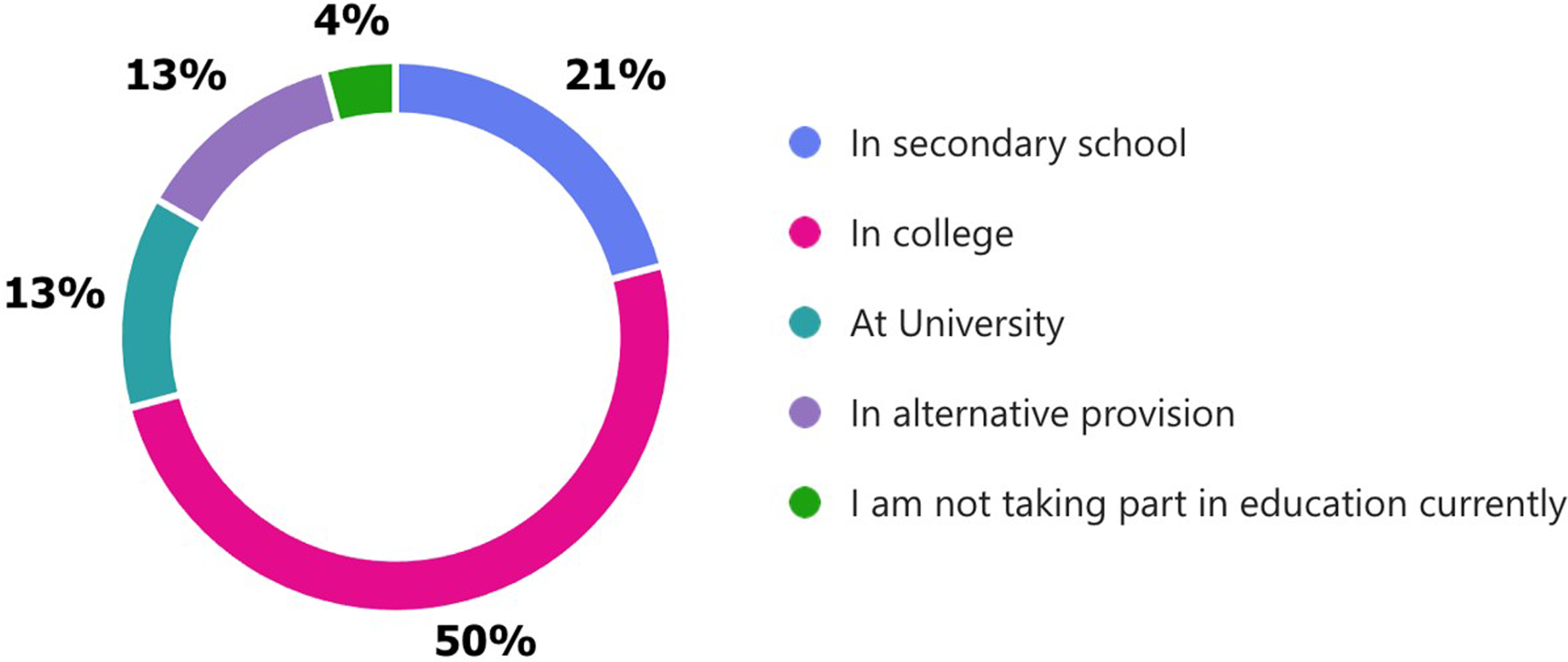
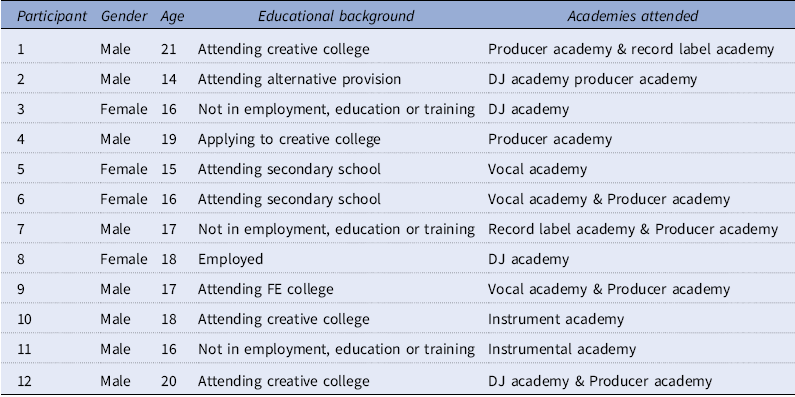
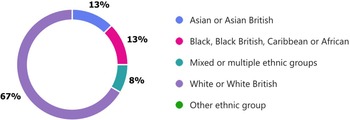
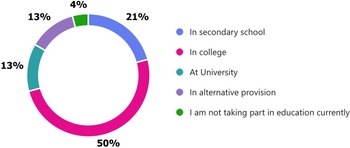
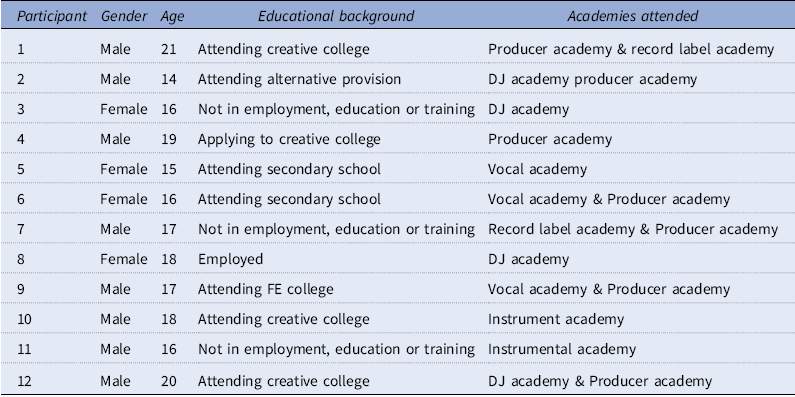
Young people aged between 14 and 21 were invited to apply for the programme through local schools and colleges and youth services. There were no prerequisites to join the project, beyond an interest in electronic music, and no musical experience of an accredited level was required. Fifty young people accessed the programme within the first year, with a pie chart detailing participant demographics in Figure 1 below. From these 50 participants, 12 young people agreed to take part in an interview at the end of the first year for this study. The median age was 17, with a slightly older age range of 19 for the record label academy. Across the whole programme, 75% of participants were male, with 17% female and 8% non-binary. The individual profile of each participant who contributed data to this study is included in the table below, including young people’s educational (also shown in Figure 2) and musical backgrounds. Young people joined Beatknots for a variety of reasons, including music skill development, such as instruments, vocals and composition, as well as getting to know people and making connections in the music scene. Several participants saw the programme as an important stepping stone on their journey to a career in the music industry.
Participants’ ethnicity across the whole programme.

Participants’ education level across the whole programme.
The programme was initiated by a local musician, who had worked previously as a Youth Worker. His impetus for creating the Beatknots programme was to connect young people, who are not accessing mainstream music education, to industry professionals and music studio spaces and venues as a way to support emerging grassroots musical talent. The research settings included 4 professional music studios: 2 in an urban location and 2 in rural locations. One of these music studios was connected to a creative industries college, and the intention was to signpost and support young people to progress their music education through there. For example, training days were hosted at the college and included an introduction to sound engineering and live sound recording using the equipment. Each ‘Academy’ was hosted over a ten-week period, with additional dates for further training and performances. At times, young people came together across the different academies, such as music production participants recording those from the vocal academy, or DJ academy participants contributing to live sound engineering for events. Young people were also able to attend more than one academy.
The data analysed for this article originates from 12 young people, who classed themselves as not having ‘formal’ music education backgrounds. This included not currently taking GCSE or A-level music, not being part of peripatetic music lessons in school, although some were attending music provision elsewhere outside of school, such as those provided by the Music Education hubs. Young people volunteered to be part of the research and, in line with university ethical procedures, gave their consent to have direct quotes used in the presentation of the research. For those under 16, parental consent was sought. The characteristics of the participants and the academies they attended are below. Please note that young people were invited to attend multiple academies (Table 1).
Qualitative methods were selected for this research in order to explore young music-makers’ experiences, perspectives and meanings in depth. Semi-structured interviews were conducted with the 12 participants, as well as the 4 Music Studio Producers, the Beatknots Programme Manager and the Music Trainees. Interviews were conducted in an informal manner, often as part of, or at the end of, academy sessions. The Researcher also observed much of the music-making in practice during the academy sessions. These methods worked alongside more quantitative evaluation tools, provided both by the funder and the music organisation, designed to track musical ability, wellbeing and citizenship. However, this data is not used in this article. Thematic analysis was conducted based upon codes from previous literature on music production (Brader & Luke, Reference BRADER and LUKE2013; Crossley, Reference CROSSLEY2023; Gann & Crooke, Reference GANN and CROOKE2023; Green, Reference GREEN2017; Hense & McFerran, Reference HENSE and MCFERRAN2017; Hess, Reference HESS2021; Levy & Travis, Reference LEVY and TRAVIS2020; O’Neill & Green, Reference O’NEILL and GREEN2001; Travis Jr et al., Reference TRAVIS, GANN, CROOKE and JENKINS2021; Wilson et al., Reference WILSON, PEREZ-Y-PEREZ and EVANS2017) and the Author’s previous research (Bennett et al., Reference BENNETT, SOFIJA, GREEN, GUERRA, HOWARD and OLIVEIRA2024; Howard, Reference HOWARD2021, Reference HOWARD2023, 2024).
Findings: affordances for education in electronic music production and inclusion
Having asked about participants’ music backgrounds and what encouraged them to join the programme, questions were asked about what musical skills and abilities they brought with them to the project and which they felt they had developed. In response, young people reported high levels of use of self-taught, pre-existing or DIY music-making skills that were relevant for electronic music production. When asked about ways of working on this programme that were beneficial or may have been different to that which they had experienced on other programmes, participants agreed that the collaborative nature of working with others across different academies was useful, not only for wider learning about music industry roles, but also for supporting their own (and others’) music production. Finally, young people were asked about which aspects of the project were most beneficial to them in terms of continuing music-making beyond this programme and if (not all were) they were to consider future careers within the music industry. To this question, participants overwhelmingly felt that social networks, rather than music skills, were of longer-term importance.
DIY music production skills
As well as family influence and extra-curricular music sessions, young people frequently referred to DIY skill acquisition in relation to music production and bringing a range of musical skills with them to the project. Social media and the digitisation of many music genres better support young people who lack the financial means to afford expensive equipment and pay for music tutoring. A laptop and a pair of speakers are the rudimentary equipment required to make a track, and social media platforms can assist anyone in releasing a track. All participants reported on the benefit of the project being free, being able to work with professional standard equipment and industry recording studios with no cost. For them, there was no financial risk if they did not achieve what they wanted to, such as getting a track mastered immediately.
With the Producer Academy, young people had self-taught the basics of LogicFootnote 1 for production, engineering, recording, mixing and mastering, but then attended the studio to fully learn the software. Free trials of software were also helpful in learning the skills. Participants reported that the digital software was quite intuitive, where the basics can be easily mastered. Although there is a range of digital music production software available, young people felt that it was not significantly different, and fundamental skills such as layering and sampling could be transferred across programmes. The below excerpt shows the appeal of working with music technology and digital equipment:
A big thing for me has always been the technology and I always liked electronic music. Being able to work with all the gear and I’ve been collecting all this kit without really knowing what to do with it (Male, Producer Academy).
Some young people had been brought instruments or digital equipment by their parents and ‘been left to it’ to teach themselves how to play. With the DJ Academy, for example, young people had initially found the equipment intimidating, but had been able to teach themselves the basics of mixing music and playing live:
I got some DJ decks for my birthday. And my Dad just kind of left me to work it out for myself. It was a bit scary with all the different dials and knobs, but actually when I started to try to do it… and I’ve been doing that for like a year or two before this project (Male, DJ Academy).
Participants reported ‘getting into’ electronic music production prior to the project, through being a fan of a particular ‘scene’, to learning skills at home to be able to master basic music production techniques. One participant said that:
I saved some money to get my own DJ controller that I use at home. So I was teaching myself how to listen when the bpm is off, when I should queue in songs and trying to get my ear in, like a proper DJ (Female, DJ Academy).
The importance of listening to music was stated by several young people, in particular those attending the Vocal Academy. Being able to copy notes and melodies and teaching themselves to harmonise was accomplished through listening to and watching other musicians on social media. Young people also recorded themselves through laptops and phones and posted videos on YouTube as a way of learning their craft. These self-recording and sharing practices were mainly undertaken within the domain of the home; however, when attending one of the Beatknots academies, young people benefitted from shared safeguarding and copyright practices during masterclasses. One participant replied that mastering was not something that could be formally taught, but learning the techniques was more about a mentoring approach that takes time to ‘train your ears’.
Young people discover electronic music online and then download apps on their phones to try and replicate those sounds. As well as self-taught skills with the software, YouTube tutorials are being used so that young people can teach themselves independently. Music professionals have set up their own YouTube channels to share their skills with others. Young people regarded this as an ‘unconventional’ method of music education, but one that is growing in popularity. One young person said:
It’s quite a closed shop (the music industry). I think sometimes for young people who haven’t got music education or been to university to do music, that’s putting them off thinking “Oh yeah, I’ll go to this thing.” But I feel like if you’re interested in that (music production) you shouldn’t be shy. You should be yourself out there and you shouldn’t hold back (Male, Producer Academy).
Young people reported that GCSE music had ‘filtered out’ those who were interested in electronic music. One participant stated that music at their school was too performance-focused and they were not comfortable in performing in front of other people. Within this project, young people’s DIY skills and music production methods held a stronger influence than parents musical aptitudes and funding for young people to be involved in music enough to consider it for a career.
Collaboration
The collaborative nature of the Beatknots programme has been embedded since its inception. Having the opportunity to work with a variety of young musicians and professionals and be supported by the project record label was a key aim of the programme founder. Attending studio-based music programmes, such as this, gives young people access to equipment, such as mixing desks and other people to collaborate with. Access to studio spaces, as spaces for collaboration, was a big draw for the participants.
One of the key benefits of being able to attend multiple academies was the opportunities for collaboration with other young musicians. Creating original music required a diversity of skills that young people recognised they could not undertake all the roles required. The following excerpt shows the opportunities for collaboration that young people attending Beatknots have and the value of these opportunities:
I’ve had about two or three chances now. So, one was with a Producer, he wanted to sing on his own song, but he needed a female voice for backing. Another one asked me to sing different parts to them and also help with the lyrics (Female, Vocal Academy).
Collaborative projects provide a platform for young musicians to learn from each other, as well as gain insights into different techniques and genres. Young people reported that collaboration also made the creative process more fun. Within electronic music production, music producers were creating tracks and then wanted rappers or vocalists to perform on them. For those who considered themselves rappers or vocalists, the learning was two-way, with many of them learning techniques of digital music production. This collaboration also extended to the recording of music, with the majority of participants being unfamiliar with sound engineering and live sound recording prior to the project. Musical collaboration was happening everywhere, as this excerpt demonstrates:
Everyone collaborates. Producers will work with vocalists, rappers, and everyone comes together and eventually, people end up with a series of tracks. You know, it all just comes really from these two rooms (Male, Producer Academy).
Working with other young people from different ages, backgrounds and parts of the city was also a positive influence on participants. Being able to listen to music together, find common ground and become comfortable with electronic music production was also significant. Below, a participant describes learning mixing techniques from someone who was much younger than they were and how they felt comfortable with making mistakes as a way of learning music production:
He’s so much younger than me and having someone younger than me made it less intimidating for me, ‘cause if I messed up he could just like explain it again, which made it more comfortable for me at the very start (Female, DJ Academy).
As well as collaborative music-making, young people looked forward to performance events, with three scheduled per year, where they could both share their new music and perform with others. Often, young people come with the skills to make music, but lack skills and experience in performance. For those within the group who were more experienced in performing, they shared their expertise. Young people also had limited access to places and platforms for performance – in the offline world – and highly valued the regular performance sessions that were scheduled into the project. There was a clear transition for those who perhaps lacked the confidence to perform at the first event, to performing and then leading technical aspects of others’ performances towards the end of the project.
Social networks for the creative industries
Networking was also important for the young people. New or expanded musical networks enabled getting to know people with whom they could collaborate, perform and learn ‘tricks of the trade’ such as how to make money from royalties and set up a record label. Connecting with people was a vital way of learning new things, especially for those considering careers in music. ‘Getting known’ or becoming recognised was also an important social aspect of this project for young people. Being part of this project has educated young people about freelance careers in the music industry through masterclasses involving professionals from a range of roles within the creative industries: PR, events promotion, music royalties, music for TV and film, sound engineering and mixing and mastering.
Parental influence was still significant in the participants’ musical backgrounds, often purchasing their first instrument or piece of equipment, but for the majority of participants, formal music education, such as taking up A-level music or receiving teaching within an institutional setting, such as a conservatory, was absent. These two highly influential factors to progressing to careers in music were superseded by the different communities of music-making, which are often built up around different genres such as EDM (electronic dance music) and jungle. Working with professionals such as sound engineers, songwriters and music producers was a big draw for young people to the project:
I struggled to find a network of people to make music with, but joining this project has opened my eyes to the social aspects of music. You know, like seeing how other people make music, collaborating, working with different artists, different vocals, different sounds like it. You couldn’t really have that in isolation in your bedroom (Male, Producer Academy).
For those who did not want to pursue a career in music, meeting others who were passionate about music production and performing was important. Without projects of this kind, young people felt that it was often by chance that they met people who are into music or who work in the industry. Social networks were key to finding people and finding the music they really loved to make. Several participants reported being invited to music production events outside of the project, which helped them to further develop these social networks. Feeling part of a group of people or friends encouraged participants to continue music-making beyond the project. Being socially networked with professional musicians and industry professionals set the ‘bar high’ for what young people wanted to achieve:
I would have never met this group of people, without this project. I wouldn’t have been open to a whole range of music that I’ve never before considered, or anything creative, like a creative job or playing clubs or anything like that … quite often these things are bounded by age or bounded by learning like a grade or through a curriculum. And actually, these projects are much more socially geared around building your network of people, getting access to the creative scene (Male, Producer Academy).
The setting of the project across four different professional music studios was also significant for building social networks. Many participants recognised the uniqueness of these settings and the valuable offer for their music-making:
Not many schools have an open music space, like this, outside of school. I think it’s been so supportive for me to carry on my musical abilities in the outside world and have more experience in performing (Female, Vocal Academy).
Within these social networks, processes of knowledge diffusion resonated within the project, dynamically linking informal music education and music careers. Through the development of social connections and industry-level skills such as production, live engineering, recording and performing, young people felt well-positioned for creative careers later in life.
Discussion
Within non-formal music education, where music-making occurs outside of an educational setting and young people have a high level of ownership over their learning, DIY practices have been little explored. Using the specific role of the Music Producer, as someone who composes, produces and releases music digitally (Pras & Guastavino, 2011), the affordances of digital skills, collaboration and social networks have been explored. Through the Beatknots programme, which has a dedicated Music Production Academy, alongside DJ Academy, Instrument Academy, Vocal Academy and Record label Academy, young people have been able to benefit from a well-rounded music education, which generates practical experiences aligned with the music industry.
The Beatknots programme was able to build upon young people’s DIY music production skills, which many felt had been ‘filtered out’ through GCSE music. Collaborative practices were vitally important to the Beatknots programme, with young people working across academies and across genres to be able to work in collective and multi-skilled teams to produce, perform and record live music tracks. This collaboration is highly symptomatic of the creative industries, with many Musicians also being skilled Music Producers, live sound engineers and social media entrepreneurs. As Haynes & Marshall (Reference HAYNES and MARSHALL2018) argue, young musicians are now expected to manage every production stage of their own music. Finally, the social networking component of the programme was also highly important and impactful, for young people’s future music industry careers.
By exploring the Beatknots programme, in relation to what is currently not offered in mainstream schooling, the case can be made for the need to expand the understanding of what constitutes music education, particularly in light of music industry careers, digital technologies for music making and DIY practices of music production, management and promotion. Through including more digital practices and music technology within formal music education, more access to and interest in the contemporary music field could be offered to young people. However, it is problematic to assume that music technology offers a more inclusive music education due to limited access to the emerging technologies required for music-making and differences in young people’s digital proficiencies and literacies.
Education to become a Music Producer is grounded in collaborative and digitally enhanced ways of making music. This is a marked difference from understanding the nature of music, as promoted through music curriculum in schools. Whilst this difference also needs to be considered within the settings in which music education happens, as schools vis-a-vis a professional music production studio, there is potential to rethink music education through the filter of music production. As Fautley & Kinsella (Reference FAUTLEY, KINSELLA, Buchborn, De Baets, Brunner and Schmid2022) argue, in their consideration of the Stormzy vs Mozart debate within the English music curriculum, music education has the potential to be more inclusive if the expected outcome is someone having a greater sense of understanding of or knowing about music, rather than through being a high-level performer. At present, this division is still highly visible within music education in schools. Music production, whether that be electronic or live music, therefore, should be included within mainstream schooling.
Conclusion
Contemporary digital practices of music production feature very little in mainstream schooling. Yet, as the Beatknots programme has demonstrated, many young people are engaged in non-formal music-making that is offers future pathways in music production for those who cannot access formal music education. This article has explored young people’s access to education in electronic music production, highlighting alternative transitions and trajectories of those from non-formal music education backgrounds. Data showed that many young people reported musical interests at an early age, which had been ‘drummed out’ of them by a limited school curriculum. Out-of-school music projects were reported as more successful in supporting young people to go on to music courses and for kick-starting careers in the music industry. To better support the creative industries, we need to acknowledge these diverse entry points.
Despite the COVID-19 pandemic increasing DIY music production, to be a Music Producer, young people from this programme told us they needed studio spaces, professional support and communities within which they could collaborate. Key to increasing accessibility was DIY skills acquisition, digital literacy and the affordances of music technology gained by young people before entering the programme. Whilst the collaborative nature of music-making is nothing new, spaces outside of school settings were vital to accessing music education beyond formal schooling. Including music production within mainstream schooling would also shift the focus of music education to ways of making music, enhancing the understanding of what good music education can be. Furthermore, introduction to and induction through musical social networks acted as an important bridge across economic and social class gaps, which remain prevalent in music education provision today.
This article has shared just one example of a non-formal music-making programme, and there will be many more examples of these efforts across the country. However, to learn to be a Music Producer, young people need to be supported to emerge from their bedrooms, be given access to professional standard equipment, and experience musical practice that aligns with industry roles. Increased funding and sustainability of studio-based programmes are imperative to provide more support for young people to negotiate careers in music and ensure that future music pathways are more equitable.
Participants’ characteristics and academy attendance from the study sample
Dr Frances Howard is Associate Professor of Youth Research at Nottingham Trent University. Her research interests include young people’s music-making in informal education settings, with a particular focus on electronic music and creative industries careers. She regularly undertakes evaluations of music programmes. Her new book, Youth Work, Music Production and Measurement, (McShane & Glenister Eds. Palgrave MacMillan 2025), focused on youth work and music and the ways this work with young people is measured and valued.

 Open access

