Introduction
The Gente de Mar Art Contest offers more than a local account of Indigenous heritage in Venezuela—it provides a test case for collaborative archaeology in a Caribbean setting shaped by enduring narratives of Indigenous ‘extinction’ and assimilation. Over the past three decades, archaeology’s relationship with Indigenous communities has been reworked through collaborative and community-led approaches that emphasise reciprocity, epistemic sovereignty and the co-production of knowledge (e.g. Atalay Reference Atalay2012; Antczak Reference Antczak2024). Yet much of this scholarship has developed in settings where Indigenous sovereignty and territorial rights are prominent within national political discourse; the Caribbean remains a critical frontier where those assumptions do not hold across the constellation of islands and the experiences of diverse Indigenous groups (see Forte Reference Forte2005).
Despite a century of archaeological research on Margarita Island, Venezuela (Figure 1), the case of the Guaiquerí exemplifies this challenge. The Guaiquerí Indigenous community traces their ancestry to the pre-colonial inhabitants of the eastern coasts and islands of Venezuela, most notably Margarita, where they also participated in the early sixteenth-century Spanish pearl enterprise (see Rodríguez Velásquez Reference Rodríguez Velásquez2026). Guaiquerí engagements with the past are primarily expressed through connections to landscape, spirituality and historical figures. They do not draw on narratives or material remains produced through archaeological research, which are also largely absent from the island’s museums (see Antczak Reference Antczak2024). To examine how the past is used and the role of archaeology in contemporary identity-making, we report results from the Gente de Mar Art Contest, co-designed with Guaiquerí partners and local institutions and run digitally during Covid-19 restrictions.
Map of Margarita, Coche and Cubagua, islands of Venezuela, showing key settlements and the archaeological sites of El Poblado and Nueva Cádiz de Cubagua (Landsat/Copernicus 2020).

Methods: art contest origins and design
In 2021, the constraints imposed by the Covid-19 pandemic pushed us to explore more creative and equitable alternatives to interviews for the exploration of Indigenous identity (Antczak et al. Reference Antczak and Fricke2026). This led to the Gente de Mar Art Contest, an event built on nearly a decade of collaboration with Guaiquerí leaders and local institutions such as the Academia de la Historia del Estado Nueva Esparta (AHENE), the Asociación Civil Comunidad Indígena de El Tirano, and the Fundación Sociedad de Amigos Casa de la Cultura Antonio Millán (FUNDASCAM). The contest was launched following community approval and it asked participants to celebrate their Guaiquerí heritage artistically. It was open to individuals on Margarita aged 12–20 years, and in this way sought to engage an age group often under-represented in traditional research. Entries could be made in any two-dimensional medium, but each piece had to be accompanied by a short, written reflection. All submissions were received digitally. Winners were announced during the Día del Guaiquerí celebrations (in September 2021), and all artworks are available in a permanent online exhibition (https://gentedemar.org/exposicion2021/) (Figure 2).
Collage of all received paintings (courtesy of various painters, compiled by authors).

The role (and afterlife) of archaeology in the Gente de Mar paintings
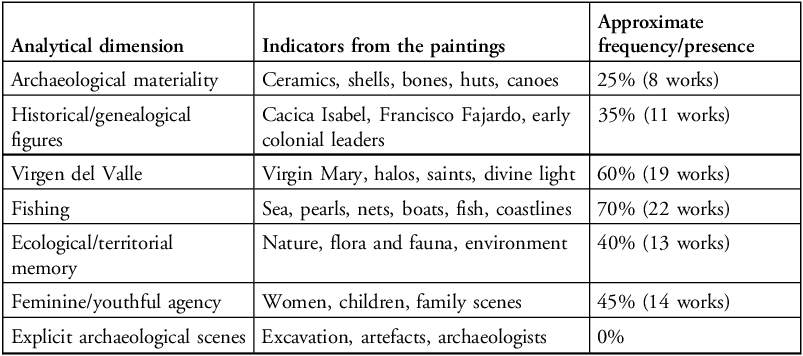
The contest received 31 submissions, offering a vivid cross-section of how young Guaiquerí artists imagine their past. We analysed the paintings thematically (Table 1) and noticed that archaeology and its results were largely absent. This indicates two issues: a lack of effective engagement with and communication of archaeological results to local communities, and an overall scarcity of archaeological work, resulting in a lack of material culture and interpretation at museums and local sites (see Rodríguez Velásquez Reference Rodríguez Velásquez2020). Importantly, the paintings suggest that this thematic absence does not signal a lack of engagement with the past; in fact, they offer insights into where archaeologists may most effectively make a difference in future work.
Analytical summary of the 31 paintings.

Through analysing the paintings we identified three modes of engagement with the past. First, symbolic materiality: shells, pearls and pottery are depicted in roughly a quarter of the works. We refer to these as symbolic as they appear not as static scientific finds but as living signs of continuing practice, always in use. These materials do not signify a vanished or lost time but rather a tangible and ongoing belonging. The site where this plays out becomes the sea—a fluid, inhabited archive where the Guaiquerí trace their lineage through everyday experiences, particularly around fishing (see Figure 3). Second, narrative echoes of historical discourse. Artists frequently invoke colonial figures of written and oral history such as Doña Isabel and Francisco Fajardo, who anchor the idea of ‘first contact’ and mestizaje (the cultural and genetic mixing of European and Indigenous populations). Through the contest, these figures are reinterpreted: instead of representing cultural disappearance, they become sources of pride, leadership and resilience. Third, engagement with community values and spirituality. Nearly two-thirds of the works centre on the Virgen del Valle (Virgin of the Valley) (see Figure 4). Here, material anchoring is displaced by an ethics of care and devotion, blending ancestry, landscape and faith. The religious and ecological motifs do not erase the past; they naturalise it, folding archaeological time into the living present of the community. The jury’s selections reinforce this interpretation. All winning works—Jeremies González’s Bajo su mirada, fiesta Guaiquerí, Carlos Cruz’s Devoción a la Virgen del Valle, Jhoan Cortesía’s El mar y la vida guaiquerí and Nicole Labrador’s La diosa Guaiquerí—emphasise these themes of devotion, genealogy and ecological femininity rather than explicit material and archaeological links to the past.
Details of paintings showing a common theme of fishing: a) Carlos Cruz; b) Rayger David Hernández Rodríguez; c) Rayger David Hernández Rodríguez; d) Fernando Gabriel Pinto Ruiz; e) Dayana Coriat; f) Moises Alejandro Larez Figueroa; g) Antony Luna; h) Veronika Rodríguez; i) María Celeste Aguilera; j) Daviangel Soria; k) Isabella Karut Gibson; l) Alejandra Naomi Simonet Franco (courtesy of named painters, compiled by authors).

Details of paintings showing a common theme of the Virgen del Valle: a) Jeremies González; b) Carlos Cruz; c) Alexmar Cabrera; d) Rayger David Hernández Rodríguez; e) Isabella Karut Gibson; f) Alejandra Naomi Simonet Franco; g) Ivan Herrera; h) Daniela Alejandra Patete Zabala; i) María Celeste Aguilera (courtesy of named painters, compiled by authors).

Conclusion
Across the world, Indigenous communities have questioned extractive research that privileges academic authority over community knowledge. The Gente de Mar art contest provides a means to assess how archaeological knowledge is used and, crucially, how it can be better used in a southern Caribbean context shaped by enduring narratives of Indigenous ‘extinction’ and assimilation. This pathway can be further developed through educational programmes and field schools, fostering collaborative pedagogies that reposition archaeology as a shared, dialogic practice rather than a unilateral mode of knowledge production. Across 31 youth artworks, archaeology and its results are currently absent; rather than reading this as a deficit of archaeological literacy, we treat it as a signal for collaboration. Where religion, kinship and practices related to the sea (fishing) operate as primary registers of identity-making, collaborative archaeology and museum exhibitions must now engage directly with these themes if they aim to be socially impactful. Beyond Margarita, these findings invite a rethinking of ‘collaboration’ in settings where Indigenous sovereignty is not the dominant political grammar. If archaeology is to contribute responsibly, it must begin from the affective archives through which communities already author history, rather than assuming that scientific forms of evidence will automatically become socially relevant.
Acknowledgements
We thank the participating painters. All participation and publication consents were obtained.
Funding statement
Funding was provided by the UK Economic and Social Research Council, Gates Cambridge, a microgrant from Caribbean Digital Collective Scholarship, and the Fundação de Amparo à Pesquisa do Estado do Rio de Janeiro (FAPERJ), Brazil.
Data availability statement
The data of this study are available in The Guaiqueri Archive, available at https://archivoguaiqueri.gentedemar.org/s/archivo-guaiqueri/item-set/7
Author contributions: CRediT categories
Oliver Antczak: Conceptualization-Equal, Data curation-Equal, Formal analysis-Equal, Funding acquisition-Equal, Investigation-Equal, Methodology-Equal. Fidel Rodríguez Velásquez: Conceptualization-Equal, Data curation-Equal, Formal analysis-Equal, Funding acquisition-Equal, Investigation-Equal, Methodology-Equal.