



An adequate diet not only provides certain amount of energy and nutrients but also promotes and maintains good health. If a diet is varied and balanced, the body will be able to obtain the necessary nutrients and energy to maintain an optimal state of health(Reference Pi, Vidal and Brassesco1).
In recent years, the general population has undergone a nutritional transition, causing significant changes in the perception and consumption of food. Previous studies in the university population have shown a decrease in the consumption of fruits, vegetables, cereals, pulses and fish, together with an increase in the consumption of meats, sweets, snacks and sugary drinks(Reference Norte Navarro and Ortiz Moncada2,Reference García-Meseguer, Burriel and García3) . The Spanish youth population has abandoned the traditional balanced Mediterranean diet characterised by combining foods such as olive oil, cereals, pulses, vegetables, fruits, nuts, fish, fermented beverages such as wine and beer, as well as a moderate intake of dairy products, meat, eggs and low consumption of red meat and sausages(Reference Sánchez Socarrás and Aguilar Martínez4,Reference Ruiz Moreno, Del Pozo de la Calle and Valero Gaspar5) in favour of more westernised diet patterns(6) characterised by the abandonment of ‘basic foods’ in favour of more elaborate and processed ones.
Pulses are a plant species of edible seeds that have been consumed for thousands of years by humans and animals. The FAO defines pulses as leguminous crops with dry and low-fat edible seeds. It does not consider the species used as vegetables (e.g. green peas or green beans), for the extraction of oil (such as soyabeans or peanuts) or others for planting purposes (such as clover and alfalfa) as pulses. Among the most well-known and consumed pulses worldwide are the common beans, chickpeas, mung beans, cowpeas, care beans, lupins, mesquite, carob, tamarind and lentils(7).
Although pulses are one of the most nutritionally complete foods as well as a climate-friendly source of protein, they are one of the least consumed food groups in Spain(Reference Considine, Siddique and Foyer8–12). The Spanish Society of Community Nutrition recommends that healthy adult population consume pulses >2 times/week with each serving being 60–80 g dry or 150–200 g cooked(Reference Aranceta Bartrina and Arija Val13,Reference Aranceta14) .
Pulses are recognised as being a good source of protein with a high lysine and low methionine and cysteine content; however, the biological value of this protein is lower than that of protein from animal sources such as egg, milk and meat. The biological value of a protein depends on the composition of amino acids and the proportions between them(Reference Suárez López, Kizlansky and López15). The protein value is maximum when these proportions are those necessary to meet the nitrogen requirements to cover physiological needs(Reference Suárez López, Kizlansky and López15). In addition, other factors such as protein structure and the presence of proteases may reduce the digestibility and biological use by the body of vegetable proteins(Reference Suárez López, Kizlansky and López15,Reference Darragh and Hodgkinson16) . Pulses are also a source of resistant starch, fibre (soluble and insoluble), vitamins (B complex), minerals (Fe, Zn, folate, Mg and Ca) and have a low lipid content. In addition, the phytochemicals, saponins and tannins found in pulses possess antioxidant and anti-carcinogenic effects(Reference Hall, Hillen and Garden Robinson17–Reference Rebello, Greenway and Finley20). Different international agencies recommend the regular consumption of pulses as an alternative to meat to reduce the intake of saturated fats(6,Reference Enjamio Perales, Rodríguez Alonso and Valero Gaspar21) . Pulse consumption can improve serum lipid profiles and positively affect CVD risk factors such as blood pressure, platelet activity and inflammation. Pulses also have a low glycaemic index, making them particularly beneficial to people with diabetes by assisting in maintaining healthy blood glucose and insulin levels(Reference Hall, Hillen and Garden Robinson17–Reference Rebello, Greenway and Finley20).
Entrance to university translates into a major lifestyle change for many young people. It can entail important changes such as living outside the family home, adapting to new activities and taking responsibility for their meals for the first time(Reference Muñoz de Mier, Lozano Estevan and Magdalena22–Reference Pérez-Gallardo, Mingo Gómez and Bayona Marzo24). Assuming this responsibility will be determined by socio-economic factors and economic constraints, and/or the greater or lesser ability to cook. The dietary habits acquired during the university stage are generally those that will remain in adulthood(Reference García-Meseguer, Burriel and García3,Reference Fernández Villa, Alguacil Ojeda and Ayán Pérez25–Reference Míguez Bernárdez, Castro Sobrino and Collins Greene27) . The social conditions and the way of life have a special impact on the habits of these young people, and there are even differences in the food inherent to the region or community where they live, for example, between the north and the south of the same country(Reference Ortiz-Moncada, Norte Navarro and Zaragoza Marti28,Reference Moreno-Gómez, Romaguera-Bosch and Tauler-Riera29) .
The hypothesis on which this study is based is that certain personal/sociodemographic factors and intakes of other food groups are related to worse adherence to the recommendations for the consumption of pulses. Identifying these factors could aid in the development of policies geared towards improving pulse consumption among university students. The objectives of this study are to determine the rate of adherence to the recommended intake of pulses and analyse the association between this adherence and personal/sociodemographic factors and dietary intake of other food groups in first-year university students.
Materials and methods
This cross-sectional study is part of the UniHcos project, a multicentre study of multipurpose prospective cohorts in eleven Spanish universities (Alicante, Cantabria, Castilla–La Mancha, Granada, Huelva, Jaén, León, Salamanca, Valencia, Valladolid and Vigo), whose general objective is to know the students’ lifestyles when they enter the university and their modification during their stay. The UniHcos project has the approval of the Ethics Committees of the collaborating universities and has therefore been performed in accordance with the ethical standards laid down in the 1964 Declaration of Helsinki and its later amendments, and the integration of the information file in the Data Protection Agency complies with the Organic Law of Protection of Personal Data.
The main inclusion criteria for students in this study were to be both a first-year student and enrolled in all first-year courses for the first time in each of the participating universities. All students who met the selection criteria and agreed to participate in the project during the 2011–2018 academic years completed an online self-questionnaire that included informed consent and ethical permission.
The questionnaire was sent to the students by way of institutional email, and students were given ample time and reminders to respond as well as assured confidentiality. Measuring and adjusting for non-response bias using weighting class adjustments, post-stratification or propensity models were not possible due to the lack of sufficient demographic or database variables. Meanwhile, item non-response bias was not a concern as those students without sufficient information (not answering the question regarding intake of pulses in the questionnaire and/or not completing at least 85 % of the remaining questionnaire) were excluded from the study.
Totally, 277 325 students were invited to participate, 9874 returned the questionnaire, but 12 (0·12 %) had to be excluded due to providing incomplete data (Fig. 1). Finally, data from 9862 (3·6 % participation rate) university students were included in the study. Based on the nature of this study, the demographic profile of the population included in the sample was representative of university students in Spain.
Participant flow chart.

Data collection
Analyses were conducted for those who provided complete dietary, demographic and socio-economic data. The personal and sociodemographic variables collected were: sex (male, female); age (years); BMI (<18·5, 18·5–24·5, 25–30, >30 kg/m2); marital status (single, domestic partner, married, separated, divorced, widowed); employment status (only study and I do not look for work, study and I look for work, study and work part time, study and work full time); housing, defined as the place where students live during the course (university residence; family home; own home; rental; other) and coexistence, defined as people with whom the student lives during the course (with my parents, roommates/friends, with my partner, with my children, alone).
To simplify the interpretation of the data, the variables were re-categorised for some of the analyses as follows:
-
Marital status: single (single, separated, divorced, widowed) and married (married, domestic partner).
-
Employment status: unemployed (only study and do not look for work, study and look for work) and employed (study and work part time, study and work full time).
-
Housing: family home, university residence (residence hall/university residence) and rental (rental, home-own, others).
-
Coexistence: parents, roommates (roommates/friends), partner (with my partner, with my children) and alone.
Dietary assessment
The dietary intake estimations were constructed from the answers to the food frequency consumption section of the online self-questionnaire which was modelled after question 96 of Section H4 of the 2006 Spanish National Health Survey(Reference Fernández Villa, Alguacil Ojeda and Ayán Pérez25,30) . There were five options (daily; 3–4 times/week, but not daily; 1–2 times/week; <1 time/week; never/almost never) for the frequency of consumption of pulses and other food groups assessed (meat (chicken, beef, pork, lamb); hamburgers, hot dogs and kebabs; eggs; fish; processed meats; dairy products; pizza; sweets (biscuits, cookies, pastries, jams, etc.); sugary drinks; juices and milkshakes; fresh fruit; pasta, rice, potatoes; bread and grains; vegetables). In this study, the five frequency options were regrouped into four during analysis; more specifically, the frequency ‘daily’ and ‘3–4 times, but not daily’ were joined to create the group ≥3–4 times/week.
For the assessment of compliance with the recommendations of the consumption of pulses, the recommendations established in the ‘dietary guidelines for the Spanish population’(Reference Aranceta Bartrina and Arija Val13) were used as a gold standard; the recommended consumption of pulses for a healthy adult population is >2 times/week. For the interpretation of the result of the frequency of consumption of pulses, students were grouped according to their compliance with the established recommendations as follows: ‘complies’ or ‘does not comply’. The category ‘complies’ corresponds to the food frequency consumption section responses ‘3–4 times a week, but not daily’ and ‘daily’; the category ‘does not comply’ corresponds to ‘1–2 times a week’, ‘less than 1 time a week’ and ‘never or almost never’.
Statistical analysis
All analyses were conducted using survey routines and the dietary survey weights to maintain the nationally representative character of the data. Analyses were conducted in IBM-SPSS version 20.0 (IBM SPSS Statistics for Windows, Released 2011; IBM Corp.)
A descriptive analysis was used for frequencies of consumption (absolute and relative) and was performed for the total sample, according to sociodemographic variables. The χ 2 or Fisher’s exact test with a statistical significance level of P < 0·05 was performed to check if there was a relationship between the groups.
Logistic regression modelling was employed to determine the contributors to students’ odds of meeting the dietary intake recommendation for pulses. All models were controlled for age, sex, household income, total energy intake and survey year. The crude OR and 95 % CI were stratified by the university of origin. A decision tree analysis was performed to corroborate the results of the logistic regression analysis and detect the strongest predictor variables in regard to compliance with pulses intake recommendations(Reference Biggs, De Ville and Suen31).
Results
Table 1 shows compliance with pulses consumption recommendations depending on location and living situation without re-categorisation. Of the students in the eleven participating universities, 75·8 % presented an inadequate consumption of pulses. It is noted that there was no significant difference between compliance with the frequency of consumption of pulses according to sex (P = 0·299), BMI (P = 0·151) or marital status (P = 0·558). However, regarding the frequency of consumption of pulses according to the current situation in terms of work and study, there was a significant difference (P = 0·001). Students who study and look for work were the group that comply with the recommended frequency of consumption of pulses in the greatest proportions (27·3 %). A significant difference (P < 0·001) was found between compliance with the frequency of consumption of pulses with respect to where they lived during the course. Those who lived in the family home comply with the frequency of consumption of pulses in the highest proportion (26·5 %), while those who did so in rental apartments had the lowest rate of compliance (21·2 %). Compliance with the frequency of consumption of pulses with respect to coexistence shows a significant difference (P < 0·001), with those who lived with their parents/partner/friends having the highest compliance rate (50·0 %) for groups whose members represent at least 1 % of the population sample. The lowest rate of compliance is found in those living with partner/friends (19·6 %). There was a statistical difference (P < 0·001) between compliance with the frequency of consumption of pulses regarding the university attended. The highest rate of adequate consumption of pulses was in the Universities of León (29·0 %) and Valladolid (28·1 %) with those with the lowest rate compliance being the Universities of Castilla–La Mancha (20·1 %) and Vigo (19·8 %) (P < 0·001).
Compliance with the recommendations on the frequency of consumption of pulses by universities and according to geographical distribution and living situation
(Numbers and percentages; 95% confidence intervals)
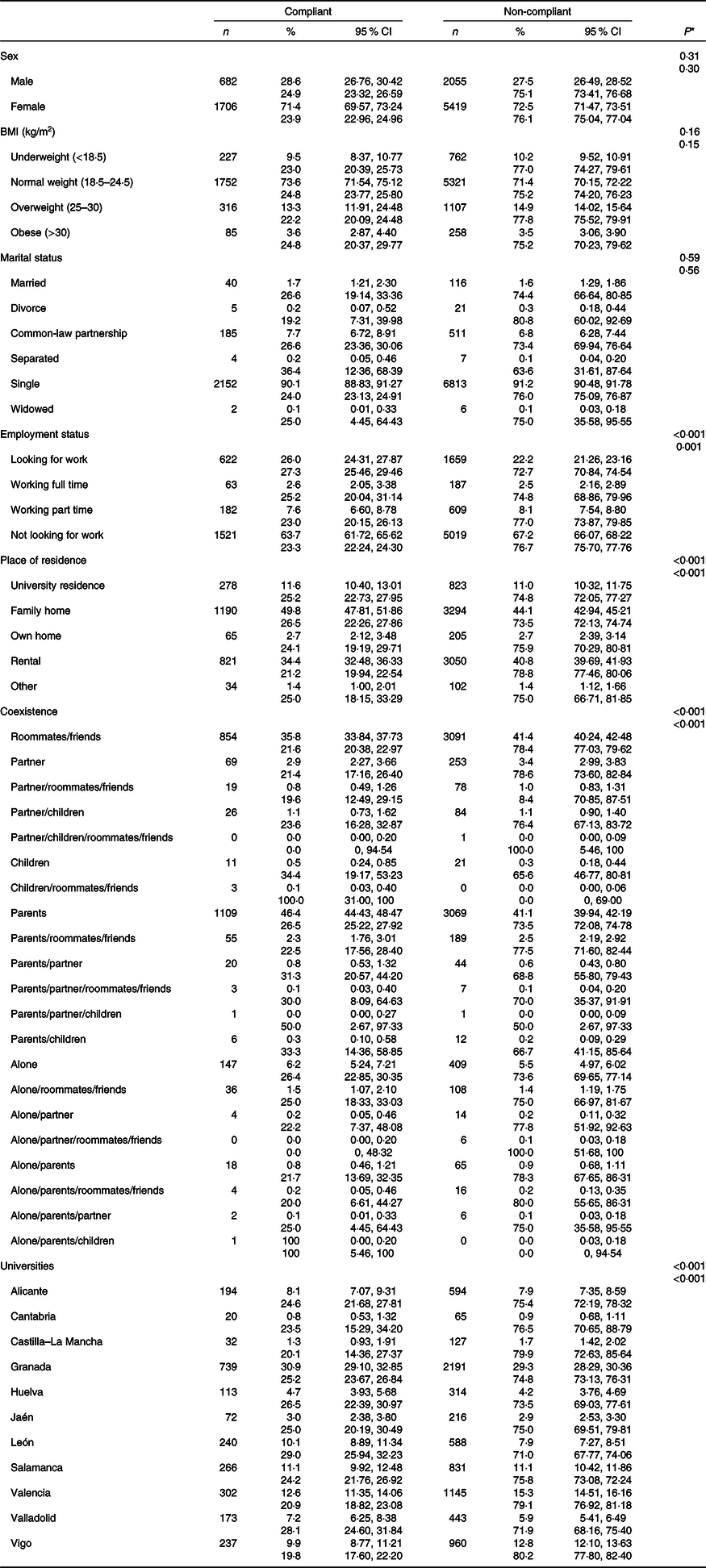
* P value obtained through the χ 2 test or Fisher’s exact test for percentages in both column and rows.
Table 2 describes the re-categorised characteristics of the population studied according to geographical location. It was observed that women accounted for 72·2 % of the studied population which had an average age of 20 (sd 4·52) years, without significant difference between north and south. There was no significant difference in the BMI distribution or the current situation in terms of work and study. There was a significant difference in relation to marital status and student accommodation and coexistence during the academic year. Students in the north lived in a significant proportion in university residences (16·6 v. 7·4 %) or alone (11·7 v. 7·3 %) compared with those from the south who in turn were more likely to be married (9·1 v. 7·9 %).
Characteristics of the university sample according to the geographical location of the universities
(Numbers and percentages; 95% confidence intervals)

* Universities of the north: Cantabria, León, Vigo, Salamanca and Valladolid.
† Universities of the south: Granada, Jaén, Huelva and Alicante.
‡ P value obtained through the χ 2 test.
Table 3 shows the factors associated with compliance with the nutritional recommendations on the frequency of consumption of pulses, according to the geographical region. Sex, BMI, marital status, employment and coexistence did not appear to affect compliance with the recommendations on the consumption of pulses in either group of universities. In relation to place of residence during the academic year, living in a student residence decreased compliance (OR 0·76; 95 % CI 0·69, 0·84) with the recommendations on the consumption of pulses without showing significant differences between northern (OR 0·79; 95 % CI 0·67, 0·93) and southern (OR 0·74; 95 % CI 0·65, 0·84) universities. Meanwhile, living in a rental decreased overall compliance (OR 0·81; 95 % CI 0·70 – 0·95) with the recommendations on the consumption of pulses and compliance in northern universities (OR 0·76; 95 % CI 0·62, 0·93).
Factors associated with compliance with the nutritional recommendations on the frequency of consumption of pulses, according to the geographical region
(Odds ratios and 95% confidence intervals)
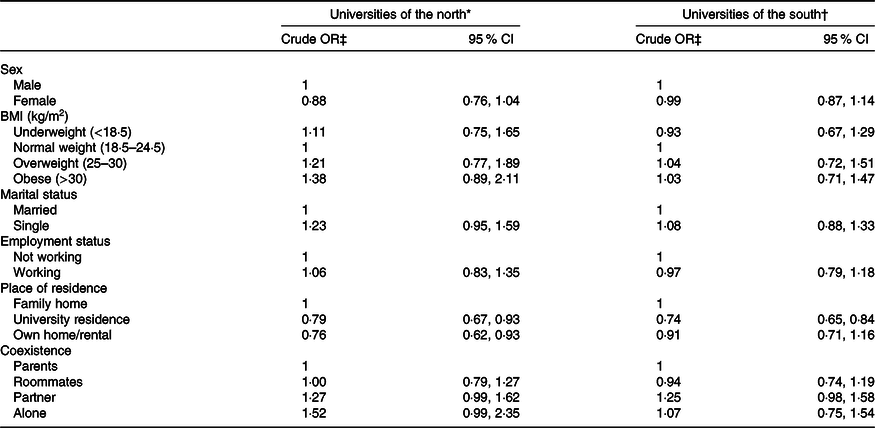
* Universities of the north: Cantabria, León, Vigo, Salamanca and Valladolid.
† Universities of the south: Granada, Jaén, Huelva and Alicante.
‡ OR and 95 % CI obtained through logistic regression.
In the decision tree created for compliance with the recommended pulses intake, it was observed that the strongest associated variable among the studied personal and sociodemographic characteristics was place of residence during the academic year. The dependent variable of this tree diagram was compliance with the pulses consumption recommendations, while its independent variables were: sex, BMI, marital status, employment status, place of residence during the academic year and coexistence during the academic year. However, place of residence was the strongest predictor of compliance during the study period. According to node 1, 26·3 % of the students who lived in the family home complied with the recommendations. The results show that as in the OR calculations, only the place of residence during the school year presents a significant effect on the rate of compliance with the recommendation for pulses consumption.
Table 4 shows the compliance with the recommendations on the frequency of consumption of pulses by the frequency of different types of food consumed by the university population. Statistical differences in compliance rates with the recommendations on the frequency of consumption of pulses appear for all the studied food items.
Compliance with the recommendations on the frequency of consumption of legumes, according to the Sociedad Española de Nutrición Comunitaria (Spanish Society of Community Nutrition), by the frequency of different types of food consumed by the university population
(Numbers and percentages; 95% confidence intervals)
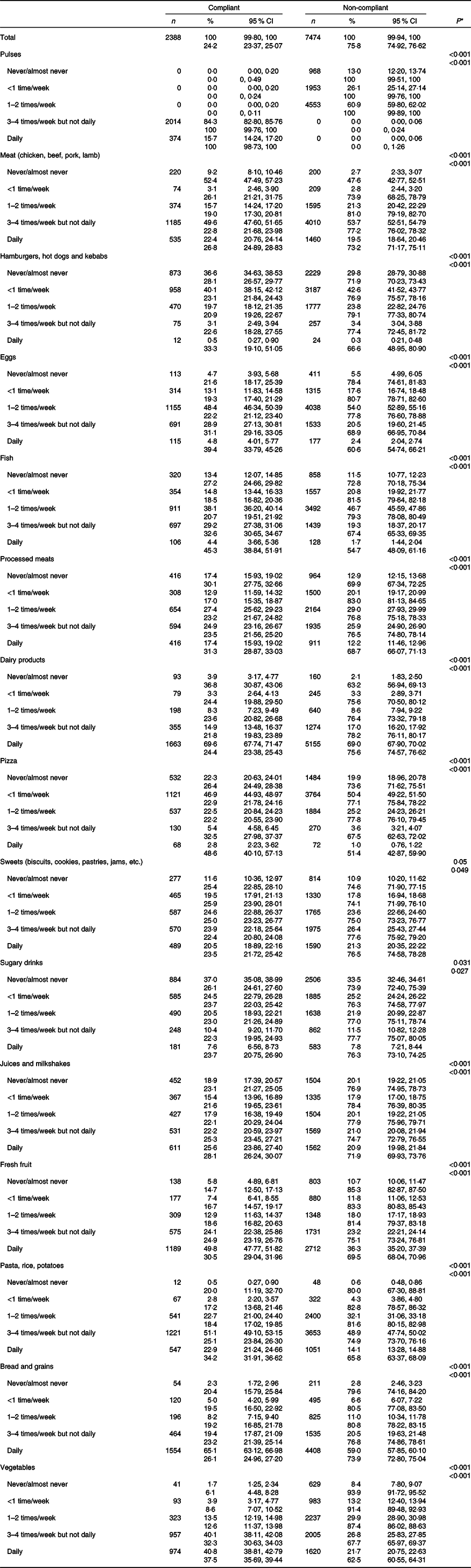
* P value obtained through the χ 2 test for percentages in both column and rows.
Within those students who comply with the frequency of consumption of pulses, 84·3 % consumed pulses 3–4 times/week and 15·7 % consumed them daily. The majority (60·9 %) of the students who did not meet the recommended weekly pulses intake consumed them 1–2 times/week, while those who never consume pulses form the smallest group (13·0 %).
The foods whose daily or almost daily consumption is associated with higher adherence to the recommended frequency of consumption of pulses are hamburgers, hot dogs and kebabs; eggs; fish; sausages and cold meats; pizza; juices and milkshakes; fresh fruits; pasta, rice and potatoes; bread and cereals. On the other hand, for meat and dairy products, students who consumed these products never or almost never present the highest proportion of adherence to the recommended frequency of consumption of pulses. In the case of sweets and sugary drinks, compliance rates were similar across all intake groups but the group with the worst compliance was that which consumed sweets or sugary drinks 3–4 times/week.
Discussion
It was identified that 75·8 % of the participating students presented an inadequate consumption of pulses, which indicates that the standard recommendations of consumption of pulses as >2 times/week(Reference Aranceta Bartrina and Arija Val13) are not being met. This is higher than that found in previous studies where compliance was found to be close to 50 %(Reference Sánchez Socarrás and Aguilar Martínez4,Reference Ledo-Varela, de Luis Román and González-Sagrado32–Reference Crovetto, Figueroa and González34) but is in accordance with another Chilean study where compliance was about 22·5 %(Reference Ratner, Hernández and Martel35) and much better than the results found in a Canadian study where none of the subjects met recommendations(Reference Strawson, Bell and Downs36) and a Mexican study where pulses were consumed by <10 % of the population(Reference Rosales Aguilar, Díaz Trujillo and Saldana Ojeda37). A study carried out in Costa Rica in medical students found that they consumed significantly greater amounts than the recommendations(Reference Jiménez Morgan and Hernández Elizondo38). Meanwhile, two Spanish studies showed that 70·9 and 91·9 % of female and 84·6 and 95·2 % of male students in Madrid(Reference Iglesias, Mata and Pérez39) and Murcia(Reference Navarro-González, López-Nicolás and Rodríguez-Tadeo40), respectively, consumed pulses at least once a week, but no data are given as to the actual quantities consumed and compliance with the recommendation cannot be assessed. However, the national average consumption per capita of pulses in Spain of 3·20 kg per person per year corresponds to an average of <1 weekly ration (80 g/ration)(12), well below the recommended amount.
The sample consists primarily of women (72·2 %); women are over-represented given that the official statistics for the 2018–2019 academic year in Spain shows only 55 % of newly enrolled students being women(41). Regarding geographical location, the students of universities of the south account for 59·6 % of the sample, while those of universities of the north for 40·4 %. This difference in participation between regions must be highlighted as there can exist inherent diet differences according to the region or community of origin of the student(Reference Noale, Nardi and Limongi42).
Most students do not work (89·4 %); however, compliance with the recommendations is higher among those who look for work. In this case, the low price of pulses, compared with other food groups, may perhaps be a factor in the higher compliance with the recommendations in those looking for work; however, with the currently available data, no further conclusion can be made. Among those students who do work, those who work full time have better compliance rates. There seems to be a relation between working more hours or actively seeking work and adequate pulses consumption. No other studies on the association between employment status in university students and pulses consumption have been found for comparison.
In this study, students who lived at home or in university residences were significantly more likely to meet the recommendations for pulses intake than those who lived in rented accommodations. As for coexistence or who the student lives with during the academic year, it can be observed that those students who live with their parents have the highest compliance rates, while those who live with roommates, be it a partner or friends, have the lowest rate of compliance. These findings are also supported by other previous studies thus suggesting that young people living away from the parental home comply less with the recommendations(Reference Muñoz de Mier, Lozano Estevan and Magdalena22,Reference Navarro-González, López-Nicolás and Rodríguez-Tadeo40) . This may be because many students assume responsibility for their food for the first time; the purchase of food, elaboration of a daily menu and the preparation of food, which are all factors that will strongly influence eating habits, now fall to the students. Lack of practice or knowledge may lead students to include foods in their diets that do not require complex processing or prolonged cooking times, such as frozen foods, pizzas, sausages or precooked meats(Reference Sánchez Socarrás and Aguilar Martínez4).
No clear pattern can be detected between the consumption of pulses and that of other foods but some trends do appear. Higher consumption of pulses is associated with higher intakes of healthy foods and also seems to be associated with lower consumption of unhealthy foods such as sweets and sugary drinks but at the same time with a higher consumption of pizza. When studying the association with meat products, fish and dairy products, there appears to be a polarisation of the consumption of these products related to pulses intake. The higher compliance rates among those with little to no consumption of these products may be due to following a restrictive diet (vegetarian, flexitarian, vegan, etc. which have recently increased in popularity(43)) in which animal products have been substituted in part by pulses. However, for those without diet restrictions, it seems that pulses intake is positively associated with the consumption of these products. Further specific and detailed information on diet restriction is not available in this study. A study relating the consumption of pulses and other foods in the university population carried out by the Spanish Nutrition Foundation in twenty-one Spanish universities coincides with this study when comparing the consumption of meat products and sweets with the consumption of pulses(Reference Ruiz Moreno, Del Pozo de la Calle and Valero Gaspar5).
Limitations
This work has limitations but can serve as a launching pad for future research on this topic. Although a large number of information were collected in the UniHcos survey, information such as the diet restrictions mentioned previously is missing. Another of the limitations of this study is its transversal design given which the results must be interpreted with caution. The questionnaire used to collect the information, a self-completed food frequency consumption section, could present a possible bias of social desirability in terms of wanting to indicate the consumption of foods that young people consider to have better or healthier characteristics. However, it is possible that this bias was controlled because the user had to concentrate on determining the number of times he/she consumes pulses and not on its healthy characteristics. In addition, food frequency consumption section is one of the most used questionnaires in population studies, to obtain information on the times or frequency with which a specific food is consumed to compare it with nutritional recommendations.
Participation in the study was completely voluntary, and invitations were sent by way of email to the students’ academic email accounts. These two factors could have influenced the participation as first-year university students may not prioritise taking part in such studies and/or may not utilise the academic emails often. The low participation rates in research similar to that presented here are common among first-year university students, and this carries with it the potential for unit non-response bias. To avoid this as much as possible, the online self-questionnaire was designed to try to avoid making it more likely for certain groups to participate or not in the study. However, the very low participation rate observed may still be the most important limitation of this study as the sample may not be representative of the Spanish university student population. This limitation is a difficult one to overcome, but changes in the methodology used to collect the data that may improve response rates should be studied and applied in future similar studies.
Conclusion
The results of this study show that compliance with the recommendations for consumption of pulses in Spanish university students is very low across all studied universities denoting a deviation from the traditional Mediterranean dietary pattern which is increasingly being abandoned by the younger generations. Compliance rates are not related to sex, BMI, marital status, employment status or coexistence but are related to the students’ place of residence during the academic year. Those who live outside the family home are less likely to comply with pulses consumption recommendations. Compliance with the recommendations for consumption of pulses seems to be associated with higher intakes of healthy foods and lower intakes of unhealthy foods with a dichotomy appearing for animal-derived products. Therefore, low consumption of pulses is seemingly not restricted to a specific profile or dietary pattern among university students, and no specific focus group for intervention can be identified. Policies promoting the consumption of pulses among the university population as a whole are necessary to increase compliance rates with the dietary recommendations.
Acknowledgements
The authors thank the research group of the UniHcos project of each one of the participating universities for the contribution of the information and the database for the study; likewise, they thank the students who participated in the study. The authors also thank the Food and Nutrition research group of the University of Alicante (ALINUT) for their preliminary contributions.
This study was supported by the National Drug Plan, Ministry of Health, Social Services and Equality of Spain (grants: 2010|145 and 2013|034).
Project conceptualisation: M. M. S. V. Development of methodology: M. M. S. V., C. A. Prieto, C. A. Perez, L. F. V. J., R. O. M., A. A. G., J. A. O., M. D. R., G. B. A., M. J. C., E. J. M., A. L. M., A. B. C. and T. F. V. Conducted research: M. M. S. V., C. A. Prieto, I. P. C., C. A. Perez, L. F. V. J., R. O. M., A. A. G., J. A. O., M. D. R., G. B. A., M. J. C., E. J. M., A. L. M., A. B. C and T. F. V. Data curation: M. M. S. V. and I. P. C. Data analysis: M. M. S. V., C. A. Prieto, I. P. C., C. A. Perez, L. F. V. J., R. O. M., A. A. G., J. A. O., M. D. R., G. B. A., M. J. C., E. J. M., A. L. M., A. B. C. and T. F. V. Writing – original draft: M. M. S. V. and I. P. C. Writing – review and editing: M. M. S. V., C. A. Prieto, I. P. C., C. A. Perez, L. F. V. J., R. O. M., A. A. G., J. A. O., M. D. R., G. B. A., M. J. C., E. J. M., A. L. M., A. B. C. and T. F. V. Primary responsibility: M. M. S. V. Project administration: T. F. V. All of the authors have read and approved the submission.
The authors declare no conflicts of interest.



