

“I want you to have it,” Speaker Mike Johnson said to President Donald Trump at a July 4, 2025, signing ceremony, as he handed him the gavel last used when Congress passed the “One Big Beautiful Bill” (OBBB) (Mascaro Reference Mascaro2025). The Speaker’s gesture symbolized Trump’s legislative success with Congress. In the first six months of his second term, Congress had enacted a 940-page law containing the president’s entire domestic-policy agenda. “What we’ve done is put everything into one bill. It’s never happened before. It’s the biggest bill of its type in history,” Trump claimed (Bennett Reference Bennett2025).
Congress’s 2025 legislative output contrasts with the first six months of Trump’s first term. By August 2017, Congress had passed virtually none of Trump’s legislative agenda. That Congress had employed the Congressional Review Act to overturn some agency rules issued under President Barack Obama, but it had not enacted any major new legislation (Kane Reference Kane2017). Instead, it had devoted almost the entire period to its failed effort to repeal and replace Obamacare. In November 2017, Congress passed the Tax Cuts and Jobs Act (TCJA). However, even that success paled in comparison to the OBBB, which not only made all of the original Trump tax cuts permanent but also encompassed an array of other domestic priorities.
When we review the scholarship on presidential–congressional relations, it is difficult to explain why Republicans had much more success in 2025 than in 2017. In accounting for a president’s legislative success with Congress, scholars typically focus on variables including party control, majority party size, and presidential popularity (Bond Reference Bond2024; Bond and Fleisher Reference Bond and Fleisher1990; Bond, Fleisher, and Wood Reference Bond, Fleisher and Wood2003; Canes-Wrone and de Marchi Reference Canes-Wrone and de Marchi2002; Edwards Reference Edwards1989). However, none of those factors sheds much light on the differences between 2017 and 2025. In broad structural terms, Trump was not much better situated to succeed with Congress in 2025 than he was in 2017. Instead, it is necessary to consider how other contextual and strategic factors can account for the different outcomes. In particular, this article discusses the reasons why Trump possessed greater political leverage over the congressional GOP in 2025 compared to 2017. The study also examines differences in legislative strategy that better situated Trump for policy wins in 2025 than in 2017.
DIFFERENT OUTCOMES, SIMILAR CONDITIONS
During the first six months of the 119th Congress (2025–2026), Republicans enacted more of their partisan priorities than during the entirety of the 115th Congress (2017–2018). Despite unified party control, Republicans enacted only one major law on a party-line vote in the 115th Congress: the TCJA (Curry and Lee Reference Curry and Lee2020, 18). Other attempts at one-party lawmaking failed, most prominently the effort to repeal and replace Obamacare. Republicans also failed to accomplish their goals of cutting domestic discretionary spending, repealing financial regulations, restricting health-insurance coverage for abortion, reforming immigration law, and imposing work requirements on Supplemental Nutrition Assistance Program (SNAP) (Edwards Reference Edwards2021; Lee Reference Lee2018; Pearson Reference Pearson2017).
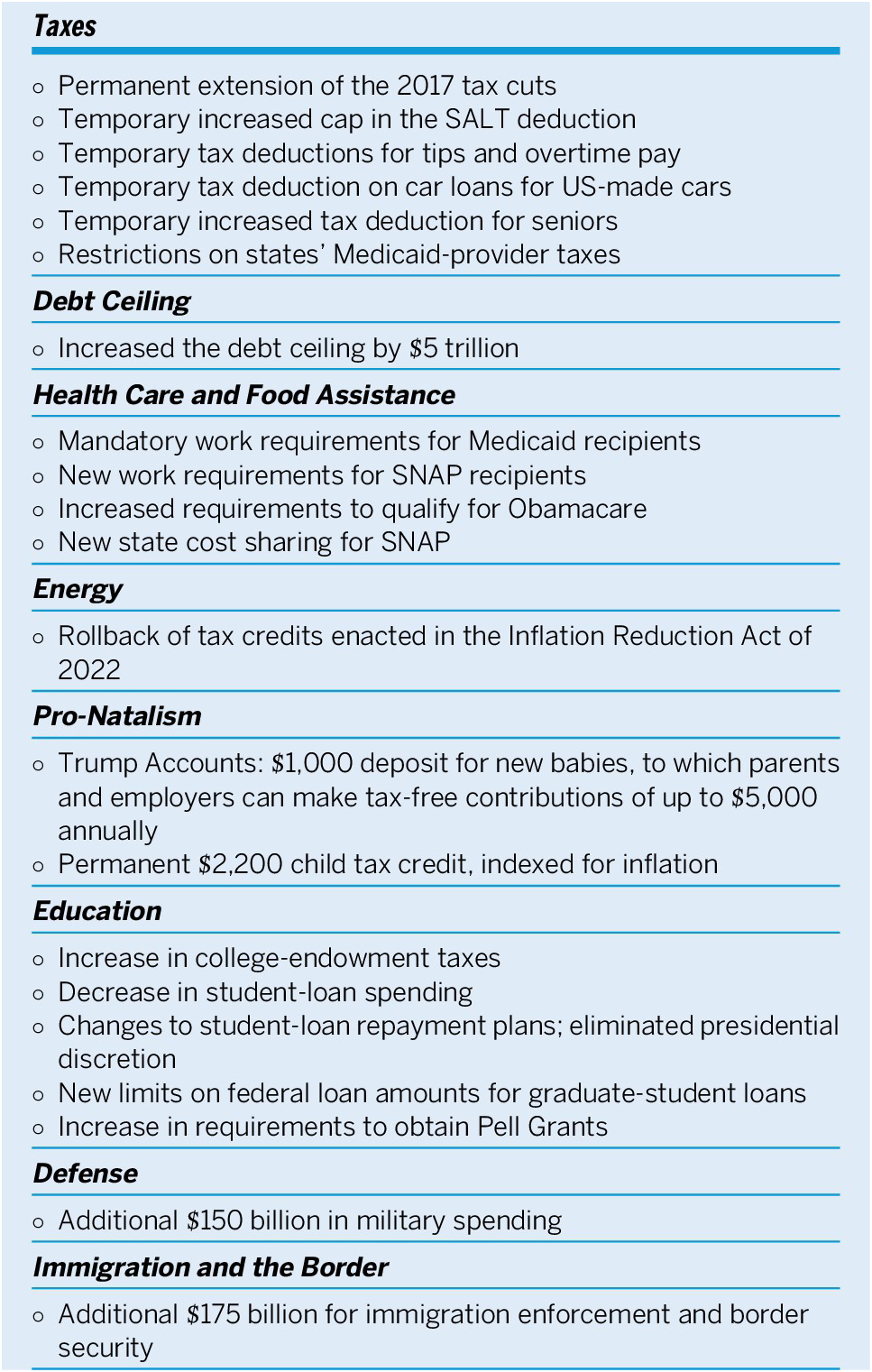
By contrast, table 1 lists major Republican priorities enacted in the OBBB. In addition to making the 2017 tax cuts permanent, the OBBB included a set of popular tax breaks (e.g., reducing taxation of tips and overtime pay) targeted at lower-income taxpayers; imposed work requirements on Medicaid and nutrition assistance; rolled back clean-energy tax credits enacted under President Joe Biden; vastly expanded funding for immigration enforcement and border security; boosted defense spending; and cut and restricted eligibility for federal student loans. Before the August recess, Congress also passed two other Trump administration priorities: the Laken Riley Act (S.5), which expedited the deportation of arrested migrants, and a regulatory framework for the cryptocurrency industry (H.R.1582). In addition, Congress acceded to the administration’s request for a $9.4-billion rescission package (H.R.4) that withdrew funding for the US Agency for International Development, the Corporation for Public Broadcasting, and other purposes. A similar recission bill (H.R.3) requested by the Trump administration failed in the 115th Congress.
Major Provisions of the One Big Beautiful Bill, 2025
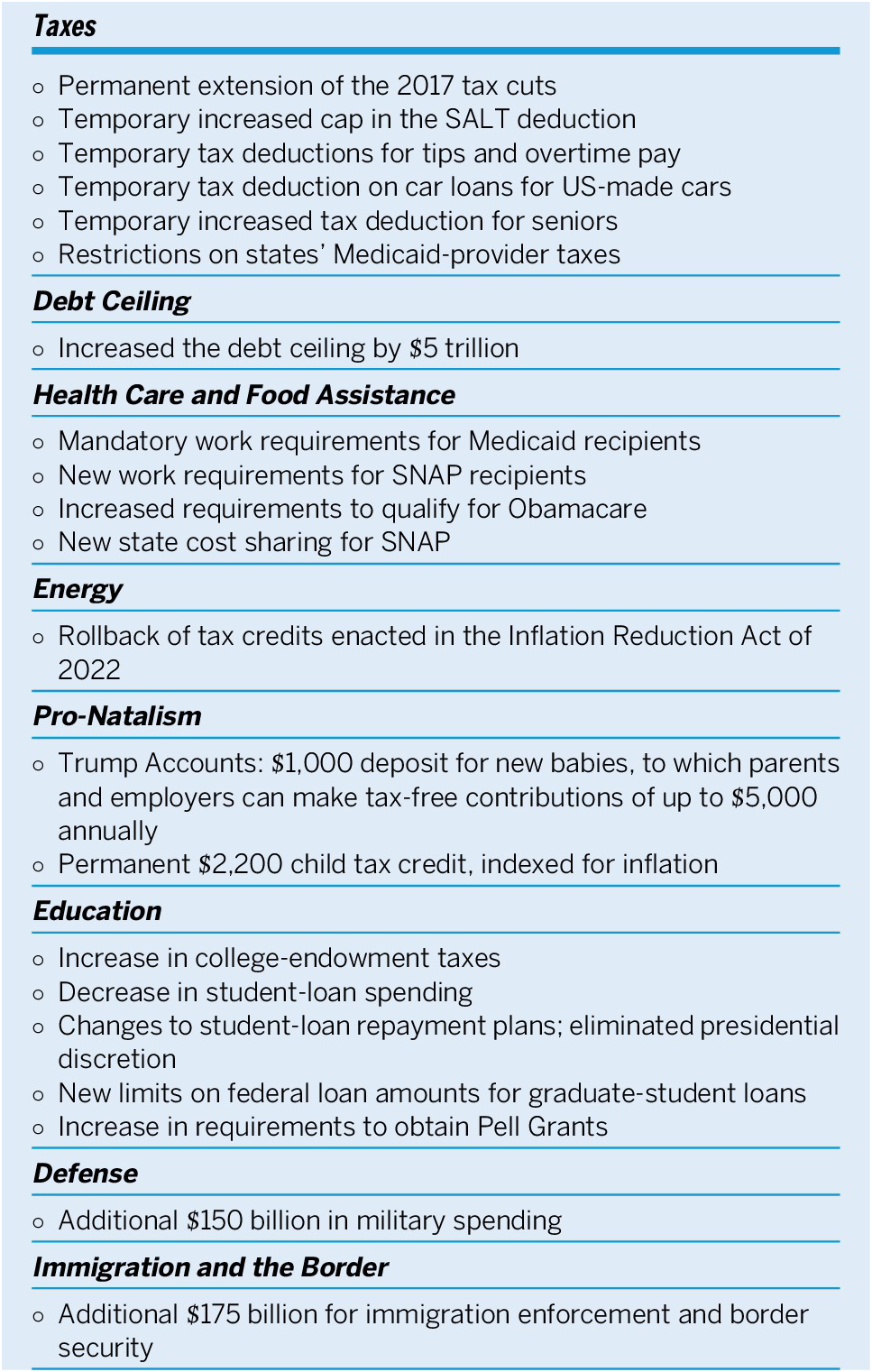
Table 1 Long description
The table is organized into eight thematic sections:
* Taxes: Includes permanent extension of 2017 tax cuts, temporary increased cap in S A L T deductions, temporary deductions for tips, overtime, and car loans for U S-made cars, increased deductions for seniors, and restrictions on state Medicaid-provider taxes.
* Debt Ceiling: Increased the debt ceiling by 5 trillion dollars.
* Health Care and Food Assistance: Mandatory work requirements for Medicaid and S N A P recipients, increased requirements for Obamacare, and new state cost sharing for S N A P.
* Energy: Rollback of tax credits from the Inflation Reduction Act of 2022.
* Pro-Natalism: Establishment of Trump Accounts with a 1,000 dollar deposit for new babies and tax-free contributions up to 5,000 dollars annually, plus a permanent 2,200 dollar child tax credit indexed for inflation.
* Education: Increased college-endowment taxes, decreased student-loan spending, eliminated presidential discretion in repayment plans, new limits on graduate-student loans, and increased requirements for Pell Grants.
* Defense: Additional 150 billion dollars in military spending.
* Immigration and the Border: Additional 175 billion dollars for immigration enforcement and border security.
The broad contextual factors typically believed to structure presidential–congressional relations were not more favorable for Trump in the 119th Congress than they were in the 115th. Both Congresses featured Republican majorities in the House of Representatives and the Senate. Indeed, Republicans had a substantially larger House majority in the 115th Congress than in the 119th Congress (241 versus 220 seats). In the Senate, Republicans held 52 seats in the 115th Congress and 53 seats in the 119th. Neither of Trump’s electoral wins featured much by way of presidential “coattails,” a factor previously found to enhance presidential authority (Conley Reference Conley2002). Indeed, Republicans actually lost seats in both the House (-6) and the Senate (-2) in 2016. In 2024, they again lost seats in the House (-2) but gained seats in the Senate (+4).
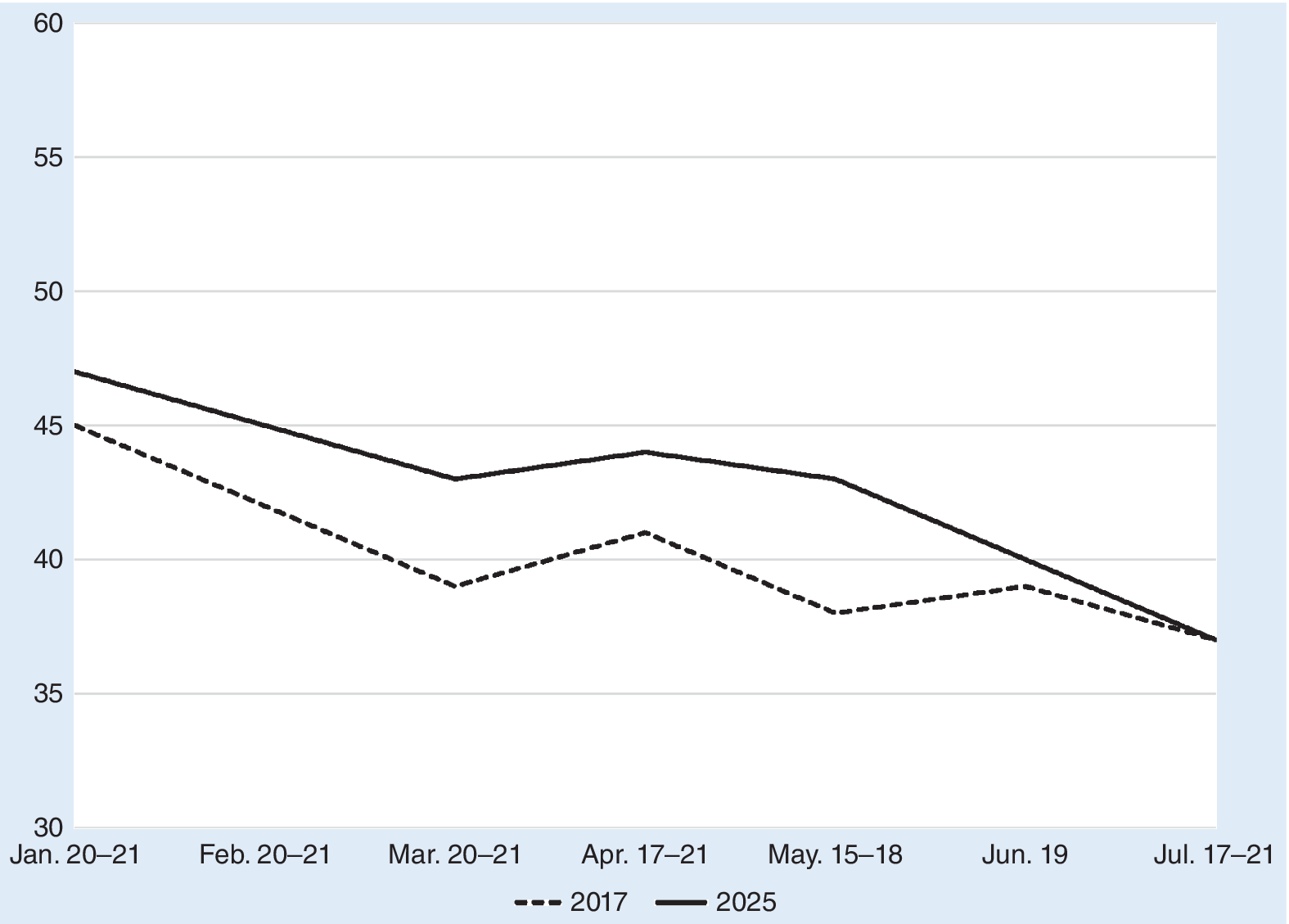
Trump’s national popularity differed little between 2017 and 2024. Figure 1 presents his approval ratings across the first six months of each term. Trump approval was 3.3 percentage points higher on average in 2025 than in 2017—an increase stemming almost entirely from increased popularity with Republican voters (Jones and Brenan Reference Jones and Brenan2025). Based on previous research, this level of increase was too modest a shift to make much difference for agenda success in Congress.Footnote 1 Indeed, throughout both 2017 and 2025, Trump was unusually unpopular for a newly elected president.
Trump Approval, January–July 2017 and 2025
Source: Gallup.
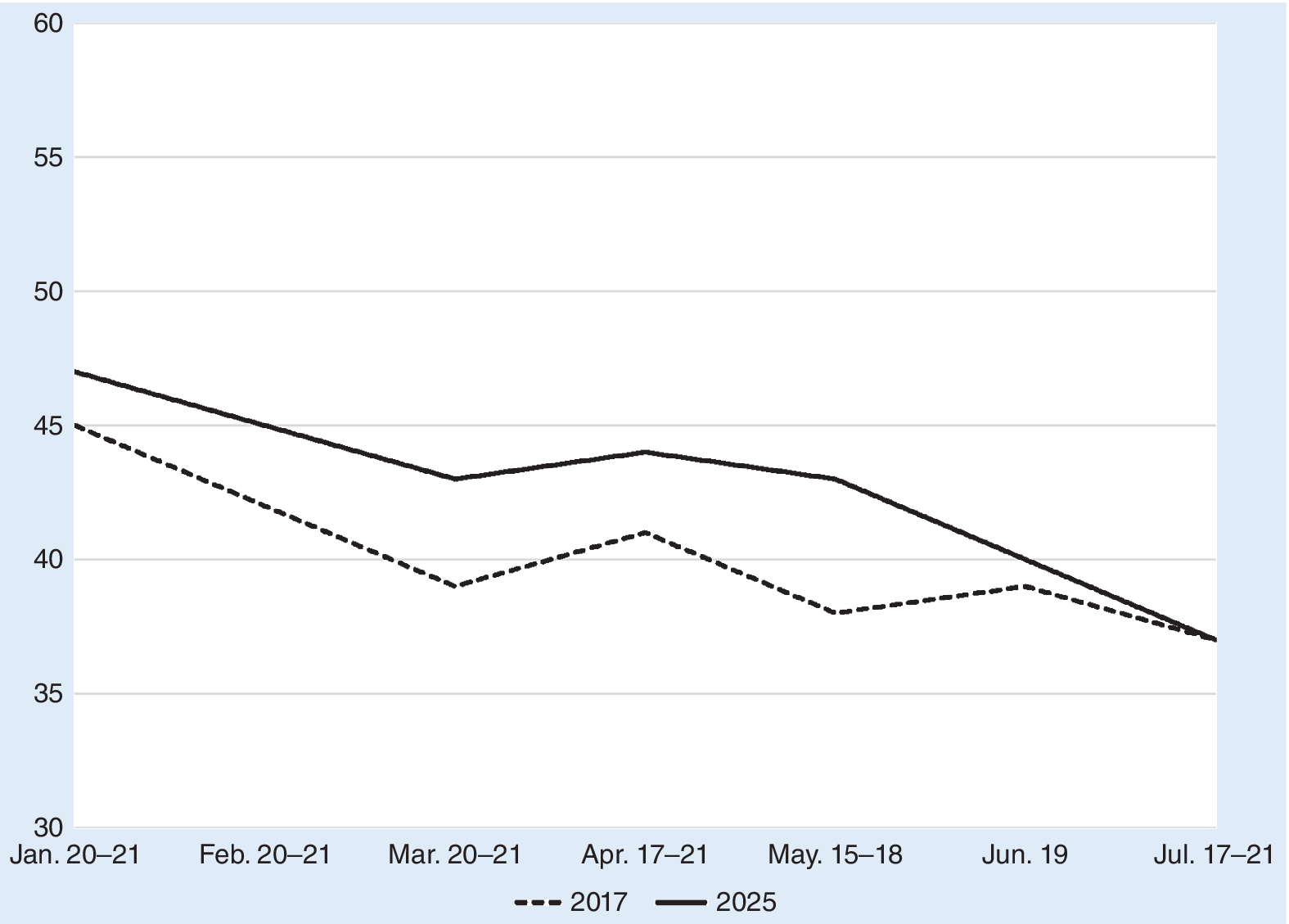
Figure 1 Long description
The Y axis represents approval percentage ranging from 30 to 60 in increments of 5. The X axis lists specific date ranges from Jan. 20–21 to Jul. 17–21.
* The 2025 data, represented by a solid black line, begins at 47 percent in late January. It shows a steady decline to 43 percent in March, a slight recovery to 44 percent in April, followed by a gradual downward trend ending at 37 percent in July.
* The 2017 data, represented by a dashed black line, starts lower at 45 percent. It follows a similar trajectory but remains consistently below the 2025 line until the final data point. It drops to 39 percent in March, rises to 41 percent in April, and fluctuates before ending at 37 percent in July.
Both lines converge at the same 37 percent approval rating by the final July 17–21 measurement period.
POLITICAL DOMINANCE OF THE GOP
Rather than the broader structural and political factors traditionally believed to empower presidents, Trump’s much greater legislative success in 2025 than in 2017 likely stemmed from his increased influence over his own party. Three reasons why Trump had more clout with the congressional GOP stand out.
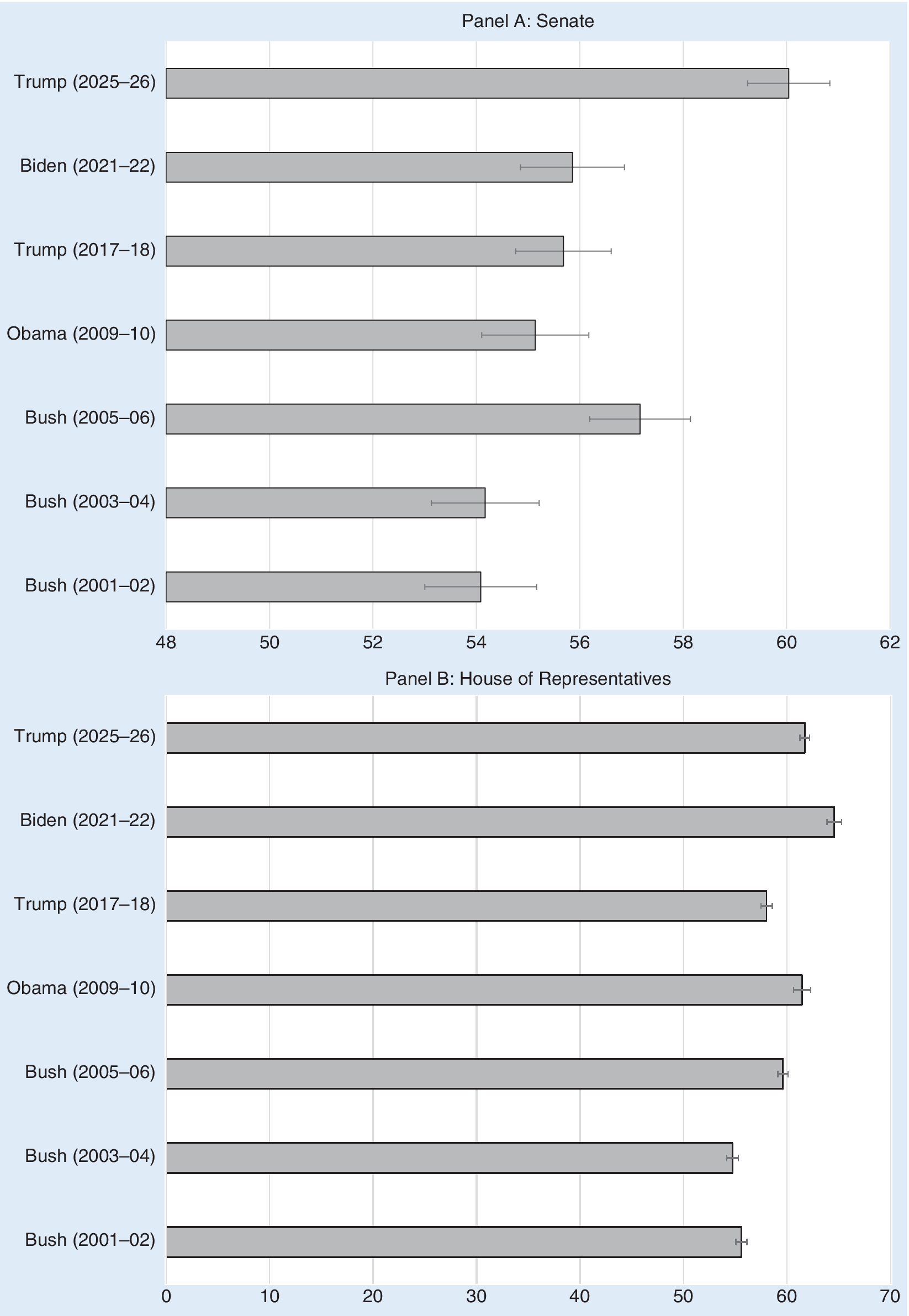
First, in 2024, Trump had the strongest electoral performance in Republican constituencies of any Republican president during the past 25 years, including his own performance in 2016 (figure 2). Indeed, no twenty-first-century president of either party had elicited more electoral support in copartisan Senate constituencies. Only Biden in 2020 had performed better in copartisan House districts. Trump’s performance was especially dominant in districts that already leaned Republican. As impressive as his performance in Republican districts was overall, Trump won fully 65% of the vote, on average, in the constituencies of House Freedom Caucus (HFC) members—a vote share half a standard deviation higher than in Republican members’ districts generally (Lee Reference Lee2025). This commanding electoral performance likely afforded him additional political leverage in dealing with a bloc that had long resisted pressure from party leaders on appropriations and debt-limit legislation (Bloch Rubin Reference Bloch Rubin2017; Green Reference Green2019).
Average Presidential Vote Share in Copartisan Constituencies in the House and the Senate
Source: Data collected by author (Lee Reference Lee2026).
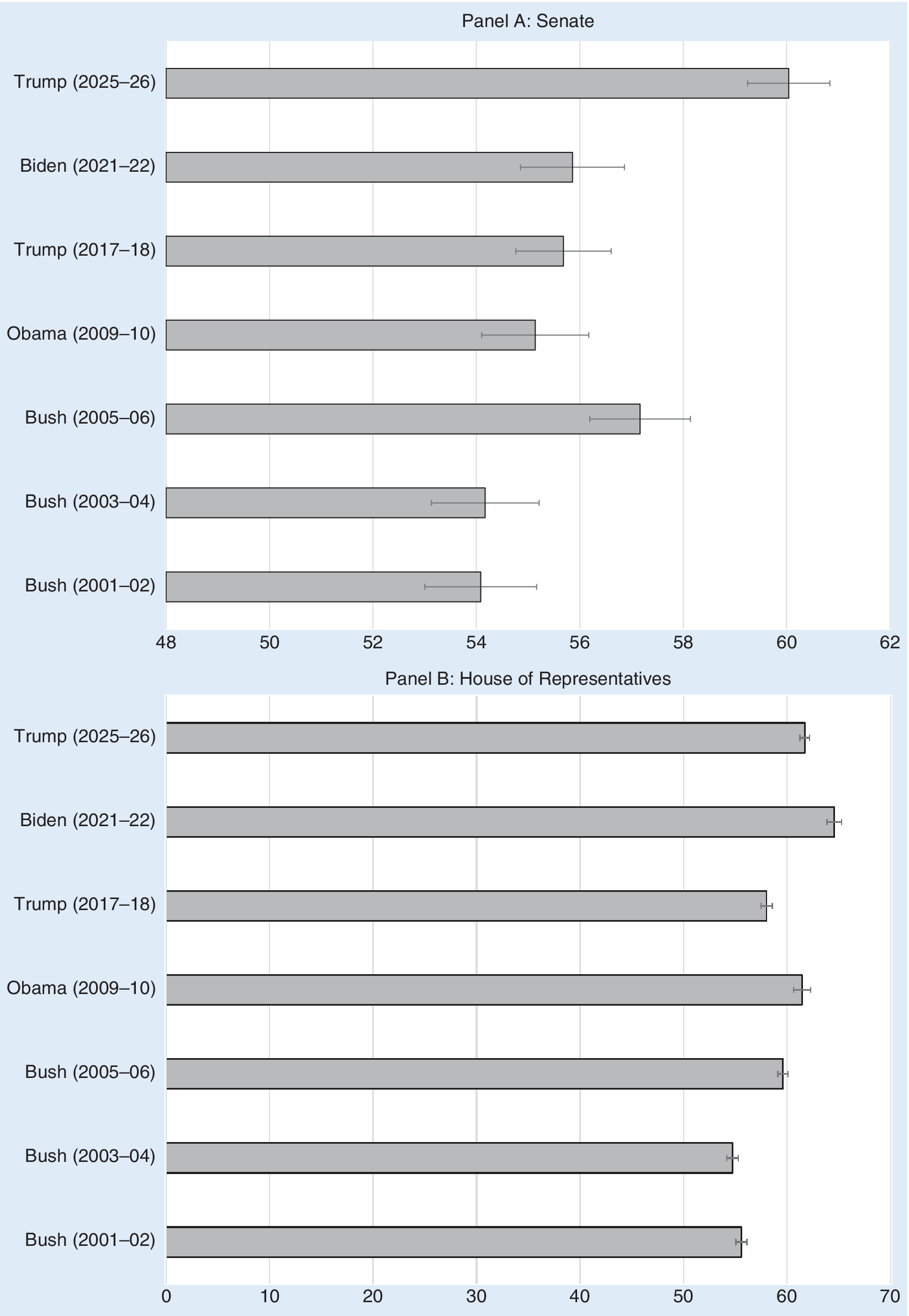
Figure 2 Long description
The figure consists of two panels with horizontal grey bars and error bars representing confidence intervals.
Panel A: Senate. The x-axis ranges from 48 to 62. From top to bottom:
* Trump 2025-26: approximately 60 percent.
* Biden 2021-22: approximately 56 percent.
* Trump 2017-18: approximately 55.5 percent.
* Obama 2009-10: approximately 55 percent.
* Bush 2005-06: approximately 57 percent.
* Bush 2003-04: approximately 54 percent.
* Bush 2001-02: approximately 54 percent.
Panel B: House of Representatives. The x-axis ranges from 0 to 70. From top to bottom:
* Trump 2025-26: approximately 62 percent.
* Biden 2021-22: approximately 64.5 percent.
* Trump 2017-18: approximately 58 percent.
* Obama 2009-10: approximately 61.5 percent.
* Bush 2005-06: approximately 59.5 percent.
* Bush 2003-04: approximately 55 percent.
* Bush 2001-02: approximately 55.5 percent.
In both panels, the error bars for the Senate are noticeably wider than those for the House of Representatives.
Not only was Trump’s support in Republican congressional constituencies unusually strong, it also was almost universal in the party. Trump carried the districts of all but three House Republicans in the 119th Congress and of all of the states represented by Republican senators except for Maine.Footnote 2 Although Trump in 2016 likewise had carried all but one of the states with Republican senators, there were 23 Republicans in the 2017 House of Representatives whose districts he had not won. Previous research revealed mixed results as to whether a president’s electoral performance or popularity within members’ constituencies affects congressional voting decisions more than party control of the seat itself (Cohen et al. Reference Cohen, Bond, Fleisher and Hamman2000; Conley Reference Conley2002; Dwyer and Treul Reference Dwyer and Treul2012). Nevertheless, the strength and universality of Trump’s electoral support in his copartisans’ constituencies probably promoted party cohesion and legislative success in 2025. Notably, one of the two House Republicans who voted against the OBBB was drawn from among the three Republican representatives whose districts Trump had not carried.Footnote 3
Second, Republican leaders in Congress in 2025 owed their position to Trump to a greater extent than Republican leaders in 2017. In 2017, House Speaker Paul Ryan (R-WI) had been in his position since October 2015, when Trump was still a long shot for the Republican presidential nomination. Ryan had served as Mitt Romney’s running mate in 2012 and had been among the party’s most visible leaders for many years. Moreover, Republicans had held the majority in the House of Representatives since the 2010 elections and would not have credited Trump for their control of the chamber in 2017. On the Senate side, Mitch McConnell (R-KY) had been Majority Leader since the 2014 elections and had led the Senate Republican party since 2007. Neither McConnell nor Ryan would have believed that they owed their leadership position to Trump in any way.
In 2025, Speaker Mike Johnson and Majority Leader John Thune (R-SD) were both indebted to Trump in various ways. House Republicans had barely eked out a three-seat majority in the 2024 elections, and Trump’s strong performance was viewed as important for the party’s success in holding onto control. By contrast, Republicans had a decisive House majority going into the 2016 elections (246 seats) and a similarly large majority afterwards (241 seats), conferring limited credit on Trump for their institutional power. The 2024 results were impressive for Senate Republicans. The party actually regained majority control of the Senate for the first time since 2019. Republicans had not flipped control of the Senate in a presidential year since 1980. Changes of party control enhance perceptions of a presidential mandate in Congress (Edwards Reference Edwards1989, 219). The 2024 Senate outcomes (+4 seats) also were far more impressive than those of the 2016 elections, during which Senate Republicans lost two seats from the 54-seat majority that they had held since 2014. Republican leaders in Congress had more reason to credit President Trump for their position in 2024 than did those in 2017.
Both Johnson and Thune also came to their leadership position after Trump already was the leader of the national party. During the leadership turmoil that followed the October 2023 vote to remove Speaker Kevin McCarthy (R-CA), all of the contenders for the Speakership sought Trump’s support. Trump scuttled the candidacy of House Republicans’ first Speaker nominee, Representative Steve Scalise (R-LA), by publicly questioning his health (Tran and Jackson Reference Tran and Jackson2023). When Trump’s own first choice, Representative Jim Jordan (R-OH), could not obtain the necessary votes, he sank the party’s third Speaker nominee Tom Emmer (R-MN) by calling him a “Globalist RINO” (Frazier Reference Frazier2023). At this point, Trump weighed in for Johnson, who finally was able to garner a House majority. As Speaker during the 118th Congress (2023–2024), Johnson ran afoul of Republican hardliners over deals he reached with Democrats, and his future as Speaker was in doubt at the end of 2024. Trump threw Johnson a “lifeline” in December with a “complete and total endorsement” to continue as Speaker when the new Congress convened (Solender Reference Solender2024).
A lieutenant to McConnell and already in party leadership, Thune was significantly less indebted to Trump than Johnson. However, Thune was elevated to top leadership only after Trump had won the 2024 presidential election. Had Trump attacked Thune publicly, he might have blocked him. In anticipation, Thune went to Mar-a-Lago before the elections to reach an “understanding” (Peterson and Wise Reference Peterson and Wise2024). Afterwards, Trump refrained from criticizing Thune and did not make an endorsement in the leadership contest. Thune clearly was not Trump’s first choice for Senate Majority Leader. Thune had harshly criticized Trump on a number of important prior points, including calling on him to exit the 2016 race after the “Access Hollywood” scandal (Johnson, Sullivan, and Costa Reference Johnson, Sullivan and Costa2016) and denouncing Trump’s behavior on January 6, 2021, as “inexcusable” (Thune Reference Thune2021). Several Trump loyalists endorsed Senator Rick Scott (R-FL) for Republican leader. Nevertheless, Trump chose to stay quiet and declined to make an endorsement. Scott was eliminated on the first round of Senate Republican conference voting; Thune then was narrowly selected over John Cornyn (R-TX)—an alternative also perceived as part of the party’s “establishment” (Perano Reference Perano2024).
Members of Congress tend to show more loyalty to leaders who select them for desirable positions (Fong Reference Fong2023). According to this logic of reciprocity, Johnson and Thune would be expected to work more closely with Trump than the congressional leaders of 2017, who felt no sense of personal obligation to him. Given Thune’s weaker debt of obligation, we would expect Johnson to exhibit the stronger loyalty of the two leaders in 2025.
Third, Trump always has been more willing than most presidents to publicly criticize and threaten to primary copartisan members of Congress. However, these threats were more credible in 2025 than in 2017. Between 2017 and 2025, Republicans who opposed Trump on salient issues were more likely than other Republicans to incur primary challengers and to lose renomination (Lee Reference Lee2023)..In addition, many other prominent congressional Republicans who opposed Trump simply decided to end their own political careers (Saldin and Teles Reference Saldin and Teles2020). In light of this history, it would be only reasonable for congressional Republicans to tread more cautiously in their dealings with Trump. Perceptions of Trump’s sway with primary voters may have compelled the HFC to fall in line despite their many objections to the OBBB (Gold, Jimison, and Mineiro Reference Gold, Jimison and Mineiro2025). Considering these three reasons, Trump was positioned to wield more political influence over members of the congressional Republican party in 2025 than in 2017.
LEGISLATIVE STRATEGY
Trump’s success is not Trump’s alone. The legislative strategy for enacting the Trump agenda was crafted in Congress, principally driven by Speaker Mike Johnson. Johnson and Majority Leader John Thune disagreed about the right approach. Thune, along with other Republican leaders including Senator Lindsey Graham (R-SC), advocated for packaging the Trump agenda into at least two major bills: (1) the first bill focusing on border, energy, and defense; and (2) a second bill later in the year focusing on tax cuts. Senate Republicans passed a budget in mid-February 2025 that would implement their multi-bill strategy. Nevertheless, Johnson continued to insist that Congress should proceed with a single bill that would enact the entire Trump agenda at once. “If we break it up, we will do parts of it, and the other parts will never get done,” Johnson maintained (Cortellessa and Popli Reference Cortellessa and Popli2025). This internal debate over strategy began immediately after the 2024 elections and persisted for months, with Trump declining to decide on an approach. “I would prefer one [bill], but I will do whatever needs to be done to get it passed,” Trump said. “I’m open to either way” (Bade Reference Bade2025).
Ultimately, Johnson persuaded Trump to agree with the higher-stakes single-bill approach. Returning from a meeting with the president, Johnson told assembled Republicans at a party retreat that Trump had decided on “one big beautiful bill,” a term that immediately was picked up by news media and soon became the official name of the proposed legislation (Diaz, Hill, and Carney Reference Diaz, Hill and Carney2025). There was considerable doubt that Johnson would be successful, considering his poor track record of maintaining Republican Party unity (Kane Reference Kane2024) and his history of relying on Democratic votes for routine legislation (Feldman Reference Feldman2024).
Assembling the legislation was a fractious process, with both moderates and hardliners repeatedly threatening to balk. Moderates—many of whom represented high-tax states such as California and New York—sought increases in the State and Local Tax (SALT) deduction, a costly demand to which leaders only reluctantly acceded. Hardliners wanted to see significant deficit reduction and demanded more cuts to Medicaid and clean-energy subsidies, which leaders were never able to fully satisfy. The final product was projected to increase the deficit by $3.5 trillion during the subsequent decade. Another obstacle was the $5 trillion increase in the debt limit included in the bill, which was especially painful for Republicans who had proudly voted against such increases through their careers to that point.
The design of the OBBB included numerous time-tested structural features that coalition leaders use to enhance public perceptions of a policy’s benefits and to obscure its costs (Arnold Reference Arnold1990; Hacker and Pierson Reference Hacker and Pierson2005). The cuts to Medicaid and SNAP were masked by both policy complexity (i.e., federal–state cost-sharing; Medicaid-provider tax freeze) and lengthy causal chains between Congress’s decisions and state policy makers’ future decisions affecting program beneficiaries. The benefits of the legislation were frontloaded, in that the tax cuts would take effect immediately, but the social-welfare cuts were delayed until late 2026. Indeed, the delay even left open the possibility that the Medicaid cuts might be rolled back before they went into effect. The overall cost of the bill was reduced by allowing the tax cuts for low-wage workers to expire at the end of the Trump presidency. All of these design choices are classic tools to make major legislative packages more palatable.
Nevertheless, congressional leaders faced many challenges in assembling the package. In some respects, the Senate budget process helped Thune navigate some internally divisive issues. Senate leaders included numerous controversial provisions in an initial draft, such as requiring states to verify immigration status in Medicaid, changes to reimbursement rates governing contracts with pharmacy benefit managers, and new limitations on eligibility for the Affordable Care Act (Kapur, Thorp, and Wong Reference Kapur, Frank Thorp and Wong2025). The parliamentarian’s rulings that excluded several of these controversial items allowed Thune to avoid some issues on which the party lacked full consensus while simultaneously blaming the parliamentarian for the outcome.
Having only one additional Republican vote to spare in the Senate also gave Thune leeway that Mitch McConnell did not possess when he attempted to repeal and replace Obamacare in 2017. Three Senate Republicans voted no on the OBBB, the same number of defections that McConnell experienced on the drive to repeal and replace Obamacare.Footnote 4 However, with 53 Republicans in 2025 rather than the 52 in 2017, the OBBB’s fate was not sealed. Attention focused on Senator Lisa Murkowski (R-AK) as a pivotal vote, who secured numerous major concessions targeted for Alaska in exchange for voting for the legislation, which she described as a “difficult and agonizing” decision (Bradner et al. Reference Bradner, Ferris, Fox and Grayer2025).
For his part, Johnson had to deal with holdouts at every step of the multistage budget process. Members of the HFC put up numerous objections. After the Senate approved a version entailing larger deficits, smaller cuts to Medicaid and green-energy subsidies, and other objectionable changes, the HFC was outraged when Trump and Johnson demanded that they accept it without further amendment. The HFC released a three-page document excoriating the bill for increasing the deficit by 1,705% more than the House bill.Footnote 5 “The Senate’s version of the BBB is morally and fiscally bankrupt,” tweeted Representative Keith Self (R-TX).Footnote 6 Representative Chip Roy (R-TX) called the bill a “travesty” (Schorr Reference Schorr2025).
Despite all the “saber rattling,” Speaker Johnson decided that he simply would not relent and pull the measure from consideration, as Speaker Ryan had done in March 2017 when he initially could not assemble the votes to repeal and replace Obamacare. No matter how forcefully the holdouts criticized the product, no matter how long they held out, Johnson insisted that they would have to go on record with a “yes” or “no” vote. The House repeatedly stayed in session overnight and twice set new records for the length of time roll-call votes were held open, but Johnson kept up the pressure. Trump personally spoke to many of the holdouts. He also made his displeasure public, posting on social media: “What are the Republicans waiting for??? What are you trying to prove??? MAGA is not happy, and it’s costing you votes!!!” (Brooks Reference Brooks2025). Ultimately, the hardliners capitulated, without securing legislative concessions.Footnote 7 Forced to choose between standing with or against the president on a high-stakes vote, they simply caved.
In short, the legislative strategy employed to enact Trump’s OBBB was brutally simple: roll together all of the party’s priorities in a single package and then force the vote as a test of loyalty to the president. Although Republican leaders had not taken a similar approach to Trump’s first-term legislative agenda, Johnson’s strategy was not new. Democrats had unsuccessfully attempted the same strategy in unified government under President Biden in 2021–2022. Democrats’ $3.5 trillion “Build Back Better” (BBB) bill packaged together Biden’s domestic-policy agenda, a proposal so far reaching that it was compared to enacting the entire New Deal in one bill. Bills bundling together more and less politically attractive proposals have always made life easier for Congress members in that they reduce “traceability” for any costs felt by constituents (Arnold Reference Arnold1990, 47). Megabills like Trump’s OBBB and Biden’s BBB hyperextend the logic.
The 2025 Republican strategy differed from Ryan-era Republicans and Biden-era Democrats in one key respect: speed. In 2021, House Democrats finally succeeded in passing their BBB only in November; Senate Democrats never followed suit. In 2025, Trump and Johnson pushed for aggressively early deadlines: Memorial Day for the budget resolution and July 4 for the reconciliation bill. Many doubted the timeline would be feasible, especially revisiting how long it had taken Republicans to advance Trump’s agenda in 2017. However, the all-out drive to enact the bill as quickly as possible capitalized on whatever “honeymoon” period Trump had. As shown in figure 1, his public approval declined over time, which is common for presidents. Moving sooner was more advantageous than protracting the partisan infighting as the president’s political capital dissipated.
CONCLUSION
As gauged by the usual factors that political scientists use to analyze presidential success with Congress, President Trump was situated similarly in the first years of his two terms. Party control, party size, and presidential popularity all differed little if at all. However, Trump achieved far more legislative success in 2025 than in 2017. As such, Trump’s much greater legislative success in 2025 relative to 2017 suggests that analysts in today’s highly party-polarized era must give more attention to intraparty politics and strategy to gauge prospects for enacting the presidents’ agenda—at least under conditions of unified party control.
Trump’s much greater legislative success in 2025 relative to 2017 suggests that analysts in today’s highly party-polarized era must give more attention to intraparty politics and strategy to gauge prospects for enacting the presidents’ agenda.
Historically, Congress has passed little legislation on the basis of only one political party’s support, and such gigantic bills are also well outside of institutional norms. However, given polarization and narrow majorities, congressional parties face enormous pressure to act before they lose control. To deliver under those constraints, recent majority parties have packaged together megabills designed to make the president’s entire legislative agenda a test of party loyalty. This parliamentary-style approach is no guarantee of success. Indeed, it seems unlikely that the 119th Congress (2025–2026) will succeed in passing further legislation using this approach, despite Speaker Johnson’s suggestions to the contrary (Hill and Carney Reference Hill and Carney2025). The looming expiration of the Trump tax cuts created powerful incentives to pass the OBBB, without which Republicans likely will struggle to reach consensus. In addition to the leverage of the expiring tax cuts, Trump had advantages in dealing with congressional Republicans in 2025 that he did not possess in 2017. Congressional leaders used those advantages fully. Speaker Johnson “tightened the vise” on dissenters by relentlessly forcing votes as loyalty tests. Given the stunning outcomes of 2025, future partisan trifectas will probably want to reopen that playbook.
ACKNOWLEDGMENTS
For helpful comments, I thank Jim Curry, Rob Oldham, and the anonymous reviewers. For excellent research assistance, I am grateful to Cynthia Huo.
DATA AVAILABILITY STATEMENT
Research documentation and data that support the findings of this study are openly available at the PS: Political Science & Politics Harvard Dataverse at https://doi.org/10.7910/DVN/CKRG9O.
CONFLICTS OF INTEREST
The author declares that there are no ethical issues or conflicts of interest in this research.


 Open access

