



The high global consumption of sugar-containing beverages has gained international public health attention due to its contribution to obesity( Reference Malik, Pan and Willett 1 ) and non-communicable diseases such as type 2 diabetes( Reference Imamura, O’Connor and Ye 2 ), CVD risk factors( Reference Malik, Popkin and Bray 3 ) and tooth decay( Reference Bernabe, Vehkalahti and Sheiham 4 ). A number of governments have introduced policies to reduce consumption of sugar-containing beverages through taxation, restrictions on marketing and public awareness campaigns( Reference Popkin and Hawkes 5 ). It is therefore unsurprising that consumers are becoming concerned about the adverse health effects of these beverages( 6 ).
Community concern about sugar consumption appears to have led to changes in the marketing of sugar-containing beverages, for example through increased advertising of beverages as ‘better-for-you’ (BFY)( 6 ). ‘Better-for-you’ is a term used increasingly by the food and beverage industry in marketing publications and in market reports( 6 , 7 ). It is starting to appear in public-facing websites (e.g. PepsiCo)( 8 ) where ‘better-for-you’ brands (e.g. Pure Leaf iced teas and Grain Waves) are presented in contrast to ‘fun-for-you’ brands (e.g. Pepsi and Doritos). The BFY category is broad and ill-defined( 6 , 7 ), including both health and nutrition claims and products classified as ‘good’ (‘products that generally are considered wholesome’)( 9 ).
In Australia, foods and beverages are required to display a Nutrition Information Panel. Nutrition information labels are common in many countries; however, their relative complexity often results in low usage among sub-populations at the highest risk of developing nutrition-related chronic illnesses( Reference Campos, Doxey and Hammond 10 ). Health and nutrition claims are another source of nutritional information provided on food and beverage packages. While it is the manufacturers’ decision whether to display health and nutrition claims or not, regulations exist around their use in Australia( 11 ). The use of health and nutrition claims on food and beverage labels is well documented. A number of studies show that consumers believe a product is healthier if it carries a health- or nutrition-related claim( Reference Abrams, Evans and Duff 12 – Reference Gorton, Mhurchu and Bramley 15 ) and a recent meta-analysis concluded that health and nutrition claims have a substantial effect on dietary choices( Reference Kaur, Scarborough and Rayner 16 ). However, these studies often do not address broader, unregulated, BFY features on food and beverage labels, which has been identified as a limitation of previous research( Reference Elliott 17 – Reference Christoforou, Dachner and Mendelson 19 ).
The present study describes the features on sugar-containing beverage labels that position them as BFY, encompassing features that include, but are not limited to, health and nutrition claims. We defined a BFY feature as ‘text or an image on packaging that either claims or implies that a product has health-related benefits or is a healthier option’. This definition includes both claims that directly state a health benefit and broad terms that imply the product may play a role in health or well-being. The display of BFY features on labels may lead consumers to believe these sugar-containing beverages are healthier for them than they would if the labels did not display BFY features; this is known as a ‘health halo’ effect( Reference Fernan, Schuldt and Niederdeppe 20 , Reference Schuldt 21 ). Understanding the messaging communicated to consumers through the BFY construct has the potential to provide further insight into trends of sugar-containing beverage consumption, including shifts from soda to other beverage types.
Methods
Data collection
During September to November 2016 we conducted an audit of labels on all non-alcoholic/non-dairy packaged beverages in South Australian grocery stores. We selected seventeen stores from leading grocery store chains( 22 ). Stores were purposively sampled from across areas of differing socio-economic status according to the 2011 Socio-Economic Index for Areas score( 23 ) to ensure that any potential differences in the availability of beverages in differing socio-economic areas were captured. The method of data collection was based on similar studies of packaged food and beverage label audits( Reference Williams, Yeatman and Ridges 24 – Reference Rayner, Wood and Lawrence 26 ). We photographed the packaging of all non-alcoholic/non-dairy beverages of size 1 litre (34 fl. oz) or less from each store. Multipacks and packages where information was not presented in English were excluded. The study was granted an exemption from Human Research Ethics Committee review.
Study sample
We recorded product descriptions (product name, flavour and package size). Product duplicates were removed from the sample. Multiple package sizes were also excluded after initial analysis of a subset of products found no difference between features on different sizes of products.
We classified products by beverage type (alcohol substitutes, coconut water (flavoured or plain), concentrates, energy drinks, fruit drinks, iced teas, juices (100 % juices separated), soda, sports drinks, flavoured water (still or sparkling) and other (i.e. probiotic drinks); see online supplementary material, Supplemental Table 1 for definitions) and recorded the sugar content. For the purposes of the present study, beverages were categorised as either sugar-free (<1 g/100 ml) or sugar-containing (≥1 g/100 ml). Sugar-containing beverages were further categorised depending on their sugar content as low sugar (≥1 and ≤2·5 g/100 ml), medium sugar (>2·5 and <5 g/100 ml), high sugar (≥5 and <10 g/100 ml) and very high sugar (≥10 g/100 ml). Low sugar was categorised based on requirements for making a low sugar claim on packages( 11 ). High and very high sugar were categorised based on WHO recommendations( 27 ), with very high sugar aligning with the recommendation of limiting daily free sugar intake to approximately 50 g, and high sugar aligning with the extended recommendation to limit daily free sugar intake to 25 g (calculations based on a standard 500–600 ml ready-to-drink beverage). Free sugar is defined as ‘monosaccharides and disaccharides added to foods and beverages by the manufacturer, cook or consumer, and sugars naturally present in honey, syrups, fruit juices and fruit juice concentrates’( 27 ). For the purposes of the current study, this means simple sugars added to beverages and those naturally present within juice. Products in the final sample were assigned unique identifiers for products and their accompanying images.
Data analysis
Beverage labels were analysed through content analysis( Reference Kondracki, Wellman and Amundson 28 ). Using the definition of BFY features above, we developed a coding framework for the content analysis (see online supplementary material, Supplemental Table 2). The coding framework was based firstly on health and nutrient content claims, as defined by the Food Standards Australia New Zealand Code on Nutrition Health and Related Claims( 29 ), and secondly on relevant literature on food packaging which has suggested that particular features on packages are perceived to imply health benefits. We conducted an initial analysis to refine categories and capture new codes. Through this process, we identified four new codes (superfoods, goodness, wellness and isotonic/hypotonic). The coding framework was further developed and refined through an iterative process that included coding random sub-samples and discussing any issues among the authors until consensus was reached. Before finalising the framework, an independent researcher was engaged to code a random sub-sample (2·5 %) of products and any disagreements or problems with the framework were discussed among the authors until consensus was reached. The final coding framework consisted of thirty-one codes for BFY features which were grouped into eight categories (presented below). Beverage labels were coded by the lead author for the presence or absence of each BFY feature anywhere on the label. At completion, a random sub-sample (10 %) of products was coded by an independent researcher and the percentage agreement was calculated (mean percentage agreement: 94·5 %; range: 77–100 %). Cohen’s κ and other similar inter-rater reliability tests were not used because the underlying assumptions do not fit our data set. The κ statistic corrects for the percentage agreement due to chance agreement, which is assumed to apply to all observed ratings. However, this assumption is problematic when there is a low likelihood of chance agreement, such as when the prevalence of one outcome is high (e.g. large proportion of zeros due to the absence of a characteristic) as was the case in our data set. The nature of our data set aligns well with circumstances in which percentage agreement is an appropriate measure( Reference Feng 30 ).
Results
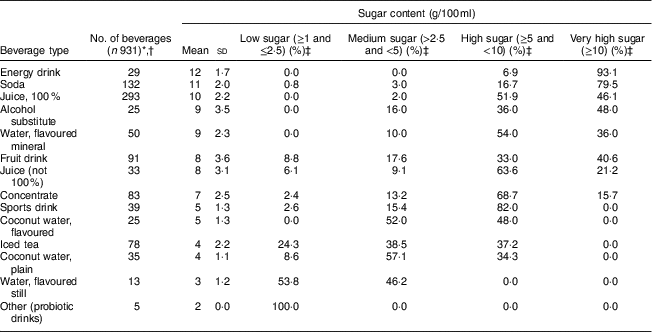
We identified 1123 unique beverage products, of which 84 % (n 945) contained sugar. The sugar-containing beverages formed the sample for the subsequent analysis. Only 5·2 % (n 49) of the sugar-containing beverages were low in sugar. The mean sugar content of beverages was 8·3 (sd 3·2) g/100 ml and ranged from 1·0 to 16·9 g/100 ml (excluding beverages with missing (n 4) or non-standardised (n 10) reporting of sugar content on labels). Energy drinks had the highest mean sugar content followed by soda and 100 % juices, with a large proportion of beverages within these categories containing a high or very high sugar content (100·0, 96·2 and 98·0 %, respectively). Although coconut waters and iced teas on average had lower amounts of sugar than other beverage categories, over a third of beverages within these categories were high in sugar (see Table 1).
Sugar content of sugary beverages by beverage category: South Australian supermarkets (n 17), September–November 2016
* Beverages missing sugar content on labels (n 4).
† Beverages removed due to unstandardised reporting of sugar content, i.e. concentrates not as mixed with water (n 10).
‡ Reported as percentage of beverage category.
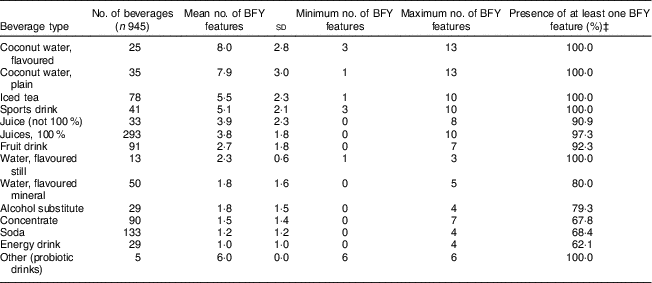
Almost all sugar-containing beverages contained BFY features on their labels (96·8 %), with 90·5 % of packages displaying fruit or vegetable features. When fruit or vegetable features were excluded, BFY features remained on a large proportion of products (87·7 %), with a mean of 3·3 (sd 2·6) unique BFY features per product. Most beverages carried at least one BFY feature (see Table 2). Coconut waters carried the highest number of unique BFY features with an average of eight BFY features per product. Although beverages within the soda and energy drink categories had fewer BFY features on packages, at least one BFY feature was still present on over two-thirds of sodas (68·4 %) and roughly two-thirds of energy drinks (62·1 %).
Better-for-you (BFY) features on sugary beverage labels by beverage categoryFootnote *,Footnote †: South Australian supermarkets (n 17), September–November 2016
* Excluding fruit or vegetable features.
† Reported as the occurrence of any one type of feature.
‡ Reported as percentage of beverage category.
Better-for-you features
Fruit or vegetables
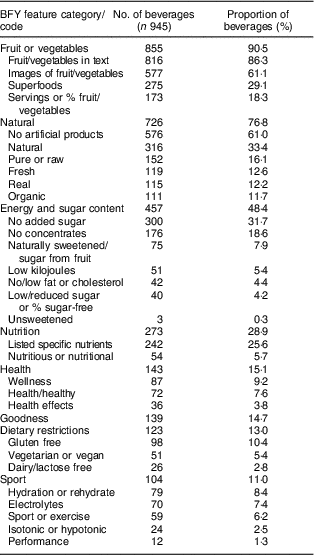
The majority (86·3 %) of beverages had text referring to fruit or vegetables on their packages and 61·1 % had an image of fruit or vegetables (Table 3). Energy drinks were the only type of beverage on which it was rare for images of fruit or vegetables to be displayed (3·4 %; see online supplementary material, Supplemental Table 3). Fruit drinks and sparkling flavoured waters commonly displayed the servings or percentage of fruit or vegetables on their labels (52·7 and 40·0 %, respectively). Just under a third of beverage labels (29·1 %) mentioned ‘superfoods’, with the most common superfoods being coconut (8·7 %), berries (6·3 %), ginger (6·2 %) and green tea/kombucha (5·4 %). Superfoods were most frequently included on the labels of coconut waters (100·0 % of labels; expected as coconut waters in themselves are considered a superfood), iced teas (59·0 %), juices (45·5 %) and 100 % juices (27·0 %).
Better-for-you (BFY) features on sugary beverage labels: South Australian supermarkets (n 17), September–November 2016
Natural
Three-quarters of beverages (76·8 %) contained features that implied they were natural products, by using the term ‘natural’, ‘organic’, ‘fresh’, ‘real’, ‘pure’ or ‘raw’ or by stating an absence of artificial products (i.e. additives, preservatives, colours etc.). All iced teas, over 90 % of coconut waters and 100 % juices, and over 80 % of fruit drinks and juices described their products as natural. Of sodas, 61·7 % also included features on labels that described them as natural, with 31·6 % using the term ‘natural’ itself and 32·3 % stating an absence of artificial products.
Energy and sugar content
Almost half of the sugar-containing beverages (48·4 %) referred to the product containing lowered, or natural, energy or sugar content, with ‘no added sugars’ and ‘no concentrates’ the most frequently used terms. Coconut waters and 100 % juices were the most common types of beverages to carry these features with over 80 % of products displaying one or more feature. More specifically, 78·2 % of 100 % juices and 62·9 % of plain coconut waters contained a no added sugar claim and 40·3 % of 100 % juices and 60·0 % of coconut waters (both plain and flavoured) contained a no concentrates claim. Coconut waters also had no/low-fat or cholesterol claims (60·0 % plain and 76·0 % flavoured). A small number of beverage packages (7·9 %) stated that the product was naturally sweetened or that the sugar was natural or from fruit.
Nutrition
Over a quarter of beverages contained features that focused on nutrition (28·9 %). This was most commonly achieved through referring to specific nutrients (25·6 %) such as ‘high in vitamin C’. Although this occurred across beverage types, it was most often used on sports drinks (68·3 %) and coconut waters (60·0 % flavoured and plain). Beverages also used broad terms such as ‘nutritious’/‘nourishing’ (5·7 %) and this was most common on juices (27·3 % of juices and 12·3 % of 100 % juices).
Health
Fifteen per cent of beverages contained features that were specifically related to health and well-being. Broad terms such as ‘health’/‘healthy’ were present most often on iced tea packages (32·1 %) and coconut waters (28·6 % plain and 16·0 % flavoured), and terms such as ‘wellness’/‘well-being’ or ‘revitalise’/‘refresh’ were most common on energy drinks (27·6 %), alcohol substitutes (24·1 %) and juices (24·2 %). References to specific health effects (e.g. claims about metabolism, cardiovascular/muscle function, immune system or digestive health) were less common; when present, these were most commonly found on juices (18·2 %) and iced teas (12·8 %).
Goodness
Fifteen per cent of beverages used the term ‘goodness’ (e.g. ‘full of goodness’ or ‘the goodness of blueberry’). This was most commonly used on juice labels (60·6 % of juices and 22·2 % of 100 % juices), iced teas (30·8 %) and sparkling flavoured waters (24·0 %).
Dietary restrictions
A small number of products noted that the beverage was suitable for people with dietary restrictions (13·0 %), with gluten free being the most common (10·4 %). Flavoured coconut waters were the most likely to indicate that they were suitable for a range of dietary restrictions such as gluten free, vegan and lactose free, with 60·0 % containing at least one or more (37·1 % in plain coconut waters), followed by iced teas which had 43·6 % of products containing one or more feature per package.
Sport
Although there were relatively few sporting features on beverage packages across the sample (11·0 %), all sports drinks contained sporting features and specifically referenced sport or exercise, with other commonly used features on sports drinks being electrolytes (100·0 %) and hydration (78·0 %). In addition, most coconut waters also displayed sporting features on packages (88·0 % of flavoured and 77·1 % of plain), often through reference to hydration (68·0 % of flavoured and 68·6 % of plain) and electrolytes (52·0 % of flavoured and 45·7 % of plain), and less commonly through direct reference to sport or exercise (24·0 % of flavoured and 8·6 % of plain). Almost one quarter of energy drinks (24·1 %) used references to sport.
Better-for-you features and sugar content
Most beverages with high or very high sugar content (n 759) carried a BFY feature on their label (85·8 %; Table 4). Of these beverages with high and very high amounts of sugar, 44·0 % displayed a BFY feature related to energy or sugar content. Specifically, 34·3 % of beverages with high and very high amounts of sugar displayed a no added sugar claim on the label and 6·7 % indicated that the beverage was naturally sweetened or that the sugar was from fruit.
Better-for-you (BFY) features on sugary beverage labels by sugar content: South Australian supermarkets (n 17), September–November 2016

* Reported as percentage of beverages within sugar category displaying feature category/code.
† Beverages missing sugar content on labels (n 4).
‡ Beverages removed due to unstandardised reporting of sugar content, i.e. concentrates not as mixed with water (n 10).
§ Excluding fruit or vegetable category.
Discussion
The current study found BFY features present on 96·8 % of sugar-containing beverage labels, with an average of 3·3 unique features per label. These features align products with being natural, emphasise their fruit and vegetable content, emphasise other nutrient contents, favourably position sugar content and suggest functional properties for the beverages. By using these BFY features, beverages may be given a ‘health halo’Reference Fernan, Schuldt and Niederdeppe (20) .
Sugar-containing beverages are positioned as natural
Positioning beverages as natural appears to be at the centre of current BFY advertising, with over three-quarters of beverages in our study displaying natural features on their labels. Advertising products as natural is not new or unusual. Nature is often used to position products as intrinsically good, healthy, fresh and innocentReference Hansen (31) . The commodification of nature has previously been documented for bottled waterReference Opel (32) and foodsReference Hansen (31) . Our study shows that manufacturers are positioning sugar-containing beverages in the same way, with coconut waters, iced teas and juices heavily using natural connotations on labels. Using the key word ‘natural’ was the most direct way this association was achieved with a third of packages doing so.
The frequent presence of fruit and vegetables on sugar-containing beverage labels also associates these beverages with being natural. The Coca-Cola Company has previously reported its efforts to ‘capture the natural goodness of fruit and vegetables for beverage use’Reference Short (33) , highlighting the importance of this positioning for advertising beverages. In our study, fruit and vegetables were present on labels in a range of ways that appeal to varying levels of consumer consciousness. Fruit or vegetable flavours and images were highly prevalent across beverage types, implicitly associating the beverages with being natural. On the other hand, while listing the servings of fruit and vegetables in a beverage was less prevalent, this more explicitly associated beverages with being natural, and nutritious, equating the consumption of juice to that of whole foods.
Promoting the absence of artificial (non-natural) products on labels was another common way through which beverages were positioned as natural. Claims such as ‘no artificial products, colours or flavours’ can often be, and were, applied across beverage categories, including beverages such as sodas which could otherwise be considered inherently unhealthy.
Sugar-containing beverages are positioned as a source of nutrition
Altering the nutritional profile of foods and beverages through reformulation and fortification can be used by manufacturers to market products as a source through which nutrition is deliveredReference Scrinis (34) . Reformulation can be used to reduce the nutrients perceived by consumers as ‘bad’ for health and fortification increases the nutrients perceived as ‘good’ for healthReference Scrinis (34) . In our study, both of these strategies were used to promote sugar-containing beverages with labels addressing the sugar and vitamin/mineral content of beverages.
Sugar is a nutrient of increasing concern to consumers( 6 , 7 ). Our study found that labels address concerns about sugar by favourably positioning the sugar content of beverages, most commonly though ‘no added sugar’ claims which were present on just under a third of labels. Beverages that included ‘no added sugar’ claims on their labels were still high in sugar, specifically free sugar. Notably problematic in this regard is 100 % juices, with over three-quarters of the 100 % juices in our sample making a ‘no added sugar’ claim, while the mean sugar content of the category was surpassed only by soda and energy drinks.
Fortification of sugar-containing beverages can also be used to draw consumer attention towards positive nutrients rather than high sugar content. As such, the use of fortification positions these non-core (discretionary) products as a source of nutrients. This was evident on a quarter of labels which referred to the nutrient content of beverages, for example through claiming high vitamin and mineral content.
Sugar-containing beverages are positioned as providing functional benefits
Functionalism extends the concept of fortification from meeting adequate nutrient intake to providing optimal nutrition for enhanced health or bodily functionsReference Scrinis (34) . Functional beverages are often perceived to be novel and technological, invoking science through reference to physiological functions and healthReference Eden (35) . Although functional beverages comprise a relatively small segment of the market, their popularity is increasingReference Siro, Kapolna and Kapolna (36) . Our study found that functionalism was advertised in two ways on beverage labels.
First, sports drink labels promoted functional benefits associated with achieving optimal sporting performance. Sports drink labels advertised electrolytes and the provision of optimal hydration for sporting performance. Scientific terms such as ‘isotonic’ and ‘hypotonic’ accompanied this positioning, further illustrating the scientific and functional positioning of these beverages.
Second, coconut waters were positioned as a ‘natural’ functional beverage, with the labels advertising electrolyte content and hydration. Unlike sports drinks, few coconut water labels made direct reference to sport and exercise. Linking functional benefits with the idea of being natural, coconut waters capitalised on the purported benefits of electrolyte consumption (namely, sporting performance) and appealed to consumers who desire natural products.
Positioning high sugar beverages as better-for-you is misleading to consumers
Prior research on consumer evaluation of beverages for health purposes is limited and has not explored how beverages are being positioned as healthyReference Kim and House (37) . However, existing research on positioning foods as healthy or BFY suggests that many advertising features we identified on beverages align with how consumers evaluate a product as healthy. For example, Luomala et al. have shown how positioning a food as natural influences consumers’ opinions on whether the food is healthy or notReference Luomala, Jokitalo and Karhu (38) . Irmak et al. found that renaming candy from ‘candy chews’ to ‘fruit chews’ can influence the health beliefs, and consumption, of candyReference Irmak, Vallen and Robinson (39) . Using BFY features on labels may therefore influence consumers’ assessment of whether sugar-containing beverages are healthy, or healthier than other options.
Positioning beverages that contain high amounts of free sugar as BFY is potentially misleading. BFY features on labels disregard the source through which the purported benefits are being deliveredReference Scrinis (40) and distract from the harms associated with consuming products high in free sugars (27) . For example, advertising that juice contains ‘no added sugar’ or ‘natural’ sugar from fruit and vegetables distracts from the high free sugar content of these beverages. Through positioning sugar-containing beverages as BFY, consumers may be influenced to select products they believe are health-promoting, which are in fact potentially harmful when overconsumed.
Public health implications
Our study has highlighted the ways in which sugar-containing beverages are being advertised as healthy on labels. The predominance of BFY features on these beverages further suggests that consumers are becoming increasingly concerned about health (7) , particularly in regard to sugar consumption from beverages( 6 ). Increased public concern around sugar consumption from beverages is a positive indicator for public health outcomes and it is not surprising that beverage manufacturers are implementing efforts to address this concern. Originally intended for improving public health, reformulation and fortification of foods and beverages has also been adopted by manufacturers and is a common technique used for advertising purposesReference Scrinis (34) . However, the use of natural ingredients, increased vitamin and minerals and ‘functional ingredients’, as advertised on sugar-containing beverage labels in our study, does not offset the harms associated with high sugar consumption (27) from these beverages. Reformulation that leads to positive public health outcomes in obesity and related non-communicable diseases is likely to occur only through significant reduction in the sugar content of these beverages. Knowledge of the techniques used to position sugar-containing beverages as BFY can inform the development of public messaging that aims to increase community literacy and reduce population overconsumption of free sugars including sugar-containing beverages.
Our study has also highlighted that the positioning of sugar-containing beverages as BFY occurs despite existing regulations that aim to prevent the misleading advertising of unhealthy products as healthy (29) . We found that it was most common for implicit BFY features (such as fruit flavours and advertising natural ingredients) to be displayed on sugar-containing beverages. Research has demonstrated that implicit health-related labelling features, such as product titles( Reference Fernan, Schuldt and Niederdeppe 20 ) and colourReference Schuldt (21) , increase consumer perceptions of the healthfulness of discretionary foods. It has further been suggested that implicit features have a stronger effect on consumer health perceptions than explicit nutrition claims through creating a health halo effect( Reference Fernan, Schuldt and Niederdeppe 20 ). The prominence and effect of implicit health- and nutrition-related features, such as the BFY features identified in our study, therefore need to be considered in existing and future regulations, for example through broadening the scope of what is regulated. Such regulations can be further strengthened by restricting the use of all health- and nutrition-related features on labels to non-discretionary foods and beverages. Australia has implemented such restrictions for health claims, with foods and beverages being required to meet a predefined nutrient profile score to be eligible to display health claims( 11 ). These restrictions have not been extended to nutrition claims, which may explain why a quarter of sugar-containing beverages advertised the presence of specific nutrients on labels.
Limitations
We restricted our study to the labels of water-based sugar-containing beverages, excluding milk-based beverages which may also be high in added sugar. Milk-based beverages may use different BFY features on their labels that were not identified in our study; analysis of the advertising features on sweetened milk labels would be complementary to our research. We also focused on advertising through labels, which may differ from advertising through other media. Further, while we have defined and measured BFY features on labels, our analysis cannot determine whether these features influence how people evaluate these beverages. The BFY features identified in the present study should be tested in experimental research to explore the effect of these features on consumers’ perceptions and consumption of sugar-containing beverages.
Conclusion
Many sugar-containing beverage labels include features that imply these drinks are healthy, or healthier than alternative beverages. If BFY features lead consumers to believe these beverages are healthy, this may influence consumption, with consequent negative implications for the health of the public. Those working in obesity prevention and public health must find ways to counter and/or prevent the misleading advertising of sugar-containing beverages as healthy.
Acknowledgements
Financial support: Funding for this study was provided by an Australian Government Research Training Program Scholarship (A.L.B.) and an Ian Wilson Liberal Research Scholarship (A.L.B). The funders were not involved in the study design, analysis and interpretation of data, thus the authors were independent of the funder. It was the authors’ decision to publish the findings of this study and the funders were not involved in the preparation of this manuscript. Conflict of interest: None. Authorship: A.L.B. developed the coding tool and collected and analysed the data, with scientific input from C.L.M. and A.J.B.-M. A.L.B. drafted the article. All authors contributed to the conceptualisation and design of the study and reviewed and revised the final version of the article. Ethics of human subject participation: This research project was exempt from review by a Human Research Ethics Committee as no human data were used and the research did not pose any foreseeable risk of harm or discomfort.
Supplementary material
To view supplementary material for this article, please visit https://doi.org/10.1017/S1368980018002392



