





Policy Significance Statement
This study provides insights into strategic narratives in national quantum technology policies across 24 countries, relevant for stakeholders in the quantum domain. Our findings from computer-assisted narrative analysis reveal a global policy discourse dominated by stories such as technological leadership, economic competitiveness, and security, while societal impacts and responsible innovation remain largely sidelined. These trends may risk reinforcing competition-driven framings that fragment international collaboration and sideline ethical considerations. We provide policy insights by (1) revealing a global narrative gap in responsible quantum development, (2) highlighting the need for inclusive, society-oriented policy frameworks, and (3) offering a holistic approach to policy analysis using novel computational methods. These insights support the development of balanced regulatory strategies that ensure the responsible advancement of quantum technologies.
1. Introduction
Due to the projection of their potential capabilities, quantum technologies (QT) are increasingly attracting the attention of governments, as reflected in rising investment in recent years. These have exceeded the US$44.5 billion mark worldwide, with the global QT market estimated to reach US$106 billion by 2040 (Kung and Fancy, Reference Kung and Fancy2021; McKinsey, 2023; Purohit et al., Reference Purohit, Kaur, Seskir, Posner and Venegas-Gomez2024). Such investments reflect more than just scientific curiosity or fascination—they are evidence of the complex dynamics between world powers, with technologies as strategic assets.
The main technologies being distinguished here are quantum sensors, quantum communication, and quantum computing—all at different technological maturity levels. Quantum sensors can achieve extremely high measurement accuracy and precision of properties such as time, gravity, and electric fields. The second category is quantum communication systems, which can create highly secure digital communication channels. The third category is quantum computers, which are expected to solve computational problems that classical computers cannot (Hoofnagle and Garfinkel, Reference Hoofnagle and Garfinkel2021). Quantum simulations, for example, could be applied to the discovery of new drugs (Flöther, Reference Flöther2023), while quantum sensing and imaging applications are already being used in radars and satellites, providing more precise measurements of physical entities or higher resolution satellite imaging, which is also used by the military (Krelina, Reference Krelina2021). Further, commercially useful quantum computers might have the potential to break internet encryption protocols, which could lead to widespread security breaches, exposing confidential information (Shor, Reference Shor1994).
As these examples of possible applications show, like many other technologies, QTs are intrinsically dual-use. This duality in the potential applications of QTs makes governance a necessity. Alongside debates on ethics and safety, research findings have underscored the need for proactive regulation and guidelines, emphasizing the importance of responsible development and implementation of this technology to ensure positive societal outcomes (Grinbaum, Reference Grinbaum2017; Seskir et al., Reference Seskir, Umbrello, Coenen and Vermaas2023). However, despite the promising potential, the number of mature, widely deployed use cases is limited, which makes it challenging to define responsible development practices and regulation. This phenomenon is also referred to as the Collingridge dilemma: at early technological stages, it is relatively easy to change their outcomes, but the precise nature of these outcomes is unclear. As an innovation matures and progresses, its consequences become clearer, but the course becomes more difficult to change (Genus and Stirling, Reference Genus and Stirling2018). Despite this uncertainty, early intervention through government policy offers the opportunity to positively shape the development of technologies before they are widely spread in society. These aspects are of increasing importance because the potential challenges of QTs extend beyond security concerns to questions of access inequality, privacy implications, or power concentration. Without appropriate governance frameworks, these technologies risk exacerbating existing digital divides or extending monopolistic systems (Ten Holter et al., Reference Ten Holter, Inglesant, Pijselman and Jirotka2024).
Researchers have already begun to develop initial guidelines, agendas, or frameworks to guide policy and regulatory measures in the field of QTs (Kop, Reference Kop2021; Aboy et al., Reference Aboy, Minssen and Kop2022; Dekker and Martin-Bariteau, Reference Dekker and Martin-Bariteau2022; Hoofnagle and Garfinkel, Reference Hoofnagle and Garfinkel2021). Despite these general frameworks, a few studies have already examined individual governmental documents, such as those from the EU or Canada (Csenkey and Graver, Reference Csenkey and Graver2024; Vogiatzoglou, Reference Vogiatzoglou2025). These studies show that policy documents often make strong claims about the revolutionary impact of QTs, particularly quantum computing, without always providing concrete scientific evidence or scenarios. Furthermore, the researchers saw a tendency toward topics such as leadership, commercialization, and economic gains, and they point out that values such as sustainability and equitability should be embedded more fully to address societal impact (Vogiatzoglou, Reference Vogiatzoglou2025). To the best of our knowledge, there is no detailed, comparative study that examines national strategies across multiple economic regions, providing a broader perspective.
To address this research gap, we analyze 55 official documents from 24 countries/regions using topic modeling and the Narrative Policy Framework (NPF) to uncover dominant policy narratives across regions and time, addressing the following research questions:
RQ1: What are common narratives in national QT initiatives?
RQ2: How do these narratives change over time?
RQ3: Are there region-specific differences regarding policies about QTs?
This study makes several contributions to the existing body of knowledge. First, it aims to contribute to research on QT governance and policy development. Second, we show how computer-assisted methods, such as BERTopic modeling, can be used to examine topics and narratives from texts in a structured and systematic way, thereby complementing NPF with a quantitative approach. This thorough quantitative and longitudinal study also tracks the changes of policy narratives over time and lays the groundwork for future research on how different nations shape the development of QTs. By identifying prevailing narratives and thematic priorities in national strategies, our findings are useful for policymakers, researchers, and stakeholders in the QT ecosystem, and can be used to refine existing frameworks and develop more targeted national strategies.
The remainder of this article is organized as follows. In Section 2, we provide the theoretical background on QTs as well as the relevance of narratives in policies. This is followed by a detailed description of the data analysis and our methodological approach. In Section 4, we describe our results, followed by the discussion, the outline of limitations, and possibilities for future research.
2. Theoretical background
2.1. Quantum technologies
QTs are a broad category of innovations that make use of quantum phenomena, resulting in systems that can, be more efficient, more accurate, or more secure in comparison to their classical counterparts. Generally speaking, three main domains can be distinguished: quantum computing, quantum communication, and quantum sensing (Hoofnagle and Garfinkel, Reference Hoofnagle and Garfinkel2021).
Quantum computing uses quantum bits instead of the binary bits of classical computing. This leads to speed-ups in performance and potentially allows quantum computers to complete tasks that are beyond the reach of classical computers today (Rietsche et al., Reference Rietsche, Dremel, Bosch, Steinacker, Meckel and Leimeister2022). In a similar vein, quantum computing has demonstrated considerable potential in the field of complex simulations. Initial use cases are being investigated for the design of advanced batteries for efficient energy storage in materials science (Quach et al., Reference Quach, Cerullo and Virgili2023) or for the simulation of chemical instances for drug discovery (Flöther, Reference Flöther2023).
Quantum communication, on the other hand, offers potentially more secure ways to transfer information. This is an important aspect, since future commercially useful quantum computers can overcome current encryption methods, such as Rivest–Shamir–Adleman, Diffie–Hellman, or Elliptic Curve Cryptography (Shor, Reference Shor1994; Aboy et al., Reference Aboy, Minssen and Kop2022; Rietsche et al., Reference Rietsche, Dremel, Bosch, Steinacker, Meckel and Leimeister2022). Quantum communication systems provide a more secure method for preventing eavesdropping and protecting data transmission compared to existing cryptographic protocols, even in the post-quantum era (Lewis and Travagnin, Reference Lewis and Travagnin2022).
Finally, quantum sensors can measure physical attributes more precisely than conventional sensors (Aboy et al., Reference Aboy, Minssen and Kop2022). Techniques such as NMR spectroscopy and MRI, which are sometimes called first-generation quantum technologies, demonstrate how quantum principles are already being used in healthcare. Further, atomic clocks provide extremely precise timekeeping and are already used in GPS systems (Degen et al., Reference Degen, Reinhard and Cappellaro2017; Hoofnagle and Garfinkel, Reference Hoofnagle and Garfinkel2021).
As illustrated by the examples above, possible applications of QTs span a broad range, addressing key issues in information security, healthcare, and climate change, among others. It is important to keep in mind, however, that the precise timing and potential of these advantages often remain uncertain due to the different stages of technological readiness in each domain. Quantum sensors are considered to have a rather high technological readiness, with applications already being used today, for example, in healthcare or satellites, while quantum computers show a comparably low technological readiness (Hoofnagle and Garfinkel, Reference Hoofnagle and Garfinkel2021).
2.2. Narrative policy analysis
Public policy, as defined by Dye (Reference Dye1992), “is whatever governments choose to do or not do” (p. 1). It includes a variety of governmental actions, such as regulations, conflict management, resource distribution, and tax collection (Dye, Reference Dye1976). Policy narratives play a crucial role in shaping both political and public understanding of these actions: governments use such narratives to portray policy issues, interpret situations, and legitimize their preferred action or outcomes (Stone, Reference Stone2012). Past research has proven the persuasive power of narratives, as they can shape public attitudes and opinions on various issues (McBeth et al., Reference McBeth, Shanahan, Arrandale Anderson and Rose2012). By investigating these narratives, researchers can uncover the underlying themes, intentions, and motivations that drive national strategies, thereby gaining a clearer understanding of how different governments perceive and prioritize certain topics, such as technology integration and development.
Narrative policy analysis has been widely used to investigate different policy domains, such as smart cities (Esposito et al., Reference Esposito, Clement, Mora and Crutzen2021), sustainability (Debnath et al., Reference Debnath, Darby, Bardhan, Mohaddes and Sunikka-Blank2020), and artificial intelligence (AI) (Bareis and Katzenbach, Reference Bareis and Katzenbach2022; af Malmborg, Reference af Malmborg2023; Guenduez and Mettler, Reference Guenduez and Mettler2023). More specifically, the NPF is a popular qualitative method that provides a structured way to deconstruct how stories and narratives shape policy decisions, stakeholder actions, and public perceptions (Jones and McBeth, Reference Jones and McBeth2010). It has been widely applied to investigate national AI policies, strategies employed within the European Climate Law, and research on climate change (Guenduez and Mettler, Reference Guenduez and Mettler2023). Additionally, researchers say the abstract nature of QTs makes them difficult to explain clearly; narratives offer an effective method to bridge this gap. (Grinbaum, Reference Grinbaum2017; Vermaas, Reference Vermaas2017; Roberson et al., Reference Roberson, Leach and Raman2021).
One technology that repeatedly emerges in the literature as key to gathering lessons learned for QTs is AI—particularly in terms of their societal or regulatory aspects (Gasser et al., Reference Gasser, De Jong and Kop2024). The literature around AI policy narratives can therefore be of great relevance, as these narratives may provide valuable indicators of evolving stories around QTs. Bareis and Katzenbach (Reference Bareis and Katzenbach2022) investigated AI policies of China, the United States, France, and Germany. Despite cultural, political, and economic differences, these countries all framed AI as a crucial, transformative technology requiring national leadership, but often insufficiently addressed its risks. Another study found six dominant AI narratives in policies from 33 countries (Guenduez and Mettler, Reference Guenduez and Mettler2023): Building a robust domestic AI marketplace to enhance global competitiveness, counteracting the dominance of large tech companies in terms of data usage, and promoting national and international collaborations in AI research and development. The researchers also found narratives about ethical and trustworthy AI, the importance of educating the workforce, and the deployment of AI across industries to stay competitive. It is noteworthy that, over time, policies have focused first on the commercialization and deployment of AI and only gradually shifted their focus to collaborative R&D efforts and ethical considerations. The analysis revealed distinct narrative priorities: China, South Korea, Taiwan, and the United States emphasized AI leadership, whereas others in the study prioritized ethical AI (Guenduez and Mettler, Reference Guenduez and Mettler2023). Additionally, another analysis of 221 AI strategy documents identifies similar insights. There are several narratives surrounding topics such as competitiveness, economic growth, technological sovereignty, and surveillance. The authors noted that governments adapt these elements to suit their local political and technological requirements (Singh et al., Reference Singh, Shehu, Dua and Wesson2025).
2.3. Narratives about quantum technologies
Looking more closely at narratives surrounding QTs, studies have primarily analyzed the public discourse taking place, focusing on publicly available practitioner talks, YouTube videos, or news coverage (Godoy-Descazeaux et al., Reference Godoy-Descazeaux, Avital and Gleasure2023; Meinsma et al., Reference Meinsma, Kristensen, Reijnierse, Smeets and Cramer2023; Seskir et al., Reference Seskir, Umbrello, Coenen and Vermaas2023; Possati, Reference Possati2024). These studies identified frames, metaphors, or narratives, depending on the focus of the investigation. Despite the difference in terminology, they uncovered similarities in the presentation of QTs: The discourse focuses primarily on quantum computing, highlighting its great potential but also the risks it poses to current encryption methods. Furthermore, the studies note that QTs are often portrayed as mysterious, referring to the spooky and enigmatic nature of quantum mechanics and the lack of easily understandable explanations of quantum concepts. Finally, while investigating the democratization of QTs, Seskir et al. (Reference Seskir, Umbrello, Coenen and Vermaas2023) argue that three narratives hinder this process: (1) QTs as an arena for geopolitics, (2) quantum mechanics as incomprehensible, and (3) quantum computing as a potential threat. Nguyen (Reference Nguyen2025) argues that such quantum narratives and their overarching imaginaries serve as a “muse” or inspiration for governmental decisions, for example, on export controls. The author argues that such decisions are not necessarily driven by the state of current quantum innovation, which faces significant engineering challenges, but rather by prominent narratives and imaginaries like the Sovereignty, Security, or Sputnik narrative. In the context of quantum computing, such underlying stories led to ringfencing rationales related to national sovereignty and security, using export controls to regulate knowledge. The author, however, points out that decisions and especially restrictions should be considered carefully, as these could backfire, leading to a fractured innovation system.
Another study considering EU policy documents found similar trends (Vogiatzoglou, Reference Vogiatzoglou2025). The EU enthusiastically highlights the transformative potential of QTs, especially quantum computing, though lacks detailed scientific evidence or specific use cases, which could impact their credibility or trust. Meanwhile, quantum sensing, despite being more advanced, is often overshadowed by quantum computing. Additionally, the researchers claim that there is tension between achieving digital sovereignty and fostering innovation, which often requires openness and collaboration in complex global networks (Vogiatzoglou, Reference Vogiatzoglou2025). These findings, however, raise the question of whether we will find similar insights across countries. Researchers suggest that an analysis of geographically and culturally diverse discourses is lacking. Furthermore, a longitudinal perspective, which is crucial for understanding long-term trends in public discourse, does not exist yet (Godoy-Descazeaux et al., Reference Godoy-Descazeaux, Avital and Gleasure2023; Meinsma et al., Reference Meinsma, Kristensen, Reijnierse, Smeets and Cramer2023).
3. Methodology and data collection
3.1. Content analysis with mixed-method design
We used a mixed-method research design (Creswell et al., Reference Creswell, Clark, Gutmann, Hanson, Tashakkori and Teddlie2003), integrating quantitative and qualitative approaches to systematically extract narratives from the documents. For the quantitative analysis, we used automated content analysis with BERTopic, a novel computational topic modeling method (Grootendorst, Reference Grootendorst2022a). Research has shown that this technique outperforms standard approaches such as LDA or STM, as it incorporates semantic relationships into its analysis. Based on deep-learning methods, it achieves a high degree of accuracy and reliability through its contextual understanding of words. Additionally, it requires less text preprocessing prior to analysis, and it can manage longer sentences and texts more efficiently than similar topic modeling approaches (Reimers, Reference Reimers2022), making it very suitable for the analysis of governmental policies (Roberts et al., Reference Roberts, Stewart and Tingley2019; Grootendorst, Reference Grootendorst2022a). Using this topic modeling approach, we then extracted the relevant topics and their prevalence in the documents. Building on this first step, we incorporated the NPF with a qualitative approach by manually screening the topics to look for common narratives and themes. This aligns with previous studies investigating AI policies (Guenduez and Mettler, Reference Guenduez and Mettler2023) and energy policies (Debnath et al., Reference Debnath, Darby, Bardhan, Mohaddes and Sunikka-Blank2020). With the combination of BERTopic modeling and NPF analysis, we improved the robustness of our findings by mitigating human errors and biases in text analysis (Isoaho et al., Reference Isoaho, Gritsenko and Mäkelä2021).
3.2. Data collection and preprocessing
To collect the documents, we searched government websites of regions that invest heavily in QTs, such as the United States, Europe, Japan, Canada, Germany, China, or India. Additionally, we also examined technology blogs, such as The Quantum Insider, to detect new policy releases and subsequently collect them on the corresponding official websites. Finally, to complement and validate our search, we utilized a combination of targeted keywords, such as “quantum technologies” or “quantum computing,” along with “government,” “policy,” “documents,” “initiative,” and “strategy” to look for other relevant websites and entries. After we found a document, it was reviewed manually to confirm its relevance to our research questions. The documents were collected as PDF files and showed differences in formatting. We thus performed data cleaning by converting each PDF file to a Word document to remove headers, footers, acknowledgements, author information, bibliographies, or appendices. Finally, we converted each Word document to a UTF-8 encoded txt file. Documents written in their national language were translated to English using DeepL (De Vries et al., Reference De Vries, Schoonvelde and Schumacher2018; Reber, Reference Reber2019). Our final sample contains 55 official documents from 24 countries/regions over a period from 2012 to 2025. Table 1 shows the descriptive data of the sample.
Descriptive data of the sample

3.3. Data analysis
3.3.1. BERTopic modeling
To analyze the textual data and derive common topics across policies, we used the BERTopic package in Python (Grootendorst, Reference Grootendorst2022a). The package relies on a Bidirectional Encoder Representation from Transformers, building on deep-learning transformer models with a self-attention-based design (Devlin et al., Reference Devlin, Chang, Lee and Toutanova2018). On account of our large dataset and the limitations related to runtime and memory (Reimers and Gurevych, Reference Reimers and Gurevych2019), we divided each article into individual sentences before the initial analysis. This resulted in 23,933 sentences from 55 policy documents. For the final model, we used the “all-distilroberta-v1” sentence embedding, due to its efficient handling of longer sentences (Reimers, Reference Reimers2022). BERTopic further requires the definition of specific parameters that influence the results of the model. We set the relevant parameters the following way: The Uniform Manifold Approximation was kept at default settings, following the recommendations for managing high-dimensional data (Grootendorst, Reference Grootendorst2022a, Reference Grootendorst2022b). We then applied the Hierarchical Density-Based Spatial Clustering of Applications with Noise algorithm to form groups of embeddings based on similarity. This allowed defining appropriate parameters to balance the number of topics and model outliers. The TopicTuner library in Python was used to optimize the min_cluster_size and min_samples parameters, resulting in values of 50 and 3, respectively. The final BERTopic model extracted 90 topics, for which we screened the representative sentences and key words. 9035 sentences were defined as outliers; therefore, 14,898 sentences represent the defined topics. Going over the topics, we identified similar ones that were then merged to avoid redundancies. The remaining 65 topics were labeled based on the representative sentences and words. Furthermore, we used an iterative qualitative approach and meticulously screened the topics to uncover similar patterns. This process allowed us to identify and categorize the topics into four overarching clusters: National Tech Strategies, Technical Aspects and Applications, Business and Market Development, and Societal Aspects.
3.3.2. Narrative policy analysis
Following the topic modeling results, we continued with the NPF, a popular approach for investigating narratives in policies (Jones and McBeth, Reference Jones and McBeth2010). Starting with the clusters and topics we previously found, we applied the NPF by going through the topics in each of the four clusters, looking for common and overarching settings, characters, plots and morals to describe the narrative in each cluster. According to the NPF, narratives in policies have the following components:
-
• Setting: Also referred to as context, this dimension serves as the backdrop for a story, extending beyond just a physical location or institution. It can include scientific facts, rules, and assumptions, providing a comprehensive foundation for the narrative.
-
• Characters: Per definition this can include heroes (solving the problem), villains (causing the problem), and victims (affected by the problem), but it is not limited to these dimensions. A character can be a person, a group, an entire organization, or a bigger entity.
-
• Plot: This is an essential part of the narrative and builds a relationship and causality between the characters, while at the same time connecting them to the setting.
-
• Moral: The moral includes a solution or advocates for a specific action.
Table 2 gives a first impression of the four narratives as well as the topics they include. The topic number is indicative of the topic prevalence in the sample. Topic 0 had the highest prevalence, topic 64 the lowest. The narratives and their dimensions will be explained in detail in the results section with excerpts from sentences assigned to the topics as examples of our interpretations.
Narratives and assigned topics

4. Findings
RQ1: What are common narratives in national QT initiatives?
Using our mixed methods approach, combining BERTopic modeling and the NPF, we derived four overarching Narratives: (1) The Quantum Race, (2) Assessing the Quantum State, (3) Building a National Quantum Market, and (4) Ensuring Quantum Readiness. We will describe these narratives in detail with exemplary quotes for the narrative dimensions that support our interpretation.
Narrative 1: Quantum race—Technological leadership for security and economic prosperity
The setting of the first narrative shows nations aiming for leadership in the global race around QTs. Governments are describing their visions and laying out national strategies to position themselves: “In 2030, Australia is recognized as a leader of the global quantum industry, and quantum technologies are integral to a prosperous, fair and inclusive Australia. Through the Strategy we will invest in, connect and grow Australia’s quantum research and industry to compete with the world’s best” (AUS, 2023).
“These investments have built a growing ecosystem that includes world-class centres of quantum expertise in universities across the country and pioneering, industry-leading companies. In recent years, other countries have ramped up their efforts to develop quantum technologies. To retain a leading position and continue to partner effectively amid growing international commitments and investments, Canada must build on its quantum advantage as the impacts of these technologies expand globally” (CAN, 2024).
The key actors are various nations and the global QT industry that appear as characters in this narrative. Connecting these players in the plot, it is obvious that countries emphasize the necessity of participating in the race around this evolving technology to secure their future economic success and national security. The United States, for instance “has made American leadership in quantum information science (QIS) a critical priority for ensuring our Nations long-term economic prosperity and national security” (US, 2020), whereas the EU emphasizes that “[…] Quantum technology has significant implications for national security. Governments may prioritize protecting sensitive information and technologies, leading to restrictions on international collaboration in specific areas of quantum research. Balancing scientific openness with national security concerns can be a complex issue” (EU, 2024).
To achieve a prosperous and secure future, the moral of this narrative advocates for robust national and international frameworks that support innovation, security and industry growth as the example from South Africa shows:“[…] various spheres of local and national government will be engaged by the flagship leadership on topics such as promulgating laws on the transition to quantum-based security in the future, legislation on the integration of foreign quantum technologies with regards to national security […]” (SA, 2021).
Narrative 2: Assessment of the quantum state—Potentials, challenges and technological readiness
Narrative 2’s setting describes the fundamental capabilities of QTs, providing outlooks for possible future applications, and at the same time assessing the readiness of QTs. It mainly explains technical aspects around QTs such as Quantum Cryptography, Quantum Algorithms, Quantum Sensing, or Quantum Simulation: “In a similar way, a quantum computer represents data using ‘qubits’—quantum bits—but these differ from bits by being able to represent not just the values 0 and 1 but also all possible intermediate numbers, including complex numbers, at the same time” (UK, 2020).
“[…] QKD provides security based on quantum physics and requires quantum communications. Although different in nature and level of maturity, PQC and QKD offer complementary advantages but also both have shortcomings” (EU, 2022). Governments are therefore also trying to assess the readiness of QTs pointing out that for quantum computing for instance“[…] there remain many technological barriers to be overcome and it is still a very long way to a commercially available quantum computer, […] [it] could potentially demonstrate quantum advantage for some commercially valuable computational problems within a five-year timeframe” (CH, 2020). Others set out initial visions for society at large, such as “[…] to realize a Quantum Internet; quantum computers, simulators, and sensors, interconnected via quantum networks distributing information and quantum resources such as coherence and entanglement, to provide European citizens with more secure telecommunications and data storage, improved healthcare, and better performing computation” (EU, 2020).
The key actors in this narrative are the research institutions working on fundamental aspects of QTs, the governments trying to make use of the promised capabilities of QTs, and the technology itself, introducing uncertainties and barriers due to its early stage of development.
The plot suggests that, for example, further “research on quantum theory, algorithms and application software is needed to discover new quantum algorithms and link quantum algorithms to use-cases in different fields” (EU, 2020), to fully make use of these promising technologies. At the same time, governments are identifying potential risks and stressing the need to prepare for the threats that QTs could pose: “QIST also has the potential to impact national security. For example, a large-scale quantum computer would threaten most of the public-key encryption infrastructure currently protecting economic and national security communications” (US, 2021).
The moral of this story is that the authorities are clearly committed to the development of this technology so that it can be fully utilized in the future. According to the documents, these efforts need to be accompanied by more fundamental research to fully understand QT capabilities and find beneficial use cases, while also balancing risks such as security threats.
Narrative 3: Creating a national quantum market—Workforce and collaboration for economic growth
The setting of the third narrative reveals efforts to commercialize QTs and push the technology from the lab into the market. This way, governments want to secure future economic productivity and growth in domestic markets: “The successful commercialization of these technologies will create a new high growth industry with the potential to enable decades of economic growth and job creation, and support productivity growth and enhanced security across a range of industries” (AUS, 2020). Governments, however, also acknowledge that “timelines for bringing commercially viable products to market depend on the specific technology and are, at present, often speculative” (US, 2021), pointing out the commercial uncertainty in this domain.
The characters involved in this narrative are research institutions, governments, and companies working on this technology, with a strong emphasis on a knowledgeable workforce: “Maintaining leadership in this critical emerging technology will depend on growing a diverse and expert workforce, especially as the global pace of QIST research and development (R&D) increases. […] Increasing the capacity for QIST R&D in companies, universities, and national laboratories, and the Federal government will require a sustained commitment to grow a diverse and expert workforce” (US, 2021).
The plot centers around the various efforts these actors are undertaking to secure national economic success. A major strategy involves facilitating the transition from research to commercialization, Safeguarding and Promoting Intellectual Property or the need for International Standardization and Benchmarking to ensure global market compatibility and to establish norms that foster reliability, consistency, and interoperability with existing infrastructure: “Standardisation of quantum technologies is essential to structure and accelerate their market adoption, ensuring reliability, consistency and interoperability with existing infrastructures, systems and components. Standardisation goes beyond certification requirements to include fundamental aspects such as vocabulary, terminology, quality parameters, models, exchange protocols and more” (IT, 2025).
According to the QT policies, the countries are developing “[…] acceleration programmes […]” with industry providing funding to “[…] support the sector to capitalise on market opportunities […]. Acceleration programmes will help to speed commercialisation, industrialisation, and linking the sector to end-users by focusing on systems integration, roadmapping, applications, and real-world demonstrations” (UK, 2023).
The moral of this story emphasizes the role of governments in supporting and accelerating the commercialization of QTs while strongly advocating that collaborative efforts between players are crucial to achieve a collective economic benefit for the nation.
Narrative 4: Ensuring quantum readiness—Responsible quantum technologies
The setting of the fourth narrative describes a broader picture in which quantum computing, sensing, and communication bring new possibilities that will have significant impact on areas like medicine, energy, logistics, and national security, potentially influencing the life of every individual citizen. The narrative expands the discourse on QTs by weaving in scientific advancement with broader societal topics, such as sustainability, well-being, or social equality, emphasizing the development in line with societal values: “[…] set(ting) an image of a future society in which the economy, environment and society are in harmony as the ultimate image of the future society that should be aimed for by utilizing quantum technology. Specifically, we aim to work together with industry, academia, and government toward a vision of a future society in which the economy, environment, and society are in harmony, with the values of ‘Innovation for Economic Growth,’ ‘Sustainability in Harmony with People and the Environment,’ and ‘Well-being.’” (JP, 2022).
The characters involved are governments, educational institutions and society at large. The plot reveals the need for a coordinated approach to develop QTs holistically and renders engagement with different stakeholders to foster quantum literacy and awareness as crucial: “Ongoing discussions with stakeholders, along with proactive engagement with end users, will be vital to providing social and economic benefits to Canadians through the development and application of transformational innovations” (CAN, 2024).
The moral of this narrative is that quantum progress must be human-centered and ethically guided, supported by an inclusive, interdisciplinary approach. Responsible innovation should be anchored in social foresight, gender equity, and ethical risk management frameworks that evolve with the technology. Efforts must go beyond technical readiness: “In this regard, since the inappropriate use of quantum technology, such as in code breaking, may cause harm to society, we will use ‘comprehensive knowledge’ that includes not only natural sciences but also humanities and social sciences to address issues such as institutional, ethical, and social acceptance issues that arise when quantum technology is newly used in society, depending on the stage of social implementation and development of the technology” (JP, 2022).
“Responsible innovation involves a conscientious and ethical approach to the development and deployment of new technologies. It emphasizes considering the societal, environmental, and ethical implications of innovations throughout the entire process, from conception to implementation. The goal is to ensure that technological advancements align with shared values, minimize risks, and contribute positively to society while addressing potential concerns and consequences” (CH, 2023).
Ultimately, governments acknowledge that it is essential that the benefits of QTs are distributed equitably, their risks are responsibly managed, and no voices are left behind in shaping their futures.
RQ2: How do these narratives change over time?
Figure 1 shows a shift from the Assessing the Quantum State narrative at the beginning of our investigated period to an increasing focus on the Quantum Race by 2023. The focus of government policies thus shifts from mainly discussing technical aspects toward national quantum strategies, revolving around leadership in the QTs industry for national security reasons and economic growth. Overall, both narratives also dominate the discourse over the years compared to the other stories. Nevertheless, a trend can be observed in which the emergence of the narratives increasingly converges over the years. The narratives on Creating a National Quantum Market and Ensuring Quantum Readiness make up a rather small proportion with less than 30% over the entire period. Considering that this assurance of education, equality, and assessment of societal impacts falls squarely into the responsibility of government, this latter finding is notable. Creating a National Quantum Market, which centers on business and market developments, still has a larger share than Ensuring Quantum Readiness, which focuses on societal aspects and a holistic approach regarding equal technology developments. In general, we can see a slight increase in the Ensuring Quantum Readiness narrative, perhaps concurrently with parallel discussions of AI safety. This trend potentially foreshadows an increased focus on aspects of responsible development and application of QTs in the years to come. Our results suggest that QTs are at an early stage of development, where research efforts are more focused on technical assessment and strategic alignment with national interests, and more recently, commercialization is also increasingly becoming the focus. Less attention has so far been paid to assessing the societal impacts.
RQ3: Are there region-specific differences regarding policies about QTs?
Narratives over time.

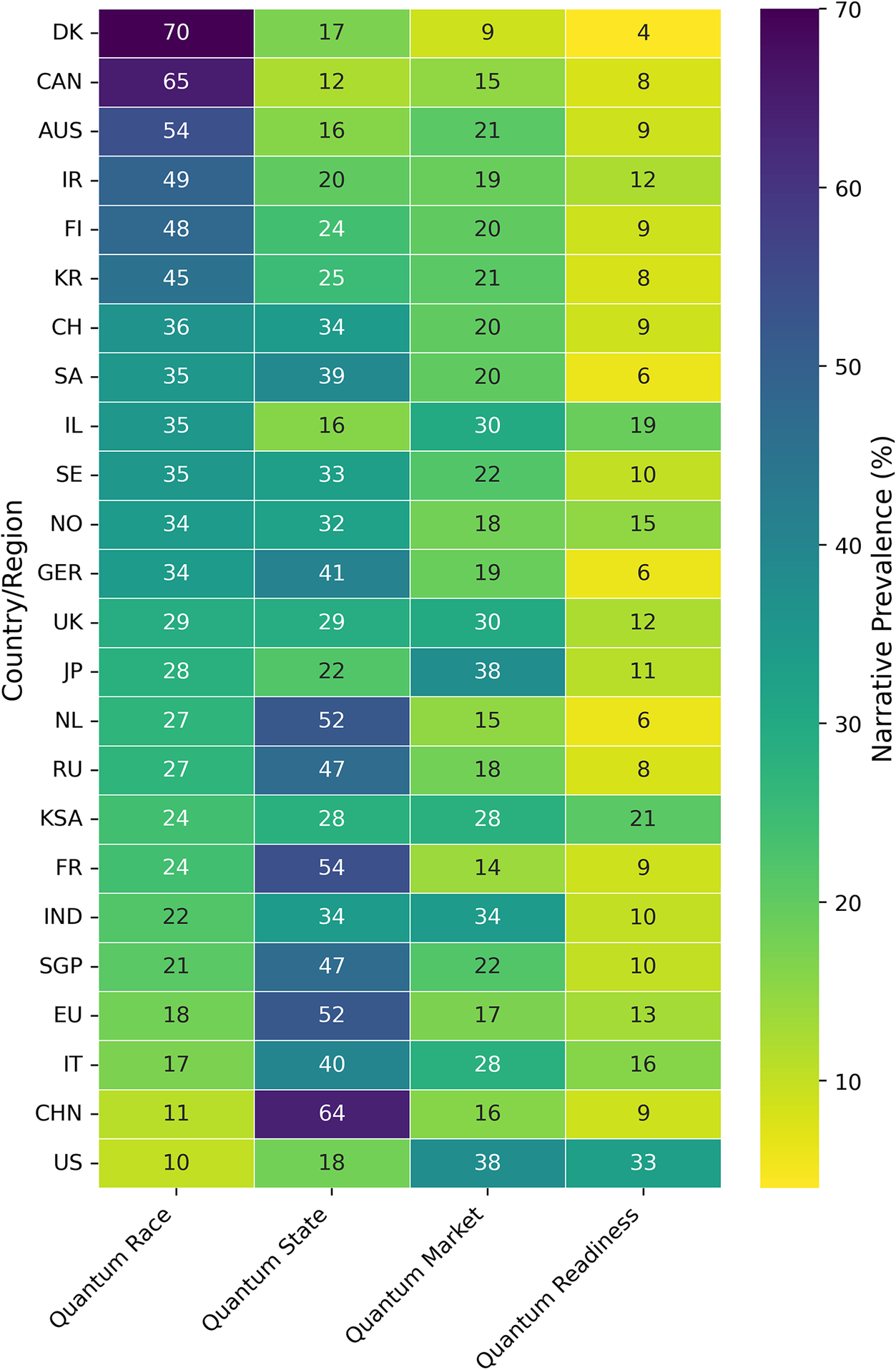
Looking at the distribution of narratives across each of the regions in the heatmap (Figure 2), we see a similar trend as in RQ2. Most nations primarily focus on the narratives Assessing the Quantum State and The Quantum Race, whereas Creating a National Quantum Market and Ensuring Quantum Readiness show lower values across most countries, with the United States being an exception. Thus, the last narrative barely appears in both Eastern and Western countries, democratic or non-democratic alike. The United States is the only country focusing mainly on Creating a National Quantum Market and Ensuring Quantum Readiness. Despite this overall pattern, some governments stand out with distinctive features of their QT policies: Saudi Arabia, United Kingdom, India, and Japan show the most even distribution of narratives used in their policies. Conversely, Denmark, Canada, and Australia among others stand out by placing a significant emphasis on the narrative of the Quantum Race. This narrative constitutes over 50% of their policy documents, emphasizing their own leadership strategies and positions in the global QT landscape. China mainly mentions the Assessing the Quantum State narrative, which makes up over 60% of its policies and shows little variation in the narratives used.
Distribution of narratives across regions.
5. Discussion
This study examined the narratives in policies related to QTs using a mixed methods approach, with BERTopic modeling and the NPF. Four primary narratives emerged that are commonly shared across countries. QTs are presented as technologies with great potential to disrupt various industries, making technological leadership a key policy goal. At the same time, governments recognize that QT developments are still in their early stages, making further research a necessity to realize their full potential. Consequently, efforts are also directed toward creating more realistic expectations about technological maturity.
Comparing our results to stories identified around QTs in previous studies that emphasize their complex and scary nature (Godoy-Descazeaux et al., Reference Godoy-Descazeaux, Avital and Gleasure2023; Meinsma et al., Reference Meinsma, Kristensen, Reijnierse, Smeets and Cramer2023; Seskir et al., Reference Seskir, Umbrello, Coenen and Vermaas2023; Possati, Reference Possati2024), the analysis suggests a shift in tone. Policy tends to demystify quantum computers and promote public understanding of the innovations. However, this positive observation is overshadowed by prevailing security concerns and the narrative of a quantum race, which shows that some countries are more concerned with winning the global race for technological leadership and securing economic advantages than focusing on social, ethical, or commercial aspects. This finding aligns with a recent analysis indicating that nations are leaning more and more toward technological sovereignty to ensure control over critical infrastructure, reducing dependence, or protecting sensitive research and IP. Although framing policies in terms of competition helps to mobilize resources or justify national spending, we argue that this narrative also has its downsides, as researchers have pointed out in the past: “we have been here before—but perhaps this time, let us resist the reinscription of competition into our technoscientific concepts and their implementation” (Coenen et al., Reference Coenen, Grinbaum, Grunwald, Milburn and Vermaas2022). This trend could hinder collaborations that are necessary to drive scientific and technological progress, knowledge exchange, or economic efficiencies. We therefore argue that QTs might benefit from a more balanced narrative approach, where competitiveness is complemented by narratives that promote contextuality, collaboration, and openness—values that help address today’s most pressing challenges, such as sustainable development goals.
All four narratives were prevalent in the government policies of each country, indicating that governments from very different economic regions and different cultures are formulating very similar narratives and arguments about their actions regarding QTs. However, the data showed that while each of them may use similar arguments, the prevalence of these arguments can vary. Findings that align with previous research on AI (Bareis and Katzenbach, Reference Bareis and Katzenbach2022; Guenduez and Mettler, Reference Guenduez and Mettler2023). For instance, the United States focuses on the creation of a commercial quantum ecosystem, signaling a proactive stance in shaping markets and quantum adoption. China, on the other hand, applies a more state-centric approach, relying on the “Assessing the Quantum State” narrative. Through state-led industrial policies, Central planning, Five-Year Plans, and flagship programs China prioritizes the evaluation of technological capabilities and basic research rather than commercialization promises. Looking more closely at the EU, we can also see a focus on technological assessment, but a quite equal distribution across the remaining three narratives, putting emphasis on value-based responsibility approaches but less commercial aggressiveness compared to the United States.
Finally, while values such as equity, inclusiveness, and societal benefit are mentioned in policies, they are rarely treated with the same urgency or priority as economic competitiveness or national security. This imbalance is particularly concerning given the transformative nature of QTs and their potential to reinforce existing inequalities. Although we acknowledge that assessing societal consequences is difficult at this early stage of development, it is nonetheless essential to avoid the pitfalls observed with AI. In the case of AI, responsibility debates gained traction only after widespread distribution, making it difficult to retroactively address algorithmic bias, labor market impacts, and governance challenges. For QTs, integrating such reflections earlier, more continuously, and systematically could help ensure that important societal considerations are not overlooked.
6. Limitations and future research
Our study is not without limitations and therefore offers opportunities for future research. First of all, we must note that the translation of non-English documents with DeepL can introduce potential systematic bias to the analysis not precisely translate nuance in the terminology of the policies. In order to minimize potential misinterpretations, we employed a holistic approach, considering the context of entire sections rather than individual sentences when formulating topics, narratives, and themes. Nevertheless, it would be beneficial for future research to examine narratives in the respective language to avoid misinterpretations or to triangulate the translation with native speakers as validation.
Looking more closely at our sample, we included government documents that were publicly available on the Internet. Although we were able to cover 24 countries in our analysis and did our best to locate all policy documents available, there is a possibility that QT policies are missing. This provides an opportunity for studies to aim for a larger sample, including more economic regions. While we did include countries from the Global South, such as South Africa, and so forth, most of the identified documents focus on Northern regions. Specifically targeting the Global South would provide a more nuanced analysis from less developed economic regions and provide insights into possible digital divides through QTs.
In addition, several methodological extensions could strengthen this research. Future research could compare the narratives found in policies with QT narratives from other domains, including those from industry, academia, or broader society. Our findings could also serve as a foundation for experimental or interview-based research investigating how specific narratives influence public perception or policymaker decision-making, providing deeper insights into why certain countries emphasize particular narratives over others. Finally, while computational topic modeling with BERTopic provides structure and scalability, it also introduces methodological constraints. The computational analysis could be enhanced using different approaches, such as STM or the inclusion of human coders to triangulate the computational findings. Finally, given that QTs include distinct domains (e.g., computing, sensing, and communications), it would make sense to investigate these separately. A focused analysis could reveal how arguments, priorities, and projected impacts differ between them, providing more granular insights.
7. Conclusion
Overall, government policies on QTs emphasize technological leadership and strategies related to national economic and security interests, reflecting a trend toward technological sovereignty. In most cases, regions focus less on commercialization and societal impacts, reflecting that QTs are still at an early stage of development. We caution that an overemphasis on leadership and competition, however, risks creating isolated innovation systems, potentially hindering shared progress, cooperation, and collaboration. Stakeholders must strive to strike a balance between sovereignty and openness to collaboration. Further, with technological progress, they should incorporate more societal perspectives into the policy discourse and ensure that the development of QTs aligns with societal interests. Finally, our results showed similar patterns in QT policies compared to AI policy narratives, providing an opportunity to learn from past developments around AI.
Data availability statement
[dataset] Pöhlmann, Gina; Ma, Charles; Suter, Viktor; Meckel, Miriam; Steinacker, Lea, 2025, “Replication Data for: How Nations Narrate Quantum Policy,” https://doi.org/10.5281/zenodo.17695986, Zenodo, V1.0.0.
Acknowledgements
The authors would like to thank the Hawaii International Conference on System Sciences for facilitating the excellent double-blind peer review of the original conference paper on which this work is based.
Author contribution
Conceptualization-Equal: G.-M.P., C.M., V.S.; Conceptualization-Supporting: M.M.; Data curation-Equal: G.-M.P., C.M., V.S.; Formal analysis-Equal: G.-M.P., C.M., V.S.; Funding acquisition-Equal: M.M., L.S.; Investigation-Equal: G.-M.P., C.M., V.S.; Methodology-Equal: G.-M.P., C.M., V.S.; Methodology-Supporting: M.M.; Project administration-Equal: M.M., L.S.; Software-Equal: G.P., C.M.; Supervision-Lead: M.M.; Validation-Equal: G.-M.P., C.M., V.S.; Visualization-Lead: G.-M.P.; Writing – Original Draft-Equal: G.-M.P., C.M., V.S.; Writing – Review & Editing-Equal: G.-M.P., V.S., C.M., M.M., L.S.
Funding statement
This work received financial support for the research, authorship, and/or publication: CHANSE, the Collaboration of Humanities and Social Sciences in Europe Initiative (Q-SHIFT Project, https://www.quantumstateofworld.com).
Competing interests
The authors declared no potential conflicts of interest with respect to the research, authorship, and/or publication of this article.
Use of AI
Claude Sonnet 4.5 was used to improve the clarity of writing and the structure of the shared Python code for the BERTopic analysis. All LLM-generated outputs were reviewed, revised, and verified by the authors.


 Open access


Comments
No Comments have been published for this article.