


Introduction
The conservation of large carnivores is a highly contentious and demanding issue in human-dominated landscapes (Chapron et al., Reference Chapron, Kaczensky, Linnell, von Arx, Huber and Andren2014; Davoli et al., Reference Davoli, Ghoddousi, Sabatini, Fabbri, Caniglia and Kuemmerle2022). The presence or recovery of these species is sometimes met with ingrained animosity rooted in human history and culture (Treves & Karanth, Reference Treves and Karanth2003). This is largely attributed to the perceived risks posed to humans, livestock and game populations and associated negative interactions (Ripple et al., Reference Ripple, Estes, Beschta, Wilmers, Ritchie and Hebblewhite2014; Davoli et al., Reference Davoli, Ghoddousi, Sabatini, Fabbri, Caniglia and Kuemmerle2022). In contrast, others welcome the presence of large carnivores, highlighting their important role in ecosystems and biodiversity protection (Chapron et al., Reference Chapron, Kaczensky, Linnell, von Arx, Huber and Andren2014). Large carnivore conservation efforts are complicated by political, social and economic issues raised by diverse groups of people (Chapron et al., Reference Chapron, Kaczensky, Linnell, von Arx, Huber and Andren2014; Salvatori et al., Reference Salvatori, Balian, Blanco, Ciucci, Demeter and Hartel2020). Additionally, because of the extensive home ranges and spatial requirements of carnivores, conservation initiatives must be carefully planned and coordinated at the population level across vast geographical scales, often encompassing diverse landscapes, administrative units and stakeholder groups (Chapron et al., Reference Chapron, Kaczensky, Linnell, von Arx, Huber and Andren2014; Johansson et al., Reference Johansson, Rauset, Samelius, McCarthy, Andrén, Tumursukh and Mishra2016).
The long-term survival of the Eurasian lynx Lynx lynx in Europe is largely dependent on the harmonious coexistence of human populations and wildlife in shared multi-use landscapes (Boitani & Linnell, Reference Boitani, Linnell, Pereira and Navarro2015; KORA Foundation, 2022). This calls for resolving social and political concerns and responses associated with the return of large carnivores to such landscapes (Breitenmoser, Reference Breitenmoser1998; Chapron et al., Reference Chapron, Kaczensky, Linnell, von Arx, Huber and Andren2014; Boitani & Linnell, Reference Boitani, Linnell, Pereira and Navarro2015). Notably, hunters and pastoralists play important roles, as their activities involve direct interactions with lynxes, their natural prey and other carnivores (Breitenmoser, Reference Breitenmoser1998; Breitenmoser et al., Reference Breitenmoser, Ryser, Molinari-Jobin, Zimmermann, Haller, Molinari, Breitenmoser-Würsten, MacDonald and Loveridge2010; Lescureux et al., Reference Lescureux, Linnell, Mustafa, Melovski, Stojanov and Ivanov2011; Arlettaz et al., Reference Arlettaz, Chapron, Kéry, Klaus, Mettaz and Roder2021). These stakeholders have specific concerns regarding the potential impact of carnivores on their activities and livelihoods, which can shape broader public attitudes and influence conservation policies (Lescureux et al., Reference Lescureux, Linnell, Mustafa, Melovski, Stojanov and Ivanov2011; Lüchtrath & Schraml, Reference Lüchtrath and Schraml2015). Furthermore, they hold valuable knowledge about the presence of lynxes and factors limiting their recovery at the local level (Lescureux et al., Reference Lescureux, Linnell, Mustafa, Melovski, Stojanov and Ivanov2011).
Currently documented perspectives of local actors regarding the lynx's return or recovery in Europe are diverse and disparate (Lescureux et al., Reference Lescureux, Linnell, Mustafa, Melovski, Stojanov and Ivanov2011; Lüchtrath & Schraml, Reference Lüchtrath and Schraml2015; Jacobsen & Linnell, Reference Jacobsen and Linnell2016; Bavin et al., Reference Bavin, MacPherson, Crowley and McDonald2023). One challenge is that people's attitudes towards interactions with wildlife are often influenced by the goals they have for activities that could be affected by carnivores (Eklund et al., Reference Eklund, Waldo, Johansson and Frank2023). However, there is limited information available on these goals and how they specifically shape interactions with lynxes. A better knowledge of the motivations underlying hunting and pastoralism could inform lynx conservation and management strategies that are relevant to the local context and based on mutual respect, trust and understanding (Eklund et al., Reference Eklund, Flykt, Frank and Johansson2020, Reference Eklund, Waldo, Johansson and Frank2023; Managi et al., Reference Managi, Islam, Saito, Stenseke, Dziba and Lavorel2022).
The lynx became locally extinct in the French Alps in the 1920s but is thought to have recently re-established itself from individuals reintroduced to the Jura and Swiss Alps (Vandel & Stahl, Reference Vandel and Stahl2005). Across France, systematic monitoring has been in place since the 1980s through the Loup-Lynx expert network (Vandel and Stahl, Reference Vandel and Stahl1996, Reference Vandel and Stahl2005). Monitoring is based on reports of lynx observations at a 100 km2 scale by trained citizen scientists (Molinari-Jobin et al., Reference Molinari-Jobin, Kéry, Marboutin, Marucco, Zimmermann and Molinari2018). Further investment is needed to complement these efforts, to assess and monitor lynx distribution and population status in more detail and understand human perspectives in relation to the return of the lynx in the French Alps (Gatti, Reference Gatti2022).
Here we investigate the knowledge and experiences of hunters and pastoralists regarding the return of the lynx to an alpine valley in France. Specifically, we explore why hunting and livestock herding activities are important to local stakeholders, and their perceptions of how these activities might be affected by the current and future presence of lynxes. Additionally, we collected accounts of lynx sightings spanning the past 4 decades to estimate the probability of lynx site use within the valley.
Study area
We conducted the study in the Giffre Valley in the northern French Alps (within the Haute Savoie region). The valley features a diverse landscape over 600–2,400 m elevation and encompasses various land uses. Forests cover 165 km2 (c. 45%), primarily comprising coniferous (39%), deciduous (34%) and mixed (23%) forests. The human population of the valley was 14,318 in 2019, with a substantial seasonal influx of visitors, amounting to over four million person-nights in a given year (INSEE, 2023).
Hunting occurs throughout the Giffre territory and is organized nationally through the Fédération Nationale des Chasseurs and through hunting associations at the commune level. The number of registered hunters in Haute Savoie was c. 8,000 in 2022, with c. 300 in the Giffre valley. The hunting season is from early September to late January, with species-specific hunting quotas and periods. The number of hunting days varies according to commune and sectors. A wide array of species are hunted, including chamois Rupicapra rupicapra, roe deer Capreolus capreolus, red deer Cervus elaphus, wild boar Sus scrofa and hares Lepus timidus and Lepus europeus, and bird species such as the black grouse Lyrurus tetrix. Large carnivores such as lynxes and grey wolves Canis lupus are, however, protected.
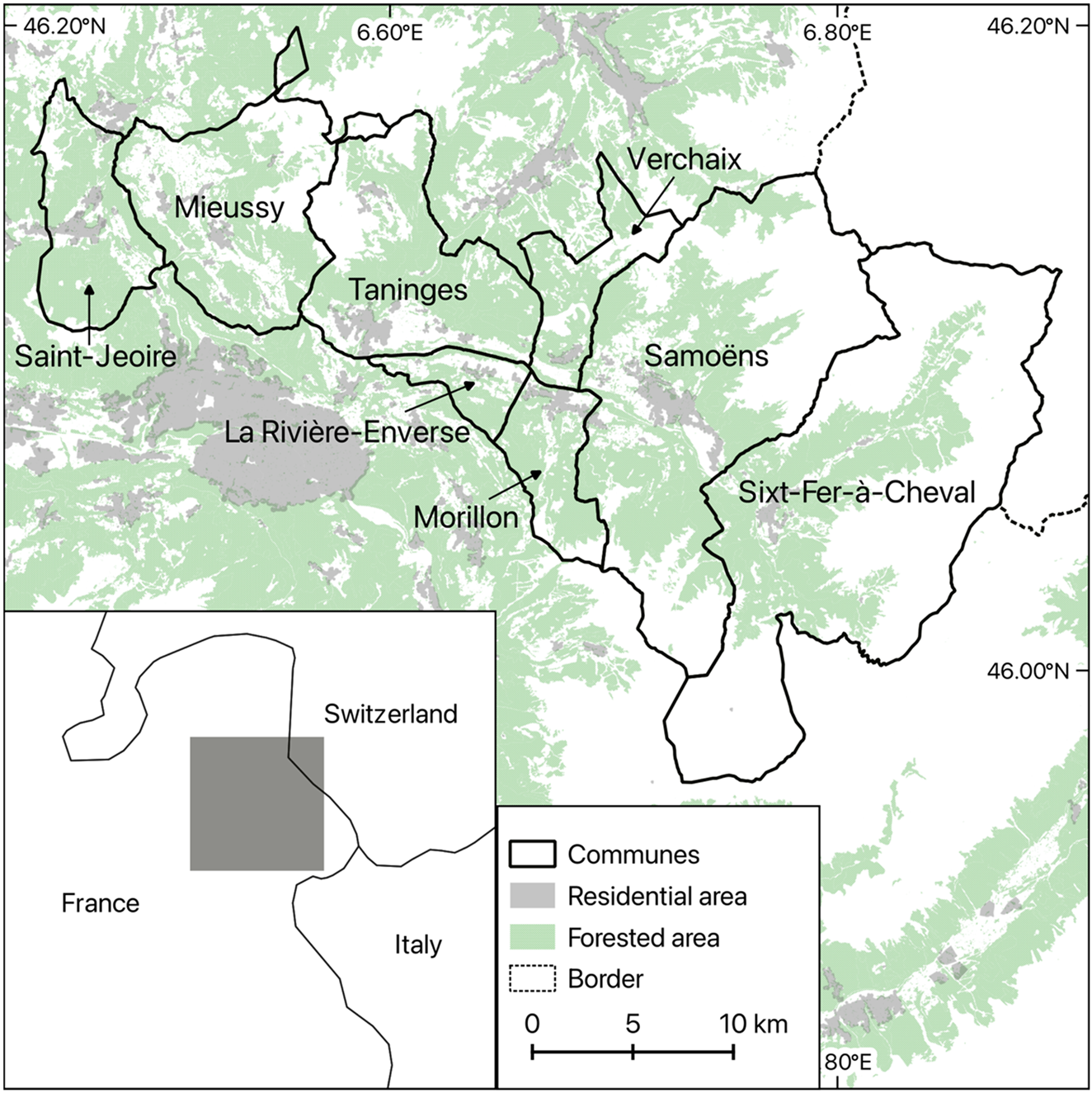
The valley also has a long tradition of pastoralism and is known for its dairy products, including local cheese specialities. Approximately 113 agricultural holdings covering a total area of 93 km2 (not including summer pastures) are used for raising livestock, primarily cattle (65%), with some sheep and goats. Tourism provides another major source of revenue, with snow sports in the winter and summer activities such as trekking, biking, rafting and mountaineering (L'Agence Savoie Mont Blanc, 2022). All eight communes of the Giffre Valley were included in the study, covering an area of 364 km2 (Fig. 1).
The eight communes in the Giffre Valley, Faucigny region, Haute Savoie, France, where we conducted this study, showing forested and human settlement areas.
In the context of conservation initiatives in France, the Lynx National Action Plan (Gatti, Reference Gatti2022) delineates a strategic framework for the conservation of lynx species for 2022–2026. This plan is the result of collaborative stakeholder efforts and is overseen by the Regional Directorate for the Environment, Planning and Housing of Bourgogne-Franche-Comté, with support from the French Biodiversity Agency. We aimed to address the two axes outlined in the Action Plan, focusing on enhancing coexistence with human activities (objectives 1.3, 1.5 and 1.6) and mitigating threats to species viability while removing barriers to its expansion (objective 2.1).
Methods
Data collection
We conducted interviews to record respondent observations of lynx in the last 4 decades and to explore respondents' perceptions of the impact of lynx presence on their hunting and farming activities. The interviews took place during June 2022–January 2023. We used snowball sampling to recruit participants, seeking to ensure spatial representation of hunters and livestock herders across all eight communes and participants from different hunting groups and pastoralist families, to gain diverse perspectives.
The interviews were guided by a semi-structured questionnaire, divided into three sections (Supplementary Tables 1–4). In the first section, respondents were presented with photos of the Eurasian lynx, European wildcat Felis silvestris, red fox Vulpes vulpes and grey wolf. These images served as a conversation opener before we asked subsequent questions to assess knowledge of these species. We then collected information on respondent demographics and attributes that could affect detection of the study species, including gender, age range, commune of residence, respondent's hunting and farming practices, time spent in the field, areas hunted or used by livestock, and other occupations. Respondents were asked to map their area of knowledge, defined as places they frequently visit in the commune, which was used to ascertain detection and non-detection of lynxes across the study site. The interviews also included questions regarding any observations of lynxes in the last 40 years, such as observation type, location, year and approximate month of each detection.
The second section examined the impact of lynxes on individual motivations, asking respondents to describe their hunting and/or farming activities, associated interest in the activity, and potential impacts of lynx presence on hunting and/or farming. We also explored what other impacts lynxes could have, for example on other wildlife species, habitats, leisure, human well-being and livelihoods.
The third section investigated future challenges and opportunities regarding lynx presence in the landscape, including views on coexistence of the lynx with hunting and livestock rearing, and the adequacy of current conservation management tools. We also examined the potential impacts of any recent perceived changes related to tourism, extreme sports, domestic animals, urbanization and forest management on the lynx. To maintain focus on the lynx, other carnivores were not specifically mentioned until the final interview question, which explored the impact of various wildlife species on hunting and livestock farming.
Data analysis
We performed two distinct methods of data analysis: occupancy modelling to estimate the probability of lynx site use while accounting for imperfect detection (Mackenzie et al., Reference Mackenzie, Nichols, Hines, Knutson and Franklin2003), and thematic analysis to explore motivations to pursue specific activities and the perceived impact of lynxes.
Occupancy modelling
We defined a 10-year detection period (2013–2022) and assumed that the probability of site use by the lynx during this time could vary within each sampling unit. This facilitated relaxing the assumption of population closure. To address the reliability of reports, we retained only detections reported to be from camera-trap images, carcass detections and direct sightings, classifying them following the SCALP classification (Status and Conservation of the Alpine Lynx Population; Molinari-Jobin et al., Reference Molinari-Jobin, Kéry, Marboutin, Molinari, Koren and Fuxjäger2012; Louvrier et al., Reference Louvrier, Molinari-Jobin, Kéry, Chambert, Miller and Zimmermann2019). Recall bias was considered to be low as encounter events with lynxes were deemed special and meaningful, thus respondents were likely to remember these events accurately because of their unique and personally impactful nature. Our examination of site use over a 10-year period allowed for a margin of error in participants' reporting of the exact year of detection.
The lynx observations were organized into a detection/non-detection framework (1/0). Each respondent was a replicate for one or more 2 × 2 km grid cells within their identified area of knowledge. We then calculated site covariates for each grid cell, including proportion of area that is forested or classified as human settlement. Sites with a high proportion of forest were expected to have a high probability of use (e.g. Molinari-Jobin et al., Reference Molinari-Jobin, Kéry, Marboutin, Molinari, Koren and Fuxjäger2012). To model the probability of detecting lynxes, we used the following survey covariates, representing the respondent's familiarity with the area: (a) number of years living in the area, (b) annual number of hunting or herding outings, and (c) activity (hunter or pastoralist).
We fitted single-season, single-species occupancy models using the package RPresence (MacKenzie & Hines, Reference Mackenzie and Hines2018) in R 4.4.0 (R Core Team, 2024) to determine the probability of site use and detection probability. We ranked the models using the Akaike information criterion (AIC) and used model averaging, given that the top model did not have an AIC weight > 0.9 (Burnham & Anderson, Reference Burnham and Anderson2002). Any models that did not converge were dropped prior to model averaging.
Analysis of themes
Responses elicited in the interviews were transcribed using the software ATLAS.ti (ATLAS.ti Scientific Software Development, 2022). Our approach was inductive, identifying patterns through the coding of recurrent themes presented by respondents. We coded motivations for hunting and pastoralism along recurrent themes (Supplementary Table 5). Responses could be coded in more than one category. Similarly, we conducted content analysis on responses regarding the actual and potential impact of lynx on hunting and pastoralism activities (Supplementary Table 5). We coded discrete segments of the transcribed responses that linked to recurrent themes highlighted by respondents. Finally, the responses related to management and conservation strategies were coded and categorized into discrete topics.
Results
Typology of respondents
We interviewed a total of 29 independent respondents across the Giffre Valley, including at least one respondent from each commune, with the exception of one commune in which no interviews were conducted. Respondents were hunters (n = 22, 76%), pastoralists (6, 21%) or both (1, 3%). They were primarily men (28, 97%) and were 18–80 years old. Most respondents (26, 90%) had been active in hunting and pastoralism in the area during at least the previous 10 years.
Of the 23 hunters, most had held a formal hunting permit since the age of 16–18 years (19, 83%). Many reported that they accompanied older family members on hunting trips during early adolescence. The mean period since obtaining a hunting permit was 27 ± 4 SD years. The majority of hunters (20, 87%) hunt with dogs. Most reported hunting large game such as wild boar (23, 100%), chamois (22, 96%), red deer (22, 96%) and roe deer (22, 96%). Fewer hunters reported hunting hare (8, 35%) or bird species such as the black grouse (7, 30%). Depending on the game, respondents usually hunt in groups (23, 100%) and sometimes alone (11, 48%). All reported hunting regularly during the season, and most did so on all available hunting days (i.e. 3 days per week). The mean number of hunting outings for any individual in the past year was 28 ± 14 SD (0–60). Hunters also reported engaging in other activities in the mountains, such as mushroom collection (6), fishing (4), cutting hay (4) and hiking (4).
Of the seven pastoralists, most (86%) reported herding cows for dairy products (milk, cheese) and just over half (4, 57%) herded small stock (goats or sheep) for meat. Pastoralists reported that their herds occupy designated high mountain pastures during the summer months (June–September). Large livestock are left unattended in electrically fenced areas and visited regularly (daily for milking cows and every 1–2 days for heifers). Most pastures are in the open, but some were said to include forested edges or areas. Sheep and goats are kept in smaller penned areas and are guarded closely by protection dogs and herders to prevent wolf predation (no particular efforts were reported to prevent lynx predation). During the winter, large and small livestock are kept indoors in large stables.
Lynx detections
All 29 respondents could identify the lynx correctly from photographs. Almost half (13, 45%) of the respondents reported detecting lynxes in the valley. A total of 21 detections were reported over the last four decades, between 1982 and 2022. Of these detections, the majority were category C3 (direct observations; 12, 57%), while others were category C1 (camera-trap photos; 4, 19%) and category C2 (chamois or roe deer carcasses; 6, 29%). Most detections (14, 67%) occurred in the previous 10 years (2013–2022).
Nearly all (28, 97%) respondents believed that lynxes were present in their commune in 2022. Many thought that the lynx was resident (13, 45%) or passing through (11, 38%). Five respondents were unsure. No respondents reported observing a lynx with kittens or young.
Probability of site use
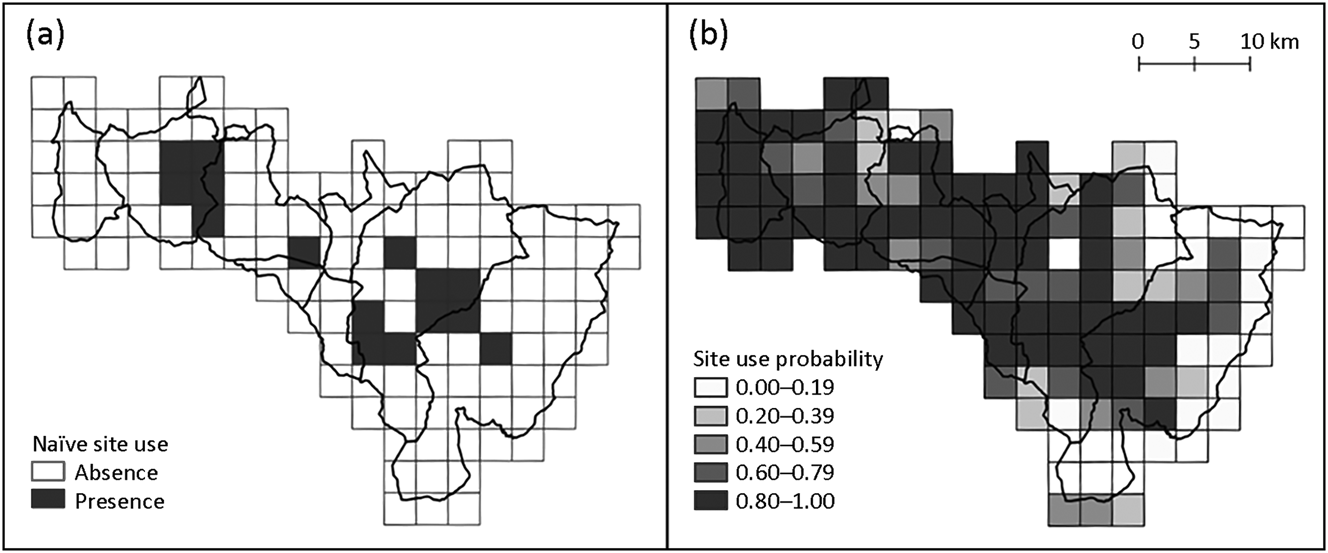
Between 2013 and 2022, the respondents reported having detected lynxes in 15 of 129 grid cells, giving a naïve site use estimate of ψ = 0.12 (Fig. 2). Lynx site use was best explained by the model that included both proportion of area that is forested and number of years the respondent had lived in the area as covariates (forest area cumulative Akaike weight = 0.81, years in area cumulative Akaike weight = 0.60; Table 1). The probability of site use was positively related to per cent forest cover (β = 1.92 ± SE 1.30). Per cent of area occupied by housing did not influence lynx site use.
Probability of site use by Eurasian lynxes in the Giffre Valley; each cell is 2 × 2 km. (a) Naïve site use estimates based on presence/absence. (b) Mean estimated probabilities of site use adjusting for detection probability and site covariates (forest cover).
Summary of model selection results indicating the role of covariates in determining probabilities of Eurasian lynx Lynx lynx detection and site use (n = 129 sites), with delta Akaike information criterion (ΔAIC), AIC weight, number of parameters (k), and 2log-likelihood.
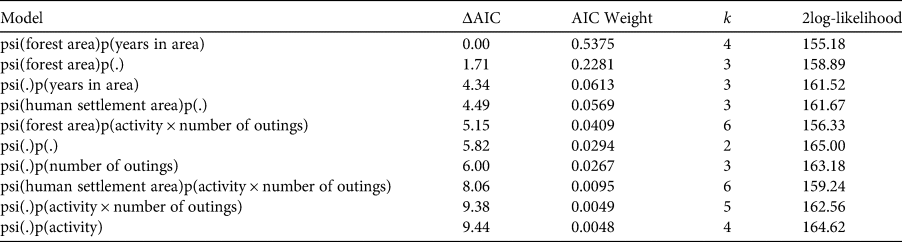
Lynx detection probability (p) was low (0.03 ± SE 0.01). Number of years living in the area slightly increased probability of detecting lynxes, as indicated by a positive covariate coefficient (β = 0.03 ± SE 0.01). The estimated probability of site use (ψ) averaged over all sites was 0.66 ± SE 0.33, indicating that the naïve estimate of site use underestimated occupancy by a factor of 5.5.
Reported motivations and perceived impact of lynx
The exploration of hunting motivations resulted in three main themes: connection with nature, family tradition and social links (Supplementary Material Table 5). Others included wildlife management, recreation, health and wildlife observation.
Connection with nature
Many hunters indicated that hunting was valuable to them as it allows them to be in nature and go to areas where they would not otherwise go. They described a complex natural world, which takes time and patience to appreciate. This theme was built around words such as ‘passion’, ‘discovery’, ‘love’ and ‘understanding’ of the natural world and the mountain environment. This was expressed through quotes such as:
‘I love the mountains. I love being in places where you know the landscape. I like going everywhere around here. It's the mountain life. It's like a way of life. Before, we hunted for food, and now it's a way of life.’ – Hunter, Samoëns/Morillon.
Family tradition
Many respondents described hunting as an important tradition in their family, often passed on through generations. The theme highlighted that they were introduced to hunting at a young age by male family members, who played an important role in building their skills and shaping their outlook on life. This was expressed by respondents through quotes such as this from a hunter in Mieussy: ‘I was born into it. I was raised with it. It's in my genes.’ Respondents explained shifts in hunting practices and associated traditions, in response to increases in specific species such as red deer and chamois:
‘It wasn't like that before. There were fewer big game animals. To hunt chamois, you had to go to Pic de Marcelly. Chamois back then were hard to get.’ – Hunter, Mieussy.
Social links
The fact that hunting is primarily a group activity ensures that time is spent with friends and family. Many hunters underlined the importance they placed in hunting for strengthening social bonds and building friendships:
‘Being with friends …We don't go all year round, and we can't wait for the months when we can go to the mountains together … It's a pleasant and friendly atmosphere.’ – Hunter, Samoëns.
Pastoralism
Interviews with the seven pastoralists identified a range of motivations that underpin their pastoral lifestyles. Nearly all respondents working in the agricultural field referred to the strong link between pastoralism and the cultural identity of the valley:
‘If the mountains are beautiful, it's also because of the farmers. We're the ones who clear the brush. The pastures with the animals are more attractive.’ – Pastoralist, Samoens.
Another identified theme concerned the link with nature, particularly in mountain landscapes. A number of respondents also highlighted the importance of pastoralism in maintaining the multi-use mountainous landscape of the region. Pastoralism is an important livelihood choice but its societal role in providing food to the community and region is also highly regarded:
‘Doing something so that people can eat is rewarding.’ – Pastoralist, Samoëns.
Perceived impact of the lynx on hunting and pastoralism
The majority of respondents indicated that lynxes do not currently interfere with hunting or pastoralism practices, with only two respondents reporting to be negatively affected by the felids. However, many felt that lynxes could have negative impacts if a reproducing population became established in the valley. Only one hunter indicated this may have a positive impact in the future.
Tolerance towards the lynx
Respondents were generally open to coexisting with lynxes in the valley. Almost half expressed a degree of tolerance towards the species under current circumstances:
‘I accept sharing. If there aren't too many. It's a matter of balance. Yes, when there's a predator, it affects the distribution of groups, they become more cautious. They settle in different places.’ – Hunter, Mieussy.
A number indicated that a larger lynx population could be accommodated in the valley given its size and explained that lynxes are part of the natural world:
‘If the lynx were present, it would have an impact. Yes, surely it needs to eat. One animal per week. 52 animals in a large territory. Lynx comes back 3–4 times to its prey.’ – Hunter, Samoëns.
Two older hunters expressed how their personal views towards the presence of lynxes had changed over time, noting an increased quantity of game species present in the landscape:
‘25 years ago, hunters used to say, “See a lynx and we shoot.” The mentality has changed. People now think and realize that we have plenty of wild game … There's enough food for everyone.’ – Hunter, Mieussy.
Four pastoralists shared a similar view, indicating they were not disturbed by the predator. None of the pastoralists reported losing livestock to lynxes, and two stated that losing a sheep would not be a major concern:
‘The herds are not disturbed. There are no carcasses. No dying sheep. The lynx is part of nature. We can always manage with them … They need to be managed.’ – Pastoralist, Mieussy.
Too few to have an impact
Many respondents reported limited experience with lynxes and indicated that there were too few individuals in the area to affect their hunting or pastoralist practices. The following comment from a hunter in Taninges illustrates this view: ‘No impact. Because currently … the lynx is not overpopulated.’ A few respondents, however, expressed that although there was currently no impact, they were concerned that this situation could change if the number of lynxes increases. Respondents indicated that lynx numbers would have to be regulated through a quota hunting system, otherwise the situation could become problematic:
‘If their numbers increased, it could be a problem because they would kill the roe deer.’ – Hunter, Sixt.
Potential/reported impact on game
Only one hunter reported that lynxes currently had a negative, though limited, impact on the availability of game:
‘Minimal negative impact. The lynx kills animals to eat. There are then fewer animals for hunters to kill. Since there are more hunters (20 hunters instead of 10), we have less to kill.’ – Hunter, Samoëns/Morillon.
However, many expressed concerns about the potential impact of lynxes on wildlife should their numbers increase significantly. Hunters were particularly concerned about the propensity of lynxes to kill chamois and roe deer, describing the lynx as ‘a potential hunting competitor, which did not follow the rules.’
Favourable comparison to the wolf
In most interviews, the question exploring the perceived impact of the lynx triggered strong responses related to the presence of the grey wolf in the valley. Many respondents made direct comparisons between the two species in terms of the impact on their way of life. The lynx was described as a carnivore that they would tolerate, whereas few felt that the wolf had any place in the valley. This was often linked to predation behaviour. Lynx were described as ‘good’ hunters that focused on one prey animal at a time, compared to wolves that were perceived as not fully consuming their kill before moving on to other prey. Generally, these statements were negative towards wolves and neutral regarding lynxes, and were made by both hunters and pastoralists.
‘But when the lynx kills an animal, it eats it. Not like the wolf, which goes away and eats another one tomorrow.’ – Hunter, Samoëns.
‘Now that there's the wolf, we like the lynx—that's the difference between a good and a bad hunter—one is the lynx, the other is the wolf. The lynx doesn't eat everything like the wolf that destroys herds.’ – Hunter, Sixt.
Other impacts
A number of respondents believed that the lynx was unlikely to have wider impacts in the valley. They emphasized the elusiveness of the species and that it is not dangerous to people. Some respondents suggested the lynx could serve as an attraction to visitors, although this raised some concerns about the already large carbon footprint of tourism in the area, which was perceived to be excessive and damaging to nature. However, given that the lynx and the wolf are both carnivores, some respondents believed that too many of each could have a significant negative impact on small and large livestock, with one pastoralist proposing that populations of both lynxes and wolves together could lead to an end of pastoralism in the valley.
Management strategies for coexistence
Respondents identified a number of challenges to coexistence with lynxes in the area. Some were concerned that the landscape may be too small and fragmented to sustain a lynx population, especially given the surge in human activity from tourism throughout the year, even in more remote areas. Activities such as electric biking, skiing, snow shoeing, camping and trekking now occur in places that were previously hard to reach, and it was noted that people are now active in the mountains even at night.
Differing views were expressed on other threats to lynxes and their coexistence with humans. A few respondents thought that lynx predation on livestock and wild game (e.g. chamois and roe deer) would be likely to lead to retaliatory killings. However, two older hunters believed that lynxes are not linked to significant depredation and they therefore expect tolerance towards them. Some voiced concerns that the lynx could be perceived as a problematic predator, in the same way as the wolf. Current measures to manage the wolf population (Grente et al., Reference Grente, Duchamp, Bauduin, Chamaille-jammes, Drouet-hoguet and Gimenez2023) were considered to be inadequate, leading to shifts in pastoral and land-use practices. One respondent reflected that wolf management efforts such as measures to prevent livestock depredation could have a positive impact on coexistence with lynxes. Another saw the expansion of forests as a positive development for the lynx, whereas four respondents expressed concern about the impact of construction works on lynx habitat.
Responses about other measures already in place that could support lynx were centred around hunting regulations that limit the number of chamois and roe deer that can be killed. All hunters stated that over the last 40 years this has led to increases in the populations of these species. They also pointed out that well planned hunting reserves at commune level could play a role in creating protected spaces for lynxes. Other measures mentioned included the presence of other types of protected areas and annual population counts of key species led by the Hunting Federation, which may limit overhunting of prey species. Changes to pastoral practices (including temporary electric fencing and use of protection dogs) were reported by pastoralists to reduce the risk of livestock predation by wolves. However, no measures were being taken specifically with respect to lynxes.
Discussion
Recognizing and incorporating the multifarious perspectives about nature into decision-making processes is imperative to build inclusive and sustainable responses to the ongoing degradation of natural systems (Managi et al., Reference Managi, Islam, Saito, Stenseke, Dziba and Lavorel2022). Our study provides an important foundation for understanding lynx–human interactions in the Giffre valley and potentially the wider French Alps region. It highlights that hunting and pastoralism are strongly rooted in a wish to connect with the natural world and continue local traditions.
Generally, hunters indicated their way of life is not threatened by the current presence of lynxes. They explained that the lynx is not currently disrupting the managed environment in which their activities and livelihoods are embedded. Older hunters underlined a shift in mentalities towards increased tolerance, because minimal damage and prey loss are attributed to lynxes. With some exceptions, most respondents recognized that the availability of large game has increased and did not consider predation of chamois and roe deer by lynxes to be a major concern.
Similarly, no pastoralists reported any livestock losses to lynxes over the last 40 years. Most herd cows and understand that cattle are not at risk of lynx depredation. This contrasts with the situation in the French Jura where depredation of small livestock remains a concern (Drouet-Hoguet et al., Reference Drouet-Hoguet, Chemesseau, Kunz and Zimmermann2021), although this is probably related to the higher lynx density (0.24–0.91 individuals per 100 km2) in the Jura (Gimenez et al., Reference Gimenez, Gatti, Duchamp, Germain, Laurent, Zimmermann and Marboutin2019; Drouet-Hoguet et al., Reference Drouet-Hoguet, Chemesseau, Kunz and Zimmermann2021).
Nonetheless, some hunters expressed concerns that increased lynx numbers could lead to a reduction in certain game species in the future. Some respondents believed that such a situation would warrant active management of the lynx, potentially including legal killing, as is practiced in Norway (Nilsen et al., Reference Nilsen, Brøseth, Odden and Linnell2012). Some also alluded to the possibility that hunters may end up killing lynxes illegally because there would be fewer game animals. These responses highlight that tolerance of lynxes may be high currently but could decline in the future. It is also possible that increased predation of roe deer and chamois could become a source of social conflict between hunters, wildlife managers and conservationists (Breitenmoser et al., Reference Breitenmoser, Ryser, Molinari-Jobin, Zimmermann, Haller, Molinari, Breitenmoser-Würsten, MacDonald and Loveridge2010; Redpath et al., Reference Redpath, Young, Evely, Adams, Sutherland and Whitehouse2013).
Stakeholders expressed much stronger concerns about the threat to their way of life posed by the return of wolves, overshadowing issues related to the lynx, as has been found in other regions (Lescureux et al., Reference Lescureux, Linnell, Mustafa, Melovski, Stojanov and Ivanov2011). Wolves were perceived as a major threat to traditional practices and pastoral livelihoods, which are closely linked to the valley's identity and culture (Pettersson et al., Reference Pettersson, Quinn, Holmes, Sait and López-Bao2021). Sweeping measures, including major shifts in pastoral practices, have been taken to reduce the risk of livestock predation by wolves, and these may have complex social effects and reinforce negative views of carnivores.
Our study emphasizes that hunters and pastoralists have extensive knowledge of the landscape that could be further harnessed for lynx population monitoring (Lescureux et al., Reference Lescureux, Linnell, Mustafa, Melovski, Stojanov and Ivanov2011). Current national level monitoring efforts draw on this, but are conducted at a larger spatial scale and lack careful assessment of detection probability. Our occupancy modelling collected data on detections and non-detections across respondents’ areas of knowledge. The results indicate that, when accounting for the low probability of detection, the area of site use by lynxes over the last 10 years is substantial. Adjusting for this probability and the availability of forest cover, the area of site use may be up to 5.5 times larger than the naïve site use over the same period, an even greater difference than elsewhere (Molinari-Jobin et al., Reference Molinari-Jobin, Kéry, Marboutin, Marucco, Zimmermann and Molinari2018). The location of the Giffre Valley plays a key role for the alpine population, acting as a bridge between the northern and southern Alps. Although lynxes have been detected in the valley, it remains unclear whether they are resident, as we did not receive reports of females with young. Our respondents’ area of knowledge covered almost the entire valley, highlighting their strengths as citizen scientists. This foundation of experiential and local knowledge underlines opportunities for leveraging such stakeholder networks for lynx detection and potentially conservation in other settings. This approach would need to be placed in the context of a broader multi-faceted strategy to address a range of challenges to human–lynx coexistence that could arise in the future (Linnell et al., Reference Linnell, Swenson and Andersen2000; Røskaft et al., Reference Røskaft, Händel, Bjerke and Kaltenborn2007).
Investigations of human–carnivore interactions remain a sensitive topic in highly polarized and politicized settings (Eklund et al., Reference Eklund, Flykt, Frank and Johansson2020, Reference Eklund, Waldo, Johansson and Frank2023). In this study we note that strong social ties have been developed within stakeholder groups, which have a clear sense of identity and purpose. We therefore relied on snowball sampling within these tight networks, which required building trust, particularly in discussions that could evoke sensitive issues such as recent damage caused by wolves (Redpath et al., Reference Redpath, Young, Evely, Adams, Sutherland and Whitehouse2013; Young et al., Reference Young, Searle, Butler, Simmons, Watt and Jordan2016; Eklund et al., Reference Eklund, Flykt, Frank and Johansson2020). Encouragingly, we found a high level of respondent engagement and interest in this research. However, respondent bias related to sample selection remains a possibility and we may only have captured a limited segment of the hunter and pastoralist community views. It would be interesting to examine differences in perception between livestock owners and herders, for example. Even within stakeholder groups, views related to human–lynx coexistence were diverse and often contradictory, with hunters, for example, voicing strong opinions both for and against the presence of lynxes in their area (Lescureux et al., Reference Lescureux, Linnell, Mustafa, Melovski, Stojanov and Ivanov2011).
Successful management of the return of the lynx needs to be built on a thorough appreciation of local stakeholder values and perspectives around which dialogue can be established. This will serve to leverage local expertise and secure cooperation between stakeholders to promote biodiversity, and thereby avoid social conflict (Redpath et al., Reference Redpath, Young, Evely, Adams, Sutherland and Whitehouse2013; Eklund et al., Reference Eklund, Flykt, Frank and Johansson2020, Reference Eklund, Waldo, Johansson and Frank2023).
Author contributions
Study design, fieldwork: all authors; data analysis: JA; writing: all authors.
Acknowledgements
We thank the Interdisciplinary Centre for Mountain Research of the University of Lausanne for financial support; all local actors for their interest, contributions and suggestions; and Claude Fisher and Ann Eklund for their helpful comments during the course of this research.
Conflicts of interest
None.
Ethical standards
This research abided by the Oryx and University of Lausanne guidelines on ethical standards. Participants provided informed consent (details in Supplementary Material 1), were informed about the study's purpose and consented to data use for publication. No personal identifying data were collected; questionnaire data were anonymized for privacy and confidentiality.
Data availability
Data supporting the study's findings are available upon request from the corresponding author, JA. The data are not publicly accessible to protect the privacy of research participants.


 Open access

