

Trust in science and empirical research has been challenged in the past decade, with an increasing perception that scholars and the broader scientific community may be ideologically driven. Certainly, within the social sciences, there are broad discussions of the left-leaning nature of academics in these fields and whether this is detrimental for science and broader public trust (Alabrese, Capozza, and Garg Reference Alabrese, Capozza and Garg2024; Bloom Reference Bloom2024). Similar discussions have taken place regarding other public-facing professions, including journalism (Hassell, Holbein, and Miles Reference Hassell, Holbein and Miles2020) and K–12 education (Education Week Research Center 2017). Through teaching and curriculum choices, social media posts and op-eds, and the framing and type of research undertaken, there is a general perception of what social scientists believe about society and politics. We know much less about what they actually do in politics and why.
Specifically, political scientists teach and research about political institutions, systems, democracy, public opinion, communication, and so on. In the United States, professors also may or may not urge students to register and vote, volunteer for campaigns, or get involved in other political activities. Some scholars may view their role as educating about and preparing students for democratic citizenship. Others may believe that their classroom should be an incubator for justice debates and activism. Alternatively, some professors may view politics as an object to be studied—much like nature or the human body—requiring an imposed objectivity held together by not getting involved in political participation or at least not much more than simply voting. Still other scholars may want to speak up and out but fear repercussions. Indeed, student perceptions of a professor’s political affiliation and views can impact course evaluations and classroom climate (Kelly-Woessner and Woessner Reference Kelly-Woessner and Woessner2006; Tollini Reference Tollini2009; Wills, Brewster, and Nowak Reference Wills, Brewster and Nowak2019).
Drawing on data collected in Summer 2024, we assessed the extent and type of political engagement among political scientists, finding three alliterative dimensions into which we tend to fall: partisans (who engage in partisan politics), public scholars (who share political science logic and findings), and pedagogues (who engage through teaching and event sponsorship). Our dimensions of engagement tend not to differ substantially by demography, institution, or rank. However, we do have different beliefs about the propriety and the likely effects of different types of engagement with politics.
IS POLITICAL SCIENCE POLITICAL AND SHOULD IT BE?
On the one hand, science has always been political—much like art, literature, and any other human enterprise. Opportunities for personal ideologies to seep into the process can happen with what we choose to study, who studies it, how we study it, and how we interpret and apply results. Political science, as a discipline, certainly offers no exception to this general observation. Debates about the proper role of political science and of individual political scientists in the political arena have long occupied the attention of many in the field (Lowi Reference Lowi1992; Smith Reference Smith2015). Describing the discipline in its infancy, for instance, Lowi (Reference Lowi1992, 2) acknowledged the diversity of approaches to real-world politics in evidence from the outset, writing that “Some early political scientists were active reformers, others were radical muckrakers, and a few may have been completely aloof.” Of course, Lowi famously would go on to excoriate much of the discipline for failing to lay challenge to conservative efforts at rebranding political liberalism and for uncritically adopting the preferred language of the state. A similar critique was leveled at the discipline a few decades later by Smith (Reference Smith2015), in which he argued that some of the only scholarship that experienced any impact beyond academia had an unmistakable conservative slant. Of course, much of the public rarely views the output of the academy in this way.
On the other hand, the public has increasingly politicized science, which is likely an outgrowth of efforts by political entrepreneurs to create just such an environment. This makes it difficult for the scientific community to communicate important findings (Lupia Reference Lupia2013) and counter misinformation. This is true of many fields; however, for a discipline that examines the political world, the lines become even more hazy. The principal objects of study by the field—that is, politicians and other political actors—can “fight back” by reframing any critique of the functioning of American democracy that might emerge from the personal politics or professional judgments of scholars. This sensitivity to the political environment was captured in responses to Elon Musk’s takeover of Twitter when academics reduced their engagement (Bisbee and Munger Reference Bisbee and Munger2025).
Although there are debates within the field on “objective and normative approaches” (Trent Reference Trent2011), we think this is why many political scientists, on average, may find it important to separate as much as possible their personal politics from their work. Some academics have cautioned that this separation between personal commitments and particular ideals, values of teaching democracy to students, and who funds our research has led to decreasing relevance of our discipline’s work to the actual political world (Smith Reference Smith2015). This may prove to be self-defeating given that even value-neutral approaches to the study of politics also tend to be viewed through a political lens (Trent Reference Trent2011).
Yet, we know there are many political scientists actively engaging in various public activities related to their research, teaching, and personal convictions. Some even have gone so far as to recommend that participation in political life should be incentivized at an institutional level (Trent Reference Trent2011). How do political scientists participate in politics and why?
HAVE POLITICAL SCIENTISTS PARTICIPATED?
In what is likely the earliest record of American political scientists’ personal political behavior, Turner and Hetrick (Reference Turner and Hetrick1972) took a similar approach to ours and surveyed 304 American Political Science Association (APSA) members in 1970. At that time, the majority of their sample had contributed money, attended a political rally, signed a petition, participated in a campaign, and engaged in a variety of other political activities. Another survey of APSA members in 1980 continued this trend, finding high levels of participation in most personal political activities. However, approximately 10% to 30% of the sample engaged in demonstrating, running for office, or stating that they gave a political speech (Roettger and Winebrenner Reference Roettger and Winebrenner1983). Generally, political scientists participated at higher levels than the average American, and this gulf appeared to be increasing from 1970 to 1980. Of course, much has changed in the discipline and demographic composition of political science faculty members in the United States since then, including diversification by gender, ethnicity, nationality, and other group memberships that often are consequential for political engagement.
Much of the recent research on political scientists and activism, particularly as it relates to equity-seeking groups, focuses more on the discipline (see, e.g., Mershon Reference Mershon2023) and less on activism in broader society by individual political scientists. Relatedly, departments, societies, professional organizations, and other academic groups have generated political statements about major current issues. This has led to disagreement about whether these types of statements should be made at all (Blake Reference Blake2024). This can be confusing because many institutions require faculty members to avoid any political activities or statements while identifying as representatives of the university but simultaneously push scholars to mobilize knowledge and engage in public scholarship.
Selection into political science would suggest an interest in the subject matter, a natural extension of which may be personal involvement in the political process. Indeed, comparing public voting records of American academics across several US states reveals that political scientists voted more frequently than their ethicist and political philosophy peers (Schwitzgebel and Rust Reference Schwitzgebel and Rust2010). Left-wing or liberal academics overall are more likely to sign petitions (Beyer and Pühringer Reference Beyer and Pühringer2022), and American scientists are more likely to donate to candidates and organizations affiliated with the Democratic Party than to Republican-affiliated candidates and groups. This trend toward Democratic support has intensified over time (Kaurov et al. Reference Kaurov, Cologna, Tyson and Oreskes2022); therefore, when we are publicly active, the entire field is painted with a partisan lens.
Although personal voting, campaigning, donating, and other political activities may be kept separate from their occupation, political scientists also publicly engage in their roles as faculty members and researchers. Whether through policy consultation, media interviews, or blog posts, many political scientists are interested in applying their research and mobilizing knowledge for societal use. For example, the global network Evidence in Governance and Politics brings together academic researchers and practitioners to build applied projects—particularly field experiments—across 38 countries.
Media interviews and scholarly blog posts are popular ways that political scientists publicly apply their expertise. Although this may be an enjoyable part of the job for many political scientists—perhaps even an essential element of it—engagement is not without potential consequences. Increasingly, scholars are facing harassment and threats from both the public and elected officials in particular states. The Researcher Support Consortium was developed to provide resources to help individual researchers and their institutions navigate these threats.Footnote 1 This mounting evidence of how academics (specifically, women and racial minorities) experience backlash from these activities—even if they are nonpartisan media commentary—may explain the reluctance of some scholars to participate in these ways.
Although this may be an enjoyable part of the job for many political scientists—perhaps even an essential element of it—engagement is not without potential consequences.
Our current focus is largely on the United StatesFootnote 2; however, it is worth noting that the incentives and consequences of political participation, public engagement, and personal activism vary widely around the globe, including extreme situations in which simply working as an academic can be threatening.
DATA
The data result from a 2024 survey of professors in the discipline following the approach of Djupe, Smith, and Sokhey (Reference Djupe, Smith and Sokhey2022) by starting with a sample of half of APSA-member departments and then taking a census of faculty members in those departments. After acquiring ethics approval from one of our institutions, we sent a recruitment invitation to 4,025 email addresses (approximately 3% failed or bounced). In total, almost 25% clicked through to the survey landing page in Qualtrics, partial responses were received from 865, and nearly complete surveys were generated by 637 respondents, for a final response rate of more than 15%. The sample distribution is close to the APSA percentage of women (36% versus 39% in August 2022), but it is too white (82% versus 71% of American APSA members), has a substantial number of full professors (47%), and has two-thirds working in PhD programs.
Although the email invitation did not mention political involvement, the sample likely features other biases. We might expect that those who responded to our survey would be more politically active than those who did not—much as is the case with the population more generally (Sciarini and Goldberg Reference Sciarini and Goldberg2016). Moreover, departments with APSA membership may not necessarily reflect the entire universe of political science departments in the profession because they tend to be better funded. We used data from the APSA membership dashboardFootnote 3 (limited to Americans) to compose weights for race, gender, and field of study. Although we used the weights, they did not change the results substantially.
The survey questions asked about respondents’ political activity in 2024; their beliefs about political activity more generally; and their rank, institution, demographics, fields, and methods of study. We present sample-level distributions of activities and beliefs about them as we develop a model of the three activity types. (Full coding information for all measures is presented in online appendix A.)
RESULTS
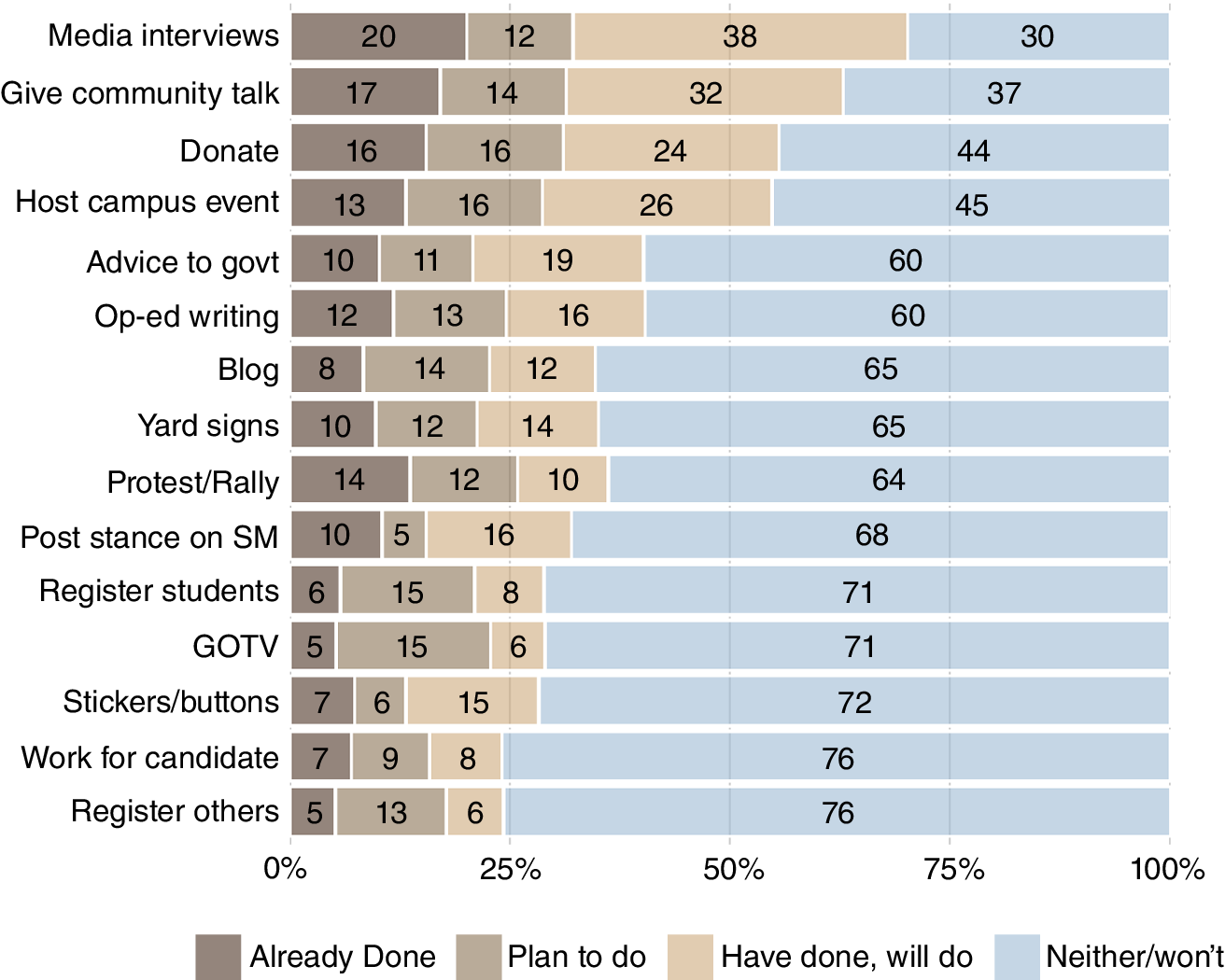
Because the survey was distributed during the summer of 2024, before a major election, it asked about political engagement in a particular way that allowed participants to indicate whether they had already engaged in each activity as well as to estimate whether they would engage in them as the year progressed. The results are shown in figure 1, which highlights the value of asking about their plans (i.e., what they will do) as well as reports (i.e., what they have done). If we had asked only about reports of completed activities, only a fraction would have engaged in most activities. Combining “have already done” with “have done AND plan to do again” (emphasis in the survey) resulted in only 11% of political scientists registering voters, 20% blogging, and 58% being interviewed by media. These responses also provide the sense that most of those who had participated planned to again in the second half of the year. This is not surprising, of course. If someone wears a button or sticker on their jean jacket, it is likely to stay on and gain more “button friends” in the future. Those interviewed for one story in an election year are likely to net more interview requests as the election progresses, particularly because quotations or interviews in one outlet draw the attention of other journalists.
Distribution of Involvement in Politics Among Political Scientists (Weighted)
Source: June 2024 Survey of Political Scientists.

However, it is also notable how few respondents participated in most of the activities. The majority reported engagement in only four types of activity: (1) hosting a campus event to learn about a political event or issue; (2) donating to candidates or parties; (3) giving a community talk; and (4) doing media interviews. Moreover, it very well could be the case that political scientists engage in several of these activities with the hope (and possibly expectation) that they will be rewarded by their institution in terms of career advancement. Political scientists continue to be more active than the general population, but it is certainly true that most are not participating in all of the things.Footnote 4 Moreover, the types of activities in which political scientists are most likely to participate are tied more closely to their professional work or are those, like donating, that are not subject to wide public scrutiny. We need to search down to eighth place to find political yard signs that would signal their political preferences to neighbors, and only 36% of political scientists reported doing or planning to do so. Although it is easy to do, only 30% stated that they had or will post their political stances on social media, and only 15% appear to do so habitually. This evidence suggests that overt, regular politicking was relatively rare among political scientists in this sample.
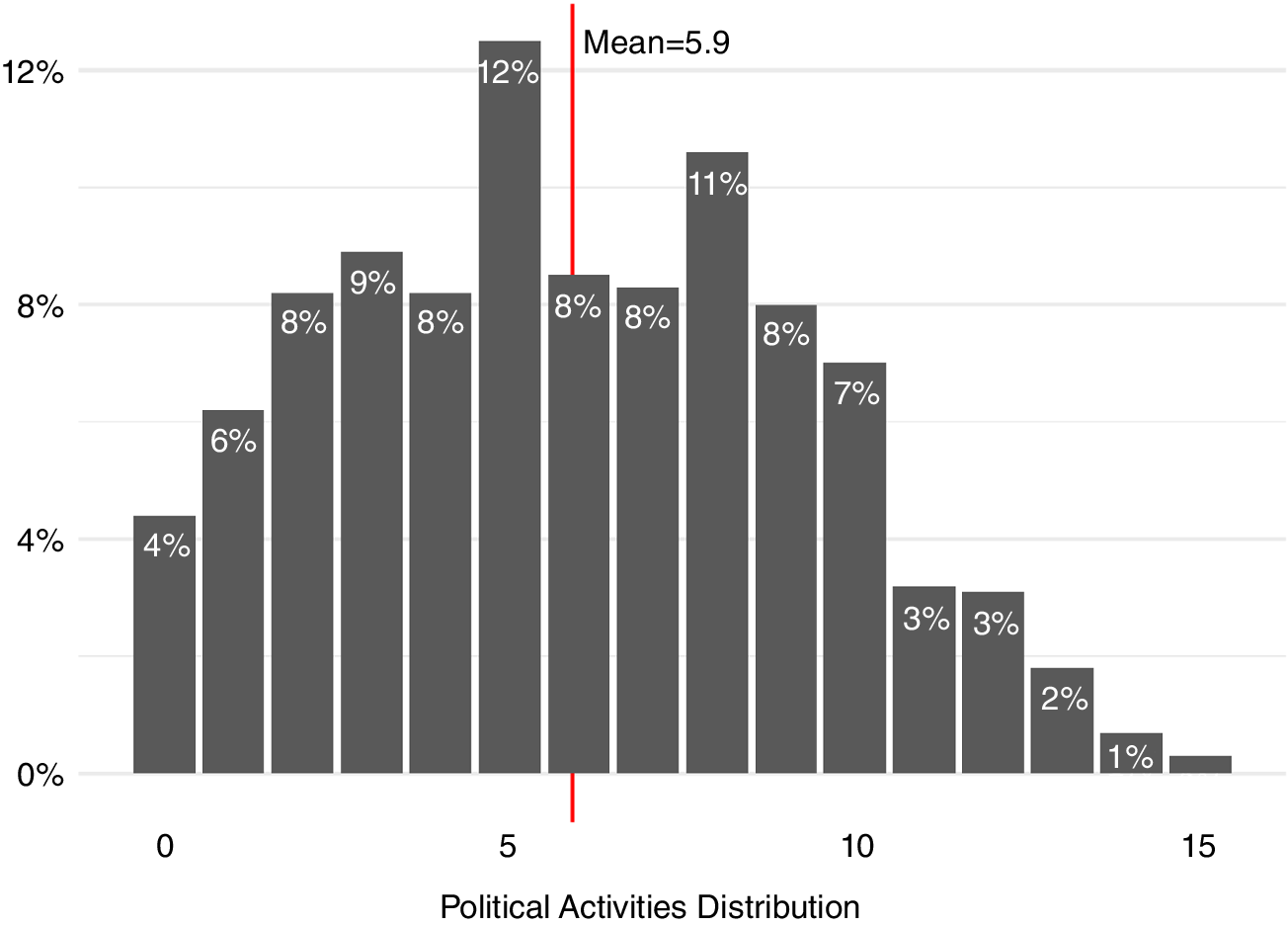
Figure 2 displays a slightly different view, aggregating the activities shown in figure 1—that is, we collapsed the first three affirmative responses to one and summed across activities. The mean was 5.9 activities (the median was 6). Whereas figure 1 reveals that a minority of respondents engaged in most activities, figure 2 suggests that our engagement portfolios are considerably varied. Only 4% of political scientists are participating in none of these activities and 6% are doing only one. Most respondents were doing a handful of activities and some were doing very many (i.e., 16% were doing 10 or more).
Distribution of Political Engagement (Weighted)
Source: June 2024 Survey of Political Scientists.

BELIEFS ABOUT THE PLACE OF POLITICS
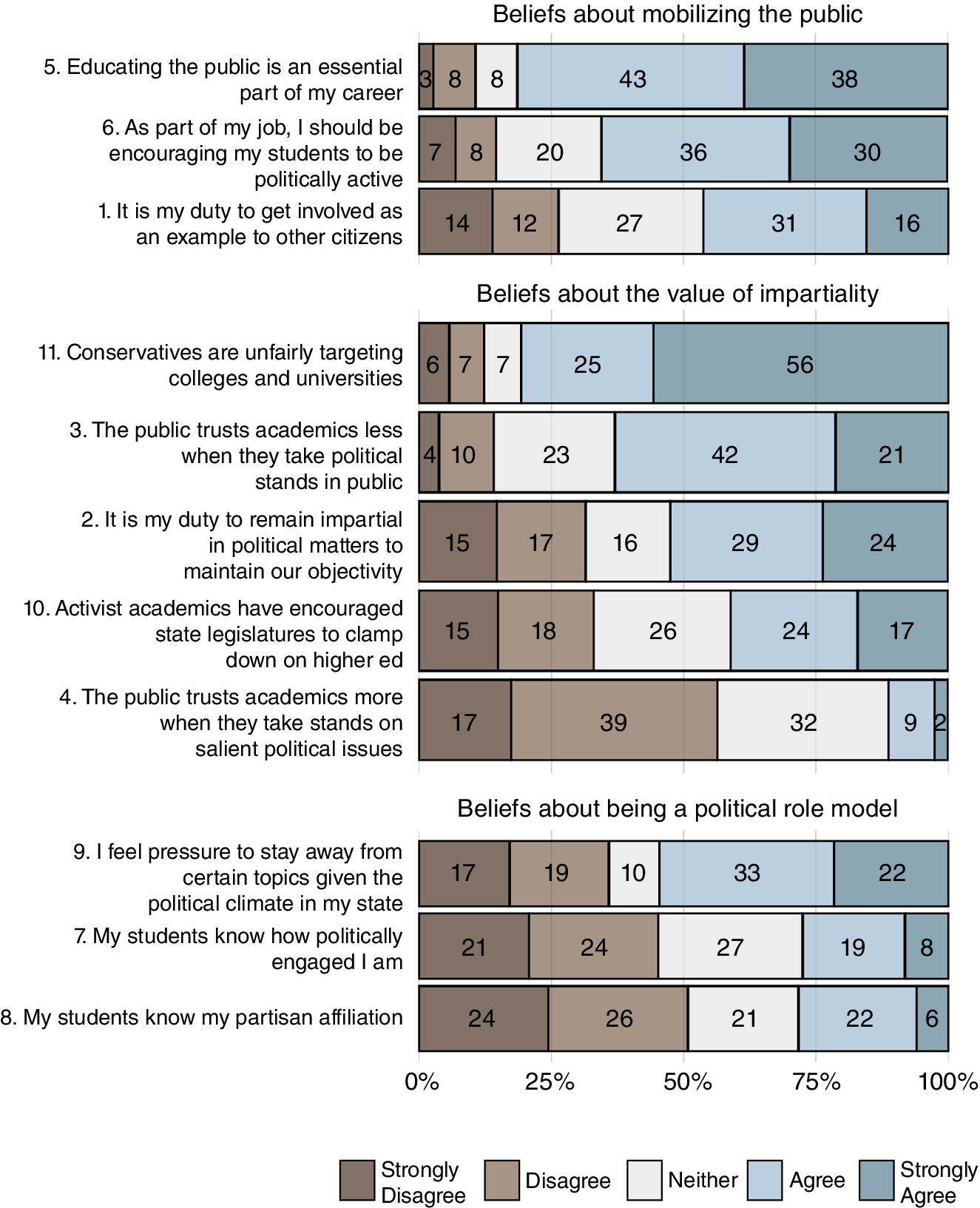
The survey asked a range of questions that tapped into political scientists’ beliefs about the appropriate place of public politics in the pursuit of a science of politics.Footnote 5 The responses to these measures shown in figure 3 are organized by principal components. (See online appendix A, table A1, for the results of the analysis.) We found three components: beliefs about the value of impartiality, beliefs about mobilizing the public, and beliefs about being a political role model. These make sense, given the level of analysis—that is, impartiality concerns the reputation of the discipline, whereas the other two belief sets concern the individual. Mobilizing is concerned about what individuals should do, and being a role model involves how individuals want to be viewed. These beliefs have key roles in explaining who participates in which political activity.
Political Scientist Beliefs About the Place of Politics in the Profession (Weighted)
Source: June 2024 Survey of Political Scientists.

Political scientists are wary of being overtly partisan, soundly rejecting the idea that they garner public trust when they take sides on salient issues. Less than a third of respondents indicated that their students know their party affiliation—although they very well could be wrong in their assessment.Footnote 6 Likewise, just over a quarter stated that their students know how politically active they are—despite almost a majority agreeing that they should set an example for other citizens, and even more agreeing that they should encourage students to be politically active. Many of the other items showcase the pressure that political scientists feel to avoid being perceived as political. Majorities avoided certain issues as too controversial and agreed that they should remain impartial to maintain their objectivity.Footnote 7 Substantial minorities of respondents did not agree with these notions, although almost two thirds believed that public politicking would undermine public trust in political science.
Political scientists are wary of being overtly partisan, soundly rejecting the idea that they garner public trust when they take sides on salient issues.
There is an interesting tension in the results about the state politics of higher education. Over time, states have reduced their support for higher education while also increasing their scrutiny of it. Moreover, a sizable minority of respondents (41%) agreed that academic activities encouraged state legislatures to more tightly regulate higher education. However, a much larger majority (81%) believed that conservatives are unfairly targeting universities. Of course, both can be true. The two are negatively correlated, as expected, but the relationship was weak (r=-0.15).
THE STRUCTURE OF OUR POLITICAL ENGAGEMENT
We do not think that engagement among political scientists is random and neither are political scientists firmly limited by abstract professional obligations. Instead, levels of activity vary systematically, given our beliefs about what is appropriate and right for advancing our tripartite mission of educating the public, maintaining trust, and being true to our own political commitments. To assess the structure of participation from the listed items, we conducted a principal components analysis (PCA) with varimax rotation and tetrachoric correlations, which are appropriate for binary variables. The results, presented in online appendix A, table A2, reveal three components that we termed partisans, public scholars, and pedagogues. Partisans are overtly political, sharing their stances publicly in their front yards or on their lapels and working for campaigns. Public scholars eschew those activities in favor of writing for popular audiences (i.e., op-eds and blogging), giving public talks, being interviewed by journalists, and other consulting work—that is, their “political work” is their political science. Pedagogues host campus events and help to get students and other citizens registered to vote.Footnote 8 We composed three additive variables (rescaled to run from 0 to 1) based on the PCA results; although the resulting scales are positively correlated, the relationships are not strong.Footnote 9
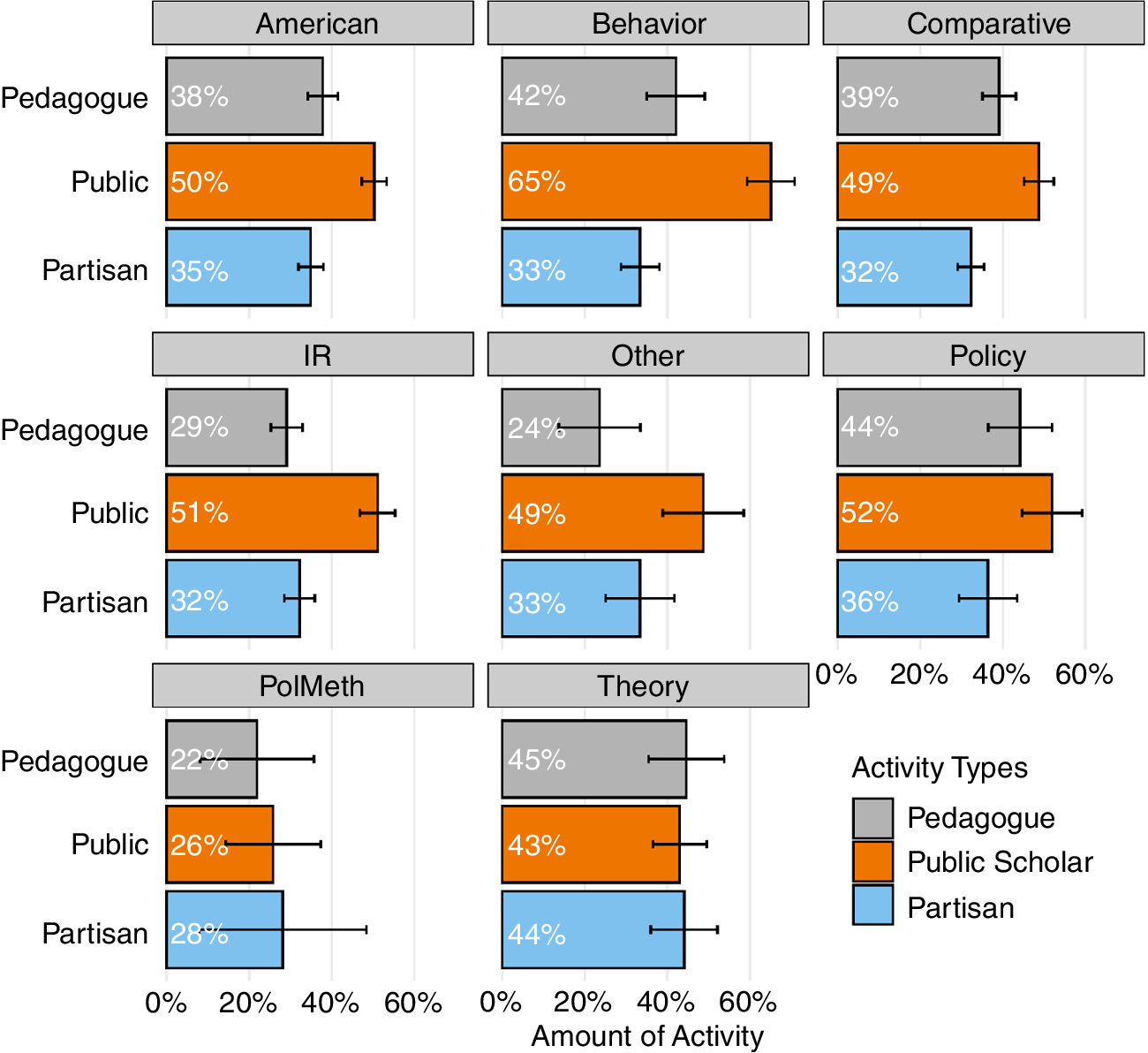
This defines the public face of political science to the extent that our survey is representative. It is useful to observe that, in general, the activity types are not engaged at different rates by field specialists: the weighted sample means were 0.35 for partisans, 0.50 for public scholarship, and 0.36 for pedagogues. As shown in figure 4, these activity types were displayed almost evenly across fields but with a few exceptions that mainly affect smaller groups. It is not surprising that a few more policy and American politics specialists sponsor campus events and voter-registration drives. Political methodologists do less of everything. Conversely, theorists are more partisan and have more pedagogic engagement while doing somewhat less public scholarship. This makes sense because theorists have the lowest level of agreement with the statement: “It is my duty to remain impartial in political matters to maintain our objectivity” (Cohen Reference Cohen2025). Comparativists are not far behind theorists in their rejection of this belief.
How Types of Activities Are Pursued by Academic Subfield (Weighted)
Source: June 2024 Survey of Political Scientists. The percentages are the average number of activities engaged in each activity type out of seven for partisan activities, out of five for public scholarship, and out of three for pedagogic activities.

We conclude our review of these data with models of the three types of activities. The results in figure 5 suggest few differences by rank, institution, and demographics, which reinforces our previous discussion (see also online appendix A, table A3).Footnote 10 Women were modestly less likely to be public scholars, whereas whites and those at PhD-granting institutions participate in less campus activity—the latter is likely a function of the enormity of those institutions and departments. Reviewing load is our weak proxy for research productivity, although it also counts as its own time-use metric—those who review more manuscripts actually do more of all three activity types.
Estimated Effects on Activity Types (Negative Binomial Model, Weighted)
Source: June 2024 Survey of Political Scientists. Tabular results are presented in online appendix A, table A3.

Much of the structure of activities can be explained with our substantive beliefs about the appropriateness of politicking.Footnote 11 Of course, it certainly could be the case that the causal arrow points in the opposite direction, with involvement in politics driving an understanding that doing so is acceptable. Those who place more value on impartiality (e.g., agreement that “The public trusts academics less when they take political stands in public”) are much less engaged with partisan politics in overt ways and are more likely to conduct pedagogic activities. Conversely, those who believe that they should be political role models (e.g., agreement that “My students know how politically engaged I am”) are more likely to engage in partisan activities and public scholarship. Moreover, a worldview that highlights the importance of mobilizing the public (e.g., “Educating the public is an essential part of my career”) promotes all three types of activity in almost equivalent ways.
According to this sample, there is little political diversity in political science, but this diversity has consequences for participation. Republicans do less partisan work and are slightly more likely to engage in public scholarship. This means that Democrats do more partisan work than Republicans, which reinforces the stereotype of the discipline. The pattern reverses with respect to public scholarship, although the gap between strong Democrats and Republicans is only about 0.75 activities. There were no systematic partisan gaps on pedagogic activities.
Quantitative scholars do as much of all types of activities as qualitative scholars, which contradicts Ricci’s (Reference Ricci1984) arguments about the political and policy irrelevance of quantitative work (see also Lowi Reference Lowi1992). However, it is true that the small number of theorists in the sample (7%) were more engaged with partisan and pedagogic activity and lean toward less public scholarship.Footnote 12
CONCLUSION
Studying politics places political scientists in a uniquely awkward position. Of course, we have our own political commitments, but placing them front and center in our public lives might undermine how others evaluate our professional work. Most political scientists believe that their credibility is at stake, and there are relatively few who wear their partisanship on their sleeves. Existence proofs are readily found of academics—including political scientists—who have faced personal or professional consequences for engaging in what might be considered partisan politics (Mervis Reference Mervis2014; Smith Reference Smith2015). However, there generally are few penaltiesFootnote 13 for violating these norms in what may be considered a tragedy of the commons.
This does not mean that political scientists are not engaged with politics—they are in a variety of ways and mostly as an expression of their professional training and findings. That is, they engage in a wide range of activities with political implications, including get-out-the-vote efforts, attending protests, blogging, and—of course—media interviews, but mostly without a clear partisan lean.
Whether and how political scientists engage is largely a function of structured worldviews about the propriety, risks, and rewards of political engagement. Many professors believe that they should set examples for their students and the wider public, but many are concerned about potential injury to their credibility and the trustworthiness of the profession when they take overtly political stands in public. The variance in these beliefs within the profession also leads to tension among colleagues about the appropriate role of political scientists in criticizing government, parties, and leaders. This leads to an almost impossible balance to achieve: leveraging our knowledge and positions to advocate for democracy but doing so in a way that will not undercut our message if personal biases are perceived. Rather than thinking of this tension as “selling out” versus losing all objectivity, we argue that this dialogue is a vital part of a healthy discipline that aims for applied relevance.
Whether and how political scientists engage is largely a function of structured worldviews about the propriety, risks, and rewards of political engagement.
SUPPLEMENTARY MATERIAL
To view supplementary material for this article, please visit http://doi.org/10.1017/S1049096525101455.
ACKNOWLEDGMENTS
We are grateful to our many colleagues who responded to our survey. The reviewers provided thoughtful feedback that improved the article. We also thank Zach Broeren and Bear Djupe for their research assistance.
DATA AVAILABILITY STATEMENT
Research documentation and data that support the findings of this study are openly available at the PS: Political Science & Politics Harvard Dataverse at https://doi.org/10.7910/DVN/AMESM3 (Djupe, Friesen, and Neiheisel Reference Djupe, Friesen and Neiheisel2025).
CONFLICTS OF INTEREST
The authors declare that there are no ethical issues or conflicts of interest in this research.


 Open access

