






1. Introduction
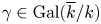
The concept of field of moduli was introduced by Matsusaka in [Reference MatsusakaMat58], and considerably clarified by Shimura in [Reference ShimuraShi59]. Suppose that  $k$ is a field with algebraic closure $\overline {k}$. Let us assume for simplicity that $k$ is perfect. An algebraic variety $X$, perhaps with additional structure, such as a polarization, or a marked point, will be defined over some intermediate field $k \to \ell \to \overline {k}$ that is finite over $k$. If $\Gamma$ is the Galois group of $\overline {k}$ over $k$, call $\Delta \subseteq \Gamma$ the subgroup formed by elements $\gamma \in \Gamma$ such that the Galois conjugate $X_{\gamma }$ is isomorphic to $X$ as a $k$-scheme, possibly with its additional structure. Then $\Delta$ is an open subgroup of $\Gamma$; the field of moduli of $X$ is the fixed subfield $\overline {k}^{\Delta }$. It is contained in every field of definition of $X$.
$X$.
If  $X$ has a finite group of automorphisms, and is one of a class of varieties with finite automorphism groups parametrized by a coarse moduli space $M \to \operatorname {Spec} k$ (for example, smooth curves of genus at least $2$), then the field of moduli has a natural interpretation as the residue field of the image of the morphism $\operatorname {Spec} \overline {k} \to M$ corresponding to $X$, see § 3.2.
One basic question is: when is  $X$ defined over its field of moduli? This problem has been the subject of a considerable amount of literature over the years.
An important early example is due to Shimura [Reference ShimuraShi72]. Let  $A_{g}$ be the moduli space of abelian varieties of genus $g$ over $\mathbb {C}$, and call $K$ its field of rational functions. Let $X$ be the corresponding generic abelian variety defined over $\overline {K}$; its field of moduli is $K$. Then Shimura proved that $X$ is defined over $K$ if and only $g$ is odd.
In the case that  $X$ is a smooth curve, an important advance is due to Dèbes and Emsalem [Reference Dèbes and EmsalemDE99].
Let  $X$ be as above; assume that the group $\operatorname {Aut} X$ of automorphisms of $X$ over $\overline {k}$ is finite. Consider the group $\Delta$ above; for each $\delta \in \Delta$ we have an isomorphism $X_{\delta } \simeq X$, well defined up to an automorphism of $X$ over $\overline {k}$. This descends to a canonical automorphism of $X/\operatorname {Aut} X$, defining an action of $\Delta$ on $X$, compatible with the action on $\overline {k}$; by Galois descent this defines a scheme $X^{\mathrm {c}}$ over $k$, a form of $X/\operatorname {Aut} X$, which we call the compression of $X$. If $X$ is a smooth curve, so is $X^{\mathrm {c}}$.
The following result is due to Dèbes and Emsalem.
Theorem [Reference Dèbes and EmsalemDE99, Corollary 4.3(c)]
Assume that  $X$ is a smooth curve of genus at least $2$. If $X^{\mathrm {c}}(k) \neq \emptyset$, then $X$ is defined over its field of moduli.
See [Reference BirchBir94, Reference Sijsling and VoightSV16] for related results, and [Reference BrescianiBre22] for applications.
Let us describe the content of this paper.
The definition of field of moduli
The definition of field of moduli for an object defined over  $\overline {k}$ is present in the literature in two particular cases, as explained above: when $k$ is perfect and when $X$ is in a class of objects having a coarse moduli space. This last hypothesis is not very natural: for example, one could be interested in the field of moduli of non-polarized abelian varieties, or K3 surfaces. In § 3 we give a somewhat more general and flexible formalism for defining fields of moduli and residual gerbes under very weak hypotheses. In particular we adapt it to non-perfect fields and objects with non-reduced automorphism group schemes, using the fppf topology instead of the Galois group.
In § 4 we apply the Grothendieck–Giraud classification of gerbes, commonly known as non-abelian cohomology, to draw some consequences. In the case of curves these consequences are spelled out in [Reference Dèbes and EmsalemDE99, Corollary 4.3], and proved using a more special formalism.
In the rest of the introduction we assume  $\operatorname {char} k = 0$; this simplifies the statements considerably. We refer to the main body of the paper for precise statements in arbitrary characteristic.
The Dèbes–Emsalem theorem in arbitrary dimension
Let  $X$ be as in the introduction. If $X$ is singular, or higher-dimensional, it is not true that if $X^{\mathrm {c}}(k) \neq \emptyset$, then $X$ is defined over its field of moduli (see [Reference Sijsling and VoightSV16, § 5] for singular examples in dimension $1$). Our main result (Theorem 5.4) is the following: let $\widetilde {X}$ be a resolution of singularities of $X^{\mathrm {c}}$. If $\widetilde {X}(k) \neq \emptyset$, then $X$ is defined over its field of moduli.
When  $X$ is a smooth curve, we have that the compression $X^{\mathrm {c}}$ is smooth, so this recovers the result of Dèbes and Emsalem. Dèbes and Emsalem mention the fact that their methods can be generalized to curves with a structure such as pointed curves [Reference Dèbes and EmsalemDE99, Remark 3.2(b)], but they do not give details on how to do it. Thus, in dimension $1$, we are essentially clarifying what curves with a structure are, and checking that the theorem of Dèbes and Emsalem holds for them. More importantly, we are able to generalize their result to arbitrary dimension.
Dèbes and Emsalem also observed that a suitable form of their theorem implies that every pointed curve of genus  $\ge 2$ is defined over its field of moduli [Reference Dèbes and EmsalemDE99, Corollary 5.4]. This fails, however, in higher dimension: smooth pointed varieties are not necessarily defined over their fields of moduli. An example is Shimura's result on generic abelian varieties explained in the introduction. In order to apply the result above, we need to ensure that a rational point of the compression $X^{\mathrm {c}}$ lifts to a resolution of singularities.
More precisely, we need conditions that ensure that a resolution of singularities  $\widetilde {X} \to X^{\mathrm {c}}$ has a rational point. In the case of pointed varieties this translates into the following question. Suppose that $X$ is a variety over $\overline {k}$ and $G$ is a finite group acting on $X$ with a smooth fixed point $\overline {p} \in X(\overline {k})$. Let $X^{\mathrm {c}}$ be a form of $X/G$ defined over $k$, with a rational point $p \in X^{\mathrm {c}}(k)$ lifting to $\overline {p}$. If $\widetilde {X} \to X^{\mathrm {c}}$ is a resolution of singularities, under what conditions does it follow that there is a rational point of $\widetilde {X}$ lying over $p$?
$p$?
The arithmetic of quotient singularities
In § 6 we introduce two related concepts.
One is that of  $R$-singularity (Definition 6.13). An $R$-singularity is a pair $(S,s)$, where $S$ is a variety over a field $K$ with quotient singularities and $s \in S(K)$, such that, in particular, if $k \subseteq K$ is a subfield, $(S', s')$ is a form of $(S,s)$ defined over $k$, and $\widetilde {S}' \to S'$ is a resolution of singularities, then $\widetilde {S}'$ has a $k$-rational point over $s'$. If the condition holds for one resolution of $S'$, then by the Lang–Nishimura theorem 5.5 it holds for every other resolution, so the choice of $\tilde {S}'$ is not important.
The other key definition is that of  $R_{d}$ group (Definition 6.12): if $d$ is a positive integer, a finite group $G$ is $R_{d}$ if whenever it acts faithfully on a smooth $d$-dimensional variety $X$ with a fixed rational point $x \in X(k)$, the pair $(X/G, [x])$, where $[x]$ is the image of $x$, is an $R$-singularity. It follows from our main theorem that if $X$ is a smooth variety over $\overline {k}$ and $\overline {p} \in X(\overline {k})$ is a $\overline {k}$-point, and $\operatorname {Aut} (X, \overline {p})$ is an $R_{d}$ group, then $(X, \overline {p})$ is defined over its field of moduli.
Not all finite groups are  $R_{d}$: for example, a cyclic group of order $2$ is not $R_{d}$ for any $d \geq 2$. Here we present two results, showing that this is not an empty definition.
The first (Theorem 6.18) shows that there are infinitely many groups that are  $R_{d}$ for all $d$. The second (Theorem 6.19) says that any finite group of order prime to $d!$ is $R_{d}$. As a consequence (Theorem 6.21), a $d$-dimensional variety $X$ with a smooth marked point $p\in X$ such that $\operatorname {Aut}(X,p)$ is finite of degree prime to $d!$ is defined over its field of moduli.
There is much more that one could say about  $R_{d}$ groups. The paper [Reference BrescianiBre24] by the first author contains a complete classification of $R_{2}$ groups. The case $d > 2$ seems much harder; hopefully it will be the subject of further work.
Using the classification in dimension  $2$, the first author proved that every smooth plane curve of degree prime with $6$ is defined over its field of moduli, and other similar results about cycles in $\mathbb {P}^{2}$ (see [Reference BrescianiBre23b, Reference BrescianiBre23c, Reference BrescianiBre23d]).
Another result along these lines is Corollary 6.24, stating that if  $X$ is an odd-dimensional variety over $\overline {k}$ with a smooth marked point $\overline {p} \in X(\overline {k})$, and the automorphism group of $(X,\overline {p})$ is cyclic of order $2$ and has $\overline {p}$ as an isolated fixed point, then $(X,\overline {p})$ is defined over its field of moduli. This would be false without assuming that $\overline {p}$ is an isolated fixed point, as the cyclic group $\mathrm {C}_{2}$ is not $R_{d}$ for any $d \geq 2$. This vastly generalizes Shimura's result that odd-dimensional generic principally polarized abelian varieties are defined over their field of moduli.
For the second and third part, the fundamental tool is the Lang–Nishimura theorem for tame stacks proved in [Reference Bresciani and VistoliBV23] (see Theorem 5.5).
2. Notation and conventions
We follow the conventions of [Reference KnutsonKnu71] and [Reference Laumon and Moret-BaillyLM00]; so the diagonals of algebraic spaces and algebraic stacks will be separated and of finite type. In particular, every algebraic space will be decent, in the sense of [Sta23, Definition 03I8].
We follow the terminology of [Reference Abramovich, Olsson and VistoliAOV08]: a tame stack is an algebraic stack  $X$ with finite inertia, such that its geometric points have linearly reductive automorphism group. This is equivalent to requiring that $X$ is étale locally over its moduli space a quotient by a finite, linearly reductive group scheme [Reference Abramovich, Olsson and VistoliAOV08, Theorem 3.2].
If  $k$ is a field and $G \to \operatorname {Spec} k$ is a group scheme, we denote by $\mathscr {B}_{k}G$ the classifying stack of $G$, whose objects are $G$-torsors.
3. Fields of moduli
Let  $k$ be a field, $(\mathrm {Aff}/k)$ the category of affine $k$-schemes. All stacks will be fppf stacks over $(\mathrm {Aff}/k)$. If $\mathscr {M}$ is such a stack, and $R$ is a $k$-algebra, we set $\mathscr {M}(R) \mathrel {\smash {\overset {\mathrm {\scriptscriptstyle def}} =}} \mathscr {M}(\operatorname {Spec} R)$; if $R \to S$ is a morphism of $k$-algebras and $\xi$ is an object of $\mathscr {M}(R)$, we denote by $\xi _{S}$ the pullback of $\xi$ to $\mathscr {M}(S)$ via the induced morphism $\operatorname {Spec} S \to \operatorname {Spec} R$.
Recall that a stack  $\mathscr {M} \to (\mathrm {Aff}/k)$ is locally finitely presented if whenever $\{A_{i}\}_{i \in I}$ is a filtered inductive system of $k$-algebras, the induced functor $\varinjlim _{i}\mathscr {M}(A_{i}) \to \mathscr {M}(\varinjlim _{i}A_{i})$ is an equivalence. In particular, we have the notion of a locally finitely presented sheaf $(\mathrm {Aff}/k) \to (\mathrm {Set})$.
Suppose that  $K$ is an extension of $k$. We define, as usual, the sheaf of automorphisms
 \[ \mathop{\underline{\mathrm{Aut}}}\nolimits_{K}\xi\colon (\mathrm{Aff}/K)^{\mathrm{op}} \to (\mathrm{Grp}), \]
where  $(\mathrm {Grp})$ is the category of groups, as the functor sending an affine $K$-scheme $S$ into the group of automorphisms of the pullback $\xi _{S}$.
If  $\xi$ and $\eta$ are two objects of $\mathscr {M}(K)$, we denote by
 \[ \mathop{\underline{\mathrm{Isom}}}\nolimits_{K\otimes_{k}K}(\operatorname{pr}_{1}^{*}\xi, \operatorname{pr}_{2}^{*}\eta)\colon (\mathrm{Aff}/S)^{\mathrm{op}} \to (\mathrm{Set}) \]
the sheaf of isomorphisms of the pullbacks of  $\xi$ and $\eta$ along the two projections $\operatorname {pr}_{1}$, $\operatorname {pr}_{2}\colon \operatorname {Spec} K \times _{\operatorname {Spec} k} \operatorname {Spec} K = \operatorname {Spec}(K\otimes _{k}K) \to \operatorname {Spec} K$.
If  $\mathscr {M}$ is locally finitely presented, the two sheaves above are locally finitely presented. Recall that, in our terminology, algebraic spaces are quasi-separated: under this assumption, group algebraic spaces are separated schemes [Sta23, Tag 08BH, Tag 0B8G]. In particular, the sheaf $\mathop {\underline {\mathrm {Aut}}}\nolimits _{K}\xi$ is an algebraic space of finite type if and only if it is a group scheme of finite type.
Lemma 3.1 Let  $\mathscr {M} \to (\mathrm {Aff}/S)$ be a locally finitely presented fppf stack, $K$ an extension of $k$,
$k$,  $\xi$ and $\eta$ two objects of $\mathscr {M}(K)$. Let $K'$ be an algebraic extension of $K$; then we have the following two equivalences.
(1) The sheaf $\mathop {\underline {\mathrm {Isom}}}\nolimits _{K\otimes _{k}K}(\operatorname {pr}_{1}^{*}\xi, \operatorname {pr}_{2}^{*}\eta )$ is an algebraic space of finite type over $K$ if and only if $\mathop {\underline {\mathrm {Isom}}}\nolimits _{K'\otimes _{k}K'}(\operatorname {pr}_{1}^{*}\xi _{K'}, \operatorname {pr}_{2}^{*}\eta _{K'})$ is an algebraic space of finite type over $K'$.
(2) The sheaf
$\mathop {\underline {\mathrm {Aut}}}\nolimits _{K}\xi$ is a group scheme of finite type if and only if $\mathop {\underline {\mathrm {Aut}}}\nolimits _{K'}\xi '$ is a group scheme of finite type.


Both parts are immediate consequences of the following, applied to the cases  $R = K$, $R' = K'$, and $R = K\otimes _{k}K$, $R' = K'\otimes _{k}K'$.
Lemma 3.2 Let  $R$ be a commutative ring, $\{R_{i}\}_{i \in I}$ a filtered inductive system of finitely presented $R$-algebras with faithfully flat transition functions. Set $R' \mathrel {\smash {\overset {\mathrm {\scriptscriptstyle def}} =}} \varinjlim _{i}R_{i}$. Let $F\colon (\mathrm {Aff}/R)^{\mathrm {op}} \to (\mathrm {Set})$ be an fppf sheaf that is locally of finite presentation, and call $F'$ the composite $(\mathrm {Aff}/R')^{\mathrm {op}} \to (\mathrm {Aff}/R)^{\mathrm {op}} \to (\mathrm {Set})$, where the functor $(\mathrm {Aff}/R')^{\mathrm {op}} \to (\mathrm {Aff}/R)^{\mathrm {op}}$ is given by restriction of scalars. Then $F$ is a finitely presented algebraic space over $R$ if and only if $F'$ is a finitely presented algebraic space over $R'$.
$R'$.
Proof. If  $F$ is a finitely presented algebraic space then $F' = \operatorname {Spec} R' \times _{\operatorname {Spec} R}F$ is also a finitely presented algebraic space. Thus, assume that $F'$ is a finitely presented algebraic space.
If  $R'$ is finitely presented over $R$, then the result follows from Artin's theorem [Reference Laumon and Moret-BaillyLM00, Corollaire 10.4]. Thus, denote by $F_{i}$ the pullback of $F$ to $\operatorname {Spec} R_{i}$; it is enough to show that $F_{i}$ is a finitely presented algebraic space for some $i$. Since $F'$ is finitely presented, it will be obtained by pullback from a finitely presented algebraic space $G$ over some $R_{i}$; we can replace $R,F$ with $R_{i},F_{i}$, and assume that $G$ is defined over $R$. Then it is enough to show that for some $i$, the pullback of $G$ to $\operatorname {Spec} R_{i}$ is isomorphic to $F_{i}$.
We claim that the isomorphism  $G_{R'} \simeq F_{R'} = F'$ comes from a morphism $G_{R_{i}} \to F_{i}$ for some $i$. For this, choose an affine scheme $U$ with an étale surjective map $U \to G$, and an affine scheme $V$ with an étale surjective map $V \to U\times _{G}U$. Since $F$ is an fppf sheaf, for any $R$-algebra $S$ the set of morphisms $\operatorname {Hom}_{S}(G_{S},F_{S})$ is the equalizer of the two maps $F(U_{S}) \to F(V_{S})$; since $F$ is locally of finite presentation, and filtered colimits commute with equalizers, we have $\operatorname {Hom}_{R'}(G_{R'},F_{R'}) = \varinjlim _{i}\operatorname {Hom}_{R_{i}}(G_{R_{i}}, F_{i})$, hence the thesis. Thus, by replacing $R$ with $R_{i}$ we may assume that there exists a morphism $G \to F$ that pulls back to the isomorphism $G_{R'} \simeq F_{R'}$; we need to check that this is an isomorphism. This is standard if $R'$ is finitely presented over $R$; let us show that the proof adapts to the general case.
Let  $S$ be any $R$-algebra, we want to show that $G(S) \to F(S)$ is bijective. Denote by $S'$,
$S'$,  $S_{i}$ the tensor products $S\otimes _{R}R'$, $S\otimes _{R} R_{i}$, we have that $G(S')=\varinjlim _{i}G(S_{i})\to F(S')=\varinjlim _{i}F(S_{i})$ is bijective. If $g_{1},g_{2}$ are elements of $G(S)$ which map to the same element of $F(S)$, then $g_{1,i}=g_{2,i}\in G(S_{i})$ for some $i$. Since $S_{i}$ is faithfully flat over $S$, this implies that $g_{1}=g_{2}$. We have, thus, proved that $G \to F$ is an injective morphism of sheaves, it remains to prove surjectivity. Let $f$ be any element of $F(S)$, there exists an $i$ such that $f_{i}\in F(S_{i})$ is the image of some element $g_{i}\in G(S_{i})$. Since $f_{i}$ descends to $S$, the two restrictions of $f_{i}$ to $S_{i}\otimes _{S}S_{i}$ are equal. Injectivity of $G\to F$ implies that the same holds for the two restrictions of $g_{i}$, hence $g_{i}$ descends to an element $g\in G(S)$. The image of $g$ in $F(S)$ restricts to $f_{i}\in F(S_{i})$, hence it is $f\in F(S)$ since $S\to S_{i}$ is faithfully flat.
3.1 The residual gerbe
Notation 3.3 In this subsection we always use the following notation:  $\mathscr {M}$ will be an fppf stack over $(\mathrm {Aff}/R)$, locally of finite presentation, $K$ an algebraic extension of $k$,
$k$,  $\xi$ an object of $\mathscr {M}(K)$. We also interpret $\xi$ as a morphism $\xi \colon \operatorname {Spec} K \to \mathscr {M}$.
Assume that  $K$ is finite over $k$. We define the residual gerbe $\mathscr {G}_{\xi }$ of $\xi$ in $\mathscr {M}$ as in [Reference Laumon and Moret-BaillyLM00, § 11], that is, we take $\mathscr {G}_{\xi }$ to be the fppf image of $\xi$ in $\mathscr {M}$. In other words, $\mathscr {G}_{\xi }$ is the full fibered subcategory of $\mathscr {M}$ such that an object $\eta$ in $\mathscr {M}(S)$ is in $\mathscr {G}_{\xi }(S)$ if there exists an fppf cover $S' \to S$ and a morphism of $k$-schemes $S' \to \operatorname {Spec} K$ such that the pullback $\eta _{S'}$ and $\xi _{S'}$ are isomorphic in $\mathscr {M}(S')$. It is immediate to check that $\mathscr {G}_{\xi }$ is an fppf stack.
Note that, by definition,  $\xi \colon \operatorname {Spec} K \to \mathscr {M}$ factors through $\mathscr {G}_{\xi }$; in fact, $\mathscr {G}_{\xi } \subseteq \mathscr {M}$ is the smallest fppf substack of $\mathscr {M}$ through which $\xi$ factors.
Lemma 3.4 Let  $L$ be a finite extension of $K$. Then $\mathscr {G}_{\xi _{L}} = \mathscr {G}_{\xi }$.
Proof. This is clear from the fact that  $\operatorname {Spec} L \to \operatorname {Spec} K$ is an fppf cover.
In the general case  $K$ is an algebraic extension of $k$, and $\xi$ an object of $\mathscr {M}(K)$ as before. Since $\mathscr {M}$ is locally of finite presentation, there is a factorization $\operatorname {Spec} K \to \operatorname {Spec} L \xrightarrow {\xi '}$ of $\xi \colon \operatorname {Spec} K \to \mathscr {M}$ with $L$ finite over $k$; we define $\mathscr {G}_{\xi }$ to be $\mathscr {G}_{\xi '}$. Because of Lemma 3.4, this is independent of the factorization. It is immediate to show that the analogue of Lemma 3.4 holds when $K/k$ and $L/K$ are only assumed to be algebraic.
Proposition 3.5 Let  $L$ be an algebraic extension of $K$. Then $\mathscr {G}_{\xi _{L}} = \mathscr {G}_{\xi }$.
Proof. Let  $E$ be an intermediate extension $k \subseteq E \subseteq K$, finite over $k$, such that $\xi \colon \operatorname {Spec} K \to \mathscr {M}$ factors as $\operatorname {Spec} K \to \operatorname {Spec} E \xrightarrow {\xi '} \mathscr {M}$. By definition, we have $\mathscr {G}_{\xi } = \mathscr {G}_{\xi '} = \mathscr {G}_{\xi _{L}}$.
Definition 3.6 We say that  $\xi$ is algebraic if the residual gerbe $\mathscr {G}_{\xi }$ is an algebraic stack.
From Proposition 3.5 we obtain the following.
Proposition 3.7 Let  $L$ be an algebraic extension of $K$. Then $\xi$ is algebraic if and only if $\xi _{L}$ is algebraic.
Proposition 3.8 The following conditions are equivalent.
(1) The object
$\xi$ is algebraic.(2) The sheaf
is an algebraic space of finite type.\[ \mathop{\underline{\mathrm{Isom}}}\nolimits_{K\otimes_{k}K}(\operatorname{pr}_{1}^{*}\xi, \operatorname{pr}_{2}^{*}\xi)\colon (\mathrm{Aff}/K\otimes_{k}K)^{\mathrm{op}} \to (\mathrm{Set}) \]


Proof. (1) ${}\implies {}$(2). The sheaf in question is the fibered product $\operatorname {Spec} K\times _{\mathscr {M}}\operatorname {Spec} K$; since $\mathscr {G}_{\xi }$ is a full subcategory of $\mathscr {M}$ and $\operatorname {Spec} K \to \mathscr {M}$ factors through $\mathscr {G}_{\xi }$, we have $\operatorname {Spec} K\times _{\mathscr {M}}\operatorname {Spec} K = \operatorname {Spec} K\times _{\mathscr {G}_{\xi }}\operatorname {Spec} K$, and the result follows.
(2) ${}\implies {}$(1). Set $S \mathrel {\smash {\overset {\mathrm {\scriptscriptstyle def}} =}} \operatorname {Spec} K$ and $R \mathrel {\smash {\overset {\mathrm {\scriptscriptstyle def}} =}} \mathop {\underline {\mathrm {Isom}}}\nolimits _{K\otimes _{k}K}(\operatorname {pr}_{1}^{*}\xi, \operatorname {pr}_{2}^{*}\xi )$. We obtain an fppf groupoid $R \mathbin {\rightrightarrows } S$; since $S \to \mathscr {G}_{\xi }$ is an fppf cover, we have an equivalence of $\mathscr {G}_{\xi }$ with the quotient stack $[R \mathbin {\rightrightarrows } S]$. Then it follows from Artin's theorem [Reference Laumon and Moret-BaillyLM00, Corollaire 10.6] that $\mathscr {G}_{\xi }$ is an algebraic stack.
If  $\xi$ is algebraic, then the sheaf $\mathop {\underline {\mathrm {Aut}}}\nolimits _{K}\xi \colon (\mathrm {Aff}/K)^{\mathrm {op}} \to (\mathrm {Grp})$ is a group scheme of finite type, as it is the restriction of $\mathop {\underline {\mathrm {Isom}}}\nolimits _{K\otimes _{k}K}(\operatorname {pr}_{1}^{*}\xi, \operatorname {pr}_{2}^{*}\xi )$ along the diagonal $\operatorname {Spec} K \subseteq \operatorname {Spec} K\otimes _{k}K$. We do not know whether the converse holds in general; but it does if $K/k$ is separable.
Proposition 3.9 Assume that the extension  $K/k$ is separable, and that $\mathop {\underline {\mathrm {Aut}}}\nolimits _{K}\xi$ is a group scheme of finite type. Then $\xi$ is algebraic.
Proof. We can assume that  $K$ is finite over $k$. Set $G \mathrel {\smash {\overset {\mathrm {\scriptscriptstyle def}} =}} \mathop {\underline {\mathrm {Aut}}}\nolimits _{K}\xi$ and $R \mathrel {\smash {\overset {\mathrm {\scriptscriptstyle def}} =}} \mathop {\underline {\mathrm {Isom}}}\nolimits _{K\otimes _{k}K}(\operatorname {pr}_{1}^{*}\xi, \operatorname {pr}_{2}^{*}\xi )$; there is a natural right action of $G$ on $R$, by right composition. Assume that $G$ is representable, and let us show that $R$ is representable.
We have  $K\otimes _{k}K = L_{1}\times \cdots \times L_{r}$, where each of the $L_{i}$ is a finite separable extension of $k$. Let us show that for each $i$ the restriction $R_{L_{i}}$ of $R$ to $\operatorname {Spec} L_{i}$ is representable by a scheme; this will prove the result. For each $i$ we have two mutually exclusive cases.
(a) There exists an extension
$L_{i}'$ of $L_{i}$ such that the pullbacks of $\operatorname {pr}_{1}^{*}\xi$ and $\operatorname {pr}_{2}^{*}\xi$ to $L_{i}'$ are isomorphic.(b) For any extension
$L'_{i}$ of $L_{i}$, the pullbacks of $\operatorname {pr}_{1}^{*}\xi$ and $\operatorname {pr}_{2}^{*}\xi$ to $L_{i}'$ are not isomorphic.


In the first case the restriction  $R_{L_{i}}$ is a $G$-torsor, and torsors are representable (see, e.g., [Sta23, Tag 04UT]). In the second case, $R_{L_{i}}=\emptyset$.
Proposition 3.10 Assume that  $\xi$ is algebraic. Then $\mathscr {G}_{\xi }$ is an fppf gerbe over $\operatorname {Spec} k(\xi )$, where $k(\xi )$ is an intermediate extension $k \subseteq k(\xi ) \subseteq K$, with $k(\xi )$ finite over $k$. Furthermore, there is the following cartesian diagram.

Proof. We can assume that  $K$ is finite over $k$. Since $\operatorname {Spec} K \to \mathscr {G}_{\xi }$ is flat and surjective, and every morphism to $\operatorname {Spec} K$ is flat, it follows that every morphism to $\mathscr {G}_{\xi }$ is flat. In particular, the inertia of $\mathscr {G}_{\xi }$ is flat over $\mathscr {G}_{\xi }$; by [Sta23, Proposition 06QJ] it follows that $\mathscr {G}_{\xi }$ is an fppf gerbe over an algebraic space $Z$ over $\operatorname {Spec} k$ (in the more general sense of [Sta23]). Under the present conditions it is immediate to check that the diagonal of $Z$ is of finite type; hence, $Z$ has dense open subset that is a scheme [Sta23, Proposition 06NH]. Since $\operatorname {Spec} K \to Z$ is flat and surjective, it follows immediately that $Z$ has to be the spectrum of a field, which proves the first statement.
For the second, the pullback  $\operatorname {Spec} K\times _{\operatorname {Spec} k(\xi )}\mathscr {G}_{\xi }$ is an fppf gerbe over $\operatorname {Spec} K$. Since $\xi \colon \operatorname {Spec} K \to \mathscr {M}$ factors, by definition, through $\mathscr {G}_{\xi }$, we obtain a section $\operatorname {Spec} K \to \operatorname {Spec} K\times _{\operatorname {Spec} k(\xi )}\mathscr {G}_{\xi }$; the automorphism group scheme of the corresponding object is $\mathop {\underline {\mathrm {Aut}}}\nolimits _{K}\xi$. This concludes the proof.
Definition 3.11 The field  $k(\xi )$ above is called the field of moduli of $\xi$.
The field of moduli has the following interpretation. Denote by  $R$ the sheaf $\mathop {\underline {\mathrm {Isom}}}\nolimits _{K\otimes _{k}K}(\operatorname {pr}_{1}^{*}\xi, \operatorname {pr}_{2}^{*}\xi )$, which is an algebraic space of finite type over $K\otimes _{k}K$, by Proposition 3.8.
Proposition 3.12 The field of moduli  $k(\xi )$ is the equalizer of the two arrows $\operatorname {pr}_{1}^{*}$ and $\operatorname {pr}_{2}^{*}\colon K \to \mathscr {O}(R)$.
Proof. Since  $\mathscr {G}_{\xi }$ is a gerbe over $\operatorname {Spec} k(\xi )$, we have $k(\xi ) = \mathscr {O}(\mathscr {G}_{\xi })$. The morphism $\operatorname {Spec} K \to \mathscr {G}_{\xi }$ is an fpqc cover, and $R = \operatorname {Spec} K \times _{\mathscr {G}_{\xi }} \operatorname {Spec} K$, hence $\mathscr {O}(\mathscr {G}_{\xi })$ is the equalizer of the two arrows in question.
In the ‘classical’ case, where  $K/k$ is a (not necessarily finite) Galois extension we obtain the following interpretation of the field of moduli.
Proposition 3.13 Suppose that  $K/k$ is a Galois extension with Galois group $G$. For each $\gamma \in G$ call $\gamma ^{*}\xi$ the pullback of $\xi$ along $\gamma \colon \operatorname {Spec} K \to \operatorname {Spec} K$; call $\overline {K}$ the algebraic closure of $K$. Let $H \subseteq G$ the subgroup consisting of the elements $\gamma \in G$ such that $(\gamma ^{*}\xi )_{\overline {K}}$ is isomorphic to $\xi _{\overline {K}}$. Then $k(\xi )$ is the field of invariants $K^{H}$.
Proof. First, assume that  $K$ is finite over $k$. In this case $\operatorname {Spec}(K \otimes _{k}K)$ is a disjoint union $\coprod _{g \in G} \operatorname {Spec} K$. The image of the natural morphism $R \to \operatorname {Spec}(K \otimes _{k}K)$ is $\coprod _{g \in H} \operatorname {Spec} K \subseteq \coprod _{g \in G} \operatorname {Spec} K$; hence, $\operatorname {pr}_{1}^{*}K$, $\operatorname {pr}_{2}^{*}\colon K \to \mathscr {O}(R)$ factor through the pullback $\prod _{g \in H} K \to \mathscr {O}(R)$, which is injective. The conclusion follows from Proposition 3.12.
If  $K$ is not finite over $k$, choose a finite intermediate extension $k \subseteq K' \subseteq K$ such that $(X, \xi )$ descends to $K'$. The result for $K'$ is easily seen to imply that for $K$.
$K$.
Definition 3.14 The object  $\xi$ is tame if it is algebraic, and $\mathop {\underline {\mathrm {Aut}}}\nolimits _{K}\xi$ is finite and linearly reductive.
Equivalently, the object  $\xi$ is tame if $\mathscr {G}_{\xi }$ is a tame stack.
3.2 Residual gerbes and moduli spaces
In case  $\mathscr {M}$ is an algebraic stack with finite inertia, there is another interesting interpretation of the field of moduli of a tame object.
Assume that  $\mathscr {M}$ is an algebraic stack with finite inertia, with moduli space $\mathscr {M} \to M$, and let $m \in M$ be a point. By the definition of a moduli space there exists an object $\xi$ over the algebraic closure $\overline {k(m)}$; we say that the point $m$ is tame if $\mathop {\underline {\mathrm {Aut}}}\nolimits _{\overline {k(m)}}\xi$ is linearly reductive.
Definition 3.15 Assume that  $m \in M$ is a tame point. The residual gerbe of $m$ is defined to be
 \[ \mathscr{G}_{m} \mathrel{\smash{\overset{\mathrm{\scriptscriptstyle def}} =}} \bigl(\operatorname{Spec} k(m)\times_{M}\mathscr{M}\bigr)_{\mathrm red}. \]
Proposition 3.16 The residual gerbe  $\mathscr {G}_{m}$ is a finite tame gerbe over $k(m)$.
Proof. By [Reference Abramovich, Olsson and VistoliAOV08, Proposition 3.6] the tame points of  $M$ form an open subspace $M' \subseteq M$; we can replace $M$ with $M'$, and assume that $\mathscr {M}$ is tame. Since formation of moduli spaces of tame stacks commutes with base change, we have that the moduli space of $\operatorname {Spec} k(m)\times _{M}\mathscr {M}$ is $\operatorname {Spec} k(m)$; and from this, that the moduli space of $\mathscr {G}_{m}$ is $\operatorname {Spec} k(m)$. From [Sta23, Proposition 06RC] it follows that $\mathscr {G}_{m}$ is a gerbe over $k(m)$, as claimed.
Proposition 3.17 Assume that  $\mathscr {M}$ is an algebraic stack with finite inertia locally of finite type over $k$, with moduli space $\mathscr {M} \to M$. Let $\xi \colon \operatorname {Spec} K \to \mathscr {M}$ be a tame object, and call $m \in M$ the image of the composite $\operatorname {Spec} K \xrightarrow {\xi } \mathscr {M} \to M$. Then the residual gerbe of $\xi$ is $\mathscr {G}_{m}$, and the field of moduli $k(\xi )$ is the residue field $k(m)$.
Proof. We may assume that  $K$ is finite over $k$. The morphism $\operatorname {Spec} K \to \mathscr {M}$ factors through $\operatorname {Spec} k(m)\times _{M}\mathscr {M}$; since $\operatorname {Spec} K$ is reduced we get a factorization $\operatorname {Spec} K \to \mathscr {G}_{m} \subseteq \mathscr {M}$. Since $\mathscr {G}_{m}$ is a finite gerbe, it follows that $\operatorname {Spec} K \to \mathscr {G}_{m}$ is flat and finite, hence it is an fppf cover. The result follows from this.
It is easy to give counterexamples to the statement of Proposition 3.17 without the tameness hypothesis. The point is that the moduli space of  $\operatorname {Spec} k(m)\times _{M}\mathscr {M}$ may be a non-trivial purely inseparable extension $k'$ of $k(m)$; and in this case the argument above shows that the field of moduli of $\xi$ is $k'$.
$k'$.
3.3 The basic question
Now assume that  $\mathscr {M} \to (\mathrm {Aff}/K)$ is an fppf locally finitely presented stack, $\xi \colon \operatorname {Spec} \overline {k} \to \mathscr {M}$ an algebraic object defined over the algebraic closure of $k$,
$k$,  $k(\xi ) \subseteq \overline {k}$ its field of moduli. Is $\xi$ defined over its field of moduli $k(\xi )$? This is equivalent to asking whether $\mathscr {G}_{\xi }(k(\xi )) \neq \emptyset$.
From now on we consider objects  $\xi$ defined over the algebraic closure $\overline {k}$ of $k$; from Proposition 3.5 it is clear that this is not a restriction.
4. Application of non-abelian cohomology
In the situation above, assume that  $\xi \in \mathscr {M}(\overline {k})$ is an algebraic object.
As an immediate corollary of the fact that every affine gerbe over a finite field is neutral [Reference Di Proietto, Tonini and ZhangDTZ20, Theorem 8.1], we get the following.
Proposition 4.1 Assume that  $k$ is finite and $\mathop {\underline {\mathrm {Aut}}}\nolimits _{\overline {k}}\xi$ is affine. Then $\xi$ is defined over its field of moduli.
One can also apply standard results on the classification of gerbes, which usually go under the name of Grothendieck–Giraud non-abelian cohomology [Reference GiraudGir71], to get conditions ensuring that  $\xi$ is defined over its field of moduli. This works very cleanly when $\mathop {\underline {\mathrm {Aut}}}\nolimits _{\overline {k}}\xi$ is finite and reduced.
Set  $G \mathrel {\smash {\overset {\mathrm {\scriptscriptstyle def}} =}} \mathop {\underline {\mathrm {Aut}}}\nolimits _{\overline {k}}\xi$, and assume for the rest of the section that $G$ is finite and reduced; according to our general conventions we think of $G$ as an ordinary group. Denote by $\operatorname {Aut} G$ the group of automorphisms of $G$, and by $\operatorname {Out} G$ its group of outer automorphisms, that is, the cokernel of the homomorphism $G \to \operatorname {Aut} G$ given by conjugation.
Proposition 4.2 Assume that the following conditions are satisfied:
(1) the center of
$G$ is trivial; and(2) the projection
$\operatorname {Aut} G \to \operatorname {Out} G$ is split.


Then  $\xi$ is defined over its field of moduli.
This should be compared with [Reference Dèbes and EmsalemDE99, Corollary 4.3(b)].
In a similar spirit we get the following, which is a generalization of [Reference Dèbes and EmsalemDE99, Corollary 4.3(a)], with the same proof.
Proposition 4.3 Assume that the absolute Galois group of  $k$ has cohomological dimension at most $1$. Then $\xi$ is defined over its field of moduli.
These two propositions are immediate corollaries of the following standard application of non-abelian cohomology.
Lemma 4.4 Let  $G$ be a finite group, $k$ a field. Let $\mathscr {G} \to (\mathrm {Aff}/k)$ be a gerbe such that $\mathscr {G}_{\overline {k}}$ is isomorphic to $\mathscr {B}_{\overline {k}}G$. Assume that either:
(1)
$G$ has trivial center, and $\operatorname {Aut} G \to \operatorname {Out} G$ is split; or(2)
$k$ has cohomological dimension $1$.


Then  $\mathscr {G}$ is neutral.
Proof. Denote by  $k^{s}$ the separable closure of $k$ and by $\Gamma =\operatorname {Gal}(k^{s}/k)$ be the absolute Galois group of $k$. We have that $\mathscr {G}_{k^{s}}$ is isomorphic to $\mathscr {B}_{k^{s}}G$ by Lemma 4.5. The tautological section $\operatorname {Spec} k^{s}\to \mathscr {B}_{k^{s}}G\to \mathscr {G}$ induces a continuous homomorphism $\Gamma \to \operatorname {Out} G$. Under both conditions (1) and (2), we have a lifting $\Gamma \to \operatorname {Aut} G$: for condition (1) this is obvious, whereas for condition (2) this follows from the fact that $G$ is projective [Reference SerreSer94, Proposition 45]. By descent theory, the homomorphism $\Gamma \to \operatorname {Aut} G$ induces a finite étale group scheme $\underline {G}$ over $k$ which is a twisted form of $G$. Equivalently, $\underline {G}$ is the quotient $(G\times \operatorname {Spec} k^{s})/\Gamma$ where $\Gamma$ acts on both $G$ and $\operatorname {Spec} k^{s}$.
Let  $L$ be the non-abelian band, in the sense of [Reference GiraudGir71], of $\mathscr {G}$. By construction, $L$ is represented by $\underline {G}$. By [Reference GiraudGir71, Théorème 3.3.3], under both conditions (1) and (2), the gerbe $\mathscr {G}$ is the only gerbe banded by $L$. Since the classifying stack $\mathscr {B}_{k}\underline {G}$ is banded by $L$ by construction, we get that $\mathscr {G}\simeq \mathscr {B}_{k}\underline {G}$, i.e. $\mathscr {G}$ is neutral.
Lemma 4.5 A finite gerbe with unramified diagonal over a separably closed field is neutral.
Proof. Let  $k$ be a separably closed field with algebraic closure $\overline {k}$, and $\mathscr {G}$ a finite gerbe over $k$ with unramified diagonal. There exists a finite extension $k'/k$ with a section $s\in \mathscr {G}(k')$. The scheme $\mathop {\underline {\mathrm {Isom}}}\nolimits (p_{1}^{*}s,p_{2}^{*}s)$ is finite étale over the artinian local ring $k'\otimes _{k}k'$ and we have a lifting $\operatorname {Spec} k'\to \mathop {\underline {\mathrm {Isom}}}\nolimits (p_{1}^{*}s,p_{2}^{*}s)$ of the closed point $\operatorname {Spec} k'\subset \operatorname {Spec} k'\otimes _{k}k'$, hence we get a section $\operatorname {Spec} k'\otimes _{k}k'\to \mathop {\underline {\mathrm {Isom}}}\nolimits (p_{1}^{*}s,p_{2}^{*}s)$. By descent theory we obtain that $s$ descends to $k$.
$k$.
These results do not apply in many cases of great interest, for example, when  $G$ is abelian and $k$ is a number field.
Our main theorem, which is a generalization of [Reference Dèbes and EmsalemDE99, Corollary 4.3(c)], gives a criterion for this to happen, when  $\xi$ is tame, for an interesting class of stacks, whose objects are algebraic spaces with additional structure.
5. The main theorem
5.1 Categories of structured spaces
We denote by  $(\mathrm {FAS}/k)$ the fibered category over $(\mathrm {Aff}/k)$ whose objects over an affine scheme $S$ over $k$ are flat finitely presented morphisms $X \to S$, where $X$ is an algebraic space.
Definition 5.1 A category of structured spaces over  $k$ is a locally finitely presented fppf stack $\mathscr {M} \to (\mathrm {Aff}/k)$, with a faithful cartesian functor $\mathscr {M} \to (\mathrm {FAS}/k)$.
Examples spring to mind.
Examples 5.2
(1) The category
$(\mathrm {FAS}/k)$ itself is a category of structured spaces.(2) Any condition that we impose on objects
$X \to S$ in $(\mathrm {FAS}/k)$ that is stable under base change and fppf local defines a full subcategory $\mathscr {M} \subseteq (\mathrm {FAS}/k)$ that is a category of structured spaces. Thus, for example, the stacks $\mathscr {M}_{g}$ and $\overline {\mathscr {M}}_{g}$ of smooth, or stable, curves of genus $g$, the stack of smooth abelian varieties, of projective surfaces, and so on.(3) The stacks
$\mathscr {M}_{g,n}$ and $\overline {\mathscr {M}}_{g,n}$ of $n$-pointed smooth, or stable, curves of genus $g$ are all categories of structured spaces.(4) The category of smooth polarized projective schemes is a category of structured spaces.


An object  $\xi$ of a category of structured spaces $\mathscr {M}$ will be denoted by $(X \to S, \xi )$, or simply $(X,\xi )$, where $X \to S$ is the image of $\xi$ in $(\mathrm {FAS}/k)$; we want to think of $(X, \xi )$ as an algebraic space with an additional structure.
A category of structured spaces  $\mathscr {M}$ has a universal family $\mathscr {X} \to (\mathrm {Aff}/k)$; the objects of $\mathscr {X}$ are triples $(X \to S, \xi, x)$, where $(X \to S, \xi )$ is an object of $\mathscr {M}(S)$, and $x\colon S \to X$ is a section of the morphism $X \to S$. We have an obvious morphism $\mathscr {X} \to \mathscr {M}$ which forgets the section. If $S \to \mathscr {M}$ is a morphism, corresponding to an object $(X \to S, \xi )$ of $\mathscr {M}(S)$, then the fibered product $S \times _{\mathscr {M}} \mathscr {X}$ is equivalent to $X$; hence, the morphism $\mathscr {X} \to \mathscr {M}$ is representable, flat, and finitely presented. The universal family is itself a category of structured spaces.
Now, let  $(X, \xi )$ be an algebraic object of $\mathscr {M}(\overline {k})$, and denote by $\mathscr {X}_{(X,\xi )}$ the fibered product $\mathscr {G}_{(X, \xi )}\times _{\mathscr {M}}\mathscr {X}$. We have a commutative diagram

in which the squares marked with  $\square$ are cartesian.
Definition 5.3 Assume that  $\mathscr {G}_{(X,\xi )}$ (and, hence, $\mathscr {X}_{(X,\xi )}$) has finite inertia. The compression of $(X,\xi )$ is the coarse moduli space of $\mathscr {X}_{(X,\xi )}$; it is an algebraic space over the field of moduli $k(X,\xi )$. We denote the compression using bold letters, for instance we write $\mathbf {X}_{(X,\xi )}$ for the compression of $(X,\xi )$.
Since formation of moduli spaces commutes with flat base change (see [Reference ConradCon05]) we have
 \[ \operatorname{Spec} \overline{k} \times_{\operatorname{Spec} k} \mathbf{X}_{(X, \xi)} = X/\mathop{\underline{\mathrm{Aut}}}\nolimits_{\overline{k}}\xi. \]
In other words, whereas  $X$ does not necessarily descend to $k(X, \xi )$, the quotient $X/\mathop {\underline {\mathrm {Aut}}}\nolimits _{\overline {k}}\xi$ always does, in a canonical fashion. This is a more general version of [Reference Dèbes and EmsalemDE99, Theorem 3.1].
It is possible to show that, in a certain sense, the compression  $\mathbf {X}_{(X,\xi )}$ contains the same amount of information as the structure $\xi$ on $X$, see [Reference BrescianiBre23a, Theorem 2].
5.2 The main result
Theorem 5.4 Let  $\mathscr {M} \to (\mathrm {Aff}/k)$ be a category of structured spaces, $(X, \xi )\in \mathscr {M}(\overline {k})$ a tame object with $X$ integral.
Assume that there exists a dominant rational map  $Y \dashrightarrow \mathbf {X}_{(X, \xi )}$ where $Y$ is an integral algebraic space of finite type over $k(X,\xi )$ with a $k(X,\xi )$-rational regular point. Then $(X,\xi )$ is defined over its field of moduli $k(X, \xi )$.
In this proof, and in the rest of the paper, a crucial role is played by the Lang–Nishimura theorem for tame stacks that we prove in [Reference Bresciani and VistoliBV23]. For the convenience of the reader we recall its statement.
Theorem 5.5 [Reference Bresciani and VistoliBV23, Theorem 4.1]
Let  $S$ be a scheme and $X\dashrightarrow Y$ a rational map of algebraic stacks over $S$, with $X$ locally noetherian and integral and $Y$ tame and proper over $S$. Let $k$ be a field, $s\colon \operatorname {Spec} k \to S$ a morphism. Assume that $s$ lifts to a regular point $\operatorname {Spec} k \to X$; then it also lifts to a morphism $\operatorname {Spec} k \to Y$.
Proof of Theorem 5.4 There exists an  $\mathop {\underline {\mathrm {Aut}}}\nolimits _{\overline {k}}\xi$-invariant open subset $U\subset X$ such that the action of $\mathop {\underline {\mathrm {Aut}}}\nolimits _{\overline {k}}\xi$ on $U$ is free: by hypothesis the action of $\mathop {\underline {\mathrm {Aut}}}\nolimits _{\overline {k}}\xi$ on $X$ is faithful, and for each non-trivial subgroup $G\subseteq \mathop {\underline {\mathrm {Aut}}}\nolimits _{\overline {k}}\xi$ the locus of points of $X$ fixed by $G$ is a proper closed subset of $X$. This, in turn, implies that there exists an open substack $\mathscr {U}\subset \mathscr {X}_{(X, \xi )}$ which is an algebraic space; then the composite $\mathscr {U} \subseteq \mathscr {X}_{(X, \xi )} \to \mathbf {X}_{(X, \xi )}$ is an open embedding.
Because of this, the hypothesis gives us a rational map  $Y\dashrightarrow \mathscr {U}$. We conclude by applying Theorem 5.5 to the composite $Y\dashrightarrow \mathscr {U}\subset \mathscr {X}_{(X, \xi )}\to \mathscr {G}_{(X, \xi )}$.
Note that if  $X$ is smooth of dimension $1$ over $\overline {k}$, then $\mathbf {X}_{(X,\xi )}$ is also smooth over $k(X,\xi )$; hence, in this case we get the following.
Corollary 5.6 Let  $\mathscr {M} \to (\mathrm {Aff}/k)$ be a category of structured spaces, $(X, \xi )\in \mathscr {M}(\overline {k})$ a tame object such that $X$ is integral, smooth and one-dimensional. Assume that the compression $\mathbf {X}_{(X,\xi )}$ has a $k(X,\xi )$-rational point. Then $(X,\xi )$ is defined over its field of moduli $k(X, \xi )$.
When  $(X,\xi )$ is a smooth projective curve with no additional structure, this is [Reference Dèbes and EmsalemDE99, Corollary 4.3(c)].
5.3 The case of pointed spaces
One case in which we can ensure the existence of a rational point on  $\mathbf {X}_{(X, \xi )}$ is the case of pointed spaces. For the rest of the paper, we use the following definition.
Definition 5.7 A pointed space  $(X, p)$ over an affine scheme $S$ over $k$ is a flat locally finitely presented morphism $f : X \to S$ with a section $p\colon S \to X$ landing in the smooth locus of $f$.
$f$.
Pointed spaces form a fibered category  $(\mathrm {PFAS}/k) \to (\mathrm {Aff}/k)$; there is an obvious representable cartesian functor $(\mathrm {PFAS}/k) \to (\mathrm {FAS}/k)$, which forgets the section.
Definition 5.8 A category of pointed structured spaces over  $k$ is a locally finitely presented fppf stack $\mathscr {M} \to (\mathrm {Aff}/k)$, with a faithful cartesian functor $\mathscr {M} \to (\mathrm {PFAS}/k)$.
If  $\mathscr {M} \to (\mathrm {PFAS}/k)$ is a category of pointed structured spaces and $S$ is a scheme, an element of $\mathscr {M}(S)$ will be denoted by $(X, p, \xi )$, where $(X,\xi )$ is the corresponding structured space given by the composition $\mathscr {M} \to (\mathrm {PFAS}/k) \to (\mathrm {FAS}/k)$ and $p\colon S \to X$ is the given section.
If  $\mathscr {M}$ is a category of pointed structured spaces, it can be considered as a category of structured spaces by composing $\mathscr {M} \to (\mathrm {PFAS}/k)$ with the forgetful morphism $(\mathrm {PFAS}/k) \to (\mathrm {FAS}/k)$. One can think of categories of pointed structured spaces as categories of structured spaces in which the structure includes a smooth marked point.
There are many natural examples of categories of pointed structured spaces: for example, the category of abelian varieties, or the category of  $n$-pointed stable, or smooth, curves, for $n \geq 1$.
Lemma 5.9 Let  $\mathscr {M}$ be a category of pointed structured spaces, $(X, p, \xi ) \in \mathscr {M}(\overline {k})$ a tame object. The compression $\mathbf {X}_{(X, p, \xi )}$ has a rational point $\mathbf {p}$ over $k(X, p, \xi )$ such that $\mathbf {p}_{\overline {k}}$ corresponds to $p$ via the identification $\mathbf {X}_{(X, p, \xi ),\overline {k}} = X/\mathop {\underline {\mathrm {Aut}}}\nolimits (X, p, \xi )$.
Proof. Consider the universal family  $\mathscr {X} \to \mathscr {M}$, and its smooth locus $\mathscr {X}_{\rm sm} \subseteq \mathscr {X}$ (this is the largest open substack of $\mathscr {X}$ where the restriction of $\mathscr {X} \to \mathscr {M}$ is smooth). The fibered product $\mathscr {M}\times _{(\mathrm {FAS}/k)}(\mathrm {PFAS}/k)$ is canonically isomorphic to $\mathscr {X}_{\rm sm}$; hence the cartesian functor $\mathscr {M} \to (\mathrm {PFAS}/k)$ induces a section $\mathscr {M} \to \mathscr {X}_{\rm sm}$ of the projection $\mathscr {X}_{\rm sm} \subseteq \mathscr {X} \to \mathscr {M}$. By restricting to $\mathscr {G}_{(X, p, \xi )}$ we obtain a section $\mathscr {G}_{(X, p, \xi )} \to \mathscr {X}_{(X, p, \xi )}$ of the projection $\mathscr {X}_{(X, p, \xi )} \to \mathscr {G}_{(X, p, \xi )}$, and, passing to moduli spaces, a section $\operatorname {Spec} k(X, p, \xi ) \to \mathbf {X}_{(X, p, \xi )}$ of the projection $\mathbf {X}_{(X, p, \xi )} \to \operatorname {Spec} k(X, p, \xi )$, or, in other words, a $k(X, p, \xi )$-rational point of $\mathbf {X}_{(X, p, \xi )}$.
When  $X$ is one-dimensional, it follows that $\mathbf {p}\in \mathbf {X}_{(X, p, \xi )}(k(X, p, \xi ))$ is smooth (recall that, by Definition 5.7, $p\in X$ is smooth). Hence, we get the following.
Corollary 5.10 Let  $\mathscr {M}$ be a category of pointed structured spaces, $(X,p,\xi )$ a tame object of $\mathscr {M}(\overline {k})$, such that $X$ is one-dimensional and integral. Then $(X, p,\xi )$ is defined over its field of moduli.
As a consequence, we recover the following result by Dèbes and Emsalem.
Corollary 5.11 [Reference Dèbes and EmsalemDE99, Corollary 5.4]
Let  $g\ge 1$ and $n\ge 1$ be positive integers and $k$ a field. Every smooth $n$-pointed curve of genus $g$ over $\overline {k}$ with tame automorphism group scheme is defined over its field of moduli.
In particular, if  $\operatorname {char} k=0$, $K/k$ is any extension and $\mathrm {M}_{g,n}$ is the coarse moduli space of smooth $n$-pointed curves of genus $g$ over $k$, every $K$-valued point of $\mathrm {M}_{g,n}$ comes from a smooth $n$-pointed curve of genus $g$ over $K$.
$K$.
Proof. Let  $\mathscr {M}_{g,n}$ be the stack of $n$-pointed curves of genus $g$ over $k$, since $n\ge 1$ we may think of it as a category of pointed structured spaces, the first part then follows from Corollary 5.10. Now assume that $\operatorname {char} k=0$, let $K/k$ be any extension and $\operatorname {Spec} K\to \mathrm {M}_{g,n}$ a point. Let $X$ be an $n$-pointed smooth curve over $\overline {K}$ corresponding to the composite $\operatorname {Spec} \overline {K} \to \operatorname {Spec} K \to \mathrm {M}_{g,n}$; by Proposition 3.17 we have that the field of moduli of $X$ is $K$, hence $X$ is defined over $K$.
$K$.
This fails for stable curves that are not irreducible: one can give examples of  $1$-pointed stable curves that are not defined over their field of moduli. The issue here is that the automorphism group of the pointed curve may not act faithfully on the component $Z\subset X$ containing the marked point: if the action on $Z$ is not faithful and $\mathbf {Z}\subset \mathbf {X}_{(X,\xi )}$ is the image in the compression, we do not have an induced rational map $\mathbf {Z} \dashrightarrow \mathscr {G}_{(X,\xi )}$ (see the proof of Theorem 5.4), and hence a smooth rational point of $\mathbf {Z}$ does not guarantee that $\mathscr {G}_{(X,\xi )}$ is neutral.
Corollary 5.10 fails in dimension higher than  $1$. There are many counterexamples. For example, fix a positive integer $g$, let $\mathrm {A}_{g}$ the moduli space of principally polarized $g$-dimensional abelian varieties over $\mathbb {C}$, and let $k$ be its field of rational functions. Call $X$ the corresponding abelian variety over the algebraic closure $\overline {k}$, which we can think of as $1$-pointed variety $(X, 0)$. By Proposition 3.17 the field of moduli of $(X,0)$ is $k$. As we mentioned in the introduction, Shimura showed in [Reference ShimuraShi72] that when $k = \mathbb {C}$ $(X,0)$ is defined over $k$ if and only if $g$ is odd (see [Reference Brosnan, Reichstein and VistoliBRV11, Appendix] for a refinement of this statement due to Najmuddin Fakhruddin). In this case the group of automorphisms is cyclic of order $2$.
$2$.
Given a positive integer  $d$, we study a natural class of discrete finite groups over $k$, with the property that if $\mathscr {M}$ is a category of pointed structured spaces, $(X,\xi )$ is a tame object of $\mathscr {M}$ over $\overline {k}$, and $\operatorname {Aut}_{\overline {k}}\xi$ is in this class, then $\xi$ is defined over its field of moduli.
6. The arithmetic of tame quotient singularities
Let  $S$ be an algebraic space of finite type over a field $k$. We say that $S$ has tame quotient singularities if there is an étale cover $\{S_{i} \to S\}$ and, for each $i$, a smooth algebraic space $U_{i}$ and a finite group $G_{i}$ of order not divisible by $\operatorname {char} k$ acting on $U_{i}$, such that $S_{i}$ is isomorphic to $U_{i}/G$. In particular, $S$ is normal.
More generally, one could consider spaces that are étale-locally quotients of smooth algebraic spaces by finite linearly reductive group schemes, as in [Reference SatrianoSat12]; but the technology to adequately deal with these in our context still does not seem to be completely in place, which forces us to limit ourselves to considering tame Deligne–Mumford stacks, as opposed to general tame stacks.
6.1 Minimal stacks
The following is known, see [Reference VistoliVis89, Proposition 2.8]. Our statement is slightly different from that in the reference, though, so we give details.
Proposition 6.1 The moduli space of a smooth tame Deligne–Mumford stack with finite inertia over  $k$ has tame quotient singularities.
Conversely, if  $S$ is an algebraic space with finite quotient singularities, there exists a smooth tame Deligne–Mumford stack with finite inertia $\widehat {S}$ with moduli space $S$, with the property that the morphism $\widehat {S} \to S$ is an isomorphism over the smooth locus of $S$.
$S$.
Furthermore, if V is a smooth integral Deligne–Mumford stack with a dominant morphism  $V\to S$, there exists a factorization $V\to \widehat {S}\to S$, unique up to a unique isomorphism. In particular, $\widehat {S}$ is unique, up to a unique isomorphism.
Proof. Let  $\mathscr {X}$ be a smooth, tame Deligne–Mumford stack with finite inertia, and let $M$ be its moduli space, we want to show that $M$ has tame quotient singularities. By [Reference Abramovich and VistoliAV02, Lemma 2.2.3], we may assume that $\mathscr {X} = [U/G]$, where $G$ is a finite group, so that $M = U/G$. If $u_{0}\colon \operatorname {Spec} \Omega \to U$ is a geometric point of $U$, and $G_{u_{0}}$ is the stabilizer of $u_{0}$, then the natural morphism $U/G_{u_{0}} \to U/G$ is étale in a neighborhood of $u_{0}$; but $G_{u_{0}}$ has order prime to $\operatorname {char} k$, because $[U/G]$ is tame, so the result follows.
If  $S$ has tame quotient singularities, then the second half of the proof of [Reference VistoliVis89, Proposition 2.8] shows the existence of a stack $\widehat {S}\to S$ as in the statement (the reference's assumption $\operatorname {char} k=0$ is not used in the relevant part of the proof).
Now let  $V\to S$ be as in the statement. Since $S$ is normal, $\widehat {S}\to S$ is an isomorphism in codimension $1$. Let $U$ be the normalization of $V\times _{S}\widehat {S}$. Since everything is of finite type over $k$ and $S$ is the moduli space of $\widehat {S}$, then $U\to V$ is proper and birational. By purity of branch locus, it is étale too, hence $U\simeq V$ and we obtain the desired morphism $V\to \widehat {S}$. The uniqueness follows from the fact that $\widehat {S}$ is separated.
We call the stack  $\widehat {S}$ above the minimal stack of $S$ (also called the canonical stack in the literature). Clearly, if $S$ has tame quotient singularities, and $k'$ is an extension of $k$, the space $S_{k'}$ obtained by base change also has tame quotient singularities, and the minimal stack of $S_{k'}$ is $\widehat {S}_{k'}$. In other words, formation of the minimal stack commutes with extensions of the base field. Furthermore, if $S' \to S$ is an étale morphism and $S$ has tame quotient singularities, then so does $S'$, and $\widehat {S'} = S'\times _{S}\widehat {S}$.
It is known that algebraic spaces with tame quotient singularities have a resolution of singularities, that is, there is a proper birational morphism  $\widetilde {S} \to S$ where $\widetilde {S}$ is a smooth algebraic space over $k$. If $k$ is perfect, this is [Reference Bergh and RydhBR19, Theorem E]; in the general case it is obtained by applying [Reference Bergh and RydhBR19, Theorem B] to the minimal stack $\widehat {S} \to S$.
6.2 Singularities and fundamental gerbes
Let  $k$ be a field; a tame quotient singularity over $k$ is a pair $(S, s)$, where $S$ is a an integral scheme of finite type over $k$ with tame quotient singularities and $s \in S(k)$ is a $k$-rational point. No other kinds of singularities will appear in this paper, so from now on a tame quotient singularity will be called simply a singularity.
Two singularities  $(S, s)$ and $(S', s')$ are equivalent if there exists a singularity $(S'', s'')$, together with étale maps $S'' \to S$ and $S'' \to S'$ sending $s''$ into $s$ and $s'$, respectively. This is true if and only if the complete local $k$-algebras $\widehat {\mathscr {O}}_{S,s}$ and $\widehat {\mathscr {O}}_{S',s'}$ are isomorphic [Reference ArtinArt69, Corollary 2.6].
Definition 6.2 Given a singularity  $(S,s)$, the fundamental gerbe $\mathscr {G}_{(S,s)}$ of $(S,s)$ is the residual gerbe, as in Definition 3.15, of $\widehat {S}\to S$ at $s$. The fundamental group $G_{(S,s)}$ of $(S,s)$ is the automorphism group of any geometric point of $\mathscr {G}_{(S,s)}$.
Thus, by definition, the fundamental group of  $(S,s)$ is a finite group, of order prime to $\operatorname {char} k$. It is well defined up to a non-canonical isomorphism.
One can prove that  $\mathscr {G}_{(S,s)}$ is the local fundamental gerbe of $S$, in the following sense. Let $S' \mathrel {\smash {\overset {\mathrm {\scriptscriptstyle def}} =}} \operatorname {Spec}\mathscr {O}_{S,s}^{\rm h}$, where $\operatorname {Spec}\mathscr {O}_{S,s}^{\rm h}$ is the henselization of $\mathscr {O}_{S,s}$, and let $U \subseteq S'$ be the smooth locus of $S'$. Set $\widehat {S'} \mathrel {\smash {\overset {\mathrm {\scriptscriptstyle def}} =}} S' \times _{S}\widehat {S}$. Then $\mathscr {G}_{(S,s)}$ is the fundamental gerbe, in the sense of [Reference Borne and VistoliBV15] of $U$ and also of $\widehat {S'}$. We do not prove this here, as it is not needed in what follows.
Since formation of the minimal stack commutes with étale morphisms, equivalent singularities have isomorphic fundamental gerbes.
Lemma 6.3 Assume that  $k$ is separably closed. Let $\mathscr {X}$ be a smooth, tame Deligne–Mumford stack which is generically a scheme, with moduli space $\mathscr {X} \to S$. Let $\xi$ be an object in $\mathscr {X}(k)$ and $s\in S(k)$ its image of $\xi$.
There exists a faithful representation  $\operatorname {Aut}\xi \subset \mathrm {GL}_{d}(k)$ such that $(S,s)$ is equivalent to $(\mathbb {A}^{d}/\operatorname {Aut}\xi,[0])$, and the quotient of $\operatorname {Aut}\xi$ by the subgroup generated by pseudoreflexions is isomorphic to the fundamental group of $(S,s)$.
Proof. After passing to an étale neighborhood of  $s\in S$, we may assume $\mathscr {X}\simeq [U/H]$ with $U$ smooth and $H$ finite of order prime to $\operatorname {char} k$. Since $k$ is separably closed, the rational point $\xi \in \mathscr {X}(k)$ lifts to a rational point $u\in U(k)$. Let $H_{u}\subset H$ be the stabilizer of $u$, then $U/H_{u}\to U/H\simeq S$ is étale in $[u]$, hence we may replace $\mathscr {X}, H$ with $[U/H_{u}], H_{u}=\operatorname {Aut}\xi$ and assume that $H=\operatorname {Aut}\xi$ and that $u$ is a fixed point.
Call  $V$ the tangent space of $U$ at $u$; then $\operatorname {Aut}\xi$ acts on $V$, and by fixing a basis we get a representation $\operatorname {Aut}\xi \to \mathrm {GL}_{d}(k)$. By Cartan's lemma, after passing to an equivariant étale neighborhood of $u$ in $U$ we may assume that there exists an étale $\operatorname {Aut}\xi$-equivariant map $U \to V$. This implies that the action of $\operatorname {Aut}\xi$ on $V$ is faithful, and that $(S,s) = (U/\operatorname {Aut}\xi, [u])$ is equivalent to $(V/\operatorname {Aut}\xi, [0])$.
Denote by  $P\subset \operatorname {Aut}\xi$ the subgroup generated by pseudoreflexions. By the Chevalley–Shephard–Todd theorem $V/P$ is smooth and $\operatorname {Aut}\xi /P$ acts on it with no fixed points in codimension $1$. It follows that $[(V/P)/(\operatorname {Aut}\xi /P)]$ is the minimal stack of $V/\operatorname {Aut}\xi$ and, hence, $\operatorname {Aut}\xi /P$ is the fundamental group of $(V/\operatorname {Aut}\xi, [0])\sim (S,s)$.
Corollary 6.4 Assume that  $k$ is separably closed, and let $(S,s)$ be a tame quotient singularity over $k$. There exists a faithful representation $G_{(S,s)}\subset \mathrm {GL}_{d}(k)$ with no pseudoreflexions such that $(S,s)\sim (\mathbb {A}^{d}_{k}/G_{(S,s)},[0])$.

6.3 Liftable singularities
The following is a consequence of Theorem 5.5.
Proposition 6.5 Let  $(S,s)$ be a tame quotient singularity, $\widetilde {S} \to S$ a resolution of singularities. The following conditions are equivalent:
(1)
$\widetilde {S}$ has a $k$-rational point over $s$;(2) the minimal stack
$\widehat {S} \to S$ has a $k$-rational point over $s$;(3) the fundamental gerbe
$\mathscr {G}_{(S,s)}$ of $(S,s)$ is neutral;(4) for every proper birational morphisms
$S' \to S$, where $S'$ is an integral tame Deligne–Mumford stack, $S'$ has a $k$-rational point over $s$.


Proof. Note that  $\widetilde {S}\to S$ and $\widehat {S}\to S$ are both birational morphisms, hence we have a birational map $\widetilde {S} \dashrightarrow \widehat {S}$ over $S$. Similarly, for every proper birational morphism $S'\to S$ we have a birational map $\widehat {S}\dashrightarrow S'$ over $S$. We get the implications $(1)\Rightarrow (2)\Rightarrow (4)$ by applying Theorem 5.5 to $\widetilde {S}\dashrightarrow \widehat {S}\dashrightarrow S'$. Condition $(4)$ clearly implies condition $(1)$. Conditions $(2)$ and $(3)$ are equivalent by the definition of the fundamental gerbe $\mathscr {G}_{(S,s)}$
Definition 6.6 Let  $(S,s)$ be a tame quotient singularity. We say that $(S, s)$ liftable if it satisfies the equivalent conditions of Proposition 6.5.
Remarks 6.7
(1) If two singularities are equivalent, then one is liftable if and only if the other is.
(2) Since formation of
$\widehat {S}$ commutes with extension of the base field, we see that if $(S,s)$ is liftable over $k$, and $k'$ is an extension of $k$, then $(S, s)_{k'}$ is also liftable.


The following construction gives a criterion for a singularity to be liftable, which will be a fundamental tool in the rest of the paper.
6.4 The blowup construction
Let  $K/k$ be a separable closure. Let $(S,s)$ be a tame quotient singularity over $k$; by Corollary 6.4 $(S_{K},s_{K}\!)$ is equivalent to $(\mathbb {A}^{d}/G,[0])$ for some $G\subset \mathrm {GL}_{d}(K)$, such that $G$ contains no pseudoreflexions and has order prime to $\operatorname {char} k$. Denote by $\overline {G}$ the image of $G$ in $\mathrm {PGL}_{d}(K)$.
Denote by  $\mathscr {G}$ the fundamental gerbe $\mathscr {G}_{(S,s)}$, and by $\mathscr {N}$ the normal bundle of $\mathscr {G}$ in $\widehat {S}$; this is a vector bundle over $\mathscr {G}$ of rank $d$. In addition, denote by $\mathscr {B}$ the blowup of $\widehat {S}$ along $\mathscr {G}$; clearly the exceptional divisor $\mathscr {E}$ equals $\mathbb {P}(\mathscr {N})$. Denote by $E$ the moduli space of $\mathscr {E}$; the morphism $\mathscr {E} \to E$ factors through the minimal stack $\widehat {E}$.
We have  $\mathscr {E}_{K} = [\mathbb {P}^{d-1}_{K}/G]$, $\mathscr {N}_{K} = [\mathbb {A}^{d}_{K}/G]$, and $E_{K} = \mathbb {P}^{d-1}_{K}/\overline {G}$.
Definition 6.8 We say that  $E$ is the associated variety of the singularity.
Recall that  $\mathscr {B}$ is the blowup of $\mathscr {G}$ in $\widehat {S}$, let $B\to S$ be its coarse moduli space. Since $\mathscr {B}$ is a tame stack and formation of coarse moduli spaces commutes with base change for tame stacks, the reduced fiber of $B\to S$ over $s$ is $E$.
$E$.
Corollary 6.9 There exists a rational morphism  $E\dashrightarrow \mathscr {G}$.
Proof. The morphism  $\mathscr {B}\to B$ is birational. Since $\mathscr {B}$ is smooth, then $B$ is normal, in particular it is regular at the generic point of $E$. It follows that the morphism $\operatorname {Spec} k(E)\to B$ lifts to a morphism $\operatorname {Spec} k(E)\to \mathscr {B}$ by our version of the Lang–Nishimura theorem 5.5. Clearly, the composite $\operatorname {Spec} k(E)\to \mathscr {B}\to \widehat {S}$ factors through $\mathscr {G}\to \widehat {S}$.
Given an irreducible algebraic space  $X$ of finite type over a field $k$, we say that a field extension $k'/k$ splits $X$ if there exists a dominant rational map $Y\dashrightarrow X_{k'}$ where $Y$ is an integral scheme of finite type over $k'$ with a smooth $k'$-rational point. If $k$ splits $X$, then we say that $X$ is split. If $X$ has tame quotient singularities, using our version of the Lang–Nishimura theorem 5.5 we see that $k'$ splits $X$ if and only if the minimal stack $\widehat {X}$ has a $k'$-rational point.
Proposition 6.10 A field extension  $k'/k$ splits $E$ if and only if it splits $\mathscr {G}$.
Proof. If  $k'$ splits $\mathscr {G}$, then there exists a morphism of $k$-stacks $\operatorname {Spec} k' \to \mathscr {G}$; since $\mathscr {E}$ is the projectivization of a vector bundle on $\mathscr {G}$, this lifts to $\operatorname {Spec} k' \to \mathscr {E}$; but $\mathscr {E}$ maps to $\widehat {E}$, so $k'$ splits $E$.
$E$.
If  $k'$ splits $E$, since there exists a rational map $E\dashrightarrow \mathscr {G}$ our version of the Lang–Nishimura theorem 5.5 implies that $k'$ splits $\mathscr {G}$.
6.5 $R$-singularities

If  $k$ and $k'$ are fields with the same characteristic, $(S,s)$ is a singularity over $k$ and $(S',s')$ is a singularity over $k'$, we say that $(S,s)$ and $(S',s')$ are stably equivalent if there exists a common extension $k\subseteq K$ and $k'\subseteq K$, such that $(S,s)_{K}$ and $(S',s')_{K}$ are equivalent. It is easily checked that this is an equivalence relation on tame quotient singularities.
Definition 6.11 An  $R$-singularity is a tame quotient singularity such that every singularity that is stably equivalent to it is liftable.
From the definition, it is not clear that there are any non-trivial examples of  $R$-singularities.
6.6 $R_{d}$ groups

Definition 6.12 Let  $d$ be a positive integer, $p$ be either $0$ or a prime, and $G$ be a finite group whose order is not divisible by $p$. We say that $G$ is an $R_{d}$ group in characteristic $p$ if for every field $K$ of characteristic $p$ and every faithful $d$-dimensional representation $G \subseteq \mathrm {GL}_{d}(K)$, the singularity $(\mathbb {A}_{K}^{d}/G, [0])$ is an $R$-singularity.
If  $G$ is $R_{d}$ in all characteristics not dividing the order of $G$, we say that $G$ is an $R_{d}$ group, or simply that $G$ is $R_{d}$.
Another way of stating this is the following.
Definition 6.13 Let  $G$ be a finite group, $(S,s)$ a singularity over a field $k$ whose characteristic does not divide the order of $G$. We say that $(S,s)$ is a $G$-singularity if there exists a field $K$ and a faithful $d$-dimensional representation $G \subseteq \mathrm {GL}_{d}(K)$ such that $(S,s)$ is stably equivalent to $(\mathbb {A}^{d}_{K}/G,[0])$.
Then  $G$ is an $R_{d}$ group if and only if every $G$-singularity is liftable.
Remarks 6.14
(1) As a point of terminology, we note that if
$G$ is not a subgroup of $\mathrm {GL}_{d}(K)$ for any field $K$ (for example, if $G$ contains an abelian subgroup of rank larger than $d$), then it is vacuously an $R_{d}$ group. Such a group cannot act faithfully on a $d$-dimensional variety with a smooth fixed point, so it will not actually appear in the statement of Theorem 6.16. Thus, we are actually only interested in $R_{d}$ groups that are subgroups of some $\mathrm {GL}_{d}(K)$.(2) Every finite group is trivially
$R_{1}$.(3) In the definition of an
$R_{d}$ group we may assume that $K$ is algebraically closed, since every singularity over a field is stably equivalent to its base change to an algebraic closure.


Lemma 6.15 Let  $\mathscr {X}$ be a geometrically integral tame Deligne–Mumford stack of dimension $d$ over a field $k$ with finite inertia and moduli space $\mathscr {X} \to M$. Assume that $\mathscr {X} \to M$ is a birational morphism. Let $\xi \in \mathscr {X}(\overline {k})$ be a smooth geometric point with image $p\in M$.
If the automorphism group  $\operatorname {Aut}_{\overline {k}}\xi$ is an $R_{d}$ group in $\operatorname {char} k$, then $(M, p)$ is an $R$-singularity. In particular, $p\in M$ lifts to a $k(p)$-rational point of $\mathscr {X}$.
Proof. This is a direct consequence of Lemma 6.3.
The point of this definition is the following result. Let us put ourselves in the situation of § 5.3:  $\mathscr {M} \to (\mathrm {Aff}/k)$ is a category of pointed structured spaces, $(X, p, \xi )\in \mathscr {M}(\overline {k})$ an algebraic object, as in Theorem 5.4.
Theorem 6.16 Let  $\mathscr {M} \to (\mathrm {Aff}/k)$ be a category of pointed structured spaces, $(X, p, \xi )\in \mathscr {M}(\overline {k})$ an algebraic object with $X$ integral of dimension $d$. Assume that the automorphism group scheme $\mathop {\underline {\mathrm {Aut}}}\nolimits _{\overline {k}}(X,p)$ is finite, tame, and reduced. If $\mathop {\underline {\mathrm {Aut}}}\nolimits _{\overline {k}}(X,p, \xi )$ is an $R_{d}$ group, then $(X,p, \xi )$ is defined over its field of moduli.
Proof. We apply Lemma 6.15 to the stack  $\mathscr {X}_{(X,p,\xi )}$, with moduli space $\mathbf {X}_{(X,p, \xi )}$, to conclude that the space $\mathbf {X}_{(X,p, \xi )}$ has an $R$-singularity at the rational point corresponding to $p$. Then if $Z \to \mathbf {X}_{(X,p, \xi )}$ is a resolution of singularities we see that $Z$ has a regular rational point by Proposition 6.5, so the conclusion follows from Theorem 5.4.
We still have to give meaningful examples of  $R_{d}$ groups.
A fairly trivial class of  $R_{d}$ groups is the following: say that a group is strongly $R_{d}$ if for any embedding $G \subseteq \mathrm {GL}_{d}(K)$, where $K$ is an algebraically closed field of characteristic not dividing $|G|$, we have that $G$ is generated by pseudoreflexions in $\mathrm {GL}_{d}(K)$. By the Chevalley–Shephard–Todd theorem we have that $\mathbb {A}^{d}/G$ is smooth, hence every strongly $R_{d}$ group is also $R_{d}$.
The following is straightforward.
Proposition 6.17
(1) If
$m$ is a positive integer, $\mathrm {C}_{m}^{d}$ is strongly $R_{d}$.(2) Dihedral groups are strongly
$R_{2}$.


To give examples of finite groups that are  $R_{d}$ without being strongly $R_{d}$ is more complicated, and requires much more technology. Here are two results in this direction.
Theorem 6.18 Let  $G$ a finite group with the following properties.
(1) The center of
$G$ is trivial.(2) The projection
$\operatorname {Aut} G \to \operatorname {Out} G$ is split.(3) Either
$G$ is perfect, or all proper normal subgroups of $G$ are perfect.


Then  $G$ is $R_{d}$ for all $d$.
$d$.
For example, these conditions are satisfied for all symmetric groups  $\mathrm {S}_{n}$ and alternating groups $\mathrm {A}_{n}$ with $n \geq 5$, $n \neq 6$. In addition, there are infinitely many classes of simple groups such that the projection $\operatorname {Aut} G \to \operatorname {Out} G$ is split; a complete classification is given in [Reference Lucchini, Menegazzo and MorigiLMM03].
Although this result is interesting, it does not give any new examples of applications of Theorem 6.16, because of Proposition 4.2. The next result, however, does yield new examples.
Theorem 6.19 A group of order prime to  $d!$ is $R_{d}$.
The following result allows us to give more examples of  $R_{d}$ groups.
Proposition 6.20 Let  $G$ be a finite group and $H \subseteq G$ a normal subgroup. If $H$ is strongly $R_{d}$ and $G/H$ is $R_{d}$, then $G$ is $R_{d}$.
Proof. Let  $G\subset \mathrm {GL}_{d}(K)$ be a faithful representation of $G$, we want to show that $(\mathbb {A}^{d}/G,[0])$ is of type $\mathrm {R}$. Since $H$ is strongly $\mathrm {R}_{d}$, the quotient $\mathbb {A}^{d}/H$ is smooth and we have an induced representation of $G/H$ on the tangent space $V$ of $[0]\in \mathbb {A}^{d}/H$. By the same argument given in the proof of Lemma 6.3 applied to $U=\mathbb {A}^{d}/H$, we get that $(\mathbb {A}^{d}/G,[0])$ is equivalent to $(V,[0])$, which is of type $\mathrm {R}$ since $G/H$ is $R_{d}$.
Thus, for example, a product of  $d$ cyclic groups $\mathrm {C}_{mr_{1}} \times \cdots \times \mathrm {C}_{mr_{d}}$, where $r_{1}, \ldots, r_{d}$ are prime to $d!$, is an $R_{d}$ group.
Note that subgroups and quotients of  $R_{d}$ groups are not necessarily $R_{d}$: for example, $\mathrm {C}_{2} \times \mathrm {C}_{2}$ is $R_{2}$, but $\mathrm {C}_{2}$ is not. Furthermore, the product of two $R_{d}$ groups is not necessarily $R_{d}$, see [Reference BrescianiBre24, Remark 18] for a counterexample with $d=2$.
By putting together Theorem 5.4, Lemma 5.9, and Theorem 6.19, we obtain the following.
Theorem 6.21 Let  $\mathscr {M}$ be a category of pointed structured spaces, $(X, p, \xi ) \in \mathscr {M}(\overline {k})$ a tame object such that $X$ is integral of dimension $d$. If $\mathop {\underline {\mathrm {Aut}}}\nolimits (X, p, \xi )$ is étale of degree prime to $d!$, then $(X, p, \xi )$ is defined over its field of moduli.
Proof. The rational point  $\mathbf {p}$ of the compression $\mathbf {X}_{(X, p, \xi )}$ given by Lemma 5.9 is a tame quotient singularity whose fundamental group has degree prime to $d!$ by hypothesis, hence $(\mathbf {X}_{(X, p, \xi )},\mathbf {p})$ is liftable by Theorem 6.19. We conclude by applying Theorem 5.4.
6.7 The proofs of Theorems 6.18 and 6.19
Let  $G \subseteq \mathrm {GL}_{d}(K)$, where $K$ is an algebraically closed field of characteristic prime to $|G|$, where $G$ satisfies the hypotheses of one of the theorems; and let $(S, s)$ be a singularity over a field $k$ that is stably equivalent to $(\mathbb {A}^{d}_{K}/G,[0])$. By extending $K$ we may assume that $k \subseteq K$, and $(S,s)_{K}$ is equivalent to $(\mathbb {A}^{d}_{K}/[0])$; under these hypotheses we need to show that $(S, s)$ is liftable.
Let  $P\subset G$ be the subgroup generated by pseudoreflexions. Under the hypothesis of Theorem 6.18, $P$ is trivial, since either $P$ or $G$ is perfect, so that the composite $P\subseteq G\to \mathrm {GL}_{d}(K)\xrightarrow {\det } K^{*}$ is trivial. Under the hypothesis of Theorem 6.19, by Lemma 6.3 applied to $[\mathbb {A}_{K}^{d}/G]$ we have that the fundamental group of $(S,s)$ is a quotient of $G$ and hence it is abelian of order prime to $d!$. We may thus replace $G$ with the fundamental group of $(S,s)$ and assume that $P$ is trivial by Corollary 6.4. Hence, in both cases we may assume that $G$ is the fundamental group of $(S,s)$.
Let  $\mathscr {G}$ be the fundamental gerbe of $(S,s)$; we have $\mathscr {G}_{K}\simeq \mathscr {B}_{K}G$.
Proof of Theorem 6.18 The gerbe  $\mathscr {G}$ satisfies the hypotheses of Lemma 4.4, hence $\mathscr {G}$ is neutral and $(S,s)$ is liftable.
Proof of Theorem 6.19 First, we may assume that  $G$ is abelian, because of the following elementary lemma, which was pointed out to us by János Kollár.
Lemma 6.22 Let  $K$ be a field, $d$ a positive integer, and $G \subseteq \mathrm {GL}_{d}(K)$ a finite subgroup whose order is not divisible by $\operatorname {char} K$ and prime to $d!$. Then $G$ is abelian.
Proof. We can assume that  $K$ is algebraically closed. Since $\operatorname {char} K$ does not divide $|G|$ we have that $K^{d}$ decomposes as a sum of irreducible representations. However, the degree of any irreducible representation divides $|G|$: this is standard in characteristic $0$, and follows from [Reference SerreSer77, § 15.5] if $\operatorname {char} K > 0$. Thus, $K^{d}$ decomposes as a sum of one-dimensional representations, and we obtain the result.
Let us proceed by induction on  $d$, starting from the case $d = 1$, which is trivial. Assume that the theorem holds in dimension $d-1$, and let $(S, s)$ be a $d$-dimensional $G$-singularity with fundamental gerbe $\mathscr {G}$; we want to show that $\mathscr {G}$ is neutral.
Since  $G$ is abelian, then $\mathscr {G}$ is associated with a cohomology class $c\in \operatorname {H}^{2}(k,G')$, where $G'$ is a twisted form of $G$ over $k$. Because of this, it is enough to prove that there exists a finite field extension $k'/k$ of degree prime with $|G|$ which splits $\mathscr {G}$: this would imply that $[k':k]c\in \operatorname {H}^{2}(k,G')$ is trivial and, hence, that $c$ is trivial too.
Let  $E$ be the associated variety of $(S, s)$; since $E_{K}\simeq \mathbb {P}^{d-1}/\overline {G}$ where $\overline {G}$ is the image of $G$ in $\mathrm {PGL}_{d}(K)$, we have that $E$ has liftable singularities by the inductive hypothesis. Thanks to Proposition 6.10 it is enough to find a finite field extension $k'/k$ of degree prime with $|G|$ and such that $E(k')\neq \emptyset$.
There exists a finite separable extension  $k_{1}/k$ such that $\mathscr {G}_{k_{1}}$ is isomorphic to $\mathscr {B}_{k_{1}}G$, and that the characters of $G$ are defined over $k_{1}$. Let $\mathscr {N}$ be the normal bundle of $\mathscr {G}$ in $\widehat {S}$. The pullback of $\mathscr {N}$ to $\mathscr {B}_{k_{1}}G$ corresponds to a $d$-dimensional representation $V$ of $G$, with an eigenspace decomposition $V = \bigoplus _{\chi \in \widehat {G}}V_{\chi }$, where $\widehat {G}$ denotes the group of characters of $G$.
$G$.
Define a functor  $\Gamma \colon (\mathrm {Aff}/k)^{\mathrm {op}} \to (\mathrm {Set})$ as follows. If $T$ is a $k$-scheme, then $\Gamma (T)$ is the set of subbundles $\mathscr {M} \subseteq \mathscr {N}_{T} \to \mathscr {G}_{T}$, with the property that there exist an fppf cover $\{\phi _{i}\colon T_{i} \to T\}$ and morphisms $\psi _{i}\colon T_{i} \to \operatorname {Spec} k_{1}$, such that for each $i$ there exists a $\chi \in \widehat {G}$ such that $V_{\chi } \neq 0$ and $\phi _{i}^{*}\mathscr {M} = \psi _{i}^{*}V_{\chi }$ in $\phi _{i}^{*}\mathscr {N} = \psi _{i}^{*}V$.
Clearly,  $\Gamma$ is an fppf sheaf. The pullback $\Gamma _{k_{1}}\colon (\mathrm {Aff}/k_{1})^{\mathrm {op}} \to (\mathrm {Set})$ is easily checked to be represented by the disjoint union of copies of $\operatorname {Spec} k_{1}$, one for each $\chi$ for which $V_{\chi } \neq 0$; this implies that $\Gamma$ is represented by a finite étale scheme over $k$, of degree at most $d$, because there are at most $d$ characters $\chi$ with $V_{\chi } \neq \emptyset$. So there exists a finite extension $k'/k$ of degree at most $d$, hence prime with $|G|$, such that $\Gamma (k') \neq \emptyset$.
After replacing  $k$ with $k'$, we can assume that there exists a non-zero subbundle $\mathscr {M} \subseteq \mathscr {N}$ whose pullback to $\mathscr {G}_{K} = \mathscr {B}_{K}G$ is $V_{\chi } \neq 0$. Consider the projective subbundle $\mathbb {P}(\mathscr {M}) \subseteq \mathbb {P}(\mathscr {N}) = \mathscr {E}$. Calling $P$ the moduli space of $\mathbb {P}(\mathscr {M})$, we have $P \subseteq E$; extending the scalars to $k_{1}$ we see that $P_{k_{1}} = \mathbb {P}(V_{\chi })/G = \mathbb {P}(V_{\chi })$, since the action of $G$ on $\mathbb {P}(V_{\chi })$ is trivial. Hence, $P$ is a Brauer–Severi variety of dimension at most $d-1$, and it has index at most $d$. This means that there exists a finite extension $k'/k$ of degree at most $d$ such that $P(k') \neq \emptyset$. Then $E(k') \neq \emptyset$, and we conclude.
6.8 Isolated $\mathrm {C}_{2}$-singularities in odd dimension

The proof of Theorem 6.19 can be adapted to prove that singularities of type  $\mathbb {A}^{d}/G$ are $R$-singularities for many cases that are not covered in the statement of the theorem. Here we give just one example, which has an interesting application.
Theorem 6.23 Let  $n$ be a positive integer which is not divisible by $\operatorname {char} K$, and consider the standard action of $\boldsymbol {\mu }_{n}$ on $\mathbb {A}^{d}_{K}$ by multiplication. If $n$ and $d$ are relatively prime, then $\mathbb {A}_{K}^{d}/\boldsymbol {\mu }_{n}$ is an $R$-singularity.
If  $d$ is odd, $\operatorname {char} K \neq 2$, $G \subseteq \mathrm {GL}_{d}(K)$ is a finite subgroup of order $2$, and $\mathbb {A}^{d}_{K}/G$ has an isolated singularity, then $G=\boldsymbol {\mu }_{2}{\rm Id}\subset \mathrm {GL}_{d}(K)$. Thus, from the theorem we get the following.
Corollary 6.24 An isolated, odd-dimensional  $\mathrm {C}_{2}$-singularity is an $R$-singularity.
Plugging this into our main result we get the following.
Corollary 6.25 Let  $\mathscr {M}$ be a category of pointed structured spaces, $(X,p,\xi )$ a tame object of $\mathscr {M}(\overline {k})$, such that $X$ is $d$-dimensional and integral. Assume that the automorphism group of $(X, p, \xi )$ is cyclic of order $2$, and that $p$ is an isolated fixed point for its action on $X$. Then if $d$ is odd, $(X, p,\xi )$ is defined over its field of moduli.
Thus, for example, we get that an odd-dimensional abelian variety  $A$ with automorphism group as small as possible, that is, cyclic of order $2$, is defined over its field of moduli, recovering in particular Shimura's result on odd-dimensional generic abelian varieties that has already been mentioned (see [Reference ShimuraShi72]).
Proof of Theorem 6.23 Under the hypotheses of the Theorem, the associated variety  $E$ is a Brauer–Severi variety of dimension $d-1$, hence it is split by a finite extension $k'$ of $k$ of degree dividing $d$. By Proposition 6.10, $k'$ splits the fundamental gerbe $\mathscr {G}$, which is banded by a twisted version of $\boldsymbol {\mu }_{n}$. The result follows from the fact that $\boldsymbol {\mu }_{n}$ is abelian of degree prime to $[k':k]$.
If  $d$ is a positive integer, what finite groups have the property that if $G$ acts linearly on $\mathbb {A}^{d}_{K}$, where $K$ is algebraically closed, with characteristic not dividing $|G|$, and $(\mathbb {A}^{d}_{K})^{G} = \{0\}$, we have that $\mathbb {A}^{d}_{K}/G$ has an $R$-singularity at the origin, without being $R_{d}$? We do not have any other example.
Acknowledgements
We are grateful to Dan Abramovich and Pierre Dèbes for some very useful discussions, to János Kollár for pointing out Lemma 6.22 to us, and to the anonymous referee, who made several very relevant comments, and pointed out references [Reference BirchBir94, Reference Sijsling and VoightSV16] to us. We thank all of them for their interest in our work.
Conflicts of Interest
None.


 Open access

