

INTRODUCTION
Throughout the Pleistocene the Arabian Peninsula underwent a series of pluvial phases that transformed much of its deserts into well-watered semiarid grasslands (Rosenberg et al., Reference Rosenberg, Preusser, Fleitmann, Schwalb, Penkman, Schmid, Al-Shanti, Kadi and Matter2011, Reference Rosenberg, Preusser, Risberg, Plikk, Kadi, Matter and Fleitmann2013; Drake et al., Reference Drake, Breeze and Parker2013; Breeze et al., Reference Breeze, Drake, Groucutt, Parton, Jennings, White and Clark-Balzan2015, Reference Breeze, Groucutt, Drake, White, Jennings and Petraglia2016; Jennings et al., Reference Jennings, Singarayer, Stone, Krebs-Kanzow, Khon, Nisancioglu and Pfeiffer2015; Parton et al., Reference Parton, White, Parker, Breeze, Jennings, Groucutt and Petraglia2015, Reference Parton, Clark-Balzan, Parker, Preston, Sung, Breeze and Leng2018; Groucutt et al., Reference Groucutt, White, Clark-Balzan, Parton, Crassard, Shipton and Jennings2015b, Reference Groucutt, Grün, Zalmout, Drake, Armitage, Candy and Clark-Wilson2018; Roberts et al., Reference Roberts, Stewart, Alagaili, Breeze, Candy, Drake and Groucutt2018). These conditions facilitated the dispersal of a variety of novel taxa into Arabia, including hippos, elephants, large carnivores, and waterbirds (McClure, Reference McClure1984; Thomas et al., Reference Thomas, Geraads, Janjou, Vaslet, Memesh, Billiou and Bocherens1998; Stimpson et al., Reference Stimpson, Lister, Parton, Clark-Balzan, Breeze, Drake and Groucutt2016; Stewart et al., Reference Stewart, Louys, Groucutt, Candy, Clark-Wilson, Breeze and Drake2019a, Reference Stewart, Louys, Price, Drake, Groucutt and Petraglia2019b; Groucutt et al., Reference Groucutt, Grün, Zalmout, Drake, Armitage, Candy and Clark-Wilson2018). Hominins, too, appear to have repeatedly occupied Arabia during these more humid intervals, as indicated by the archaeological record (e.g., Petraglia et al., Reference Petraglia, Alsharekh, Crassard, Drake, Groucutt, Parker and Roberts2011, Reference Petraglia, Alsharekh, Breeze, Clarkson, Crassard, Drake and Groucutt2012; Groucutt and Petraglia, Reference Groucutt and Petraglia2012; Shipton et al., Reference Shipton, Parton, Breeze, Jennings, Groucutt, White, Drake, Crassard, Alsharekh and Pertraglia2014, Reference Shipton, Blinkhorn, Breeze, Cutherbertson, Drake, Groucutt and Jennings2018; Groucutt et al., Reference Groucutt, Shipton, Alsharekh, Jennings, Scerri and Petraglia2015a, Reference Groucutt, White, Clark-Balzan, Parton, Crassard, Shipton and Jennings2015b, Reference Groucutt, Grün, Zalmout, Drake, Armitage, Candy and Clark-Wilson2018; Scerri et al., Reference Scerri, Breeze, Parton, Groucutt, White, Stimpson, Clark-Balzan, Jennings, Alsharekh and Petraglia2015). A recent fossil finding places Homo sapiens in the region by ca. 90 ka (Groucutt et al., Reference Groucutt, Grün, Zalmout, Drake, Armitage, Candy and Clark-Wilson2018) and recently discovered lithic artefacts demonstrate that hominins dispersed into Arabia as early as ca. 500–300 ka (Roberts et al., Reference Roberts, Stewart, Alagaili, Breeze, Candy, Drake and Groucutt2018; Stewart et al., Reference Stewart, Louys, Groucutt, Candy, Clark-Wilson, Breeze and Drake2019a).
Considering the importance of the Arabian Peninsula in hominin prehistory, and the regular occurrence of spatially associated lithic artefacts and fossils at relict lake and river sites within the Arabian interior (e.g., Delagnes et al., Reference Delagnes, Tribolo, Bertran, Brenet, Crassard, Jaubert and Khalidi2012; Scerri et al., Reference Scerri, Breeze, Parton, Groucutt, White, Stimpson, Clark-Balzan, Jennings, Alsharekh and Petraglia2015; Breeze et al., Reference Breeze, Groucutt, Drake, Louys, Scerri, Armitage and Zalmout2017; Groucutt et al., Reference Groucutt, Grün, Zalmout, Drake, Armitage, Candy and Clark-Wilson2018; Roberts et al., Reference Roberts, Stewart, Alagaili, Breeze, Candy, Drake and Groucutt2018; Stewart et al., Reference Stewart, Louys, Groucutt, Candy, Clark-Wilson, Breeze and Drake2019a), it is crucial that we develop an understanding of the preservational pathways that skeletal elements in these environments might take. Fortunately, the need for taphonomic frameworks with which to study large vertebrate fossil assemblages has long been recognised and a wealth of actualistic and naturalistic landscape studies within tropical settings have been conducted and applied to questions surrounding hominin and animal landscape use, interactions, and behaviour (e.g., Behrensmeyer, Reference Behrensmeyer1978; Behrensmeyer and Dechant Boaz, Reference Behrensmeyer, Dechant Boaz, Behrensmeyer and Hill1980; Blumenchine, Reference Blumenschine1986, Reference Blumenschine1988, Reference Blumenschine1989; Domínguez-Rodrigo, Reference Domínguez-Rodrigo2001; Faith and Behrensmeyer, Reference Faith and Behrensmeyer2006; Faith, Reference Faith2007). Considerably less attention, however, has been devoted to understanding the taphonomic processes operating in desert environments (e.g., Andrews and Whybrow, Reference Andrews and Whybrow2005; Denys et al., Reference Denys, Schuster, Guy, Mouchelin, Vignaud, Viriot and Brunt2007). Deserts experience rapid sediment deflation and depositional hiatuses (Parton et al., Reference Parton, Clark-Balzan, Parker, Preston, Sung, Breeze and Leng2018) that prolong deposition and facilitate the exhumation of fossils. Once on the surface, fossils in deserts are exposed to extreme temperature fluctuations, frost, strong winds, sandstorms, and rare but intense downpour events, all of which may serve to significantly modify fossil appearance and assemblage composition (Denys et al., Reference Denys, Schuster, Guy, Mouchelin, Vignaud, Viriot and Brunt2007). The Nefud Desert is no exception. Extreme diurnal temperature variations cause rocks to fracture and exfoliate, winter temperatures reach below freezing, and strong winds occasionally incite severe sandstorms (Edgell, Reference Edgell2006). How these conditions might affect the preservation of fossils has not been systematically investigated.
Here we report a taxonomic and taphonomic assessment of ten Arabian Pleistocene fossil deposits (Fig. 1). Fossils include both surface and excavated specimens collected from the western Nefud Desert, northern Saudi Arabia. This study adds new taxa to the currently depauperate Arabian fossil record. It summarises the common taphonomic processes that dictated bone assemblage accumulation in Pleistocene Arabian palaeolake settings and reports on those that continue to modify fossil assemblages today.
Map of fossil localities mentioned in the text (inset taken from Breeze et al., [Reference Breeze, Groucutt, Drake, Louys, Scerri, Armitage and Zalmout2017]). Figure is a Landsat 5 false colour (bands 7, 4, 1, RGB) multispectral satellite image of the western Nefud. This band combination highlights the dunes of the sand sea in yellow, while bedrock exposures and the plains surrounding the Nefud are in darker tones. (For interpretation of the references to color in this figure legend, the reader is referred to the web version of this article.)

PREVIOUS INVESTIGATIONS
The site of Khall Amayshan-1 (KAM-1, or “Thomas loc-1”) has previously been investigated by various research teams (Thomas et al., Reference Thomas, Geraads, Janjou, Vaslet, Memesh, Billiou and Bocherens1998; Rosenberg et al., Reference Rosenberg, Preusser, Risberg, Plikk, Kadi, Matter and Fleitmann2013; Scerri et al., Reference Scerri, Breeze, Parton, Groucutt, White, Stimpson, Clark-Balzan, Jennings, Alsharekh and Petraglia2015). The palaeolake sequence is elevated up to 2.5 m above the basin floor and comprises interdigitated marls, silts, and sands, indicating lake-level fluctuations throughout its existence (Rosenberg et al., Reference Rosenberg, Preusser, Risberg, Plikk, Kadi, Matter and Fleitmann2013; Scerri et al., Reference Scerri, Breeze, Parton, Groucutt, White, Stimpson, Clark-Balzan, Jennings, Alsharekh and Petraglia2015). Diatoms are dominated by freshwater species and indicate a shallowing of the lake moving up the sequence (Rosenberg et al., Reference Rosenberg, Preusser, Risberg, Plikk, Kadi, Matter and Fleitmann2013). Thomas and colleagues (Reference Thomas, Geraads, Janjou, Vaslet, Memesh, Billiou and Bocherens1998) recovered fossils from the surface of the palaeolake and initially attributed the site to the early Pleistocene based on their interpretation of a mostly extinct faunal assemblage that included Pelorovis sp. cf. P. oldowayensis and tentatively attributed Hexaprotodon (Thomas et al., Reference Thomas, Geraads, Janjou, Vaslet, Memesh, Billiou and Bocherens1998). However, subsequent investigations of the site using optically stimulated luminescence (OSL) dating found the deposits directly beneath the fossils to range between 117 ± 8 ka and 99 ± 7 ka (Rosenberg et al., Reference Rosenberg, Preusser, Risberg, Plikk, Kadi, Matter and Fleitmann2013). Rosenberg et al. (Reference Rosenberg, Preusser, Risberg, Plikk, Kadi, Matter and Fleitmann2013), in their stratigraphic log of the site (their fig. 12, p. 117), indicated that fossils were present in the uppermost marl unit (~30 cm) and in the underlying calcareous sands (~50–60 cm) but provided no details on the remains themselves. Scerri et al. (Reference Scerri, Breeze, Parton, Groucutt, White, Stimpson, Clark-Balzan, Jennings, Alsharekh and Petraglia2015) also noted fossils scattered on the surface of the palaeolake deposit and reported 106 Middle Palaeolithic lithic artefacts. Artefacts were made of both local (quartzite) and nonlocal (chert) material and likely reflect several discrete flaking episodes, indicating the repeated use of the lake by late Pleistocene hominins.
A second site just north of KAM-1, called Khall Amayshan-4 (KAM-4), comprises six distinct palaeolake deposits—northwest (NW) lake, northeast (NE) lake, south (S) lake, southwest (SW) lake, southeast (SE) lake, and central lake (Fig. 2). Each palaeolake deposit was associated with a discrete lithic artefact assemblage ranging from Acheulean to Middle Palaeolithic, suggesting that lake formation at the site was not contemporaneous (Scerri et al., Reference Scerri, Breeze, Parton, Groucutt, White, Stimpson, Clark-Balzan, Jennings, Alsharekh and Petraglia2015). Abundant lithics, including some refits, indicate that some knapping took place on site (Scerri et al., Reference Scerri, Breeze, Parton, Groucutt, White, Stimpson, Clark-Balzan, Jennings, Alsharekh and Petraglia2015).
(color online) Map of KAM-4 showing the position of the different lakes and lake boundaries, trenches, and fossils (left), and full sedimentary sequence of the fossil-bearing deposits (right).

An additional site located a few kilometres northeast of KAM-4, called Site 16.3, was also investigated by Rosenberg et al. (Reference Rosenberg, Preusser, Risberg, Plikk, Kadi, Matter and Fleitmann2013; Fig. 3). The deposit consists of a ~170-cm-thick laminated white diatomite underlain by white sands dated by OSL to 99 ± 7 ka. Rosenberg et al. (Reference Rosenberg, Preusser, Fleitmann, Schwalb, Penkman, Schmid, Al-Shanti, Kadi and Matter2011, Reference Rosenberg, Preusser, Risberg, Plikk, Kadi, Matter and Fleitmann2013) found that the aeolian sediments underlying palaeolake deposits typically predated lake formation by only a few thousand years, suggesting lake onset at Site 16.3 lies close to 99 ka. Diatom analysis demonstrated an abundance of freshwater species and a gradual change toward a dominance of planktonic and facultatively planktonic taxa, indicating a transition to deeper waters moving up the sequence (Rosenberg et al., Reference Rosenberg, Preusser, Risberg, Plikk, Kadi, Matter and Fleitmann2013).
(color online) Map of Site 16.3 showing the location of the lithics, fossils, and Syncerus skeleton (left), and full stratigraphic log (right).

METHODS
Surveys
The 2013–2016 surveys focused on palaeohydrological features (i.e., relict lakes, wetlands, and rivers) owing to their importance as palaeoenvironmental proxies and high potential to yield archaeological and palaeontological material, as demonstrated by previous research (e.g., Petraglia et al., Reference Petraglia, Alsharekh, Breeze, Clarkson, Crassard, Drake and Groucutt2012; Rosenberg et al., Reference Rosenberg, Preusser, Risberg, Plikk, Kadi, Matter and Fleitmann2013; Scerri et al., Reference Scerri, Breeze, Parton, Groucutt, White, Stimpson, Clark-Balzan, Jennings, Alsharekh and Petraglia2015; Stimpson et al., Reference Stimpson, Breeze, Clark-Balzan, Groucutt, Jennings, Parton, Scerri, White and Petraglia2015, 2016; Stewart et al., Reference Stewart, Louys, Groucutt, Candy, Clark-Wilson, Breeze and Drake2019a). Palaeolakes and wetlands were identified via remote sensing (see Breeze et al., Reference Breeze, Drake, Groucutt, Parton, Jennings, White and Clark-Balzan2015, Reference Breeze, Groucutt, Drake, White, Jennings and Petraglia2016, Reference Breeze, Groucutt, Drake, Louys, Scerri, Armitage and Zalmout2017) and were investigated on both the fringe of the present-day dune field (via four-wheel-drive vehicles) and deeper into the desert interior (via helicopter, provided the Saudi Geological Survey) (Fig. 1). A total of 40 sites were investigated, most of which yielded significant environmental archives, many with lithic artefacts, and some with fossils (for further details, see Breeze et al., Reference Breeze, Groucutt, Drake, Louys, Scerri, Armitage and Zalmout2017). Ten of the fossil-bearing deposits are reported in the present study. All sites reported here comprise inverted relief outcrops of ancient lake deposits situated in interdunal depressions within the western Nefud Desert, attesting to the significant sediment erosion and deflation of palaeolake sediments in the region. While direct chronological information is only available for KAM-1 and Site 16.3, it is likely that all the deposits date to the Pleistocene. Indeed, all dated palaeolake deposits in the western Nefud Desert can be tied to the humid periods of the middle and late Pleistocene.
At each location, pedestrian surveys were conducted across the extent of all exposed palaeolake surfaces, as well as part way up the sand dunes flanking these (for additional details, see Breeze et al., Reference Breeze, Groucutt, Drake, Louys, Scerri, Armitage and Zalmout2017). Given that each site comprised only a small area(s) of exposed palaeolake sediments isolated within interdunal depressions, site surveys were relatively quick and straightforward. Surveys were conducted by “fanning” out across the landscape. This assisted in locating all areas of exposed palaeolake sediments. All fossils, regardless of size, were plotted using a total station or differential global positioning systems (DGPS), given a unique identifier number, and collected. Given that most fossils are surface finds recovered from restricted areas atop palaeolake surfaces with which they can be parsimoniously associated, we treat each site as a single, distinct fossil assemblage but note that time-averaging and mixing may have occurred. Shallow excavations (using trowels and brushes) were conducted at two sites (Site 16.3, WNEF16_1) to recover dense concentrations of fossils that were found eroding out of the palaeolake surfaces. The discovery of fossils eroding out of the fringe of the KAM-4 NW lake deposit prompted the excavation of four 2 × 2 m trenches (Fig. 2). Excavations focused on the palaeolake sediments, which extended to a depth of ~120 cm before reaching the underlying sterile dune sands. All excavated sediment was sieved through a 2-mm mesh, and all fossils were collected.
Systematic palaeontology
Each fossil specimen was identified to the lowest taxonomic level possible; this process was facilitated by osteological collections housed at the Australian National University (ANU) and University of New South Wales (UNSW), as well as by indirect comparisons (photographs, measurements) with material housed at the Smithsonian Institution National Museum of Natural History (NMNH), USA. Fossil dimensions (length, width) were measured using digital callipers and additional comparative morphometric data were collected following von den Driesch (Reference Driesch1976).
Taphonomic analysis
Taphonomic analysis was conducted following established methods and fossils were investigated by eye, geological hand lens (10–20×), and light binocular microscope (up to 40×) (for a detailed discussion of the methods, see Stewart et al., Reference Stewart, Louys, Groucutt, Candy, Clark-Wilson, Breeze and Drake2019a). Specimen counts were reported in standard quantitative units: number of recovered specimens (NRSP), number of identified specimens (NISP), minimum number of elements (MNE), and minimum number of individuals (MNI). MNE was calculated as the minimum number of skeletal units needed to account for all specimens of a given skeletal unit without taking into consideration the age or side (for bilaterally paired elements) of the animal (Bunn and Kroll, Reference Bunn and Kroll1986). MNI was calculated similarly but by taking into consideration age and side. Fossils were assigned an animal size class based on a simplified version of the size classes listed in Bunn (Reference Bunn1982): small-sized animals (size classes I–II; <100 kg; e.g., gazelle), medium-sized animals (size class III; 100–340 kg; e.g., wildebeest), and large-sized animals (size classes IV–VI; >340 kg; e.g., elephant).
Each fossil was assigned a weathering stage ranging from zero (unweathered) to five (extensively weathered) following Behrensmeyer (Reference Behrensmeyer1978). Fossils were also assessed for root etching, manganese staining, and sediment abrasion, although their precise frequencies were not always quantified. Root etching was defined as irregular U-shaped grooves, often occurring in dense concentrations, and are the result of the dissolution of bone tissue by plant root chemicals (Fernández-Jalvo and Andrews, Reference Fernández-Jalvo and Andrews2016). Manganese staining was defined as the blackening of bone, often appearing patchy and spatially confined, and is typically the product of deposition in water or water-lain sediments but may also arise from dry bacterial growth (Fernández-Jalvo and Andrews, Reference Fernández-Jalvo and Andrews2016). Sediment abrasion was defined as the rounding, pitting, and polishing of fossils and the cause of abrasion (e.g., windblown sediment, water-sediment abrasion, trampling) was distinguished based on criteria outlined in the literature (e.g., Olsen and Shipman, Reference Olsen and Shipman1988; Fernández-Jalvo and Andrews, Reference Fernández-Jalvo and Andrews2003; Denys et al., Reference Denys, Schuster, Guy, Mouchelin, Vignaud, Viriot and Brunt2007). Carnivore tooth marks were identified as pits, scores, furrows, and punctures following Binford (Reference Binford1981), and tooth pit dimensions were recorded following Domínguez-Rodrigo and Piqueras (Reference Domínguez-Rodrigo and Piqueras2003).
Long-bone circumference completeness (%) was recorded as type 1 (less than half), type 2 (more than half but incomplete), or type 3 (complete) following Bunn (Reference Bunn1982). Long-bone breakage was recorded as green (fresh) or dry based on the fracture angle, outline, and edge characteristics described in Villa and Mahieu (Reference Villa and Mahieu1991). When suitable, density-mediated attrition was investigated by Spearman's rank-order correlation coefficient between MNE and wildebeest bone mineral density (Lam et al., Reference Lam, Chen and Pearson1999). To investigate preferential fluvial transport of bones, fossils were placed into categories based on Voorhies transport groups (Voorhies, Reference Voorhies1969). Additionally, the tooth to vertebrate ratio (T/V) was also calculated as a measure of hydraulic winnowing, with values between 0.44–1.5 and 3.12–3.48 indicating limited and strong hydraulic winnowing, respectively (following Behrensmeyer, Reference Behrensmeyer1975). Statistical analyses were carried out in PAST (Hammer et al., Reference Hammer, Harper and Ryan2001), and graphics were generated using RStudio (RStudio Team, 2015).
RESULTS
Systematic Palaeontology
Order Testudines Batsch, 1788
Testudines sp.
Material: Site 16.3 – two plastron fragments (16.3/255, 256) and a single vertebra (16.3/405); WNEF16_20 – three carapace fragments (unnumbered).
Description: Two small tortoise plastron fragments, between 4 mm and 6 mm in thickness, and three carapace fragments. A single, poorly preserved vertebrae with maximum length and width of 27.7 mm and 21.4 mm, respectively, is also likely that of a tortoise. Given the fragmentary nature of these specimens, little more can be said regarding their taxonomy.
Class Aves Linnaeus, 1758
Referred material: Site 16.3 – coracoid bone (16.3/259); KAM-4 NW lake – a humerus (KAM4/1), proximal femur (unnumbered), distal tarsometatarsus (unnumbered), metapodial (KAM4/294), distal second metacarpal (unnumbered), and two distal phalanges (KAM16/301 and unnumbered).
Remarks: Various small bird bones were recovered, but all are fragmented and provide no further diagnostic characteristics.
Order Stuthioniformes Latham, 1790
Family Struthionidae Vigors, 1825
Genus Struthio Linnaeus, 1758
Struthio sp.
Material: KAM-4 S lake – a single eggshell fragment (unnumbered); KAM-4 NW lake – two egg shell fragments (KAM16/547, unnumbered).
Description and remarks: Thick eggshell fragments with a mostly smooth surface and pores tightly concentrated in shallow circular to semicircular pits are referred to ostrich eggshell (Fig. 4C). Shell thickness measured ~2.0 mm and pit diameter measured between 0.5 mm and 0.75 mm, consistent with late Pleistocene ostrich eggshell recovered from sites in Asia (Shani et al., Reference Shani, Kumar, Bajpai and Srinivasan1989; Blinkhorn et al., Reference Blinkhorn, Achyuthan and Petraglia2015) and Africa (Texier et al., Reference Texier, Porraz, Parkington, Rigaud, Poggenpoel and Tribolo2013).
(color online) (A) Left maxilla (KAM-4/002), Nesokia sp.; (B) left mandible (KAM-4/290), Muridae sp.; (C) eggshell fragment (KAM16/547), Struthio sp.; (D) intermediate phalanx (KAM16/272), Equus sp.; (E) M2 or M3 (WNEF16_1), cf. Syncerus sp.; (F) complete (16.3/291) and broken (16.3/436) calcanei, Syncerus sp. cf. S. antiquus; (G) right distal phalanx (16.3/unnumbered), Syncerus sp. cf. S. antiquus; (H) right horn core (16.3/416), Antilopinae sp.; (I) distal metapodial (16.3, 16.3/SGS/1060.25), Syncerus sp. cf. S. antiquus; (J) horn core (WNEF16_25) with salt crystals (see insets), Hippotragus sp.; (K) gypsum crystal fossil recovered from the Ti's al Ghadah basin. Scale bars are 30 mm unless specified.

Class Mammalia
Order Rodentia Bowdich, 1821
Family Muridae Illiger, 1811
Muridae gen. et sp. indet.
Material: KAM-4 NW lake – left mandible with m2 and m3 in place (KAM-4/290).
Description and remarks: Teeth are rooted, brachydont, heavily worn, and exhibit a simple occlusal pattern (Fig. 4B). The m3 has a triangular occlusal outline that is narrower to the posterior, whereas the m2 is square and with two buccolingually arranged lophs. The preserved tooth-row length is 4.9 mm, and the complete tooth row length (m2–m3) is estimated to be 7.3 mm. Dipodidae can be discounted based on either their more complex occlusal pattern and/or small size, and in the case of Paradipus by the presence of enamel on the molar buccal and lingual surfaces. Overall, the molar shape and cusp disposition is typical of that of murids. Muridae is a diverse and widespread family of rodents and species of Apodemus, Arvicanthus, Acomys, Rattus, Mus, Nesokia, among others, can be found in Arabia today (Harrison and Bates, Reference Harrison and Bates1991), while earlier murid taxa (e.g., Parapeomys, Dendromus) are known from Miocene fossil deposits in eastern Arabia (Thomas et al., Reference Thomas, Sen, Khan, Battail and Ligabues1982; Whybrow and Hill, Reference Whybrow and Hill1999; Bibi et al., Reference Bibi, Hill, Beech, Yasin, Wang, Flynn and Fortelius2013). Nesokia can be discounted based on their more hypsodont teeth with highly developed lophs (see below), whereas extant species of Gerbillinae, Acomys, Apodemus, and Mus can mostly be discounted based on their small size (see Harrison and Bates, Reference Harrison and Bates1991). The fossil specimen does, however, fall within the size range of some murid taxa that inhabit Arabia today, such as Rattus and Arvicanthus. However, given that the teeth are heavily worn and do not preserve the loph arrangement, coupled with the poor fossil record for the region, we assign the KAM-4 specimen to the family Muridae.
Genus Nesokia Gray, 1842
Nesokia sp.
Material: KAM-4 NW lake – left maxilla with M1 and M2 in place (KAM-4/002).
Description and remarks: Left maxilla with large, fully hypsodont molars and strongly developed lophs is clearly reminiscent of Nesokia (Fig. 4A); however, it cannot be assigned to species on the basis of the material preserved. M1 and M2 have a combined length of 6 mm. Individual cusps are still visible, suggesting the tooth is in early stages of wear.
Order Proboscidea Illiger, 1811
Family Elephantidae Linnaeus, 1758
Elephantidae sp.
Material: KAM-4 NW lake – various tooth enamel fragments (KAM16/292, unnumbered).
Description and remarks: Tooth enamel fragments were recovered and are consistent with elephantids, but the fragments are small and poorly preserved and little more can be said regarding their taxonomy.
Order Perrisodactyla Owen, 1848
Family Equidae Gray, 1821
Genus Equus Linnaeus, 1758
Equus sp.
Materia: KAM-4 NW lake – intermediate phalanx (KAM16/272).
Description and remarks: An intermediate phalanx (KAM16/272) is that of an equid (Fig. 4D). It is far too large to be one of the wild asses, and its length is consistent with the large African Equus greyvi, some species of extinct Eurasian stenonoid horses (i.e., Equus altidens, Equus suessenbornensis), and wild horse (Equus ferus ferus) (Supplementary Table S1). A principal component analysis (PCA) using five metric variables (Supplementary Table S1) found the KAM-4 specimen to be most similar to E. altidens and E. grevyi (Fig. 5). However, given the poor preservation of the specimen and the fact that the PCA analysis did not discriminate well among taxa on either axis, we refer the KAM-4 specimen to genus only.
Principal component analysis (PCA) scatter for five metric variables of fossil intermediate phalanx (KAM16/272; yellow and red star) and comparative data from extant and extinct Equus spp. PC1 and PC2 explain 81.4% and 8.9% of the variance, respectively. Data from http://www.vera-eisenmann.com (accessed 3 May 2019) and Alberdi and Palombo (Reference Alberdi and Palombo2013). (For interpretation of the references to color in this figure legend, the reader is referred to the web version of this article.)

Order Artiodactyla Owen, 1848
Family Hippopotamidae Gray, 1921
Genus Hippopotamus Linnaeus, 1758
Hippopotamus amphibius Linnaeus, 1758
Referred material: KAM-1 – right third metacarpal (KAM-1/F34); Site 16.3 – two left (16.3/51, 210) and one right (16.3/437) astragali, four distal metapodials (16.3/33, 84, 111, 385), and proximal, intermediate, and distal phalanges (16.3/82, 334B, 334A).
Description and remarks: A metacarpal recovered from KAM-1 (KAM-1/F34) is referred to a hippopotamid (Fig. 6B). The specimen is bleached white and exhibits cortical exfoliation probably due to wind erosion. The proximal articular surface is triangular in outline and dips to the palmar, while the lateral side extends substantially farther to the proximal than does the medial side, consistent with the third metacarpal of the right forefoot. Its size fits well within the range of modern Hippopotamus amphibius (Supplementary Table S2) and is far too large to be considered Hexaprotodon liberiensis. Thomas et al. (Reference Thomas, Geraads, Janjou, Vaslet, Memesh, Billiou and Bocherens1998) also reported numerous hippopotamid remains from KAM-1. Only a single element was described—a fifth metacarpal (JM 301) “morphologically similar to that of Hippopotamus” but “much more slender” and tentatively referred to Hexaprotodon (Thomas et al., Reference Thomas, Geraads, Janjou, Vaslet, Memesh, Billiou and Bocherens1998, p. 148). The authors were probably somewhat influenced by their early Pleistocene interpretation of the site and belief that Hexaprotodon occupied the region up until the Holocene (Thomas et al., Reference Thomas, Geraads, Janjou, Vaslet, Memesh, Billiou and Bocherens1998). Thomas et al. (Reference Thomas, Geraads, Janjou, Vaslet, Memesh, Billiou and Bocherens1998), however, were incorrect. Recent OSL dating found that the KAM-1 lake deposit dated to the late Pleistocene (Rosenberg et al., Reference Rosenberg, Preusser, Risberg, Plikk, Kadi, Matter and Fleitmann2013), while Hip. amphibius is the only known hippopotamid to have occupied Africa and southwest Asia during this time (Stewart et al., Reference Stewart, Louys, Price, Drake, Groucutt and Petraglia2019b). The material described here, and probably the material reported by Thomas et al. (Reference Thomas, Geraads, Janjou, Vaslet, Memesh, Billiou and Bocherens1998), can be referred to Hip. amphibius.
(color online) Hippopotamid remains. (A) Right (16.3/51) and left (16.3/437) astragali, Hippopotamus amphibius; (B) right third metacarpal (KAM-1/F38), Hip. amphibius; (C) juvenile proximal phalanx of the second or third digit (16.3/82), Hip. amphibius; (D) distal metapodial fragment (16.3/111), Hip. amphibius; (E) astragalus (KAM-4/010), Hippopotamus sp.; (F) femur head (KAM-4 NE lake, KAM-4/7015), cf. Hippopotamus. Scale bars are 30 mm unless specified.

Hippopotamid remains are relatively abundant at Site 16.3 (n = 23) and consist primarily of fragmented appendicular and axial remains. A well-preserved and complete right astragalus (16.3/51) is too large and squamate to be that of a Hexaprotodon sp. and is consistent in overall shape and size to Hip. amphibius (Fig. 6A, Supplementary Table S3). Two additional astragali (16.3/210, 437), preserving only the distal end, are of similar size and morphology (Fig. 6A). Three distal metapodial fragments (16.3/84, 111, 385), representing the third or fourth metapodials, resemble those of Hip. amphibius in their large width and horizontally positioned distal epiphyses (Fig. 6D, Supplementary Table S4), which contrast to the more obliquely placed distal epiphyses of Hex. liberiensis (Hooijer, Reference Hooijer1950). A smaller and more obliquely positioned distal metapodial (16.3/33) may represent a second or fifth metapodial and, if correct, is too large to be considered Hex. liberiensis (Supplementary Table S4). Two robust proximal phalanges (16.3/35, 82) can be attributed to either the second or third digits, one of which can be referred to as a juvenile on the basis of its unfused (and absent) proximal epiphysis (Fig. 6C). A distal phalanx (16.3/334A) with a greatest breadth measuring 27 mm and a poorly preserved intermediate phalanx (16.3/334B) are also referred to Hippopotamus. Given the late Pleistocene age of the lake with which the fossil remains are associated (Rosenberg et al., Reference Rosenberg, Preusser, Risberg, Plikk, Kadi, Matter and Fleitmann2013) and similarities between the hippopotamid fossils and Hip. amphibius, we attribute the Site 16.3 remains to the extant Hip. amphibius accordingly.
Hippopotamus sp.
Material: KAM-4 NW lake – right astragalus (KAM-4/010).
Description and remarks: A right astragalus (KAM4/010) recovered from KAM-4 NW lake is similar in overall size and morphology to Hip. amphibius (Fig. 6E). The specimen is, however, poorly preserved and distorted, making a specific assignment difficult, and we refer this specimen to Hippopotamus sp. accordingly.
cf. Hippopotamus sp.
Material: KAM-4 NE lake – femur head (KAM-4/7015), distal fibula (KAM-4/7016).
Description and remarks: Two specimens recovered from KAM-4 NE lake are probably a hippopotamid but are too incomplete to be confidently attributed – a large globular femur head (Fig. 6F) with a diameter of 77.6 mm and a distal fibula.
Family Bovidae Gray, 1821
Genus Syncerus Hodgson, 1847
Syncerus sp. cf. S. antiquus Duvernoy, 1851
Referred material: Site 16.3 – right distal phalanx (unnumbered), a right and left calcaneum (16.3/291 and 16.3/436), distal metapodial (16.3/SGS/1060.19), and proximal tibia (16.3/SGS/1060.25); KAM-1 – left distal humerus (KAM-1/F38).
Description and remarks: Numerous fossils represent a large buffalo, and while most of the specimens are fragmented, some are complete enough to provide taxonomic insight. A distal phalanx (16.3/unnumbered; Fig. 4G) with a curved plantar surface and poorly developed processes extensorius and tuberculum flexorium is consistent with Syncerus and Pelorovis, but not Bos (Peters, Reference Peters1986; Thomas et al., Reference Thomas, Geraads, Janjou, Vaslet, Memesh, Billiou and Bocherens1998). Its length falls outside the size range reported for the extant Syncerus caffer (Supplementary Table S5), and in this respect it more closely resembles the larger extinct Syncerus antiquus (placed within Syncerus rather than Pelorovis following Gentry [Reference Gentry, Werdelin and Sanders2010]) and Pelorovis. Indeed, its size closely matches the Pelorovis sp. cf. P. oldowayensis distal phalanx reported from KAM-1 (Thomas et al., Reference Thomas, Geraads, Janjou, Vaslet, Memesh, Billiou and Bocherens1998; but see below). Two calcanea (16.3/291, 436) are consistent with those of Bos and S. antiquus in size and in exhibiting a short sustentaculum tali and well-developed processes coracoideus, features that are absent in S. caffer (Gentry, Reference Gentry1967; Peters, Reference Peters1986; Fig. 4F, Supplementary Table S5). A distal metapodial (16.3/SGS/1060.19) is larger than those of S. caffer and Bos but comparable to late Pleistocene S. antiquus remains from Africa, while a proximal tibia (16.3/SGS/1060.25) also exceeds the size ranges reported for the S. caffer and Bos (Supplementary Table S5). We therefore refer the Site 16.3 large bovid material to Syncerus and note that the late Pleistocene age of the site makes attribution to S. antiquus most likely.
A large bovid distal humerus (KAM-1/F38) recovered from KAM-1 is provisionally referred to S. antiquus, as its size exceeds those of S. caffer and Bos (Supplementary Table S5). Thomas et al. (Reference Thomas, Geraads, Janjou, Vaslet, Memesh, Billiou and Bocherens1998) also reported remains of a large buffalo from KAM-1, which were provisionally attributed to P. oldowayensis. However, as discussed elsewhere (Stewart et al., Reference Stewart, Louys, Price, Drake, Groucutt and Petraglia2019b), more recent dating of the KAM-1 palaeolake to the late Pleistocene is suggestive of the younger species S. antiquus. The specimen described here, and probably those reported by Thomas et al. (Reference Thomas, Geraads, Janjou, Vaslet, Memesh, Billiou and Bocherens1998), can be provisionally referred to the late Pleistocene S. antiquus.
cf. Syncerus sp.
Referred material: WNEF16_1 – a single complete M2 or M3 (WNEF16_1).
Description and remarks: A single complete M2 or M3 (WNEF16_1; Fig. 4E) differs from Bubalus in its less complex occlusal outline, while the infundibulum of the distal loop exhibits a marked internal fold as seen in Syncerus and Pelorovis, and sometimes in Bos, albeit typically less pronounced (Martínez-Navarro et al., Reference Martínez-Navarro, Pérez-Claro, Palombo, Rook and Palmqvist2007). The small and simple basal pillar is consistent with Pelorovis and S. antiquus, whereas those of other large Bovinae are typically more complex and medially pronounced (Gentry, Reference Gentry1967). That said, rare examples of S. caffer with relatively short basal pillars were encountered when examining comparative material. Its size (occlusal length = 31.6 mm, posterior lobe width = 21.3) is comparable to S. caffer and S. antiquus. The former is unknown from north of the Sahara, while the latter populated southwest Asia during the Pleistocene (Stewart et al., Reference Stewart, Louys, Price, Drake, Groucutt and Petraglia2019b). Therefore, we provisionally attribute the WNEF16_1 specimen to Syncerus.
Subfamily Antilopinae Gray, 1921
Antilopinae sp.
Material: Site 16.3 – right horn core (16.3/416).
Description and remarks: A small right horn corn (Fig. 4H) with backward curvature, slight torsion, some mediolateral compression, and flattened lateral side is referred to gazelle (Gentry and Gentry, Reference Gentry and Gentry1978). The transverse and anteroposterior diameters measured 21.9 mm and 28.1 mm, respectively. The size and compression index (77.9 mm) are consistent with various species of gazelle, including Gazella dorcas and Nanger soemmeringii (Gentry, Reference Gentry1964; Gentry and Gentry, Reference Gentry and Gentry1978).
Subfamily Hippotraginae Brooke, 1876
Genus Hippotragus Harris, 1838
Hippotragus sp.
Material: WNEF16_25 – horn core (WNEF16_25).
Description: A single fragmented but well-preserved and near-complete horn core (Fig. 4J). The horn core exhibits strong mediolateral compression and is without torsion, keels, or ridges, matching those of the living Hippotragus spp. The preserved length along the anterior of the horn core is 370 mm, but its original length may have been substantially longer. Given the fragmentary nature of the specimen and lack of morphometric data, only a generic assignment is possible.
Genus Oryx de Blainville, 1816
Oryx sp.
Referred material: Site 16.3 – horn core (16.3/415); KAM-4 Lake S lake – two horn cores (KAM-4/7059, 7088); KAM-4 NW lake – occipital bone with two partially preserved horn cores (KAM-4/014); WNEF16_20 – horn core (WNEF16_20).
Description and remarks: Small, straight semicircular horn cores without torsion attributable to the genus Oryx were recovered from numerous sites. The basal horn core dimensions of the KAM-4 NW lake specimen (KAM-4/014) are larger than comparative material of the Arabian endemic Oryx leucoryx, smaller than Oryx gazella and Oryx beisa, and within the range of the desert-adapted Oryx dammah (Supplementary Table S6). The KAM-4 NW lake specimen differs from the latter in having more widely diverging horn cores, but in this regard is comparable to all other living species. It differs from the fossil specimens from the nearby middle Pleistocene site of Ti's al Ghadah in being less robust and having more divergent horn cores (Thomas et al., Reference Thomas, Geraads, Janjou, Vaslet, Memesh, Billiou and Bocherens1998; Stimpson et al., Reference Stimpson, Lister, Parton, Clark-Balzan, Breeze, Drake and Groucutt2016). Stimpson et al. (Reference Stimpson, Lister, Parton, Clark-Balzan, Breeze, Drake and Groucutt2016) suggested that the large and robust Oryx fossils from Ti's al Ghadah might represent a now-extinct large-bodied Pleistocene form of O. leucoryx. Given the intermediate size of the specimens described here, it is possible that the KAM-4 NW lake specimen represents a transitional form between the large-bodied middle Pleistocene Oryx and the smaller, extant Arabian O. leucoryx.
Taphonomic analysis
Various taphonomic considerations and their role in shaping the Arabian Pleistocene fossil assemblages are discussed in the following sections. The sites with limited fossil material (i.e., WNEF16_20, WNEF16_22, and WNEF16_25) are excluded from the discussions unless otherwise specified. Full results of the quantitative and qualitative taxonomic and taphonomic analysis are presented in Tables 1–3 (raw data in Supplementary Tables S7 and S8) and complete skeletal inventory in Supplementary Table S9.
Taxonomic list.a

a Asterisks (*) indicate taxa listed in Thomas et al. (Reference Thomas, Geraads, Janjou, Vaslet, Memesh, Billiou and Bocherens1998). Taxa listed in bold recovered during excavation.
Taxonomic representation according to number of identified specimens (NISP) and minimum number of individuals (MNI).

Results of the taphonomic analysis (% number of recovered specimens data).

a Circ. comp., long-bone circumference completeness.
Khall Amayshan-1 (KAM-1)
Fossils were recovered from within and atop the uppermost marl unit at KAM-1 (see Rosenberg et al. [Reference Rosenberg, Preusser, Risberg, Plikk, Kadi, Matter and Fleitmann2013] and Scerri et al. [Reference Scerri, Breeze, Parton, Groucutt, White, Stimpson, Clark-Balzan, Jennings, Alsharekh and Petraglia2015] for detailed descriptions of the entire sequence). It should be noted that Thomas et al. (Reference Thomas, Geraads, Janjou, Vaslet, Memesh, Billiou and Bocherens1998) also collected fossils at this site that are not included in this analysis, and, therefore, the fossils studied here may not be an accurate reflection of the original taphocoenosis. To the best of our knowledge, no other fossils have been collected from the other sites analysed here.
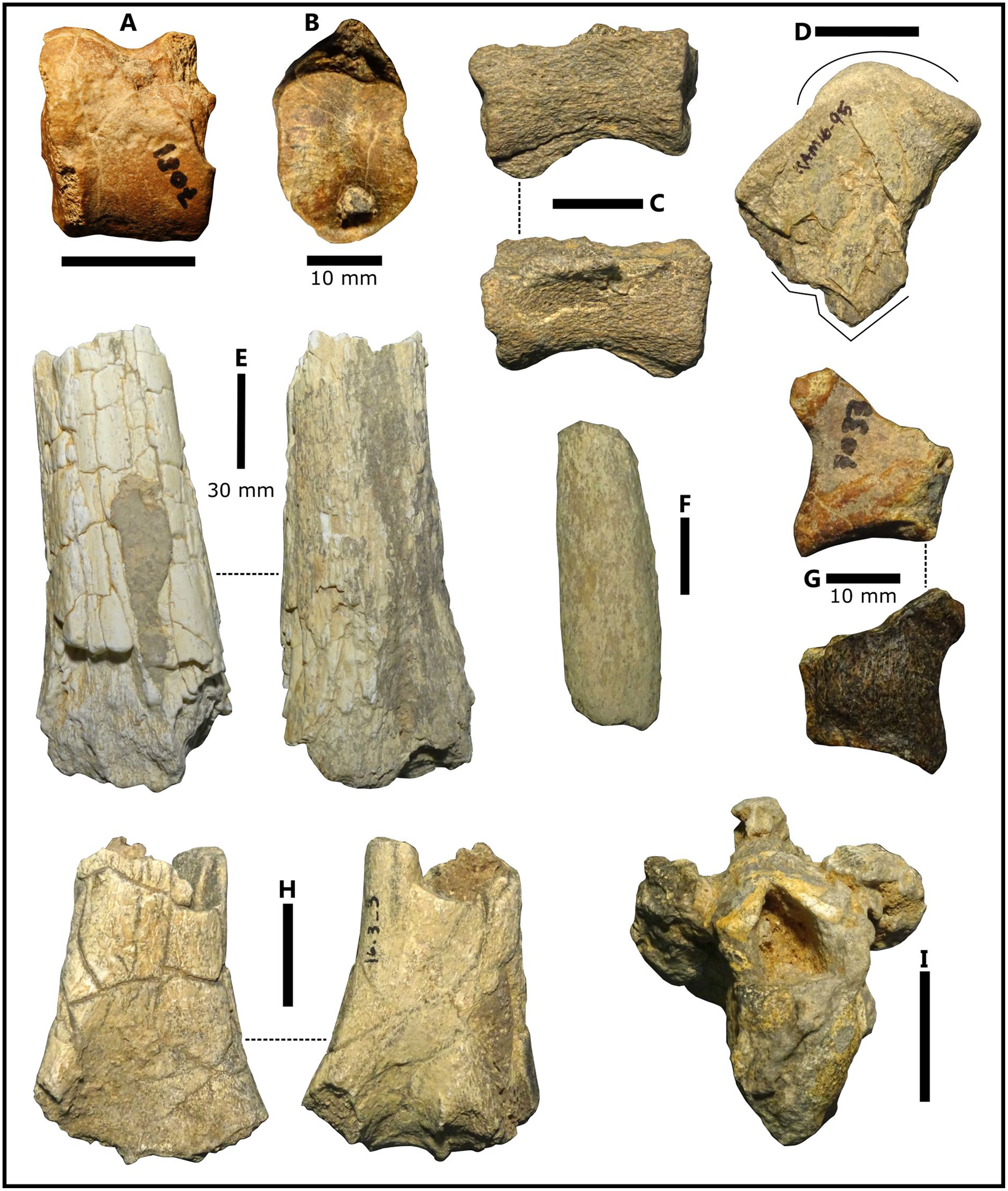
Seventy-six fossils were recovered at KAM-1, representing four taxa and matching those reported by Thomas et al. (Reference Thomas, Geraads, Janjou, Vaslet, Memesh, Billiou and Bocherens1998). Small vertebrate remains are absent, and small fossils in general are underrepresented at the site (Fig. 7). Fossils range in colour from light brown and grey to bleached white (Fig. 8E), and several specimens exhibit manganese staining. No fossils were unweathered, and most exhibited stage 2 and 3 weathering (n = 31, 81%). For two-thirds of the fossils it was impossible to determine weathering stage due to significant abrasion and cortical exfoliation, and this is the case for most assemblages analysed here. Wind abrasion appears to have been particularly pronounced in the KAM-1 fossil assemblage, and all specimens exhibit some degree of rounding, pitting, and polish, with some fossils having been reduced to near pebbles (Fig. 8F).
(color online) Distribution of frequencies (%) for each specimen size range.

(color online) Examples of taphonomic modifications. (A) Carnivore-gnawed bovid astragalus (KAM 4 S lake; KAM-4/7081); (B) bovid distal phalanx with carnivore tooth puncture (KAM 4 S lake; KAM-4/7033); (C) wind-eroded vertebra centrum with cancellous bone exposed (KAM 4 NW lake); (D) unidentified fragment displaying rounding and slight polish on one side (top) and sharp edges on the other (bottom) (KAM 4 NW lake; KAM-16/95); (E) large midshaft heavily wind-abraded and bleached on one side (left) and less bleached and displaying weathering stage 4 on the other (right) (KAM1); (F) heavily wind-abraded midshaft fragment of large animal (KAM1); (G) manganese-stained fragment (KAM 4 S lake; KAM4/7033); (H) bovid distal humerus exhibiting post-fossilisation root damage (16.3_3); (I) plastically deformed thoracic vertebrae (KAM 4 NW lake; KAM16/71). Scale bars are 20 mm unless otherwise specified.
Limb-bone elements dominate the assemblage (n = 25, 76% of NISP) and long-bone midshafts make up most of these (n = 15, 45% of NISP). Most midshafts have fracture angle, outline, and edge characteristics consistent with dry fracturing (n = 14, 74%), and most retain their complete circumference (n = 12, 67%). A handful of specimens exhibit plastic deformation (i.e., crushing), suggesting that the site once lay under a significant weight of sediment, and rare instances of plastic deformation were also observed in the KAM-4 and Site 16.3 assemblages (e.g., Fig. 8I). Easily transported elements (Voorhies groups I and II) are best represented, and the tooth to vertebrae ratio (T/V = 2.5) falls between the values reported by Behrensmeyer and Dechant Boaz (Reference Behrensmeyer, Dechant Boaz, Behrensmeyer and Hill1980) for minimal and strong hydraulic sorting.
Khall Amayshan-4 (KAM-4) NW lake
Renewed investigations at KAM-4 revealed previously unrecognised palaeolake deposits (Fig. 2), and fossils were recovered from the surfaces of three of these: KAM-4 NW lake, KAM-4 NE lake, and KAM-4 S lake. The KAM-4 NW lake fossils were found concentrated on a sandy area between two of the excavated trenches (Trenches 1 and 3) that is interpreted as an ancient sandspit that led into the lake. Twenty-two fossils were discovered during excavations and represent the first time that fossils have been recovered from within stratigraphy at the site.
The KAM-4 NW lake assemblage is one of the largest and most taxonomically diverse sites reported here, with a total of 596 fossils representing eight taxa. Remains of small vertebrates—which comprise rodents, birds, tortoises, and small bovids—were recovered from atop the deposit and during the excavation of palaeolake sediments and were relatively more abundant in the latter. Medium-sized animals dominate the assemblage, and it seems likely that most of this material is attributable to one or several medium-sized bovids (e.g., Oryx). Large-sized animals are very rare, but recovered materials indicate the presence of Hippopotamus and an elephantid.
Fossils range in colour from grey and light brown to maroon, the latter being more characteristic of the excavated assemblage (Fig. 4A and B). Manganese staining and root etching were occasionally observed, and two bone fragments recovered during excavation are blackened and appear burnt, although additional analyses are needed to confirm this. Likewise, the KAM-4 NW lake assemblage appears significantly impacted by wind abrasion, with all fossils exhibiting rounding, pitting, and polish, and in some instances significant exposure of cancellous bone (e.g., Fig. 8C). Inter-specimen differences in abrasion, more characteristic of wind abrasion, were also observed (e.g., Fig. 8D). The fossils for which weathering could be reliably determined range between weathering stages 0 and 4, with most falling into the latter two stages (n = 153, 74%), and a Spearman's test found a significant positive correlation between specimen size (length) and weathering stage (Spearman's rho, r s = 0.166, P < 0.018). A small number of fossils, mostly appendicular elements, show evidence of carnivore gnawing (n = 8, 1.3%).
Limb-bone elements make up nearly half of the identifiable material (n = 109, 47% of NISP) followed by vertebrae (n = 58, 25% of NISP) and small compact bones like phalanges, carpals, and tarsals (n = 33, 14% of NISP). Most limb bones are fragmented such that they retain less than half of their circumference (n = 56, 78%) and exhibit features typical of dry fracturing (n = 36, 72%). Abundant fragile vertebrae and small animal remains (e.g., birds, rodents) suggest that the assemblage has undergone minimal density-mediated attrition. This is also borne out by the lack of correlation between medium-sized bovid long-bone survivorship (MNE) and wildebeest bone mineral density (Spearman's rho, r s = −0.192, P = 0.369; Supplementary Table S11). This should, however, be interpreted with caution, given the heavily fragmented nature of the limb-bone portion of this assemblage (see Marean et al., Reference Marean, Domínguez-Rodrigo and Pickering2004; Clark, Reference Clark2019). There is a clear bias toward easily transported elements (Voorhies groups I and II) and hydraulic winnowing is also supported by the low tooth to vertebrae ratio (T/V = 0.03). Very small animal remains (rodents, birds, and tortoise)—which are relatively abundant at the site—also support the preferential transport of easy-to-transport remains. However, the bulk of these findings (n = 13, 72.2%) were recovered from the excavated portion of the assemblage, suggesting that once exposed, microfaunal remains are transported or destroyed. Alternatively, microfaunal remains may have been simply missed during pedestrian surveys, and more intensive surveys should be undertaken in the future to test for this.
Khall Amayshan-4 (KAM-4) NE lake
The NE lake fossil assemblage is the smallest and least diverse of the KAM-4 fossil deposits, with only 17 fossils representing two taxa. Small vertebrates are absent, medium-sized animals make up about two-thirds of the assemblage, while large animals make up the remaining third and indicate the possible presence of Hippopotamus.
Fossils are typically brown in colour and some are manganese stained. Fossils show weathering stages 2–4 with stage 3 being most common (n = 6, 50%). All fossils exhibit rounding, pitting, and/or polish consistent with abrasion by windblown sediment. All identified specimens are appendicular elements, half of which are long-bone midshaft fragments (n = 5, 56% of NISP). Carnivore tooth–marked specimens are relatively common (n = 5, 29%) and include two measurable tooth pits with dimensions of 2.8 × 2.2 mm and 4.6 × 3.6 mm (Supplementary Table S10). Green- (n = 2, 50%) and dry-fractured (n = 2, 50%) long bones are equally abundant, and long bones retaining less than half (n = 4, 57%) and their complete circumference (n = 3, 43%) are similarly represented.
Khall Amayshan-4 (KAM-4) S lake
Sixty-seven fossils were recovered from the KAM-4 S lake representing at least two taxa. Small vertebrates are represented by a few small bovid remains as well as a single piece of ostrich eggshell, which, given that ostriches inhabited the Arabian Peninsula until historic times (Potts, Reference Potts2001), may be of more recent origin. Medium-sized mammals make up the remainder of the fossil material, and it appears that much of this material is attributable to one or several medium-sized bovids (e.g., Oryx).
Fossils range from dark brown to maroon, exhibit rounding and pitting characteristic of wind abrasion, and occasional root etching and manganese staining (e.g., Fig. 8G). Fossils appear less weathered than at the other sites investigated here, reaching maximally to weathering stage 3 and with most falling into stage 2 (n = 27, 54%). Carnivore tooth–marked bones are relatively abundant (n = 10, 15%) and a single tooth pit measured 5.0 × 4.4 mm (Supplementary Table S10). Most midshaft fragments are represented by pieces retaining less than half their circumference (n = 4, 80%), and most of these have fracture angle, shape, and edge characteristics consistent with dry fracturing (n = 6, 75%).
Site 16.3
Follow-up investigations at Site 16.3 showed additional sandy marl sediments situated above the upper diatomite unit that were not recognised by Rosenberg et al. (Reference Rosenberg, Preusser, Risberg, Plikk, Kadi, Matter and Fleitmann2013), perhaps because they were only preserved in some sections of the site. These consisted of silty sediments capped by a sandstone-like sandy marl and are interpreted as representing the final desiccation phase of the lake, meaning that the sequence records an entire dry–wet–dry cycle. The recovery of fossils from areas where the sandstone had eroded suggests that bones were deposited as the lake was drying. Most fossils were found on the surface of the palaeolake and concentrated in the southern half of the deposit, while at the centre of the palaeolake a single Syncerus skeleton was found eroding out of the surface of the palaeolake sediment (Fig. 9A and B).
(color online) Landscape images of the sites, fossils, and modern bone accumulations. (A) Image of the Site 16.3 palaeolake with researchers (white arrow) indicating the location of the Syncerus skeleton; (B) Syncerus skeleton eroding out of the Site 16.3 palaeolake sediments; (C) lithic artefacts and probable Syncerus skeleton at site WNEF16_1; (D) medium-sized bovid scapula found eroding out of the surface of the KAM-4 NW lake; (E–F) modern camel carcass exhibiting varying stages of preservation and weathering.

The Site 16.3 fossil assemblage is the largest assemblage investigated here, with 615 fossils recovered representing six taxa, although the Site 16.3 lake is comparatively large and a non-insignificant number of these fossils can be attributed to a single large bovid. Small vertebrates are again rare, and although medium-sized mammals are most abundant, only a single horn core tentatively attributed to Oryx could be more precisely identified. Large-sized mammals are abundant and include Hippopotamus amphibius (NISP = 23, MNI = 2) and Syncerus sp. cf. S. antiquus (NISP = 53, MNI = 1). A dense concentration of Syncerus and unidentifiable bone fragments (n = 90) was recovered from an area of ~3 m2 at the centre of the palaeolake exposure and, given their propinquity and similar appearance and preservation, are interpreted as a single Syncerus skeleton.
Fossils range from pale yellow to brown, and most specimens exhibit pitting, rounding, and polish consistent with wind abrasion (e.g., Fig. 8H). Some fossils retain sandstone cemented to their surface, consistent with the hypothesis that the fossils eroded from the uppermost sandstone unit preserved in some sections of the site. Manganese staining (e.g., Fig. 6D) and root etching were occasionally observed, with some instances of the latter being shallow and differing in colour from the surrounding bone (e.g., Fig. 8H), indicating that etching occurred more recently and probably following fossilisation (Fernández-Jalvo and Andrews, Reference Fernández-Jalvo and Andrews2016). Fossils show weathering stages 0–4, with stages 2 and 3 being most common (n = 172, 63%) and, as at KAM-4 NW lake, there is a positive correlation between specimen size (length) and weathering (Spearman's rho, r s = 0.227, P < 0.001).
Thirty-nine elements (6.3%) show evidence for carnivore gnawing, including 28 measurable tooth pits with major and minor axes ranging from 1.6 mm to 9.7 mm and 1.5 mm to 7.0 mm, respectively (Supplementary Table S10). Two tooth pits on epiphyseal and diaphyseal fragments measured 7.7 × 7.0 mm and 7.5 × 6.7 mm, respectively, being most consistent with gnawing by a large carnivore such hyena or lion (cf. Delaney-Rivera et al., Reference Delaney-Rivera, Plummer, Hodgson, Forrest, Hertel and Oliver2009). Appendicular elements are abundant (n = 64, 43% of NISP), as too are carpals/tarsals (n = 21, 14% of NISP), and fragile vertebrae (n = 21, 14% of NISP) and ribs (n = 17, 11% of NISP). Most long bones retain less than half their original circumference (n = 17, 65%) and exhibit fracture patterns consistent with dry fracturing (n = 16, 62%). Abundant easily transported elements (Voorhies groups I and II) and the low tooth to vertebrae ratio (T/V = 0.0) suggest that the assemblage may have undergone some hydraulic winnowing.
WNEF16_1
Similar to the individual Syncerus skeleton recovered at Site 16.3, the WNEF16_1 assemblage comprises a single large buffalo skeleton—provisionally attributed to Syncerus—eroding out of the palaeolake surface in a dense 1-m2 concentration. While the bulk of the assemblage consists of unidentifiable bone fragments, most appear to be from a large animal, are similar in preservation and appearance, and are interpreted as representing a single individual. Fossils are sandy in colour and exhibit occasional superficial root etching. Interestingly, the WNEF16_1 assemblage exhibits the full spectrum of weathering stages, with most falling into stages 2 and 3 (n = 146, 83%), and demonstrates, rather importantly, that significant variations in weathering can occur across very small spatial and temporal scales. Again, there is a positive correlation between specimen length and weathering (Spearman's rho, r s = 0.311, P < 0.001). The assemblage is very heavily fragmented, with almost the entire assemblage comprising small midshaft (n = 91, 43% of NRSP) and unidentifiable (n = 111, 53% of NRSP) bone fragments. All long bones have been fragmented such that they retain less than half their circumference (n = 91, 100%), and most display fracture angle, outline, and edge characteristic consistent with dry fracturing (n = 42, 67%).
DISCUSSION
Species representation and palaeoenvironmental implications
This study represents the first widespread taphonomic study of fossil faunal assemblages in the Arabian Peninsula and an important initial step in elucidating the processes governing fossil preservation and site formation in this unique region. Overall, the fauna identified here are comparable to other Pleistocene sites in the western Nefud Desert and include three previously unrecognised taxa in the Arabian Pleistocene fossil record—Nesokia sp., Muridae sp., and Hippotragus sp. The fauna from sites KAM-1 and Site 16.3, notably Hippopotamus, Equus, and Syncerus, is consistent with palaeoenvironmental data that demonstrate that at times during Marine Isotope Stage 5 (MIS 5; ca. 130–74 ka) the western Nefud Desert was significantly more humid, with expansive grasslands and interdunal lakes (e.g., Rosenberg et al., Reference Rosenberg, Preusser, Risberg, Plikk, Kadi, Matter and Fleitmann2013; Jennings et al., Reference Jennings, Singarayer, Stone, Krebs-Kanzow, Khon, Nisancioglu and Pfeiffer2015; Breeze et al., Reference Breeze, Groucutt, Drake, White, Jennings and Petraglia2016; Groucutt et al., Reference Groucutt, Grün, Zalmout, Drake, Armitage, Candy and Clark-Wilson2018). The presence of Hippopotamus and elephant at KAM-4 NW lake suggests a similar environmental scenario. While less can be reliably said about the other sites, the small sample sizes and lack of chronological data, the presence of taxa such as Hippotragus sp. (as at WNEF16_25), and the accompanying palaeolake sediments and taphonomic evidence (see next section of this Discussion) all suggest that these assemblages were deposited under conditions more humid than characterize the region today.
Overall, small vertebrates are drastically underrepresented in the Arabian fossil record. Even today, the hyperarid Nefud Desert is host to an array of small birds, reptiles, rodents, lagomorphs, and carnivores (see Harrison and Bates, Reference Harrison and Bates1991), and greater precipitation and grassland availability during interglaciations (i.e., an increase in primary productivity) would have only increased small animal species richness and abundance (the “energy-richness hypothesis”; Hawkins et al., Reference Hawkins, Field, Cornell, Currie, Guégan, Kaufman and Kerr2003). The scarcity of small animal remains may reflect a sampling bias against smaller and more difficult to spot fossils during pedestrian surveys and is, in part, supported by the more abundant and diverse small animal assemblages in the excavated portion of the KAM-4 NW lake assemblage, as well as at the nearby sites of Al Wusta (Groucutt et al., Reference Groucutt, Grün, Zalmout, Drake, Armitage, Candy and Clark-Wilson2018) and Ti's al Ghadah (Stimpson et al., Reference Stimpson, Lister, Parton, Clark-Balzan, Breeze, Drake and Groucutt2016; Stewart et al., Reference Stewart, Louys, Groucutt, Candy, Clark-Wilson, Breeze and Drake2019a). Alternatively, this bias might be the result of taphonomic processes that preferentially destroy smaller bones, and other researchers have noted that small animals have a reduced chance of being preserved in the fossil record (Behrensmeyer and Dechant Boaz, Reference Behrensmeyer, Dechant Boaz, Behrensmeyer and Hill1980; Haynes, Reference Haynes1988; Andrews, Reference Andrews, Lindsay, Fahlbusch and Mein1990). Moreover, while microfauna (small mammals, birds, and reptiles) may be accumulated by large carnivores (e.g., Kruuk, Reference Kruuk1976; Williams et al., Reference Williams, Andrews, García-Morato, Villa and Fernández-Jalvo2018), they are more typically accumulated by smaller mammals and raptors (Fernández-Jalvo et al., Reference Fernández-Jalvo, Andrews, Denys, Sesé, Stoetzel, Marin-Monfort and Pesquero2016) and, as such, have vastly different taphonomic histories. The small sample size in the present study precludes any detailed analysis, but future studies may elucidate the accumulation processes of microfauna in lakeside environments in Arabia.
Medium-sized bovids dominate the Arabian Pleistocene fossil record, and to date, remains of Oryx, Hippotragus, and Alcelaphinae have been identified (McClure, Reference McClure1984; Stimpson et al., Reference Stimpson, Lister, Parton, Clark-Balzan, Breeze, Drake and Groucutt2016; Groucutt et al., Reference Groucutt, Grün, Zalmout, Drake, Armitage, Candy and Clark-Wilson2018; Stewart et al., Reference Stewart, Louys, Groucutt, Candy, Clark-Wilson, Breeze and Drake2019a). Oryx is particularly well represented in the Arabian Pleistocene fossil record, and analysis of the morphometry and morphology of some of these remains suggest that they may represent a now-extinct species, as has been alluded to for the remains recovered from the middle Pleistocene site of Ti's al Ghadah (Thomas et al., Reference Thomas, Geraads, Janjou, Vaslet, Memesh, Billiou and Bocherens1998; Stimpson et al., Reference Stimpson, Lister, Parton, Clark-Balzan, Breeze, Drake and Groucutt2016). Large-sized animals include Syncerus, Hippopotamus amphibius, and elephant, and these taxa have been identified at other nearby sites (Stimpson et al., Reference Stimpson, Lister, Parton, Clark-Balzan, Breeze, Drake and Groucutt2016; Groucutt et al., Reference Groucutt, Grün, Zalmout, Drake, Armitage, Candy and Clark-Wilson2018), as well as farther south (McClure, Reference McClure1984). Hippopotamus is relatively common in the Arabian fossil record, perhaps reflecting the research focus on palaeolake deposits.
Taphonomic analysis
The taphonomic study of the fossils also provided some key insights into the environmental and depositional histories of the assemblages. The dark brown/maroon colouration of some of the assemblages (as at KAM-4 NW lake; Fig. 4A) is indicative of deposition in oxygenated and biologically active soils, while manganese staining commonly reflects deposition in water or water-lain sediments and is consistent with the lacustrine setting in which the fossils were recovered (e.g., Fernández-Jalvo and Andrews, Reference Fernández-Jalvo and Andrews2016; Fig. 8G). Root etching was occasionally observed and, in some instances, was deep and similar in appearance to the cortical bone, suggesting that etching occurred before fossilisation. In contrast, some root marks (as at WNEF16_1 and Site 16.3) were more surficial and differed in colour from the surrounding fossil bone, indicating etching occurred more recently (Fernández-Jalvo and Andrews, Reference Fernández-Jalvo and Andrews2016; Fig. 8H). The latter is interesting in that it suggests that fossils remained near the surface during subsequent humid phases, probably facilitated by slow sedimentation rates and deflation during more arid intervals.
The varied weathering pattern observed at large and taxonomically diverse sites such as KAM-4 NW lake and Site 16.3 probably reflects attritional bone accumulations in which carcasses were continually added to the landscape. Lakes are attractive features in semiarid settings and provide a constant input of bones variably affected by weathering processes through time (Behrensmeyer, Reference Behrensmeyer1978; Haynes, Reference Haynes1988). Interestingly, the single Syncerus skeleton at WNEF16_1 exhibits the full spectrum of weathering stages, demonstrating that significant variations in weathering can occur across very small spatial and temporal scales. During our surveys, we also observed a camel carcass that, in a single cranium, was partially fleshed below the surface of the sand but exhibited stage 2 weathering above (Fig. 9C and D). Andrews and Whybrow (Reference Andrews and Whybrow2005) also observed this, albeit not to the extent reported here, when monitoring a single camel carcass in a desert environment over a 15-year period; the authors attributed this to shifting sands covering and protecting small bones such as ribs and vertebrae. Likewise, smaller fossils are less weathered in some of the sites analysed here, although this is may be due to other factors preferentially protecting smaller bones (e.g., vegetation, lake water). While poor preservation and extensive wind abrasion make commenting on the duration of exposure problematic, we note that the scarcity of unweathered bone suggests that burial was typically slow or that bones were regularly re-exposed before fossilisation.
Wind abrasion is perhaps the most significant process affecting the Arabian surface fossil deposits and is known to be particularly prevalent in desert regions where there is abundant sandy substrate and little in terms of vegetation to stabilise sediments (Fernández-Jalvo and Andrews, Reference Fernández-Jalvo and Andrews2016). The KAM-1 and KAM-4 fossil assemblages are most significantly impacted by wind abrasion, with all fossils showing some degree of rounding, pitting, and/or polish consistent with abrasion by windblown sand. While the extent of wind abrasion probably largely reflects time since exhumation, the position in the landscape relative to the surrounding dunes may also play a role, with dunes acting as either wind funnels or protective barriers. It is also possible that wind has spatially redistributed fossils in the landscape. Indeed, observations in a similar desert environment (Fuego-Patagonia) found strong winds significantly redistributed lithic artefacts in the landscape, many of which exceeded the size and weight of fossils reported here (Borrazzo, Reference Borrazzo2016). Such a process could explain the contrast between the densely concentrated Syncerus skeleton and the sparsely concentrated loose surface fossils at Site 16.3 (Figs. 3 and 9B).
Carnivores probably also played a role in distributing bones across the landscape, and despite the paucity of carnivore remains in the present study, their presence is inferred from tooth-marked bone (e.g., Fig. 8B). Large tooth pits, tooth notches, and green-fractured bones attest to the role of large bone crushing carnivores, such as hyena, in the accumulation of at least some of these assemblages (KAM-4, Site 16.3). That said, tooth-marked specimens are typically very rare and/or assemblages too small to provide more detailed insights into the role of carnivores as bone accumulators. The individual Syncerus skeleton from Site 16.3 does, however, appear to have been primarily accumulated by large carnivores, as suggested by gnawed ribs, epiphyses, and midshaft fragments. The scarcity of carnivore tooth marks here may be due to the various aforementioned attritional processes and greater evidence for carnivore processing at the well-preserved site of Ti's al Ghadah (Stewart et al., Reference Stewart, Louys, Groucutt, Candy, Clark-Wilson, Breeze and Drake2019a) lends some credence to this hypothesis.
Overall, skeletal part representation is poor, and unidentifiable fragments dominate across all assemblages (making up two-thirds of all material analysed here), followed by midshaft fragments, and small compact bones. The predominance of dense elements suggests that these assemblages have undergone significant density-mediated attrition, although the primary taphonomic process controlling for this remains difficult to assess. The scarcity of dense dental remains in the Arabian fossil deposits is at odds with this, but Behrensmeyer (Reference Behrensmeyer1978) noted teeth in the Amboseli National Park, Kenya, rapidly disintegrated as a result of surface desiccation (see also Conard et al., Reference Conard, Walker and Kandel2008). Such a process may explain the scarcity of dental remains in the Nefud Desert fossil assemblages and is perhaps best exemplified at WNEF16_1, where, except for a single complete molar, dental remains are represented by heavily fragmented and fragile enamel and dentine splinters. The KAM-4 NW lake and Site 16.3 assemblages appear to have been less influenced by density-mediated attrition, as evidenced by abundant ribs, vertebrae, and small fragile animal remains. Overall, the results suggest that while density-mediated attrition was probably significant, it may not fully explain the taxonomic and skeletal part representation across all sites.
The clear bias towards easily transported elements and low tooth-to-vertebrae ratios suggest that some of the assemblages may have been influenced by hydraulic winnowing, perhaps as a result of lake-level fluctuations. Indeed, previous studies at KAM-1 found that the lake underwent frequent lake-level fluctuations (Rosenberg et al., Reference Rosenberg, Preusser, Risberg, Plikk, Kadi, Matter and Fleitmann2013) and preliminary analysis of the KAM-4 NW lake sediments have identified fossil-bearing units (3a, 3b, and 4b; Fig. 2) with abundant allogenic sands, low relative CaCO3, and “rip up” marls (i.e., eroded and reworked marl fragments) indicative of a dynamic lake system. However, as highlighted earlier, the low number of teeth at these sites may also be explained by the preferential destruction of dental remains in lacustrine settings, and the values reported here are similar to those for nontransported bone assemblages from lake margin habitats in the Amboseli National Park, Kenya (Behrensmeyer and Dechant Boaz, Reference Behrensmeyer, Dechant Boaz, Behrensmeyer and Hill1980). While changes in local landscape hydrology are likely to have altered bone accumulations in some form, their specific influence is not currently discernible.
Bone breakage is ubiquitous, and most long bones retain less than half of their original circumference and exhibit fracture patterns consistent with dry fracturing. The KAM-1 assemblage is unique in having more complete long bones, which may reflect the more resilient bones of the larger animals preserved at the site (Hippopotamus, Syncerus). Bone fragmentation may have also been promoted by the physiochemical stresses associated with repeated temperature and moisture fluctuations, which are known to accelerate bone degradation and weathering (Behrensmeyer, Reference Behrensmeyer1978; Haynes, Reference Haynes1988; Pokines et al., Reference Pokines, Faillace, Berger, Pirtle, Sharpe, Curtis, Lombardi and Admans2018), and it has been argued that the poor preservation of fossil assemblages within the South African interior is the result of bone deposition within river, lake, and spring margins (Hutson, Reference Hutson2018). Dense, highly mineralised fossils, such as fossil teeth, have been found to be disproportionately affected by drastic temperature fluctuations, leading to their underrepresentation in some fossil assemblages (Conard et al., Reference Conard, Walker and Kandel2008).
More recently, fragmentation may have been exacerbated by insolation and salt weathering of fossils, processes particularly pronounced in desert environments and thought to be the source of much of the fragmentary geological material that fills the Nefud Desert today (Edgell, Reference Edgell2006). The former involves the differential expansion and contraction of rock constituents brought on by extreme diurnal temperature variations (Gutiérrez, Reference Gutiérrez2005), whereas the latter involves the precipitation and expansion of salt crystals within rock cracks (Cooke and Smalley, Reference Cooke and Smalley1968; Cooke, Reference Cooke1981). Palaeolakes in the Nefud Desert contain abundant carbonates and sulphates (Groucutt et al., Reference Groucutt, Grün, Zalmout, Drake, Armitage, Candy and Clark-Wilson2018; see also Fig. 4K), and salt crystals were identified in the WNEF16_25 horn core that was found fragmented but retaining its shape in the landscape (Fig. 4J). Bauer (Reference Bauer1988, p. 45) noted that animal teeth from caves in northeast Saudi Arabia were “split and crumbling” due to the formation of gypsum crystals within the lamellar bone. Mehlman (Reference Mehlman1987) went as far to suggest that salt weathering may be the most significant factor driving the breakdown of fossil material at Lake Eyasi in East Africa.
Finally, there are several instances of plastic deformation, and similar observations were made nearby at the site of Al Wusta (Groucutt et al., Reference Groucutt, Grün, Zalmout, Drake, Armitage, Candy and Clark-Wilson2018). This could be the result of significant lake sediment buildup or dune migration over the sites. The latter is supported by the discovery of buried or partially buried palaeolakes beneath the present-day sand dunes (Schulz and Whitney, Reference Schulz and Whitney1986; Breeze et al., Reference Breeze, Groucutt, Drake, Louys, Scerri, Armitage and Zalmout2017), while the varying positions of lakes at KAM-4 also suggest that the dune topography shifted substantially between phases of lake formation. Taken together, processes such as salt weathering, insolation weathering, and plastic deformation appear to have significantly modified the Arabian fossil assemblage appearance and composition and are likely to continue to do so into the future.
CONCLUSIONS
The fauna identified in this study strongly support the idea that at times during the Pleistocene, the western Nefud Desert boasted large grasslands and permanent river and lake systems. Notable is the presence of Hippopotamus, Syncerus, and elephants at several noncontemporaneous sites in the Nefud Desert (Thomas et al., Reference Thomas, Geraads, Janjou, Vaslet, Memesh, Billiou and Bocherens1998; Stimpson et al., Reference Stimpson, Lister, Parton, Clark-Balzan, Breeze, Drake and Groucutt2016; Groucutt et al., Reference Groucutt, Grün, Zalmout, Drake, Armitage, Candy and Clark-Wilson2018) and elsewhere in Arabia (McClure, Reference McClure1984), demonstrating that pluvial phases were periodically wet and vegetated enough to allow for the dispersal of large water-dependent taxa into the Arabian interior. Climatic amelioration also facilitated the dispersal of hominins (Groucutt and Petraglia, Reference Groucutt and Petraglia2012) and large carnivores (Stimpson et al., Reference Stimpson, Lister, Parton, Clark-Balzan, Breeze, Drake and Groucutt2016; Stewart et al., Reference Stewart, Louys, Groucutt, Candy, Clark-Wilson, Breeze and Drake2019a, Reference Stewart, Louys, Price, Drake, Groucutt and Petraglia2019b) into Arabia, with the presence of the latter inferred here from tooth-marked bone. While the role that carnivores played in the accumulation and modification of the Arabian fossil deposits remains difficult to assess, it seems likely it was greater than the current observations suggest. The same seems likely for hominins, given the extensive Arabian archaeological record (Groucutt and Petraglia, Reference Groucutt and Petraglia2012) and likely evidence for carcass processing by hominins at the well-preserved site of Ti's al Ghadah (Roberts et al., Reference Roberts, Stewart, Alagaili, Breeze, Candy, Drake and Groucutt2018; Stewart et al., Reference Stewart, Louys, Groucutt, Candy, Clark-Wilson, Breeze and Drake2019a).
The sedimentological and taphonomic data also indicate that bones were deposited in conditions more humid than characterize the region today. Most striking about the Arabian fossil assemblages is their significant attrition, obscuring and fragmenting most finds. Fragmentation of bone may have been further exacerbated by the physiochemical stresses associated with lacustrine environments, principally repeated wetting and drying events. Perhaps even more significant in the assemblages studied here are post-exhumation processes such as wind abrasion, insolation, and salt weathering. Studies in hyperarid environments such as Arabia and the Sahara are further confounded by rapid sediment deflation and depositional hiatuses that promote the mixing of temporally discrete deposits. Indeed, the lack of evidence of butchery in assemblages with tightly associated fossils and lithic artefacts (as at WNEF16_1) suggests that there may not be an immediate temporal correlation between spatially associated objects. While more work is needed to investigate the impact of desertic processes on fossils, the fossils examined here clearly demonstrate that these processes are highly destructive and have drastically altered fossil appearance and assemblage composition.
ACKNOWLEDGMENTS
We thank Curtis Marean, Robin Dennell, Peter Andrews, and two anonymous reviewers for their comments on this paper. The Palaeodeserts Project thanks His Royal Highness Prince Sultan bin Salman, former president of the Saudi Commission for Tourism and National Heritage (SCTH), and the vice presidents, Ali Ghabban and Jamal Omar, for supporting our fieldwork in Saudi Arabia. We also thank Abdullah Al Zahrani and Abdulaziz al Omari of the SCTH for logistical assistance and advice. President of the Saudi Geological Survey Hussain. M. Otaibi, past president Zohair A. Nawab, and vice president Saleh El-Sefrey for providing research logistics. We thank the Saudi Geological Survey team for their help in the field: Abdulah Memesh, Ammar Abdulshakoor, Adel Matari, Ahmed Bahameem, and Abdou Al-Massari. We acknowledge the generous financial support of the SCTH, the Max Planck Society, the European Research Council (Advanced Grant to MDP, 295719 PALAEODESERTS: Climate Change and Hominin Evolution in the Arabian Desert: Life and Death at the crossroads of the Old World), and the Leverhulme Trust (PG-2017-087). HSG thanks the British Academy for funding. PSB acknowledges funding from the Leverhulme Foundation. MS would like to that the PANGEA Research Centre for funding. JL's research is supported by the Australian Research Council (ARC) Future Fellowship Grant (FT160100450).
SUPPLEMENTARY MATERIAL
The supplementary material for this article can be found at https://doi.org/10.1017/qua.2020.6.


 Open access

