




Elder abuse (EA), also known as the abuse of older people or older adult abuse/mistreatment, is a prevalent phenomenon, estimated to affect one in six community-dwelling older adults annually (Yon et al., Reference Yon, Mikton, Gassoumis and Wilber2017), with rates ranging from 2 to 33% of older people in institutional settings such as care homes (Yon et al., Reference Yon, Ramiro-Gonzalez, Mikton, Huber and Sethi2019). Often defined as ‘a single or repeated act, or lack of appropriate action, occurring within any relationship where there is an expectation of trust, which causes harm or distress to an older person’ (World Health Organization, 2024, para. 2), EA is an impactful, albeit often overlooked, type of interpersonal violence (Fraga Dominguez et al., Reference Fraga Dominguez, Storey and Glorney2021; Yunus et al., Reference Yunus, Hairi and Choo2019).
Under-reporting of EA remains a major challenge resulting in many hidden cases (Truong et al., Reference Truong, Burnes, Alaggia, Elman and Rosen2019), with only 15% of cases reported to police or other authorities (Burnes, Acierno, & Hernandez-Tejada, Reference Burnes, Acierno and Hernandez-Tejada2019). Although victims can self-report abuse, research has identified many barriers impacting their ability to disclose (Fraga Dominguez et al., Reference Fraga Dominguez, Storey and Glorney2021), and reporting EA to authorities and accessing the criminal justice system may be especially challenging (Brown & Gordon, Reference Brown and Gordon2022; Fraga Dominguez et al., Reference Fraga Dominguez, Storey and Glorney2021; Simmons et al., Reference Simmons, Wiklund and Ludvigsson2022). Some individuals (e.g., older people living with dementia and/or cognitive impairment) are more vulnerable to EA and these vulnerabilities may also impact their ability to self-advocate (Storey, Reference Storey2020). In these cases, the role of others in advocating for the victim is particularly important.
Much research on EA reporting by individuals other than victims has focused on professionals (Fraga Dominguez et al., Reference Fraga Dominguez, Storey and Glorney2021; Snow et al., Reference Snow, Wyman, Malloy, Brubacher and Warren2023; Truong et al., Reference Truong, Burnes, Alaggia, Elman and Rosen2019). However, evidence suggests that EA victims are more likely to disclose to informal sources (e.g., family and friends) than to formal sources (Fraga Dominguez et al., Reference Fraga Dominguez, Storey and Glorney2021). From those informal sources, victims may not always be looking for specific support. Research on older victims has found that some victims may: want to cope with the situation on their own, want help but be unsure of the type, or want a specific type of help (e.g., emotional support or someone to talk to, practical help, or someone to intervene on their behalf; Simmons et al., Reference Simmons, Wiklund and Ludvigsson2022). Given the frequency of informal disclosure, the role of those who are not professionally related to the victim and their involvement in EA cases have received increasing attention (e.g., Breckman et al., Reference Breckman, Burnes, Ross, Marshall, Suitor, Lachs and Pillemer2018; Fraga Dominguez et al., Reference Fraga Dominguez, Storey and Glorney2022a; Kilaberia & Stum, Reference Kilaberia and Stum2022; Kilaberia et al., Reference Kilaberia, Fuhrman and Stum2023). This focus has been on non-abusing family members, friends, or neighbours of the victim who support victims in coping with an EA experience (Breckman et al., Reference Breckman, Burnes, Ross, Marshall, Suitor, Lachs and Pillemer2018; Burnes et al., Reference Burnes, Breckman, Henderson, Lachs and Pillemer2019). Research has found that almost 60% of individuals who are aware of a relative, friend, or neighbour experiencing EA become involved as helpers (Breckman et al., Reference Breckman, Burnes, Ross, Marshall, Suitor, Lachs and Pillemer2018). Although there is no agreed definition of what the help provided involves, it could include gathering financial documents, and offering financial or housing support (Breckman et al., Reference Breckman, Burnes, Ross, Marshall, Suitor, Lachs and Pillemer2018). Conceptualizations of help-seeking and help-giving are not consistent among researchers, victims, or those who seek to support them, which may lead to disagreement between victims and non-professional supporters about what helping should involve, whether it should involve formal systems (e.g., police or adult protection services), and what a desired or successful outcome looks like (Fraga Dominguez et al., Reference Fraga Dominguez, Storey and Glorney2021, Reference Fraga Dominguez, Storey and Glorney2022a; Kilaberia & Stum, Reference Kilaberia and Stum2022; Simmons et al., Reference Simmons, Wiklund and Ludvigsson2022). Thus, by intervening or seeking help, non-professional supporters may not always respect victims’ wishes, particularly if they are not providing help that matches the type the victim needs or wants.
Within the EA field, several researchers have referred to individuals who are not professionally related to the victim and who provide support as ‘concerned persons’ (Breckman et al., Reference Breckman, Burnes, Ross, Marshall, Suitor, Lachs and Pillemer2018; Fraga Dominguez et al., Reference Fraga Dominguez, Storey and Glorney2022a; Kilaberia & Stum, Reference Kilaberia and Stum2022). Concerned persons are often victims’ relatives (Fraga Dominguez et al., Reference Fraga Dominguez, Storey and Glorney2022a; Kilaberia & Stum, Reference Kilaberia and Stum2022; Kilaberia et al., Reference Kilaberia, Fuhrman and Stum2023) and their involvement in EA cases can positively impact victims. Burnes et al. (Reference Burnes, Acierno and Hernandez-Tejada2019) found that EA victims who had a concerned person in their personal network were more likely to use formal services than those who did not, highlighting the importance of this support in enabling formal help-seeking. In other cases, concerned persons may facilitate case resolution without involving formal support; using a single case enquiry, Kilaberia and Stum (Reference Kilaberia and Stum2022) analysed a case of financial exploitation where a family successfully resolved a situation of abuse without involving formal systems, while honouring the victim’s wishes.
These positive impacts can co-occur with negative impacts on concerned persons, and a study by Breckman et al. (Reference Breckman, Burnes, Ross, Marshall, Suitor, Lachs and Pillemer2018) suggested these negative impacts may be linked to their supporting role. In their study, participants who knew a person experiencing abuse but who had not become involved in helping them were less likely to experience distress than those who had become involved. Fraga Dominguez et al. (Reference Fraga Dominguez, Storey and Glorney2022a) investigated the types of impact experienced by concerned persons in a large sample of cases reported to a U.K. helpline and found that impact often related to the concerned persons’ mental health, financial circumstances, and relationship with the victim. Although the use of secondary data in the study made it difficult to determine the unique cause of the impact, the authors concluded that this may result from both knowledge of the abuse and the support provided to EA victims and that sometimes the causes of impact were intertwined. On the other hand, Kilaberia and Stum (Reference Kilaberia and Stum2022) identified some positive impacts for the concerned persons, including the restoration of family relationships.
Although research in this area is limited, recent studies have contributed to understanding concerned persons’ help-seeking experiences, including what they expect from formal services, the challenges they face in supporting the victim, and their reasons for seeking help. Some of these challenges may help to explain the negative impacts highlighted in the literature. In a large sample of cases which represented different types of abuse, Fraga Dominguez et al. (Reference Fraga Dominguez, Storey and Glorney2022a) found that concerned persons sought help due to a concern for a victim’s well-being or an escalation of the abuse. They faced barriers relating to formal services, the perpetrator’s behaviour, and when the victim disagreed with the concerned person about the need for third-party help. Expanding on challenges specific to formal services, Kilaberia et al. (Reference Kilaberia, Fuhrman and Stum2023) focused on concerned persons’ experiences interacting with social services in cases of family-perpetrated financial EA. Participants’ experiences were predominantly negative, highlighting issues such as entry point failures and gaps in social services and multidisciplinary collaborations. Participants also highlighted family-related barriers, particularly relating to the perpetrator’s influence on family dynamics. As an additional challenge, concerned persons and victims may not always have the same perceptions of the abuse or the same expectations in terms of the help required from services, or if services should be involved (Fraga Dominguez et al., Reference Fraga Dominguez, Storey and Glorney2022a; Kilaberia & Stum, Reference Kilaberia and Stum2022); however, this has not been explored in depth.
Overall, the available evidence suggests that EA victims frequently disclose to informal sources of help, and many of these disclosure recipients become involved in helping victims, as concerned persons. In some cases, concerned persons may be the only possible reporter, particularly where victims are isolated from formal services or limited by health-related concerns, including cognitive impairment. Although concerned persons can play an instrumental role in supporting victims, they also experience challenges and are negatively impacted by their involvement. Further research into their help-seeking experiences and the challenges they face can help to identify areas of need and support. Although some of the challenges experienced appear to be similar to the ones experienced by EA victims (Fraga Dominguez et al., Reference Fraga Dominguez, Storey and Glorney2022a), a further understanding of the experiences of concerned persons will be helpful in tailoring support services and policies.
The present study aimed to further our understanding of concerned persons’ roles and experiences in seeking help for EA victims. Specifically, the study focused on (a) concerned persons’ perceptions and understanding of EA; (b) their help-seeking experience (including barriers, facilitators, sources of help, responses from sources, help provided, and help received); (c) their wishes regarding help-seeking; and (d) the impact of their knowledge of and/or involvement in EA cases.
Methods
Design
A semi-structured interview and a survey adapted from this interview – and designed to elicit qualitative and descriptive responses – were used to address the research aims. Originally, participation was only available to U.K. participants via an interview. However, following challenges in recruiting participants, participation was opened to residents of other countries. In addition, based on informal feedback from organizations that an online survey may facilitate recruitment (e.g., by allowing for anonymity), the survey was developed in Qualtrics as an additional way of participating.
Participants
Participants were eligible if they (a) had supported or sought help on behalf of an EA victim – aged 60 or older, consistent with the general WHO cut-off (2024); (b) had a non-professional relationship with the victim (e.g., relatives, friends, or neighbours); and (c) had supported or sought help on behalf of the victim in one of seven eligible countries: United Kingdom, Ireland, United States, Canada, Australia, New Zealand, or Spain. These countries were chosen because they were English or Spanish-speaking – languages spoken by the author who collected the data – and the authors were familiar with organizations targeting EA in those countries. These countries shared some similarities (a common understanding of EA, population awareness, and an understanding of mental capacity) and had services available to address EA, which were signposted to participants if they needed further support. The wording in the recruitment materials referred to ‘victims of abuse’; however, it included the title of the study with the label ‘elder abuse’, and in the participant information sheet for the survey, the WHO’s (2024) ‘elder abuse’ definition and an age cut-off were provided.
Potential participants for both the survey and interview were targeted by sharing information about the study with different older adult-serving organizations in the countries targeted; some of these organizations shared the information with their networks. The researchers also posted information about the study on their social media accounts (e.g., Twitter, LinkedIn, or Facebook), where information was reshared by other accounts and reposted on relevant groups (e.g., aging related). Participants contacted the researchers to take part in the interview; the link to the survey was included as part of the recruitment messages, so no contact with the researchers was necessary.
There were 19 participants in this study; one participant was only interviewed and 17 only completed the survey. Another participant took part in the interview and then several months later in the survey (as disclosed by themselves when completing the survey). Participant ages ranged from 21 to 71 years (M = 53.9, SD = 13.7) and resided in the following countries: five in the United Kingdom (26%) – four in England and one unknown – six in the United States (32%), four in Australia (21%), three in Canada (16%), and one in New Zealand (5%). Participants were primarily female (n = 18, 95%), married (n = 8, 42%), and related to the victim (n = 17, 90%). U.S. participants were primarily non-Latino White (n = 5, 83%) and one was Native American/Alaska Native. U.K. participants were primarily White British (n = 4, 80%); one reported mixed race/ethnicity. All Australian participants reported Australian or European ancestry, and all Canadian participants and the participant from New Zealand reported European ancestry.
Materials
Interview guide
The semi-structured interview guide was developed based on previous literature and the preliminary analyses of a study focused on help-seeking in a large sample of EA cases (see Fraga Dominguez et al., Reference Fraga Dominguez, Storey and Glorney2022a). The interview was piloted with six workers from a relevant EA organization to ensure its suitability for the target population. As a result of the feedback, the researchers implemented some minor wording changes. The interview guide consisted of five main sections: (a) participant and victim demographic characteristics; (b) the abuse situation, including information about the perpetrator, and the victim–perpetrator relationship; (c) the help-seeking process; (d) victims’ wishes towards intervention; (e) help provided to victim and help received from services, satisfaction with outcomes, and desired outcomes; and (f) impact of knowledge about the abuse and support provided to the participant. Table 1 contains an overview of the areas explored within each section. Most questions were open-ended, but some were closed (some dichotomous and some with several categories), in order to obtain case characteristics to describe the sample (e.g., abuse types).
Overview of sections and topic areas covered in the study

Note: CP = concerned person.
a Although participants were asked about the impact of knowledge of the abuse situation, some discussed the impact of the abuse itself in their answers.
Survey
The survey was created based on the interview guide and followed the same structure and queried the same information. It facilitated participation by allowing participants to take breaks and complete the survey within their own time. In order to enhance survey completion rate, several open-ended interview questions were rephrased to closed questions. However, textboxes were available throughout to facilitate participant elaboration of responses. Participants provided data using text boxes for open-ended questions and as a follow-up to closed-ended questions where relevant. The relevant frequencies are provided within the ‘Results’ section. Qualtrics was used to collect the survey data and did not collect any identifying information from participants; a unique code was generated so that participants could withdraw their data if necessary.
Procedure
The project (and subsequent amendments) received ethical approval from Royal Holloway, University of London (REC ID: 1488). Recruitment began in September 2019 and finished in June 2020. All data were collected by the first author. Interviews, of between 2.5 and 3 h duration, were conducted via telephone and transcribed verbatim. Participants were fully informed about the study via a participant information sheet and provided consent prior to the interview (verbally, audio-recorded) or survey (electronically via Qualtrics). No compensation was provided.
Data analysis
The first author analysed the data using qualitative content analysis (survey) and thematic analysis (TA; interview). The first author used memos to document and review decisions and to reflect on their impressions of the data and the analytical process, facilitating researcher reflexivity, as discussed by Cope (Reference Cope2014) and Kortsjens and Moser (Reference Korstjens and Moser2018). In addition, the research team (made of the first and second authors, with published research in EA, and the third author, with expertise in qualitative research) discussed the analysis, mitigating the bias in the results through agreeing and disconfirming evidence for categories and themes.
Qualitative content analysis was used to analyse the 18 survey responses and descriptive aspects of the two interviews. This followed the approach of directed content analysis (Hsieh & Shannon, Reference Hsieh and Shannon2005), given that existing research in this area provided a structured approach to both collecting and analysing the data, with codes being generated both before and during data analysis. The data were uploaded to NVivo, and the software was used to code the data. The coding was deductive in that the original questions posed to participants and associated variables guided the coding of the responses provided. Within a given area (e.g., reactions to the concerned person helping the victim), previously generated deductively, the first author read all the data several times to become familiar with it before proceeding to inductively generate and assign codes to the data (e.g., ‘worry about abuser’s retaliation’). Thereafter, common patterns were identified and categories (e.g., ‘negative or unsupportive reaction’) were generated, which were further defined and revised iteratively. Afterwards, participant responses within these categories were read to ensure that the categories accurately reflected their meaning. The second and third authors reviewed the categories with reference to extensive illustrative excerpts and these categories were refined through discussion and agreement between authors. Examples and/or quotes were chosen to illustrate the meaning of the categories as reported. Given the low-to-medium level of detail of survey responses, generated in response to targeted questions, coding happened at a primarily descriptive level.
TA was used to further engage with the two in-depth interviews with the objective of identifying common themes in the interviewees’ experiences of seeking help and further contextualizing the survey findings. This took an inductive approach (Braun & Clarke, Reference Braun and Clarke2021) and offered richer interpretation of data than the content analysis. The objective was to identify points of commonality in their experiences of seeking help on behalf of an EA victim, with a view to proposing themes. The analysis followed the orientation of reflexive TA (Braun & Clarke, Reference Braun and Clarke2021), characterized by the researcher’s reflective engagement with, and interpretation of, the data. The first author read and re-read the data and took notes during transcription and while reading the transcripts. Afterwards, the transcripts were coded for help-seeking experience, and then initial themes were generated from these codes. Themes were developed, reviewed, and refined as necessary. These were reviewed by the second and third authors and agreement was reached on the description of each.
To describe the sample and report categorical variables, descriptive statistics were provided. For the purposes of those categorical variables, the data for the participants who were both interviewed and then completed the survey were combined so that this participant’s responses were only counted once. Their interview transcript was retained and analysed using TA along with the other interviews.
Results
Results are presented in line with the research aims and are broadly understood as a timeline of help-seeking. The process starts with participants becoming aware of abuse and, in most cases, seeking help from others (with barriers and facilitators associated with this process). After seeking help, they obtain both positive and negative responses and outcomes. Where available, information about victim perspectives, as reported by participants, is included, such as their support for the participant’s actions or the help received. Finally, the impact on participants is discussed, linked to the process of seeking help and the abuse itself.
Participant and victim demographic characteristics
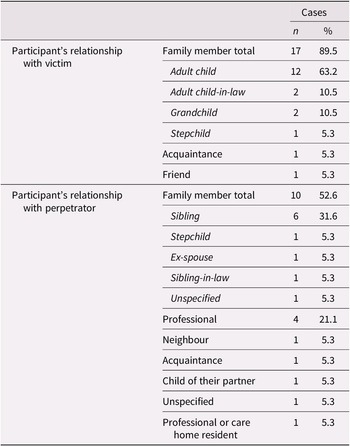
Participants had experience helping a relative, usually a parent, and were also commonly related to the perpetrator – often a sibling (see Table 2).
Participants’ characteristics and relationship with victim and perpetrator

Note: N = 19.
One participant indicated two types of relationships with the perpetrator because the victim was abused by multiple perpetrators.
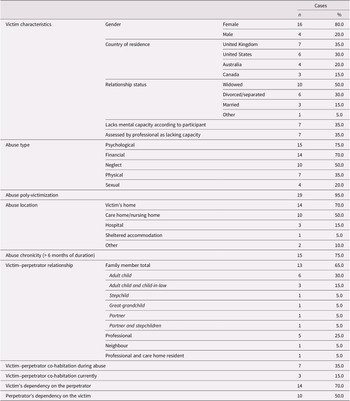
Table 3 displays the characteristics of the victims, the abuse, and the victim–perpetrator relationship. One participant reported supporting two victims. Victims (n = 20) were predominantly female, suffering family-perpetrated abuse, often chronically. Different abuse types and locations were represented. The victims’ ages when the participants started supporting them ranged from 50 to 93 years (M = 76.15, SD = 10.82), and their ages at the time of the study or when participants stopped supporting them ranged from 60 to 99 years (M = 80.20, SD = 10.48).
Victim, abuse, and victim–perpetrator relationship characteristics

Note: Participants could indicate multiple answers for abuse type and location. One participant indicated two types of relationship for victim–perpetrator relationships (i.e., multiple perpetrators).
Participants’ perceptions and awareness of the abuse
Most often, participants (n = 13) identified the victim’s abuse experience as ‘elder abuse’ at the time it was occurring, and all except one (n = 18) identified it as such at the time of participation. One participant identified the situation as chronic domestic abuse extending into the victim’s older age. Five participants became aware of the abuse due to the victim disclosure only, nine without the victim disclosing (e.g., detecting abuse signs), and in five cases there was both a disclosure and awareness via different methods. Overall, the victim had disclosed to the participant in 10 cases; in four of these cases, there had been an escalation of the EA prior to the victim disclosing.
Eight participants described their response to the victim’s disclosure, although two described their feelings (e.g., angry), rather than how they responded. Participants tried to obtain more information from the victim (n = 2), tried to direct the victim to advice (n = 1), and responded by validating the victim’s feelings, hugging them, or telling them that they would try to stop the abuse (n = 3), or were unsure about how to react at the time (n = 1).
When participants became aware of the abuse in a way other than the victim’s disclosure or in addition to it (n = 14), this was often due to observing the abuse, the victim behaving worryingly or the victim’s wishes suddenly changing or reversing (e.g., ‘I could start to see things were going wrong when, one by one, all of these decisions were being overturned, sometimes in the space of 24 hours or less’ [P1]). Participants had sometimes discovered evidence of abuse (e.g., seeing substantial amounts of money missing in bank transactions). Some became aware after seeing unexplained symptoms in the victim which were evidence of abuse (e.g., symptoms of being overmedicated). In some cases, the perpetrator had behaved in a controlling way in front of the participant or communicated something worrying to them. Finally, one participant built a timeline of events after the victim’s death by reviewing hospital notes and messages with the victim from which they found evidence of abuse.
Participants’ help-seeking process
Worries about seeking informal and formal help
Almost half of the participants worried about seeking help on behalf of the victim (n = 9). Of those, seven indicated worries related to formal help, three related to informal help, and three indicated other worries.
Relating to formal services, participants reported a variety of concerns (e.g., not being believed, services not doing anything to stop the abuse or hiding institutional abuse). Relatedly, one participant worried that services would not get involved because the victim was competent and giving the money to the perpetrator voluntarily. Some were worried that reporting would lead to negative consequences for the victim (e.g., further frightening a sexual abuse victim by having to undergo medical forensic testing). One participant worried about themselves specifically that they would not be protected from the perpetrator’s recrimination, and one worried about contacting specific services (e.g., police). Additionally, one participant indicated that, even though they were not worried about contacting services at first, they worried about it after having negative experiences with multiple services (i.e., not examining the evidence gathered by the participant and interviewing the victim in front of the alleged perpetrator).
Participants who indicated worries related to informal help were concerned about the abuse escalating, the perpetrator’s reaction, and the victim becoming distressed. The three participants who indicated worries without placing them in the categories as formal or informal mentioned general fear of repercussions towards the victim or themselves.
Barriers related to the perpetrator’s behaviour
In 11 cases, the perpetrator had done something to prevent the participant from seeking help. The behaviours specified were lying about, bullying, or threatening the participant, manipulating agencies so that they perceived the participant to be the problem, or making false allegations about the participant (n = 5). Perpetrators also prevented the participants from visiting the victim or ‘alienated’ the victim from family (n = 2).
In seven cases, participants indicated that the perpetrator tried to prevent the victim from reporting. Behaviours were similar to those used with participants, including isolating the victim and preventing visits from others. In addition, two participants mentioned that the perpetrators manipulated the victim or the information that they could access.
Participants’ expectations before seeking help
Participants provided information about their expectations from informal and formal sources before seeking help, with most participants (n = 14) discussing expectations of informal sources. These participants usually had a positive expectation (n = 10), including anticipating support from those sources in protecting the victim, that they would understand the victim’s vulnerability, and that they would feel outrage or anger about the situation. Three participants had negative expectations, namely the source not believing the participant, siding with the perpetrator, or blaming the victim.
Regarding expectations from formal sources of help, 17 participants provided a response. Most (n = 15) expected a positive response, primarily that these would take action to protect the victim and follow the appropriate procedures. One expected a negative response (i.e., ‘covering up’ of abuse), and one expected that they would be unable to help because the victim had mental capacity and did not want intervention.
Seeking help and facilitators to help-seeking
All participants except one (n = 18) told someone about the abuse. In eight of those cases, participants told someone immediately after becoming aware. Three sought help within an hour, the next day, or ‘soon after’; three after a few weeks or a month; one after a few months; and two waited a year. One could not specify because they were ‘still trying to help’, and another reported difficulty answering because there were many instances of help-seeking.
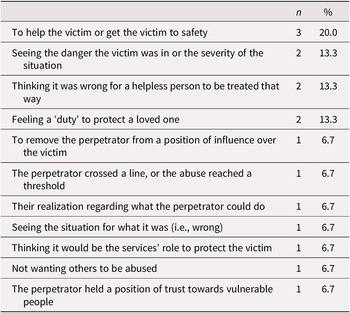
Participants were asked about whether escalation occurred prior to help-seeking. In five cases, participants had just become aware of the abuse, so the question did not apply. Of the remaining 13, many said the situation had worsened before they sought help (n = 9). When asked about what had made them decide to disclose the situation or seek formal help, 15 participants provided a response (see Table 4). Primarily, participants wanted to help the victim and protect them from danger, but they were also moved by their belief that the situation was wrong or that they had a duty to help.
Participants’ reasons for seeking help

Note: n = 15. The total percentage exceeds 100 because one participant indicated two reasons.
Participants were asked to indicate whether there was anything that could have helped them to seek support sooner or anything that they wished they had known at the time. More than half (n = 14) responded ‘yes’. The majority (n = 9) believed that increased societal and professional awareness about EA would have been beneficial (e.g., perpetrator behaviours, prevalence, relevant legislation, reporting obligations, and available help). Two participants indicated that a better response from formal services and service collaboration and communication with older adults and their relatives might have helped them seek support sooner.
Sources of help for participants, responses obtained, and success in seeking help
Almost half of the participants knew where to seek help (n = 9). A majority of those who disclosed first told a formal service (n = 13): the police; solicitors; management, staff, or director of a residential facility; EA hotline or advocacy services; the hospital; a GP; or social services. Those who disclosed to an informal source first (n = 5) told friends, relatives, or the victim’s relative. The responses to their disclosures were mixed; some services intervened, but others responded with disbelief (e.g., saying that the perpetrator ‘would not do that’ or that the victim was hallucinating, and the disclosure was due to their illness). Some informal sources did not know how to help, and some also responded with disbelief. Several participants stated that some of their first sources of disclosure, working in residential facilities, were unsurprised because these incidents ‘were commonplace’.
When asked about how talking about the situation with the persons they disclosed to made them feel, the majority reported negative feelings (n = 17), such as stress, frustration, trauma, fear, or shame. On the other hand, five reported positive feelings such as empowerment, validation, and positivity from knowing that there were others working to prevent abuse. A majority (n = 11) of those who disclosed reported that their first disclosure impacted further disclosures. Consistent with the responses obtained, this impact was mostly negative (n = 6), with participants feeling less likely to pursue other avenues of disclosure, or that their distress had deepened. Sometimes impact was mixed (n = 3), as some services helped but others did not. Finally, two participants identified a positive impact, motivating them to bring perpetrators to justice.
Many participants did not stop at a single disclosure: 16 indicated that they had sought help from further sources. Although five indicated contacting only one additional informal or formal source, many indicated that two or more additional sources were contacted (n = 11). One participant said that there were ‘too many to count’ and another estimated that they had been in touch with 40–50 agencies overall. Many participants obtained negative or mixed responses from subsequent disclosure receivers, particularly from formal services.
Also consistent with the responses described above, more than half of the participants (n = 12) reported struggling in the process of helping the victim or being unable to help (e.g., because the victim held mental capacity and did not accept help). Participants described this situation as prompting feelings of not only sadness, depression, helplessness, hopelessness, and despondency but also fear, anger, and exhaustion. Some participants experienced guilt and blamed themselves for the abuse, not being able to help, or felt like they were failing the victim. One participant felt ‘[l]ike [they were] failing [their] loved one, who had done everything for [them] her entire life’ (P16).
Victims’ attitudes towards help and satisfaction with help received
Regarding how participants thought the victim would react to their trying to help, there were 18 responses referring to 19 victims. Responses were divided into whether participants thought the victim would support their actions or not, and whether the victim understood that the situation was abuse or how serious it was. Some participants’ responses fit into two response types (i.e., participants identified limited understanding from the victim combined with a negative/positive reaction); thus, the frequencies below exceed 19. Victims:
-
• Reacted negatively or unsupportively (n = 9): worrying about themselves or the participant – as well as their relationship with the participant – or not agreeing that they needed help or that the participant should intervene:
‘She worried about the abuser and was also afraid of his anger’ (P5).
‘Mum was worried for me; she knew he was trying to stop me from visiting and she did not want that’ (P11).
-
• Reacted positively or supportively (n = 7): for example, the victim was ‘appreciative’ or ‘glad’, or ‘wanted to be believed’.
-
• Could not understand the situation, its severity, or was unaware due to cognitive limitations (n = 5):
‘I don’t think she would understand the severity and consequences and how harmful it is to have such a person working with vulnerable elders’ (P3).
Help provided by participants, help received by participants and victims, and satisfaction with outcomes
Participants were asked about the help they were asked to provide, the help they provided, the help the victim ultimately received, and whether they were satisfied with the outcomes of help-seeking. Services asked some participants to do several things (e.g., contact other services, make referrals, and support the victim financially; n = 7). However, others were asked to ignore the issue and move forward (n = 2). Two participants reported that the victim had not asked them to do anything. Participants provided several types of support, most commonly emotional (see Table 5 for other types).
Support provided by participants to EA victims

Note: n = 17. The total percentage exceeds 100 because some participants indicated more than one support type.
Most participants were dissatisfied with the help the victim received (n = 14). Some participants (n = 10) provided information about the reasons for their dissatisfaction; primarily, this was because there was no help provided, the abuse continued, they were ignored, or their concerns were not taken seriously by services. Those who were satisfied with part of the help (n = 3) recognized that some services had been helpful or reported that some services and professionals had a high workload by way of explanation for the inadequate response received.
Participants were also asked to indicate whether they thought the victim was satisfied, and if not, give reasons for dissatisfaction. In six cases, the participant did not know whether the victim was satisfied (e.g., due to lack of information about the victim). The victim was satisfied with the help received in only two cases. In one case, the victim was satisfied with some help but not all. The participant indicated that the victim understood that the participant had ‘pushed and pushed for her to get the help she has needed for so many years’ (P6). The victim was not satisfied with the help received in 11 cases. Eight participants indicated reasons, such as not being believed, not recovering the money they lost, the abuse continuing, or the help coming slowly. For example:
‘After a long hospital stay, she was moved to another nursing home. They too are treating my mother horribly. They knew what happened to her and they have done nothing to help her’ (P9).
‘She was treated as having BPSD (Behavioral and Psychological Symptoms of Dementia). And she had made up all her allegations’ (P12).
Perpetrator outcomes
Before being asked about what participants would like to happen to perpetrators, they were asked about what had happened (if anything). Most participants said there had been no consequences for the perpetrator’s behaviour (n = 11). In only five cases, there had been some consequences, such as psychological suffering, estrangement from siblings, or legal consequences (i.e., conviction). Finally, three participants were unsure about what had happened to the perpetrator. Regarding what participants wished happened to the perpetrator, the most commonly desired outcome was legal consequences (see Table 6).
Participant desired perpetrator outcomes

Note: N = 19. The total percentage exceeds 100 because several participants indicated more than one desired outcome.
When asked about the victims’ wishes for the perpetrator, 11 participants provided an answer, with the following wishes reported: legal consequences (n = 4); no negative consequences (n = 2); separation from victim or prevented from visiting (n = 2); firing or removal from a position of caring for victim (i.e., in a care home, n = 2); and the perpetrator to change (n = 1).
Impact on participants
Participants were asked about the impact of knowing about the abuse situation and the impact of the activities that they engaged in to support the victim. The most common answers for each are provided in Table 7.
Participants’ reported impact

a Although participants were asked about the impact of knowledge of the abuse situation, some discussed the impact of the abuse itself in their answers.
The most common impact from both knowledge and helping was psychological. A participant described living in a ‘constant state of nervousness and threat’. Participants felt the burden of seeking help and two participants felt that they were doing the work that professionals should be doing. Impact also related to the participant’s relationships with others, namely their family, the victim, or the perpetrator. In relation to the victim, a participant’s quote illustrates the time lost during the abuse perpetration:
‘That’s the saddest thing; that’s the thing I can’t think of too much because we’re talking five years. The last five years I have not been able to freely spend time with her, I haven’t been able to go to her hospital appointments, I haven’t been able to have lunch with her, I can’t get a supper with her, because the abuser has held such control over her’ (P6).
Themes from interviewees’ experiences of seeking help
The findings in the previous sections are drawn from the survey and interview data. Thematic analysis was used to further engage with the interview data only to identify common themes in the two interview participants’ experiences of seeking help and provide more context about the findings identified in previous sections. Although the interview schedule followed the chronology of help-seeking, the data were analysed inductively and with no predetermined thematic structure. The interviews concerned two U.K. participants who in both cases had supported their parents with dementia who were experiencing abuse from multiple perpetrators. Two themes were identified, and these aim to complement and enhance the survey data.
Fighting against many walls
The interviewees’ feeling of fighting – particularly professionals and formal services – was a common feature in their help-seeking experiences, consistent with the general findings from the survey and expanding on the content discussed in the previous section. In trying to help or assist the victim, the participants were fighting different fronts or walls, which were built by services, the perpetrators, and sometimes the victim.
Participants referred to ‘fighting against a tide of disbelief’ or contacting multiple professionals without receiving satisfactory help. Interviewees expressed that a lot of the harm in these cases – for the victims and themselves – could have been avoided if services had followed appropriate procedures. Additionally, they identified a lack of understanding about EA or domestic abuse by many professionals or a failure to recognize risk, as illustrated in the following quotes:
‘I have seen absolutely no skill, no awareness, no training, no ability to recognize the red flags, the coercion and control, and domestic abuse’. (Interviewee 1)
‘[…] they didn’t understand EA or didn’t care to understand EA. When you challenged them about it, then they built a wall and they refused to listen, and then they would build a bigger wall to shut you out, and then build a bigger wall to even try and discredit you’. (Interviewee 2)
Another perceived challenge in interacting with services was services working in isolation, with insufficient communication between different professionals about incidents, making it harder to identify abuse patterns. Interviewees also described services referring the abuse incident to one another and unloading responsibility onto other agencies. Relatedly, a service not intervening was perceived as influencing other agencies’ willingness to act:
‘When the police are seen by other agencies (health, social care, etc.) as doing nothing, it gets quoted “well, the police haven’t done anything”, which is to say, “well, there’s nothing to see”’. (Interviewee 2)
Some of the help-seeking challenges above had a connection with the victim’s age. Interviewees identified age discrimination within services, which made these services treat cases concerning older adults differently than other adults or minimize abuse:
‘And that’s when I started to see this age discrimination, which is, “ah, she is an old lady, and you know, all old ladies have falls, you know, she just had a fall” […] You know, there was always minimizing going on’. (Interviewee 1)
In addition, vulnerabilities that are more common with increasing age (e.g., cognitive limitations linked to dementia) resulted in services attributing signs of neglect to dementia symptoms, or not believing the victim’s disclosures:
‘[They said:] “She’s got Alzheimer’s, people with Alzheimer’s say things like that”’. (Interviewee 1)
Mental capacity, an important consideration with increasing age, was another source of challenges. Contradictions between professionals and perpetrators were sometimes perceived as something that was being used to the perpetrator’s benefit, and the reason perpetrators sometimes blocked capacity assessments:
‘[…] it’s in other people’s best interests to say she has mental capacity. Then, legal decisions can be made, supposedly from her, which may not really reflect the true state of things’. (Interviewee 2)
Although the main wall they seemed to be fighting was services, interviewees were also fighting the perpetrators, who controlled the victim, prevented the interviewees from visiting the victims, subjected the interviewees to abuse, and created false allegations so that services and the victim would see the interviewees as the problem, as illustrated in the quotes below:
‘He’s taken every opportunity to, hmm, portray me as a problem and that he is a victim of harassment by me, and he’s actually told the court in the witness statement that the police have advised him to take action against me for harassment’. (Interviewee 1)
And, on fewer occasions, they also faced obstacles related to the victim, who would sometimes be appreciative of their help and confide in them, but at other times would be unsupportive of their help-seeking efforts.
Expectation versus reality
This theme refers to interviewees’ expectations of services and professionals and their contrast with reality. Although victims may not seek help because of negative expectations from services, overall, these interviewees had positive expectations and sought help under the impression that asking for help alone would be the hardest part, as illustrated below:
‘I’ve taken a big step to reach out and ask for help, you know, something very private, and it takes lots of courage and so you speak out and you think “Thank God, I’ve had the courage, now I’m going to be helped”’. (Interviewee 1)
After this, they were expecting professionals to assume responsibility and take the necessary steps to protect the victim. However, they found that the professionals’ interventions were unsatisfactory. In addition, interviewees were asked to act themselves:
‘I kind of expected that the professionals […] would kind of do their job. And that was the biggest let-down ever. Just that none of them really provided any type of satisfactory outcome, and ehm, nobody looked at the evidence that we collected, nobody interviewed my mother without the abuser’s presence’. (Interviewee 2)
In one of the cases, these interactions made the interviewee wary of further reporting, and said that they would not seek help from the same professionals again, illustrating that the responses from sources of help can impact further help-seeking:
‘I don’t feel like I trust any of them, ever again, not one, not even for [other] things […] in the future […], if I ever need to contact [them], I would avoid them as much as possible’. (Interviewee 2)
That interviewee, while acknowledging that there were many challenges in the professionals’ work and that the manipulation from perpetrator(s) was difficult to manage, also thought that it was important to follow appropriate procedures:
‘Maybe they’re under pressure, maybe they don’t care. I don’t know, but they’re dealing with people’s lives, they need to get it right. There’s no excuse for that’. (Interviewee 2)
Discussion
The aim of this study was to explore concerned persons’ role and experiences in EA cases, with a particular focus on help-seeking, including barriers, facilitators, satisfaction with services, and impact of seeking help on behalf of older victims of abuse. The findings are consistent with previous literature in terms of the role of concerned persons, the barriers experienced in seeking help on behalf of older victims, and the wide-ranging negative impact linked to concerned persons’ awareness and involvement in these cases. The findings provide a more nuanced understanding of the process of help-seeking, illustrating how initial positive expectations of third-party help can be replaced by negative expectations due to response issues, and also exemplifying the challenges arising from the perpetrator’s behaviour.
Concerned persons’ role
Concerned persons were primarily female relatives of the victim, particularly adult children. This is consistent with previous research which identifies EA as commonly a family matter, where both perpetrators and those trying to provide support are relatives of the victim (Dow et al., Reference Dow, Gahan, Gaffy, Joosten, Vrantsidis and Jarred2020; Fraga Dominguez et al., Reference Fraga Dominguez, Storey and Glorney2022b). The predominantly female sample is consistent with research in this and related areas (e.g., Fraga Dominguez et al., Reference Fraga Dominguez, Storey and Glorney2022a; Kilaberia et al., Reference Kilaberia, Fuhrman and Stum2023; Moschella et al., Reference Moschella, Bennett and Banyard2018). The sample composition could be explained both by gendered patterns in helping, and more willingness to participate in research; however, it is important to consider as previous research found that women were more likely to experience distress associated with knowledge of an EA case (Breckman et al., Reference Breckman, Burnes, Ross, Marshall, Suitor, Lachs and Pillemer2018). Participants had provided a variety of support to victims, particularly emotional, and had also reported abuse to a variety of services and provided practical and financial support. In over a third of cases, support had been provided after being suggested by services. Overall, the findings support previous literature which identifies that concerned persons provide wide-ranging support in a variety of areas, sometimes in response to formal systems’ requests (Breckman et al., Reference Breckman, Burnes, Ross, Marshall, Suitor, Lachs and Pillemer2018). The experiences reported in the current study provide us with a unique understanding of the ways in which concerned persons enable formal help-seeking, through multiple contacts with, and notification of, different service providers and pursuing legal action.
Concerned persons’ help-seeking experiences
This study has provided a more detailed understanding of the process of help-seeking from the perspective of concerned persons. Participants’ help-seeking experiences were characterized as a long-lasting process with many service contacts and were perceived as a struggle by over half of the sample. Most participants had a positive expectation before reporting the abuse; however, they associated their first disclosure and the responses obtained with negative feelings. With some exceptions, participants were dissatisfied with the help and responses received, and this negatively impacted their desire to seek further help, consistent with previous research on concerned persons (Kilaberia et al., Reference Kilaberia, Fuhrman and Stum2023) and victims of different types of interpersonal violence, including older victims (Fraga Dominguez et al., Reference Fraga Dominguez, Storey and Glorney2021; Sylaska & Edwards, Reference Sylaska and Edwards2014; Truong et al., Reference Truong, Burnes, Alaggia, Elman and Rosen2019). It is true that EA is under-reported by victims, professionals, and the public, and this has led to a necessary focus on increasing reporting to formal sources. However, evidence suggests that concerned persons, particularly family members, are already frequent reporters to formal services and helplines (Breckman et al., Reference Breckman, Burnes, Ross, Marshall, Suitor, Lachs and Pillemer2018; Fraga Dominguez et al., Reference Fraga Dominguez, Storey and Glorney2022a). Thus, attention must also be paid to what happens when individuals do report EA. It is important to ensure that services respond appropriately to allegations, both from professionals and from concerned persons. As illustrated in the current study, negative or inadequate responses may lead to disengagement by reporters and missed opportunities for intervention and protecting victims and others from harm.
Barriers to help-seeking experienced by concerned persons identified herein – albeit similar to those previously reported and those experienced by victims – additionally highlight the influence of the perpetrator in preventing reporting. Abusers made it harder for both concerned persons and victims to seek help by isolating and/or manipulating them and some lied about the concerned person, bullied them, or made false allegations. Further research on barriers caused by the perpetrator will be helpful in informing the general understanding of the reasons why older victims and concerned persons do not report abuse. As EA often takes place in a familial context and knowing that relatives are often those abusing and those trying to help (Fraga Dominguez et al., Reference Fraga Dominguez, Storey and Glorney2022a; Kilaberia et al., Reference Kilaberia, Fuhrman and Stum2023), perpetrators might know the concerned person and could potentially use this knowledge to their advantage.
Impact experienced
The current study contributes to understanding the impact concerned persons experience. Many described wide-ranging negative impacts, both from knowing about the abuse and from trying to help the victim. These experiences took a substantial toll on the concerned person’s mental health, physical health, financial status, and family relationships, and some concerned persons also experienced abuse by perpetrators and had false allegations made against them. Although this dynamic of abuse and allegations against concerned persons has been previously identified (Fraga Dominguez et al., Reference Fraga Dominguez, Storey and Glorney2022a), it is not clear how often it occurs and how service providers deal with these concerned persons’ experiences. Research with service providers exploring these issues may help to understand how to manage the challenges of a situation where allegations are being made by different family members against each other. Overall, positive impacts that concerned persons can have on victims and the support that the victims receive are counterweighed by a negative impact for concerned persons. A conceptualization of concerned persons as potential secondary or additional victims, as framed by Kilaberia et al. (Reference Kilaberia, Fuhrman and Stum2023) may be helpful when advancing research in this area.
Findings about victims’ help-seeking
The findings also help to understand why some victims may reject help offered by others, including formal supporters, which has been noted as a challenge in the literature (Fraga Dominguez et al., Reference Fraga Dominguez, Storey and Glorney2022a). The findings also contextualize the disagreements that can occur between the older victim and a concerned person trying to help. Sometimes victims did not want concerned persons involved and their reasons for this varied. For example, to protect themselves or the concerned person, but also due to disagreement with the concerned person about the need for help. Even when both victims and concerned persons perceive a need for help, it has been previously noted that they may not agree on the type of help required or what a successful outcome is (Kilaberia & Stum, Reference Kilaberia and Stum2022). The current study illustrates this disagreement; wishes in terms of perpetrator outcomes were different for victims and concerned persons, with more concerned persons supporting legal consequences. The disagreement could also relate to the specific help provided, which could be practical in a case where a victim is seeking emotional support. Regardless of the reason, victims’ rejection of concerned persons’ help is likely to be challenging for concerned persons. Education from professionals about these challenges and relevant laws and policies in terms of reporting and the duty of services to intervene may be helpful in navigating these challenging situations.
Challenges related to age discrimination and age-related vulnerabilities
As part of the barriers experienced by concerned persons, we identified unique challenges due to age discrimination from services, as well as vulnerabilities that are more likely with increased age, such as dementia and diminished mental capacity, which affected the concerned persons’ interaction with the victim and services. Concerned persons encountered challenges supporting victims with dementia who disclosed but were sometimes not believed by services, their disclosures dismissed, and abuse signs identified by the concerned person dismissed as the result of dementia. These findings shed light on barriers that may exist in reporting abuse where the victim has cognitive difficulties and support previous research emphasizing the need to investigate the abuse and help-seeking experiences of people living with dementia (Bows, Reference Bows2018; Fraga Domínguez et al., Reference Fraga Domínguez, Valiquette, Storey and Glorney2020, Reference Fraga Dominguez, Storey and Glorney2021; Walsh et al., Reference Walsh, Olson, Ploeg, Lohfeld and MacMillan2010). Participants also identified age discrimination towards the victims, where services were more likely to dismiss concerned persons’ concerns about the victim or to treat these concerns differently than the responses they perceived for other types of concerns experienced by other populations. Thus, the current study findings suggest that the role of ageism and other societal factors should be considered when studying help-seeking by victims and concerned persons. As previously identified by Fraga Dominguez et al. (Reference Fraga Domínguez, Valiquette, Storey and Glorney2020), responding to allegations of abuse by older victims with cognitive limitations is linked to specific challenges (e.g., vague disclosures and communication difficulties); however, careful investigations and collaboration between services can help to address these obstacles.
Implications for practice
The findings suggest that concerned persons undertake an essential, albeit often burdening, role in trying to support EA victims and protect them from further harm; however, they face many challenges in their interactions with formal services and are negatively impacted by their involvement. The role of concerned persons requires more recognition from the perspective of organizations and professionals who address EA (e.g., healthcare, adult protection, and policing professionals), as they are a largely invisible piece of EA intervention (Kilaberia & Stum, Reference Kilaberia and Stum2022). Inadequate responses may lead to disengagement from key individuals who may be in the best position to enable victims’ access to formal help (Burnes et al., Reference Burnes, Acierno and Hernandez-Tejada2019) and report future or ongoing incidents of abuse. Given that EA victims can often be isolated, and this isolation is exacerbated through the perpetrator’s influence (Burnes et al., Reference Burnes, Acierno and Hernandez-Tejada2019), concerned persons’ relationship with the victim can be essential in accessing any help. Given the current study findings about general challenges faced when reporting and the issue of false allegations by abusers, it is important that any reports are investigated, by seeking corroborating evidence from multiple sources and professionals. A case study reported by Fraga Dominguez et al. (Reference Fraga Domínguez, Valiquette, Storey and Glorney2020) exemplifies how to seek evidence when the perpetrator contradicts professionals’ concerns of abuse.
Within this recognition of concerned persons’ role, it should be acknowledged that they are negatively impacted by their involvement and require support. Service providers who interact with CPs need to consider this support before they ask them to perform a variety of tasks for the victim, such as providing emotional or practical support, reporting to other services, or helping financially. Previously, it has been suggested that concerned persons need support that is specifically tailored to their needs, including education on how to support victims while protecting themselves from harm, and emotional support for the distress they experience (Breckman et al., Reference Breckman, Burnes, Ross, Marshall, Suitor, Lachs and Pillemer2018). Any support provided by services needs to consider the complex relationship dynamics involved (Dow et al., Reference Dow, Gahan, Gaffy, Joosten, Vrantsidis and Jarred2020; Kilaberia & Stum, Reference Kilaberia and Stum2022), as well as the potential for direct harm experienced from perpetrators.
Overall, findings suggest that responses from EA services are not perceived as adequate and can lead to disengagement. Previous research has identified similar challenges experienced by both EA victims and concerned persons in different countries (e.g., Dow et al., Reference Dow, Gahan, Gaffy, Joosten, Vrantsidis and Jarred2020; Fraga Dominguez et al., Reference Fraga Dominguez, Storey and Glorney2021, Reference Fraga Dominguez, Storey and Glorney2022a; Kilaberia & Stum, Reference Kilaberia and Stum2022). Some of the key issues highlighted in the study relate to limited recognition of EA dynamics, ageism within services, issues responding to allegations by cognitively impaired victims, as well as insufficient collaboration between different services (e.g., police and social care). When considering staff training and policy development, these areas should all be prioritized. The benefits of multidisciplinary collaborations and approaches are well-established, as they are particularly helpful in dealing with the complex nature of EA cases, which often involve poly-victimization (Heisler, Reference Heisler2017; Yonashiro-Cho et al., Reference Yonashiro-Cho, Rowan, Gassoumis, Gironda and Wilber2019).
Limitations
This study has some limitations. One limitation is that the researcher did not establish any limit regarding when the EA took place, and six participants were discussing a case where the victim was deceased. Thus, the experiences reported may be affected by memory recall, and the issues that participants raised may not be as relevant currently (e.g., the overall services’ response could have improved due to increased awareness). However, in 32% of cases, including the two interviews, the participants described the situation as ongoing. Moreover, those participants reporting a past situation likely had more time to reflect on the experience and may have been less emotionally involved, potentially increasing objectivity. To maintain anonymity, no data were gathered on where (i.e., which organization’s message or social media platform) participants came across the recruitment information. Thus, the sample is likely biased in that self-selecting participants are probably those who were intensely involved in helping EA victims. This bias means that the wide-ranging negative impact experienced may not be such in the general population, but also elevates the prevalence in this study of repeated efforts to seek help. It could also be biased towards those who had negative experiences with services because those who had a positive experience may not feel compelled to share their experiences. Importantly, the study indicates that some people experience major barriers trying to help EA victims and are negatively impacted by seeking help on their behalf.
In terms of the data analysis, only one of the authors conducted the data analysis; however, the discussion with the second and third authors enhanced the trustworthiness of the study. As an additional limitation specific to the TA, this is based on interviews conducted with only two participants; however, the aim of this analysis was to complement and provide more depth to the survey findings. Finally, although the countries of participation have notable similarities, legislation is different across these countries and even across states or provinces within a country, which can limit the integration of findings in the study. The sample was not large enough to make comparisons in the help-seeking experience with respect to the victim’s country of residence.
Conversely, the study has several strengths in terms of the characteristics of the sample, namely the diversity in terms of abuse types, victim–perpetrator relationships, and victim–concerned person relationships. The sample included several cases of sexual abuse and abuse perpetrated in residential facilities, which are generally under-represented in research (Fraga Dominguez et al., Reference Fraga Dominguez, Storey and Glorney2022b). It also included the views of participants from several countries, highlighting that, despite different systems and country specificities, some experiences are common across countries. Overall, the comprehensive exploration of concerned persons’ experiences, focused on different aspects of help-seeking, has supported and provided further insight into existing findings. The study helps to contextualize the ways in which concerned persons support victims, the unique barriers experienced in doing so, and the challenges of interacting with service providers.
Summary of findings
This study explored the role and help-seeking experiences of non-professional supporters of EA victims (i.e., concerned persons) in a diverse sample of EA cases from different countries, and the findings contribute to recent research in the area. Concerned persons were primarily the victims’ female relatives and experienced many barriers to help-seeking, particularly related to the formal services that they approached. Their awareness and experiences seeking help, obtaining primarily negative or unsatisfactory responses, made them reluctant to seek help in the future. They also experienced wide-ranging negative impacts due to their awareness of and involvement in cases. The current findings support the need for further research on the experience of concerned persons, who both provide informal support and enable formal help-seeking. They also emphasize the need for support provision that is tailored to the unique needs and challenges experienced by concerned persons. Better protocols will ensure that concerned persons can continue to support their loved ones while preventing or limiting the harm to themselves and the victims.
Data availability statement
The participants of this study did not give written consent for their data to be shared publicly, so due to the sensitive nature of the research, supporting data are not available.
Financial support
The first author has been supported by a college studentship awarded by Royal Holloway, University of London.
Competing interests
We have no competing interests to declare.



 Open access

