




1. Introduction
In Mainland Scandinavian, the particle så ‘so’ can occur between fronted constituents and the finite verb in root clauses, especially in spoken language (Faarlund, Lie & Vannebo 1997:817, Ottesjö & Lindström Reference Ottesjö and Lindström2005).Footnote 1 This seems to violate V2, a defining property of Mainland Scandinavian. As illustrated in example (1) from Standard Swedish, the result is a V3 pattern superficially.

Similar V3 patterns are common in other contemporary Germanic V2 languages as well (De Clercq, Haegeman, Lohndal & Meklenborg 2023; see below). This paper focuses on optional så between initial elements and the finite verb in root clauses in Fenno-Swedish, where the V3 particle så occurs more widely compared to Standard (Sweden) Swedish. Other functions of så, such as consecutive conjunction, VP-pro-form or AP-intensifier (see Holmberg Reference Holmberg2023 for examples) are not included in this study.Footnote 2
The V3 particle så has been described from various perspectives (Holmberg 1986:113–118, Reference Holmberg2023, Ekerot Reference Ekerot1988, Nordström Reference Nordström2010, Eide Reference Eide2011, Meklenborg Reference Meklenborg2020). The starting point of this study is that the construction is a type of copy-left dislocation, which also results in V3 in Swedish. Copy-left dislocation is illustrated in examples (2a, b). The initial constituent (buskarna ‘bushes’, i morgon ‘tomorrow’) is followed by a resumptive item, placed in the same position as så in (1).


In copy-left dislocation, the fronted constituent is followed by a resumptive that is spelled out as a pronominal (2a) or an adverbial (2b), determined by the agreement with the fronted constituent. In Mainland Scandinavian, så seems to be the ‘general adverbial resumptive’, a term coined by Meklenborg (Reference Meklenborg2020), with non-agreeing spell-out. As shown in example (1), så can occur when the fronted constituent is an epistemic adverb. Pronominal or adverbial spell-outs would not be grammatical in sentences like this since the epistemic adverb has no features to agree with.
In Standard Swedish and other Swedish varieties spoken in Sweden (hereafter referred to as Sweden Swedish), the relationship between så and pronominal or adverbial resumptives is mutually exclusive to a high degree. For example, fronted argument DPs (2a) cannot be followed by the non-agreeing spell-out så. On the contrary, Fenno-SwedishFootnote 3 seems to allow så after almost any initial constituent (Holmberg Reference Holmberg1986, Reference Holmberg2023; see also Ivars Reference Ivars and Ivars1993, Reference Ivars, Arboe and Schoonderbeek Hansen2011). Holmberg (Reference Holmberg2023) suggests that a speaker of Fenno-Swedish is always free to choose så over the pronominal and adverbial alternatives (3a), while this is ungrammatical in Sweden Swedish (3b).


Additionally, the Fenno-Swedish så-particle occurs in some contexts where copy-left dislocation never takes place in Sweden Swedish. For example, no resumptive item can follow fronted wh-phrases in Sweden Swedish, while at least some such constructions seem grammatical in Fenno-Swedish (4a). Holmberg (Reference Holmberg2023) argues that in Fenno-Swedish så can be preceded by anything as long as the initial element is not a pure operator (4b). This paper seeks to determine the precise status of the V3 particle så in Fenno-Swedish, as will be described in more detail below.


Placing the particle så after an initial pronoun (5) also seems highly untypical in Fenno-Swedish, for no apparent reason.

The ill-formed status of this word order is not explicitly predicted by prior research, and its implications have not been discussed before. An explanation that will be articulated in the discussion part of this paper is that there is a prosodic condition in Fenno-Swedish which prohibits så between a monosyllabic constituent and the verb, regardless of syntactic function.
While the Sweden Swedish så-construction has been examined rather extensively (see e.g. Elmquist Reference Elmquist1945, Heino Reference Heino1984, Holmberg Reference Holmberg1986, Ekerot Reference Ekerot1988, Nordström Reference Nordström2010, Holmberg Reference Holmberg2023, Meklenborg Nilsen Reference Nilsen, Harchaoui and Modicom2025), the empirical research pertaining to the syntactic conditions of the Fenno-Swedish så is more limited (Ivars Reference Ivars and Ivars1993, Sollid & Eide, Reference Sollid and Eide2007). The aim of this paper is to fill this research gap.
Three hypotheses will be tested in this data-driven paper. The first is that så, in addition to occurring in non-agreeing contexts, can replace any agreeing resumptive (see 3a), as suggested by Ekerot (Reference Ekerot1988) and discussed by Ivars (Reference Ivars and Ivars1993). It can thus function as an alternative to copy-left dislocation, with the same discourse functions as copy-left dislocation, regardless of the category of the initial element. The second hypothesis is that the Fenno-Swedish så can be preceded by anything as long as the initial element is not a pure operator, as in (4b) (Holmberg Reference Holmberg2023). Under this hypothesis the discourse function of the initial element is not crucial. The two first alternatives are generalisations, but the third hypothesis provides an explanation: a prosodic preference licenses the V3 particle så in the left periphery of Fenno-Swedish. Under this hypothesis, the Fenno-Swedish så provides an anacrusis satisfying a preference on the part of an intonation phrase (Riad Reference Riad2009).Footnote 5
The data of the study comprises acceptability-judgement data from the Nordic Syntax Database, occurrences of så-construction in a corpus of spoken Fenno-Swedish (NorDiga) and the results of an online survey testing the hypotheses of the paper (see Section 4). Both language use realised in spoken language and the introspection of language users are thus examined, which provides us with two perspectives to understand the construction.
In this paper, Fenno-Swedish refers to Swedish varieties used by the Swedish-speaking linguistic minority in Finland (5.1% of the population; see Statistics Finland Reference Hiltunen, Koivula and Ruuskanen2024). Fenno-Swedish, spoken as L1, is mostly prominent in the coastal regions of Finland. Differences between Fenno-Swedish and Swedish spoken in Sweden can be found in pronunciation, intonation and vocabulary, as well as syntax (see Karlsson Reference Karlsson2017).
The organisation of this paper is as follows. Copy-left dislocation as a syntactic phenomenon occurring in different languages is discussed in Section 2. Subsequently, the differences between Sweden Swedish (Section 2.2) and Fenno-Swedish (Section 2.3) are presented. The theoretical implications of previous research (Holmberg Reference Holmberg2023) are outlined in Section 3. In Section 4, we present the method and the data. The data from the two corpus sources used is discussed in Section 5, and the main results of the survey experiment are analysed in Section 6. The conclusions are discussed in Section 7 and summarised in Section 8.
2. Resumptive items in copy-left dislocation
In this section, we discuss generalised resumptive items, as defined by Meklenborg (Reference Meklenborg2020), in copy-left dislocation. Generalised resumptive particles, such as så, are semantically bleached. Typically, they are not translatable. Thus, they do not express the same semantics as the preceding constituent in the same way as specialised resumptives do, cf. där ‘there’ in I Paris, där mötte vi våra tidigare grannar ‘In Paris, there we met our former neighbours’ (Meklenborg Reference Meklenborg2020; see also Eide Reference Eide2011).
In Section 2.1, we first discuss resumptives in copy-left dislocation in Germanic languages in general. We then move on to så and copy-left dislocation in Sweden Swedish in Section 2.2. Finally, in Section 2.3, we present resumptive så in Fenno-Swedish as analysed in prior research.
2.1 Generalised resumptive items in Germanic languages
Copy-left dislocation is a characteristic property of Modern Germanic V2 languages, but the distribution of resumptive patterns varies among them (Meklenborg Reference Meklenborg2020). A general adverbial resumptive, such as så, can be found in only some Modern Germanic V2 languages, including the Mainland Scandinavian languagesFootnote 6 (6a) (Sollid & Eide Reference Sollid and Eide2007, Eide Reference Eide2011, Meklenborg Reference Meklenborg2020), Icelandic (Catasso & Meklenborg, forthcoming), Faroese (Ekerot Reference Ekerot1988), Tyrolean (6b), Mòcheno (Meklenborg Reference Meklenborg2020), and the East Flemish variety of the Ghent area (6c) (De Clercq & Haegeman Reference De Clercq and Haegeman2023). A general adverbial resumptive has also been available in German (6d), yet it has become obsolete (Catasso & Meklenborg, forthcoming).


In Mainland Scandinavian (6a), Faroese, and German (6d), the general resumptive is derived from an adverb denoting manner, ‘so’. In Icelandic, the general resumptive þá, functioning similarly to så, is derived from ‘then’ (Catasso & Meklenborg, forthcoming). In Tyrolean (6b) and Mòcheno, the general resumptive is derived from the PP in + selben ‘in self’ (Meklenborg Reference Meklenborg2020), and in the East Flemish variety of the Ghent area (6c) it resembles the distal demonstrative die ‘that’ (De Clercq & Haegeman Reference De Clercq and Haegeman2023). Furthermore, a resumptive item derived from the particle ‘so’ was used in Middle Dutch; see example (7) from Jansen (Reference Jansen, Traugott, Labrum and Shepherd1980).Footnote 7

In (7), the resumptive item ‘so’ occurs after an argument DP, similarly to Fenno-Swedish (see 3a). However, Fenno-Swedish seems to be the only Modern Germanic variety displaying this syntactic pattern, with the C-element die in the Ghent variety of East Flemish as the closest counterpart, being ‘not selective in terms of constituents to its left’ (De Clercq & Haegeman Reference De Clercq and Haegeman2023:135).
2.2 Resumptives in Sweden Swedish
In Sweden Swedish, the general adverbial resumptive så almost exclusively occurs after initial adjuncts (Nordström Reference Nordström2010, Holmberg Reference Holmberg2023). Any initial adjunct can be followed by så, including fronted adverbial constituents, such as adverbs (8a) or adjunct PPs (8b), and adverbial clauses (8c).


In contrast with this, specialised pronominal or adverbial spell-outs are used when the initial constituent is an argument (9) or a predicate. In these contexts, the general adverbial resumptive så would be ungrammatical (Holmberg Reference Holmberg2023).

When the initial element in Sweden Swedish is an argument and represents a category that creates a pronominal resumptive, the general adverbial resumptive så is unavailable. There are some exceptions with så following arguments, but it is still an unpreferred alternative to a pronominal element (Teleman, Hellberg, Andersson & Holm Reference Teleman, Hellberg, Andersson and Holm1999, Nordström Reference Nordström2010, Meklenborg, Helland & Lohndal Reference Meklenborg, Helland, Lohndal, Wolfe and Meklenborg2021).Footnote 8 If the first element is an adjunct, the spell-out can always be så, but in the case of temporal and conditional adjuncts, då can also be employed (I morgon, så/då öppnar vi tidigt). Similarly, locative adjuncts can be followed by där and dit (I Paris, så/där mötte vi våra tidigare grannar).
There are also contexts like fronted negation, where neither så nor specialised resumptives can be used (Heino Reference Heino1984). The most typical case concerns the sentential negation inte (10), but så is ungrammatical in contexts with other fronted negation markers as well, such as ingalunda ‘by no means’, knappast ‘hardly’, and aldrig Footnote 9 ‘never’.

In Sweden Swedish, the general adverbial resumptive så cannot occur after an initial wh-phrase either (11) (Holmberg Reference Holmberg1986, Reference Holmberg2023, Nordström Reference Nordström2010).

In studies focusing on discourse and interaction, the resumptive så has been analysed as a boundary marker signalling, for example, transition to another part in storytelling (Ottesjö & Lindström Reference Ottesjö and Lindström2005; see also Ekerot Reference Ekerot1988, Sandberg Reference Sandberg2003) or a new point of departure in the discourse (Nordström Reference Nordström2010).Footnote 10 However, exploring these functions lies beyond the scope of this paper.
2.3 Resumptives in Fenno-Swedish
While copy-left dislocation in Fenno-Swedish is mostly similar to Sweden Swedish, the general adverbial resumptive så occurs more widely in Fenno-Swedish (Holmberg Reference Holmberg1986, Ekerot Reference Ekerot1988, Sollid & Eide Reference Sollid and Eide2007, Nordström Reference Nordström2010, Eide Reference Eide2011, Ivars Reference Ivars, Arboe and Schoonderbeek Hansen2011, Meklenborg Reference Meklenborg2020, Holmberg Reference Holmberg2023). Arguably, så can be used interchangeably for any other resumptive, whether pronominal or adverbial. In the following, we summarise the current account of Fenno-Swedish based on Holmberg (Reference Holmberg2023).
Most importantly, så can occur after fronted arguments in Fenno-Swedish (Holmberg Reference Holmberg2023). In (12), Sweden Swedish syntax would only allow the pronominal resumptive den ‘it’ after the argument DP (see 9), while both general and specialised resumptives are grammatical in Fenno-Swedish.

The same seems to apply to all initial constituents that are arguments, including PPs and CPs: Till Oslo så vill hon inte flytta ‘She doesn’t want to move to Oslo’, Att du kan sjunga så vet jag ‘I know that you can sing’. Possibly, topicalised predicates can also be succeeded by så in Fenno-Swedish (see Holmberg Reference Holmberg2023): Spela piano så kan han ‘Play the piano he can’. The general resumptive så seems to be an equal alternative to pronominal and adverbial resumptives, being available in more or less the same contexts. Seemingly, almost any initial constituent can occur with så in Fenno-Swedish (Holmberg Reference Holmberg2023), which is the main – but not only – difference compared to Sweden Swedish.
As discussed in the previous subsection, negation and wh-phrases cannot precede så in Sweden Swedish. In Fenno-Swedish, however, the general resumptive så appears in some wh-questions, for example, with adjunct questions (13), which differs from other varieties of Swedish (Holmberg Reference Holmberg2023).

Argument questions are more complex, and it is evident that further research is necessary. According to Holmberg (Reference Holmberg2023), questions with a D(iscourse)-linked wh-phrase (14a) are clearly grammatical, while bare argument questions (14b) are ungrammatical.


As for negation markers, no exact generalisation has been presented by prior research. Addressing this research gap is one of the goals of this study, and the underlying assumption, based on examples found online, is that at least some negative adverbs, such as in (15), can precede så.Footnote 11


Another aspect, not addressed in prior research, is pronouns preceding the resumptive så. While there are no obvious reasons to reject such sentences (16), they are less natural than examples including other initial argument DPs. Whether (16) is grammatical in Fenno-Swedish is therefore also tested and discussed in the present paper.

The constituents that appear incompatible with så in Fenno-Swedish in (14b) and (16) are both monosyllabic and normally weakly stressed. A possible explanation for why specific initial constituents cannot combine with så is that they violate a prosodic condition, perhaps prohibiting two prosodically weak constituents preceding the verb.
To summarise, in Fenno-Swedish the general adverbial resumptive så can appear with any type of initial constituent occurring in copy-left dislocation in Swedish. Additionally, it can occur with some wh-phrases and negation markers. However, resumptive så appears to be obstructed by an unidentified condition in some contexts, for example, after an initial pronoun.
3. The syntax of copy-left dislocation
The framework of the paper is based on Eide (Reference Eide2011), Holmberg (Reference Holmberg2020), and especially Holmberg (Reference Holmberg2023:292–294), a theory along the lines of Rizzi (Reference Rizzi and Haegeman1997, Reference Rizzi and den Dikken2013), with a richly structured C-domain, including several different projections that host topicalised and focused constituents of the sentence. In this framework, we recognise cross-linguistic variation regarding which discourse functions can be realised there (Holmberg Reference Holmberg2020).
In main clauses, the highest verb always moves to Fin due to a feature attracting it. Figure 1 displays the structure of the main clause, in the case of copy-left dislocation involving a DP and in the case of wh-movement with a Focus head. A phrasal constituent moves, leaving a corresponding gap, or is base-generated in spec-FinP. This yields V2 order: the spec of Fin can be crossed by only one constituent. This constituent can move further up the tree to positions such as a wh-position or a topic position. In the former case, if the constituent is a wh-phrase, it will move to spec-whFoc (see Figure 1). If the constituent is a DP, CP, or PP or other adjunct, it can move to the specifier position of a Force head, the highest head in declarative main clauses, encoding declarative force. It may encode topicality but need not do so.
The structure of the main clause.

The Force head has an unvalued φ, which is valued by the moved XP if the XP has φ-features (copy-left dislocation); otherwise the feature is realised as så.Footnote 12 Thus, it is this head that is spelled out according to the agreement with the initial phrase of copy-left dislocation construction, the non-agreeing spell-out being så. In Fenno-Swedish, så has become a generalised spell-out that can occur with almost any initial constituent (17).


However, the XP moving to the specifier position of the Force head and the agreement can be obstructed by a Focus head that eliminates the probe-goal relation necessary for attracting the XP in spec-FinP. The intervening Focus head is called for when the constituent moved to spec-FinP is a wh-phrase (18a) or the sentential negation (18b) (Holmberg Reference Holmberg2023).


These are impossible contexts for så (and copy-left dislocation in general), at least in Sweden Swedish (see Heino Reference Heino1984, Nordström Reference Nordström2010). In Fenno-Swedish, the picture is less clear, as described in Section 2.3, and the theoretical consequences of examining constructions including wh-phrases and negation markers will be evaluated. Arguably, the examples in (18) are also ungrammatical in Fenno-Swedish. This, too, will be examined in the present study.
However, at least some constituents including a wh-phrase or a negation may, as discussed, be followed by så in Fenno-Swedish (see Section 2.3). The question concerning theoretical consequences is whether the configuration in Fenno-Swedish is compatible with the analysis presented above. The data sources utilised in this discussion are presented in the next section.
4. Data and method
In the study, we utilise three data sources: a syntax database covering all Scandinavian languages (Nordic Syntax Database), a corpus of spoken Fenno-Swedish (NorDiga), and an online survey completed at the turn of the year 2022/2023.
The Nordic Syntax Database comprises judgements by 924 Nordic dialect speakers from 207 places to a list of sentences that illustrate various syntactic phenomena (Lindstad, Nøklestad, Johannessen & Vangsnes Reference Lindstad, Nøklestad, Johannessen, Alexander Vangsnes, Jokinen and Bick2009). In total, six sentences tested topic doubling, the category including the sentences with properties discussed in this paper, namely the particle så causing a V3 pattern graded by the participants (for examples, see the next section), and these judgements can be sorted and filtered in several ways, of which the most relevant for this study is the geographical aspect.
The Nordica Digital Archive (NorDiga) at the University of Helsinki is a corpus of Swedish spoken-language data collected in Finland. This study utilises recordings with corresponding transcripts in NorDiga, which makes it possible to conduct searches. We collected all sentences including the particle så and a V3 pattern from 46 recordings of interviews and group discussions conducted between the years 1970 and 2003.
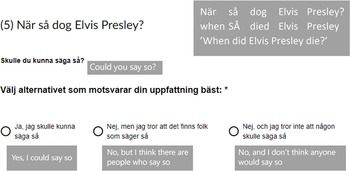
The third data set, the online survey conducted for this study specifically, is an acceptability judgement experiment. The survey comprised 19 sentences, each featuring the particle så in the V3 pattern. In total 1344 speakers of Fenno-Swedish judged the sentences in the following manner: after each sentence, they were asked whether it represents something they could say themselves. The options are displayed in Figure 2.
The presentation of sentences to participants in the online survey.

The goal of the survey is similar to the one of The Nordic Syntax Database, but instead of formal tasks such as Likert scale (see e.g. Sprouse, Schütze & Almeida Reference Sprouse, Schütze and Almeida2013), the solution is a multiple-alternative task with more explicitly stated options. The two extremes are worded as ‘Yes, I could say so’ and ‘No, and I don’t think anyone would say so’, but in addition them, there is an alternative between them: as ‘No, but I think there are people who say so’. Even with these wordings, however, the methodological goal is not to elicit guesses about other people’s grammar. Rather it provides an outlet for reporting that the example represents something familiar without having to specify the source, which mitigates a potential discrepancy between reported and attested speech. In other words, the method combines a direct acceptability judgement task with the benefits of an indirect acceptability judgement task (Buchstaller & Corrigan Reference Buchstaller, Corrigan, Maguire and McMahon2011a, Reference Buchstaller, Corrigan, Gregersen, Parrott and Quist2011b). Still, the method maintains a binary approach to acceptability of syntactic structures, as the respondents’ own speech is still reported by ‘yes’ or ‘no’. The method thus permits some variation in the application of the results, but requires coherence in interpretations while doing so, which is the main argument for including clearly worded options instead of a numerical scale. The ultimate goal of this method is to estimate acceptability as a composite property affected by the grammaticality of the tested sentence (see Sprouse, Schütze & Almeida Reference Sprouse, Schütze and Almeida2013 for more discussion of the methodology).
All tested sentences are displayed in Figure 3 in Section 6. As the participants of the experiments are informed about the purpose of the task, the experimental design does not include specific fillers. Considering how prominently experimental some of the tested sentences are, attempts to mask the purpose would have made the experiment testing three separate hypotheses with multiple minimal pairs unnecessarily heavy for the respondents.
In the next section, we discuss cases found in the Nordic Syntax Database, followed by occurrences in NorDiga. Subsequently, in Section 6, we analyse the results of the survey conducted specifically for this study.
5. The construction in the database (NSD) and authentic conversations (NorDiga)
5.1 The database
The Nordic Syntax Database includes two example sentences with the så-construction and V3 order that have been rated by Swedish-speaking informants from Sweden and Finland. In both examples, the initial constituent is a DP, which is likely to be considered ungrammatical in Sweden Swedish and grammatical in Fenno-Swedish.
The first example (19) includes den här boken ‘this book’ as a subject, followed by så. Out of 45 informants from Finland, 42 rated it as well accepted by giving it a score of 4 or 5 on a 5-point rating scale. Thus, in Fenno-Swedish example (19) clearly seems to be grammatical.

On the contrary, most informants from Sweden (119 out of 149) rated example (19) as unacceptable by giving it the score of 1 or 2. While there are also some high scores in the data from Sweden, the example is mostly considered ungrammatical.
The other example in the database, which is shown in (20), includes den här boken ‘this book’ as a fronted object, followed by så. Again, most informants from Finland found the example grammatical: 34 out of 37 rated it as acceptable (scores 4–5).Footnote 13

Similarly to (19), example (20) was mainly rated as poor by the informants from Sweden: 114 out of 188 informants found it unacceptable (scores 1–2). However, several high scores (4–5) were also given. The general outcome of the sentences in the Nordic syntax database is thus that an initial argument DP followed by så is grammatical in Fenno-Swedish but rejected by most speakers in Sweden. It should be pointed out that the initial constituents in (19) and (20) are not particularly heavy and include no relative clause, which supports the finding that heavy constituents are not a condition (Meklenborg Reference Meklenborg2020, Holmberg Reference Holmberg2023) even though fronted DPs are often heavy when followed by så (Sollid & Eide Reference Sollid and Eide2007, Nordström Reference Nordström2010).
5.2 Conversational data
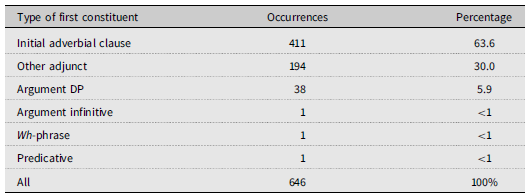
To move on to the Nordica digital archive (NorDiga) with authentic conversations, we will discuss examples of the construction found in three collections in the archive: Björneborgsvägen (BV) [Björneborgsvägen Street], Helsingforssvenska (HS) [Swedish in Helsinki], and Språk och attityder bland helsingforssvenska ungdomar (HUSA) [Language and attitudes among Swedish-speaking young people in Helsinki].Footnote 14 We collected 646 sentences including a V3 pattern and så in the transcripts of the recordings. In Table 1, the summary of the occurring initial constituents is presented.
The så-constructions in NorDiga categorised by the type of initial constituent

In the NorDiga corpus data, så in most cases occurs with initial adverbial clauses. Typically, these occurrences include temporal (21a) or conditional (21b) clauses.


Most cases (93.9% in total) include some kind of initial adjunct. In addition to adverbial clauses, adjunct PPs (22a) and adverbs (22b) are common.


While Fenno-Swedish allows initial argument DPs followed by så, it can hardly be seen as a frequent phenomenon. In the NorDiga corpus data, DPs combined with så often include a relative clause (23). This confirms the status of initial DPs containing a subordinate clause: it does not determine the acceptability of så, but it seems to be typical in actual language usage.


In the NorDiga spoken language data, there are few occurrences of other initial constituents unique for the Fenno-Swedish så-pattern.Footnote 16 One example of an initial wh-phrase (24) can be found. As predicted by Holmberg (Reference Holmberg2023, discussed in Section 2.3), a V3-pattern-triggering så thus seems to be compatible also with wh-movement, at least in some cases.

While both the NSD database and the NorDiga conversational data confirm så as grammatical and occurring in contexts unique to Fenno-Swedish, the number of occurrences is not high. Quantitatively, the typical usage is dominated by initial adjuncts, most often temporal and conditional adverbial clauses, which are also common in Sweden Swedish.Footnote 17
However, it is not uncommon that syntactic constructions are largely accepted as grammatical yet are very rare in authentic discourse (see e.g. Niemi Reference Niemi2005, Divjak Reference Divjak2017). To examine acceptability and variation in a more robust way, it was necessary to conduct an additional survey of judgements by informants. The results of this study are discussed in the next section.
6. The results of the online survey
In total, 1344 speakers of Fenno-Swedish judged 19 relevant example sentences in the survey conducted at the turn of the year 2022/2023. Figure 3 shows the sentences tested and the informants’ judgements of them.
The sentences included in the online survey and the participants’ judgements of them.

Nearly every participant reported that they could use sentence (A). As for sentence (B), only 13% reported that they would themselves say so, but 48% thought the sentence could be used by some speakers. In three cases (D, G, P), around 70% of participants considered the sentence to be so flawed that no one could use it. In many cases, however, a substantial number of informants considered ‘No, but I think some people say so’ as the most accurate option, which justifies the inclusion of indirect grammaticality judgement testing in the survey (cf. above and Buchstaller & Corrigan Reference Buchstaller, Corrigan, Maguire and McMahon2011a, Reference Buchstaller, Corrigan, Gregersen, Parrott and Quist2011b). Without this option, a notable share of the recognition of the construction would have been lost, resulting in an insufficient overall picture.
6.1 Initial adverbial clause
The first example sentence (A) of the survey included an initial adverbial clause followed by så, which is a typical context where a V3-pattern-triggering så occurs in Standard Swedish, as well. Testing this sentence, shown in (25) below, serves two purposes. First, it is meant to be an easy warm-up question for the participants. Secondly, it shows whether the assignment has been understood correctly by the informants, since they should judge the sentence as perfectly acceptable.


The sentence in example (25) was accepted by almost every participant of the survey: 96.9% reported that they could use the sentence themselves, and an additional 2.5% thought that at least some other people do so. Testing the example in (25) thus fulfilled its function as an indicator of the integrity of the experimental design and the informants’ ability to report their judgements legitimately in the survey.
6.2 Initial nominal DP
Two sentences with initial nominal DPs followed by så were tested in the survey. The first one includes a relative clause (C, shown in 26), and the second one is bare (B, shown in 27). As discussed, this distinction has been raised and discussed in earlier research. However, it has not been tested quantitatively before.
44% of the participants reported they could use the sentence with a relative clause (C, shown in 26) themselves, and another 40% believed that other people could do it. The bare DP (B, shown in 27) was reported to be used by 13% of the participants, and an additional 48% thought at least someone else could use it.


As discussed in Section 5.2, both types with initial DPs tested can be found also in the corpus data. Additionally, initial DPs without relative clauses are well accepted by the informants of the Nordic Syntax Database (Section 5.1). In the acceptability test, the latter setup includes a noticeable amount of inter-individual variation in judgements. However, the generalised outcome is that the analysis must account for initial nominal DPs followed by så being allowed.
6.3 Initial negation markers
The online survey also included an example sentence with the fronted sentential negation inte ‘not’ (D, shown in 28). Additionally, the negative adverb ingenstans ‘nowhere’ followed by så was tested. The sentential negation inte was poorly rated. Only 4% (54 individuals) reported they could say so themselves, which is the lowest result in the online survey. Moreover, 66% of the informants rejected the sentence entirely.
The sentence with the negative adverb ingenstans (F, shown in 29) was judged much more positively: 44% reported that they could use it themselves, and another 44% that some people could say so. These are among the highest scores of the survey. The result indicates that considering all initial negation markers incompatible with så is excessive: the analysis must account for at least negative adverbs being allowed. Arguably, this applies also to other negative adverbs (e.g. aldrig ‘never’).
The negative pronoun referring to the absence of participants, ingen (Q, shown in 30), was reported to be used by 12%. However, taken together with informants reporting that some people could use it, more than 50% considered the sentence to be used in spoken language.


6.4 Wh-movement
Based on Holmberg (Reference Holmberg2023), bare argument questions (I, shown in 31) are not expected to be grammatical. In (31), vem ‘who’ is followed by så, and only 6% of the informants reported this as something they could say themselves, while 61% could not think of anyone saying so. This confirms the expectation. Replacing vem with vad ‘what’ results in almost identical ratings (M, shown in 32): 6% could reportedly say so, and 61% reported they think no one uses the sentence.


The example including an adjunct question (E, repeated here as 33) is almost as controversial as the argument questions in (31) and (32). While 8% of the participants could reportedly say so, almost half of the informants (48%) reported they did not think anyone could use the sentence.

The distinction reported by Holmberg (Reference Holmberg2023) between one-word adjunct questions and argument questions was thus not confirmed by the survey.Footnote 18 However, another sentence tested in the online survey includes a heavier wh-argument with nominal content (S, shown in 34). The result for this sentence is more positive as 18% of the informants could use the example themselves, and only 37% rejected the idea of anyone saying so. In fact, this sentence is rated better than the sentence including an initial bare DP (27). Consequently, it must be considered permitted, on a par with B (27).

The survey indicates that questions with a D-linked wh-phrase are the most accepted cases among sentences involving wh-movement and så. Example K, shown in (35), was accepted by 39% of the informants as something they could say themselves. Only 17% considered it impossible for anyone to say so. The sentence is thus rated almost as good as the initial DP with a relative clause (26), and the score is among the best in the survey.

The conclusion that can be drawn is that Fenno-Swedish allows both fronted negative constituents and wh-questions with resumptive så tested, but both also have limitations. Negative adverbs can co-occur with så, while the sentential negation cannot. Among wh-questions, the distinction between arguments and adjuncts seems to have very little effect on the acceptability of sentences. However, any wh-constituents that include nominal content are rated better. The sentences in (34) and (35) are considered as acceptable as the sentences with initial DPs preceding så in (26) and (27).
6.5 Pure quantifier
The quantifier alla ‘all’ followed by så (H in Figure 3) is judged in a similar way as ingen ‘nobody’ in (30): only 11% of the participants report they could use the sentence in (36) themselves and 47% that they do not think anyone could use it. At the same time, the sentence is judged as used by someone by a notable proportion of the participants (42%). This is important as alla is a pure operator, which is presumed not to allow så to follow in Fenno-Swedish (see Section 1, and the discussion in Section 7).

A chi-square test reveals that there is a significant dependency on the level of individual speakers between the acceptance of the alla and ingen sentences when considering all three response options (p < .00001), when comparing ‘Yes, I could say so’ with the other options (p < .00001), and when focusing on ‘No, and I don’t think anyone would say so’ (p < .00001).
6.6 Initial pronouns
Resumption after initial pronouns seems to be less acceptable. The same concerns initial constituents smaller than phonological words, possibly another context not compatible with resumption. The survey therefore included several sentences testing pronouns and other prosodically ‘small’ items with resumption.
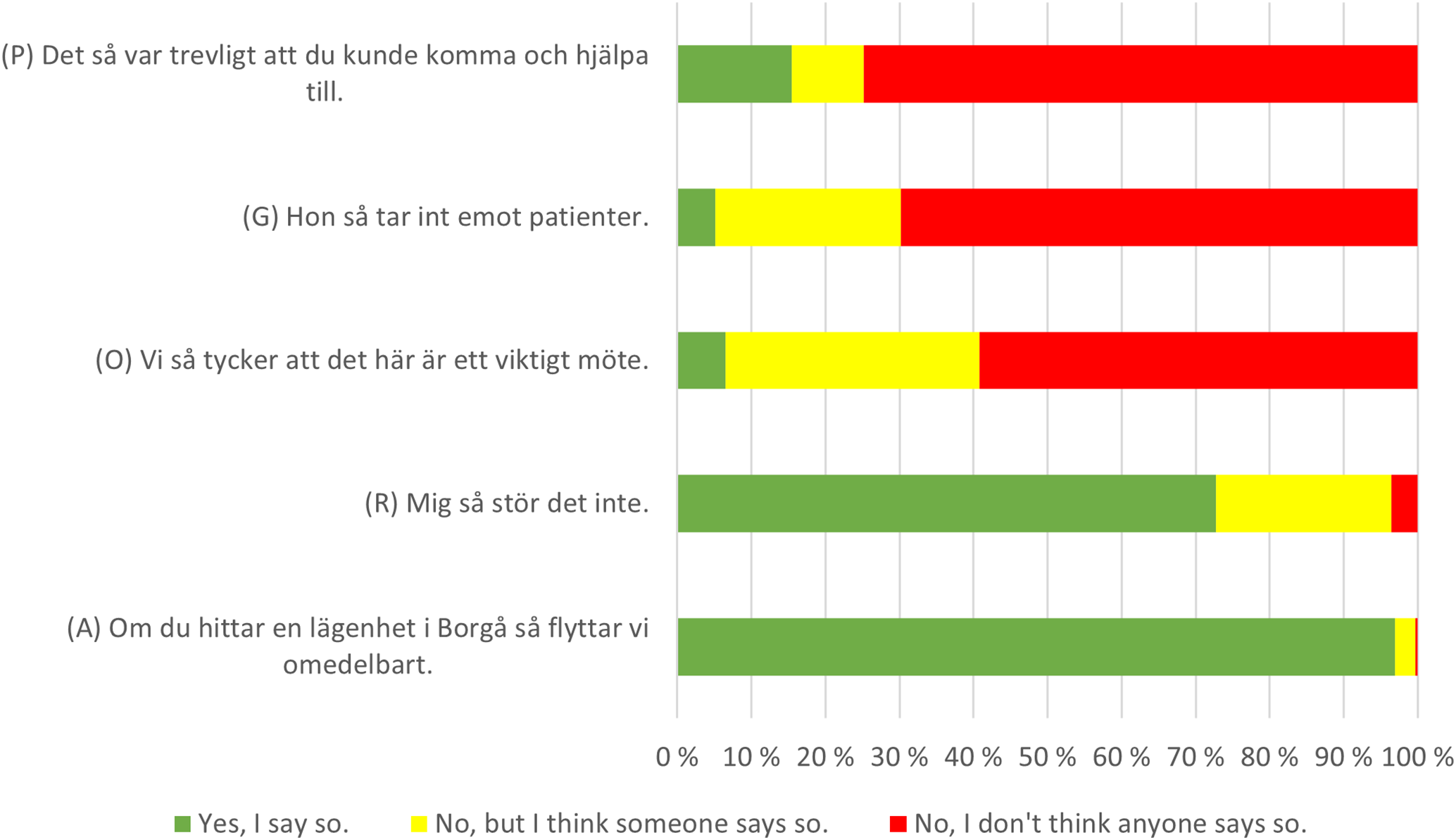
The survey confirmed that sentences with initial pronouns (G, O) are poorly accepted. Only 5% of the informants reported they could use the sentence in G (shown in 37) themselves, while 70% could not think of anyone saying so. As for the sentence in O (shown in 38), the share of participants reporting they could say it themselves is 7%, and 59% reported that no one could use it.


In contrast, the accusative form mig ‘me’ does not seem to be a problem (R, shown in 39). 73% of the participants confirm they could say so themselves, and an additional 24% reported someone else could do so. The sentence is thus one of the most accepted ones in the survey,Footnote 19 only surpassed by the sentences containing an initial conditional clause (see example 25).

The sentence with an initial pronoun followed by resumptive så thus stands for some of the lowest scores of the survey but also some of the highest.Footnote 20 The prosodic properties of monosyllabic initial constituents and their performance in the survey will be discussed in the next section. The key sentence in the survey is P (shown in 40). The initial expletive pronoun det ‘it’ in the sentence is always unstressed.

While as much as 15% of the participants announced they could use the sentence in (40) in their speech, the share of informants that could not think of anyone being able to do so, 75%, is the largest in the survey. In this regard, the sentence in (40) is the most poorly performing in the survey.
7. Discussion
The results presented above strongly indicate that initial nominal DP, subject or object, is a category that can be followed by resumptive så without difficulties in Fenno-Swedish (as suggested by Holmberg Reference Holmberg1986, Ekerot Reference Ekerot1988, Sollid & Eide Reference Sollid and Eide2007, Nordström Reference Nordström2010, Eide Reference Eide2011, Ivars Reference Ivars, Arboe and Schoonderbeek Hansen2011, Meklenborg Reference Meklenborg2020, Holmberg Reference Holmberg2023). This is displayed by the survey, as well as the Nordic Syntax Database and the corpus data.
To repeat the three hypotheses tested in the paper, the first one is that så is a general spell-out of the F(orce) head (see Figure 1). The second hypothesis is that any category can precede så in F except pure operators and the third one is that så is prosodically motivated, providing an anacrusis for the intonation phrase introduced by V in Fin. The first two hypotheses are generalisations with no associated explanation, while the third hypothesis provides one.
The first hypothesis is well justified making the Fenno-Swedish så a fully generalised spell-out of F(orce). This is unique within Mainland Scandinavian but not unheard of among Germanic V2 languages (De Clercq & Haegeman Reference De Clercq and Haegeman2023). The first hypothesis does not, however, account for the possibility of så occurring with initial negation or wh-movement (Holmberg Reference Holmberg2023), which the second hypothesis addresses.
The interplay of så and different kinds of fronted negative constituents in Fenno-Swedish has been noted but not discussed further by Holmberg (Reference Holmberg2023). In the survey of this study, the sentential negation inte ‘not’ comes out as strongly dispreferred and arguably ungrammatical. The initial negative argument ingen ‘nobody’ receives mixed judgements, while negative adverbs like ingenstans ‘nowhere’ can precede så without issues. In the case of wh-movement, D-linked wh-phrases are, as noted by Holmberg (Reference Holmberg2023), well accepted in comparison to other sentences with wh-movement tested. The predicted distinction between argument and adjunct questions is, however, not apparent in the results, as both are almost equally rarely accepted. The sentence including an adjunct question (33) seems, however, slightly better than those with argument questions in (31) and (32).
The third hypothesis addresses the significant contrast between initial pronouns relating to prosody. Sentences with initial pronouns receive both some of the highest and lowest scores in the survey. The sentence including the expletive pronoun det comes out as the least favourable in the sense that the rate of ‘No, I don’t think anyone says so’ judgements is the highest in the survey (P in Figure 4). Most other pronouns tested are not well received either (examples 37, 38; G and O in Figure 4). However, the sentence with mig ‘me’ (39, R in Figure 4), is exceptionally well accepted by the participants, the overall score being higher only for the sentence with an initial adverbial clause (A in Figure 4). Explaining this result is pivotal for establishing whether the Fenno-Swedish pattern is a completely syntactic phenomenon.
The survey sentences crucial for the discussion on prosody.

As syntax, prosody, and semantic or discourse-pragmatic features work together and in the same direction,Footnote 21 it is important to consider also the interplay of prosody and syntax in the generalisations of så in Fenno-Swedish. This relates to the role of ‘Wackernagel’s law’ in relation to copy-left dislocation and så in Mainland Scandinavian, discussed by Eide (Reference Eide2011). Briefly summarised, Indo-European languages tend to employ prosodically light elements in the second position of declarative clauses, in particular, clitics (Wackernagel Reference Wackernagel1892). Mainland Scandinavian does not have clitics proper, and the constituent order limits the possible outcomes, but V3 patterns have a strong preference for stressed initial elements. As defined by this preference, copy-left dislocation has been considered to be a topic construction (Eide Reference Eide2011).
While the prosodic qualities of the initial element were not the sole focus of the survey in this study, some of the tested sentences can be interpreted as having a contrastive reading, especially the sentence in (39) repeated and expanded here as (41).


Being prone to a contrastive (topic) reading thus makes an initial pronoun more acceptable in a sentence with resumptive så, which is also the case in Norwegian (Meklenborg & Lohndal Reference Meklenborg and Lohndal2023). In the answers to the online survey, pronouns are dispreferred, as are bare wh-words and the sentential negation inte ‘not’. A common denominator of the strongly dispreferred sentences is a prosodically weak initial constituent. This is most obvious in (40) as the initial expletive pronoun det ‘it’ is always unstressed, but it also applies to the initial sentential negation inte in (28) (see Brandtler & Håkansson Reference Brandtler, Håkansson, Brandtler, Håkansson, Huber and Klingvall2012).
Thus, we propose that a division of the Fenno-Swedish så-pattern has developed into a fully prosodic, post-syntactic phenomenon where sentence-initial stress in an integral factor. Under this hypothesis, the key assumption is that syntactic copy-left dislocation, familiar from Sweden Swedish, and the prosodic pattern involving så, occur in parallel in Fenno-Swedish. In the former case, så can follow all kinds of adjuncts as described in Section 3. In the latter case, however, så is not summoned by syntax. Instead, it is inserted to satisfy a prosodic preference of having an anacrusis – an unstressed syllable – in the beginning of the prosodic constituent including the finite verb.
If the initial prosodic structure of the sentence already has a syntactically derived unstressed syllable, such as a pronoun, bare wh-question, or a sentential negation, there is no prosodic motivation to insert så, and attempts to do so will not result in well-formed sentences. The basis of the third hypothesis of this paper is therefore that unstressed initial elements are incompatible with resumptive så. The sentence with an initial expletive pronoun and så in (40) thus has to be rephrased as in (42) in order to be grammatical.

In almost all poorly accepted sentences, the initial element is either typically, as in the case of pronouns, as in (37) and (38), or always, as in the case of the sentential negation inte and the expletive pronoun det, as in (28) and (40), unstressed. Sentences prone to contrastive topic or focus reading and their prosodic consequences, stress, are much more acceptable, also when the initial element should be dispreferred according to conventional syntactic analysis of copy-left dislocation. This concerns the underlying contrastive topic reading in (39) and (41), as well as the fronted negative constituents ingen ‘nobody’ in (30) and ingenstans ‘nowhere’ in (29), both naturally pronounced with stress.Footnote 22
As the particle så itself is unstressed, an attractive hypothesis is that the finite verb cannot be preceded by two weak items. However, a pronoun in the preverbal position, without resumption, does not form a prosodic phrase (ϕ) or prosodic word (ω) of its own. Instead, it is incorporated in the following prosodic phrase together with the VP, as illustrated in (42) (Myrberg & Riad Reference Myrberg and Riad2015). Conceivably, this incorporation could exclude the possibility of inserting så, and attempts to do so result in ill-formed sentences. However, the following counterexamples with monosyllabic, presumably unstressed, initial elements are perfectly acceptable, and such occurrences can also be found in the corpus data of this study (43).Footnote 23

In terms of prosody, så is thus an anacrusis: an unstressed syllable in the beginning of the prosodic constituent, which is an acknowledged property of Swedish word prosody (Myrberg & Riad Reference Myrberg and Riad2015). On the word level of the prosodic hierarchy, an anacrusis consists of a prefix or an unstressed root syllable (Riad Reference Riad2009). For our proposal, it is essential to evaluate on which level of the prosodic hierarchy the anacrustic så occurs. Possible domains are a prosodic word (ω), a prosodic phrase (ϕ), or an intonation phrase (ι) (Myrberg & Riad Reference Myrberg and Riad2015). As an integral part of the argument is that no more than one unstressed syllable is permitted in the case of så (see discussion on example 40 above), the word level of the prosodic hierarchy can be ruled out due to examples like (44) being found in the corpus data. They show that a finite verb like betyda [be ˈtyːda] with a prefix (here be-) or an unstressed root syllable, already employing an anacrusis on the word level, can also be preceded by så.

This implies that the anacrustic så is not a phenomenon occurring on the word level of prosody. The anacrusis we suggest is not a preference of the finite verb but a larger prosodic constituent initiated by the finite verb. In the prosodic hierarchy of Swedish (Myrberg & Riad Reference Myrberg and Riad2015), this is an intonation phrase (ι). Intonation phrases, in general, are a domain capable of hosting an anacrusis (see e.g. Rangarathnam, Bhaskaran & Manjula Reference Rangarathnam, Bhaskaran and Manjula2014). See Holmberg, Sahkai & Tamm (Reference Holmberg, Sahkai and Tamm2025) for another case where V2 order is affected by a prosodic condition on the intonation phrase.
Finally, the preference is described as follows: if the constituent X in Figure 5 is a prosodic phrase or word, the preference is yet to be satisfied, and så can optionally occur as an anacrusis.
Explaining the preference of anacrusis in terms of syntax.

We propose that the intonation phrase (ι) with the preference of having an anacrusis corresponds to C′ in syntax, always headed by the finite verb in main clauses. As shown earlier, it is unaffected by any anacrusis included in the finite verb and the prosodic word equivalent to it. Moreover, the suggested post-syntactic preference co-exists with syntactic copy-left dislocation, including the rule that any adverb can be followed by så, unaffected by prosodic properties.
Eide (Reference Eide2011) argues that Norwegian Copy Left Dislocation is a topic construction, specifically an Aboutness-shift topic (A-topic) construction in Frascarelli’s (Reference Frascarelli2007) and Bianchi & Frascarelli’s (Reference Bianchi and Frascarelli2010) sense, and that this holds also for the så-construction, at least in the core cases. The discourse function of an A-topic is to introduce or reintroduce an element which is already familiar to the participants/is already in the Common Ground as topic of the discourse. As such it cannot be entirely deaccented. If så is a Topic marker in Fenno-Swedish, this would explain why it cannot be preceded by a deaccented pronoun. However, although Fenno-Swedish så can be preceded by an A-topic, this is certainly not a defining property. Perhaps most obviously, it can be preceded by a wh-phrase in a question. As Holmberg (Reference Holmberg2023) notes, it can be preceded by new-information focus, and it can head an all-new sentence starting a new conversation. In such cases så is not replaceable by an agreeing pronoun. So, the observation that the Fenno-Swedish så-construction cannot be preceded by a deaccented item cannot be explained in terms of discourse function. We can maintain, therefore, that the best explanation to date of the condition is the prosodic one.
8. Conclusion
In this study, we have considered three hypotheses for the Fenno-Swedish V3 pattern of the particle så. The point of departure is that the construction is a part of copy-left dislocation, a phenomenon resulting in an optional element preceding the finite verb, thus creating a distinct V3 order. This is an established analysis defining the distribution in Sweden Swedish. Så occurs with initial adjuncts. The first hypothesis of this study essentially considers Fenno-Swedish så having an expanded distribution in copy-left dislocation: it can follow any initial element that is subject to the phenomenon, thus making it a fully generalised spell-out. However, certain types of initial elements render copy-left dislocation unacceptable in Sweden Swedish. This concerns negation markers and wh-phrases. Due to prior assessments of some sentences with initial negation markers or wh-phrases possibly allowing så, the second hypothesis considers så being able to follow initial elements of any category except pure operators. The third hypothesis is that, alongside the syntax of copy-left dislocation there is a prosodic rule at work in Fenno-Swedish that rules out a deaccented constituent preceding så.
In this study, we have utilised acceptability judgement data from the Nordic Syntax Database, conversational data from the Nordica Digital Archive and conducted an acceptability judgement experiment online to contribute additional data similar to Nordic Syntax Database. The two first data sources confirmed the apparently fully generalised distribution of så as a resumptive item of copy-left dislocation. However, the frequency of examples unique to Fenno-Swedish is rather low in conversational data. A need for additional testing arose due to the open questions concerning initial negation markers and wh-phrases. While the second hypothesis accounts for the possibility of all initial elements except pure operators being followed by så, the acceptability judgement test fails to support its implications and provides reasonable arguments to reject it.
The shortcoming of the two first hypotheses is that they were generalisations, with no associated explanation: Why would fronted pure operators exclude så, if that was indeed the case? The third hypothesis provides an explanation of the generalisation established by close inspection of the data: there is a prosodic rule that rules out a deaccented constituent preceding så. This hypothesis also has the benefit of explicitly involving prosody, recognised by other recent research to be relevant for the syntactic distribution of various functional items. In this light, a proposal involving the interplay of syntax and prosody is an interesting contribution to the ongoing debate about V3 patterns in Mainland Scandinavian.
While this paper represents a full-length exploration of the Fenno-Swedish så-pattern, the scope excludes the contributions of conversation and discourse analysis (cf. Nordström Reference Nordström2010). Further research on these aspects is warranted as the proposition of this paper opens up for more detailed comparative studies between Fenno-Swedish and other Mainland Scandinavian varieties.
Acknowledgements
I would like to thank Mikko Kuronen, Anders Holmberg, Camilla Wide, and the audiences at Språkets funktion and the workshop Microvariation and microchange in the Scandinavian languages (MMSL). I am also grateful to the anonymous reviewers for their valuable feedback. This research was funded by the University of Turku and The Swedish Cultural Foundation in Finland, to whom I express my sincere gratitude. All errors are my responsibility.





 Open access

