




1. Introduction
The main aim of this article is to provide a formal account of a relatively recent palatalization process, widely known in the literature as s-retraction, as exemplified by street [ʃʧɹiːt]. This innovation has been documented across multiple, often geographically distant, varieties of English, including American, British, Australian and New Zealand English. Moreover, substantial evidence suggests that s-retraction is an ongoing sound change that is gaining ground as it is observed not only in word-initial and word-internal clusters but also in external sandhi contexts, e.g. street [ʃʧɹiːt], district [dɪʃʧɹɪkt] and this trick [ðɪʃ ʧɹɪk]. More specifically, the palatalization under investigation affects the alveolar fricative /s/ in front of two types of clusters, i.e. /tɹ/ and /tj/, both of which are subject to a related palatalization process known as affrication – resulting in pronunciations such as strike [ʃʧɹaɪk] and stupid [ʃʧuːpɪd]. While previous research on s-retraction has primarily focused on sociophonetic and laboratory-based (acoustic/articulatory) studies (e.g. Durian Reference Durian2007; Gylfadottir Reference Gylfadottir2015; Smith et al. Reference Smith, Mielke, Magloughlin and Wilbanks2019), this article aims to provide a formal theoretical analysis of this ongoing phonological change. Following a detailed description of s-retraction (section 2), section 3 offers a brief review of the literature. Section 4 outlines the theoretical framework adopted for the analysis, while section 5 presents a formal account of s-retraction and its interaction with affrication. Finally, section 6 summarizes the main findings and suggests directions for future research.
2. S-retraction
The realization of /s/ as [ʃ] in /stɹ/ and /stj/ clusters, documented in both laboratory settings and naturalistic speech, particularly among younger speakers, suggests that the fricative may have already merged phonologically with /ʃ/ in these contexts, at least for some individuals (Smith et al. Reference Smith, Mielke, Magloughlin and Wilbanks2019: 40). However, given the increasing prevalence of s-retraction and, more importantly, its occurrence in external sandhi (Altendorf et al. Reference Altendorf, MacDonald and Thielking2021), it remains appropriate to analyze this phenomenon as an active phonological process rather than a fully lexicalized change (see also the discussion in section 3). This is particularly evident in its application across word boundaries, as in last year and this trick.
In what follows I adhere to one of the core principles of Government Phonology (GP), that of the Minimality Hypothesis (Kaye Reference Kaye, Dressler, Luschützky, Pfeiffer and Rennison1992, Reference Kaye1995; Pöchtrager Reference Pöchtrager2014), which assumes that phonological processes apply whenever their conditions are met. This hypothesis recognizes as phonological only those palatalization patterns that are exceptionless and phonologically conditioned. Consequently, the occurrence of s-retraction across word boundaries supports its classification as a true phonological process rather than a lexicalized phenomenon. While word-internal and word-initial instances of s-retraction might be viewed as lexically conditioned – since their realization can vary even among speakers of the same accent – I include them in the analysis due to their increasing regularity.
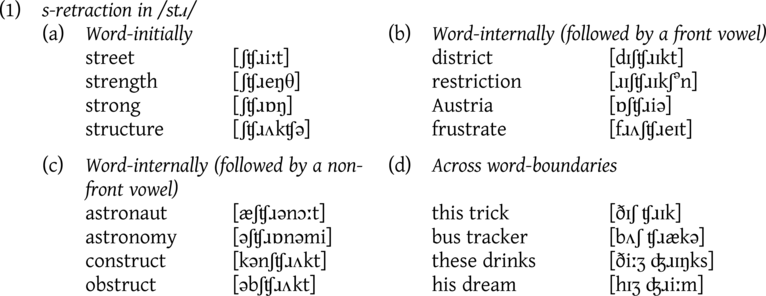
The examples in (1) and (2) illustrate s-retraction in /stɹ/ and /stj/ clusters:Footnote 1
The examples in (2) illustrate s-retraction in other contexts.


Since s-retraction is more common in /stɹ/ than in /stj/ clusters, these contexts are presented separately. The forms in (1) are widely attested across various English accents, whereas those in (2) are more restricted. In particular, s-retraction in /stj/ sequences (2a, c) is absent in dialects characterized by yod-dropping, such as General American English (GA), where yod coalescence does not occur. It is worth noting that the data presentation in (2) is somewhat simplified, since in GA the yod is predominantly dropped in stressed syllables, as in student [stuːdənt], whereas in unstressed syllables (foot-internally) the yod tends to be retained and undergoes coalescence, as in estuary [esʧueɹi], which may in turn create the phonological environment that triggers s-retraction, yielding forms such as [eʃʧueɹi] (see also the discussion below). I take such cases to pattern with items like digestion, and include them in the (2b) set, which illustrates lexicalized yod coalescence.
As shown in (1a–c), s-retraction occurs in /stɹ/ clusters word-initially (1a) and word-internally (1b–c). It becomes evident that the [ʃʧɹ] realization does not depend on the frontness of the following vowel, e.g. strong (1a), nor on the frontness of the preceding vowel, e.g. Austria (1b). In fact, it can even occur in the absence of a preceding vowel, e.g. construct (1c). Finally, (1d) demonstrates that s-retraction also applies at the word-boundary level. Since external sandhi processes are not constrained by intra-word phonotactics, both /s/ and /z/ may undergo retraction before /tɹ/ and /dɹ/ in the following word.
The forms in (2) illustrate s-retraction in other contexts, including /stj/ clusters (2a). These are presented separately due to their more limited distribution. In some accents, the glide /j/ has historically been deleted (Yod Dropping, Wells Reference Wells1982), as in GA, which limits the range of contexts where s-retraction can occur, as already mentioned above. Word-initially (2a), /stj/ clusters are typically followed by the high back vowel [uː]/[ʊ],Footnote 2, Footnote 3 which reflects their historical development from an earlier [iu] diphthong ([iu] > [juː]) (see Kijak Reference Kijak2023).
The forms in (2b) are grouped together with other words containing the /stj/ clusters because they illustrate lexicalized yod coalescence.Footnote 4 Historically, these words contained /tj/, which underwent coalescence [kwestjən] > [kwesʧən], enabling further s-retraction [kwesʧən] > [kweʃʧən]. Although rare, the non-coalesced pronunciation persists in some accents, such as conservative RP and certain Caribbean English varieties. Finally, (2c), like (1d), demonstrates that s-retraction is a phonologically active process as it applies across word boundaries, as in this tube [ðɪʃ ʧuːb].
To sum up, the data presentation in this section distinguishes between /stɹ/ and /stj/ clusters as s-retraction is more widespread in the former and varies across accents in the latter. Examples show that s-retraction occurs word-initially, word-internally and across word boundaries, demonstrating that it is not conditioned by vowel frontness or other phonotactic restrictions. Additionally, s-retraction interacts with yod coalescence, influencing words historically containing /tj/ clusters. Overall, the data suggest that s-retraction is synchronically active, particularly in environments where phonological conditions favor its application.
3. Previous accounts
3.1. Sociophonetic studies
Most previous accounts of s-retraction focus on either social and geographical factors or acoustic and articulatory details. The growing body of research supports the claim that s-retraction is spreading rapidly across the English-speaking world. This phenomenon has been reported in several regions of the United States, including Philadelphia, Louisiana, Georgia, Washington, DC, California, New York, Arizona, South Dakota (Labov Reference Labov, Baugh and Scherzer1984; Reference Labov2001; Shapiro Reference Shapiro1995; Phillips Reference Phillips, Bybee and Hopper2001; Durian Reference Durian2007; Baker et al. Reference Baker, Archangeli and Mielke2011; Rutter Reference Rutter2011; Gylfadottir Reference Gylfadottir2015; Wilbanks Reference Wilbanks2017). It has also been documented in various British varieties, such as Estuary English, Colchester, Edinburgh and Manchester English (Altendorf Reference Altendorf2003; Bass Reference Bass2009; Sollgan Reference Sollgan2013; Smith et al. Reference Smith, Mielke, Magloughlin and Wilbanks2019; Nichols & Bailey Reference Nichols and Bailey2019; Bailey et al. Reference Bailey, Nichols, Turton and Baranowski2022), as well as in Australian and New Zealand English (Lawrence Reference Lawrence2000; Bauer & Warren Reference Bauer, Warren, Burridge and Kortmann2008; Stevens & Harrington Reference Stevens and Harrington2016; Stevens et al. Reference Stevens, Harrington and Schiel2019; Stuart-Smith et al. Reference Stuart-Smith, Sonderegger, Macdonald, Mielke, McAuliffe, Thomas, Calhoun, Escudero, Tabain and Warren2019). General findings from sociophonetic studies suggest that s-retraction represents an ongoing or recently completed sound change in which the alveolar fricative /s/ in /stɹ/, /stj/ and /sʧ/ clusters is not much different acoustically from the palatal [ʃ] (Nichols & Bailey Reference Nichols and Bailey2019; Bailey et al. Reference Bailey, Nichols, Turton and Baranowski2022). Moreover, this palatalization is more commonly observed in younger speakers born in 1990s (Durian Reference Durian2007). In addition to phonetically oriented studies, more formal phonological analyses have also looked at these innovative variants, i.e. those in which the place of articulation shifts from alveolar to post-alveolar ([s] > [ʃ]). Some of the earliest accounts of this process include studies by Shapiro (Reference Shapiro1995), Lawrence (Reference Lawrence2000), Durian (Reference Durian2007) and Bailey et al. (Reference Bailey, Nichols, Turton and Baranowski2022), among others. The following subsection briefly reviews earlier formal proposals on the phonological aspects of s-retraction.
3.2. Phonological studies
One of the earliest phonological accounts of s-retraction is proposed by Shapiro (Reference Shapiro1995), who describes it as a case of non-local assimilation or assimilation ‘at a distance’ (see also Baker et al. Reference Baker, Archangeli and Mielke2011; Stevens & Harrington Reference Stevens and Harrington2016). Shapiro (Reference Shapiro1995) observes that the palatal [ʃ] in /stɹ/ clusters results from long-distance assimilation to the cluster-final /ɹ/, causing /s/ to become more retroflex and rounded. This has been questioned by Gylfadottir (Reference Gylfadottir2015) who notes that /ɹ/ in /skɹ/ and /spɹ/ does not induce the same retraction effect on /s/, suggesting that palatalization occurs exclusively in /stɹ/ clusters. This, she argues, challenges the long-distance assimilation hypothesis, as there is no clear reason why /ɹ/ would not have the same effect in /skɹ/ and /spɹ/ as in /stɹ/. An alternative explanation is proposed by Janda & Joseph (Reference Janda, Joseph, Blake and Burridge2003) (see also Durian Reference Durian2007), who argue that s-retraction is triggered not by /t/ or /ɹ/, but rather by a preceding or following vowel. Similarly, Durian (Reference Durian2007: 72) suggests that the innovation originates in word-internal contexts, when /stɹ/ is preceded by a front vowel (through progressive assimilation), e.g. restriction, district, and only later extends to word-initial contexts. However, this explanation faces challenges, as s-retraction is observed after any vowel or consonant, e.g. frustrated, construction. Lawrence (Reference Lawrence2000: 83) instead argues that s-retraction results from local assimilation of /s/ to /t/, where /s/ becomes palatalized via assimilation to the following alveopalatal [ʧ]. According to this account, s-retraction is always followed by an affricated /tɹ/ cluster, occurring in two steps: /stɹ/ > [sʧɹ] > [ʃʧɹ]. Since /t/ is consistently affricated when /s/ retracts in /stɹ/ clusters, and since pre-rhotic affrication of /t/ is widespread in English varieties (Cruttenden Reference Cruttenden2014; Lindsey Reference Lindsey2019), I assume – contrary to Shapiro (Reference Shapiro1995), Janda & Joseph (Reference Janda, Joseph, Blake and Burridge2003) and Durian (Reference Durian2007) – that s-retraction is contingent upon /t/ affrication. This assumption is supported by the observation that speakers may affricate the /tɹ/ cluster without retracting /s/, but not the reverse: speakers do not retract /s/ without also affricating /t/. In other words, affricating /tɹ/ does not necessarily imply s-retraction, but s-retraction does not occur without affrication of /tɹ/. As noted by Smith et al. (Reference Smith, Mielke, Magloughlin and Wilbanks2019: 15) and Nichols & Bailey (Reference Nichols and Bailey2019), none of their participants exhibited s-retraction in /stɹ/ without also affricating /tɹ/. Additionally, /t/ undergoes affrication before yod, as in tune [ʧuːn] (yod coalescence), which suggests that similar conditions apply to s-retraction in /stj/ clusters. Retraction without affrication is unlikely or unattested, e.g. *[ʃtjuːpɪd].Footnote 5 This provides further evidence that s-retraction in /stj/ clusters is driven by the same mechanism – plosive affrication. Moreover, it correctly predicts the absence of s-retraction in other sCj- clusters such as spew [spjuː] and skew [skjuː]. In this regard, I align with Bailey et al. (Reference Bailey, Nichols, Turton and Baranowski2022), who argue that s-retraction is best explained with direct reference to /t/ affrication, with /ɹ/ playing only an indirect role. Since s-retraction occurs in both /stɹ/ and /stj/ clusters, it follows that the affricate, rather than the rhotic, is the primary conditioning factor. This is further supported by the fact that /tj/ and /tɹ/ both undergo affrication in contemporary English, as an illustration compare the following forms: student [ʃʧuːdənt] and mischief [mɪʃʧɪf] (Hannisdal Reference Hannisdal2006). In the former, s-retraction is limited to instances where the /tj/ cluster itself undergoes coalescence, while in the latter, s-retraction is triggered by an underlying affricate rather than by yod or rhotic affrication. To summarize, I follow Bailey et al. (Reference Bailey, Nichols, Turton and Baranowski2022) in assuming that /s/ undergoes local assimilation to an adjacent affricated /t/, which itself becomes affricated under the influence of a following /ɹ/. The question of whether /tɹ/ > [ʧɹ] affrication represents a change in progress or a fully phonologized and stabilized feature is beyond the scope of this discussion. Instead, I adopt Lindsey’s (Reference Lindsey2019: 61) position that /tɹ/ affrication has already been established, at least in Standard Southern British English (SSB).
4. Theoretical background and some preliminary hypotheses
The present analysis of s-retraction and its associated processes is grounded in Element Theory (ET), a phonological framework that employs a set of monovalent cognitive elements to represent segmental structure (Kaye et al. Reference Kaye, Lowenstamm and Vergnaud1985; Reference Kaye, Lowenstamm and Vergnaud1990; Harris Reference Harris1994; Harris & Lindsey Reference Harris and Lindsey1995; Reference Harris, Lindsey, Burton-Roberts, Carr and Docherty2000; Backley Reference Backley2011). These elements are abstract units of structure that encode internalized phonological patterns (auditory images) and are directly linked to specific acoustic properties in the speech signal (3). The version of ET adopted in this study, following Backley (Reference Backley2011), comprises six elements: three resonance elements |I U A| and three non-resonance elements |Ɂ H L|.

Notably, these elements can be incorporated into the phonological structure of both vowels and consonants. For instance, the element |I|, when associated with a vocalic position, is realized as the vowel [i], whereas in a consonantal position, it corresponds to the palatal glide [j]. This highlights the fact that the distinction between vowels and consonants can sometimes depend solely on syllabic affiliation. More broadly, resonance elements encode vowel distinctions and consonantal place properties, whereas non-resonance elements convey tonal and laryngeal features in vowels and define source and laryngeal characteristics in consonants (4).

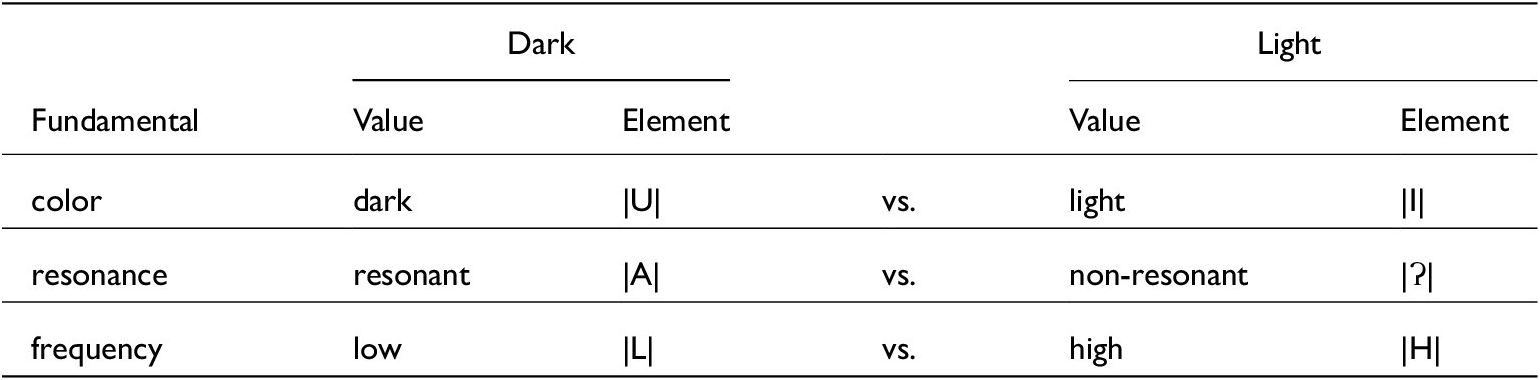
While elements are sufficiently large to be interpreted in isolation, they may also combine to form complex phonological expressions. These combinations are asymmetrical, forming a head-dependent relationship in which the headed element exhibits a more prominent acoustic pattern than the dependent element. One important consequence of this asymmetry is that each element has at least two phonetic realizations – one as a head and another as a dependent. For example, while labials are represented by a headed |U|, velars are characterized by a non-headed |U|. Consequently, in the English consonantal system, /p/ is represented as |U Ɂ H|, whereas /k/ is denoted as |U Ɂ H|, with the distinction arising from the headedness of |U| (Backley & Nasukawa Reference Backley and Nasukawa2009; Backley Reference Backley2011; Kijak Reference Kijak2017). Furthermore, even though elements are free to combine with one another within a single segment, certain element combinations are more marked than others, with the more marked configurations representing cross-linguistically rare segments. This markedness arises when two elements with contradictory acoustic properties merge within a single segment. A notable example is the combination of |U| and |I| (formant lowering + high F2), giving rise to cross-linguistically rare segments such as the front rounded vowels [y ø] and the palatovelar obstruents [c ɟ ç ʝ].Footnote 7 Note that in languages that permit the co-occurrence of antagonistic elements within a single segment, only one element in the pair assumes the head function. This means that the theory permits segments to contain more than one headed element. For example, an aspirated labial plosive in English may be represented as |U Ɂ H|, with both |U| and |H| functioning as heads (see Backley Reference Backley2017). To account for such rare interactions as, for example, |U| and |I|, elements are classified into two broad categories: dark elements |U A L| and light elements |I Ɂ H| (Backley Reference Backley2011: 200ff.). Additionally, elements form three antagonistic pairs, each corresponding to a fundamental phonetic property: color, resonance and frequency (table 1).
The antagonistic pairs of dark and light elements (Backley Reference Backley2017: 9)

Although brief, the preceding discussion of the ET model’s theoretical foundations provides the necessary framework to introduce the elemental make-up of the English consonants relevant to this study. The representation in (5) includes only those segments directly involved in the processes under investigation.

Some clarification regarding the phonological status of affricates in (5) is necessary. In this study, /ʧ/ and /ʤ/ are analyzed as phonologically equivalent to simple stops, with the key distinction being their phonetic realization. More precisely, while plain stops typically feature a brief or even inaudible release phase, affricated stops are marked by an extended burst of friction accompanied by perceptible resonance (Cyran Reference Cyran2010; Backley Reference Backley2011: 108). This delayed release in affricates is generally understood as a phonetic enhancement cue, rather than a reflection of any underlying contour structure in phonological representation. Accordingly, the view that affricates should be analyzed as a type of stop is widely supported in the literature (Cyran Reference Cyran2010; Backley Reference Backley2011).Footnote 9 Moreover, given that s-retraction occurs in two types of clusters – /stɹ/ and /stj/ – and that its initial stage consistently involves the affrication of the coronal stop preceding a rhotic or glide, I assume that both /ɹ/ and /j/ function as palatal triggers. As such, both segments must be specified for the element |I| (Harris Reference Harris1994: 259, Scheer Reference Scheer1999: 220; van der Torre Reference Torre2003: 159–61). Additionally, /ɹ/ is assigned the element |A|, which aligns with its historical vocalization to schwa and its activity in sandhi phenomena in non-rhotic accents (Broadbent Reference Broadbent1991).
The following section will focus on analyzing the data presented in section 2, applying the theoretical framework developed here to examine patterns of s-retraction in greater detail.
5. Analysis
A key conclusion drawn from the preceding discussion is that s-retraction is primarily triggered by the affrication of the coronal stop, which occurs in the presence of a following rhotic /ɹ/ or yod /j/. While r-triggered affrication is widely observed across English varieties, j-triggered affrication is restricted to dialects that exhibit yod coalescence rather than yod dropping. This initial step transforms /tɹ/, /dɹ/ and /tj/, /dj/ clusters into [ʧɹ]/[ʤɹ] (affrication) and [ʧ]/[ʤ] (coalescence), respectively, as represented in (6).Footnote 10

In the case of r-triggered affrication (6a), the rhotic, which consists of two phonological elements |I A|, remains phonetically present alongside the newly formed affricate. In contrast, in j-triggered affrication (6b), the yod is fully absorbed into the preceding consonant, leading to coalescence.Footnote 11 In both cases, the change results from the replacement of the coronal plosive’s |A| element by the palatal element |I| from the following rhotic or glide. An important issue concerns the conditions under which the element |I| spreads – namely, why it does so when preceded by a stop, as in [tɹ] > [ʧɹ], but not when preceded by a dental fricative, as in three [θɹiː]. This pattern may be accounted for by invoking the notion of headedness within ET. Specifically, it could be proposed that alveolar stops are characterized by a non-headed resonance element |A|, whereas the dental fricative /θ/ contains a headed resonant structure. Under this account, the element |I| is able to replace or merge with a weaker, non-headed resonant (as in a coronal stop), but not with a stronger, headed one (as in fricatives like /θ/). This would explain the asymmetry in |I|-spreading. A similar rationale may account for cases such as Sri Lanka, where /s/, like coronal stops, also contains a non-headed resonant and is therefore susceptible to modification by a following |I| element.
What differentiates the representations in (6a) and (6b) is the formal status of both triggers. While the rhotic is a part of a branching Onset, the yod instead forms a complex segment [tʲ]. In other words, instead of a branching Onset solution, I assume a secondary palatalized character of Cj sequences in English, hence Cʲ. This is dictated by, among other things, the observation that the glide, which historically comes from the development of the /iu/ diphthong (/iu/ > /ju/), can evolve after any consonant and this puts into question the otherwise severe phonotactic constraints observed by the English branching Onset. More specifically, it has been argued (Kijak Reference Kijakin prep.) that due to the simplification of the /iu/ diphthong, the element |I|, which separates from /iu/ and becomes floating, is reattached to the preceding consonant in the Onset, forming a secondary palatalized segment, e.g. [tʲ], [kʲ], [hʲ], etc. This type of restructuring, involving the asynchronic realization of the palatal element, aligns with cross-linguistic tendencies, where floating palatal elements are commonly reassociated leftward (van de Weijer Reference Weijer and van Oostendorp2011: 695ff.).Footnote 12 More crucially for the present analysis, the secondary palatalized coronal is either affricated to [ʧ] (full palatalization), a trend observed in accents such as SSB, or simplified. In the latter scenario, /j/ is simply deleted following coronal consonants – a process known in the literature as Later Yod Dropping (LYD) (Wells Reference Wells1982: 247). This raises several immediate questions, such as why, in dialects that exhibit LYD, e.g. General American, yod deletion occurs exclusively after coronals. Given that some varieties of English – such as those spoken in East Anglia – have also been reported to drop the yod after labials and velars (Generalized Yod Dropping (GYD); Trudgill (Reference Trudgill, Kortmann and Upton2008)), the restriction of yod deletion to coronals in LYD dialects appears to be a dialect-specific development rather than a consequence of a universal phonological constraint. On the other hand, however, the dialectal distribution of yod dropping appears to follow an implicational scale. Early Yod Dropping (EYD) first affects /j/ after palatals and /ɹ/ (Wells Reference Wells1982), followed by the extension of the process to coronals (LYD), and finally to all consonantal environments, including labials and velars (GYD). While EYD can be straightforwardly interpreted as a form of Obligatory Contour Principle (OCP) enforcement – resolving a potential conflict between |I|-headed segments – LYD may be similarly accounted for by positing that coronals in such dialects are specified with a non-headed |I|. GYD, then, represents the final stage of the process, where the yod is deleted regardless of the nature of the preceding consonant.
Furthermore, full palatalization (coalescence), as in [tʲ] > [ʧ], is restricted to coronals, unlike labials and velars.Footnote 13 This asymmetry is explained here as a consequence of the antagonistic character of the elements involved. Specifically, English coronals are typically specified for the element |A|, while labials and velars are associated with |U|. As a result, the element replacement strategy that underlies palatalization fails to apply to the latter, thereby blocking the restructuring necessary for full palatalization. This can be further accounted for in terms of element incompatibility: |I| (introduced by the glide or rhotic) and |U| belong to the same class – namely, the ‘color’ category – and thus exhibit conflicting acoustic properties, which inhibits their co-occurrence. By contrast, |A| and |I| belong to different categories – resonance and color, respectively – and therefore interact more readily (see table 1 above). Additionally, in the case of labials, the incoming |I| would need to replace a strong (headed) |U| element, making such replacement structurally disfavored. It follows that coronals, represented as non-headed |A| segments, constitute the most susceptible targets for palatalization processes in Modern English.Footnote 14
Finally, the propensity of the element |I| to spread to the preceding position is a tendency that has been observed cross-linguistically (Backley Reference Backley2017: 8). The leftward movement proclivity of this element can be noticed not only in the history of English (Kijak Reference Kijak2022), but also in those of its contemporary dialects that witness yod coalescence (Kijak Reference Kijak2023) and s-retraction. Now, since s-retraction exclusively occurs when preceding an affricated coronal, the palatal element |I| not only modifies the coronal stop but can also extend further leftward, affecting the preceding /s/. This process is illustrated in (7).

The analysis proposed in (7) supports the observation that s-retraction depends on the affrication of the following coronal stop. Crucially, it provides the answer to the question of why affrication can occur without s-retraction [sʧɹiːt], but the reverse pattern *[ʃtɹiːt] is unattested. An important issue concerns the syllabic affiliation of the sequences under discussion, specifically whether it is crucial for the sibilant to occupy the rhyme position. My preliminary response is negative. However, the structure of the entire sequence – particularly in sandhi contexts – appears to be relevant. For instance, sibilant retraction is predominantly observed in s+tɹ clusters (e.g. this trick), whereas retraction is less common in st+ɹ sequences, as in most recent, just right, and seems to be constrained by factors such as phrase frequency (see also footnote 16). The situation is somewhat different with stj sequences, where both parses – s+tj and st+j – witness s-retraction, as in this tube and last year, respectively.Footnote 15 I do not have a definitive account for this variation, but my working hypothesis is that it relates to the phonological nature of /j/. As a monoelemental segment, /j/ can readily parachute onto the preceding consonant – even across a word boundary – thereby forming a secondary palatalized consonant (see the discussion above). This is evident in sequences such as t+j, whether or not preceded by /s/, as in last year, meet you, miss you and similar cases. In summary, affrication of /tɹ/ appears to be limited to branching onset environments and is typically absent in sandhi contexts. However, s-retraction can occur in both s+tɹ (e.g. this trick) and st+ɹ (e.g. just right) configurations, though the former is far more robustly attested, while the latter seems to be modulated by additional factors such as phrase frequency. By contrast, stj sequences behave differently: while the initial trigger remains the affrication of /t/ by the following yod, /j/ is more plausibly analyzed as forming a secondary palatalized consonant rather than a branching onset and so it seems to more easily cross the word boundary which may be evidenced by examples such as last year and meet you, miss you.
Furthermore, the absence of s-retraction in other, non-coronal, clusters, such as /spɹ/ and /skɹ/ is once again attributed to elemental antagonism. Recall that labials and velars contain the element |U|, which prevents affrication when followed by a palatal element |I|. While Nichols & Bailey (Reference Nichols and Bailey2019) report some degree of retraction in /spɹ/ and /skɹ/, e.g. spruce and screw, this is interpreted here as a phonetic effect rather than a phonological process. This claim is further supported by Bailey et al. (Reference Bailey, Nichols, Turton and Baranowski2022: 13), who show that s-retraction in /stɹ/ clusters is significantly more extreme than in other /sCɹ/ and /sC/ clusters.Footnote 16
Summing up, this section has demonstrated that s-retraction is conditioned by the affrication of the following coronal stop, which in turn results from the spread of the palatal element |I| from either a rhotic /ɹ/ or a glide /j/. The elemental interactions involved explain why s-retraction is exclusive to /stɹ/ and /stj/ clusters, while remaining absent in /spɹ/ and /skɹ/. Furthermore, the analysis accounts for dialectal variation in yod coalescence and yod dropping, illustrating how broader phonological patterns shape the conditions under which s-retraction occurs.
6. Conclusions
This study has provided a formal phonological account of s-retraction, demonstrating that its occurrence is directly linked to the affrication of the following coronal stop. The analysis has shown that both the rhotic /ɹ/ and the glide /j/ function as palatal triggers in this process, as they both contain the palatal element |I|. This element spreads leftward, first influencing the coronal stop, which undergoes affrication, and then extending further to the preceding /s/, leading to retraction.
A key finding is that s-retraction is exclusive to /stɹ/ and /stj/ clusters, as it does not occur in clusters such as /spɹ/ and /skɹ/. This absence is explained by elemental antagonism, where labials and velars contain |U|, which inhibits the affrication process necessary for s-retraction. Additionally, the analysis accounts for dialectal variation in yod coalescence and yod dropping, which determine whether affrication occurs in the first place.
Moreover, this study has argued that s-retraction is a phonologically active process, rather than a purely lexicalized or phonetic phenomenon. The evidence from external sandhi contexts, where s-retraction occurs across word boundaries, further supports this claim. The findings align with broader cross-linguistic patterns of palatalization and affrication, reinforcing the idea that s-retraction is governed by systematic phonological principles. This analysis could also help explain the phonotactic gap *sɹ- by proposing that the rhotic /ɹ/ itself gives rise to a phonological constraint whereby it must be preceded by /ʃ/ in such clusters, due to its role in triggering s-retraction.
Comparative studies across languages that exhibit similar palatalization processes may provide further insights into the general mechanisms governing s-retraction.
Acknowledgments
I would like to thank the two anonymous reviewers for their careful reading of an earlier version of this article and for their valuable comments and suggestions, which have contributed to improving its clarity and argumentation. Any remaining errors or shortcomings are solely my responsibility.

 Open access

